SmarterEd

Aussie Maths & Science Teachers: Save your time with SmarterEd

  • Login
  • Get Help
  • About

HMS, HIC EQ-Bank 121

Discuss how language and media as broad features of society can both create and reduce health inequities in Australia.   (6 marks)

--- 18 WORK AREA LINES (style=lined) ---

Show Answers Only

*PEEL – Solution is structured using separate PEEL methods for each side of the argument; [P] Identify the point, [E] expand on the point with a link to question asked, [Ev] apply evidence/examples, [L] linking sentence back to question.*

Creating Health Inequities

  • [P] On one hand, language barriers prevent effective healthcare access.
  • [E] This creates significant challenges when non-English speakers cannot communicate symptoms or understand treatment plans.
  • [Ev] For instance, Vietnamese elderly avoid hospitals due to interpreter shortages, leading to untreated diabetes complications.
  • [L] This demonstrates how language differences worsen health inequities.
     
  • [P] From one perspective, media representation excludes minority groups.
  • [E] This approach offers mainstream health messages but creates gaps for diverse communities.
  • [Ev] Aboriginal health campaigns using only English miss 30% of remote communities who prefer traditional languages.
  • [L] Media’s narrow focus amplifies existing health disparities.

Reducing Health Inequities

  • [P] Conversely, well directed multilingual health services can improve access.
  • [E] These initiatives can help diverse populations to navigate healthcare confidently and make informed decisions.
  • [Ev] For example, Medicare translating documents into 20 languages increased migrant health screening by 45%.
  • [L] In this way, language can directly reduce healthcare barriers.
     
  • [P] Culturally appropriate media can also be highly effective in promoting health equity.
  • [E] This creates opportunities for targeted health education reaching previously excluded groups.
  • [Ev] SBS radio’s multilingual COVID information reached 80% of migrant communities, improving vaccination rates.
  • [L] Media diversity effectively bridges health information gaps.

Despite these benefits, consistent funding for translation services remains challenging. Nevertheless, evidence shows language and media interventions significantly impact health equity when properly resourced.
Show Worked Solution

*PEEL – Solution is structured using separate PEEL methods for each side of the argument; [P] Identify the point, [E] expand on the point with a link to question asked, [Ev] apply evidence/examples, [L] linking sentence back to question.*

Creating Health Inequities

  • [P] On one hand, language barriers prevent effective healthcare access.
  • [E] This creates significant challenges when non-English speakers cannot communicate symptoms or understand treatment plans.
  • [Ev] For instance, Vietnamese elderly avoid hospitals due to interpreter shortages, leading to untreated diabetes complications.
  • [L] This demonstrates how language differences worsen health inequities.
     
  • [P] From one perspective, media representation excludes minority groups.
  • [E] This approach offers mainstream health messages but creates gaps for diverse communities.
  • [Ev] Aboriginal health campaigns using only English miss 30% of remote communities who prefer traditional languages.
  • [L] Media’s narrow focus amplifies existing health disparities.

Reducing Health Inequities

  • [P] Conversely, well directed multilingual health services can improve access.
  • [E] These initiatives can help diverse populations to navigate healthcare confidently and make informed decisions.
  • [Ev] For example, Medicare translating documents into 20 languages increased migrant health screening by 45%.
  • [L] In this way, language can directly reduce healthcare barriers.
     
  • [P] Culturally appropriate media can also be highly effective in promoting health equity.
  • [E] This creates opportunities for targeted health education reaching previously excluded groups.
  • [Ev] SBS radio’s multilingual COVID information reached 80% of migrant communities, improving vaccination rates.
  • [L] Media diversity effectively bridges health information gaps.

Despite these benefits, consistent funding for translation services remains challenging. Nevertheless, evidence shows language and media interventions significantly impact health equity when properly resourced.
Filed Under: Broad features of society Tagged With: Band 4, Band 5, smc-5803-40-Media/peer influence, smc-5803-50-Culture, smc-5803-58-Inequities

HMS, HIC EQ-Bank 120

Outline TWO ways that broad features of society create health inequities for specific population groups in Australia.   (4 marks)

--- 10 WORK AREA LINES (style=lined) ---

Show Answers Only

Cultural barriers and discrimination

  • Aboriginal and Torres Strait Islander Peoples experience language barriers and lack of trust in healthcare providers.
  • Experiences of discrimination lead to avoidance of healthcare services.
  • This results in increased duration and severity of illness and poorer health outcomes including mental health disorders.

Political structures and healthcare policy

  • Migrants and refugees may face barriers accessing culturally appropriate healthcare services
  • Government policies often do not adequately address diverse language and cultural needs in healthcare delivery.
  • This can result in delayed treatment and lead to poor health outcomes for culturally diverse populations.
Show Worked Solution

Cultural barriers and discrimination

  • Aboriginal and Torres Strait Islander Peoples experience language barriers and lack of trust in healthcare providers.
  • Experiences of discrimination lead to avoidance of healthcare services.
  • This results in increased duration and severity of illness and poorer health outcomes including mental health disorders.

Political structures and healthcare policy

  • Migrants and refugees may face barriers accessing culturally appropriate healthcare services
  • Government policies often do not adequately address diverse language and cultural needs in healthcare delivery.
  • This can result in delayed treatment and lead to poor health outcomes for culturally diverse populations.

Filed Under: Broad features of society Tagged With: Band 4, smc-5803-45-Political structures, smc-5803-50-Culture, smc-5803-58-Inequities

HMS, HIC EQ-Bank 413

To what extent can protective factors prevent substance misuse among young Australians.   (12 marks)

--- 30 WORK AREA LINES (style=lined) ---

Show Answers Only

Judgment Statement

  • Protective factors can significantly prevent substance misuse among young Australians.
  • Evidence shows family connections, personal skills, and community engagement substantially reduce risk.

Family and Personal Protective Factors:

  • Research has consistently shown that strong family relationships significantly reduce the risk of any individual becoming a drug addict.
  • Young people with parents who model responsible attitudes and communicate openly about risks show markedly lower substance use rates.
  • Clear family expectations create boundaries that guide decision-making during peer pressure situations.
  • One major reason why these factors work is that they establish healthy normative beliefs before exposure to substances.
  • Additionally, self-regulation skills provide crucial alternatives to substance use when facing stress.
  • Youth who learn mindfulness and healthy coping mechanisms show resilience in stressful situations that increase the risk for substance use.
  • These combined family and personal factors form powerful prevention barriers.

Community and School Connections

  • Community engagement through sports, arts, and volunteering creates protective social networks.
  • These activities provide identity, purpose, and recognition that reduce needs for substances as social tools.
  • School connectedness adds another protective layer through adult supervision and future goal orientation.
  • However, it is important to consider that some youth lack access to these protective environments.
  • Socioeconomic and cultural barriers can limit participation in activities or create family stress that undermines protection.
  • Despite this, protective factors remain the stronger influence on young Australians.

Reaffirmation

  • The evidence demonstrates protective factors significantly prevent youth substance misuse.
  • Multiple protective layers working together create resilience stronger than individual risk factors.
  • Implications suggest that investing in family support, personal skill development and community programs will further increase the most influential protective factors for young people.
Show Worked Solution

Judgment Statement

  • Protective factors can significantly prevent substance misuse among young Australians.
  • Evidence shows family connections, personal skills, and community engagement substantially reduce risk.

Family and Personal Protective Factors:

  • Research has consistently shown that strong family relationships significantly reduce the risk of any individual becoming a drug addict.
  • Young people with parents who model responsible attitudes and communicate openly about risks show markedly lower substance use rates.
  • Clear family expectations create boundaries that guide decision-making during peer pressure situations.
  • One major reason why these factors work is that they establish healthy normative beliefs before exposure to substances.
  • Additionally, self-regulation skills provide crucial alternatives to substance use when facing stress.
  • Youth who learn mindfulness and healthy coping mechanisms show resilience in stressful situations that increase the risk for substance use.
  • These combined family and personal factors form powerful prevention barriers.

Community and School Connections

  • Community engagement through sports, arts, and volunteering creates protective social networks.
  • These activities provide identity, purpose, and recognition that reduce needs for substances as social tools.
  • School connectedness adds another protective layer through adult supervision and future goal orientation.
  • However, it is important to consider that some youth lack access to these protective environments.
  • Socioeconomic and cultural barriers can limit participation in activities or create family stress that undermines protection.
  • Despite this, protective factors remain the stronger influence on young Australians.

Reaffirmation

  • The evidence demonstrates protective factors significantly prevent youth substance misuse.
  • Multiple protective layers working together create resilience stronger than individual risk factors.
  • Implications suggest that investing in family support, personal skill development and community programs will further increase the most influential protective factors for young people.

Filed Under: Research and Health Related Issues Tagged With: Band 4, Band 5, Band 6, smc-5800-15-Protective/risk factors

HMS, HIC EQ-Bank 412

Using ONE health-related issue affecting young people, evaluate the effectiveness of social justice principles in addressing health inequities experienced by young Australians.   (12 marks)

--- 30 WORK AREA LINES (style=lined) ---

Show Answers Only

Health related issue: Youth violence and bullying

Evaluation Statement

  • Social justice principles are partially effective in addressing youth violence and bullying among young Australians.
  • This evaluation examines equity in access to anti-violence programs and empowerment through participation.

Equity in Access to Programs

  • Equity principles partially fulfil the goal of equal protection from violence for all youth.
  • Evidence supporting this includes school-based anti-bullying programs reaching diverse student populations.
  • However, rural and remote communities have limited access to specialised support services. For example, Indigenous youth experience 2.5 times higher bullying rates despite targeted interventions.
  • While strong in metropolitan areas, programs show limitations in addressing geographic disparities.
  • Socioeconomic barriers prevent some families accessing private counselling when school programs prove insufficient.
  • A critical weakness is inconsistent program quality across different schools and regions.

Empowerment Through Participation

  • The participation principle strongly meets youth empowerment objectives.
  • Student-led anti-bullying committees are self reported by participants as more effective than adult-imposed policies.
  • Evidence indicates peer mentoring programs reduce bullying incidents by 30% in participating schools.
  • Research confirms youth-designed campaigns achieve higher engagement than traditional approaches. These campaigns promote young people’s leadership skills while creating culturally relevant solutions.
  • This comprehensive involvement addresses root causes rather than just symptoms.
  • The evidence indicates that meaningful participation transforms students from victims to advocates.

Final Evaluation

  • Weighing these factors shows social justice principles achieve moderate success overall.
  • The strengths in participation partially compensate for equity limitations.
  • Although effective for empowering engaged students, social justice principles prove less suitable for reaching marginalised youth
  • The overall evaluation demonstrates need for better resource distribution to underserved communities.
  • Implications suggest combining strong participation frameworks with targeted equity investments. This process will address both empowerment and access barriers simultaneously.
Show Worked Solution

Health related issue: Youth violence and bullying

Evaluation Statement

  • Social justice principles are partially effective in addressing youth violence and bullying among young Australians.
  • This evaluation examines equity in access to anti-violence programs and empowerment through participation.

Equity in Access to Programs

  • Equity principles partially fulfil the goal of equal protection from violence for all youth.
  • Evidence supporting this includes school-based anti-bullying programs reaching diverse student populations.
  • However, rural and remote communities have limited access to specialised support services. For example, Indigenous youth experience 2.5 times higher bullying rates despite targeted interventions.
  • While strong in metropolitan areas, programs show limitations in addressing geographic disparities.
  • Socioeconomic barriers prevent some families accessing private counselling when school programs prove insufficient.
  • A critical weakness is inconsistent program quality across different schools and regions.

Empowerment Through Participation

  • The participation principle strongly meets youth empowerment objectives.
  • Student-led anti-bullying committees are self reported by participants as more effective than adult-imposed policies.
  • Evidence indicates peer mentoring programs reduce bullying incidents by 30% in participating schools.
  • Research confirms youth-designed campaigns achieve higher engagement than traditional approaches. These campaigns promote young people’s leadership skills while creating culturally relevant solutions.
  • This comprehensive involvement addresses root causes rather than just symptoms.
  • The evidence indicates that meaningful participation transforms students from victims to advocates.

Final Evaluation

  • Weighing these factors shows social justice principles achieve moderate success overall.
  • The strengths in participation partially compensate for equity limitations.
  • Although effective for empowering engaged students, social justice principles prove less suitable for reaching marginalised youth
  • The overall evaluation demonstrates need for better resource distribution to underserved communities.
  • Implications suggest combining strong participation frameworks with targeted equity investments. This process will address both empowerment and access barriers simultaneously.

Filed Under: Research and Health Related Issues Tagged With: Band 4, Band 5, smc-5800-10-Youth health issue, smc-5800-15-Protective/risk factors

HMS, HIC EQ-Bank 410

Evaluate the importance of health literacy skills in empowering young people to make positive health decisions about food choices.   (8 marks)

--- 22 WORK AREA LINES (style=lined) ---

Show Answers Only

*Recommended words/phrases for “Evaluation” keyword questions are highlighted in bold throughout the answer below.

Evaluation Statement

  • Health literacy skills are highly effective in empowering young people to make positive food choices.
  • This evaluation examines practical application abilities and long-term behaviour change impact.

Practical Application Abilities

  • Health literacy effectively equips young people with practical decision-making skills.
  • Evidence shows health-literate teens successfully read food labels and identify hidden sugars.
  • Research indicates they make significantly better supermarket choices than those without these skills.
  • This indicates a real world practical benefit as young people apply their knowledge to daily food selection.
  • The ability to decode marketing claims proves particularly valuable in today’s misleading food environment.

Long-term Behaviour Change

  • Health literacy is partially successful in achieving sustained healthy eating patterns.
  • While strong in building knowledge, only 5% of young Australians aged 15-24 meet recommended fruit and vegetable intake.
  • This shows limitations between possessing literacy and consistent application.
  • Social pressures and convenience often override health knowledge in food decisions.
  • Although effective for understanding nutrition, it proves less suitable for overcoming environmental barriers like cost and accessibility.
  • The gap between knowledge and action reveals moderate long-term success.

Final Evaluation

  • Weighing these factors shows health literacy is highly valuable but insufficient alone.
  • The strengths outweigh weaknesses because foundational skills enable lifelong learning.
  • The overall evaluation demonstrates health literacy forms a critical foundation requiring environmental support.
  • Implications suggest combining literacy education with practical cooking skills and improved food access.
Show Worked Solution

*Recommended words/phrases for “Evaluation” keyword questions are highlighted in bold throughout the answer below.

Evaluation Statement

  • Health literacy skills are highly effective in empowering young people to make positive food choices.
  • This evaluation examines practical application abilities and long-term behaviour change impact.

Practical Application Abilities

  • Health literacy effectively equips young people with practical decision-making skills.
  • Evidence shows health-literate teens successfully read food labels and identify hidden sugars.
  • Research indicates they make significantly better supermarket choices than those without these skills.
  • This indicates a real world practical benefit as young people apply their knowledge to daily food selection.
  • The ability to decode marketing claims proves particularly valuable in today’s misleading food environment.

Long-term Behaviour Change

  • Health literacy is partially successful in achieving sustained healthy eating patterns.
  • While strong in building knowledge, only 5% of young Australians aged 15-24 meet recommended fruit and vegetable intake.
  • This shows limitations between possessing literacy and consistent application.
  • Social pressures and convenience often override health knowledge in food decisions.
  • Although effective for understanding nutrition, it proves less suitable for overcoming environmental barriers like cost and accessibility.
  • The gap between knowledge and action reveals moderate long-term success.

Final Evaluation

  • Weighing these factors shows health literacy is highly valuable but insufficient alone.
  • The strengths outweigh weaknesses because foundational skills enable lifelong learning.
  • The overall evaluation demonstrates health literacy forms a critical foundation requiring environmental support.
  • Implications suggest combining literacy education with practical cooking skills and improved food access.

Filed Under: Research and Health Related Issues, Strengthening, protecting and enhancing health Tagged With: Band 4, Band 5, smc-5511-20-Health management, smc-5800-10-Youth health issue

HMS, HIC EQ-Bank 408

Evaluate the effectiveness of social media in influencing young people's health behaviours.   (8 marks)

--- 22 WORK AREA LINES (style=lined) ---

Show Answers Only

ANSWER STYLE #1: General Points to use within student-chosen answer structure

  • Social media platforms provide accessible health information and education through influencers promoting positive health behaviors such as exercise routines, nutrition advice, and mental health awareness campaigns.
  • Online communities create support networks for young people facing health challenges, reducing isolation and providing encouragement for those managing conditions like anxiety, depression or chronic illnesses.
  • However, social media can spread misinformation about health practices, particularly concerning nutrition, fitness, and mental health treatments, leading young people to adopt potentially harmful practices without professional guidance.
  • The pressure to conform to idealised body images on platforms like Instagram contributes to poor body image, with research showing increased rates of disordered eating patterns among heavy social media users.
  • Health promotion campaigns utilising social media have demonstrated effectiveness in reaching young audiences with targeted messaging about issues like quitting smoking and sexual health, particularly when content is youth-led and authentic.
  • The algorithms of social media platforms can create echo chambers that reinforce harmful behaviours like extreme dieting or substance use by connecting users with similar content, limiting exposure to balanced health perspectives.


ANSWER STYLE #2: Highly structured

Evaluation Statement

  • Social media is partially effective in influencing young people’s health behaviours.
  • This evaluation examines reach and engagement capabilities versus harmful content exposure.

Reach and Engagement

  • Social media demonstrates superior reach for health messaging to young audiences.
  • Evidence supporting this includes health campaigns achieving millions of views through youth influencers.
  • Online support communities successfully connect isolated young people managing anxiety or chronic illnesses.
  • Online platforms are very good at engaging young people through interactive features and peer-to-peer support networks.
  • For example, youth-led content about quitting smoking shows 60% higher engagement than traditional campaigns.
  • Another critical strength is 24/7 accessibility allowing immediate health information access.

Harmful Content Exposure

  • Social media can often fail to achieve safe health information delivery for vulnerable youth.
  • Research indicates that Instagram use correlates with increased eating disorders among teenagers due to its algorithms creating echo chambers that reinforce extreme dieting.
  • Platforms inadequately fulfil their responsibility to filter health misinformation. While strong in spreading content, online platforms do not consider it their responsibility to verify its accuracy.
  • As a result, harmful content such as unqualified influencers promoting dangerous detox teas can reach more youth than qualified health professionals.

Final Evaluation

  • Weighing these factors shows social media’s influence is a double-edged sword.
  • The strengths partially outweigh weaknesses because positive campaigns can counteract harmful content.
  • Although effective for health promotion reach, it proves less suitable for ensuring information quality.
  • The overall evaluation demonstrates urgent need for digital health literacy education.
  • Implications suggest platforms should be pressured to implement stricter controls over the accuracy of content that appears on their site.
Show Worked Solution

ANSWER STYLE #1: General Points to use within student-chosen answer structure

  • Social media platforms provide accessible health information and education through influencers promoting positive health behaviors such as exercise routines, nutrition advice, and mental health awareness campaigns.
  • Online communities create support networks for young people facing health challenges, reducing isolation and providing encouragement for those managing conditions like anxiety, depression or chronic illnesses.
  • However, social media can spread misinformation about health practices, particularly concerning nutrition, fitness, and mental health treatments, leading young people to adopt potentially harmful practices without professional guidance.
  • The pressure to conform to idealised body images on platforms like Instagram contributes to poor body image, with research showing increased rates of disordered eating patterns among heavy social media users.
  • Health promotion campaigns utilising social media have demonstrated effectiveness in reaching young audiences with targeted messaging about issues like quitting smoking and sexual health, particularly when content is youth-led and authentic.
  • The algorithms of social media platforms can create echo chambers that reinforce harmful behaviours like extreme dieting or substance use by connecting users with similar content, limiting exposure to balanced health perspectives.


ANSWER STYLE #2: Highly structured

Evaluation Statement

  • Social media is partially effective in influencing young people’s health behaviours.
  • This evaluation examines reach and engagement capabilities versus harmful content exposure.

Reach and Engagement

  • Social media demonstrates superior reach for health messaging to young audiences.
  • Evidence supporting this includes health campaigns achieving millions of views through youth influencers.
  • Online support communities successfully connect isolated young people managing anxiety or chronic illnesses.
  • Online platforms are very good at engaging young people through interactive features and peer-to-peer support networks.
  • For example, youth-led content about quitting smoking shows 60% higher engagement than traditional campaigns.
  • Another critical strength is 24/7 accessibility allowing immediate health information access.

Harmful Content Exposure

  • Social media can often fail to achieve safe health information delivery for vulnerable youth.
  • Research indicates that Instagram use correlates with increased eating disorders among teenagers due to its algorithms creating echo chambers that reinforce extreme dieting.
  • Platforms inadequately fulfil their responsibility to filter health misinformation. While strong in spreading content, online platforms do not consider it their responsibility to verify its accuracy.
  • As a result, harmful content such as unqualified influencers promoting dangerous detox teas can reach more youth than qualified health professionals.

Final Evaluation

  • Weighing these factors shows social media’s influence is a double-edged sword.
  • The strengths partially outweigh weaknesses because positive campaigns can counteract harmful content.
  • Although effective for health promotion reach, it proves less suitable for ensuring information quality.
  • The overall evaluation demonstrates urgent need for digital health literacy education.
  • Implications suggest platforms should be pressured to implement stricter controls over the accuracy of content that appears on their site.

Filed Under: Research and Health Related Issues Tagged With: Band 3, Band 4, Band 5, smc-5800-10-Youth health issue

HMS, HIC EQ-Bank 407

Describe how alcohol consumption can impact the health and wellbeing of young people.   (5 marks)

--- 15 WORK AREA LINES (style=lined) ---

Show Answers Only
  • Alcohol affects brain development in young people, potentially causing long-term cognitive impairment and memory problems as the brain continues developing until approximately age 25.
  • Binge drinking increases risk-taking behaviors such as unsafe sex, violence, and dangerous driving, leading to higher rates of accidents and injuries.
  • Young people who drink regularly are more susceptible to developing alcohol dependence later in life, creating long-term health concerns.
  • Alcohol consumption can interfere with academic performance through poor concentration, missed classes and reduced study time, affecting future opportunities.
  • Social impacts include damaged relationships with family and friends, legal consequences from underage drinking, and reduced participation in healthy activities like sports and community engagement.
Show Worked Solution
  • Alcohol affects brain development in young people, potentially causing long-term cognitive impairment and memory problems as the brain continues developing until approximately age 25.
  • Binge drinking increases risk-taking behaviors such as unsafe sex, violence, and dangerous driving, leading to higher rates of accidents and injuries.
  • Young people who drink regularly are more susceptible to developing alcohol dependence later in life, creating long-term health concerns.
  • Alcohol consumption can interfere with academic performance through poor concentration, missed classes and reduced study time, affecting future opportunities.
  • Social impacts include damaged relationships with family and friends, legal consequences from underage drinking, and reduced participation in healthy activities like sports and community engagement.

Filed Under: Research and Health Related Issues Tagged With: Band 3, Band 4, smc-5800-10-Youth health issue

HMS, HIC EQ-Bank 406

Explain how unhealthy body image can impact the overall wellbeing of young people.   (5 marks)

--- 15 WORK AREA LINES (style=lined) ---

Show Answers Only

*Language highlighting the cause-effect relationship is bolded in the answer below.

  • Unhealthy body image leads to disordered eating patterns and eating disorders that compromise physical health. This occurs because young people restrict food intake or engage in purging behaviours, which causes nutrient deficiencies affecting growth and development.
  • Low self-esteem and negative self-worth develop from poor body image. This relationship results in a cycle where negative thoughts reinforce body dissatisfaction, which leads to depression and anxiety.
  • Social withdrawal occurs when body insecurities create discomfort in social settings. The reason for this is that body shame generates social anxiety, causing young people to avoid peer interactions and limiting their support network development.
  • Academic performance declines as a result of mental resources being diverted to appearance concerns. This happens when constant body image worry consumes cognitive energy needed for learning.
  • Excessive exercise or dangerous weight loss methods cause physical harm. This is due to extreme behaviours disrupting hormonal balance and immunity, which leads to serious health complications including bone density loss.
Show Worked Solution

*Language highlighting the cause-effect relationship is bolded in the answer below.

  • Unhealthy body image leads to disordered eating patterns and eating disorders that compromise physical health. This occurs because young people restrict food intake or engage in purging behaviours, which causes nutrient deficiencies affecting growth and development.
  • Low self-esteem and negative self-worth develop from poor body image. This relationship results in a cycle where negative thoughts reinforce body dissatisfaction, which leads to depression and anxiety.
  • Social withdrawal occurs when body insecurities create discomfort in social settings. The reason for this is that body shame generates social anxiety, causing young people to avoid peer interactions and limiting their support network development.
  • Academic performance declines as a result of mental resources being diverted to appearance concerns. This happens when constant body image worry consumes cognitive energy needed for learning.
  • Excessive exercise or dangerous weight loss methods cause physical harm. This is due to extreme behaviours disrupting hormonal balance and immunity, which leads to serious health complications including bone density loss.

Filed Under: Research and Health Related Issues Tagged With: Band 3, Band 4, smc-5800-10-Youth health issue

PHYSICS, M3 EQ-Bank 1

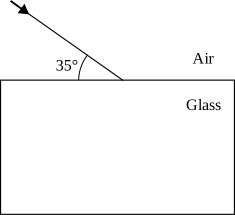
A ray of light of wavelength 4 \(\times\) 10\(^{-7}\) metres crosses from air into a block of glass as shown below. The refractive index of the glass is 1.6.
 

  1. What will be the angle of refraction in the glass?   (2 marks)

--- 4 WORK AREA LINES (style=lined) ---

  1. What is the speed of the light within the glass?   (1 mark)

--- 2 WORK AREA LINES (style=lined) ---

  1. What is the frequency of the light within the glass?   (2 marks)

--- 4 WORK AREA LINES (style=lined) ---

Show Answers Only

a.    \(30.8^{\circ}\)

b.    \(1.88 \times 10^8\ \text{ms}^{-1}\)

c.    \(7.5 \times 10^{14}\)

Show Worked Solution

a.    Using Snell’s Law:

\(n_1 \sin\theta_1\) \(=n_2 \sin \theta_2\)  
\(\theta_2\) \(=\sin^{-1}\left(\dfrac{n_1 \sin\theta_1}{n_2}\right)\)  
\(\theta_2\) \(=\sin^{-1}\left(\dfrac{1 \times \sin 55}{1.6}\right)\), where the angle of incidence is between the ray and the normal.   
  \(=30.8^{\circ}\)  


b.   \(v_g=\dfrac{c}{n_g}=\dfrac{3 \times 10^8}{1.6}=1.88 \times 10^8\ \text{ms}^{-1}\)
 

c.    The frequency of light is independent of the medium it is travelling through.

  • The frequency of the light in the glass will be the same as the frequency of the light in air.
  •    \(f=\dfrac{c}{\lambda_{\text{air}}} = \dfrac{3 \times 10^8}{4 \times 10^{-7}} = 7.5 \times 10^{14}\)

Filed Under: Ray Model of Light Tagged With: Band 4, Band 5, smc-4281-10-Snell's Law, smc-4281-20-Snell's Law and TIR, smc-4281-40-Speed of light in medium

PHYSICS, M3 EQ-Bank 8 MC

A beam of light is travelling from a transparent liquid into air. The refractive index of the liquid is 1.4.

What is the critical angle for light passing from the liquid into air?

  1. 30.0\(^{\circ}\)
  2. 45.6\(^{\circ}\)
  3. 54.6\(^{\circ}\)
  4. 65.4\(^{\circ}\)
Show Answers Only

\(B\)

Show Worked Solution
  • Using the critical angle formula:
\(\sin \theta_c\) \(=\dfrac{n_2}{n_1}\)  
\(\theta_c\) \(=\sin^{-1}\left(\dfrac{n_2}{n_1}\right)\)  
  \(=\sin^{-1}\left(\dfrac{1}{1.4}\right)\)  
  \(=45.6^{\circ}\)  

 
\(\Rightarrow B\)

Filed Under: Ray Model of Light Tagged With: Band 4, smc-4281-20-Snell's Law and TIR

PHYSICS, M3 EQ-Bank 7 MC

A light detector measures an intensity of 180 W/m² when placed 2 metres from a light source.

What will the intensity be if the detector is moved to a distance of 6 metres from the same source?

  1. 60 Wm\(^{-2}\)
  2. 30 Wm\(^{-2}\)
  3. 20 Wm\(^{-2}\)
  4. 10 Wm\(^{-2}\)
Show Answers Only

\(C\)

Show Worked Solution
  • Intensity of light between two points uses the inverse square law: \(I_1r_1^2 = I_2r_2^2\).
\(I_2\) \(=\dfrac{I_1r_1^2}{r_2^2}\)  
  \(=\dfrac{180 \times 2^2}{6^2}\)  
  \(=20\ \text{Wm}^{-2}\)  

 
\(\Rightarrow C\)

Filed Under: Ray Model of Light Tagged With: Band 4, smc-4281-50-Light Intensity

PHYSICS, M3 EQ-Bank 6 MC

The light intensity reaching a probe from a distant star is measured to be 10 units when the probe is 40 AU from the star.

What will the intensity be when the probe moves to a distance of 10 AU from the same star?

  1. 40 units
  2. 80 units
  3. 100 units
  4. 160 units
Show Answers Only

\(D\)

Show Worked Solution
  • The intensity of light between two points is determined using the inverse square law: \(I_1r_1^2 = I_2r_2^2\).

\(I_2=\dfrac{I_1r_1^2}{r_2^2}=\dfrac{10 \times 40^2}{10^2}=160\ \text{units}\)

\(\Rightarrow D\)

Filed Under: Ray Model of Light Tagged With: Band 4, smc-4281-50-Light Intensity

PHYSICS, M3 EQ-Bank 5 MC

What is the critical angle for light travelling from water (refractive index 1.33) into air?

  1. \(35.0^{\circ}\)
  2. \(41.3^{\circ}\)
  3. \(48.8^{\circ}\)
  4. \(90.0^{\circ}\)
Show Answers Only

\(C\)

Show Worked Solution
  • Using the critical angle formula:
\(\sin \theta_c\) \(=\dfrac{n_2}{n_1}\)  
\(\theta_c\) \(=\sin^{-1}\left(\dfrac{n_2}{n_1}\right)\)  
  \(=\sin^{-1}\left(\dfrac{1}{1.33}\right)\)  
  \(=48.8^{\circ}\)  

 
\(\Rightarrow C\)

Filed Under: Ray Model of Light Tagged With: Band 4, smc-4281-20-Snell's Law and TIR

HMS, HIC EQ-Bank 119

Describe an inequity related to socioeconomic factors of health in Australia and suggest ways in which it could be addressed.   (4 marks)

--- 10 WORK AREA LINES (style=lined) ---

Show Answers Only

Sample answer:

  • An inequity related to socioeconomic factors is the significant gap in educational attainment between Australians from high and low socioeconomic backgrounds.
  • Only 60% of students from low socioeconomic backgrounds complete Year 12 compared to 90% from high socioeconomic backgrounds.
  • This educational inequity leads to reduced employment opportunities, lower income, and poorer health outcomes.

Strategies to address this issue could include:

  • Targeted early intervention programs in disadvantaged schools.
  • Financial support for low-income families for educational costs.
  • Mentoring programs connecting disadvantaged students with educational and career pathways.
Show Worked Solution

Sample answer:

  • An inequity related to socioeconomic factors is the significant gap in educational attainment between Australians from high and low socioeconomic backgrounds.
  • Only 60% of students from low socioeconomic backgrounds complete Year 12 compared to 90% from high socioeconomic backgrounds.
  • This educational inequity leads to reduced employment opportunities, lower income, and poorer health outcomes.

Strategies to address this issue could include:

  • Targeted early intervention programs in disadvantaged schools.
  • Financial support for low-income families for educational costs.
  • Mentoring programs connecting disadvantaged students with educational and career pathways.

Filed Under: Socioeconomic Tagged With: Band 4, smc-5805-10-Education, smc-5805-80-Inequities

HMS, HIC EQ-Bank 118

Outline TWO inequities related to environmental factors of health in Australia and suggest one way each could be addressed.   (4 marks)

--- 10 WORK AREA LINES (style=lined) ---

Show Answers Only

Geographic location

  • Indigenous Australian communities in remote areas experience health inequities due to limited access to health services, resulting in higher rates of preventable hospitalisations.
  • This could be addressed through increased investment in telehealth infrastructure and training local community health workers to provide basic healthcare services.

Pollution exposure

  • People of lower socioeconomic status often live in areas with higher pollution levels from industrial zones or major roadways, leading to increased respiratory conditions.
  • This inequity could be addressed through stricter environmental regulations for industries in residential areas and subsidised housing developments in areas with better air quality.
Show Worked Solution

Geographic location

  • Indigenous Australian communities in remote areas experience health inequities due to limited access to health services, resulting in higher rates of preventable hospitalisations.
  • This could be addressed through increased investment in telehealth infrastructure and training local community health workers to provide basic healthcare services.

Pollution exposure

  • People of lower socioeconomic status often live in areas with higher pollution levels from industrial zones or major roadways, leading to increased respiratory conditions.
  • This inequity could be addressed through stricter environmental regulations for industries in residential areas and subsidised housing developments in areas with better air quality.

Filed Under: Environmental Tagged With: Band 4, Band 5, smc-5804-10-Geographic location, smc-5804-20-Air/water quality, smc-5804-55-Inequities

HMS, HIC EQ-Bank 117

Explain how health inequities can result from differences in health behaviours across population groups in Australia.   (5 marks)

--- 15 WORK AREA LINES (style=lined) ---

Show Answers Only

Rural vs city populations

  • Higher tobacco use in remote areas compared to major cities causes increased rates of respiratory diseases and cancers in rural populations, creating a geographic health inequity.
  • This occurs because smoking and its significant health dangers are concentrated in these communities, leading to an increased disease burden.

English speaking vs Non-English speaking populations

  • Lower physical activity participation among people from non-English speaking backgrounds versus Australian-born residents causes higher cardiovascular disease rates in culturally diverse communities.
  • This inequity develops because reduced fitness levels lead to poorer health outcomes, including an increase in heart and respiratory issues.

Higher vs lower socioeconomic populations

  • Similarly, inadequate fruit and vegetable consumption in lower socioeconomic areas versus higher areas, causes nutritional inequities that result in increased chronic disease.
  • This occurs because nutrients aren’t high in diets, allowing preventable diseases to develop unchecked.
  • These behaviour-related health outcomes create persistent inequities that are systematically reinforced through social determinants.
Show Worked Solution

Rural vs city populations

  • Higher tobacco use in remote areas compared to major cities causes increased rates of respiratory diseases and cancers in rural populations, creating a geographic health inequity.
  • This occurs because smoking and its significant health dangers are concentrated in these communities, leading to an increased disease burden.

English speaking vs Non-English speaking populations

  • Lower physical activity participation among people from non-English speaking backgrounds versus Australian-born residents causes higher cardiovascular disease rates in culturally diverse communities.
  • This inequity develops because reduced fitness levels lead to poorer health outcomes, including an increase in heart and respiratory issues.

Higher vs lower socioeconomic populations

  • Similarly, inadequate fruit and vegetable consumption in lower socioeconomic areas versus higher areas, causes nutritional inequities that result in increased chronic disease.
  • This occurs because nutrients aren’t high in diets, allowing preventable diseases to develop unchecked.
  • These behaviour-related health outcomes create persistent inequities that are systematically reinforced through social determinants.

Filed Under: Biomedical and Health Behaviours Tagged With: Band 4, Band 5, smc-5806-10-Health behaviours, smc-5806-70-Inequities

HMS, HIC EQ-Bank 116

Outline TWO inequities related to biomedical factors of health in Australia and suggest one way each could be addressed.   (4 marks)

--- 10 WORK AREA LINES (style=lined) ---

Show Answers Only

Socioeconomic status

  • People living in the lowest socioeconomic areas have significantly higher rates of uncontrolled high blood pressure compared to those in the highest socioeconomic areas.
  • This could be addressed through targeted community health programs offering free blood pressure screening and management education in lower socioeconomic areas.

Aboriginal and Torres Strait Islander status:

  • Indigenous peoples are four times more likely than other Australians to have diabetes or pre-diabetes.
  • This could be addressed through culturally appropriate diabetes prevention programs. These initiatives should be led by Aboriginal health workers, focusing on early detection, management, and include traditional approaches to nutrition and physical activity.
Show Worked Solution

Socioeconomic status

  • People living in the lowest socioeconomic areas have significantly higher rates of uncontrolled high blood pressure compared to those in the highest socioeconomic areas.
  • This could be addressed through targeted community health programs offering free blood pressure screening and management education in lower socioeconomic areas.

Aboriginal and Torres Strait Islander status:

  • Indigenous peoples are four times more likely than other Australians to have diabetes or pre-diabetes.
  • This could be addressed through culturally appropriate diabetes prevention programs. These initiatives should be led by Aboriginal health workers, focusing on early detection, management, and include traditional approaches to nutrition and physical activity.

Filed Under: Biomedical and Health Behaviours Tagged With: Band 4, Band 5, smc-5806-20-Biomedical, smc-5806-70-Inequities

HMS, HIC EQ-Bank 404

Justify the classification of social media use as a significant health issue for young Australians.   (6 marks)

--- 18 WORK AREA LINES (style=lined) ---

Show Answers Only

Position Statement

  • Social media use is justifiably classified as a significant health issue for young Australians.
  • Evidence confirms widespread usage, mental health impacts, and cyberbullying prevalence.

Mental Health and Usage Impacts

  • Research shows one-third of teenagers aged 13-17 use social media “almost constantly”.
  • This demonstrates significant risks because almost 50% of young Australians report negative online experiences.
  • Studies indicate strong links between social media and increased anxiety and depression.
  • Excessive screen time decreases physical activity, contributing to obesity.
  • The significance of this health issue is compounded because it affects both mental and physical health simultaneously.

Cyberbullying and Sleep Disruption

  • The eSafety Commissioner identifies cyberbullying as causing serious psychological distress.
  • Additionally, excessive use disrupts sleep through blue light exposure.
  • The negative health impacts of poor sleep grow in significance due to the direct influence they have on cognitive function and academic performance.
  • Evidence confirms these effects further compound existing mental health vulnerabilities.

Reinforcement

  • While social media provides benefits like health information access, negative impacts outweigh positives.
  • The evidence remains compelling because harm affects the core health areas.
  • This justifies urgent public health responses including education programs.
  • Classification as significant is warranted given the widespread, multifaceted health consequences.
Show Worked Solution

Position Statement

  • Social media use is justifiably classified as a significant health issue for young Australians.
  • Evidence confirms widespread usage, mental health impacts, and cyberbullying prevalence.

Mental Health and Usage Impacts

  • Research shows one-third of teenagers aged 13-17 use social media “almost constantly”.
  • This demonstrates significant risks because almost 50% of young Australians report negative online experiences.
  • Studies indicate strong links between social media and increased anxiety and depression.
  • Excessive screen time decreases physical activity, contributing to obesity.
  • The significance of this health issue is compounded because it affects both mental and physical health simultaneously.

Cyberbullying and Sleep Disruption

  • The eSafety Commissioner identifies cyberbullying as causing serious psychological distress.
  • Additionally, excessive use disrupts sleep through blue light exposure.
  • The negative health impacts of poor sleep grow in significance due to the direct influence they have on cognitive function and academic performance.
  • Evidence confirms these effects further compound existing mental health vulnerabilities.

Reinforcement

  • While social media provides benefits like health information access, negative impacts outweigh positives.
  • The evidence remains compelling because harm affects the core health areas.
  • This justifies urgent public health responses including education programs.
  • Classification as significant is warranted given the widespread, multifaceted health consequences.

Filed Under: Research and Health Related Issues Tagged With: Band 4, Band 5, smc-5800-10-Youth health issue

HMS, HIC EQ-Bank 403

Outline three potential impacts of vaping on the health of young Australians.   (3 marks)

--- 7 WORK AREA LINES (style=lined) ---

Show Answers Only
  • Vaping can lead to nicotine addiction as vapes can contain up to 50 times the nicotine of a cigarette, making young people much more likely to start smoking cigarettes.
  • Vaping exposes young people to harmful chemicals including formaldehyde which can cause serious lung diseases, cardiovascular disease and respiratory disorders.
  • The developing adolescent brain is vulnerable to nicotine, with vaping potentially impairing cognitive development.
Show Worked Solution
  • Vaping can lead to nicotine addiction as vapes can contain up to 50 times the nicotine of a cigarette, making young people much more likely to start smoking cigarettes.
  • Vaping exposes young people to harmful chemicals including formaldehyde which can cause serious lung diseases, cardiovascular disease and respiratory disorders.
  • The developing adolescent brain is vulnerable to nicotine, with vaping potentially impairing cognitive development.

Filed Under: Research and Health Related Issues Tagged With: Band 4, smc-5800-10-Youth health issue

HMS, HIC EQ-Bank 402

Describe THREE trends in mental health issues affecting young Australians.  (3 marks)

--- 7 WORK AREA LINES (style=lined) ---

Show Answers Only
  • Mental health conditions affect approximately 39% of Australians aged 16-24, with females (46%) experiencing higher rates than males (32%).
  • Anxiety disorders are the most common mental health condition among young people, affecting approximately 17% of the population.
  • Despite increasing prevalence, help-seeking behaviours have improved with young people more likely to access mental health services than any other age group.
Show Worked Solution
  • Mental health conditions affect approximately 39% of Australians aged 16-24, with females (46%) experiencing higher rates than males (32%).
  • Anxiety disorders are the most common mental health condition among young people, affecting approximately 17% of the population.
  • Despite increasing prevalence, help-seeking behaviours have improved with young people more likely to access mental health services than any other age group.

Filed Under: Research and Health Related Issues Tagged With: Band 4, smc-5800-10-Youth health issue

PHYSICS, M3 EQ-Bank 3 MC

A student predicts how the intensity of light from a small lamp will decrease as the distance increases.

What percentage of light will reach a sensor placed at 5 metres from the source?

  1. \(6.25\%\)
  2. \(4\%\)
  3. \(11\%\)
  4. \(3\%\)
Show Answers Only

\(B\)

Show Worked Solution
  • The intensity of light decreases via an inverse square law where \(I \propto \dfrac{1}{r^2}\)
  • At 5 m from the source the intensity of light measured, \(I = \dfrac{1}{5^2} = \dfrac{1}{25} = 0.04\)
  • Percentage of light reaching the sensor = 4%.

\(\Rightarrow B\)

Filed Under: Ray Model of Light Tagged With: Band 4, smc-4281-50-Light Intensity

HMS, HIC EQ-Bank 115

  1. Describe what is meant by biomedical factors as determinants of health.   (2 marks)

    --- 5 WORK AREA LINES (style=lined) ---

  2. Outline THREE biomedical risk factors that can influence health outcomes for Australians and how these risks might be addressed by an individual.   (3 marks)

    --- 7 WORK AREA LINES (style=lined) ---

Show Answers Only

a.    Biomedical factors as determinants of health:

  • Biomedical factors are easily observed bodily markers that identify a person’s risk of disease and health potential.
  • Testing for these markers can be done through common medical procedures such as blood tests, genetic screening and MRI’s. 
  • Biomedical risk factors interact with lifestyle behaviours to either protect health or increase disease susceptibility.
  • These factors can be considered limited because while they identify risks of disease, they don’t take into account other dimensions of health.
     

b.   Answers could include:

  • Genetics significantly influences health by determining a person’s susceptibility to various diseases such as cystic fibrosis and Down syndrome (trisomy 21). Once known, people can actively mitigate the risk factors through lifestyle choices.
  • Blood pressure levels affect cardiovascular health, with approximately one-third of Australian adults living with high blood pressure (hypertension). Lifestyle changes, such as more physical exercise, can help reduce an individual’s blood pressure and risk of heart attack.
  • Cholesterol levels, particularly the balance between HDL and LDL cholesterol, impact heart health and cause coronary heart disease if not managed properly. An improved diet that reduces saturated fat intake, is an effective way to address this biomedical risk factor.
Show Worked Solution

a.    Biomedical factors as determinants of health:

  • Biomedical factors are easily observed bodily markers that identify a person’s risk of disease and health potential.
  • Testing for these markers can be done through common medical procedures such as blood tests, genetic screening and MRI’s. 
  • Biomedical risk factors interact with lifestyle behaviours to either protect health or increase disease susceptibility.
  • These factors can be considered limited because while they identify risks of disease, they don’t take into account other dimensions of health.
     

b.   Answers could include:

  • Genetics significantly influences health by determining a person’s susceptibility to various diseases such as cystic fibrosis and Down syndrome (trisomy 21). Once known, people can actively mitigate the risk factors through lifestyle choices.
  • Blood pressure levels affect cardiovascular health, with approximately one-third of Australian adults living with high blood pressure (hypertension). Lifestyle changes, such as more physical exercise, can help reduce an individual’s blood pressure and risk of heart attack.
  • Cholesterol levels, particularly the balance between HDL and LDL cholesterol, impact heart health and cause coronary heart disease if not managed properly. An improved diet that reduces saturated fat intake, is an effective way to address this biomedical risk factor.

Filed Under: Biomedical and Health Behaviours Tagged With: Band 4, smc-5806-20-Biomedical

HMS, HIC EQ-Bank 114

  1. Describe what is meant by health behaviours as a determinant of health.   (2 marks)

    --- 5 WORK AREA LINES (style=lined) ---

  2. Outline THREE health behaviours that have shown positive trends among young Australians in recent years.   (3 marks)

    --- 7 WORK AREA LINES (style=lined) ---

Show Answers Only

a.    Health behaviours as a determinant of health:

  • Health behaviours in this context refer to individual beliefs and actions regarding health and wellbeing.
  • The behaviours can act as protective factors reducing illness risk or as risk factors increasing likelihood of injury or disease.
  • The behaviours directly influence overall health status.

b.   Answers could include 3 of the following:

  • Alcohol consumption has improved with an increasing number of 14-24 year olds abstaining completely from alcohol consumption, reducing their risk of alcohol-related harm.
  • Tobacco smoking rates have declined significantly, with over 85% of Australians aged 18 and over not smoking daily, contributing to reduced disease burden.
  • Sexual practices have shown positive trends with increased condom use over the last decade. This trend indicates young people have greater protection against sexually transmitted infections and unwanted pregnancy, resulting in declining HIV and hepatitis C rates. 
  • Fruit consumption among children aged 5-14 has shown positive trends with nearly three-quarters meeting the recommended daily intake. This demonstrates improved nutritional awareness and potentially better long-term health outcomes.
Show Worked Solution

a.    Health behaviours as a determinant of health:

  • Health behaviours in this context refer to individual beliefs and actions regarding health and wellbeing.
  • The behaviours can act as protective factors reducing illness risk or as risk factors increasing likelihood of injury or disease.
  • The behaviours directly influence overall health status.

b.   Answers could include 3 of the following:

  • Alcohol consumption has improved with an increasing number of 14-24 year olds abstaining completely from alcohol consumption, reducing their risk of alcohol-related harm.
  • Tobacco smoking rates have declined significantly, with over 85% of Australians aged 18 and over not smoking daily, contributing to reduced disease burden.
  • Sexual practices have shown positive trends with increased condom use over the last decade. This trend indicates young people have greater protection against sexually transmitted infections and unwanted pregnancy, resulting in declining HIV and hepatitis C rates. 
  • Fruit consumption among children aged 5-14 has shown positive trends with nearly three-quarters meeting the recommended daily intake. This demonstrates improved nutritional awareness and potentially better long-term health outcomes.

Filed Under: Biomedical and Health Behaviours Tagged With: Band 3, Band 4, smc-5806-10-Health behaviours

HMS, HIC EQ-Bank 400 MC

According to Australia's Health 2024, which of the following age groups has the highest rate of mental illness in the last 12 months?

  1. Females aged 16-24 years
  2. Males aged 16-24 years
  3. Females aged 25-34 years
  4. Males aged 25-34 years
Show Answers Only

\(A\)

Show Worked Solution
  • A is correct: According to Australia’s Health 2024, females aged 16-24 have the highest rate of mental illness in the last 12 months at 46%, which is significantly higher than other age and gender groups.

Other Options:

  • B is incorrect: Males aged 16-24 have a rate of 32%, which is high but not the highest.
  • C is incorrect: Females aged 25-34 have lower rates than females aged 16-24.
  • D is incorrect: Males aged 25-34 have lower rates than both young females and young males aged 16-24.

Filed Under: Research and Health Related Issues Tagged With: Band 4, smc-5800-10-Youth health issue

HMS, HIC EQ-Bank 113

Outline how a young person living in a rural community with limited income might experience the interaction of socioeconomic and environmental determinants affecting their health.   (3 marks)

--- 7 WORK AREA LINES (style=lined) ---

Show Answers Only
  • A young person in a rural community faces compounding health challenges as distance from services (environmental factor) combines with financial constraints (socioeconomic factor) to restrict healthcare access.
  • Their family’s socioeconomic status may limit transport options which makes geographical isolation a larger problem. This can reduce participation in sport and physical activities, resulting in decreased physical health outcomes.
  • Educational opportunities (socioeconomic factor) may be restricted by both remoteness (environmental factor) and family income (socioeconomic). This interaction can lead to reduced health literacy and less preventative healthcare by young people.
Show Worked Solution
  • A young person in a rural community faces compounding health challenges as distance from services (environmental factor) combines with financial constraints (socioeconomic factor) to restrict healthcare access.
  • Their family’s socioeconomic status may limit transport options which makes geographical isolation a larger problem. This can reduce participation in sport and physical activities, resulting in decreased physical health outcomes.
  • Educational opportunities (socioeconomic factor) may be restricted by both remoteness (environmental factor) and family income (socioeconomic). This interaction can lead to reduced health literacy and less preventative healthcare by young people.

Filed Under: Socioeconomic Tagged With: Band 4, smc-5805-30-Income, smc-5805-70-Interaction of factors

HMS, HIC EQ-Bank 112

Analyse how socioeconomic determinants contribute to health inequities experienced by young Australians.   (8 marks)

--- 22 WORK AREA LINES (style=lined) ---

Show Answers Only

*PEEL – Solution is structured using an adjusted PEEL method; [P] Identify components and their relationship, [E] explain the interaction/influence between them, [Ev] provide evidence showing the relationship in action, [L] linking sentence back to question.

  • [P] Education quality and parental income operate together to shape health outcomes.
  • [E] The relationship between school resources and family wealth shows disadvantaged students receive less health education due to this combination of factors.
  • [Ev] Low-income schools lack nutrition programs and sports facilities, resulting in higher obesity rates.
  • [L] This interaction demonstrates how education systematically compounds existing socioeconomic health gaps.
     
  • [P] Employment instability connects directly to mental health challenges and physical wellbeing.
  • [E] Casual work is associated with increased stress due to unpredictable work schedules, income insecurity and limited sick leave.
  • [Ev] Young people in this type of work report anxiety at double the rate of permanent employees and frequently delay medical appointments.
  • [L] This establishes a cause-effect pattern linking casual work to deteriorating psychological and physical health.
     
  • [P] Housing affordability influences an individual’s physical environment and other social health determinants.
  • [E] The interplay between rental stress and living conditions shows young people sacrifice health necessities for shelter.
  • [Ev] 40% of young renters live in overcrowded, mouldy housing, causing respiratory issues and social isolation.
  • [L] These elements combine to produce environment-driven health inequities affecting multiple dimensions.
     
  • [P] Digital access functions through the interaction of income, location and education.
  • [E] This component can influence health information access, telehealth participation and social connections.
  • [Ev] Rural youth without reliable internet miss 50% more mental health appointments than urban peers.
  • [L] The broader impact shows technology barriers compound existing disadvantages, creating deeper health divides.
Show Worked Solution

*PEEL – Solution is structured using an adjusted PEEL method; [P] Identify components and their relationship, [E] explain the interaction/influence between them, [Ev] provide evidence showing the relationship in action, [L] linking sentence back to question.

  • [P] Education quality and parental income operate together to shape health outcomes.
  • [E] The relationship between school resources and family wealth shows disadvantaged students receive less health education due to this combination of factors.
  • [Ev] Low-income schools lack nutrition programs and sports facilities, resulting in higher obesity rates.
  • [L] This interaction demonstrates how education systematically compounds existing socioeconomic health gaps.
     
  • [P] Employment instability connects directly to mental health challenges and physical wellbeing.
  • [E] Casual work is associated with increased stress due to unpredictable work schedules, income insecurity and limited sick leave.
  • [Ev] Young people in this type of work report anxiety at double the rate of permanent employees and frequently delay medical appointments.
  • [L] This establishes a cause-effect pattern linking casual work to deteriorating psychological and physical health.
     
  • [P] Housing affordability influences an individual’s physical environment and other social health determinants.
  • [E] The interplay between rental stress and living conditions shows young people sacrifice health necessities for shelter.
  • [Ev] 40% of young renters live in overcrowded, mouldy housing, causing respiratory issues and social isolation.
  • [L] These elements combine to produce environment-driven health inequities affecting multiple dimensions.
     
  • [P] Digital access functions through the interaction of income, location and education.
  • [E] This component can influence health information access, telehealth participation and social connections.
  • [Ev] Rural youth without reliable internet miss 50% more mental health appointments than urban peers.
  • [L] The broader impact shows technology barriers compound existing disadvantages, creating deeper health divides.

Filed Under: Socioeconomic Tagged With: Band 4, Band 5, Band 6, smc-5805-10-Education, smc-5805-20-Employment, smc-5805-50-Interconnection, smc-5805-80-Inequities

PHYSICS, M3 EQ-Bank 10 MC

Which of the following waves has the shortest wavelength?

  1. A microwave with a frequency of \(3.0 \times 10^{11}\ \text{Hz}\).
  2. A sound wave with a frequency of \(15\ \text{kHz}\).
  3. A water wave travelling at \(4.0\ \text{ms}^{-1}\) with a frequency of \(0.25\ \text{Hz}\).
  4. A radio wave with a frequency of \(90\ \text{MHz}\).
Show Answers Only

\(A\)

Show Worked Solution

\(v=f\lambda\) \(\Rightarrow\) \(\lambda = \dfrac{v}{f}\).

  Microwave: \(\lambda = \dfrac{3.0 \times 10^8}{3.0 \times 10^{11}} = 1 \times 10^{-3}\ \text{m}\).

  Sound wave: \(\lambda = \dfrac{340}{15 \times 10^3} = 0.023\ \text{m}\).

  Water wave: \(\lambda = \dfrac{4.0}{0.25} = 1\ \text{m}\).

  Radio wave: \(\lambda = \dfrac{3.0 \times 10^8}{90 \times 10^6} = 3.33\ \text{m}\).
 

  • The microwave has the smallest wavelength.

\(\Rightarrow A\)

Filed Under: Wave Properties and Behaviour Tagged With: Band 4, smc-4278-20-Wave calculations, smc-4278-35-Mechanical Waves, smc-4278-45-EMR

PHYSICS, M3 EQ-Bank 4

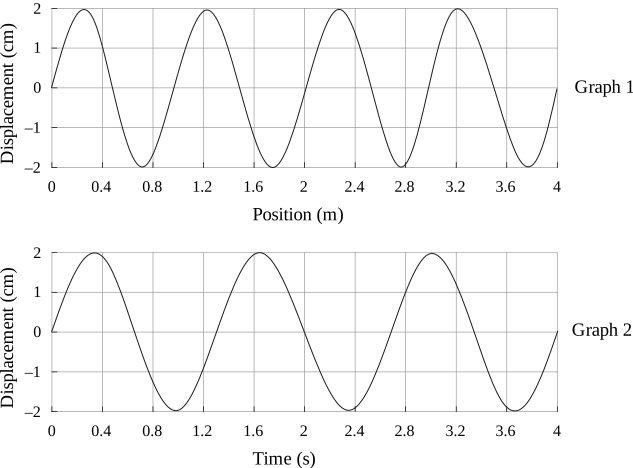
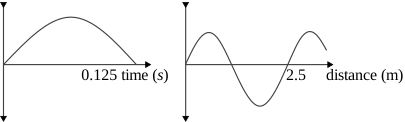
Determine the speed of the following wave.   (2 marks)
 

--- 4 WORK AREA LINES (style=lined) ---

Show Answers Only

\(v=10\ \text{ms}^{-1}\).

Show Worked Solution
  • From the first diagram it takes 0.125 s for half a cycle of the wave, hence the period \((T)\) of the wave is 0.25 s.
  • From the second diagram the wavelength of the wave, \(\lambda = 2.5\ \text{m}\).
  •    \(v = f\lambda = \dfrac{\lambda}{T} = \dfrac{2.5}{0.25} = 10\ \text{ms}^{-1}\).

Filed Under: Wave Properties and Behaviour Tagged With: Band 4, smc-4278-20-Wave calculations

PHYSICS, M3 EQ-Bank 1

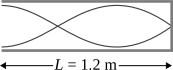
The diagram below shows a standing wave pattern in a closed pipe with a total length of 1.2 metres.
 

The speed of sound in air is 340 ms\(^{-1}\).

Determine the wavelength of the standing wave and state the number of nodes in the diagram.   (2 marks)

--- 4 WORK AREA LINES (style=lined) ---

Show Answers Only
  • \(\lambda = 1.6\ \text{m}\).
  • There are two nodes in the diagram.
Show Worked Solution
  • There is \(\dfrac{3}{4}\) of a wavelength in the closed pipe which is 1.2 m long.
  •    \(\dfrac{3}{4}\lambda=1.2\ \ \Rightarrow \ \ \lambda=1.2 \times \dfrac{4}{3}=1.6\ \text{m}\)
  • A node is a point along a standing wave where there is no movement. The displacement of the medium is always zero at that location.
  • There are two nodes in the diagram.

Filed Under: Sound Waves Tagged With: Band 4, smc-4280-20-Modelling standing waves

PHYSICS, M3 EQ-Bank 3

How do mechanical waves differ from electromagnetic waves? Include examples to illustrate your response.   (4 marks)

--- 12 WORK AREA LINES (style=lined) ---

Show Answers Only
  • Mechanical waves (e.g. sound, water waves, vibrations on a string) need a medium to travel through.
  • They transfer energy by making particles in the medium vibrate. This vibration can be either perpendicular (transverse waves – eg. ripples in water) or parallel (longitudinal waves – eg. sound waves in air) to the direction of motion.
  • The speed of a mechanical wave depends on the medium’s physical properties.
  • Electromagnetic waves (e.g. light, radio waves, X-rays) do not need a medium and can move through a vacuum.
  • These waves are transverse, made of electric and magnetic fields oscillating at right angles.
  • They travel fastest in a vacuum \((3 \times 10^8\ \text{ms}^{-1})\) and slow down in materials like air or glass—how much depends on the material’s refractive index.
  • The electromagnetic spectrum includes a wide range, from low-frequency radio waves to high-frequency gamma rays.
Show Worked Solution
  • Mechanical waves (e.g. sound, water waves, vibrations on a string) need a medium to travel through.
  • They transfer energy by making particles in the medium vibrate. This vibration can be either perpendicular (transverse waves – eg. ripples in water) or parallel (longitudinal waves – eg. sound waves in air) to the direction of motion.
  • The speed of a mechanical wave depends on the medium’s physical properties.
  • Electromagnetic waves (e.g. light, radio waves, X-rays) do not need a medium and can move through a vacuum.
  • These waves are transverse, made of electric and magnetic fields oscillating at right angles.
  • They travel fastest in a vacuum \((3 \times 10^8\ \text{ms}^{-1})\) and slow down in materials like air or glass—how much depends on the material’s refractive index.
  • The electromagnetic spectrum includes a wide range, from low-frequency radio waves to high-frequency gamma rays.

Filed Under: Wave Properties and Behaviour Tagged With: Band 4, Band 5, smc-4278-35-Mechanical Waves, smc-4278-45-EMR

HMS, HIC EQ-Bank 092 MC

A young person living in a low socioeconomic area has completed Year 10 but is considering leaving school to work full-time. According to socioeconomic determinants of health, what is the most likely long-term health outcome of this decision?

  1. Improved mental health due to financial independence.
  2. Equivalent health outcomes to those who complete Year 12 education.
  3. Temporary physical health challenges that resolve once stable employment is found.
  4. Reduced access to employment opportunities that provide health benefits.
Show Answers Only

\(D\)

Show Worked Solution
  • D is correct because lower educational attainment generally leads to reduced access to employment opportunities that provide health benefits.

Other options:

  • A is incorrect because while employment may provide some financial independence, leaving school early often limits long-term earning potential, which can increase financial stress.
  • B is incorrect because research shows that those who complete higher levels of education generally have better health outcomes than those who leave school early.
  • C is incorrect because the health challenges associated with lower educational attainment are often persistent rather than temporary.

Filed Under: Socioeconomic Tagged With: Band 4, smc-5805-10-Education, smc-5805-20-Employment, smc-5805-50-Interconnection

HMS, HIC EQ-Bank 091 MC

Which of the following BEST describes the relationship between education, employment and income as socioeconomic determinants of health?

  1. They are independent factors that separately influence different dimensions of health.
  2. Income is the primary determinant that directly influences education and employment outcomes.
  3. They operate in a cyclical manner where each can influence and reinforce the others.
  4. They primarily affect physical health but have minimal impact on other health dimensions.
Show Answers Only

\(C\)

Show Worked Solution
  • C is correct because education affects employment opportunities, which affects income, which in turn affects access to education for the next generation, creating an interconnected cycle.

Other options:

  • A is incorrect because these determinants are not independent; they are closely interrelated.
  • B is incorrect because income is not the primary determinant; all three work together, with education often being the initial factor.
  • D is incorrect because socioeconomic determinants affect all dimensions of health including mental and emotional health.

Filed Under: Socioeconomic Tagged With: Band 4, smc-5805-50-Interconnection

PHYSICS, M3 EQ-Bank 2

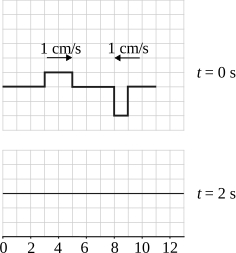
The diagram shows two rectangular pulses moving along a string, each travelling at a constant speed of 1 cm/s at time  \(t=0\ \text{s}\).

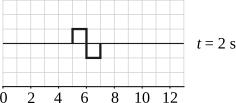
Sketch the appearance of the string at  \(t=2\ \text{s}\)  in the grid below.   (2 marks)


--- 0 WORK AREA LINES (style=lined) ---

Show Answers Only
 

Show Worked Solution

Filed Under: Wave Properties and Behaviour Tagged With: Band 4, smc-4278-50-Wave superposition

PHYSICS, M3 EQ-Bank 7 MC

A marine communication system operates at a frequency of \(92.9\ \text{MHz}\). What is the wavelength of the signal being transmitted?

  1. \(3.2 \times 10^6\ \text{m}\)
  2. \(3.2 \times 10^3\ \text{m}\)
  3. \(3.2\ \text{m}\)
  4. \(3.2 \times 10^{-3}\ \text{m}\)
Show Answers Only

\(C\)

Show Worked Solution
  • \(92.9\ \text{MHz} = 92.9 \times 10^6\ \text{Hz}\)
  • \(\lambda = \dfrac{v}{f} = \dfrac{3 \times 10^8}{92.9 \times 10^6} = 3.2\ \text{m}\)

\(\Rightarrow C\)

Filed Under: Wave Properties and Behaviour Tagged With: Band 4, smc-4278-20-Wave calculations

PHYSICS, M3 EQ-Bank 1

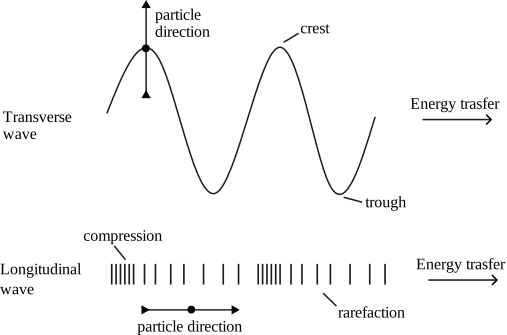
  1. Create a labelled diagram to illustrate the distinction between transverse and longitudinal wave types. Briefly describe how the particle motion differs in each case.   (3 marks)

--- 10 WORK AREA LINES (style=lined) ---

  1. Describe a difference between electromagnetic waves and mechanical waves, giving an example of each.   (2 marks)

--- 4 WORK AREA LINES (style=lined) ---

  1. A beam of light has a frequency of \(5.0 \times 10^{14}\ \text{Hz}\). Calculate the wavelength of this light in metres.   (1 mark)

--- 2 WORK AREA LINES (style=lined) ---

Show Answers Only

a.    


  • For transverse waves, particles move at 90 degrees to the direction of energy transfer.
  • For longitudinal waves, particles move back and forward in the same direction as the energy transfer.

b.   Electromagnetic wave example: radio wave.

  • EMR does not require a medium to travel through. i.e. they can travel through a vacuum.

Mechanical wave example: sound wave.

  • Mechanical waves require a medium to travel through.

c.    \(6 \times 10^{-7}\ \text{m}\).

Show Worked Solution

a.    


  • For transverse waves, particles move at 90 degrees to the direction of energy transfer.
  • For longitudinal waves, particles move back and forward in the same direction as the energy transfer.

b.   Electromagnetic wave example: radio wave.

  • EMR does not require a medium to travel through. i.e. they can travel through a vacuum.

Mechanical wave example: sound wave.

  • Mechanical waves require a medium to travel through.

c.   Using  \(v = f \lambda\):

\(\lambda = \dfrac{v}{f} = \dfrac{3 \times 10^8}{5.0 \times 10^{14}} = 6 \times 10^{-7}\ \text{m}\).

Filed Under: Wave Properties and Behaviour Tagged With: Band 4, smc-4278-20-Wave calculations, smc-4278-30-Transverse vs longitudinal, smc-4278-35-Mechanical Waves

HMS, HIC EQ-Bank 111

Explain how media and culture as sociocultural determinants affect health outcomes, discussing both their positive and negative influences on individual and community health.    (5 marks)

--- 15 WORK AREA LINES (style=lined) ---

Show Answers Only

Media

  • Media influences health through multiple channels including social media platforms, advertising and entertainment, with both intentional and unintentional health messaging affecting behaviour.
  • Positive media impacts include deliberate health campaigns like anti-smoking initiatives and cancer screening promotions that provide clear health information and encourage preventative actions.
  • However, media negatively affects health through embedded messaging promoting unrealistic body standards and glamorising harmful behaviours. This can contribute to eating disorders and poor self-image, particularly among young people.

Culture

  • Culture determines health through established customs, dietary patterns and healthcare practices that become normalised within communities.
  • Positive cultural influences include providing a sense of belonging and identity that supports emotional and spiritual wellbeing through shared traditions.
  • Negative cultural influences can include poor eating habits, leading to obesity, and cultural stigma surrounding issues like mental health, which discourages individuals from seeking help for psychological issues. 
Show Worked Solution

Media

  • Media influences health through multiple channels including social media platforms, advertising and entertainment, with both intentional and unintentional health messaging affecting behaviour.
  • Positive media impacts include deliberate health campaigns like anti-smoking initiatives and cancer screening promotions that provide clear health information and encourage preventative actions.
  • However, media negatively affects health through embedded messaging promoting unrealistic body standards and glamorising harmful behaviours. This can contribute to eating disorders and poor self-image, particularly among young people.

Culture

  • Culture determines health through established customs, dietary patterns and healthcare practices that become normalised within communities.
  • Positive cultural influences include providing a sense of belonging and identity that supports emotional and spiritual wellbeing through shared traditions.
  • Negative cultural influences can include poor eating habits, leading to obesity, and cultural stigma surrounding issues like mental health, which discourages individuals from seeking help for psychological issues. 

Filed Under: Broad features of society Tagged With: Band 4, Band 5, smc-5803-40-Media/peer influence, smc-5803-50-Culture, smc-5803-60-Interaction of determinants

HMS, HIC EQ-Bank 110

Identify two key sociocultural determinants and explain how they influence health behaviours and outcomes during adolescence, providing both positive and negative examples.    (5 marks)

--- 15 WORK AREA LINES (style=lined) ---

Show Answers Only

Answers could include two of the following:

Family Influence

  • [P] Parents modelling healthy behaviours can help shape adolescent lifestyle choices.
  • [E] This leads to teenagers developing similar exercise and eating patterns.
  • [Ev] Active parents produce children 50% more likely to participate in regular sports.
  • [L] This shows a clear connection between parental role-modelling and teen health habits.
     
  • [P] Family dysfunction and conflict cause poor coping mechanisms.
  • [E] This results in adolescents potentially developing harmful stress responses.
  • [Ev] Teens witnessing domestic violence show triple the rates of smoking and substance use.
  • [L] This demonstrates how family stress directly impacts adolescent health behaviours.

Peer Influence

  • [P] Positive peer groups encourage healthy activities and choices.
  • [E] This causes increased physical activity and better social connections.
  • [Ev] Teens with sporty friends exercise 60% more through team sports participation.
  • [L] These elements work together to reinforce sustainable healthy behaviours.
     
  • [P] Negative peer pressure promotes dangerous risk-taking behaviours.
  • [E] This increases the chances of substance experimentation for social acceptance.
  • [Ev] Party culture normalises binge drinking, with 70% initially trying alcohol due to peer pressure.
  • [L] This relationship results in social acceptance overriding health knowledge.

Religion

  • [P] Religious communities provide strong support networks.
  • [E] This causes improved mental wellbeing through belonging.
  • [Ev] Church youth groups reduce adolescent depression rates by 40% through meaningful connections.
  • [L] Spiritual communities enhance resilience during challenging developmental periods.
     
  • [P] Religious restrictions can limit healthcare access.
  • [E] This results in delayed treatment or untreated conditions.
  • [Ev] Some faiths prohibit blood transfusions, contraception or mental health medication.
  • [L] In this way, religious beliefs can occasionally compromise optimal health outcomes.
Show Worked Solution

Answers could include two of the following:

Family Influence

  • [P] Parents modelling healthy behaviours can help shape adolescent lifestyle choices.
  • [E] This leads to teenagers developing similar exercise and eating patterns.
  • [Ev] Active parents produce children 50% more likely to participate in regular sports.
  • [L] This shows a clear connection between parental role-modelling and teen health habits.
     
  • [P] Family dysfunction and conflict cause poor coping mechanisms.
  • [E] This results in adolescents potentially developing harmful stress responses.
  • [Ev] Teens witnessing domestic violence show triple the rates of smoking and substance use.
  • [L] This demonstrates how family stress directly impacts adolescent health behaviours.

Peer Influence

  • [P] Positive peer groups encourage healthy activities and choices.
  • [E] This causes increased physical activity and better social connections.
  • [Ev] Teens with sporty friends exercise 60% more through team sports participation.
  • [L] These elements work together to reinforce sustainable healthy behaviours.
     
  • [P] Negative peer pressure promotes dangerous risk-taking behaviours.
  • [E] This increases the chances of substance experimentation for social acceptance.
  • [Ev] Party culture normalises binge drinking, with 70% initially trying alcohol due to peer pressure.
  • [L] This relationship results in social acceptance overriding health knowledge.

Religion

  • [P] Religious communities provide strong support networks.
  • [E] This causes improved mental wellbeing through belonging.
  • [Ev] Church youth groups reduce adolescent depression rates by 40% through meaningful connections.
  • [L] Spiritual communities enhance resilience during challenging developmental periods.
     
  • [P] Religious restrictions can limit healthcare access.
  • [E] This results in delayed treatment or untreated conditions.
  • [Ev] Some faiths prohibit blood transfusions, contraception or mental health medication.
  • [L] In this way, religious beliefs can occasionally compromise optimal health outcomes.

Filed Under: Broad features of society Tagged With: Band 4, Band 5, smc-5803-20-Family, smc-5803-40-Media/peer influence, smc-5803-60-Interaction of determinants

HMS, HIC EQ-Bank 089 MC

A community health campaign aims to increase fruit and vegetable consumption among teenagers.

The campaign is MOST likely to succeed if it addresses which combination of sociocultural factors?

  1. Media influence and peer group norms
  2. Political structures and language barriers
  3. Economic prosperity and urban development
  4. Geographic location and technological access
Show Answers Only

\(A\)

Show Worked Solution
  • A is correct as media influence shapes perceptions about food, while peer group norms strongly affect teenage behaviour, including food choices.

Other options:

  • B is incorrect as political structures and language barriers, while sociocultural factors, are not the most direct influences on teenage dietary choices.
  • C is incorrect as these factors relate to socioeconomic and environmental determinants rather than sociocultural ones.
  • D is incorrect as these are environmental factors rather than sociocultural determinants of health.

Filed Under: Broad features of society Tagged With: Band 4, smc-5803-40-Media/peer influence

HMS, HIC EQ-Bank 088 MC

Which of the following BEST explains how social cohesion influences the health of individuals within a community?

  1. It determines the economic resources available for healthcare services.
  2. It creates networks that provide emotional support during health challenges.
  3. It dictates the quality of physical infrastructure affecting physical activity.
  4. It determines the level of educational attainment within the population.
Show Answers Only

\(B\)

Show Worked Solution
  • B is correct. Social cohesion refers to the strength of relationships within communities, which provides emotional support networks critical during health challenges.

Other options:

  • A is incorrect as economic resources relate more to socioeconomic rather than sociocultural factors.
  • C is incorrect as physical infrastructure is an environmental determinant rather than a sociocultural one.
  • D is incorrect as while social cohesion may influence educational attainment, it doesn’t best explain an individual’s health from the given options.

Filed Under: Broad features of society Tagged With: Band 4, smc-5803-30-Social cohesion/inclusion

PHYSICS, M3 EQ-Bank 2-3 MC

A wave is moving along a string. Graph 1 shows the displacement of the string at different positions, while Graph 2 shows how the displacement of a single point on the string changes over time.


Part 1

Based on Graph 1, what is the wavelength of the wave?

  1. \(1.0\ \text{m}\)
  2. \(2.0\ \text{m}\)
  3. \(3.0\ \text{m}\)
  4. \(4.0\ \text{m}\)

 
Part 2

What is the speed of the wave along the string?

  1. \(0.33\ \text{ms}^{-1}\)
  2. \(0.66\ \text{ms}^{-1}\)
  3. \(0.75\ \text{ms}^{-1}\)
  4. \(1.33\ \text{ms}^{-1}\)
Show Answers Only

Part 1: \(A\)

Part 2: \(C\)

Show Worked Solution

Part 1

  • The wavelength is given by the distance between two corresponding points on the wave (i.e. crest to crest or trough to trough).
  • The from the graph, the wave repeats itself after 1.0 m.

\(\Rightarrow A\)

 
Part 2

  • The wave repeats three times in 4 seconds → Period of the wave is 1.33 s.
  • The frequency of the wave, \(f = \dfrac{1}{T} = \dfrac{1}{1.33} = 0.75\ \text{Hz}\).
  •    \(v = f \lambda = 0.75 \times 1.0 = 0.75\ \text{ms}^{-1}\)

\(\Rightarrow C\)

Filed Under: Wave Properties and Behaviour Tagged With: Band 4, smc-4278-20-Wave calculations

HMS, HIC EQ-Bank 109

Explain how limited access to health services in rural areas impacts health outcomes, and discuss TWO ways in which this environmental factor interacts with other determinants of health.    (5 marks)

--- 15 WORK AREA LINES (style=lined) ---

Show Answers Only

Language highlighting the cause-effect relationship is bolded in the answer below.

  • Limited access to health services in rural areas directly impacts health outcomes. This occurs because delayed diagnosis and treatment allow conditions to worsen.
  • This happens when people living rurally travel hours to reach hospitals and specialists. As a result, treatment and preventative care become less accessible.

Interaction with other determinants:

  • This environmental factor interacts with socioeconomic determinants. The reason for this is rural areas typically have lower incomes. This leads to residents lacking money to overcome access barriers.
  • There is a direct link between distance and financial burden. This shows when travelling to cities for cancer screening adds costs. This relationship results in services like physiotherapy becoming unaffordable without Medicare coverage.
  • Individual determinants are also affected. This demonstrates why health literacy remains lower – it occurs because lack of local health education programs limits knowledge about preventative care.
  • These elements work together to create emotional burdens. This happens when separation from family during treatment affects mental health. This interaction allows multiple stressors to compound simultaneously.
  • To put it simply, this combination of factors multiplies health inequities. This demonstrates why rural populations experience higher mortality rates for preventable conditions. The clear connection between access, income, and knowledge creates systematic disadvantage.
Show Worked Solution

Language highlighting the cause-effect relationship is bolded in the answer below.

  • Limited access to health services in rural areas directly impacts health outcomes. This occurs because delayed diagnosis and treatment allow conditions to worsen.
  • This happens when people living rurally travel hours to reach hospitals and specialists. As a result, treatment and preventative care become less accessible.

Interaction with other determinants:

  • This environmental factor interacts with socioeconomic determinants. The reason for this is rural areas typically have lower incomes. This leads to residents lacking money to overcome access barriers.
  • There is a direct link between distance and financial burden. This shows when travelling to cities for cancer screening adds costs. This relationship results in services like physiotherapy becoming unaffordable without Medicare coverage.
  • Individual determinants are also affected. This demonstrates why health literacy remains lower – it occurs because lack of local health education programs limits knowledge about preventative care.
  • These elements work together to create emotional burdens. This happens when separation from family during treatment affects mental health. This interaction allows multiple stressors to compound simultaneously.
  • To put it simply, this combination of factors multiplies health inequities. This demonstrates why rural populations experience higher mortality rates for preventable conditions. The clear connection between access, income, and knowledge creates systematic disadvantage.

Filed Under: Environmental Tagged With: Band 4, Band 5, smc-5804-10-Geographic location, smc-5804-60-Interaction of determinants

HMS, HIC EQ-Bank 107

Outline TWO environmental factors that contribute to poorer health outcomes for people living in remote areas of Australia.   (3 marks)

--- 7 WORK AREA LINES (style=lined) ---

Show Answers Only
  • Geographic isolation requiring travel over long distances on poor quality roads increases risk of motor vehicle accidents.
  • Limited access to healthcare services with remote communities lacking specialists, hospitals and preventative health programs.
  • This results in delayed diagnoses and reduced treatment opportunities for chronic conditions.
  • These two environmental factors also interact in this instance to create compounded health disadvantages for remote populations.
Show Worked Solution
  • Geographic isolation requiring travel over long distances on poor quality roads increases risk of motor vehicle accidents.
  • Limited access to healthcare services with remote communities lacking specialists, hospitals and preventative health programs.
  • This results in delayed diagnoses and reduced treatment opportunities for chronic conditions.
  • These two environmental factors also interact in this instance to create compounded health disadvantages for remote populations.

Filed Under: Environmental Tagged With: Band 3, Band 4, smc-5804-10-Geographic location, smc-5804-40-Safe workplaces

HMS, HIC EQ-Bank 087 MC

An 18-year-old woman lives in a small rural town where the nearest hospital is 120 kilometres away.

Which combination of environmental factors would MOST likely affect her health status?

  1. Access to fluoridated water and public transport availability.
  2. Air pollution levels and access to healthy food options.
  3. Housing affordability and population density.
  4. Distance to health services and quality of road infrastructure.
Show Answers Only

\(D\)

Show Worked Solution
  • D is correct as both distance to health services and road infrastructure quality are critical environmental factors affecting health access.

Other options:

  • A is incorrect as while fluoridated water access may differ in rural areas, this combination doesn’t represent the most significant environmental factors for the scenario.
  • B is incorrect as air pollution is typically lower in rural areas and not the most significant environmental determinant in this scenario.
  • C is incorrect as housing affordability is more of a socioeconomic factor, and population density, while an environmental characteristic, doesn’t impact health access as significantly as distance to services.

Filed Under: Environmental Tagged With: Band 4, smc-5804-10-Geographic location

HMS, HIC EQ-Bank 086 MC

Which of the following BEST explains why air quality can be considered an environmental determinant of health?

  1. Air quality is affected by factors such as education level.
  2. Poor air quality increases the risk of respiratory infections and cardiovascular conditions.
  3. Air pollution primarily affects individual health choices regarding physical activity.
  4. Air quality improvements are determined by cultural attitudes toward the environment.
Show Answers Only

\(B\)

Show Worked Solution
  • B is correct as poor air quality resulting from emissions increases the risk of respiratory infections and other cardiovascular conditions.

Other options:

  • A is incorrect as air quality is an environmental factor, not primarily a socioeconomic one.
  • C is incorrect as while air pollution may impact physical activity choices, this is not the primary way air quality acts as a health determinant.
  • D is incorrect as air quality is an environmental factor that affects health directly, not primarily through cultural attitudes.

Filed Under: Environmental Tagged With: Band 4, smc-5804-20-Air/water quality

PHYSICS, M2 EQ-Bank 5

Two identical 1200 kg cars travelling at 72 kmh\(^{-1}\) in opposite directions collide head-on and then rebound with exactly half of their original speeds.

  1. Is this collision elastic or inelastic? Give your reasons.   (2 marks)

--- 4 WORK AREA LINES (style=lined) ---

  1. Given that the cars were in contact with each other for a total of 0.5 seconds, calculate the average force that acts on each car whilst they are in contact.   (2 marks)

--- 4 WORK AREA LINES (style=lined) ---

Show Answers Only

a.    A collision will be elastic if kinetic energy is conserved in the reaction.

  \(KE_i = \dfrac{1}{2} \times 1200 \times 20^2 + \dfrac{1}{2} \times 1200 \times 20^2 = 480\ \text{kJ}\)

  \(KE_f = \dfrac{1}{2} \times 1200 \times 10^2 + \dfrac{1}{2} \times 1200 \times 10^2 = 120\ \text{kJ}\)

  • As kinetic energy is not conserved in the collision, the collision is inelastic.
     

b.    There is 72 kN acting on each car in the direction of their change in motion.

Show Worked Solution

a.    A collision will be elastic if kinetic energy is conserved in the reaction.

  \(KE_i = \dfrac{1}{2} \times 1200 \times 20^2 + \dfrac{1}{2} \times 1200 \times 20^2 = 480\ \text{kJ}\)

  \(KE_f = \dfrac{1}{2} \times 1200 \times 10^2 + \dfrac{1}{2} \times 1200 \times 10^2 = 120\ \text{kJ}\)

  • As kinetic energy is not conserved in the collision, the collision is inelastic.
     

b.    Using the impulse equation, \(I= \Delta p = F \Delta t\):

\(F\) \(=\dfrac{\Delta p}{\Delta t}\)  
  \(=\dfrac{m \Delta v}{\Delta t}\)  
  \(=\dfrac{1200 \times (10-(-20))}{0.5}\)  
  \(=-72\,000\ \text{N}\)  
     
  • There is 72 kN acting on each car in the direction of their change in motion.

Filed Under: Momentum, Energy and Simple Systems Tagged With: Band 4, Band 5, smc-4277-40-Elastic/inelastic collisions, smc-4277-50-Impulse

PHYSICS, M2 EQ-Bank 4

The graph below represents the net force applied to a 1600 kg vehicle.
 

  1. Calculate the total impulse exerted on the vehicle over the 52 second interval.   (2 marks)

--- 4 WORK AREA LINES (style=lined) ---

  1. If the vehicle begins at rest, determine its speed at the end of the 52 seconds.   (2 marks)

--- 4 WORK AREA LINES (style=lined) ---

Show Answers Only

a.    The total impulse exerted on the vehicle is \(22\,400\ \text{Ns}\).

b.    The final speed of the vehicle is \(14\ \text{ms}^{-1}\).

Show Worked Solution

a.    Total impulse is given by the area under the force-time graph:

The area under the graph can be split up as seen below:
 

  \(\text{Area 1}\ =400 \times 12 = 4800\ \text{Ns}\).

  \(\text{Area 2}\ = \dfrac{1}{2} \times 400 \times 8 = 1600\ \text{Ns}\)

  \(\text{Area 3}\ = \dfrac{1}{2} \times 800 \times 8 = 3200\ \text{Ns}\)

  \(\text{Area 4}\ = 800 \times 8 = 6400\ \text{Ns}\)

  \(\text{Area 5}\ = \dfrac{1}{2} \times 800 \times 16 = 6400\ \text{Ns}\)

\(\therefore\) The total impulse exerted on the vehicle is \(22\,400\ \text{Ns}\).


b.     \(I\) \(=\Delta p\)
  \(I\) \(=mv-mu\)
  \(22\,400\) \(=1600v-1600 \times 0\)
  \(v\) \(=\dfrac{22\,400}{1600}\)
    \(=14\ \text{ms}^{-1}\)

 
\(\therefore\) The final speed of the vehicle is \(14\ \text{ms}^{-1}\).

Filed Under: Momentum, Energy and Simple Systems Tagged With: Band 3, Band 4, smc-4277-50-Impulse, smc-4277-60-Force-time graphs

HMS, TIP 2023 HSC 31a

Choose ONE type of training to answer BOTH Question 31 (a) (i) and (ii).

  1. For the type of training chosen, outline TWO methods an athlete can use to improve performance.  (3 marks)

    --- 7 WORK AREA LINES (style=lined) ---

  2. For the type of training chosen, explain TWO measurements that can be used by an athlete to monitor improved performance.  (5 marks)

    --- 15 WORK AREA LINES (style=lined) ---

Show Answers Only

Sample answer

i.   Anaerobic Training

  • Sprint Interval Training (SIT)
    • In this method an athlete performs repeated bouts of all-out sprints (e.g., 30-second maximal effort) followed by longer rest periods (e.g., 2-4 minutes).
    • Anaerobic capacity is improved by stressing the lactic acid system, enhancing the ability to perform high-intensity efforts.
  • Plyometrics
    • This method involves explosive movements such as box jumps, depth jumps, or medicine ball throws.
    • These exercises utilise the stretch-shortening cycle to develop power, improving performance in sports requiring explosive movements like basketball or volleyball.

ii.  Performance Measurements – Anaerobic Training

  • The Wingate test measures anaerobic power through a 30-second all-out cycling assessment. This test works by recording peak power output and power decline over the duration. Athletes can monitor improvement because pre and post-training comparisons reveal increased anaerobic capacity. For example, a soccer player showing increased peak power demonstrates improved ability to perform repeated sprints during matches. This measurement is effective because it directly reflects the energy system adaptations resulting from anaerobic training programs.
  • Vertical jump testing assesses lower body power development from explosive training methods. The measurement functions through precise height recording using contact mats or jump platforms. Athletes track progress because increased jump height indicates enhanced muscular power and coordination. A basketball player who improves their vertical jump after plyometric training demonstrates better explosive capacity. This measurement proves valuable because it directly translates to improved in-game performance when jumping for rebounds or blocking shots, showing clear functional application of training adaptations.

Show Worked Solution

Sample answer

i.   Anaerobic Training

  • Sprint Interval Training (SIT)
    • In this method an athlete performs repeated bouts of all-out sprints (e.g., 30-second maximal effort) followed by longer rest periods (e.g., 2-4 minutes).
    • Anaerobic capacity is improved by stressing the lactic acid system, enhancing the ability to perform high-intensity efforts.
  • Plyometrics
    • This method involves explosive movements such as box jumps, depth jumps, or medicine ball throws.
    • These exercises utilise the stretch-shortening cycle to develop power, improving performance in sports requiring explosive movements like basketball or volleyball.

ii.  Performance Measurements – Anaerobic Training

  • The Wingate test measures anaerobic power through a 30-second all-out cycling assessment. This test works by recording peak power output and power decline over the duration. Athletes can monitor improvement because pre and post-training comparisons reveal increased anaerobic capacity. For example, a soccer player showing increased peak power demonstrates improved ability to perform repeated sprints during matches. This measurement is effective because it directly reflects the energy system adaptations resulting from anaerobic training programs.
  • Vertical jump testing assesses lower body power development from explosive training methods. The measurement functions through precise height recording using contact mats or jump platforms. Athletes track progress because increased jump height indicates enhanced muscular power and coordination. A basketball player who improves their vertical jump after plyometric training demonstrates better explosive capacity. This measurement proves valuable because it directly translates to improved in-game performance when jumping for rebounds or blocking shots, showing clear functional application of training adaptations.

♦ (ii) Mean mark 55%.

Filed Under: Types of training and training methods Tagged With: Band 4, Band 5, smc-5457-30-Specific tests, smc-5459-05-Anaerobic

HMS, TIP 2023 HSC 30a

Refer to the following scenario to answer BOTH Questions 30 (a) (i) and (ii).

An athlete tries to change direction quickly to evade an opponent during a basketball game. They hear a loud snap and feel their knee give way beneath them, sustaining knee ligament damage.

  1. Outline TWO classifications of this injury.   (3 marks)

    --- 7 WORK AREA LINES (style=lined) ---

  2. Explain the process for determining the nature and extent of this injury.   (5 marks)

    --- 15 WORK AREA LINES (style=lined) ---

Show Answers Only

Sample answer

i.   Injury classifications

  • An indirect injury as it resulted from internal forces when the athlete tried to change direction, rather than from direct external impact.
  • A soft tissue injury since ligaments are connective tissue rather than bone, with damage occurring to the structural components that stabilize the knee joint.

ii. Assessment of nature and extent of the injury – TOTAPS

  • The TOTAPS assessment begins by talking with the athlete about injury mechanism and symptoms. This communication reveals critical information about the snap sound and knee instability because these details indicate potential ligament rupture severity. Questioning establishes pain location and movement limitations which helps identify specific structures involved.
  • Observation follows because visual indicators reveal injury extent through swelling, bruising, or deformity patterns. These signs demonstrate ligament damage severity and guide subsequent assessment steps. Touch assessment then occurs to pinpoint specific pain sites along knee ligament pathways. This palpation process identifies which structures like ACL or MCL are damaged because tenderness patterns correspond to anatomical locations.
  • Active movement testing enables the athlete to attempt limited knee flexion and extension. Range restrictions occur due to ligament injury and muscle guarding which indicates functional limitations. Passive movement assessment involves careful knee manipulation including anterior drawer tests. These specialised tests determine ligament stability because abnormal movement patterns reveal structural compromise. Skills testing becomes contraindicated because obvious instability creates risk for further damage to compromised ligaments.

Show Worked Solution

Sample answer

i.   Injury classifications

  • An indirect injury as it resulted from internal forces when the athlete tried to change direction, rather than from direct external impact.
  • A soft tissue injury since ligaments are connective tissue rather than bone, with damage occurring to the structural components that stabilize the knee joint.

ii. Assessment of nature and extent of the injury – TOTAPS

  • The TOTAPS assessment begins by talking with the athlete about injury mechanism and symptoms. This communication reveals critical information about the snap sound and knee instability because these details indicate potential ligament rupture severity. Questioning establishes pain location and movement limitations which helps identify specific structures involved.
  • Observation follows because visual indicators reveal injury extent through swelling, bruising, or deformity patterns. These signs demonstrate ligament damage severity and guide subsequent assessment steps. Touch assessment then occurs to pinpoint specific pain sites along knee ligament pathways. This palpation process identifies which structures like ACL or MCL are damaged because tenderness patterns correspond to anatomical locations.
  • Active movement testing enables the athlete to attempt limited knee flexion and extension. Range restrictions occur due to ligament injury and muscle guarding which indicates functional limitations. Passive movement assessment involves careful knee manipulation including anterior drawer tests. These specialised tests determine ligament stability because abnormal movement patterns reveal structural compromise. Skills testing becomes contraindicated because obvious instability creates risk for further damage to compromised ligaments.

♦ (ii) Mean mark 51%.

Filed Under: Management/prevention of injuries Tagged With: Band 4, Band 5, smc-5472-05-Management classification, smc-5472-10-Management assessment

HMS, HIC 2023 HSC 28b

To what extent can the development of support networks and access to health services enable young people to attain better health?   (12 marks)

--- 28 WORK AREA LINES (style=lined) ---

Show Answers Only

*Recommended language to consider for “To What Extent” questions is bolded in the answer below.

Judgment Statement

  • Support networks and health services enable young people to attain significantly better health.
  • Evidence shows mental health services, accessible platforms and culturally appropriate care substantially improve outcomes.

Mental Health and Accessibility

  • One major reason why these services work is they’re specifically designed for young people’s unique needs and preferences.
  • Evidence supporting this includes nearly three-quarters of headspace clients reporting satisfaction and experiencing measurable reductions in psychological distress.
  • Research consistently shows that school-based health services show considerably higher consultation rates compared to community alternatives.
  • This demonstrates how removing transportation and scheduling barriers significantly improves access.
  • Digital platforms like ReachOut reached 280,000 young Australians in 2022. Crucially, over 80% of these users wouldn’t have sought traditional help.
  • The main factors supporting this success include multiple access points which work flexibly with young people’s needs.

Aboriginal Community Controlled Health Organisations (ACCHO’s)

  • ACCHO’s achieve 45% higher Indigenous youth engagement than mainstream services by recognising Country connection and community as central to wellbeing.
  • This culturally appropriate approach largely addresses specific health inequities.
  • However, it is important to consider that rural youth still face significant service gaps.
  • An alternative perspective is that geographic isolation minimally impacts access when digital options work well, but poor internet connectivity undermines this potential.
  • Compounding this, workforce shortages mean long waiting lists even in well-serviced areas.
  • Despite this, available services remain the stronger factor because they have shown they are highly effective when accessible.

Reaffirmation

  • Support networks and health services significantly enable better youth health outcomes.
  • The main factors supporting this include varied delivery mechanisms providing multiple pathways for young people to access healthcare.
  • Implications suggest that continued investment in youth-specific, accessible, and culturally appropriate services remains critical.
Show Worked Solution

*Recommended language to consider for “To What Extent” questions is bolded in the answer below.

Judgment Statement

  • Support networks and health services enable young people to attain significantly better health.
  • Evidence shows mental health services, accessible platforms and culturally appropriate care substantially improve outcomes.

Mental Health and Accessibility

  • One major reason why these services work is they’re specifically designed for young people’s unique needs and preferences.
  • Evidence supporting this includes nearly three-quarters of headspace clients reporting satisfaction and experiencing measurable reductions in psychological distress.
  • Research consistently shows that school-based health services show considerably higher consultation rates compared to community alternatives.
  • This demonstrates how removing transportation and scheduling barriers significantly improves access.
  • Digital platforms like ReachOut reached 280,000 young Australians in 2022. Crucially, over 80% of these users wouldn’t have sought traditional help.
  • The main factors supporting this success include multiple access points which work flexibly with young people’s needs.

Aboriginal Community Controlled Health Organisations (ACCHO’s)

  • ACCHO’s achieve 45% higher Indigenous youth engagement than mainstream services by recognising Country connection and community as central to wellbeing.
  • This culturally appropriate approach largely addresses specific health inequities.
  • However, it is important to consider that rural youth still face significant service gaps.
  • An alternative perspective is that geographic isolation minimally impacts access when digital options work well, but poor internet connectivity undermines this potential.
  • Compounding this, workforce shortages mean long waiting lists even in well-serviced areas.
  • Despite this, available services remain the stronger factor because they have shown they are highly effective when accessible.

Reaffirmation

  • Support networks and health services significantly enable better youth health outcomes.
  • The main factors supporting this include varied delivery mechanisms providing multiple pathways for young people to access healthcare.
  • Implications suggest that continued investment in youth-specific, accessible, and culturally appropriate services remains critical.

♦♦ Mean mark 46%.

Filed Under: Strengthening, protecting and enhancing health Tagged With: Band 4, Band 5, Band 6, smc-5511-30-Social connection/ethics

PHYSICS, M2 EQ-Bank 3

The diagram below shows a top view of two objects moving across a frictionless surface. Object \(X\) has a mass of 3.5 kg, and object \(Y\) has a mass of 2.5 kg. Their initial velocities are indicated in the diagram.


The two objects collide and stick together after the collision.

  1. Calculate the velocity of the combined mass after the collision.   (4 marks)

--- 8 WORK AREA LINES (style=lined) ---

  1. Determine the amount of kinetic energy lost due to the collision.   (2 marks)

--- 4 WORK AREA LINES (style=lined) ---

Show Answers Only

a.    \(2.91\ \text{ms}^{-1}, \ \text{S}57.8^{\circ}\text{E}\).

b.    \(16.21\ \text{J}\).

Show Worked Solution

a.    The momentum of each object can be seen in the diagrams below:
 

  • By letting east and south be the positive directions we can sum the vectors by their horizontal and vertical components:

\(p_h = 14\cos 60 + 8.25\cos 20 = 14.75\ \text{Ns}\)

\(p_v = 14\sin 60-8.25\sin 20 = 9.30\ \text{Ns}\)
 

  • The total momentum of the system after the collision can be represented in the diagram below:
     

\(p_T^2=9.30^2 + 14.75^2=\sqrt{304.0525} = 17.44\ \text{Ns}\)
 

  • Total mass of the system after the collision = 6 kg
  • The speed after the collision \(=\dfrac{p_T}{m} = \dfrac{17.44}{6} = 2.91\ \text{ms}^{-1}\).
\(\tan \theta \) \(=\dfrac{9.30}{14.75}\)  
\(\theta\) \(=\tan^{-1}\left(\dfrac{9.30}{14.75}\right)=32.2^{\circ}\)  

  
\(\therefore\) The velocity of the combined mass after the collision is \(2.91\ \text{ms}^{-1}\), \(\text{S}57.8^{\circ}\text{E}\).

 
b.    
The kinetic energy before the collision:

\(KE_i = \dfrac{1}{2} \times 3.5 \times 4^2 + \dfrac{1}{2} \times 2.5 \times 3.3^2 = 41.6125\ \text{J}\)

The kinetic energy after the collision:

\(KE_f = \dfrac{1}{2} \times 6 \times 2.91^2 = 25.4043\ \text{J}\)

\(\Delta KE = 25.4043-41.6125 = -16.21\ \text{J}\)

\(\therefore\) The kinetic energy lost in the collision was \(16.21\ \text{J}\).

Filed Under: Momentum, Energy and Simple Systems Tagged With: Band 4, Band 5, smc-4277-20-Momentum conservation, smc-4277-30-Energy conservation

PHYSICS, M2 EQ-Bank 2

A 2.00 kg block is moving right at 0.30 m/s. A second 0.40 kg block is moving in the opposite direction at 0.10 m/s, resulting in a collision.

After the collision, both blocks stick together and move to the right.
 

  1. Calculate the speed of the two blocks after the collision.   (2 marks)

--- 5 WORK AREA LINES (style=lined) ---

  1. Determine the impulse that the smaller block applies to the larger block.   (2 marks)

--- 5 WORK AREA LINES (style=lined) ---

Show Answers Only

a.    \(0.233\ \text{ms}^{-1}\)

b.    \(0.134\ \text{kg m s}^{-1}\) to the left.

Show Worked Solution

a.    Using the conservation of energy:

\(m_1u_1 + m_2u_2\) \(=v(m_1 + m_2)\)  
\(2 \times 0.3 + 0.4 \times -0.1\) \(=v \times (2 + 0.4)\)  
\(2.4v\) \(=0.56\)  
\(v\) \(=0.233\ \text{ms}^{-1}\)  


b.   Impulse can be calculated using: \(I = \Delta p = m_1v-m_1u_1\):

  •    \(I =2 \times 0.233- \times 0.3 = -0.134\ \text{kgms}^{-1}\)
  • The smaller block applies an impulse of \(0.134\ \text{kg m s}^{-1}\) on the larger block to the left.

Filed Under: Momentum, Energy and Simple Systems Tagged With: Band 4, smc-4277-20-Momentum conservation, smc-4277-50-Impulse

HMS, HIC EQ-Bank 84 MC

A mental health campaign emphasises individual resilience through positive messaging: "Find your strength" rather than "Fight depression." The campaign focuses on developing coping skills and encourages activities that bring joy and meaning.

This approach best reflects which health model?

  1. Biomedical model
  2. Ecological model
  3. Sociocultural model
  4. Salutogenic model
Show Answers Only

\(D\)

Show Worked Solution
  • D is correct as the salutogenic model focuses on factors that promote wellbeing rather than on disease. It emphasises strengths, coping resources, and positive aspects of health maintenance.

Other options:

  • A is incorrect because the biomedical model would focus on the diagnosis and treatment of depression as a medical condition.
  • B is incorrect as the ecological model would emphasise multiple levels of influence (individual, relationship, community, society) rather than primarily focusing on individual strengths and coping.
  • C is incorrect because while the sociocultural model considers broader influences on health, this campaign primarily reflects positive health factors rather than social and cultural determinants.

Filed Under: Models of health promotion Tagged With: Band 4, smc-5510-30-Biomedical, smc-5510-45-Sociocultural, smc-5510-50-Salutogenic, smc-5510-55-Ecological

HMS, HIC EQ-Bank 106

Discuss how healthcare facility design has evolved to reflect principles of the salutogenic model of health, and where limitations still exist.   (4 marks)

--- 10 WORK AREA LINES (style=lined) ---

Show Answers Only
  • The salutogenic model emphasises maintaining wellness rather than just treating illness. This perspective is evident in modern healthcare facilities incorporating natural lighting and views of nature to reduce stress and promote healing.
  • Traditional hospital designs often contradicted salutogenic principles with sterile, institutional environments focused on medical equipment and efficiency rather than patient wellbeing.
  • Today’s facilities increasingly include communal spaces and gardens, recognising the importance of social connection in maintaining health. The Royal Children’s Hospital demonstrates this with its child-friendly environment.
  • This evolution reflects growing recognition that healing environments actively contribute to health outcomes, though budget constraints still limit implementation in many facilities.
Show Worked Solution
  • The salutogenic model emphasises maintaining wellness rather than just treating illness. This perspective is evident in modern healthcare facilities incorporating natural lighting and views of nature to reduce stress and promote healing.
  • Traditional hospital designs often contradicted salutogenic principles with sterile, institutional environments focused on medical equipment and efficiency rather than patient wellbeing.
  • Today’s facilities increasingly include communal spaces and gardens, recognising the importance of social connection in maintaining health. The Royal Children’s Hospital demonstrates this with its child-friendly environment.
  • This evolution reflects growing recognition that healing environments actively contribute to health outcomes, though budget constraints still limit implementation in many facilities.

Filed Under: Models of health promotion Tagged With: Band 4, smc-5510-50-Salutogenic

HMS, HIC EQ-Bank 81 MC

A youth mental health service redesigns its facility to include natural lighting, comfortable seating areas, artwork from local schools, and a garden space where clients can participate in group activities.

This approach best aligns with which principle of the salutogenic model of health?

  1. Focusing on identifying and treating mental health disorders.
  2. Emphasising medication compliance to reduce symptom severity.
  3. Creating environments that promote wellbeing rather than just addressing illness.
  4. Prioritising crisis intervention over long-term health maintenance.
Show Answers Only

\(C\)

Show Worked Solution
  • C is correct as the salutogenic model emphasises factors that maintain wellbeing rather than just treating illness, reflected in the service’s focus on creating positive, supportive environments that promote overall wellness.

Other options:

  • A is incorrect because focusing primarily on identifying and treating disorders represents a more biomedical approach rather than salutogenic thinking.
  • B is incorrect as medication compliance emphasis reflects a treatment-centred approach rather than the holistic wellness perspective of the salutogenic model.
  • D is incorrect because prioritising crisis intervention over maintenance contradicts the salutogenic focus on sustained wellbeing rather than just addressing problems when they become severe.

Filed Under: Models of health promotion Tagged With: Band 4, smc-5510-50-Salutogenic

HMS, HIC EQ-Bank 104

Describe TWO ways UNESCO's health policies and programs have influenced health promotion in Australia.   (4 marks)

--- 10 WORK AREA LINES (style=lined) ---

Show Answers Only

Answers could include:

Health Literacy

  • UNESCO’s educational programs addressing health literacy have influenced Australia’s school curriculum development.
  • This includes comprehensive sex education and environmental health awareness programs in Australian schools.
  • These programs help students develop informed perspectives on health issues and environmental sustainability.

Awareness of Bullying and Violence Against Women

  • UNESCO’s International Day against Violence and Bullying at School initiative has shaped Australia’s approach to bullying prevention.
  • This has led to the implementation of national anti-bullying campaigns in Australian schools.
  • These campaigns focus on creating safer learning environments and reducing the negative mental health impacts of bullying, which affects nearly one in three Australian students.
Show Worked Solution

Answers could include:

Health Literacy

  • UNESCO’s educational programs addressing health literacy have influenced Australia’s school curriculum development.
  • This includes comprehensive sex education and environmental health awareness programs in Australian schools.
  • These programs help students develop informed perspectives on health issues and environmental sustainability.

Awareness of Violence and Bullying at School

  • UNESCO’s International Day against Violence and Bullying at School initiative has shaped Australia’s approach to bullying prevention.
  • This has led to the implementation of national anti-bullying campaigns in Australian schools.
  • These campaigns focus on creating safer learning environments and reducing the negative mental health impacts of bullying, which affects nearly one in three Australian students.

Filed Under: Models of health promotion Tagged With: Band 4, smc-5510-60-Global health policies

HMS, HIC EQ-Bank 80 MC

The World Health Organisation's Framework Convention on Tobacco Control has influenced Australian health promotion through which of the following approaches?

  1. Requiring Australia to implement identical tobacco control measures as all other signatory countries.
  2. Providing evidence-based strategies that Australia has adapted and expanded upon in national campaigns.
  3. Mandating specific funding allocations for tobacco control in the federal health budget.
  4. Transferring responsibility for tobacco control from Australian governments to WHO oversight.
Show Answers Only

\(B\)

Show Worked Solution
  • B is correct as the WHO Framework provided evidence-based strategies and minimum standards. Australia has not only implemented but expanded upon these measures.

Other options:

  • A is incorrect because the Framework sets minimum standards but allows countries to implement stronger measures.
  • C is incorrect as no global organisation can mandate specific budget allocations to a sovereign nation like Australia.
  • D is incorrect because the Framework enhances national responsibility for tobacco control rather than transferring it to WHO oversight.

Filed Under: Models of health promotion Tagged With: Band 4, smc-5510-60-Global health policies

HMS, HIC 2023 HSC 28ai

Outline ONE strategy that can be used to overcome an individual factor that adversely affects a young person's health.   (3 marks)

--- 7 WORK AREA LINES (style=lined) ---

Show Answers Only

Sample answer

  • A young person with low health literacy regarding sun protection could attend SunSmart education programs delivered in Australian schools.
  • Programs like this provide practical strategies for sun protection including the five S’s of ‘Slip, Slop, Slap, Seek, Slide’ to improve knowledge of UV protection behaviors.
  • These programs address the individual factor of knowledge and attitudes by fostering understanding of the link between sun exposure and skin cancer risk in Australia’s high-UV environment.
Show Worked Solution

Sample answer

  • A young person with low health literacy regarding sun protection could attend SunSmart education programs delivered in Australian schools.
  • Programs like this provide practical strategies for sun protection including the five S’s of ‘Slip, Slop, Slap, Seek, Slide’ to improve knowledge of UV protection behaviors.
  • These programs address the individual factor of knowledge and attitudes by fostering understanding of the link between sun exposure and skin cancer risk in Australia’s high-UV environment.

Filed Under: Health Status of Young People Tagged With: Band 4, smc-5509-20-Causes of health issues, smc-5509-40-Protective factors, smc-5509-50-Determinants

HMS, HIC EQ-Bank 102

Analyse how social, historical and political determinants impact the effectiveness of Aboriginal and Torres Strait Islander approaches to health.

In your response, discuss at least THREE domains of the Aboriginal and Torres Strait Islander model of social and emotional wellbeing.   (8 marks)

--- 22 WORK AREA LINES (style=lined) ---

Show Answers Only

*Recommended words/phrases to convey relationships and implications are bolded.

Overview Statement

  • Social, historical and political determinants interact with Aboriginal health approaches through the social, community and Country domains.
  • These relationships influence the effectiveness of culturally appropriate care and self-determination.

Social and community domains:

  • Socioeconomic factors like housing and education directly affect Aboriginal peoples’ ability to access health services.
  • When poverty prevents things like transport to appointments, it effects an individuals’ ability to engage with health services and maintain wellbeing across multiple domains.
  • ACCHOs respond by providing outreach programs that bring services to remote and poor areas. This reveals a key issue whereby social barriers can work to undermine even culturally appropriate approaches.
  • Therefore, politically and socially addressing housing and income inequities can promote stronger community connections.
  • A key takeaway is that health approaches must tackle social inequity to strengthen wellbeing domains.

Country domain:

  • Colonisation and forced removals created intergenerational trauma that disrupts connection to Country.
  • This historical damage effectively prevents traditional land relationships for many Indigenous individuals, essential for Aboriginal identity.
  • On-Country healing programs demonstrate how reconnecting with land improves health outcomes. For example, Ngangkari healers working on traditional lands show much better engagement than clinic-based services.
  • In this way, historical acknowledgment enables rebuilding of Country and spiritual connections.

Implications and Synthesis

  • These determinants form an interconnected system affecting all wellbeing domains simultaneously.
  • This analysis shows that political self-determination strengthens both cultural and community connections, with the COVID-19 Aboriginal Advisory Group’s success a case in point.
  • It is significant that isolated health interventions fail without tackling underlying systemic issues which clearly indicates that health programs must address all three determinants together.
Show Worked Solution

*Recommended words/phrases to convey relationships and implications are bolded.

Overview Statement

  • Social, historical and political determinants interact with Aboriginal health approaches through the social, community and Country domains.
  • These relationships influence the effectiveness of culturally appropriate care and self-determination.

Social and community domains:

  • Socioeconomic factors like housing and education directly affect Aboriginal peoples’ ability to access health services.
  • When poverty prevents things like transport to appointments, it effects an individuals’ ability to engage with health services and maintain wellbeing across multiple domains.
  • ACCHOs respond by providing outreach programs that bring services to remote and poor areas. This reveals a key issue whereby social barriers can work to undermine even culturally appropriate approaches.
  • Therefore, politically and socially addressing housing and income inequities can promote stronger community connections.
  • A key takeaway is that health approaches must tackle social inequity to strengthen wellbeing domains.

Country domain:

  • Colonisation and forced removals created intergenerational trauma that disrupts connection to Country.
  • This historical damage effectively prevents traditional land relationships for many Indigenous individuals, essential for Aboriginal identity.
  • On-Country healing programs demonstrate how reconnecting with land improves health outcomes. For example, Ngangkari healers working on traditional lands show much better engagement than clinic-based services.
  • In this way, historical acknowledgment enables rebuilding of Country and spiritual connections.

Implications and Synthesis

  • These determinants form an interconnected system affecting all wellbeing domains simultaneously.
  • This analysis shows that political self-determination strengthens both cultural and community connections, with the COVID-19 Aboriginal Advisory Group’s success a case in point.
  • It is significant that isolated health interventions fail without tackling underlying systemic issues which clearly indicates that health programs must address all three determinants together.

Filed Under: Models of health promotion Tagged With: Band 4, Band 5, Band 6, smc-5510-10-ATSI model

HMS, HIC EQ-Bank 101

Explain how health promotion partnerships with Aboriginal and Torres Strait Islander communities strengthen health outcomes in Australia.

In your answer, refer to at least THREE domains of the Aboriginal and Torres Strait Islander model of social and emotional wellbeing.   (6 marks)

--- 18 WORK AREA LINES (style=lined) ---

Show Answers Only

*Language highlighting the cause-effect relationship is bolded in the answer below.

  • Health promotion partnerships strengthen cultural connection because they incorporate traditional healing alongside Western medicine. Examples include programs like Ngangkari healers working in hospitals, validating Indigenous knowledge. As a result, young Aboriginal people see their culture respected in healthcare which leads to increased engagement and stronger cultural identity.
  • Community connection is strengthened through ACCHOs, which create Indigenous-controlled health spaces. This works by enabling communities to decide their own health priorities. In this process, young people develop ownership and leadership skills which builds social capital through community action.
  • Connection to Country is strengthened through partnerships that recognise the fundamental relationship between land and wellbeing. This occurs when initiatives like on-Country healing programs provide access to traditional lands. This relationship results in improved spiritual and mental health for young Indigenous people.
  • Connection to spirituality and ancestors is supported when health services acknowledge traditional systems of knowledge. This can be seen when the Ngangkari healing approach integrates practitioners who connect “ancestors to ancestors”.
  • These partnerships address historical determinants by acknowledging past government policies that damaged health and wellbeing. As a result, they enable self-determination through community leadership in design and implementation.
Show Worked Solution

*Language highlighting the cause-effect relationship is bolded in the answer below.

  • Health promotion partnerships strengthen cultural connection because they incorporate traditional healing alongside Western medicine. Examples include programs like Ngangkari healers working in hospitals, validating Indigenous knowledge. As a result, young Aboriginal people see their culture respected in healthcare which leads to increased engagement and stronger cultural identity.
  • Community connection is strengthened through ACCHOs, which create Indigenous-controlled health spaces. This works by enabling communities to decide their own health priorities. In this process, young people develop ownership and leadership skills which builds social capital through community action.
  • Connection to Country is strengthened through partnerships that recognise the fundamental relationship between land and wellbeing. This occurs when initiatives like on-Country healing programs provide access to traditional lands. This relationship results in improved spiritual and mental health for young Indigenous people.
  • Connection to spirituality and ancestors is supported when health services acknowledge traditional systems of knowledge. This can be seen when the Ngangkari healing approach integrates practitioners who connect “ancestors to ancestors”.
  • These partnerships address historical determinants by acknowledging past government policies that damaged health and wellbeing. As a result, they enable self-determination through community leadership in design and implementation.

Filed Under: Models of health promotion Tagged With: Band 4, Band 5, smc-5510-10-ATSI model

HMS, HIC EQ-Bank 100

Outline how partnerships between health services and Aboriginal and Torres Strait Islander communities contribute to improved health outcomes.   (3 marks)

--- 8 WORK AREA LINES (style=lined) ---

Show Answers Only
  • Partnerships recognise the importance of cultural knowledge by incorporating traditional healing practices alongside Western medicine (eg. the integration of Ngangkari healers in hospital settings).
  • They enable community ownership and leadership through ACCHOs, which increases cultural pride, strengthens identity and ensures services are culturally appropriate and accessible.
  • These collaborative approaches empower communities to identify their own health priorities and develop tailored solutions. For example, during the COVID-19 pandemic where the ATSI Advisory Group helped create culturally informed pandemic responses.
Show Worked Solution
  • Partnerships recognise the importance of cultural knowledge by incorporating traditional healing practices alongside Western medicine (eg. the integration of Ngangkari healers in hospital settings).
  • They enable community ownership and leadership through ACCHOs, which increases cultural pride, strengthens identity and ensures services are culturally appropriate and accessible.
  • These collaborative approaches empower communities to identify their own health priorities and develop tailored solutions. For example, during the COVID-19 pandemic where the ATSI Advisory Group helped create culturally informed pandemic responses.

Filed Under: Models of health promotion Tagged With: Band 4, smc-5510-10-ATSI model

  • « Previous Page
  • 1
  • …
  • 13
  • 14
  • 15
  • 16
  • 17
  • …
  • 114
  • Next Page »

Copyright © 2014–2025 SmarterEd.com.au · Log in