SmarterEd

Aussie Maths & Science Teachers: Save your time with SmarterEd

  • Login
  • Get Help
  • About

CHEMISTRY, M4 EQ-Bank 6 MC

The chemical equation for photosynthesis is given below:

\(\ce{6CO2(g) + 6H2O(l) -> C6H12O6(s) +6O2(g)}\)

Which of the following does Not effect the value of  \(\Delta H\)  for this reaction?

  1. \(\Delta H_f\ \ \ce{ O2(g)}\)
  2. \(\Delta H_f\ \ \ce{ CO2(g)}\)
  3. \(\Delta H_f\ \ \ce{ C6H12O6(s)}\)
  4. \(\Delta H_f\ \ \ce{ H2O(l)}\)
Show Answers Only

\(A\)

Show Worked Solution
  • The  \(\Delta H_f\)​  of  \(\ce{O2}\)  is \(0\) because oxygen is in its elemental form.
  • The standard enthalpy of formation of any element in its standard state is zero.
  • Hence it will have no effect on the  \(\Delta H\)  for photosynthesis.

\(\Rightarrow A\) 

Filed Under: Enthalpy and Hess's Law Tagged With: Band 4, smc-4267-30-Enthalpies of formation

BIOLOGY, M2 EQ-Bank 4

Stomata play a crucial role in plant survival.

Explain how environmental factors affect stomatal opening and closing, and discuss the consequences of these changes for the plant.   (3 marks)

--- 6 WORK AREA LINES (style=lined) ---

Show Answers Only
  • Two environmental factors that cause stomata to close are high temperatures and low rainfall (which can often coincide).
  • These environmental factors cause increased water loss from leaves.
  • The closure of the stomata benefits the plant by conserving water, which is crucial for survival in dry conditions.
  • However, a significant drawback is the reduction in CO2 uptake, which limits photosynthesis and can decrease overall plant growth and productivity if prolonged.
Show Worked Solution
  • Two environmental factors that cause stomata to close are high temperatures and low rainfall (which can often coincide).
  • These environmental factors cause increased water loss from leaves.
  • The closure of the stomata benefits the plant by conserving water, which is crucial for survival in dry conditions.
  • However, a significant drawback is the reduction in CO2 uptake, which limits photosynthesis and can decrease overall plant growth and productivity if prolonged.

Filed Under: Nutrient and Gas Requirements Tagged With: Band 4, smc-4305-25-Plant Gas Exchange

BIOLOGY, M2 EQ-Bank 6 MC

Which of the following best describes the primary function of stomata in plants?

  1. To absorb water from the atmosphere
  2. To regulate gas exchange and water loss
  3. To produce glucose through photosynthesis
  4. To transport minerals from the roots to the leaves
Show Answers Only

\(B\)

Show Worked Solution
  • Stomata are tiny pores in plant leaves that primarily function to regulate gas exchange.
  • Stomata allow \(\ce{CO2}\) in for photosynthesis and \(\ce{O2}\) out as a byproduct) and control water loss through transpiration. 

\(\Rightarrow B\)

Filed Under: Nutrient and Gas Requirements Tagged With: Band 4, smc-4305-25-Plant Gas Exchange

CHEMISTRY, M4 EQ-Bank 1

The chemical equation for the combustion of butanol \(\ce{(C4H9OH(l))}\) is given below

\(\ce{C4H9OH(l) + 6O2(g) -> 4CO2(g) + 5H2O(l)}\)         \(\Delta H = -2670\ \text{kJ mol}^{-1}\)

\begin{array} {|c|c|}
\hline \text{Compound} & \Delta H_f \ \text{(kJ mol}^{-1}) \\
\hline \ce{CO2(g)} & -393 \\
\hline \ce{H2O(l)} & -286 \\
\hline \end{array}

  1. Define what the term 'standard enthalpy of formation' means.   (1 mark)

--- 2 WORK AREA LINES (style=lined) ---

  1. Use the table data to calculate the standard enthalpy of formation of butanol.   (3 marks)

--- 6 WORK AREA LINES (style=blank) ---

Show Answers Only

a.   Standard enthalpy of formation:

  • The change in enthalpy when one mole of a substance is formed from its constituent elements in their standard states under standard conditions (298 K temperature and 100 kPa).
  • The elements must be in their most stable form at these conditions.

b.    \(-332\ \text{kJ mol}^{-1}\)

Show Worked Solution

a.   Standard enthalpy of formation:

  • The change in enthalpy when one mole of a substance is formed from its constituent elements in their standard states under standard conditions (298 K temperature and 100 kPa).
  • The elements must be in their most stable form at these conditions.
     
b.     \(\Delta H\) \(= \Sigma{\Delta H_f \text{ (products)}}-\Sigma{\Delta H_f \text{ (reactants)}}\)
  \(-2670\) \(=(4 \times -393 + (5 \times -286))-(\Delta H_f \text{ butanol} + (6 \times 0))\)
  \(\Delta H_f \text{ butanol}\) \(=-3002 + 2670\)
    \(=-332\ \text{kJ mol}^{-1}\)
     
  • The standard enthalpy of formation of an element is 0.

Filed Under: Enthalpy and Hess's Law Tagged With: Band 4, Band 6, smc-4267-30-Enthalpies of formation

BIOLOGY, M2 EQ-Bank 3

  1. Write a word equation that describes the process of photosynthesis.   (1 mark)

    --- 1 WORK AREA LINES (style=lined) ---

  2. Outline the distribution and uses of photosynthetic products in plants.   (3 marks)

    --- 5 WORK AREA LINES (style=lined) ---

Show Answers Only

a.   
           

b.   Glucose:

  • The primary product of photosynthesis is glucose, which can be transported via the phloem to other parts of the plant, such as roots, fruits, or growing tissues. 
  • Alternatively, it can be converted to starch for short-term storage in leaves or transported to roots or other storage organs for long-term storage. 

Oxygen:

  • Oxygen is produced as a byproduct and released into the atmosphere through the stomata, although some is used by the plant for its own cellular respiration processes.
Show Worked Solution

a.   
           

b.   Glucose:

  • The primary product of photosynthesis is glucose, which can be transported via the phloem to other parts of the plant, such as roots, fruits, or growing tissues. 
  • Alternatively, it can be converted to starch for short-term storage in leaves or transported to roots or other storage organs for long-term storage. 

Oxygen:

  • Oxygen is produced as a byproduct and released into the atmosphere through the stomata, although some is used by the plant for its own cellular respiration processes.

Filed Under: Nutrient and Gas Requirements Tagged With: Band 3, Band 4, smc-4305-20-Photosynthesis

BIOLOGY, M2 EQ-Bank 2 MC

Which of the following correctly describes the primary path of sugar transport in plants?

  1. From roots to leaves via xylem
  2. From leaves to roots via phloem
  3. From leaves to roots via xylem
  4. From roots to leaves via phloem
Show Answers Only

\(B\)

Show Worked Solution
  • In plants, the products of photosynthesis (primarily sugars) are transported from the leaves, where they are produced, to other parts of the plant via the phloem tissue.

\(\Rightarrow B\)

Filed Under: Nutrient and Gas Requirements Tagged With: Band 4, smc-4305-20-Photosynthesis

BIOLOGY, M2 EQ-Bank 1 MC

Which of the following statements about light microscopy and transmission electron microscopy (TEM) in plant cell imaging is correct?

  1. Light microscopy provides higher magnification than TEM
  2. TEM can be used to observe living plant cells
  3. Light microscopy allows for the observation of chloroplast structure
  4. TEM provides detailed images of the plant cell wall's molecular structure
Show Answers Only

\(D\)

Show Worked Solution
  • TEM provides much higher magnification and resolution than light microscopy, allowing it to reveal detailed images of the plant cell wall.
  • Light microscopy, while useful for observing overall cell structure and some organelles, cannot provide this level of detail.

\(\Rightarrow D\)

Filed Under: Nutrient and Gas Requirements Tagged With: Band 4, smc-4305-70-Imaging technologies

BIOLOGY, M2 EQ-Bank 1

Describe two different imaging technologies that can be used to investigate plant structure.   (2 marks)

--- 5 WORK AREA LINES (style=lined) ---

Show Answers Only

Light microscopy:

  • Light microscopes use visible light to magnify plant structures, allowing visualisation of cell walls, chloroplasts, and other organelles.
  • This technology is particularly useful for observing living plant tissues and can achieve magnifications up to about 1000x, enabling the study of cellular organisation and basic tissue structure. 

Transmission electron microscopy (TEM):

  • TEMs use a beam of electrons instead of light to create highly detailed images of ultra-thin sections of plant cells, achieving magnifications up to 2,000,000x.
  • This technology allows researchers to observe the intricate internal structures of plant cells, including chloroplasts and mitochondria.
Show Worked Solution

Light microscopy:

  • Light microscopes use visible light to magnify plant structures, allowing visualisation of cell walls, chloroplasts, and other organelles.
  • This technology is particularly useful for observing living plant tissues and can achieve magnifications up to about 1000x, enabling the study of cellular organisation and basic tissue structure. 

Transmission electron microscopy (TEM):

  • TEMs use a beam of electrons instead of light to create highly detailed images of ultra-thin sections of plant cells, achieving magnifications up to 2,000,000x.
  • This technology allows researchers to observe the intricate internal structures of plant cells, including chloroplasts and mitochondria.

Filed Under: Nutrient and Gas Requirements Tagged With: Band 4, smc-4305-70-Imaging technologies

BIOLOGY, M2 EQ-Bank 13

Describe features that a student could observe under a microscope to determine whether cells on a slide are plant or animal cells.   (3 marks)

--- 6 WORK AREA LINES (style=lined) ---

Show Answers Only

Observations could include (only 3 required):

  • Cell wall: present in plant cells, absent in animal cells.
  • Chloroplasts: green organelles present in plant cells, absent in animal cells.
  • Large central vacuole: typically present in plant cells, while animal cells have smaller, multiple vacuoles.
  • Mitochondria and lysosomes: suggests it is an animal cell.
  • Cell shape: Plant cells often appear more rigid and rectangular, while animal cells are usually more rounded or irregular in shape.
Show Worked Solution

Observations could include (only 3 required):

  • Cell wall: present in plant cells, absent in animal cells.
  • Chloroplasts: green organelles present in plant cells, absent in animal cells.
  • Large central vacuole: typically present in plant cells, while animal cells have smaller, multiple vacuoles.
  • Mitochondria and lysosomes: suggests it is an animal cell.
  • Cell shape: Plant cells often appear more rigid and rectangular, while animal cells are usually more rounded or irregular in shape.

Filed Under: Organisation of Cells Tagged With: Band 4, smc-4304-80-Plants

BIOLOGY, M2 EQ-Bank 12

A table has been created to examine the roles of a plant's root system, along with the organs involved and an example of cell specialisation within the system.

Fill in the table below.   (3 marks)

\begin{array} {|l|c|}
\hline
\rule{0pt}{2.5ex} \text{Role} & \text{1.   ___________________________________________}  \\
\text{(2 examples)}\rule[-1ex]{0pt}{0pt} & \text{2.   ___________________________________________}  \\
\hline
\rule{0pt}{2.5ex} \text{Organs} &\text{1.   ___________________________________________}  \\
\text{(2 examples)}\rule[-1ex]{0pt}{0pt} & \text{2.   ___________________________________________}  \\
\hline
\hline
\rule{0pt}{2.5ex} \text{Example of} & \text{______________________________________________}  \\
\text{cell specialisation}\rule[-1ex]{0pt}{0pt} & \text{______________________________________________}  \\
\hline
\end{array}

--- 0 WORK AREA LINES (style=lined) ---

Show Answers Only

\begin{array} {|l|c|}
\hline
\rule{0pt}{2.5ex} \text{Role} &\text {Anchors plant, absorbs water and}\\
\text{(2 examples)}\rule[-1ex]{0pt}{0pt} & \text {minerals (choose 2)}  \\
\hline
\rule{0pt}{2.5ex} \text{Organs} & \ \text {Roots (tap / lateral / fibrous), tubers,}\  \\
\text{(2 examples)}\rule[-1ex]{0pt}{0pt} &\text {bulbs (choose 2)}\\
\hline
\hline
\rule{0pt}{2.5ex} \text{Example of} & \text{Root hair cells have a large surface} \\
\text{cell specialisation}\rule[-1ex]{0pt}{0pt} & \text{area to increase absorption.}  \\
\hline
\end{array}

Show Worked Solution

\begin{array} {|l|c|}
\hline
\rule{0pt}{2.5ex} \text{Role} &\text {Anchors plant, absorbs water and}\\
\text{(2 examples)}\rule[-1ex]{0pt}{0pt} & \text {minerals (choose 2)}  \\
\hline
\rule{0pt}{2.5ex} \text{Organs} & \ \text {Roots (tap / lateral / fibrous), tubers,}\  \\
\text{(2 examples)}\rule[-1ex]{0pt}{0pt} &\text {bulbs (choose 2)}\\
\hline
\hline
\rule{0pt}{2.5ex} \text{Example of} & \text{Root hair cells have a large surface} \\
\text{cell specialisation}\rule[-1ex]{0pt}{0pt} & \text{area to increase absorption.}  \\
\hline
\end{array}

Filed Under: Organisation of Cells Tagged With: Band 4, smc-4304-80-Plants

BIOLOGY, M2 EQ-Bank 10

"The circulatory and excretory systems in humans are intricately linked, each depending on the other for optimal function."

  1. Describe two ways in which the circulatory system and the excretory system of humans exhibit interdependence.   (2 marks)

    --- 5 WORK AREA LINES (style=lined) ---

  2. Provide one example of a disorder that could affect both systems.   (2 marks)

    --- 5 WORK AREA LINES (style=lined) ---

Show Answers Only

a.   Examples of system interdependence:

  • The circulatory system delivers blood to the kidneys, allowing waste products and excess water to be filtered out, which is crucial for the excretory system’s function.
  • Conversely, the kidneys produce a hormone that stimulates red blood cell production in the bone marrow, directly influencing the circulatory system. 

b.   Disorder that can affect both systems:

  • High blood pressure (hypertension) is a disorder that affects both the circulatory and excretory systems.
  • Persistent high blood pressure can damage the blood vessels in the kidneys, impairing their ability to filter blood effectively and clear waste.
  • This kidney damage can lead to a toxic environment that, in turn, adversely affects the function of the circulatory system.
Show Worked Solution

a.   Examples of system interdependence:

  • The circulatory system delivers blood to the kidneys, allowing waste products and excess water to be filtered out, which is crucial for the excretory system’s function.
  • Conversely, the kidneys produce a hormone that stimulates red blood cell production in the bone marrow, directly influencing the circulatory system. 

b.   Disorder that can affect both systems:

  • High blood pressure (hypertension) is a disorder that affects both the circulatory and excretory systems.
  • Persistent high blood pressure can damage the blood vessels in the kidneys, impairing their ability to filter blood effectively and clear waste.
  • This kidney damage can lead to a toxic environment that, in turn, adversely affects the function of the circulatory system.

Filed Under: Organisation of Cells Tagged With: Band 4, Band 5, smc-4304-75-Cardiorespiratory System, smc-4304-78-Other Organ Systems

BIOLOGY, M2 EQ-Bank 11

A table has been created to examine the roles of the human circulatory system, along with examples of the organs and tissues involved.

Fill in the table by providing two examples for each.   (3 marks)

\begin{array} {|l|c|}
\hline
\rule{0pt}{2.5ex} \text{Role} & \text{1.   ___________________________________________}  \\
\text{(2 examples)}\rule[-1ex]{0pt}{0pt} & \text{2.   ___________________________________________}  \\
\hline
\rule{0pt}{2.5ex} \text{Organs} &\text{1.   ___________________________________________}  \\
\text{(2 examples)}\rule[-1ex]{0pt}{0pt} & \text{2.   ___________________________________________}  \\
\hline
\hline
\rule{0pt}{2.5ex} \text{Tissues} & \text{1.   ___________________________________________}  \\
\text{(2 examples)}\rule[-1ex]{0pt}{0pt} & \text{2.   ___________________________________________}  \\
\hline
\end{array}

--- 0 WORK AREA LINES (style=lined) ---

Show Answers Only

\begin{array} {|l|c|}
\hline
\rule{0pt}{2.5ex} \text{Role} & \quad\text {Transports food, waste material and} \quad\\
\text{(2 examples)}\rule[-1ex]{0pt}{0pt} & \text {oxygen around the body (choose 2)} \\
\hline
\rule{0pt}{2.5ex} \text{Organs} & \text {Heart, blood vessels}\\
\text{(2 examples)}\rule[-1ex]{0pt}{0pt} & \\
\hline
\hline
\rule{0pt}{2.5ex} \text{Tissues} & \text {Capillaries, blood, epithelial tissue}\\
\text{(2 examples)}\rule[-1ex]{0pt}{0pt} & \text{(choose 2)}\\
\hline
\end{array}

Show Worked Solution

\begin{array} {|l|c|}
\hline
\rule{0pt}{2.5ex} \text{Role} & \quad\text {Transports food, waste material and} \quad\\
\text{(2 examples)}\rule[-1ex]{0pt}{0pt} & \text {oxygen around the body (choose 2)} \\
\hline
\rule{0pt}{2.5ex} \text{Organs} & \text {Heart, blood vessels}\\
\text{(2 examples)}\rule[-1ex]{0pt}{0pt} & \\
\hline
\hline
\rule{0pt}{2.5ex} \text{Tissues} & \text {Capillaries, blood, epithelial tissue}\\
\text{(2 examples)}\rule[-1ex]{0pt}{0pt} & \text{(choose 2)}\\
\hline
\end{array}

Filed Under: Organisation of Cells Tagged With: Band 4, smc-4304-60-Hierarchy, smc-4304-75-Cardiorespiratory System

Functions, EXT1 F1 EQ-Bank 2 MC

Which one of the following functions in not even?

  1. \(f(x)=\sqrt{4-3x^2}\)  when  \(\abs{x} \leq \abs{\dfrac{2}{\sqrt3}}\)
  2. \(f(x)=x^2\)
  3. \(f(x)=\dfrac{1}{1+x^2}\)
  4. \(f(x)=x \sqrt{1-x^2}\)  when  \(\abs{x} \leq 1\)
Show Answers Only

\(D\)

Show Worked Solution

\(\text{Even functions}\ \Rightarrow \ \ f(x)=f(-x) \)

\(\text{Consider option D:}\)

\(f(-x)\) \(=-x \sqrt{1-(-x)^2}\)  
  \(=-x \sqrt{1-x^2}\)  
  \(\neq f(x) \)  

 
\(\Rightarrow D\)

Filed Under: Reflections and Harder Graphs (Ext1) Tagged With: Band 4, smc-1072-50-Even Functions

Trigonometry, EXT1 T1 EQ-Bank 4

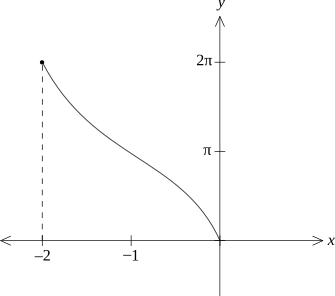
Sketch the graph  \(y=2 \cos ^{-1}(x+1)\).   (3 marks)

--- 10 WORK AREA LINES (style=lined) ---

Show Answers Only

Show Worked Solution

\(\text{Domain:}\)

\(-1 \leqslant x+1 \leqslant 1 \ \Rightarrow \ -2 \leqslant x \leqslant 0\)

\(\text{Range:}\)

\(0 \leqslant \cos ^{-1}(x) \leqslant \pi\ \ \Rightarrow \ \ 0\leqslant 2 \cos ^{-1}(x) \leqslant 2 \pi\)
 

Filed Under: T1 Inverse Trig Functions (Y11) Tagged With: Band 4, smc-1024-11-arccos Graphs

Combinatorics, EXT1 A1 EQ-Bank 15

\(\left(\sqrt{5}-2 \right)^5=x+y \sqrt{5}\)

Find the values of \(x\) and \(y\) using binomial expansion.   (2 marks)

--- 5 WORK AREA LINES (style=lined) ---

Show Answers Only

\(x=-682,  y=305\)

Show Worked Solution

  \( \left(\sqrt{5}-2\right)^5\) \(={ }^5 C_0 \cdot\left(\sqrt{5}\right)^5+{ }^5 C_1\left(\sqrt{5}\right)^4 \cdot(-2)+{ }^5 C_2\left(\sqrt{5}\right)^3 \cdot(-2)^2\)
    \(+{ }^5 C_3\left(\sqrt{5}\right)^2 \cdot(-2)^3 +{ }^5 C_4\left(\sqrt{5}\right) \cdot(-2)^4+{ }^5 C_5(-2)^5 \)
    \( = 25 \sqrt{5}-250+200 \sqrt{5}-400+80 \sqrt{5}-32\)
    \(=  305 \sqrt{5}-682 \)

 
\(\therefore x=-682,  y=305\)

Filed Under: Binomial Expansion (Ext1) Tagged With: Band 4, smc-1088-40-Full Expansion

BIOLOGY, M2 EQ-Bank 9

  1. Identify two different types of tissues found in a leaf.   (1 mark)
  2. Discuss how the overall structure of the leaf as an organ enhances its ability to perform photosynthesis.   (2 marks)
Show Answers Only

a.   Types of tissues can include (choose two):

  • Epidermis, xylem and ground tissue. 

b.   Leaf structure and photosynthesis:

  • A leaf’s broad, flat shape maximises the surface area exposed to sunlight, allowing for efficient light capture.
  • The epidermis on the upper surface is often transparent, allowing light to penetrate to the photosynthetic tissues beneath, while also providing protection and controlling water loss.
  • The xylem, part of the vascular tissue network throughout the leaf, ensures efficient transport of water and minerals to photosynthetic cells, supporting the process of photosynthesis.
Show Worked Solution

a.   Types of tissues can include (choose two):

  • Epidermis, xylem and ground tissue. 

b.   Leaf structure and photosynthesis:

  • A leaf’s broad, flat shape maximises the surface area exposed to sunlight, allowing for efficient light capture.
  • The epidermis on the upper surface is often transparent, allowing light to penetrate to the photosynthetic tissues beneath, while also providing protection and controlling water loss.
  • The xylem, part of the vascular tissue network throughout the leaf, ensures efficient transport of water and minerals to photosynthetic cells, supporting the process of photosynthesis.

Filed Under: Organisation of Cells Tagged With: Band 4, Band 5, smc-4304-80-Plants

BIOLOGY, M2 EQ-Bank 8

Epidermal tissues in plants can be compared to the epithelium in animals.

  1. Describe one structural similarity between these tissue types.   (1 mark)

    --- 2 WORK AREA LINES (style=lined) ---

  2. Outline one functional similarity they share.   (1 mark)

    --- 2 WORK AREA LINES (style=lined) ---

  3. Discuss how both tissues contribute to their respective organism's interaction with the environment.   (2 marks)

    --- 5 WORK AREA LINES (style=lined) ---

Show Answers Only

a.   Structural similarity could include one of the following:

  • Both plant epidermal tissue and animal epithelium form a single layer of tightly packed cells that cover the outer surfaces of the organism.
  • Both types of tissue are typically attached to a basement membrane that separates them from underlying tissues. 

b.   Functional similarity could include one of the following:

  • Both tissue types serve as a protective barrier, shielding the underlying tissues from physical damage.
  • Both tissue types can provide protection from pathogens and excessive water loss. 

c.   Interaction with the environment:

  • In plants, the epidermis regulates gas exchange through stomata and may produce structures like trichomes for protection or water conservation.
  • Similarly, in animals, the epithelium can be specialised for absorption, allowing the organism to respond to various environmental stimuli.
Show Worked Solution

a.   Structural similarity could include one of the following:

  • Both plant epidermal tissue and animal epithelium form a single layer of tightly packed cells that cover the outer surfaces of the organism.
  • Both types of tissue are typically attached to a basement membrane that separates them from underlying tissues. 

b.   Functional similarity could include one of the following:

  • Both tissue types serve as a protective barrier, shielding the underlying tissues from physical damage.
  • Both tissue types can provide protection from pathogens and excessive water loss. 

c.   Interaction with the environment:

  • In plants, the epidermis regulates gas exchange through stomata and may produce structures like trichomes for protection or water conservation.
  • Similarly, in animals, the epithelium can be specialised for absorption, allowing the organism to respond to various environmental stimuli.

Filed Under: Organisation of Cells Tagged With: Band 3, Band 4, Band 5, smc-4304-80-Plants

BIOLOGY, M2 EQ-Bank 7

Describe the relationship between cells and tissues in multicellular organisms, using a specific example to illustrate your answer.   (3 marks)

--- 5 WORK AREA LINES (style=lined) ---

Show Answers Only
  • Cells are the fundamental units of life, capable of performing all basic life processes such as metabolism, growth, and reproduction.
  • Tissues, by comparison, represent the next level of organisation in multicellular organisms, consisting of groups of similar cells working together to perform a specific function.
  • For example, in epithelial tissue, closely packed cells form sheets that line body surfaces and cavities. While individual epithelial cells can perform basic cellular functions, it’s their collective arrangement and specialised features that allow the tissue to act as a protective barrier and regulate the passage of materials.
  • This relationship between cells and tissues demonstrates how the organisation of basic living units into more complex structures enables organisms to develop specialised functions and adapt to diverse environments.
Show Worked Solution
  • Cells are the fundamental units of life, capable of performing all basic life processes such as metabolism, growth, and reproduction.
  • Tissues, by comparison, represent the next level of organisation in multicellular organisms, consisting of groups of similar cells working together to perform a specific function.
  • For example, in epithelial tissue, closely packed cells form sheets that line body surfaces and cavities. While individual epithelial cells can perform basic cellular functions, it’s their collective arrangement and specialised features that allow the tissue to act as a protective barrier and regulate the passage of materials.
  • This relationship between cells and tissues demonstrates how the organisation of basic living units into more complex structures enables organisms to develop specialised functions and adapt to diverse environments.

Filed Under: Organisation of Cells Tagged With: Band 4, smc-4304-60-Hierarchy

BIOLOGY, M2 EQ-Bank 6

Describe the role of tissues in an organ, using a specific example to illustrate your answer.   (3 marks)

--- 6 WORK AREA LINES (style=lined) ---

Show Answers Only

Exemplar answer 1 (using the circulatory system):

  • Tissues play a crucial role in organs by providing specialised structures that work together to perform the organ’s function.
  • In the heart, cardiac muscle tissue forms the bulk of the organ and is responsible for its pumping action. Connective tissue provides support and protection, while epithelial tissue lines the inner chambers of the heart to provide a smooth surface for blood flow.
  • The coordinated action of these different tissues allows the heart to function effectively as a pump, demonstrating how the organisation of tissues contributes to an organ’s overall function in the circulatory system. 

Exemplar answer 2 (using the digestive system):

  • In the stomach, epithelial tissue forms the inner lining that secretes gastric juices and protects the organ from the acidic environment.
  • Smooth muscle tissue in the stomach wall enables the churning and mixing of food, while connective tissue provides structure and support.
  • Additionally, nervous tissue allows for the regulation of digestive processes through nerve signals.
  • The coordinated action of these different tissues enables the stomach to break down food, mix it with digestive enzymes and move it along the digestive tract. This illustrates how the organisation of tissues contributes to an organ’s overall function in the digestive system.
Show Worked Solution

Exemplar answer 1 (using the circulatory system):

  • Tissues play a crucial role in organs by providing specialised structures that work together to perform the organ’s function.
  • In the heart, cardiac muscle tissue forms the bulk of the organ and is responsible for its pumping action. Connective tissue provides support and protection, while epithelial tissue lines the inner chambers of the heart to provide a smooth surface for blood flow.
  • The coordinated action of these different tissues allows the heart to function effectively as a pump, demonstrating how the organisation of tissues contributes to an organ’s overall function in the circulatory system. 

Exemplar answer 2 (using the digestive system):

  • In the stomach, epithelial tissue forms the inner lining that secretes gastric juices and protects the organ from the acidic environment.
  • Smooth muscle tissue in the stomach wall enables the churning and mixing of food, while connective tissue provides structure and support.
  • Additionally, nervous tissue allows for the regulation of digestive processes through nerve signals.
  • The coordinated action of these different tissues enables the stomach to break down food, mix it with digestive enzymes and move it along the digestive tract. This illustrates how the organisation of tissues contributes to an organ’s overall function in the digestive system.

Filed Under: Organisation of Cells Tagged With: Band 4, smc-4304-60-Hierarchy, smc-4304-75-Cardiorespiratory System, smc-4304-78-Other Organ Systems

BIOLOGY, M2 EQ-Bank 8 MC

Consider the following statements about the hierarchical organisation in multicellular organisms:

\(\text{I.}\)   All cells in an organ perform the same function.  
\(\text{II.}\)   Tissues are composed of similar types of cells working together.  
\(\text{III.}\)   Organ systems always contain only one type of organ.  
\(\text{IV.}\)   The function of an organ is dependent on the collective action of its tissues.  

 
Which combination of statements is correct?

  1. \(\text{I}\) and \(\text{II}\) only
  2. \(\text{II}\) and \(\text{IV}\) only
  3. \(\text{I}\), \(\text{II}\), and \(\text{III}\) only
  4. \(\text{II}\), \(\text{III}\), and \(\text{IV}\) only
Show Answers Only

\(B\)

Show Worked Solution

Consider each statement:

  • \(\text{I}\): Incorrect. While cells in an organ often have related functions, not all cells in an organ perform exactly the same function. 
  • \(\text{II}\): Correct. Tissues are indeed composed of similar types of cells working together to perform a specific function.
  • \(\text{III}\): Incorrect. Organ systems usually contain multiple types of organs that work together. For example, the digestive system includes the stomach, intestines, liver, and pancreas.
  • \(\text{IV}\): Correct. The function of an organ does depend on the collective action of its constituent tissues. Each tissue contributes its specific role to the overall function of the organ.

\(\Rightarrow B\)

Filed Under: Organisation of Cells Tagged With: Band 4, smc-4304-60-Hierarchy

BIOLOGY, M2 EQ-Bank 4

Explain how colonial organisms represent an intermediate stage between unicellular and multicellular organisms.

In your answer, include an example that looks at the basic structure of a colonial organism and how it compares to both unicellular and multicellular organisms.   (3 marks)

--- 6 WORK AREA LINES (style=lined) ---

Show Answers Only
  • Colonial organisms represent an intermediate stage between unicellular and multicellular organisms in several ways.
  • The basic structure of a colony consists of many genetically identical cells living together, as seen in sponges where individual cells form a loose association.
  • In terms of cell specialisation, colonial organisms show more diversity than unicellular organisms but less than true multicellular organisms.
  • For example, sponges have some specialised cells for feeding and water flow, but most cells remain relatively undifferentiated.
  • Regarding cooperation, colonial organisms demonstrate more cell interaction than unicellular life forms, with cells in a sponge colony working together to filter water and share nutrients, but they lack the complex, interdependent organ systems found in multicellular organisms.
Show Worked Solution
  • Colonial organisms represent an intermediate stage between unicellular and multicellular organisms in several ways.
  • The basic structure of a colony consists of many genetically identical cells living together, as seen in sponges where individual cells form a loose association.
  • In terms of cell specialisation, colonial organisms show more diversity than unicellular organisms but less than true multicellular organisms.
  • For example, sponges have some specialised cells for feeding and water flow, but most cells remain relatively undifferentiated.
  • Regarding cooperation, colonial organisms demonstrate more cell interaction than unicellular life forms, with cells in a sponge colony working together to filter water and share nutrients, but they lack the complex, interdependent organ systems found in multicellular organisms.

Filed Under: Organisation of Cells Tagged With: Band 4, smc-4304-30-Colonial

BIOLOGY, M2 EQ-Bank 3

Coral polyps form colonies that can grow into large reef structures.

Explain how coral colonies demonstrate characteristics of colonial organisms.   (3 marks)

--- 6 WORK AREA LINES (style=lined) ---

Show Answers Only
  • Coral colonies demonstrate key characteristics of colonial organisms by showing both unicellular and multicellular characteristics in their structure and behaviour.
  • Each individual coral polyp in the colony is capable of surviving on its own, possessing all the necessary structures for feeding, reproduction, and basic life functions, which is a characteristic of unicellular organisms.
  • However, these polyps also cooperate by sharing resources and forming a collective skeleton, showing a level of integration more characteristic of multicellular organisms.
  • Despite this cooperation, coral polyps generally lack the high degree of specialisation seen in true multicellular organisms, maintaining a relatively uniform structure and function across the colony.
Show Worked Solution
  • Coral colonies demonstrate key characteristics of colonial organisms by showing both unicellular and multicellular characteristics in their structure and behaviour.
  • Each individual coral polyp in the colony is capable of surviving on its own, possessing all the necessary structures for feeding, reproduction, and basic life functions, which is a characteristic of unicellular organisms.
  • However, these polyps also cooperate by sharing resources and forming a collective skeleton, showing a level of integration more characteristic of multicellular organisms.
  • Despite this cooperation, coral polyps generally lack the high degree of specialisation seen in true multicellular organisms, maintaining a relatively uniform structure and function across the colony.

Filed Under: Organisation of Cells Tagged With: Band 4, smc-4304-30-Colonial

BIOLOGY, M2 EQ-Bank 2

Compare and contrast the structure and function of a unicellular organism with a specialised cell from a multicellular organism.

In your answer, provide an example of each and discuss how the structures of each cell type relate to their functions.   (3 marks)

--- 6 WORK AREA LINES (style=lined) ---

Show Answers Only
  • A yeast cell is a unicellular organism that has all the structures it needs within a single cell to perform all life functions, including a nucleus for storing genetic information, and organelles like mitochondria for energy production.
  • In contrast, a neuron in a multicellular organism is highly specialised, with branch-like dendrites for receiving signals, and a long axon for sending electrical messages.
  • The yeast cell’s structures allow it to live independently, carrying out all necessary life processes on its own.
  • The neuron’s specialized structure, however, shows how cells in multicellular organisms can have specific jobs, allowing the whole organism to perform more complex functions by dividing tasks among different cell types.
Show Worked Solution
  • A yeast cell is a unicellular organism that has all the structures it needs within a single cell to perform all life functions, including a nucleus for storing genetic information, and organelles like mitochondria for energy production.
  • In contrast, a neuron in a multicellular organism is highly specialised, with branch-like dendrites for receiving signals, and a long axon for sending electrical messages.
  • The yeast cell’s structures allow it to live independently, carrying out all necessary life processes on its own.
  • The neuron’s specialized structure, however, shows how cells in multicellular organisms can have specific jobs, allowing the whole organism to perform more complex functions by dividing tasks among different cell types.

Filed Under: Organisation of Cells Tagged With: Band 4, smc-4304-10-Unicellular, smc-4304-20-Multicellular

CHEMISTRY, M4 EQ-Bank 4 MC

Carbon dioxide decomposes into carbon monoxide and oxygen according to the equation:

   \(\ce{2CO2(g) → 2CO(g) + O2(g)} \quad \Delta H = +566 \, \text{kJ/mol}\)

Which of the following statements about this reaction is correct?

  1. The energy required to break the bonds in the reactants is less than the energy released when the products are formed.
  2. The energy required to break the bonds in the reactants is equal to the energy released when the products are formed.
  3. The energy required to break the bonds in the reactants is less than the energy required to form the reactants from the products.
  4. The energy required to break the bonds in the reactants is more than the energy released when the products are formed.
Show Answers Only

\(D\)

Show Worked Solution
  • This is an endothermic reaction (\(\Delta H > 0\))
  • More energy is absorbed to break the bonds in the reactants (CO₂) than is released during the formation of the products (\(\ce{CO}\) and \(\ce{O2}\)).
  • The positive enthalpy value indicates a net absorption of energy.

\(\Rightarrow D\)

Filed Under: Enthalpy and Hess's Law Tagged With: Band 4, smc-4267-20-Enthalpy and bonding

CHEMISTRY, M4 EQ-Bank 2

  1. Identify Hess' Law.   (2 marks)

    --- 4 WORK AREA LINES (style=lined) ---

  2. Given these heats of formation, \(\Delta H_f\):

\begin{array} {|c|c|}
\hline \text{Chemical} & \Delta H_f \ \text{(kJ mol}^{-1}) \\
\hline  \ce{C2H6(g)} & -84.7 \\
\hline \ce{CO2(g)} & -393.5 \\
\hline \ce{H2O(l)} & -285.8 \\
\hline \ce{CO(g)} & -115 \\
\hline \end{array}

  1. Calculate \(\Delta H\) for the combustion of:
    1.  mole of ethane (\(\ce{C2H6}\)) to produce carbon dioxide and water.   (2 marks)

      --- 5 WORK AREA LINES (style=lined) ---

    2. 1 mole of ethane (\(\ce{C2H6}\)) to produce carbon monoxide and water.   (2 marks)

      --- 5 WORK AREA LINES (style=lined) ---

Show Answers Only

a.    Hess’s Law:

  • The total enthalpy change for a reaction is the same, regardless of the route by which the chemical reaction occurs, provided the initial and final conditions are the same.

b.i.    \(\Delta H= -1560.8 \, \text{kJ/mol}\)

b.ii.   \(\Delta H = -1177.6 \, \text{kJ/mol}\)

Show Worked Solution

a.    Hess’s Law:

  • The total enthalpy change for a reaction is the same, regardless of the route by which the chemical reaction occurs, provided the initial and final conditions are the same.
     

b.i.   Enthalpy change:

  • complete combustion of 1 mole of ethane (\(\ce{C2H6}\)) to produce carbon dioxide and water.
  • \(\ce{C2H6(g) + 3 O2(g) → 2 CO2(g) + 3 H2O(l)}\)
  • \(\Delta H = \Delta H_f \text{ products}-\Delta H_f \text{ reactants}\)
  • \(\Delta H = [2(-393.5) + 3(-285.8)]-[(-84.7)] = -1560.8 \, \text{kJ/mol}\)
     

b.ii.  Enthalpy change:

  • incomplete combustion of 1 mole of ethane (\(\ce{C2H6}\)) to produce carbon monoxide and water.
  • \(\ce{C2H6(g) + 2.5 O2(g) → 2 CO(g) + 3 H2O(l)}\)
  • \(\Delta H = \Delta H_f \text{ products}-\Delta H_f \text{ reactants}\)
  • \(\Delta H = [2(-110.5) + 3(-285.8)]-[(-84.7)] = -1177.6 \, \text{kJ/mol}\)

Filed Under: Enthalpy and Hess's Law Tagged With: Band 4, Band 5, smc-4267-10-Hess's Law in energy cycles, smc-4267-30-Enthalpies of formation

Calculus, EXT1 C1 EQ-Bank 2

75 Tasmanian Devils are placed in a Devil's Ark sanctuary that can support a maximum population of 500 devils. The increase in the devil population is proportional to the difference between the devil population and the number of devils that the sanctuary can support.

  1. Show that  \(D=500-A e^{k t}\)  is a solution to the differential equation \(\dfrac{d D}{d t}=k(D-500)\), where \(D\) is the current devil population, \(t\) is time in years and \(k\) is the constant of proportionality.   (1 mark)

    --- 3 WORK AREA LINES (style=lined) ---

  2. After two years, the population has grown to 245. Show that  \(k=-0.255\), correct to three significant figures.   (2 marks)

    --- 6 WORK AREA LINES (style=lined) ---

  3. Hence, determine how many devils will be on the island after 5 years.  (1 mark)

    --- 3 WORK AREA LINES (style=lined) ---

Show Answers Only

a.    \(D\) \(=500-A e^{k t}\)
  \(\dfrac{dD}{dt}\) \(=-kAe^{kt}\)
    \(=k(500-Ae^{kt}-500)\)
    \(=k(D-500)\)

 
b.   
\(\text{Find}\ A,\ \text{given}\ \ t=0\ \ \text{when}\ \ D=75:\)

\(\begin{aligned} 75 & =500-A e^0 \\
A & =500-75 \\
& =425
\end{aligned}\)

\(\text{Find}\ k,\ \text{given}\ \ t=2\ \ \text{when}\ \ D=245:\)

\(\begin{aligned}
245 & =500-425 e^{2k} \\
e^{2k} & =\dfrac{500-245}{425} \\
2k & = \log_{e}(0.6) \\
k & =\dfrac{1}{2}\log_{e}(0.6)\\
 & =-0.2554… \\
& =-0.255 \ \text{(3 sig. figures as required)}
\end{aligned}\)

 
c.  
\(\text{381 devils}\)

Show Worked Solution

a.    \(D\) \(=500-A e^{k t}\)
  \(\dfrac{dD}{dt}\) \(=-kAe^{kt}\)
    \(=k(500-Ae^{kt}-500)\)
    \(=k(D-500)\)

 
b.   
\(\text{Find}\ A,\ \text{given}\ \ t=0\ \ \text{when}\ \ D=75:\)

\(\begin{aligned} 75 & =500-A e^0 \\
A & =500-75 \\
& =425
\end{aligned}\)

\(\text{Find}\ k,\ \text{given}\ \ t=2\ \ \text{when}\ \ D=245:\)

\(\begin{aligned}
245 & =500-425 e^{2k} \\
e^{2k} & =\dfrac{500-245}{425} \\
2k & = \log_{e}(0.6) \\
k & =\dfrac{1}{2}\log_{e}(0.6)\\
 & =-0.2554… \\
& =-0.255 \ \text{(3 sig. figures as required)}
\end{aligned}\)

 
c. 
 \(\text{Find}\ D\ \text{when}\ \ t=5:\)

\(D\) \(=500-425e^{5 \times -0.255} \)  
  \(=381.24…\)  
  \(=381\ \text{devils (nearest whole)}\)  

Filed Under: Modified Growth and Decay Tagged With: Band 3, Band 4, smc-1080-20-Other

CHEMISTRY, M4 EQ-Bank 3 MC

Which of the following are the main products of respiration?

  1. Oxygen and glucose
  2. Water and carbon dioxide
  3. Lactic acid and oxygen
  4. Glucose and water
Show Answers Only

\(B\)

Show Worked Solution
  • The balanced equation for respiration is:
  •    \(\ce{C6H12O6 + 6O2 → 6CO2 + 6H2O + energy}\)     \(-\Delta H\)
  • Thus, the main products are carbon dioxide and water.

\(\Rightarrow B\)

Filed Under: Enthalpy and Hess's Law Tagged With: Band 4, smc-4267-20-Enthalpy and bonding

CHEMISTRY, M4 EQ-Bank 17

The decomposition of a metal carbonate is represented by the following equation:

\(\ce{MCO3(s) → MO(s) + CO2(g)}\)

The following data was recorded:

\(\Delta H = +130 \, \text{kJ/mol},\ \ \Delta S = +160 \, \text{J/mol K}\)

  1. Calculate the Gibbs free energy at 350 K.   (2 marks)

--- 4 WORK AREA LINES (style=blank) ---

  1. Determine if the reaction is spontaneous at this temperature.   (1 mark)

--- 2 WORK AREA LINES (style=blank) ---

  1. Discuss how both enthalpy and entropy influence the spontaneity of this reaction and predict the temperature range in which the reaction will be spontaneous.   (4 marks)

--- 8 WORK AREA LINES (style=blank) ---

Show Answers Only

a.    \(\Delta G = +74 \, \text{kJ/mol}\)

b.    The reaction is non-spontaneous at 350 K.

c.   Enthalpy and entropy influence the spontaneity:

  • To be spontaneous, \(\Delta G\) must be negative, where  \(\Delta G = \Delta H- T\Delta S\).
  • The reaction has a positive enthalpy, indicating it requires energy input, which opposes spontaneity.
  • However, the positive entropy means the disorder of the system increases, which favours spontaneity.
  • At higher temperatures, the entropy contribution will dominate, overcoming the positive enthalpy and making the reaction spontaneous.
  • To find the temperature where the reaction becomes spontaneous, set \(\Delta G = 0\):
  •    \(0=\Delta H-T\Delta S\)
  •    \(T=\dfrac{\Delta H}{\Delta S}=\dfrac{130}{0.160}=812.5\ \text{K}\)
  • Thus, the reaction will be spontaneous above 812.5 K.
Show Worked Solution

a.    \(\Delta G = \Delta H- T\Delta S\)

Convert \(\Delta S\) to \(\text{kJ/mol K}\)

\(\Delta S = 0.160 \, \text{kJ/mol K}\)

\(\Delta G = 130-(350 \times 0.160) = 130-56 = +74 \, \text{kJ/mol}\)
 

b.    Since \(\Delta G > 0\), the reaction is non-spontaneous at 350 K.
 

c.   Enthalpy and entropy influence the spontaneity:

  • To be spontaneous, \(\Delta G\) must be negative, where  \(\Delta G = \Delta H- T\Delta S\).
  • The reaction has a positive enthalpy, indicating it requires energy input, which opposes spontaneity.
  • However, the positive entropy means the disorder of the system increases, which favours spontaneity.
  • At higher temperatures, the entropy contribution will dominate, overcoming the positive enthalpy and making the reaction spontaneous.
  • To find the temperature where the reaction becomes spontaneous, set \(\Delta G = 0\):
  •    \(0=\Delta H-T\Delta S\)
  •    \(T=\dfrac{\Delta H}{\Delta S}=\dfrac{130}{0.160}=812.5\ \text{K}\)
  • Thus, the reaction will be spontaneous above 812.5 K.

Filed Under: Entropy and Gibbs Free Energy Tagged With: Band 4, Band 6, smc-4268-50-Determining Spontaneity, smc-4268-80-Calculating G

CHEMISTRY, M4 EQ-Bank 16

Given the following values for a reaction:

\(\Delta H = +150 \, \text{kJ/mol}\)  and  \(\Delta S = +250 \, \text{J/mol K}\)

  1. Calculate the Gibbs free energy at 298 K.   (2 mark)

    --- 4 WORK AREA LINES (style=blank) ---

  2. Is the reaction spontaneous at this temperature? Justify your answer.   (1 mark)

    --- 2 WORK AREA LINES (style=lined) ---

  3. Predict the temperature at which the reaction would become spontaneous.   (2 marks)

    --- 5 WORK AREA LINES (style=blank) ---

Show Answers Only

a.    \(\Delta G = +75.5 \, \text{kJ/mol}\)
 
b.    The reaction is non-spontaneous at 298 K.
 
c.    The reaction becomes spontaneous above 600 K.

Show Worked Solution

a.    \(\Delta G = \Delta H-T\Delta S\):

Convert \(\Delta S\) to \(\text{kJ/mol K}\):

\(\Delta S = 0.250 \, \text{kJ/mol K}\)

\(\Delta G = 150-(298 \times 0.250) = 150-74.5 = +75.5 \, \text{kJ/mol}\)
 

b.    \(\Delta G > 0\) at 298 K \(\Rightarrow\) reaction is non-spontaneous at 298 K.
 

c.    Find the temperature where the reaction becomes spontaneous:

  • Solve for \(T\) when \(\Delta G = 0\):
  •    \(0= \Delta H-T\Delta S\)
  •    \(T = \dfrac{\Delta H}{\Delta S} = \dfrac{150}{0.250} = 600 \, \text{K}\)
  • As the temperature rises, \(T\Delta S\) increases, therefore \(\Delta G\) decreases, increasing the spontaneity of the reaction.
  • The reaction becomes spontaneous above 600 K.

Filed Under: Entropy and Gibbs Free Energy Tagged With: Band 4, Band 5, smc-4268-50-Determining Spontaneity, smc-4268-80-Calculating G

Calculus, EXT1 C1 EQ-Bank 2

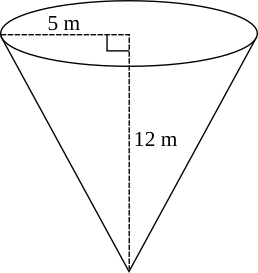
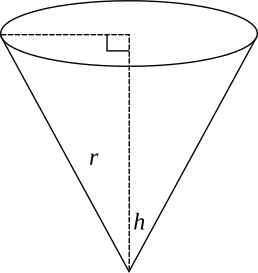
A wheat silo in the shape of a right cone is pictured below.

The silo has a height of 12 metres and a base radius of 5 metres. Wheat is poured into the top of the silo at a rate of 3 cubic metres per minute.

At any given time, the wheat filling the silo will have a vertical height of \(h\) metres from the bottom tip and a radius \(r\).
 

  1. Explain why  \(r=\dfrac{5h}{12} \)   (1 mark)
  2. Find an expression for \(\dfrac{dh}{dt}\).   (2 marks)
  3. At what rate is the height of the wheat in the cone increasing when the height of the wheat in the cone is 7 metres from the bottom?   (1 mark)

Show Answers Only

\(\dfrac{432}{1225\pi}\ \text{m/minute} \)

Show Worked Solution

a.   \(\text{Using similar triangles:}\)

\(\dfrac{r}{h}=\dfrac{5}{12}\ \ \Rightarrow \ r=\dfrac{5h}{12} \)
 

b.   \(V =\dfrac{1}{3} \pi r^2 h=\dfrac{1}{3} \pi\left(\dfrac{5h}{12}\right)^2 \times h = \dfrac{25\pi}{432} \times h^{3} \)

\(\dfrac{dV}{dh} = \dfrac{3 \times 25\pi}{432} \times h^{2} = \dfrac{25\pi}{144} \times h^{2}\)

\(\Rightarrow \dfrac{dh}{dV}= \dfrac{144}{25\pi \times h^{2}}\)

\(\Rightarrow \dfrac{dV}{dt}=3\ \ \text{(given)}\)
 

\(\dfrac{d h}{d t} =\dfrac{d h}{dV} \times \dfrac{dV}{dt} = 3 \times \dfrac{144}{25\pi \times h^{2}} \)

 
c.   \(\text {When}\ \  h=7:\)

\(\dfrac{d h}{d t} = 3 \times \dfrac{144}{25\pi \times 7^{2}}=\dfrac{432}{1225\pi}\ \text{m/minute} \)

Filed Under: Related Rates of Change (Ext1) Tagged With: Band 4, smc-1079-10-Volume

Functions, EXT1 F1 EQ-Bank 12

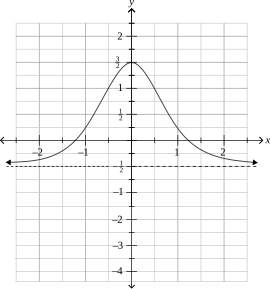
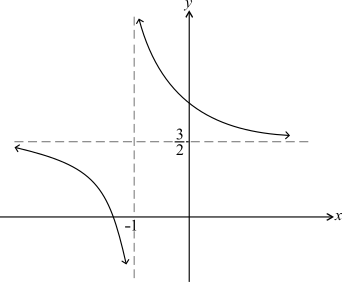
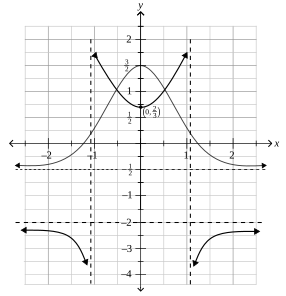
The diagram shows the graph of the function \(y=f(x)\).


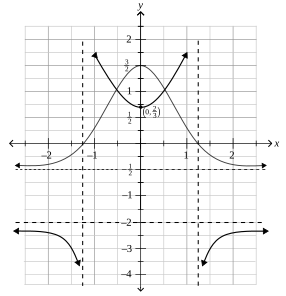
On the diagram, sketch the graph of  \(y=\dfrac{1}{f(x)}\), stating the range in set notation.   (3 marks)

--- 4 WORK AREA LINES (style=lined) ---


Show Answers Only

\(\text{Range}\ y=\dfrac{1}{f(x)}:  \Big(-\infty, -2\Big)\ \cup\  \Big[\dfrac{2}{3}, \infty\Big)\)

Show Worked Solution

Note: graphs must intersect on \(y=1\) line.

\(\text{Range}\ y=\dfrac{1}{f(x)}:  \Big(-\infty, -2\Big)\ \cup\  \Big[\dfrac{2}{3}, \infty\Big)\)

Filed Under: Reflections and Harder Graphs (Ext1) Tagged With: Band 4, smc-1072-10-y = 1 / f(x)

Trigonometry, EXT1 T3 EQ-Bank 5

By making the substitution  \(t=\tan \dfrac{\theta}{2}\), or otherwise, show that  \(\dfrac{1+\sin x-\cos x}{1+\sin x+\cos x}=\tan \dfrac{x}{2}\).   (3 marks)

--- 8 WORK AREA LINES (style=lined) ---

Show Answers Only

  \(\operatorname{LHS} \) \( =\dfrac{1+\sin x-\cos x}{1+\sin x+\cos x}\)
    \( =\dfrac{1+\dfrac{2 t}{1+t^2}-\dfrac{1-t^2}{1+t^2}}{1+\dfrac{2 t}{1+t^2}+\dfrac{1-t^2}{1+t^2}} \times \dfrac{1+t^2}{1+t^2}\)
    \( =\dfrac{1+t^2+2 t-1+t^2}{1+t^2+2 t+1-t^2}\)
    \( =\dfrac{2 t(t+1)}{2(t+1)} \)
    \(=t\)
    \(=\tan \dfrac{x}{2}\)

Show Worked Solution

  \(\operatorname{LHS} \) \( =\dfrac{1+\sin x-\cos x}{1+\sin x+\cos x}\)
    \( =\dfrac{1+\dfrac{2 t}{1+t^2}-\dfrac{1-t^2}{1+t^2}}{1+\dfrac{2 t}{1+t^2}+\dfrac{1-t^2}{1+t^2}} \times \dfrac{1+t^2}{1+t^2}\)
    \( =\dfrac{1+t^2+2 t-1+t^2}{1+t^2+2 t+1-t^2}\)
    \( =\dfrac{2 t(t+1)}{2(t+1)} \)
    \(=t\)
    \(=\tan \dfrac{x}{2}\)


Filed Under: Identities, Equations and 't' formulae (Ext1) Tagged With: Band 4, smc-1076-30-`t` formulae

Functions, EXT1 F1 EQ-Bank 2

Sketch the graph of  \(y=\abs{x^2-5x+4}\).   (2 marks)

--- 10 WORK AREA LINES (style=blank) ---

Show Answers Only

Show Worked Solution

\(y=\abs{x^2-5 x+4}=\abs{(x-1)(x-4)}\)

\(x\text{-intercepts at} \ (1,0), (4,0)\)

\(y=(x-1)(x-4) \ \text{has low at} \ \ x=\dfrac{5}{2} \ \text{(by symmetry)}\)

\(\Rightarrow \ \text {Low at} \ \left(\dfrac{5}{2},\dfrac{-9}{4}\right)\)
 

Filed Under: Reflections and Harder Graphs (Ext1) Tagged With: Band 4, smc-1072-30-y = | f(x) |; y = f( |x| )

Functions, EXT1 F1 EQ-Bank 3

If  \(f(x)=\dfrac{4-e^{5 x}}{3}\),  find the inverse function  \(f^{-1}(x)\).   (2 marks)

--- 6 WORK AREA LINES (style=lined) ---

Show Answers Only

\(f^{-1}=\dfrac{1}{5} \ln \abs{4-3x}\)

Show Worked Solution

\(f(x) = \dfrac{4-e^{5x}}{3}\)

\(\text{Inverse: swap}\ \ x↔y\)

\(x\) \(=\dfrac{4-e^{5x}}{3} \)  
\(3x\) \(=4-e^{5y}\)  
\(e^{5y}\) \(=4-3x\)  
\(\ln e^{5y}\) \(=\ln \abs{4-3x}\)  
\(5y\) \(=\ln \abs{4-3x}\)  
\(y\) \(=\dfrac{1}{5} \ln \abs{4-3x}\)  

Filed Under: Inverse Functions (Ext1) Tagged With: Band 4, smc-1034-10-Logs and Exponentials

Functions, EXT1 F2 EQ-Bank 1

The polynomial  \(P(x)=2 x^3-m x^2+n x+27\)  has a double root and  \(P(-3)=P^{\prime}(-3)=0\). 

Find the values of \(m\) and \(n\) and hence find the other root of \(P(x)\).   (3 marks)

--- 8 WORK AREA LINES (style=lined) ---

Show Answers Only

\(m=-15, n=36\)

\(\gamma= -\dfrac{3}{2}\)

Show Worked Solution

\(P(x)=2 x^3-m x^2+n x+27\)

\(P^{′}(x)=6x^2-2m x+n\)

\(P(-3)\) \(=2 \times (-3)^{3}-(-3)^2m-3n+27\)  
\(0\) \(=-54-9m-3n+27\)  
\(9m+3n\) \(=-27\ \ …\ (1)\)  


\(P^{′}(-3)\) \(=6 \times (-3)^2+6m+n\)  
\(6m+n\) \(=-54\)  
\(18m+3n\) \(=-162\ …\ (2)\)  

 
   \( (2)-(1):\)

\(9m=-135\ \ \Rightarrow  m=-15\)

\(6 \times -15+n=-54\ \ \Rightarrow \ n=36\)

\(\text{Using product of roots:}\)

\(\alpha \beta \gamma\) \(=\dfrac{-d}{a}\)  
\((-3)^{2} \gamma\) \(=\dfrac{-27}{2} \)  
\(\gamma\) \(=\dfrac{-27}{2 \times 9} = -\dfrac{3}{2}\)  

Filed Under: Sum, Products and Multiplicity of Roots (Ext1) Tagged With: Band 4, smc-1205-20-Multiplicity of Roots

CHEMISTRY, M4 EQ-Bank 7 MC

At what temperature would the reaction with the following enthalpy and entropy values become non-spontaneous?

\(\Delta H = +100 \, \text{kJ/mol}\)  and  \(\Delta S = +200 \, \text{J/mol K}\)

  1. Below 500 K
  2. Above 500 K
  3. Below 250 K
  4. Above 250 K
Show Answers Only

\(A\)

Show Worked Solution
  • To determine when the reaction becomes non-spontaneous, solve for \(T\) when \(\Delta G = 0\):
  •    \(0 = \Delta H-T\Delta S\)
  •    \(T = \dfrac{\Delta H}{\Delta S} = \dfrac{100}{0.200} = 500 \, \text{K}\)
  • As the temperature increases, \(T\Delta S\) increases and so \(\Delta G\) decreases. For a non-spontaneous reaction, \(\Delta G\) must be postive.
  • Thus, the reaction becomes non-spontaneous below 500 K.

\(\Rightarrow A\)

Filed Under: Entropy and Gibbs Free Energy Tagged With: Band 4, smc-4268-50-Determining Spontaneity

CHEMISTRY, M4 EQ-Bank 6 MC

The chemical reaction has the following enthalpy and entropy values:

\(\Delta H = -400 \, \text{kJ/mol}\)  and  \(\Delta S = +150 \, \text{J/mol K}\)

Determine the spontaneity of the reaction.

  1. Always spontaneous
  2. Spontaneous at low temperatures only
  3. Spontaneous at high temperatures only
  4. Non-spontaneous at all temperatures
Show Answers Only

\(A\)

Show Worked Solution
  • For a reaction to be spontaneous, \(\Delta G\) must be negative.
  • Using \(\Delta G = \Delta H-T\Delta S\), since \(\Delta H\) is negative and \(\Delta S\) is positive, \(\Delta G\) will always be negative, making the reaction spontaneous at all temperatures.

\(\Rightarrow A\)

Filed Under: Entropy and Gibbs Free Energy Tagged With: Band 4, smc-4268-50-Determining Spontaneity

Trigonometry, EXT1 T2 EQ-Bank 8

  1. Show that  \(\dfrac{\sin 2 x}{1+\cos 2 x}=\tan x\).  (1 mark)

    --- 3 WORK AREA LINES (style=lined) ---

  2. Hence find the exact value of \(\tan \dfrac{\pi}{8}\) in simplest form.  (2 marks)

    --- 5 WORK AREA LINES (style=lined) ---

Show Answers Only

a.   \(\dfrac{\sin 2 x}{1+\cos 2 x}\) \(=\dfrac{2\sin x \cos x}{2\cos^{2} x}\)  
  \(=\dfrac{\sin x}{\cos x}\)  
  \(=\tan x\)  

b.   \(\sqrt2-1\)

Show Worked Solution

a.   \(\dfrac{\sin 2 x}{1+\cos 2 x}\) \(=\dfrac{2\sin x\, \cos x}{2\cos^{2} x}\)  
  \(=\dfrac{\sin x}{\cos x}\)  
  \(=\tan x\)  


b.    \(\tan \dfrac{\pi}{8}\) \(=\dfrac{\sin \frac{\pi}{4}}{1+\cos \frac{\pi}{4}}\)
    \(= \dfrac{\frac{1}{\sqrt2}}{1+\frac{1}{\sqrt2}} \times \dfrac{\sqrt2}{\sqrt2} \)
    \(= \dfrac{1}{\sqrt2+1} \times \dfrac{\sqrt2-1}{\sqrt2-1}\)
    \(=\sqrt2-1\)

Filed Under: T2 Further Trigonometric Identities (Y11) Tagged With: Band 3, Band 4, smc-1025-10-Double Angles

CHEMISTRY, M4 EQ-Bank 4 MC

Which of the following would involve an increase in entropy?

  1. \(\ce{H2O(l) → H2O(s)}\)
  2. \(\ce{2 Na2CO3(aq) + 3 CaCl2(aq) → 2 NaCl(s) + 3 CaCO3(s)}\)
  3. \(\ce{2 NH3(g) + 3 HCl(g) → 2 NH4Cl(s)}\)
  4. \(\ce{Na2CO3(s) → 2Na^+ + CO3^{2-}(aq)}\)
Show Answers Only

\(D\)

Show Worked Solution
  • Dissolving a solid into an aqueous solution increases entropy, as the ions become separated from the ionic lattice and so more disordered in the solution.

\(\Rightarrow D\)

Filed Under: Entropy and Gibbs Free Energy Tagged With: Band 4, smc-4268-60-Predicting Entropy Changes

CHEMISTRY, M4 EQ-Bank 14

The combustion of propane is represented by the following equation:

\(\ce{C3H8(g) + 5O2(g) \rightarrow 3CO2(g) + 4H2O(l)}\)

\(\Delta H = -2220\ \text{kJ mol}^{-1}\),  \(\Delta S = -269\ \text{J mol}^{-1}\text{K}^{-1}\)

  1. Justify why the entropy change for this reaction is negative based on the chemical equation.   (2 marks)

    --- 4 WORK AREA LINES (style=lined) ---

  1. Using the Gibbs free energy equation, determine if the combustion of propane is spontaneous at 298 K. Show your working.  (2 marks)

    --- 4 WORK AREA LINES (style=lined) ---

Show Answers Only

a.    Entropy change in the combustion of propane:

  • The reactants include 1 molecule of propane gas and 5 molecules of oxygen gas, making a total of 6 gas molecules.
  • The products, however, consist of 3 molecules of carbon dioxide gas and 4 molecules of liquid water.
  • Since gases have higher entropy than liquids, the total number of gas molecules decreases from 6 to 3, which results in a decrease in disorder.
  • This explains why the entropy change, \(\Delta S\), is negative. 

b.    Using the Gibbs free energy equation:

\(\Delta G = \Delta H-T \Delta S\)

Convert \(\Delta S\) from \(\text{J mol}^{-1}\text{K}^{-1}\) to \(\text{kJ mol}^{-1}\text{K}^{-1}\):

\(\Delta S = -0.269\ \text{kJ mol}^{-1}\text{K}^{-1}\).

\(\Delta G\) \(= -2220\ \text{kJ mol}^{-1}-(298\ \text{K} \times -0.269\ \text{kJ mol}^{-1}\text{K}^{-1})\)  
  \(= -2220\ \text{kJ mol}^{-1} + 80.162\ \text{kJ mol}^{-1}\)  
  \(= -2139.84\ \text{kJ mol}^{-1}\)  

 
\(\Rightarrow\) Since \(\Delta G < 0\), the reaction is spontaneous at 298 K.

Show Worked Solution

a.    Entropy change in the combustion of propane:

  • The reactants include 1 molecule of propane gas and 5 molecules of oxygen gas, making a total of 6 gas molecules.
  • The products, however, consist of 3 molecules of carbon dioxide gas and 4 molecules of liquid water.
  • Since gases have higher entropy than liquids, the total number of gas molecules decreases from 6 to 3, which results in a decrease in disorder.
  • This explains why the entropy change, \(\Delta S\), is negative.

b.    Using the Gibbs free energy equation:

\(\Delta G = \Delta H-T \Delta S\)

Convert \(\Delta S\) from \(\text{J mol}^{-1}\text{K}^{-1}\) to \(\text{kJ mol}^{-1}\text{K}^{-1}\):

\(\Delta S = -0.269\ \text{kJ mol}^{-1}\text{K}^{-1}\).

\(\Delta G\) \(= -2220\ \text{kJ mol}^{-1}-(298\ \text{K} \times -0.269\ \text{kJ mol}^{-1}\text{K}^{-1})\)  
  \(= -2220\ \text{kJ mol}^{-1} + 80.162\ \text{kJ mol}^{-1}\)  
  \(= -2139.84\ \text{kJ mol}^{-1}\)  
     
  • Since \(\Delta G < 0\), the reaction is spontaneous at 298 K.

Filed Under: Entropy and Gibbs Free Energy Tagged With: Band 4, smc-4268-50-Determining Spontaneity, smc-4268-80-Calculating G

Trigonometry, EXT1 T2 EQ-Bank 3

  1. Show that  \(\cos 30^{\circ} \cos 15^{\circ}=\dfrac{1}{2}\left[\cos 15^{\circ}+\dfrac{1}{\sqrt{2}}\right]\).  (2 marks)

    --- 5 WORK AREA LINES (style=lined) ---

  2. Hence, or otherwise, find the exact value of  \(\cos 15^{\circ}\).   (2 marks)

    --- 5 WORK AREA LINES (style=lined) ---

Show Answers Only

a.   \(\text{Show:}\ \cos 30^{\circ} \cos 15^{\circ}=\dfrac{1}{2}\left[\cos 15^{\circ}+\dfrac{1}{\sqrt{2}}\right]\)

\(\cos(30^{\circ}+15^{\circ})=\cos 30^{\circ} \cos 15^{\circ}-\sin 30^{\circ} \sin 15^{\circ}\ …\ (1)\)

\(\cos(30^{\circ}-15^{\circ})=\cos 30^{\circ} \cos 15^{\circ}+\sin 30^{\circ} \sin 15^{\circ}\ …\ (2)\)

  \(\text{Add (1) + (2):}\)

\(2\cos 30^{\circ} \cos 15^{\circ}\) \(=\cos 45^{\circ}+\cos 15^{\circ}\)  
\(\cos 30^{\circ} \cos 15^{\circ}\) \(=\dfrac{1}{2}\Big[\cos 15^{\circ}+\dfrac{1}{\sqrt2}\Big] \)  

 
b.
  \(\cos 15^{\circ}=\dfrac{\sqrt6+\sqrt2}{4} \)

Show Worked Solution

a.   \(\text{Show:}\ \cos 30^{\circ} \cos 15^{\circ}=\dfrac{1}{2}\left[\cos 15^{\circ}+\dfrac{1}{\sqrt{2}}\right]\)

\(\cos(30^{\circ}+15^{\circ})=\cos 30^{\circ} \cos 15^{\circ}-\sin 30^{\circ} \sin 15^{\circ}\ …\ (1)\)

\(\cos(30^{\circ}-15^{\circ})=\cos 30^{\circ} \cos 15^{\circ}+\sin 30^{\circ} \sin 15^{\circ}\ …\ (2)\)

  \(\text{Add (1) + (2):}\)

\(2\cos 30^{\circ} \cos 15^{\circ}\) \(=\cos 45^{\circ}+\cos 15^{\circ}\)  
\(\cos 30^{\circ} \cos 15^{\circ}\) \(=\dfrac{1}{2}\Big[\cos 15^{\circ}+\dfrac{1}{\sqrt2}\Big] \)  


b.    \(2\cos 30^{\circ} \cos 15^{\circ}\) \(=\cos 15^{\circ}+\dfrac{1}{\sqrt2}\)
  \(\cos 15^{\circ}(2\cos 30^{\circ}-1)\) \(=\dfrac{1}{\sqrt2}\)
  \(\cos 15^{\circ}(\sqrt3-1)\) \(=\dfrac{1}{\sqrt2}\)
  \(\cos 15^{\circ}\) \(=\dfrac{1}{\sqrt2(\sqrt3-1)}\)
    \(=\dfrac{1}{\sqrt6-\sqrt2} \times \dfrac{\sqrt6+\sqrt2}{\sqrt6+\sqrt2}\)
    \(=\dfrac{\sqrt6+\sqrt2}{4} \)

Filed Under: T2 Further Trigonometric Identities (Y11) Tagged With: Band 4, Band 5, smc-1025-20-Compound Angles

Combinatorics, EXT1 A1 EQ-Bank 3

Four girls and four boys are to be seated around a circular table. In how many ways can the eight children be seated if:

  1. there are no restrictions?   (1 mark)

    --- 2 WORK AREA LINES (style=lined) ---

  2. the two tallest boys must not be seated next to each other?   (1 mark)

    --- 3 WORK AREA LINES (style=lined) ---

  3. the two youngest children sit together?   (1 mark)

    --- 3 WORK AREA LINES (style=lined) ---

Show Answers Only

a.   \(\text{Combinations (no restriction)}\ = 7! \)

b.   \(\text{Total combinations}\ = 5 \times 6! \)

c.   \(\text{Total combinations}\ = 2 \times 6! \)

Show Worked Solution

a.   \(\text{Fix one child in a seat (strategy for circle combinations):}\)

\(\text{Combinations (no restriction)}\ = 7! \)
 

b.   \(\text{Fix the tallest boy in a seat:}\)

\(\text{Possible seats for 2nd tallest boy}\ =5\)

\(\text{Combinations for other 6 children}\ = 6! \)

\(\text{Total combinations}\ = 5 \times 6! \)
 

c.   \(\text{Fix the youngest in a seat:}\)

\(\text{Possible seats for 2nd youngest}\ =2\)

\(\text{Combinations for other 6 children}\ = 6! \)

\(\text{Total combinations}\ = 2 \times 6! \)

Filed Under: Permutations and Combinations (Ext1) Tagged With: Band 3, Band 4, smc-1082-30-Combinations in a Circle

CHEMISTRY, M4 EQ-Bank 2 MC

Which of the following scenarios would lead to a decrease in entropy?

  1. A gas condensing into a liquid
  2. A solid dissolving into water
  3. One particle decomposes into two
  4. A solid breaking down into multiple particles
Show Answers Only

\(A\)

Show Worked Solution
  • A gas condensing into a liquid results in a decrease in entropy because the molecules in the liquid phase are more organised and have less freedom of movement compared to the gas phase. 
  • This leads the system to a reduction in disorder.

\(\Rightarrow A\)

Filed Under: Entropy and Gibbs Free Energy Tagged With: Band 4, smc-4268-60-Predicting Entropy Changes

CHEMISTRY, M1 EQ-Bank 11

  1. Draw Lewis dot diagrams for both water AND methane.   (2 marks)

--- 2 WORK AREA LINES (style=blank) ---

  1. Methane has a boiling point of –161.5°C, while water has a melting point of 0°C and a boiling point of 100°C.
  2. Account for the differences in these physical properties for these TWO common substances in our atmosphere.   (2 marks)

--- 4 WORK AREA LINES (style=lined) ---

Show Answers Only

a.   Methane \((\ce{CH4})\)       Water \((\ce{H2O})\)

 
  • All electrons must be shown as dots, not crosses, circles, etc.
  • No lines should be present to represent covalent bonds. 

b.   Differences in the physical properties of methane and water:

  • Can be explained by the differences in their molecular structures and intermolecular forces.
  • Methane \(\ce{(CH4)}\) is a nonpolar molecule with weak dispersion forces between its molecules. These weak forces result in a very low boiling point of -161.5°C.
  • Water \(\ce{(H2O)}\), on the other hand, is a polar molecule that forms strong hydrogen bonds between its molecules. These strong intermolecular forces require more energy to be broken and result in much higher melting and boiling points (0°C and 100°C, respectively).
Show Worked Solution

a.   Methane \((\ce{CH4})\)       Water \((\ce{H2O})\)

 
  • All electrons must be shown as dots, not crosses, circles, etc.
  • No lines should be present to represent covalent bonds. 

b.   Differences in the physical properties of methane and water:

  • Can be explained by the differences in their molecular structures and intermolecular forces.
  • Methane \(\ce{(CH4)}\) is a nonpolar molecule with weak dispersion forces between its molecules. These weak forces result in a very low boiling point of -161.5°C.
  • Water \(\ce{(H2O)}\), on the other hand, is a polar molecule that forms strong hydrogen bonds between its molecules. These strong intermolecular forces require more energy to be broken and result in much higher melting and boiling points (0°C and 100°C, respectively).

Filed Under: Bonding Tagged With: Band 4, Band 5, smc-4258-30-Lewis Dot, smc-4258-40-Inter/Intramolecular Bonding

CHEMISTRY, M2 EQ-Bank 4

A student is required to dilute 150.00 mL solution of 3.00 mol L\(^{-1}\) hydrochloric acid to produce 250.00 mL of 0.54 mol L\(^{-1}\) hydrochloric acid. 

Explain how the student should perform this dilution in a school laboratory. Include relevant calculations in your answer AND explain how the student should prepare any equipment they would use.   (4 marks)

--- 8 WORK AREA LINES (style=lined) ---

Show Answers Only
  • The student should wash a 250 mL volumetric flask with distilled water only, if any hydrochloric acid was in the flask it would increase the final concentration to an unknown value.
  • A 50 mL volumetric pipette should be rinsed with distilled water to remove impurities then rinsed with the 3.00 M HCl solution to be diluted, as if any water was left in the pipette it would dilute the acid by an unknown factor.
  • The initial and final concentrations and volumes are related by the dilution equation:
  •    \(C_1 V_1 = C_2 V_2 \), where
  •    \( C_1 = 3.00 \, \text{M} \) (initial concentration)
  •    \( V_1 \) = volume to be pipetted
  •    \( C_2 = 0.54 \, \text{M} \) (final concentration)
  •    \( V_2 = 250.00 \, \text{mL} \) (final volume)
  • Rearrange to solve for \( V_1 \):
  •    \( V_1 = \dfrac{C_2 V_2}{C_1}  = \dfrac{0.54 \times 250.00}{3.00}= \dfrac{125.00}{3.00} = 45 \, \text{mL} \)
  • Thus, the student would pipette 45 mL of the 3.00 M acid and deliver it to the 250 mL volumetric flask, making it up to the 250 mL line with distilled water. This would produce a 0.50 M dilution.
Show Worked Solution
  • The student should wash a 250 mL volumetric flask with distilled water only, if any hydrochloric acid was in the flask it would increase the final concentration to an unknown value.
  • A 50 mL volumetric pipette should be rinsed with distilled water to remove impurities then rinsed with the 3.00 M HCl solution to be diluted, as if any water was left in the pipette it would dilute the acid by an unknown factor.
  • The initial and final concentrations and volumes are related by the dilution equation:
  •    \(C_1 V_1 = C_2 V_2 \), where
  •    \( C_1 = 3.00 \, \text{M} \) (initial concentration)
  •    \( V_1 \) = volume to be pipetted
  •    \( C_2 = 0.54 \, \text{M} \) (final concentration)
  •    \( V_2 = 250.00 \, \text{mL} \) (final volume)
  • Rearrange to solve for \( V_1 \):
  •    \( V_1 = \dfrac{C_2 V_2}{C_1}  = \dfrac{0.54 \times 250.00}{3.00}= \dfrac{125.00}{3.00} = 45 \, \text{mL} \)
  • Thus, the student would pipette 45 mL of the 3.00 M acid and deliver it to the 250 mL volumetric flask, making it up to the 250 mL line with distilled water. This would produce a 0.50 M dilution.

Filed Under: Concentration and Molarity Tagged With: Band 4, Band 5, smc-4261-60-Dilutions, smc-4261-90-Practical Investigation

CHEMISTRY, M2 EQ-Bank 3

A student is required to dilute 100.00 mL solution of 2.00 mol L\(^{-1}\) hydrochloric acid to produce 200.00 mL of 0.20 mol L\(^{-1}\) hydrochloric acid. 

Explain how the student should perform this dilution in a school laboratory. Include relevant calculations in your answer AND explain how the student should prepare any equipment they would use.    (4 marks)

--- 8 WORK AREA LINES (style=lined) ---

Show Answers Only
  • The student should wash a 200 mL volumetric flask with distilled water only, as if any hydrochloric acid was in the flask it would increase the final concentration to an unknown value.
  • A 20 mL volumetric pipette should be rinsed with distilled water to remove impurities then rinsed with the 2.00 M HCl solution to be diluted, as if any water was left in the pipette it would dilute the acid by an unknown factor.
  • The initial and final concentrations and volumes are related by the dilution equation:
  •    \( C_1 V_1 = C_2 V_2 \), where 
  •    \( C_1 = 2.00 \, \text{M} \) (initial concentration)
  •    \( V_1 \) = volume to be pipetted
  •    \( C_2 = 0.20 \, \text{M} \) (final concentration)
  •    \( V_2 = 200.00 \, \text{mL} \) (final volume)
  • Solve for \( V_1 \):
  •    \( V_1 = \dfrac{C_2 V_2}{C_1} = \dfrac{0.20 \times 200.00}{2.00} = \dfrac{40.00}{2.00} = 20.00 \ \text{mL} \)
  • Thus, the student would pipette 20.00 mL of the 2.00 M acid and deliver it to the 200 mL volumetric flask, making it up to the 200 mL line with distilled water. This would produce a 0.200 M or \(1:10\) dilution.
Show Worked Solution
  • The student should wash a 200 mL volumetric flask with distilled water only, as if any hydrochloric acid was in the flask it would increase the final concentration to an unknown value.
  • A 20 mL volumetric pipette should be rinsed with distilled water to remove impurities then rinsed with the 2.00 M HCl solution to be diluted, as if any water was left in the pipette it would dilute the acid by an unknown factor.
  • The initial and final concentrations and volumes are related by the dilution equation:
  •    \( C_1 V_1 = C_2 V_2 \), where 
  •    \( C_1 = 2.00 \, \text{M} \) (initial concentration)
  •    \( V_1 \) = volume to be pipetted
  •    \( C_2 = 0.20 \, \text{M} \) (final concentration)
  •    \( V_2 = 200.00 \, \text{mL} \) (final volume)
  • Solve for \( V_1 \):
  •    \( V_1 = \dfrac{C_2 V_2}{C_1} = \dfrac{0.20 \times 200.00}{2.00} = \dfrac{40.00}{2.00} = 20.00 \ \text{mL} \)
  • Thus, the student would pipette 20.00 mL of the 2.00 M acid and deliver it to the 200 mL volumetric flask, making it up to the 200 mL line with distilled water. This would produce a 0.200 M or \(1:10\) dilution.

Filed Under: Concentration and Molarity Tagged With: Band 4, Band 5, smc-4261-60-Dilutions, smc-4261-90-Practical Investigation

CHEMISTRY, M2 EQ-Bank 2

A 500 mL solution contains 10.0 g of \(\ce{NaCl}\). Calculate the molarity of the \(\ce{NaCl}\) solution. Show all relevant calculations.   (3 marks)

--- 6 WORK AREA LINES (style=lined) ---

Show Answers Only

\(\text{0.342 M}\)

Show Worked Solution

The molar mass of \(\ce{NaCl}\) is calculated as follows:

\( \ce{M(NaCl) = 22.99 + 35.45 = 58.44\ \text{g/mol}} \)

Calculate the moles of \(\ce{NaCl}\):

\( \ce{n(NaCl) =\dfrac{\text{m}}{\text{M}}= \dfrac{10.0}{58.44} = 0.171\ \text{mol}} \)

Finally, calculate the molarity of the solution using the volume in litres:

\(c = \dfrac{\text{n}}{\text{V}} = \dfrac{0.171}{0.500} = 0.342\ \text{M}\)

Therefore, the molarity of the \(\ce{NaCl}\) solution is \(0.342\ \text{M}\).

Filed Under: Concentration and Molarity Tagged With: Band 4, smc-4261-20-Concentration Calculations

Trigonometry, 2ADV T3 EQ-Bank 6

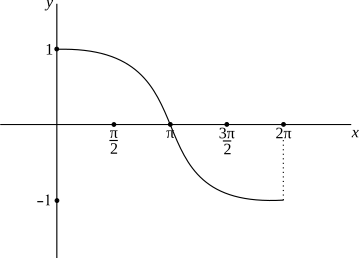
  1. Sketch the function \(y=\cos \left(\dfrac{x}{2}\right)\)  from  \(0 \leqslant x \leqslant 2 \pi\)   (1 mark)

    --- 0 WORK AREA LINES (style=blank) ---

  2. Find the value of \(x\) when  \(y=0.5\), for  \(0 \leqslant x \leqslant 2 \pi\)   (2 marks)

    --- 6 WORK AREA LINES (style=lined) ---

Show Answers Only

a.    
           

b.   \(x=\dfrac{2\pi}{3}\)

Show Worked Solution

a.    
           

b. \(\quad y\) \(=\cos \Big(\dfrac{x}{2}\Big)\)
  \(0.5\) \(=\cos \Big(\dfrac{x}{2}\Big) \)
  \(\dfrac{x}{2}\) \(=\cos^{-1} (0.5) \)
  \(\dfrac{x}{2}\) \(=\dfrac{\pi}{3}, \ \dfrac{5\pi}{3}\)
  \(x\)  \(=\dfrac{2\pi}{3}\ \ (0 \leqslant x \leqslant 2 \pi) \)

Filed Under: Trig Graphs (Y12) Tagged With: Band 3, Band 4, smc-977-20-cos, smc-977-50-Intersection

CHEMISTRY, M4 EQ-Bank 10

Calculate the temperature range where the following reaction will occur spontaneously.

\(\ce{2H2O2(l) -> 2H2O(l) + O2(g)}\)

where  \(\Delta H = -196.0\ \text{kJ}\)  and  \(\Delta S = 125.0\ \text{J K}^{-1} \)   (3 marks)

--- 6 WORK AREA LINES (style=lined) ---

Show Answers Only
  • The reaction is spontaneous at temperatures below 1568.0 K.
Show Worked Solution

\(\text{Find}\ T\ \text{when}\ \Delta G = 0: \)

\(\Delta H-T \Delta S =0\)

\(T= \dfrac{\Delta H}{\Delta S}= \dfrac{-196.0}{0.125}=1568.0\ \text{K} \)

  • As \(T\) decreases, \(\Delta G\) decreases.
  • Reaction is spontaneous when \(\Delta G < 0\).
  • The reaction is spontaneous at temperatures below 1568.0 K.

Filed Under: Entropy and Gibbs Free Energy Tagged With: Band 4, smc-4268-50-Determining Spontaneity

CHEMISTRY, M4 EQ-Bank 9

At what temperature range would the following reaction occur spontaneously?

\(\ce{C(s) + O2(g) -> CO2(g)}\)

where  \(\Delta H = -393.5\ \text{kJ}\)  and  \(\Delta S = 213.6\ \text{J K}^{-1} \)   (3 marks)

--- 6 WORK AREA LINES (style=lined) ---

Show Answers Only
  • The reaction is spontaneous at all temperatures.
Show Worked Solution

\(\text{Find}\ T\ \text{when}\ \Delta G = 0: \)

\(\Delta H-T \Delta S\)\(=0\)

\(T= \dfrac{\Delta H}{\Delta S} = \dfrac{-393.5}{0.2136}= -1842.52\ \text{K}\)
 
  • Since negative temperature is not physically meaningful in this context, the reaction is spontaneous at all temperatures.
  • As \(T\) increases, \(\Delta G\) becomes more negative.
  • Reaction is spontaneous when \(\Delta G < 0\).
  • The reaction is spontaneous at all temperatures.

Filed Under: Entropy and Gibbs Free Energy Tagged With: Band 4, smc-4268-50-Determining Spontaneity

CHEMISTRY, M4 EQ-Bank 8

Determine the temperature range at which the following reaction will occur spontaneously.

\(\ce{N2(g) + 3H2(g) -> 2NH3(g)}\)

where  \(\Delta H = -92.4\ \text{kJ}\)  and  \(\Delta S = -198.3\ \text{J K}^{-1} \)   (3 marks)

--- 6 WORK AREA LINES (style=lined) ---

Show Answers Only
  • The reaction is spontaneous at temperatures below 465.94 K.
Show Worked Solution

\(\text{Find}\ T\ \text{when}\ \Delta G = 0: \)

   \(T= \dfrac{\Delta H}{\Delta S} = \dfrac{-92.4}{-0.1983} =465.94\ \text{K} \)

  • As \(T\) decreases, \(\Delta G\) decreases.
  • Reaction is spontaneous when \(\Delta G < 0\).
  • Therefore the reaction is spontaneous at temperatures below 465.94 K.

Filed Under: Entropy and Gibbs Free Energy Tagged With: Band 4, smc-4268-50-Determining Spontaneity

CHEMISTRY, M4 EQ-Bank 7

At what temperature range would the following reaction occur spontaneously?

   \(\ce{2SO2(g) + O2(g) -> 2SO3(g)}\) 

where  \(\Delta H = -198.2\ \text{kJ}\)  and  \(\Delta S = -188\ \text{J K}^{-1} \)   (3 marks)

--- 6 WORK AREA LINES (style=lined) ---

Show Answers Only
  • The reaction is spontaneous at temperatures below 1053.19 K.
Show Worked Solution

\(\text{Find}\ T\ \text{when}\ \Delta G = 0: \)

   \(T= \dfrac{\Delta H}{\Delta S}= \dfrac{-198.2}{-0.188} =1053.19\ \text{K} \)

  • As \(T\) decreases, \(\Delta G\) decreases.
  • Reaction is spontaneous when \(\Delta G < 0\).
  • The reaction is spontaneous at temperatures below 1053.19 K.

Filed Under: Entropy and Gibbs Free Energy Tagged With: Band 4, smc-4268-50-Determining Spontaneity

Trigonometry, 2ADV T2 EQ-Bank 7

Prove  \(\dfrac{1+\cot \theta}{1+\tan \theta}=\cot \theta\).   (3 marks)

--- 8 WORK AREA LINES (style=lined) ---

Show Answers Only
  \(\text{LHS}\) \(=\dfrac{1+\dfrac{\cos \theta}{\sin \theta}}{1+\dfrac{\sin \theta}{\cos \theta}}\)
    \(=\dfrac{\dfrac{\sin \theta+\cos \theta}{\sin \theta}}{\dfrac{\cos \theta+\sin \theta}{\cos \theta}}\)
    \(=\dfrac{\sin \theta+\cos \theta}{\sin \theta} \times \dfrac{\cos \theta}{\cos \theta+\sin \theta}\)
    \(=\dfrac{\cos \theta}{\sin \theta}\)
    \(=\cot \theta\)
    \(\ =\text{ RHS}\)
Show Worked Solution
  \(\text{LHS}\) \(=\dfrac{1+\dfrac{\cos \theta}{\sin \theta}}{1+\dfrac{\sin \theta}{\cos \theta}}\)
    \(=\dfrac{\dfrac{\sin \theta+\cos \theta}{\sin \theta}}{\dfrac{\cos \theta+\sin \theta}{\cos \theta}}\)
    \(=\dfrac{\sin \theta+\cos \theta}{\sin \theta} \times \dfrac{\cos \theta}{\cos \theta+\sin \theta}\)
    \(=\dfrac{\cos \theta}{\sin \theta}\)
    \(=\cot \theta\)
    \(\ =\text{ RHS}\)

Filed Under: Trig Identities and Harder Equations (Adv-2027), Trig Identities and Harder Equations (Y11) Tagged With: Band 4, smc-1189-20-Prove Identity, smc-6412-20-Prove Identity

Calculus, 2ADV C1 EQ-Bank 8

The displacement \(x\) metres from the origin at time, \(t\) seconds, of a particle travelling in a straight line is given by

\(x=t^3-9 t^2+9 t, \quad t \geqslant 0\)

  1. Find the time(s) when the particle is at the origin.   (2 marks)

    --- 5 WORK AREA LINES (style=lined) ---

  2. On the graph below, sketch the displacement, \(x\) metres, with respect to time \(t\).   (2 marks)


    --- 0 WORK AREA LINES (style=lined) ---

  3. Find the velocity of the particle when  \(t=2\).   (2 marks)

    --- 6 WORK AREA LINES (style=lined) ---

Show Answers Only

a.  \(\text{Particle at origin when}\ \ t=0, t=3.\)

b.


c.   \(\dot{x}=-15\  \text{m s}^{-1}\)

Show Worked Solution

a.    \(x\) \(=t^3-9 t^2+9 t\)
    \(=t\left(t^2-9 t+9\right)\)
    \(=t(t-3)^2\)

 
\(\text{Particle at origin when}\ \ t=0, t=3.\)

 
b.


c.    \(x=t^3-9 t^2+9 t\)

\(\dot{x}= \dfrac{dx}{dt} = 3 t^2-18 t+9\)

\(\text {When } t=2:\)

\(\dot{x}=3 \times 2^2-18 \times 2+9=-15\  \text{m s}^{-1}\)

Filed Under: Rates of Change (Adv-2027) Tagged With: Band 3, Band 4, smc-6438-10-Motion Graphs, smc-6438-20-Polynomial Function

Functions, 2ADV F2 EQ-Bank 2

A graph of the hyperbola  \(y=\dfrac{1}{x+p}+q\)  is shown, where \(p\) and \(q\) are constants.
 

Find the values of \(p\) and \(q\) and hence the graphs \(x\)-axis intercept.   (2 marks)

--- 6 WORK AREA LINES (style=lined) ---

Show Answers Only

\(\text {Vertical asymptote at } \ x=-1 \ \ \Rightarrow p=1\)

\(\text {Horizontal asymptote at } \ y=\dfrac{3}{2} \ \  \Rightarrow q=\dfrac{3}{2}\)

\(y=\dfrac{1}{x+1}+\dfrac{3}{2}\)
 

\(x\text{-intercept when} \ \ y=0:\)

  \(\dfrac{1}{x+1}+\dfrac{3}{2}\)  \(=0\)
  \(\dfrac{1}{x+1}\)  \(=-\dfrac{3}{2}\)
  \(3 x+3\)  \(=-2\)
  \(3x\)  \(=-5\)
  \(x\)  \(=-\dfrac{5}{3}\)

Show Worked Solution

\(\text {Vertical asymptote at } \ x=-1 \ \ \Rightarrow p=1\)

\(\text {Horizontal asymptote at } \ y=\dfrac{3}{2} \ \  \Rightarrow q=\dfrac{3}{2}\)

\(y=\dfrac{1}{x+1}+\dfrac{3}{2}\)
 

\(x\text{-intercept when} \ \ y=0:\)

  \(\dfrac{1}{x+1}+\dfrac{3}{2}\)  \(=0\)
  \(\dfrac{1}{x+1}\)  \(=-\dfrac{3}{2}\)
  \(3 x+3\)  \(=-2\)
  \(3x\)  \(=-5\)
  \(x\)  \(=-\dfrac{5}{3}\)

Filed Under: Non-Calculus Graphing (Y12), Reciprocal Functions (Adv-2027) Tagged With: Band 4, smc-1009-10-Quotient Function, smc-1009-40-Identify Asymptotes, smc-6382-30-Sketch Graph

Functions, 2ADV F1 EQ-Bank 25

Prove that the line between \((1,-1)\) and \((4,-3)\) is perpendicular to the line \(3x-2y-4=0\)   (2 marks)

--- 6 WORK AREA LINES (style=lined) ---

Show Answers Only

\(\text {Perpendicular lines}\ \ \Rightarrow\ m_1 \times m_2 = -1\)

\(\text {Line 1 gradient:}\)

\(P_1 (1,-1), P_2(4,-3) \)

\(m_1=\dfrac{y_2-y_1}{x_2-x_1}=\dfrac{-3+1}{4-1}=-\dfrac{2}{3}\)
 

\(\text {Line 2 gradient:}\)

\(3x-2y-4=0\ \ \Rightarrow \ y= \dfrac{3}{2}x-2\ \ \Rightarrow m_2=\dfrac{3}{2}\)

\(m_1 \times m_2 = -\dfrac{2}{3} \times \dfrac{3}{2} = -1\)

\(\therefore\ \text{Lines are perpendicular.}\)

Show Worked Solution

\(\text {Perpendicular lines}\ \ \Rightarrow\ m_1 \times m_2 = -1\)

\(\text {Line 1 gradient:}\)

\(P_1 (1,-1), P_2(4,-3) \)

\(m_1=\dfrac{y_2-y_1}{x_2-x_1}=\dfrac{-3+1}{4-1}=-\dfrac{2}{3}\)
 

\(\text {Line 2 gradient:}\)

\(3x-2y-4=0\ \ \Rightarrow \ y= \dfrac{3}{2}x-2\ \ \Rightarrow m_2=\dfrac{3}{2}\)

\(m_1 \times m_2 = -\dfrac{2}{3} \times \dfrac{3}{2} = -1\)

\(\therefore\ \text{Lines are perpendicular.}\)

Filed Under: Linear Functions (Adv-2027), Linear Functions (Y11) Tagged With: Band 4, smc-6214-05-Coordinate Geometry, smc-985-30-Coordinate Geometry

Trigonometry, 2ADV T1 EQ-Bank 6 MC

The triangle \(A B C\) has an exact area of \((12-\sqrt{3})\) cm\(^{2}\).
 

The exact value of \(x\) is

  1. \(\dfrac{24-2\sqrt{3}}{3}\)
  2. \(\dfrac{8\sqrt{3}-2}{3} \)
  3. \(8\sqrt{3}-1\)
  4. \(12\sqrt{3}+1\)
Show Answers Only

\(B\)

Show Worked Solution
  \(12-\sqrt{3}\) \(=\dfrac{1}{2} \cdot 6 \cdot x \cdot \sin 120^{\circ}\)
  \(12-\sqrt{3}\) \(=3x \cdot \sin 120^{\circ}\)
  \(12-\sqrt{3}\) \(=\dfrac{3\sqrt{3}x}{2}\)
  \(x\) \(=\dfrac{2(12-\sqrt{3})}{3\sqrt{3}} \times \dfrac {\sqrt{3}}{\sqrt{3}}\)
    \(=\dfrac{24\sqrt{3}-6}{9} \)
    \(=\dfrac{8\sqrt{3}-2}{3} \)

 
\(\Rightarrow B\)

Filed Under: Trig Ratios, Sine and Cosine Rules (Adv-2027), Trig Ratios, Sine and Cosine Rules (Y11) Tagged With: Band 4, smc-6392-30-Sine Rule, smc-980-30-Sine Rule

Functions, 2ADV F1 EQ-Bank 24 MC

Given that  \(f(x)=\left\{\begin{array}{ll}3-(x-2)^2, & \text { for } x \leqslant 2 \\ m x+5, & \text { for } x>2\end{array}\right.\)

What is the value of \(m\) for which \(f(x)\) is continuous at  \(x=2\) ?

  1. \(1\)
  2. \(2\)
  3. \(-1\)
  4. \(-2\)
Show Answers Only

\(C\)

Show Worked Solution

\(\text {If continuous at}\ x=2:\)

  \(3-(x-2)^2\) \(=mx+5\)
  \(3-(2-2)^2\) \(=2m+5\)
   \(2m\) \(=-2\)
  \(m\) \(=-1\)

 
\(\Rightarrow C\)

Filed Under: Further Functions and Relations (Y11), Piecewise Functions (Adv-2027) Tagged With: Band 4, smc-987-80-Continuous, syllabus-2027

L&E, 2ADV E1 EQ-Bank 5

Solve the equation  \(8^{n+3}=\dfrac{1}{2}\)   (2 marks)

--- 5 WORK AREA LINES (style=lined) ---

Show Answers Only

\(n=-\dfrac{10}{3} \)

Show Worked Solution

\(8^{n+3}\) \(=\dfrac{1}{2}\)  
\(2^{3(n+3)}\) \(=2^{-1}\)  
\(3n+9\) \(=-1\)  
\(3n\) \(=-10\)  
\(n\) \(=-\dfrac{10}{3} \)  

Filed Under: Log/Index Laws and Equations (Adv-2027), Log/Index Laws and Equations (Y11) Tagged With: Band 4, smc-6455-50-Exponential Equations, smc-963-50-Exponential Equation

Calculus, 2ADV C1 EO-Bank 7

Differentiate  `2x(1-4x)^5`  with respect to `x`.   (2 marks)

--- 5 WORK AREA LINES (style=lined) ---

Show Answers Only

`y^{′}=2(1-4x)^4(1-24x)`

Show Worked Solution

`y=2x(1-4x)^5`

`text{Using the product and chain rules:}`

`y^{′}` `=2 xx (1-4x)^5-40x(1-4x)^4`  
  `=2(1-4x)^4(1-4x-20x)`  
  `=2(1-4x)^4(1-24x)`  

Filed Under: Standard Differentiation (Adv-X) Tagged With: Band 4, eo-unique, smc-1069-20-Chain Rule, smc-1069-25-Product Rule, smc-1069-30-Basic Differentiation

  • « Previous Page
  • 1
  • …
  • 33
  • 34
  • 35
  • 36
  • 37
  • …
  • 114
  • Next Page »

Copyright © 2014–2025 SmarterEd.com.au · Log in