The volume of a sphere is given by \(V=\dfrac{4}{3}\pi r^3\) where \(r\) is the radius of the sphere.
If the volume of a sphere is \(385\ \text{cm}^3\), find the radius, to 1 decimal place. (3 marks)
--- 6 WORK AREA LINES (style=lined) ---
Aussie Maths & Science Teachers: Save your time with SmarterEd
The volume of a sphere is given by \(V=\dfrac{4}{3}\pi r^3\) where \(r\) is the radius of the sphere.
If the volume of a sphere is \(385\ \text{cm}^3\), find the radius, to 1 decimal place. (3 marks)
--- 6 WORK AREA LINES (style=lined) ---
Consider the function `f`, where `f:\left(-\frac{1}{2}, \frac{1}{2}\right) \rightarrow R, f(x)=\log _e\left(x+\frac{1}{2}\right)-\log _e\left(\frac{1}{2}-x\right).`
Part of the graph of `y=f(x)` is shown below.
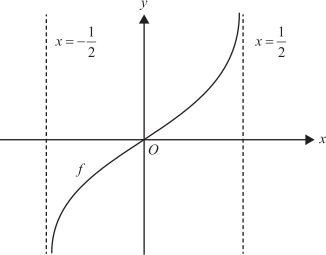
--- 1 WORK AREA LINES (style=lined) ---
--- 3 WORK AREA LINES (style=lined) ---
--- 2 WORK AREA LINES (style=lined) ---
--- 3 WORK AREA LINES (style=lined) ---
--- 4 WORK AREA LINES (style=lined) ---
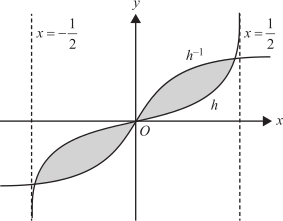
--- 2 WORK AREA LINES (style=lined) ---
--- 2 WORK AREA LINES (style=lined) ---
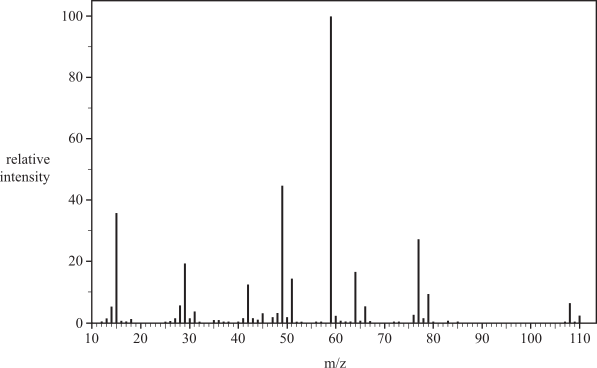
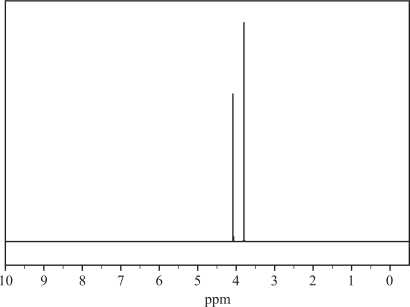
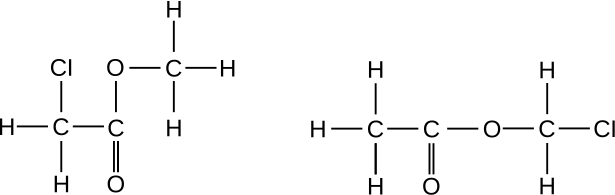
A chemist uses spectroscopy to identify an unknown organic molecule, Molecule \(\text{J}\), that contains chlorine. The \({}^{13}\text{C NMR}\) spectrum of Molecule \(\text{J}\) is shown below. The infra-red (IR) spectrum of Molecule \(\text{J}\) is shown below. --- 2 WORK AREA LINES (style=lined) --- The mass spectrum of Molecule \(\text{J}\) is shown below --- 2 WORK AREA LINES (style=lined) --- The \({ }^1 \text{H NMR}\) spectrum of Molecule \(\text{J}\) is shown below. --- 3 WORK AREA LINES (style=lined) --- --- 5 WORK AREA LINES (style=blank) --- a. Absence of a very broad \(\ce{OH}\) acid peak between 2500–3000. b. The peak at 110 m/z: c. The two singlet peaks indicate: d. Either of the two molecules shown below are correct: a. Absence of a very broad \(\ce{OH}\) acid peak between 2500–3000. b. The peak at 110 m/z: c. The two singlet peaks indicate: d. Either of the two molecules shown below are correct:
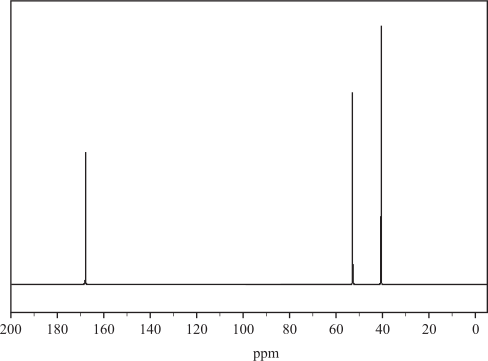
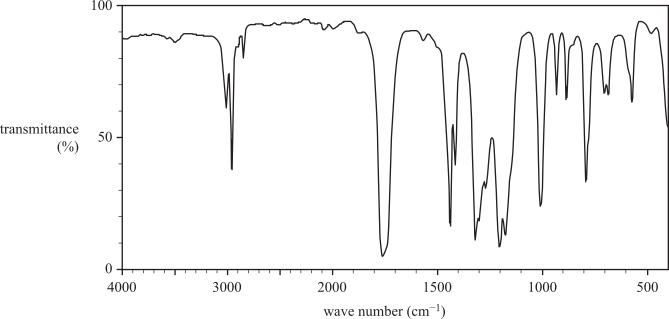
Show Answers Only
 Show Worked Solution
♦ Mean mark (a) 41%.
♦♦♦ Mean mark (b) 15%.
COMMENT: Know the masses of common isotopes.
♦ Mean mark (d) 40%.
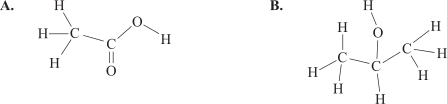
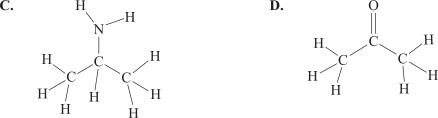
The spectroscopy information for an organic molecule is given below.
| number of peaks in \({}^{13}\text{C NMR}\) | 2 |
| number of sets of peaks in \({}^{1}\text{H NMR}\) | 3 |
| m/z of the last peak in the mass spectrum | 60 |
| infra-red (IR) spectrum | an absorption peak appears at 3350 cm\(^{-1}\) |
The organic molecule is
A weather station records daily maximum temperatures
The five-number summary for the distribution of maximum temperatures for the month of February is displayed in the table below.
\begin{array} {|l|c|}
\hline
\rule{0pt}{2.5ex} \ \rule[-1ex]{0pt}{0pt} & \textbf{Temperature (°C)} \\
\hline
\rule{0pt}{2.5ex} \text{Minimum} \rule[-1ex]{0pt}{0pt} & 16 \\
\hline
\rule{0pt}{2.5ex} Q_1 \rule[-1ex]{0pt}{0pt} & 21 \\
\hline
\rule{0pt}{2.5ex} \text{Median} \rule[-1ex]{0pt}{0pt} & 25 \\
\hline
\rule{0pt}{2.5ex} Q_3 \rule[-1ex]{0pt}{0pt} & 31 \\
\hline
\rule{0pt}{2.5ex} \text{Maximum} \rule[-1ex]{0pt}{0pt} & 39 \\
\hline
\end{array}

--- 5 WORK AREA LINES (style=lined) ---
| a. |  |
b. `IQR = Q_3-Q_1=31-21=10`
| `text(Lower fence)` | `= Q_1-1.5 xx IQR` |
| `= 21-1.5 xx 10` | |
| `= 6` |
| `text(Upper fence)` | `= Q_3 + 1.5 xx IQR` |
| `= 31 + 1.5 xx 10` | |
| `= 46` |
`text{Since 6 < 16 (minimum) and 46 > 39 (maximum)}`
`=>\ \text{There are no outliers.}`
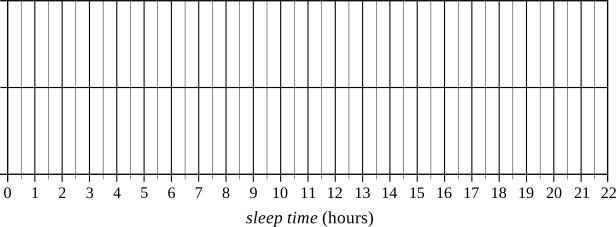
The five-number summary below was determined from the sleep time, in hours, of a sample of 59 types of mammals.
\begin{array} {|l|c|}
\hline
\rule{0pt}{2.5ex} \ \ \ \textbf{Statistic} \rule[-1ex]{0pt}{0pt} & \textbf{Sleep time (hours)} \\
\hline
\rule{0pt}{2.5ex} \text{minimum} \rule[-1ex]{0pt}{0pt} & \text{2.5} \\
\hline
\rule{0pt}{2.5ex} \text{first quartile} \rule[-1ex]{0pt}{0pt} & \text{8.0} \\
\hline
\rule{0pt}{2.5ex} \text{median} \rule[-1ex]{0pt}{0pt} & \text{10.5} \\
\hline
\rule{0pt}{2.5ex} \text{third quartile} \rule[-1ex]{0pt}{0pt} & \text{13.5} \\
\hline
\rule{0pt}{2.5ex} \text{maximum} \rule[-1ex]{0pt}{0pt} & \text{20.0} \\
\hline
\end{array}
--- 5 WORK AREA LINES (style=lined) ---
--- 0 WORK AREA LINES (style=lined) ---
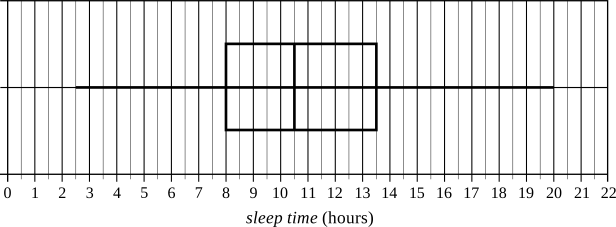
a. `IQR = Q_3-Q_1 = 13.5-8.0 = 5.5`
| `text(Lower fence)` | `= Q_1-1.5 xx IQR` |
| `= 8-1.5 xx 5.5` | |
| `= -0.25` |
| `text(Upper fence)` | `= Q_3 + 1.5 xx IQR` |
| `= 13.5 + 1.5 xx 5.5` | |
| `= 21.75` |
`text(S) text(ince) \ -0.25 < 2.5 \ text{(minimum value) and} \ 21.75 > 20.0 \ text{(maximum value)}`
`=> \ text(no outliers)`
b.
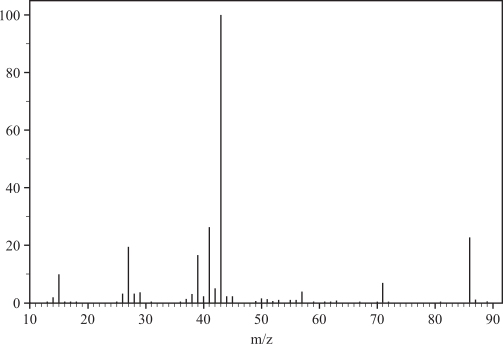
Molecule \(\text{V}\) contains only carbon atoms, hydrogen atoms and one oxygen atom. The mass spectrum of molecule \(\text{V}\) is shown below. --- 4 WORK AREA LINES (style=lined) --- --- 1 WORK AREA LINES (style=lined) --- The \({ }^1 \text{H NMR}\) spectrum of molecule \(\text{V}\) is shown below. --- 2 WORK AREA LINES (style=lined) --- The \({ }^{13} \text{C NMR}\) spectrum of molecule \(\text{V}\) is shown below. --- 8 WORK AREA LINES (style=blank) --- a.i. Molar mass of \(\text{V}\ = 86\ \text{g mol}^{-1}\) a.ii. Small peak at m/z = 87: b. The doublet peak at 1.1 ppm: c. a.i. Molar mass of \(\text{V}\ = 86\ \text{g mol}^{-1}\) a.ii. Small peak at m/z = 87: b. The doublet peak at 1.1 ppm: c. From the carbon NMR graph: From the hydrogen NMR graph:
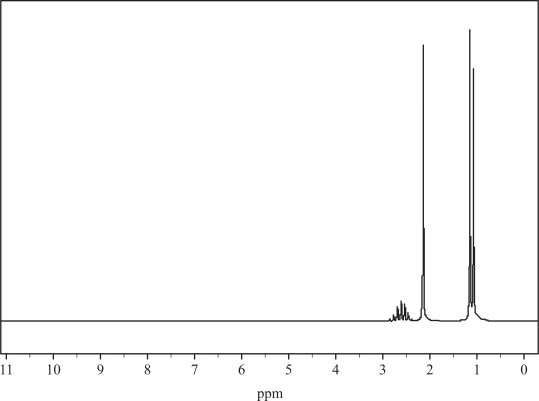
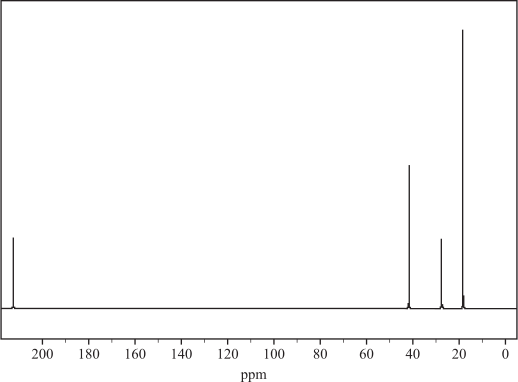
Show Answers Only
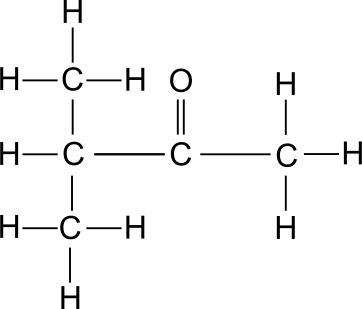 Show Worked Solution
♦ Mean mark (b) 50%.
♦ Mean mark (c) 43%.
The strength of the eggshell of birds is determined by the calcium carbonate, \(\ce{CaCO3}\), content of the eggshell. The percentage of calcium carbonate in the eggshell can be determined by gravimetric analysis. 0.412 g of clean, dry eggshell was completely dissolved in a minimum volume of dilute hydrochloric acid. \(\ce{CaCO3(s) + 2H+(aq)\rightarrow Ca^2+(aq) + CO2(g) + H2O(l)}\) An excess of a basic solution of ammonium oxalate, \(\ce{(NH4)2C2O4}\), was then added to form crystals of calcium oxalate monohydrate, \(\ce{CaC2O4.H2O}\). The suspension was filtered and the crystals were then dried to constant mass. 0.523 g of \(\ce{CaC2O4.H2O}\) was collected. --- 1 WORK AREA LINES (style=lined) --- --- 6 WORK AREA LINES (style=lined) ---
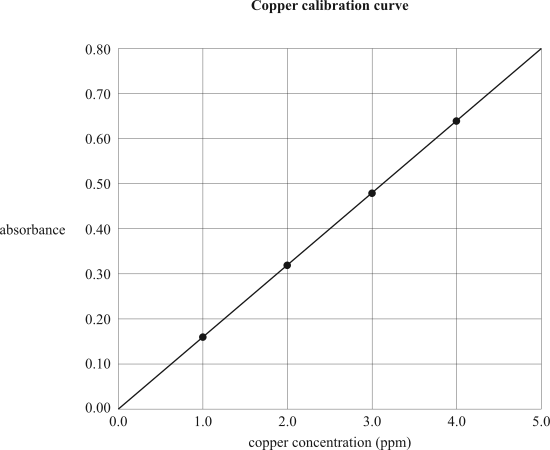
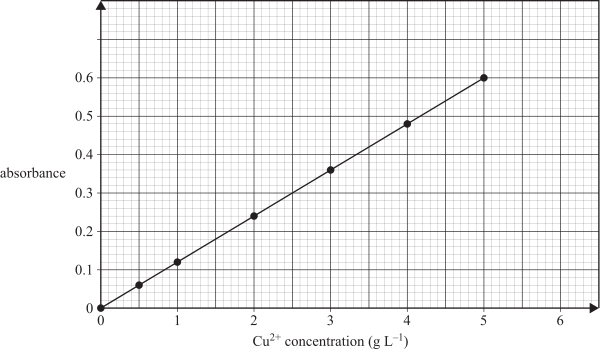
An atomic absorption spectrometer can be used to determine the level of copper in soils. The calibration curve below plots the absorbance of four standard copper solutions against the concentration of copper ions in ppm.
The concentrations of copper ions in the standard solutions were 1.0, 2.0, 3.0 and 4.0 mg L\(^{-1}\). (1 mg L\(^{-1}\) = 1 ppm)
Question 16
The concentration of copper in a test solution can be determined most accurately from the calibration curve if it is between
Question 17
If the test solution gave an absorbance reading of 0.40, what would be the concentration of copper ions in the solution in mol L\(^{-1}\)?
Organic compounds are numerous and diverse due to the nature of the carbon atom. There are international conventions for the naming and representation of organic compounds. --- 5 WORK AREA LINES (style=lined) --- --- 1 WORK AREA LINES (style=lined) --- --- 1 WORK AREA LINES (style=lined) --- i. ii. \(\ce{C4H6}\) iii. • Longest carbon chain is 6, hence hexane i. ii. \(\ce{C4H6}\) iii. Longest carbon chain is 6, hence hexane
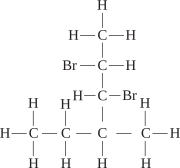
Show Answers Only
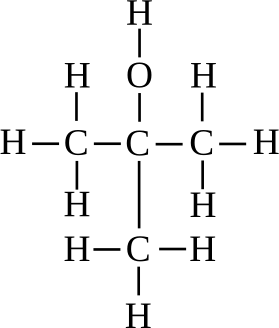
Show Worked Solution
♦♦♦ Mean mark (c) 27%.
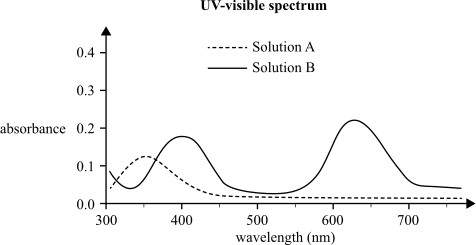
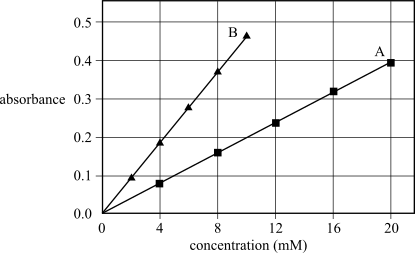
UV-visible spectroscopy was used to measure the spectra of two solutions, \(\text{A}\) and \(\text{B}\). Solution \(\text{A}\) was a pink colour, while Solution \(\text{B}\) was a green colour. The analyst recorded the absorbance of each solution over a range of wavelengths on the same axes. The resultant absorbance spectrum is shown below. --- 3 WORK AREA LINES (style=lined) --- The analyst used two sets of standard solutions and blanks to determine the calibration curves for the two solutions. The absorbances were plotted on the same axes. The graph is shown below. --- 6 WORK AREA LINES (style=lined) --- --- 4 WORK AREA LINES (style=lined) ---
Brass is an alloy of copper and zinc.
To determine the percentage of copper in a particular sample of brass, an analyst prepared a number of standard solutions of copper\(\text{(II)}\) ions and measured their absorbance using an atomic absorption spectrometer (AAS).
The calibration curve obtained is shown below.
--- 5 WORK AREA LINES (style=lined) ---
--- 3 WORK AREA LINES (style=lined) ---
--- 1 WORK AREA LINES (style=lined) ---
A common iron ore, fool’s gold, contains the mineral iron pyrite, \(\ce{FeS2}\).
Typically, the percentage by mass of \(\ce{FeS2}\) in a sample of fool’s gold is between 90% and 95%. The actual percentage in a sample can be determined by gravimetric analysis.
The sulfur in \(\ce{FeS2}\) is converted to sulfate ions, \(\ce{SO4^2–}\) as seen below:
\(\ce{4FeS2 + 11O2 \rightarrow 2Fe2O3 + 8SO4^2-}\)
This is then mixed with an excess of barium chloride, \(\ce{BaCl2}\), to form barium sulfate, \(\ce{BaSO4}\), according to the equation
\(\ce{Ba^2+(aq) + SO4^2–(aq)\rightarrow BaSO4(s)}\)
When the reaction has gone to completion, the \(\ce{BaSO4}\) precipitate is collected in a filter paper and carefully washed. The filter paper and its contents are then transferred to a crucible. The crucible and its contents are heated until constant mass is achieved.
The data for an analysis of a mineral sample is as follows.
| \(\text{initial mass of mineral sample}\) | \(\text{14.3 g}\) |
| \(\text{mass of crucible and filter paper}\) | \(\text{123.40 g}\) |
| \(\text{mass of crucible, filter paper and dry}\ \ce{BaSO4}\) | \(\text{174.99 g}\) |
| \(\ce{M(FeS2)}\) | \(\text{120.0 g mol}^{-1}\) |
| \(\ce{M(BaCl2)}\) | \(\text{208.3 g mol}^{-1}\) |
| \(\ce{M(BaSO4)}\) | \(\text{233.4 g mol}^{-1}\) |
--- 9 WORK AREA LINES (style=lined) ---
--- 2 WORK AREA LINES (style=lined) ---
The molar heat of combustion of pentan-1-ol \(\ce{(C5H12O)}\) is 2800 kJ mol\(^{-1}\). A quantity of pentan-1-ol was combusted, generating 108 kJ of heat.
What mass of pentan-1ol was combusted?
Enthalpy changes for the melting of iodine, \(\ce{I2}\), and for the sublimation of iodine are provided below.
\(\ce{I2(s) \rightarrow I2(l) \quad \quad \Delta H = +16 kJ mol^{-1}}\)
\(\ce{I2(s) \rightarrow I2(g) \quad \quad \Delta H = +62 kJ mol^{-1}}\)
Determine the enthalpy change for the vaporisation of iodine that is represented by the equation \(\ce{I2(l) \rightarrow I2(g)}\). (2 marks)
--- 4 WORK AREA LINES (style=lined) ---
Consider the statement:
The effectiveness of a metal catalyst is not dependent upon its surface area.
Explain if this statement correct, giving reasons for your answer. (2 marks)
--- 5 WORK AREA LINES (style=lined) ---
A catalyst increases the value of the equilibrium constant, thus favouring the extent of the forward reaction, resulting in a greater yield of product.
Determine if this statement is correct or incorrect, giving reasons for your answer. (2 marks)
--- 5 WORK AREA LINES (style=lined) ---
The following is a student’s summary of catalysts. It contains some correct and incorrect statements.
--- 1 WORK AREA LINES (style=lined) ---
--- 8 WORK AREA LINES (style=lined) ---
Determine the enthalpy change when 40 g of \(\ce{NaOH}\) is dissolved in one litre of water, given the temperature of the solution is measure to have increased by 10.6 °C. Give your answer to the nearest kilojoule. (2 marks)
--- 4 WORK AREA LINES (style=lined) ---
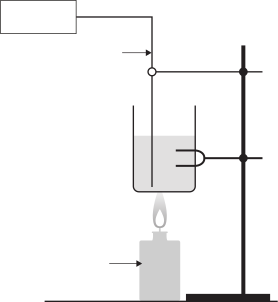
A senior Chemistry student created an experiment to calculate the molar heat of combustion of butane.
The experimental steps are as follows:
Results
| Quantity | Measurement |
| mass of empty can | 52.14 g |
| mass of can + water before combustion | 303.37 g |
| mass of butane canister before heating | 260.15 g |
| mass of butane canister after heating | 259.79 g |
| initial temperature of water | 22.1 °C |
| final temperature of water | 32.7 °C |
The balanced thermochemical equation for the complete combustion of butane is
\(\ce{2C4H10(g) + 13O2(g) \rightarrow 8CO2(g) + 10H2O(l)},\ \ \Delta H=-5748\ \text{kJ mol}^{-1}\)
--- 4 WORK AREA LINES (style=lined) ---
--- 4 WORK AREA LINES (style=lined) ---
--- 3 WORK AREA LINES (style=lined) ---
Consider the following equations.
| \(\ce{\frac{1}{2}N2(g) + O2(g) → NO2(g)}\) | \(\quad\Delta H = +30 \text{kJ mol}^{-1}\) |
| \(\ce{N2(g) + 2O2(g) → N2O4(g)}\) | \(\quad \Delta H = +10 \text{kJ mol}^{-1}\) |
Calculate the enthalpy change for the reaction \(\ce{N2O4(g)\rightarrow 2NO2(g)}\) (2 marks)
--- 4 WORK AREA LINES (style=lined) ---
Consider the following energy profile for a particular chemical reaction, where \(\text{I, II}\) and \(\text{III}\) represent enthalpy changes during the reaction.
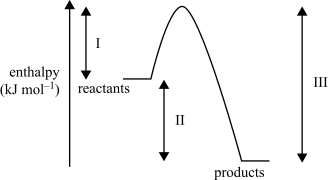
Which one of the following statements is correct?
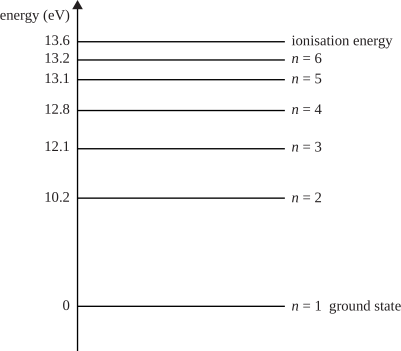
The energy level diagram for a hydrogen atom is shown below. --- 4 WORK AREA LINES (style=lined) --- --- 4 WORK AREA LINES (style=lined) ---
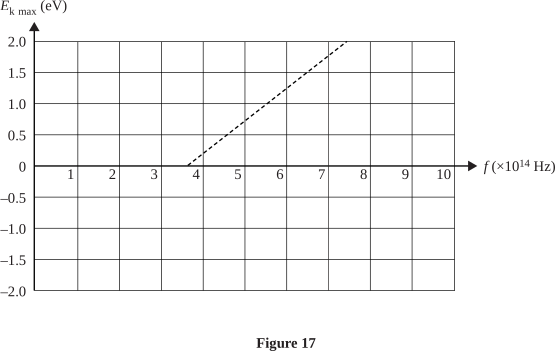
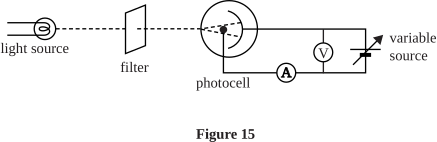
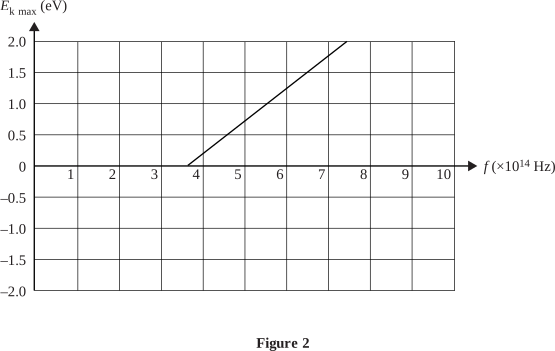
Students are studying the photoelectric effect using the apparatus shown in Figure 1. Figure 2 shows the results the students obtained for the maximum kinetic energy \((E_{\text{k max }})\) of the emitted photoelectrons versus the frequency of the incoming light. --- 2 WORK AREA LINES (style=lined) --- --- 2 WORK AREA LINES (style=lined) --- --- 2 WORK AREA LINES (style=lined) --- --- 0 WORK AREA LINES (style=blank) --- a.i. \(5.4 \times 10^{-15}\ \text{eV s}\) ii. \(811\ \text{nm}\) iii. \(1.9\ \text{eV}\). b. a.i. Planck’s constant \((h)\): \(\therefore h=\dfrac{\text{rise}}{\text{run}}=\dfrac{1.25-0}{6 \times 10^{14}-3.7\times 10^{-14}}=5.4 \times 10^{-15}\ \text{eV s}\) a.ii. Max wavelength = minimum frequency of emitted photoelectron. \(\lambda=\dfrac{c}{f}=\dfrac{3 \times 10^8}{3.7 \times 10^{14}}=811\ \text{nm}\) a.iii. b. Constructing the new graph:
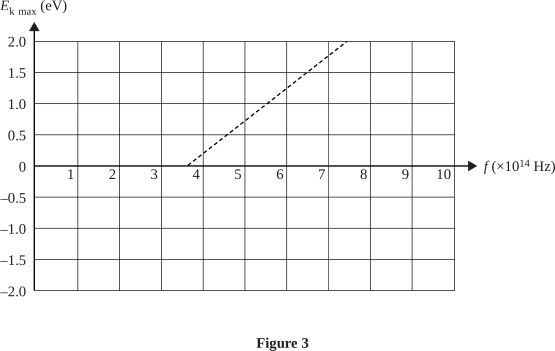
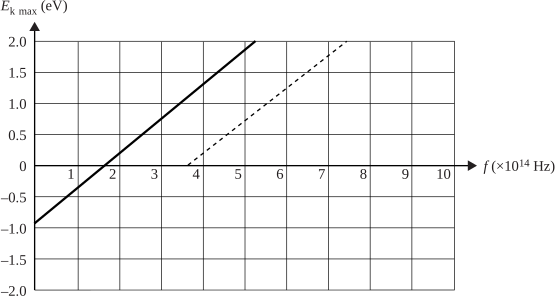
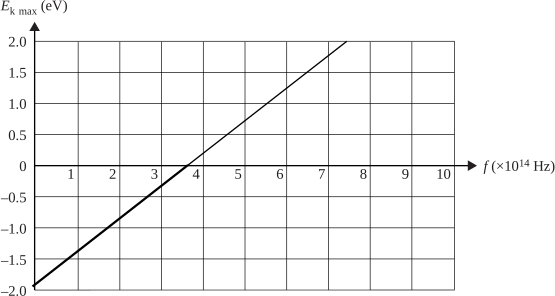
On Figure 3, draw the line that would be obtained if a different metal, with a work function of \(\dfrac{1}{2} \phi\), were used in the photocell. The original graph is shown as a dashed line. (2 marks)
Show Answers Only
 Show Worked Solution
♦ Mean mark (a)(ii) 44%.
A projectile is launched from the ground at an angle of 39° and at a speed of 25 m s\(^{-1}\), as shown in the diagram. The maximum height that the projectile reaches above the ground is labelled \(h\). --- 5 WORK AREA LINES (style=lined) --- --- 5 WORK AREA LINES (style=lined) ---
a. \(v_v=25\,\sin39^{\circ}=15.733\ \text{ms}^{-1}\) \(\text{At max height:}\ v_v=0\) b. \(\text{Since path is symmetrical:}\) \(\text{Time of flight}\ (t_2) =1.6 \times 2=3.2\ \text{s}\). \(v_h=25\,\cos39^{\circ}=19.43\ \text{ms}^{-1}\ \ \text{(see part (a) diagram)}\) \(\therefore R=v_ht_2=19.43 \times 3.2= 62\ \text{m}\)

Show Worked Solution

\(v\)
\(=u+at_1\)
\(0\)
\(=15.733 -9.8t_1\)
\(9.8t_1\)
\(=15.733\)
\(t_1\)
\(=1.6\ \text{s (2 sig.fig)}\)
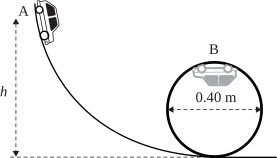
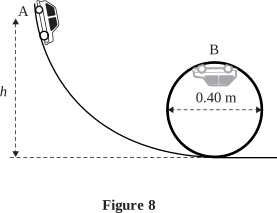
A 250 g toy car performs a loop in the apparatus shown in the diagram below. The car starts from rest at point \(\text{A}\) and travels along the track without any air resistance or retarding frictional forces. The radius of the car's path in the loop is 0.20 m. When the car reaches point \(\text{B}\) it is travelling at a speed of 3.0 m s\(^{-1}\). --- 6 WORK AREA LINES (style=lined) --- --- 6 WORK AREA LINES (style=lined) --- --- 5 WORK AREA LINES (style=lined) ---
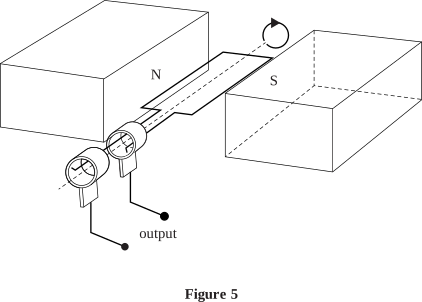
Students in a Physics practical class investigate the piece of electrical equipment shown in the diagram. It consists of a single rectangular loop of wire that can be rotated within a uniform magnetic field. The loop has dimensions 0.50 m × 0.25 m and is connected to the output terminals with slip rings. The loop is in a uniform magnetic field of strength 0.40 T. --- 1 WORK AREA LINES (style=lined) --- --- 3 WORK AREA LINES (style=lined) --- The students connect the output terminals of the piece of electrical equipment to an oscilloscope. One student rotates the loop at a constant rate of 20 revolutions per second. --- 3 WORK AREA LINES (style=lined) --- --- 4 WORK AREA LINES (style=lined) --- --- 3 WORK AREA LINES (style=lined) ---
Navigation in vehicles or on mobile phones uses a network of global positioning system (GPS) satellites. The GPS consists of 31 satellites that orbit Earth. In December 2018, one satellite of mass 2270 kg, from the GPS Block \(\text{IIIA}\) series, was launched into a circular orbit at an altitude of \(20\ 000\) km above Earth's surface. --- 4 WORK AREA LINES (style=lined) --- \begin{array}{|l|l|} --- 6 WORK AREA LINES (style=lined) ---
\hline \rule{0pt}{2.5ex}\text{mass of satellite} \rule[-1ex]{0pt}{0pt}& 2.27 \times 10^3 \ \text{kg} \\
\hline \rule{0pt}{2.5ex}\text{altitude of satellite above Earth's surface} \rule[-1ex]{0pt}{0pt}& 2.00 \times 10^7 \ \text{m} \\
\hline
\end{array}
The diagram below shows a schematic diagram of a DC motor. The motor has a coil, \(JKLM\), consisting of 100 turns. The permanent magnets provide a uniform magnetic field of 0.45 T.
The commutator connectors, \(X\) and \(Y\), provide a constant DC current, \(I\), to the coil. The length of the side \(JK\) is 5.0 cm.
The current \(I\) flows in the direction shown in the diagram.
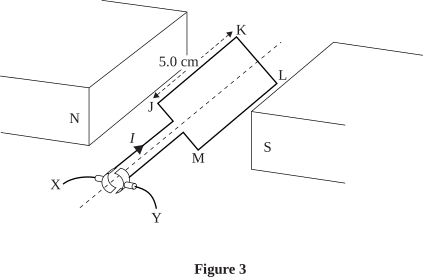
--- 1 WORK AREA LINES (style=lined) ---
--- 0 WORK AREA LINES (style=lined) ---
--- 4 WORK AREA LINES (style=lined) ---
--- 4 WORK AREA LINES (style=lined) ---
a. Current runs from the positive terminal to the negative terminal.
\(X\) is connected to the positive terminal of the current supply.
b. Using the right-hand rule: force on \(JK\) is down the page.
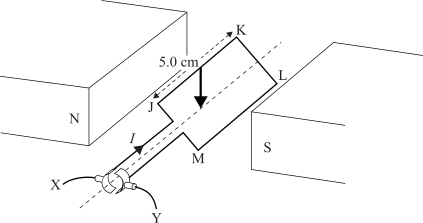
c. Role of the split-ring commutator:
d. \(F=nlIB=100 \times 0.05 \times 6 \times 0.45 = 13.5\ \text{N}\)
a. Current runs from the positive terminal to the negative terminal.
\(X\) is connected to the positive terminal of the current supply.
b. Using the right-hand rule: force on \(JK\) is down the page.
c. Role of the split-ring commutator:
d. \(F=nlIB=100 \times 0.05 \times 6 \times 0.45 = 13.5\ \text{N}\)
Which one of the following is true when incandescent light is compared to laser light?
Joanna is an observer in Spaceship \(\text{A}\), watching Spaceship \(\text{B}\) fly past at a relative speed of 0.943\(c\). She measures the length of Spaceship \(\text{B}\) from her frame of reference to be 150 m.
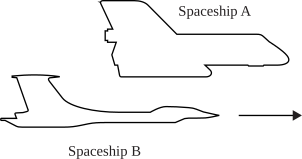
Which one of the following is closest to the proper length of Spaceship \(\text{B}\)?
A small ball is rolling at constant speed along a horizontal table. It rolls off the edge of the table and follows the parabolic path shown in the diagram below. Ignore air resistance.
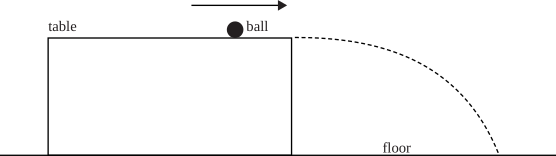
Which one of the following statements about the motion of the ball as it falls is correct?
An electrical generator is shown in the diagram below. The generator is turning clockwise.
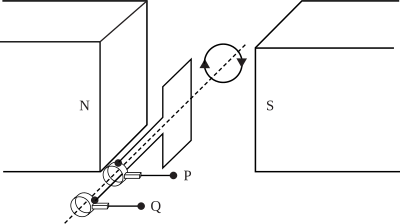
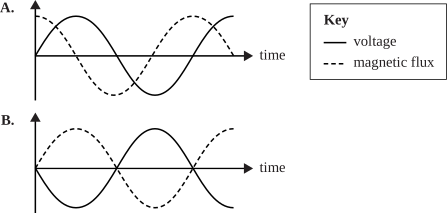
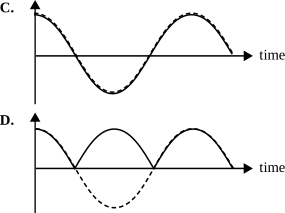
The voltage between \(\text{P}\) and \(\text{Q}\) and the magnetic flux through the loop are both graphed as a function of time, with voltage versus time shown as a solid line and magnetic flux versus time shown as a dashed line. Which one of the following graphs best shows the relationships for this electrical generator?
The coil of an AC generator completes 50 revolutions per second. A graph of output voltage versus time for this generator is shown below.
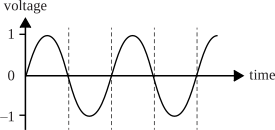
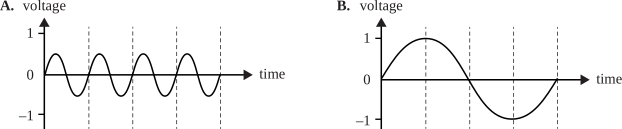
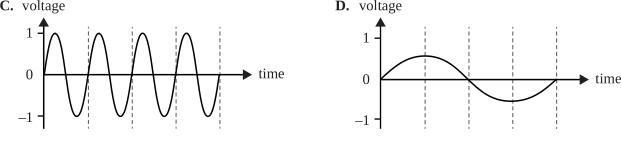
Which one of the following graphs best represents the output voltage if the rate of rotation is changed to 25 revolutions per second?
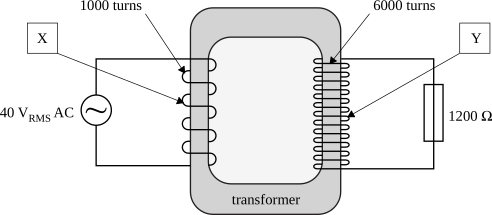
A 40 V AC generator and an ideal transformer are used to supply power. The diagram below shows the generator and the transformer supplying 240 V to a resistor with a resistance of 1200 \( \Omega \).
Question 5
Which of the following correctly identifies the parts labelled \(\text{X}\) and \(\text{Y}\), and the function of the transformer?
\begin{align*}
\begin{array}{l}
\rule{0pt}{2.5ex} \ \rule[-1ex]{0pt}{0pt}& \\
\rule{0pt}{2.5ex}\textbf{A.}\rule[-1ex]{0pt}{0pt}\\
\rule{0pt}{2.5ex}\textbf{B.}\rule[-1ex]{0pt}{0pt}\\
\rule{0pt}{2.5ex}\textbf{C.}\rule[-1ex]{0pt}{0pt}\\
\rule{0pt}{2.5ex}\textbf{D.}\rule[-1ex]{0pt}{0pt}\\
\end{array}
\begin{array}{|l|l|l|}
\hline
\rule{0pt}{2.5ex}\quad \ \ \ \text{Part X}\quad \rule[-1ex]{0pt}{0pt}&\ \ \ \quad \text{Part Y} \quad& \text{Function of transformer} \\
\hline
\rule{0pt}{2.5ex}\text{primary coil}\rule[-1ex]{0pt}{0pt}&\text{secondary coil} & \text{step-down}\\
\hline
\rule{0pt}{2.5ex}\text{primary coil}\rule[-1ex]{0pt}{0pt}& \text{secondary coil}&\text{step-up}\\
\hline
\rule{0pt}{2.5ex}\text{secondary coil}\rule[-1ex]{0pt}{0pt}& \text{primary coil} &\text{step-down}\\
\hline
\rule{0pt}{2.5ex}\text{secondary coil}\rule[-1ex]{0pt}{0pt}& \text{primary coil} &\text{step-up}\\
\hline
\end{array}
\end{align*}
Question 6
Which one of the following is closest to the current in the primary circuit?
The magnitude of the acceleration due to gravity at Earth's surface is \(g\).
Planet \(\text{Y}\) has twice the mass and half the radius of Earth. Both planets are modelled as uniform spheres.
Which one of the following best gives the magnitude of the acceleration due to gravity on the surface of Planet \(\text{Y}\)?
The duration of telemarketing calls to mobile phone users is a continuous random variable \(T\) minutes, with probability density function
\(f(t)= \begin{cases} \dfrac{2}{5} e^{-\frac{2}{5} t} & t \geq 0 \\ \ 0 & \text {elsewhere }\end{cases}\)
Find the value of \(k\) such that 90% of telemarketing calls last less than \(k\) minutes. Express your answer in the form \(\dfrac{a}{b} \,\log _e(c)\), where \(a, b\) and \(c\) are positive integers. (3 marks) --- 8 WORK AREA LINES (style=lined) ---
Let \(f: R \rightarrow R\), where \(f(x)=2-x^2\).
--- 2 WORK AREA LINES (style=lined) ---
--- 4 WORK AREA LINES (style=lined) ---
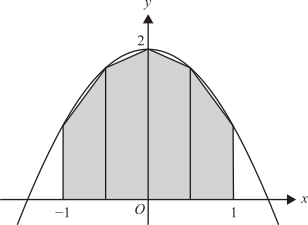
--- 5 WORK AREA LINES (style=lined) ---
Consider the simultaneous equations below, where \(a\) and \(b\) are real constants. \begin{aligned} Find the values of \(a\) and \(b\) for which the simultaneous equations have no solutions. (4 marks) --- 8 WORK AREA LINES (style=lined) ---
& (a+3) x+9 y=3 b\\
& 2 x+a y=5
\end{aligned}
20 mL 0.08 mol L\(^{-1}\ \ce{HCl}\) is mixed with 30 mL of 0.05 mol L\(^{-1}\ \ce{NaOH}\).
What is the pH of the resultant solution?
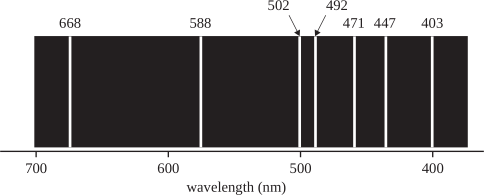
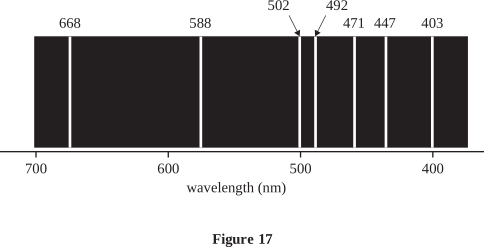
The diagram shows the emission spectrum for helium gas. --- 1 WORK AREA LINES (style=lined) --- --- 6 WORK AREA LINES (style=lined) --- --- 4 WORK AREA LINES (style=lined) ---
A beam of electrons travelling at 1.72 × 10\(^5\) m s\(^{-1}\) illuminates a crystal, producing a diffraction pattern as shown below. Ignore relativistic effects. --- 5 WORK AREA LINES (style=lined) --- The electron beam is now replaced by an X-ray beam. The resulting diffraction pattern has the same spacing as that produced by the electron beam. Calculate the energy of one X-ray photon. Show your working. (3 marks) --- 6 WORK AREA LINES (style=lined) ---

The metal surface in a photoelectric cell is exposed to light of a single frequency and intensity in the apparatus shown in Diagram A. The voltage of the battery can be varied in value and reversed in direction. --- 0 WORK AREA LINES (style=lined) --- --- 1 WORK AREA LINES (style=lined) --- --- 2 WORK AREA LINES (style=lined) --- a. The photocurrent will also be tripled. b. The stopping voltage. c. Zero photocurrent at \(\text{A}\): a. The photocurrent will also be tripled. b. The stopping voltage. c. Zero photocurrent at \(\text{A}\):
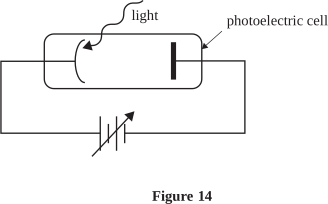

Show Answers Only
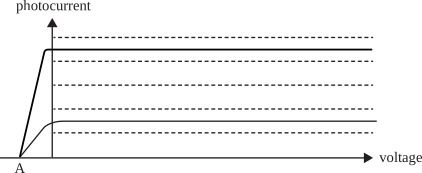
Show Worked Solution
♦♦ Mean mark (c) 32%.
COMMENT: The work function of the metal had no relevance to this question.
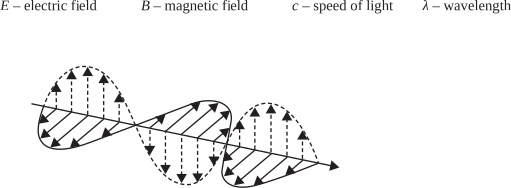
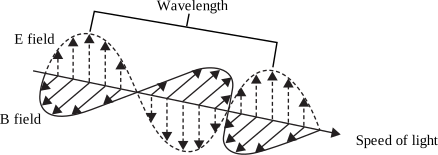
The diagram below shows a representation of an electromagnetic wave.
Correctly label the diagram below using the following symbols. (3 marks)
--- 0 WORK AREA LINES (style=lined) ---
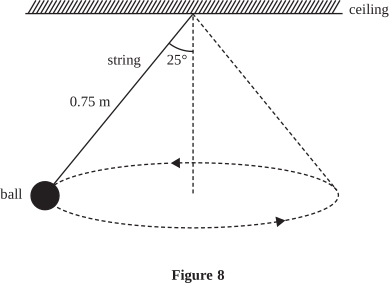
The diagram below shows a small ball of mass 1.8 kg travelling in a horizontal circular path at a constant speed while suspended from the ceiling by a 0.75 m long string.
--- 0 WORK AREA LINES (style=blank) ---
--- 8 WORK AREA LINES (style=lined) ---
a.

b. \(1.2\ \text{ms}^{-1}\)
a. Only two forces are acting on the ball: \(F_w\) and \(F_T\):
b.

\(\text{Using}\ \ \tan\theta=\dfrac{F_{\text{net}}}{mg}:\)
| \( F_{\text{net}}\) | \(=mg\,\tan\theta\) | |
| \(\dfrac{mv^2}{r}\) | \(=mg\,\tan\theta\) | |
| \(\dfrac{v^2}{r}\) | \(=g\,\tan\theta\) | |
| \(\therefore v\) | \(=\sqrt{g\,r\,\tan\theta}\) | |
| \(=\sqrt{9.8 \times 0.317 \times \tan 25}\ \ ,\ \ (r = 0.75 \times \sin25=0.317\ \text{m})\) | ||
| \(=1.2\ \text{ms}^{-1}\) |
Two Physics students hold a coil of wire in a constant uniform magnetic field, as shown in Figure 5a. The ends of the wire are connected to a sensitive ammeter. The students then change the shape of the coil by pulling each side of the coil in the horizontal direction, as shown in Figure 5b. They notice a current register on the ammeter.
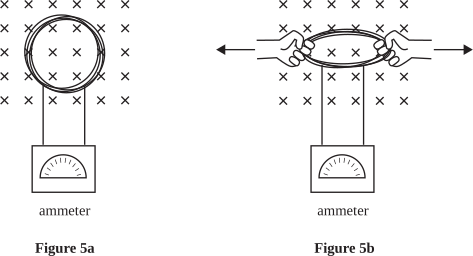
--- 2 WORK AREA LINES (style=blank) ---
--- 6 WORK AREA LINES (style=lined) ---
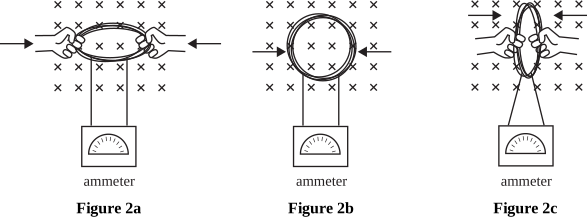
--- 6 WORK AREA LINES (style=lined) ---
Consider the functions \(f\) and \(g\), where \begin{aligned} --- 2 WORK AREA LINES (style=lined) --- --- 3 WORK AREA LINES (style=lined) --- --- 4 WORK AREA LINES (style=lined) ---
& f: R \rightarrow R, f(x)=x^2-9 \\
& g:[0, \infty) \rightarrow R, g(x)=\sqrt{x}
\end{aligned}
The Ionospheric Connection Explorer (ICON) space weather satellite, constructed to study Earth's ionosphere, was launched in October 2019. ICON will study the link between space weather and Earth's weather at its orbital altitude of 600 km above Earth's surface. Assume that ICON's orbit is a circular orbit.
--- 2 WORK AREA LINES (style=lined) ---
--- 8 WORK AREA LINES (style=lined) ---
--- 4 WORK AREA LINES (style=lined) ---
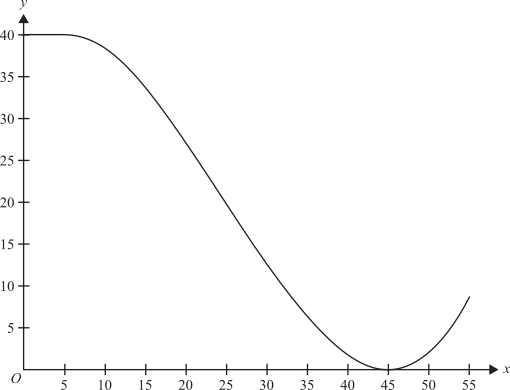
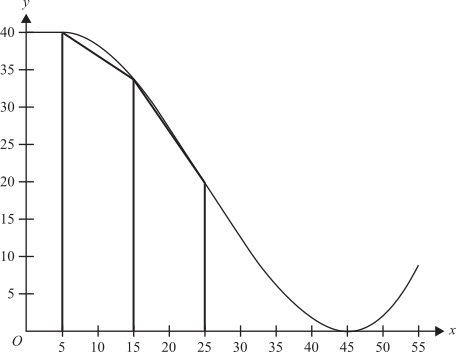
Jac and Jill have built a ramp for their toy car. They will release the car at the top of the ramp and the car will jump off the end of the ramp. The cross-section of the ramp is modelled by the function \(f\), where \(f(x)= \begin{cases}\displaystyle \ 40 & 0 \leq x<5 \\ \dfrac{1}{800}\left(x^3-75 x^2+675 x+30\ 375\right) & 5 \leq x \leq 55\end{cases}\) \(f(x)\) is both smooth and continuous at \(x=5\). The graph of \(y=f(x)\) is shown below, where \(x\) is the horizontal distance from the start of the ramp and \(y\) is the height of the ramp. All lengths are in centimetres. --- 2 WORK AREA LINES (style=lined) --- --- 1 WORK AREA LINES (style=lined) --- --- 1 WORK AREA LINES (style=lined) --- --- 1 WORK AREA LINES (style=lined) --- Jac and Jill decide to use two trapezoidal supports, each of width \(10 cm\). The first support has its left edge placed at \(x=5\) and the second support has its left edge placed at \(x=15\). Their cross-sections are shown in the graph below. --- 5 WORK AREA LINES (style=lined) --- --- 4 WORK AREA LINES (style=lined) --- --- 6 WORK AREA LINES (style=lined) --- --- 3 WORK AREA LINES (style=lined) ---
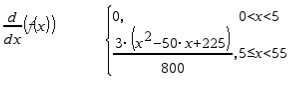
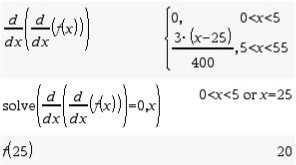
a. \(\text{Using CAS: Define f(x) then}\) \(\text{OR}\quad f^{\prime}(x)= \begin{cases}\displaystyle \ 0 & 0 < x<5 \\ \dfrac{1}{800}\left(3x^2-150 x+675 \right) & 5 \leq x < 55\end{cases}\) b.i \(\text{Using CAS: Find }f^”(x)\ \text{then solve }=0\) \(\therefore\ \text{Point of inflection at }(25, 20)\) b.ii \(\text{Gradient function strictly increasing for }x\in [25, 55]\) b.iii \(\text{Gradient function strictly decreasing for }x\in [5, 25]\) c. \(\text{Using CAS:}\)
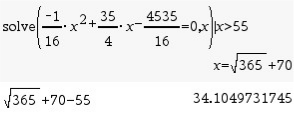
\(\therefore\ \text{The sloped edges of the trapeziums would be above }f(x)\) \(\text{making the trapezium rule approximation greater than the}\) \(\text{actual area.}\) e.i \(f(55)=\dfrac{35}{4}\ \text{(Using CAS)}\) \(\text{and }f(55)=g(55)\rightarrow g(55)=\dfrac{35}{4}\) \(\text{and }g'(55)=f'(55)\) \(\rightarrow\ f'(55)=\dfrac{1}{800}(3\times 55^2-150\times 55+675)=\dfrac{15}{8}\) \(\rightarrow\ -\dfrac{55}{8}+b=\dfrac{15}{8}\) \(\therefore b=\dfrac{35}{4}\quad (2)\) \(\text{Sub (2) into (1)}\) \(c=\dfrac{3165}{16}-55\times\dfrac{35}{4}\) \(c=-\dfrac{4535}{16}\) \(\therefore\ b=\dfrac{35}{4}\ \text{or}\ 8.75 , c=-\dfrac{4535}{16}\ \text{or}\ -283.4375\) e.ii \(\text{Using CAS: Solve }g(x)=0|x>55\) \(\text{Horizontal distance}=\sqrt{365}+70-55=34.104\dots\approx 34.10\ \text{cm (2 d.p.)}\)
Show Worked Solution
\(\text{Area}\)
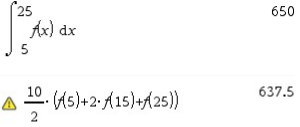
\(=\dfrac{h}{2}\Big(f(5)+2f(15)+f(25)\Big)\)
\(=\dfrac{10}{2}\Big(40+2\times 33.75+20\Big)=637.5\)
\(\therefore\ \text{Estimate : Exact}\)
\(=637.5:650\)
\(=\dfrac{637.5}{650}\times 100\)
\(=98.0769\%\approx 98.1\%\)
d. \(\text{In the interval }x\in [25, q]\text{ the curve is concave up.}\)
\(\therefore -\dfrac{1}{16}\times 55^2+55b+c\)
\(=\dfrac{35}{4}\)
\(c\)
\(=\dfrac{35}{4}+\dfrac{3025}{16}-55b\)
\(c\)
\(=\dfrac{3165}{16}-55b\quad (1)\)
\(g'(x)=-\dfrac{x}{8}+b\)
Electron microscopes use a high-precision electron velocity selector consisting of an electric field, \(E\), perpendicular to a magnetic field, \(B\).
Electrons travelling at the required velocity, \(v_0\), exit the aperture at point \(\text{Y}\), while electrons travelling slower or faster than the required velocity, \(v_0\), hit the aperture plate, as shown in Figure 2.
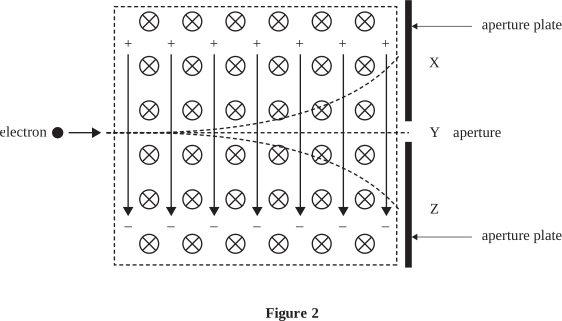
--- 2 WORK AREA LINES (style=lined) ---
--- 4 WORK AREA LINES (style=lined) ---
--- 1 WORK AREA LINES (style=lined) ---
--- 5 WORK AREA LINES (style=lined) ---
Quantised energy levels within atoms can best be explained by
| \(\text{I}\) | The energy of a light wave increases with increasing amplitude. |
| \(\text{II}\) | The energy of a light wave increases with increasing frequency. |
| \(\text{III}\) | The energy of a light wave increases with decreasing wavelength. |
Which of the statements above about the energy of light waves is correct?
Matter is converted to energy by nuclear fusion in stars.
If the star Alpha Centauri converts mass to energy at the rate of 6.6 × 10\(^9\) kg s\(^{-1}\), then the power generated is closest to
A company produces soft drinks in aluminium cans.
The company sources empty cans from an external supplier, who claims that the mass of aluminium in each can is normally distributed with a mean of 15 grams and a standard deviation of 0.25 grams.
A random sample of 64 empty cans was taken and the mean mass of the sample was found to be 14.94 grams.
Uncertain about the supplier's claim, the company will conduct a one-tailed test at the 5% level of significance. Assume that the standard deviation for the test is 0.25 grams.
--- 1 WORK AREA LINES (style=lined) ---
--- 3 WORK AREA LINES (style=lined) ---
--- 2 WORK AREA LINES (style=lined) ---
--- 3 WORK AREA LINES (style=lined) ---
The equipment used to package the soft drink weighs each can after the can is filled. It is known from past experience that the masses of cans filled with the soft drink produced by the company are normally distributed with a mean of 406 grams and a standard deviation of 5 grams.
--- 5 WORK AREA LINES (style=lined) ---
A student is playing minigolf on a day when there is a very strong wind, which affects the path of the ball. The student hits the ball so that at time \(t=0\) seconds it passes through a fixed origin \(O\). The student aims to hit the ball into a hole that is 7 m from \(O\). When the ball passes through \(O\), its path makes an angle of \(\theta\) degrees to the forward direction, as shown in the diagram below.
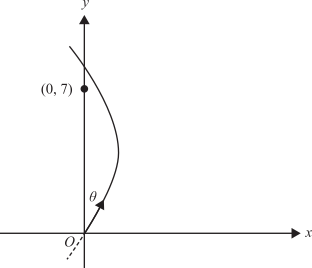
The path of the ball \(t\) seconds after passing through \(O\) is given by
\(\underset{\sim}{\text{r}}(t)=\dfrac{1}{2} \sin \left(\dfrac{\pi t}{4}\right) \underset{\sim}{\text{i}}+2 t \underset{\sim}{\text{j}}\) for \(t \in[0,5]\)
where \(\underset{\sim}{i}\) is a unit vector to the right, perpendicular to the forward direction, \(\underset{\sim}{j}\) is a unit vector in the forward direction and displacement components are measured in metres.
--- 7 WORK AREA LINES (style=lined) ---
--- 4 WORK AREA LINES (style=lined) ---
--- 4 WORK AREA LINES (style=lined) ---
--- 5 WORK AREA LINES (style=lined) ---
--- 5 WORK AREA LINES (style=lined) ---
a. \(r(t)=\dfrac{1}{2}\,\sin \left(\dfrac{\pi t}{4}\right) \underset{\sim}{i}+2 t \underset{\sim}{j}\)
\(\dot{r}(t)=\dfrac{\pi}{8}\, \cos \left(\dfrac{\pi t}{4}\right) \underset{\sim}{i}+2 \underset{\sim}{j}\)
\(\dot{r}(0)=\dfrac{\pi}{8}\,\underset{\sim}{i}+2\underset{\sim}{j}\)

\begin{aligned}
\tan (90-\theta) & =\dfrac{2}{\frac{\pi}{8}} \\
90-\theta & =\tan ^{-1}\left(\dfrac{16}{\pi}\right)=78.9^{\circ} \\
\theta & =11.1^{\circ}
\end{aligned}
| b.i. | \(\text{Speed}\) | \(=\abs{\dot{r}(0)}\) |
| \(=\sqrt{\left(\dfrac{\pi}{8}\right)^2+2^2}\) | ||
| \(=2.04\ \text{ms}^{-1}\ \text{(2 d.p.)}\) |
b.ii. \(\abs{\dot{r}}=\sqrt{\left(\dfrac{\pi}{8}\right)^2 \times \cos ^2\left(\dfrac{\pi t}{4}\right)+4}\)
\(\abs{\dot{r}}\text { is a minimum when}\ \ \cos ^2\left(\dfrac{\pi t}{4}\right)=0\)
\(\Rightarrow t=2\)
\(\therefore\ \text{Minimum speed} =\sqrt{4}=2 \text{ ms} ^{-1}\)
c. \(\text{Ball position}\ \Rightarrow \ \underset{\sim}{r}=\dfrac{1}{2}\,\sin \left(\dfrac{\pi t}{4}\right)\underset{\sim}{i}+2 \, t\underset{\sim}{j}\)
\(\text{Hole position}\ \Rightarrow \ \underset{\sim}{h}=0 \underset{\sim}{i}+7\underset{\sim}{j}\)
\(\underset{\sim}{d}=\underset{\sim}{r}-\underset{\sim}{h}=\dfrac{1}{2}\, \sin \left(\dfrac{\pi t}{4}\right) \underset{\sim}{i}+(2 t-7)\underset{\sim}{j}\)
\(\abs{\underset{\sim}{d}}=\sqrt{\left(\dfrac{1}{2}\right)^2 \sin ^2\left(\dfrac{\pi t}{4}\right)+(2 t-7)^2}\)
\(\text {Minimum }\abs{d}=0.188\text{ m (3 d.p.)}\)
| d. | \(\text{Distance}\) | \(=\displaystyle \int_0^4\left(\frac{\pi}{8}\, \cos \left(\frac{\pi t}{4}\right)\right)^2+4\, dt\) |
| \(=8.077\ \text{m (3 d.p.)}\) |
Write balanced chemical equations for each of the following reactions (states of matter are not required).
--- 2 WORK AREA LINES (style=lined) ---
--- 2 WORK AREA LINES (style=lined) ---
Write balanced chemical equations for each of the following reactions (states of matter are not required).
--- 2 WORK AREA LINES (style=lined) ---
--- 2 WORK AREA LINES (style=lined) ---
--- 2 WORK AREA LINES (style=lined) ---
Write balanced chemical equations for each of the following reactions (states of matter are not required).
--- 2 WORK AREA LINES (style=lined) ---
--- 2 WORK AREA LINES (style=lined) ---
Write balanced chemical equations for each of the following reactions (states of matter are not required).
--- 2 WORK AREA LINES (style=lined) ---
--- 2 WORK AREA LINES (style=lined) ---
--- 2 WORK AREA LINES (style=lined) ---
A student stirs 2.80 g of silver \(\text{(I)}\) nitrate powder into 250.0 mL of 1.00 mol L\(^{-1}\) sodium hydroxide solution until it is fully dissolved. A reaction occurs and a precipitate appears.
--- 2 WORK AREA LINES (style=lined) ---
--- 8 WORK AREA LINES (style=lined) ---
The student weighed a piece of filter paper, filtered out the precipitate and dried it thoroughly in an incubator. The final precipitate mass was higher than predicted in (b).
--- 4 WORK AREA LINES (style=lined) ---