SmarterEd

Aussie Maths & Science Teachers: Save your time with SmarterEd

  • Login
  • Get Help
  • About

Calculus, SPEC1 2022 VCAA 2

Solve the differential equation  `(dy)/(dx) = -x sqrt(4-y^2)`  given that  `y(2) = 0`. Give your answer in the form  `y = f(x)`.   (3 marks)

--- 8 WORK AREA LINES (style=lined) ---

Show Answers Only

`y=2sin(-(1)/(2)x^(2)+2)`

Show Worked Solution
`int(dy)/(sqrt(4-y^(2)))` `=int-x\ dx`  
`sin^(-1)((y)/(2))` `=-(1)/(2)x^(2)+c`  

 
`y(2)=0\ \=> \ c=2`

`(y)/(2)` `=sin(-(1)/(2)x^(2)+2)`  
`y` `=2sin(-(1)/(2)x^(2)+2)`  

Filed Under: Equations Tagged With: Band 4, smc-5161-50-dy/dx=f(y)

Vectors, SPEC2 2023 VCAA 5

The points with coordinates \(A(1,1,2), B(1,2,3)\) and \(C(3,2,4)\) all lie in a plane \(\Pi\).

  1. Find the vectors \(\overrightarrow{A B}\) and \(\overrightarrow{A C}\), and hence show that the area of triangle \(A B C\) is 1.5 square units.  (2 marks)

    --- 5 WORK AREA LINES (style=lined) ---

  2. Find the shortest distance from point \(B\) to the line segment \(A C\).  (2 marks)

    --- 3 WORK AREA LINES (style=lined) ---

A second plane, \(\psi\), has the Cartesian equation  \(2 x-2 y-z=-18\).

  1. At what acute angle does the line given by \(\underset{\sim}{ r }(t)=3 \underset{\sim}{ i }+2 \underset{\sim}{ j }+4 \underset{\sim}{ k }+t(\underset{\sim}{ i }-2 \underset{\sim}{ j }+2\underset{\sim}{ k }), t \in R\), intersect the plane \(\psi\) ? Give your answer in degrees correct to the nearest degree.  (2 marks)

    --- 4 WORK AREA LINES (style=lined) ---

A line \(L\) passes through the origin and is normal to the plane \(\psi\). The line \(L\) intersects \(\psi\) at a point \(D\).

  1. Write down an equation of the line \(L\) in parametric form.  (1 mark)

    --- 2 WORK AREA LINES (style=lined) ---

  2. Find the shortest distance from the origin to the plane \(\psi\).  (2 marks)

    --- 3 WORK AREA LINES (style=lined) ---

  3. Find the coordinates of point \(D\).  (2 marks)

    --- 5 WORK AREA LINES (style=lined) ---

Show Answers Only

a.     \(\overrightarrow{A B}  =\overrightarrow{O B}-\overrightarrow{O A}=\left(\begin{array}{l}1 \\ 2 \\ 3\end{array}\right)-\left(\begin{array}{l}1 \\ 1 \\ 2\end{array}\right)=\left(\begin{array}{l}0 \\ 1 \\ 1\end{array}\right)\)
  \(\overrightarrow{A C}  =\overrightarrow{O C}-\overrightarrow{O A}=\left(\begin{array}{l}3 \\ 2 \\ 4\end{array}\right)-\left(\begin{array}{l}1 \\ 1 \\ 2\end{array}\right)=\left(\begin{array}{l}2 \\ 1 \\ 2\end{array}\right)\)

\(\text{Area}=\dfrac{1}{2}\ \bigg|\overrightarrow{AB} \times \overrightarrow{AC}\bigg|=\dfrac{1}{2}\ \left|\begin{array}{ccc}\underset{\sim}{i} & \underset{\sim}{j} & \underset{\sim}{k} \\ 0 & 1 & 1 \\ 2 & 1 & 2\end{array}\right|=\dfrac{1}{2}\ \bigg|\underset{\sim}{i}+2 \underset{\sim}{j}-2 \underset{\sim}{k}\bigg|=\dfrac{3}{2}\)

b.    \(\text {Shortest distance }=1 \text { unit }\)

c.     \(26^{\circ}\)

d.    \(\underset{\sim}{r}(t)=\underset{\sim}{n} \times t=2 t \underset{\sim}{i}-2 t \underset{\sim}{j}-t \underset{\sim}{k}\)

\(x=2 t, y=-2 t, z=-t \quad \text{(also accepted)}\)

e.    \(\text {Shortest distance }=6\)

f.    \(D(-4,4,2)\)

Show Worked Solution

a.     \(\overrightarrow{A B}  =\overrightarrow{O B}-\overrightarrow{O A}=\left(\begin{array}{l}1 \\ 2 \\ 3\end{array}\right)-\left(\begin{array}{l}1 \\ 1 \\ 2\end{array}\right)=\left(\begin{array}{l}0 \\ 1 \\ 1\end{array}\right)\)
  \(\overrightarrow{A C}  =\overrightarrow{O C}-\overrightarrow{O A}=\left(\begin{array}{l}3 \\ 2 \\ 4\end{array}\right)-\left(\begin{array}{l}1 \\ 1 \\ 2\end{array}\right)=\left(\begin{array}{l}2 \\ 1 \\ 2\end{array}\right)\)

\(\text{Area}=\dfrac{1}{2}\ \bigg|\overrightarrow{AB} \times \overrightarrow{AC}\bigg|=\dfrac{1}{2}\ \left|\begin{array}{ccc}\underset{\sim}{i} & \underset{\sim}{j} & \underset{\sim}{k} \\ 0 & 1 & 1 \\ 2 & 1 & 2\end{array}\right|=\dfrac{1}{2}\ \bigg|\underset{\sim}{i}+2 \underset{\sim}{j}-2 \underset{\sim}{k}\bigg|=\dfrac{3}{2}\)

 
b.   
\(\text {In } \triangle ABC \text {, shortest distance of } B \text { to } A C\ \text {is the} \perp \text {distance }\)

\(|\overrightarrow{A C}|= \displaystyle{\sqrt{2^2+1^2+2^2}}=3\)

\(\dfrac{3}{2}=\dfrac{1}{2}\ |\overrightarrow{A C}| \times h \ \Rightarrow \ h=1\)

\(\therefore \text { Shortest distance }=1 \text { unit }\)
 

♦♦ Mean mark (b) 35%.

c.    \(\text {Vector} \perp \text {to plane}\ \psi\  \text {is}\ \ \underset{\sim}{n}=2 \underset{\sim}{i}-2 \underset{\sim}{j}-\underset{\sim}{k}\)

\(\text{Parallel line to}\ \underset{\sim}{r}(t) \ \text{is}\ \ \underset{\sim}{m}=\underset{\sim}{i}-2 \underset{\sim}{j}+2\underset{\sim}{k}\)

\(\text{Find angle } \alpha \text{ between }\underset{\sim}{n} \text{ and } \underset{\sim}{m},\)

\(\text{Solve for } \alpha:\)

\((2 \underset{\sim}{i}-2 \underset{\sim}{j}-\underset{\sim}{k})(\underset{\sim}{i}-2 \underset{\sim}{j}+\underset{\sim}{2 k})=3 \times 3 \times \cos \, \alpha\)

\(\Rightarrow \alpha=64^{\circ} \text { (nearest degree) }\)
 

\(\text{Find angle } \theta \text{ between } \underset{\sim}{m} \text{ and plane } \psi :\)

\(\theta=90-64=26^{\circ}\)
 

d.    \(\underset{\sim}{r}(t)=\underset{\sim}{n} \times t=2 t \underset{\sim}{i}-2 t \underset{\sim}{j}-t \underset{\sim}{k}\)

\(x=2 t, y=-2 t, z=-t \quad \text{(also accepted)}\)
 

♦ Mean mark (d) 52%.

e.    \(|\overrightarrow{OD}|=\text{shortest distance from } O \text{ to plane } \psi\).

\(\Rightarrow D \text{ is on } L \text{ and } \psi\)

\(\text{Solve for } t: \  2(2 t)-2(-2 t)-(t)=-18\)

\(\Rightarrow t=-2\)

\(|\overrightarrow{OD}|=-4 \underset{\sim}{i}+4 \underset{\sim}{j}+2 \underset{\sim}{k}\)

\(\text {Shortest distance }=\displaystyle{\sqrt{(-4)^2+4^2+2^2}}=6\)
 

f.    \(\overrightarrow{OD}=-4 \underset{\sim}{i}+4 \underset{\sim}{j}+2 \underset{\sim}{i}\)

\(D(-4,4,2)\)

♦ Mean mark (f) 41%.

Filed Under: Basic Concepts and Calculations, Vector Lines, Planes and Geometry Tagged With: Band 4, Band 5, smc-1176-20-Angle between vectors, smc-1176-45-Vector planes, smc-1177-40-Triangles, smc-1177-50-2D problems

PHYSICS, M5 2021 VCE 3

To calculate the mass of distant pulsars, physicists use Newton's law of universal gravitation and the equations of circular motion.

The planet Phobetor orbits pulsar PSR B1257+12 at an orbital radius of 6.9 × 10\(^{10}\) m and with a period of 8.47 × 10\(^6\) s.

Assuming that Phobetor follows a circular orbit, calculate the mass of the pulsar. Show all your working.  (3 marks)

--- 5 WORK AREA LINES (style=lined) ---

Show Answers Only

\(M=2.71\ \times 10^{30}\ \text{kg}\)

Show Worked Solution
\(\dfrac{r^3}{T^2}\) \(=\dfrac{GM}{4\pi^2}\)  
\(M\) \(=\dfrac{4\pi^2 r^3}{G T^2}\)  
  \(=\dfrac{4 \pi^2 \times (6.9 \times 10^{10})^3}{6.67 \times 10^{-11} \times (8.47 \times 10^6)^2}\)  
  \(=2.71 \times 10^{30}\ \text{kg}\)  

Filed Under: Motion in Gravitational Fields Tagged With: Band 4, smc-3692-30-Orbital Velocity/Period/Radius

PHYSICS, M6 2021 VCE 2

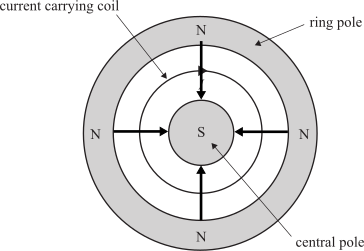
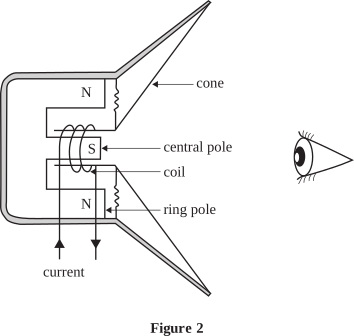
A schematic side view of one design of an audio loudspeaker is shown in Diagram 1 below. It uses a current carrying coil that interacts with permanent magnets to create sound by moving a cone in and out.
 

Diagram 2 shows a schematic view of the loudspeaker from the position of the eye shown in Diagram 1. The direction of the current is clockwise, as shown.


  1. Draw four magnetic field lines on Diagram 2, showing the direction of each field line using an arrow.   (1 mark)

    --- 0 WORK AREA LINES (style=lined) ---

  2. Which one of the following gives the direction of the force acting on the current carrying coil shown in Diagram 2?   (1 mark)
A. left B. right
C. up the page D. down the page
E. into the page F. out of the page

--- 1 WORK AREA LINES (style=lined) ---

  1. The current carrying coil has a radius of 5.0 cm and 20 turns of wire, and it carries a clockwise current \((I)\) of 2.0 A. Its magnetic field strength \((B)\) is 200 mT.
  2. Calculate the magnitude of the force, \(F\), acting on the current carrying coil. Show your working.   (2 marks)

    --- 6 WORK AREA LINES (style=lined) ---

Show Answers Only

a.   
         

b.    \(E\)

c.    \(2.51\ \text{N}\)

Show Worked Solution

a.    Magnetic fields run from the north pole to the south pole.


b.    Apply the right-hand rule:

  • Thumb to the right and fingers down, the force on the current carrying coil must be into the page.

\(\Rightarrow E\)
 

c.    \(l= 2\pi \times 5 \times 10^{-2} = 0.1\pi\)

\(\therefore F=nlIB=20 \times 0.1\pi \times 2 \times 0.2=2.51\ \text{N}\)
♦♦♦ Mean mark 24%.

Filed Under: The Motor Effect Tagged With: Band 4, Band 6, smc-3694-20-Force on Current-Carrying Conductor

Statistics, SPEC2 2023 VCAA 6

A forest ranger wishes to investigate the mass of adult male koalas in a Victorian forest. A random sample of 20 such koalas has a sample mean of 11.39 kg.

It is known that the mass of adult male koalas in the forest is normally distributed with a standard deviation of 1 kg.

  1. Find a 95% confidence interval for the population mean (the mean mass of all adult male koalas in the forest). Give your values correct to two decimal places.  (1 mark)

    --- 3 WORK AREA LINES (style=lined) ---

  2. Sixty such random samples are taken and their confidence intervals are calculated.
  3. In how many of these confidence intervals would the actual mean mass of all adult male koalas in the forest be expected to lie?  (1 mark)

    --- 2 WORK AREA LINES (style=lined) ---

The ranger wants to decrease the width of the 95% confidence interval by 60% to get a better estimate of the population mean.

  1. How many adult male koalas should be sampled to achieve this?  (1 mark)

    --- 2 WORK AREA LINES (style=lined) ---

It is thought that the mean mass of adult male koalas in the forest is 12 kg. The ranger thinks that the true mean mass is less than this and decides to apply a one-tailed statistical test. A random sample of 40 adult male koalas is taken and the sample mean is found to be 11.6 kg.

  1. Write down the null hypothesis, \(H_0\), and the alternative hypothesis, \(H_1\), for the test.   (1 mark)

    --- 2 WORK AREA LINES (style=lined) ---

The ranger decides to apply the one-tailed test at the 1% level of significance and assumes the mass of adult male koalas in the forest is normally distributed with a mean of 12 kg and a standard deviation of 1 kg.

  1.  i. Find the \(p\) value for the test correct to four decimal places.  (1 mark)

    --- 2 WORK AREA LINES (style=lined) ---

  2. ii. Draw a conclusion about the null hypothesis in part d. from the \(p\) value found above, giving a reason for your conclusion.  (1 mark)

    --- 2 WORK AREA LINES (style=lined) ---

  3. What is the critical sample mean (the smallest sample mean for \(H_0\) not to be rejected) in this test? Give your answer in kilograms correct to three decimal places.  (1 mark)

    --- 2 WORK AREA LINES (style=lined) ---

Suppose that the true mean mass of adult male koalas in the forest is 11.4 kg, and the standard deviation is 1 kg. The level of significance of the test is still 1%.

  1. What is the probability, correct to three decimal places, of the ranger making a type \(\text{II}\) error in the statistical test?  (1 mark)

    --- 2 WORK AREA LINES (style=lined) ---

Show Answers Only

a.    \((10.95,11.83)\)

b.    \(57\)

c.    \(n=125\)

d.    \(H_0: \mu=12, \quad H_1: \mu<12\)

e.i.  \(p=0.0057\)

e.ii. \(\text{Since } p<0.01 \text { : reject } H_0 \text {, favour } H_1\)

f.    \(\text {Critical sample mean } \bar{x} \approx 11.632\)

g.    \(\text{Pr}(\bar{x} \geqslant 11.63217 \mid \mu=11.4) \approx 0.071\)

Show Worked Solution

a.    \(\sigma_{\text{pop}}=1\)

\(\text{Sample:}\ \ n=20,\ \ \bar{x}=11.39,\ \ \sigma_{\text {sample }}=\dfrac{1}{\sqrt{20}}\)

\(\text{Find 95% C.I. (by CAS):}\)

\((10.95,11.83)\)
 

b.    \(\text{95% C.I. for 60 samples calculated}\)

\(\text{Number expected }(\mu \text{ within C.I.)}=0.95 \times 60=57\)
 

c.    \(\text {C.I.}=\left(11.39-1.96 \times \dfrac{1}{\sqrt{20}}, 11.39+1.96 \times \dfrac{1}{\sqrt{20}}\right)\)

\(\Rightarrow \text { Interval }=2 \times 1.96 \times \dfrac{1}{\sqrt{20}}\)

\(\text{Interval reduced by } 60\%\)

\(\Rightarrow \text{ New interval }=0.40 \times 2 \times 1.96 \times \dfrac{1}{\sqrt{20}}\)

\(\text{Solve for } n\) :

\(2 \times 1.96 \times \dfrac{1}{\sqrt{n}}=0.40 \times 2 \times 1.96 \times \dfrac{1}{\sqrt{20}}\)

\(\Rightarrow n=125\)
 

♦♦♦ Mean mark (c) 28%.

d.    \(H_0: \mu=12,\ \ H_1: \mu<12\)
 

e.i.  \(E(\bar{X})=\mu=12\)

 \(\bar{x}=11.6, \ \sigma(\bar{X})=\dfrac{1}{\sqrt{40}}\)

 \(p=\operatorname{Pr}(\bar{X} \leqslant 11.6)=0.0057\)


e.ii. \(\text{Since}\ \  p<0.01 \text {: reject } H_0 \text {, favour } H_1\)
 

f.    \(\text{Pr}(\bar{X} \leqslant a \mid \mu=12) \geqslant 0.01\) 

\(\text{Find } a \text{ (by CAS):}\)

\(\text{inv Norm}\left(0.01,12, \dfrac{1}{\sqrt{40}}\right) \ \Rightarrow \ a \geqslant 11.63217\)

\(\text {Critical sample mean}\ \ \bar{x} \approx 11.632\)
 

g.    \(\mu=11.4,\ \ \sigma_{\text{pop}}=1,\ \  n=40\)

\(\text{Pr}(\bar{X} \geqslant 11.63217 \mid \mu=11.4) \approx 0.071\)

♦♦ Mean mark (g) 39%.

Filed Under: Confidence Intervals and Hypothesis Testing (SM) Tagged With: Band 3, Band 4, Band 5, smc-1162-10-95% CI (sample), smc-1162-30-One-tail test, smc-1162-50-Null/Alternative hypothesis

CHEMISTRY, M1 EQ-Bank 6

Explain the trend in reactivity with water of the elements in Group 2 as you move down the group.   (2 marks)

--- 5 WORK AREA LINES (style=lined) ---

Show Answers Only
  • The reactivity of Group 2 elements with water increases as you move down the group due to decreasing ionization energies and increasing atomic radii.
  • Lower ionization energies and larger atomic radii make it easier for these metals to lose electrons and react with water, forming hydroxides and hydrogen gas. 
  • For instance, magnesium reacts slowly with hot water, while barium reacts vigorously even at room temperature, illustrating this trend.
Show Worked Solution
  • The reactivity of Group 2 elements with water increases as you move down the group due to decreasing ionization energies and increasing atomic radii.
  • Lower ionization energies and larger atomic radii make it easier for these metals to lose electrons and react with water, forming hydroxides and hydrogen gas. 
  • For instance, magnesium reacts slowly with hot water, while barium reacts vigorously even at room temperature, illustrating this trend.

Filed Under: Periodicity Tagged With: Band 4, smc-4257-40-Reactivity

PHYSICS, M8 2022 VCE 15

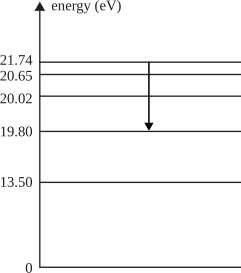
The diagram shows some of the energy levels of excited neon atoms. These energy levels are not drawn to scale.
 

  1. Show that the energy transition required for an emitted photon of wavelength 640 nm is 1.94 eV.   (1 mark)

--- 4 WORK AREA LINES (style=lined) ---

  1. On the diagram, draw an arrow to show the transition that would emit the photon described in part a.   (1 mark)

--- 0 WORK AREA LINES (style=blank) ---

Show Answers Only

a.    \(E=hf=\dfrac{hc}{\lambda}=\dfrac{6.626 \times 10^{-34} \times 3 \times 10^8}{640 \times 10^{-9}}=3.106 \times 10^{-19}\ \text{J}\)

\(\text{Convert to electron volts} =\dfrac{3.106 \times 10^{-19}}{1.602 \times 10^{-19}}=1.94\ \text{eV}\)
 

b.   
       

Show Worked Solution

a.    \(E=hf=\dfrac{hc}{\lambda}=\dfrac{6.626 \times 10^{-34} \times 3 \times 10^8}{640 \times 10^{-9}}=3.106 \times 10^{-19}\ \text{J}\)

\(\text{Convert to electron volts} =\dfrac{3.106 \times 10^{-19}}{1.602 \times 10^{-19}}=1.94\ \text{eV}\)
 

b.
       

Filed Under: Quantum Mechanical Nature of the Atom Tagged With: Band 4, smc-3702-20-Electron Transitions, smc-3702-30-Photon Energy

PHYSICS, M7 2022 VCE 14*

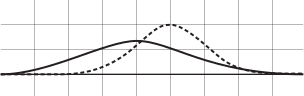
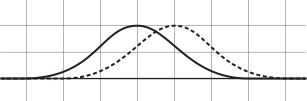
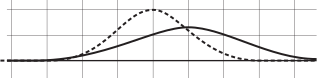
Sam undertakes a photoelectric effect experiment using the apparatus shown in Figure 1. She uses a green filter.
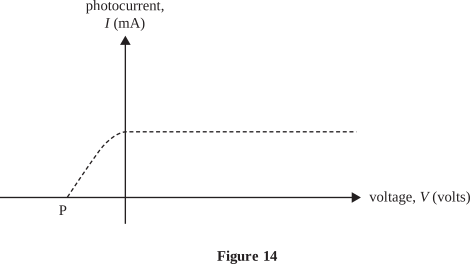


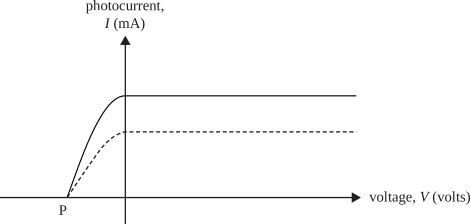
Sam produces a graph of photocurrent, \(I\), in milliamperes, versus voltage, \(V\), in volts, as shown in Figure 2.


  1. Identify what point \(\text{P}\) represents on the graph in Figure 2.   (1 mark)

--- 2 WORK AREA LINES (style=lined) ---

  1. Sam then significantly increases the intensity of the light.
  2. Sketch the resulting graph on Figure 3. The dashed line in Figure 14 represents the original data.   (2 marks)


--- 0 WORK AREA LINES (style=blank) ---
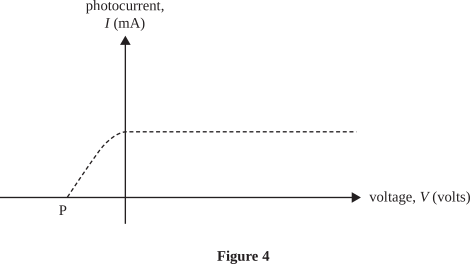
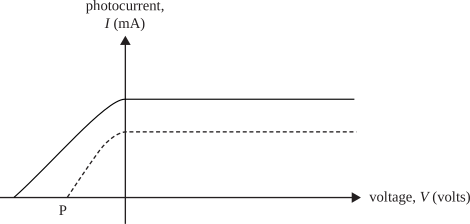
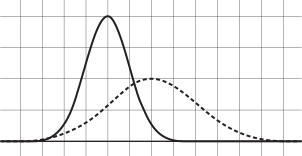
  1. Sam replaces the green filter with a violet filter, keeping the light source at the increased intensity.
  2. Sketch the resulting graph on Figure 4. The dashed line in Figure 4 represents the original data.   (2 marks)
     

--- 0 WORK AREA LINES (style=blank) ---

Show Answers Only

a.    Stopping voltage        

b.   

c.   

Show Worked Solution

a.    Stopping voltage
 

b.    Diagram will exhibit the following points:

  • Increasing the intensity of light will increase the photocurrent due to more photoelectrons being ejected from the metal.
  • However, it will not change the energy of the photoelectrons, hence the stopping voltage remains the same.
     

c.    Diagram will exhibit the following points:

  • Changing the colour from green to violet will increase the frequency of the light.
  • As \(E=hf\), the energy of the photoelectrons will increase, hence there needs to be a greater stopping voltage.
     

Filed Under: Light: Quantum Model Tagged With: Band 3, Band 4, smc-3698-10-Photoelectric Effect

Functions, MET2 2023 VCAA 2

The following diagram represents an observation wheel, with its centre at point \(P\). Passengers are seated in pods, which are carried around as the wheel turns. The wheel moves anticlockwise with constant speed and completes one full rotation every 30 minutes.When a pod is at the lowest point of the wheel (point \(A\)), it is 15 metres above the ground. The wheel has a radius of 60 metres.
 

Consider the function \(h(t)=-60\ \cos(bt)+c\) for some \(b, c \in R\), which models the height above the ground of a pod originally situated at point \(A\), after time \(t\) minutes.

  1. Show that \(b=\dfrac{\pi}{15}\) and \(c=75\).   (2 marks)

    --- 5 WORK AREA LINES (style=lined) ---

  2. Find the average height of a pod on the wheel as it travels from point \(A\) to point \(B\).
  3. Give your answer in metres, correct to two decimal places.   (2 marks)

    --- 3 WORK AREA LINES (style=lined) ---

  4. Find the average rate of change, in metres per minute, of the height of a pod on the wheel as it travels from point \(A\) to point \(B\).   (1 mark)

    --- 3 WORK AREA LINES (style=lined) ---

After 15 minutes, the wheel stops moving and remains stationary for 5 minutes. After this, it continues moving at double its previous speed for another 7.5 minutes.

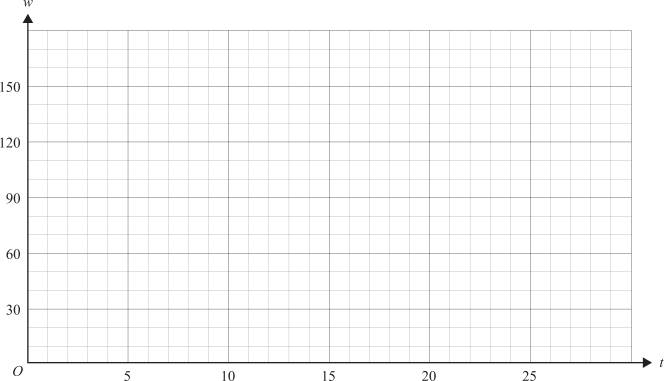
The height above the ground of a pod that was initially at point \(A\), after \(t\) minutes, can be modelled by the piecewise function \(w\):
 

\(w(t) = \begin {cases}
h(t)         &\ \ 0 \leq t < 15 \\
k         &\ \ 15 \leq t < 20 \\
h(mt+n) &\ \ 20\leq t\leq 27.5
\end{cases}\)

 
where \(k\geq 0, m\geq 0\) and \(n \in R\).

  1.   i.State the values of \(k\) and \(m\).   (1 mark)

    --- 2 WORK AREA LINES (style=lined) ---

      
     ii. Find all possible values of \(n\).   (2 marks)

    --- 4 WORK AREA LINES (style=lined) ---


    iii. Sketch the graph of the piecewise function \(w\) on the axes below, showing the coordinates of the endpoints.   (3 marks)

    --- 0 WORK AREA LINES (style=lined) ---

     
  1.  
Show Answers Only

a.    \(\text{See worked solution}\)

b.    \(\approx 36.80\ \text{m}\)

c.    \(8\)

d.i.  \(k=135, m=2\)

d.ii. \(n=30p+5,\ p\in Z\)

d.iii. 
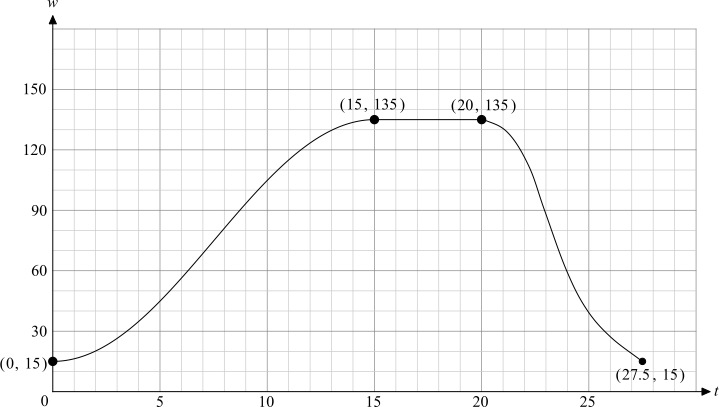
Show Worked Solution
a.    \(\text{Period:}\) \(\dfrac{2\pi}{b}\) \(=30\)
    \(\therefore\ b\) \(=\dfrac{\pi}{15}\)

  
\(\text{Given }h(t)=-60\cos(bt)+c,\ \text{evaluate when }t=0, h=15\ \text{to find }c.\)

\(-60\ \cos(0)+c\)  \(=15\)
\(c\) \(=75\)

  \(\therefore\ h(t)=-60\cos(\dfrac{\pi t}{15})+75\)

b.     \(\text{Average height}\) \(=\dfrac{1}{\frac{30}{4}-0}\displaystyle\int_0^{\frac{30}{4}}\Bigg(-60\cos\Bigg(\dfrac{\pi}{15}t\Bigg)+75\Bigg)\,dt\)
    \(=\dfrac{2}{15}\left[75t-\dfrac{900\ \sin(\frac{\pi}{15}t)}{\pi}\right]_{0}^{7.5}\)
    \(=\dfrac{2}{15}\Bigg[75\times 7.5-\dfrac{900\ \sin(\frac{\pi}{15}\times 7.5)}{\pi}\Bigg]-\Bigg[0\Bigg]\)
    \(=\dfrac{75\pi-120}{\pi}=\dfrac{15(5\pi-8)}{\pi}\)
    \(=36.802\dots\approx 36.80\ \text{m}\)
 
♦♦ Mean mark (b) 45%.
MARKER’S COMMENT: \(\frac{1}{60}\int_0^{60} h(t)dt\) was a common error.
Others incorrectly found average rate of change instead of average value.

c.   \(\text{Av rate of change of height}\)

  \(=\dfrac{h(7.5)-h(0)}{7.5}\)
  \(=\dfrac{\Bigg(75-60\cos(\dfrac{\pi \times 7.5}{15})\Bigg)-\Bigg(75-60\cos(\dfrac{\pi\times 0}{15})\Bigg)}{7.5}\)
  \(=\dfrac{75-15}{7.5}=8\)
 
♦ Mean mark (c) 50%.
MARKER’S COMMENT: Common incorrect answer was – 8.
di.    \(\text{Period is 30 minutes, so after 15 minutes pod}\)
\(\text{is at the top of the wheel.}\)
  \(\therefore\ k=75-60\ \cos(\frac{\pi}{15}\times 15)=135\)

  
\(\text{Pod is travelling at twice its previous speed}\)
\(\text{so one revolution takes 15 minutes}\)

\(\therefore\ \text{Period}\rightarrow\) \(\dfrac{2\pi}{bm}\) \(=15\)
  \(bm\) \(=\dfrac{2\pi}{15}\)
  \(\dfrac{\pi}{15}\cdot m\) \(=\dfrac{2\pi}{15}\)
  \(m\) \(=\dfrac{2\pi}{15}\times \dfrac{15}{\pi}\)
    \(=2\)
 
♦♦ Mean mark (d)(i) 40%.
MARKER’S COMMENT: Many students could find \(k\) but not \(m\) with \(m=\frac{1}{2}\) a common error.
dii.   \(\text{When }t=20\ \text{the pod is at the top of the wheel and height is 135.}\)
  
\(\text{When }t=27.5\ \text{the pod is back at the start and height is 15.}\)

   
\(\text{Using CAS solve for }t=20:\rightarrow\ h(2(20)+n)=135\ \rightarrow\ n=30p+5\)

\(\text{Using CAS solve for }t=27.5:\rightarrow\ h(2(27.5)+n)=15\ \rightarrow\ n=30p+5\)

\(\therefore\ n=30p+5,\ p\in Z\)

 
♦♦♦ Mean mark (d)(ii) 20%.
MARKER’S COMMENT: Many students set up the correct equations to solve but did not provide the general solution. Some incorrectly stated the variable as an element of R.

diii.   

 
♦♦♦ Mean mark (d)(iii) 40%.
MARKER’S COMMENT: Students are reminded to include all endpoints and be particular about the curvature of graph.

Filed Under: Average Value and Other, Integration (Trig), Trig Equations, Trig Integration Tagged With: Band 4, Band 5, Band 6, smc-2757-70-Sketch graph, smc-725-20-Cos, smc-747-20-cos, smc-747-60-Average Value

Calculus, MET2 2023 VCAA 1

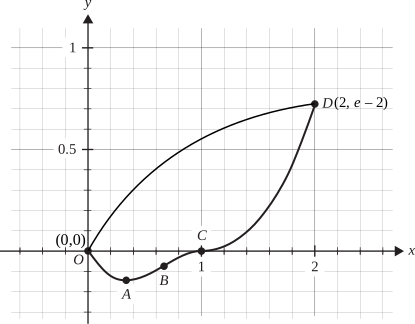
Let \(f:R \rightarrow R, f(x)=x(x-2)(x+1)\). Part of the graph of \(f\) is shown below.
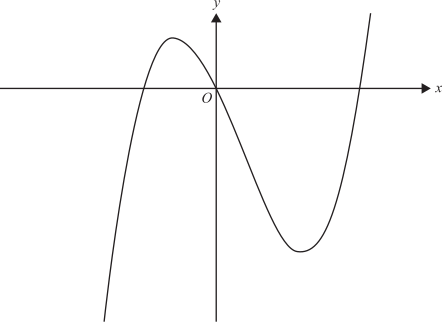
  1. State the coordinates of all axial intercepts of \(f\).   (1 mark)

    --- 2 WORK AREA LINES (style=lined) ---

  2. Find the coordinates of the stationary points of \(f\).   (2 marks)

    --- 3 WORK AREA LINES (style=lined) ---

    1. Let \(g:R\rightarrow R, g(x)=x-2\).
    2. Find the values of \(x\) for which \(f(x)=g(x)\).   (1 mark)

      --- 3 WORK AREA LINES (style=lined) ---

    1. Write down an expression using definite integrals that gives the area of the regions bound by \(f\) and \(g\).  (2 marks)

      --- 4 WORK AREA LINES (style=lined) ---

    2. Hence, find the total area of the regions bound by \(f\) and \(g\), correct to two decimal places.   (1 mark)

      --- 2 WORK AREA LINES (style=lined) ---

  1. Let \(h:R\rightarrow R, h(x)=(x-a)(x-b)^2\), where \(h(x)=f(x)+k\) and \(a, b, k \in R\).
  2. Find the possible values of \(a\) and \(b\).   (4 marks)

    --- 9 WORK AREA LINES (style=lined) ---

Show Answers Only

a.    \((-1, 0), (0, 0), (2, 0)\)

b.    \(\Bigg(\dfrac{1-\sqrt{7}}{3}, \dfrac{2(7\sqrt{7}-10}{27}\Bigg), \Bigg(\dfrac{1+\sqrt{7}}{3}, \dfrac{-2(7\sqrt{7}-10}{27}\Bigg)\)

c.i.  \(x=2,\ \text{or}\ x=\dfrac{-1\pm \sqrt{5}}{2}\)

c.ii. \(\text{Let }a=\dfrac{-1-\sqrt{5}}{2}\ \text{and }b=\dfrac{-1+\sqrt{5}}{2}\)

 \(\text{Then}\ A=\displaystyle\int_a^b (x-2)(x^2+x-1)\,dx+\displaystyle\int_b^2 -(x-2)(x^2+x-1)\,dx\)

c.iii. \(5.95\)

d.   \(\text{1st case }\rightarrow \ a=\dfrac{2\sqrt{7}+1}{3}, b=\dfrac{1-\sqrt{7}}{3}\)

\(\text{2nd case }\rightarrow \ a=\dfrac{-2\sqrt{7}+1}{3}, b=\dfrac{1+\sqrt{7}}{3}\)

Show Worked Solution

a.    \((-1, 0), (0, 0), (2, 0)\)
  

b.    \(\text{Using CAS solve for}\ x:\)

\(\dfrac{d}{dx}(x(x-2)(x+1))=0\)

\(\therefore\ x=\dfrac{1-\sqrt{7}}{3}\ \text{and }x=\dfrac{1+\sqrt{7}}{3}\)

\(\text{Substitute }x\ \text{values into }f(x)\ \text{using CAS to get}\ y\ \text{values}\)

\(\text{The stationary points of }f\ \text{are}:\)

\(\Bigg(\dfrac{1-\sqrt{7}}{3}, \dfrac{2(7\sqrt{7}-10}{27}\Bigg), \Bigg(\dfrac{1+\sqrt{7}}{3}, \dfrac{-2(7\sqrt{7}-10}{27}\Bigg)\)
  

ci    \(\text{Given }f(x)=g(x)\)

\(x(x-2)(x+1)\) \(=x-2\)
\(x(x-2)(x+1)(x-2)\) \(=0\)
\((x-2)(x(x+1)-1)\) \(=0\)
\((x-2)(x^2+x-1)\) \(=0\)

  
\(\therefore\ \text{Using CAS: } \)

\(x=2,\ \text{or}\ x=\dfrac{-1\pm \sqrt{5}}{2}\)

cii  \(\text{Area of bounded region:}\)

\(\text{Let }a=\dfrac{-1-\sqrt{5}}{2}\ \text{and }b=\dfrac{-1+\sqrt{5}}{2}\)

\(\text{Then}\ A=\displaystyle\int_a^b (x-2)(x^2+x-1)\,dx+\displaystyle\int_b^2 -(x-2)(x^2+x-1)\,dx\)
  

ciii  \(\text{Solve the integral in c.ii above using CAS:}\)
  \(\text{Total area}=5.946045..\approx 5.95\)


d.   \(\text{Method 1 – Equating coefficients}\)

\((x-a)(x-b)^2=x(x-2)(x+1)+k\)

\(x^3-2bx^2-ax^2+b^2x+2abx-ab^2=x^3-x^2-2x+k\)

\((x^3-(a+2b)x^2+(2ab+b^2)x-ab^2=x^3-x^2-2x+k\)

\(\therefore\ -(a+2b)=-1\ \to\ a=1-2b …(1)\)

\(2ab+b^2=-2\ \ …(2)\)

\(\text{Substitute (1) into (2) and solve for }b.\)

\(2b(1-2b)+b^2\) \(=-2\)
\(3b^2-2b-2\) \(=0\)
\(b\) \(=\dfrac{1\pm \sqrt{7}}{3}\)
\(\text{When }b\) \(=\dfrac{1+\sqrt{7}}{3}\)
\(a\) \(=1-2\Bigg(\dfrac{1+\sqrt{7}}{3}\Bigg)=\dfrac{-2\sqrt{7}+1}{3}\)
\(\text{When }b\) \(=\dfrac{1-\sqrt{7}}{3}\)
\(a\) \(=1-2\Bigg(\dfrac{1-\sqrt{7}}{3}\Bigg)=\dfrac{2\sqrt{7}+1}{3}\)


\(\text{Method 2 – Using transformations}\)

\(\text{The squared factor in }(x-a)(x-b)^2=x(x-2)(x+1)+k,\)

\(\text{shows that the turning point is on the }x\ \text{axis}.\)

\(\therefore\ \text{Lowering }f(x)\ \text{by }\dfrac{2(7\sqrt{7}-10)}{27}\ \text{and raising }f(x)\ \text{by }\dfrac{2(7\sqrt{7}+10)}{27}\)

\(\text{will give the 2 possible sets of values for }a\ \text{and}\ b.\)

\(\text{1st case – lowering using CAS solve }h(x) =0\ \rightarrow\ h(x)=f(x)-\dfrac{2(7\sqrt{7}-10)}{27}\)

\(\therefore\ x-\text{intercepts}\rightarrow \ a=\dfrac{2\sqrt{7}+1}{3}, b=\dfrac{1-\sqrt{7}}{3}\)

\(\text{2nd case – raising using CAS solve }h(x) =0\ \rightarrow\ h(x)=f(x)+\dfrac{2(7\sqrt{7}+10)}{27}\)

\(\therefore\ x-\text{intercepts}\rightarrow \ a=\dfrac{-2\sqrt{7}+1}{3}, b=\dfrac{1+\sqrt{7}}{3}\)


Filed Under: Area Under Curves, Functional Equations, Polynomials, Standard Integration Tagged With: Band 2, Band 3, Band 4, Band 6, smc-634-10-Polynomial, smc-642-10-(f o g)(x), smc-723-20-Cubic, smc-723-80-Area between graphs

PHYSICS, M8 2021 VCE 17 MC

Which one of the following is closest to the de Broglie wavelength of a 663 kg motor car moving at 10 m s\(^{-1}\) ?

  1. \(10^{-37}\) m
  2. \(10^{-36}\) m
  3. \(10^{-35}\) m
  4. \(10^{-34}\) m
Show Answers Only

\(A\)

Show Worked Solution

\(\lambda=\dfrac{h}{mv}=\dfrac{6.626 \times 10^{-34}}{663 \times 10}=9.99 \times 10^{-38} \approx 10^{-37}\ \text{m}\)

\(\Rightarrow A\)

Filed Under: Quantum Mechanical Nature of the Atom Tagged With: Band 4, smc-3702-40-De Broglie

PHYSICS, M5 2021 VCE 9-10 MC

Lucy is running horizontally at a speed of 6 m s\(^{-1}\) along a diving platform that is 8.0 m vertically above the water.

Lucy runs off the end of the diving platform and reaches the water below after time \(t\).

She lands feet first at a horizontal distance \(d\) from the end of the diving platform.
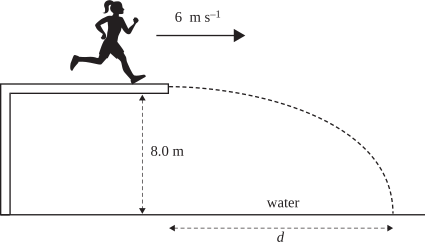
 

Question 9

Which one of the following expressions correctly gives the distance \(d\) ?

  1. 0.8\(t\)
  2. 6\(t\)
  3. 5\(t^2\)
  4. 6\(t\) + 5\(t^2\)


Question 10

Which one of the following is closest to the time taken, \(t\), for Lucy to reach the water below?

  1. 0.8 s
  2. 1.1 s
  3. 1.3 s
  4. 1.6 s
Show Answers Only

\(\text{Question 9:} \ B\)

\(\text{Question 10:} \ C\)

Show Worked Solution

Question 9

  • The horizontal displacement formula for projectile motion:  \(s=ut\)
  • Horizontal distance: \(d=6t\)

\(\Rightarrow B\)
 

Question 10

Find time of flight \((t):\)

\(s\) \(=ut+\dfrac{1}{2}at^2\)  
\(s\) \(=\dfrac{1}{2}at^2\ \ \ (u=0)\)  
\(t\) \(=\sqrt{\dfrac{2s}{a}}=\sqrt{\dfrac{2 \times 8}{9.8}}\approx 1.3\ \text{s}\)  


\(\Rightarrow C\)

Filed Under: Projectile Motion Tagged With: Band 3, Band 4, smc-3690-25-Range, smc-3690-45-Time of Flight

PHYSICS, M6 2021 VCE 7*

A mobile phone charger uses a step-down transformer to transform 240 V AC mains voltage to 5.0 V. The mobile phone draws a current of 3.0 A while charging. Assume that the transformer is ideal and that all readings are RMS.

Calculate the current drawn from the mains during charging?   (2 marks)

--- 5 WORK AREA LINES (style=lined) ---

Show Answers Only

\(0.06\ \text{A}\)

Show Worked Solution
\(\text{Power}_{\text{in}}\) \(=\ \text{Power}_{\text{out}}\)  
\(V_p I_p\) \(=V_s I_s\)  
\(I_p\) \(=\dfrac{V_s I_s}{V_p}=\dfrac{5 \times 3}{240}=0.06\ \text{A}\)  

Filed Under: Electromagnetic Induction Tagged With: Band 4, smc-3705-50-Transformer Calcs

PHYSICS, M6 2021 VCE 6 MC

A magnet approaches a coil with six turns, as shown in the diagram below. During time interval \(\Delta t\), the magnetic flux changes by 0.05 Wb and the average induced EMF is 1.2 V.
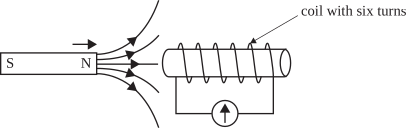
 

Which one of the following is closest to the time interval \(\Delta t\) ?

  1. 0.04 s
  2. 0.01 s
  3. 0.25 s
  4. 0.50 s
Show Answers Only

\(C\)

Show Worked Solution
\(\varepsilon\) \(=N\dfrac{\Delta \Phi}{\Delta t}\)  
\(\Delta t\) \(=N \dfrac{\Delta \Phi}{\varepsilon}=6 \times \dfrac{0.05}{1.2}=0.25\ \text{s}\)  


\(\Rightarrow C\)

Filed Under: Electromagnetic Induction Tagged With: Band 4, smc-3705-20-Induced emf, smc-3705-30-Magnetic Flux

PHYSICS, M8 2022 VCE 17

A materials scientist is studying the diffraction of electrons through a thin metal foil. She uses electrons with an energy of 10.0 keV. The resulting diffraction pattern is shown in Figure 19.
 

  1. Calculate the de Broglie wavelength of the electrons in nanometres.  (4 marks)

--- 6 WORK AREA LINES (style=lined) ---

  1. The materials scientist then increases the energy of the electrons by a small amount and hence their speed by a small amount.

    Explain what effect this would have on the de Broglie wavelength of the electrons. Justify your answer.  (3 marks)

--- 6 WORK AREA LINES (style=lined) ---

Show Answers Only

a.    \(0.012\ \text{nm}\)

b.    Effects when speed of the electron increases by a small amount:

  • Momentum will increase by a small amount
  • As \(\lambda \propto \dfrac{1}{mv}\), if the momentum of the electron increases, its corresponding de Broglie wavelength will decrease.

Show Worked Solution

a.    Convert electron volts to joules:

\(\Rightarrow \ E=10 \times 10^3 \times 1.602 \times 10^{-19}=1.602 \times 10^{-15}\ \text{J}\)

\(E\) \(=\dfrac{1}{2}mv^2\)  
\(v\) \(=\sqrt{\dfrac{2E}{m}}\)  
  \(=\sqrt{\dfrac{2 \times 1.602 \times 10^{-15}}{9.109 \times 10^{-31}}}\)  
  \(=5.93 \times 10^7\)  


\(\therefore \lambda\) \(=\dfrac{h}{mv}\)  
  \(=\dfrac{6.626 \times 10^{-34}}{9.109 \times 10^{-27} \times 5.93 \times 10^7}\)  
  \(=1.23 \times 10^{-11}\ \text{m}\)  
  \(=0.012\ \text{nm}\)  

♦ Mean mark 42%.

b.    Effects when speed of the electron increases by a small amount:

  • Momentum will increase by a small amount
  • As \(\lambda \propto \dfrac{1}{mv}\), if the momentum of the electron increases, its corresponding de Broglie wavelength will decrease.

Filed Under: Quantum Mechanical Nature of the Atom Tagged With: Band 4, Band 5, smc-3702-40-De Broglie

Calculus, 2ADV C4 2022 MET1 4

The graph of  \(y=x+\dfrac{1}{x}\) is shown over part of its domain.
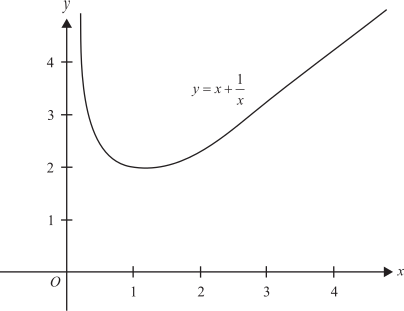
 

Use two trapeziums of equal width to approximate the area between the curve, the \(x\)-axis and the lines  \(x=1\)  and  \(x=3\).   (2 marks)

--- 4 WORK AREA LINES (style=lined) ---

Show Answers Only

\(5\dfrac{1}{6}\)

Show Worked Solution

\(\text{Trapezium rule approximation (see formula sheet):}\)

\begin{array} {|c|c|}
\hline
\rule{0pt}{2.5ex} x\rule[-1ex]{0pt}{0pt} & 1&2&3 \\
\hline
\rule{0pt}{2.5ex} f(x)\rule[-1ex]{0pt}{0pt} & 1+1=2 & 2+\dfrac{1}{2}=\dfrac{5}{2} & 3+ \dfrac{1}{3}=\dfrac{10}{3}\\
\hline
\end{array}

\(\text{Area}\) \(\approx \dfrac{3-1}{2\times 2}\Bigg[2+2\times\dfrac{5}{2}+\dfrac{10}{3}\Bigg]\)
  \(\approx\dfrac{1}{2}\Bigg[\dfrac{6}{3}+\dfrac{15}{3}+\dfrac{10}{3}\Bigg]\)
  \(\approx5\dfrac{1}{6}\)

Filed Under: Trapezoidal Rule (Y12) Tagged With: Band 4, smc-976-20-No Table

Calculus, 2ADV C2 2023 MET1 1a

Let  \(y=\dfrac{x^2-x}{e^x}\).

Find and simplify \(\dfrac{dy}{dx}\).   (2 marks)

--- 4 WORK AREA LINES (style=lined) ---

Show Answers Only

\(\dfrac{-x^2+3x-1}{e^x}\)

Show Worked Solution

\(\text{Using the quotient rule:}\)

\(\dfrac{dy}{dx}\) \(=\dfrac{e^x(2x-1)-(x^2-x)e^x}{(e^x)^2}\)
  \(=\dfrac{e^x(-x^2+3x-1)}{e^{2x}}\)
  \(=\dfrac{-x^2+3x-1}{e^x}\)

Filed Under: Exponential Calculus (Y12), L&E Differentiation (Y12) Tagged With: Band 4, smc-965-10-Differentiation (base e), smc-965-30-Indefinite integrals, smc-967-10-Exponentials (base e), smc-967-40-Quotient Rule

L&E, 2ADV E1 2023 MET1 2

Solve  \(e^{2x}-12=4e^{x}\)  for  \(x\ \in\ R\).   (3 marks)

--- 6 WORK AREA LINES (style=lined) ---

Show Answers Only

\(x=\log_{e}6\)

Show Worked Solution
\(e^{2x}-12\) \(=4e^{x}\)
\(e^{2x}-4e^{x}-12\) \(=0\)

 
\(\text{Let}\ \ u=e^{x}:\)

\(u^2-4u-12\) \(=0\)
\((u-6)(u+2)\) \(=0\)
 

\(\Rightarrow u=6\ \ \ \text{or}\ -2\)

\(\therefore e^{x}\) \(=6\ \ \ \ \ \ \ \ \ \ \text{or}\ \ \ \ \ \ e^{x}=-2\ \text{(no solution)}\)  
\(x\) \(=\log_{e}6 \)  

Filed Under: Log/Index Laws and Equations (Adv-2027), Log/Index Laws and Equations (Y11) Tagged With: Band 4, smc-6455-50-Exponential Equations, smc-963-50-Exponential Equation

PHYSICS, M6 2022 VCE 6

The diagram shows a simple alternator consisting of a rectangular coil of area 0.060 m\(^{2}\) and 200 turns, rotating in a uniform magnetic field. The magnetic flux through the coil in the vertical position shown in the diagram is 1.2 × 10\(^{-3}\) Wb.
 

  1. Calculate the strength of the magnetic field. Show your working.  (2 marks)

--- 4 WORK AREA LINES (style=lined) ---

  1. The rectangular coil rotates at a frequency of 2.5 Hz.
  2. Calculate the average induced EMF produced in the first quarter of a turn. Begin the quarter with the coil in the vertical position shown in the diagram.  (3 marks)

--- 6 WORK AREA LINES (style=lined) ---

Show Answers Only

a.    \(0.02\ \text{T}\)

b.    \(2.4\ \text{V}\)

Show Worked Solution
a.     \(\Phi\) \(=BA\)
  \(B\) \(=\dfrac{\Phi}{A}=\dfrac{1.2 \times 10^{-3}}{0.060}=0.02\ \text{T}\)

 
b.   
\(\text{The time for 1 complete rotation:}\)

\(T=\dfrac{1}{f}=\dfrac{1}{2.5}=0.4\ \text{s}\)

\(\Rightarrow \text{Time for a quarter turn}\ =0.1\ \text{s}\)

\(\varepsilon=N\dfrac{\Delta \Phi}{t}=200 \times  \dfrac{1.2 \times 10^{-3}}{0.1}=2.4\ \text{V}\)

Filed Under: Electromagnetic Induction Tagged With: Band 3, Band 4, smc-3705-20-Induced emf, smc-3705-30-Magnetic Flux

PHYSICS, M6 2022 VCE 5*

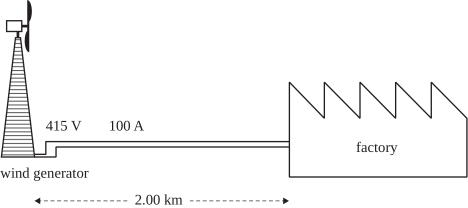
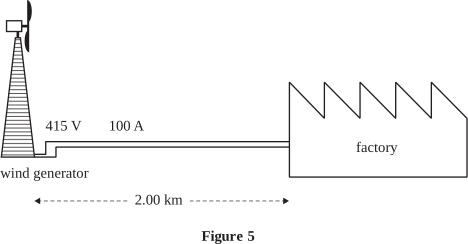
A wind generator provides power to a factory located 2.00 km away, as shown in the diagram.

When there is a moderate wind blowing steadily, the generator produces a voltage of 415 V and a current of 100 A.

The total resistance of the transmission wires between the wind generator and the factory is 2.00 \(\Omega\).
 

  1. Calculate the power, in kilowatts, produced by the wind generator when there is a moderate wind blowing steadily.   (1 mark)

--- 2 WORK AREA LINES (style=lined) ---

To operate correctly, the factory's machinery requires a power supply of 40 kW.

  1. Determine whether the energy supply system, as shown, will be able to supply power to the factory when the moderate wind is blowing steadily. Justify your answer with calculations.   (3 marks)

--- 6 WORK AREA LINES (style=lined) ---

  1. The factory's owner decides to limit transmission energy loss by installing two transformers: a step-up transformer with a turns ratio of 1:10 at the wind generator and a step-down transformer with a turns ratio of 10:1 at the factory. Each transformer can be considered ideal.

    With the installation of the transformers, determine the power, in kilowatts, now supplied to the factory.   (3 marks)

--- 8 WORK AREA LINES (style=lined) ---

Show Answers Only

a.    \(41.5\ \text{kW}\)

b.    \(P_{\text{loss}}=I^2R=100^2 \times 2=20000\ \text{W}=20\ \text{kW}\)

\(\Rightarrow\ \text{Net power supplied}\ =41.5-20=21.5\ \text{kW}\ < 40\ \text{kW}\)

\(\therefore \ \text{The power supply will not be enough to power the factory.}\)

c.    \(41.3\ \text{kW}\)

Show Worked Solution

a.    \(P=VI=415 \times 100 = 41\ 500\ \text{W}=41.5\ \text{kW}\)
 

b.    \(P_{\text{loss}}=I^2R=100^2 \times 2=20000\ \text{W}=20\ \text{kW}\)

\(\Rightarrow\ \text{Net power supplied}\ =41.5-20=21.5\ \text{kW}\ < 40\ \text{kW}\)

\(\therefore \ \text{The power supply will not be enough to power the factory.}\)
 

c.     \(\dfrac{I_s}{I_p}\) \(=\dfrac{N_p}{N_s}\)
  \(I_s\) \(=\dfrac{N_p}{N_s} \times I_p=\dfrac{1}{10} \times 100=10\ \text{A}\)


\(P_{\text{loss}} \text{(new)} =I^2R=10^2 \times 2=200\ \text{W}=0.2\ \text{kW}\)

\(\therefore\ \text{Net power supplied}\ =41.5-0.2=41.3\ \text{kW}\)

Filed Under: Electromagnetic Induction Tagged With: Band 3, Band 4, smc-3705-80-Energy Distribution

PHYSICS, M6 2022 VCE 3

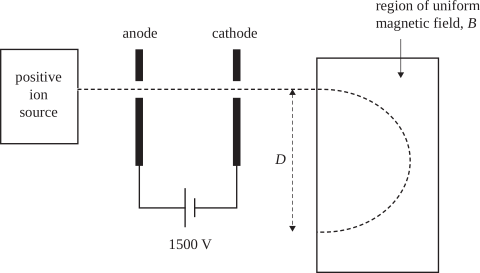
A schematic diagram of a mass spectrometer that is used to deflect charged particles to determine their mass is shown in the diagram. Positive singly charged ions (with a charge of +1.602 × 10\(^{-19}\) C) are produced at the ion source. These are accelerated between an anode and a cathode. The potential difference between the anode and the cathode is 1500 V. The ions pass into a region of uniform magnetic field, \(B\), and are directed by the field into a semicircular path of diameter \(D\).


  1. Calculate the increase in the kinetic energy of each ion as it passes between the anode and the cathode. Give your answer in joules.  (2 marks)

    --- 5 WORK AREA LINES (style=lined) ---

Each ion has a mass of 4.80 × 10\(^{-27}\) kg.

  1. Show that each ion has a speed of 3.16 × 10\(^{5}\) m s\(^{-1}\) when it exits the cathode. Assume that the ion leaves the ion source with negligible speed. Show your working.  (2 marks)

--- 6 WORK AREA LINES (style=lined) ---

  1. The region of uniform magnetic field, \(B\), in Figure 3 has a magnitude of 0.10 T.
  2. Calculate the diameter, \(D\), of the semicircular path followed by the ions within the magnetic field in Figure 3.  (3 marks)

    --- 7 WORK AREA LINES (style=lined) ---

Show Answers Only

a.    \(2.403 \times 10^{-16}\ \text{J}\)

b.     \(\Delta KE\) \(=\dfrac{1}{2}mv^2\)
  \(v\) \(=\sqrt{\dfrac{2 \Delta KE}{m}}\)
    \(=\sqrt{\dfrac{2 \times 2.403 \times 10^{-16}}{4.80 \times 10^{-27}}}\)
    \(=3.16 \times 10^5\ \text{ms}^{-1}\)

c.    \(0.19\ \text{m}\)

Show Worked Solution
a.    \(W=\Delta KE=qV=1.602 \times 10^{-19} \times 1500=2.403 \times 10^{-16}\ \text{J}\)
  
b.     \(\Delta KE\) \(=\dfrac{1}{2}mv^2\)
  \(v\) \(=\sqrt{\dfrac{2 \Delta KE}{m}}\)
    \(=\sqrt{\dfrac{2 \times 2.403 \times 10^{-16}}{4.80 \times 10^{-27}}}\)
    \(=3.16 \times 10^5\ \text{ms}^{-1}\)


c.     \(F_B\) \(=F_c\)
  \(qvB\) \(=\dfrac{mv^2}{r}\)
  \(r\) \(=\dfrac{mv}{qB}\)
    \(=\dfrac{4.80 \times 10^{-27} \times 3.16 \times 10^5}{1.602 \times 10^{-19} \times 0.10}\)
    \(=0.095\ \text{m}\)

 
\(\therefore\ D=0.19\ \text{m}\)

Filed Under: Charged Particles, Conductors and Electric/Magnetic Fields Tagged With: Band 4, smc-3693-18-Combination EF and MF, smc-3693-35-Kinematic/Work Calcs

PHYSICS, M5 2022 VCE 2

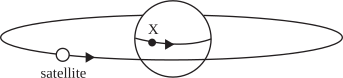
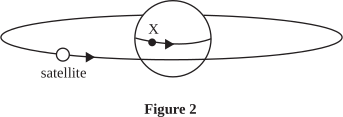
There are over 400 geostationary satellites above Earth in circular orbits. The period of orbit is one day (86 400 seconds). Each geostationary satellite remains stationary in relation to a fixed point on the equator. The diagram shows an example of a geostationary satellite that is in orbit relative to a fixed point, \(\text{X}\), on the equator.
 

  1. Explain why geostationary satellites must be vertically above the equator to remain stationary relative to Earth's surface.   (2 marks)

--- 4 WORK AREA LINES (style=lined) ---

  1.  Using  \(G=6.67 \times 10^{-11}\ \text{N m}^{2}\ \text{kg}^{-2}, M_{\text{E}} = 5.98 \times 10^{24}\ \text{kg}\)  and  \(R_{\text{E}} = 6.37 \times 10^{6}\ \text{m}\), show that the altitude of a geostationary satellite must be equal to \(3.59 \times 10^{7}\ \text{m}\).   (4 marks)

--- 8 WORK AREA LINES (style=lined) ---

  1. Calculate the speed of an orbiting geostationary satellite.   (3 marks)

--- 7 WORK AREA LINES (style=lined) ---

Show Answers Only

a.   Reasons the satellite must orbit relative to a fixed point on the equator:

  • So that it is in the same rotational plane/axis of the Earth. 
  • The gravitational force on the satellite must be directly towards the centre of the Earth and it must orbit at a set altitude to the Earth where the speed of the satellite matches the rotational speed of the Earth.
  • As the speed and direction of the satellite matches that of the Earth, it will remain stationary relative to the motion of the Earth.

b.    See worked solutions

c.    3076 ms\(^{-1}\)

Show Worked Solution

a.   Reasons the satellite must orbit relative to a fixed point on the equator:

  • So that it is in the same rotational plane/axis of the Earth. 
  • The gravitational force on the satellite must be directly towards the centre of the Earth and it must orbit at a set altitude to the Earth where the speed of the satellite matches the rotational speed of the Earth.
  • As the speed and direction of the satellite matches that of the Earth, it will remain stationary relative to the motion of the Earth.
♦♦♦ Mean mark (a) 19%.
b.     \(\dfrac{r^3}{T^2}\) \(=\dfrac{GM}{4\pi^2}\)
  \(r\) \(=\sqrt[3]{\dfrac{GMT^2}{4\pi^2}}\)
    \(=\sqrt[3]{\dfrac{6.67 \times 10^{-11} \times 5.98 \times 10^{24} \times (86\ 400)^2}{4\pi^2}}\)
    \(=42.250 \times 10^6\ \text{m}\)

 
\(\therefore \ \text{Altitude}\ =42.250 \times 10^6 -6.37 \times 10^6 =3.59 \times 10^7\ \text{m}\)
 

c.     \(v\) \(=\sqrt{\dfrac{GM}{r}}\)
    \(=\sqrt{\dfrac{6.67 \times 10^{-11} \times 5.98 \times 10^{24}}{42.25 \times 10^6}}\)
    \(=3073\ \text{ms}^{-1}\)

Filed Under: Motion in Gravitational Fields Tagged With: Band 4, Band 6, smc-3692-30-Orbital Velocity/Period/Radius, smc-3692-40-Satellites

PHYSICS, M6 2022 VCE 1

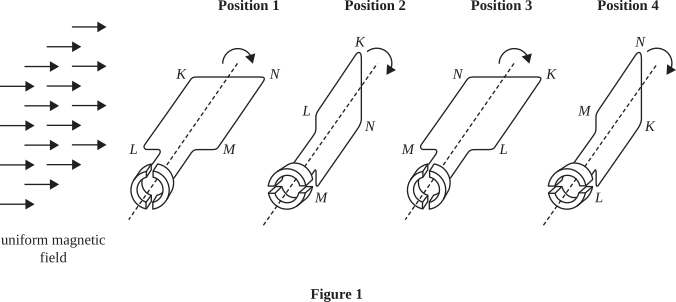
The diagram shows four positions (1, 2, 3 and 4) of the coil of a single-turn, simple DC motor. The coil is turning in a uniform magnetic field that is parallel to the plane of the coil when the coil is in Position 1, as shown.

When the motor is operating, the coil rotates about the axis through the middle of sides \(L M\) and \(N K\) in the direction indicated. The coil is attached to a commutator. Current for the motor is passed to the commutator by brushes that are not shown in the diagram.
 

  1. When the coil is in Position 1, in which direction is the current flowing in the side \(K L-\) from \(K\) to \(L\) or from \(L\) to \(K\)? Justify your answer.   (2 marks)

--- 3 WORK AREA LINES (style=lined) ---

  1. When the coil is in Position 3, in which direction is the current flowing in the side \(KL-\) from \(K\) to \(L\) or
    from \(L\) to \(K\)?
       (1 marks)

--- 2 WORK AREA LINES (style=lined) ---

  1. The side \(K L\) of the coil has a length of 0.10 m and experiences a magnetic force of 0.15 N due to the magnetic field, which has a magnitude of 0.5 T.

    Calculate the magnitude of the current in the coil.   (2 marks)

--- 5 WORK AREA LINES (style=lined) ---

Show Answers Only

a.    \(K\) to \(L\)

b.    \(L\) to \(K\)

c.    \(3\ \text{A}\)

Show Worked Solution

a.    Using the right hand rule:

  • Palm faces up (force), fingers to the right (magnetic field), and the thumb faces out of the page.
  • Therefore the current must run from \(K\) to \(L\).

b.    Using the right hand rule:

  • Palm now faces down the page (force), fingers still to the right.
  • The current will run from \(L\) to \(K\) (thumb).
c.    \(F\) \(=lIB\)
  \(I\) \(=\dfrac{F}{lB}=\dfrac{0.15}{0.1 \times 0.5}=3\ \text{A}\)

Filed Under: The Motor Effect Tagged With: Band 3, Band 4, smc-3694-20-Force on Current-Carrying Conductor

PHYSICS, M8 2022 VCE 17 MC

Gamma radiation is often used to treat cancerous tumours. The energy of a gamma photon emitted by radioactive cobalt-60 is 1.33 MeV.

Which one of the following is closest to the frequency of the gamma radiation?

  1. \(1.33 \times 10^{6}\ \text{Hz}\)
  2. \(3.21 \times 10^{20}\ \text{Hz}\)
  3. \(3.21 \times 10^{21}\ \text{Hz}\)
  4. \(2.01 \times 10^{39}\ \text{Hz}\)
Show Answers Only

\(B\)

Show Worked Solution
  • \(\text{Convert 1.33 MeV to joules:}\)
  •    \((1.33 \times 10^{6} \times 1.602 \times 10^{-19} =2.13 \times 10^{-13}\ \text{J}\)
  • \(\text{Using}\ \ E=hf\):
  •    \(f=\dfrac{E}{h} = \dfrac{2.13 \times 10^{-13}}{6.626 \times 10^{-34}}=3.21 \times 10^{20}\ \text{Hz}\)

\(\Rightarrow B\)

Filed Under: Quantum Mechanical Nature of the Atom Tagged With: Band 4, smc-3702-30-Photon Energy

PHYSICS, M8 2022 VCE 14 MC

Which one of the following best provides evidence of electrons behaving as waves?

  1. photoelectric effect
  2. atomic emission spectra
  3. atomic absorption spectra
  4. diffraction of electrons through a crystal
Show Answers Only

\(D\)

Show Worked Solution
  • Diffraction is a wave phenomenon.
  • As electrons produce a diffraction pattern after passing through a crystal, they are behaving as waves.

\(\Rightarrow D\)

Filed Under: Quantum Mechanical Nature of the Atom Tagged With: Band 4, smc-3702-40-De Broglie

PHYSICS, M6 2022 VCE 5 MC

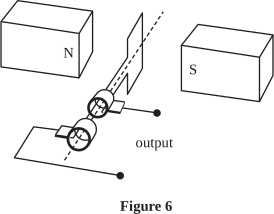
A simple electricity generator is shown in the diagram below. When the coil is rotated, the output voltage across the slip rings is measured. The graph shows how the output voltage varies with time.
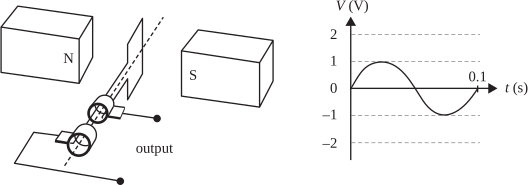
 

The frequency of rotation of the generator is now doubled.

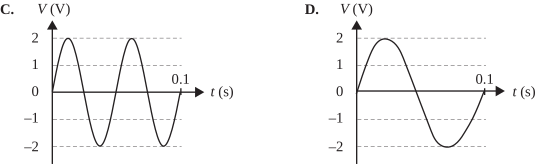
Which one of the following graphs best represents the output voltage measured across the slip rings?
 

Show Answers Only

\(C\)

Show Worked Solution
  •  If the frequency is doubled than the coil will rotate twice as fast, hence two periods will occur instead of one.
  • The induced emf is proportional to the frequency of the rotation of the coil, as the frequency is doubled so will the induced emf.

\(\Rightarrow C\)

Filed Under: Applications of the Motor Effect Tagged With: Band 4, smc-3695-40-Generators

PHYSICS, M8 2023 VCE 16

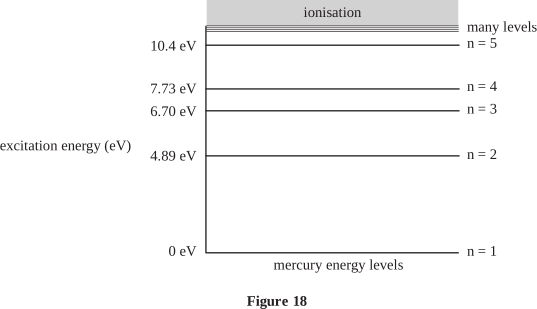
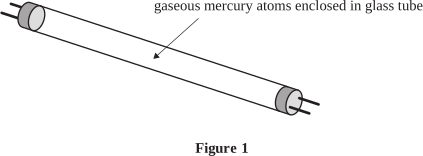
Fluorescent lights, when operating, contain gaseous mercury atoms, as shown in Figure 1.
 

Analysis of the light produced by fluorescent lights shows a number of emission spectral lines, including a prominent line representing a wavelength of 436.6 nm.

  1. Calculate the energy of the photons represented by the emission spectral line representing a wavelength of 436.6 nm.   (2 marks)

--- 4 WORK AREA LINES (style=lined) ---

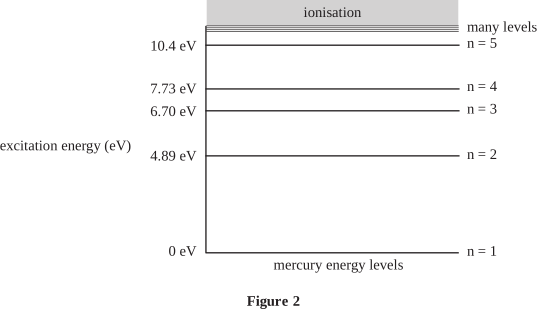
Figure 2 shows the lowest five energy levels for mercury.
 

  1. On the energy level diagram in Figure 2, draw an arrow showing the energy level transition that corresponds to the production of the spectral line representing a wavelength of 436.6 nm.   (1 mark)

    --- 0 WORK AREA LINES (style=lined) ---

Show Answers Only

a.    \(E=2.84\ \text{eV}\)

b.    
       

Show Worked Solution

a.    \(E=\dfrac{hc}{\lambda}=\dfrac{6.626 \times 10^{-34} \times 3 \times 10^8}{436.6 \times 10^{-9}}=4.549 \times 10^{-19}\ \text{J}\)

\(\text{Convert to eV:}\)

\(E= \dfrac{4.549 \times 10^{-19}}{1.602 \times 10^{-19}} = 2.84\ \text{eV}\)
 

b.    
Filed Under: Quantum Mechanical Nature of the Atom Tagged With: Band 4, smc-3702-20-Electron Transitions, smc-3702-30-Photon Energy

Calculus, SPEC2 2023 VCAA 4

A fish farmer releases 200 fish into a pond that originally contained no fish. The fish population, \(P\), grows according to the logistic model,  \(\dfrac{d P}{d t}=P\left(1-\dfrac{P}{1000}\right)\) , where \(t\) is the time in years after the release of the 200 fish.

  1. The above logistic differential equation can be expressed as
  2. \(\displaystyle \int \frac{A}{P}+\dfrac{B}{1-\dfrac{P}{1000}} d P=\int dt \text {, where } A, B \in R .\)
  3. Find the values of \(A\) and \(B\).  (1 mark)

    --- 2 WORK AREA LINES (style=lined) ---

One form of the solution for \(P\) is  \(P=\dfrac{1000}{1+D e^{-t}}\ \),  where \(D\) is a real constant.

  1. Find the value of \(D\).  (1 mark)

    --- 2 WORK AREA LINES (style=lined) ---

The farmer releases a batch of \(n\) fish into a second pond, pond 2 , which originally contained no fish. The population, \(Q\), of fish in pond 2 can be modelled by  \(Q=\dfrac{1000}{1+9 e^{-1.1 t}}\),  where \(t\) is the time in years after the \(n\) fish are released.

  1. Find the value of \(n\).  (1 mark)

    --- 2 WORK AREA LINES (style=lined) ---

  2. Find the value of \(Q\) when \(t=6\).
  3. Give your answer correct to the nearest integer.  (1 mark)

    --- 2 WORK AREA LINES (style=lined) ---

  4.  i. Given that  \(\dfrac{dQ}{dt}=\dfrac{11}{10} Q\left(1-\dfrac{Q}{1000}\right)\),  express  \(\dfrac{d^2 Q}{d t^2}\)  in terms of \(Q\).  (1 mark)

    --- 4 WORK AREA LINES (style=lined) ---

  5. ii. Hence or otherwise, find the size of the fish population in pond 2 and the value of \(t\) when the rate of growth of the population is a maximum. Give your answer for \(t\) correct to the nearest year.  (2 marks)

    --- 4 WORK AREA LINES (style=lined) ---

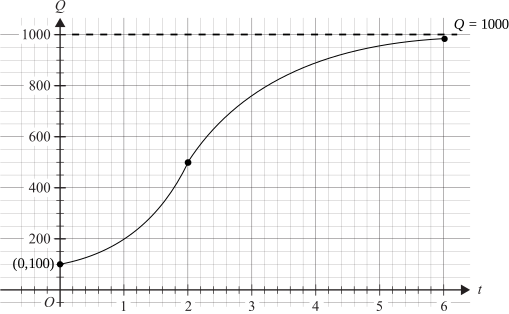
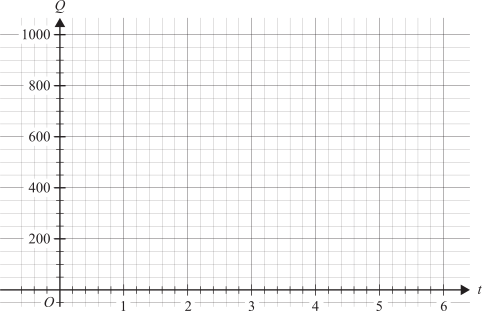
  6. Sketch the graph of \(Q\) versus \(t\) on the set of axes below. Label any axis intercepts and any asymptotes with their equations.  (2 marks)

    --- 0 WORK AREA LINES (style=lined) ---


The farmer wishes to take 5.5% of the fish from pond 2 each year. The modified logistic differential equation that would model the fish population, \(Q\), in pond 2 after \(t\) years in this situation is

\(\dfrac{d Q}{d t}=\dfrac{11}{10}\, Q\left(1-\dfrac{Q}{1000}\right)-0.055Q\)

  1. Find the maximum number of fish that could be supported in pond 2 in this situation.  (1 mark)

    --- 4 WORK AREA LINES (style=lined) ---

Show Answers Only

a.    \(A=1, \quad B=\dfrac{1}{1000}\)

b.   \(\Rightarrow D=4\)

c.    \(n=\dfrac{1000}{1+9 e^0}=100\)

d.   \(Q=\dfrac{1000}{1+9 e^{-6.6}} \approx 988\)

e.i.  \(Q^{\prime}=\frac{121}{100}\, Q\left(1-\frac{Q}{1000}\right)^2-\frac{121}{100\ 000}\left(1-\frac{Q}{1000}\right)\)

e.ii. \(t=2\)

f.   


g.  \(Q=950\)

Show Worked Solution

a.    \(\dfrac{dP}{dt}=P\left(1-\dfrac{P}{1000}\right) \ \Rightarrow \ \dfrac{d t}{d P}=\dfrac{1}{P}\left(\dfrac{1}{1-\frac{P}{1000}}\right)\)

\(\text{Expand (by CAS):}\)

\(\dfrac{1}{P}\left(\dfrac{1}{1-\frac{P}{1000}}\right)=\dfrac{1}{P}-\dfrac{1}{(P-1000)}=\dfrac{1}{P}+\dfrac{1}{1000}\left(\dfrac{1}{1-\frac{P}{1000}}\right)\)

\(A=1, \quad B=\dfrac{1}{1000}\)
 

♦ Mean mark (a) 48%.

b.   \(\text{When}\ \ t=0, P=200 \text{ (given)}\)

\(\text{Solve}\ \ 200=\dfrac{1000}{1+D e^0}\ \ \text{for}\  t:\)

\(\Rightarrow D=4\ \ \text {(by CAS):}\)
 

c.    \(Q=\dfrac{1000}{1+9 e^{-1.1 t}}\)

\(\text{At}\ \ t=0, Q=n\):

\(n=\dfrac{1000}{1+9 e^0}=100\)
 

d.    \(\text{Find } Q \text{ when } t=6:\)

\(Q=\dfrac{1000}{1+9 e^{-6.6}} \approx 988\)
 

e.i.  \(\dfrac{d Q}{d t}=\dfrac{11}{10}\, Q\left(1-\dfrac{Q}{1000}\right)\)

\(\text{Using the product rule:}\)

\begin{aligned}
Q^{\prime \prime} & =\frac{11}{10}\left[Q^{\prime}\left(1-\frac{Q}{1000}\right)+Q\left(-\frac{1}{1000}\, Q^{\prime}\right)\right] \\
& =\frac{11}{10}\left[\frac{11}{10}\, Q\left(1-\frac{Q}{1000}\right)^2-\frac{Q}{1000}\left(\frac{11}{10}\, Q\left(1-\frac{Q}{1000}\right)\right)\right] \\
& =\frac{121}{100}\, Q\left(1-\frac{Q}{1000}\right)^2-\frac{121}{100\ 000}\left(1-\frac{Q}{1000}\right)
\end{aligned}


♦♦♦ Mean mark (e)(i) 21%.

e.ii. \(\text{Max } Q^{\prime} \Rightarrow Q^{\prime \prime}=0\)

\(\text{Solve } Q^{\prime \prime}=0 \ \ \text {(by CAS):}\)

\(\Rightarrow Q=500\)

\(\text{Solve } Q=500 \text{ for } t \text{ (by CAS):}\)

\(t=1.99 \ldots=2 \ \text{(nearest year)}\)
 

f.   


g.  \(\text{Solve for } Q \ \text{(by CAS):}\)

\(\dfrac{d Q}{d t}=\dfrac{11}{10}\, Q\left(1-\dfrac{Q}{1000}\right)-0.055\,Q=0\)

\(\Rightarrow Q=950\)
♦ Mean mark (g) 40%.

Filed Under: Applied Contexts Tagged With: Band 3, Band 4, Band 5, smc-1184-60-Growth and decay

PHYSICS, M7 2023 VCE 13

A group of physics students undertake a Young's double-slit experiment using the apparatus shown in the diagram. They use a green laser that produces light with a wavelength of 510 nm. The light is incident on two narrow slits, S\(_1\) and S\(_2\). The distance between the two slits is 100 \( \mu \)m.
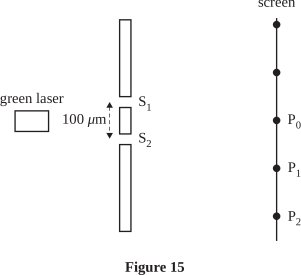
 

An interference pattern is observed on a screen with points P\(_{0}\), P\(_{1}\) and P\(_2\) being the locations of adjacent bright bands, as shown. Point  P\(_0\) is the central bright band.

  1. Calculate the path difference between S\(_{1}\)P\(_{2}\) and S\(_{2}\)P\(_{2}\). Give your answer in metres. Show your working.   (2 marks)

--- 3 WORK AREA LINES (style=lined) ---

  1. The green laser is replaced by a red laser.
  2. Describe the effect of this change on the spacing between adjacent bright bands.   (1 mark)

--- 2 WORK AREA LINES (style=lined) ---

  1. Explain how Young's double-slit experiment provides evidence for the wave-like nature of light and not the particle-like nature of light.   (3 marks)

--- 6 WORK AREA LINES (style=lined) ---

Show Answers Only

a.    \(1.02 \times 10^{-6}\ \text{m}\)

b.    The spacing between adjacent bright bands will increase.

c.    Evidence for the wave-like nature of light:

  • Young’s double slit experiment was used to show that light can produce an interference pattern as it diffracts when it passes through the slits.
  • As this is a wave phenomenon, the experiment provided valuable evidence to support the wave-like nature of light.
  • Using the particle-like nature of light as a model, two bright bands would have been expected behind the two slits as the particles would have passed through the slits in a straight line which was not observed.
Show Worked Solution

a.    \(\text{Difference in distance}\ = 2 \lambda\)

\(\text{Path difference}\ =2 \times 510 \times 10^{-9} = 1.02 \times 10^{-6}\ \text{m}\).

♦ Mean mark (a) 45%.

b.    The spacing will increase.

  • \( x=\dfrac{m\lambda D}{d}\), where \(D\) is the length between the screen and the slits and \(x\) is the distance between adjacent bright bands.
  • Since \(x \propto \lambda\), as the wavelength of light increases from green to red, so will the spacing between adjacent bright bands.
     

c.    Evidence for the wave-like nature of light:

  • Young’s double slit experiment was used to show that light can produce an interference pattern as it diffracts when it passes through the slits.
  • As this is a wave phenomenon, the experiment provided valuable evidence to support the wave-like nature of light.
  • Using the particle-like nature of light as a model, two bright bands would have been expected behind the two slits as the particles would have passed through the slits in a straight line which was not observed.

Filed Under: Light: Wave Model Tagged With: Band 4, Band 5, smc-3697-20-Young, smc-3697-30-Double Slit Calcs

PHYSICS, M7 2023 VCE 10

A proton in an accelerator beamline of proper length 4.80 km has a Lorentz factor, \(\gamma\), of 2.00.

  1. Calculate the speed of the proton relative to the beamline in terms of \(c\), the speed of light in a vacuum. Give your answer to three significant figures.  (3 marks)

--- 6 WORK AREA LINES (style=lined) ---

  1. Calculate the length of the beamline in the reference frame of the proton.  (1 mark)

--- 3 WORK AREA LINES (style=lined) ---

Show Answers Only

a.    \(0.866c\)

b.    \(2.4\ \text{km}\)

Show Worked Solution
a.   \(\dfrac{1}{\sqrt{1-\frac{v^2}{c^2}}}\) \(=2\)  
\(\sqrt{1-\dfrac{v^2}{c^2}}\) \(=\dfrac{1}{2}\)  
\(1-\dfrac{v^2}{c^2}\) \(=\dfrac{1}{4}\)  
\(\dfrac{v^2}{c^2}\) \(=\dfrac{3}{4}\)  
\(v^2\) \(=\dfrac{3}{4}c^2\)  
\(v\) \(=0.866c\)  


b.     \(l\) \(=l_0\sqrt{1-\dfrac{v^2}{c^2}}\)
    \(=4.8 \times \sqrt{1-\dfrac{(0.886c)^2}{c^2}}\)
    \(=4.8 \times 0.5\)
    \(=2.4\ \text{km}\)

Filed Under: Light and Special Relativity Tagged With: Band 4, smc-3699-20-Length Contraction

PHYSICS, M5 2023 VCE 9

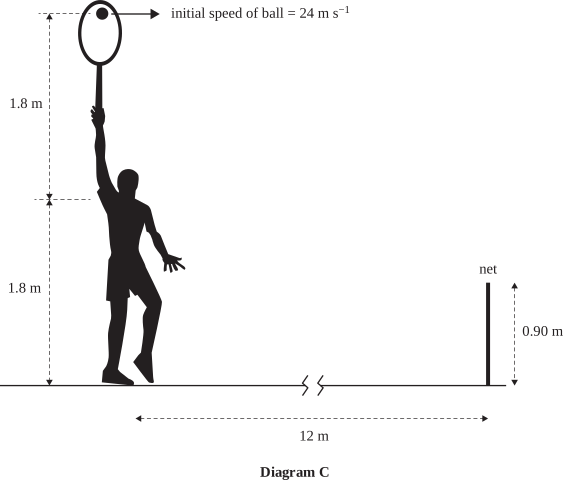
Giorgos is practising his tennis serve using a tennis ball of mass 56 g.

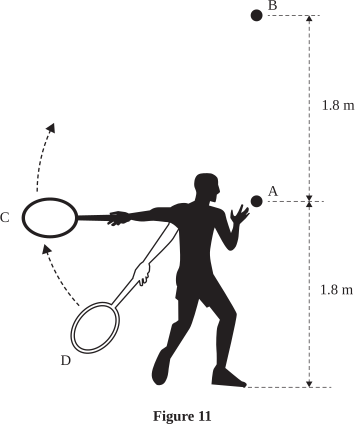
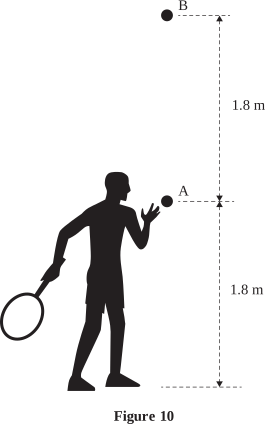
  1. Giorgos practises throwing the ball vertically upwards from point A to point B, as shown in Diagram A. His daughter Eka, a physics student, models the throw, assuming that the ball is at the level of Giorgos's shoulder, point A, both when it leaves his hand and also when he catches it again. Point A is 1.8 m from the ground. The ball reaches a maximum height, point B, 1.8 m above Giorgos's shoulder.


  1. Show that the ball is in the air for 1.2 s from the time it leaves Giorgos's hand, which is level with his shoulder, until he catches it again at the same height.   (2 marks)

--- 5 WORK AREA LINES (style=lined) ---

  1. Giorgos swings his racquet from point D through point C, which is horizontally behind him at shoulder height, as shown in Diagram B, to point B. Eka models this swing as circular motion of the racquet head. The centre of the racquet head moves with constant speed in a circular arc of radius 1.8 m from point C to point B.

  1. The racquet passes point C at the same time that the ball is released at point A and then the racquet hits the ball at point B.
  2. Calculate the speed of the racquet at point C.   (2 marks)

--- 5 WORK AREA LINES (style=lined) ---

  1. The ball leaves Giorgos's racquet with an initial speed of 24 m s\(^{-1}\) in a horizontal direction, as shown in Diagram C. A tennis net is located 12 m in front of Giorgos and has a height of 0.90 m.
     

  1. How far above the net will the ball be when it passes above the net? Assume that there is no air resistance. Show your working.   (3 marks)

--- 7 WORK AREA LINES (style=lined) ---
Show Answers Only

a.    \(1.2\ \text{s}\)

b.    \(4.7\ \text{ms}^{-1}\)

c.    \(1.475\ \text{m}\)

Show Worked Solution

a.    Time to for the ball to fall from max height back to shoulder level:

\(s\) \(=ut+\dfrac{1}{2}at^2\)  
\(1.8\) \(=0 \times t + \dfrac{1}{2} \times 9.8 \times t^2\)  
\(t\) \(=\sqrt{\dfrac{1.8}{4.9}}=0.606\ \text{s}\)  


\(\text{Total time of flight}\ =0.606 \times 2=1.2\ \text{s}\)
 

b.    The racket travels a quarter of the circumference of the circle in 0.606 seconds.

\(v=\dfrac{d}{t}=\dfrac{2\pi \times 1.8 \times 0.25}{0.606}=4.7\ \text{ms}^{-1}\)
 

♦♦ Mean mark (b) 27%.

c.    Time for the ball to reach the net:

  \(t=\dfrac{d}{v}=\dfrac{12}{24}=0.5\ \text{s}\)

Vertical displacement from max height in 0.5 seconds:

  \(s=ut+\dfrac{1}{2}at^2=0 \times 0.5 + \dfrac{1}{2} \times 9.8 \times 0.5^2=1.225\ \text{m}\).

\(\text{Height (at net)}\ =3.6-1.225=2.375\ \text{m}\).

\(\therefore\ \text{Height (above net)}\ =2.375-0.9=1.475\ \text{m}\)

♦ Mean mark (c) 47%.

Filed Under: Projectile Motion Tagged With: Band 4, Band 5, smc-3690-40-Vertical Displacement, smc-3690-45-Time of Flight

Calculus, SPEC2 2023 VCAA 3

The curve given by  \(y^2=x-1\), where  \(2 \leq x \leq 5\), is rotated about the \(x\)-axis to form a solid of revolution.

  1.  i. Write down the definite integral, in terms of \(x\), for the volume of this solid of revolution.  (1 mark)

    --- 2 WORK AREA LINES (style=lined) ---

  2. ii. Find the volume of the solid of revolution.  (1 mark)

    --- 2 WORK AREA LINES (style=lined) ---

  3.  i. Express the curved surface area of the solid in the form  \(\pi \displaystyle \int_a^b \sqrt{A x-B}\, d x\), where \(a, b, A, B\) are all positive integers.  (2 marks)

    --- 4 WORK AREA LINES (style=lined) ---

  4. ii. Hence or otherwise, find the curved surface area of the solid correct to three decimal places.  (1 mark)

    --- 2 WORK AREA LINES (style=lined) ---

The total surface area of the solid consists of the curved surface area plus the areas of the two circular discs at each end.

The 'efficiency ratio' of a body is defined as its total surface area divided by the enclosed volume.

  1. Find the efficiency ratio of the solid of revolution correct to two decimal places.  (2 marks)

    --- 2 WORK AREA LINES (style=lined) ---

  2. Another solid of revolution is formed by rotating the curve given by  \(y^2=x-1\) about the \(x\)-axis for  \(2 \leq x \leq k\), where \(k \in R\). This solid has a volume of \(24 \pi\).
  3. Find the efficiency ratio for this solid, giving your answer correct to two decimal places.  (3 marks)

    --- 4 WORK AREA LINES (style=lined) ---

Show Answers Only

a.i. \(\displaystyle V=\pi \int y^2 d x=\pi \int_2^5(x-1) dx\)
 

a.ii. \(\text{Evaluating integral (by calc):}\)

\(V=\dfrac{15 \pi}{2}\ \text{u}^3\)
 

b.i.  \(\displaystyle y=\sqrt{x-1} \ \Rightarrow \ \frac{d y}{d x}=\frac{1}{2} \cdot \frac{1}{\sqrt{x-1}} \ \Rightarrow \ \frac{d^2 y}{dx^2}=\frac{1}{4(x-1)}\)

\(\ \ \begin{aligned} \displaystyle \int_2^5 2 \pi \sqrt{x-1} \ \sqrt{1+\frac{1}{4(x-1)}} \ d x & =\int_2^5 2 \pi \sqrt{x-1+\frac{1}{4}}\, d x \\ & =\pi \int_2^5 \sqrt{4 x-3}\, d x\end{aligned}\)

 
b.ii.
\(\text{Evaluate integral in b.i.}\)

\(\text {S.A.}=30.847\ \text{u}^2\)
 

c.    \(y=\sqrt{x-1}\)

\(\text{At}\ \ x=2\ \ \Rightarrow y=1\)

\(\text{At}\ \ x=5\ \ \Rightarrow y=2\)

\begin{aligned}
\text{Total S.A. } &=30.847+\pi(1)^2+\pi(2)^2 \\
&=46.5545\ \text{u}^2 \\
\end{aligned}

\(\text {Efficiency ratio}=\dfrac{46.5545}{\frac{15 \pi}{2}}=1.98\ \text{(2 d.p.)}\)
 

d.   \(V=\displaystyle \pi \int_2^k(x-1) d x=24 \pi\)

\(\text{Solve (by calc):}\)

\(\dfrac{\pi k(k-2)}{2}=24 \pi \ \Rightarrow \ k=8 \)

\(\text {S.A.}=\pi \displaystyle{\int_2^8} \sqrt{4 x-3}\, d x=75.9163 \ldots\)

\(\text{Total S.A.}=75.9163+\pi(1+7)=101.049 \)

\(\text{Efficiency ratio}=\dfrac{101.049}{24 \pi}= 1.34\ \text{(2 d.p.)}\)

Show Worked Solution

a.i. \(\displaystyle V=\pi \int y^2 d x=\pi \int_2^5(x-1) dx\)
 

a.ii. \(\text{Evaluating integral (by calc):}\)

\(V=\dfrac{15 \pi}{2}\ \text{u}^3\)
 

b.i.  \(\displaystyle y=\sqrt{x-1} \ \Rightarrow \ \frac{d y}{d x}=\frac{1}{2} \cdot \frac{1}{\sqrt{x-1}} \ \Rightarrow \ \frac{d^2 y}{dx^2}=\frac{1}{4(x-1)}\)

\(\ \ \begin{aligned} \displaystyle \int_2^5 2 \pi \sqrt{x-1} \ \sqrt{1+\frac{1}{4(x-1)}} \ d x & =\int_2^5 2 \pi \sqrt{x-1+\frac{1}{4}}\, d x \\ & =\pi \int_2^5 \sqrt{4 x-3}\, d x\end{aligned}\)

 
b.ii.
\(\text{Evaluate integral in b.i.}\)

\(\text {S.A.}=30.847\ \text{u}^2\)
 

c.    \(y=\sqrt{x-1}\)

\(\text{At}\ \ x=2\ \ \Rightarrow y=1\)

\(\text{At}\ \ x=5\ \ \Rightarrow y=2\)

\begin{aligned}
\text{Total S.A. } &=30.847+\pi(1)^2+\pi(2)^2 \\
&=46.5545\ \text{u}^2 \\
\end{aligned}

\(\text {Efficiency ratio}=\dfrac{46.5545}{\frac{15 \pi}{2}}=1.98\ \text{(2 d.p.)}\)
 

d.   \(V=\displaystyle \pi \int_2^k(x-1) d x=24 \pi\)

\(\text{Solve (by calc):}\)

\(\dfrac{\pi k(k-2)}{2}=24 \pi \ \Rightarrow \ k=8 \)

\(\text {S.A.}=\pi \displaystyle{\int_2^8} \sqrt{4 x-3}\, d x=75.9163 \ldots\)

\(\text{Total S.A.}=75.9163+\pi(1+7)=101.049 \)

\(\text{Efficiency ratio}=\dfrac{101.049}{24 \pi}= 1.34\ \text{(2 d.p.)}\)

Filed Under: Solids of Revolution Tagged With: Band 3, Band 4, Band 5, smc-1180-30-Square root, smc-1180-50-x-axis rotations, smc-1180-65-Surface area, smc-1180-80-Efficiency ratio

Complex Numbers, SPEC2 2023 VCAA 2

Let \(w=\text{cis}\left(\dfrac{2 \pi}{7}\right)\).

  1. Verify that \(w\) is a root of  \(z^7-1=0\).   (1 marks)

    --- 2 WORK AREA LINES (style=lined) ---

  1. List the other roots of  \(z^7-1=0\)  in polar form.   (1 mark)

    --- 2 WORK AREA LINES (style=lined) ---

  1. On the Argand diagram below, plot and label the points that represent all the roots of  \(z^7-1=0\).   (2 marks)

    --- 0 WORK AREA LINES (style=blank) ---


  1.  i. On the Argand diagram below, sketch the ray that originates at the real root of  \(z^7-1=0\)  and passes through the point represented by \( \text{cis}\left(\dfrac{2 \pi}{7} \right)\).   (1 mark)

    --- 0 WORK AREA LINES (style=lined) ---


  1. ii. Find the equation of this ray in the form \(\text{Arg}\left(z-z_0\right)=\theta\), where \(z_0 \in C\), and \(\theta\) is measured in radians in terms of \(\pi\).   (1 mark)

    --- 3 WORK AREA LINES (style=lined) ---

  2. Verify that the equation  \(z^7-1=0\)  can be expressed in the form 
  3.     \((z-1)\left(z^6+z^5+z^4+z^3+z^2+z+1\right)=0\).   (1 mark)

    --- 4 WORK AREA LINES (style=lined) ---

  4.   i. Express  \(\text{cis}\left(\dfrac{2 \pi}{7}\right)+\operatorname{cis}\left(\dfrac{12 \pi}{7}\right)\) in the form \(A \cos (B \pi)\), where \(A, B \in R^{+}\).   (1 mark)

    --- 3 WORK AREA LINES (style=lined) ---

  5. ii. Given that  \(w=\operatorname{cis}\left(\dfrac{2 \pi}{7}\right)\)  satisfies  \((z-1)\left(z^6+z^5+z^4+z^3+z^2+z+1\right)=0\),

use De Moivre's theorem to show that

      1. \(\cos \left(\dfrac{2 \pi}{7}\right)+\cos \left(\dfrac{4 \pi}{7}\right)+\cos \left(\dfrac{6 \pi}{7}\right)=-\dfrac{1}{2}\).   (2 marks)

        --- 8 WORK AREA LINES (style=lined) ---

Show Answers Only

a.   \(w^7-1 =\ \text{cis} \Big{(}\dfrac{2 \pi}{7} \Big{)}^7-1 = \text{cis} \Big{(}\dfrac{14 \pi}{7}\Big{)}-1 = 1-1=0\)

\(\therefore w\ \text{is a root of}\ \ z^7-1=0 \)
 

b.  \(\text{Roots of}\ \ z^7-1=0:\) 

\(\text{cis} (0), \text{cis} \Big{(}\dfrac{2 \pi}{7} \Big{)}, \text{cis} \Big{(}\dfrac{4 \pi}{7} \Big{)}, \text{cis} \Big{(}\dfrac{6 \pi}{7} \Big{)}, \text{cis} \Big{(}\dfrac{8 \pi}{7} \Big{)}, \text{cis} \Big{(}\dfrac{10 \pi}{7} \Big{)}, \text{cis} \Big{(}\dfrac{12 \pi}{7} \Big{)} \)

c.   
          

d.i.   
          

d.ii. \(\text{Base angle (isosceles Δ)}\ = \dfrac{1}{2} \times \Big{(}\pi-\dfrac{2\pi}{7}\Big{)} = \dfrac{5\pi}{14} \)

\(\arg(z-1)=\dfrac{9\pi}{14} \)
 

e.    \((z-1)(z^6+z^5+z^4+z^3+z^2+z+1) \)  
    \(=(z^7+z^6+z^5+z^4+z^3+z^2+z)-(z^6+z^5+z^4+z^3+z^2+z+1) \)  
    \(=z^7-1\)  


f.i.   \(\text{cis}\Big{(}\dfrac{2\pi}{7}\Big{)} + \text{cis}\Big{(}\dfrac{12\pi}{7}\Big{)} = \text{cis}\Big{(}\dfrac{2\pi}{7}\Big{)} + \text{cis}\Big{(}-\dfrac{2\pi}{7}\Big{)} =2\cos\Big{(}\dfrac{2\pi}{7}\Big{)}  \)
 

f.ii.  \(z^6+z^5+z^4+z^3+z^2+z+1=0\ \ \text{(using part (e))} \)

\((z^6+z)+(z^4+z^3)+(z^5+z^2)=-1 \)

\(\Bigg{(}\text{cis}\Big{(}\dfrac{12\pi}{7}\Big{)} + \text{cis}\Big{(}\dfrac{2\pi}{7}\Big{)}\Bigg{)} + \Bigg{(}\text{cis}\Big{(}\dfrac{8\pi}{7}\Big{)} + \text{cis}\Big{(}\dfrac{6\pi}{7}\Big{)}\Bigg{)} + \Bigg{(}\text{cis}\Big{(}\dfrac{10\pi}{7}\Big{)} + \text{cis}\Big{(}\dfrac{4\pi}{7}\Big{)}\Bigg{)}=-1\)

\(2\cos \Big{(}\dfrac{2 \pi}{7}\Big{)}+2\cos \Big{(}\dfrac{6 \pi}{7}\Big{)}+2\cos \Big{(}\dfrac{4 \pi}{7}\Big{)}=-1\)

\(\cos \Big{(}\dfrac{2 \pi}{7}\Big{)}+\cos \Big{(}\dfrac{4 \pi}{7}\Big{)}+\cos \Big{(}\dfrac{6 \pi}{7}\Big{)}=-\dfrac{1}{2}\)

Show Worked Solution

a.   \(w^7-1 =\ \text{cis} \Big{(}\dfrac{2 \pi}{7} \Big{)}^7-1 = \text{cis} \Big{(}\dfrac{14 \pi}{7}\Big{)}-1 = 1-1=0\)

\(\therefore w\ \text{is a root of}\ \ z^7-1=0 \)
 

b.  \(\text{Roots of}\ \ z^7-1=0:\) 

\(\text{cis} (0), \text{cis} \Big{(}\dfrac{2 \pi}{7} \Big{)}, \text{cis} \Big{(}\dfrac{4 \pi}{7} \Big{)}, \text{cis} \Big{(}\dfrac{6 \pi}{7} \Big{)}, \text{cis} \Big{(}\dfrac{8 \pi}{7} \Big{)}, \text{cis} \Big{(}\dfrac{10 \pi}{7} \Big{)}, \text{cis} \Big{(}\dfrac{12 \pi}{7} \Big{)} \)

c.   
          

d.i.   
          

d.ii. \(\text{Base angle (isosceles Δ)}\ = \dfrac{1}{2} \times \Big{(}\pi-\dfrac{2\pi}{7}\Big{)} = \dfrac{5\pi}{14} \)

\(\arg(z-1)=\dfrac{9\pi}{14} \)
 

e.    \((z-1)(z^6+z^5+z^4+z^3+z^2+z+1) \)  
    \(=(z^7+z^6+z^5+z^4+z^3+z^2+z)-(z^6+z^5+z^4+z^3+z^2+z+1) \)  
    \(=z^7-1\)  


f.i.   \(\text{cis}\Big{(}\dfrac{2\pi}{7}\Big{)} + \text{cis}\Big{(}\dfrac{12\pi}{7}\Big{)} = \text{cis}\Big{(}\dfrac{2\pi}{7}\Big{)} + \text{cis}\Big{(}-\dfrac{2\pi}{7}\Big{)} =2\cos\Big{(}\dfrac{2\pi}{7}\Big{)}  \)
 

f.ii.  \(z^6+z^5+z^4+z^3+z^2+z+1=0\ \ \text{(using part (e))} \)

\((z^6+z)+(z^4+z^3)+(z^5+z^2)=-1 \)

\(\Bigg{(}\text{cis}\Big{(}\dfrac{12\pi}{7}\Big{)} + \text{cis}\Big{(}\dfrac{2\pi}{7}\Big{)}\Bigg{)} + \Bigg{(}\text{cis}\Big{(}\dfrac{8\pi}{7}\Big{)} + \text{cis}\Big{(}\dfrac{6\pi}{7}\Big{)}\Bigg{)} + \Bigg{(}\text{cis}\Big{(}\dfrac{10\pi}{7}\Big{)} + \text{cis}\Big{(}\dfrac{4\pi}{7}\Big{)}\Bigg{)}=-1\)

\(2\cos \Big{(}\dfrac{2 \pi}{7}\Big{)}+2\cos \Big{(}\dfrac{6 \pi}{7}\Big{)}+2\cos \Big{(}\dfrac{4 \pi}{7}\Big{)}=-1\)

\(\cos \Big{(}\dfrac{2 \pi}{7}\Big{)}+\cos \Big{(}\dfrac{4 \pi}{7}\Big{)}+\cos \Big{(}\dfrac{6 \pi}{7}\Big{)}=-\dfrac{1}{2}\)

Filed Under: Factors and Roots (SM), Mod/Arg Form and Argand Diagrams (SM) Tagged With: Band 3, Band 4, Band 6, smc-1172-30-Roots > 3, smc-1172-40-Conjugate roots, smc-1172-60-Sketch solutions, smc-2597-50-Mod/Arg and powers, smc-2597-70-Conjugates

Algebra, MET2 2023 VCAA 16 MC

Let \(f(x)=e^{x-1}\).

Given that the product function \(f(x)\times g(x)=e^{(x-1)^2}\), the rule for the function \(g\) is

  1. \(g(x)=e^{x-1}\)
  2. \(g(x)=e^{(x-2)(x-1)}\)
  3. \(g(x)=e^{(x+2)(x-1)}\)
  4. \(g(x)=e^{x(x-2)}\)
  5. \(g(x)=e^{x(x-3)}\)
Show Answers Only

\(B\)

Show Worked Solution
\(f(x)\times g(x)\) \(=e^{(x-1)^2}\)
\(e^{x-1}\times g(x)\) \(=e^{(x-1)^2}\)
\( g(x)\) \(=\dfrac{e^{(x-1)^2}}{e^{(x-1)}}\)
  \(=e^{(x-1)^2}\times e^{(x-1)^-1}\)
  \(=e^{x^2-3x+2}\)
  \(=e^{(x-2)(x-1)}\)

 
\(\Rightarrow B\)

Filed Under: Functional Equations, Log/Index Laws and Equations Tagged With: Band 4, smc-642-40-Other functions, smc-726-50-Exponential Equation

Probability, MET2 2023 VCAA 4

A manufacturer produces tennis balls.

The diameter of the tennis balls is a normally distributed random variable \(D\), which has a mean of 6.7 cm and a standard deviation of 0.1 cm.

  1. Find  \(\Pr(D>6.8)\), correct to four decimal places.   (1 mark)

    --- 1 WORK AREA LINES (style=lined) ---

  2. Find the minimum diameter of a tennis ball that is larger than 90% of all tennis balls produced.
  3. Give your answer in centimetres, correct to two decimal places.   (1 mark)

    --- 2 WORK AREA LINES (style=lined) ---

Tennis balls are packed and sold in cylindrical containers. A tennis ball can fit through the opening at the top of the container if its diameter is smaller than 6.95 cm.

  1. Find the probability that a randomly selected tennis ball can fit through the opening at the top of the container.
  2. Give your answer correct to four decimal places.   (1 mark)

    --- 2 WORK AREA LINES (style=lined) ---

  3. In a random selection of 4 tennis balls, find the probability that at least 3 balls can fit through the opening at the top of the container.
  4. Give your answer correct to four decimal places.   (2 marks)

    --- 2 WORK AREA LINES (style=lined) ---

A tennis ball is classed as grade A if its diameter is between 6.54 cm and 6.86 cm, otherwise it is classed as grade B.

  1. Given that a tennis ball can fit through the opening at the top of the container, find the probability that it is classed as grade A.
  2. Give your answer correct to four decimal places.   (2 marks)

    --- 4 WORK AREA LINES (style=lined) ---

  3. The manufacturer would like to improve processes to ensure that more than 99% of all tennis balls produced are classed as grade A.
  4. Assuming that the mean diameter of the tennis balls remains the same, find the required standard deviation of the diameter, in centimetres, correct to two decimal places.   (2 marks)

    --- 5 WORK AREA LINES (style=lined) ---

  5. An inspector takes a random sample of 32 tennis balls from the manufacturer and determines a confidence interval for the population proportion of grade A balls produced.
  6. The confidence interval is (0.7382, 0.9493), correct to four decimal places.
  7. Find the level of confidence that the population proportion of grade A balls is within the interval, as a percentage correct to the nearest integer.   (2 marks)

    --- 5 WORK AREA LINES (style=lined) ---

A tennis coach uses both grade A and grade B balls. The serving speed, in metres per second, of a grade A ball is a continuous random variable, \(V\), with the probability density function
 

\(f(v) = \begin {cases}
\dfrac{1}{6\pi}\sin\Bigg(\sqrt{\dfrac{v-30}{3}}\Bigg)         &\ \ 30 \leq v \leq 3\pi^2+30 \\
0         &\ \ \text{elsewhere}
\end{cases}\)
 

  1. Find the probability that the serving speed of a grade A ball exceeds 50 metres per second.
  2. Give your answer correct to four decimal places.   (1 mark)

    --- 2 WORK AREA LINES (style=lined) ---

  3. Find the exact mean serving speed for grade A balls, in metres per second.   (1 mark)

    --- 3 WORK AREA LINES (style=lined) ---

The serving speed of a grade B ball is given by a continuous random variable, \(W\), with the probability density function \(g(w)\).

A transformation maps the graph of \(f\) to the graph of \(g\), where \(g(w)=af\Bigg(\dfrac{w}{b}\Bigg)\).

  1. If the mean serving speed for a grade B ball is \(2\pi^2+8\) metres per second, find the values of \(a\) and \(b\).   (2 marks)

    --- 5 WORK AREA LINES (style=lined) ---

Show Answers Only

a.    \(0.1587\)

b.    \(d\approx6.83\)

c.    \(0.9938\)

d.    \(0.9998\)

e.    \(0,8960\)

f.    \(0.06\)

g.    \(90\%\)

h.    \(0.1345\)

i.    \(3(\pi^2+4)\)

j.    \(a=\dfrac{3}{2}, b=\dfrac{2}{3}\)

Show Worked Solution

a.    \(\text{Normal distribution:}\to \mu=6.7, \sigma=0.1\)

\(D\sim N(6.7, 0.1^2)\)

\(\text{Using CAS: }[\text{normCdf}(6.8, \infty, 6.7, 0.1)]\)

\(\Pr(D>6.8)=0.15865…\approx0.1587\)
 

b.    \(\Pr(D<d)=0.90\)  

\(\Pr\Bigg(Z<\dfrac{d-6.7}{0.1}\Bigg)=0.90\)

\(\text{Using CAS: }[\text{invNorm}(0.9, 6.7, 0.1)]\)

\(\therefore\ d=6.828155…\approx6.83\ \text{cm}\)


c.   \(\text{Normal distribution:}\to \mu=6.7, \sigma=0.1\)

\(D\sim N(6.7, 0.1^2)\)

\(\text{Using CAS: }[\text{normCdf}(-\infty, 6.95, 6.7, 0.1)]\)

\(\Pr(D<6.95)=0.99379…\approx0.9938\)
 

d.    \(\text{Binomial:}\to  n=4, p=0.99379…\)

\(X=\text{number of balls}\)

\(X\sim \text{Bi}(4, 0.999379 …)\)

\(\text{Using CAS: }[\text{binomCdf}(4, 0.999379 …, 3, 4)]\)

\(\Pr(X\geq 3)=0.99977 …\approx 0.9998\)


e.    \(\Pr(\text{Grade A|Fits})\) \(=\Pr(6.54<D<6.86|D<6.95)\)
    \(=\dfrac{\Pr(6.54<D<6.86)}{\Pr(D<6.95)}\)
  \(\text{Using CAS: }\) \(=\Bigg[\dfrac{\text{normCdf}(6.54, 6.86, 6.7, 0.1)}{\text{normCdf}(-\infty, 6.95, 6.7, 0.1)}\Bigg]\)
    \(=\dfrac{0.89040…}{0.99977…}\)
    \(=0.895965…\approx 0.8960\)


f.    \(\text{Normally distributed → symmetrical}\)

\(\text{Pr ball diameter outside the 99% interval}=1-0.99=0.01\)

\(D\sim N(6.7, \mu^2)\)

\(\Pr(6.54<D<6.86)>0.99\)

\(\therefore\ \Pr(D<6.54)<\dfrac{1-0.99}{2}\)

\(\text{Find z score using CAS: }\Bigg[\text{invNorm}\Bigg(\dfrac{1-0.99}{2},0,1\Bigg)\Bigg]=-2.575829…\)

\(\text{Then solve:} \ \dfrac{6.54-6.7}{\sigma}<-2.575829…\)

\(\therefore\ \sigma<0.0621\approx 0.06\)


♦♦ Mean mark (f) 35%.
MARKER’S COMMENT: Incorrect responses included using \(\Pr(D<6.86)=0.99\). Many answers were accepted in the range \(0<\sigma\leq0.06\) as max value of SD was not asked for provided sufficient working was shown.

g.   \(\hat{p}=\dfrac{0.7382+0.9493}{2}=0.84375\)

\(\text{Solve the following simultaneous equations for }z, \hat{p}=0.84375\)

\(0.84375-z\sqrt{\dfrac{0.84375(1-0.84375)}{32}}\) \(=0.7382\)      \((1)\)
\(0.84375+z\sqrt{\dfrac{0.84375(1-0.84375)}{32}}\) \(=0.9493\) \((2)\)
\(\text{Equation}(2)-(1)\)    
\(2z\sqrt{\dfrac{0.84375(1-0.84375)}{32}}\) \(=0.2111\)  
\(z=\dfrac{0.10555}{\sqrt{\dfrac{0.84375(1-0.84375)}{32}}}\) \(=1.64443352\)  

 
\(\text{Alternatively using CAS: Solve the following simultaneous equations for }z, \hat{p}\)

\(\hat{p}-z\sqrt{\dfrac{\hat{p}(1-\hat{p})}{32}}\) \(=0.7382\)
\(\text{and}\)  
\(\hat{p}+z\sqrt{\dfrac{\hat{p}(1-\hat{p})}{32}}\) \(=0.9493\)

\(\rightarrow \ z=1.64444…\ \text{and}\ \hat{p}=0.84375\)
 

\(\therefore\ \text{Using CAS: normCdf}(-1.64443352, 1.64443352, 0 , 1)\)

\(\text{Level of Confidence} =0.89999133…=90\%\)


♦♦ Mean mark (g) 25%.
MARKER’S COMMENT: \(\hat{p}\) was often calculated incorrectly with \(\hat{p}=0.8904\) frequently seen.

h.   \(\text{Using CAS: Evaluate }\to \displaystyle \int_{50}^{3\pi^2+30} \frac{1}{6\pi}\sin\Bigg(\sqrt{\dfrac{v-30}{3}}\Bigg)\,dx=0.1345163712\approx 0.1345\)

i.   \(\text{Using CAS: Evaluate }\to \displaystyle \int_{30}^{3\pi^2+30} v.\dfrac{1}{6\pi}\sin\Bigg(\sqrt{\dfrac{v-30}{3}}\Bigg)\,dx=3(\pi^2+4)=3\pi^2+12\)

j.  \(\text{When the function is dilated in both directions, }a\times b=1\)
 

\(\text{Method 1 : Simultaneous equations}\)

\(g(w) = \begin {cases}
\dfrac{b}{6\pi}\sin\Bigg(\sqrt{\dfrac{\dfrac{w}{b}-30}{3}}\Bigg)         &\ \ 30b \leq v \leq b(3\pi^2+30) \\
\\ 0         &\ \ \text{elsewhere}
\end{cases}\)

\(\text{Using CAS: Define }g(w)\ \text{and solve the simultaneous equations below for }a, b.\)
 

\(\displaystyle \int_{30.b}^{b.(3\pi^2+30)} g(w)\,dw=1\)

\(\displaystyle \int_{30.b}^{b.(3\pi^2+30)} w.g(w)\,dw=2\pi^2+8\)

\(\therefore\ b=\dfrac{2}{3}\ \text{and}\ a=\dfrac{3}{2}\)

 
\(\text{Method 2 : Transform the mean}\)


\(\text{Area}\) \(=1\)
\(\therefore\ a\) \(=\dfrac{1}{b}\)
\(\to\ b\) \(=\dfrac{E(W)}{E(V)}\)
  \(=\dfrac{2\pi^2+8}{3\pi^2+12}\)
  \(=\dfrac{2(\pi^2+4)}{3(\pi^2+4)}\)
  \(=\dfrac{2}{3}\)
 
\(\therefore\ a\) \(=\dfrac{3}{2}\)

♦♦♦ Mean mark (j) 10%.

Filed Under: Normal Distribution, Probability density functions Tagged With: Band 3, Band 4, Band 5, Band 6, smc-637-45-Other probability, smc-637-80-Trig PDF, smc-719-10-Single z-score, smc-719-20-95% confidence intervals, smc-719-30-Other z-score intervals, smc-719-50-Conditional probability

Calculus, SPEC2 2023 VCAA 1

Viewed from above, a scenic walking track from point \(O\) to point \(D\) is shown below. Its shape is given by

\(f(x)= \begin{cases}-x(x+a)^2, & 0 \leq x \leq 1 \\ e^{x-1}-x+b, & 1<x \leq 2 .\end{cases}\)

The minimum turning point of section \(O A B C\) occurs at point \(A\). Point \(B\) is a point of inflection and the curves meet at point \(C(1,0)\). Distances are measured in kilometres.
 

  1. Show that  \(a=-1\)  and  \(b=0\).  (1 mark)

    --- 3 WORK AREA LINES (style=lined) ---

  2. Verify that the two curves meet smoothly at point \(C\).  (2 marks)

    --- 5 WORK AREA LINES (style=lined) ---

  3.  i. Find the coordinates of point \(A\).  (1 mark)

    --- 3 WORK AREA LINES (style=lined) ---

  4. ii. Find the coordinates of point \(B\).  (1 mark)

    --- 3 WORK AREA LINES (style=lined) ---

The return track from point \(D\) to point \(O\) follows an elliptical path given by

\(x=2 \cos (t)+2, y=(e-2) \sin (t)\), where \(t \in\left[\dfrac{\pi}{2}, \pi\right]\).

  1. Find the Cartesian equation of the elliptical path.  (2 marks)

    --- 3 WORK AREA LINES (style=lined) ---

  2. Sketch the elliptical path from \(D\) to \(O\) on the diagram above.  (1 mark)

    --- 0 WORK AREA LINES (style=lined) ---

  3.  i. Write down a definite integral in terms of \(t\) that gives the length of the elliptical path from \(D\) to \(O\).  (1 mark)

    --- 2 WORK AREA LINES (style=lined) ---

  4. ii. Find the length of the elliptical path from \(D\) to \(O\).
  5.     Give your answer in kilometres correct to three decimal places.   (1 mark)

    --- 2 WORK AREA LINES (style=lined) ---

Show Answers Only

a.    \(\text{At}\ C(1,0): \)

\(\underset{x \to 1^{-}}{\lim} f_1(x) = \underset{x \to 1^{-}}{\lim}-x(x+a)^2 = -1(1+a)^2 = 0 \)

    \(a=-1\)

\(\underset{x \to 1^{+}}{\lim} f_2(x)\ \underset{x \to 1^{+}}{\lim} (e^{x-1}-x+b) = e^0-1+b=b = 0 \)
 

b.    \(\text{Find derivative functions (by calc)}:\)

\(\dfrac{d}{dx} \big{(}-x(x-1)^2\big{)} = -(x-1)(3x-1)\ \ \Rightarrow \ \ \text{At}\ \ x=1, f_1^{′}(x)=0 \)

\(\dfrac{d}{dx} (e^{x-1}-x+b) = e^{x-1}-1\ \ \Rightarrow \ \ \text{At}\ \ x=1, f_2^{′}(x)=0 \)

\(\Rightarrow\ \text{Since gradients are equal, curves meet smoothly.}\)
 

c.i.  \(A\Big{(} \frac{1}{3}, -\frac{4}{27} \Big{)} \)
 

c.ii.  \(B\Big{(} \frac{2}{3}, -\frac{2}{27} \Big{)} \)
 

d.   \(\Big{(}\dfrac{x-2}{2}\Big{)}^2 + \Big{(}\dfrac{y}{e-2}\Big{)}^2=1\)
 

e.    


f.i.    \(\displaystyle{\int_{\frac{\pi}{2}}^{\pi}} \sqrt{4\,\sin^2(t)+(e-2)^2\cos^2(t)}\,dt\)
 

f.ii.  \(\text{Length}\ = 2.255\)

Show Worked Solution

a.    \(\text{At}\ C(1,0): \)

\(\underset{x \to 1^{-}}{\lim} f_1(x) = \underset{x \to 1^{-}}{\lim}-x(x+a)^2 = -1(1+a)^2 = 0 \)

    \(a=-1\)

\(\underset{x \to 1^{+}}{\lim} f_2(x)\ \underset{x \to 1^{+}}{\lim} (e^{x-1}-x+b) = e^0-1+b=b = 0 \)
 

b.    \(\text{Find derivative functions (by calc)}:\)

\(\dfrac{d}{dx} \big{(}-x(x-1)^2\big{)} = -(x-1)(3x-1)\ \ \Rightarrow \ \ \text{At}\ \ x=1, f_1^{′}(x)=0 \)

\(\dfrac{d}{dx} (e^{x-1}-x+b) = e^{x-1}-1\ \ \Rightarrow \ \ \text{At}\ \ x=1, f_2^{′}(x)=0 \)

\(\Rightarrow\ \text{Since gradients are equal, curves meet smoothly.}\)
 

c.i.  \(\dfrac{d}{dx} \big{(}-x(x-1)^2\big{)} = -(x-1)(3x-1)\ \Rightarrow \ \text{SP when}\ x=\dfrac{1}{3} \)

\(A\Big{(} \frac{1}{3}, -\frac{4}{27} \Big{)} \)
 

c.ii.  \(\text{POI at}\ B: \ f_1^{″}(x)=-6x+4=0\ \ \Rightarrow x=\dfrac{2}{3} \)

\(B\Big{(} \frac{2}{3}, -\frac{2}{27} \Big{)} \)
 

d.   \(\dfrac{x-2}{2}=\cos(t), \ \ \dfrac{y}{e-2}=\sin(t) \)

\(\Big{(}\dfrac{x-2}{2}\Big{)}^2 + \Big{(}\dfrac{y}{e-2}\Big{)}^2=1\)
 

e.    


f.i.    \(\dfrac{dx}{dt} = -2\sin(t),\ \ \dfrac{dy}{dt} = (e-2)\cos(t) \)

\(\displaystyle{\int_{\frac{\pi}{2}}^{\pi}} \sqrt{4\,\sin^2(t)+(e-2)^2\cos^2(t)}\,dt\)
 

f.ii.   \(\text{Evaluate the integral in part f.i.}\)

\(\Rightarrow \text{Length}\ = 2.255\)
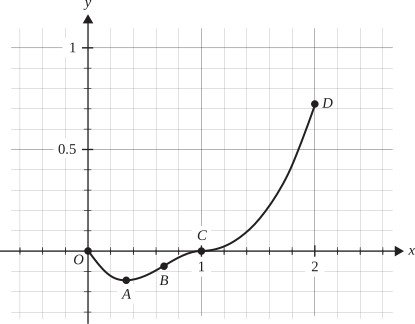
Filed Under: Arc Lengths, Areas and Other, Tangents and Curve Sketching Tagged With: Band 3, Band 4, smc-1181-10-Arc length, smc-1181-40-Parametric functions, smc-1182-10-Find gradient, smc-1182-40-Other 1st/2nd deriv problems

PHYSICS, M6 2023 VCE 7*

Two high-voltage transmission lines span a distance of 260 km between Power Plant A and Town B, as shown in the diagram. Power Plant A provides 350 MW of power. The potential difference at Power Plant A is 500 kV. The current in the transmission lines has a value of 700 A and the power loss in the transmission lines is 20 MW.
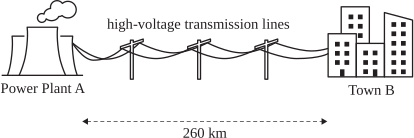


  1. Show, using calculations, that the total resistance of the two transmission lines is 41 \(\Omega\).   (2 marks)

--- 8 WORK AREA LINES (style=lined) ---

  1. Town B needs a minimum of 480 kV.
  2. Determine whether 480 kV will be available to Town B. Show your working.   (3 marks)

--- 8 WORK AREA LINES (style=lined) ---

  1. Explain what would happen if the electricity between Power Plant A and Town B were to be transmitted at 50 kV instead of 500 kV. Assume that the resistance of the transmission lines is still 41 \(\Omega\).   (2 marks)

--- 6 WORK AREA LINES (style=lined) ---

Show Answers Only

a.    \(41\ \Omega\)

b.    The power generated in the power plant is 500 kV.

\(V_{\text{drop}}=IR=700 \times 41 =28.7\ \text{kV} \)

\(V_{\text{remaining}} = 500-28.7 = 471.3\ \text{kV} \)

\(\therefore\) 480V will not be available to Town B.
 

c.    If the voltage was decreased by a factor of 10 to 50 kV:

  • Power remains constant \((P=VI)\)
  • The current through the power lines would increase by a factor of 10.
  • As \(P_{\text{loss}}=I^2r\), this would dramatically increase the power loss and significantly less power would be transmitted to the town.
Show Worked Solution
a.     \(P_{\text{loss}}\) \(=I^2R\)
  \(R\) \(=\dfrac{P_{\text{loss}}}{I^2}=\dfrac{20 \times 10^6}{700^2}=41\ \Omega\)


b.    The power generated in the power plant is 500 kV.

\(V_{\text{drop}}=IR=700 \times 41 =28.7\ \text{kV} \)

\(V_{\text{remaining}} = 500-28.7 = 471.3\ \text{kV} \)

\(\therefore\) 480V will not be available to Town B.
 

c.    If the voltage was decreased by a factor of 10 to 50 kV:

  • Power remains constant \((P=VI)\)
  • The current through the power lines would increase by a factor of 10.
  • As \(P_{\text{loss}}=I^2r\), this would dramatically increase the power loss and significantly less power would be transmitted to the town.

Filed Under: Electromagnetic Induction Tagged With: Band 3, Band 4, smc-3705-80-Energy Distribution

PHYSICS, M6 2023 VCE 5

Figure 1 shows a single square loop of conducting wire placed just outside a constant uniform magnetic field, \(B\). The length of each side of the loop is 0.040 m. The magnetic field has a magnitude of 0.30 T and is directed out of the page.

Over a time period of 0.50 s, the loop is moved at a constant speed, \(v\), from completely outside the magnetic field, Figure 1, to completely inside the magnetic field, Figure 2.
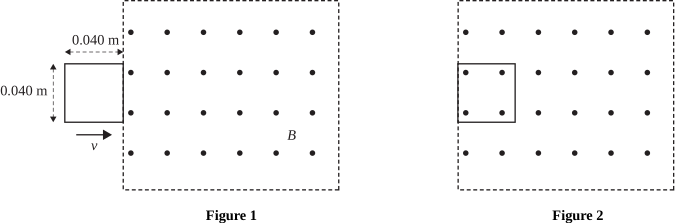
 

  1. Calculate the average EMF produced in the loop as it moves from the position just outside the region of the field, Figure 1, to the position completely within the area of the magnetic field, Figure 2.
  2. Show your working.   (2 marks)

--- 5 WORK AREA LINES (style=lined) ---
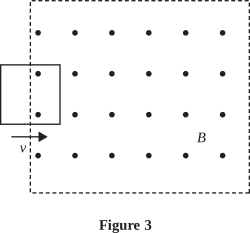
  1. On the small square loop in Figure 3, show the direction of the induced current as the loop moves into the area of the magnetic field.   (1 mark)
     

--- 5 WORK AREA LINES (style=blank) ---

Show Answers Only

a.    \(9.6 \times 10^{-4}\ \text{V}\)

b.    
       

Show Worked Solution
a.     \(\varepsilon\) \(=\dfrac{\Delta \phi}{\Delta t}\)
    \(=\dfrac{\Delta B A}{\Delta t}\)
    \(=\dfrac{0.3 \times 0.04^2}{0.5}\)
    \(=9.6 \times 10^{-4}\ \text{V}\)


b.  
         

♦ Mean mark (b) 45%.

Filed Under: Electromagnetic Induction Tagged With: Band 4, Band 5, smc-3705-20-Induced emf, smc-3705-40-Lenz and Faraday

Calculus, MET2 2023 VCAA 5

Let \(f:R \to R, f(x)=e^x+e^{-x}\) and \(g:R \to R, g(x)=\dfrac{1}{2}f(2-x)\).

  1. Complete a possible sequence of transformations to map \(f\) to \(g\).   (2 marks)
    •    Dilation of factor \(\dfrac{1}{2}\) from the \(x\) axis.

    --- 2 WORK AREA LINES (style=lined) ---

Two functions \(g_1\) and \(g_2\) are created, both with the same rule as \(g\) but with distinct domains, such that \(g_1\) is strictly increasing and \(g_2\) is strictly decreasing.

  1. Give the domain and range for the inverse of \(g_1\).   (2 marks)

    --- 3 WORK AREA LINES (style=lined) ---

Shown below is the graph of \(g\), the inverse of \(g_1\) and \(g_2\), and the line \(y=x\).
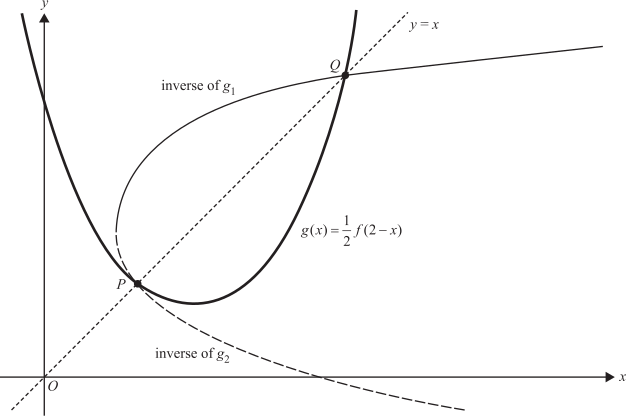
 

The intersection points between the graphs of \(y=x, y=g(x)\) and the inverses of \(g_1\) and \(g_2\), are labelled \(P\) and \(Q\).

    1. Find the coordinates of \(P\) and \(Q\), correct to two decimal places.   (1 mark)

      --- 2 WORK AREA LINES (style=lined) ---

    1. Find the area of the region bound by the graphs of \(g\), the inverse of \(g_1\) and the inverse of \(g_2\).
    2. Give your answer correct to two decimal places.   (2 marks)

      --- 4 WORK AREA LINES (style=lined) ---

Let \(h:R\to R, h(x)=\dfrac{1}{k}f(k-x)\), where \(k\in (o, \infty)\).

  1. The turning point of \(h\) always lies on the graph of the function \(y=2x^n\), where \(n\) is an integer.
  2. Find the value of \(n\).  (1 mark)

    --- 2 WORK AREA LINES (style=lined) ---

Let \(h_1:[k, \infty)\to R, h_1(x)=h(x)\).

The rule for the inverse of \(h_1\) is \(y=\log_{e}\Bigg(\dfrac{1}{k}x+\dfrac{1}{2}\sqrt{k^2x^2-4}\Bigg)+k\)

  1. What is the smallest value of \(k\) such that \(h\) will intersect with the inverse of \(h_1\)?\
  2. Give your answer correct to two decimal places.   (1 mark)

    --- 3 WORK AREA LINES (style=lined) ---

It is possible for the graphs of \(h\) and the inverse of \(h_1\) to intersect twice. This occurs when \(k=5\).

  1. Find the area of the region bound by the graphs of \(h\) and the inverse of \(h_1\), where \(k=5\).
  2. Give your answer correct to two decimal places.   (2 marks)

    --- 5 WORK AREA LINES (style=lined) ---

Show Answers Only

a.    \(\text{Reflect in the }y\text{-axis}\)

\(\text{Then translate 2 units to the right}\)

\(\text{OR}\)

\(\text{Translate 2 units to the left}\)

\(\text{Then reflect in the }y\text{-axis}\)

\(\text{OR}\)

\(\text{Translate 2 units to the right only }(f \ \text{even function})\)

b.    \(\text{See worked solution}\)

c.i.  \(P(1.27, 1.27\), Q(4.09, 4.09)\)

c.ii. \(2\displaystyle \int_{1.27…}^{4.09…} (x-g(x))\,dx=5.56\)

d.    \(n=-1\)

e. \(k\approx 1.27\)

f. \(A=43.91\)

Show Worked Solution

a.    \(\text{Reflect in the }y\text{-axis}\)

\(\text{Then translate 2 units to the right}\)

\(\text{OR}\)

\(\text{Translate 2 units to the left}\)

\(\text{Then reflect in the }y\text{-axis}\)

\(\text{OR}\)

\(\text{Translate 2 units to the right only }(f \ \text{even function})\)

b.    \(\text{Some options include:}\)

•  \(\text{Domain}\to [1, \infty)\ \ \ \text{Range}\to [2, \infty)\)
\(\text{or}\)
•  \(\text{Domain}\to (1, \infty)\ \ \ \text{Range}\to (2, \infty)\)
 

\(\text{If functions split at turning point } (2, 1)\ \text{then possible options:}\)

• \(\text{Domain}\ g_1\to [2, \infty)\ \ \ \text{Range}\to [1, \infty)\)
   \(\text{and }\)
  \(\text{Domain}\ g_1^{-1}\to [1, \infty)\ \ \ \text{Range}\to [2, \infty)\)

\(\text{or}\)

•  \(\text{Domain}\ g_1\to (2, \infty)\ \ \ \text{Range}\to (1, \infty)\)
   \(\text{and }\)
   \(\text{Domain}\ g_1^{-1}\to (1, \infty)\ \ \ \text{Range}\to (2, \infty)\)


♦ Mean mark 50%.
MARKER’S COMMENT: Note: maximal domain not requested so there were many correct answers. Many students seemed to be confused by notation. Often domain and range reversed.

c.i.  \(\text{By CAS:}\  P(1.27, 1.27), Q(4.09, 4.09)\)

c.ii.   \(\text{Area}\) \(=2\displaystyle \int_{1.27…}^{4.09…} (x-g(x))\,dx\)
    \(=2\displaystyle \int_{1.27…}^{4.09…} \Bigg(x-\dfrac{1}{2}\Big(e^{2-x}+e^{x-2}\Big)\Bigg)\,dx\)
    \(\approx 5.56\)

♦♦ Mean mark (c)(ii) 30%.
MARKER’S COMMENT: Some students set up the integral but did not provide an answer.
Others did not double the integral. Some incorrectly used \(\displaystyle \int_{1.27…}^{4.09…}(g_1^-1-g(x))\,dx\).
Others had correct answer but incorrect integral.

d.    \((0, 2)\ \text{turning pt of }f(x)\)

\(\text{and }h(x) \text{is the transformation from }f(x)\)

\(\therefore \Bigg(k, \dfrac{2}{k}\Bigg)\ \text{turning tp of }h(x)\)

\(\text{so the coordinates have the relationship}\)

\(y=\dfrac{2}{x}=2x^{-1}\)

\(\therefore\ n=-1\)


♦♦♦ Mean mark (d) 10%.
MARKER’S COMMENT: Question not well done. \(n=1\) a common error.

e.    \(\text{Smallest }k\ \text{is when inverse of the curves }h_1\ \text{and}\ h\)

\(\text{touch with the line }y=x.\)

\(\therefore\ h(x)\) \(=\dfrac{1}{k}\Big(e^{k-x}+e^{x-k}\Big)\)
  \(=x\)


\(\text{and}\ h'(x)\) \(=\dfrac{1}{k}\Big(-e^{k-x}+e^{x-k}\Big)\)
  \(=1\)

\(\text{at point of intersection, where }k>0.\)

\(\text{Using CAS graph both functions to solve or solve as simultaneous equations.}\)

\(\rightarrow\ k\approx 1.2687\approx 1.27\)


♦♦♦♦ Mean mark (e) 0%.
MARKER’S COMMENT: Question poorly done with many students not attempting.

f.    \(\text{When}\ k=5\)

\(h_1^{-1}(x)=\log_e\Bigg(\dfrac{5}{2}x+\dfrac{1}{2}\sqrt{25x^2-4}\Bigg)+5\)

\(\text{and }h(x)=\dfrac{1}{5}\Big(e^{5-x}+e^{x-5}\Big)\)

\(\text{Using CAS: values of }x\ \text{at of intersection of fns are}\)

\(x\approx 1.45091…\ \text{and}\ 8.78157…\)

\(\text{Area}\) \(=\displaystyle \int_{1.45091…}^{8.78157…}h_1^{-1}(x)- h(x)\,dx\)
  \(=\displaystyle \int_{1.45091…}^{8.78157…} \log_e\Bigg(\dfrac{5}{2}x+\dfrac{1}{2}\sqrt{25x^2-4}\Bigg)+5-\dfrac{1}{5}\Big(e^{5-x}+e^{x-5}\Big)\,dx\)
  \(=43.91\) 

♦♦♦ Mean mark (f) 15%.
MARKER’S COMMENT: Errors were made with terminals. Common error using \(x=2.468\), which was the \(x\) value of the pt of intersection of \(h\) and \(y=x\).

Filed Under: Area Under Curves, Integration (L&E), L&E Integration, Logs and Exponential Functions, Transformations Tagged With: Band 4, Band 5, Band 6, smc-5204-50-Find intersection, smc-5204-80-Area between curves, smc-723-50-Log/Exponential, smc-723-95-Transformations, smc-740-20-Exponential (definite), smc-748-20-Exponential (definite)

PHYSICS, M6 2023 VCE 4*

A transformer is used to provide a low-voltage supply for six outdoor garden globes. The circuit is shown in the diagram below. Assume there is no power loss in the connecting wires. 
 

The input of the transformer is connected to a power supply that provides an AC voltage of 240 V. The globes in the circuit are designed to operate with an AC voltage of 12 V. Each globe is designed to operate with a power of 20 W.

  1. Assuming that the transformer is ideal, calculate the ratio of primary turns to secondary turns of the transformer.   (1 mark)

--- 2 WORK AREA LINES (style=lined) ---

The globes are turned on.

  1. Calculate the current in the primary coil of the transformer.   (2 marks)

--- 4 WORK AREA LINES (style=lined) ---

  1. Explain why the input current to the primary coil of the transformer must be AC rather than constant DC for the globes to shine.   (2 marks)

--- 4 WORK AREA LINES (style=lined) ---

Show Answers Only

a.    \(20:1\)

b.    \(0.5\ \text{A}\)

c.    AC input current:

  • A change in flux from the primary coil induces an EMF in the secondary coil.
  • Only an AC current will provide the change in flux required for the transformer to work. 
  • DC currents provide a constant flux and therefore will not work on a transformer.

Show Worked Solution

a.    \(\dfrac{N_p}{N_s}=\dfrac{240}{12}=20:1\)
 

b.    The total power drawn on the secondary side \(=6 \times 20=120\ \text{W}\)

Total power on the primary side is \(120\ \text{W}\).

\(I=\dfrac{P}{V}=\dfrac{120}{240}=0.5\ \text{A}\)

♦ Mean mark (b) 43%.

c.    AC input current:

  • A change in flux from the primary coil induces an EMF in the secondary coil.
  • Only an AC current will provide the change in flux required for the transformer to work. 
  • DC currents provide a constant flux and therefore will not work on a transformer.
♦ Mean mark (c) 42%.

Filed Under: Electromagnetic Induction Tagged With: Band 4, Band 5, smc-3705-50-Transformer Calcs

PHYSICS, M7 2023 VCE 19*

The diagram below shows the spectrum of light emitted by a hydrogen vapour lamp. The spectral line indicated by the arrow on the diagram is in the visible region of the spectrum.
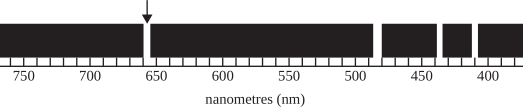
   

Calculate the frequency of the light corresponding to the spectral line indicated by the arrow.   (2 marks)

--- 4 WORK AREA LINES (style=lined) ---

Show Answers Only

\(B\)

Show Worked Solution

\(\lambda = 655\ \text{nm}\ = 655 \times 10^{-9}\ \text{m}\)

\(f=\dfrac{c}{\lambda}=\dfrac{3 \times 10^8}{655 \times 10^{-9}} \approx 4.6 \times 10^{14}\ \text{Hz}\)

Filed Under: Electromagnetic Spectrum Tagged With: Band 4, smc-3696-10-Spectroscopy

PHYSICS, M7 2023 VCE 18 MC

Which one of the following statements best describes the type of light produced from different types of light sources?

  1. Light from a laser is coherent and has a very narrow range of wavelengths.
  2. Light from an incandescent lamp is coherent and has a range of wavelengths.
  3. Light from an incandescent lamp is incoherent and has a very narrow range of wavelengths.
  4. Light from a single-colour light-emitting diode (LED) is coherent and contains a very wide range of wavelengths.
Show Answers Only

\(A\)

Show Worked Solution
  • Laser light is coherent and usually monochromatic, meaning it produces a specific wavelength of light.
  • Incandescent light is incoherent but displays a range of wavelengths, therefore it is not \(B\) or \(C\).
  • LED’s contain a narrow range of wavelengths, therefore it is not \(D\).

\(\Rightarrow A\)

Filed Under: Light: Wave Model Tagged With: Band 4, smc-3697-20-Young

PHYSICS, M8 2023 VCE 17 MC

Which one of the following statements best explains why it is possible to compare X-ray and electron diffraction patterns?

  1. X-rays can exhibit particle-like properties.
  2. Electrons can exhibit wave-like properties.
  3. Electrons are a form of high-energy X-rays.
  4. Both electrons and X-rays can ionise matter.
Show Answers Only

\(B\)

Show Worked Solution
  • de Broglie developed an equation linking an objects momentum to its wavelength. 
  • At high speeds, the wavelength of electrons is similar to that of X-rays and so they can be compared.

\(\Rightarrow B\)

Filed Under: Quantum Mechanical Nature of the Atom Tagged With: Band 4, smc-3702-40-De Broglie

PHYSICS, M5 2023 VCE 2

Phobos is a small moon in a circular orbit around Mars at an altitude of 6000 km above the surface of Mars.

The gravitational field strength of Mars at its surface is 3.72 N kg\(^{-1}\). The radius of Mars is 3390 km.

  1. Show that the gravitational field strength 6000 km above the surface of Mars is 0.48 N kg\(^{-1}\).   (2 marks)

--- 6 WORK AREA LINES (style=lined) ---

  1. Calculate the orbital period of Phobos. Give your answer in seconds.  (3 marks)

--- 7 WORK AREA LINES (style=lined) ---

  1. Phobos is very slowly getting closer to Mars as it orbits.
  2. Will the orbital period of Phobos become shorter, stay the same or become longer as it orbits closer to Mars? Explain your reasoning.  (2 marks)

--- 5 WORK AREA LINES (style=lined) ---

Show Answers Only

a.    \(0.48\ \text{N kg}^{-1}\)

b.    \(2.77 \times 10^4\ \text{s}\)

c.    The orbital period will become shorter.

Show Worked Solution

a.    \(\text{Find the mass of Mars:}\)

         \(g\) \(=\dfrac{GM}{r^2}\)
  \(M\) \(=\dfrac{gr^2}{G}\)
    \(=\dfrac{3.72 \times (3390 \times 10^3)^2}{6.67 \times 10^{-11}}\)
    \(=6.409 \times 10^{23}\)

 
\(\text{Find the gravitational field strength where}\ \ r= 9390\ \text{km:}\) 

         \(g\) \(=\dfrac{GM}{r^2}\)
    \(=\dfrac{6.67 \times 10^{-11} \times 6.41 \times 10^{23}}{(9\ 390\ 000)^2}\)
    \(=0.48\ \text{N kg}^{-1}\)


b.     \(\dfrac{r^3}{T^2}\) \(=\dfrac{GM}{4\pi^2}\)
  \(T\) \(=\sqrt{\dfrac{4\pi^2 r^3}{GM}}\)
    \(=\sqrt{\dfrac{4\pi^2 (9\ 390\ 000)^3}{6.67 \times 10^{-11} \times 6.409 \times 10^{23}}}\)
    \(=27\ 652\ \text{s}\)
    \(=2.77 \times 10^4\ \text{s}\)

♦ Mean mark (b) 53%. 
COMMENT: 
Rounded calculations, such as using 6.41 × 10^23 were marked as wrong.

c.    \(T=\sqrt{\dfrac{4\pi^2 r^3}{GM}}\)

\(T \propto \sqrt{r^3}\)

\(\therefore\) Decreasing the orbital radius will also decrease the orbital period.

Filed Under: Motion in Gravitational Fields Tagged With: Band 4, Band 5, smc-3692-15-Gravitational field strength, smc-3692-30-Orbital Velocity/Period/Radius

PHYSICS, M5 2023 VCE 9*

An engineer is designing a banked circular curve of radius 25 m in a new bicycle velodrome.

Diagram A shows the bicycle approaching the banked section, and diagram B shows the front view of a bicycle moving out of the page as it rounds the banked bend.
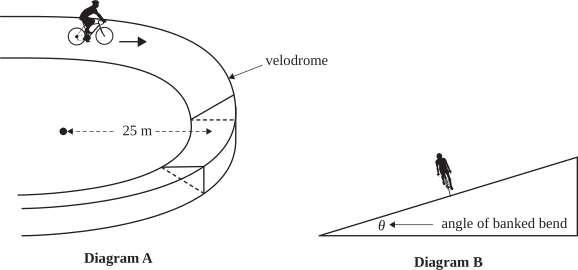
 

The bicycle is travelling at 11 m s\(^{-1}\) on the banked section. At this speed there are no sideways frictional forces between the wheels and the road surface.

Determine the angle of the banked bend with the road surface, giving your answer to the nearest degree.   (3 marks)
Show Answers Only

\(26^{\circ}\)

Show Worked Solution

\(\tan \theta\) \(=\dfrac{F_c}{mg}\)  
\(F_c\) \(=mg \tan \theta\)  
\(\dfrac{mv^2}{r}\) \(=mg \tan \theta\)  
\(\dfrac{v^2}{r}\) \(=g \tan \theta\)  
\(\tan \theta\) \(=\dfrac{v^2}{gr}=\dfrac{11^2}{9.8 \times 25}\)  
\(\theta\) \(=\tan^{-1}\Big(\dfrac{11^2}{9.8 \times 25}\Big)=26^{\circ}\)  

Filed Under: Circular Motion Tagged With: Band 4, smc-3691-65-Banked tracks

PHYSICS, M6 2023 VCE 5-6 MC

The diagram below shows a stationary circular coil of conducting wire connected to a low-resistance globe in a uniform, constant magnetic field, \(B\).
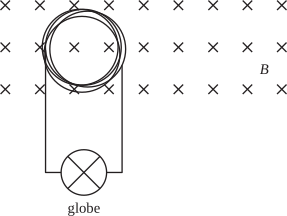


Question 5

The magnetic field is switched off.

Which one of the following best describes the globe in the circuit \( \textbf{before} \) the magnetic field is switched off, \( \textbf{during} \) the time the magnetic field is being switched off and \( \textbf{after} \) the magnetic field is switched off?

\begin{align*}
\begin{array}{l}
\rule{0pt}{2.5ex} \ \rule[-1ex]{0pt}{0pt}& \\
\rule{0pt}{2.5ex}\textbf{A.}\rule[-1ex]{0pt}{0pt}\\
\rule{0pt}{2.5ex}\textbf{B.}\rule[-1ex]{0pt}{0pt}\\
\rule{0pt}{2.5ex}\textbf{C.}\rule[-1ex]{0pt}{0pt}\\
\rule{0pt}{2.5ex}\textbf{D.}\rule[-1ex]{0pt}{0pt}\\
\end{array}
\begin{array}{|c|c|}
\hline
\rule{0pt}{2.5ex}\quad\text{Before}\quad\rule[-1ex]{0pt}{0pt}&\quad \text{During} \quad& \quad\text{After}\quad\\
\hline
\rule{0pt}{2.5ex}\text{Off}\rule[-1ex]{0pt}{0pt}&\text{On}& \text{Off}\\
\hline
\rule{0pt}{2.5ex}\text{On}\rule[-1ex]{0pt}{0pt}& \text{On}& \text{Off}\\
\hline
\rule{0pt}{2.5ex}\text{On}\rule[-1ex]{0pt}{0pt}& \text{Off} & \text{Off}\\
\hline
\rule{0pt}{2.5ex}\text{Off}\rule[-1ex]{0pt}{0pt}& \text{On} & \text{On}\\
\hline
\end{array}
\end{align*}

 
Question 6

The radius of the coil is 5 cm and the magnetic field strength is 0.2 T. The coil has 100 loops. Assume that the magnetic field is perpendicular to the area of the coil.

Which one of the following is closest to the magnitude of the magnetic flux through the coil of wire when the magnetic field is switched on?

  1.  0.0016 Wb
  2.  0.16 Wb
  3.  16 Wb
  4. 1600 Wb
Show Answers Only

\(\text{Question 5:}\ A\)

\(\text{Question 6:}\ A\)

Show Worked Solution

Question 5

  • By Faraday’s Law of Induction, an EMF and current will be induced in the coil when the coil experiences a change of flux causing the light to turn on. 
  • This occurs when the strength of the magnetic field is changing and so the light will be on during the time the magnetic field is being reduced to 0.
  • Before and after this, there is no change in flux (i.e. no EMF or current produced) so the light will be off.

\(\Rightarrow A\)


Question 6

\(\phi=BA=B \times \pi \times r^2 = 0.2 \times \pi \times (0.05)^2= 0.0016\ \text{Wb}\)

  
\(\Rightarrow A\)

Filed Under: Electromagnetic Induction Tagged With: Band 4, smc-3705-30-Magnetic Flux

PHYSICS, M6 2023 VCE 1 MC

One type of loudspeaker consists of a current-carrying coil within a radial magnetic field, as shown in the diagram below. \(X\) and \(Y\) are magnetic poles, and the direction of the current, \(I\), in the coil is clockwise as shown.
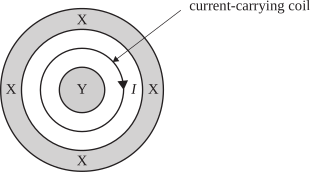


The force, \(F\), acting on the current-carrying coil is directed into the page.

Which one of the following statements correctly identifies the magnetic polarities of \(X\) and \(Y\)?

  1. \(X\) is a north pole and \(Y\) is a south pole.
  2. \(X\) is a south pole and \(Y\) is a north pole.
  3. Both \(X\) and \(Y\) are north poles.
  4. Both \(X\) and \(Y\) are south poles.
Show Answers Only

\(A\)

Show Worked Solution
  • Using the right hand rule, the palm faces into the page (direction of the force) and thumb points down the page (direction of the current).
  • The direction of the magnetic field is from \(X\) and \(Y\) (direction of fingers).
  • \(X\) is a north pole and \(Y\) is a south pole.

\(\Rightarrow A\)

Filed Under: Charged Particles, Conductors and Electric/Magnetic Fields Tagged With: Band 4, smc-3693-15-Charged Particles in MF

Statistics, SPEC2 2023 VCAA 19 MC

A company accountant knows that the amount owed on any individual unpaid invoice is normally distributed with a mean of $800 and a standard deviation of $200.

What is the probability, correct to three decimal places, that in a random sample of 16 unpaid invoices the total amount owed is more than $13 500?

  1. 0.087
  2. 0.191
  3. 0.413
  4. 0.587
  5. 0.809
Show Answers Only

\(B\)

Show Worked Solution

\(n=16, \ E(X)=\mu=800 \)

\(X\ \sim\ N(800, 200^2)  \)

\(\bar{X} \sim N\Bigg{(}800, \dfrac{200^2}{\sqrt{16}}\Bigg{)} \sim N(800, 50^2) \)

\(\text{Pr} (\Sigma X>13\ 500) = \text{Pr}\Bigg{(}\bar{X} > \dfrac{13\ 500}{16}\Bigg{)} = \text{Pr}(\bar{X} > 843.75)= 0.190…\)

\(\Rightarrow B\)

Filed Under: Linear Combinations and Sample Means (SM) Tagged With: Band 4, smc-1160-50-Distributions of sample means

Probability, MET2 2023 VCAA 15 MC

Let X be a normal random variable with mean of 100 and standard deviation of 20. Let Y be a normal random variable with mean of 80 and standard deviation of 10.

Which of the diagrams below best represents the probability density functions for X and Y, plotted on the same set of axes?
 

A.   
         B.   
         
C.   D.
         
E.
     
Show Answers Only

\(A\)

Show Worked Solution

\(X\sim N(100, 20^2)\ \ \ Y\sim N(80, 10^2)\)

\(\text{Mean }X>\text{Mean }Y \ \text{ie peak of }X\ \text{is to the right.}\)

\(\longrightarrow\ \text{Eliminate B and E}\)

\(\text{SD }X>\text{SD }Y\ \therefore\ X\ \text{has a greater spread ie curve flatter.} \)

\(\longrightarrow\ \text{Eliminate C and D}\)

 
\(\Rightarrow A\)

Filed Under: Normal Distribution, Probability density functions Tagged With: Band 4, smc-719-10-Single z-score

Vectors, SPEC2 2023 VCAA 17 MC

Consider the vectors  \(\underset{\sim}{\text{a}}=\alpha \underset{\sim}{\text{i}}+\underset{\sim}{\text{j}}-\underset{\sim}{\text{k}}, \ \underset{\sim}{\text{b}}=3 \underset{\sim}{\text{i}}+\beta \underset{\sim}{\text{j}}+4 \underset{\sim}{\text{k}}\)  and  \(\underset{\sim}{\text{c}}=2 \underset{\sim}{\text{i}}-7 \underset{\sim}{\text{j}}+\gamma \underset{\sim}{\text{k}}\), where \(\alpha, \beta, \gamma \in R\). If  \(\underset{\sim}{\text{a}} \times \underset{\sim}{\text{b}}=\underset{\sim}{\text{c}}\), then

  1. \(\alpha=-2, \ \beta=-1, \ \gamma=-5\)
  2. \(\alpha=-1, \ \beta=2, \ \gamma=-1\)
  3. \(\alpha=1, \ \beta=-2, \ \gamma=-5\)
  4. \(\alpha=-2, \ \beta=-1, \ \gamma=-1\)
  5. \(\alpha=1, \ \beta=-2, \ \gamma=5\)
Show Answers Only

\(C\)

Show Worked Solution

\begin {aligned}\underset{\sim}{\text{a}} \times \underset{\sim}{\text{b}}=\left|\begin{array}{ccc}
\underset{\sim}{\text{i}} & \underset{\sim}{\text{j}} & \underset{\sim}{\text{k}} \\ \alpha & 1 & -1 \\ 3 & \beta & 4\end{array}\right|\ & =(4+\beta)\underset{\sim}{\text{i}}-(4\alpha+3)\underset{\sim}{\text{j}}+(\alpha \beta-3) \underset{\sim}{\text{k}} \end{aligned}

\(\text{Equating coefficients given}\ \ \underset{\sim}{\text{a}} \times \underset{\sim}{\text{b}}=\underset{\sim}{\text{c}}:\)

\(4+\beta =2\ \ \Rightarrow \ \beta=-2 \)

\(4\alpha +3 = 7 \ \ \Rightarrow \ \alpha = 1 \)

\(\alpha \beta-3=\gamma \ \ \Rightarrow \ \gamma=-5 \)

\(\Rightarrow C\)

Filed Under: Basic Concepts and Calculations Tagged With: Band 4, smc-1176-55-Cross product

Mechanics, EXT2 M1 SM-Bank 5

A student throws a ball for his dog to retrieve. The position vector of the ball, relative to an origin \(O\) at ground level \(t\) seconds after release, is given by  \(  \underset{\sim}{\text{r}}{}_\text{B} (t)=5 t \underset{\sim}{\text{i}}+7 t \underset{\sim}{\text{j}}+(15 t-4.9 t^2+1.5) \underset{\sim}{\text{k}} \). Displacement components are measured in metres, where \(\underset{\sim}{\text{i}}\) is a unit vector to the east, \(\underset{\sim}{\text{j}}\) is a unit vector to the north and \( \underset{\sim} {\text{k}}\) is a unit vector vertically up.

Calculate the total vertical distance, in metres, travelled by the ball before it hits the ground. Give your answer correct to one decimal place.   (3 marks)

Show Answers Only

\(24.5\ \text{m} \)

Show Worked Solution

\(\text{Upwards distance}\ (z) = 15t-4.9t^2+1.5\)

\(\dfrac{dz}{dt}=15-9.8t\)

\(\text{Find}\ t\ \text{when}\ \dfrac{dz}{dt}=0\ \text{(vertical max):} \)

\(15-9.8t=0\ \ \Rightarrow \ \ t=\dfrac{15}{9.8} \)

\(z\Big{(}t=\frac{15}{9.8}\Big{)} = 15 \times \Big{(}\dfrac{15}{9.8}\Big{)}-4.9 \times \Big{(}\dfrac{15}{9.8}\Big{)}^2 + 1.5 \approx 12.98\ \text{m} \)
  

\(\text{At}\ \ t=0, \ z=1.5 \)

\(\therefore \text{Total vertical distance}\ = (12.98-1.5)+12.98 = 24.5\ \text{m (1 d.p.)} \)

Filed Under: Projectile Motion Tagged With: Band 4, smc-1060-04-Motion as f(t), smc-1060-50-Vectors and motion

Vectors, SPEC2 2023 VCAA 15 MC

If the sum of two unit vectors is a unit vector, then the magnitude of the difference of the two vectors is

  1. \(0\)
  2. \(\dfrac{1}{\sqrt{2}}\)
  3. \(\sqrt{2}\)
  4. \(\sqrt{3}\)
  5. \(\sqrt{5}\)
Show Answers Only

\(D\)

Show Worked Solution

\(\text{Vectors can be drawn as two sides of an equilateral triangle.}\)
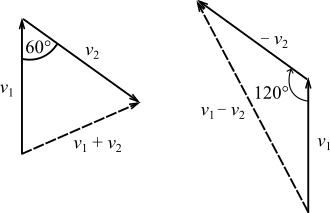
\(\text{Using the cosine rule for the difference between the two vectors:}\)

\(c^2\) \(=a^2+b^2-2ab\, \cos C\)  
  \(=1+1-2\times -\dfrac{1}{2} \)  
  \(=3\)  
\(c\) \(=\sqrt{3}\)  

 
\(\Rightarrow D\)

Filed Under: Vector Lines, Planes and Geometry Tagged With: Band 4, smc-1177-40-Triangles, smc-1177-50-2D problems

Calculus, SPEC2 2023 VCAA 13 MC

A tourist in a hot air balloon, which is rising vertically at 2.5 m s\(^{-1}\), accidentally drops a phone over the side when the phone is 80 metres above the ground.

Assuming air resistance is negligible, how long in seconds, correct to two decimal places, does it take for the phone to hit the ground?

  1. 2.86
  2. 2.98
  3. 3.79
  4. 4.04
  5. 4.30
Show Answers Only

\(E\)

Show Worked Solution

\(\text{Take upward velocity as positive.}\)

\(u=2.5\ \text{ms}^{-1}, \ a=-9.8\ \text{ms}^{-2} \)

\(\text{Using}\ \ s=ut+\dfrac{1}{2}at^2,\)

\(\text{Find}\ t\ \text{when}\ \ s=-80\ \text{(by calc):} \)

\(-80=2.5t-4.9t^2\ \ \Rightarrow \ \ t=4.30\ \text{s}\)

\(\Rightarrow E\)

Filed Under: Motion (SM) Tagged With: Band 4, smc-1159-10-Motion as f(t), smc-1159-50-Projectiles

Mechanics, EXT2 M1 EQ-Bank 6

The acceleration, \(a\) ms\(^{-2}\), of a particle that starts from rest and moves in a straight line is described by  \(a=1+v\), where \(v\) ms\(^{-1}\) is its velocity after \(t\) seconds.

Determine the velocity of the particle after \( \log _e(e+1) \) seconds.   (3 marks)

Show Answers Only

\(e\ \text{ms}^{-1}\)

Show Worked Solution

\(\dfrac{dv}{dt}=1+v\ \ \Rightarrow \ \dfrac{dt}{dv} = \dfrac{1}{1+v} \)

\(t= \displaystyle{\int \dfrac{1}{1+v}\ dv} = \log_e{(1+v)}+c \)

\(\text{When}\ \ t=0, v=0\ \ \Rightarrow \ c=0 \)

\(t\) \(=\log_e(1+v) \)  
\(1+v\) \(=e^t\)  
\(v\) \(=e^t-1\)  

 
\(\text{At}\ \ t=\log_e(e+1): \)

\(v=e^{\log_e{(e+1)}}-1 = e+1-1=e\ \text{ms}^{-1} \)

Filed Under: Motion Without Resistance Tagged With: Band 4, smc-1060-06-a=f(v)

Probability, MET2 2023 VCAA 10 MC

A continuous random variable \(X\) has the following probability density function
 

\(g(x) = \begin {cases}
\dfrac{x-1}{20}         &\ \ 1 \leq x < 6 \\
\\
\dfrac{9-x}{12}         &\ \ 6 \leq x < 9 \\
\\ 0 &\ \ \ \text{elsewhere}
\end{cases}\)
 

The value of \(k\) such that  \(\text{Pr}(X<k)=0.35\)  is

  1. \(\sqrt{14}-1\)
  2. \(\sqrt{14}+1\)
  3. \(\sqrt{15}-1\)
  4. \(\sqrt{15}+1\)
  5. \(1-\sqrt{15}\)
Show Answers Only

\(B\)

Show Worked Solution

\(\displaystyle \int_{1}^{6} \dfrac{x-1}{20}\,dx=0.625>0.35\)

\(\therefore\ k\ \text{lies between 1 and 6 so solve for interval }1\leq x\leq k\)
 

\(\text{Solve for}\ k\ \text{(by CAS)}:\)

\(\displaystyle \int_{1}^{k} \dfrac{x-1}{20}\,dx=0.35\ \ \Rightarrow \ \ k=\sqrt{14}+1\)

\(\Rightarrow B\)

Filed Under: Probability density functions Tagged With: Band 4, smc-637-50-Linear PDF

Calculus, MET2 2023 VCAA 7 MC

Let  \(f(x)=\log_{e}x\), where  \(x>0\)  and  \(g(x)=\sqrt{1-x}\), where  \(x<1\).

The domain of the derivative of \((f\circ g)(x)\) is

  1. \(x\in R\)
  2. \(x\in (-\infty, 1]\)
  3. \(x\in (-\infty, 1)\)
  4. \(x\in (0, \infty)\)
  5. \(x\in (0, 1)\)
Show Answers Only

\(C\)

Show Worked Solution

\(\text{Given }f(x)=\log_{e}x\ \ \text{and}\ \ g(x)=\sqrt{1-x}\)

\((f\circ g)(x)=\log_{e}\sqrt{1-x}=\dfrac{1}{2}\log_{e}(1-x)\)

\((f\circ g)^{′}(x)=\dfrac{1}{2}\times\dfrac{-1}{1-x}=\dfrac{1}{2(x-1)}\ \text{  where}\ \ x<1\)

\(\Rightarrow C\)

Filed Under: Differentiation (L&E), L&E Differentiation Tagged With: Band 4, smc-739-30-Logs, smc-739-90-Functional equations, smc-745-20-Logs, smc-745-70-Functional equations

Calculus, MET2 2023 VCAA 5 MC

Which one of the following functions has a horizontal tangent at \((0, 0)\)?

  1. \(y=x^{-\frac{1}{3}}\)
  2. \(y=x^{\frac{1}{3}}\)
  3. \(y=x^{\frac{2}{3}}\)
  4. \(y=x^{\frac{4}{3}}\)
  5. \(y=x^{\frac{3}{4}}\)
Show Answers Only

\(D\)

Show Worked Solution

\(\text{Index must be greater than 1 otherwise the gradient function }\)

\(\text{will not be defined at }x=0.\)

\(y=x^{\frac{4}{3}}\ \ \Rightarrow \ \dfrac{dy}{dx}=\frac{4}{3}x^{\frac{1}{3}}\ \ (\text{only option defined at}\ x=0)\)

\(\Rightarrow D\)

Filed Under: The Derivative Function and its Graph Tagged With: Band 4, smc-2830-50-SP problems

Algebra, MET2 2023 VCAA 4 MC

Consider the system of simultaneous equations below containing the parameter \(k\).

\(kx+5y\) \(=k+5\)
\(4x+(k+1)y\) \(=0\)

 
The value(s) of \(k\) for which the system of equations has infinite solutions are

  1. \(k\in \{-5, 4\}\)
  2. \(k\in \{-5\}\)
  3. \(k\in \{4\}\)
  4. \(k\in R\setminus \{-5, 4\}\)
  5. \(k\in R\setminus \{-5\}\)
Show Answers Only

\(B\)

Show Worked Solution
\(kx+5y\) \(=k+5\) \(\ \ \rightarrow\ \ \ \ \) \(y\) \(=-\dfrac{k}{5}x+\dfrac{k+5}{5}\)
\(4x+(k+1)y\) \(=0\) \(\ \ \rightarrow\ \ \ \ \) \(y\) \(=-\dfrac{4}{k+1}x+0\)

 
\(\text{Infinite solutions when gradients and }y\text{-intercepts equal.}\)
 
\(\text{Equating gradients (by CAS):}\)

\(-\dfrac{k}{5}=-\dfrac{4}{k+1}\ \ \Rightarrow\ \ k=4\ \text{ or}\ -5\)
   
\(\text{Equating intercepts:}\)

\(\dfrac{k+5}{5}=0\ \ \Rightarrow \ \ k=-5\)

\(k=-5\ \ \text{satisfies both equations (infinite solutions)}.\)

\(\Rightarrow B\)

Mean mark 55%.

Filed Under: Simultaneous Equations Tagged With: Band 4, smc-721-20-Infinite solutions

Calculus, MET1 2022 VCAA 8

Part of the graph of `y=f(x)` is shown below. The rule `A(k)=k \ sin(k)` gives the area bounded by the graph of `f`, the horizontal axis and the line `x=k`.
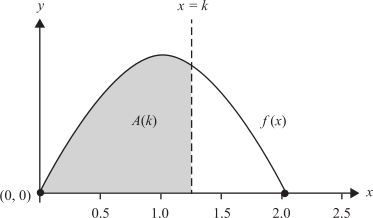
 

  1. State the value of `A\left(\frac{\pi}{3}\right)`.   (1 mark)

    --- 2 WORK AREA LINES (style=lined) ---

  2. Evaluate `f\left(\frac{\pi}{3}\right)`.   (2 marks)

    --- 6 WORK AREA LINES (style=lined) ---

  3. Consider the average value of the function `f` over the interval `x \in[0, k]`, where `k \in[0,2]`.
  4. Find the value of `k` that results in the maximum average value.   (2 marks)

    --- 6 WORK AREA LINES (style=lined) ---

Show Answers Only

a.    ` (sqrt(3)pi)/6`

b.    `(3sqrt(3) +pi)/6`

c.    `k = pi/2`

Show Worked Solution
a.  `A(pi/3)` `= pi/3sin(pi/3)`  
  `= pi/3 xx sqrt(3)/2`  
  `= (sqrt(3)pi)/6`  
b.   `f(k)` `= A^{\prime}(k)`  
`f(k)` `=d/dx(k\ sin\ k)`  
  `= sin\ k + k\ cos\ k`  
`f(pi/3)` `= sin\ pi/3 + pi/3\ cos\ pi/3`  
  `= sqrt(3)/2 + pi/3 xx 1/2`  
  `= sqrt(3)/2 + pi/6`  
  `=(3sqrt(3) +pi)/6`  

♦♦♦ Mean mark (b) 25%.
MARKER’S COMMENT: Common error was giving derivative of `A(k)` as `k\ cos (k)`.
c.   Average value `= (A(k))/k`  
  `= 1/k(int_0^k f(x) d x)`  
  `= 1/k[x\ sin (x)]_0^k`  
  `= 1/k[k\ sin (k)] = sin\ k`  

 
`:.` Average value has a maximum value of 1 when `k = pi/2`


♦♦♦ Mean mark (c) 25%.
MARKER’S COMMENT: Students often chose unnecessarily complicated methods or inconsistently applied nomenclature when attempting this question.

Filed Under: Average Value and Other, Differentiation (Trig), Trig Differentiation Tagged With: Band 4, Band 6, smc-736-10-sin, smc-736-40-Product Rule, smc-744-10-sin, smc-756-20-Trig

Calculus, MET1 2022 VCAA 7

A tilemaker wants to make square tiles of size 20 cm × 20 cm.

The front surface of the tiles is to be painted with two different colours that meet the following conditions:

  • Condition 1 - Each colour covers half the front surface of a tile.
  • Condition 2 - The tiles can be lined up in a single horizontal row so that the colours form a continuous pattern.

An example is shown below.
 

There are two types of tiles: Type A and Type B.

For Type A, the colours on the tiles are divided using the rule `f(x)=4 \sin \left(\frac{\pi x}{10}\right)+a`, where `a \in R`.

The corners of each tile have the coordinates (0,0), (20,0), (20,20) and (0,20), as shown below.
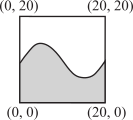
 

  1.  i. Find the area of the front surface of each tile.   (1 mark)

    --- 2 WORK AREA LINES (style=lined) ---

    ii. Find the value of `a` so that a Type A tile meets Condition 1.   (1 mark)

    --- 2 WORK AREA LINES (style=lined) ---


Type B tiles, an example of which is shown below, are divided using the rule `g(x)=-\frac{1}{100} x^3+\frac{3}{10} x^2-2 x+10`.
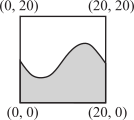
 

  1. Show that a Type B tile meets Condition 1.   (3 marks)

    --- 8 WORK AREA LINES (style=lined) ---
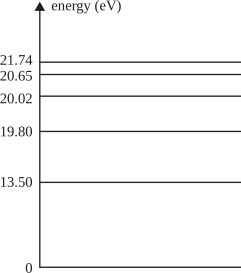
  2. Determine the endpoints of `f(x)` and `g(x)` on each tile. Hence, use these values to confirm that Type A and Type B tiles can be placed in any order to produce a continuous pattern in order to meet Condition 2.   (2 marks)

    --- 8 WORK AREA LINES (style=lined) ---
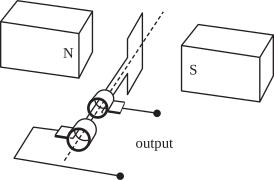
Show Answers Only

a.i.    `400` cm²

a.ii.   `a = 10`

b.     `200` cm²

c.     See worked solution

Show Worked Solution
a.i   Area `= 20 xx 20`  
  `= 400` cm²  

  
a.ii  `a = 10`
 

b.   Area `=\int_0^{20} \frac{-x^3}{100}+\frac{3 x^2}{10}-2 x+10\ d x`  
  `=\left[\frac{-x^4}{400}+\frac{x^3}{10}-x^2+10 x\right]_0^{20}`  
  `=\left[-\frac{20^4}{400}+\frac{20^3}{10}-20^2+10 xx 20\right]-\left[0\right]`  
  `= – 400 +800 -400 +200`  
  `= 200` cm²  

 
`:.` The area of the coloured section of the Type B tile is 200 cm² which is half the 400 cm² area of the tile.
 

c.   
`f(0)` `=4 \sin \left(\frac{\pi(0)}{10}\right)+10 = 10`  
  `f(20)` `=4 \sin (2 \pi)+10 = 10`  
  `g(0)` `=\frac{-0}{100}+\frac{3(0)}{10}-2(0)+10=10`  
  `g(20)` `=-\frac{8000}{100}+\frac{200}{10}-2(20)+10 = 10`  

 
→`\ f(0) = f(20) = g(0) = g(20) =10`
 

`:.`    The endpoints for `f(x)` are `(0,10)` and `(20,10)` and for `g(x)` are also `(0,10)` and `(20,10)`.

So the tiles can be placed in any order to make the continuous pattern.


♦♦ Mean mark (c) 30%.
MARKER’S COMMENT: Students often only found `f(20)` and `g(20)`, however, `f(0)` and `g(0)` also needed to be found to verify the pattern match.

Filed Under: Area Under Curves, Standard Integration Tagged With: Band 4, Band 6, smc-2757-10-Sin, smc-723-70-Other, smc-749-20-Definite Integrals

  • « Previous Page
  • 1
  • …
  • 38
  • 39
  • 40
  • 41
  • 42
  • …
  • 114
  • Next Page »

Copyright © 2014–2025 SmarterEd.com.au · Log in