SmarterEd

Aussie Maths & Science Teachers: Save your time with SmarterEd

  • Login
  • Get Help
  • About

Number and Algebra, NAP-J2-12

Trevor has poured milk into some glasses.

He makes them all exactly one quarter full.

Trevor counts by quarters to find out, in total, how many full cups of milk he has.
 

  Which number does Trevor count next?

`5` `3` `1 1/2` `2 1/4` `2 1/2`


Show Answers Only

`1 1/2`

Show Worked Solution

`text(Add)\ 1/4\ text(for each additional cup.)`

`:.\ text(Next number)` `= 1 1/4 + 1/4`
  `= 1 1/2`


Filed Under: Fractions and Decimals, Fractions and Decimals, Fractions and Decimals, Patterns, Patterns Tagged With: Band 4, smc-3019-40-Counting by fractions, smc-3087-30-Fraction word problems, smc-3088-30-Other patterns, smc-691-30-Fraction word problems, smc-692-30-Other patterns

Number and Algebra, NAP-J2-08

Emily has 85 cents in 5-cent pieces.

How many 5-cent pieces does she have?

`17` `80` `40` `425`


Show Answers Only

`17`

Show Worked Solution

`85 ÷ 5 = 17\ text(pieces)`

Filed Under: Financial Mathematics, Money and Financial Mathematics, Solving problems - Multiply/Divide, Solving Problems - Multiply/Divide Tagged With: Band 4, smc-2536-30-$ and cents calculations, smc-3085-20-Division, smc-3086-30-$ and cents calculations, smc-922-20-Division

Geometry, NAP-J2-06

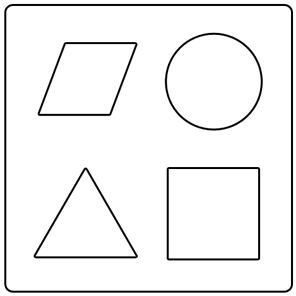
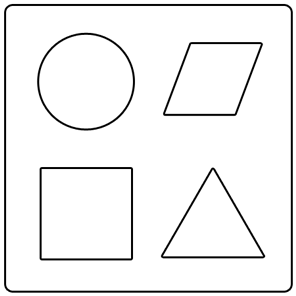
Dinesh is standing inside a shop. He looks through a window with four shapes in it.


The shapes can be seen from both sides of the window.

How would the window look when viewed from outside the shop?


Show Answers Only

Show Worked Solution

Filed Under: 2D-3D Shapes, 2D-3D Shapes Tagged With: Band 4, smc-3121-30-Different views, smc-695-30-Different views

Measurement, NAP-J2-05

How many days are there in 4 weeks?

7 days 11 days 20 days 28 days


Show Answers Only

`28\ text(days)`

Show Worked Solution

`text(Days in 4 weeks)`

`= 4 xx 7`

`= 28\ text(days)`

Filed Under: Time, Time Tagged With: Band 4, smc-3091-50-Convert day/month/year, smc-694-50-Convert day/month/year

Statistics, NAP-J2-04

Four students were asked what pets they owned.
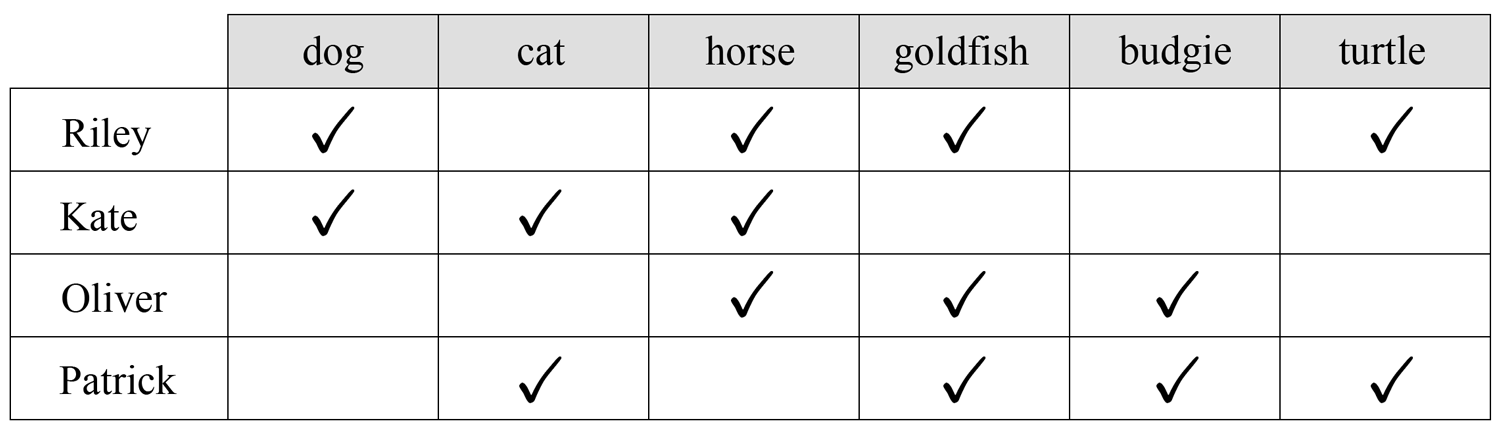
Who had both a goldfish and a cat as pets?

Riley Kate Oliver Patrick


Show Answers Only

`text(Patrick)`

Show Worked Solution

`text(Patrick)`

Filed Under: Data and Interpretation, Data and Interpretation Tagged With: Band 4, smc-3136-60-Table data, smc-698-60-Table data

CHEMISTRY, M4 2009 HSC 20

  1. Calculate the mass of ethanol \(\ce{C2H6O}\) that must be burnt to increase the temperature of 210 g of water by 65°C, if exactly half of the heat released by this combustion is lost to the surroundings.
  2. The heat of combustion of ethanol is 1367 kJ mol −1.  (3 marks)

    --- 12 WORK AREA LINES (style=lined) ---

  3. What are TWO ways to limit heat loss from the apparatus when performing a first-hand investigation to determine and compare heat of combustion of different liquid alkanols?  (1 mark)

    --- 2 WORK AREA LINES (style=lined) ---

Show Answers Only

a.    3.85 grams

b.    Answers could include two of the following:

  • Use of an insulated vessel (Styrofoam cup)
  • Place the vessel as close as safely possible to the Bunsen’s flame.
  • Use a lid for the beaker
Show Worked Solution

a.    \(q=mC \Delta T = 210 \times 4.18 \times 65 = 57\ 057\ \text{J} = 57.057\ \text{kJ}\)

\(\ce{n(C2H5OH) = \dfrac{57.057}{1367} = 0.04174\ \text{mol}}\)

\(\ce{m(C2H5OH) = n \times MM = 0.04174 \times 46.068 = 1.923\ \text{g}}\)

Since half of the heat is lost to environmental surroundings.

\(\ce{m(C2H5OH)_{\text{init}} = 2 \times 1.923= 3.85\ \text{g}}\)
 

b.    Answers could include two of the following:

  • Use of an insulated vessel (Styrofoam cup)
  • Place the vessel as close as safely possible to the Bunsen’s flame.
  • Use a lid for the beaker

Filed Under: Energy Changes in Chemical Reactions Tagged With: Band 3, Band 4, smc-4266-20-Heat of combustion

CHEMISTRY, M4 2013 HSC 27

A 0.259 g sample of ethanol is burnt to raise the temperature of 120 g of an oily liquid, as shown in the graph. There is no loss of heat to the surroundings.
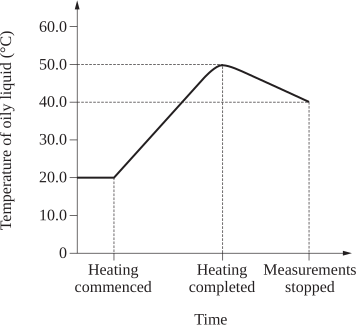
 

Using the information shown on the graph, calculate the specific heat capacity of the oily liquid. The heat of combustion of ethanol is 1367 kJ mol–1.   (4 marks)

--- 14 WORK AREA LINES (style=lined) ---

Show Answers Only

\(2.13 \times 10^{3}\ \text{J kg}^{-1}\text{K}^{-1}\)

Show Worked Solution

\(\ce{MM(C2H5OH) = 2 \times 12.01 + 6 \times 1.008 + 16 = 46.068}\)

\(\ce{n(C2H5OH) = \dfrac{\text{m}}{\text{MM}} = \dfrac{0.259}{46.068} = 5.622 \times 10^{-3}\ \text{mol}}\)

\(\text{Heat combustion}(q)\ = 1367 \times 5.622 \times 10^{-3} = 7.685\ \text{kJ} = 7685\ \text{J}\)

Mean mark 59%.
\(q\) \(=mc \Delta T\)  
\(c\) \(=\dfrac{q}{m \Delta T}\)  
  \(=\dfrac{7685}{0.120 \times (50-20)} \)  
  \(=2.13 \times 10^{3}\ \text{J kg}^{-1}\text{K}^{-1} \)  

Filed Under: Energy Changes in Chemical Reactions Tagged With: Band 4, smc-4266-20-Heat of combustion

Number, NAP-J3-CA03

Four students did a standing long jump and the results were recorded.

Which student had the longest jump?

Leigh 2.01 m Sam 0.70 m Job 0.80 m Ronan 1.05 m


Show Answers Only

`text(Leigh 2.01 m)`

Show Worked Solution

`text(Leigh 2.01 m)`

Filed Under: Decimals Tagged With: Band 4, smc-2136-10-Decimal order, smc-2136-30-Word problems

Statistics, NAP-J3-CA01

Four students recorded the number of times they participated in different sports in one week in the table below.
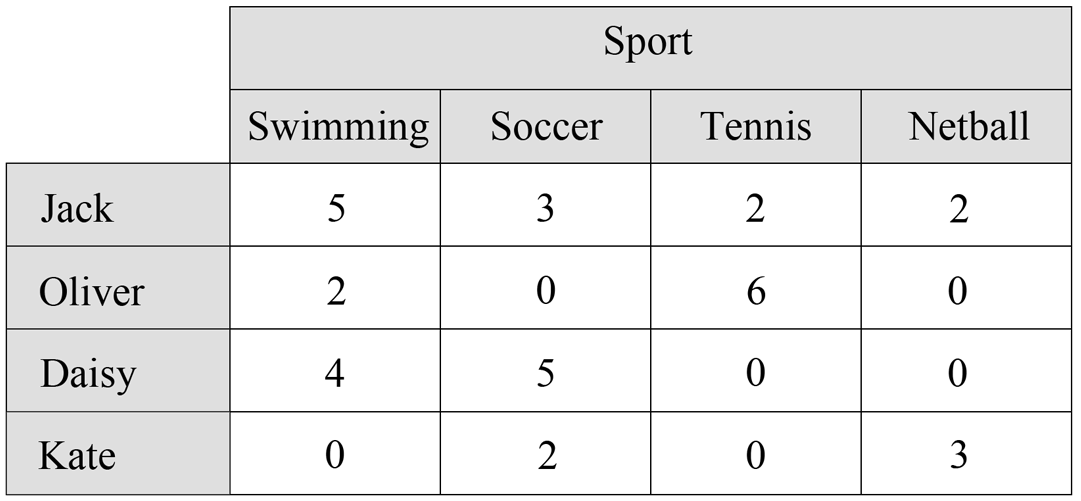
 

In total, which sport was participated in the most times?

Swimming Soccer Tennis Netball


Show Answers Only

`text(Swimming)`

Show Worked Solution

`text(Times each sport was played:)`

`text(Swimming – 11)`

`text(Soccer – 10)`

`text(Tennis – 8)`

`text(Netball – 5)`

`:.\ text(Swimming was participated in the most.)`

Filed Under: Data and Interpretation, Data and Statistics (7) Tagged With: Band 4, smc-3166-20-Table data, smc-674-20-Table data

L&E, 2ADV E1 SM-Bank 9

Solve  `log_2(6-x)-log_2(4-x) = 2`  for `x`, where  `x < 4`.  (2 marks)

--- 5 WORK AREA LINES (style=lined) ---

Show Answers Only

`10/3`

Show Worked Solution

`text(Simplify using log laws:)`

`log_2((6-x)/(4-x))` `= 2`
`2^2` `= (6-x)/(4-x)`
`16-4x` `= 6-x`
`3x` `= 10`
`:. x` `= 10/3`

Filed Under: Log/Index Laws and Equations (Adv-2027), Log/Index Laws and Equations (Y11), Log/Index laws and Other Equations Tagged With: Band 4, smc-6455-10-Logs - Product/Quotient Rules, smc-963-10-Log - product/quotient rule

L&E, 2ADV E1 SM-Bank 7

Solve the equation  `2 log_3(5)-log_3 (2) + log_3 (x) = 2`  for  `x.`  (2 marks)

Show Answers Only

`18/25`

Show Worked Solution
`log_3 (5)^2-log_3 (2) + log_3 (x)` `= 2`
`log_3 (25x)-log_3 (2)` `=2`
`log_3 ((25 x)/2)` `= 2`
`(25x)/2` `= 3^2`
`:. x` `= 18/25`

Filed Under: Log/Index Laws and Equations (Adv-2027), Log/Index Laws and Equations (Y11), Log/Index laws and Other Equations Tagged With: Band 4, smc-6455-10-Logs - Product/Quotient Rules, smc-963-10-Log - product/quotient rule

L&E, 2ADV E1 SM-Bank 4 MC

If  `f(x) = 3 log_e (2x),` and  `f(5x) = log_e (y),`

then `y` is equal to

  1. `30x`
  2. `6x`
  3. `125x^3`
  4. `1000x^3`
Show Answers Only

`D`

Show Worked Solution
`f(5x)` `= 3 log_e (2(5x))`
`log_e (y)` `= 3 log_e (10 x)`
  `= log_e (10x)^3`
`y` `= 1000 x^3`

`=> D`

Filed Under: Log/Index Laws and Equations (Adv-2027), Log/Index Laws and Equations (Y11), Log/Index laws and Other Equations Tagged With: Band 4, smc-6455-20-Logs - Power Rule, smc-963-20-Log - power rule

L&E, 2ADV E1 SM-Bank 2 MC

If  `y = log_a (7x - b) + 3`, then `x` is equal to

  1. `1/7 a^(y - 3) + b`
  2. `(y - 3)/(log_a(7 - b))`
  3. `1/7 (a^(y - 3) + b)`
  4. `a^(y - 3) - b/7`
Show Answers Only

`C`

Show Worked Solution
`y – 3` `= log_a (7x – b)`
`a^(y – 3)` `= 7x – b`
`a^(y – 3) + b` `= 7x`
`:. x` `= 1/7 (a^(y – 3) + b)`

`=>   C`

Filed Under: Log/Index Laws and Equations (Adv-2027), Log/Index Laws and Equations (Y11), Log/Index laws and Other Equations Tagged With: Band 4, smc-6455-40-Logs - Other, smc-963-40-Log - Other

L&E, 2ADV E1 SM-Bank 10

Solve the equation  `2^(3x-3) = 8^(2-x)`  for  `x`.  (2 marks)

Show Answers Only

`3/2`

Show Worked Solution
`2^(3x-3)` `= 2^(3(2-x))`
`3x-3` `= 6-3x`
`6x` `= 9`
`:. x` `= 3/2`

Filed Under: Log/Index Laws and Equations (Adv-2027), Log/Index Laws and Equations (Y11), Log/Index laws and Other Equations Tagged With: Band 4, smc-6455-50-Exponential Equations, smc-963-50-Exponential Equation

GEOMETRY, FUR1 SM-Bank 32 MC

Makoua and Macapá are two towns on the equator.

The longitude of Makoua is 16°E and the longitude of Macapá is 52°W.

How far apart are these two towns if the radius of Earth is approximately 6400 km?

A.  `4000\ text(km)`

B.  `7600\ text(km)`

C.  `1\ 367\ 200\ text(km)`

D.  `1\ 447\ 600\ text(km)`

E.   `2\ 734\ 400\ text(km)`

Show Answers Only

`B`

Show Worked Solution

2UG-2006-19MC Answer

`text(Angular Difference)` `= 52 + 16`
  `= 68°`


`text(Arc)\ AB` `=\ text(Distance between two towns)`
  `= 68/360 xx 2 xx pi xx r`
  `= 68/360 xx 2 xx pi xx 6400`
  `= 7595.67…\ text(km)`

 
`=>  B`

Filed Under: Great Circle Geometry Tagged With: Band 4, smc-758-20-Great Circle distance

GEOMETRY, FUR1 SM-Bank 18 MC

Stockholm is located at  59°N 18°E  and Darwin is located at  13°S 131°E. 

What is the time difference between Stockholm and Darwin? (Ignore time zones and daylight saving.)

  1. 184 minutes
  2. 188 minutes
  3. 288 minutes
  4. 452 minutes
  5. 596 minutes
Show Answers Only

`D`

Show Worked Solution

`text(Stockholm is 59°N 18°E,  Darwin is 13°S 131°E)`

`text{Angular difference (longitude)}`

`= 131^@− 18^@`

`= 113^@`
 

`:.\ text(Time difference)` `= 113 xx 4`
  `= 452\ text(minutes)`

 
`⇒ D`

Filed Under: Great Circle Geometry Tagged With: Band 4, smc-758-10-Time differences

GEOMETRY, FUR1 SM-Bank 15 MC

Which expression will give the shortest distance, in kilometres, between Mount Isa (20°S  140°E)  and Tokyo (35°N  140°E)?

  1. `15/360 xx 2 xx pi xx 6400`
  2. `55/360 xx 2 xx pi xx 6400`
  3. `125/360 xx 2 xx pi xx 6400`
  4. `140/360 xx 2 xx pi xx 6400`
  5. `305/360 xx 2 xx pi xx 6400`
Show Answers Only

`B`

Show Worked Solution

`text(Tokyo is 35° North of the equator, Mt Isa 20° South)`

`text(Arc length) = 55/360 xx 2 xx pi xx 6400`

`=>  B`

Filed Under: Great Circle Geometry Tagged With: Band 4, smc-758-20-Great Circle distance

GEOMETRY, FUR2 SM-Bank 25

A ship sails due South from Channel-Port-aux-Basques, Canada,  47°N  59°W  to Barbados, 13°N  59°W.

How far did the ship sail, to the nearest kilometre? Assume that the radius of Earth is 6400 km.    (2 marks)

Show Answers Only

 `3798\ text{km (nearest km)}`

Show Worked Solution
`text(Angular difference in latitude)` `=47` `-13`
  `=34^@`

 
`text{(No difference in longitude)}`
 

`:.\ text(Distance)` `=34/360` `xx 2 pi r`
  `=34/360` `xx 2` `xx pi` `xx 6400`
  `= 3797.836…`
  `= 3798` `text{km   (nearest km)}`

Filed Under: Great Circle Geometry Tagged With: Band 4

GEOMETRY, FUR2 SM-Bank 15

Osaka is at  34°N, 135°E, and Denver is at  40°N, 105°W. 

  1. Show that there is a 16-hour time difference between the two cities.
    (Ignore time zones.)    (1 mark)
  2. John lives in Denver and wants to ring a friend in Osaka. In Denver it is 9 pm Monday.     


    What time and day is it in Osaka then?   (1 mark)

  3. John’s friend in Osaka sent him a text message which happened to take 14 hours to reach him. It was sent at 10 am Thursday, Osaka time.


    What was the time and day in Denver when John received the text?    (1 mark)

Show Answers Only
  1. `text{Proof (See Worked Solutions)}`
  2. `1\ text(pm Tuesday)`
  3. `8\ text(am Thursday)`
Show Worked Solution
a.   `text(Longitude difference)` `= 135 + 105`
    `= 240^@`


`text(Time difference)` `= 240/15`
  `= 16\ text(hours   … as required)`


b.  `text(Denver is behind Osaka time because it is further west.)`

`:.\ text(Time in Osaka)` `= 9\ text(pm Monday plus 16 hours)`
  `= 1\ text(pm Tuesday)`


c.  `text(Denver is 16 hours behind Osaka)`

`:.\ text(John will receive the text at 10 am Thursday less 16)`

`text{plus 14 hours (i.e. 8 am Thursday.)}`

Filed Under: Great Circle Geometry Tagged With: Band 4, Band 5, smc-758-10-Time differences

GEOMETRY, FUR2 SM-Bank 14

Pontianak has a longitude of 109°E, and Jarvis Island has a longitude of 160°W.

Both places lie on the Equator

  1. Find the shortest great circle distance between these two places, to the nearest kilometre. You may assume that the radius of the Earth is 6400 km.    (2 marks)
  2. The position of Rabaul is 4° to the south and 48° to the west of Jarvis Island. What is the latitude and longitude of Rabaul?     (1 mark)
Show Answers Only
  1. `10\ 165\ text(km)\ \ \ text{(nearest km)}`
  2. `152^@ text(E)`
Show Worked Solution
a.   `text(Longitude difference)` `= 109 + 160`
    `= 269^@`


`=> text(Shortest distance)\ text{(by degree)}` `= 360 – 269`
  `= 91^@`


`:.\ text(Shortest distance)` `= 91/360 xx 2 pi r`
  `= 91/360 xx 2 xx pi xx 6400`
  `= 10\ 164.79…`
  `=10\ 165\ text(km)\ text{(nearest km)}`


b.   `text(Latitude)`
  `4^@\ text(South of Jarvis Island)`
  `text(S)text(ince Jarvis Island is on equator)`
  `=>\ text(Latitude is)\ 4^@ text(S)`
   
  `text(Longitude)`
  `text(Jarvis Island is)\ 160^@ text(W)`
  `text(Rubail is)\ 48^@\ text(West of Jarvis Island, or 208° West)`
  `text(which is)\ 28^@\ text{past meridian (180°)}`


`=>\ text(Longitude)` `= (180\ -28)^@ text(E)`
  `= 152^@ text(E)`


`:.\ text(Position is)\ (4^@text{S}, 152^@text{E})`

Filed Under: Great Circle Geometry Tagged With: Band 4, Band 5, smc-758-20-Great Circle distance, smc-758-40-Earth Coordinates

GEOMETRY, FUR2 SM-Bank 13

Melbourne is located at (38°S, 145°E) and Dubai is located at (24°N, 55°E).

  1. Calculate the difference in longitude between Melbourne and Dubai.  (1 mark)
  2. Show that the time difference between Melbourne and Dubai is 6 hours.  (1 mark)
  3. A plane leaves Melbourne on Friday at 11.30 pm. The flight time to Dubai is 15 hours.


    What will be the time and the day in Dubai when the plane is due to land?  (1 marks)

Show Answers Only
  1. `90^@`
  2. `text(See Worked Solutions)`
  3. `text(8:30 am on Saturday)`
Show Worked Solution

a.   `text(Difference in longitude)`

`= 145 – 55`

`= 90^@`


b.   `text(S)text(ince)\ 1^@ = 4\ text(min time difference,)`

`text(Time difference)`

`= 90 xx 4`

`= 360\ text(mins)`

`= 6\ text(hours  … as required)`


c.    `text(Arrival time)` `= 11:30 + 15\ text(hours)`
    `= 14:30\ text{(Melbourne time)}`


`:.\ text(Arrival time in Dubai time)`

`= 14:30 – 6\ text(hours)`

`= 8:30\ text(am on Saturday)`

Filed Under: Great Circle Geometry Tagged With: Band 4, smc-758-10-Time differences

GEOMETRY, FUR2 SM-Bank 12

This diagram represents Earth. `O` is at the centre, and `A` and `B` are points on the surface.
 

2UG-2005-27b
 

Find the shortest great circle distance from `A` to `B`.

Give your answer in to the nearest km.   (2 marks)

Show Answers Only

`text{4803 km  (nearest km)}`

Show Worked Solution

`A : 35^@text(N)\ 20^@text(E)\ \ \ \ B:8^@text(S)\ 20^@text(E)`

HSC 2005 27b

`text(Angular difference)` `= 35^@ + 8^@`
  `= 43^@`


`:.\ text(Distance from)\ A\ text(to)\ B`

`= 43/360 xx 2 xx pi xx r`

`= 43/360 xx 2 xx pi xx 6400`

`= 4803.1…`

`= 4803\ text{km  (nearest km)}`

Filed Under: Great Circle Geometry Tagged With: Band 4, smc-758-20-Great Circle distance

Probability, MET1 2012 VCAA 8b

The probability density function `f` of a random variable `X` is given by
 

`qquad qquad f(x) = {((x + 1)/12, 0 <= x <= 4), (\ \ 0, text{otherwise}):}`
 

Find the value of `b` such that  `text(Pr) (X <= b) = 5/8.`  (3 marks)

Show Answers Only

`3`

Show Worked Solution
`1/12 int_0^b (x + 1)\ dx` `= 5/8`
`[1/2 x^2 + x]_0^b` `= 15/2`
`1/2b^2 + b` `= 15/2`
`b^2 + 2b – 15` `= 0`
`(b + 5) (b – 3)` `= 0`


`:. b = 3,\ \ \ b in (0, 4)`

Filed Under: Probability density functions Tagged With: Band 4, smc-637-45-Other probability, smc-637-50-Linear PDF

Calculus, MET1 2006 VCAA 3a

Let  `y = x tan(x)`. Evaluate  `(dy)/(dx)`  when `x = pi/6`.   (3 mark)

--- 7 WORK AREA LINES (style=lined) ---

Show Answers Only

`(3sqrt3 + 2pi)/9`

Show Worked Solution

`text(Using the product rule:)`

MARKER’S COMMENT: A common error was not knowing the exact trig function values.

`d/(dx)(uv)` `= u^{prime}v + uv^{prime}`
`(dy)/(dx)` `= tan(x) + x/(cos^2(x))`


`text(When)\ x = pi/6,`

`(dy)/(dx)` `= tan(pi/6) + (pi/6)/((cos(pi/6))^2)`
  `= 1/sqrt3 + pi/6 xx (2/sqrt3)^2`
  `= sqrt3/3 + (4pi)/18`
  `= (3sqrt3 + 2pi)/9`

Filed Under: Differentiation (Trig), Trig Differentiation Tagged With: Band 4, smc-736-30-tan, smc-736-40-Product Rule, smc-744-30-tan, smc-744-40-Product Rule

Calculus, MET1 2009 VCAA 1b

For  `f(x) = (cos(x))/(2x + 2)`  find  `f prime (pi)`.   (3 marks)

--- 6 WORK AREA LINES (style=lined) ---

Show Answers Only

`1/(2 (pi + 1)^2)`

Show Worked Solution

`text(Using Quotient Rule:)`

MARKER’S COMMENT: A majority of students did not substitute  `x=pi`  correctly.
`(g/h)^{prime}` `= (g^{prime} h – gh^{prime})/h^2`
`f^{prime}(x)` `= (-sin (x) (2x + 2)-2 cos (x))/(2x + 2)^2`
`:. f^{prime}(pi)` `= (-sin (pi) (2pi + 2)-2 cos (pi))/(2pi + 2)^2`
  `= (0-2 (-1))/[2 (pi + 1)]^2`
  `= 2/(4(pi + 1)^2)`
  `= 1/(2 (pi + 1)^2)`

Filed Under: Differentiation (Trig), Trig Differentiation Tagged With: Band 4, smc-736-20-cos, smc-736-50-Quotient Rule, smc-744-20-cos, smc-744-50-Quotient Rule

Calculus, MET1 SM-Bank 5

The function with rule  `f(x)`  has derivative  `f^{prime}(x) =  cos\ 3x`.

If  `f(pi/6) = 1,`  find  `f(x).`  (3 marks)

--- 6 WORK AREA LINES (style=lined) ---

Show Answers Only

`f(x)= 1/3 sin\ 3x + 2/3`

Show Worked Solution
`int f(x)\ dx` `=int cos\ 3x\ dx`
  `= 1/3 sin\ 3x + c`
`f(pi/6)`  `= 1/3\ [sin\ (3 xx pi/6) ]+ c`
`1`  `= 1/3\ sin\ pi/2+c`
`c`  `= 2/3`

 
`:.f(x)= 1/3 sin\ 3x + 2/3`

Filed Under: Integration (Trig), Trig Integration Tagged With: Band 4, smc-737-20-cos, smc-737-60-Find f(x) given f'(x), smc-747-20-cos, smc-747-70-Find f(x) given f'(x)

Calculus, MET2 2007 VCAA 20 MC

The average value of the function  `y = tan (2x)`  over the interval  `[0, pi/8]`  is

  1. `2/pi log_e (2)`
  2. `pi/4`
  3. `1/2`
  4. `4/pi log_e 2`
  5. `8/pi`
Show Answers Only

`A`

Show Worked Solution
`y_text(average)` `= 1/(pi/8 – 0) int_0^(pi/8) (tan 2x)\ dx`
  `= 8/pi  int_0^(pi/8) (tan 2x)\ dx`
  `= (2 log_e (2))/pi`

`=>   A`

Filed Under: Average Value and Other, Integration (Trig), Trig Integration Tagged With: Band 4, smc-737-50-Average Value, smc-747-60-Average Value, smc-756-20-Trig

Probability, MET2 2007 VCAA 18 MC

The heights of the children in a queue for an amusement park ride are normally distributed with mean 130 cm and standard deviation 2.7 cm. 35% of the children are not allowed to go on the ride because they are too short.

The minimum acceptable height correct to the nearest centimetre is

  1. 126
  2. 127
  3. 128
  4. 129
  5. 130
Show Answers Only

`D`

Show Worked Solution

`X = text(height)`

`X ∼ N (130, 2.7^2)`

vcaa-2007-meth2-18

`text(Pr)(X < a)` `= 0.35\ \ \ [text(CAS: invNorm)(0.35, 130, 2.7)]`
`a` `= 128.96`

 
`=>   D`

Filed Under: Normal Distribution Tagged With: Band 4, smc-719-10-Single z-score

Probability, MET2 2007 VCAA 16 MC

If a random variable `X` has probability density function
 

`f(x) = {(x/2, if x in[0,2]), (0,\ \ \ text(otherwise)):}`
 

then  `text(E) (X)`  is equal to

  1. `1/2`
  2. `1`
  3. `4/3`
  4. `2/3`
  5. `2`
Show Answers Only

`C`

Show Worked Solution
`text(E) (X)` `= int_0^2 x (x/2)\ dx`
  `=[x^3/6]_0^2`
  `= 4/3`

 
`=>   C`

Filed Under: Probability density functions Tagged With: Band 4, smc-637-10-E(X), smc-637-50-Linear PDF

Calculus, MET2 2007 VCAA 13 MC

For the graph of  `y = 4x^3 + 27x^2-30x + 10`  the subset of `R` for which the gradient is negative is given by the interval

  1. `(0.5, 5.0)`
  2. `(-4.99, 0.51)`
  3. `(-oo, 1/2)`
  4. `(-5, 1/2)`
  5. `(2.25, oo)`
Show Answers Only

`D`

Show Worked Solution
`y` `=4x^3 + 27x^2 – 30x + 10`
`y′` `=12x^2 + 54x – 30`


`text(Sketch the graph:)`

vcaa-2007-meth2-13

`:.\ text(Gradient is negative for)\ \  x in (– 5, 1/2).`

`=>   D`

Filed Under: Curve Sketching Tagged With: Band 4, smc-724-60-Increasing/Decreasing intervals

Calculus, MET2 2007 VCAA 12 MC

Let  `f: R -> R`  be a differentiable function such that

  • `f prime(3) = 0`
  • `f prime(x) < 0`  when  `x < 3`  and when  `x > 3`

When  `x = 3`, the graph of  `f`  has a

  1. local minimum
  2. local maximum
  3. stationary point of inflection
  4. point of discontinuity
  5. gradient of 3
Show Answers Only

`C`

Show Worked Solution

`text(Use a gradient table:)`

vcaa-2007-meth2-12

`:.\ text(Point of inflection at)\ \ x = 3.`

`=>   C`

Filed Under: The Derivative Function and its Graph Tagged With: Band 4, smc-2830-50-SP problems

L&E, 2ADV E1 SM-Bank 11 MC

Solve the equation  `e^(4x) - 5e^(2x) + 4 = 0`  for `x`

  1. `x= 1, 4`
  2. `x= – 4, – 1`
  3. `x= 0, log_e 2`
  4. `x= – log_e 2, 0, log_e 2 `
Show Answers Only

`C`

Show Worked Solution

`e^(4x) – 5e^(2x) + 4 = 0`

`text(Let)\ \ X=e^(2x)`

`X^2-5X+4` `=0`
`(X-4)(X-1)` `=0`
`X` `=4 or 1`


`:.e^(2x)` `=4` `e^(2x)` `=1`
`2x` `=log_e 4` `x` `=0`
`x` `=(2log_e 2)/2`    
  `=log_e 2`    

`=> C`

Filed Under: Equations reducible to quadratics, Log/Index Laws and Equations (Adv-2027), Log/Index Laws and Equations (Y11), Log/Index laws and Other Equations Tagged With: Band 4, smc-6455-50-Exponential Equations, smc-6455-60-Quadratic Equations, smc-963-50-Exponential Equation, smc-963-60-Quadratic Equations

Graphs, MET2 2007 VCAA 10 MC

The graph of  `y = kx-3`  intersects the graph of  `y = x^2 + 8x`  at two distinct points for

  1. `k = 11`
  2. `k > 8 + 2 sqrt 3 or k < 8-2 sqrt 3`
  3. `5 <= k <= 6`
  4. `8-2 sqrt 3 <= k <= 8 + 2 sqrt 3`
  5. `k = 5`
Show Answers Only

`B`

Show Worked Solution

`text(Intersection occurs when:)`

`kx-3` `= x^2 + 8x`
`x^2 + (8-k)x + 3` `= 0`


`text(For 2 points of intersection:)`

`Delta` `> 0`
`(8-k)^2-4 (3)` `> 0`


`:. k < 8-2 sqrt 3\  uu\  k > 8 + 2 sqrt 3`

`=>   B`

Filed Under: Polynomials Tagged With: Band 4, smc-750-30-Discriminant

Calculus, MET2 2007 VCAA 9 MC

Let  `k = int_-2^-1 1/x\ dx`, then `e^k` is equal to

  1. `log_e(2)`
  2. `1`
  3. `2`
  4. `e`
  5. `1/2`
Show Answers Only

`E`

Show Worked Solution

`text(The integral can be seen as the negative)`

`text(equivalent of the area under)\ \ y=1/x`

`text(between)\ \ x=1 and x=2.`

`k` `= – [log_e x]_1^2`
  `=-(log_e(2)-log_e(1))`
  `= – log_e (2)`
  `= log_e (1/2)`
`:. e^k` `= e^(log_e(1/2))`
  `= 1/2`

 
`=>   E`

Filed Under: Integration (L&E), L&E Integration Tagged With: Band 4, smc-740-40-Log (definite), smc-748-40-Log (definite)

Calculus, MET2 2007 VCAA 4 MC

The average rate of change of the function with rule  `f(x) = x^3 - sqrt (x + 1)`  between  `x = 0`  and  `x = 3`  is

A.   `0`

B.   `12`

C.   `26/3`

D.   `25/3`

E.   `8`

Show Answers Only

`C`

Show Worked Solution

`text(Define)\ \ f(x) = x^3 – sqrt (x + 1)\ \ text(on CAS)`

`text(Average ROC)` `= (f(3) – f(0))/(3 – 0)`
  `= 26/3`

`=>   C`

Filed Under: Standard Differentiation Tagged With: Band 4, smc-746-40-Average ROC

Graphs, MET2 2007 VCAA 1 MC

The linear function  `f: D -> R,\ f(x) = 6 - 2x`  has range  `text([−4, 12]).`

The domain `D` is

  1. `[– 3, 5]`
  2. `[– 5, 3]`
  3. `R`
  4. `[– 14, 18]`
  5. `[– 18, 14]`
Show Answers Only

`A`

Show Worked Solution
`12` `= 6 – 2x`
`x` `= – 3`


`- 4` `= 6 – 2x`
`x` `= 5`


`:. x in [– 3, 5]`

`=>   A`

Filed Under: Coordinate Geometry Tagged With: Band 4, smc-727-40-Domain/Range

Algebra, MET1 SM-Bank 24

The polynomial  `p(x) = x^3-ax + b`  has a remainder of 2 when divided by  `(x-1)`  and a remainder of 5 when divided by  `(x + 2)`.  

Find the values of  `a`  and  `b`.   (3 marks)

--- 6 WORK AREA LINES (style=lined) ---

Show Answers Only
`a` `= 4`
`b` `= 5`
Show Worked Solution
`p(x)` `= x^3-ax + b`
`P(1)` `= 2`
`1-a + b` `= 2`
`b` `= a+1\ \ \ …\ text{(1)}`
`P (-2)` `= 5`
`-8 + 2a + b` `= 5`
`2a + b` `= 13\ \ \ …\ text{(2)}`


`text(Substitute)\ \ b = a+1\ \ text(into)\ \ text{(2)}`

`2a + a+1` `= 13`
`3a` `= 12`
`:. a` `= 4`
`:. b` `= 5`

Filed Under: Polynomials Tagged With: Band 4, smc-750-10-Factor Theorem, smc-750-20-Remainder Theorem

Algebra, MET1 SM-Bank 23

The graph of  `P(x) = x^2 + ax + b`  cuts the `x`-axis when  `x=2.`  When  `P(x)`  is divided by  `x + 1`, the remainder is 18.

Find the values of  `a`  and  `b`.   (3 marks)

--- 8 WORK AREA LINES (style=lined) ---

Show Answers Only

`a = -7\ \ text(and)\ \ b = 10`

Show Worked Solution

`P(x) = x^2 + ax + b`

`text(S)text(ince the graph cuts the)\ xtext(-axis at)\ \ x = 2,`

`P(2)` `=0`  
`2^2 + 2a + b` `= 0`  
`2a + b` `= -4`       `…\ (1)`

 
`P(-1) = 18,`

`(-1)^2-a + b` `= 18`  
`-a + b` `= 17`    `…\ (2)`

 
`text(Subtract)\ \ (1) − (2),`

`3a` `= -21`
`a` `= -7`

 
`text(Substitute)\ \ a = -7\ \ text{into (1),}`

`2(-7) + b` `= -4`
`b` `= 10`


`:.a = -7\ \ text(and)\ \ b = 10`

Filed Under: Polynomials Tagged With: Band 4, smc-750-10-Factor Theorem, smc-750-20-Remainder Theorem

Graphs, MET2 2008 VCAA 22 MC

The graph of the function  `f` with domain  `[0, 6]`  is shown below.

VCAA 2008 22mc

Which one of the following is not true?

  1. The function is not continuous at  `x = 2`  and  `x = 4.`
  2. The function exists for all values of `x` between `0` and `6.`
  3. `f(x) = 0`  for  `x = 2`  and  `x = 5.`
  4.  The function is positive for  `x ∈ [0, 5).`
  5. The gradient of the function is not defined at  `x = 4.`
Show Answers Only

`C`

Show Worked Solution

`f(x) > 0\ \ text(for)\ \ x = 2`

`:.\ text(Option)\ \  C\ \ text(is not true)`

`=>   C`

Filed Under: Quotient and Other Graphs Tagged With: Band 4, smc-757-20-Other functions

Probability, MET2 2008 VCAA 14 MC

The minimum number of times that a fair coin can be tossed so that the probability of obtaining a head on each trial is less than 0.0005 is

A.     `8`

B.     `9`

C.   `10`

D.   `11`

E.   `12`

Show Answers Only

`D`

Show Worked Solution

`text(Let)\ \ X = text(Number of heads,)`

`X ∼ text(Bi) (n, 1/2)`

`text(Pr) (X = n)` `< 0.0005`
`((n), (n)) (1/2)^n (1/2)^0` `< 0.0005`
`n` `> 10.97`

`:. n_min = 11`

`=>   D`

Filed Under: Binomial Tagged With: Band 4, smc-638-15-Find n given probability, smc-638-40-Inverse Binom N (CAS)

Probability, MET2 2008 VCAA 13 MC

According to a survey, 30% of employed women have never been married.

If 10 employed women are selected at random, the probability (correct to four decimal places) that at least 7 have never been married is

A.   `0.0016`

B.   `0.0090`

C.   `0.0106`

D.   `0.9894`

E.   `0.9984`

Show Answers Only

`C`

Show Worked Solution

`text(Let)\ \ X =\ text(Number who have not been married)`

`X∼\ text(Bi) (10, 0.3)`

`text(Pr) (X >= 7)\ \ \ [text(CAS: binomCdf) (10, 0.3, 7, 10)]`

`= 0.0106`

`=>   C`

Filed Under: Binomial Tagged With: Band 4, smc-638-20-binomCdf (CAS)

Probability, MET2 2008 VCAA 5 MC

Let `X` be a discrete random variable with a binomial distribution. The mean of `X` is 1.2 and the variance of `X` is 0.72

The values of `n` (the number of independent trials) and `p` (the probability of success in each trial) are

A.   `n = 4,\ \ \ \ \ p = 0.3`

B.   `n = 3,\ \ \ \ \ p = 0.6`

C.   `n = 2,\ \ \ \ \ p = 0.6`

D.   `n = 2,\ \ \ \ \ p = 0.4`

E.   `n = 3,\ \ \ \ \ p = 0.4`

Show Answers Only

`E`

Show Worked Solution

`X∼\ text(Bi) (n, p)`

`text(E) (X)` `= 1.2`
`np` `= 1.2\ …\ (1)`
`text(Var) (X)` `= 0.72`
`np (1 – p)` `= 0.72\ …\ (2)`


`text(Solve simultaneous equations:)`

`:. n = 3,\ \ p = 0.4`

`=>   E`

Filed Under: Binomial Tagged With: Band 4, smc-638-35-Find n/p given E(X) Var(X)

Calculus, MET2 2008 VCAA 3 MC

The average value of the function with rule  `f(x) = log_e (3x + 1)`  over the interval  `[0, 2]`  is

  1. `(log_e(7))/2`
  2. `log_e(7)`
  3. `(7 log_e (7))/3 - 2`
  4. `(7 log_e (7) - 6)/6`
  5. `(35 log_e(7) - 12)/18`
Show Answers Only

`D`

Show Worked Solution
MARKER’S COMMENT: Almost a quarter of students found the average rate of change!
`y_text(avg)` `= 1/(2 – 0) int_0^2 log_e (3x + 1)\ dx`
  `= (7 log_e(7) – 6)/6`

 
`=>   D`

Filed Under: Average Value and Other Tagged With: Band 4, smc-756-10-Log/Exponential

Calculus, MET2 2008 VCAA 1 MC

VCAA 2008 1mc

The area under the curve  `y = sin (x)`  between  `x = 0`  and  `x  = pi/2`  is approximated by two rectangles as shown.

This approximation to the area is

A.   `1`

B.   `pi/2`

C.   `((sqrt 3 + 1) pi)/12`

D.   `0.5`

E.   `((sqrt 3 + 1) pi)/6`

Show Answers Only

`C`

Show Worked Solution

`text(Rectangle width) = pi/6`

`text(Area)` `~~ pi/6 [sin (pi/6) + sin (pi/3)]`
  `~~pi/6(sqrt3/2 + 1/2)`
  `~~ (pi (sqrt 3 + 1))/12`

`=>   C`

Filed Under: Area Under Curves (old) Tagged With: Band 4, smc-723-60-Trig, smc-723-90-Approximations

Algebra, 2UG AM3 SM-Bank 06

Solve these simultaneous equations to find the values of  `x`  and  `y`.

 `4x - 2y = 18`

`3x + 2y = 10`   (3 marks)

Show Answers Only

`x = 4,\ \ y = -1`

Show Worked Solution

`text(Solution 1 – Eliminations)`

`4x – 2y = 18\ …\ text{(i)}`

`3x +2y = 10\ …\ text{(ii)}`

`text{(i)} + text{(ii)}`

`7x` `= 28`
`x` `= 4`

`text(Substitute)\ \ x = 4\ \ text(into)\ text{(i)}`

`4 xx 4 – 2y` `= 18`
`- 2y` `= 2`
`y` `= -1`

`:.\ text(Solution is)\ \ x = 4\ \ text(and)\ y = -1`


`text(Alternative Solution – Substitution)`

`4x – 2y = 18\ …\ text{(i)}`

`3x + 2y = 10\ …\ text{(ii)}`

`text{Divide (i) by 2}`

`2x – y` `= 9`
`y` `= 2x – 9`

`text(Substitute)\ \ y = 2x – 9\ \ text(into)\ text{(ii)}`

`3x + 2(2x – 9)` `= 10`
`3x + 4x – 18` `= 10`
`7x` `= 28`
`x` `= 4`

`text(Substitute)\ \ x= 4\ \ text{into (i)}`

`4 xx 4 – 2y` `= 18`
`- 2y` `= 2`
`y` `= -1`

Filed Under: Linear and Other Equations Tagged With: Band 4

Algebra, MET1 SM-Bank 25

Solve these simultaneous equations to find the values of  `x`  and  `y`.    (3 marks)

`y = 2x + 1`

`x-2y-4 = 0`

--- 8 WORK AREA LINES (style=lined) ---

Show Answers Only

`x = -2,\ y = -3`

Show Worked Solution

`text(Solution 1 – Substitution)`

`y = 2x + 1\ \ \ \ \ …\ text{(i)}`

`x-2y-4 = 0\ \ \ \ \ …\ text{(ii)}`
 

`text(Substitute)\ \ y = 2x + 1\ \ text(into)\ text{(ii)}`

`x-2(2x + 1)-4` `= 0`
`x-4x-2-4` `= 0`
`-3x- 6` `= 0`
`3x` `= -6`
`x` `= -2`

 
`text(Substitute)\ \ x = –2\ \ text(into)\ text{(i)}`

`y = 2(–2) + 1 = -3`

`:.\ text(Solution is)\ x = -2,\ y = -3`
 

`text(Alternative Solution – Elimination)`

`y = 2x + 1\ \ \ \ \ …\ text{(i)}`

`x-2y-4 = 0\ \ \ \ \ …\ text{(ii)}`
 

`text(Multiply)\ text{(i)} xx 2`

`2y` `= 4x + 2`
`-4x + 2y-2` `= 0\ \ \ \ \ …\ text{(iii)}`

 
`text{Add  (ii) + (iii)}`

`-3x-6` `= 0`
`x` `= -2`
`y` `= -3\ \ text{(see Solution 1)}`

Filed Under: Simultaneous Equations Tagged With: Band 4, smc-721-10-Unique solution

Calculus, MET1 SM-Bank 28

The function  `f`  has the rule  `f(x) = 1 + 2 cos x`.

  1. Show that the graph of  `y = f(x)`  cuts the `x`-axis at  `x = (2 pi)/3`.   (1 mark)

    --- 6 WORK AREA LINES (style=lined) ---
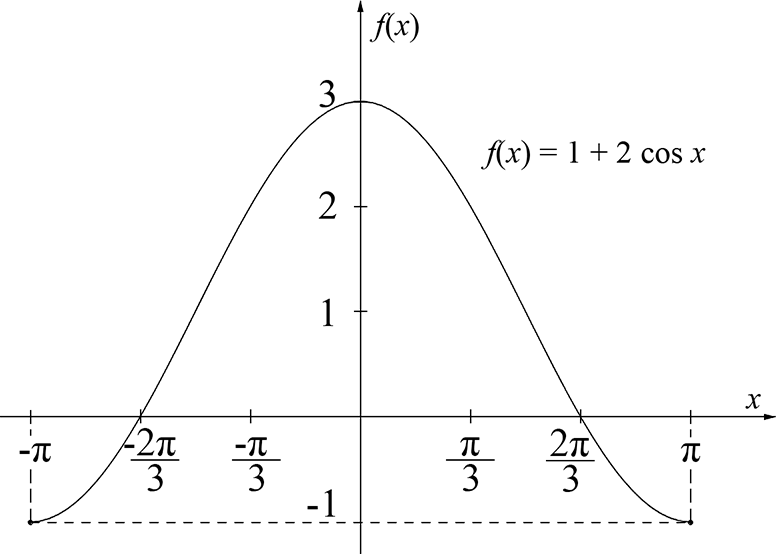
  2. Sketch the graph  `y = f(x)`  for  `x  in [-pi,pi]`  showing where the graph cuts each of the axes.   (2 marks)

    --- 0 WORK AREA LINES (style=lined) ---

  3. Find the area under the curve  `y = f(x)`  between  `x = -pi/2`  and  `x = (2 pi)/3`.   (3 marks)

    --- 6 WORK AREA LINES (style=lined) ---

Show Answers Only
  1. `text(Proof)\ \ text{(See Worked Solutions)}` 
  2.  
       
  3. `((7 pi)/6 + sqrt 3 + 1)\ text(u²)`
Show Worked Solution

a.   `f(x) = 1 + 2 cos x`

`f(x)\ text(cuts the)\ x text(-axis when)\ f(x) = 0`

`1 + 2 cos x` `= 0`
`2 cos x` `=-1`
 `cos x` `= -1/2`

 
`:.  x = (2 pi)/3\ …\ text(as required)`


b.   2UA HSC 2006 7b


c.  `text(Area)` `= int_(-pi/2)^((2 pi)/3) 1 + 2 cos x\ \ dx`
  `= [x + 2 sin x]_(-pi/2)^((2 pi)/3)`
  `= [((2 pi)/3 + 2 sin­ (2 pi)/3)-((-pi)/2 + 2 sin­ (-pi)/2)]`
  `= ((2 pi)/3 + 2 xx sqrt 3/2)-((-pi)/2 +2(- 1))`
  `= (2 pi)/3 + sqrt(3) + pi/2 + 2`
  `= ((7 pi)/6 + sqrt(3) + 2)\ text(u²)`

Filed Under: Area Under Curves, Trig Graphing Tagged With: Band 4, Band 5, smc-2757-15-Cos, smc-2757-70-Sketch graph, smc-723-60-Trig

Graphs, MET1 SM-Bank 27

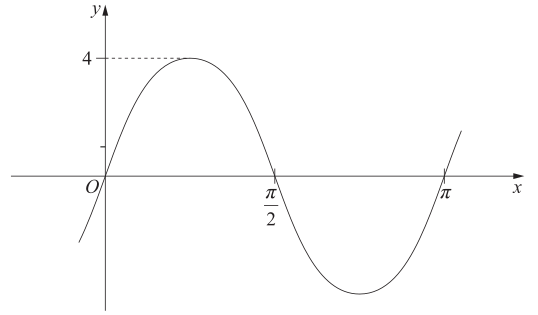
The graph shown is  `y = A sin bx`.

  1. Write down the value of  `A`.   (1 mark)

    --- 1 WORK AREA LINES (style=lined) ---

  2. Find the value of  `b`.   (1 mark)

    --- 6 WORK AREA LINES (style=lined) ---

  3. Copy or trace the graph into your writing booklet.


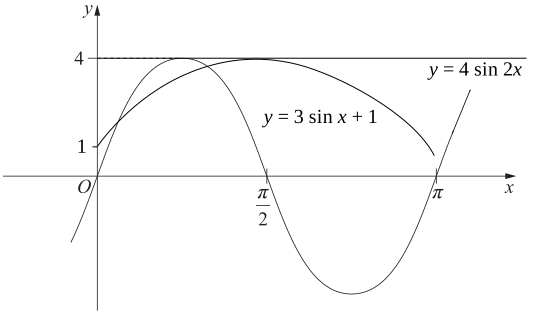
    On the same set of axes, draw the graph  `y = 3 sin x + 1`  for  `0 <= x <= pi`.   (2 marks)

    --- 10 WORK AREA LINES (style=blank) ---

Show Answers Only
  1. `A = 4`
  2. `b = 2`
  3. `text(See Worked Solutions for sketch)`
Show Worked Solution

a.   `A = 4`

b.  `text(S)text(ince the graph passes through)\ \ (pi/4, 4)`

`text(Substituting into)\ \ y = 4 sin bx`

`4 sin (b xx pi/4)` `=4`
`sin (b xx pi/4)` `= 1`
`b xx pi/4` `= pi/2`
`:. b` `= 2`


 MARKER’S COMMENT: Graphs are consistently drawn too small by many students. Aim to make your diagrams 1/3 to 1/2 of a page. 
c.

Filed Under: Trig Graphing Tagged With: Band 3, Band 4, smc-2757-10-Sin, smc-2757-30-Find period, smc-2757-40-Find amplitude, smc-2757-70-Sketch graph

Calculus, MET1 SM-Bank 25

Evaluate  `int_0^(pi/4) cos 2x\ dx`.   (2 marks)

--- 4 WORK AREA LINES (style=lined) ---

Show Answers Only

`1/2`

Show Worked Solution

`int_0^(pi/4) cos 2x`

`= [1/2 sin\ 2x]_0^(pi/4)`

`= [1/2 sin\ pi/2-1/2 sin\ 0]`

`= 1/2-0`

`= 1/2`

Filed Under: Integration (Trig), Trig Integration Tagged With: Band 4, smc-737-20-cos, smc-747-20-cos

Calculus, MET1 SM-Bank 21

Find the equation of the tangent to the curve  `y = cos 2x`  at the point whose `x`-coordinate is  `pi/6.`   (3 marks)

--- 7 WORK AREA LINES (style=lined) ---

Show Answers Only

`y =-sqrt 3 x + ((sqrt 3 pi)/6 + 1/2)`

Show Worked Solution

`y = cos 2x`

`dy/dx =-2 sin 2x`

`text(When)\ \ x = pi/6,`

`y` `= cos (2 xx pi/6)`
  `= cos (pi/3)`
  `= 1/2`


`dy/dx` `= -2 sin (pi/3)`
  `= -2 xx sqrt 3 / 2`
  `= -sqrt 3`


`:. text(Equation of tangent,)\ \ m =-sqrt 3, text(through)\ \ (pi/6, 1/2) :`

`y-y_1` `= m(x-x_1)`
`y-1/2` `= -sqrt 3 ( x-pi/6)`
`y-1/2` `= -sqrt 3 x + (sqrt 3 pi)/6`
`y` `= -sqrt 3 x + ((sqrt 3 pi)/6 + 1/2)`

Filed Under: Tangents and Normals Tagged With: Band 4, smc-634-30-Trig Function, smc-634-50-Find tangent given curve

Calculus, MET1 SM-Bank 20

If   `f(x)= 2 sin 3x - 3 tan x`, find  `f^{prime}(0)`.   (2 marks)

--- 6 WORK AREA LINES (style=lined) ---

Show Answers Only

`3`

Show Worked Solution
`y` `= 2 sin 3x-3 tan x`
`(dy)/(dx)` `= 6 cos 3x-3 sec^2 x`

  
`text(When)\ \ x = 0,`

`(dy)/(dx)` `= 6 cos 0-3 sec^2 0`
  `= 6 (1)-3/(cos^2 0)`
  `= 6-3`
  `= 3`

Filed Under: Differentiation (Trig), Trig Differentiation Tagged With: Band 4, smc-736-10-sin, smc-736-30-tan, smc-736-60-Chain Rule, smc-744-10-sin, smc-744-30-tan, smc-744-60-Chain Rule

Algebra, MET1 SM-Bank 24

The rule for  `f`  is  `f(x) = e^x-e^(-x)`.

Show that the inverse function is given by

    `f^(-1)(x) = log_e((x + sqrt(x^2 + 4))/2)`  (3 marks)

--- 14 WORK AREA LINES (style=lined) ---

Show Answers Only

`text{Proof (See Worked Solutions.)}`

Show Worked Solution

`y = e^x-e^(-x)`

`text(Inverse: swap)\  x harr y`

`x` `= e^y-1/(e^y)`
`xe^y` `= e^(2y)-1`
`e^(2y)-xe^y-1` `= 0`


`text(Let)\ \ A = e^y`

`:.A^2-xA-1 = 0`
 

`text(Using the quadratic formula)`

`A` `=(x ± sqrt((-x)^2-4 · 1 · (-1)))/(2 · 1)`
  `=(x ± sqrt(x^2 + 4))/2`


`text(S)text(ince)\ \ (x-sqrt(x^2 + 4))/2<0\ \ text(and)\ \ e^y>0,`

`:.e^y` `= (x + sqrt(x^2 + 4))/2`
`log_e e^y` ` = log_e((x + sqrt(x^2 + 4))/2)`
`y` `= log_e((x + sqrt(x^2 + 4))/2)`
`:.f^(-1)(x)` `= log_e((x + sqrt(x^2 + 4))/2)\ \  …\ text(as required)`

Filed Under: Logs and Exponential Functions Tagged With: Band 4, Band 5, smc-633-20-Log/Exponential

Algebra, MET1 SM-Bank 23

The function  `f: [0,oo) → R`  with rule  `f(x) = 1/(1 + x^2)`  is drawn below.

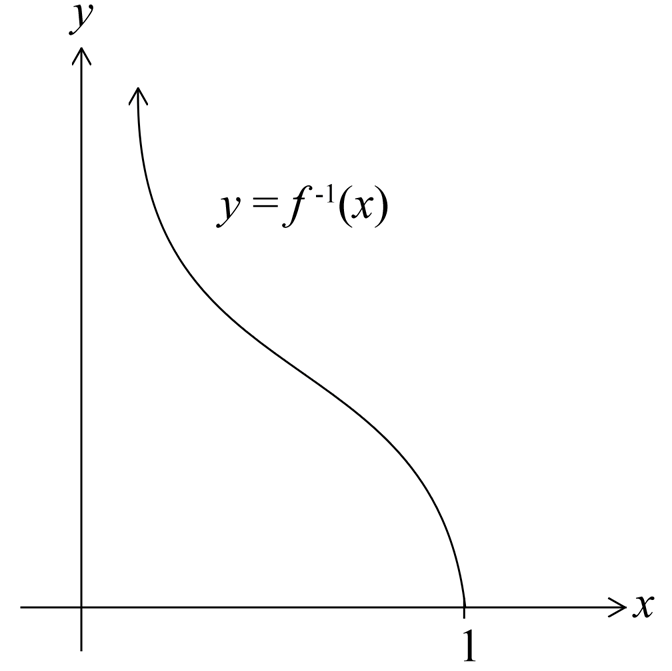
Inverse Functions, EXT1 2004 HSC 5b

  1. Copy or trace this diagram into your writing booklet.
  2. On the same set of axes, sketch  `y=f^(-1)(x)`  where  `f^(-1)` is the inverse function of  `f(x)`.   (1 mark)

    --- 6 WORK AREA LINES (style=blank) ---

  3. Find the domain of the inverse  `f^(-1)`.   (1 mark)

    --- 2 WORK AREA LINES (style=lined) ---

  4. Find an expression for  `y = f^(-1)(x)`  in terms of  `x`.   (2 marks)

    --- 6 WORK AREA LINES (style=lined) ---

  5. The graphs of  `y = f(x)`  and  `y = f^(-1)(x)`  meet at exactly one point  `P`.Let  `α`  be the `x`-coordinate of  `P`. Explain why  `α`  is a root of the equation
  6.      `x^3 + x-1 = 0`.   (1 mark)

    --- 6 WORK AREA LINES (style=lined) ---

Show Answers Only
  1. `text(See Worked Solutions)`
  2. `0 < x ≤ 1`
  3. `y = sqrt((1-x)/x), y > 0`
  4. `text(See Worked Solutions)`
Show Worked Solution
a.  

Inverse Functions, EXT1 2004 HSC 5b Answer

b.   `text(Range of)\ \ f(x):\ (0,1]`

`:.\ text(Domain of)\ \ f^(-1)(x):  (0,1]`


c.  `f(x) = 1/(1 + x^2)`

`text(Inverse: swap)\  x harr y`

`x` `= 1/(1 + y^2)`
`x(1 + y^2)` `= 1`
`1 + y^2` `= 1/x`
`y^2` `= 1/x-1`
  `= (1-x)/x`
`y` `= ± sqrt((1-x)/x)`


`:.y = sqrt((1-x)/x), \ \ y >= 0`


d.   `P\ \ text(occurs when)\ \ f(x)\ \ text(cuts)\ \ y = x`

`text(i.e. where)`

`1/(1 + x^2)` `= x`
`1` `= x(1 + x^2)`
`1` `= x + x^3`
`x^3 + x-1` `= 0`


`=>\ text(S)text(ince)\ α\ text(is the)\ x\ text(-coordinate of)\ P,`

`text(it is a root of)\ \ \ x^3 + x-1 = 0`

Filed Under: Polynomial and Other Functions Tagged With: Band 4, Band 5, smc-5205-50-Find intersection, smc-5205-70-Sketch graph

Calculus, MET1 SM-Bank 21

The rule for function  `f` is  `f(x) = e^(-x^2)`.  The diagram shows the graph  `y = f(x)`.

 Inverse Functions, EXT1 2010 HSC 3b

The graph has two points of inflection. 

  1. Find the `x` coordinates of these points.   (2 marks)

    --- 10 WORK AREA LINES (style=lined) ---

  2. Explain why the domain of `f(x)` must be restricted if `f(x)` is to have an inverse function.    (1 mark)

    --- 4 WORK AREA LINES (style=lined) ---

  3. Find the rule for the inverse function `f^(-1)` if the domain of `f(x)` is restricted to  `x ≥ 0.`   (2 marks)

    --- 6 WORK AREA LINES (style=lined) ---

  4. Find the domain for `f^(-1)`.    (1 mark)

    --- 2 WORK AREA LINES (style=lined) ---

  5. Sketch the curve  `y = f^(-1) (x)`.   (1 mark)

    --- 6 WORK AREA LINES (style=blank) ---

Show Answers Only
  1. `x = +- 1/sqrt2`
  2. `text(There can only be 1 value of)\ y\ text(for each value of)\ x.`
  3. `f^(-1)x = sqrt(ln(1/x))`
  4. `0 <= x <= 1`
  5. Inverse Functions, EXT1 2010 HSC 3b Answer

Show Worked Solution
a.    `y` `= e^(-x^2)`
  `dy/dx` `= -2x * e^(-x^2)`
  `(d^2y)/(dx^2)` `= -2x (-2x * e^(-x^2)) + e ^(-x^2) (-2)`
    `= 4x^2 e^(-x^2)-2e^(-x^2)`
    `= 2e^(-x^2) (2x^2-1)`

 
`text(P.I. when)\ \ (d^2y)/(dx^2) = 0`

`2e^(-x^2) (2x^2-1)` `= 0` 
 `2x^2-1` `= 0` 
 `x^2` `= 1/2`
 `x` `= +- 1/sqrt2` 
COMMENT: It is also valid to show that `f(x)` is an even function and if a P.I. exists at `x=a`, there must be another P.I. at `x=–a`.
`text(When)\ \ ` `x < 1/sqrt2,` `\ (d^2y)/(dx^2) < 0`
  `x > 1/sqrt2,` `\ (d^2y)/(dx^2) > 0`

 
`=>\ text(Change of concavity)`

`:.\ text(P.I. at)\ \ x = 1/sqrt2`
 

`text(When)\ \ ` `x <-1/sqrt2,` `\ (d^2y)/(dx^2) > 0`
  `x >-1/sqrt2,` `\ (d^2y)/(dx^2) < 0`

 
`=>\ text(Change of concavity)`

`:.\ text(P.I. at)\ \ x =-1/sqrt2`


b.   `text(In)\ f(x), text(there are 2 values of)\ y\ text(for)`
  `text(each value of)\ x.`
  `:.\ text(The domain of)\ f(x)\ text(must be restricted)`
  `text(for)\ \ f^(-1) (x)\ text(to exist).`


c.  `y = e^(-x^2)`

`text(Inverse: swap)\  x harr y` 

`x` `= e^(-y^2),\ \ \ x >= 0`
`lnx` `= ln e^(-y^2)`
`-y^2` `= lnx`
`y^2` `= -lnx`
  `=ln(1/x)`
`y` `= +- sqrt(ln (1/x))`


`text(Restricting)\ \ x>=0,\ \ =>y>=0`

`:.  f^(-1) (x)=sqrt(ln (1/x))`


d.   `f(0) = e^0 = 1`

`:.\ text(Range of)\ \ f(x)\ \ text(is)\ \ 0 < y <= 1`

`:.\ text(Domain of)\ \ f^(-1) (x)\ \ text(is)\ \ 0 < x <= 1`


e. 

Inverse Functions, EXT1 2010 HSC 3b Answer

Filed Under: Curve Sketching, Logs and Exponential Functions Tagged With: Band 4, Band 5, smc-5204-70-Sketch graph, smc-724-30-Log/Exponential, smc-724-40-Inverse functions

Graphs, MET1 SM-Bank 20

The rule for  `f` is  `f(x) = x-1/2 x^2`  for  `x <= 1`.  This function has an inverse,  `f^(-1) (x)`.

  1. Sketch the graphs of  `y = f(x)`  and  `y = f^(-1) (x)`  on the same set of axes. (Use the same scale on both axes.)   (2 marks)

    --- 6 WORK AREA LINES (style=lined) ---

  2. Find the rule for the inverse function  `f^(-1) (x)`.    (2 marks)

    --- 8 WORK AREA LINES (style=lined) ---

  3. Evaluate  `f^(-1) (3/8)`.    (1 mark)

    --- 5 WORK AREA LINES (style=lined) ---

Show Answers Only
  1.  
    Inverse Functions, EXT1 2008 HSC 5a Answer
  2. `y = 1-sqrt(1-2x)`
  3. `1/2`
Show Worked Solution
a. 

Inverse Functions, EXT1 2008 HSC 5a Answer

b.   `y = x-1/2 x^2,\ \ \ x <= 1`


`text(For the inverse function, swap)\ \ x↔y,`

`x` `= y-1/2 y^2,\ \ \ y <= 1`
`2x` `= 2y-y^2`
`y^2-2y + 2x` `= 0`


`text(Using quadratic formula,)`

`y` `= (2 +- sqrt( (-2)^2-4 * 1 * 2x) )/2`
  `= (2 +- sqrt(4-8x))/2`
  `= (2 +- 2 sqrt(1-2x))/2`
  `= 1 +- sqrt (1-2x)`


`:. y = 1-sqrt(1-2x), \ \ (y <= 1)`


c.    `f^(-1) (3/8)` `= 1-sqrt(1-2(3/8))`
    `= 1-sqrt(1-6/8)`
    `= 1-sqrt(1/4)`
    `= 1-1/2`
    `= 1/2`

Filed Under: Polynomial and Other Functions Tagged With: Band 3, Band 4, smc-5205-10-Polynomials, smc-5205-70-Sketch graph

Algebra, MET1 SM-Bank 11

Let  `f: R→R`  where  `f(x)= x^3-2`.

Evaluate  `f^(-1)(25),` where  `f^(-1)`  is the inverse function of  `f`.   (2 marks)

--- 5 WORK AREA LINES (style=lined) ---

Show Answers Only

`3`

Show Worked Solution

`text(Let)\ \ y = x^3-2`

`text(For inverse),\ \ x harr y`

`x` `= y^3-2`
`y^3` `= x + 2`
`y` `= (x + 2)^(1/3)`


`:. f^(-1)(25)` `=(25+2)^(1/3)`
  `=3`

Filed Under: Polynomial and Other Functions Tagged With: Band 4, smc-5205-10-Polynomials, smc-633-10-Polynomial

Calculus, MET1 2006 ADV 2bi

If  `f^{prime}(x)= (x^2)/(x^3 + 1)`  and  `f(1)= log_e 2,` find  `f(x)`.   (3 marks)

--- 8 WORK AREA LINES (style=lined) ---

Show Answers Only

`f(x) = 1/3 log_e(x^3 + 1) + 2/3 log_e 2`

Show Worked Solution
`f(x)` `=int f^{prime}(x)\ dx`
  `=int (x^2)/(x^3 + 1)\ dx`
  `= 1/3 int (3x^2)/(x^3 + 1)\ dx`
  `=1/3 log_e |(x^3 + 1)|+c`


`text(S)text(ince)\ \ f(1)= log_e 2,`

`1/3 log_e 2+c` `= log_e 2`
`c` `=2/3 log_e 2`
   

`:.\ f(x) = 1/3 log_e(x^3 + 1) + 2/3 log_e 2`

Filed Under: Integration (L&E), L&E Integration Tagged With: Band 4, smc-740-60-Find f(x) given f'(x), smc-748-70-Find f(x) given f'(x)

Calculus, MET1 2011 ADV 4b

Find the value of  `int_e^(e^3) 5/x`  with respect to `x`.   (2 marks)

--- 6 WORK AREA LINES (style=lined) ---

Show Answers Only

`10`

Show Worked Solution

`int_e^(e^3) 5/x\ dx`

`= 5 int_e^(e^3) 1/x\ dx`

`= 5[lnx]_e^(e^3)`

`= 5(ln e^3-ln e)`

`= 5(3-1)`

`= 10`

Filed Under: Integration (L&E), L&E Integration Tagged With: Band 4, smc-740-40-Log (definite), smc-748-40-Log (definite)

Calculus, MET1 2008 ADV 3b

  1. Differentiate  `log_e(cos x)` with respect to `x`.   (2 marks)

    --- 3 WORK AREA LINES (style=lined) ---

  2. Hence, or otherwise, evaluate  `int_0^(pi/4) tan x\ dx`.   (2 marks)

    --- 6 WORK AREA LINES (style=lined) ---

Show Answers Only
  1. `-tan x`
  2. `-log_e(1/sqrt2)\  text{or  0.35  (2 d.p.)}`
Show Worked Solution
a.   `y` `= log_e(cos x)`
  `(dy)/(dx)` `= (-sin x)/(cos x)`
    `=-tan x`


b.   `int_0^(pi/4) tan x\ dx`

`= -[log_e(cos x)]_0^(pi/4)`

`= -[log_e(cos(pi/4))-log_e(cos 0)]`

`= -[log_e(1/sqrt2)-log_e 1]`

`= -[log_e(1/sqrt2)-0]`

`= -log_e(1/sqrt2)`

`= 0.346…`

`= 0.35\ \ (text(2 d.p.))`

Filed Under: Integration (Trig), Trig Integration Tagged With: Band 3, Band 4, smc-747-50-Integration by recognition

Calculus, MET1 2016 ADV 12d

  1. Differentiate  `y = xe^(3x)`.   (1 mark)

    --- 3 WORK AREA LINES (style=lined) ---

  2. Hence find the exact value of  `int_0^2 e^(3x) (3 + 9x)\ dx`.   (2 marks)

    --- 5 WORK AREA LINES (style=lined) ---
Show Answers Only
  1. `e^(3x) (1 + 3x)`
  2. `6e^6`
Show Worked Solution

a.  `y = xe^(3x)`

`text(Using product rule,)`

`(dy)/(dx)` `= x · 3e^(3x) + 1 · e^(3x)`
  `= e^(3x) (1 + 3x)`


b.  `int_0^2 e^(3x) (3 + 9x)\ dx`

`= 3 int_0^2 e^(3x) (1 + 3x)\ dx`

`= 3 [x e^(3x)]_0^2`

`= 3 (2e^6-0)`

`= 6e^6`

Filed Under: Integration (L&E), L&E Integration Tagged With: Band 3, Band 4, smc-740-20-Exponential (definite), smc-740-80-Integration by recognition, smc-748-20-Exponential (definite), smc-748-80-Integration by recognition

  • « Previous Page
  • 1
  • …
  • 85
  • 86
  • 87
  • 88
  • 89
  • …
  • 114
  • Next Page »

Copyright © 2014–2025 SmarterEd.com.au · Log in