SmarterEd

Aussie Maths & Science Teachers: Save your time with SmarterEd

  • Login
  • Get Help
  • About

BIOLOGY, M1 2018 HSC 35d

Construct a flow chart to summarise the main steps and products of the light-independent reactions of photosynthesis.  (5 marks)

Show Answers Only

Show Worked Solution

Filed Under: Cell Function Tagged With: Band 4, Band 5, smc-4303-10-Photosynthesis

BIOLOGY, M1 2018 HSC 27

With the breakdown of proteins, animals produce ammonia, a nitrogenous waste product that must be removed. Direct removal of ammonia requires the excretion of large amounts of water.

Explain how both terrestrial mammals and insects conserve water while excreting nitrogenous wastes.  (4 marks)

--- 6 WORK AREA LINES (style=lined) ---

Show Answers Only
  • In order to conserve water, terrestrial mammals concentrate their urine which can be done through structural adaptations such as elongated loops of Henle and collecting ducts in the kidney.
  • Because ammonia is toxic, mammals convert ammonia to the less toxic urea which can be excreted in concentrated form.
  • Insects can produce uric acid, a substance even less toxic than urea which can be excreted in very concentrated form with little water required.
Show Worked Solution
  • In order to conserve water, terrestrial mammals concentrate their urine which can be done through structural adaptations such as elongated loops of Henle and collecting ducts in the kidney.
  • Because ammonia is toxic, mammals convert ammonia to the less toxic urea which can be excreted in concentrated form.
  • Insects can produce uric acid, a substance even less toxic than urea which can be excreted in very concentrated form with little water required.
♦ Mean mark 39%.

Filed Under: Cell Function Tagged With: Band 5, smc-4303-50-Excretion

BIOLOGY, M1 2018 HSC 23

  1. A student plans to investigate the effect of light intensity on transpiration in plants. 
  2. Complete the table, identifying features that this student should include to ensure valid experimental design.  (3 marks)

\begin{array} {|l|l|}
\hline
\rule{0pt}{2.5ex}\textit{Dependent variable}\rule[-1ex]{0pt}{0pt} &  \text{•}  \ \ \ \ \ \ \ \ \ \ \ \ \ \ \ \ \ \ \ \ \ \ \ \ \ \ \ \ \ \ \ \ \ \ \ \ \ \ \ \ \ \ \ \ \ \ \ \ \ \ \ \ \ \ \ \ \ \ \ \ \ \ \ \ \ \ \ \  \ \ \ \ \ \ \ \ \\
\hline
\rule{0pt}{2.5ex}\textit{Control}\rule[-1ex]{0pt}{0pt} &  \text{•} \\
\hline
\rule{0pt}{2.5ex}\textit{Variables to be kept constant}\rule[-1ex]{0pt}{0pt} &   \text{•} \\  &   \text{•} \\
\hline
\end{array}

  1. Explain ONE mechanism for the movement of materials in xylem vessels.  (2 marks)

    --- 4 WORK AREA LINES (style=lined) ---

Show Answers Only

a.   

\begin{array} {|l|l|}
\hline
\rule{0pt}{2.5ex}\textit{Dependent variable}\rule[-1ex]{0pt}{0pt} &  \text{• Amount of water lost}  \\
\hline
\rule{0pt}{2.5ex}\textit{Control}\rule[-1ex]{0pt}{0pt} &  \text{• Plant kept in the dark} \\
\hline
\rule{0pt}{2.5ex}\textit{Variables to be kept constant}\rule[-1ex]{0pt}{0pt} &   \text{• Plant type} \\  &   \text{• Temperature} \\
\hline
\end{array}
 

b.    Water molecules have chemical properties which make them cohesive.

  • Due to this, when water evaporates or transpires, other water molecules are pulled up the xylem vessels.
  • This is one of the core mechanisms that drives the movement of water from roots to leaves.

Show Worked Solution

a.   

\begin{array} {|l|l|}
\hline
\rule{0pt}{2.5ex}\textit{Dependent variable}\rule[-1ex]{0pt}{0pt} &  \text{• Amount of water lost}  \\
\hline
\rule{0pt}{2.5ex}\textit{Control}\rule[-1ex]{0pt}{0pt} &  \text{• Plant kept in the dark} \\
\hline
\rule{0pt}{2.5ex}\textit{Variables to be kept constant}\rule[-1ex]{0pt}{0pt} &   \text{• Plant type} \\  &   \text{• Temperature} \\
\hline
\end{array}

♦ Mean mark (a) 54%.

 b.    Water molecules have chemical properties which make them cohesive.

  • Due to this, when water evaporates or transpires, other water molecules are pulled up the xylem vessels.
  • This is one of the core mechanisms that drives the movement of water from roots to leaves. 

Filed Under: Cell Function Tagged With: Band 4, Band 5, smc-4303-10-Photosynthesis, smc-4303-30-Movement of materials

CHEMISTRY, M3 2012 HSC 13-14 MC

Use the information provided to answer Questions 13 and 14.

\begin{array} {|l|}
\hline \text{This equation represents a common redox reaction.} \\ \ \ \ \ce{Cr2O7^{2-}(aq) + 14H+(aq) + 6Fe^{2+}(aq) \rightarrow 2Cr^{3+}(aq) + 6Fe^{3+}(aq) + 7H2O(l)} \\
\hline \end{array}

Question 13

What is the oxidising agent in the reaction?

  1. \(\ce{H^+}\)
  2. \(\ce{Cr^3+}\)
  3. \(\ce{Fe^2+}\)
  4. \(\ce{Cr2O7^2-}\)

 
Question 14

What is the value of \(\ce{E}_{\text {cell }}^{\ominus}\) for the reaction?

  1. 0.59 V
  2. 0.92 V
  3. 1.90 V
  4. 2.13 V
Show Answers Only

\(\text{Question 13:}\ D\)

\(\text{Question 14:}\ A\)

Show Worked Solution

Question 13

  • The oxidising agent is the chemical that undergoes reduction. The chromium changes its oxidation number from \(+6\) to \(+3\) indication reduction.
  • Thus it is the dichromate ion which undergoes reduction.

\(\Rightarrow D\)
 

Question 14

From the list of standard potentials:

  • The reduction voltage of dichromate ions is 1.36 \(\text{V}\) 
  • The oxidation of \(\ce{Fe^2+}\) ions is -0.77 \(\text{V}\) 
  •    \(1.36 + -0.77= 0.59\ \text{V}\) 

\(\Rightarrow A\)

Filed Under: Predicting Reactions of Metals Tagged With: Band 4, Band 5, smc-4264-25-Redox

CHEMISTRY, M3 2016 HSC 16 MC

An electrochemical cell has the following structure.
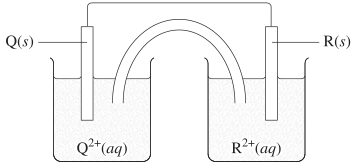
 

This particular cell can be represented as:

\( \ce{Q}  |  \ce{Q^2+}  ||  \ce{R^2+}  |  \ce{R} \)

Which of the following cells would produce the highest cell potential at standard conditions?

  1. \( \ce{Mg}  |  \ce{Mg^2+}  ||  \ce{Fe^2+}  |  \ce{Fe} \)
  2. \( \ce{Al}  |  \ce{Al^3+}  ||  \ce{Cu^2+}  |  \ce{Cu} \)
  3. \( \ce{Zn}  |  \ce{Zn^2+}  ||  \ce{Pb^2+}  |  \ce{Pb} \)
  4. \( \ce{Ni}  |  \ce{Ni^2+}  ||  \ce{Ag^+}  |  \ce{Ag} \)
Show Answers Only

\(B\)

Show Worked Solution

Calculate the cell potential of each option:

A. cell potential \(= -2.36 + 0.44 = -1.92\)

B. cell potential \(= -1.68 +-0.3= -1.98\)

C. cell potential \(= -0.76 + 0.1= -0.66\)

D. cell potential \(= -0.24 +-0.8 = -1.04\)

\(\Rightarrow B\)

Filed Under: Predicting Reactions of Metals Tagged With: Band 5, smc-4264-40-Cell Potentials

CHEMISTRY, M3 2017 HSC 11 MC

Consider the following redox reaction.

\( \ce{2K2Cr2O7}(aq) + \ce{2H2O}(l) + \ce{3S}(s) \rightarrow \ce{2Cr2O3}(aq) + \ce{4KOH}(aq) + \ce{3SO2}(g) \)

Which species is being oxidised?

  1. \( \ce{Cr^6+}\)
  2.  \( \ce{K^+} \)
  3. \( \ce{O^2-} \)
  4. \( \ce{S} \)
Show Answers Only

\(D\)

Show Worked Solution
  • Sulfer has an oxidation number of 0 on the left hand side of the equation.
  • Let \(x\) equal the oxidation number of sulfur within \(\ce{3SO2}(g) \).
\(x+2 \times -2\) \(=0\)  
\(x-4\) \(=0\)  
\(x\) \(=4\)  


  • The increase in oxidation number shows the species, \( \ce{S} \), has undergone oxidation.

\(\Rightarrow D\)

Filed Under: Predicting Reactions of Metals Tagged With: Band 5, smc-4264-25-Redox, smc-4264-30-Oxidation Numbers

HMS, HAG 2020 HSC 22

Complete the table for THREE current leading causes of mortality for males and females in Australia.   (4 marks)

--- 0 WORK AREA LINES (style=blank) ---

\begin{array}{|c|c|c|}
\hline
\rule{0pt}{2.5ex}\textit{Current leading} & \textit{Trend in mortality rate for} & \textit{Trend in mortality rate for}\\
\rule[-1ex]{0pt}{0pt}\quad \textit{cause of mortality} \quad & \textit{males over the last 10 years} & \textit{females over the last 10 years}\\
\hline
\quad & \quad &\quad\\
\hline
\quad & \quad &\quad\\
\hline
\quad & \quad &\quad\\
\hline
\end{array}

 
Show Answers Only

\(\text{Any THREE of the following}\)

\begin{array}{|l|c|c|}
\hline
\rule{0pt}{2.5ex}\quad \quad \textit{Current leading} & \textit{Trend in mortality} & \textit{Trend in mortality }\\
\quad \ \  \textit{cause of mortality} \quad & \textit{rates for males over} & \textit{rate for females }\\
\rule[-1ex]{0pt}{0pt}\quad \quad & \textit{the last 10 years} & \textit{over the last 10 years}\\
\hline
\rule{0pt}{2.5ex}\text{Coronary heart disease} \rule[-1ex]{0pt}{0pt}& \text{Decreased} & \text{Decreased} \\
\hline
\rule{0pt}{2.5ex}\text{Dementia and Alzheimer’s } & \text{Increased} & \text{Increased} \\
\rule[-1ex]{0pt}{0pt}\text{disease} & \text{} & \text{} \\
\hline
\rule{0pt}{2.5ex}\text{Cerebrovascular disease} \rule[-1ex]{0pt}{0pt}& \text{Decreased} & \text{Decreased} \\
\hline
\rule{0pt}{2.5ex}\text{Lung cancer} \rule[-1ex]{0pt}{0pt}& \text{Decreased} & \text{Decreased} \\
\hline
\rule{0pt}{2.5ex}\text{Chronic obstructive} & \text{Decreased} & \text{Decreased} \\
\rule[-1ex]{0pt}{0pt}\text{pulmonary disease} & \text{} & \text{} \\
\hline
\rule{0pt}{2.5ex}\text{Diabetes} \rule[-1ex]{0pt}{0pt}& \text{Increased} & \text{Increased} \\
\hline
\rule{0pt}{2.5ex}\text{Cardiovascular disease} \rule[-1ex]{0pt}{0pt}& \text{Decreased} & \text{Decreased} \\
\hline
\rule{0pt}{2.5ex}\text{Mental health (suicide)} \rule[-1ex]{0pt}{0pt}& \text{Increased} & \text{Increased} \\
\hline
\end{array}

Show Worked Solution

\(\text{Any THREE of the following}\)

\begin{array}{|l|c|c|}
\hline
\rule{0pt}{2.5ex}\quad \quad \textit{Current leading} & \textit{Trend in mortality} & \textit{Trend in mortality }\\
\quad \ \  \textit{cause of mortality} \quad & \textit{rates for males over} & \textit{rate for females }\\
\rule[-1ex]{0pt}{0pt}\quad \quad & \textit{the last 10 years} & \textit{over the last 10 years}\\
\hline
\rule{0pt}{2.5ex}\text{Coronary heart disease} \rule[-1ex]{0pt}{0pt}& \text{Decreased} & \text{Decreased} \\
\hline
\rule{0pt}{2.5ex}\text{Dementia and Alzheimer’s } & \text{Increased} & \text{Increased} \\
\rule[-1ex]{0pt}{0pt}\text{disease} & \text{} & \text{} \\
\hline
\rule{0pt}{2.5ex}\text{Cerebrovascular disease} \rule[-1ex]{0pt}{0pt}& \text{Decreased} & \text{Decreased} \\
\hline
\rule{0pt}{2.5ex}\text{Lung cancer} \rule[-1ex]{0pt}{0pt}& \text{Decreased} & \text{Decreased} \\
\hline
\rule{0pt}{2.5ex}\text{Chronic obstructive} & \text{Decreased} & \text{Decreased} \\
\rule[-1ex]{0pt}{0pt}\text{pulmonary disease} & \text{} & \text{} \\
\hline
\rule{0pt}{2.5ex}\text{Diabetes} \rule[-1ex]{0pt}{0pt}& \text{Increased} & \text{Increased} \\
\hline
\rule{0pt}{2.5ex}\text{Cardiovascular disease} \rule[-1ex]{0pt}{0pt}& \text{Decreased} & \text{Decreased} \\
\hline
\rule{0pt}{2.5ex}\text{Mental health (suicide)} \rule[-1ex]{0pt}{0pt}& \text{Increased} & \text{Increased} \\
\hline
\end{array}


♦♦ Mean mark 47%.

Filed Under: Chronic Conditions, Diseases and Injury, Current Health Status Tagged With: Band 5, smc-5474-05-Major causes, smc-5477-05-Cardiovascular disease, smc-5477-10-Cancer trends, smc-5477-15-Other conditions

CHEMISTRY, M2 2006 HSC 10 MC

Phosphorus pentoxide reacts with water to form phosphoric acid according to the following equation.

\(\ce{P2O5}(s) + \ce{3H2O}(l) \rightarrow \ce{2H3PO4}(aq)\)

Phosphoric acid reacts with sodium hydroxide according to the following equation.

\(\ce{H3PO4}(aq) + \ce{3NaOH}(aq) \rightarrow \ce{Na3PO4}(aq) + \ce{3H2O}(l)\)

A student reacted 1.42 g of phosphorus pentoxide with excess water.

What volume of 0.30 mol L\(^{-1}\) sodium hydroxide would be required to neutralise all the phosphoric acid produced?

  1. 0.067 L
  2. 0.10 L
  3. 0.20 L
  4. 5.0 L
Show Answers Only

\(C\)

Show Worked Solution

\(MM(\ce{P2O5})=2(30.97)+5(16)=141.94\ \text{g\mol}\) 

\(n(\ce{P2O5})=\dfrac{1.42}{141.94}=0.01 \ \text{mol}\)

 \(n(\ce{H3PO4}) = 2 \times 0.01 = 0.02\ \text{mol}\)

 \(n(\ce{NaOH})\) for neutralisation \(= 3 \times 0.02 = 0.06\ \text{mol}\)

  • Using  \(c=\dfrac{n}{V}:\)
  •    \(V=\dfrac{n}{c}=\dfrac{0.06}{0.3}=0.2\ \text{L}\) 

\( \Rightarrow C\)

Filed Under: Chemical Reactions and Stoichiometry Tagged With: Band 5, smc-4259-20-Mass Changes, smc-4259-80-Conservation of Mass

CHEMISTRY, M6 2012 HSC 30

A chemist analysed aspirin tablets for quality control. The initial step of the analysis was the standardisation of a \(\ce{NaOH}\) solution. Three 25.00 mL samples of a 0.1034 mol L\(^{-1}\) solution of standardised \(\ce{HCl}\) were titrated with the \( \ce{NaOH} \) solution. The average volume required for neutralisation was 25.75 mL.

  1. Calculate the molarity of the \(\ce{NaOH}\) solution.  (2 marks)

Three flasks were prepared each containing a mixture of 25 mL of water and 10 mL of ethanol. An aspirin tablet was dissolved in each flask. The aspirin in each solution was titrated with the standardised \(\ce{NaOH}\) solution according to the following equation:

\(\ce{C9H8O4(aq) + NaOH(aq) \rightarrow C9H7O4Na(aq) + H2O(l)}\)

The following titration results were obtained.

\begin{array} {|c|c|}
\hline
\rule{0pt}{2.5ex}\textit{Tablet}\rule[-1ex]{0pt}{0pt} & \textit{Volume}\ \text{(mL)}\\
\hline
\rule{0pt}{2.5ex}\text{1}\rule[-1ex]{0pt}{0pt} & 16.60\\
\hline
\rule{0pt}{2.5ex}\text{2}\rule[-1ex]{0pt}{0pt} & 16.50\\
\hline
\rule{0pt}{2.5ex}\text{3}\rule[-1ex]{0pt}{0pt} & 16.55\\
\hline
\end{array}

  1. Calculate the average mass (mg) of aspirin per tablet.  (3 marks)
Show Answers Only

a.    \(\ce{0.1004 mol L^{-1}}\)

b.    \(\ce{299.2 mg}\)

Show Worked Solution

a.    \(\ce{n(HCl) = c \times V = 0.1034 \times 0.02500 = 2.585 \times 10^{-3} moles}\)

\(\ce{n(HCl) = n(OH^{-})}\)

\[\ce{[OH-] = \frac{2.585 \times 10^{-3}}{0.02575} = 0.1004 mol L^{-1}}\]  

b.    \(\ce{n(HCl) = c \times V = 0.1004 \times 0.01655 = 1.661 \times 10^{-3} moles}\)

\(\ce{n(HCl) = n(C9H8O4) = 1.661 \times 10^{-3} moles}\)

\(\ce{MM(C9H8O4) = 9 \times 12.01 + 8 \times 1.008 + 4 \times 16.00 = 180.154 g}\)

\(\ce{Average mass of C9H8O4  per tablet}\)

\(\ce{= n \times MM = 1.661 \times 10^{-3} \times 180.154 = 0.2992 g = 299.2 mg}\)

Filed Under: Quantitative Analysis Tagged With: Band 4, Band 5, smc-3675-10-Titration

CHEMISTRY, M2 2013 HSC 28

A student attempted to determine the concentration of a hydrochloric acid solution. The following steps were performed.

Step 1. A conical flask was rinsed with water.

Step 2. A 25.0 mL pipette was rinsed with water.

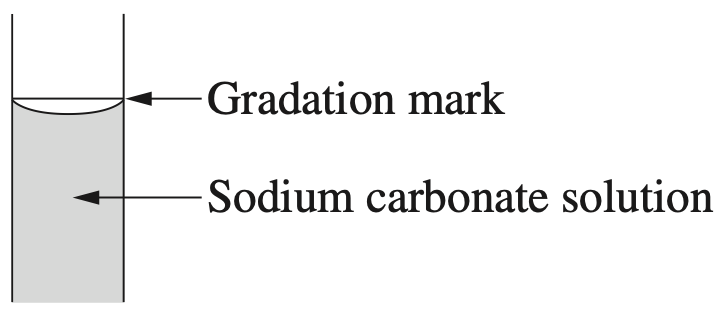
Step 3. The student filled the pipette with a standard sodium carbonate solution to the level shown in the diagram.
Step 4. The standard sodium carbonate solution in the pipette was transferred to the conical flask. The student ensured that all of the sodium carbonate solution was transferred to the conical flask by blowing through the pipette. Three drops of an appropriate indicator were added to the conical flask.

Step 5. A burette was rinsed with the hydrochloric acid solution and then filled with the acid. The student then carried out a titration to determine the concentration of the hydrochloric acid solution.

In steps 2,3 and 4 above the student did not follow acceptable procedures.

  1. Identify the mistake the student made in step 4 and propose a change that would improve the validity of the result.  (2 marks)
  2. Explain the effect of the mistakes made in steps 2 and 3 on the calculation of the concentration of the hydrochloric acid solution.  (3 marks)
Show Answers Only

a.   Mistake: blowing through the pipette

  • Proposed change: student should have touched the end of the pipette to the surface of flask to draw out the liquid.

b.   Mistake (step 2): rinsing the pipette with water

  • This would decrease the number of moles of \(\ce{Na2CO3}\) it contains.

Mistake (step 3): not filling to the gradation mark

  • By not filling to the mark, the pipette would contain fewer moles of \(\ce{Na2CO3}\).
  • Hence, a lower volume of the \(\ce{HCl}\) would be added from the burette, but the student would think that there were more moles of \(\ce{HCl}\) in this volume.
  • As a result, the calculated concentration of the acid solution would be higher than the actual concentration.
Show Worked Solution

a.   Mistake: blowing through the pipette

  • Proposed change: student should have touched the end of the pipette to the surface of flask to draw out the liquid.

b.   Mistake (step 2): rinsing the pipette with water

  • This would decrease the number of moles of \(\ce{Na2CO3}\) it contains.

Mistake (step 3): not filling to the gradation mark

  • By not filling to the mark, the pipette would contain fewer moles of \(\ce{Na2CO3}\).
  • Hence, a lower volume of the \(\ce{HCl}\) would be added from the burette, but the student would think that there were more moles of \(\ce{HCl}\) in this volume.
  • As a result, the calculated concentration of the acid solution would be higher than the actual concentration.
♦ Mean mark (b) 54%.

Filed Under: Concentration and Molarity Tagged With: Band 4, Band 5, smc-4261-90-Practical Investigation

CHEMISTRY, M2 2009 HSC 15 MC

The graph shows the maximum dissolved oxygen concentration in water as a function of temperature at normal atmospheric pressure.
 

What is the volume of \(\ce{O2}\) that can dissolve in 10.0 L of water at 25°C and normal atmospheric pressure?

  1. 62.0 mL
  2. 63.5 mL
  3. 80.0 mL
  4. 124 mL
Show Answers Only

\(A\)

Show Worked Solution
  • Concentration of \(\ce{O2}\) at 25°C is 8 \(\text{mgL}^{-1}\), thus in 10 \(\text{L}\), 80 \(\text{mg}\).
  • \(n(\ce{O2})=\dfrac{80 \times 10^{-3}}{32}= 0.0025\ \text{mol}\)
  • \(v(\ce{O2})= 0.0025 \times 24.79= 0.0620\ \text{L} = 62.0\ \text{mL}\)

\(\Rightarrow A\)

Filed Under: Gas Laws Tagged With: Band 5, smc-4262-40-Volume

CHEMISTRY, M2 2009 HSC 22

The nitrogen content of bread was determined using the following procedure:

    • A sample of bread weighing 2.80 g was analysed.
    • The nitrogen in the sample was converted into ammonia.
    • The ammonia was collected in 50.0 mL of 0.125 mol L\(^{-1}\) hydrochloric acid. All of the ammonia was neutralised, leaving an excess of hydrochloric acid.
    • The excess hydrochloric acid was titrated with 23.30 mL of 0.116 mol L\(^{-1}\) sodium hydroxide solution.
  1. Write balanced equations for the TWO reactions involving hydrochloric acid.   (2 marks)

    --- 4 WORK AREA LINES (style=lined) ---

  2. Calculate the moles of excess hydrochloric acid.   (1 mark)

    --- 2 WORK AREA LINES (style=lined) ---

  3. Calculate the moles of ammonia.   (2 marks)

    --- 4 WORK AREA LINES (style=lined) ---

  4. Calculate the percentage by mass of nitrogen in the bread.   (2 marks)

    --- 4 WORK AREA LINES (style=lined) ---

Show Answers Only

a.    \(\ce{NH3(g) + HCl(aq) \rightarrow NH4+(aq) + Cl-(aq)}\)

\(\ce{NaOH(aq) + HCl(aq) \rightarrow NaCl(aq) + H2O(l)}\)

b.   \(2.70 \times 10^{-3}\)

c.   \(3.55 \times 10^{-3}\)

d.   \(1.78\%\)

Show Worked Solution

a.    \(\ce{NH3(g) + HCl(aq) \rightarrow NH4+(aq) + Cl-(aq)}\)

\(\ce{NaOH(aq) + HCl(aq) \rightarrow NaCl(aq) + H2O(l)}\)
 

b.    \(\ce{n(NaOH excess) = c \times V = 0.116 \times 0.02330 = 2.70 \times 10^{-3} moles}\)
 

c.    \(\ce{n(HCl original) = c \times V = 0.125 \times 0.0500 = 6.25 \times 10^{-3} moles}\)

\(\ce{n(HCl used) = 6.25 \times 10^{-3}-2.70 \times 10^{-3} = 3.55 \times 10^{-3} moles}\)

\(\ce{n(NH3) = n(HCl used) = 3.55 \times 10^{-3} moles}\)
 

d.    \(\ce{n(N) = n(NH3) = 3.55 \times 10^{-3} moles}\)

\(\ce{Mass N = 3.55 \times 10^{-3} \times 14.01 = 0.0497 g}\)

\[\ce{\% N (by mass) = \frac{0.0497}{2.80} \times 100\% = 1.78\%}\]

Filed Under: Mole Concept Tagged With: Band 3, Band 4, Band 5, smc-4260-20-Mole conversions, smc-4260-30-Molar mass, smc-4260-40-Limiting reagent reactions, smc-4260-50-Percentage composition

CHEMISTRY, M2 2010 HSC 19 MC

Sodium azide is used in automobile airbags to provide a source of nitrogen gas for rapid inflation in an accident.The equation shows the production of nitrogen gas from sodium azide.

\( \ce{2NaN3}(s) \rightarrow \ce{2Na}(s) + \ce{3N2}(g)\)

What mass of sodium azide will produce 40L of \(\ce{N2}\) at 100 kPa and 0°C?

  1. 70 g
  2. 76 g
  3. 114 g
  4. 172 g
Show Answers Only

\(B\)

Show Worked Solution
  • At 100 kPa and 0°C, constant is 22.71 \(\text{Lmol}^{-1}\)
  • \(n(\ce{N2})=\dfrac{40}{22.71}=1.76\ \text{mol}\)
  • \(n(\text{sodium azide})= 1.76 \times \dfrac{2}{3} =1.17\ \text{mol}\)
  • \(m(\text{sodium azide})=1.17 \times 65.02 =76\ \text{g}\)

\(\Rightarrow B\)

Filed Under: Gas Laws Tagged With: Band 5, smc-4262-20-Molar Calculations

CHEMISTRY, M2 2011 HSC 19 MC

All of the carbon dioxide in a soft drink with an initial mass of 381.04 g was carefully extracted and collected as a gas. The final mass of the drink was 380.41 g.

What volume would the carbon dioxide occupy at 100 kPa and 25°C?

  1. 0.33 L
  2. 0.35 L
  3. 0.56 L
  4. 0.63 L
Show Answers Only

\(B\)

Show Worked Solution

\(\ce{m(CO2)}= 0.63\ \text{g}\)

\(\ce{n(CO2)}= \dfrac{0.63}{44.01}=0.0143\ \text{mol}\)

\(\ce{V(CO2)}= 0.0143 \times 24.79=0.35\ \text{L}\)

\(\Rightarrow B\)

Filed Under: Gas Laws Tagged With: Band 5, smc-4262-40-Volume

CHEMISTRY, M2 2011 HSC 20 MC

When charcoal reacts in the presence of oxygen, carbon monoxide and carbon dioxide are produced according to the following chemical reactions.

\( \ce{C}(s) +\frac{1}{2} \ce{O}_2(g) \rightarrow \mathrm{CO}(g)\)

\(\ce{C}(s) +\ce{O2}(g) \rightarrow \ce{CO2}(g)\)

What would be the total mass of gas produced when 400 g of charcoal is reacted, assuming equal amounts are consumed in each reaction?

  1. 0.93 kg
  2. 1.2 kg
  3. 1.5 kg
  4. 2.5 kg
Show Answers Only

\(B\)

Show Worked Solution

\(n(\ce{C} (s))=\dfrac{400}{12.01}=33.3\ \text{mol}\)

  • 16.65 \(\text{mol}\) of charcoal goes into each reaction. Therefore 16.65 \(\text{mol}\) of \(\ce{CO}(g)\) and \(\ce{CO2}(g)\) are produced.
  •    \(m(\ce{CO})=16.65 \times 28.01 =466.4\ \text{g}\)
  •    \(m(\ce{CO2})=16.65 \times 44.01 =732.8\ \text{g}\)
  • Total mass produced = 1199.2 \(\text{g}\) = 1.2 \(\text{kg}\).

\(\Rightarrow B\)

Filed Under: Chemical Reactions and Stoichiometry Tagged With: Band 5, smc-4259-20-Mass Changes, smc-4259-80-Conservation of Mass

CHEMISTRY, M6 2014 HSC 30

A batch of dry ice (solid \(\ce{CO_2}\)) was contaminated during manufacture. To determine its purity, the following steps were carried out.
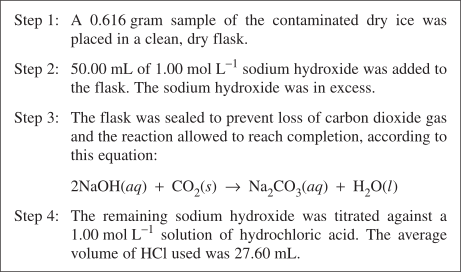
  1. Calculate the number of moles of \(\ce{NaOH}\) added in Step 2.  (1 mark)
  2. Calculate the percentage purity by mass of this batch of dry ice.  (4 marks)
Show Answers Only

a.   0.0500 moles

b.   80.0%

Show Worked Solution

a.    \(\ce{n(NaOH) = c \times V = 0.0500 \times 1.00 = 0.0500 moles}\)
  

b.    \(\ce{n(HCl) = c \times V = 0.0276 \times 1.00 = 0.0276 mol (titrate excess NaOH)}\)

\(\ce{n(NaOH to neutralise CO2) = 0.0500-0.0276 = 0.0224 mol}\)
 

\(\ce{Ratio \ NaOH\ : CO2 = 2\ : 1  (from equation)}\)

\(\ce{n(CO2) = \frac{1}{2} \times n(NaOH) = \frac{1}{2} \times 0.0224 = 0.0112 mol}\)

\(\ce{MM (CO2) = 12.01 + 2 \times 16 = 44.01}\)

\(\ce{Mass (CO2) = n \times MM = 0.0112 \times 44.01 = 0.493 g}\)

\[\ce{\% Dry ice (by mass) = \frac{0.493}{0.616} \times 100\% = 80.0\%}\]

♦ Mean mark (b) 41%.

Filed Under: Quantitative Analysis Tagged With: Band 4, Band 5, smc-3675-10-Titration

CHEMISTRY, M6 2016 HSC 29

A solution of hydrochloric acid was standardised by titration against a sodium carbonate solution using the following procedure.

  • All glassware was rinsed correctly to remove possible contaminants.
  • Hydrochloric acid was placed in the burette.
  • 25.0 mL of sodium carbonate solution was pipetted into the conical flask.

The titration was performed and the hydrochloric acid was found to be 0.200 mol L\(^{-1} \).

  1. Identify the substance used to rinse the conical flask and justify your answer.   (2 marks)

    --- 4 WORK AREA LINES (style=lined) ---

  2. Seashells contain a mixture of carbonate compounds. The standardised hydrochloric acid was used to determine the percentage by mass of carbonate in a seashell using the following procedure.
    • A 0.145 g sample of the seashell was placed in a conical flask.
    • 50.0 mL of the standardised hydrochloric acid was added to the conical flask.
    • At the completion of the reaction, the mixture in the conical flask was titrated with 0.250 mol L\(^{-1} \) sodium hydroxide.
  1. The volume of sodium hydroxide used in the titration was 29.5 mL.
  2. Calculate the percentage by mass of carbonate in the sample of the seashell.   (4 marks)

    --- 14 WORK AREA LINES (style=lined) ---

Show Answers Only

a.   Substance for rinse:

  • Water should be used to rinse the conical flask as this will not change the number of moles of \(\ce{Na2CO3}\) placed in it.

b.   \( 54.3\% \)

Show Worked Solution

a.   Substance for rinse:

  • Water should be used to rinse the conical flask as this will not change the number of moles of \(\ce{Na2CO3}\) placed in it.

b.   \(\ce{HCl + NaOH \rightarrow H2O + NaCl}\)

\(\ce{n(NaOH) = c \times V = 0.250 \times 0.0295 = 7.375 \times 10^{-3} moles}\)

\(\ce{n(HCl) = 7.375 \times 10^{-3} (after reaction)}\)

\(\ce{n(HCl – original) = c \times V = 0.200 \times 0.0500 = 0.0100 moles}\)

\(\ce{n(HCl – used) = 0.0100-7.375 \times 10^{-3} = 2.625 \times 10^{-3} moles}\)
 

\(\ce{2HCl + CO3^{2-} \rightarrow H2O + CO2 + 2Cl-}\)

\(\ce{HCl\ : CO3^{2-} = 2\ : 1}\)

\[\ce{n(CO3^{2-}) = \frac{2.625 \times 10^{-3}}{2} = 1.3125 \times 10^{-3} moles}\]

\(\ce{m(CO3^{2-}) = 1.3125 \times 10^{-3} \times 60.01 = 0.07876 g}\)

\[\ce{\text{% Mass} (CO3^{2-}) = \frac{0.07876}{0.145} \times 100\% = 54.3\%} \]

♦ Mean mark (b) 40%.

Filed Under: Quantitative Analysis Tagged With: Band 4, Band 5, smc-3675-10-Titration

CHEMISTRY, M1 2009 HSC 30c

The graph shows the first ionisation energy of some elements.
 

Account for the trends in the graph in terms of the electron configuration of the elements.  (3 marks)

Show Answers Only


Show Worked Solution
  • The increase in ionisation energy from Z=2 to 10 and Z=11 to 18 relates to the increase in effective nuclear charge across periods 1 and 2 respectively.
  • The same valence shell is being filled across a period, hence inner shell shielding and nucleus – shell distance is approximately constant while the nuclear charge increases.
  • Hence the electron binding force increases, requiring greater energy to remove a valence shell electron. Therefore, the ionisation energy increases across a period.
  • When the next valence shell begins to fill, as occurs at Z=3, 11 and 19 , the ionisation energy drops substantially because the electron experiences increased inner shell nuclear shielding and is further from the nucleus.
  • The generally lower ionisation energies for the second period elements compared to the first period elements also reflects the filling of higher valence shells.
  • This reflects the decrease in ionisation energy down a group in the periodic table.

Filed Under: Periodicity Tagged With: Band 5, smc-4257-10-Atomic Radii, smc-4257-20-Electronegativity, smc-4257-30-Ionisation Energy

CHEMISTRY, M1 2010 HSC 35d

Experimental evidence from emission line spectra of gaseous atoms has highlighted both the merits and the limitations of Bohr's atomic model. 

Discuss Bohr's atomic model with reference to this evidence.  (5 marks)

Show Answers Only


Show Worked Solution
  • The Bohr model of the atom describes the orbit of electrons around the nucleus at fixed radii and energy.
  • The emission line spectrum of hydrogen was seen to support the Bohr model as discrete lines were observed which could be assigned to electronic transitions between fixed energy levels.
  • However when the emission line spectrum for sodium was recorded there were more spectral lines than could be explained by the Bohr model. Line splitting or doublets were observed.
  • The line splitting or doublets result from electrons having differing angular momenta, residing in sub-shells, which was not considered in the Bohr model.

Filed Under: Periodicity Tagged With: Band 4, Band 5, smc-4257-40-Reactivity

CHEMISTRY, M1 2011 HSC 7 MC

Which of the following lists contains ONLY unstable isotopes?

  1. \( \ce{^{207}_{82}Pb}, \ \ce{^{99}_{43}Tc}, \ \ce{^{12}_{7}N} \)
  2. \( \ce{^{214}_{82}Pb}, \ \ce{^{46}_{20}Ca}, \ \ce{^{99}_{43}Tc}\)
  3. \( \ce{^{238}_{92}U}, \ \ce {^{40}_{20}Ca}, \ \ce{^{12}_{7}N}\)
  4. \( \ce{^{238}_{92}U}, \ \ce{^{40}_{20}Ca}, \ \ce{^{99}_{43}Tc}\)
Show Answers Only

`B`

Show Worked Solution
  • The stability of Isotopes is determined by their  Neutron:Proton Ratio and the total number of nucleons (neutrons + protons) in the nucleus.
  • Elements with an atomic number smaller than 20 (Z < 20) are stable with their  Neutron : Proton  ratio approximating 1 : 1
  • Heavier elements (Z = 20 – 83) require a higher  Neutron : Proton  ratio (usually about 1.5 : 1) to maintain nuclear stability as more neutrons are required to mitigate the inherent repulsive forces between the growing number of Protons and prevent nuclear decay.
  • This relationship can be graphed and is commonly referred to as the ‘Belt of Stability’. Elements and their isotopes with an atomic number greater than 83 are all only unstable.

`=>B`

Filed Under: Atomic Structure and Atomic Mass Tagged With: Band 5, smc-4256-60-Isotopes

CHEMISTRY, M1 2012 HSC 37e

Evaluate the contribution of the Bohr model to the development of our understanding of the structure of the atom.   (7 marks)

Show Answers Only
  • The Bohr model of the atom was developed to use the quantisation of energy to explain the emission and absorption spectrum of hydrogen.
  • It proposed that the single electron of the atom was confined to defined orbits around the nucleus, somewhat analogous to a planet’s orbit around its star.
  • For the electron to change to a different orbit, energy had to be absorbed (to go to a higher energy orbit) or emitted (to go to a lower energy orbit).
  • The energy absorbed or emitted is well-defined, giving rise to sharp absorption or emission lines. No other changes in energy are allowed.
  • The model was an important step towards understanding and accepting the quantum view of the atom and introduced the idea of energy levels (shells) to describe the electronic configuration of atoms.
  • The Bohr model could not be applied to atoms other than hydrogen and did not provide any explanation for the quantisation.
  • These restrictions and limitations of the model were recognised by Bohr and the model was not meant to be used beyond the hydrogen atom, but the attractiveness of the simplicity of the model has ensured continued use and propagates the incorrect concept of electrons as particles orbiting a nucleus.
Show Worked Solution

Evaluation Statement

  • The Bohr model was partially effective in advancing atomic understanding.
  • This evaluation is based on: explaining hydrogen spectra, introducing quantum concepts and applicability to other atoms.

Explaining Hydrogen Spectra

  • Bohr’s model successfully addressed hydrogen’s emission and absorption lines.
  • Evidence supporting this includes: correctly predicted wavelengths of spectral lines using quantised energy levels.
  • The model clearly fulfilled its primary purpose by mathematically linking electron transitions to observed spectra.
  • This strongly meets the criterion as it solved a major scientific puzzle of the time.

Applicability Beyond Hydrogen

  • The model fails to achieve accuracy for multi-electron atoms.
  • Evidence indicates that predictions become increasingly inaccurate with more electrons.
  • Bohr himself recognised these limitations, restricting the model to hydrogen.
  • This criterion is insufficiently met, revealing fundamental flaws in the model’s underlying assumptions.

Introduction of Quantum Concepts

  • The model effectively introduced revolutionary ideas like energy levels (electron shells) and quantisation.
  • These concepts became foundational for quantum mechanics development.
  • While the orbital concept was incorrect, it adequately fulfilled the need for a transitional model.
  • This satisfactorily meets the criterion of advancing theoretical understanding.

Final Evaluation

  • Weighing these factors shows the Bohr model was highly effective as a stepping stone but limited as a complete theory.
  • The strengths outweigh the weaknesses because it successfully bridged classical and quantum physics.
  • Although inadequate for complex atoms, it proves essential for teaching atomic concepts.
  • The overall evaluation demonstrates its crucial but transitional role in atomic theory development.

Filed Under: Atomic Structure and Atomic Mass Tagged With: Band 4, Band 5, smc-4256-90-Models of the Atom

BIOLOGY, M4 2015 HSC 35e

'Science has been used to solve problems in the investigation of evolutionary
relationships between humans and other primates, and so has provided information of interest to society.' 

Justify this statement in terms of the scientific knowledge behind DNA-DNA hybridisation AND karyotype analysis.  (7 marks)

--- 20 WORK AREA LINES (style=lined) ---

Show Answers Only

→ Using comparative morphologies limits our ability in determining relationships between humans and other primates. Sometimes morphologies seem very different, yet the changes or modifications required to achieve those differences might be small in number or too simple. 

→ Using genetic evidence gives a much more accurate picture.

DNA-DNA Hybridisation

→ Can be used to show how genetically similar two species are.

→ DNA from a human and a chimpanzee (other primate) can be tested for melting point. Then it can be melted into single strands. The single strands are combined into hybrid DNA, in which some hydrogen bonding between base pairs does not happen because they are not complementary.

→ The lower the hybrid DNA M.P. is compared to the original DNA is a measure of how similar the original DNA was.

→ When the DNA is similar the two species are seen to be close in evolutionary terms.

Karyotype Analysis

→ Involves using a chemical to kill a cell during cell division when the chromosomes can be seen individually.

→ Photos are taken and the chromosome pictures arranged in pairs of increasing size. This picture of all the chromosomes in the genome is a karyotype.

→ Comparing the number, size, shape and banding pattern of chromosomes allows scientists to observe differences between species.

→ The fewer differences between karyotypes, the closer the species are in evolutionary terms.

→ People are interested to study our closest living relatives, as it helps us to understand where we have come from. It helps us to understand ourselves as a species when we can identify our closest living relatives and see our unique or common features and behaviours. DNA-DNA hybridisation and karyotype analysis help scientists to accurately achieve this knowledge.

Show Worked Solution

→ Using comparative morphologies limits our ability in determining relationships between humans and other primates. Sometimes morphologies seem very different, yet the changes or modifications required to achieve those differences might be small in number or too simple. 

→ Using genetic evidence gives a much more accurate picture.

DNA-DNA Hybridisation

→ Can be used to show how genetically similar two species are.

→ DNA from a human and a chimpanzee (other primate) can be tested for melting point. Then it can be melted into single strands. The single strands are combined into hybrid DNA, in which some hydrogen bonding between base pairs does not happen because they are not complementary.

→ The lower the hybrid DNA M.P. is compared to the original DNA is a measure of how similar the original DNA was.

→ When the DNA is similar the two species are seen to be close in evolutionary terms.

Karyotype Analysis

→ Involves using a chemical to kill a cell during cell division when the chromosomes can be seen individually.

→ Photos are taken and the chromosome pictures arranged in pairs of increasing size. This picture of all the chromosomes in the genome is a karyotype.

→ Comparing the number, size, shape and banding pattern of chromosomes allows scientists to observe differences between species.

→ The fewer differences between karyotypes, the closer the species are in evolutionary terms.

→ People are interested to study our closest living relatives, as it helps us to understand where we have come from. It helps us to understand ourselves as a species when we can identify our closest living relatives and see our unique or common features and behaviours. DNA-DNA hybridisation and karyotype analysis help scientists to accurately achieve this knowledge.

Filed Under: BIO - Ex-syllabus checks required Tagged With: Band 4, Band 5

BIOLOGY, M4 2015 HSC 35d

  1. Distinguish between relative dating and absolute dating of fossils.   (2 marks)

    --- 4 WORK AREA LINES (style=lined) ---
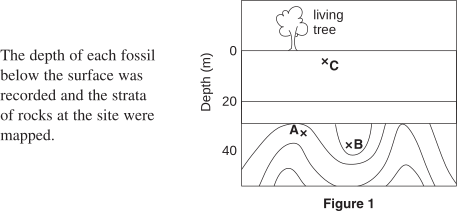
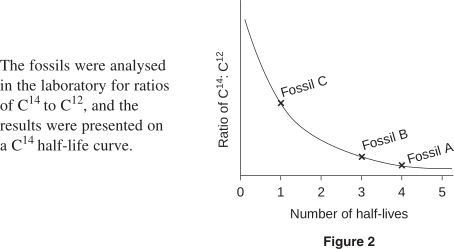
  2. Students found three fossils (A, B and C) at an archaeological site. 
     

The students concluded that their data were conflicting and they could not determine the relative ages of the fossils.

Evaluate the students' conclusion with reference to the data presented.   (4 marks)

--- 8 WORK AREA LINES (style=lined) ---

Show Answers Only

i.    Relative vs absolute dating:

  • Relative dating is used to compare fossils, giving scientists data to determine if one fossil is older/younger than another.
  • Absolute dating can provide a quantitative value for the actual age of individual fossils. 

ii.    Evaluation of conclusion:

  • Fossil B is located at a lower depth than fossil A, however, the strata that contains fossil A is below the strata that contains fossil B.
  • This has occurred because the landscape was folded via geological processes, pushing up some of the strata containing fossil A and pushing down the strata containing fossil B. Therefore, fossil A is the older of the two. 
  • Fossil C is younger because it is located in a higher strata than the other two fossils.
  • In Figure 2, fossil A is shown to have an age of four half-lives of \(\ce{C^{14}}\), fossil B three half-lives and fossil C one half-life. This evidence suggests fossil A is the oldest and fossil C is much younger. Therefore the students’ conclusion is incorrect as the graphical data is consistent with the mapped data.
Show Worked Solution

i.    Relative vs absolute dating:

  • Relative dating is used to compare fossils, giving scientists data to determine if one fossil is older/younger than another.
  • Absolute dating can provide a quantitative value for the actual age of individual fossils. 

ii.    Evaluation of conclusion:

  • Fossil B is located at a lower depth than fossil A, however, the strata that contains fossil A is below the strata that contains fossil B.
  • This has occurred because the landscape was folded via geological processes, pushing up some of the strata containing fossil A and pushing down the strata containing fossil B. Therefore, fossil A is the older of the two. 
  • Fossil C is younger because it is located in a higher strata than the other two fossils.
  • In Figure 2, fossil A is shown to have an age of four half-lives of \(\ce{C^{14}}\), fossil B three half-lives and fossil C one half-life. This evidence suggests fossil A is the oldest and fossil C is much younger. Therefore the students’ conclusion is incorrect as the graphical data is consistent with the mapped data.

Filed Under: Past Ecosystems Tagged With: Band 4, Band 5, smc-4312-07-Rock structure/formation, smc-4312-25-Palaeontology, smc-4312-40-Evaluating hypotheses

BIOLOGY, M4 2016 HSC 35d

A new fossil form was recently found in South Africa. This fossil shares characteristics with both the genus Australopithecus and the genus Homo.

There has been debate as to whether this new fossil form should be classified in the genus Australopithecus or in the genus Homo.

  1. Describe a key difference between fossils classified as the genus Australopithecus and those classified as the genus Homo.   (2 marks)

    --- 3 WORK AREA LINES (style=lined) ---

  2. Explain how DNA sequencing technology could be used to determine which genus the new fossil belongs to. In your answer, refer to relevant hominid species.   (4 marks)

    --- 8 WORK AREA LINES (style=lined) ---

Show Answers Only

i.     → If the fossil is to be classified as the genus Homo, then the fossil should indicate an upright stance.

→ Alternatively, if the fossil is to be classified as the genus Australopithecus, then the fossil should indicate a stooped stance.
 

ii.   → Mitochondrial DNA sequences of the fossil and a modern Homo species (eg Homo sapiens) could be compared to determine time since a common ancestor.

→ If the time since a common ancestor is less than 2 MYA, the fossil is likely to be of the Homo genus.

→ If it is greater than 2 MYA since a common ancestor, it is likely that this fossil is either Australopithecus or another species.

Show Worked Solution

i.     → Genus Homo: the fossil should indicate an upright stance.

→ Genus Australopithecus: the fossil should indicate a stooped stance.
 

ii.   DNA sequencing

→ Mitochondrial DNA sequences of the fossil and a modern Homo species (eg Homo sapiens) could be compared to determine time since a common ancestor.

→ If the time since a common ancestor is less than 2 MYA, the fossil is likely to be of the Homo genus.

→ If it is greater than 2MYA since a common ancestor, it is likely that this fossil is either Australopithecus or another species.

Filed Under: BIO - Ex-syllabus checks required Tagged With: Band 4, Band 5

BIOLOGY, M4 2016 HSC 35b

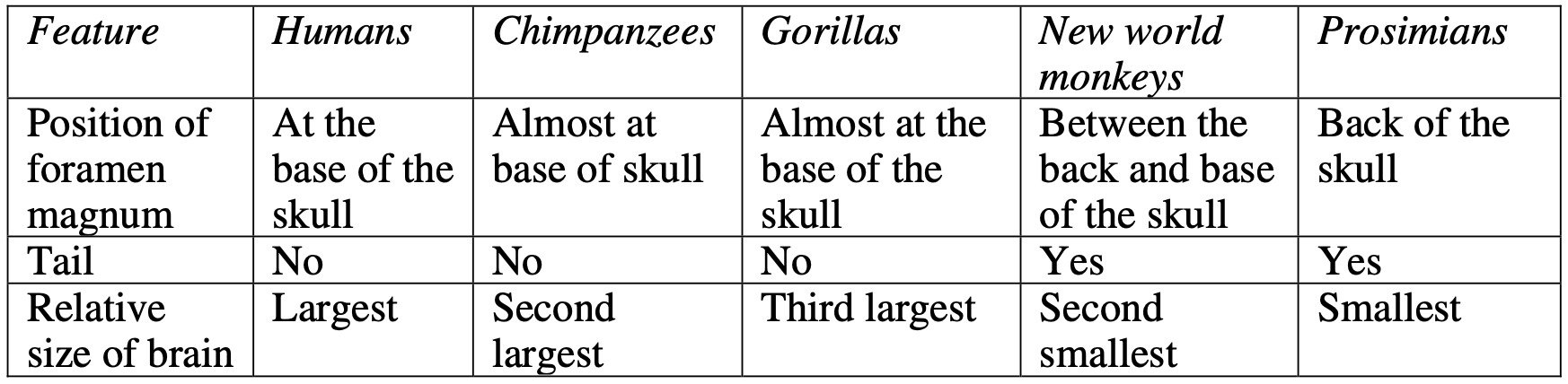
The table compares some of the amino acids present in a particular protein in different primates.

Using these data and your knowledge of the characteristics of primate groups, explain why using different types of data improves the reliability of estimated evolutionary relationships.  (5 marks)

Show Answers Only


Show Worked Solution

→ The amino acid data set shows that chimpanzees and humans have identical amino acids in this protein.

→ Gorillas show one amino acid difference, new world monkeys show three amino acid differences and prosimians show four amino acid differences.

→ On the basis of this data, it can be assessed that chimpanzees and humans are identical, followed by gorillas then new world monkeys and then prosimians.
 

→ The morphological characteristics outlined in the table would rank the organisms in evolutionary proximity as chimpanzees most closely related to humans but different species, followed by gorillas then new world monkeys and then prosimians.

→ Both data sets correlate and therefore the estimates of evolutionary proximity to humans can be considered to be more reliable.

Filed Under: BIO - Ex-syllabus checks required Tagged With: Band 4, Band 5

BIOLOGY, M3 2002 HSC 25

  1. Define the concept of punctuated equilibrium in evolution.  (1 mark)

    --- 2 WORK AREA LINES (style=lined) ---

  2. How does punctuated equilibrium differ from the process proposed by Darwin?  (3 marks)

    --- 7 WORK AREA LINES (style=lined) ---

Show Answers Only

a.    Punctuated equilibrium:

  • Once species adapts to their environment, they will undergo little or no evolutionary change, remaining in an equilibrium state until a rapid change to their environment forces evolutionary change.

b.    Punctuated equilibrium vs Darwin:

  • These two theories both acknowledge natural selection, but differ in the pace and pattern of evolution.
  • Darwin’s theory suggests gradual, continuous evolution, with small changes accumulating over time as species adapt to their environment.
  • In contrast, punctuated equilibrium proposes that species remain stable for long periods with drastic evolutionary changes occurring in when the environment undergoes rapid change, thus forcing quick evolutionary change.
Show Worked Solution

a.    Punctuated equilibrium:

  • Once species adapts to their environment, they will undergo little or no evolutionary change, remaining in an equilibrium state until a rapid change to their environment forces evolutionary change.

b.    Punctuated equilibrium vs Darwin:

  • These two theories both acknowledge natural selection, but differ in the pace and pattern of evolution.
  • Darwin’s theory suggests gradual, continuous evolution, with small changes accumulating over time as species adapt to their environment.
  • In contrast, punctuated equilibrium proposes that species remain stable for long periods with drastic evolutionary changes occurring in when the environment undergoes rapid change, thus forcing quick evolutionary change.

Filed Under: Natural Selection Tagged With: Band 4, Band 5, smc-4309-30-Punctuated equilibrium

BIOLOGY, M3 2009 HSC 27

Most offspring resemble their parents in a number of characteristics, but there are often some characteristics in the offspring that are unexpected.  

Explain, using examples, how genetics and the environment can affect the phenotype of individuals.  (8 marks)

--- 16 WORK AREA LINES (style=lined) ---

Show Answers Only

→ Offspring inherit characteristics based off their parents. Their are various factors which can influence what characteristics, or phenotype, they actually exhibit.

→ When offspring exhibit characteristics that are unexpected, this is often due to the characteristic being a recessive trait. In this way, both parents had the allele for it but it was masked by the dominant trait. The offspring then inherited both of these recessive alleles, meaning it could no longer be masked.

→ One such example is if the parents are both type A but their son/daughter is type O as a result of inheriting the recessive allele for no surface proteins.

→ Traits can also be unexpected if they are sex-linked, meaning the allele lies on an X sex chromosome. In this way, males will only have to have one recessive X allele for it to be expressed, while females need them both. In this way, the ratios for sex-linked characteristics is different than if they were autosomal.

→ When genes are being copied, mistakes (mutations) are made in the process and new genes or combinations of genes can be generated in the process.

→ These can be passed on to offspring, giving them characteristics different from their parents. For example, the peppered moth. Dark coloured peppered moths appeared in the population due to a mutation.

→ The environment can affect the way in which genes are expressed so that an individuals phenotype is affect by environmental conditions. For example, malnutrition can lead to individuals being shorter in height compared to their genetic potential.

Show Worked Solution

→ Offspring inherit characteristics based off their parents. Their are various factors which can influence what characteristics, or phenotype, they actually exhibit.

→ When offspring exhibit characteristics that are unexpected, this is often due to the characteristic being a recessive trait. In this way, both parents had the allele for it but it was masked by the dominant trait. The offspring then inherited both of these recessive alleles, meaning it could no longer be masked.

→ One such example is if the parents are both type A but their son/daughter is type O as a result of inheriting the recessive allele for no surface proteins.

→ Traits can also be unexpected if they are sex-linked, meaning the allele lies on an X sex chromosome. In this way, males will only have to have one recessive X allele for it to be expressed, while females need them both. In this way, the ratios for sex-linked characteristics is different than if they were autosomal.

→ When genes are being copied, mistakes (mutations) are made in the process and new genes or combinations of genes can be generated in the process.

→ These can be passed on to offspring, giving them characteristics different from their parents. For example, the peppered moth. Dark coloured peppered moths appeared in the population due to a mutation.

→ The environment can affect the way in which genes are expressed so that an individuals phenotype is affect by environmental conditions. For example, malnutrition can lead to individuals being shorter in height compared to their genetic potential.

Filed Under: BIO - Ex-syllabus checks required Tagged With: Band 4, Band 5, smc-4307-40-Selection pressures

BIOLOGY, M3 2010 HSC 30

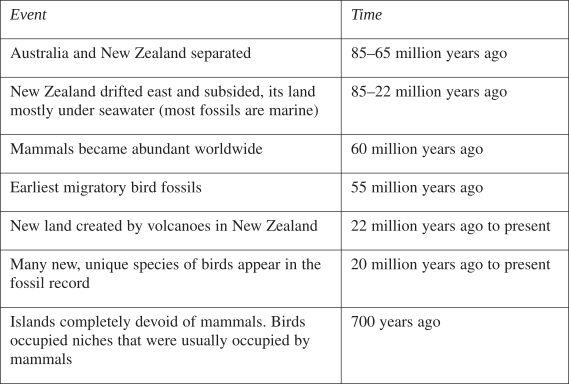
Geological and biological history of New Zealand

Use this information and other relevant knowledge to demonstrate how the practice of biology has led to the validation of current theories of evolution.  (7 marks)

--- 18 WORK AREA LINES (style=lined) ---

Show Answers Only
  • In the New Zealand information, many practices of biology were undertaken to compile the data.
  • The observations of fauna in New Zealand represent an important practice in biological science. Making clear, dispassionate and unbiased observations, and recording such observations are intrinsic to science and provide an essential pathway to validating theories.
  • These observations validated the idea of convergent evolution; birds in New Zealand, without competition from mammals, developed similar characteristics and were able to live in the same environments as mammals do elsewhere.
  • Practices in palaeontology of ageing fossils by radiometric dating or stratigraphy, describing fossils and comparing fossils, allows a history of fauna of New Zealand to be compiled, and history of islands (eg. deducing from fossils found to be almost completely marine that New Zealand was covered by oceans).
  • The history of fauna and geologic events validates Charles Darwin’s theory of evolution in that populations of birds, which began as occasional visitors, gradually changed into permanent endemic species.
  • Divergent evolution is validated as new unique species develop from migratory species, as shown by the fossils of new, unique birds.
  • The data also validates the punctuated equilibrium theory in that the diversification of bird species happened very quickly in the space of only 2 million years.
Show Worked Solution
  • In the New Zealand information, many practices of biology were undertaken to compile the data.
  • The observations of fauna in New Zealand represent an important practice in biological science. Making clear, dispassionate and unbiased observations, and recording such observations are intrinsic to science and provide an essential pathway to validating theories.
  • These observations validated the idea of convergent evolution; birds in New Zealand, without competition from mammals, developed similar characteristics and were able to live in the same environments as mammals do elsewhere.
  • Practices in palaeontology of ageing fossils by radiometric dating or stratigraphy, describing fossils and comparing fossils, allows a history of fauna of New Zealand to be compiled, and history of islands (eg. deducing from fossils found to be almost completely marine that New Zealand was covered by oceans).
  • The history of fauna and geologic events validates Charles Darwin’s theory of evolution in that populations of birds, which began as occasional visitors, gradually changed into permanent endemic species.
  • Divergent evolution is validated as new unique species develop from migratory species, as shown by the fossils of new, unique birds.
  • The data also validates the punctuated equilibrium theory in that the diversification of bird species happened very quickly in the space of only 2 million years.

Filed Under: Evolution - The Evidence, Natural Selection Tagged With: Band 4, Band 5, smc-4309-35-Convergent/Divergent, smc-4310-05-Fossils

BIOLOGY, M3 2014 HSC 26

Explain how Darwin/Wallace's theory of evolution by natural selection and isolation accounts for convergent evolution. Use an example to support your answer.  (5 marks)

Show Answers Only
  • Convergent evolution occurs when two species evolve to possess similar characteristics by natural selection in similar environments.
  • The organisms cannot interbreed to share any new DNA generated by mutation: they are genetically isolated from each other yet they develop similar characteristics.
  • When variation exists in a population, the theory of evolution by natural selection states that this variation will cause some individuals to be better suited to their environment. In this way, they are more likely to survive and hence reproduce, passing on their adaptive characteristics to further generations. After many generations, the traits of those variants are common in the population.
  • Dolphins and sharks demonstrate convergent evolution. The dolphin is a mammal and the shark is a fish. They inhabit the marine environment which imposes the same selection pressures on both types of organism. 
  • Despite being genetically isolated, they both exhibit a streamlined body shape and possess fins for propulsion and stability.
  • These features are adaptive for movement in a highly viscous environment.
Show Worked Solution
  • Convergent evolution occurs when two species evolve to possess similar characteristics by natural selection in similar environments.
  • The organisms cannot interbreed to share any new DNA generated by mutation: they are genetically isolated from each other yet they develop similar characteristics.
  • When variation exists in a population, the theory of evolution by natural selection states that this variation will cause some individuals to be better suited to their environment. In this way, they are more likely to survive and hence reproduce, passing on their adaptive characteristics to further generations. After many generations, the traits of those variants are common in the population.
  • Dolphins and sharks demonstrate convergent evolution. The dolphin is a mammal and the shark is a fish. They inhabit the marine environment which imposes the same selection pressures on both types of organism. 
  • Despite being genetically isolated, they both exhibit a streamlined body shape and possess fins for propulsion and stability.
  • These features are adaptive for movement in a highly viscous environment.
Mean mark 51%.

Filed Under: Natural Selection Tagged With: Band 4, Band 5, smc-4309-35-Convergent/Divergent

BIOLOGY, M2 2014 HSC 24

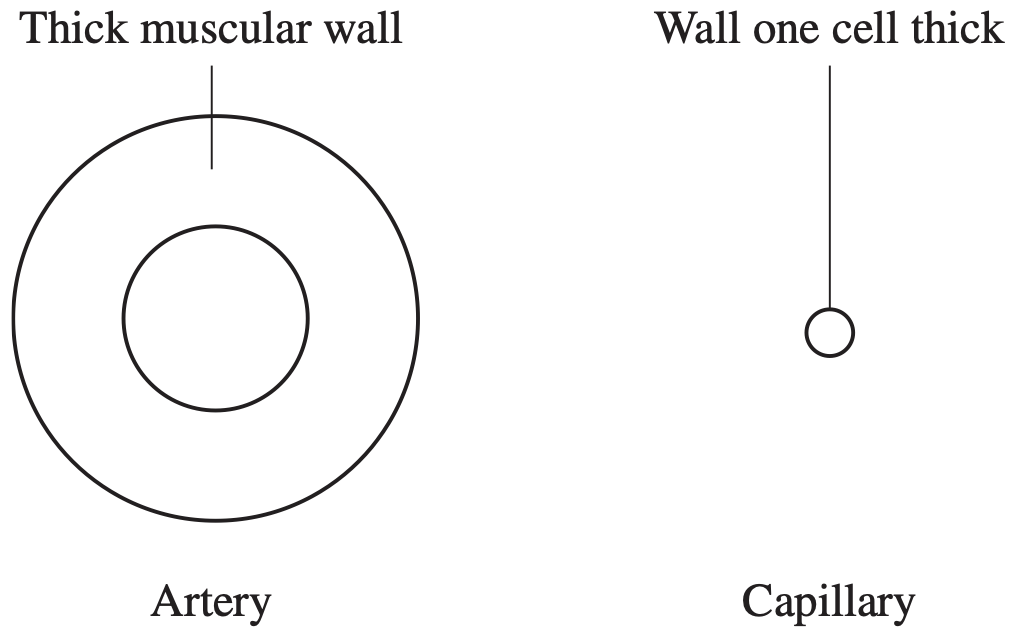
  1. Use labelled diagrams to distinguish between the structure of an artery and that of a capillary.   (2 marks)

    --- 8 WORK AREA LINES (style=blank) ---

  2. Relate one structure of a capillary to its function.   (2 marks)

    --- 5 WORK AREA LINES (style=lined) ---

Show Answers Only

a.   
       

b.    Structure: One cell thick wall.

Related function: Allows diffusion of small molecules through the capillary wall to allow substances in and out of the bloodstream.

Show Worked Solution

a.   
       

b.    Structure: One cell thick wall.

Related function: Allows diffusion of small molecules through the capillary wall to allow substances in and out of the bloodstream.

♦ Mean mark 49%.

Filed Under: Organisation of Cells Tagged With: Band 4, Band 5, smc-4304-75-Cardiorespiratory System

BIOLOGY, M2 2015 HSC 27

  1. Outline TWO differences between whole blood and plasma.  (2 marks)

    --- 3 WORK AREA LINES (style=lined) ---

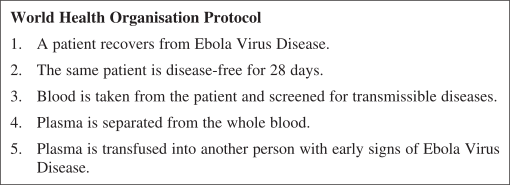
The steps below show the preparation and use of blood products in the treatment of Ebola Virus Disease. This disease is characterised by significant blood loss.

  1. Explain why this protocol produces an effective treatment for Ebola Virus Disease.  (3 marks)

    --- 8 WORK AREA LINES (style=lined) ---

Show Answers Only

a.    Whole blood and plasma differences:

→ Whole blood contains cells including WBC’s, RBC’s and platelets while plasma does not.

→ Plasma is a straw coloured liquid and whole blood is a thick red liquid.
 

b.   Answers could include:

→ The plasma will contain antibodies for this disease because it has been taken from someone who has survived the disease. This will help to immobilise the virus in recipients blood stream.

→ Screening blood prevents the spread of Ebola and other blood-borne diseases from donor to recipient.

→ The plasma is separated from the whole blood meaning no blood type match is needed as there are no cells in the plasma but it still contains the beneficial antibodies.

Show Worked Solution

a.    Whole blood and plasma differences:

→ Whole blood contains cells including WBC’s, RBC’s and platelets while plasma does not.

→ Plasma is a straw coloured liquid and whole blood is a thick red liquid.

♦ Mean mark (a) 49%.

b.   Answers could include:

→ The plasma will contain antibodies for this disease because it has been taken from someone who has survived the disease. This will help to immobilise the virus in recipients blood stream.

→ Screening blood prevents the spread of Ebola and other blood-borne diseases from donor to recipient.

→ The plasma is separated from the whole blood meaning no blood type match is needed as there are no cells in the plasma but it still contains the beneficial antibodies.

Filed Under: BIO - Ex-syllabus checks required Tagged With: Band 4, Band 5, smc-4306-10-Blood

BIOLOGY, M2 2016 HSC 31

As altitude increases, the partial pressure of oxygen \( \text{(p} \ce{O_2)}\) in air decreases. 

Species A and B are closely related endotherms that live in different habitats in Asia. The minimum \( \text{p} \ce{O_2}\) required for 100% blood oxygen saturation differs in these species because of differences in their haemoglobin structure. Data related to these two species are shown below.

\begin{equation}
\begin{array}{|c|c|c|}
\hline \text { Endotherm species } & \text { Habitat altitude } & \text { Minimum } \mathrm{pO}_2 \text { for } 100 \%\ \mathrm{Hb} \text { saturation } \\
\hline \mathrm{A} & \mathrm{High} & 54 \\
\mathrm{~B} & \text { Low } & 80 \\
\hline
\end{array}
\end{equation}

Explain how the differences in these species could have arisen, using the Darwin/Wallace theory of evolution and your understanding of the adaptive advantage of haemoglobin.  (8 marks)

--- 18 WORK AREA LINES (style=lined) ---

Show Answers Only
  • Haemoglobin is a protein that provides a mechanism for transport of oxygen around the body. As it is a protein, it’s structure is dependant on the individual’s genotype.
  • Species A and Species B are able to reach 100% saturation at differing partial pressures of oxygen, meaning they have different DNA which codes for different haemoglobin structures.
  • Species A and B are likely to have diverged from a common ancestor because of differing environmental pressures resulting in two different species. Within the ancestral population there was variation which resulted from random mutations. One mutation would have resulted in haemoglobin that is able to reach 100% saturation at a lower partial pressure of oxygen.
  • When members of the ancestral species moved to a higher altitude the ability of their haemoglobin to reach saturation at a lower \( \text{p} \ce{O_2}\) gave them a survival advantage. These individuals were then more likely to reproduce and pass on their favourable genes.
  • For individuals living at lower altitudes, there is no survival advantage to being able to reach 100% saturation at lower \( \text{p} \ce{O_2}\) which means this trait was not selected for.
  • Over time, due to the isolation at a higher altitude a new species evolved.
Show Worked Solution
  • Haemoglobin is a protein that provides a mechanism for transport of oxygen around the body. As it is a protein, it’s structure is dependant on the individual’s genotype.
  • Species A and Species B are able to reach 100% saturation at differing partial pressures of oxygen, meaning they have different DNA which codes for different haemoglobin structures.
  • Species A and B are likely to have diverged from a common ancestor because of differing environmental pressures resulting in two different species. Within the ancestral population there was variation which resulted from random mutations. One mutation would have resulted in haemoglobin that is able to reach 100% saturation at a lower partial pressure of oxygen.
  • When members of the ancestral species moved to a higher altitude the ability of their haemoglobin to reach saturation at a lower \( \text{p} \ce{O_2}\) gave them a survival advantage. These individuals were then more likely to reproduce and pass on their favourable genes.
  • For individuals living at lower altitudes, there is no survival advantage to being able to reach 100% saturation at lower \( \text{p} \ce{O_2}\) which means this trait was not selected for.
  • Over time, due to the isolation at a higher altitude a new species evolved.
♦♦ Mean mark 41%.

Filed Under: Natural Selection Tagged With: Band 4, Band 5, Band 6, smc-4309-10-Biological diversity

BIOLOGY, M2 2017 HSC 27

  1. Draw labelled diagrams to distinguish between transverse sections of a xylem vessel and a phloem vessel.   (2 marks)

    --- 6 WORK AREA LINES (style=blank) ---

  2. Describe the process that transports sugars through a plant.   (3 marks)

    --- 6 WORK AREA LINES (style=lined) ---

Show Answers Only

a.   
       

b.   Sugar transportation:

  • Sugars produced in the leaves are transported into the phloem by active transport.
  • Water from the xylem then follows into the phloem by osmosis, which increases the pressure.
  • This creates a pressure gradient in the phloem allowing the sugar to move up or down the plant.
  • At the ‘sink’, sugars are then removed via active transport to required locations.
Show Worked Solution
a.   
       
♦ Mean mark (a) 47%.

b.   Sugar transportation:

  • Sugars produced in the leaves are transported into the phloem by active transport.
  • Water from the xylem then follows into the phloem by osmosis, which increases the pressure.
  • This creates a pressure gradient in the phloem allowing the sugar to move up or down the plant.
  • At the ‘sink’, sugars are then removed via active transport to required locations.
♦ Mean mark (b) 42%.

Filed Under: Transport Tagged With: Band 5, smc-4306-30-Plants

BIOLOGY, M1 2014 HSC 28

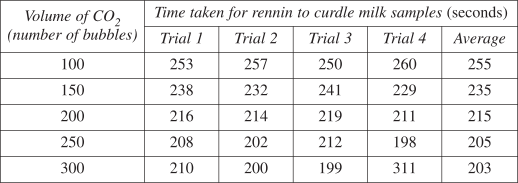
Rennin is an enzyme found in the stomach of young mammals. Rennin curdles the milk drunk by the mammal and allows the milk solids to stay longer in the stomach to be further digested.

Students conducted an investigation into rennin activity. They bubbled different volumes of carbon dioxide gas into milk samples. Each sample was 50mL and was kept at a constant temperature. The students then added rennin to each milk sample and recorded the time taken for the milk to curdle.
 

  1. Account for the students' calculated average time for 300 bubbles of \( \ce{CO_2} \).  (2 marks)

    --- 4 WORK AREA LINES (style=lined) ---
  2. Explain the results of this experiment.  (4 marks)

    --- 8 WORK AREA LINES (style=lined) ---
Show Answers Only

a.    Calculating the average:

  • The outlier (311 seconds) was removed from the data set, then the remaining data points at 300 bubbles of \(\ce{CO_2}\) were averaged.
  • This was necessary as it is significantly different to other values for time taken to curdle at that \(\ce{CO_2}\) volume and allowed the calculated average to fall within the predetermined trend. 

b.    As bubbles of \(\ce{CO_2}\) increase, time to curdle decreases.

  • This scenario is explicitly seen between 100-200 bubbles, where the curdling time reduces by 20 seconds at each interval.
  • This means increased concentration of \(\ce{CO_2}\) also increases activity of the enzyme.
  • As \(\ce{CO_2}\) increases acidity of a solution, these results show us that rennin activity increases at reduced pH levels.
  • The slower increase of enzyme activity after 250 bubbles of \(\ce{CO_2}\) is due to the enzyme being close to its optimum pH where the enzyme activity graph flattens off at the peak of the curve.

Show Worked Solution

a.    Calculating the average:

  • The outlier (311 seconds) was removed from the data set, then the remaining data points at 300 bubbles of \(\ce{CO_2}\) were averaged.
  • This was necessary as it is significantly different to other values for time taken to curdle at that \(\ce{CO_2}\) volume and allowed the calculated average to fall within the predetermined trend. 
♦ Mean mark (a) 46%.

b.    As bubbles of \(\ce{CO_2}\) increase, time to curdle decreases.

  • This scenario is explicitly seen between 100-200 bubbles, where the curdling time reduces by 20 seconds at each interval.
  • This means increased concentration of \(\ce{CO_2}\) also increases activity of the enzyme.
  • As \(\ce{CO_2}\) increases acidity of a solution, these results show us that rennin activity increases at reduced pH levels.
  • The slower increase of enzyme activity after 250 bubbles of \(\ce{CO_2}\) is due to the enzyme being close to its optimum pH where the enzyme activity graph flattens off at the peak of the curve.
♦♦♦ Mean mark (b) 35%.

Filed Under: Cell Function Tagged With: Band 5, Band 6, smc-4303-60-Enzymes

BIOLOGY, M1 2013 HSC 25

The graph below shows the results obtained from testing the activity of a bacterial enzyme.
 

  1. Name ONE variable, other than temperature, that would have been controlled in the experiment.  (1 mark)

    --- 2 WORK AREA LINES (style=lined) ---

  2. For what temperature range does the enzyme display the maximum rate of change in activity?   (1 mark)

    --- 1 WORK AREA LINES (style=lined) ---

  3. Account for the activity of the enzyme at the parts of the graph labelled A, B, C and D.  (4 marks)

    --- 8 WORK AREA LINES (style=lined) ---

  4. Based on the information in the graph, suggest the type of environment in which these bacteria might survive. (1 mark)

    --- 1 WORK AREA LINES (style=lined) ---

Show Answers Only

a.    Answers could include:

  • pH
  • Enzyme concentration
  • Substrate concentration 

b.    89 – 93°C (D).

c.    Enzyme activity at each point:

A: A constant gradient indicates a constant increasing rate of enzyme activity as temperature increases.

B: Graph level at a maximum (10 μmol/s). Enzyme-substrate complex operating at maximum even though temperature is increasing.

C: Graph decreasing indicating a reduction in enzyme efficiency due to increasing temperature denaturing enzyme.

D: Graph rapidly goes to 0 indicating enzyme activity stops because the enzyme is denatured.

d.    Hotter environments, such as desserts or hot, geothermal springs.

Show Worked Solution

a.    Answers could include:

  • pH
  • Enzyme concentration
  • Substrate concentration 

b.    89 – 93°C (D).

c.    Enzyme activity at each point:

A: A constant gradient indicates a constant increasing rate of enzyme activity as temperature increases.

B: Graph level at a maximum (10 μmol/s). Enzyme-substrate complex operating at maximum even though temperature is increasing.

C: Graph decreasing indicating a reduction in enzyme efficiency due to increasing temperature denaturing enzyme.

D: Graph rapidly goes to 0 indicating enzyme activity stops because the enzyme is denatured.

♦♦♦ Mean mark (b) 22%.

d.    Hotter environments, such as desserts or hot, geothermal springs.

Filed Under: Cell Function Tagged With: Band 4, Band 5, smc-4303-60-Enzymes

BIOLOGY, M1 2015 HSC 22

Explain why insects excrete uric acid as their principal nitrogenous waste.  (2 marks)

Show Answers Only
  • Insects need to conserve water within their bodies by reducing water loss.
  • This is done through their creation of uric acid which low toxicity and therefore it can be excreted in a highly concentrated form, reducing insects need for large amounts of water to excrete their nitrogenous wastes.
Show Worked Solution
  • Insects need to conserve water within their bodies by reducing water loss.
  • This is done through their creation of uric acid which low toxicity and therefore it can be excreted in a highly concentrated form, reducing insects need for large amounts of water to excrete their nitrogenous wastes.
♦ Mean mark 48%.

Filed Under: Cell Function Tagged With: Band 5, smc-4303-50-Excretion

BIOLOGY, M1 2016 HSC 23

  1. Explain ONE reason why the concentration of water in cells should be maintained within a narrow range for optimal cell function.  (2 marks)

    --- 5 WORK AREA LINES (style=lined) ---

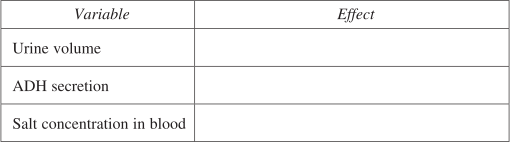
  2. A person has consumed large amounts of water. Complete the table to show the effect on each of the variables listed.  (3 marks)


--- 0 WORK AREA LINES (style=lined) ---
Show Answers Only

a.    Correct answers could include:

  • Concentration of water in cells is maintained to regulate concentrations of solutes in cells.
  • Concentration of water in a narrow range provides appropriate substrate concentrations for metabolic function.

b.

\begin{array} {|l|l|}
\hline
\rule{0pt}{2.5ex}\ \ \ \ \ \ \ \ \textit{Variable}\rule[-1ex]{0pt}{0pt} & \rule{0pt}{2.5ex}\textit{Effect}\rule[-1ex]{0pt}{0pt}\\
\hline
\rule{0pt}{2.5ex}\text{Urine Volume}\rule[-1ex]{0pt}{0pt} & \rule{0pt}{2.5ex}\text{Increase}\rule[-1ex]{0pt}{0pt}\\
\hline
\rule{0pt}{2.5ex}\text{ADH Secretion}\rule[-1ex]{0pt}{0pt} & \rule{0pt}{2.5ex}\text{Decrease}\rule[-1ex]{0pt}{0pt}\\
\hline
\rule{0pt}{2.5ex}\text{Salt concentration in blood}\rule[-1ex]{0pt}{0pt} & \rule{0pt}{2.5ex}\text{Decrease}\rule[-1ex]{0pt}{0pt}\\
\hline
\end{array}

Show Worked Solution

a.    Correct answers could include:

  • Concentration of water in cells is maintained to regulate concentrations of solutes in cells.
  • Concentration of water in a narrow range provides appropriate substrate concentrations for metabolic function.
♦ Mean mark 43%.

b.

\begin{array} {|l|l|}
\hline
\rule{0pt}{2.5ex}\ \ \ \ \ \ \ \ \textit{Variable}\rule[-1ex]{0pt}{0pt} & \rule{0pt}{2.5ex}\textit{Effect}\rule[-1ex]{0pt}{0pt}\\
\hline
\rule{0pt}{2.5ex}\text{Urine Volume}\rule[-1ex]{0pt}{0pt} & \rule{0pt}{2.5ex}\text{Increase}\rule[-1ex]{0pt}{0pt}\\
\hline
\rule{0pt}{2.5ex}\text{ADH Secretion}\rule[-1ex]{0pt}{0pt} & \rule{0pt}{2.5ex}\text{Decrease}\rule[-1ex]{0pt}{0pt}\\
\hline
\rule{0pt}{2.5ex}\text{Salt concentration in blood}\rule[-1ex]{0pt}{0pt} & \rule{0pt}{2.5ex}\text{Decrease}\rule[-1ex]{0pt}{0pt}\\
\hline
\end{array}

Filed Under: Cell Function Tagged With: Band 4, Band 5, smc-4303-50-Excretion

BIOLOGY, M7 SM-Bank 27

Influenza is an infectious respiratory disease. In humans, it can be caused by the influenza A or influenza B viruses.

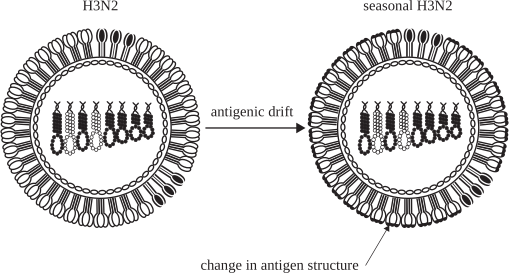
Antigenic drift can result in small changes to the structure of the antigens on the surface of the influenza virus, as shown in the diagram below.
 

  1. What change would have occurred within the virus to bring about the change in the structure of the antigen?  (1 mark)

    --- 1 WORK AREA LINES (style=lined) ---

  2. Vaccines against influenza are available and it is recommended that people are vaccinated each year.
  3. Explain, in terms of antigenic drift, why vaccinations are recommended yearly for influenza rather than once every few years.  (2 marks)

    --- 5 WORK AREA LINES (style=lined) ---
Show Answers Only

a.   Mutation.

b.   Correct answers could include:

  • Vaccines contain new antigens resulting in the production of new antibodies OR memory cells specific to the antigen.
  • Memory cells allow for a faster OR larger immune response.
  • Any existing memory cells specific to the previous antigens would no longer be effective.

Show Worked Solution

a.   Mutation.

b.   Correct answers could include:

  • Vaccines contain new antigens resulting in the production of new antibodies OR memory cells specific to the antigen.
  • Memory cells allow for a faster OR larger immune response.
  • Any existing memory cells specific to the previous antigens would no longer be effective.

Filed Under: Immunity and Responses to Pathogens Tagged With: Band 4, Band 5, smc-3657-25-Antibodies

BIOLOGY, M6 SM-Bank 25

Over time, the South African cheetah population has suffered drastic reduction due to periodic droughts, disease and hunting. Currently, only small, isolated populations of cheetahs exist in the wild.

Explain, in terms of genetic diversity, why cheetah populations are now on the verge of extinction.  (3 marks)

--- 6 WORK AREA LINES (style=lined) ---

Show Answers Only
  • The cheetah population has suffered a severe bottleneck. This means that (by chance) certain alleles may be over- or under-represented in the surviving population, and some (potentially ‘fitter’) alleles may have been lost altogether.
  • This reduces genetic variability and means that the small surviving population’s gene pool is not representative of the original population.
  • If the environment suddenly changes, the selection pressures on the cheetahs will also change. Having a limited gene pool may mean the population cannot adapt to the changing conditions and are therefore at increased risk of extinction.
Show Worked Solution
  • The cheetah population has suffered a severe bottleneck. This means that (by chance) certain alleles may be over- or under-represented in the surviving population, and some (potentially ‘fitter’) alleles may have been lost altogether.
  • This reduces genetic variability and means that the small surviving population’s gene pool is not representative of the original population.
  • If the environment suddenly changes, the selection pressures on the cheetahs will also change. Having a limited gene pool may mean the population cannot adapt to the changing conditions and are therefore at increased risk of extinction.

Filed Under: Mutation Tagged With: Band 5, smc-3652-10-Mechanisms of Change/Variation

CHEMISTRY, M5 EQ-Bank 29

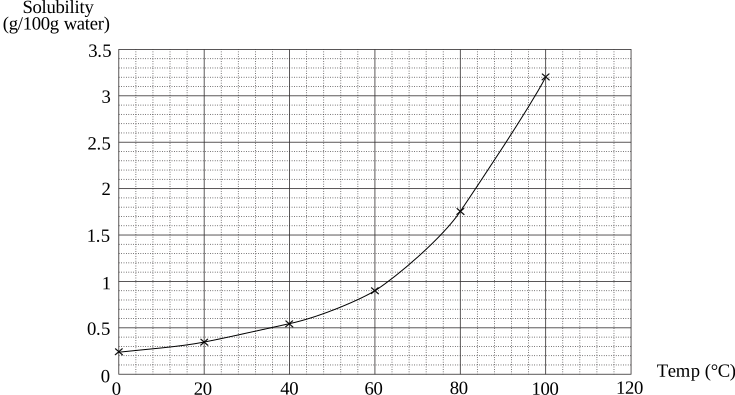
The information in the table shows how the solubility of lead chloride is affected by temperature.  
 

Using a graph, calculate the solubility product \((K_{sp})\) of the dissolution of lead chloride at 50°C. Include a fully labelled graph and a relevant chemical equation in your answer   (6 marks)

 

--- 12 WORK AREA LINES (style=lined) ---
Show Answers Only

\(\ce{K_{sp} = 6.4 \times 10^{-5}}\)

Show Worked Solution


\(\ce{PbCl2(s) \rightleftharpoons Pb^2+(aq) + 2Cl^-(aq)}\)

\(\ce{Using the graph:}\)

\(\ce{Solubility (50°) = 0.7 g/100 g water = 7 g/L}\)

\(\ce{Converting to mol L^{-1}:}\)

\[\ce{MM(PbCl2) = 207.2 + 2 \times 35.45 = 278.1}\]

\[\ce{n = \frac{m}{MM} = \frac{7}{278.1} = 0.0252 mol L^{-1}}\]

\(\ce{[Pb^2+(aq)] = 0.0252 mol L^{-1}}\)
 

\(\ce{Mole ratio \ Pb^2+ : Cl^- = 1:2}\)

\(\Rightarrow \ce{[Cl^-]  = 2 \times 0.0252 = 0.0504 mol L^{-1}}\)
 

\begin{aligned}
\ce{$K_{sp}$} & \ce{= [Pb^2+][Cl^-]^{2}} \\
 & \ce{=0.0252 \times (0.0504)^{2}}  \\
 & \ce{= 6.4 \times 10^{-5}}  \\
\end{aligned}

Filed Under: Solution Equilibria Tagged With: Band 4, Band 5, smc-3672-15-Find K(sp), smc-3672-60-Concentration graphs

CHEMISTRY, M5 EQ-Bank 28

A 100 mL saturated solution of calcium hydroxide at 25°C contains 0.173 g of calcium hydroxide.

  1. Calculate the solubility product \(\ce{($K_{sp}$)}\) of this salt at 25°C.  (3 marks)

    --- 7 WORK AREA LINES (style=lined) ---

  2. Explain why the undissolved solid is not included in the expression for the solubility product constant.  (1 marks)

    --- 2 WORK AREA LINES (style=lined) ---

Show Answers Only

a.    \(\ce{$K_{sp}$ = 5.06 \times 10^{-5}}\)

b.    Undissolved solid:

  • \(\ce{[CaOH2(s)]}\) is constant throughout the reaction.
  • Since it does not change, it is not included in the equilibrium expression.
Show Worked Solution

a.   \(\ce{CaOH2(s) \rightleftharpoons Ca^2+(aq) + 2OH^-(aq)}\)

\(\ce{Solubility = 0.173 g/100 mL = 1.73 g/L}\)

\[\ce{n = \frac{m}{MM} = \frac{1.73}{74.093} = 0.00233 mol}\]

\(\ce{[Ca^{2+}] = 0.0233 mol L^{-1}}\)
 

\(\ce{Mole ratio  \ Ca^2+ : OH^- = 1:2}\)

\(\ce{$K_{sp}$   =[Ca^2+][OH^-]^{2}}\)


\(\ce{[OH^-]  = 2 \times 0.0233 = 0.0466 mol L^{-1}}\)
 

\begin{aligned}
\ce{$K_{sp}$} & \ce{=[Ca^2+][OH^-]^{2}}  \\
 & \ce{= 0.0233 \times (0.0466)^{2}}  \\
 & \ce{= 5.06 \times 10^{-5}}  \\
\end{aligned}

 
b. 
   Undissolved solid:

  • \(\ce{[CaOH2(s)]}\) is constant throughout the reaction.
  • Since it does not change, it is not included in the equilibrium expression.

Filed Under: Solution Equilibria Tagged With: Band 4, Band 5, smc-3672-15-Find K(sp)

CHEMISTRY, M6 EQ-Bank 14 MC

Equal volumes of four different acids are titrated with the same base at 25°.

Information about these acids is given in the table.
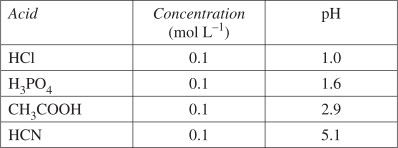
 

Which acid requires the greatest volume of base for complete reaction?

  1. \(\ce{HCl}\)
  2. \(\ce{H3PO4}\)
  3. \(\ce{CH3COOH}\)
  4. \(\ce{HCN}\)
Show Answers Only

`B`

Show Worked Solution
  • The volume of base required for complete reaction is independent of the strength of the acid as all neutralisation reactions go to completion.
  • Phosphoric acid (\(\ce{H3PO4}\)) has three acidic hydrogens whereas the other given bases only have one. So, phosphoric acid requires three times the amount of base as any other acid given.

`=> B`

Filed Under: Quantitative Analysis Tagged With: Band 5, smc-3675-40-Strong/Weak Acids

CHEMISTRY, M6 EQ-Bank 28

The flowchart shown outlines the sequence of steps used to determine the concentration of an unknown hydrochloric acid solution.
 

Describe steps A, B and C including correct techniques, equipment and appropriate calculations. Determine the concentration of the hydrochloric acid.  (8 marks)

--- 16 WORK AREA LINES (style=lined) ---

Show Answers Only

Step A

  • Prepare \(\ce{Na2CO3}\) by drying. Protect solid \(\ce{Na2CO3}\) from moisture in the air by storing in a desiccator.
  • Calculate mass of dried \(\ce{Na2CO3}\) required and weigh accurately.
  •    \(\ce{m(Na2CO3) = 0.1 \times 0.5 \times 105.99 = 5.30 g}\)
  • Clean and rinse a 500 mL volumetric flask with distilled water.
  • Add 5.30 grams of \(\ce{Na2CO3}\) to the volumetric flask using a funnel and wash funnel using distilled water. Add distilled water to the flask to the bottom of the meniscus.

Step B

  • Clean and rinse a 50 mL burette. Fill burette with the unknown acid and place on a retort stand.
  • Clean and rinse a 250 mL conical flask with distilled water.
  • Clean a 25 mL pipette and rinse with 0.1 M \(\ce{Na2CO3}\) solution. Fill pipette with \(\ce{Na2CO3}\) solution to bottom of meniscus.
  • Transfer all pipette solution into conical flask and add an appropriate indicator. A white background (tile) should be placed under the flask to highlight any colour changes in the solution.
  • Slowly add acid solution from the burette into the conical flask and record the volume used when the indicator changes colour.

Step C

  • The initial titration represents a test run to establish an indicative volume. Three subsequent titrations should be performed with the average titration forming the basis of \(\ce{HCl}\) concentration calculations.
  • Calculate the concentration of \(\ce{HCl}\)
  •    \(\ce{2H^+(aq) + CO3^{2-} (aq) \rightarrow H2CO3 (aq) \rightarrow H2O (l) + CO2 (g)}\)
  •    \(\ce{M(Na2CO3) = 0.1 \times 0.025 = 2.5 \times 10^{-3}}\)
  •    \(\ce{M(HCl) = 2 \times M(Na2CO3) = 5\times 10^{-3}}\)
  •    \[\ce{[HCl] = \frac{M(HCl)}{Vol HCl} = \frac{5 \times 10^{-3}}{21.4 \times 10^{-3}} = 0.234 mol L^{-1}}\]
Show Worked Solution

Step A

  • Prepare \(\ce{Na2CO3}\) by drying. Protect solid \(\ce{Na2CO3}\) from moisture in the air by storing in a desiccator.
  • Calculate mass of dried \(\ce{Na2CO3}\) required and weigh accurately.
  •    \(\ce{m(Na2CO3) = 0.1 \times 0.5 \times 105.99 = 5.30 g}\)
  • Clean and rinse a 500 mL volumetric flask with distilled water.
  • Add 5.30 grams of \(\ce{Na2CO3}\) to the volumetric flask using a funnel and wash funnel using distilled water. Add distilled water to the flask to the bottom of the meniscus.

Step B

  • Clean and rinse a 50 mL burette. Fill burette with the unknown acid and place on a retort stand.
  • Clean and rinse a 250 mL conical flask with distilled water.
  • Clean a 25 mL pipette and rinse with 0.1 M \(\ce{Na2CO3}\) solution. Fill pipette with \(\ce{Na2CO3}\) solution to bottom of meniscus.
  • Transfer all pipette solution into conical flask and add an appropriate indicator. A white background (tile) should be placed under the flask to highlight any colour changes in the solution.
  • Slowly add acid solution from the burette into the conical flask and record the volume used when the indicator changes colour.

Step C

  • The initial titration represents a test run to establish an indicative volume. Three subsequent titrations should be performed with the average titration forming the basis of \(\ce{HCl}\) concentration calculations.
  • Calculate the concentration of \(\ce{HCl}\)
  •    \(\ce{2H^+(aq) + CO3^{2-} (aq) \rightarrow H2CO3 (aq) \rightarrow H2O (l) + CO2 (g)}\)
  •    \(\ce{M(Na2CO3) = 0.1 \times 0.025 = 2.5 \times 10^{-3}}\)
  •    \(\ce{M(HCl) = 2 \times M(Na2CO3) = 5\times 10^{-3}}\)
  •    \[\ce{[HCl] = \frac{M(HCl)}{Vol HCl} = \frac{5 \times 10^{-3}}{21.4 \times 10^{-3}} = 0.234 mol L^{-1}}\]

Filed Under: Quantitative Analysis Tagged With: Band 4, Band 5, smc-3675-10-Titration

CHEMISTRY, M6 EQ-Bank 29

Explain why a mixture of acetic acid (1 M) and sodium acetate (1 M) can act as a buffer while a mixture of hydrochloric acid (1 M) and sodium chloride (1 M) cannot.   (3 marks)

--- 8 WORK AREA LINES (style=lined) ---

Show Answers Only
  • A buffer is a mixture of a weak acid and its conjugate base which is able to counteract changes in pH when small amounts of acid or base is added.
  • In this case acetic acid and sodium acetate can act as a buffer. The following equilibrium is established:
  •    \(\ce{CH3COOH(aq) + H2O(l) \rightleftharpoons CH3COO^-(aq) + H3O+(aq)}\)
  • Any addition of acid to the mixture increases the \(\ce{[H3O^+]}\) and shifts the above equilibrium to the left, removing \(\ce{H3O^+}\) ions and minimising a change in pH. 
  • Likewise, any addition of base causes \(\ce{OH^-}\) ions to react with \(\ce{H3O^+}\) in solution. This shifts the above equilibrium to the right, generating more \(\ce{H3O^+}\) and maintaining a relatively constant pH.
  • Hydrochloric acid is a strong acid, so its conjugate base, chloride has negligible basic activity.
  • The dissociation of hydrochloric acid goes to completion, so addition of base simply lowers the pH of the solution as there is no aqueous hydrochloric acid able to generate \(\ce{H3O^+}\). Addition of acid will raise the pH as chloride ions are unable to react with \(\ce{H3O^+}\) ions.
Show Worked Solution
  • A buffer is a mixture of a weak acid and its conjugate base which is able to counteract changes in pH when small amounts of acid or base is added.
  • In this case acetic acid and sodium acetate can act as a buffer. The following equilibrium is established:
  •    \(\ce{CH3COOH(aq) + H2O(l) \rightleftharpoons CH3COO^-(aq) + H3O+(aq)}\)
  • Any addition of acid to the mixture increases the \(\ce{[H3O^+]}\) and shifts the above equilibrium to the left, removing \(\ce{H3O^+}\) ions and minimising a change in pH. 
  • Likewise, any addition of base causes \(\ce{OH^-}\) ions to react with \(\ce{H3O^+}\) in solution. This shifts the above equilibrium to the right, generating more \(\ce{H3O^+}\) and maintaining a relatively constant pH.
  • Hydrochloric acid is a strong acid, so its conjugate base, chloride has negligible basic activity.
  • The dissociation of hydrochloric acid goes to completion, so addition of base simply lowers the pH of the solution as there is no aqueous hydrochloric acid able to generate \(\ce{H3O^+}\). Addition of acid will raise the pH as chloride ions are unable to react with \(\ce{H3O^+}\) ions.

Filed Under: Quantitative Analysis Tagged With: Band 5, smc-3675-60-Buffers

CHEMISTRY, M6 EQ-Bank 24

The pH of a 0.30 M aqueous propanoic acid solution was measured to be 2.7. The dissociation of propanoic acid is represented below.

\(\ce{CH3CH2COOH($aq$) + H2O($l$) \rightleftharpoons CH3CH2COO^-($aq$) + H3O^{+}($aq$)}\)

Calculate the `K_a` of the solution.   (3 marks)

Show Answers Only

\(\ce{$K_{a}$ = 1.3 \times 10^{-5}}\)

Show Worked Solution

\(\ce{pH = -log_{10}[H3O^{+}] = 2.7} \)

\(\ce{[H3O^{+}] = 10^{-2.7} = 1.995 \times 10^{-3} mol L^{-1}}\)

\(\ce{[H3O^{+}] = [CH3CH2COO^{-}]} \)

\begin{aligned}
\ce{$K_{a}$} &= \dfrac{\ce{[H3O^{+}][CH3CH2COO^{-}]}}{\ce{[CH3CH2COOH]}}  \\
&= \dfrac{\ce{(1.995 \times 10^{-3})(1.995 \times 10^{-3})}}{\ce{(0.30 – 1.995 \times 10^{-3})}}   \\
&= \ce{1.3 \times 10^{-5}}
\end{aligned}

Filed Under: Quantitative Analysis Tagged With: Band 5, smc-3675-30-Ka/Kb

CHEMISTRY, M7 EQ-Bank 27

Contrast ONE addition polymer and ONE condensation polymer in terms of their structures, properties and uses. Include structural formulae in your answers.   (7 marks)

--- 20 WORK AREA LINES (style=lined) ---

Show Answers Only

Addition polymer – polyethylene. Condensation polymer – nylon.

Structures
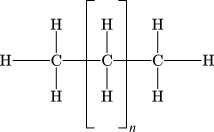
  • Polyethylene is made by the addition of ethylene monomers with the following structural formula:

  • Nylon is a condensation polymer made from 1,6-diaminohexane and adipic acid, producing a by-product of water molecules. It has the following structural formula.

Properties

  • Polyethylene is inexpensive, weatherproof and relatively resistant to chemicals.
  • There are two main types of polyethylene which have different properties. Low-density polyethylene (LDPE) is semi-rigid while high density polyethylene (HDPE) is fluid.
  • Nylon is strong and relatively resistant to moisture absorptivity. It is longer lasting than polyethylene, resistant to chemicals and is used to make nylon fibre.

Applications

  • LDPE is used to produce products such as plastic soft drink bottles, flexible water pipes and cling wrap. HDPE’s fluidity make it an appropriate material for producing shopping bags, plastic crates and drums for storage.
  • Nylon is very versatile in its manufacturing uses. It is a common input for clothing, can be used for injection-moulded parts for vehicles and also as reinforcement for rubber tyres. 
  • Nylon is also used as the main material input for nylon thread which has a myriad of uses, including stitching for clothes and the production of rope.
Show Worked Solution

Addition polymer – polyethylene. Condensation polymer – nylon.

Structures
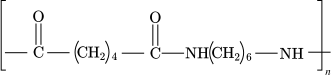
  • Polyethylene is made by the addition of ethylene monomers with the following structural formula:

  • Nylon is a condensation polymer made from 1,6-diaminohexane and adipic acid, producing a by-product of water molecules. It has the following structural formula.

Properties

  • Polyethylene is inexpensive, weatherproof and relatively resistant to chemicals.
  • There are two main types of polyethylene which have different properties. Low-density polyethylene (LDPE) is semi-rigid while high density polyethylene (HDPE) is fluid.
  • Nylon is strong and relatively resistant to moisture absorptivity. It is longer lasting than polyethylene, resistant to chemicals and is used to make nylon fibre.

Applications

  • LDPE is used to produce products such as plastic soft drink bottles, flexible water pipes and cling wrap. HDPE’s fluidity make it an appropriate material for producing shopping bags, plastic crates and drums for storage.
  • Nylon is very versatile in its manufacturing uses. It is a common input for clothing, can be used for injection-moulded parts for vehicles and also as reinforcement for rubber tyres. 
  • Nylon is also used as the main material input for nylon thread which has a myriad of uses, including stitching for clothes and the production of rope.

Filed Under: Polymers Tagged With: Band 4, Band 5, smc-3681-10-Addition Polymers, smc-3681-20-Condensation Polymers

CHEMISTRY, M6 EQ-Bank 25

The graph shows changes in pH for the titrations of equal volumes of solutions of two monoprotic acids, Acid 1 and Acid 2.
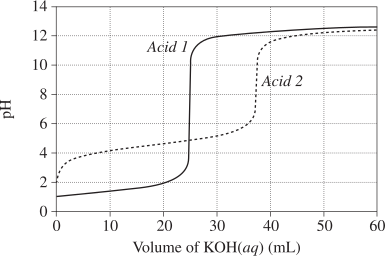
 

Explain the differences between Acid 1 and Acid 2 in terms of their relative strengths and concentrations.   (3 marks)

--- 6 WORK AREA LINES (style=lined) ---

Show Answers Only
  • Acid 1 is a strong acid. Its initial pH = 1 and its equivalence point is at pH = 7.
  • Acid 2 is a weaker acid. Its initial pH ~ 2 and its equivalence point is >7.
  • Acid 2 has a higher concentration than Acid 1 as it doesn’t take that much more \(\ce{KOH}\) to neutralise it.
Show Worked Solution
  • Acid 1 is a strong acid. Its initial pH = 1 and its equivalence point is at pH = 7.
  • Acid 2 is a weaker acid. Its initial pH ~ 2 and its equivalence point is >7.
  • Acid 2 has a higher concentration than Acid 1 as it doesn’t take that much more \(\ce{KOH}\) to neutralise it.

Filed Under: Bronsted-Lowry Theory, Quantitative Analysis Tagged With: Band 5, smc-3674-15-pH of Mixed Solution, smc-3674-20-Strong/Weak Acids & Bases, smc-3675-20-Titration Curves and Conductivity Graphs, smc-3675-40-Strong/Weak Acids

CHEMISTRY, M5 EQ-Bank 15 MC

What will happen when sulfuric acid is added to a saturated solution of sparingly soluble calcium sulfate?

  1. The concentration of calcium and sulfate ions will increase over time due to the presence of \(\ce{H^{+}}\) ions.
  2. The concentration of calcium and sulfate ions will decrease over time due to the presence of \(\ce{H^{+}}\) ions.
  3. The concentration of calcium and sulfate ions will increase over time due to the presence of \(\ce{SO4^{2-}}\) ions.
  4. The concentration of calcium and sulfate ions will decrease over time due to the presence of \(\ce{SO4^{2-}}\) ions.
Show Answers Only

`D`

Show Worked Solution
  • The saturated solution of calcium sulfate is originally at equilibrium
  •    \(\ce{CaSO4(s) \rightleftharpoons Ca^2+(aq) + SO4^2-(aq)}\)
  • The addition of sulfuric acid increases the concentration of \(\ce{SO4^{2-}}\) (sulfate) ions in solution.
  • By Le Chatelier’s principle, the above equilibrium will shift left to counteract this, decreasing the concentration of calcium and sulfate ions over time.

`=>D`

Filed Under: Solution Equilibria Tagged With: Band 5, smc-3672-70-Precipitate

CHEMISTRY, M5 EQ-Bank 13 MC

0.20 moles of phosphorus pentachloride were heated to 200°C in a 2 L container in the presence of a vanadium catalyst according to the following reaction.

\( \ce{PCl5(g) \rightleftharpoons  PCl3(g) + Cl2(g)}\)

At equilibrium, the mixture was found to contain 0.16 moles of chlorine.

Which of the following is the equilibrium constant for this reaction at this temperature?

  1. 0.32
  2. 0.64
  3. 1.56
  4. 3.13
Show Answers Only

`A`

Show Worked Solution

\(\ce{PCl5(g) \rightleftharpoons PCl3(g) + Cl2(g)}\)

\[\ce{[PCl5]_{init} = \frac{n}{V} = \frac{0.20}{2} = 0.10 mol L^{-1}}\]

\begin{array} {|l|c|c|c|}
\hline  & \ce{[PCl5]} & \ce{[PCl3]}  & \ce{[Cl2]} \\
\hline \text{Initial} & 0.10 & 0  & 0 \\
\hline \text{Change} & -0.08 & +0.08  & +0.08 \\
\hline \text{Equilibrium} & 0.02  & 0.08 & 0.08 \\
\hline \end{array}

 
\[\ce{$K_{eq}$ = \frac{[PCl3][Cl2]}{[PCl5]} = \frac{0.08^2}{0.02} = 0.32}\]

`=>A`

Filed Under: Equilibrium Constant Tagged With: Band 5, smc-3671-10-Find K(eq)

Algebra, STD1 A3 2019 HSC 9 MC

The container shown is initially full of water.
 

Water leaks out of the bottom of the container at a constant rate.

Which graph best shows the depth of water in the container as time varies?
 

A. B.
C. D.
Show Answers Only

`D`

Show Worked Solution

`text(Depth will decrease slowly at first and accelerate.)`

`=> D`

Filed Under: Non-Linear: Inverse and Other Problems (Std 2), Quadratics, Variation and Rates of Change Tagged With: Band 5, num-title-ct-pathb, num-title-qs-hsc, smc-4239-60-Variable rates of change, smc-795-20-Other Relationship

Financial Maths, STD1 F3 2021 HSC 30

Blake opens a new credit card account on 1 May. He uses it, for the first time, on 4 May to buy concert tickets for $850.

He makes no further purchases or repayments during the month of May.

A statement for the credit card is issued on the last day of each month.

The statement for May shows that interest is charged at 19.75% per annum, compounding daily, from 20 May (included) until 31 May (included).

  1. What is the compound interest shown on the statement issued on 31 May?  (3 marks)

    --- 6 WORK AREA LINES (style=lined) ---

  2. The minimum payment is calculated as 3% of the closing balance on 31 May. Calculate the minimum payment.  (1 mark)

    --- 1 WORK AREA LINES (style=lined) ---

Show Answers Only
  1. `$5.54`
  2. `$25.67`
Show Worked Solution

a.   `text(Daily interest rate) = 19.75/365 = 0.05411text(%) = 0.0005411`

`text(Days incurring interest = 12)`

`text{Card balance (31 May)}` `= PV(1+r)^n`
  `= 850 (1 + 0.0005411)^12`
  `= $855.54`


`:.\ text(Interest)` `= 855.54-850`
  `= $5.54`


b.    `text(Minimum payment)` `= 855.54 xx 0.03`
    `= $25.67`

Filed Under: Loans and Credit Cards (Std 2) Tagged With: Band 4, Band 5, smc-814-10-Credit Cards

CHEMISTRY, M5 EQ-Bank 21

Three gases \(\ce{X, Y}\) and \(\ce{Z}\) were mixed in a closed container and allowed to reach equilibrium. A change was imposed at time \(\ce{$T$}\) and the equilibrium was re-established. The concentration of each gas is plotted against time.
 

  1. What is a possible change that was imposed at time \(\ce{$T$}\)?   (1 mark)

    --- 2 WORK AREA LINES (style=lined) ---

  2. Write a chemical reaction that is represented by the concentration graph above.   (2 marks)

    --- 4 WORK AREA LINES (style=lined) ---

Show Answers Only

a.    An increase in the volume of the container.

b.    \( \ce{X(g) \rightleftharpoons Y(g) + Z(g)}\)

Show Worked Solution

a.   At time \(\ce{$T$}\):

  • The concentration of all species decreases by an amount proportional to their initial concentration.
  • This could be due to an increase in the volume of the container.

b.   Chemical reaction:

  • After the system change, equilibrium re-establishes by favouring the conversion of \(\ce{X}\) into \(\ce{Y}\) and \(\ce{Z}\) .
  • As change in concentration of all species is equal, they react in a 1:1:1 molar ratio.
  • Therefore the chemical reaction is:  \( \ce{X(g) \rightleftharpoons Y(g) + Z(g)}\)

Filed Under: Factors that Affect Equilibrium Tagged With: Band 3, Band 5, smc-3670-30-Concentration, smc-3670-60-Concentration diagrams

CHEMISTRY, M5 EQ-Bank 12 MC

Nitrogen dioxide (a brown gas) and dinitrogen tetroxide (a colourless gas) are both forms of oxides of nitrogen. They are in equilibrium according to the equation

\( \ce{2NO2(g) \rightleftharpoons N2O4(g)}\).

An equilibrium mixture of the two gases at room temperature is light brown but at higher temperatures the colour becomes a much deeper brown.

What conclusion can be drawn from this observation?

  1. The reverse reaction in the equation is endothermic.
  2. The forward reaction in the equation is endothermic.
  3. The brown colour is due to the strong nitrogen–oxygen bonds in \(\ce{NO2}\).
  4. The equilibrium concentration of \( \ce{N2O4}\) is not dependent on temperature.
Show Answers Only

`A`

Show Worked Solution
  • Le Chatelier’s principle states that when an equilibrium system is subject to a change in conditions, it will shift such as to partially counteract the imposed change.
  • When the temperature of the system is increased, it will shift to favour the endothermic reaction, counteracting the increase in temperature.
  • In this case, the deeper brown colour shows the conversion to nitrogen dioxide is favoured following an increase in temperature. The reverse reaction is therefore endothermic.

`=>A`

Filed Under: Factors that Affect Equilibrium Tagged With: Band 5, smc-3670-10-Temperature

CHEMISTRY, M7 EQ-Bank 26

This flow chart shows reactions involving six different organic compounds (A to F).


Draw the structures of compounds A to F, justifying your diagrams with reference to the information provided.   (7 marks)

--- 16 WORK AREA LINES (style=lined) ---

Show Answers Only

A:  
       

B:  
       

C:  
           

D:  
       

E:  
       

F:  
       

Show Worked Solution
  • A combines with dilute  \(\ce{H2SO4}\)  to produce two alcohols.
  • C doesn’t react with strong oxidant (i.e. it is a tertiary alcohol).

C:  
           

  • B must therefore be 2-methylbutan-1-ol or 3-methylbutan-2-ol.
  • Since B gives two products when heated with concentrated \(\ce{H2SO4}\), it must be 3-methylbutan-2-ol, as 2-methylbutan-1-ol will only produce one product.

B:  
       

  • D is a ketone, produced by B reacting with a strong oxidant.

D:  
       

  • A can be dehydrated using concentrated  \(\ce{H2SO4}\)  on either B or C.

A:  
       

  • B dehydrates to A or E. Given A‘s structure above,

E:  
       

  • C dehydrates to A or F. Again, given A’s structure above,

F:  
       

Filed Under: Hydrocarbons and Associated Reactions Tagged With: Band 4, Band 5, smc-3677-40-Molecular Shape, smc-3677-80-Reactions of Saturated Hydrocarbons

CHEMISTRY, M8 EQ-Bank 23

\(\ce{Fe^2^+}\) and \(\ce{X} \) react to form an ionic compound according to the general equation

\(\ce{aFe^2^+ + $b$(X)\rightleftharpoons [Fe_a(X)_b]^2^a^+}\)

where \(\ce{$a$}\) and \(\ce{$b$}\) are numbers representing the ratio in which \(\ce{Fe^2^+}\) and \(\ce{X} \) combine.

Spectrophotometry was used to determine the stoichiometric ratio between \(\ce{Fe^2^+}\) and \(\ce{X} \). To do this, eight 10 mL samples were prepared by reacting solutions of \(\ce{Fe^2^+}\) with solutions of \(\ce{X} \) in varying ratios. All \(\ce{Fe^2^+}\) and \(\ce{X} \) solutions had the same concentration. The absorbance of the samples is tabulated below.
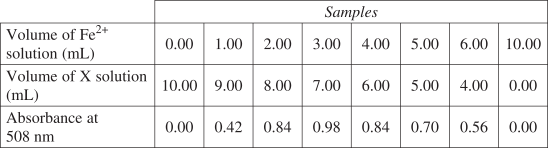
 

  1. On the grid, construct a graph of absorbance against volume of \(\ce{Fe^2^+}\) solution from 0.00 mL to 6.00 mL, and draw TWO lines of best fit.  (3 marks)


  1. The reaction proceeds according to the general equation
  2.       \(\ce{aFe^2^+ + $b$X \rightleftharpoons [Fe_a(X)_b]^2^a^+}\).
  3. Find the values of \(\ce{$a$}\) and \(\ce{$b$}\) . Justify your answer with reference to the data given and the graph in part (a).   (3 marks)

    --- 8 WORK AREA LINES (style=lined) ---

Show Answers Only

a.  
           

b.   Find values of \(\ce{$a$}\) and \(\ce{$b$}\):

  • The graph shows that as the volume of compound \(\ce{X} \) decreases between 10mL and 7.5mL, there is an increase in \(\ce{Fe^{2+}}\) ions. This indicates an excess of \(\ce{Fe^{2+}}\) ions limiting the products.
  • The absorbance reaches a maximum when the 2.5 mL of compound \(\ce{Fe^{2+}}\) is added to 7.5 mL of compound \(\ce{X}\). Since the concentrations of the initial solutions are equal (given), equal volumes contain equal moles.
  • The ratio of volumes at peak absorbance = 2.5 : 7.5 = 1 : 3 (i.e. the correct stoichiometric ratio).
  • Hence \(\ce{$a$ = 1}\) and \(\ce{$b$ = 3}\).
  • The curve then turns down sharply, indicating a reduction in \(\ce{Fe^{2+}}\).
Show Worked Solution

a.  
           

b.   Find values of \(\ce{$a$}\) and \(\ce{$b$}\):

  • The graph shows that as the volume of compound \(\ce{X} \) decreases between 10mL and 7.5mL, there is an increase in \(\ce{Fe^{2+}}\) ions. This indicates an excess of \(\ce{Fe^{2+}}\) ions limiting the products.
  • The absorbance reaches a maximum when the 2.5 mL of compound \(\ce{Fe^{2+}}\) is added to 7.5 mL of compound \(\ce{X}\). Since the concentrations of the initial solutions are equal (given), equal volumes contain equal moles.
  • The ratio of volumes at peak absorbance = 2.5 : 7.5 = 1 : 3 (i.e. the correct stoichiometric ratio).
  • Hence \(\ce{$a$ = 1}\) and \(\ce{$b$ = 3}\).
  • The curve then turns down sharply, indicating a reduction in \(\ce{Fe^{2+}}\).

Filed Under: Inorganic Substances Tagged With: Band 4, Band 5, smc-3682-50-Stoichiometric Calculations

CHEMISTRY, M8 EQ-Bank 28

Limestone \(\ce{(CaCO_3)}\) contributes to the hardness of water by releasing \(\ce{Ca^2^+}\) ions. The following chemical equation represents this reaction.

\(\ce{CaCO3($s$) + H_2O($l$) + CO_2($g$) \rightleftharpoons Ca^2^+($aq$) + 2HCO3^-($aq$)}\)      \((\Delta H<0)\)

It has been suggested that heating water reduces its hardness.

Explain how this suggestion can be tested accurately, validly and reliably.   (9 marks)

--- 30 WORK AREA LINES (style=lined) ---

Show Answers Only
  • Atomic absorption spectroscopy (AAS) can be used to test if heating reduces water hardness.
  • It does this by calculating the concentrations of metal ions in solutions. AAS can calculate the concentration of \(\ce{Ca^{2+}}\) in heated and non-heated samples of water and any difference in the relative concentrations of \(\ce{Ca^{2+}}\) can be used to verify the suggestion.
  • It should be noted that a reduced concentration of \(\ce{Ca^{2+}}\) indicates that the water hardness is reduced.

Methodology of testing

  • Prepare standard solutions with known concentrations of \(\ce{Ca^{2+}}\) and measure their absorbance. Plot the concentrations against the absorbance of the standard solutions and draw a calibration curve (i.e. a line of best fit).
  • Measure the absorbance of a water sample before heating and another after heating. Using the absorbance and the calibration curve, calculate the concentration of \(\ce{Ca^{2+}}\) in each sample and compare the concentrations between the heated and unheated samples.
  • The AAS should be calibrated, at which point the concentration of calcium ions can be calculated to an accuracy in the parts per million (ppm). To ensure accurate calibration of the AAS, the standard solutions need to be prepared precisely which will involve the accurate weighing of solids and the use of a pipette or a similar instrument to measure solution volumes.
  • Water used in the experiment should be de-ionised (normal drinking water has an abundance of \(\ce{Na+}\) and \(\ce{Ca^{2+}}\)).
  • The margin of experimental error decreases when sufficient calibration samples are used and the measurement of absorbance of these samples is repeated and averaged. 
  • The reliability of results increases when many samples of heated and non-heated water are used to confirm that the concentrations of \(\ce{Ca^{2+}}\) in the heated water samples are consistently lower than the concentrations of \(\ce{Ca^{2+}}\) in the unheated water samples.
  • AAS can also be used to test the validity of the results. A hollow cathode lamp for calcium can direct light through the solution. This light has a specific wavelength that will only be absorbed by calcium ions. In this way, accurate measurements are made which can then be compared against the results and provide evidence of the validity of the original suggestion.
Show Worked Solution
  • Atomic absorption spectroscopy (AAS) can be used to test if heating reduces water hardness.
  • It does this by calculating the concentrations of metal ions in solutions. AAS can calculate the concentration of \(\ce{Ca^{2+}}\) in heated and non-heated samples of water and any difference in the relative concentrations of \(\ce{Ca^{2+}}\) can be used to verify the suggestion.
  • It should be noted that a reduced concentration of \(\ce{Ca^{2+}}\) indicates that the water hardness is reduced.

Methodology of testing

  • Prepare standard solutions with known concentrations of \(\ce{Ca^{2+}}\) and measure their absorbance. Plot the concentrations against the absorbance of the standard solutions and draw a calibration curve (i.e. a line of best fit).
  • Measure the absorbance of a water sample before heating and another after heating. Using the absorbance and the calibration curve, calculate the concentration of \(\ce{Ca^{2+}}\) in each sample and compare the concentrations between the heated and unheated samples.
  • The AAS should be calibrated, at which point the concentration of calcium ions can be calculated to an accuracy in the parts per million (ppm). To ensure accurate calibration of the AAS, the standard solutions need to be prepared precisely which will involve the accurate weighing of solids and the use of a pipette or a similar instrument to measure solution volumes.
  • Water used in the experiment should be de-ionised (normal drinking water has an abundance of \(\ce{Na+}\) and \(\ce{Ca^{2+}}\)).
  • The margin of experimental error decreases when sufficient calibration samples are used and the measurement of absorbance of these samples is repeated and averaged. 
  • The reliability of results increases when many samples of heated and non-heated water are used to confirm that the concentrations of \(\ce{Ca^{2+}}\) in the heated water samples are consistently lower than the concentrations of \(\ce{Ca^{2+}}\) in the unheated water samples.
  • AAS can also be used to test the validity of the results. A hollow cathode lamp for calcium can direct light through the solution. This light has a specific wavelength that will only be absorbed by calcium ions. In this way, accurate measurements are made which can then be compared against the results and provide evidence of the validity of the original suggestion.

Filed Under: Inorganic Substances Tagged With: Band 4, Band 5, Band 6, smc-3682-60-Colourimetry UV-Vis and AAS

CHEMISTRY, M5 EQ-Bank 12

An industrial plant makes ammonia from nitrogen gas and hydrogen gas. The reaction is exothermic.  

The graph shows the adjustments made to increase the yield of ammonia.
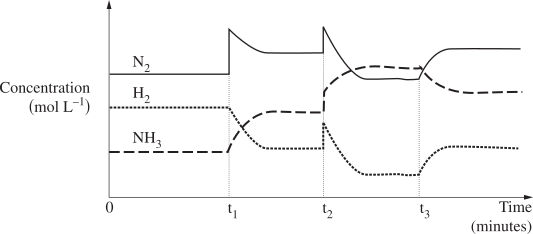
Account for the changes in conditions that have shaped the graph during the time the system was observed. Include a relevant chemical equation in your answer.   (5 marks)

Show Answers Only

\(\ce{N2(g) + 3H2(g) \rightleftharpoons 2NH3(g) \ \ \ \ ΔH = -92 kJ mol}^{-1} \)

From \( t_0\) to \(t_1: \) the system is in equilibrium.

At \(t_1:\)

  • Nitrogen is introduced to the system and its concentration increases sharply.
  • Le Chatelier’s principle states that when a system in equilibrium is disturbed, the equilibrium will shift in the direction that minimises the change. In this case, the equilibrium will shift to the right to use up more nitrogen. A greater yield of ammonia will result until equilibrium is re-established.

At \(t_2:\)

  • The concentration of both reactants and products increases. This effect could be caused by a decrease in volume of the reaction vessel which will result in an increase in pressure on the system.
  • The above equation shows that 4 moles of gas (on the left-hand side) react to form 2 moles of gas (on the right-hand side). Le Chatelier’s principle dictates that this increase in pressure will cause the system to again shift right, to the side with fewer moles of gas, to counteract the change.
  • This right shift will further increase the yield of ammonia until equilibrium is re-established.

At \(t_3:\)

  • There is a change to the system that shifts the reaction back to the left. The gradual change in concentrations indicate that this could be due to a change in temperature.
  • Since this reaction is exothermic, the reverse reaction (left shift) absorbs heat. An increase in temperature would cause this shift, lowering the yield of ammonia until equilibrium is again restored.
Show Worked Solution

\(\ce{N2(g) + 3H2(g) \rightleftharpoons 2NH3(g) \ \ \ \ ΔH = -92 kJ mol}^{-1} \)

From \( t_0\) to \(t_1: \) the system is in equilibrium.

At \(t_1:\)

  • Nitrogen is introduced to the system and its concentration increases sharply.
  • Le Chatelier’s principle states that when a system in equilibrium is disturbed, the equilibrium will shift in the direction that minimises the change. In this case, the equilibrium will shift to the right to use up more nitrogen. A greater yield of ammonia will result until equilibrium is re-established.

At \(t_2:\)

  • The concentration of both reactants and products increases. This effect could be caused by a decrease in volume of the reaction vessel which will result in an increase in pressure on the system.
  • The above equation shows that 4 moles of gas (on the left-hand side) react to form 2 moles of gas (on the right-hand side). Le Chatelier’s principle dictates that this increase in pressure will cause the system to again shift right, to the side with fewer moles of gas, to counteract the change.
  • This right shift will further increase the yield of ammonia until equilibrium is re-established.

At \(t_3:\)

  • There is a change to the system that shifts the reaction back to the left. The gradual change in concentrations indicate that this could be due to a change in temperature.
  • Since this reaction is exothermic, the reverse reaction (left shift) absorbs heat. An increase in temperature would cause this shift, lowering the yield of ammonia until equilibrium is again restored.

Filed Under: Factors that Affect Equilibrium Tagged With: Band 4, Band 5, smc-3670-10-Temperature, smc-3670-29-Pressure, smc-3670-60-Concentration diagrams

PHYSICS, M5 EQ-Bank 29

A student used the following scale diagram to investigate orbital properties. The diagram shows a planet and two of its moons, \(V\)  and \(W\). The distances between each of the moons and the planet are to scale while the sizes of the objects are not.
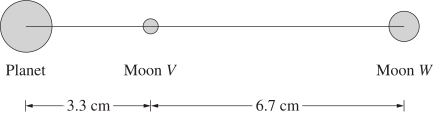
 

Complete the table to compare the orbital properties of Moon \(V\) and Moon \(W\). Show relevant calculations in the space below the table.  (4 marks)

--- 0 WORK AREA LINES (style=lined) ---

\begin{array}{|l|c|c|c|}
\hline
\rule{0pt}{2.5ex} & \textit{Orbital radius} & \textit{Orbital period} & \textit{Orbital velocity}\\
& \text{(\(W\) relative to \(V\))} \rule[-1ex]{0pt}{0pt}&  \text{(\(W\) relative to \(V\))}  &  \text{(\(W\) relative to \(V\))} \\
\hline
\rule{0pt}{3.5ex}\text{Quantitative}&\text{}&\text{}&\text{}\\
\text{comparison}\rule[-2ex]{0pt}{0pt}&\text{}&\text{}&\text{}\\
\hline
\rule{0pt}{3.5ex}\text{Qualitative}&\text{}&\text{}&\text{}\\
\text{comparison}\rule[-2ex]{0pt}{0pt}&\text{}&\text{}&\text{}\\
\hline
\end{array}

Show Answers Only

\begin{array} {|l|c|c|c|}
\hline  \rule{0pt}{2.5ex}  & \textit{Orbital radius} & \textit{Orbital period} & \textit{Orbital velocity} \\
\hline \rule{0pt}{2.5ex}\text{Quantitative Comp.} \rule[-1ex]{0pt}{0pt}& 3.0 & 5.2 & 0.58 \\
\hline \rule{0pt}{2.5ex}\text{Qualitative Comp.} \rule[-1ex]{0pt}{0pt}& \text{Larger} & \text{Larger} & \text{Slower} \\
\hline \end{array}

 
Comparing radii:

\(\dfrac{r_w}{r_v}=\dfrac{10}{3.3}=3\)
 

As moons \(V\) and \(W\) are both orbiting the same body, the ratio \(\dfrac{r^3}{T^2}\) will be the same for both.

Comparing orbital periods:

\(\dfrac{r_w^3}{T_w^2}\) \(=\frac{r_v^3}{T_v^2}\)  
\(\left(\dfrac{T_w}{T_v}\right)^2\) \(=\left(\dfrac{r_w}{r_v}\right)^3=3^3\)  
\(\dfrac{T_w}{T_v}=\) \(=\sqrt{27}=5.2\)  

 
Comparing orbital velocities:

\(v=\dfrac{2 \pi r}{T}\)

 
Using the calculations for radius and period:

\(v_w\) \(=\dfrac{2 \pi r_w}{T_w}\)  
  \(=\dfrac{2 \pi\left(3.0 \times r_v\right)}{5.2 \times T_v}\)  
  \(=\dfrac{3.0}{5.2} \times \dfrac{2 \pi r_v}{T_v}\)  
  \(=\dfrac{3.0}{5.2} \times v_v\)  
\(\dfrac{v_w}{v_v}\) \(=0.58\)  

Show Worked Solution

\begin{array} {|l|c|c|c|}
\hline  \rule{0pt}{2.5ex}  & \textit{Orbital radius} & \textit{Orbital period} & \textit{Orbital velocity} \\
\hline \rule{0pt}{2.5ex}\text{Quantitative Comp.} \rule[-1ex]{0pt}{0pt}& 3.0 & 5.2 & 0.58 \\
\hline \rule{0pt}{2.5ex}\text{Qualitative Comp.} \rule[-1ex]{0pt}{0pt}& \text{Larger} & \text{Larger} & \text{Slower} \\
\hline \end{array}

 
Comparing radii:

\(\dfrac{r_w}{r_v}=\dfrac{10}{3.3}=3\)
 

As moons \(V\) and \(W\) are both orbiting the same body, the ratio \(\dfrac{r^3}{T^2}\) will be the same for both.

Comparing orbital periods:

\(\dfrac{r_w^3}{T_w^2}\) \(=\frac{r_v^3}{T_v^2}\)  
\(\left(\dfrac{T_w}{T_v}\right)^2\) \(=\left(\dfrac{r_w}{r_v}\right)^3=3^3\)  
\(\dfrac{T_w}{T_v}=\) \(=\sqrt{27}=5.2\)  

 
Comparing orbital velocities:

\(v=\dfrac{2 \pi r}{T}\)

 
Using the calculations for radius and period:

\(v_w\) \(=\dfrac{2 \pi r_w}{T_w}\)  
  \(=\dfrac{2 \pi\left(3.0 \times r_v\right)}{5.2 \times T_v}\)  
  \(=\dfrac{3.0}{5.2} \times \dfrac{2 \pi r_v}{T_v}\)  
  \(=\dfrac{3.0}{5.2} \times v_v\)  
\(\dfrac{v_w}{v_v}\) \(=0.58\)  

Filed Under: Motion in Gravitational Fields Tagged With: Band 5, smc-3692-30-Orbital Velocity/Period/Radius

PHYSICS, M5 EQ-Bank 28

A bullet is fired vertically from the surface of Mars, at the escape velocity of Mars. Another bullet is fired vertically from the surface of Earth, at the escape velocity of Earth.

Neglecting air resistance, compare the energy transformations of the two bullets.   (5 marks)

Show Answers Only
  • The total energy of the bullet fired from the surface of Mars will remain constant. Its kinetic energy will transform into potential energy as it gains altitude. 
  • As the bullet fired from Mars reaches an ‘infinite’ distance away, it escapes Mars’ gravitational attraction. Here, the kinetic energy of the bullet is zero as it has expended all of its initial kinetic energy.
  • The potential energy (`U`) of the bullet has also decreased to zero as  `U=-(GMm)/(r)`.
  • A similar process occurs for the bullet fired from the surface of Earth at its escape velocity. As the mass and radius of Earth are different to that of Mars, the actual escape velocity, `v_(esc)=sqrt((2GM)/(r))` will be different.
  • The initial values of kinetic and potential energy, `U=-(GMm)/(r)` will also be different.
Show Worked Solution
  • The total energy of the bullet fired from the surface of Mars will remain constant. Its kinetic energy will transform into potential energy as it gains altitude. 
  • As the bullet fired from Mars reaches an ‘infinite’ distance away, it escapes Mars’ gravitational attraction. Here, the kinetic energy of the bullet is zero as it has expended all of its initial kinetic energy.
  • The potential energy (`U`) of the bullet has also decreased to zero as  `U=-(GMm)/(r)`.
  • A similar process occurs for the bullet fired from the surface of Earth at its escape velocity. As the mass and radius of Earth are different to that of Mars, the actual escape velocity, `v_(esc)=sqrt((2GM)/(r))` will be different.
  • The initial values of kinetic and potential energy, `U=-(GMm)/(r)` will also be different.

Filed Under: Motion in Gravitational Fields Tagged With: Band 4, Band 5, smc-3692-20-Energy Changes, smc-3692-70-Escape Velocity

PHYSICS, M5 EQ-Bank 25

In the 1840s, French physicist, Hippolyte Fizeau performed an experiment to measure the speed of light. He shone an intense light source at a mirror 8 km away and broke up the light beam with a rotating cogwheel. He adjusted the speed of rotation of the wheel until the reflected light beam could no longer be seen returning through the gaps in the cogwheel.

The diagram shows a similar experiment. The cogwheel has 50 teeth and 50 gaps of the same width.
 

Explain why specific speeds of rotation of the cogwheel will completely block the returning light. Support your answer with calculations.   (5 marks)

--- 13 WORK AREA LINES (style=lined) ---
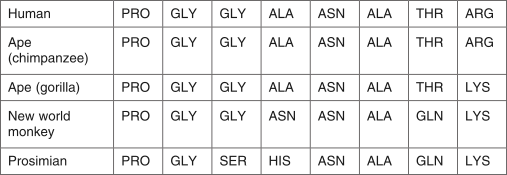
Show Answers Only
  • Light travelling through a gap in the cogwheel can be completely blocked by a tooth. This occurs if a tooth moves exactly the width of a gap in the time it takes for light to travel to the mirror and back.
  • Calculating the time taken:
  •    `t=(s)/(v)=(2xx8000)/(3.00 xx10^(8))=5.33 xx10^(-5)  text{s}`
  • To completely block the light, the tooth will have moved into the path of a gap in this time. Since there are 50 teeth and 50 gaps, the wheel will have undergone one hundredth of a rotation in this time.
  •    `omega=(Delta theta)/(t)=((2pi)/(100))/(5.33 xx10^(-5))=1180  text{rad s}^(-1)`
  • Additionally, the light will also be completely blocked if the cogwheel is spun at 3, 5, 7, or any odd multiple of this speed. In these cases, the wheel turns an odd number of gap-tooth intervals in the time it takes light to return.
  • For example, at three times this speed, the wheel rotates three hundredths of a full turn during the light’s round trip, so the returning light meets the second tooth instead of a gap and is blocked.
Show Worked Solution
  • Light travelling through a gap in the cogwheel can be completely blocked by a tooth. This occurs if a tooth moves exactly the width of a gap in the time it takes for light to travel to the mirror and back.
  • Calculating the time taken:
  •    `t=(s)/(v)=(2xx8000)/(3.00 xx10^(8))=5.33 xx10^(-5)  text{s}`
  • To completely block the light, the tooth will have moved into the path of a gap in this time. Since there are 50 teeth and 50 gaps, the wheel will have undergone one hundredth of a rotation in this time.
  •    `omega=(Delta theta)/(t)=((2pi)/(100))/(5.33 xx10^(-5))=1180  text{rad s}^(-1)`
  • Additionally, the light will also be completely blocked if the cogwheel is spun at 3, 5, 7, or any odd multiple of this speed. In these cases, the wheel turns an odd number of gap-tooth intervals in the time it takes light to return.
  • For example, at three times this speed, the wheel rotates three hundredths of a full turn during the light’s round trip, so the returning light meets the second tooth instead of a gap and is blocked.

Filed Under: Circular Motion, Electromagnetic Spectrum Tagged With: Band 4, Band 5, smc-3691-40-Angular Velocity, smc-3696-20-Measuring c

  • « Previous Page
  • 1
  • …
  • 32
  • 33
  • 34
  • 35
  • 36
  • …
  • 82
  • Next Page »

Copyright © 2014–2025 SmarterEd.com.au · Log in