SmarterEd

Aussie Maths & Science Teachers: Save your time with SmarterEd

  • Login
  • Get Help
  • About

Statistics, STD2 S5 SM-Bank 2 MC

The pulse rates of a large group of 18-year-old students are approximately normally distributed with a mean of 75 beats/minute and a standard deviation of 11 beats/minute. 

The percentage of 18-year-old students with pulse rates less than 53 beats/minute or greater than 86 beats/minute is closest to

  1. `2.5text(%)` 
  2. `5text(%)` 
  3. `16text(%)` 
  4. `18.5text(%)` 
Show Answers Only

`D`

Show Worked Solution

`mu=75,\ \ \ sigma=11`

COMMENT: Two applications of the 68-95-99.7% rule are required. A good strategy is to first draw a normal curve and shade the required areas.
`z text{-score (53)}` `=(x-mu) /sigma`
   `=(53-75)/11`
   `= – 2`
`z text{-score (86)}` `= (86-75)/11`
  `=1`

core 2008 VCAA 6-7

`text(From the diagram, the % of students that have a)`

`z text(-score below – 2 or above 1)`

 `=2.5+16`

`=18.5 text(%)`

 `=>D`

Filed Under: DS5/6 - Normal Distribution and Sampling, Normal Distribution (Y12), S5 The Normal Distribution (Y12) Tagged With: Band 5, common-content, smc-819-20-z-score Intervals, smc-995-20-z-score Intervals

Statistics, STD2 S5 SM-Bank 1 MC

The head circumference (in cm) of a population of infant boys is normally distributed with a mean of 49.5 cm and a standard deviation of 1.5 cm.

Four hundred of these boys are selected at random and each boy’s head circumference is measured.

The number of these boys with a head circumference of less than 48.0 cm is closest to 

  1. `3`
  2. `10`
  3. `64`
  4. `272`
Show Answers Only

`C`

Show Worked Solution

`mu=49.5,\ \ sigma=1.5`

`z text{-score (49.5)` `=(x-mu)/sigma`
  `=(48.0-49.5)/1.5`
  `=– 1`


`:.\ text(Number of boys with a head under 48.0 cm)`

`=16text(%) xx 400`

`=64`

`=>  C`

Filed Under: DS5/6 - Normal Distribution and Sampling, Normal Distribution (Y12), S5 The Normal Distribution (Y12) Tagged With: Band 4, common-content, smc-819-10-Single z-score, smc-995-10-Single z-score

Algebra, STD2 A1 EQ-Bank 13

If  `(y-3)/3 =5`,  find  `y`.   (2 marks)

Show Answers Only

`18`

Show Worked Solution
`(y-3)/3` `= 5`
 `y-3` `= 15`
 `y` `= 18`

Filed Under: AM1 - Algebra (Prelim), Substitution and Other Equations (Std 1), Substitution and Other Equations (Std 2), Substitution and Other Equations (Std2-2027) Tagged With: Band 2, common-content, smc-1116-30-Algebraic Fractions, smc-6234-30-Algebraic Fractions, smc-789-30-Algebraic Fractions

Algebra, STD2 A1 EQ-Bank 3

Find the value of  `r`  given  `r/7-4 = 3`.  (1 mark)

Show Answers Only

`49`

Show Worked Solution
`r/7-4` `= 3`
`r/7` `= 7`
`:.r` `= 49`

Filed Under: AM1 - Algebra (Prelim), Substitution and Other Equations (Std 1), Substitution and Other Equations (Std 2), Substitution and Other Equations (Std2-2027) Tagged With: Band 2, common-content, smc-1116-30-Algebraic Fractions, smc-6234-30-Algebraic Fractions, smc-789-30-Algebraic Fractions

Financial Maths, STD2 F5 2015 HSC 30c

The table gives the present value interest factors for an annuity of $1 per period, for various interest rates `(r)` and numbers of periods `(N)`.

2015 30c

  1. Oscar plans to invest $200 each month for 74 months. His investment will earn interest at the rate of 0.0080 (as a decimal) per month.


    Use the information in the table to calculate the present value of this annuity.  (1 mark)

    --- 2 WORK AREA LINES (style=lined) ---

  2. Lucy is using the same table to calculate the loan repayment for her car loan. Her loan is `$21\ 500` and will be repaid in equal monthly repayments over 6 years. The interest rate on her loan is 10.8% per annum.


    Calculate the amount of each monthly repayment, correct to the nearest dollar.  (2 marks)

    --- 4 WORK AREA LINES (style=lined) ---

Show Answers Only
  1. `$11\ 136.89\ \ text{(nearest cent)}`
  2. `$407\ \ text{(nearest dollar)}`
Show Worked Solution

i.    `N = 74, r = 0.0080`

♦ Mean mark 48%.

`PVtext{(annuity) table factor}\ = 55.68446`

`:.PV\ text(of annuity)`

`= $200 xx 55.68446`

`= $11\ 136.892`

`= $11\ 136.89\ \ text{(nearest cent)}`


ii.  `text(Over 6 years)`

♦♦ Mean mark 33%.

`N = 6 xx 12 = 72\ text(months)`

`r = 10.8/12 = text(0.9%) = 0.009`

`PVtext{(annuity) table factor}\ =52.82118`
 

`text(Let)\ $M =\ text(monthly repayment)`

`text(Loan)\ = PV\ text(of annuity)`

`$21\ 500` `= M xx 52.82118`
 `:.\ M` `= $407.033…`
  `= $407\ \ text{(nearest dollar)}`

Filed Under: F5 Annuities (Y12), FM5 - Annuities and Loan repayments, Modelling Investments and Loans (Y12) Tagged With: Band 5, common-content, smc-1002-50-PV Annuity Table, smc-816-20-PV of $1 Annuity Table

Statistics, STD2 S1 2015 HSC 29d

Data from 200 recent house sales are grouped into class intervals and a cumulative frequency histogram is drawn.
 

2UG 2015 29d1 
 

  1. Use the graph to estimate the median house price.   (1 mark)

    --- 1 WORK AREA LINES (style=lined) ---

  2. By completing the table, calculate the mean house price.   (3 marks)

\begin{array} {|c|c|}
\hline
\rule{0pt}{2.5ex} \text{Class Centre} \rule[-1ex]{0pt}{0pt} & \text{Frequency} \\ \text{(\$'000)} &  \\
\hline
\rule{0pt}{2.5ex}  \rule[-1ex]{0pt}{0pt} &  \\
\hline
\rule{0pt}{2.5ex}  \rule[-1ex]{0pt}{0pt} &  \\
\hline
\rule{0pt}{2.5ex}  \rule[-1ex]{0pt}{0pt} &  \\
\hline
\rule{0pt}{2.5ex}  \rule[-1ex]{0pt}{0pt} & \\
\hline
\end{array}

--- 2 WORK AREA LINES (style=lined) ---

Show Answers Only
  1. `text(See Worked Solutions.)`
  2. `text(See Worked Solutions.)`
Show Worked Solution
i.   

2UG 2015 29d Answer

`text(From the graph, the estimated median)`

`text(house price = $392 500)`

♦♦♦ Mean marks of 9% for part (i) and 34% for part (ii)!

 
ii.

\begin{array} {|c|c|}
\hline
\rule{0pt}{2.5ex} \text{Class Centre} \rule[-1ex]{0pt}{0pt} & \text{Frequency} \\ \text{(\$’000)} &  \\
\hline
\rule{0pt}{2.5ex}  375 \rule[-1ex]{0pt}{0pt} & 30\\
\hline
\rule{0pt}{2.5ex}  385 \rule[-1ex]{0pt}{0pt} &  50 \\
\hline
\rule{0pt}{2.5ex}  395 \rule[-1ex]{0pt}{0pt} & 70 \\
\hline
\rule{0pt}{2.5ex}  405 \rule[-1ex]{0pt}{0pt} & 50 \\
\hline
\end{array}

 
`text(Mean house price ($’000))`

`= (375xx30 + 385xx50 + 395xx70 + 405xx50)/200`

`=$392`

`:. text(Mean house price is)\ $392\ 000`

Filed Under: Bar Charts and Histograms, Bar Charts and Histograms (Std 2), Bar Charts and Histograms (Std2-2027), Bar Charts and Histograms (Y12) Tagged With: Band 5, Band 6, common-content, smc-6310-30-Cumulative Frequency Histograms, smc-6310-50-Class Centres, smc-821-20-Cumulative Frequency Histograms, smc-821-40-Class Centres, smc-997-20-Cumulative Frequency Histograms, smc-997-40-Class Centres

Statistics, STD2 S4 2015 HSC 28e

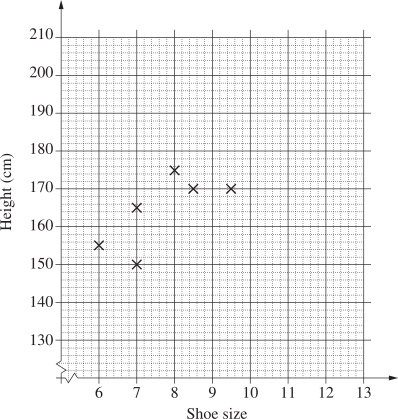
The shoe size and height of ten students were recorded.

\begin{array} {|l|c|c|}
\hline \rule{0pt}{2.5ex} \text{Shoe size} \rule[-1ex]{0pt}{0pt} & \text{6} & \text{7} & \text{7} & \text{8} & \text{8.5} & \text{9.5} & \text{10} & \text{11} & \text{12} & \text{12} \\
\hline \rule{0pt}{2.5ex} \text{Height} \rule[-1ex]{0pt}{0pt} & \text{155} & \text{150} & \text{165} & \text{175} & \text{170} & \text{170} & \text{190} & \text{185} & \text{200} & \text{195} \\
\hline
\end{array}

  1. Complete the scatter plot AND draw a line of fit by eye.  (2 marks)
     
     
  2. Use the line of fit to estimate the height difference between a student who wears a size 7.5 shoe and one who wears a size 9 shoe.  (1 mark)

    --- 1 WORK AREA LINES (style=lined) ---

  3. A student calculated the correlation coefficient to be 1 for this set of data. Explain why this cannot be correct.  (1 mark)

    --- 2 WORK AREA LINES (style=lined) ---

Show Answers Only
  1. `text(See Worked Solutions.)`
  2. `13\ text{cm  (or close given LOBF drawn)}
  3. `text(A correlation co-efficient of 1 would)`
    `text(mean that all data points occur on the)`
    `text(line of best fit which clearly isn’t the case.)`
Show Worked Solution

i.    
      2UG 2015 28e Answer

ii.   `text{Shoe size 7½ gives a height estimate of 162 cm (see graph)}`

`text{Shoe size 9 gives a height estimate of 175 cm (see graph)}`

`:.\ text(Height difference)` `= 175-162`
  `= 13\ text{cm  (or close given LOBF drawn)}`


iii.   `text(A correlation co-efficient of 1 would mean)`

♦ Mean mark (c) 39%.

`text(that all data points occur on the line of best)`

`text(fit which clearly isn’t the case.)`

Filed Under: Bivariate Data Analysis (Y12), Correlation / Body Measurements, S3 Further Statistical Analysis (Y12), S4 Bivariate Data Analysis (Y12) Tagged With: Band 4, Band 5, common-content, smc-1001-10-Line of Best Fit, smc-1001-30-Correlation, smc-1113-10-Line of Best Fit, smc-1113-20-Scatterplot from Table, smc-1113-30-Correlation, smc-785-10-Line of Best Fit, smc-785-30-Correlation

Statistics, STD2 S5 2015 HSC 28b

The results of two tests are normally distributed. The mean and standard deviation for each test are displayed in the table.
 

2015 28b

 
Kristoff scored 74 in Mathematics and 80 in English. He claims that he has performed better in English.

Is Kristoff correct? Justify your answer using appropriate calculations.  (2 marks)

--- 4 WORK AREA LINES (style=lined) ---

Show Answers Only

`text(He is correct.)`

Show Worked Solution

`text(In Maths)`

♦ Mean mark 44%.
`ztext{-score(74)}` `= (x − mu)/sigma`
  `= (74 − 70)/6.5`
  `= 0.6153…`

 
`text(In English)`

`ztext{-score(80)}` `= (80 − 75)/8`
  `= 0.625`

 
`=>\ text(Kristoff’s)\ ztext(-score in English is higher than)`

`text(his)\ z text(-score in Maths.)`

`:.\ text(He is correct. He performed better in English.)`

Filed Under: DS5/6 - Normal Distribution and Sampling, Normal Distribution (Y12), S5 The Normal Distribution (Y12) Tagged With: Band 5, common-content, smc-819-10-Single z-score, smc-819-30-Comparisons of Data Sets, smc-995-10-Single z-score, smc-995-30-Comparisons of Data Sets

Statistics, STD2 S1 2015 HSC 27d

In a small business, the seven employees earn the following wages per week:

\(\$300, \ \$490, \ \$520, \ \$590, \ \$660, \ \$680, \ \$970\)

  1.  Is the wage of $970 an outlier for this set of data? Justify your answer with calculations.  (3 marks)

    --- 6 WORK AREA LINES (style=lined) ---

  2.  Each employee receives a $20 pay increase.


     What effect will this have on the standard deviation?  (1 mark)

    --- 2 WORK AREA LINES (style=lined) ---

Show Answers Only

i.    \(\text{See Worked Solutions.} \)

ii.    \(\text{The standard deviation will remain the same.}\)

Show Worked Solution

i.    \(300, 490, 520, 590, 660, 680, 970\)

\(\text{Median}\) \(= 590\)
\(Q_1\) \(= 490\)
\(Q_3\) \(= 680\)
\(IQR\) \(= 680-490 = 190\)


\(\text{Outlier if \$970 is greater than:} \)

\(Q_3 + 1.5 x\times IQR = 680 + 1.5 \times 190 = \$965 \) 

\(\therefore\ \text{The wage \$970 per week is an outlier.}\)

♦ Mean mark (i) 39%.


ii. 
  \(\text{All values increase by \$20, but so too does the mean.} \)

\(\text{Therefore the spread about the new mean will not change} \)

\(\text{and therefore the standard deviation will remain the same.} \)

Filed Under: Measures of Centre and Spread (Std2-2027), Summary Statistics - No Graph (Std 2), Summary Statistics - No graph (Y12), Summary Statistics (no graph), Summary Statistics (Std 1) Tagged With: Band 4, Band 5, common-content, smc-1131-30-IQR and Outliers, smc-1131-50-Std Dev (by calc), smc-6312-30-IQR and Outliers, smc-6312-50-Std Dev (by Calc), smc-824-30-IQR and Outliers, smc-824-50-Std Dev (by calc), smc-999-30-IQR and Outliers, smc-999-50-Std Dev (by calc)

Algebra, STD2 A2 2015 HSC 27c

Ariana’s parents have given her an interest‑free loan of $4800 to buy a car. She will pay them back by paying `$x` immediately and `$y` every month until she has repaid the loan in full.

After 18 months Ariana has paid back $1510, and after 36 months she has paid back $2770.

This information can be represented by the following equations.

`x + 18y = 1510`

`x + 36y = 2770`

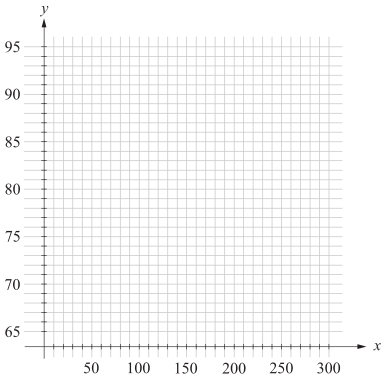
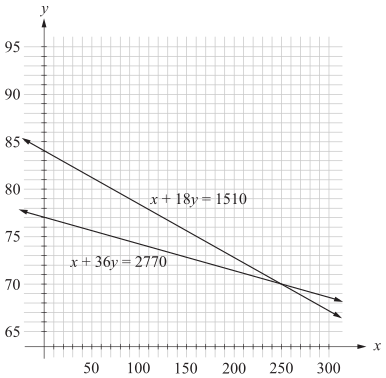
  1. Graph these equations below and use to solve simultaneously for the values of `x` and `y`.   (2 marks)


    --- 1 WORK AREA LINES (style=lined) ---

  2. How many months will it take Ariana to repay the loan in full? (2 marks)

    --- 4 WORK AREA LINES (style=lined) ---

Show Answers Only
  1. `x = 250, \ y = 70`
  2. `text(65 months)`
Show Worked Solution

i.

 
`:.\ text(Solution is)\ \ x = 250, \ y = 70`
 

ii.  `text(Let)\ \ A = text(the amount paid back after)\ n\ text(months)`

`A = 250 + 70n`

♦ Mean mark 44%.

`text(Find)\ n\ text(when)\ A = 4800`

`250 + 70n` `= 4800`
`70n` `= 4550`
`n` `= 65`


`:.\ text(It will take Ariana 65 months to repay)`

`text(the loan in full.)`

Filed Under: Breakeven and Financial modelling, Linear Applications, Linear Functions (Adv-2027), Linear Functions (Y11) Tagged With: Band 5, common-content, num-title-ct-coreb, num-title-qs-hsc, smc-4421-30-Cost/Revenue, smc-6214-20-Other Real World Applications, smc-985-20-Other Linear Applications

Probability, STD2 S2 2015 HSC 26e

The table shows the relative frequency of selecting each of the different coloured jelly beans from packets containing green, yellow, black, red and white jelly beans.

\begin{array} {|c|c|}
\hline
\rule{0pt}{2.5ex} \textit{Colour} \rule[-1ex]{0pt}{0pt} & \textit{Relative frequency} \\
\hline
\rule{0pt}{2.5ex} \text{Green} \rule[-1ex]{0pt}{0pt} & 0.32 \\
\hline
\rule{0pt}{2.5ex} \text{Yellow} \rule[-1ex]{0pt}{0pt} & 0.13 \\
\hline
\rule{0pt}{2.5ex} \text{Black} \rule[-1ex]{0pt}{0pt} & 0.14 \\
\hline
\rule{0pt}{2.5ex} \text{Red} \rule[-1ex]{0pt}{0pt} &  \\
\hline
\rule{0pt}{2.5ex} \text{White} \rule[-1ex]{0pt}{0pt} & 0.24 \\
\hline
\end{array}

  1. What is the relative frequency of selecting a red jelly bean?  (1 mark)

    --- 2 WORK AREA LINES (style=lined) ---

  2. Based on this table of relative frequencies, what is the probability of NOT selecting a black jelly bean?  (1 mark)

    --- 2 WORK AREA LINES (style=lined) ---

Show Answers Only
  1. \(0.17\)
  2. \(0.86\)
Show Worked Solution

i.  \(\text{Relative frequency of red}\)

\(= 1-(0.32 + 0.13 + 0.14 + 0.24)\)

\(= 1-0.83\)

\(= 0.17\)


ii.  \(P\text{(not selecting black)}\)

\(= 1-P\text{(selecting black)}\)

\(= 1-0.14\)

\(= 0.86\)

Filed Under: Combinations and Single Stage Events (Std 2), Probability, Relative Frequency, Relative Frequency (Std 1), Relative Frequency (Std 2), Relative Frequency (Y11), Single and Multi-Stage Events (Std 1), Single stage events Tagged With: Band 3, Band 4, common-content, num-title-ct-core, num-title-qs-hsc, smc-1133-20-Games of Chance, smc-1135-05-Simple Probability, smc-4225-20-Complementary events, smc-4225-35-Relative frequency, smc-827-20-Games of Chance, smc-828-10-Simple Probability, smc-990-20-Games of Chance

Financial Maths, STD2 F4 2015 HSC 26d

A family currently pays $320 for some groceries.

Assuming a constant annual inflation rate of 2.9%, calculate how much would be paid for the same groceries in 5 years’ time.  (2 marks)

Show Answers Only

`$369.17\ \ text{(nearest cent)}`

Show Worked Solution
`FV` `= PV(1 + r)^n`
  `= 320(1.029)^5`
  `= $369.1703…`
  `= $369.17\ \ text{(nearest cent)}`

Filed Under: Compound Interest, Compound Interest and Shares (Std2), F2 Investment (Y12), FM2 - Investing, Modelling Investments and Loans (Y12) Tagged With: Band 4, common-content, num-title-ct-coreb, num-title-qs-hsc, smc-1002-20-FV Formula, smc-1108-20-FV Formula, smc-4334-10-Find FV, smc-817-20-FV Formula

Algebra, STD2 A1 2015 HSC 24 MC

Consider the equation  `(2x)/3-4 = (5x)/2 + 1`.

Which of the following would be a correct step in solving this equation?

  1. `(2x)/3-3 = (5x)/2`
  2. `(2x)/3 = (5x)/2 + 5`
  3. `2x-4 = (15x)/2 + 3`
  4. `(4x)/6-8 = 5x + 2`
Show Answers Only

`B`

Show Worked Solution
`(2x)/3-4` `= (5x)/2 + 1`
`(2x)/3` `= (5x)/2 + 5`

 
`=>B`

Filed Under: Algebraic Fractions, Linear and Other Equations, Substitution and Other Equations (Std 1), Substitution and Other Equations (Std 2), Substitution and Other Equations (Std2-2027) Tagged With: Band 4, common-content, num-title-ct-pathc, num-title-qs-hsc, smc-1116-30-Algebraic Fractions, smc-4402-40-Multiple fractions, smc-6234-30-Algebraic Fractions, smc-789-30-Algebraic Fractions

Statistics, STD2 S5 2015 HSC 20 MC

A machine produces cylindrical pipes. The mean of the diameters of the pipes is 8 cm and the standard deviation is 0.04 cm.

Assuming a normal distribution, what percentage of cylindrical pipes produced will have a diameter less than 7.96 cm?

  1. `text(16%)`
  2. `text(32%)`
  3. `text(34%)`
  4. `text(68%)`
Show Answers Only

`A`

Show Worked Solution

`mu = 8\ text(cm)\ \ \ s = 0.04\ text(cm)`

♦ Mean mark 50%.
`ztext{-score(7.96)}` `= (x − mu)/sigma`
  `= (7.96 − 8)/0.04`
  `= −1`


2UG 2015 20MC Answer

`:.\ text(% of pipes with a diameter less than 7.96 cm.)`

`=\ text(50%) – text(34%)`

`=\ text(16%)`

`⇒ A`

Filed Under: DS5/6 - Normal Distribution and Sampling, Normal Distribution (Y12), S5 The Normal Distribution (Y12) Tagged With: Band 5, common-content, smc-819-10-Single z-score, smc-995-10-Single z-score

Statistics, STD2 S1 2015 HSC 19 MC

The table shows the life expectancy (expected remaining years of life) for females at selected ages in the given periods of time.

2015 19 mc

In 1975, a 45‑year‑old female used the information in the table to calculate the age to which she was expected to live. Twenty years later she recalculated the age to which she was expected to live.

What is the difference between the two ages she calculated?

  1.    2.7 years
  2.    3.1 years
  3.    3.7 years
  4.    5.8 years
Show Answers Only

`D`

Show Worked Solution

`text(In 1975, her life expectancy)`

♦ Mean mark 39%.

`=\ text(age + remaining years)`

`= 45 + 34`

`= 79`

`text(In 1995,  her life expectancy)`

`= 65 + 19.8`

`= 84.8`

`:.\ text(Difference)` `= 84.8 − 79`
  `= 5.8\ text(years)`

`⇒ D`

Filed Under: Bar Charts, Histograms and Other Graphs (Std 1), Life Expectancy, Other Chart Types (Y12), Other Charts (Std 2), Other Charts (Std2-2027), S4 Bivariate Data Analysis (Y12) Tagged With: Band 5, common-content, smc-1128-28-Other Charts, smc-6311-30-Other Charts, smc-822-40-Other Charts, smc-998-40-Other Charts

Financial Maths, STD2 F4 2015 HSC 17 MC

What amount must be invested now at 4% per annum, compounded quarterly, so that in five years it will have grown to  $60 000?

  1. $8919
  2. $11 156
  3. $49 173
  4. $49 316
Show Answers Only

`C`

Show Worked Solution

`text(Using)\ \ FV = PV(1 + r)^n`

`r` `= text(4%)/4` `= text(1%) = 0.01\ text(per quarter)`
`n` `= 5 xx 4` `= 20\ text(quarters)`


`60\ 000` `= PV(1 + 0.01)^(20)`
`:.PV` `= (60\ 000)/1.01^(20)`
  `= $49\ 172.66…`

`⇒ C`

Filed Under: Compound Interest, Compound Interest and Shares (Std2), F2 Investment (Y12), FM4 - Credit and Borrowing, Modelling Investments and Loans (Y12) Tagged With: Band 4, common-content, num-title-ct-coreb, num-title-qs-hsc, smc-1002-20-FV Formula, smc-1108-20-FV Formula, smc-4334-30-Find PV, smc-817-20-FV Formula

Statistics, STD2 S1 2015 HSC 6 MC

The times, in minutes, that a large group of students spend on exercise per day are presented in the box‑and‑whisker plot.
 

What percentage of these students spend between 40 minutes and 60 minutes per day on exercise?

  1. 17%
  2. 20%
  3. 25%
  4. 50%
Show Answers Only

`C`

Show Worked Solution

`text{Q}_1 = 40, \ text(Median) = 60`

`:.\ text(% Students between 40 and 60)`

`= 50text{%}-25text{%}`

`=25 text{%}`
 

`=>C`

Filed Under: Box Plots and 5-Number Summary, Stem & Leaf, Box & Whisker, Summary Statistics - Box Plots (Std 2), Summary Statistics - Box Plots (Std2-2027), Summary Statistics - Box Plots (Y12), Summary Statistics (Std 1) Tagged With: Band 4, common-content, num-title-ct-corea, num-title-qs-hsc, smc-1000-10-Single Box-Plots, smc-5021-50-Box plot (single), smc-6313-10-Single Box Plots, smc-825-10-Single Box-Plots

Statistics, STD2 S1 2015 HSC 4 MC

On a school report, a student’s record of completing homework is graded using the following codes.

C = consistently
U = usually
S = sometimes
R = rarely
N = never

What type of data is this?

  1. Categorical, ordinal
  2. Categorical, nominal
  3. Numerical, continuous
  4. Numerical, discrete
Show Answers Only

`A`

Show Worked Solution

`text(The data has been grouped into categories and)`

`text(because each category can be ranked, it is ordinal.)`

`⇒ A`

Filed Under: Classifying Data, Classifying Data (Std 1), Classifying Data (Std 2), Classifying Data (Y12), Data Classification, Investigation and Sampling Methods (Std2-2027), DS1 - Stats and society Tagged With: Band 4, common-content, num-title-ct-core, num-title-qs-hsc, smc-1127-20-Classifying Data, smc-5075-10-Categorical, smc-6309-20-Data Classification, smc-820-20-Classifying Data

Functions, 2ADV F1 2015 HSC 2 MC

What is the slope of the line with equation  `2x - 4y + 3 = 0`?

  1. `-2`
  2. `-1/2`
  3. `1/2`
  4. `2`
Show Answers Only

`C`

Show Worked Solution
`2x – 4y + 3` `= 0`
`4y` `= 2x + 3`
`y` `= 1/2 x + 3/4`

`:.\ text(Slope)\ = 1/2`

`=> C`

Filed Under: 6. Linear Functions, Linear Equations and Basic Graphs (Std 2), Linear Functions (Adv-2027), Linear Functions (Y11) Tagged With: Band 3, common-content, smc-6214-05-Coordinate Geometry, smc-792-10-Gradient, smc-985-30-Coordinate Geometry

Trigonometry, 2ADV T1 2004 HSC 3c

Trig Ratios, 2UA 2004 HSC 3c
 

The diagram shows a point  `P`  which is  30 km due west of the point  `Q`.

The point  `R`  is 12 km from  `P`  and has a bearing from  `P`  of  070°. 

  1. Find the distance of  `R`  from  `Q`.   (2 marks)

    --- 4 WORK AREA LINES (style=lined) ---

  2. Find the bearing of  `R`  from  `Q`.   (2 marks)

    --- 4 WORK AREA LINES (style=lined) ---

Show Answers Only
  1. `19.2\ text(km)\ \ \ text{(1 d.p.)}` 
  2. `282^@`
Show Worked Solution

i.   `text(Join)\ \ RQ\ \ text(to form)\ \ Delta RPQ`

Trig Ratios, 2UA 2004 HSC 3c Answer

`/_RPQ = 90 – 70 = 20^@`

`text(Using the cosine rule:)`

`RQ^2` `= PR^2 + PQ^2 – 2 xx PR xx PQ xx cos /_RPQ`
  `= 12^2 + 30^2 – 2 xx 12 xx 30 xx cos 20^@`
  `= 367.421…`
`:.\ RQ` `= 19.168…`
  `= 19.2\ text(km)\ \ text{(1 d.p.)}`


ii.   `text(Using sine rule:)`

`(sin /_RQP)/12` `= (sin 20^@)/(19.168…)`
`sin/_RQP` `= (12 xx sin 20^@)/(19.168…)`
  `= 0.214…`
`/_RQP` `= 12.36…^@`
  `= 12^@\ \ \ text{(nearest degree)}`


`:.\ text(Bearing of)\ R\ text(from)\ Q`

`=270+12`

`=282^@`

Filed Under: Bearings (Adv-2027), Bearings (Y11), Sine and Cosine Rules, Bearings Tagged With: Band 3, Band 4, common-content, smc-6395-10-Bearings, smc-981-10-Bearings

Statistics, STD2 S4 2006 HSC 27b

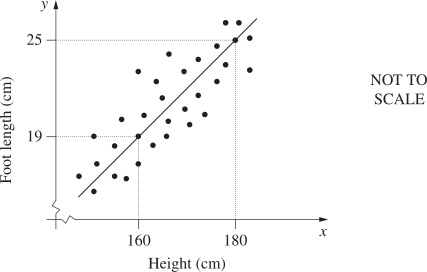
Each member of a group of males had his height and foot length measured and recorded. The results were graphed and a line of fit drawn.
 

  1. Why does the value of the `y`-intercept have no meaning in this situation?  (1 mark)

    --- 2 WORK AREA LINES (style=lined) ---

  2. George is 10 cm taller than his brother Harry. Use the line of fit to estimate the difference in their foot lengths.  (1 mark)

    --- 2 WORK AREA LINES (style=lined) ---

  3. Sam calculated a correlation coefficient of  −1.2  for the data. Give TWO reasons why Sam must be incorrect.  (2 marks)

    --- 5 WORK AREA LINES (style=lined) ---

Show Answers Only
  1. `text(The y-intercept occurs when)\ x = 0.\ text(It has`
    `text(no meaning to have a height of 0 cm.)`
  2. `text(A 10 cm height difference means George should)`
    `text(have a 3 cm longer foot.)`
  3. `text(A correlation co-efficient must be between –1 and 1.)`
    `text(Foot length is positively correlated to a person’s)`
    `text(height and therefore can’t be a negative value.)`
Show Worked Solution

i.  `text(The y-intercept occurs when)\ x = 0.\ text(It has)`

`text(no meaning to have a height of 0 cm.)`


ii.  `text(A 20 cm height difference results in a foot length)`

`text(difference of 6 cm.)`
 

`:.\ text(A 10 cm height difference means George should)`

`text(have a 3 cm longer foot.)`


iii.  `text(A correlation co-efficient must be between –1 and 1.)`

`text(Foot length is positively correlated to a person’s)`

`text(height and therefore isn’t a negative value.)`

Filed Under: Bivariate Data Analysis (Y12), Correlation / Body Measurements, S3 Further Statistical Analysis (Y12), S4 Bivariate Data Analysis (Y12) Tagged With: Band 4, Band 5, Band 6, common-content, smc-1001-10-Line of Best Fit, smc-1001-30-Correlation, smc-1113-10-Line of Best Fit, smc-1113-30-Correlation, smc-785-10-Line of Best Fit, smc-785-30-Correlation

Probability, STD2 S2 2006 HSC 26c

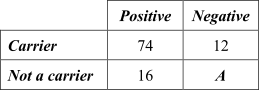
A new test has been developed for determining whether or not people are carriers of the Gaussian virus.

Two hundred people are tested. A two-way table is being used to record the results.
 

  1.  What is the value of  `A`?  (1 mark)

    --- 1 WORK AREA LINES (style=lined) ---

  2.  A person selected from the tested group is a carrier of the virus.


     What is the probability that the test results would show this?  (2 marks) 

    --- 4 WORK AREA LINES (style=lined) ---

  3.  For how many of the people tested were their test results inaccurate?  (1 mark)

    --- 2 WORK AREA LINES (style=lined) ---

Show Answers Only
  1. `98`
  2. `37/43`
  3. `28`
Show Worked Solution
i.  `A` `= 200-(74 + 12 + 16)`
  `= 98`


ii.  `P` `= text(# Positive carriers)/text(Total carriers)`
  `= 74/86`
  `= 37/43`


iii.  `text(# People with inaccurate results)`

`= 12 + 16`

`= 28`

Filed Under: Relative Frequency, Relative Frequency (Std 1), Relative Frequency (Std 2), Relative Frequency (Y11), Relative Frequency and Venn Diagrams Tagged With: Band 3, Band 4, common-content, num-title-ct-pathb, num-title-qs-hsc, smc-1133-10-Surveys/Two-Way Tables, smc-4815-10-2-Way tables, smc-827-10-Surveys/Two-Way Tables, smc-990-10-Surveys/Two-Way Tables

Functions, 2ADV F1 2005 HSC 1d

Express  `((2x-3))/2-((x-1))/5`  as a single fraction in its simplest form.  (2 marks)

--- 5 WORK AREA LINES (style=lined) ---

Show Answers Only

`(8x-13)/10`

Show Worked Solution

`((2x-3))/2-((x-1))/5`

`= (5(2x-3)-2(x-1))/10`

`= (10x-15-2x + 2)/10`

`= (8x-13)/10`

Filed Under: Algebraic Fractions, Algebraic Techniques (Adv-2027), Algebraic Techniques (Y11), Factors and Other Equations Tagged With: Band 3, common-content, num-title-ct-pathc, num-title-qs-hsc, smc-4356-10-Addition, smc-6213-10-Algebraic Fractions, smc-983-40-Algebraic Fractions

Statistics, STD2 S1 2007 HSC 22 MC

A set of examination results is displayed in a cumulative frequency histogram and polygon (ogive).
 

2007 22 mc
 
Sanath knows that his examination mark is in the 4th decile.

Which of the following could have been Sanath’s examination mark?

  1.    37
  2.    57
  3.    67
  4.    77
Show Answers Only

`B`

Show Worked Solution

Data, 2UG 2007 HSC 22 MC Answer

`text(4th decile occurs when cumulative frequency)`

`text(is between 15 and 20.)`

`:.\ text(Examination mark must be between 55 and 60.)`

`=>  B`

Filed Under: Bar Charts and Histograms, Bar Charts and Histograms (Std 2), Bar Charts and Histograms (Std2-2027), Bar Charts and Histograms (Y12) Tagged With: Band 6, common-content, smc-6310-30-Cumulative Frequency Histograms, smc-821-20-Cumulative Frequency Histograms, smc-997-20-Cumulative Frequency Histograms

Algebra, STD2 A4 2005 HSC 28b

Sue and Mikey are planning a fund-raising dance. They can hire a hall for $400 and a band for $300. Refreshments will cost them $12 per person.

  1. Write a formula for the cost ($C) of running the dance for `x` people. (1 mark)

    --- 2 WORK AREA LINES (style=lined) ---

The graph shows planned income and costs when the ticket price is $20 

2005 28b

  1. Estimate the minimum number of people needed at the dance to cover the costs.  (1 mark)

    --- 1 WORK AREA LINES (style=lined) ---

  2. How much profit will be made if 150 people attend the dance? (1 mark)

    --- 2 WORK AREA LINES (style=lined) ---

Sue and Mikey plan to sell 200 tickets. They want to make a profit of $1500.

  1. What should be the price of a ticket, assuming all 200 tickets will be sold?  (3 marks)

    --- 6 WORK AREA LINES (style=lined) ---

Show Answers Only
  1. `700 + 12x`
  2. `text(Approximately 90)`
  3. `$500`
  4. `$23`
Show Worked Solution
i.    `$C` `= 400 + 300 + (12 xx x)`
    `= 700 + 12x`


ii.  `text(Using the graph intersection)`

`text(Approximately 90 people are needed)`

`text(to cover the costs.)`


iii.  `text(If 150 people attend)`

`text(Income)` `= 150 xx $20`
  `= $3000`
`text(C)text(osts)` `= 700 + (12 xx 150)`
  `= $2500`


`:.\ text(Profit)` `= 3000 − 2500`
  `= $500`


iv.  `text(C)text(osts when)\ x = 200:`

`C` `= 700 + (12 xx 200)`
  `= $3100`


`text(Income required to make $1500 profit)`

`= 3100 + 1500`

`= $4600`
 

`:.\ text(Price per ticket)` `= 4600/200`
  `= $23`

Filed Under: A3 Types of Relationships (Y12), Breakeven and Financial modelling, FM1 - Earning money, Linear Functions (Adv-2027), Linear Functions (Y11), Simultaneous Equations and Applications (Std 2) Tagged With: Band 4, Band 5, common-content, smc-1099-10-Cost/Revenue, smc-6214-10-Cost/Revenue, smc-794-10-Cost/Revenue, smc-985-10-Cost/Revenue

Statistics, STD2 S1 2005 HSC 27d

Nine students were selected at random from a school, and their ages were recorded.

\begin{array} {|c|}
\hline
\rule{0pt}{2.5ex} \textbf{Ages} \rule[-1ex]{0pt}{0pt} \\
\hline
\rule{0pt}{2.5ex} \ \ \ \text{12     11     16} \ \ \  \rule[-1ex]{0pt}{0pt} \\ \rule{0pt}{2.5ex} \text{14     16     15} \rule[-1ex]{0pt}{0pt} \\ \rule{0pt}{2.5ex} \text{14     15     14} \rule[-1ex]{0pt}{0pt} \\
\hline
\end{array}

  1. What is the sample standard deviation, correct to two decimal places?   (2 marks)

    --- 4 WORK AREA LINES (style=lined) ---

  2. Briefly explain what is meant by the term standard deviation.   (1 mark)

    --- 2 WORK AREA LINES (style=lined) ---

Show Answers Only
  1. `text{1.69  (to 2 d.p.)}`
  2. `text(Standard deviation is a measure of how much)`


    `text(members of a data group differ from the mean)`


    `text(value of the group)`

Show Worked Solution

i.  `text(Sample standard deviation)`

`= 1.6914…\ text{(by calculator)}`

`= 1.69\ \ \ text{(to 2 d.p.)}`


ii.  `text(Standard deviation is a measure of how much)`

`text(members of a data group differ from the mean)`

`text(value of the group.)`

Filed Under: Measures of Centre and Spread (Std2-2027), Summary Statistics - No Graph (Std 2), Summary Statistics - No graph (Y12), Summary Statistics (no graph), Summary Statistics (Std 1) Tagged With: Band 4, Band 6, common-content, smc-1131-50-Std Dev (by calc), smc-6312-50-Std Dev (by Calc), smc-824-50-Std Dev (by calc), smc-999-50-Std Dev (by calc)

Measurement, STD2 M6 2005 HSC 27c

2UG-2005-27c
 

The bearing of `C` from `A` is 250° and the distance of `C` from `A` is 36 km.

  1. Explain why  `theta`  is 110°.   (1 mark)

    --- 2 WORK AREA LINES (style=lined) ---

  2. If  `B`  is 15 km due north of  `A`, calculate the distance of  `C`  from  `B`, correct to the nearest kilometre.   (3 marks)

    --- 6 WORK AREA LINES (style=lined) ---

Show Answers Only
  1. `110^@`
  2. `text{43 km (nearest km)}`
Show Worked Solution

i.  `text(There is 360° about point)\ A`

`:.theta + 250^@` `= 360^@`
`theta` `= 110^@`


ii.   
`a^2` `= b^2 + c^2 − 2ab\ cos\ A`
`CB^2` `= 36^2 + 15^2 − 2 xx 36 xx 15 xx cos\ 110^@`
  `= 1296 + 225 −(text(−369.38…))`
  `= 1890.38…`
`:.CB` `= 43.47…`
  `= 43\ text{km  (nearest km)}`

Filed Under: Bearings & Field Surveys, Bearings and Radial Surveys (Std2) Tagged With: Band 4, common-content, smc-803-10-Bearings

Statistics, STD2 S5 2005 HSC 26c

The weights of boxes of Brekky Bicks are normally distributed. The mean is 754 grams and the standard deviation is 2 grams.

  1. What is the `z`-score of a box of Brekky Bicks with a weight of 754 g?   (1 mark)

    --- 2 WORK AREA LINES (style=lined) ---

  2. What is the weight of a box that has a `z`-score of  –1?   (1 mark)

    --- 2 WORK AREA LINES (style=lined) ---

  3. Brekky Bicks boxes are labelled as having a weight of 750 g. What percentage of boxes will have a weight less than 750 g?   (2 marks)

    --- 4 WORK AREA LINES (style=lined) ---

Show Answers Only
  1. `0\ text{(mean)}`
  2.  `752\ text(grams)`
  3. `text(2.5%)`
Show Worked Solution

i.    `text{z-score (754 g) = 0}`

`text{(Noting that 754 g is the mean)}`


ii.   `ztext(-score)` `= (x − mu)/sigma`
`-1` `= (x − 754)/2`
 `x – 754` `= -2`
`x`  `= 752\ text(grams)`


iii. `text{z-score (750)}` `= (750 − 754)/2`
    `= -2`


  `:.\ text(Graph shows that 2.5% of boxes will weigh)`

`text(less than 750 g.)`

Filed Under: DS5/6 - Normal Distribution and Sampling, Normal Distribution (Y12), S5 The Normal Distribution (Y12) Tagged With: Band 4, Band 5, common-content, smc-819-10-Single z-score, smc-995-10-Single z-score

Financial Maths, STD2 F5 2005 HSC 26b

Rod is saving for a holiday. He deposits $3600 into an account at the end of every year for four years. The account pays 5% per annum interest, compounding annually.

The table shows future values of an annuity of $1.
 

2UG-2005-26b
 

  1. Use the table to find the value of Rod’s investment at the end of four years.   (2 marks)

    --- 4 WORK AREA LINES (style=lined) ---

  2. How much interest does Rod earn on his investment over the four years?   (2 marks)

    --- 4 WORK AREA LINES (style=lined) ---

Show Answers Only
  1. `$15\ 516.36`
  2. `$1116.36`
Show Worked Solution

i.   `text(Using the table),\ r =\ text(5% and)\ n = 4`

`text(Annuity factor = 4.3101)`

`:.\ text(Value of investment)`

`= 3600 xx 4.3101`

`= $15\ 516.36`


ii.  `text(Interest)` `= text(Value) − text(Contributions)`
  `= 15\ 516.36 − (4 xx 3600)`
  `= $1116.36`

Filed Under: F5 Annuities (Y12), FM5 - Annuities and Loan repayments, Modelling Investments and Loans (Y12) Tagged With: Band 4, Band 5, common-content, smc-1002-40-FV Annuity Table, smc-816-10-FV of $1 Annuity Table

Statistics, STD2 S1 2006 HSC 23c

Vicki wants to investigate the number of hours spent on homework by students at her high school.

  1. Briefly describe a valid method of randomly selecting 200 students for a sample.  (1 mark)

    --- 2 WORK AREA LINES (style=lined) ---

  2. Vicki chooses her sample and asks each student how many hours (to the nearest hour) they usually spend on homework during one week.


    The responses are shown in the frequency table.
     
         2UG-2006-23c

    What is the mean amount of time spent on homework?  (2 marks)

    --- 4 WORK AREA LINES (style=lined) ---

Show Answers Only
  1. `text(A valid method would be using a stratified sample.)`


    `text(The number of students sampled in each year is)`


    `text(proportional to the size of each year.)`

  2. `text(7.275 hours)`
Show Worked Solution

i.   `text(A valid method would be using a stratified sample.)`

`text(The number of students sampled in each year is)`

`text(proportional to the size of each year.)`

MARKER’S COMMENT: This “routine” exercise of finding a mean from grouped data was incorrectly answered by most students! The best responses copied the table and inserted a class-centre column (see solution).


ii.    2UG-2006-23c Answer


`text(Mean)` `= text(Sum of Scores) / text(Total scores)`
  `= 1455/200`
  `= 7.275\ text(hours)`

Filed Under: Classifying Data (Std 1), Classifying Data (Std 2), Data Classification, Investigation and Sampling Methods (Std2-2027), DS1 - Stats and society, Measures of Centre and Spread (Std2-2027), Summary Statistics - No Graph (Std 2), Summary Statistics (no graph), Summary Statistics (Std 1) Tagged With: Band 4, Band 5, common-content, smc-1127-10-Sampling Methods, smc-1131-10-Mean, smc-1131-40-Class Centres, smc-6309-10-Sampling Methods, smc-6312-10-Mean, smc-6312-40-Class Centres, smc-820-10-Sampling Methods, smc-824-10-Mean, smc-824-40-Class Centres

Statistics, STD2 S1 2006 HSC 24c

The heights of the 60 members of a choir were recorded. These results were grouped and then displayed as a cumulative frequency histogram and polygon.

The shortest person in the choir is 140 cm and the tallest is 190 cm.
 

2UG-2006-24c1

Draw an accurate box-and-whisker plot to represent the data.  (3 marks)

--- 8 WORK AREA LINES (style=lined) ---

Show Answers Only

`text{See Worked Solutions}`

Show Worked Solution

`text(Low) = 140`

`text(High) = 190`

`text(Median) = 150\ \ \ \ text{(# People = 30)}`

`Q_1 = 145\ \ \ \ text{(# People = 15)}`

`Q_3 = 170\ \ \ \ text{(# People = 45)}`

`text(Box and Whisker)`

HSC Data 13

Filed Under: Bar Charts and Histograms, Bar Charts and Histograms (Std 2), Bar Charts and Histograms (Std2-2027), Bar Charts and Histograms (Y12), Stem & Leaf, Box & Whisker, Summary Statistics - Box Plots (Std 2), Summary Statistics - Box Plots (Std2-2027), Summary Statistics - Box Plots (Y12) Tagged With: Band 5, common-content, smc-1000-30-Draw Box-Plots, smc-1128-20-Cumulative Frequency Histograms, smc-6310-30-Cumulative Frequency Histograms, smc-6313-30-Draw Box Plots, smc-821-20-Cumulative Frequency Histograms, smc-825-30-Draw Box-Plots, smc-997-20-Cumulative Frequency Histograms

Statistics, STD2 S1 2006 HSC 24a

2UG-2006-24a

List TWO ways in which this graph is misleading.  (2 marks)

--- 4 WORK AREA LINES (style=lined) ---

Show Answers Only

`text(Reasons the graph is misleading include)`

`text(- the columns are a different widths/volumes)`

`text(- the vertical axis doesn’t start at zero)`

Show Worked Solution

`text(Reasons the graph is misleading include)`

`text(- the columns are a different widths/volumes)`

`text(- the vertical axis doesn’t start at zero)`

Filed Under: Bar Charts and Histograms, Bar Charts and Histograms (Std 2), Bar Charts and Histograms (Std2-2027), Bar Charts and Histograms (Y12), Bar Charts, Histograms and Other Graphs (Std 1), Interpreting Data Tagged With: Band 4, common-content, num-title-ct-core, num-title-qs-hsc, smc-1128-10-Bar Charts, smc-5077-10-Misleading graphs, smc-6310-10-Bar Charts, smc-821-10-Bar Charts, smc-997-10-Bar Charts

Statistics, STD2 S1 2005 HSC 24d

The sector graph shows the proportion of people, as a percentage, living in each region of Sumcity. There are 24 000 people living in the Eastern Suburbs.
 

2UG-2005-24d1
 

  1. Show that the total number of people living in Sumcity is  160 000.  (1 mark)

    --- 1 WORK AREA LINES (style=lined) ---

Jake used the information above to draw a column graph.
 

2UG-2005-24d2

  1. The column graph height is incorrect for one region.


    Identify this region and justify your answer.   (2 marks)

    --- 4 WORK AREA LINES (style=lined) ---

Show Answers Only
  1. `160\ 000`
  2. `text(Western Suburbs population)`
Show Worked Solution

i.   `text(Let the population of Sumcity =)\ P`

`text(15%)× P` `= 24\ 000`
`:.P`  `= (24\ 000)/0.15` 
  `= 160\ 000\ …\ text(as required)` 


ii.  `text(Western Suburbs population)`

`= text(10%) × 160\ 000`

`= 16\ 000`

`text(The column graph has this population as)`

`text(12 000 people which is incorrect.)`

Filed Under: Bar Charts and Histograms, Bar Charts and Histograms (Std 2), Bar Charts and Histograms (Std2-2027), Bar Charts and Histograms (Y12), Bar Charts, Histograms and Other Graphs (Std 1), Displaying Data, Other Chart Types (Y12), Other Charts (Std 2), Other Charts (Std2-2027), Other Graphs Tagged With: Band 4, common-content, num-title-ct-core, num-title-qs-hsc, smc-1128-10-Bar Charts, smc-5076-15-Sector graphs and Divided Bar graphs, smc-5077-10-Misleading graphs, smc-6310-10-Bar Charts, smc-6311-30-Other Charts, smc-821-10-Bar Charts, smc-822-40-Other Charts, smc-997-10-Bar Charts, smc-998-40-Other Charts

Statistics, STD2 S1 2005 HSC 24a

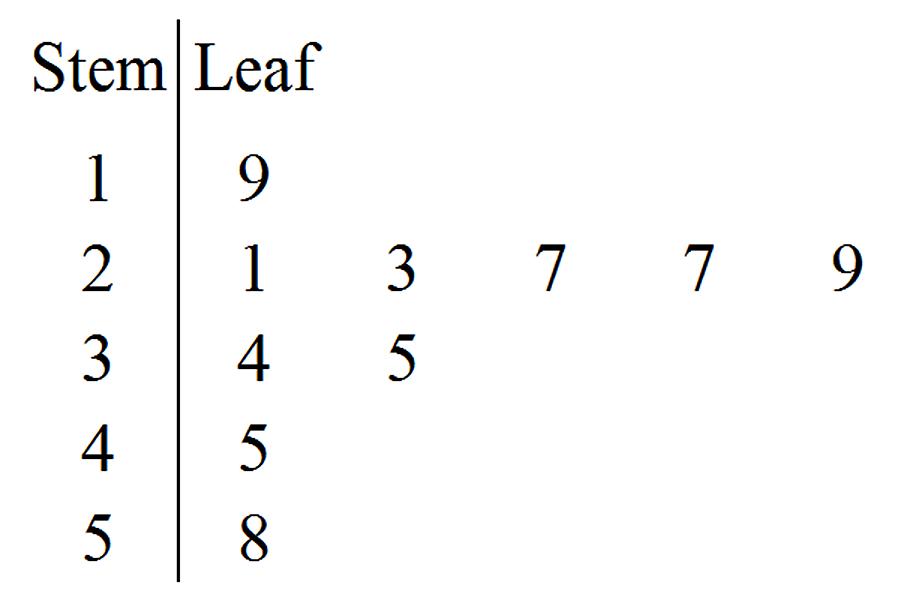
  1. Draw a stem-and-leaf plot for the following set of scores.
  2.  


    `21\ \ \ 45\ \ \ 29\ \ \ 27\ \ \ 19\ \ \ 35\ \ \ 23\ \ \ 58\ \ \ 34\ \ \ 27`  (2 marks)

    --- 6 WORK AREA LINES (style=blank) ---

  3. What is the median of the set of scores?   (1 mark)

    --- 2 WORK AREA LINES (style=lined) ---

  4. Comment on the skewness of the set of scores.   (1 mark)

    --- 2 WORK AREA LINES (style=lined) ---

Show Answers Only
  1.  
  2. `28`
  3. `text(The data has a tail that stretches to the right)`
  4.  

    `:.\ text(Data is positively Skewed.)`

Show Worked Solution
i.    HSC 2005 24a


ii.  `text(10 scores)`

`:.\ text(Median)` `= text{(5th + 6th)}/2`
  `= (27 + 29)/2`
  `= 28`


iii.  `text(The data has a tail that stretches to the right)`

`:.\ text(Data is positively skewed.)`

Filed Under: Bar Charts, Histograms and Other Graphs (Std 1), Displaying Data, Other Chart Types (Y12), Other Charts (Std 2), Other Charts (Std2-2027), Stem & Leaf, Box & Whisker Tagged With: Band 4, Band 5, common-content, num-title-ct-core, num-title-qs-hsc, smc-1128-24-Stem and Leaf, smc-5076-20-Stem and Leaf, smc-6311-10-Stem-and-Leaf, smc-822-20-Stem and Leaf, smc-998-20-Stem and Leaf

Algebra, STD2 A4 2004 HSC 26a

  1. The number of bacteria in a culture grows from 100 to 114 in one hour.


    What is the percentage increase in the number of bacteria?   (1 mark)

    --- 1 WORK AREA LINES (style=lined) ---

  2. The bacteria continue to grow according to the formula  `n = 100(1.14)^t`, where `n` is the number of bacteria after `t` hours.


    What is the number of bacteria after 15 hours?   (1 mark)

\begin{array} {|l|c|}
\hline
\rule{0pt}{2.5ex} \text{Time in hours $(t)$} \rule[-1ex]{0pt}{0pt} & \;\; 0 \;\;  &  \;\; 5 \;\;  & \;\; 10 \;\;  & \;\; 15 \;\; \\
\hline
\rule{0pt}{2.5ex} \text{Number of bacteria ( $n$ )} \rule[-1ex]{0pt}{0pt} & \;\; 100 \;\;  &  \;\; 193 \;\;  & \;\; 371 \;\;  & \;\; ? \;\; \\
\hline
\end{array}

--- 1 WORK AREA LINES (style=lined) ---

  1. Use the values of `n` from  `t = 0`  to  `t = 15`  to draw a graph of  `n = 100(1.14)^t`.


    Use about half a page for your graph and mark a scale on each axis.   (4 marks)

    --- 10 WORK AREA LINES (style=lined) ---

  2. Using your graph or otherwise, estimate the time in hours for the number of bacteria to reach 300.   (1 mark)

    --- 1 WORK AREA LINES (style=lined) ---

Show Answers Only
  1. `text(14%)`
  2. `714`
  3. `text(Proof)\ \ text{(See Worked Solutions)}`
  4. `text(8.4 hours)`
Show Worked Solution

i.   `text(Percentage increase)`

COMMENT: Common ADV/STD2 content in new syllabus.

`= (114 -100)/100 xx 100`

`= 14text(%)`


ii.  `n = 100(1.14)^t`

`text(When)\ \ t = 15,`

`n` `= 100(1.14)^15`
  `= 713.793\ …`
  `= 714\ \ \ text{(nearest whole)}`


iii. 


iv.  `text(Using the graph)`

`text(The number of bacteria reaches 300 after)`

`text(approximately 8.4 hours.)`

Filed Under: Exponential/Quadratic (Projectile), Graphs and Applications (Y11), Non-Linear: Exponential/Quadratics (Std 2) Tagged With: Band 3, Band 4, Band 5, common-content, HSC, smc-830-30-Exponential, smc-966-10-Exponential graphs, smc-966-30-Other exponential modelling

Statistics, STD2 S1 2005 HSC 22 MC

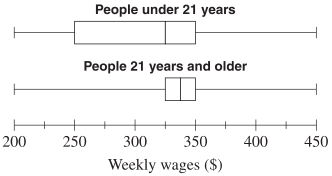
Two groups of people were surveyed about their weekly wages. The results are shown in the box-and-whisker plots.
 

Which of the following statements is true for the people surveyed?

  1. The same percentage of people in each group earned more than $325 per week.
  2. Approximately 75% of people under 21 years earned less than $350 per week.
  3. Approximately 75% of people 21 years and older earned more than $350 per week.
  4. Approximately 50% of people in each group earned between $325 and $350 per week.
Show Answers Only

`B`

Show Worked Solution

`text{Option A: 50% of Under 21 group earned over $325 and 75%}`

`text{of Over 21 group did. NOT TRUE.}`
 

`text{Option B: 75% of Under 21 group earned below $350 is TRUE.}`
 

`text{Options C and D: can both be proven to be untrue using their}`

`text{median and quartile values.}`

`=>  B`

Filed Under: Box Plots and 5-Number Summary, Stem & Leaf, Box & Whisker, Summary Statistics - Box Plots (Std 2), Summary Statistics - Box Plots (Std2-2027), Summary Statistics - Box Plots (Y12) Tagged With: Band 6, common-content, num-title-ct-corea, num-title-qs-hsc, smc-1000-20-Parallel Box-Plots, smc-5021-60-Box plots (parallel), smc-6313-20-Parallel Box Plots, smc-825-20-Parallel Box-Plots

Probability, STD2 S2 2005 HSC 16 MC

On a television game show, viewers voted for their favourite contestant. The results were recorded in the two-way table.

\begin{array} {|l|c|c|}
\hline
\rule{0pt}{2.5ex} \rule[-1ex]{0pt}{0pt} & \textbf{Male viewers} & \textbf{Female viewers} \\
\hline
\rule{0pt}{2.5ex}\textbf{Contestant 1}\rule[-1ex]{0pt}{0pt} & 1372 & 3915\\
\hline
\rule{0pt}{2.5ex}\textbf{Contestant 2}\rule[-1ex]{0pt}{0pt} & 2054 & 3269\\
\hline
\end{array}

One male viewer was selected at random from all of the male viewers.

What is the probability that he voted for Contestant 1?

  1. `1372/(10\ 610)`
  2. `1372/5287`
  3. `1372/3426`
  4. `1372/2054`
Show Answers Only

`C`

Show Worked Solution

`text(Total male viewers)\ = 1372 + 2054= 3426`

  
`P\ text{(Male viewer chosen voted for C1)}`

`= text(Males who voted for C1)/text(Total male viewers)`

`= 1372/3426`
 

`=>  C`

Filed Under: Relative Frequency, Relative Frequency (Std 1), Relative Frequency (Std 2), Relative Frequency (Y11), Relative Frequency and Venn Diagrams Tagged With: Band 4, common-content, num-title-ct-pathb, num-title-qs-hsc, smc-1133-10-Surveys/Two-Way Tables, smc-4815-10-2-Way tables, smc-4815-50-Conditional probability, smc-827-10-Surveys/Two-Way Tables, smc-990-10-Surveys/Two-Way Tables

Statistics, STD2 S1 2005 HSC 9 MC

A set of data is represented by the cumulative frequency histogram and ogive.
 

2UG-2005-9MC
 

What is the best approximation for the interquartile range for this set of data?

  1.    25
  2.    30
  3.    35
  4.    40
Show Answers Only

`C`

Show Worked Solution

2UG-2005-9MC Answer

`IQR` `= Q3 − Q1`
  `= 80 − 45`
  `= 35`

`=>  C`

Filed Under: Bar Charts and Histograms, Bar Charts and Histograms (Std 2), Bar Charts and Histograms (Std2-2027), Bar Charts and Histograms (Y12), Bar Charts, Histograms and Other Graphs (Std 1) Tagged With: Band 5, common-content, smc-1128-20-Cumulative Frequency Histograms, smc-1128-30-IQR, smc-6310-30-Cumulative Frequency Histograms, smc-6310-40-IQR, smc-821-20-Cumulative Frequency Histograms, smc-821-30-IQR, smc-997-20-Cumulative Frequency Histograms, smc-997-30-IQR

Probability, STD2 S2 2004 HSC 25c

Lie detector tests are not always accurate. A lie detector test was administered to 200 people.

The results were:

• 50 people lied. Of these, the test indicated that 40 had lied;
• 150 people did NOT lie. Of these, the test indicated that 20 had lied.

  1. Complete the table using the information above   (2 marks)


    --- 0 WORK AREA LINES (style=lined) ---

  2. For how many of the people tested was the lie detector test accurate?   (1 mark)

    --- 2 WORK AREA LINES (style=lined) ---

  3. For what percentage of the people tested was the test accurate?   (1 mark)

    --- 2 WORK AREA LINES (style=lined) ---

  4. What is the probability that the test indicated a lie for a person who did NOT lie?   (1 mark)

    --- 2 WORK AREA LINES (style=lined) ---

Show Answers Only
  1. `text(See Worked Solutions)`
  2. `170`
  3. `text(85%)`
  4. `2/15`
Show Worked Solution

i.

ii.  `text(# Accurate readings)`

`= 40 + 130`

`= 170`
 

iii.  `text(Percentage of people with accurate readings)`

`= text(# Accurate readings)/text(Total readings) xx 100`

`= 170/200`

`= 85 text(%)`
 

iv.  `text{P(lie detected when NOT a lie)}`

`= 20/150`

`= 2/15`

Filed Under: Relative Frequency, Relative Frequency (Std 1), Relative Frequency (Std 2), Relative Frequency (Y11), Relative Frequency and Venn Diagrams Tagged With: Band 4, Band 5, common-content, num-title-ct-pathb, num-title-qs-hsc, smc-1133-10-Surveys/Two-Way Tables, smc-4815-10-2-Way tables, smc-827-10-Surveys/Two-Way Tables, smc-990-10-Surveys/Two-Way Tables

Statistics, STD2 S5 2004 HSC 24c

The normal distribution shown has a mean of 170 and a standard deviation of 10.


  1. Roberto has a raw score in the shaded region. What could his `z`-score be?  (1 mark)

    --- 1 WORK AREA LINES (style=lined) ---

  2. What percentage of the data lies in the shaded region?  (2 marks)

    --- 4 WORK AREA LINES (style=lined) ---

Show Answers Only
  1. `1 <= text(z-score) <= 2`
  2. `text(13.5%)`
Show Worked Solution
i.  `ztext{-score(180)}` `= (x – mu)/sigma`
  `= (180 – 170) / 10`
  `= 1`


`ztext{-score(190)}` `= (190 -170)/10`
  `= 2`

 
`:. 1 <= ztext(-score) <= 2`


ii.   

`text(From the graph above,)`

`text(13.5% lies in the shaded area.)`

Filed Under: DS5/6 - Normal Distribution and Sampling, Normal Distribution (Y12), S5 The Normal Distribution (Y12) Tagged With: Band 4, Band 5, common-content, smc-819-20-z-score Intervals, smc-819-40-Graphs, smc-995-20-z-score Intervals, smc-995-40-Graphs

Statistics, STD2 S5 2006 HSC 17 MC

In a normally distributed set of scores, the mean is 23 and the standard deviation is 5.

Approximately what percentage of the scores will lie between 18 and 33?

  1. `text(34%)`
  2. `text(47.5%)`
  3. `text(68%)`
  4. `text(81.5%)`
Show Answers Only

`D`

Show Worked Solution

`mu = 23`

`sigma = 5`

`z text{-score (18)}` `= (x – mu)/sigma`
  `= (18 – 23)/5`
  `= -1`
`z text{-score (33)}` `= (33 – 23)/5`
  `= 2`

z-score

`:.\ text(Percentage between –1 and 2)`

`= 34 + 34 + 13.5`

`=\ text(81.5%)`

`=>  D`

Filed Under: DS5/6 - Normal Distribution and Sampling, Normal Distribution (Y12), S5 The Normal Distribution (Y12) Tagged With: Band 5, common-content, smc-819-20-z-score Intervals, smc-995-20-z-score Intervals

Measurement, STD2 M6 2006 HSC 13 MC

What is the bearing of  `A`  from  `B`?
 

2UG-2006-13MC
 

  1.   `060°`
  2.   `120°`
  3.   `150°`
  4.   `300°`
Show Answers Only

`D`

Show Worked Solution

 2UG-2006-13MC Answer

`text(Bearing of)\ A\ text(from)\ B`

`= 180 +120`

`= 300^@`

`=>  D`

Filed Under: Bearings & Field Surveys, Bearings and Radial Surveys (Std2) Tagged With: Band 4, common-content, smc-803-10-Bearings

Statistics, STD2 S1 2006 HSC 12 MC

The mean of a set of 5 scores is 62.

What is the new mean of the set of scores after a score of 14 is added?

  1.   38
  2.   54
  3.   62
  4.   76
Show Answers Only

`B`

Show Worked Solution

`text(Mean of 5 scores) = 62`

`:.\ text(Total of 5 scores) = 62 xx 5 = 310`

`text(Add a score of 14)`

`text(Total of 6 scores) = 310 + 14 = 324`

`:.\ text(New mean)` `= 324/6`
  `= 54`

`=>  B`

Filed Under: Data Analysis, Measures of Centre and Spread (Std2-2027), Summary Statistics - No Graph (Std 2), Summary Statistics - No graph (Y12), Summary Statistics (no graph), Summary Statistics (Std 1) Tagged With: Band 4, common-content, num-title-ct-core, num-title-qs-hsc, smc-1131-10-Mean, smc-4224-25-Mean, smc-4224-50-Add/remove data, smc-6312-10-Mean, smc-824-10-Mean, smc-999-10-Mean

Statistics, STD2 S1 2006 HSC 8 MC

Which of these graphs best represents positively skewed data with the smaller standard deviation?
 

2UG-2006-8abMC

2UG-2006-8cdMC

Show Answers Only

`C`

Show Worked Solution

`text(By elimination)`

`text(Positive skew when the tail on the`

`text(right side is longer.)`

`:.\ text(NOT)\ B\ text(or)\ D`

`text(A smaller standard deviation occurs)`

`text(when data is clustered more closely.)`

`:.\ text(NOT)\ A\ text(where data is more widely spread.)`

`=>  C`

Filed Under: Bar Charts, Histograms and Other Graphs (Std 1), DS5/6 - Normal Distribution and Sampling, Normal Distribution (Y12), Other Chart Types (Y12), Other Charts (Std 2), Other Charts (Std2-2027), Other Graphs, S5 The Normal Distribution (Y12) Tagged With: Band 5, common-content, smc-1128-28-Other Charts, smc-6311-30-Other Charts, smc-819-40-Graphs, smc-822-40-Other Charts, smc-995-40-Graphs, smc-998-40-Other Charts

Functions, 2ADV F1 2004 HSC 1c

Solve   `(x-5)/3-(x+1)/4 = 5`.   (2 marks)

Show Answers Only

`83`

Show Worked Solution
`(x-5)/3-(x+1)/4` `= 5`
`12((x-5)/3)-12((x+1)/4)` `= 12 xx 5`
`4x-20-3x-3` `= 60`
`x-23` `= 60`
`:. x` `= 83`

Filed Under: Algebraic Fractions, Algebraic Techniques (Adv-2027), Algebraic Techniques (Y11), Factors and Other Equations Tagged With: Band 3, common-content, num-title-ct-pathc, num-title-qs-hsc, smc-4402-40-Multiple fractions, smc-6213-10-Algebraic Fractions, smc-983-40-Algebraic Fractions

Probability, STD2 S2 2006 HSC 6 MC

Marcella is planning to roll a standard six-sided die 60 times.

How many times would she expect to roll the number 4?

  1.   6
  2.   10
  3.   15
  4.   20
Show Answers Only

`B`

Show Worked Solution

`P(4) = 1/6`

`:.\ text(Expected times to roll 4)`

`= 1/6 xx text(number of rolls)`

`= 1/6 xx 60`

`= 10`

`=>  B`

Filed Under: Probability, Relative Frequency, Relative Frequency (Std 1), Relative Frequency (Std 2), Relative Frequency (Y11) Tagged With: Band 4, common-content, num-title-ct-core, num-title-qs-hsc, smc-1133-20-Games of Chance, smc-1133-30-Expected Frequency (np), smc-4225-35-Relative frequency, smc-827-20-Games of Chance, smc-827-40-Expected Frequency (np), smc-990-20-Games of Chance, smc-990-40-Expected Frequency (np)

Statistics, STD2 S1 2006 HSC 4 MC

A set of scores is displayed in a stem-and-leaf plot.
 

 2UG-2006-4MC

 
What is the median of this set of scores?

  1.   28
  2.   30
  3.   33
  4.   47
Show Answers Only

`C`

Show Worked Solution

`text(10 scores)`

`text(Median)` `= text{5th + 6th}/2`
  `= (28 + 38)/2`
  `= 33`

`=>  C`

Filed Under: Bar Charts, Histograms and Other Graphs (Std 1), Other Chart Types (Y12), Other Charts (Std 2), Other Charts (Std2-2027), Stem & Leaf, Box & Whisker Tagged With: Band 4, common-content, num-title-ct-core, num-title-qs-hsc, smc-1128-24-Stem and Leaf, smc-4224-20-Median, smc-4224-40-Stem and Leaf, smc-6311-10-Stem-and-Leaf, smc-822-20-Stem and Leaf, smc-998-20-Stem and Leaf

Statistics, STD2 S1 2005 HSC 1 MC

What is the mean of the set of scores?

`3, \ 4, \ 5, \ 6, \ 6, \ 8, \ 8, \ 8, \ 15`
 

  1. 6
  2. 7
  3. 8
  4. 9
Show Answers Only

`B`

Show Worked Solution
`text(Mean)` `= ((3 + 4 + 5 +6 + 6 + 8 + 8 + 8 + 15))/9`
  `= 63/9`
  `= 7`

 
`=> B`

Filed Under: Data Analysis, Measures of Centre and Spread (Std2-2027), Summary Statistics - No Graph (Std 2), Summary Statistics (Std 1) Tagged With: Band 2, common-content, num-title-ct-core, num-title-qs-hsc, smc-1131-10-Mean, smc-4224-25-Mean, smc-6312-10-Mean, smc-824-10-Mean

Statistics, STD2 S1 2004 HSC 12 MC

This box-and-whisker plot represents a set of scores.
 

What is the interquartile range of this set of scores?

  1. 1
  2. 2
  3. 3
  4. 5
Show Answers Only

`C`

Show Worked Solution

`text{Q}_1 = 8, \ text{Q}_3 = 11`

`text{IQR}` `= text{Q}_3-text{Q}_1`
  `= 11-8`
  `= 3`

 
`=> C`

Filed Under: Stem & Leaf, Box & Whisker, Summary Statistics - Box Plots (Std 2), Summary Statistics - Box Plots (Std2-2027), Summary Statistics - Box Plots (Y12), Summary Statistics (Std 1) Tagged With: Band 3, common-content, smc-1000-10-Single Box-Plots, smc-1131-35-Box Plots, smc-6313-10-Single Box Plots, smc-825-10-Single Box-Plots

Statistics, STD2 S1 2004 HSC 8 MC

This sector graph shows the distribution of 116 prizes won by three schools: X, Y and Z.


How many prizes were won by School X?

  1.   26
  2.   32
  3.   81
  4.   99
Show Answers Only

`B`

Show Worked Solution

`text(Centre angle of School X sector)`

`= 100^@\ text{(by measurement)}`
 

`:.\ text(Prizes won by school X)`

`= 100/360 xx 116`

`= 32.22\ …`

`=> B`

Filed Under: Bar Charts, Histograms and Other Graphs (Std 1), Displaying Data, Other Chart Types (Y12), Other Charts (Std 2), Other Charts (Std2-2027), Other Graphs Tagged With: Band 3, common-content, num-title-ct-core, num-title-qs-hsc, smc-1128-28-Other Charts, smc-5076-15-Sector graphs and Divided Bar graphs, smc-6311-30-Other Charts, smc-822-40-Other Charts, smc-998-40-Other Charts

Statistics, STD2 S1 2004 HSC 6-7 MC

Use the set of scores  1, 3, 3, 3, 4, 5, 7, 7, 12  to answer Questions 6 and 7.
 

Question 6

What is the range of the set of scores?

  1. 6
  2. 9
  3. 11
  4. 12


Question 7

What are the median and the mode of the set of scores?

  1. Median 3, mode 5
  2. Median 3, mode 3
  3. Median 4, mode 5
  4. Median 4, mode 3
Show Answers Only

`text(Question 6:)\ C`

`text(Question 7:)\ D`

Show Worked Solution

`text(Question 6)`

`text(Range)` `= text(High) – text(Low)`
  `= 12 – 1`
  `= 11`

`=> C`


`text(Question 7)`

`text(9 scores)`

`:.\ text(Median)` `= (9 + 1) / 2`
  `=5 text(th score)`
  `= 4`

`text(Mode) = 3`

`=> D`

Filed Under: Data Analysis, Measures of Centre and Spread (Std2-2027), Summary Statistics - No Graph (Std 2), Summary Statistics - No graph (Y12), Summary Statistics (no graph), Summary Statistics (Std 1) Tagged With: Band 3, Band 4, common-content, num-title-ct-core, num-title-qs-hsc, smc-1131-20-Median and Mode, smc-1131-70-Other, smc-4224-45-Mean/median/mode/range, smc-6312-20-Median and Mode, smc-6312-70-Other, smc-824-20-Median and Mode, smc-824-70-Other, smc-999-20-Median and Mode, smc-999-70-Other

Statistics, STD2 S5 SM-Bank 4 MC

The length of a type of ant is approximately normally distributed with a mean of 4.8 mm and a standard deviation of 1.2 mm.

A standardised ant length of  `z\ text(= −0.5)`  corresponds to an actual ant length of

A.   ` text(2.4 mm)`

B.   `text(3.6 mm)`

C.   `text(4.2 mm)`

D.   `text(5.4 mm)`

Show Answers Only

`C`

Show Worked Solution
`z` `= \ \ (x – mu)/sigma`
`-0.5` `= \ \ (x – 4.8)/1.2`
`-0.6` `= \ \ x – 4.8`
`x` `= \ \ 4.2\ text(mm)`

 
`=>C`


Filed Under: DS5/6 - Normal Distribution and Sampling, Normal Distribution (Y12), S5 The Normal Distribution (Y12) Tagged With: Band 4, common-content, smc-819-10-Single z-score, smc-995-10-Single z-score

Statistics, STD2 S5 SM-Bank 3 MC

The time, in hours, that each student spent sleeping on a school night was recorded for `1550` secondary-school students. The distribution of these times was found to be approximately normal with a mean of 7.4 hours and a standard deviation of 0.7 hours.

How many students would you expect to spend more than 8.1 hours sleeping on a school night?

You may assume for normally distributed data that:

    • `text(68%)` of scores have  `z`-scores between  `–1` and `1`
    • `text(95%)` of scores have  `z`-scores between  `–2` and `2`
    • `text(99.7%)` of scores have  `z`-scores between  `–3` and `3`.

A.  `16`

B.  `248`

C.  `1302`

D.  `1510`

Show Answers Only

`B`

Show Worked Solution

`text (Need to find z-score of 8.1 hours)`

`text(z-score)` `= (x-mu)/sigma` 
  `= (8.1-7.4)/0.7`
  `= 1`


`text(68% students with  –1 < z-score < 1)`

`:.\ text(16% have  z-score > 1)`

`text(# Students)` `= 16%×1550`
  `= 248`

`=>B`

Filed Under: DS5/6 - Normal Distribution and Sampling, Normal Distribution (Y12), S5 The Normal Distribution (Y12) Tagged With: Band 5, common-content, smc-819-10-Single z-score, smc-995-10-Single z-score

Algebra, STD2 A2 2007 HSC 27b

A clubhouse uses four long-life light globes for five hours every night of the year. The purchase price of each light globe is $6.00 and they each cost  `$d`  per hour to run.

  1. Write an equation for the total cost (`$c`) of purchasing and running these four light globes for one year in terms of  `d`.    (2 marks)

    --- 4 WORK AREA LINES (style=lined) ---

  2. Find the value of  `d`  (correct to three decimal places) if the total cost of running these four light globes for one year is $250.   (1 mark)

    --- 2 WORK AREA LINES (style=lined) ---

  3. If the use of the light globes increases to ten hours per night every night of the year, does the total cost double? Justify your answer with appropriate calculations.   (1 mark)

    --- 2 WORK AREA LINES (style=lined) ---

  4. The manufacturer’s specifications state that the expected life of the light globes is normally distributed with a standard deviation of 170 hours.


    What is the mean life, in hours, of these light globes if 97.5% will last up to 5000 hours?   (1 mark)

    --- 2 WORK AREA LINES (style=lined) ---

Show Answers Only
  1. `$c = 24 + 7300d`
  2. `0.031\ $ text(/hr)\ text{(3 d.p.)}`
  3. `text(Proof)\ \ text{(See Worked Solutions)}`
  4. `text(4660 hours.)`
Show Worked Solution

i.  `text(Purchase price) = 4 xx 6 = $24`

`text(Running cost)` `= text(# Hours) xx text(Cost per hour)`
  `= 4 xx 5 xx 365 xx d`
  `= 7300d`
 
`:.\ $c = 24 + 7300d`


ii.  `text(Given)\ \ $c = $250`

`250` `= 24 + 7300d`
`7300d` `= 226`
`d` `= 226/7300`
  `= 0.03095…`
  `= 0.031\ $ text(/hr)\ text{(3 d.p.)}`


iii.  `text(If)\ d\ text(doubles to 0.062)\ \ $text(/hr)`

`$c` `= 24 + 7300 xx 0.062`
  `= $476.60`
   
`text(S) text(ince $476.60 is less than)\ 2 xx $250\ ($500),`
`text(the total cost increases to less than double)`
`text(the original cost.)`


iv.  `sigma = 170`

`z\ text(-score of 5000 hours) = 2`

`z` `= (x – mu)/sigma`
`2` `= (5000 – mu)/170`
`340` `= 5000 – mu`
`mu` `= 4660`


`:.\ text(The mean life of these globes is 4660 hours.)`

Filed Under: Applications: Currency, Fuel and Other Problems (Std 2), Applications: Currency, Fuel and Other Problems (Std2-2027), Breakeven and Financial modelling, DS5/6 - Normal Distribution and Sampling, Linear Functions (Adv-2027), Linear Functions (Y11), Normal Distribution (Y12), S5 The Normal Distribution (Y12) Tagged With: Band 4, Band 5, common-content, smc-6214-10-Cost/Revenue, smc-6256-30-Other Linear Applications, smc-793-30-Other Linear Applications, smc-819-10-Single z-score, smc-985-10-Cost/Revenue, smc-995-10-Single z-score

Measurement, STD2 M6 2007 HSC 26a

The diagram shows information about the locations of towns  `A`,  `B`  and  `Q`.


  1. It takes Elina 2 hours and 48 minutes to walk directly from Town `A` to Town `Q`.


    Calculate her walking speed correct to the nearest km/h.    (1 mark)

    --- 1 WORK AREA LINES (style=lined) ---

  2. Elina decides, instead, to walk to Town `B` from Town `A` and then to Town `Q`.


    Find the distance from Town `A` to Town `B`. Give your answer to the nearest km.   (2 marks)

    --- 4 WORK AREA LINES (style=lined) ---

  3. Calculate the bearing of Town `Q` from Town `B`.   (1 mark)

    --- 2 WORK AREA LINES (style=lined) ---

Show Answers Only
  1. `5\ text(km/hr)\ text{(nearest km/hr)}`
  2. `18\ text(km)\ text{(nearest km)}`
  3. `236^@`
Show Worked Solution

i.  `text(2 hrs 48 mins) = 168\ text(mins)`

`text(Speed)\ text{(} A\ text(to)\ Q text{)}` `= 15/168`
  `= 0.0892…\ text(km/min)`


`text(Speed)\ text{(in km/hr)}` `= 0.0892… xx 60`
  `= 5.357…\ text(km/hr)`
  `= 5\ text(km/hr)\ text{(nearest km/hr)}`


ii.  

`text(Using cosine rule)`

`AB^2` `= 15^2 + 10^2 – 2 xx 15 xx 10 xx cos 87^@`
  `= 309.299…`
`AB` `= 17.586…`
  `= 18\ text(km)\ text{(nearest km)}`


`:.\ text(The distance from Town)\ A\ text(to Town)\ B\ text(is 18 km.)`


iii  
`/_CAQ` `= 31^@\ \ \ text{(} text(straight angle at)\ A text{)}`
`/_AQD` `= 31^@\ \ \ text{(} text(alternate angle)\ AC\ text(||)\ DQ text{)}`
`/_DQB` `= 87 – 31 = 56^@`
`/_QBE` `= 56^@\ \ \ text{(} text(alternate angle)\ DQ \ text(||)\ BE text{)}`


`:.\ text(Bearing of)\ Q\ text(from)\ B`

`= 180 + 56`

`= 236^@`

Filed Under: Bearings & Field Surveys, Bearings and Radial Surveys (Std2) Tagged With: Band 4, Band 5, common-content, smc-803-10-Bearings

Statistics, STD2 S5 2007 HSC 25d

The results of two class tests are normally distributed. The means and standard deviations of the tests are displayed in the table.


  1. Stuart scored 63 in Test 1 and 62 in Test 2. He thinks that he has performed better in Test 1. Do you agree? Justify your answer using appropriate calculations.   (2 marks)

    --- 5 WORK AREA LINES (style=lined) ---

  2. If 150 students sat for Test 2, how many students would you expect to have scored less than 64?   (2 marks)

    --- 4 WORK AREA LINES (style=lined) ---

Show Answers Only
  1. `text(Proof)\ \ text{(See Worked Solutions)}`
  2. `126`
Show Worked Solution

i.  `text(In Test 1,)\ \ mu = 60,\ sigma = 6.2`

`z text(-score)\ (63)` `= (x – mu)/sigma`
  `= (63 – 60)/6.2`
  `= 0.483…`

 
`text(In Test 2,)\ \ mu = 58,\ sigma = 6.0`

`z text(-score)\ (62)` `= (62 – 58)/6.0`
  `= 0.666…`
 

`text(S) text(ince Stuart’s)\ z\ text(-score is higher in Test 2,)`

`text(his performance relative to the class is better)`

`text(despite his mark being slightly lower.)`


ii.  `text(In Test 2)`

`z text(-score)\ (64)` `= (64 – 58)/6`
  `= 1`

`=> text(84% have)\ z text(-score) < 1`

`:.\ text(# Students expected below 64)`

`= text(84%) xx 150`

`= 126`

Filed Under: DS5/6 - Normal Distribution and Sampling, Normal Distribution (Y12), S5 The Normal Distribution (Y12) Tagged With: Band 4, Band 5, common-content, smc-819-10-Single z-score, smc-819-30-Comparisons of Data Sets, smc-995-10-Single z-score, smc-995-30-Comparisons of Data Sets

Statistics, STD2 S1 2007 HSC 24d

Barry constructed a back-to-back stem-and-leaf plot to compare the ages of his students.


  1. Write a brief statement that compares the distribution of the ages of males and females from this set of data.   (1 mark)

    --- 2 WORK AREA LINES (style=lined) ---

  2. What is the mode of this set of data?   (1 mark)

    --- 1 WORK AREA LINES (style=lined) ---

  3. Liam decided to use a grouped frequency distribution table to calculate the mean age of the students at Barry’s Ballroom Dancing Studio. 


    For the age group 30 - 39 years, what is the value of the product of the class centre and the frequency?   (2 marks)

    --- 3 WORK AREA LINES (style=lined) ---

  4. Liam correctly calculated the mean from the grouped frequency distribution table to be 39.5.


    Caitlyn correctly used the original data in the back-to-back stem-and-leaf plot and calculated the mean to be 38.2. 


    What is the reason for the difference in the two answers?   (1 mark)

    --- 2 WORK AREA LINES (style=lined) ---

Show Answers Only
  1. `text(More males attend than females and a higher proportion)`
    `text(of those are younger males, with the distribution being)`
    `text(positively skewed. Female attendees are generally older)`
    `text(and have a negatively skewed distribution.)`
  2. `text(Mode) = 64\ \ \ text{(4 times)}`
  3. `172.5`
  4. `text(The difference in the answers is due to the class)`
  5. `text(centres used in group frequency tables distorting)`
  6. `text(the mean value from the exact data.)`
Show Worked Solution
i. `text(More males attend than females and a higher proportion)`
  `text(of those are younger males, with the distribution being)`
  `text(positively skewed. Female attendees are generally older)`
  `text(and have a negatively skewed distribution.)`


ii. `text(Mode) = 64\ \ \ text{(4 times)}`


iii. `text(Class centre)` `= (30 + 39)/2`
    `= 34.5`
  `text(Frequency) = 5`

 
`:.\ text(Class centre) xx text(frequency)`

`= 34.5 xx 5`

`= 172.5`
 

iv. `text(The difference in the answers is due to the class)`
  `text(centres used in group frequency tables distorting)`
  `text(the mean value from the exact data.)`

Filed Under: Bar Charts, Histograms and Other Graphs (Std 1), Other Chart Types (Y12), Other Charts (Std 2), Other Charts (Std2-2027), Stem & Leaf, Box & Whisker Tagged With: Band 3, Band 4, Band 5, common-content, smc-1128-26-Back-to-back Stem and Leaf, smc-6311-20-Back-to-Back Stem-and-Leaf, smc-822-30-Back-to-Back Stem and Leaf, smc-998-30-Back-to-Back Stem and Leaf

Statistics, STD2 S1 2007 HSC 24a

Consider the following set of scores:

`3, \ 5, \ 5, \ 6, \ 8, \ 8, \ 9, \ 10, \ 10, \ 50.` 

  1. Calculate the mean of the set of scores.   (1 mark)

    --- 1 WORK AREA LINES (style=lined) ---

  2. What is the effect on the mean and on the median of removing the outlier?   (2 marks)

    --- 5 WORK AREA LINES (style=lined) ---

Show Answers Only
  1. `11.4`
  2. `text{If the outlier (50) is removed, the mean}`


    `text(would become lower.)`

  3.  

    `text(Median will NOT change.)`

Show Worked Solution

i.  `text(Total of scores)`

`= 3 + 5 + 5 + 6 + 8 + 8 + 9 + 10 + 10 +50`

`= 114`
 

`:.\ text(Mean) = 114/10 = 11.4`


ii.  `text(Mean)`

`text{If the outlier (50) is removed, the mean}`

`text(would become lower.)`
 

`text(Median)`

`text(The current median (10 data points))`

`= text(5th + 6th)/2 = (8 + 8)/2 = 8`

`text(The new median (9 data points))`

`=\ text(5th value)`

`= 8`
 

`:.\ text(Median will NOT change.)`

Filed Under: Data Analysis, Measures of Centre and Spread (Std2-2027), Summary Statistics - No Graph (Std 2), Summary Statistics - No graph (Y12), Summary Statistics (no graph), Summary Statistics (Std 1) Tagged With: Band 3, Band 4, common-content, num-title-ct-core, num-title-qs-hsc, smc-1131-10-Mean, smc-1131-20-Median and Mode, smc-4224-25-Mean, smc-4224-30-Outliers, smc-4224-50-Add/remove data, smc-6312-10-Mean, smc-6312-20-Median and Mode, smc-824-10-Mean, smc-824-20-Median and Mode, smc-999-10-Mean, smc-999-20-Median and Mode

Statistics, STD2 S1 2007 HSC 21 MC

This set of data is arranged in order from smallest to largest.

 `5, \ 6, \ 11, \ x, \ 13, \ 18, \ 25`

The range is six less than twice the value of  `x`.

Which one of the following is true?

  1.    The median is 12 and the interquartile range is 7.
  2.    The median is 12 and the interquartile range is 12.
  3.    The median is 13 and the interquartile range is 7.
  4.    The median is 13 and the interquartile range is 12.
Show Answers Only

`D`

Show Worked Solution

`5, 6, 11, x, 13, 18, 25`

`text(Range)` `= 2x – 6`
`25 – 5` `= 2x – 6`
`2x` `= 26`
`x` `= 13`
`:.\ text(Median)` `= 13`

 
`Q_1 = 6\ \ \ \ \ Q_3 = 18`

`:.\ text(IQR) = 12`

 
`=>  D`

Filed Under: Measures of Centre and Spread (Std2-2027), Summary Statistics - No Graph (Std 2), Summary Statistics - No graph (Y12), Summary Statistics (no graph), Summary Statistics (Std 1) Tagged With: Band 5, common-content, smc-1131-20-Median and Mode, smc-1131-30-IQR and Outliers, smc-1131-70-Other, smc-6312-20-Median and Mode, smc-6312-30-IQR and Outliers, smc-6312-70-Other, smc-824-20-Median and Mode, smc-824-30-IQR and Outliers, smc-824-70-Other, smc-999-20-Median and Mode, smc-999-70-Other

Statistics, STD2 S1 2007 HSC 17 MC

Ms Wigginson decided to survey a sample of 10% of the students at her school.

The school enrolment is shown in the table. 


She surveyed the same number of students in each year group.

How would the numbers of students surveyed in Year 10 and Year 11 have changed if Ms Wigginson had chosen to use a stratified sample based on year groups? 

  1.    Increased in both Year 10 and Year 11
  2.    Decreased in both Year 10 and Year 11
  3.    Increased in Year 10 and decreased in Year 11
  4.    Decreased in Year 10 and increased in Year 11
Show Answers Only

`C`

Show Worked Solution

`text(Total students surveyed)`

`= text(10%) xx 1200`

`= 120`

`text(Students surveyed per year group)`

`= 120/6`

`= 20`


`text(A stratified sample would have sampled 10%)`

`text(of each year group.)`

`text(In Year 10, 10%) xx 230 = 23`

`text(In Year 11, 10%) xx 150 = 15`

`:.\ text(More students sampled in Year 10 and)`

`text(less in Year 11.)`

`=>  C`

Filed Under: Classifying Data (Std 1), Classifying Data (Std 2), Data Classification, Investigation and Sampling Methods (Std2-2027), DS1 - Stats and society Tagged With: Band 5, common-content, smc-1127-10-Sampling Methods, smc-6309-10-Sampling Methods, smc-820-10-Sampling Methods

  • « Previous Page
  • 1
  • 2
  • 3
  • 4
  • 5
  • 6
  • Next Page »

Copyright © 2014–2025 SmarterEd.com.au · Log in