SmarterEd

Aussie Maths & Science Teachers: Save your time with SmarterEd

  • Login
  • Get Help
  • About

Probability, STD2 EQ-Bank 33

History and Geography are two of the subjects students may decide to study. For a group of 40 students, the following is known.

    • 7 students study neither History nor Geography
    • 20 students study History
    • 18 students study Geography
  1. Draw a Venn diagram that represents the information given, and hence find the number of students that study both History and Geography.   (2 marks)

    --- 6 WORK AREA LINES (style=lined) ---

  2. A student is chosen at random. Determine the probability that the students studies Geography only.   (1 mark)

    --- 3 WORK AREA LINES (style=lined) ---

Show Answers Only

a.    \(\text{Venn diagram:}\)
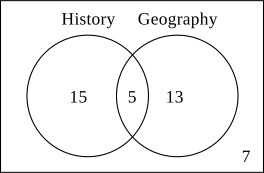
\(n\text{(study H and G)}= 5\)
 

b.    \(P(\text{study G only}) = \dfrac{13}{40}=32.5\% \)
Show Worked Solution

a.    \(\text{Venn diagram:}\)

\(n\text{(study H and G)}= 5\)
 

b.    \(P(\text{study G only}) = \dfrac{13}{40}=32.5\% \)
Filed Under: Venn Diagrams and Expected/Relative Frequency Tagged With: Band 4, Band 5, smc-6936-10-Venn Diagrams, syllabus-2027

Probability, STD2 EQ-Bank 32

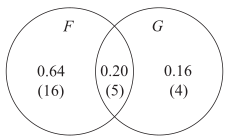
In a workplace of 25 employees, each employee speaks either French or German, or both.

If 36% of the employees speak German, and 20% speak both French and German.

  1. Draw a Venn diagram that represents the information given.   (2 marks)

    --- 6 WORK AREA LINES (style=lined) ---

  2. If one person is chosen at random, what is the probability they can speak French but cannot speak German?   (2 marks)

    --- 4 WORK AREA LINES (style=lined) ---

Show Answers Only

a.   `text(Venn diagram:)`


b.    \(\text{Number who can speak French but not German = 16}\)

\(P(F\ \text{but not}\ G)=\dfrac{16}{25} = 64\%\)

Show Worked Solution

a.   `text(Venn diagram:)`


b.    \(\text{Number who can speak French but not German = 16}\)

\(P(F\ \text{but not}\ G)=\dfrac{16}{25} = 64\%\)

Filed Under: Venn Diagrams and Expected/Relative Frequency Tagged With: Band 4, Band 5, smc-6936-10-Venn Diagrams, syllabus-2027

Probability, STD2 EQ-Bank 22

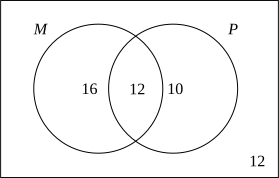
A survey of 50 students found that:

  • 28 students study Mathematics (set \(M\))
  • 22 students study Physics (set \(P\) )
  • 12 students study both Mathematics and Physics.
  1. Draw a Venn diagram to represent this information.   (2 marks)

    --- 6 WORK AREA LINES (style=lined) ---

  2. How many students study Mathematics but not Physics?   (1 mark)

    --- 2 WORK AREA LINES (style=lined) ---

  3. If a student is chosen at random, what is the probability that they do not study either subject?   (1 mark)

    --- 2 WORK AREA LINES (style=lined) ---

Show Answers Only

a.


b.    \(\text{Using the Venn diagram:}\)

\(\text{Number who study Maths but not physics = 16}\)
 

c.    \(P(\text{study both}) = \dfrac{12}{50}=24\%\)

Show Worked Solution

a.


b.    \(\text{Using the Venn diagram:}\)

\(\text{Number who study Maths but not physics = 16}\)
 

c.    \(P(\text{study neither}) = \dfrac{12}{50}=24\%\)

Filed Under: Venn Diagrams and Expected/Relative Frequency Tagged With: Band 4, smc-6936-10-Venn Diagrams, syllabus-2027

Probability, STD2 EQ-Bank 20

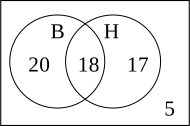
In a group of 60 students, 38 play basketball, 35 play hockey and 5 do not play either basketball or hockey.

  1. Draw a Venn diagram to represent the information given.   (2 marks)

    --- 5 WORK AREA LINES (style=lined) ---

  2. What percentage of students play both basketball and hockey?   (1 mark)

    --- 4 WORK AREA LINES (style=lined) ---

Show Answers Only

a.    

 
b.
    \(\text{From the diagram, 18 students play both sports.}\)

\(\text{Percentage}\ = \dfrac{18}{60} \times 100 = 30\%\)

Show Worked Solution

a.    

 
b.
    \(\text{From the diagram, 18 students play both sports.}\)

\(\text{Percentage}\ = \dfrac{18}{60} \times 100 = 30\%\)

Filed Under: Venn Diagrams and Expected/Relative Frequency Tagged With: Band 4, smc-6936-10-Venn Diagrams, syllabus-2027

Probability, STD2 EQ-Bank 24

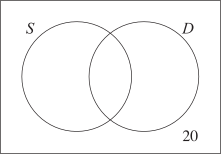
In Year 11 there are 80 students. Of these, 50 play a sport \((S), 25\) are involved in debating ( \(D\) ), and 20 do neither.

  1. Using this information, complete the Venn diagram.   (2 marks)


  1. A Year 11 student is selected at random.
  2. What is the probability that the student plays a sport and is involved in debating?   (1 mark)

    --- 2 WORK AREA LINES (style=lined) ---

  3. Two Year 11 students are selected at random.
  4. What is the probability that both students are involved in debating only?   (2 marks)

    --- 3 WORK AREA LINES (style=lined) ---

Show Answers Only

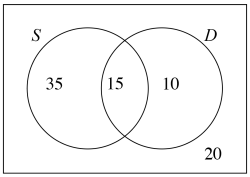
a.    
 

b.    \(\dfrac{3}{16}\)

c.    \(\dfrac{9}{632} \)

Show Worked Solution

a.    
     

b.    \(\text{Using the Venn diagram:}\)

\(P\text{(plays both)} = \dfrac{15}{80}=\dfrac{3}{16}\)
 

c.    \(P\text{(both students involved in debating only)}\)

\(=\dfrac{10}{80} \times\ \dfrac{9}{79}=\dfrac{9}{632} (\approx 0.0142)\)

Filed Under: Venn Diagrams and Expected/Relative Frequency Tagged With: Band 4, Band 5, smc-6936-10-Venn Diagrams, syllabus-2027

Probability, STD2 S2 2025 HSC 13 MC

A ten-sided die has faces numbered 1 to 10 .

The die is constructed so that the probability of obtaining the number 1 is greater than the probability of obtaining any of the other numbers. The numbers 2 to 10 are equally likely to occur.

When the die is rolled 153 times, a 1 is obtained 72 times.

By using the relative frequency of rolling a 1, which of the following is the best estimate for the probability of rolling a 10 ?

  1. \(\dfrac{1}{17}\)
  2. \(\dfrac{1}{11}\)
  3. \(\dfrac{1}{10}\)
  4. \(\dfrac{1}{9}\)
Show Answers Only

\(A\)

Show Worked Solution

\(P(1) = \dfrac{72}{153}=\dfrac{8}{17} \)

\(\text{Let}\ \ p=P(2)=P(3) = … =P(10) \)

\(\dfrac{8}{17}+9p\) \(=1\)  
\(9p\) \(=1-\dfrac{8}{17}\)  
\(p\) \(=\dfrac{1}{17}\)  

 
\(\Rightarrow A\)

♦ Mean mark 53%.

Filed Under: Relative Frequency, Venn Diagrams and Expected/Relative Frequency Tagged With: 2adv-std2-common, Band 5, smc-6936-30-Relative Frequency, smc-6936-50-Games of Chance, smc-827-20-Games of Chance, smc-827-40-Expected Frequency (np)

Probability, STD2 S2 2024 HSC 12 MC

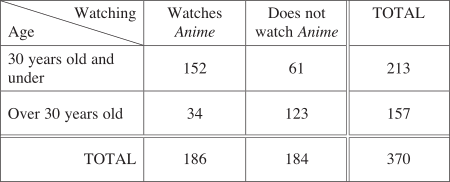
A survey of 370 people was conducted to investigate the association between watching Anime and the age of the person.

The two-way table shows the responses collected.

Approximately what percentage of the over 30-year-olds watch Anime?

  1. 9%
  2. 18%
  3. 22%
  4. 42%
Show Answers Only

\(C\)

Show Worked Solution

\(\text {Total over } 30=157\)

\(\text {Over 30s who watch anime = 34}\)

\(\text {% over 30s who watch anime}\ =\dfrac{34}{157}=21.7\%\)

\(\Rightarrow C\)

Filed Under: Relative Frequency, Relative Frequency, Venn Diagrams and Expected/Relative Frequency Tagged With: Band 4, common-content, smc-6936-20-Two-way Tables, smc-827-10-Surveys/Two-Way Tables, smc-990-10-Surveys/Two-Way Tables

Probability, STD2 S2 2019 HSC 20

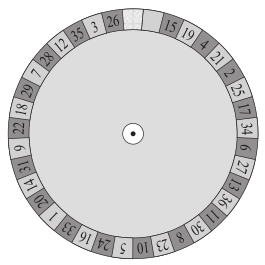
A roulette wheel has the numbers 0, 1, 2, …, 36 where each of the 37 numbers is equally likely to be spun.
 

If the wheel is spun 18 500 times, calculate the expected frequency of spinning the number 8.   (2 marks)

--- 4 WORK AREA LINES (style=lined) ---

Show Answers Only

`500`

Show Worked Solution

`P(8) = 1/37`

`:.\ text(Expected Frequency (8)) = 1/37 xx 18\ 500 = 500`

Filed Under: Data, Expected/Relative Frequency, Probability, Relative Frequency, Relative Frequency, Relative Frequency, Venn Diagrams and Expected/Relative Frequency Tagged With: Band 4, common-content, num-title-ct-core, num-title-qs-hsc, smc-1133-20-Games of Chance, smc-4225-35-Relative frequency, smc-6805-40-Games of Chance, smc-6805-50-Expected Frequency, smc-6888-10-Expected Frequency, smc-6888-20-Games of Chance, smc-6936-40-Expected Frequency, smc-6936-50-Games of Chance, smc-827-20-Games of Chance, smc-827-40-Expected Frequency (np), smc-990-20-Games of Chance, smc-990-40-Expected Frequency (np)

Probability, STD2 S2 2018 HSC 20 MC

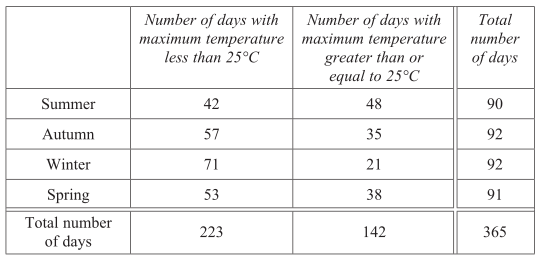
During a year, the maximum temperature each day was recorded. The results are shown in the table.
  

From the days with a maximum temperature less than 25°C, one day is selected at random.

What is the probability, to the nearest percentage, that the selected day occurred during winter?

  1. 19%
  2. 25%
  3. 32%
  4. 77%
Show Answers Only

`C`

Show Worked Solution
`text{P(winter day)}` `= (text(winter days < 25))/text(total days < 25) xx 100`
  `= 71/223 xx 100`
  `= 31.8…%`

`=> C`

Filed Under: Probability, Relative Frequency, Relative Frequency, Relative Frequency, Venn Diagrams and Expected/Relative Frequency Tagged With: Band 4, common-content, num-title-ct-core, num-title-qs-hsc, smc-1133-10-Surveys/Two-Way Tables, smc-4225-35-Relative frequency, smc-6936-30-Relative Frequency, smc-827-10-Surveys/Two-Way Tables, smc-990-10-Surveys/Two-Way Tables

Probability, STD2 S2 2017 HSC 29c

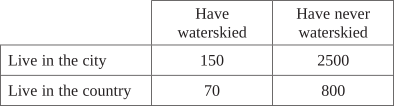
A group of Year 12 students was surveyed. The students were asked whether they live in the city or the country. They were also asked if they have ever waterskied.

The results are recorded in the table.
  

  1. A person is selected at random from the group surveyed. Calculate the probability that the person lives in the city and has never waterskied.   (2 marks)

    --- 4 WORK AREA LINES (style=lined) ---

  2. A newspaper article claimed that Year 12 students who live in the country are more likely to have waterskied than those who live in the city.


    Is this true, based on the survey results? Justify your answer with relevant calculations.   (2 marks)

    --- 4 WORK AREA LINES (style=lined) ---

Show Answers Only

i.    `125/176`

ii.   `text(See Worked Solutions)`

Show Worked Solution

i.    `P= text(live in city, not skied)/text(total surveyed)= 2500/3520= 125/176`

♦ Mean mark part (ii) 47%.

 
ii.
   `P(text(live in country, skied))= 70/((70 + 800))= 0.0804…= 8text(%)`

`P(text(live in city, skied))= 150/((150 + 2500))= 0.0566= 6text(%)`

`text(S)text(ince 8% > 6%, the statement is true.)`

Filed Under: Relative Frequency, Relative Frequency, Relative Frequency, Relative Frequency, Venn Diagrams and Expected/Relative Frequency Tagged With: Band 4, Band 5, common-content, smc-1133-10-Surveys/Two-Way Tables, smc-6936-20-Two-way Tables, smc-827-10-Surveys/Two-Way Tables, smc-990-10-Surveys/Two-Way Tables

Probability, STD2 S2 2017 HSC 5 MC

In a survey of 200 randomly selected Year 12 students it was found that 180 use social media.

Based on this survey, approximately how many of 75 000 Year 12 students would be expected to use social media?

  1. 60 000
  2. 67 500
  3. 74 980
  4. 75 000
Show Answers Only

`B`

Show Worked Solution

`text(Expected number)= 180/200 xx 75\ 000= 67\ 500`

`=> B`

Filed Under: Data, DS5/6 - Normal Distribution and Sampling, Expected/Relative Frequency, Probability, Relative Frequency, Relative Frequency, Relative Frequency, Relative Frequency, Venn Diagrams and Expected/Relative Frequency Tagged With: Band 3, common-content, num-title-ct-core, num-title-qs-hsc, smc-1133-10-Surveys/Two-Way Tables, smc-1133-30-Expected Frequency (np), smc-4225-35-Relative frequency, smc-6805-50-Expected Frequency, smc-6888-10-Expected Frequency, smc-6936-40-Expected Frequency, smc-827-10-Surveys/Two-Way Tables, smc-827-40-Expected Frequency (np), smc-990-10-Surveys/Two-Way Tables, smc-990-40-Expected Frequency (np)

Probability, STD2 S2 2016 HSC 23 MC

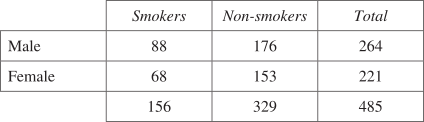
A group of 485 people was surveyed. The people were asked whether or not they smoke. The results are recorded in the table.
 

A person is selected at random from the group.

What is the approximate probability that the person selected is a smoker OR is male?

  1. 33%
  2. 18%
  3. 68%
  4. 87%
Show Answers Only

`=> C`

Show Worked Solution

`P(text(Smoker or a male))`

`= (text(Total males + female smokers))/(text(Total surveyed))`

`= (264 + 68)/485`

`= 0.684…`
 

`=> C`

♦♦ Mean mark 34%.

Filed Under: Relative Frequency, Relative Frequency, Relative Frequency, Relative Frequency, Relative Frequency and Venn Diagrams, Venn Diagrams and Expected/Relative Frequency Tagged With: Band 6, common-content, num-title-ct-pathb, num-title-qs-hsc, smc-1133-10-Surveys/Two-Way Tables, smc-4815-10-2-Way tables, smc-4815-50-Conditional probability, smc-6936-20-Two-way Tables, smc-827-10-Surveys/Two-Way Tables, smc-990-10-Surveys/Two-Way Tables

Probability, STD2 S2 2006 HSC 26c

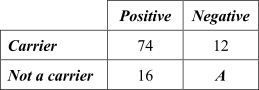
A new test has been developed for determining whether or not people are carriers of the Gaussian virus.

Two hundred people are tested. A two-way table is being used to record the results.
 

  1.  What is the value of `A`?   (1 mark)

    --- 1 WORK AREA LINES (style=lined) ---

  2.  A person selected from the tested group is a carrier of the virus.
  3. What is the probability that the test results would show this?   (2 marks) 

    --- 4 WORK AREA LINES (style=lined) ---

  4.  For how many of the people tested were their test results inaccurate?   (1 mark)

    --- 2 WORK AREA LINES (style=lined) ---

Show Answers Only

a.    `98`

b.    `37/43`

c.    `28`

Show Worked Solution

a.    `A= 200-(74 + 12 + 16)= 98`
 

b.    `P= text(#Positive carriers)/text(Total carriers)= 74/86= 37/43`
 

c.    `text(Number with inaccurate results) = 12 + 16 = 28`

Filed Under: Relative Frequency, Relative Frequency, Relative Frequency, Relative Frequency, Relative Frequency and Venn Diagrams, Venn Diagrams and Expected/Relative Frequency Tagged With: Band 3, Band 4, common-content, num-title-ct-pathb, num-title-qs-hsc, smc-1133-10-Surveys/Two-Way Tables, smc-4815-10-2-Way tables, smc-6936-20-Two-way Tables, smc-827-10-Surveys/Two-Way Tables, smc-990-10-Surveys/Two-Way Tables

Probability, STD2 S2 2005 HSC 16 MC

On a television game show, viewers voted for their favourite contestant. The results were recorded in the two-way table.

\begin{array} {|l|c|c|}
\hline
\rule{0pt}{2.5ex} \rule[-1ex]{0pt}{0pt} & \textbf{Male viewers} & \textbf{Female viewers} \\
\hline
\rule{0pt}{2.5ex}\textbf{Contestant 1}\rule[-1ex]{0pt}{0pt} & 1372 & 3915\\
\hline
\rule{0pt}{2.5ex}\textbf{Contestant 2}\rule[-1ex]{0pt}{0pt} & 2054 & 3269\\
\hline
\end{array}

One male viewer was selected at random from all of the male viewers.

What is the probability that he voted for Contestant 1?

  1. `1372/(10\ 610)`
  2. `1372/5287`
  3. `1372/3426`
  4. `1372/2054`
Show Answers Only

`C`

Show Worked Solution

`text(Total male viewers)\ = 1372 + 2054= 3426`

  
`P\ text{(Male viewer chosen voted for C1)}`

`= text(Males who voted for C1)/text(Total male viewers)`

`= 1372/3426`
 

`=>  C`

Filed Under: Relative Frequency, Relative Frequency, Relative Frequency, Relative Frequency, Relative Frequency and Venn Diagrams, Venn Diagrams and Expected/Relative Frequency Tagged With: Band 4, common-content, num-title-ct-pathb, num-title-qs-hsc, smc-1133-10-Surveys/Two-Way Tables, smc-4815-10-2-Way tables, smc-4815-50-Conditional probability, smc-6936-20-Two-way Tables, smc-827-10-Surveys/Two-Way Tables, smc-990-10-Surveys/Two-Way Tables

Probability, STD2 S2 2004 HSC 25c

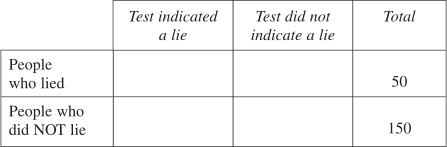
Lie detector tests are not always accurate. A lie detector test was administered to 200 people.

The results were:

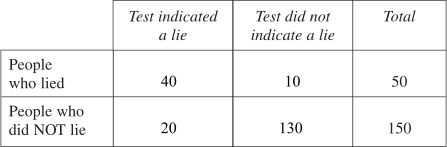
• 50 people lied. Of these, the test indicated that 40 had lied;
• 150 people did NOT lie. Of these, the test indicated that 20 had lied.

  1. Complete the table using the information above   (2 marks)


    --- 0 WORK AREA LINES (style=lined) ---

  2. For how many of the people tested was the lie detector test accurate?   (1 mark)

    --- 2 WORK AREA LINES (style=lined) ---

  3. For what percentage of the people tested was the test accurate?   (1 mark)

    --- 2 WORK AREA LINES (style=lined) ---

  4. What is the probability that the test indicated a lie for a person who did NOT lie?   (1 mark)

    --- 2 WORK AREA LINES (style=lined) ---

Show Answers Only

a.    `text(See Worked Solutions)`

b.    `170`

c.    `text(85%)`

d.    `2/15`

Show Worked Solution

a.

b.    `text(# Accurate readings) = 40 + 130 = 170`
 

c.    `text(Percentage of people with accurate readings)`

`= text(# Accurate readings)/text(Total readings) xx 100`

`= 170/200`

`= 85 text(%)`
 

d.    `text{P(lie detected when NOT a lie)} = 20/150= 2/15`

Filed Under: Relative Frequency, Relative Frequency, Relative Frequency, Relative Frequency, Relative Frequency and Venn Diagrams, Venn Diagrams and Expected/Relative Frequency Tagged With: Band 4, Band 5, common-content, num-title-ct-pathb, num-title-qs-hsc, smc-1133-10-Surveys/Two-Way Tables, smc-4815-10-2-Way tables, smc-6936-20-Two-way Tables, smc-827-10-Surveys/Two-Way Tables, smc-990-10-Surveys/Two-Way Tables

Probability, STD2 S2 2006 HSC 6 MC

Marcella is planning to roll a standard six-sided die 60 times.

How many times would she expect to roll the number 4?

  1. 6
  2. 10
  3. 15
  4. 20
Show Answers Only

`B`

Show Worked Solution

`P(4) = 1/6`

`:.\ text(Expected times to roll 4) = 1/6 xx 60 = 10`

`=>  B`

Filed Under: Data, Expected/Relative Frequency, Probability, Relative Frequency, Relative Frequency, Relative Frequency, Relative Frequency, Venn Diagrams and Expected/Relative Frequency Tagged With: Band 4, common-content, num-title-ct-core, num-title-qs-hsc, smc-1133-20-Games of Chance, smc-1133-30-Expected Frequency (np), smc-4225-35-Relative frequency, smc-6805-40-Games of Chance, smc-6805-50-Expected Frequency, smc-6888-10-Expected Frequency, smc-6888-20-Games of Chance, smc-6936-40-Expected Frequency, smc-6936-50-Games of Chance, smc-827-20-Games of Chance, smc-827-40-Expected Frequency (np), smc-990-20-Games of Chance, smc-990-40-Expected Frequency (np)

Probability, STD2 S2 2007 HSC 16 MC

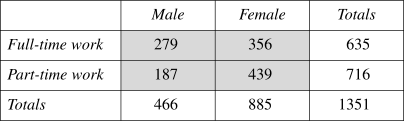
Leanne copied a two-way table into her book.


Leanne made an error in copying one of the values in the shaded section of the table.

Which value has been incorrectly copied?

  1. The number of males in full-time work
  2. The number of males in part-time work
  3. The number of females in full-time work
  4. The number of females in part-time work
Show Answers Only

`D`

Show Worked Solution

`text(By checking row and column total, the number of females in part-time)`

`text(work is incorrect.)`

`=>  D`

Filed Under: Relative Frequency, Relative Frequency, Relative Frequency, Relative Frequency and Venn Diagrams, Summary Statistics (no graph), Venn Diagrams and Expected/Relative Frequency Tagged With: Band 4, common-content, num-title-ct-pathb, num-title-qs-hsc, smc-1133-10-Surveys/Two-Way Tables, smc-4815-10-2-Way tables, smc-6936-20-Two-way Tables, smc-827-10-Surveys/Two-Way Tables, smc-990-10-Surveys/Two-Way Tables

Probability, STD2 S2 2007 HSC 2 MC

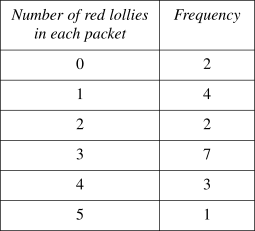
Each student in a class is given a packet of lollies. The teacher records the number of red lollies in each packet using a frequency table.
 

What is the relative frequency of a packet of lollies containing more than three red lollies?

  1. `4/19`
  2. `4/15`
  3. `11/19`
  4. `11/15`
Show Answers Only

`A`

Show Worked Solution

`text(# Packets with more than 3 red) = 3 + 1 = 4`

`text(Total packets) = 19`

`:.\ text(Relative Frequency) = 4/19`

`=>  A`

Filed Under: Expected/Relative Frequency, Probability, Relative Frequency, Relative Frequency, Relative Frequency, Relative Frequency, Venn Diagrams and Expected/Relative Frequency Tagged With: Band 3, common-content, num-title-ct-core, num-title-qs-hsc, smc-1133-10-Surveys/Two-Way Tables, smc-4225-35-Relative frequency, smc-6888-35-Relative Frequency, smc-6936-30-Relative Frequency, smc-827-10-Surveys/Two-Way Tables, smc-990-10-Surveys/Two-Way Tables

Probability, STD2 S2 2008 HSC 26b

The retirement ages of two million people are displayed in a table.


  1. What is the relative frequency of the 51–55 year retirement age?  (1 mark)

    --- 1 WORK AREA LINES (style=lined) ---

  2. Describe the distribution.   (1 mark)

    --- 2 WORK AREA LINES (style=lined) ---

Show Answers Only

a.    `7/400`

b.    `text(Distribution is negatively skewed because as age increases, so does the)`

`text(number of people in each age bracket.)`

Show Worked Solution

a.    `text(Relative frequency)\ (51-55)`

`= text{# People (51-55)}/text(Total People)`

`= (35\ 000)/(2\ 000\ 000)`

`= 7/400`
 

b.    `text(Distribution is negatively skewed because as age increases, so does the)`

`text(number of people in each age bracket.)`

Filed Under: Relative Frequency, Relative Frequency, Relative Frequency, Relative Frequency, Summary Statistics (no graph), Venn Diagrams and Expected/Relative Frequency Tagged With: Band 4, Band 5, common-content, smc-1133-10-Surveys/Two-Way Tables, smc-6936-30-Relative Frequency, smc-827-10-Surveys/Two-Way Tables, smc-990-10-Surveys/Two-Way Tables, smc-999-70-Other

Probability, STD2 S2 2008 HSC 26a

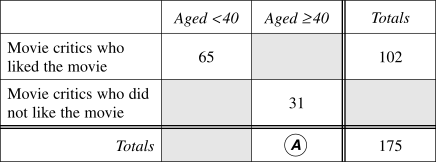
Cecil invited 175 movie critics to preview his new movie. After seeing the movie, he conducted a survey. Cecil has almost completed the two-way table.
 

  1. Determine the value of  `A`.   (1 mark)

    --- 1 WORK AREA LINES (style=lined) ---

  2. A movie critic is selected at random.


    What is the probability that the critic was less than 40 years old and did not like the movie?  (2 marks)

    --- 4 WORK AREA LINES (style=lined) ---

  3. Cecil believes that his movie will be a box office success if 65% of the critics who were surveyed liked the movie.


    Will this movie be considered a box office success? Justify your answer.  (1 mark)

    --- 2 WORK AREA LINES (style=lined) ---

Show Answers Only

a.    `58`

b.    `6/25`

c.    `text(Proof)\ \ text{(See Worked Solutions)}`

Show Worked Solution

a.    `text{Critics liked and}\ >= 40 = 102-65 = 37`

`A = 37+31=68`

 
b.
    `text{Critics did not like and < 40} = 175-65-37-31= 42`

`P text{(not like and  < 40)}= 42/175= 6/25`
 

c.    `text(Critics liked) = 102`

`text(% Critics liked)= 102/175 xx 100= 58.28…%`

`:.\ text{Movie NOT a box office success (< 65% critics liked)}`

Filed Under: Relative Frequency, Relative Frequency, Relative Frequency, Relative Frequency, Relative Frequency and Venn Diagrams, Venn Diagrams and Expected/Relative Frequency Tagged With: Band 3, Band 4, common-content, num-title-ct-pathb, num-title-qs-hsc, smc-1133-10-Surveys/Two-Way Tables, smc-4815-10-2-Way tables, smc-6936-20-Two-way Tables, smc-827-10-Surveys/Two-Way Tables, smc-990-10-Surveys/Two-Way Tables

Probability, STD2 S2 2014 HSC 8 MC

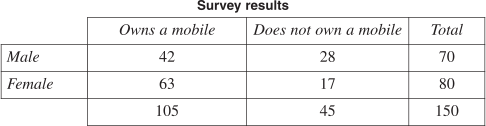
A group of 150 people was surveyed and the results recorded.


A person is selected at random from the surveyed group. 

What is the probability that the person selected is a male who does not own a mobile?

  1. `28/150`
  2. `45/150` 
  3. `28/70` 
  4. `45/70` 
Show Answers Only

`A`

Show Worked Solution

`P=text(number of males without mobile)/text(number in group)= 28/150`

`=>  A`

Filed Under: Relative Frequency, Relative Frequency, Relative Frequency, Relative Frequency and Venn Diagrams, Venn Diagrams and Expected/Relative Frequency Tagged With: Band 3, common-content, num-title-ct-pathb, num-title-qs-hsc, smc-1133-10-Surveys/Two-Way Tables, smc-4815-10-2-Way tables, smc-6936-20-Two-way Tables, smc-827-10-Surveys/Two-Way Tables

Probability, STD2 S2 2011 HSC 25c

At another school, students who use mobile phones were surveyed. The set of data is shown in the table.

2UG 2011 25c

  1. How many students were surveyed at this school?   (1 mark)

    --- 1 WORK AREA LINES (style=lined) ---

  2. Of the female students surveyed, one is chosen at random. What is the probability that she uses pre-paid?   (1 mark)

    --- 2 WORK AREA LINES (style=lined) ---

Ten new male students are surveyed and all ten are on a plan. The set of data is updated to include this information.

  1. What percentage of the male students surveyed are now on a plan? Give your answer to the nearest per cent.   (1 mark)

    --- 2 WORK AREA LINES (style=lined) ---

Show Answers Only

a.    `580`

b.    `text(54%)`

c.    `text(42%)`

Show Worked Solution

a.    `text(# Students surveyed)=319+261=580`
 

b.    `Ptext{(Female uses prepaid)}`

`=text(# Females on prepaid)/text(Total females)=172/319=0.53918… ~~ 54\text{% (nearest %)}`
 

c.    `text(% Males on plan)` `=text(# Males on plan + 10)/text(Total males + 10)`
  `=(103+10)/(261+10)`
  `=113/271`
  `=0.4169…`
  `=42\text{%  (nearest %)}`

Filed Under: Relative Frequency, Relative Frequency, Relative Frequency, Relative Frequency, Summary Statistics (no graph), Venn Diagrams and Expected/Relative Frequency Tagged With: Band 2, Band 3, Band 4, common-content, smc-1133-10-Surveys/Two-Way Tables, smc-6936-20-Two-way Tables, smc-827-10-Surveys/Two-Way Tables, smc-990-10-Surveys/Two-Way Tables

Probability, STD2 S2 2011 HSC 24b

A die was rolled 72 times. The results for this experiment are shown in the table.

\begin{array} {|c|c|}
\hline
\rule{0pt}{2.5ex} \textit{Number obtained} \rule[-1ex]{0pt}{0pt} & \textit{Frequency} \\
\hline
\rule{0pt}{2.5ex} \ 1 \rule[-1ex]{0pt}{0pt} & 16 \\
\hline
\rule{0pt}{2.5ex} \ 2 \rule[-1ex]{0pt}{0pt} & 11 \\
\hline
\rule{0pt}{2.5ex} \ 3 \rule[-1ex]{0pt}{0pt} & \textbf{A} \\
\hline
\rule{0pt}{2.5ex} \ 4 \rule[-1ex]{0pt}{0pt} & 8 \\
\hline
\rule{0pt}{2.5ex} \ 5 \rule[-1ex]{0pt}{0pt} & 12 \\
\hline
\rule{0pt}{2.5ex} \ 6 \rule[-1ex]{0pt}{0pt} & 15 \\
\hline
\end{array}

  1. Find the value of `A`.   (1 mark)

    --- 1 WORK AREA LINES (style=lined) ---

  2. What was the relative frequency of obtaining a 4.   (1 mark)

    --- 2 WORK AREA LINES (style=lined) ---

  3. If the die was unbiased, which number was obtained the expected number of times?   (1 mark)

    --- 2 WORK AREA LINES (style=lined) ---

Show Answers Only

a.    \(10\)

b.    \(\dfrac{1}{9}\)

c.    \(5\)

Show Worked Solution

a.    \(\text{Since die rolled 72 times:}\)

\(A=72-(16+11+8+12+15)=10\)

♦ Mean mark 38%
IMPORTANT: Many students confused ‘relative frequency’ with ‘frequency’ and incorrectly answered 8.

 
b.
     \(\text{Relative frequency of 4}=\dfrac{8}{72}=\dfrac{1}{9}\)
 

c.    \(\text{Expected frequency of any number}=\dfrac{1}{6}\times 72=12\)

\(\therefore\ \text{5 was obtained the expected number of times.}\)

Filed Under: Data, Expected/Relative Frequency, Probability, Relative Frequency, Relative Frequency, Relative Frequency, Relative Frequency, Venn Diagrams and Expected/Relative Frequency Tagged With: Band 2, Band 4, Band 5, common-content, num-title-ct-core, num-title-qs-hsc, smc-1133-20-Games of Chance, smc-1133-30-Expected Frequency (np), smc-4225-35-Relative frequency, smc-6805-40-Games of Chance, smc-6805-50-Expected Frequency, smc-6888-10-Expected Frequency, smc-6888-20-Games of Chance, smc-6888-35-Relative Frequency, smc-6936-30-Relative Frequency, smc-6936-40-Expected Frequency, smc-6936-50-Games of Chance, smc-827-20-Games of Chance, smc-827-40-Expected Frequency (np), smc-990-20-Games of Chance, smc-990-40-Expected Frequency (np)

Probability, STD2 S2 2009 HSC 28d

In an experiment, two unbiased dice, with faces numbered  1, 2, 3, 4, 5, 6  are rolled 18 times.

The difference between the numbers on their uppermost faces is recorded each time. Juan performs this experiment twice and his results are shown in the tables.

 2009 28d

Juan states that Experiment 2 has given results that are closer to what he expected than the results given by Experiment 1.

Is he correct? Explain your answer by finding the sample space for the dice differences and using theoretical probability.   (4 marks)

--- 8 WORK AREA LINES (style=lined) ---

Show Answers Only

 `text{Juan is correct (See Worked Solutions)}`

Show Worked Solution
♦♦♦ Mean mark 7%.
MARKER’S COMMENT: This question guides students by asking for an explanation using the sample space for the dice differences.

`text(Sample space for dice differences:)`

2UG-2009-28d1

2UG-2009-28d2_1

2UG-2009-28d3_1

`text(Juan is correct.  The table shows Experiment 1 has greater total differences to the)`

`text(expected frequencies than Experiment 2)`

Filed Under: Multi-stage Events, Multi-Stage Events, Relative Frequency, Relative Frequency, Relative Frequency, Single and Multi-Stage Events, Venn Diagrams and Expected/Relative Frequency Tagged With: Band 6, common-content, smc-6935-50-Arrays, smc-6936-40-Expected Frequency, smc-6936-50-Games of Chance, smc-827-20-Games of Chance, smc-827-40-Expected Frequency (np), smc-829-50-Arrays

Probability, STD2 S2 2009 HSC 9 MC

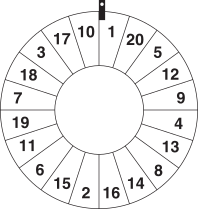
A wheel has the numbers 1 to 20 on it, as shown in the diagram. Each time the wheel is spun, it stops with the marker on one of the numbers.
 

The wheel is spun 120 times.

 How many times would you expect a number less than 6 to be obtained?

  1. `20` 
  2. `24` 
  3. `30` 
  4. `36` 
Show Answers Only

`C`

Show Worked Solution

`P(text(number < 6) ) = 5/20 = 1/4`

`:.\ text(Expected times)= 1/4 xx text(times spun)= 1/4 xx 120= 30`

`=>  C`

Filed Under: Data, Expected/Relative Frequency, Probability, Relative Frequency, Relative Frequency, Relative Frequency, Relative Frequency, Venn Diagrams and Expected/Relative Frequency Tagged With: Band 4, common-content, num-title-ct-core, num-title-qs-hsc, smc-1133-20-Games of Chance, smc-1133-30-Expected Frequency (np), smc-4225-35-Relative frequency, smc-6805-40-Games of Chance, smc-6805-50-Expected Frequency, smc-6888-10-Expected Frequency, smc-6888-20-Games of Chance, smc-6936-40-Expected Frequency, smc-6936-50-Games of Chance, smc-827-20-Games of Chance, smc-827-40-Expected Frequency (np), smc-990-20-Games of Chance, smc-990-40-Expected Frequency (np)

Probability, STD2 S2 2009 HSC 8 MC

Some men and women were surveyed at a football game. They were asked which team they supported. The results are shown in the two-way table.
 

2UG-2009-8MC 

What percentage of the women surveyed supported Team B, correct to the nearest percent?

  1. 23%
  2. 45%
  3. 47%
  4. 55%
Show Answers Only

`D`

Show Worked Solution

`text(% Women for Team B)= text(# Women for Team B)/text(# Women surveyed)= 90/165= 54.54\ … %`

`=>  D`

Filed Under: Relative Frequency, Relative Frequency, Relative Frequency, Relative Frequency, Venn Diagrams and Expected/Relative Frequency Tagged With: Band 4, common-content, smc-1133-10-Surveys/Two-Way Tables, smc-6936-20-Two-way Tables, smc-827-10-Surveys/Two-Way Tables, smc-990-10-Surveys/Two-Way Tables

Probability, STD2 S2 2010 HSC 12 MC

A group of 347 people was tested for flu and the results were recorded. The flu test  results are not always accurate.

2010 12 MC

A person is selected at random from the tested group.

What is the probability that their test result is accurate, to the nearest per cent?

  1.    21%
  2.    22%
  3.    95%
  4.    96%
Show Answers Only

`C`

Show Worked Solution
`P\ text((Test accurate))` `=text(Accurate readings)/text(Total tested)`
  `=(72+256)/347`
  `=94.5244…%`

`=>  C`

Filed Under: Relative Frequency, Relative Frequency, Relative Frequency, Relative Frequency, Venn Diagrams and Expected/Relative Frequency Tagged With: Band 4, common-content, smc-1133-10-Surveys/Two-Way Tables, smc-6936-20-Two-way Tables, smc-827-10-Surveys/Two-Way Tables, smc-990-10-Surveys/Two-Way Tables

Probability, STD2 S2 2012 HSC 26e

The dot plot shows the number of push-ups that 13 members of a fitness class can do in one minute.

2012 26e

  1.  What is the probability that a member selected at random from the class can do more than 38 push-ups in one minute?   (1 mark)

    --- 1 WORK AREA LINES (style=lined) ---

  2.  A new member who can do 32 push-ups in one minute joins the class.


    Does the addition of this new member to the class change the probability calculated in part (a)? Justify your answer.   (1 mark)

    --- 2 WORK AREA LINES (style=lined) ---

Show Answers Only

a.    `7/13`

b.    `text{Yes (See Worked Solutions)}`

Show Worked Solution

a.    `P= text(# Members > 38 push-ups)/text(Total members)= 7/13`

 
b.
    `text(Yes.)`

`Ptext{(+ New member)}` `= text(Members > 38 push-ups)/text(Total members)`
  `= 7/14≠ 7/13`
MARKER’S COMMENT: The most successful candidates used fractions in part (b) rather than relying solely on words.

Filed Under: Expected/Relative Frequency, Probability, Relative Frequency, Relative Frequency, Relative Frequency, Relative Frequency, Venn Diagrams and Expected/Relative Frequency Tagged With: Band 3, Band 4, common-content, num-title-ct-core, num-title-qs-hsc, smc-1133-10-Surveys/Two-Way Tables, smc-4225-35-Relative frequency, smc-6888-30-Surveys, smc-6936-30-Relative Frequency, smc-827-10-Surveys/Two-Way Tables, smc-990-10-Surveys/Two-Way Tables

Probability, STD2 S2 2013 HSC 10 MC

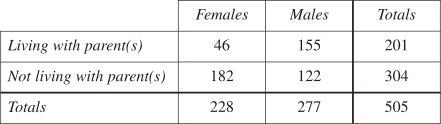
Students studying vocational education courses were surveyed about their living arrangements.

One of these students is selected at random.

 What is the probability that this student is male and living with his parent(s)?

  1. 31%
  2. 40%
  3. 56%
  4. 77%
Show Answers Only

`A`

Show Worked Solution

`text(Number of males living with their parents is = 155)`.

`:.\ P=155/505=0.30693…%`

`=>\ A`

Filed Under: Relative Frequency, Relative Frequency, Relative Frequency, Relative Frequency, Venn Diagrams and Expected/Relative Frequency Tagged With: Band 4, common-content, smc-1133-10-Surveys/Two-Way Tables, smc-6936-20-Two-way Tables, smc-827-10-Surveys/Two-Way Tables, smc-990-10-Surveys/Two-Way Tables

Probability, STD2 S2 2013 HSC 7 MC

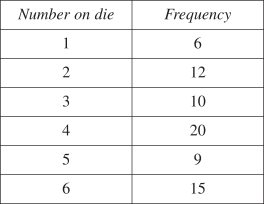
In an experiment, a standard six-sided die was rolled 72 times. The results are shown in the table.
 

Which number on the die was obtained the expected number of times?

  1. 1
  2. 2
  3. 3
  4. 6
Show Answers Only

`B`

Show Worked Solution

`text(Probability of rolling a specific number)=1/6`

`text{After 72 rolls, expected number of times (of any specific number)}`

 `=1/6 xx 72=12`

`=>\ B`

Filed Under: Data, Expected/Relative Frequency, Probability, Relative Frequency, Relative Frequency, Relative Frequency, Relative Frequency, Venn Diagrams and Expected/Relative Frequency Tagged With: Band 3, common-content, num-title-ct-core, num-title-qs-hsc, smc-1133-20-Games of Chance, smc-1133-30-Expected Frequency (np), smc-4225-35-Relative frequency, smc-6805-40-Games of Chance, smc-6805-50-Expected Frequency, smc-6888-10-Expected Frequency, smc-6888-20-Games of Chance, smc-6936-40-Expected Frequency, smc-6936-50-Games of Chance, smc-827-20-Games of Chance, smc-827-40-Expected Frequency (np), smc-990-20-Games of Chance, smc-990-40-Expected Frequency (np)

Copyright © 2014–2026 SmarterEd.com.au · Log in