SmarterEd

Aussie Maths & Science Teachers: Save your time with SmarterEd

  • Login
  • Get Help
  • About

Data Analysis, GEN2 2024 VCAA 1

Table 1 lists the Olympic year, \(\textit{year}\), and the gold medal-winning height for the men's high jump, \(\textit{Mgold}\), in metres, for each Olympic Games held from 1928 to 2020. No Olympic Games were held in 1940 or 1944, and the 2020 Olympic Games were held in 2021.

Table 1

\begin{array}{|c|c|}
\hline \quad \textit{year} \quad & \textit{Mgold}\,\text{(m)} \\
\hline 1928 & 1.94 \\
\hline 1932 & 1.97 \\
\hline 1936 & 2.03 \\
\hline 1948 & 1.98 \\
\hline 1952 & 2.04 \\
\hline 1956 & 2.12 \\
\hline 1960 & 2.16 \\
\hline 1964 & 2.18 \\
\hline 1968 & 2.24 \\
\hline 1972 & 2.23 \\
\hline 1976 & 2.25 \\
\hline 1980 & 2.36 \\
\hline 1984 & 2.35 \\
\hline 1988 & 2.38 \\
\hline 1992 & 2.34 \\
\hline 1996 & 2.39 \\
\hline 2000 & 2.35 \\
\hline 2004 & 2.36 \\
\hline 2008 & 2.36 \\
\hline 2012 & 2.33 \\
\hline 2016 & 2.38 \\
\hline 2020 & 2.37 \\
\hline
\end{array}

  1. For the data in Table 1, determine:
  2.  i. the maximum \(\textit{Mgold}\) in metres   (1 mark)

    --- 1 WORK AREA LINES (style=lined) ---

  3. ii. the percentage of \(\textit{Mgold}\) values greater than 2.25 m.   (1 mark)

    --- 2 WORK AREA LINES (style=lined) ---

  4. The mean of these \(\textit{Mgold}\) values is 2.23 m, and the standard deviation is 0.15 m.
  5. Calculate the standardised \(z\)-score for the 2000 \(\textit{Mgold}\) of 2.35 m.   (1 mark)

    --- 3 WORK AREA LINES (style=lined) ---

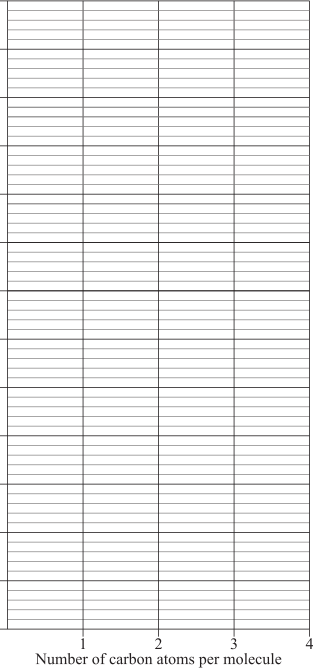
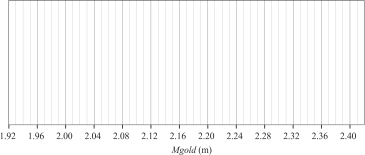
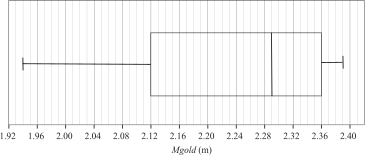
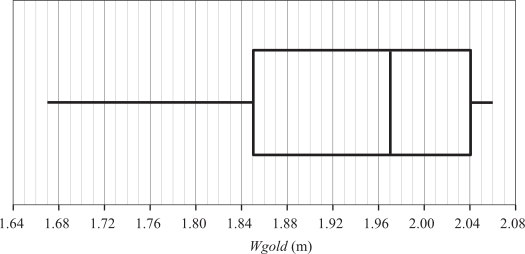
  6. Construct a boxplot for the \(\textit{Mgold}\) data in Table 1 on the grid below.   (2 marks)

    --- 0 WORK AREA LINES (style=lined) ---

     

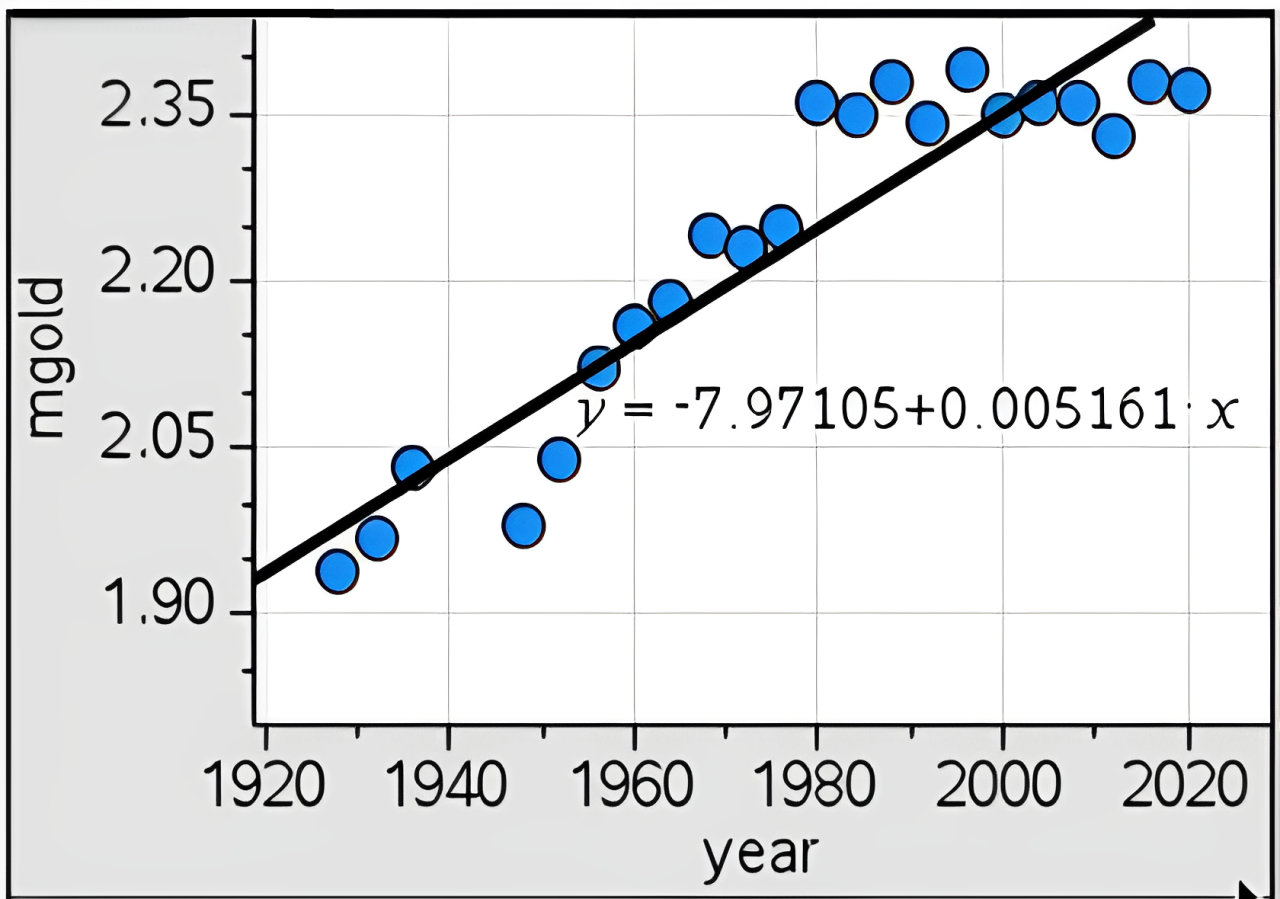
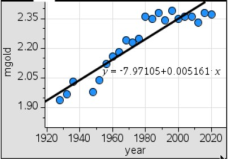
  1. A least squares line can also be used to model the association between \(\textit{Mgold}\) and \(\textit{year}\).
  2. Using the data from Table 1, determine the equation of the least squares line for this data set.
  3. Use the template below to write your answer.
  4. Round the values of the intercept and slope to three significant figures.   (2 marks)

    --- 0 WORK AREA LINES (style=lined) ---


  1. The coefficient of determination is 0.857
  2. Interpret the coefficient of determination in terms of \(\textit{Mgold}\) and \(\textit{year}\).   (1 mark)

    --- 4 WORK AREA LINES (style=lined) ---

Show Answers Only

a.i.   \(2.39\)

a.ii.  \(50\%\)

b.    \(0.8\)

c.     

d.   
    

e.    \(\text{A coefficient of determination of 85.7% shows the variation in}\)

\(\text{the}\ Mgold\ \text{that is explained by the variation in the }year.\)

Show Worked Solution

a.i.   \(2.39\)

a.ii.  \(\dfrac{11}{22}=50\%\)

b.     \(z\) \(=\dfrac{x-\overline x}{s_x}\)
    \(=\dfrac{2.35-2.23}{0.15}\)
    \(=0.8\)

  
c.   
\(Q_2=\dfrac{2.33+2.25}{2}=2.29\)

\(Q_1=2.12, \ Q_3=2.36\)

\(\text{Min}\ =1.94, \ \text{Max}\ =2.39\)
  

d.   \(\text{Using CAS:}\)


Mean mark (d) 52%.
Mean mark (e) 52%.

e.    \(\text{A coefficient of determination of 85.7% shows the variation in}\)

\(\text{the}\ Mgold\ \text{that is explained by the variation in the }year.\)

Filed Under: Correlation and Regression, Graphs - Stem/Leaf and Boxplots, Normal Distribution Tagged With: Band 2, Band 3, Band 4, smc-265-20-Find LSRL Equation/Gradient, smc-265-75-Explanatory / Response, smc-265-80-Rounding (Sig Fig), smc-600-10-Single z-score, smc-643-10-Single Box-Plots

BIOLOGY, M8 2024 HSC 11 MC

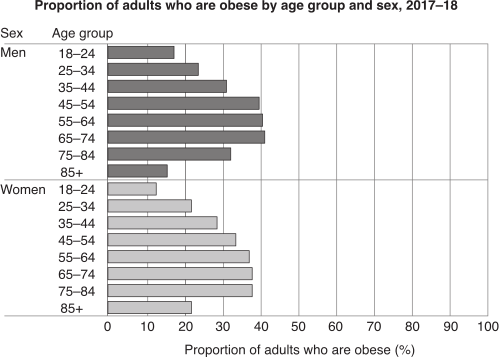
The data shows the proportion of adults living in Australia who are obese.
 

Which of the following can be observed from the data?

  1. The proportion of obese adults always increases with age.
  2. There is a greater percentage of men who are obese than women in all age groups.
  3. The proportion of women who are obese increases from 13% at 18–24 to 38% at 65–74.
  4. The proportion of men who are obese increases from 18% at 18–24 to 35% at 45–54, then decreases to 23% at age 85 and over.
Show Answers Only

\(C\)

Show Worked Solution
  • Options \(A, B\) and \(D\) can be shown to be incorrect with reference to the table.

\(\Rightarrow C\)

Filed Under: Epidemiology Tagged With: Band 3, smc-3661-10-Analysing Results

BIOLOGY, M8 2024 HSC 7 MC

How do stomata maintain water balance in plants?

  1. They close in hot weather to decrease transpiration.
  2. They open in cold weather to decrease transpiration.
  3. They open in hot weather to decrease evaporative cooling.
  4. They close in cold weather to decrease evaporative cooling.
Show Answers Only

\(A\)

Show Worked Solution
  • Stomata close in hot weather to decrease transpiration.
  • This adaptive response helps prevent excessive water loss during high temperatures and maintain proper water balance.

\(\Rightarrow A\)

Filed Under: Homeostasis Tagged With: Band 3, smc-3659-30-Water Balance in Plants

BIOLOGY, M5 2024 HSC 4 MC

Which row of the table correctly identifies components of DNA?

\begin{align*}
\begin{array}{l}
\rule{0pt}{2.5ex} \ \rule[-1ex]{0pt}{0pt}& \\
\rule{0pt}{2.5ex}\textbf{A.}\rule[-1ex]{0pt}{0pt}\\
\rule{0pt}{2.5ex}\textbf{B.}\rule[-1ex]{0pt}{0pt}\\
\rule{0pt}{2.5ex}\textbf{C.}\rule[-1ex]{0pt}{0pt}\\
\rule{0pt}{2.5ex}\textbf{D.}\rule[-1ex]{0pt}{0pt}\\
\end{array}
\begin{array}{|c|c|}
\hline
\rule{0pt}{2.5ex}\textit{Phosphate} \rule[-1ex]{0pt}{0pt}& \quad \textit{Ribose} \quad & \textit{Deoxyribose} & \quad \textit{Uracil} \quad & \ \ \textit{Thymine}\ \ \\
\hline
\rule{0pt}{2.5ex}\checkmark \rule[-1ex]{0pt}{0pt}& \text{} & \checkmark & \checkmark & \text{} \\
\hline
\rule{0pt}{2.5ex}\text{} \rule[-1ex]{0pt}{0pt}& \checkmark & \text{} & \checkmark & \checkmark \\
\hline
\rule{0pt}{2.5ex}\text{} \rule[-1ex]{0pt}{0pt}& \checkmark & \checkmark & \text{} & \checkmark \\
\hline
\rule{0pt}{2.5ex}\checkmark \rule[-1ex]{0pt}{0pt}& \text{} & \checkmark & \text{} & \checkmark \\
\hline
\end{array}
\end{align*}

Show Answers Only

\(D\)

Show Worked Solution
  • DNA contains phosphate groups, deoxyribose sugar (not ribose), and thymine (not uracil which is found in RNA instead).
  • The last row with checkmarks for phosphate, deoxyribose, and thymine is therefore the only correct combination.

\(\Rightarrow D\)

Filed Under: DNA and Polypeptide Synthesis Tagged With: Band 3, smc-3650-70-DNA Components

BIOLOGY, M6 2024 HSC 3 MC

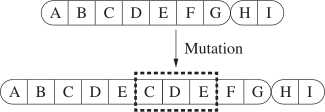
The image shows a chromosome that has undergone mutation. Each letter represents a gene.
 

What type of mutation has occurred?

  1. Deletion
  2. Duplication
  3. Inversion
  4. Substitution
Show Answers Only

\(B\)

Show Worked Solution
  • Looking at the sequence, we can see that genes C and E appear twice in the mutated chromosome (creating a repeat of genetic material).
  • This is characteristic of a duplication mutation rather than deletion (loss), inversion (reversal), or substitution (replacement).

\(\Rightarrow B\)

Filed Under: Mutation Tagged With: Band 3, smc-3652-40-Chromosomal Mutations

BIOLOGY, M6 2024 HSC 2 MC

Resin produced by spinifex grass has long been used by Aboriginal Peoples. Spinifex resin is currently used to produce medicinal creams.

What is this an example of?

  1. Biotechnology
  2. Selective breeding
  3. Artificial insemination
  4. Genetically modified organisms
Show Answers Only

\(A\)

Show Worked Solution
  • This is an example of biotechnology because it involves using traditional knowledge to harness a biological resource (spinifex resin) for medicinal purposes.
  • This fits the broad definition of biotechnology as using biological systems or processes to create useful products.

\(\Rightarrow A\)

Filed Under: Biotechnology Tagged With: Band 3, smc-3653-50-Identification

BIOLOGY, M7 2024 HSC 1 MC

Which of the following are non-cellular pathogens?

  1. Bacteria
  2. Fungi
  3. Prions
  4. Protozoa
Show Answers Only

\(C\)

Show Worked Solution
  • Bacteria, fungi, and protozoa are all cellular organisms.
  • Prions are misfolded proteins that can cause disease by inducing normal proteins to misfold, making them non-cellular pathogens.

\(\Rightarrow C\)

Filed Under: Causes of Infectious Disease Tagged With: Band 3, smc-3655-10-Classifying Pathogens

CHEMISTRY, M6 2024 HSC 3 MC

Which of the following compounds can be correctly described as an Arrhenius base when dissolved in water?

  1. Sodium nitrate
  2. Sodium sulfate
  3. Sodium chloride
  4. Sodium hydroxide
Show Answers Only

\(D\)

Show Worked Solution
  • An Arrhenius base is a compound that increases the concentration of \(\ce{OH-}\) ions when it is dissolved in water.
  • Sodium hydroxide is the only compound that dissolves in water to produce hydroxide ions.
  •    \(\ce{NaOH(s) -> Na+(aq) + OH-(aq)}\)

\(\Rightarrow D\)

Filed Under: Properties of Acids and Bases Tagged With: Band 3, smc-3673-10-Arrhenius and Bronsted-Lowry

CHEMISTRY, M5 2024 HSC 2 MC

Aboriginal and Torres Strait Islander Peoples have used leaching in flowing water over several days to prepare various foods from plants that can be toxic to humans.

What was the reason for this?

  1. To react with toxins
  2. To dissolve low solubility toxins
  3. To prevent the food from decomposing
  4. To break down compounds that are difficult to digest
Show Answers Only

\(B\)

Show Worked Solution
  • The toxins form a equilibrium system: \(\ce{toxins(s)\rightleftharpoons toxins(aq)}\)
  • As the water flows away, the concentration of aqueous toxins decreases which shifts the equilibrium system to the right, causing more low solubility toxins to break down.

\(\Rightarrow B\)

Filed Under: Solution Equilibria Tagged With: Band 3, smc-3672-75-Removing toxins

Networks, GEN1 2024 VCAA 36 MC

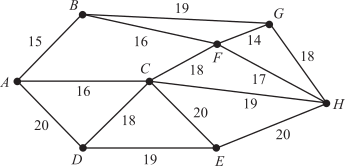
Eight houses in an estate are to be connected to the internet via underground cables.

The network below shows the possible connections between the houses.

The vertices represent the houses.

The numbers on the edges represent the length of cable connecting pairs of houses, in metres.


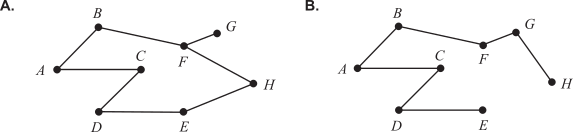
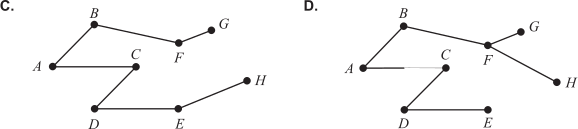
The graph that represents the minimum length of cable needed to connect all the houses is


Show Answers Only

\(D\)

Show Worked Solution

\(\text{Consider all options}\)

\(\text{Option A: contains a circuit}\ \rightarrow\ \text{Eliminate A}\)

\(\text{Option B:}\ 19+18+16+15+16+14+18=116\)

\(\text{Option C:}\ 20+19+18+16+15+16+14=118\)

\(\text{Option D:}\ 19+18+16+15+16+14+17=115\)

\(\Rightarrow D\)

Filed Under: Minimum Spanning Trees and Shortest Paths Tagged With: Band 3, smc-624-40-Prim's Algorithm

Networks, GEN1 2024 VCAA 34 MC

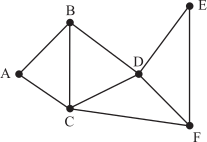
Consider the following graph.
 

A Eulerian trail through this graph could be

  1. \(\text{ABCDEF}\)
  2. \(\text{ACBDCFDEF}\)
  3. \(\text{BACBDCFDEF}\)
  4. \(\text{BDCABCDFCDEF}\)
Show Answers Only

\(C\)

Show Worked Solution

\(\text{An Eulerian trail has exactly 2 vertices of odd degree.}\)

\(\text{You must start on one and finish on the other ie B to F.}\)

\(\rightarrow\ \text{Eliminate A and B}\)

\(\text{A path cannot use the same edge twice}\ \rightarrow\ \text{Eliminate D}\)

\(\Rightarrow C\)

Filed Under: Travelling Problems and Adjacency Matrices Tagged With: Band 3, smc-622-10-Euler

Networks, GEN1 2024 VCAA 33 MC

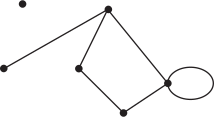
Consider the following graph.
 

The sum of the degrees of the vertices is

  1. 10
  2. 11
  3. 12
  4. 13
Show Answers Only

\(C\)

Show Worked Solution

\(\text{Sum of Degrees} =0+1+3+4+2+2=12\)

\(\Rightarrow C\)

Filed Under: Basic Concepts Tagged With: Band 3, smc-626-20-Degrees of Vertices

CHEMISTRY, M7 2024 HSC 1 MC

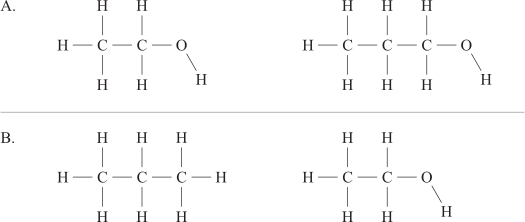
Which two substances are members of the same homologous series?
 

Show Answers Only

\(A\)

Show Worked Solution
  • A homologous series refers to compounds with the same or similar functional group and same general formula.
  • Both substances in \(A\) contain a hydroxyl group.

\(\Rightarrow A\)

Filed Under: Nomenclature Tagged With: Band 3, smc-3676-20-Alcohols

Matrices, GEN1 2024 VCAA 28 MC

A primary school is hosting a sports day.

Students represent one of four teams: blue \((B)\), green \((G)\), red \((R)\) or yellow \((Y)\).

Students compete in one of three sports: football \((F)\), netball \((N)\) or tennis \((T)\).

Matrix \(W\) shows the number of students competing in each sport and the team they represent.

\begin{aligned} \\
& \quad B  \quad \ G \quad \  R \quad \ Y \\
W = & \begin{bmatrix}
85 & 60 & 64 & 71 \\
62 & 74 & 80 & 64 \\
63 & 76 & 66 & 75
\end{bmatrix}\begin{array}{l}
F\\
N\\
T
\end{array}
\end{aligned}

Matrix \(W\) is multiplied by the matrix \(\begin{bmatrix}1 \\ 1 \\ 1 \\ 1\end{bmatrix}\) to produce matrix \(X\).

Element \(x_{31}\) indicates that

  1. 210 students represent the blue team.
  2. 210 students compete in netball.
  3. 280 students compete in tennis.
  4. 280 students compete in football.
Show Answers Only

\(C\)

Show Worked Solution

\begin{aligned} \\
X = & \begin{bmatrix}
280 \\
280 \\
280
\end{bmatrix}\begin{array}{l}
F\\
N\\
T
\end{array}
\end{aligned}

\(\Rightarrow C\)

Filed Under: Matrix Applications Tagged With: Band 3, smc-619-30-Matrix product and interpretation

Matrices, GEN1 2024 VCAA 26 MC

A market stall sells three types of candles.

The cost of each type of candle is shown in matrix \(C\) below.

\begin{align}
C=\left[\begin{array}{lll}
25 & 32 & 43
\end{array}\right] \end{align}

Towards the end of the day, the cost of each item is discounted by 15%.

Which one of the following expressions can be used to determine each discounted price?

  1. \(0.15C\)
  2. \(0.85C\)
  3. \(8.5C\)
  4. \(15C\)
Show Answers Only

\(B\)

Show Worked Solution

\(\text{Discounted price is 85}\%\ \text{of the original price.}\)

\(\therefore, 0.85 is the multiplier}\)

\(\Rightarrow B\)

Filed Under: Matrix Calculations Tagged With: Band 3, smc-616-10-Basic Calculations

Matrices, GEN1 2024 VCAA 25 MC

Matrix \(J\) is a \(2 \times 3\) matrix.

Matrix \(K\) is a \(3 \times 1\) matrix.

Matrix \(L\) is added to the product \(J K\).

The order of matrix \(L\) is

  1. \(1 \times 3\)
  2. \(2 \times 1\)
  3. \(2 \times 3\)
  4. \(3 \times 2\)
Show Answers Only

\(B\)

Show Worked Solution

\(J\ \text{is order}\ 2\times 3\ \text{and}\ K\ \text{is order}\ 3\times 1\)

\(JK\ \text{is order}\ 2\times 1\)

\(\text{For addition}\ L\ \text{must also be}\ 2\times 1\)

\(\Rightarrow B\)

Filed Under: Matrix Calculations Tagged With: Band 3, smc-616-30-Matrix Product

Data Analysis, GEN1 2024 VCAA 7 MC

Fiona plays nine holes of golf each week, and records her score.

Her mean score for all rounds in 2024 is 55.7

In one round, when she recorded a score of 48, her standardised score was  \(z=-1.75\)

The standard deviation for score in 2024 is

  1. 1.1
  2. 2.3
  3. 4.4
  4. 6.95
Show Answers Only

\(C\)

Show Worked Solution
\(z\) \(=\dfrac{x-\overline{x}}{s_x}\)
\(-1.75\) \(=\dfrac{48-55.7}{s_x}\)
\(s_x\) \(=\dfrac{48-55.7}{-1.75}\)
  \(=4.4\)

  
\(\Rightarrow C\)

Filed Under: Normal Distribution Tagged With: Band 3, smc-600-10-Single z-score

Data Analysis, GEN1 2024 VCAA 5 MC

The number of siblings of each member of a class of 24 students was recorded.

The results are displayed in the table below.

\begin{array}{|c|c|c|c|c|c|c|c|c|c|c|c|}
\hline
\rule{0pt}{2.5ex} \ \ 2\ \ \rule[-1ex]{0pt}{0pt} & \ \ 1 \ \ & \ \ 3 \ \ & \ \ 2 \ \ & \ \ 1 \ \ & \ \ 1 \ \ & \ \ 1 \ \ & \ \ 4 \ \ & \ \ 1 \ \ & \ \ 1 \ \ & \ \ 1 \ \ & \ \ 1 \ \ \\
\hline
\rule{0pt}{2.5ex} 1 \rule[-1ex]{0pt}{0pt} & 2 & 1 & 2 & 2 & 1 & 3 & 4 & 2 & 2 & 3 & 1 \\
\hline
\end{array}

A boxplot was constructed to display the spread of the data.

Which one of the following statements about this boxplot is correct?

  1. There are no outliers.
  2. The value of the interquartile range (IQR) is 1.5
  3. The value of the median is 1.5
  4. All of the five-number summary values are whole numbers.
Show Answers Only

\(C\)

Show Worked Solution

\(Q_1=1,\ Q_2=1.5,\ Q_3=2\rightarrow\ \ \text{eliminate D}\)

\(IQR=2-1=1\rightarrow\ \ \text{eliminate B}\)

\(Q_2=1.5 \longrightarrow \text{Median }=1.5 \ \rightarrow\ \text{C correct}\)

\(Q_3+1.5\times IQR=2+1.5\times 1 = 3.5 \ \rightarrow\ \ \text{eliminate A}\)

\(\Rightarrow C\)

Filed Under: Graphs - Stem/Leaf and Boxplots Tagged With: Band 3, smc-468-50-IQR / Outliers, smc-643-10-Single Box-Plots, smc-643-60-Outliers

Data Analysis, GEN1 2024 VCAA 2 MC

Freddie organised a function at work. He surveyed the staff about their preferences.

He asked them about their payment preference (cash or electronic payment) and their budget preference (less than $50 or more than $50).

The variables in this survey, payment preference and budget preference, are

  1. both categorical variables.
  2. both numerical variables.
  3. categorical and numerical variables, respectively.
  4. numerical and categorical variables, respectively.
Show Answers Only

\(A\)

Show Worked Solution

\(\text{Payment preference is categorical.}\)

\(\text{Budget preference contains numbers, however, it cannot be}\)

\(\text{quantified, therefore it is also categorical.}\)

\(\Rightarrow A\)

Filed Under: Summary Statistics Tagged With: Band 3, smc-468-10-Data Classification

Data Analysis, GEN1 2024 VCAA 1 MC

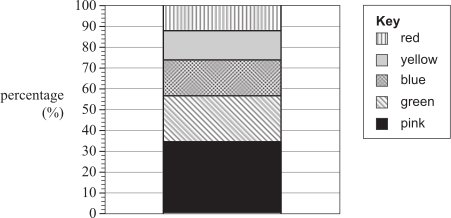
A group of students were asked to name their favourite colour.

The results are displayed in the percentage segmented bar chart below.
 

The percentage of students who named blue as their favourite colour is closest to

  1. 14%
  2. 18%
  3. 26%
  4. 74%
Show Answers Only

\(B\)

Show Worked Solution

\(\%\ \text{Blue}\ =74-56=18\%\)

\(\Rightarrow B\)

Filed Under: Graphs - Histograms and Other Tagged With: Band 3, smc-644-40-Segmented Bar Charts

Complex Numbers, EXT2 N2 2024 HSC 7 MC

It is given that \(\abs{z-1+i}=2\).

What is the maximum possible value of \(\abs{z}\)?

  1. \(\sqrt{2}\)
  2. \(\sqrt{10}\)
  3. \(2+\sqrt{2}\)
  4. \(2-\sqrt{2}\)
Show Answers Only

\(C\)

Show Worked Solution

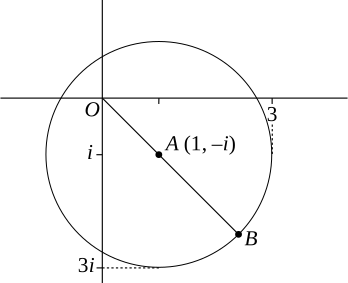
\(\abs{z-1+i}=2 \ \Rightarrow \ \text{circle centre} \ \ (1,-i), \ \ \text {radius}=2\)


\(OA=\sqrt{1^2+1^2}=\sqrt{2}\)

\(AB=2 \ \ \text{(radius)}\)

\(\therefore \abs{z}_{\text{max}}=2+\sqrt{2}\)

\(\Rightarrow C\)

Filed Under: Geometrical Implications of Complex Numbers Tagged With: Band 3, smc-1052-60-Other problems

Mechanics, EXT2 M1 2024 HSC 15c

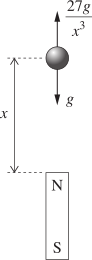
A bar magnet is held vertically. An object that is repelled by the magnet is to be dropped from directly above the magnet and will maintain a vertical trajectory. Let \(x\) be the distance of the object above the magnet.
 

The object is subject to acceleration due to gravity, \(g\), and an acceleration due to the magnet \(\dfrac{27 g}{x^3}\), so that the total acceleration of the object is given by

 \(a=\dfrac{27 g}{x^3}-g\)

The object is released from rest at  \(x=6\).

  1. Show that  \(v^2=g\left(\dfrac{51}{4}-2 x-\dfrac{27}{x^2}\right)\).   (2 marks)

    --- 8 WORK AREA LINES (style=lined) ---

  2. Find where the object next comes to rest, giving your answer correct to 1 decimal place.  (2 marks)

    --- 10 WORK AREA LINES (style=lined) ---

Show Answers Only


Show Worked Solution

i.    \(a=\dfrac{27 g}{x^3}-g\)

\(\dfrac{d}{dx}(\frac{1}{2}v^{2})\) \(= \dfrac{27g}{x^3}-g\)  
\(\dfrac{1}{2} v^2\) \(=-\dfrac{27 g}{2 x^2}-g x+c\)  

 
\(\text{When}\ \ x=6, v=0:\)

\(0\) \(=-\dfrac{27g}{2 \times 6^2}-6g+c\)  
\(c\) \(=\dfrac{459 g}{72}=\dfrac{51 g}{8}\)  


  \(\dfrac{1}{2} v^2\) \(=-\dfrac{27 g}{2 x^2}-g x+\dfrac{51 g}{8}\)
  \(v^2\) \(=-\dfrac{27 g}{x^2}-2 g x+\dfrac{51g }{4}\)
    \(=g\left(\dfrac{51}{4}-2 x-\dfrac{27}{x^2}\right)\)


ii.    \(\text{Find \(x\) when  \(v=0\):}\)

\(\dfrac{51}{4}-2 x-\dfrac{27}{x^2}\) \(=0\)  
\(51 x^2-8 x^3-108\) \(=0\)  
\(8 x^3-51 x^2+108\) \(=0\)  

 
\(\text{Given  \(x=6\)  is a root:}\)

♦♦♦ Mean mark (ii) 24%.

\(8 x^3-51 x^2+108=(x-6)\left(8 x^2-3 x-18\right)\)

\(\text{Other roots:}\)

  \(x\) \(=\dfrac{3 \pm \sqrt{9-4 \cdot 8 \cdot 18}}{2 \times 8}\)
    \(=\dfrac{3 \pm \sqrt{585}}{16}\)
    \(=\dfrac{3+3 \sqrt{65}}{16} \quad(x>0)\)
    \(=1.7 \ \text{units (1 d.p.)}\)

 
\(\therefore \ \text{Object next comes to rest at  \(x=1.7\) units}\) 

Filed Under: Resisted Motion Tagged With: Band 3, Band 6, smc-1061-07-Resistive medium, smc-1061-30-R ~ other

Vectors, EXT2 V1 2024 HSC 14e

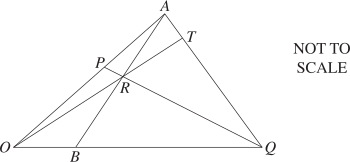
The diagram shows triangle \(O Q A\).

The point \(P\) lies on \(O A\) so that  \(O P: O A=3: 5\).

The point \(B\) lies on \(O Q\) so that  \(O B: O Q=1: 3\).

The point \(R\) is the intersection of \(A B\) and \(P Q\).

The point \(T\) is chosen on \(A Q\) so that \(O, R\) and \(T\) are collinear.
 

Let  \(\underset{\sim}{a}=\overrightarrow{O A}, \ \underset{\sim}{b}=\overrightarrow{O B}\)  and  \(\overrightarrow{P R}=k \overrightarrow{P Q}\)  where \(k\) is a real number.

  1. Show that  \(\overrightarrow{O R}=\dfrac{3}{5}(1-k) \underset{\sim}{a}+3 k \underset{\sim}{b}\).   (2 marks)

    --- 5 WORK AREA LINES (style=lined) ---

Writing  \(\overrightarrow{A R}=h \overrightarrow{A B}\), where \(h\) is a real number, it can be shown that  \(\overrightarrow{O R}=(1-h) \underset{\sim}{a}+h \underset{\sim}{b}\).  (Do NOT prove this.)

  1. Show that  \(k=\dfrac{1}{6}\).   (2 marks)

    --- 4 WORK AREA LINES (style=lined) ---

  2. Find \(\overrightarrow{O T}\) in terms of \(\underset{\sim}{a}\) and \(\underset{\sim}{b}\).   (2 marks)

    --- 4 WORK AREA LINES (style=lined) ---

Show Answers Only

i.    \(\underset{\sim}{a}=\overrightarrow{O A}, \ \underset{\sim}{b}=\overrightarrow{O B}, \ \overrightarrow{P R}=k \overrightarrow{P Q}\)

\(\overrightarrow{O P}: \overrightarrow{O A}=3: 5 \ \Rightarrow \ \overrightarrow{O P} = \dfrac{3}{5} \times \overrightarrow{O A} \)

\(\overrightarrow{O B}: \overrightarrow{O Q}=1: 3\ \Rightarrow \ \overrightarrow{O Q} = 3 \times \overrightarrow{OB} \)

\(\text {Show } \overrightarrow{O R}=\dfrac{3}{5}(1-k) \underset{\sim}{a}+3 k \underset{\sim}{b}\)

  \(\overrightarrow{O R}\) \(=\overrightarrow{O P}+k \overrightarrow{P Q}\)
    \(=\overrightarrow{O P}+k(\overrightarrow{O Q}-\overrightarrow{O P})\)
    \(=(1-k) \overrightarrow{O P}+k \overrightarrow{O Q}\)
    \(=\dfrac{3}{5}(1-k)\underset{\sim}{a}+3 k \underset{\sim}{b}\)


ii.    \(\overrightarrow{A R}=h \overrightarrow{A B}, \quad h \in \mathbb{R}\)

\(\overrightarrow{OR}=(1-h) \underset{\sim}{a}+h \underset{\sim}{b} \ \ \text{(given)}\)

\(\overrightarrow{O R}=\dfrac{3}{5}(1-k) \underset{\sim}{a}+3 k \underset{\sim}{b} \ \ \text{(part(i))}\)

\(\text{Vector }\underset{\sim}{a} \neq \lambda \underset{\sim}{b}\ (\lambda \in \mathbb{R})\ \Rightarrow \ \text{linearly independent and are basis vectors for } \overrightarrow{O R}\).

\(\text {Equating coefficients:}\)

   \(\dfrac{3}{5}(1-k)=1-h\ \ldots\ (1)\)

   \(h=3 k\ \ldots\ (2)\)

\(\text{Substituting (2) into (1)}\)

     \(\dfrac{3}{5}(1-k)\) \(=1-3 k\)
  \(3-3 k\) \(=5-15 k\)
  \(k\) \(=\dfrac{1}{6}\)

 
iii. 
   \(\overrightarrow{O T}=\dfrac{3}{4}(\underset{\sim}{a}+\underset{\sim}{b})\)

Show Worked Solution

i.    \(\underset{\sim}{a}=\overrightarrow{O A}, \ \underset{\sim}{b}=\overrightarrow{O B}, \ \overrightarrow{P R}=k \overrightarrow{P Q}\)

\(\overrightarrow{O P}: \overrightarrow{O A}=3: 5 \ \Rightarrow \ \overrightarrow{O P} = \dfrac{3}{5} \times \overrightarrow{O A} \)

\(\overrightarrow{O B}: \overrightarrow{O Q}=1: 3\ \Rightarrow \ \overrightarrow{O Q} = 3 \times \overrightarrow{OB} \)

\(\text {Show } \overrightarrow{O R}=\dfrac{3}{5}(1-k) \underset{\sim}{a}+3 k \underset{\sim}{b}\)

  \(\overrightarrow{O R}\) \(=\overrightarrow{O P}+k \overrightarrow{P Q}\)
    \(=\overrightarrow{O P}+k(\overrightarrow{O Q}-\overrightarrow{O P})\)
    \(=(1-k) \overrightarrow{O P}+k \overrightarrow{O Q}\)
    \(=\dfrac{3}{5}(1-k)\underset{\sim}{a}+3 k \underset{\sim}{b}\)


ii.    \(\overrightarrow{A R}=h \overrightarrow{A B}, \quad h \in \mathbb{R}\)

\(\overrightarrow{OR}=(1-h) \underset{\sim}{a}+h \underset{\sim}{b} \ \ \text{(given)}\)

\(\overrightarrow{O R}=\dfrac{3}{5}(1-k) \underset{\sim}{a}+3 k \underset{\sim}{b} \ \ \text{(part(i))}\)

\(\text{Vector }\underset{\sim}{a} \neq \lambda \underset{\sim}{b}\ (\lambda \in \mathbb{R})\ \Rightarrow \ \text{linearly independent and are basis vectors for } \overrightarrow{O R}\).

\(\text {Equating coefficients:}\)

   \(\dfrac{3}{5}(1-k)=1-h\ \ldots\ (1)\)

   \(h=3 k\ \ldots\ (2)\)

\(\text{Substituting (2) into (1)}\)

     \(\dfrac{3}{5}(1-k)\) \(=1-3 k\)
  \(3-3 k\) \(=5-15 k\)
  \(k\) \(=\dfrac{1}{6}\)


iii.    \(\overrightarrow{O T}=\lambda \overrightarrow{O R}\)

\(\text {Using parts (i) and (ii):}\)

\(\overrightarrow{O R}=\dfrac{3}{5}\left(1-\dfrac{1}{6}\right)\underset{\sim}{a}+3\left(\dfrac{1}{6}\right) \underset{\sim}{b}=\dfrac{1}{2}\left(\underset{\sim}{a}+\underset{\sim}{b}\right)\)

\(\overrightarrow{O T}=\dfrac{\lambda}{2}(\underset{\sim}{a}+\underset{\sim}{b})\)

♦ Mean mark (iii) 45%.
 

\(\text {Find } \lambda:\)

  \(\overrightarrow{O T}\) \(=\overrightarrow{O A}+\mu \overrightarrow{A Q}\)
  \(\dfrac{\lambda}{2}(\underset{\sim}{a}+\underset{\sim}{b})\) \(=\underset{\sim}{a}+\mu(3 \underset{\sim}{b}-\underset{\sim}{a}) \quad \Big(\text{noting}\ \overrightarrow{A Q}=\overrightarrow{O Q}-\overrightarrow{O A}=3 \underset{\sim}{b}-\underset{\sim}{a}\Big)\)
    \(=\underset{\sim}{a}(1-\mu)+3 \mu \underset{\sim}{b}\)

 
\(\text {Equating coefficients:}\)

\(\dfrac{\lambda}{2}=3 \mu \ \Rightarrow \ \mu=\dfrac{\lambda}{6}\)

  \(1-\dfrac{\lambda}{6}\) \(=\dfrac{\lambda}{2}\)
  \(6-\lambda\) \(=3 \lambda\)
  \(\lambda\) \(=\dfrac{3}{2}\)

 
\(\therefore \overrightarrow{O T}=\dfrac{3}{4}(\underset{\sim}{a}+\underset{\sim}{b})\)

Filed Under: Vectors and Geometry Tagged With: Band 3, Band 4, Band 5, smc-1210-40-Triangle, smc-1210-55-Ratios, smc-1210-60-2D problems

ENGINEERING, TE 2024 HSC 4 MC

Which row of the table correctly identifies characteristics of analogue and digital communications?

\begin{align*}
\begin{array}{c}
\ & \\
\ & \\
\rule{0pt}{2.5ex}\textbf{A.}\\
\rule{0pt}{2.5ex}\textbf{}\\
\rule{0pt}{2.5ex}\textbf{B.}\\
\rule{0pt}{2.5ex}\textbf{}\\
\rule{0pt}{2.5ex}\textbf{C.}\\
\rule{0pt}{2.5ex}\textbf{}\\
\rule{0pt}{2.5ex}\textbf{D.}\\
\rule{0pt}{2.5ex}\textbf{}\\
\end{array}
\begin{array}{|l|l|}
\hline
\rule[-1ex]{0pt}{0pt} \quad \quad \quad \quad \quad Analogue  & \rule[-1ex]{0pt}{0pt} \quad \quad \quad \quad \quad Digital \\
\hline
\rule[-1ex]{0pt}{0pt} \text{Continuous (varying) signal} & \rule[-1ex]{0pt}{0pt} \text{Discrete (binary) signal} \\
\rule[-1ex]{0pt}{0pt} \text{Less susceptible to signal degradation} & \rule[-1ex]{0pt}{0pt} \text{More susceptible to signal degradation} \\
\hline
\rule[-1ex]{0pt}{0pt} \text{Continuous (varying) signal} & \rule[-1ex]{0pt}{0pt} \text{Discrete (binary) signal} \\
\rule[-1ex]{0pt}{0pt} \text{More susceptible to signal degradation} & \rule[-1ex]{0pt}{0pt} \text{Less susceptible to signal degradation} \\
\hline
\rule[-1ex]{0pt}{0pt} \text{Discrete (binary) signal} & \rule[-1ex]{0pt}{0pt} \text{Continuous (varying) signal} \\
\rule[-1ex]{0pt}{0pt} \text{Less susceptible to signal degradation} & \rule[-1ex]{0pt}{0pt} \text{More susceptible to signal degradation} \\
\hline
\rule[-1ex]{0pt}{0pt} \text{Discrete (binary) signal} & \rule[-1ex]{0pt}{0pt} \text{Continuous (varying) signal} \\
\rule[-1ex]{0pt}{0pt} \text{More susceptible to signal degradation} & \rule[-1ex]{0pt}{0pt} \text{Less susceptible to signal degradation} \\
\hline
\end{array}
\end{align*}

Show Answers Only

\(B\)

Show Worked Solution
  • Analog signals are continuous and more susceptible to degradation while digital signals are discrete (binary) and less susceptible to degradation since they can be regenerated and error-corrected during transmission.

\(\Rightarrow B\)

Filed Under: Electricity/Electronics Tagged With: Band 3, smc-3730-28-Analogue/Digital properties

ENGINEERING, PPT 2024 HSC 3 MC

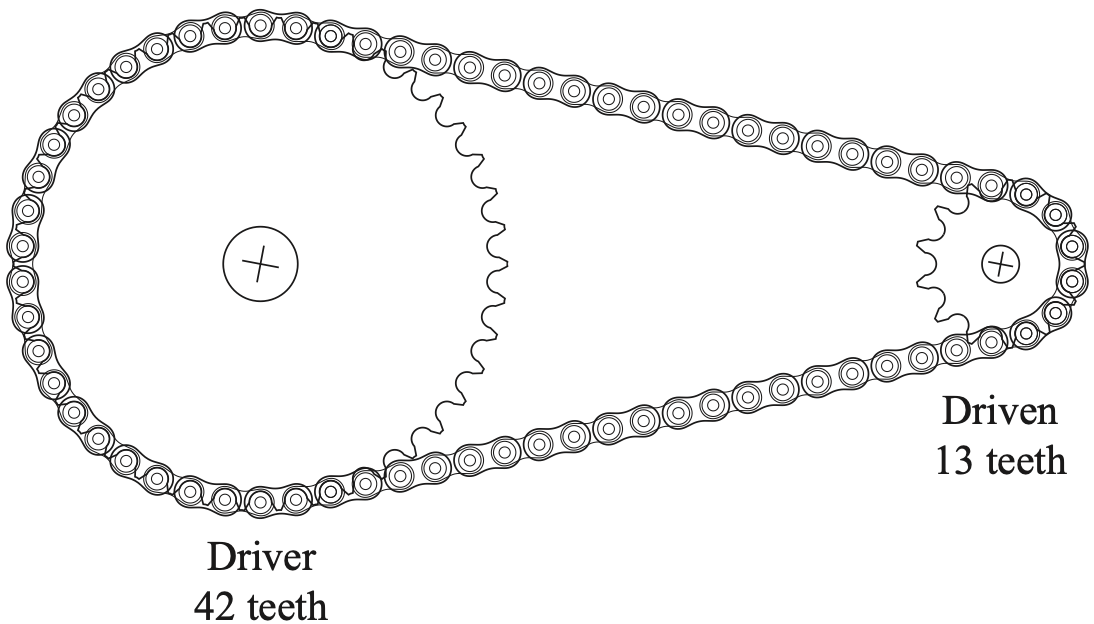
A simplified image of a bicycle chain drive is shown.
 

If a cyclist is pedalling at 70 revolutions per minute (RPM), what is the RPM of the driven wheel?

  1. 3.2
  2. 21.7
  3. 226.2
  4. 546.0
Show Answers Only

\(C\)

Show Worked Solution

\(\text{Velocity Ratio}\ (VR)\ = \dfrac{\text{output teeth}}{\text{input teeth}} = \dfrac{13}{42}=0.3095\)

\(\text{Output speed (RPM)}\ = \dfrac{\text{input speed}}{VR} = \dfrac{70}{0.3095}=226.2\)

\(\Rightarrow C\)

Filed Under: Mechanics Tagged With: Band 3, smc-3718-10-Mechanical advantage

ENGINEERING, CS 2024 HSC 1 MC

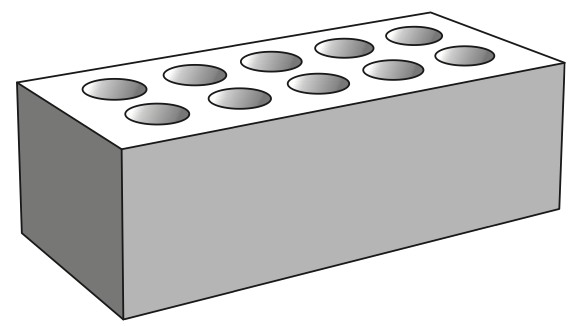
A common house brick is shown.
 

Which forming process was used to manufacture the brick?

  1. Forging
  2. Extrusion
  3. Slip casting
  4. Shell moulding
Show Answers Only

\(B\)

Show Worked Solution
  • Common house bricks are manufactured through extrusion, where clay is forced through a die to create a rectangular column that is then cut into individual brick lengths before drying and firing.

\(\Rightarrow B\)

Filed Under: Engineering Materials Tagged With: Band 3, smc-3715-35-Ceramics

Mechanics, EXT2 M1 2024 HSC 13c

A particle of unit mass moves horizontally in a straight line. It experiences a resistive force proportional to \(v^2\), where \(v\) m s\(^{-1}\) is the speed of the particle, so that the acceleration is given by  \(-k v^2\).

Initially the particle is at the origin and has a velocity of 40 m s\(^{-1}\) to the right. After the particle has moved 15 m to the right, its velocity is 10 m s\(^{-1}\) (to the right).

  1. Show that  \(v=40 e^{-k x}\).   (3 marks)

    --- 8 WORK AREA LINES (style=lined) ---

  2. Show that  \(k=\dfrac{\ln 4}{15}\).   (1 mark)

    --- 4 WORK AREA LINES (style=lined) ---

  3. At what time will the particle's velocity be 30 m s\(^{-1}\) to the right?   (3 marks)

    --- 8 WORK AREA LINES (style=lined) ---

Show Answers Only

i.    \(\ddot{x}=v \cdot \dfrac{d v}{d x}=-k v^2\)

  \(\dfrac{d v}{d x}\) \(=-k v\)
  \(\dfrac{d x}{d v}\) \(=-\dfrac{1}{k v}\)
  \(\displaystyle\int \frac{1}{v}\, d v\) \(=\displaystyle -\int k\, d x\)
  \(\ln \abs{v}\) \(=-k x+c\)
  \(v\) \(=e^{-k x+c}\)
    \(=A e^{-k x}\ \ (\text{where } A=e^c)\)

 
\(\text {When } x=0, v=40:\)

\(40=A e^{\circ} \ \Rightarrow \ A=40\)

\(\therefore V=40 \, e^{-k x}\)
 

ii.   \(\text {Show}\ \ k=\dfrac{\ln 4}{15}\)

\(\text {When } x=15, v=10:\)

  \(10\) \(=40 e^{-15 k}\)
  \(e^{-15 k}\) \(=\dfrac{1}{4}\)
  \(-15 k\) \(=\ln \left(\dfrac{1}{4}\right)\)
  \(15 k\) \(=\ln 4\)
  \(k\) \(=\dfrac{\ln 4}{15}\)

iii.  \(\dfrac{1}{8\,\ln 4}\  \text{seconds}\)

Show Worked Solution

i.    \(\ddot{x}=v \cdot \dfrac{d v}{d x}=-k v^2\)

  \(\dfrac{d v}{d x}\) \(=-k v\)
  \(\dfrac{d x}{d v}\) \(=-\dfrac{1}{k v}\)
  \(\displaystyle\int \frac{1}{v}\, d v\) \(=\displaystyle -\int k\, d x\)
  \(\ln \abs{v}\) \(=-k x+c\)
  \(v\) \(=e^{-k x+c}\)
    \(=A e^{-k x}\ \ (\text{where } A=e^c)\)

 
\(\text {When } x=0, v=40:\)

\(40=A e^{\circ} \ \Rightarrow \ A=40\)

\(\therefore V=40 \, e^{-k x}\)
 

ii.   \(\text {Show}\ \ k=\dfrac{\ln 4}{15}\)

\(\text {When } x=15, v=10:\)

  \(10\) \(=40 e^{-15 k}\)
  \(e^{-15 k}\) \(=\dfrac{1}{4}\)
  \(-15 k\) \(=\ln \left(\dfrac{1}{4}\right)\)
  \(15 k\) \(=\ln 4\)
  \(k\) \(=\dfrac{\ln 4}{15}\)


iii.   \(\text {Find}\ t\ \text {when}\ \ v=30:\)

  \(\dfrac{d v}{d t}\) \(=-k v^2\)
  \(\dfrac{d t}{d v}\) \(=-\dfrac{1}{k v^2}\)
  \(t\) \(=\displaystyle -\int \dfrac{1}{k v^2}\, d v=\dfrac{1}{k v}+c\)

 
\(\text {When}\ \ t=0, v=40:\)

\(0=\dfrac{1}{40 k}+c \ \Rightarrow \ c=-\dfrac{1}{40 k}\)
 

\(\text{Find \(t\) when  \(v=30\):}\)

  \(t\) \(=\dfrac{1}{30k}-\dfrac{1}{40k}\)
    \(=\dfrac{1}{120k}\)
    \(=\dfrac{15}{120\, \ln 4}\)
    \(=\dfrac{1}{8\,\ln 4}\  \text{seconds}\)

Filed Under: Resisted Motion Tagged With: Band 3, smc-1061-07-Resistive medium, smc-1061-20-R ~ v^2

Vectors, EXT2 V1 2024 HSC 13a

The point \(A\) has position vector  \(8 \underset{\sim}{i}-6 \underset{\sim}{j}+5 \underset{\sim}{k}\). The line \(\ell\) has vector equation

\(x \underset{\sim}{i}+y \underset{\sim}{j}+z \underset{\sim}{k}=t(\underset{\sim}{i}+\underset{\sim}{j}+2 \underset{\sim}{k})\).

The point \(B\) lies on \(\ell\) and has position vector  \(p \underset{\sim}{i}+p \underset{\sim}{j}+2 p \underset{\sim}{k}\).

  1. Show that  \(\abs{A B}^2=6 p^2-24 p+125\).   (1 mark)

    --- 4 WORK AREA LINES (style=lined) ---

  2. Hence, or otherwise, determine the shortest distance between the point \(A\) and the line \(\ell\).  (2 marks)

    --- 6 WORK AREA LINES (style=lined) ---

Show Answers Only

i.     \(A\left(\begin{array}{c}8 \\ -6 \\ 5\end{array}\right), \quad \ell: \left(\begin{array}{l}x \\ y \\ z\end{array}\right)+t\left(\begin{array}{l}1 \\ 1 \\ 2\end{array}\right), \quad B\left(\begin{array}{c}p \\ p \\ 2 p\end{array}\right)\)
 

\(\overrightarrow{A B}=\left(\begin{array}{l}p \\ p \\ 2 p\end{array}\right)-\left(\begin{array}{c}8 \\ -6 \\ 5\end{array}\right)=\left(\begin{array}{c}p-8 \\ p+6 \\ 2 p-5\end{array}\right)\)
 

  \(\abs{AB}^2\) \(=(p-8)^2+(p+6)^2+(2 p-5)^2\)
    \(=p^2-16 p+64+p^2+12 p+36+4 p^2-20 p+25\)
    \(=6 p^2-24 p+125\)


ii.    \(\abs{AB}_{\text {min}}=\sqrt{101} \text { units}\)

Show Worked Solution

i.     \(A\left(\begin{array}{c}8 \\ -6 \\ 5\end{array}\right), \quad \ell: \left(\begin{array}{l}x \\ y \\ z\end{array}\right)+t\left(\begin{array}{l}1 \\ 1 \\ 2\end{array}\right), \quad B\left(\begin{array}{c}p \\ p \\ 2 p\end{array}\right)\)
 

\(\overrightarrow{A B}=\left(\begin{array}{l}p \\ p \\ 2 p\end{array}\right)-\left(\begin{array}{c}8 \\ -6 \\ 5\end{array}\right)=\left(\begin{array}{c}p-8 \\ p+6 \\ 2 p-5\end{array}\right)\)
 

  \(\abs{AB}^2\) \(=(p-8)^2+(p+6)^2+(2 p-5)^2\)
    \(=p^2-16 p+64+p^2+12 p+36+4 p^2-20 p+25\)
    \(=6 p^2-24 p+125\)


ii.    \(\text{Find shortest distance between \(A\) and \(\ell\).}\)

\(\Rightarrow \text { Find \(p\) when \(\abs{A B}\) is a minimum:}\)

\(\text{Minimum occurs when}\ \ p=\dfrac{-b}{2 a}=\dfrac{24}{2 \times 6}=2\)

\(\therefore \abs{AB}_{\text {min}}=\sqrt{6(2)^2-24(2)+125}=\sqrt{101} \text { units}\)

♦ Mean mark (ii) 45%.

Filed Under: Vectors and Vector Equations of Lines Tagged With: Band 3, Band 5, smc-1196-40-Perpendicular

Vectors, EXT2 V1 2024 HSC 12e

The line \(\ell\) passes through the points \(A(3,5,-4)\) and \(B(7,0,2)\).

  1. Find a vector equation of the line \(\ell\).   (1 mark)

    --- 4 WORK AREA LINES (style=lined) ---

  2. Determine, giving reasons, whether the point \(C(10,5,-2)\) lies on the line \(\ell\).   (2 marks)

    --- 7 WORK AREA LINES (style=lined) ---

Show Answers Only

i.    \(\text{ Equation of line:} \ \left(\begin{array}{c}3 \\ 5 \\ -4\end{array}\right)+\lambda\left(\begin{array}{c}4 \\ -5 \\ 6\end{array}\right),\ (\lambda \in \mathbb{R} )\)

ii.    \(\text{If \(C\) lies on the line}, \ \exists \lambda \in \mathbb{R}\  \ \text{such that:}\)

\(\left(\begin{array}{c}10 \\ 5 \\ -2\end{array}\right)=\left(\begin{array}{c}3 \\ -5 \\ 6\end{array}\right)+\lambda\left(\begin{array}{c}4 \\ -5 \\ 6\end{array}\right)\)

 
\(\text{Find \(\lambda\) for \(x\)-component: }\)

\(10=3+4 \lambda \ \Rightarrow \ \lambda=\dfrac{7}{4}\)

\(\text{Check \(\lambda=\dfrac{7}{4}\) for \(y\)-component:}\)

\(5=-5+\dfrac{7}{4}(-5) \ \ \Rightarrow\ \ \text{not correct}\)

\(\therefore C\  \text{does not lie on the line.}\)

Show Worked Solution

i.     \(A(3,5,-4), \quad B(7,0,2)\)

\(\overrightarrow{A B}=\left(\begin{array}{l}7 \\ 0 \\ 2\end{array}\right)-\left(\begin{array}{c}3 \\ 5 \\ -4\end{array}\right)=\left(\begin{array}{c}4 \\ -5 \\ 6\end{array}\right)\)

\(\therefore \text{ Equation of line:} \ \left(\begin{array}{c}3 \\ 5 \\ -4\end{array}\right)+\lambda\left(\begin{array}{c}4 \\ -5 \\ 6\end{array}\right),\ (\lambda \in \mathbb{R} )\)
 

ii.    \(\text{If \(C\) lies on the line}, \ \exists \lambda \in \mathbb{R}\  \ \text{such that:}\)

\(\left(\begin{array}{c}10 \\ 5 \\ -2\end{array}\right)=\left(\begin{array}{c}3 \\ -5 \\ 6\end{array}\right)+\lambda\left(\begin{array}{c}4 \\ -5 \\ 6\end{array}\right)\)

 
\(\text{Find \(\lambda\) for \(x\)-component: }\)

\(10=3+4 \lambda \ \Rightarrow \ \lambda=\dfrac{7}{4}\)

\(\text{Check \(\lambda=\dfrac{7}{4}\) for \(y\)-component:}\)

\(5=-5+\dfrac{7}{4}(-5) \ \ \Rightarrow\ \ \text{not correct}\)

\(\therefore C\  \text{does not lie on the line.}\)

Filed Under: Vectors and Vector Equations of Lines Tagged With: Band 3, smc-1196-10-Find line given 2 points, smc-1196-25-Point lies on line

Complex Numbers, EXT2 N1 2024 HSC 12c

Consider the equation  \(\abs{z}=z+8+12 i\), where  \(z=a+b i\)  is a complex number and \(a, b\) are real numbers.

  1. Explain why  \(b=-12\).   (1 mark)

    --- 4 WORK AREA LINES (style=lined) ---

  2. Hence, or otherwise, find \(z\).   (2 marks)

    --- 6 WORK AREA LINES (style=lined) ---

Show Answers Only

i.     \(\abs{z}=z+8+12i\)

\(z=a+b i\ \ \Rightarrow\ \ \abs{z}=\sqrt{a^2+b^2}\)

\(\text{Equating moduli:}\)

\(\sqrt{a^2+b^2}=a+b i+8+12 i=a+8+(b+12) i\)

\(\text{Since } \sqrt{a^2+b^2} \in \mathbb{R}:\)

\(b+12=0 \ \Rightarrow \ b=-12\)
 

ii.    \(z=5-12 i\)

Show Worked Solution

i.     \(\abs{z}=z+8+12i\)

\(z=a+b i\ \ \Rightarrow\ \ \abs{z}=\sqrt{a^2+b^2}\)

\(\text{Equating moduli:}\)

\(\sqrt{a^2+b^2}=a+b i+8+12 i=a+8+(b+12) i\)

\(\text{Since } \sqrt{a^2+b^2} \in \mathbb{R}:\)

\(b+12=0 \ \Rightarrow \ b=-12\)
  

ii.    \(\abs{a-12 i}\) \(=a+8\)
  \(\sqrt{a^2+144}\) \(=a+8\)
  \(a^2+144\) \(=a^2+16 a+64\)
  \(16a\) \(=80\)
  \(a\) \(=5\)
 
\(\therefore z=5-12 i\)

Filed Under: Arithmetic of Complex Numbers Tagged With: Band 3, smc-1048-10-Basic Arithmetic

Calculus, EXT2 C1 2024 HSC 12b

Use partial fractions to find \(\displaystyle \int \frac{3 x^2+2 x+1}{(x-1)\left(x^2+1\right)}\, d x\)   (3 marks)

--- 8 WORK AREA LINES (style=lined) ---

Show Answers Only

\(I=3 \ln \abs{x-1}+2 \tan ^{-1}(x)+c\)

Show Worked Solution

\(\displaystyle\int \dfrac{3 x^2+2 x+1}{(x-1)\left(x^2+1\right)}\, d x\)

\(\dfrac{3 x^2+2 x+1}{(x-1)\left(x^2+1\right)}=\dfrac{A}{(x-1)}+\dfrac{B x+C}{x^2+1}\)

  \(3 x^2+2 x+1\) \(=A\left(x^2+1\right)+(x-1)(B x+C)\)
    \(=A x^2+A+B x^2+C x-B x-C\)
    \(=(A+B) x^2+(C-B) x+A-C\)

 
\(\text {If } x=1:\)

\(3+2+1=2 A \ \Rightarrow \ A=3\)

\(A+B=3 \quad \quad \ \Rightarrow \ B=0\)

\(A-C=1 \quad \quad \ \Rightarrow \ C=2\)

  \(\therefore I\) \(=\displaystyle \int \frac{3}{x-1}+\frac{2}{x^2+1}\, d x\)
    \(=3 \ln \abs{x-1}+2 \tan ^{-1}(x)+c\)

Filed Under: Partial Fractions Tagged With: Band 3, smc-1056-20-Cubic denom, smc-1056-40-PF not given

Vectors, EXT2 V1 2024 HSC 12a

The vector \(\underset{\sim}{a}\) is \(\left(\begin{array}{l}1 \\ 2 \\ 3\end{array}\right)\) and the vector \(\underset{\sim}{b}\) is \(\left(\begin{array}{c}2 \\ 0 \\ -4\end{array}\right)\).

  1. Find \(\dfrac{\underset{\sim}{a} \cdot \underset{\sim}{b}}{\underset{\sim}{b} \cdot \underset{\sim}{b}}\, \underset{\sim}{b}\).   (1 mark)

    --- 4 WORK AREA LINES (style=lined) ---

  2. Show that  \(\underset{\sim}{a}-\dfrac{\underset{\sim}{a} \cdot \underset{\sim}{b}}{\underset{\sim}{b} \cdot \underset{\sim}{b}}\, \underset{\sim}{b}\)  is perpendicular to \(\underset{\sim}{b}\).  (2 marks)

    --- 6 WORK AREA LINES (style=lined) ---

Show Answers Only

1.     \(\left(\begin{array}{c}-1 \\ 0 \\ 2\end{array}\right)\)

ii.    \(\underset{\sim}{a}-\dfrac{\underset{\sim}{a} \cdot \underset{\sim}{b}}{\underset{\sim}{b} \cdot \underset{\sim}{b}}\, \underset{\sim}{b}=\left(\begin{array}{l}1 \\ 2 \\ 3\end{array}\right)-\left(\begin{array}{c}-1 \\ 0 \\ 2\end{array}\right)=\left(\begin{array}{l}2 \\ 2 \\ 1\end{array}\right)\)

\( \left(\underset{\sim}{a}-\dfrac{\underset{\sim}{a} \cdot \underset{\sim}{b}}{\underset{\sim}{b} \cdot \underset{\sim}{b}}\underset{\sim}{b}\right)\left(\begin{array}{c}-1 \\ 0 \\ 2\end{array}\right)=\left(\begin{array}{l}2 \\ 2 \\ 1\end{array}\right)\left(\begin{array}{c}-1 \\ 0 \\ 2\end{array}\right) = -2+0+2=0\)

\(\therefore\ \text {Vectors are perpendicular.}\)

Show Worked Solution

i.    \(\underset{\sim}{a}=\left(\begin{array}{l}1 \\ 2 \\ 3\end{array}\right), \quad \underset{\sim}{b}=\left(\begin{array}{c}2 \\ 0 \\ -4\end{array}\right)\)
 

\(\dfrac{\underset{\sim}{a} \cdot \underset{\sim}{b}}{\underset{\sim}{b} \cdot \underset{\sim}{b}}\, \underset{\sim}{b}=\dfrac{2+0-12}{4+0+16}\left(\begin{array}{c}2 \\ 0 \\ -4\end{array}\right)=-\dfrac{1}{2}\left(\begin{array}{c}2 \\ 0 \\ -4\end{array}\right)=\left(\begin{array}{c}-1 \\ 0 \\ 2\end{array}\right)\)

 
ii.
    \(\underset{\sim}{a}-\dfrac{\underset{\sim}{a} \cdot \underset{\sim}{b}}{\underset{\sim}{b} \cdot \underset{\sim}{b}}\, \underset{\sim}{b}=\left(\begin{array}{l}1 \\ 2 \\ 3\end{array}\right)-\left(\begin{array}{c}-1 \\ 0 \\ 2\end{array}\right)=\left(\begin{array}{l}2 \\ 2 \\ 1\end{array}\right)\)
 

\( \left(\underset{\sim}{a}-\dfrac{\underset{\sim}{a} \cdot \underset{\sim}{b}}{\underset{\sim}{b} \cdot \underset{\sim}{b}}\,\underset{\sim}{b}\right)\left(\begin{array}{c}-1 \\ 0 \\ 2\end{array}\right)=\left(\begin{array}{l}2 \\ 2 \\ 1\end{array}\right)\left(\begin{array}{c}-1 \\ 0 \\ 2\end{array}\right) = -2+0+2=0\)

 
\(\therefore\ \text{Vectors are perpendicular.}\)

Filed Under: Basic Concepts and Arithmetic Tagged With: Band 2, Band 3, smc-1195-30-Perpendicular Vectors, smc-1195-40-Unit Vectors and Projections

Complex Numbers, EXT2 N1 2024 HSC 11e

  1. Write the number  \(\sqrt{3}+i\)  in modulus-argument form.   (2 marks)

    --- 4 WORK AREA LINES (style=lined) ---

  2. Hence, or otherwise, write  \((\sqrt{3}+i)^7\)  in exact Cartesian form.   (2 marks)

    --- 4 WORK AREA LINES (style=lined) ---

Show Answers Only

i.     \(2 \text{cis}\left(\dfrac{\pi}{6}\right)=2\left(\cos \left(\dfrac{\pi}{6}\right)+i \sin \left(\dfrac{\pi}{6}\right)\right)\)

ii.    \(-64 \sqrt{3}-64 i\)

Show Worked Solution

i.     \(z=\sqrt{3}+i\)

\(|z|=\sqrt{3+1}=2\)

\(\arg (z)=\tan ^{-1}\left(\dfrac{1}{\sqrt{3}}\right)=\dfrac{\pi}{6}\)

\(z=2 \text{cis}\left(\dfrac{\pi}{6}\right)=2\left(\cos \left(\dfrac{\pi}{6}\right)+i \sin \left(\dfrac{\pi}{6}\right)\right)\)
 

ii.     \((\sqrt{3}+i)^7\) \(=2^7\left(\cos \left(\dfrac{7 \pi}{6}\right)+i \sin \left(\dfrac{7 \pi}{6}\right)\right)\)
    \(=128\left(-\dfrac{\sqrt{3}}{2}-\dfrac{1}{2} i\right)\)
    \(=-64 \sqrt{3}-64 i\)

Filed Under: Argand Diagrams and Mod/Arg form Tagged With: Band 2, Band 3, smc-1049-20-Cartesian to Mod/Arg, smc-1049-50-Powers

Calculus, EXT2 C1 2024 HSC 11d

Evaluate  \(\displaystyle\int_0^{\frac{\pi}{2}} \dfrac{1}{\sin \theta+1}\, d \theta\).   (3 marks)

--- 9 WORK AREA LINES (style=lined) ---

Show Answers Only

\(1\)

Show Worked Solution

\(t=\tan (\frac{\theta}{2}), \ \sin \theta=\dfrac{2 t}{1+t^2}\)

\(d t=\dfrac{1}{2} \sec ^2 (\frac{\theta}{2})\, d \theta \ \Rightarrow \ d \theta=\dfrac{2}{1+\tan ^2 (\frac{\theta}{2})}\, d t=\dfrac{2}{1+t^2}\, d t\)

\(\text {When}\ \ \theta=\dfrac{\pi}{2}\ \ \Rightarrow\ \ \tan (\frac{\theta}{2})=1\)

\(\text {When}\ \ \theta=0\ \ \Rightarrow\ \ \tan(\frac{\theta}{2})=0\)

\(\displaystyle{\int}_0^{\frac{\pi}{2}} \dfrac{1}{\sin \theta+1}\, d \theta\) \(=\displaystyle{\int}_0^1 \frac{1}{\dfrac{2 t}{1+t^2}+1} \cdot \frac{2}{1+t^2}\, d t\)
  \(=\displaystyle{\int}_0^1 \dfrac{2}{2 t+1+t^2}\, d t\)
  \(=\displaystyle{\int}_0^1 \dfrac{2}{(t+1)^2}\, d t\)
  \(=-\left[\dfrac{2}{t+1}\right]_0^1\)
  \(=-\left(\dfrac{2}{2}-2\right)\)
  \(=1\)

Filed Under: Trig Integration Tagged With: Band 3, smc-1193-20-t = tan theta/2

Vectors, EXT2 V1 2024 HSC 11c

Find the angle between the two vectors  \(\underset{\sim}{u}=\left(\begin{array}{c}1 \\ 2 \\ -2\end{array}\right)\) and  \(\underset{\sim}{v}=\left(\begin{array}{c}4 \\ -4 \\ 7\end{array}\right)\), giving your answer in radians, correct to 1 decimal place.   (2 marks)

--- 5 WORK AREA LINES (style=lined) ---

Show Answers Only

\(\theta=2.3^c \ \ \text{(1 d.p.)}\)

Show Worked Solution

\(\underset{\sim}{u}=\left(\begin{array}{c}1 \\ 2 \\ -2\end{array}\right),\abs{\underset{\sim}{u}}=\sqrt{1+4+4}=3\)

\(\underset{\sim}{v}=\left(\begin{array}{c}4 \\ -4 \\ 7\end{array}\right),\abs{\underset{\sim}{v}}=\sqrt{16+16+49}=9\)

\(\cos \theta=\dfrac{\underset{\sim}{u} \cdot \underset{\sim}{v}}{|\underset{\sim}{u}||\underset{\sim}{v}|}=\dfrac{1 \times 4-2 \times 4-2 \times 7}{3 \times 9}=-\dfrac{2}{3}\)

\(\theta=\cos ^{-1}\left(-\dfrac{2}{3}\right)=2.30 \ldots=2.3^c \ \ \text{(1 d.p.)}\)

Filed Under: Basic Concepts and Arithmetic Tagged With: Band 3, smc-1195-20-Angles Between Vectors

Calculus, EXT1 C3 2024 HSC 13a

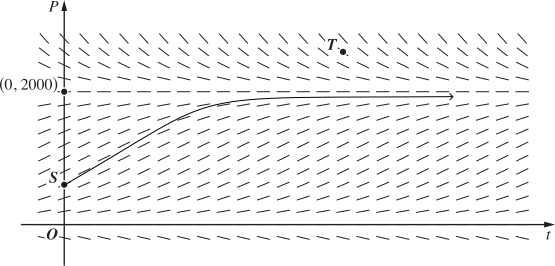
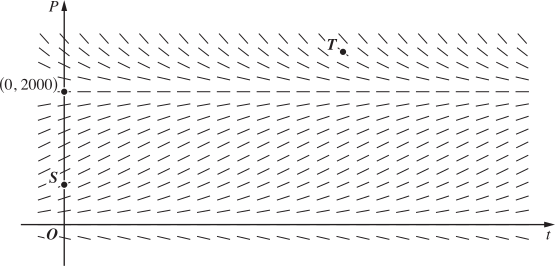
In an experiment, the population of insects, \(P(t)\), was modelled by the logistic differential equation

\(\dfrac{d P}{d t}=P(2000-P)\)

where \(t\) is the time in days after the beginning of the experiment.

The diagram shows a direction field for this differential equation, with the point \(S\) representing the initial population.
 

  1. Explain why the graph of the solution that passes through the point \(S\) cannot also pass through the point \(T\).   (1 mark)

    --- 2 WORK AREA LINES (style=lined) ---
  2. Clearly sketch the graph of the solution that passes through the point \(S\).   (1 mark)

    --- 5 WORK AREA LINES (style=blank) ---

  3. Find the predicted value of the population, \(P(t)\), at which the rate of growth of the population is largest.   (2 marks)

    --- 4 WORK AREA LINES (style=lined) ---
Show Answers Only

 i.    \(\text{Any solution that passes through}\ S\ \text{will follow the}\)

\(\text{slope field (not crossing any lines) and approach a horizontal}\)

\(\text{asymptote at}\ P=2000\ \text{from the lower side}\ (P<2000).\)

ii.    
       

iii.  \(P= 1000\)

Show Worked Solution

 i.    \(\text{Any solution that passes through}\ S\ \text{will follow the}\)

\(\text{slope field (not crossing any lines) and approach a horizontal}\)

\(\text{asymptote at}\ P=2000\ \text{from the lower side}\ (P<2000).\)

ii.    
       

iii.  \(\dfrac{d P}{d t}=P(2000-P)\)

\(\text {Find \(P\) where  \(\dfrac{d P}{d t}\)  is a maximum.}\)

\(\text{Consider the graph}\ \ y=P(2000-P): \)

\(\Rightarrow \ \text {Graph is a concave down quadratic cutting at}\ \ P=0\ \ \text{and}\ \ P=2000\)

\(\Rightarrow \ \text{Max value of}\ \ P(2000-P)\ \ \Big(\text{i.e.}\ \dfrac{dP}{dt}\Big)\ \ \text{occurs at}\ \ P=1000\ \text{(axis).}\)
♦ Mean mark (iii) 51%.

Filed Under: Applications of Differential Equations Tagged With: Band 3, Band 4, Band 5, smc-1198-30-Quantity

Proof, EXT1 P1 2024 HSC 12d

Use mathematical induction to prove that  \(2^{3 n}+13\)  is divisible by 7 for all integers  \(n \geq 1\).   (3 marks)

--- 12 WORK AREA LINES (style=lined) ---

Show Answers Only

\(\text{Proof (See worked solutions)}\)

Show Worked Solution

\(\text{Prove}\ \ 2^{3 n}+13\ \ \text{is divisible by 7 for}\ \ n \geq 1.\)

\(\text {If}\ \ n=1:\)

\(2^{3 \times 1}+13=21=3 \times 7\)

\(\therefore \text { True for } n=1.\)
 

\(\text {Assume true for } n=k:\)

\(2^{3 k}+13=7P \ \text{(where \(P\) is an integer)}\)

\(\Rightarrow 2^{3k}=7 P-13\ \ldots\ (1)\)

\(\text {Prove true for}\ \ n=k+1:\)

  \(2^{3(k+1)}+13\) \(=2^{3 k} \times 2^3+13\)
    \(=8\left(2^{3 k}\right)+13\)
    \(=8(7P-13)+13\ \ \text{(see (1) above)}\)
    \(=56 P-8 \times 13+13\)
    \(=7(8 P-13)\)

 
\(\Rightarrow \text { True for } n=k+1\)

\(\therefore\ \text{Since true for}\ \ n=1, \text{by PMI, true for integers}\ \ n \geqslant 1.\)

Filed Under: P1 Induction (Y12) Tagged With: Band 3, smc-1019-10-Divisibility

Calculus, EXT1 C3 2024 HSC 12b

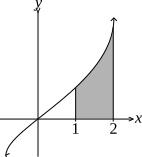
The region, \(R\), is bounded by the function, \(y=x^3\), the \(x\)-axis and the lines  \(x=1\)  and  \(x=2\).

What is the volume of the solid of revolution obtained when the region \(R\) is rotated about the \(x\)-axis?   (3 marks)

--- 6 WORK AREA LINES (style=lined) ---

Show Answers Only

\(V=\dfrac{127 \pi}{7} \ \ \text{u}^3\)

Show Worked Solution

  \(V\) \(=\pi \displaystyle \int_1^2 y^2\, d x\)
    \(=\pi \displaystyle \int_1^2 x^6\,d x\)
    \(=\pi\left[\dfrac{x^7}{7}\right]_1^2\)
    \(=\pi\left(\dfrac{2^7-1}{7}\right)\)
    \(=\dfrac{127 \pi}{7} \ \ \text{u}^3\)

Filed Under: Further Area and Solids of Revolution (Ext1) Tagged With: Band 3, smc-1039-10-Polynomial, smc-1039-60-x-axis Rotation

Vectors, EXT1 V1 2024 HSC 12a

The vectors \(\displaystyle \binom{a^2}{2}\) and \(\displaystyle  \binom{a+5}{a-4}\) are perpendicular.

Find the possible values of \(a\).   (3 marks)

--- 5 WORK AREA LINES (style=lined) ---

Show Answers Only

\(x=1,-4 \text { or }-2\)

Show Worked Solution
\(\text{If vectors are }\perp:\)

\(\displaystyle\binom{a^2}{2} \cdot\binom{a+5}{a-4}=0\)

\(a^3+5 a^2+2 a-8=0\)
 

\(\text{Test for roots:}\)

\(1^3+5 \times 1^2+2\times 1-8=0 \, \checkmark\)

\((a-1) \text{ is a factor.}\)

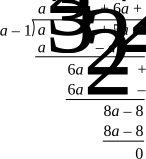
\(\text{By polynomial long division:}\)

\((a-1)\left(a^2+6 a+8\right)=0\)

\((a-1)(a+4)(a+2)=0\)

\(\therefore x=1,-4 \text { or }-2\)

Filed Under: Operations With Vectors (Ext1) Tagged With: Band 3, smc-1086-25-Perpendicular Vectors

Calculus, EXT1 C3 2024 HSC 11g

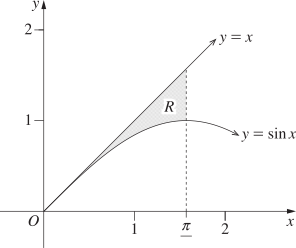
The region, \(R\), is bounded by the curves  \(y=\sin x, y=x\)  and the line  \(x=\dfrac{\pi}{2}\)  as shown in the diagram.
 

Find the area of the region \(R\).   (3 marks)

--- 6 WORK AREA LINES (style=lined) ---
Show Answers Only

\(\dfrac{\pi^2}{8}-1\ \ \text{u}^2\)

Show Worked Solution

  \(R\) \(=\displaystyle{\int}_0^{\frac{\pi}{2}} x-\sin x \, d x\)
    \(=\left[\dfrac{x^2}{2}+\cos x\right]_0^{\frac{\pi}{2}}\)
    \(=\left[\left(\dfrac{\pi^2}{8}+\cos \dfrac{\pi}{2}\right)-(0+\cos 0)\right]\)
    \(=\dfrac{\pi^2}{8}-1\ \ \text{u}^2\)

Filed Under: Further Area and Solids of Revolution (Ext1) Tagged With: Band 3, smc-1039-50-Area

Calculus, EXT1 C1 2024 HSC 11f

The volume of a sphere of radius \(r\) cm, is given by  \(V=\dfrac{4}{3} \pi r^3\),  and the volume of the sphere is increasing at a rate of \(10 \text{ cm}^3 \text{ s}^{-1}\).

Show that the rate of increase of the radius is given by  \(\dfrac{d r}{d t}=\dfrac{5}{2 \pi r^2} \text{ cm s}^{-1}\).   (2 marks)

--- 5 WORK AREA LINES (style=lined) ---

Show Answers Only

  \(\dfrac{d r}{d t}\) \(=\dfrac{d V}{d t} \times \dfrac{d r}{d V}\)
    \(=10 \times \dfrac{1}{4 \pi r^2}\)
    \(=\dfrac{5}{2 \pi r^2} \text{ cm/s}\)

Show Worked Solution

\(V=\dfrac{4}{3} \pi r^3 \ \Rightarrow \ \dfrac{d V}{d r}=4 \pi r^2\)

\(\dfrac{d V}{d t}=10\)

  \(\dfrac{d r}{d t}\) \(=\dfrac{d V}{d t} \times \dfrac{d r}{d V}\)
    \(=10 \times \dfrac{1}{4 \pi r^2}\)
    \(=\dfrac{5}{2 \pi r^2} \text{ cm/s}\)

Filed Under: Related Rates of Change (Ext1) Tagged With: Band 3, smc-1079-10-Volume

Calculus, EXT1 C2 2024 HSC 11e

Differentiate the function  \(f(x)=\arcsin \left(x^5\right)\).   (1 mark)

--- 3 WORK AREA LINES (style=lined) ---

Show Answers Only

\(f^{\prime}(x)=\dfrac{5 x^4}{\sqrt{1-x^{10}}}\)

Show Worked Solution

\(f(x)=\sin ^{-1}\left(x^5\right)\)

\(f^{\prime}(x)=5 x^4 \times \dfrac{1}{\sqrt{1-\left(x^5\right)^2}}=\dfrac{5 x^4}{\sqrt{1-x^{10}}}\)

Filed Under: Inverse Functions Calculus (Ext1) Tagged With: Band 3, smc-1037-10-Sin/Cos Differentiation

Calculus, EXT1 C3 2024 HSC 11d

Solve the differential equation  \(\dfrac{d y}{d x}=x y\),  given  \(y>0\). Express your answer in the form  \(y=e^{f(x)}\).   (2 marks)

--- 6 WORK AREA LINES (style=lined) ---

Show Answers Only

\(y=e^{\frac{x^2}{2}}\)

Show Worked Solution

  \(\dfrac{d y}{d x}\) \(=x y\)
  \(\displaystyle\int \frac{1}{y}\, d y\) \(=\displaystyle\int x\, d x\)
  \(\ln y\) \(=\dfrac{1}{2} x^2+c\)
  \(y\) \(=e^{\frac{x^2}{2}+c}\)
    \(=e^{\frac{x^2}{2}} \cdot e^c\)
    \(=A e^{\frac{x^2}{2}} \text{ (where \(A=e^c)\)}\)

 
\(\therefore y=e^{\frac{x^2}{2}}\ \  \text{is a solution } (A=1)\)

Filed Under: Equations and Slope Fields Tagged With: Band 3, smc-1197-20-Differential Equations, smc-1197-30-dy/dx = f(x y)

Calculus, EXT1 C2 2024 HSC 11c

Using the substitution  \(u=x-1\), find  \(\displaystyle \int x \sqrt{x-1}\, d x\).   (3 marks)

--- 5 WORK AREA LINES (style=lined) ---

Show Answers Only

\(\dfrac{2}{5}(x-1)^{\frac{5}{2}}+\dfrac{2}{3}(x-1)^{\frac{3}{2}}+c\)

Show Worked Solution

\(\displaystyle \int x \sqrt{x-1}\, d x \)

     
  \(u=x-1\) \(\Rightarrow \ x=u+1 \)
  \(\dfrac{d u}{d x}=1\)    \(\Rightarrow \ d u=d x\)


  \(\displaystyle\int(u+1) \sqrt{u+1-1}\, d u\) \(=\displaystyle{\int}(u+1) \sqrt{u} \, d u\)
    \(=\displaystyle{\int} u^{\frac{3}{2}}+u^{\frac{1}{2}}\, d u\)
    \(=\dfrac{2}{5} u^{\frac{5}{2}}+\dfrac{2}{3} u^{\frac{3}{2}}+c\)
    \(=\dfrac{2}{5}(x-1)^{\frac{5}{2}}+\dfrac{2}{3}(x-1)^{\frac{3}{2}}+c\)

Filed Under: Integration By Substitution (Ext1) Tagged With: Band 3, smc-1036-20-Polynomial

Functions, EXT1 F1 2024 HSC 11b

Solve  \(x^2-8 x-9 \leq 0\).   (2 marks)

--- 4 WORK AREA LINES (style=lined) ---

Show Answers Only

\(-1 \leqslant x \leqslant 9\)

Show Worked Solution

    \(x^2-8 x-9 \leqslant 0\)
    \((x-9)(x+1) \leqslant 0\)
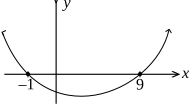
 

\(\therefore -1 \leqslant x \leqslant 9\)

Filed Under: Inequalities (Ext1), Quadratics and Cubic Functions (Adv-2027) Tagged With: Band 3, smc-1033-30-Quadratics, smc-6215-20-Inequalities

Vectors, EXT1 V1 2024 HSC 11a

Consider the vectors  \(\underset{\sim}{a}=3 \underset{\sim}{i}+2 \underset{\sim}{j}\)  and  \(\underset{\sim}{b}=-\underset{\sim}{i}+4 \underset{\sim}{j}\).

  1. Find  \(2 \underset{\sim}{a}-\underset{\sim}{b}\).   (1 mark)

    --- 3 WORK AREA LINES (style=lined) ---

  2. Find  \(\underset{\sim}{a} \cdot \underset{\sim}{b}\).   (1 mark)

    --- 3 WORK AREA LINES (style=lined) ---

Show Answers Only

i.    \(\displaystyle \binom{7}{0}\)

ii.   \(5\)

Show Worked Solution

i.     \(\underset{\sim}{a}=3 \underset{\sim}{i}+2 \underset{\sim}{j}, \ \underset{\sim}{b}=-\underset{\sim}{i}+4 \underset{\sim}{j}\)

\(2 \underset{\sim}{a}-\underset{\sim}{b}=2 \displaystyle \binom{3}{2}-\binom{-1}{4}=\binom{6}{4}-\binom{-1}{4}=\binom{7}{0}\)
 

ii.    \(\underset{\sim}{a} \cdot \underset{\sim}{b}=\displaystyle\binom{3}{2}\binom{-1}{4}=3 \times(-1)+2 \times 4=5\).

Filed Under: Operations With Vectors (Ext1) Tagged With: Band 2, Band 3, smc-1086-10-Basic Calculations

CHEMISTRY, M2 EQ-Bank 2 MC

Which is the correct balanced formula equation for the reaction of potassium with water?

  1. \(\ce{K(s) + H2O(l) -> KOH(aq) + H2(g)}\)
  2. \(\ce{2K(s) + 2H2O(aq) -> 2KOH(aq) + H2(g)}\)
  3. \(\ce{2K(s) + 2H2O(l) -> 2KOH(aq) + H2(g)}\)
  4. \(\ce{K(s) + 2H2O(aq) -> KOH(aq) + 2H2(g)}\)
Show Answers Only

\(C\)

Show Worked Solution
  • The correct chemical equation is:
  •    \(\ce{2K(s) + 2H2O(l) -> 2KOH(aq) + H2(g)}\) 
  • The state of water is always liquid. An aqueous solution refers to a solution where a substance has been dissolved into water.

\(\Rightarrow C\)

Filed Under: Chemical Reactions and Stoichiometry Tagged With: Band 3, smc-4259-50-Balancing Chemical Equations

CHEMISTRY, M2 EQ-Bank 2

In an experiment, calcium carbonate \(\ce{(CaCO3)}\) is heated strongly to produce calcium oxide \(\ce{(CaO)}\) and carbon dioxide according to the reaction below:

\(\ce{CaCO3(s) -> CaO(s) + CO2(g)}\)

A student starts with 50.0 g of calcium carbonate. After heating, they collect 28.0 g of calcium oxide.

  1. Using the law of conservation of mass, calculate the mass of carbon dioxide gas produced in this reaction.   (2 marks)

--- 4 WORK AREA LINES (style=lined) ---

  1. Explain how the law of conservation of mass applies to this reaction.   (2 marks)

--- 4 WORK AREA LINES (style=lined) ---

Show Answers Only

a.    \(22.0\ \text{g}\)

b.    Application of law to reaction:

  • The mass of reactants in a chemical reaction must equal the mass of the products.
  • Here, the 50.0 g of calcium carbonate decomposes into 28.0 g of calcium oxide and 22.0 g of carbon dioxide gas.
  • The total mass of products (28.0 g + 22.0 g) equals the initial mass of reactants (50.0 g), confirming that mass is conserved in this reaction.
Show Worked Solution

a.    Law of conservation of mass:

  • The total mass of reactants must equal the total mass of products.
  •   \(m\ce{(CO2)}=m\ce{(CaCO3)}-m\ce{(CaO)}= 50.0-28.0=22.0\ \text{g}\)

b.    Application of law to reaction:

  • The mass of reactants in a chemical reaction must equal the mass of the products.
  • Here, the 50.0 g of calcium carbonate decomposes into 28.0 g of calcium oxide and 22.0 g of carbon dioxide gas.
  • The total mass of products (28.0 g + 22.0 g) equals the initial mass of reactants (50.0 g), confirming that mass is conserved in this reaction.

Filed Under: Chemical Reactions and Stoichiometry Tagged With: Band 3, Band 4, smc-4259-80-Conservation of Mass

CHEMISTRY, M2 EQ-Bank 1 MC

What numbers are required to correctly balance this equation?

__\(\ce{Fe2O3 +}\) __\(\ce{CO ->}\) __\(\ce{Fe +}\) __\(\ce{CO2}\)

  1. \(1, 3, 2, 3\)
  2. \(2, 3, 1, 3\)
  3. \(1, 1, 2, 1\)
  4. \(2, 4, 2, 4\)
Show Answers Only

\(A\)

Show Worked Solution

Balancing the iron \(\ce{Fe}\) atoms:

  • There are 2 Fe atoms in \(\ce{Fe2O3}\), so we place a 2 in front of \(\ce{Fe}\) on the product side.
  •    \(\ce{Fe2O3 + CO -> 2Fe + CO2}\)  

Balancing the oxygen \(\ce{O}\) atoms:

  • \(\ce{Fe2O3}\) has 3 oxygen atoms. To balance equation, we need 3 \(\ce{CO}\) molecules on the reactant side to balance the 3 \(\ce{CO2}\) molecules on the product side.
  •    \(\ce{Fe2O3 + 3CO -> 2Fe + 3CO2}\)

\(\Rightarrow A\)

Filed Under: Chemical Reactions and Stoichiometry Tagged With: Band 3, smc-4259-50-Balancing Chemical Equations

CHEMISTRY, M2 EQ-Bank 13

  1. Calculate the volume of solution needed to obtain 0.6 moles of solute from a solution of concentration 1.2 mol/L.   (1 mark)

--- 2 WORK AREA LINES (style=lined) ---

  1. Explain the significance of accurate volume measurements when preparing solutions of specific concentrations in the laboratory.   (2 marks)

--- 4 WORK AREA LINES (style=lined) ---

Show Answers Only

a.    \(0.5\ \text{L}\)

b.    The exact volumes of solutions must be known as:

  • The concentration of each solution must be precise, as it affects the molar ratios and yields.
  • Miscalculating volume would lead to incorrect concentrations, impacting experimental results and validity.
Show Worked Solution

a.    \(V=\dfrac{n}{c}=\dfrac{0.6}{1.2}=0.5\ \text{L}\)
 

b.    The exact volumes of solutions must be known as:

  • The concentration of each solution must be precise, as it affects the molar ratios and yields.
  • Miscalculating volume would lead to incorrect concentrations, impacting experimental results and validity.

Filed Under: Concentration and Molarity Tagged With: Band 3, Band 5, smc-4261-30-Volume Calculations

CHEMISTRY, M2 EQ-Bank 12

  1. Calculate the amount (in moles) of a solute in a 2.0 L solution with a concentration of 0.75 mol/L.   (1 mark)

--- 2 WORK AREA LINES (style=lined) ---

  1. Using your answer from part a, determine the mass of the solute if the solute is \(\ce{NaCl}\).   (2 marks)

--- 4 WORK AREA LINES (style=lined) ---

Show Answers Only

a.    \(1.5\ \text{mol}\)

b.    \(87.99\ \text{g}\)

Show Worked Solution

a.    \(n = c \times V = 0.75 \times 2 = 1.5\ \text{mol}\)
 

b.    \(MM\ce{(NaCl)} = 22.99 + 35.45 = 58.44\ \text{g/mol}\)

\(m\ce{(NaCl)} = MM \times n = 58.44 \times 1.5 = 87.99\ \text{g}\)

Filed Under: Concentration and Molarity Tagged With: Band 3, smc-4261-40-Mass Calculations

CHEMISTRY, M2 EQ-Bank 11 MC

A student prepares a solution of potassium nitrate by dissolving 0.05 kg of \(\ce{KNO3}\) in enough water to make 2000 mL of solution. Which of the following correctly calculates the concentration of the solution in mol L\(^{-1}\)?

  1. \(25 \times 10^{-6}\ \text{g L}^{-1}\)
  2. \(25 \times 10^{-4}\ \text{g L}^{-1}\)
  3. \(25 \times 10^{-2}\ \text{g L}^{-1}\)
  4. \(25\ \text{g L}^{-1}\)
Show Answers Only

\(D\)

Show Worked Solution
  • Mass of \(\ce{KNO3}\) = 0.05 × 1000 = 50 g.
  • Volume of solution = 2 litres (L)
  •    \(c\ce{(KNO3)} = \dfrac{50}{2} = 25\ \text{g L}^{-1}\)

\(\Rightarrow D\)

Filed Under: Concentration and Molarity Tagged With: Band 3, smc-4261-20-Concentration Calculations

Calculus, EXT1 C3 2024 HSC 2 MC

Consider the functions  \(y=f(x)\)  and  \(y=g(x)\), and the regions shaded in the diagram below. 
 

Which of the following gives the total area of the shaded regions?

  1. \(\displaystyle \int_{-4}^4 f(x)-g(x)\,d x\)
  2. \(\displaystyle \left|\int_{-4}^4 f(x)-g(x)\,d x\right|\)
  3. \(\displaystyle \int_{-4}^{-3} f(x)-g(x)\,d x+\int_{-3}^{-1} f(x)-g(x)\,d x+\int_{-1}^1 f(x)-g(x)\,d x+\int_1^4 f(x)-g(x)\,d x \)
  4. \(\displaystyle - \int_{-4}^{-3} f(x)-g(x)\,d x+\int_{-3}^{-1} f(x)-g(x)\,d x-\int_{-1}^1 f(x)-g(x)\,d x+\int_1^4 f(x)-g(x)\,d x\)
Show Answers Only

\(D\)

Show Worked Solution

\(\text{Intervals where}\ f(x) \gt g(x)\ \ \Rightarrow\ \text{Positive area values}\)

\(\text{Intervals where}\ g(x) \gt f(x)\ \ \Rightarrow\ \text{Negative area values}\)

\(\Rightarrow D\)

Filed Under: Further Area and Solids of Revolution (Ext1) Tagged With: Band 3, smc-1039-50-Area

CHEMISTRY, M2 EQ-Bank 8 MC

A student prepares a standard solution of sodium chloride. They dissolve 5.85 g of sodium chloride \(\ce{(NaCl)}\) in enough water to make 1.00 L of solution. Determine the concentration of this solution.

  1. 0.100 mol L\(^{-1}\)
  2. 0.500 mol L\(^{-1}\)
  3. 1.00 mol L\(^{-1}\)
  4. 5.85 mol L\(^{-1}\)
Show Answers Only

\(A\)

Show Worked Solution

\(n\ce{(NaCl)} = \dfrac{5.85}{22.99 + 35.45} = 0.100\ \text{mol}\)

\(\ce{[NaCl]} = \dfrac{n}{V} = \dfrac{0.100}{1} = 0.100\ \text{mol L}^{-1}\)

\(\Rightarrow A\)

Filed Under: Concentration and Molarity Tagged With: Band 3, smc-4261-20-Concentration Calculations

Trigonometry, EXT1 T1 2024 HSC 5 MC

Consider the function  \(g(x) = 2 \sin^{-1}(3x)\).

Which transformations have been applied to \(f(x) = \sin^{-1}(x)\)  to obtain \(g(x)\)?

  1. Vertical dilation by a factor of \(\dfrac{1}{2}\) and a horizontal dilation by a factor of \(\dfrac{1}{3}\)
  2. Vertical dilation by a factor of \(\dfrac{1}{2}\) and a horizontal dilation by a factor of 3
  3. Vertical dilation by a factor of 2 and a horizontal dilation by a factor of \(\dfrac{1}{3}\)
  4. Vertical dilation by a factor of 2 and a horizontal dilation by a factor of 3
Show Answers Only

\(C\)

Show Worked Solution

\(\text{A vertical dilation of factor 2:}\)

\(f(x) = \sin^{-1}(x)\ \ \rightarrow \ \ f_1(x) = 2\sin^{-1}(x)\)

\(\text{A horizontal dilation of factor}\ \dfrac{1}{3}:\)

\(f_1(x) = 2\sin^{-1}(x)\ \ \rightarrow \ \ f_2(x) = 2\sin^{-1}(3x)\)

\(\Rightarrow C\)

Filed Under: T1 Inverse Trig Functions (Y11) Tagged With: Band 3, smc-1024-40-Transformations

Functions, EXT1 F2 2024 HSC 1 MC

The polynomial  \(x^{3} + 2x^{2}-5x-6\)  has zeros  \(-1, -3\) and \(\alpha\).

What is the value of \(\alpha\)?

  1. \(-2\)
  2. \(2\)
  3. \(3\)
  4. \(6\)
Show Answers Only

\(B\)

Show Worked Solution

\(\alpha \beta \gamma = -\dfrac{\text{d}}{\text{a}} = 6\)

\(-1 \times -3 \times \alpha\) \(=6\)  
\(\alpha\) \(=2\)  

 
\(\Rightarrow B\)

Filed Under: Sum, Products and Multiplicity of Roots (Ext1) Tagged With: Band 3, smc-1205-10-Sum and Product

CHEMISTRY, M2 EQ-Bank 5 MC

A standard solution is best described as:

  1. A solution prepared to an approximate concentration for general use.
  2. A solution with a precisely known concentration, used in quantitative chemical analysis.
  3. A solution containing only one type of solute molecule.
  4. A solution prepared by dissolving a solid solute in a small volume of solvent.
Show Answers Only

\(B\)

Show Worked Solution
  • A standard solution is a solution with a precise and known concentration, allowing accurate calculations in quantitative chemical analysis.
  • It is prepared by dissolving an exact amount of a primary standard in a specific volume of solvent.

\(\Rightarrow B\)

Filed Under: Concentration and Molarity Tagged With: Band 3, smc-4261-70-Standard Solutions

CHEMISTRY, M2 EQ-Bank 7

  1. 4.56 g of potassium chloride \(\ce{KCl}\) is dissolved in 250 mL of water. What is the concentration of this solution?   (2 marks)

--- 4 WORK AREA LINES (style=lined) ---

  1. How many grams of calcium chloride \(\ce{CaCl2}\) will be needed to make 1.50 L of a 0.250 M solution?   (2 marks)

--- 4 WORK AREA LINES (style=lined) ---

Show Answers Only

a.    \(0.24\ \text{mol L}^{-1}\)

b.    \(41.6\ \text{g}\)

Show Worked Solution

a.    \(MM\ce{(KCl)}= 39.10 + 35.45 = 74.55\ \text{g mol}^{-1}\)

\(n\ce{(KCl)}= \dfrac{m}{MM} = \dfrac{4.56}{74.55} = 0.061\ \text{mol}\)

\(c\ce{(KCl)}=\dfrac{n}{V}= \dfrac{0.061}{0.25} = 0.24\ \text{mol L}^{-1}\)


b.    \(n\ce{(CaCl2)} = c \times V = 0.25 \times 1.5 = 0.375\ \text{mol}\)

\(m\ce{(CaCl2)} = MM \times n = (40.08 + 2(35.45)) \times 0.375 = 41.6\ \text{g}\)

Filed Under: Concentration and Molarity Tagged With: Band 3, Band 4, smc-4261-20-Concentration Calculations, smc-4261-40-Mass Calculations

Probability, STD1 S2 2024 HSC 17

A wheel is shown with the numbers 0 to 19 marked.

A game is played where the wheel is spun until it stops.

When the wheel stops, a pointer points to the winning number. Each number is equally likely to win.
 

  1. List all the even numbers on the wheel that are greater than 7.   (1 mark)

    --- 2 WORK AREA LINES (style=lined) ---

  2. What is the probability that the winning number is NOT an even number greater than 7?   (2 marks)

    --- 4 WORK AREA LINES (style=lined) ---

Show Answers Only

a.    \(8\ ,\ 10\ ,\ 12\ ,\ 14\ ,\ 16\ ,\ 18\)

b.    \(0.7\)

Show Worked Solution

a.    \(8\ ,\ 10\ ,\ 12\ ,\ 14\ ,\ 16\ ,\ 18\ \text{(6 numbers)}\)
 

b.   \(\text{Total numbers = 20}\)

\(\text{Numbers not even and > 7}\ = 20-6=14\ \text{numbers}\)

\(P\text{(not even and > 7)}\ =\dfrac{14}{20}=0.7\)

♦♦ Mean mark (b) 32%.

Filed Under: Single and Multi-Stage Events (Std 1) Tagged With: Band 3, Band 5, smc-1135-05-Simple Probability, smc-1135-30-P(E) = 1 - P(not E)

Financial Maths, STD1 F3 2024 HSC 5 MC

A car is valued at $25 000 when new. Its value depreciates by 25% per annum.

Which of the following best describes the change in value of the car after one year?

  1. Decrease of $1000
  2. Increase of $1000
  3. Decrease of $6250
  4. Increase of $6250
Show Answers Only

\(C\)

Show Worked Solution
\(S\) \(=V_0(1-r)^n\)
  \(=25000(1-0.25)^1\)
  \(=$18\,750\)

 
\(\therefore\ \text{Decrease in value}\ = $25\,000-$18\,750=$6250\)
 

\(\Rightarrow C\)

Filed Under: Depreciation - Declining Balance (Std 1) Tagged With: Band 3, smc-1139-10-Find S

  • « Previous Page
  • 1
  • …
  • 14
  • 15
  • 16
  • 17
  • 18
  • …
  • 57
  • Next Page »

Copyright © 2014–2025 SmarterEd.com.au · Log in