SmarterEd

Aussie Maths & Science Teachers: Save your time with SmarterEd

  • Login
  • Get Help
  • About

Functions, 2ADV F1 2018 HSC 3 MC

What is the `x`-intercept of the line  `x + 3y + 6 = 0`?

  1. `(-6, 0)`
  2. `(6, 0)`
  3. `(0, -2)`
  4. `(0, 2)`
Show Answers Only

`A`

Show Worked Solution

`x text(-intercept occurs when)\ y = 0:`

`x + 0 + 6` `= 0`
`x` `= -6`

 
`:. x text{-intercept is}\  (-6, 0)`

`=>  A`

Filed Under: 6. Linear Functions, Cartesian Plane, Linear Equations and Basic Graphs, Linear Functions, Linear Functions Tagged With: Band 3, common-content, num-title-ct-pathc, num-title-qs-hsc, smc-4422-80-Other, smc-6214-08-Intercepts, smc-792-20-Equation of Line, smc-985-30-Coordinate Geometry

Probability, STD2 S2 2018 HSC 9 MC

An experiment has three distinct outcomes, A, B and C.

Outcome A occurs 50% of the time. Outcome B occurs 23% of the time.

What is the expected number of times outcome C would occur if the experiment is conducted 500 times?

  1. 115
  2. 135
  3. 250
  4. 365
Show Answers Only

`text(B)`

Show Worked Solution

`text(Expectation of outcome)\ C`

`= 1 – 0.5 – 0.23`

`= 0.27`
 

`:.\ text(Expected times)\ C\ text(occurs)`

`= 0.27 xx 500`

`= 135`

`=>\ text(B)`

Filed Under: Fundamental Understanding, Fundamental Understanding, Probability Tagged With: Band 3, num-title-ct-core, num-title-qs-hsc, smc-4225-35-Relative frequency

Algebra, STD2 A2 2018 HSC 5 MC

The driving distance from Alex's home to his work is 20 km. He drives to and from work five times each week. His car uses fuel at the rate of 8 L/100 km.

How much fuel does he use driving to and from work each week?

  1. 16 L
  2. 20 L
  3. 25 L
  4. 40 L
Show Answers Only

`A`

Show Worked Solution

`text(Total distance travelled each week)`

`= 5 xx 2 xx 20= 200\ text(km)` 

`:.\ text(Total fuel used)= 200/100 xx 8\ text(L)= 16\ text(L)`

`=>A`

Filed Under: Applications of Linear Relationships, Applications of Linear Relationships, Applications: Currency, Fuel and Other Problems, Applications: Currency, Fuel and Other Problems, M4 Rates (Y12), Rates Tagged With: Band 3, smc-1104-20-Fuel, smc-1119-20-Fuel, smc-6256-20-Fuel/Transport, smc-6513-10-Fuel/Transport, smc-793-20-Fuel, smc-805-10-Fuel

Algebra, STD2 A4 2018 HSC 4 MC

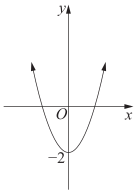
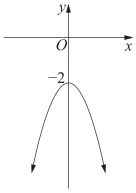
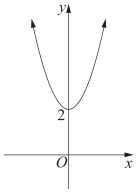
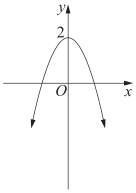
Which graph best represents the equation  `y = x^2-2`?
 

A. B.
C. D.
Show Answers Only

`A`

Show Worked Solution

`y = x^2-2`

`ytext(-intercept) = -2\ \ \ (text(when) = 0)`

`text(Quadratic is positive with vertex at)\ \ y = -2`

`=>A`

Filed Under: Non-Linear: Exponential/Quadratics, Quadratics Tagged With: Band 3, num-title-ct-corea, num-title-qs-hsc, smc-4443-10-Identify graphs, smc-830-10-Identify Graphs

Statistics, STD2 S1 2018 HSC 1 MC

A set of scores has the following five-number summary.

lower extreme = 2
lower quartile = 5
median = 6
upper quartile = 8
upper extreme = 9

What is the range?

  1. 2
  2. 3
  3. 6
  4. 7
Show Answers Only

`D`

Show Worked Solution
`text(Range)` `=\ text(upper extreme − lower extreme)`
  `= 9-2= 7`

`=> D`

Filed Under: Measures of Centre and Spread, Measures of Centre and Spread, Summary Statistics, Summary Statistics - No Graph, Summary Statistics - No graph Tagged With: Band 3, common-content, smc-1131-70-Other, smc-6312-70-Other, smc-6532-70-Other, smc-824-70-Other, smc-999-70-Other

Plane Geometry, EXT1 2018 HSC 14c

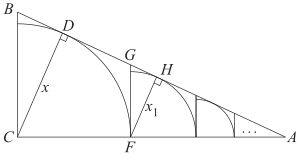
In triangle `ABC, BC` is perpendicular to `AC`. Side `BC` has length `a`, side `AC` has length `b` and side `AB` has length `c`. A quadrant of a circle of radius `x`, centered at `C`, is constructed. The arc meets side `BC` at `E`. It touches the side `AB` at `D`, and meets side `AC` at `F`. The interval `CD` is perpendicular to `AB`.
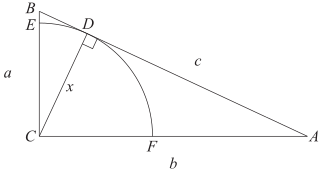


  1. Show that `Delta ABC` and `Delta ACD` are similar.  (1 mark)
  2. Show that
     
    `qquad x = (ab)/c`.  (1 mark)
     

  3. From `F`, a line perpendicular to `AC` is drawn to meet `AB` at `G`, forming the right-angled triangle `GFA`. A new quadrant is constructed in triangle `GFA` touching side `AB` at `H`. The process is then repeated indefinitely.


  4. Show that the limiting sum of the areas of all the quadrants is
     
    `qquad (pi ab^2)/(4(2c - a)).`  (4 marks)
     

  5. Hence, or otherwise, show that
     
    `qquad pi/2 < (2c - a)/b`.  (1 mark)


Show Answers Only
  1. `text(Proof)\ \ text{(See Worked Solutions)}`
  2. `text(Proof)\ \ text{(See Worked Solutions)}`
  3. `text(Proof)\ \ text{(See Worked Solutions)}`
  4. `text(Proof)\ \ text{(See Worked Solutions)}`
Show Worked Solution

(i)   `text(In)\ triangle ABC,`

`/_BCA = 90^@\ \ \ (BC _|_ AC)`
 

`/_ BCA = /_ ADC\ \ text{(right-angles)}`

`/_ BAC = /_ DAC\ \ text{(common)}`
 

`:. Delta ABC\ text(|||)\ Delta ACD\ \ text{(equiangular)}`


(ii) `(CD)/(BC)` `= (AC)/(AB)` `text{(corresponding sides of}`
   `text{similar triangles)}`
  `x/a` `= b/c`  
  `:. x` `= (ab)/c`  


(iii)
  `text(Area of)\ Q_1 = 1/4 pi x^2`

♦♦♦ Mean mark part (iii) 19%.

`text(Area of)\ Q_2 => text(find)\ x_1`


`text(Consider)\ Delta ACD and Delta AFH`

`/_ADC = /_AHF\ \ text{(right angles)}`

`/_ CAD = /_FAH\ \ text{(common)}`

`:. Delta ACD\ text(|||)\ Delta AFH\ \ text{(equiangular)}`


`(FH)/(CD)` `= (AF)/(AC)` `text{(corresponding sides}`
`text{of similar triangles)}`
`x_1/x` `= (AC – CF)/(AC)`  
  `= (b – x)/b`  
  `= (b – (ab)/c)/b` `text{(using part (ii))}`
  `= (cb – ab)/(bc)`  
  `= (c – a)/c`  
`:. x_1` `= x((c – a)/c)`  


`=> x_2\ text(will be shorter again by the same ratio)`

`x_2` `= x_1 ((c – a)/c)`
  `= x((c – a)/c)^2`
  `vdots`
`x_n` `= x((c – a)/c)^n`


`text(Limiting sum of quadrant areas)`

`= Q_1 + Q_2 + … + Q_n`

`= 1/4 pi x^2 + 1/4 {:pi x_1:}^ 2 + … + 1/4 {:pi x_n:}^2`

`= 1/4 pi x^2 + 1/4 pi x^2 ((c – a)/c)^2 + … + 1/4 pi x^2 ((c – a)/c)^(2n)`

`= 1/4 pi x^2 underbrace{[1 + ((c – a)/c)^2 + … + ((c – a)/c)^(2n)]}_{text(GP with)\ a = 1, \ r = ((c-a)/c)^2`

`= 1/4 pi x^2 [1/(1 – ((c-a)/c)^2)]`

`= 1/4 pi ((ab)/c)^2 (c^2/(c^2 – (c – a)^2))`

`= pi/4 xx (a^2 b^2)/(c^2 – c^2 + 2ac – a^2)`

`= pi/4 xx (a^2 b^2)/(a(2c – a))`

`= (pi ab^2)/(4(2c – a))\ \ \ text(… as required)`


(iv)  `text(S)text{ince the limiting sum all the quadrants (from part (iii))}`

♦♦ Mean mark part (iv) 21%.

`text(is less than the area of)\ \ Delta ABC:`

`(pi ab^2)/(4(2c – a))` `< (ab)/2`
`(pi b)/(4(2c – a))` `< 1/2`
`pi/4` `< (2c – a)/(2b)`
`pi/2` `< (2c – a)/b\ \ \ text(… as required)`

Filed Under: 2. Plane Geometry EXT1 Tagged With: Band 3, Band 5, Band 6

Networks, STD2 N2 EQ-Bank 20

A table is constructed to represent the network diagram below.
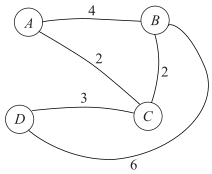


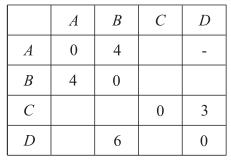
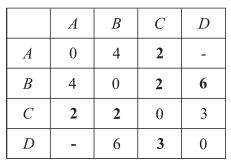
Complete the table.   (2 marks)
 

--- 0 WORK AREA LINES (style=lined) ---
Show Answers Only

Show Worked Solution

Filed Under: Basic Concepts, Basic Concepts, Network Concepts, Network Concepts Tagged With: Band 3, smc-1136-20-Network to Table, smc-6307-20- Network to Table, smc-6526-20- Network to Table, smc-912-20-Network to Table

Proof, EXT1 P1 2018 HSC 13a

Prove by mathematical induction that, for  `n >= 1,`

`2-6 + 18-54 + … + 2 (-3)^(n-1) = (1-(-3)^n)/2.`  (3 marks)

--- 14 WORK AREA LINES (style=lined) ---

Show Answers Only

`text(Proof)\ \ text{(See Worked Solutions)}`

Show Worked Solution

`text(If)\ \ n = 1,`

`text(LHS)` `= 2 (-3)^0 = 2`
`text(RHS)` `= (1-(-3)^1)/2 = 2`

`:.\ text(True for)\ n = 1`
 

`text(Assume true for)\ n = k`

`2-6 + 18-54 + … + 2 (-3)^(k-1) = (1-(-3)^k)`
 

`text(Prove true for)\ \ n = k + 1`

`text(i.e.)\ \ 2-6 + … + 2 (-3)^(k-1) + 2 (-3)^k = (1-(-3)^(k + 1))/2`

`text(LHS)` `= underbrace{2-6 + … + 2(-3)^(k-1)}_text(Sum of GP, r = –3) + 2 (-3)^k`
  `= (2(1-(-3)^k))/(1+3) + 2 (-3)^k`
  `= (1-(-3)^k + 4 (-3)^k)/2`
  `= (1 + 3(-3)^k)/2`
  `= (1-(-3)(-3)^k)/2`
  `= (1-(-3)^(k + 1))/2`
  `=\ text(RHS)`

 
`=>\ text(True for)\ \ n=k+1`

`:.\ text(S)text(ince true for)\ \ n=1, text(by PMI, true for integral)\ n >= 1.`

Filed Under: 7. Induction and Other Series EXT1, P1 Induction (Y12) Tagged With: Band 3, smc-1019-20-Sum of a Series

Mechanics, EXT2* M1 2018 HSC 13c

An object is projected from the origin with an initial velocity of  `V` at an angle  `theta`  to the horizontal. The equations of motion of the object are

`x(t)` `= Vt cos theta`
`y(t)` `= Vt sin theta - (g t^2)/2.`  (Do NOT prove this.)


  1. Show that when the object is projected at an angle  `theta`, the horizontal range is


         `V^2/g sin 2 theta`  (2 marks)

    --- 6 WORK AREA LINES (style=lined) ---

  2. Show that when the object is projected at an angle  `pi/2 - theta`, the horizontal range is also 


         `V^2/g sin 2 theta`.  (1 mark)

    --- 3 WORK AREA LINES (style=lined) ---

  3. The object is projected with initial velocity `V` to reach a horizontal distance `d`, which is less than the maximum possible horizontal range. There are two angles at which the object can be projected in order to travel that horizontal distance before landing.


    Let these angles be `alpha`  and  `beta`, where  `beta = pi/2 - alpha.`


    Let  `h_alpha`  be the maximum height reached by the object when projected at the angle `alpha` to the horizontal.


    Let  `h_beta`  be the maximum height reached by the object when projected at the angle `beta` to the horizontal.
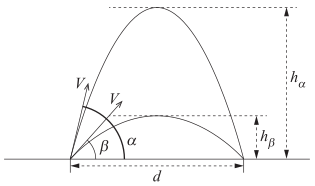


    Show that the average of the two heights, `(h_alpha + h_beta)/2`, depends only on `V` and `g`.  (3 marks)

    --- 9 WORK AREA LINES (style=lined) ---

Show Answers Only
  1. `text(Proof)\ \ text{(See Worked Solutions)}`
  2. `text(Proof)\ \ text{(See Worked Solutions)}`
  3. `text(Proof)\ \ text{(See Worked Solutions)}`
Show Worked Solution

i.    `text(Horizontal range occurs when)\ \ y = 0`

`Vt sin theta – (g t^2)/2` `= 0`
`V sin theta – (g t)/2` `= 0`
`t` `= (2V sin theta)/g`

 
`text(Find)\ \ x\ \ text(when)\ \ t=(2V sin theta)/g :`

`x` `= Vt cos theta`
  `= V((2V sin theta)/g) cos theta`
  `= (V^2 * 2sin theta cos theta)/g`
  `= V^2/g sin 2 theta\ \ \ text(.. as required)`


ii.  `text(Find)\ \ x\ \ text(when)\ \ theta = (pi/2 – theta):`

`x` `= V^2/g sin 2 (pi/2 – theta)`
  `= V^2/g underbrace {sin (pi – 2 theta)}_{text(Using)\ \ sin (pi-theta) = sin theta}`
  `= V^2/g sin 2 theta\ \ \ text(.. as required)`


iii.  `text(Highest point → half way through the flight.)`

`=> h_alpha\ \ text(occurs when)\ \ t=(V sin alpha)/g\ \ text{(by symmetry)}`
  

`:. h_alpha` `= V((V sin alpha)/g) sin alpha – g/2 ((V sin alpha)/g)^2`
  `= (V^2 sin^2 alpha)/g – g/2 ((V^2 sin^2 alpha)/g^2)`
  `= (V^2 sin^2 alpha)/g – (V^2 sin^2 alpha)/(2g)`
  `= (V^2 sin^2 alpha)/(2g)`


`text(Similarly,)\ \ h_beta = (V^2 sin^2 beta)/(2g)`

♦ Mean mark 44%.
 

`:. (h_alpha + h_beta)/2` `= 1/2 ((V^2 sin^2 alpha)/(2g) + (V^2 sin^2 beta)/(2g))`
  `= V^2/(4g) (sin^2 alpha + underbrace{sin^2 beta}_{text(Using)\ \ beta= pi/2 -alpha})`
  `= V^2/(4g) (sin^2 alpha + sin^2(pi/2 – alpha)) `
  `= V^2/(4g) (sin^2 alpha + cos^2 alpha)`
  `= V^2/(4g)`

 
`:. text(The average height depends only on)\ V\ text(or)\ g.`

Filed Under: Projectile Motion, Projectile Motion EXT1 Tagged With: Band 3, Band 4, Band 5, smc-1062-10-Range/Time of Flight, smc-1062-20-Max Height

Calculus, EXT1 C2 2018 HSC 12c

Let  `f(x) = sin^(-1) x + cos^(-1) x`.

  1. Show that  `f^{′}(x) = 0`  (1 mark)

    --- 2 WORK AREA LINES (style=lined) ---

  2. Hence, or otherwise, prove
     
    `qquad sin^(-1) x + cos^(-1) x = pi/2`.  (1 mark)

    --- 4 WORK AREA LINES (style=lined) ---

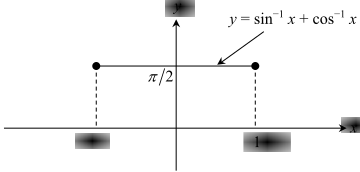
  3. Hence, sketch
     
    `qquad f(x) = sin^(-1) x + cos^(-1) x`.  (1 mark)

    --- 8 WORK AREA LINES (style=lined) ---

Show Answers Only
  1. `text(Proof)\ \ text{(See Worked Solutions)}`
  2. `text(Proof)\ \ text{(See Worked Solutions)}`
  3. `text(See Worked Solutions)`
Show Worked Solution

i.    `f^{′}(x) = 1/sqrt(1-x^2) + (-1/sqrt (1-x^2)) = 0`


ii.  `text(S)text(ince)\ \ f^{′}(x) = 0\ \ => f(x)\ \ text(is a constant.)`

♦ Mean mark (ii) 37%.

`text(Substituting)\ \ x=1\ \ text{into the equation  (any value works)}`

  `sin^(-1) 1 + cos^(-1) 1` `= pi/2 + 0`
    `= pi/2\ \ text(… as required)`


iii.  `text(Domain restrictions require:)\ \ -1<x<1`

♦ Mean mark (iii) 40%.


Filed Under: Inverse Functions Calculus, Inverse Trig Functions EXT1 Tagged With: Band 3, Band 5, smc-1037-10-Sin/Cos Differentiation

Calculus, EXT1 C1 2018 HSC 12b

A ferris wheel has a radius of 20 metres and is rotating at a rate of 1.5 radians per minute. The top of a carriage is `h` metres above the horizontal diameter of the ferris wheel. The angle of elevation of the top of the carriage from the centre of the ferris wheel is `theta`.
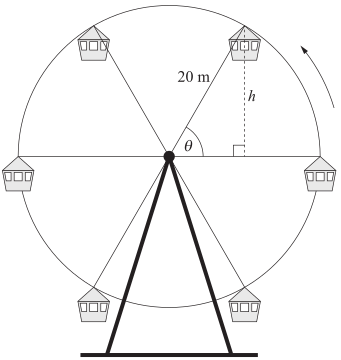


  1. Show that  `(dh)/(d theta) = 20 cos theta`.  (1 mark)

    --- 2 WORK AREA LINES (style=lined) ---

  2. At what speed is the top of the carriage rising when it is 15 metres higher than the horizontal diameter of the ferris wheel? Give your answer correct to one decimal place.  (2 marks)

    --- 6 WORK AREA LINES (style=lined) ---

Show Answers Only
  1. `text(Proof)\ \ text{(See Worked Solution)}`
  2. `19.8\ text{metres per minute  (1 d.p)}`
Show Worked Solution

i.   `text(From the diagram,)`

`sin theta` `= h/20`
`h` `= 20 sin theta`
`:. (dh)/(d theta)` `= 20 cos theta`


ii.   `text(Find)\ \ (dh)/(dt)\ text(when)\ h = 15:`

`(dh)/(dt)` `= (dh)/(d theta) xx (d theta)/(dt)`
  `= (20 cos theta) xx 1.5`
  `= 30 cos theta`

 
`text(Find)\ cos theta\ \ text(when)\ h = 15`

`text(Using Pythagoras,)`

`cos theta` `=sqrt(20^2 – 15^2)/20`  
  `=sqrt7/4`  


`:. (dh)/(dt)` `= 30 cos theta`
  `= (15 sqrt 7)/2`
  `~~ 19.8\ text{metres per minute  (1 d.p)}`

Filed Under: Rates of Change EXT1, Related Rates of Change Tagged With: Band 3, Band 4, smc-1079-40-Other Themes

Trig Calculus, EXT1 2018 HSC 12a

Find  `int cos^2 (3x)\ dx`.  (2 marks)

Show Answers Only

`x/2 + 1/12 sin (6x) + c`

Show Worked Solution

`text(Using)\ \ cos^2 x = 1/2(1+cos(2x)),`

`int cos^2 (3x)\ dx` `= 1/2 int 1 + cos (6x)\ dx`
  `= 1/2 (x + 1/6 sin (6x)) + c`
  `= x/2 + 1/12 sin (6x) + c`

Filed Under: 13. Trig Calc, Graphs and Circular Measure EXT1 Tagged With: Band 3

Calculus, EXT1 C2 2018 HSC 11f

Evaluate  `int_-3^0 x/sqrt(1 - x) dx`, using the substitution  `u = 1 - x`.  (3 marks)

--- 8 WORK AREA LINES (style=lined) ---

Show Answers Only

`- 8/3`

Show Worked Solution
`u` `= 1 – x\ \ => x=1-u`
`(du)/dx` `= -1`
`dx` `= -du`

 
`text(When)\ \ x=0, \ u=1`

`text(When)\ \ x=-3, \ u=4`
 
`int_-3^0 x/sqrt (1- x)\ dx`

  `= -int_4^1 (1 – u)/sqrt(u)\ du`
  `= – int_4^1 u^(- 1/2) – u^(1/2)\ du`
  `= – [2 u^(1/2) – 2/3 u^(3/2)]_4^1`
  `= -[(2-2/3) – (2 sqrt 4 – 2/3 (sqrt 4)^3)`
  `= -[4/3 – (4-16/3)]`
  `= -8/3`

Filed Under: 11. Integration EXT1, Integration By Substitution Tagged With: Band 3, smc-1036-10-Linear, smc-1036-50-Limits Invert

Real Functions, EXT1 2018 HSC 11e

Consider the function  `f(x) = 1/(4x - 1)`.
 

  1. Find the domain of  `f(x)`.  (1 mark)
  2. For what values of  `x`  is  `f(x) < 1`?  (2 marks)
Show Answers Only
  1. `{text(all real)\ x,  x!=1/4}`
  2. `x > 1/2 or x < 1/4`
Show Worked Solution

(i)   `text(Domain is)\ {text(all real)\ x,  x!=1/4}`


(ii)   `1/(4x – 1)` `< 1`
  `(4x – 1)` `< (4 x – 1)^2`
  `(4x – 1)^2 – (4x – 1)` `> 0`
  `(4x – 1)[4x – 1- 1]` `> 0`
  `2 (4x – 1) (2x – 1)` `> 0`

 
`text(Sketching the parabola:)`

`x > 1/2 or x < 1/4.`
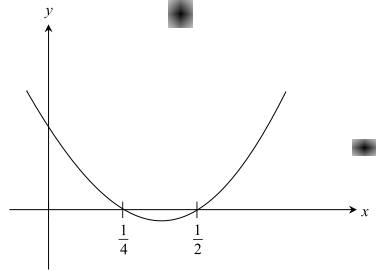
`text(From the graph,)`

`y > 1\ \ text(when)\ \ x < 1/4 or x > 1/2`

Filed Under: 10. Geometrical Applications of Calculus EXT1 Tagged With: Band 3, Band 4

Trigonometry, EXT1 T3 2018 HSC 11c

Write  `sqrt 3 sin x + cos x`  in the form `R sin (x + alpha)` where  `R > 0`  and  `0 <= alpha <= pi/2.`   (2 marks)

--- 6 WORK AREA LINES (style=lined) ---

Show Answers Only
`R sin (x + alpha)` `=sqrt 3 sin x + cos x`
`R sin x cos alpha + R cos x sin alpha` `=sqrt 3 sin x + cos x`

 
`text(Equating coefficients:)`

`R cos alpha= sqrt 3,\ \ R sin alpha= 1`

`R^2= (sqrt 3)^2 + 1^2=4\ \ =>\ \ R=2`

`2sin alpha=1\ \ =>\ \ sin alpha=1/2\ \ =>\ \ \alpha= pi/6 quad (0 <= alpha <= pi/2)`

`:. sqrt 3 sin x + cos x = 2 sin (x + pi/6).`

Show Worked Solution
`R sin (x + alpha)` `=sqrt 3 sin x + cos x`
`R sin x cos alpha + R cos x sin alpha` `=sqrt 3 sin x + cos x`

  
`text(Equating coefficients:)`

`R cos alpha= sqrt 3,\ \ R sin alpha= 1`

`R^2= (sqrt 3)^2 + 1^2=4\ \ =>\ \ R=2`

`2sin alpha=1\ \ =>\ \ sin alpha=1/2\ \ =>\ \ \alpha= pi/6`

`:. sqrt 3 sin x + cos x = 2 sin (x + pi/6).`

Filed Under: 5. Trig Ratios EXT1, Auxiliary Angles, Auxiliary Angles Tagged With: Band 3, smc-1075-10-Rsin, smc-6674-10-Rsin

L&E, EXT1 2018 HSC 11b

Solve  `log_2 5 + log_2(x - 2) = 3.`  (2 marks)

Show Answers Only

`x=18/5`

Show Worked Solution
`log_2 (5) + log_2 (x – 2)` `= 3`
`log_2(5 (x – 2))` `= 3`
`5(x – 2)` `= 2^3`
`5x – 10` `= 8`
`5x` `= 18`
`x` `= 18/5`

 
`text(S)text(ince the domain requires)\ x>2,`

`x=18/5`

Filed Under: 12. Logs and Exponentials EXT1 Tagged With: Band 3

Functions, EXT1 F2 2018 HSC 11a

Consider the polynomial  `P(x) = x^3-2x^2-5x + 6`.

  1. Show that  `x = 1`  is a zero of `P(x)`.   (1 mark)

    --- 2 WORK AREA LINES (style=lined) ---

  2. Find the other zeros.   (2 marks)

    --- 5 WORK AREA LINES (style=lined) ---

Show Answers Only
  1. `text(See Worked Solution)`
  2. `x = -2 and x = 3`
Show Worked Solution

i.    `P(1) = 1-2-5 + 6 = 0`

`:. x=1\ \ text(is a zero)`


ii.   `text{Using part (i)} \ => (x-1)\ text{is a factor of}\ P(x)`

`P(x) = (x-1)*Q(x)`
 

`text(By long division:)`

`P(x)` `= (x-1) (x^2-x-6)`
  `= (x-1) (x-3) (x + 2)`

 
`:.\ text(Other zeroes are:)`

`x = -2 and x = 3`

Filed Under: Polynomials, Remainder and Factor Theorems, Remainder and Factor Theorems, Roots, Remainders and Factors Tagged With: Band 1, Band 3, num-title-ct-patha, num-title-qs-hsc, smc-1031-10-Factor Theorem, smc-4242-10-Factor Theorem, smc-6644-10-Factor Theorem

Linear Functions, EXT1 2018 HSC 2 MC

The acute angle between the lines  `y = 3x`  and  `y = 5x`  is  `theta.`

What is the value of  `tan theta?`

A.     `1/8`

B.     `1/7`

C.     `1/2`

D.     `4/7`

Show Answers Only

`A`

Show Worked Solution
`tan theta` `= |(m_1 – m_2)/(1 + m_1 m_2)|`
  `= |(5 – 3)/(1 + 5 xx 3)|`
  `= 1/8`


`⇒  A`

Filed Under: 6. Linear Functions EXT1 Tagged With: Band 3

Polynomials, EXT1 2018 HSC 1 MC

The polynomial  `2x^3 + 6x^2 - 7x - 10`  has zeros  `alpha, beta and gamma.`

What is the value of  `alpha beta gamma (alpha + beta + gamma)?`

A.     `−60`

B.     `−15`

C.     `15`

D.     `60`

Show Answers Only

`B`

Show Worked Solution

`a = 2, \quad b = 6, \quad c = -7, \quad d = -10`

`alpha beta gamma` `= -d/a`
  `= -((-10))/2`
  `= 5`


`alpha + beta + gamma` `= -b/a`
  `= -6/2`
  `= -3`


`:. alpha beta gamma (alpha + beta + gamma) = -15`

`⇒  B`

Filed Under: Roots, Remainders and Factors Tagged With: Band 3

Networks, STD2 N3 2013 FUR2 2

A project will be undertaken in the wildlife park. This project involves the 13 activities shown in the table below. The duration, in hours, and predecessor(s) of each activity are also included in the table.


NETWORKS, FUR2 2013 VCAA 21


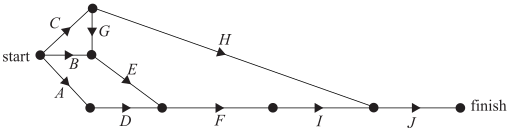
Activity `G` is missing from the network diagram for this project, which is shown below.

 
NETWORKS, FUR2 2013 VCAA 22


  1. Complete the network diagram above by inserting activity `G`.  (1 mark)
  2. Determine the earliest starting time of activity `H`.  (1 mark)

    --- 1 WORK AREA LINES (style=lined) ---

  3. Given that activity `G` is not on the critical path


    1. write down the activities that are on the critical path in the order that they are completed  (1 mark)

      --- 2 WORK AREA LINES (style=lined) ---

    2. find the latest starting time for activity `D`.  (1 mark)

      --- 1 WORK AREA LINES (style=lined) ---

  4. Consider the following statement.


    ‘If the time to complete just one of the activities in this project is reduced by one hour, then the minimum time to complete the entire project will be reduced by one hour.’

    Explain the circumstances under which this statement will be true for this project.  (1 mark)

    --- 2 WORK AREA LINES (style=lined) ---

  5. Assume activity `F` is reduced by two hours.
    What will be the minimum completion time for the project?  (1 mark)

    --- 2 WORK AREA LINES (style=lined) ---

Show Answers Only

a.

networks-fur2-2013-vcaa-2-answer

b.  `7\ text(hours)`

c.i.  `AFIM`

c.ii. `14\ text(hours)`

d.  `text(The statement will only be true if the crashed activity)`
      `text(is on the critical path)\ \ A F I M.`

e.  `text(36 hours)`

Show Worked Solution
a.    networks-fur2-2013-vcaa-2-answer


b.  `text(Scanning forwards and backwards:)`
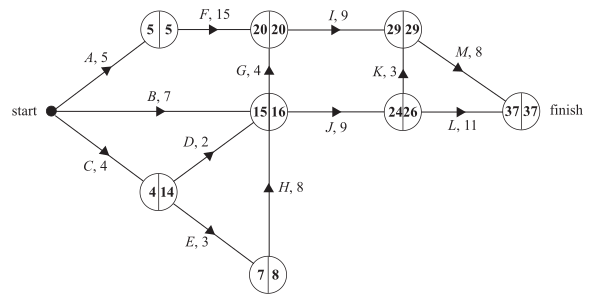
`text(EST for Activity)\ H`

`= 4 + 3`

`= 7\ text(hours)`
 

c.i.   `A F I M`

♦♦ Mean mark of parts (c)-(e) (combined) was 40%.
 

c.ii.  `text(LST of)\ G = 20 – 4 = 16\ text(hours)`

 `text(LST of)\ D = 16 – 2 = 14\ text(hours)`
 

d.   `text(The statement will only be true if the time reduced activity)`

MARKER’S COMMENT: Most students struggled with part (d).

`text(is on the critical path)\ \ A F I M.`
 

e.   `A F I M\ text(is 37 hours.)`

`text(If)\ F\ text(is reduced by 2 hours, the new critical)`

`text(path is)\ \ C E H G I M\ text{(36 hours)}`

`:.\ text(Minimum completion time = 36 hours)`

Filed Under: Critical Paths Tagged With: Band 3, Band 4, Band 5, smc-916-10-Table to Network, smc-916-30-Scanning Both Ways, smc-916-40-Critical Path Adjustments

Networks, STD2 N3 2012 FUR2 2

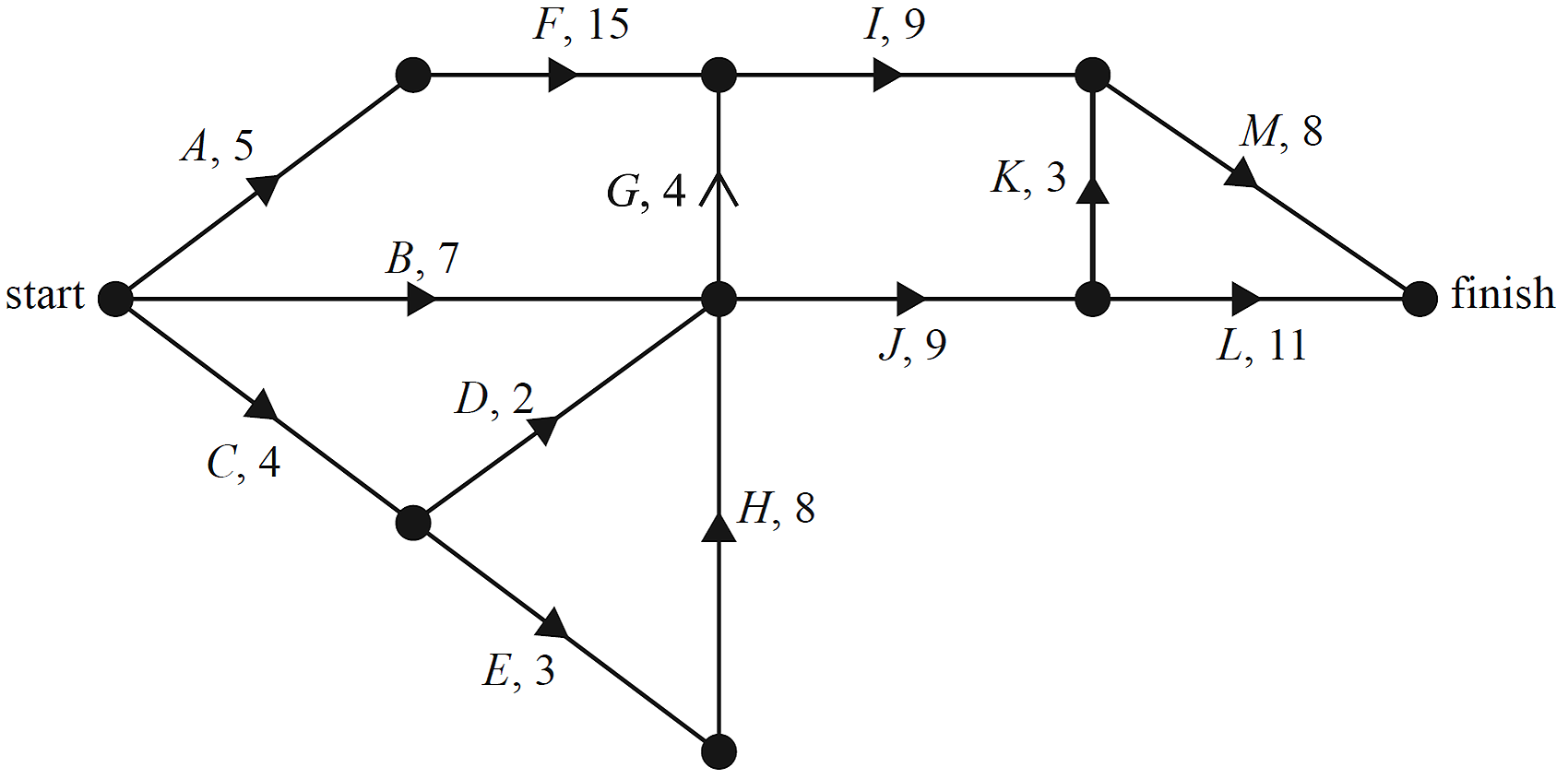
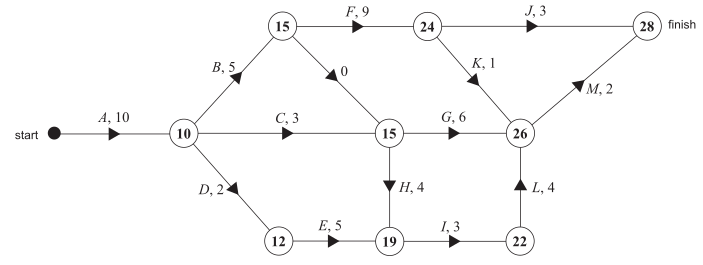
Thirteen activities must be completed before the produce grown on a farm can be harvested. 

The directed network below shows these activities and their completion times in days.
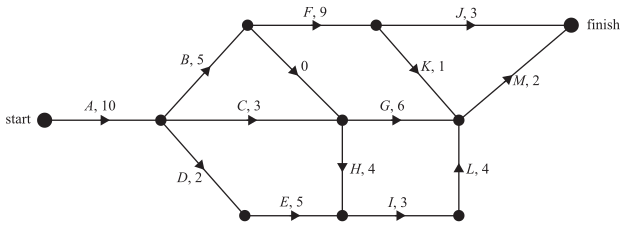


  1. Determine the earliest starting time, in days, for activity `E`.  (1 mark)

    --- 1 WORK AREA LINES (style=lined) ---

  2. An activity with zero duration starts at the end of activity `B`.


    Explain why this activity is used on the network diagram.  (1 mark)

    --- 1 WORK AREA LINES (style=lined) ---

  3. Determine the earliest starting time, in days, for activity `H`.  (1 mark)

    --- 1 WORK AREA LINES (style=lined) ---

  4. In order, list the activities on the critical path.  (1 mark)

    --- 2 WORK AREA LINES (style=lined) ---

  5. Determine the latest starting time, in days, for activity `J`.  (1 mark)

    --- 1 WORK AREA LINES (style=lined) ---

Show Answers Only
  1. `12\ text(days)`
  2. `F\ text(has)\ B\ text(as a predecessor while)\ G\ text(and)\ H`
    `text(have)\ B\ text(and)\ C\ text(as predecessors.)`
    `text(S)text(ince there cannot be 2 activities called)\ B, text(a zero)`
    `text{duration activity is drawn as an extension of}\ B\ text(to)`
    `B\ text(show that it is also a predecessor of)\ G\ text(and)\ H.`
  3. `15\ text(days)`
  4. `ABHILM`
  5. `25\ text(days)`
Show Worked Solution
a.    `text(EST of)\ E` `= 10 + 2`
    `= 12\ text(days)`
♦ Mean mark of all parts (combined) 47%.


b.   `F\ text(has)\ B\ text(as a predecessor while)\ G\ text(and)\ H`

`text(have)\ B\ text(and)\ C\ text(as predecessors.)`

`text(S)text(ince there cannot be 2 activities called)\ B, text(a zero)`

`text{duration activity is drawn as an extension of}\ B\ text(to)`

`text(show that it is also a predecessor of)\ G\ text(and)\ H.`
 

♦♦ “Few students” were able to correctly deal with the zero duration activity in part (c).

c.  `text(Scanning forwards:)`


`text(EST for)\ H = 15\ text(days)`
 

d.   `text(The critical path is)\ \ ABHILM`
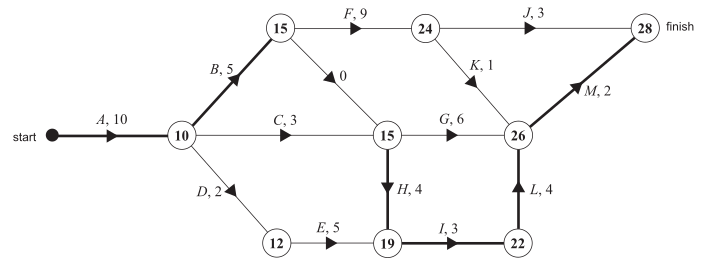


e.   `text(The shortest time to complete all the activities)`

MARKER’S COMMENT: A correct calculation based on an incorrect critical path in part (d) gained a consequential mark here. Show your working!.

`= 10 + 5 + 4 + 3  + 4 + 2`

`= 28\ text(days)`
 

`:.\ text(LST of)\ J` `= 28 − 3`
  `= 25\ text(days)`

Filed Under: Critical Paths Tagged With: Band 3, Band 4, Band 5, smc-916-30-Scanning Both Ways, smc-916-50-Dummy Activity

Networks, STD2 N3 2006 FUR1 5 MC

For a particular project there are ten activities that must be completed.

These activities and their immediate predecessors are given in the following table.
 

networks-fur1-2006-vcaa-5-mc

 
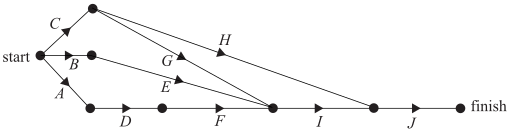
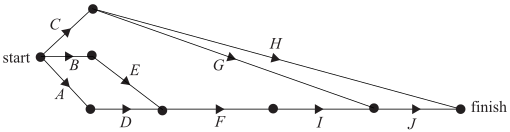
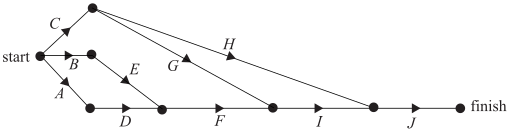
A directed graph that could represent this project is


A.
B.
C.
D.
Show Answers Only

`D`

Show Worked Solution

`text(Consider the information in the table:)`

`text(D and E are prerequisites to F → eliminate B)`

`text(G is a prerequisite to I → eliminate A and C)`

`=>\ text(Option D reflects the information in the table:)`
 

`rArr D`

Filed Under: Critical Paths Tagged With: Band 3

Networks, STD2 N2 EQ-Bank 19

An estate has large open parklands that contain seven large trees.

The trees are denoted as vertices A to G on the network diagram below.

Walking paths link the trees as shown.

The numbers on the edges represent the lengths of the paths in metres.
 

NETWORKS, FUR2 2007 VCAA 2

Jamie is standing at A and Michelle is standing at D.

Write down the shortest route that Jamie can take and the distance travelled to meet Michelle at D.  (2 marks) 

--- 3 WORK AREA LINES (style=lined) ---

Show Answers Only

`text(Shortest path is)\ AFCD`

`text(Shortest distance is 500 metres.)`

Show Worked Solution

`text(One strategy – using Dijkstra’s algorithm:)`
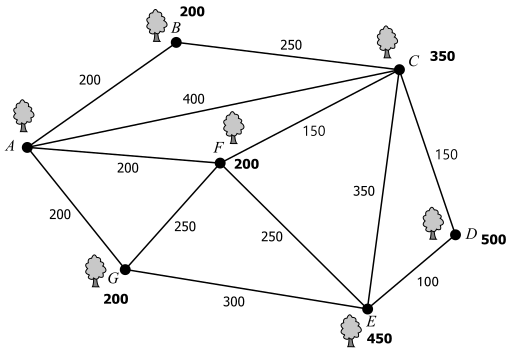


`text(Shortest path is)\ AFCD`

`text(Shortest distance)= 200 + 150 + 150= 500\ text(metres)`

Filed Under: Shortest Path, Shortest Paths, Shortest Paths, Shortest Paths Tagged With: Band 3, smc-1137-10-Network Diagram, smc-6308-10-Network Diagrams, smc-6527-10-Network Diagrams, smc-913-10-Network Diagram

Networks, STD2 N3 2014 FUR1 2 MC

In the directed graph above, the only vertex with a label that can be reached from vertex Y is

A.  vertex A

B.  vertex B

C.  vertex C

D.  vertex D

Show Answers Only

`D`

Show Worked Solution

`=>D`

Filed Under: Flow Networks and Minimum Cuts Tagged With: Band 3, smc-915-40-Other Directed Flows

Networks, STD2 N3 2006 FUR1 2 MC

The following directed graph represents a series of one-way streets with intersections numbered as nodes 1 to 8.
 

networks-fur1-2006-vcaa-2-mc-1

 
All intersections can be reached from

A.   intersection 4

B.   intersection 5

C.   intersection 6

D.   intersection 8 

Show Answers Only

`B`

Show Worked Solution

`text(The two edges connected to vertex 5 both flow away from the)`

`text(vertex. Therefore, vertex 5 cannot be reached in this network)`

`text(starting from any other vertex, eliminating options A, C and D.)` 

`rArr B`

Filed Under: Flow Networks and Minimum Cuts Tagged With: Band 3, smc-915-40-Other Directed Flows

Networks, STD2 N2 EQ-Bank 21

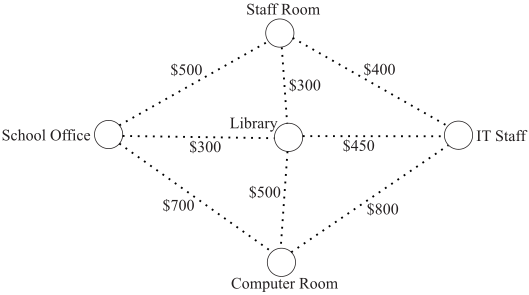
A school is designing a computer network between five key areas within the school.

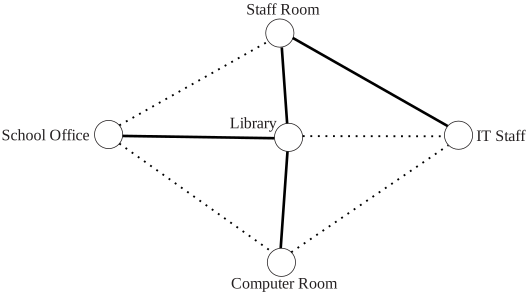
The cost of connecting the rooms is shown in the diagram below.
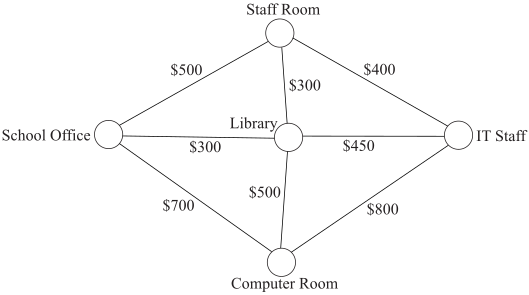


  1. Complete the spanning tree below that creates the school's network at a minimum cost.   (1 mark)

    --- 0 WORK AREA LINES (style=lined) ---


  2. What is the minimum cost of the network?   (1 mark)

    --- 1 WORK AREA LINES (style=lined) ---

Show Answers Only

 a.


b.   `$1500`

Show Worked Solution

a.   `text(One Strategy: Using Prim’s Algorithm)`

`text(Starting vertex – Staff Room)`

`text(1st edge: Staff Room – Library)`

`text(2nd edge: Library – School Office)`

`text(3rd edge: Staff Room – IT Staff)`

`text(4th edge: Library – Computer Room)`
  

b.    `text(Minimum Cost)= 300 + 300 + 400 + 500= $1500`

Filed Under: Minimum Spanning Trees, Minimum Spanning Trees, Spanning Trees, Spanning Trees Tagged With: Band 3, Band 4, smc-1138-30-Cost, smc-1138-40-Draw Tree, smc-6320-30-Cost, smc-6320-40-Draw Tree, smc-6528-30-Cost, smc-6528-40-Draw Tree, smc-914-30-Cost, smc-914-40-Draw Tree

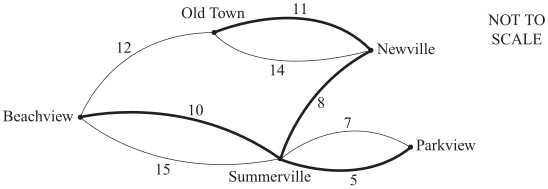
Networks, STD2 N2 EQ-Bank 5 MC

This diagram shows the possible paths (in km) for laying gas pipes between various locations.
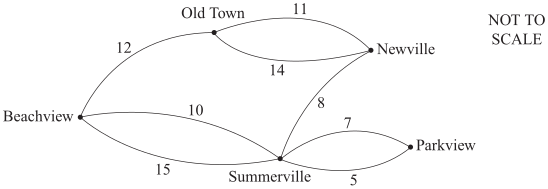


Gas is to be supplied from one location. Any one of the locations can be the source of the supply.

What is the minimum total length of the pipes required to provide gas to all the locations?

  1. 32 km
  2. 34 km
  3. 36 km
  4. 38 km
Show Answers Only

`B`

Show Worked Solution

`text(Using Kruskal’s Algorithm:)`


`text(1st edge: Parkview – Summerville)\ (5)`

`text(2nd edge: Summerville – Newville)\ (8)`

`text(3rd edge: Beachview – Summerville)\ (10)`

`text(4th edge: Old Town – Newville)\ (11)`

 
`:.\ text(Minimum length of pipes.)`

`= 5 + 8 + 10 + 11= 34`
 

`=> B`

Filed Under: Minimum Spanning Trees, Minimum Spanning Trees, Spanning Trees, Spanning Trees Tagged With: Band 3, smc-1138-20-Distance, smc-6320-20-Distance, smc-6528-20-Distance, smc-914-20-Distance

Networks, STD2 N2 EQ-Bank 22

Water will be pumped from a dam to eight locations on a farm.

The pump and the eight locations (including the house) are shown as vertices in the network diagram below.

The numbers on the edges joining the vertices give the shortest distances, in metres, between locations.
 

NETWORKS, FUR2 2012 VCAA 1


  1. How many vertices on the network diagram have an odd degree?   (1 mark)

    --- 1 WORK AREA LINES (style=lined) ---


    The total length of all edges in the network is 1180 metres.


    The total length of pipe that supplies water from the pump to the eight locations on the farm is a minimum.


    This minimum length of pipe is laid along some of the edges in the network.

  2. On the diagram below, draw the minimum length of pipe that is needed to supply water to all locations on the farm.   (2 marks)
     
     
    NETWORKS, FUR2 2012 VCAA 1

  3. What is the mathematical term that is used to describe this minimum length of pipe?   (1 mark)

    --- 1 WORK AREA LINES (style=lined) ---

Show Answers Only
  1. `2`
  2.  
    NETWORKS, FUR2 2012 VCAA 1 Answer

  3. `text(Minimum spanning tree)`
Show Worked Solution

a.   `2\ text{(the house and the top right vertex)}`

MARKER’S COMMENT: Many students, surprisingly, had problems with part (i).
 

b.   `text(One Strategy – Using Prim’s algorithm:)`

`text(Starting at the house)`

`text(1st edge: 50)`

`text{2nd edge: 40 (either)}`

`text(3rd edge: 40)`

`text(4th edge: 60  etc…)`
 

NETWORKS, FUR2 2012 VCAA 1 Answer


c.
    `text(Minimum spanning tree)`

Filed Under: Minimum Spanning Trees, Minimum Spanning Trees, Spanning Trees, Spanning Trees Tagged With: Band 3, Band 4, smc-1138-20-Distance, smc-1138-40-Draw Tree, smc-6320-20-Distance, smc-6320-40-Draw Tree, smc-6528-20-Distance, smc-6528-40-Draw Tree, smc-914-20-Distance, smc-914-40-Draw Tree

Networks, FUR2 2015 VCE 2

The factory supplies groceries to stores in five towns, `Q`, `R`, `S`, `T` and `U`, represented by vertices on the graph below.


Networks, FUR2 2015 VCAA 2

The edges of the graph represent roads that connect the towns and the factory.

The numbers on the edges indicate the distance, in kilometres, along the roads.

Vehicles may only travel along the road between towns `S` and `Q` in the direction of the arrow due to temporary roadworks.

Each day, a van must deliver groceries from the factory to the five towns.

The first delivery must be to town `T`, after which the van will continue on to the other four towns before returning to the factory.

Describe the order in which these deliveries would follow to achieve the shortest possible circuit and the length, in kilometres, of the circuit.  (2 marks)

Show Answers Only

`text(Route: factory)\ −T − S −Q − R − S −U − text(factory)`

`text(Shortest circuit)\ = 162\ text(km)`

Show Worked Solution

`text(Route: factory)\ −T − S −Q − R − S −U − text(factory)`

`text(Distance)`

`= 44 + 38 + 12 + 8 + 38 + 22`

`= 162\ text(km)`

Filed Under: Uncategorized Tagged With: Band 3

Networks, STD2 N2 2011 FUR2 1

Aden, Bredon, Carrie, Dunlop, Enwin and Farnham are six towns.

The network shows the road connections and distances between these towns in kilometres.
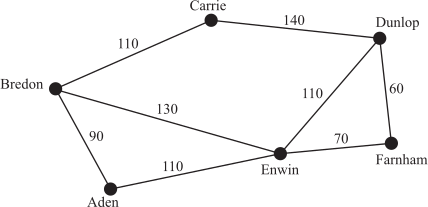
 

  1. In kilometres, what is the shortest distance between Farnham and Carrie?   (1 mark)

    --- 1 WORK AREA LINES (style=lined) ---

  2. How many different ways are there to travel from Farnham to Carrie without passing through any town more than once?   (1 mark)

    --- 1 WORK AREA LINES (style=lined) ---

An engineer plans to inspect all of the roads in this network.

He will start at Dunlop and inspect each road only once.

  1. At which town will the inspection finish?   (1 mark)

    --- 2 WORK AREA LINES (style=lined) ---

Show Answers Only

a.    `200\ text(km)`

b.    `6`

c.    `text(Bredon)`

Show Worked Solution

a.   `text{Farnham to Carrie (shortest)}= 60 + 140= 200\ text(km)`
  

b.   `text(Different paths are:)`

`FDC, FEDC, FEBC, FEABC, FDEBC, FDEABC`

`:. 6\ text(different ways)`
  

c.   `text(A possible path is)\ DFEABCDEB\ text(and will finish)`

`text{at Bredon – the only other odd-degree vertex.}`

`text{(Note that solving this can be done quickly by applying the}`

`text{concept underlying the Konigsberg Bridge problem.)}`

Filed Under: Shortest Path, Shortest Paths, Shortest Paths, Shortest Paths Tagged With: Band 2, Band 3, smc-1137-10-Network Diagram, smc-913-10-Network Diagram

Networks, STD2 N2 2010 FUR2 2

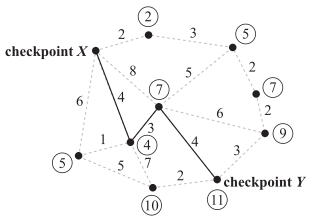
The diagram below shows a network of tracks (represented by edges) between checkpoints (represented by vertices) in a short-distance running course. The numbers on the edges indicate the time, in minutes, a team would take to run along each track.


Network, FUR2 2011 VCAA 2_1
 

A challenge requires teams to run from checkpoint `X` to checkpoint `Y` using these tracks.

What would be the shortest possible time for a team to run from checkpoint `X` to checkpoint `Y`? Mark the shortest route on the diagram below.   (2 marks)

 
  Network, FUR2 2011 VCAA 2_2

--- 4 WORK AREA LINES (style=lined) ---

 
Show Answers Only

`11\ text(minutes)`

Show Worked Solution

`text(Using Djikstra’s Algorithm:)`


`text(Shortest distance)\ \ X\ \ text(to)\ \ Y`

`=4 + 3 + 4= 11\ text(minutes)`

Filed Under: Shortest Path, Shortest Paths, Shortest Paths, Shortest Paths Tagged With: Band 3, smc-1137-10-Network Diagram, smc-6308-10-Network Diagrams, smc-6527-10-Network Diagrams, smc-913-10-Network Diagram

Networks, STD2 N3 2009 FUR2 2

One of the landmarks in a city is a hedge maze. The maze contains eight statues. The statues are labelled `F` to `M` on the following directed graph. Walkers within the maze are only allowed to move in the directions of the arrows.
 

NETWORKS, FUR2 2009 VCAA 2
 

  1. Write down the two statues that a walker could not reach from statue `M`.  (1 mark)

    --- 1 WORK AREA LINES (style=lined) ---

  2. One way that statue `H` can be reached from statue `K` is along path `KFH`.


    List the three other ways that statue `H` can be reached from statue `K`.  (1 mark)

    --- 1 WORK AREA LINES (style=lined) ---

Show Answers Only
  1. `F and K`
  2. `KJH, KMJH, KFJH`
Show Worked Solution

a.   `F and K`

b.   `KJH, KMJH, KFJH`

Filed Under: Flow Networks and Minimum Cuts Tagged With: Band 3, smc-915-40-Other Directed Flows

Networks, STD2 N2 2017 FUR2 1

Bus routes connect six towns.

The towns are Northend (`N`), Opera (`O`), Palmer (`P`), Quigley (`Q`), Rosebush (`R`) and Seatown (`S`).

The graph below gives the cost, in dollars, of bus travel along these routes.

Bai lives in Northend (`N`) and he will travel by bus to take a holiday in Seatown (`S`).
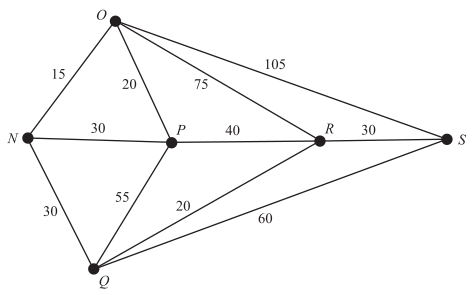


  1. Bai considers travelling by bus along the route Northend (`N`) – Opera (`O`) – Seatown (`S`).
    How much would Bai have to pay?   (1 mark)

    --- 1 WORK AREA LINES (style=lined) ---

  2. If Bai takes the cheapest route from Northend (`N`) to Seatown (`S`), which other town(s) will he pass through?   (1 mark)

    --- 1 WORK AREA LINES (style=lined) ---

Show Answers Only

a.    `$120`

b.    `text(Quigley and Rosebush.)`

Show Worked Solution

a.    `text(C)text(ost)= 15 + 105= $120`
  

b.   `text(Using Djikstra’s algorithm:)`
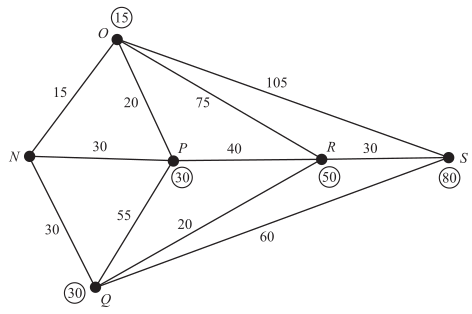
`text(Fastest route is:)\ \ NQRS.` 

`:.\ text(Other towns are Quigley and Rosebush.)`

Filed Under: Shortest Path, Shortest Paths, Shortest Paths, Shortest Paths Tagged With: Band 2, Band 3, smc-1137-10-Network Diagram, smc-6308-10-Network Diagrams, smc-6527-10-Network Diagrams, smc-913-10-Network Diagram

Networks, STD2 N2 2013 FUR2 1

The vertices in the network diagram below show the entrance to a wildlife park and six picnic areas in the park: `P1`, `P2`, `P3`, `P4`, `P5` and `P6`.

The numbers on the edges represent the lengths, in metres, of the roads joining these locations.
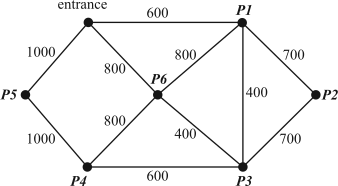


  1. In this graph, what is the degree of the vertex at the entrance to the wildlife park?   (1 mark)

    --- 1 WORK AREA LINES (style=lined) ---

  2. What is the shortest distance, in metres, from the entrance to picnic area `P3`?   (1 mark)

    --- 1 WORK AREA LINES (style=lined) ---

Show Answers Only

a.    `3`

b.    `1000\ text(m)`

Show Worked Solution

a.   `3`

b.  `text(Using Djikstra’s algorithm:)`
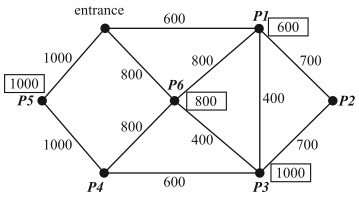


`text( Shortest distance)`

`= E-P1-P3= 600 + 400= 1000\ text(m)`

Filed Under: Shortest Path, Shortest Paths, Shortest Paths, Shortest Paths Tagged With: Band 2, Band 3, smc-1137-10-Network Diagram, smc-6308-10-Network Diagrams, smc-6527-10-Network Diagrams, smc-913-10-Network Diagram

Networks, FUR2 2012 VCE 1

Water will be pumped from a dam to eight locations on a farm.

The pump and the eight locations (including the house) are shown as vertices in the network diagram below.

The numbers on the edges joining the vertices give the shortest distances, in metres, between locations.
 

NETWORKS, FUR2 2012 VCAA 1
 

a.i.  Determine the shortest distance between the house and the pump.  (1 mark)

a.ii. How many vertices on the network diagram have an odd degree?  (1 mark)

The total length of pipe that supplies water from the pump to the eight locations on the farm is a minimum.

This minimum length of pipe is laid along some of the edges in the network.

b.i.  On the diagram below, draw the minimum length of pipe that is needed to supply water to all locations on the farm.  (1 mark)


  NETWORKS, FUR2 2012 VCAA 1
 

b.ii. What is the mathematical term that is used to describe this minimum length of pipe in part b.i.?  (1 mark)

Show Answers Only

a.i.  `160\ text(m)`

a.ii. `2`

b.i.  `1250\ text(m)`

NETWORKS, FUR2 2012 VCAA 1 Answer

b.ii. `text(Minimal spanning tree)`

Show Worked Solution

a.i.   `text(Shortest distance)`

`=70 + 90`

`= 160\ text(m)`

MARKER’S COMMENT: Many students, surprisingly, had problems with part (a)(ii).


a.ii.   `2\ text{(the house and the top right vertex)}`


b.i.    NETWORKS, FUR2 2012 VCAA 1 Answer


b.ii.   `text(Minimal spanning tree)`

Filed Under: Uncategorized Tagged With: Band 3, Band 4

Networks, STD2 N2 2015 FUR2 1

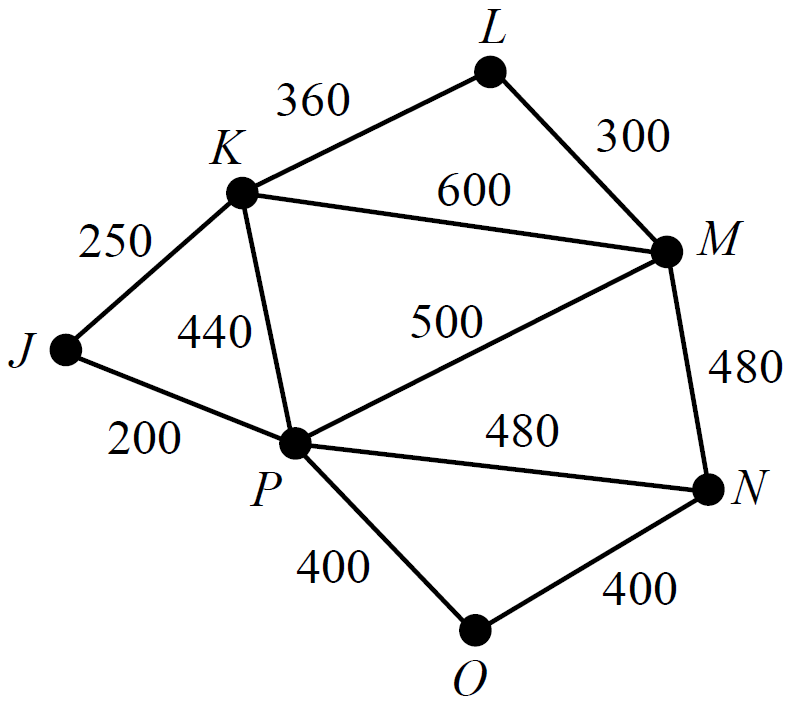
A factory requires seven computer servers to communicate with each other through a connected network of cables.

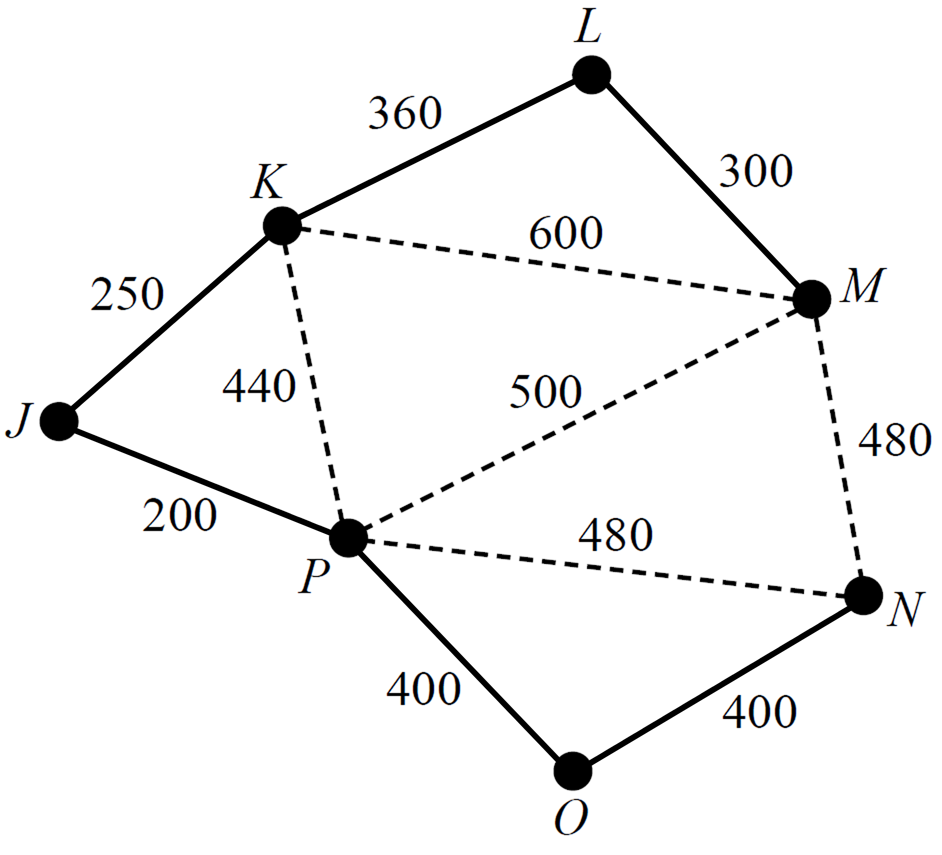
The servers, `J`, `K`, `L`, `M`, `N`, `O` and `P`, are shown as vertices on the graph below.
 

Networks, FUR2 2015 VCAA 11

 
The edges on the graph represent the cables that could connect adjacent computer servers.

The numbers on the edges show the cost, in dollars, of installing each cable.

  1. What is the cost, in dollars, of installing the cable between server `L` and server `M`?   (1 mark)

    --- 1 WORK AREA LINES (style=lined) ---

  2. What is the cheapest cost, in dollars, of installing cables between server `K` and server `N`?   (1 mark)

    --- 1 WORK AREA LINES (style=lined) ---

  3. The computer servers will be able to communicate with all the other servers as long as each server is connected by cable to at least one other server.

    1. The cheapest installation that will join the seven computer servers by cable in a connected network follows a minimum spanning tree.


      Draw the minimum spanning tree on the plan below.   (1 mark) 
       

      Networks, FUR2 2015 VCAA 12


    2. The factory’s manager has decided that only six connected computer servers will be needed, rather than seven.


      How much would be saved in installation costs if the factory removed computer server `P` from its minimum spanning tree network?


      A copy of the graph above is provided below to assist with your working.   (1 mark)

      Networks, FUR2 2015 VCAA 12

      --- 0 WORK AREA LINES (style=lined) ---

Show Answers Only

a.   `$300`

b.   `$920`

c.   `N\ text(and)\ P\ text{(or}\ P\ text(and)\ N)`

i.
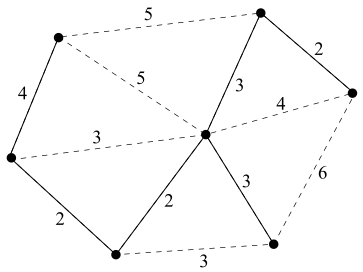
Networks, FUR2 2015 VCAA 12 Answer

ii.   `$120`

Show Worked Solution

a.   `$300`

b.   `text(Minimum cost of)\ K\ text(to)\ N`

`= 440 + 480= $920` 

MARKER’S COMMENT: Many students had difficulty finding the minimum spanning tree, often incorrectly excluding `PO` or `KL`.

c.i.  `text(Using Prim’s Algorithm:)`

`text(Starting at Vertex)\ L`

`text{1st Edge: L → M (300)}`

`text{2nd Edge: L → K (360)}`

`text{3rd Edge: K → J (250)}`

`text{4th Edge: J → P (200)  etc…}`
 

Networks, FUR2 2015 VCAA 12 Answer


c.ii.
`text(Disconnect)\ J – P\ text(and)\ O – P`

 `text(Savings) = 200 + 400 = $600`

 `text(Add in)\ M – N`

 `text(C)text(ost) = $480`

 `:.\ text(Net savings)= 600-480= $120`

Filed Under: Minimum Spanning Trees, Minimum Spanning Trees, Spanning Trees, Spanning Trees Tagged With: Band 2, Band 3, Band 4, smc-1138-30-Cost, smc-1138-40-Draw Tree, smc-6320-30-Cost, smc-6320-40-Draw Tree, smc-6528-30-Cost, smc-6528-40-Draw Tree, smc-914-30-Cost, smc-914-40-Draw Tree

Networks, STD2 N2 2011 FUR2 2

At the Farnham showgrounds, eleven locations require access to water. These locations are represented by vertices on the network diagram shown below. The dashed lines on the network diagram represent possible water pipe connections between adjacent locations. The numbers on the dashed lines show the minimum length of pipe required to connect these locations in metres.
 

NETWORKS, FUR2 2011 VCAA 2 

 
All locations are to be connected using the smallest total length of water pipe possible.

  1. On the diagram, show where these water pipes will be placed.   (1 mark)
  2. Calculate the total length, in metres, of water pipe that is required.   ( 1 mark) 

    --- 1 WORK AREA LINES (style=lined) ---

Show Answers Only

a.

NETWORKS, FUR2 2011 VCAA 2 Answer

b.   `510\ text(metres)`

Show Worked Solution

a.   `text(Using Prim’s Algorithm)`

`text(Starting at bottom right vertex)`

`text{1st Edge: 50}`

`text{2nd Edge: 40`

`text(3rd Edge: 50)`

`text(4th Edge: 40   etc…)`
 

NETWORKS, FUR2 2011 VCAA 2 Answer


b.
  `text(Total length of water pipe)`

`= 50+40+50+40+50+60+40+60+60+60`

`= 510\ text(metres)`

Filed Under: Minimum Spanning Trees, Minimum Spanning Trees, Spanning Trees, Spanning Trees Tagged With: Band 3, Band 4, smc-1138-20-Distance, smc-1138-40-Draw Tree, smc-6320-20-Distance, smc-6320-40-Draw Tree, smc-6528-20-Distance, smc-6528-40-Draw Tree, smc-914-20-Distance, smc-914-40-Draw Tree

Networks, STD2 N2 2008 FUR2 1

James, Dante, Tahlia and Chanel are four children playing a game.

In this children’s game, seven posts are placed in the ground.

The network below shows distances, in metres, between the seven posts.

The aim of the game is to connect the posts with ribbon using the shortest length of ribbon.

This will be a minimal spanning tree.


NETWORKS, FUR2 2008 VCAA 11

  1. Draw in a minimal spanning tree for this network on the diagram below.   (1 mark)


NETWORKS, FUR2 2008 VCAA 12

  1. Determine the length, in metres, of this minimal spanning tree.   (1 mark)

    --- 1 WORK AREA LINES (style=lined) ---

  2. How many different minimal spanning trees can be drawn for this network?   (1 mark)

    --- 1 WORK AREA LINES (style=lined) ---

Show Answers Only

 a.


`text(or)`

b.   `16\ text(metres)`

c.   `2`

Show Worked Solution

a.  `text(Using Kruskal’s Algorithm)`

`text{Edges 1-3: 2}`

`text{Edges 4-5: 3  (2 edges with weight 3 create a circuit and are ignored)`

`text(Edge 6: 4)` 
 

`text(or)`
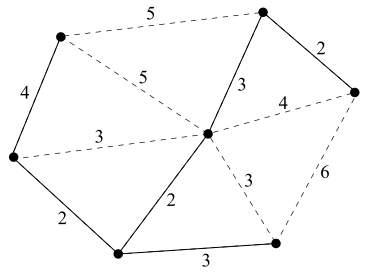
b.   `text(Length of minimal spanning tree)`

`= 2+2+2+3+3+4= 16\ text(metres)` 

c.   `2`

Filed Under: Minimum Spanning Trees, Minimum Spanning Trees, Spanning Trees, Spanning Trees Tagged With: Band 3, Band 4, smc-1138-20-Distance, smc-1138-40-Draw Tree, smc-6320-20-Distance, smc-6320-40-Draw Tree, smc-6528-20-Distance, smc-6528-40-Draw Tree, smc-914-20-Distance, smc-914-40-Draw Tree

Networks, STD2 N2 2014 FUR1 5 MC

 
Which one of the following is the minimal spanning tree for the weighted graph shown above?

vcaa-networks-fur1-2014-5ii

Show Answers Only

`A`

Show Worked Solution

`text(Using Prim’s algorithm:)`

`text(Starting at vertex)\ A,`

`text(1st edge:)\ A → J\ (6)`

`text(2nd edge:)\ A → B\ (8)`

`text(3rd edge:)\ B → C\ (9)`

`text(4th edge:)\ J → I\ (10)`

`text(3rd edge:)\ B → D\ (10)\ \ text(etc…)`

 
`=>  A`

Filed Under: Minimum Spanning Trees, Minimum Spanning Trees, Spanning Trees, Spanning Trees Tagged With: Band 3, smc-1138-10-General, smc-6320-10-General, smc-6528-10-General, smc-914-10-General

Networks, STD2 N2 2013 FUR1 3 MC

 
The vertices of the graph above represent nine computers in a building. The computers are to be connected with optical fibre cables, which are represented by edges. The numbers on the edges show the costs, in hundreds of dollars, of linking these computers with optical fibre cables.

Based on the same set of vertices and edges, which one of the following graphs shows the cable layout (in bold) that would link all the computers with optical fibre cables for the minimum cost?


vcaa-networks-fur1-2013-3ii

Show Answers Only

`A`

Show Worked Solution

`text(Using Prim’s algorithm)`

`text(Starting at far left vertex,)`

`text{1st edge: 2}`

`text(2nd edge: 3)`

`text{3rd edge: 4}`

`text(4th edge: 3   etc…)`

`=>  A`

Filed Under: Minimum Spanning Trees, Minimum Spanning Trees, Spanning Trees, Spanning Trees Tagged With: Band 3, smc-1138-20-Distance, smc-6320-20-Distance, smc-6528-20-Distance, smc-914-20-Distance

Networks, STD2 N2 2010 FUR1 5 MC

vcaa-networks-fur1-2010-5
 

For the network above, the length of the minimal spanning tree is

  1. 30
  2. 31
  3. 35
  4. 39
Show Answers Only

`C`

Show Worked Solution

`text(Using Kruskal’s algorithm:)`

`text{Edge 1: 2 (least weight)}`

`text(Edge 2: 3)`

`text(Edge 3: 4)`

`text(Edges 4-5: 5)`

`text{Edges 6-7: 8 (unused edges with weights <8 create circuits and are ignored)}`
 

vcaa-networks-fur1-2010-5i

 
`:.\ text(Minimal spanning tree)= 2+3+4+5+5+8+8= 35`

`=>  C`

Filed Under: Minimum Spanning Trees, Minimum Spanning Trees, Spanning Trees, Spanning Trees Tagged With: Band 3, smc-1138-10-General, smc-6320-10-General, smc-6528-10-General, smc-914-10-General

Networks, STD2 N2 2017 FUR1 2 MC

Two graphs, labelled Graph 1 and Graph 2, are shown below.
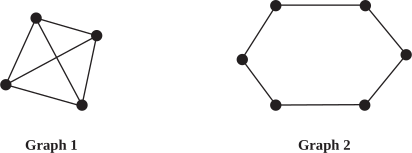


The sum of the degrees of the vertices of Graph 1 is

  1. two less than the sum of the degrees of the vertices of Graph 2.
  2. one less than the sum of the degrees of the vertices of Graph 2.
  3. equal to the sum of the degrees of the vertices of Graph 2.
  4. two more than the sum of the degrees of the vertices of Graph 2.
Show Answers Only

`C`

Show Worked Solution

`text(Graph 1)`

`∑\ text(degrees)\ = 3 + 3 + 3 + 3 = 12`

`text(Graph 2)`

`∑\ text(degrees)\ = 2 + 2 + 2 + 2 + 2 + 2 = 12`

`=> C`

Filed Under: Basic Concepts, Basic Concepts, Basic Concepts, Network Concepts, Network Concepts Tagged With: Band 3, num-title-ct-path, smc-1136-40-Degrees of Vertices, smc-4788-20-Degrees of vertices, smc-6307-50-Degree of Vertices, smc-6526-50-Degree of Vertices, smc-912-40-Degrees of Vertices

Networks, FUR1 2017 VCE 1 MC

Which one of the following graphs contains a loop?

A. B.
C. D.
Show Answers Only

`B`

Show Worked Solution

`text(A loop occurs when an edge connects a vertex to)`

`text{itself (without going through an other node).}`

`=> B`

Filed Under: Uncategorized Tagged With: Band 3

Networks, STD2 N2 EQ-Bank 5 MC

A store manager is directly in charge of five department managers.

Each department manager is directly in charge of six sales people in their department.

This staffing structure could be represented graphically by
  1. a tree.
  2. a path.
  3. a cycle.
  4. a weighted graph.
Show Answers Only

`A`

Show Worked Solution

`=>  A`

Filed Under: Basic Concepts, Basic Concepts, Network Concepts, Network Concepts Tagged With: Band 3, smc-1136-30-Definitions, smc-6307-40-Definitions, smc-6526-40-Definitions, smc-912-30-Definitions

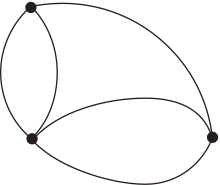
Networks, STD2 N2 EQ-Bank 4 MC

The number of vertices with an odd degree in the network above is

  1. `2`
  2. `3`
  3. `4`
  4. `5`
Show Answers Only

`A`

Show Worked Solution

`=> A`

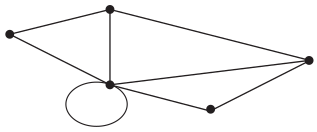
`text{(Note a loop creates 2 extra degrees to a vertex.)}`

Filed Under: Basic Concepts, Basic Concepts, Network Concepts, Network Concepts Tagged With: Band 3, smc-1136-40-Degrees of Vertices, smc-6307-50-Degree of Vertices, smc-6526-50-Degree of Vertices, smc-912-40-Degrees of Vertices

Calculus, MET1 SM-Bank 3

Find a primitive of  `4 + sec^2\ x`.   (2 marks)

--- 2 WORK AREA LINES (style=lined) ---

Show Answers Only

`4x + tan\ x + c`

Show Worked Solution

`int 4 + sec^2\ x\ dx`

`= 4x + tan\ x + c`

Filed Under: Integration (Trig), Trig Integration Tagged With: Band 3, smc-737-30-sec^2, smc-747-30-sec^2

Calculus, MET1 2010 ADV 2di

Find  `int sqrt(5x +1) \ dx .`   (2 marks)

Show Answers Only

`2/15(5x  + 1)^(3/2) + c`


Show Worked Solution
` int sqrt( 5x + 1 ) \ dx` `= 1/(3/2) xx 1/5 xx (5x+1)^(3/2) + c`
  `=  2/15(5x  + 1)^(3/2) + c`

Filed Under: Standard Integration Tagged With: Band 3, smc-749-10-Indefinite Integrals

Calculus, MET1 2017 ADV 11b

Find  `int (2x + 1)^4\ dx`.  (1 mark)

Show Answers Only

`(2x + 1)^5/10 + c`

Show Worked Solution
`int (2x + 1)^4\ dx` `= 1/5 xx 1/2 xx (2x + 1)^5 + c`
  `= (2x + 1)^5/10 + c`

Filed Under: Standard Integration Tagged With: Band 3, smc-749-10-Indefinite Integrals

Calculus, MET1 2011 ADV 4d

  1. Differentiate  `y=sqrt(9-x^2)`  with respect to  `x`.   (2 marks)

    --- 4 WORK AREA LINES (style=lined) ---

Show Answers Only
  1. `- x/sqrt(9-x^2)`
  2. `-6 sqrt(9-x^2) + c`
Show Worked Solution
IMPORTANT: Some students might find calculations easier by rewriting the equation as `y=(9-x^2)^(1/2)`.
a.    `y` `= sqrt(9-x^2)`
    `= (9-x^2)^(1/2)`

 
`text{Using the function of a function rule (or “chain” rule)}`

`dy/dx` `=1/2 xx (9-x^2)^(-1/2) xx d/dx (9-x^2)`
  `= 1/2 xx (9-x^2)^(-1/2) xx -2x`
  `=-x/sqrt(9-x^2)`


b.    `int (6x)/sqrt(9-x^2)\ dx` `= -6 int (-x)/sqrt(9-x^2)\ dx`
    `= -6 sqrt(9-x^2) + c`

Filed Under: Standard Integration Tagged With: Band 3, Band 4, smc-749-40-Diff then Integrate

Calculus, MET1 2015 ADV 12c

Find  `f^{′}(x)`, where  `f(x) = (x^2 + 3)/(x-1).`   (2 marks)

--- 5 WORK AREA LINES (style=lined) ---

Show Answers Only

`((x-3) (x + 1))/(x-1)^2`

Show Worked Solution

`f(x) = (x^2 + 3)/(x-1)`

`text(Using the quotient rule)`

`u` `= x^2 + 3` `\ \ \ \ \ \ v` `= x-1`
`u^{′}` `= 2x` `\ \ \ \ \ \ v^{′}` `= 1`
`f′(x)` `= (u^{′} v-uv^{′})/v^2`
  `= (2x (x-1)-(x^2 + 3) xx 1)/(x-1)^2`
  `= (2x^2-2x-x^2-3)/(x-1)^2`
  `= (x^2-2x-3)/(x-1)^2`
  `= ((x-3) (x + 1))/(x-1)^2`

Filed Under: Standard Differentiation Tagged With: Band 3, smc-746-10-Quotient Rule

Calculus, MET1 ADV 2004 1b

Differentiate  `x^4 + 5x^(−1)`  with respect to  `x`.   (2 marks)

Show Answers Only

`4x^3 – 5x^(-2)`

Show Worked Solution
`y` `= x^4 + 5x^(-1)`
`dy/dx`  `= 4x^3 – 5x^(-2)`

Filed Under: Standard Differentiation Tagged With: Band 3, smc-746-35-Standard

Calculus, MET1 2016 ADV 11b

Differentiate  `(x + 2)/(3x-4).`  (2 marks)

Show Answers Only

`(-10)/(3x-4)^2`

Show Worked Solution

`y = (x + 2)/(3x-4)`

`text(Using the quotient rule:)`

`(g/h)^{′}` `= (g^{′} h-gh^{′})/h^2`
`y^{′}` `= (1 (3x-4)-(x + 2) · 3)/(3x-4)^2`
  `= (-10)/(3x-4)^2`

Filed Under: Standard Differentiation Tagged With: Band 3, smc-746-10-Quotient Rule

Calculus, MET1 2015 VCAA 1b

Let  `f(x) = (log_e(x))/(x^2)`.

  1. Find  `f^{prime}(x)`.   (2 marks)

    --- 3 WORK AREA LINES (style=lined) ---

  2. Evaluate  `f^{prime}(1)`.   (1 mark)

    --- 2 WORK AREA LINES (style=lined) ---

Show Answers Only
  1. `(1 – 2log_e(x))/(x^3)`
  2. `1`
Show Worked Solution

i.   `text(Using Quotient Rule:)`

`(h/g)^{prime}` `= (h^{prime}g-hg^{prime})/(g^2)`
`f^{prime}(x)` `= ((1/x)x^2-log_e(x)*2x)/(x^4)`
  `= (1-2log_e(x))/(x^3)`


ii.    `f^{prime}(1)` `= (1-2log_e(1))/(1^3)`
    `= 1`

Filed Under: Differentiation (L&E), L&E Differentiation Tagged With: Band 3, Band 4, smc-739-30-Logs, smc-739-50-Quotient Rule, smc-745-20-Logs, smc-745-40-Quotient Rule

GRAPHS, FUR2 2017 VCAA 3

Lifeguards are required to ensure the safety of swimmers at the beach.

Let `x` be the number of junior lifeguards required.

Let `y` be the number of senior lifeguards required.

The inequality below represents the constraint on the relationship between the number of senior lifeguards required and the number of junior lifeguards required.

 Constraint 1  `y >= x/4`
 

  1. If eight junior lifeguards are required, what is the minimum number of senior lifeguards required?  (1 mark)

 
There are three other constraints.

 Constraint 2  `x ≥ 6`

 Constraint 3  `y ≥ 4`

 Constraint 4  `x + y ≥ 12`

  1. Interpret Constraint 4 in terms of the number of junior lifeguards and senior lifeguards required.  (1 mark)

 
The shaded region of the graph below contains the points that satisfy Constraints 1 to 4.
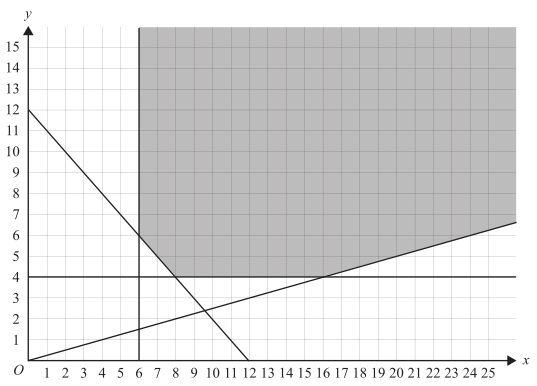
All lifeguards receive a meal allowance per day.

Junior lifeguards receive $15 per day and senior lifeguards receive $25 per day.

The total meal allowance cost per day, `$C`, for the lifeguards is given by

`C = 15x + 25y`

  1. Determine the minimum total meal allowance cost per day for the lifeguards.  (2 marks)
  2. On rainy days there will be no set minimum number of junior lifeguards or senior lifeguards required, therefore:


    • Constraint 2  `(x ≥ 6)`  and Constraint 3  `(y ≥ 4)`  are removed


    • Constraint 1 and Constraint 4 are to remain.


              Constraint 1  `y >= x/4`


              Constraint 4  `x + y >= 12`


    The total meal allowance cost per day,
    `$C`, for the lifeguards remains as


    `C = 15x + 25y`


    How many junior lifeguards and senior lifeguards work on a rainy day if the total meal allowance cost 
    is to be a minimum?


    Write your answers in the boxes provided below.  (1 mark)


Show Answers Only

a.   `2`

b.   `text(The total combined number of junior and)`

`text(senior lifeguards must be at least 12.)`

c.   `$220`

d.   
Show Worked Solution

a.   `text(Minimum senior lifeguards) = 8/4 = 2`


b.   `text(The total combined number of junior and)`

`text(senior lifeguards must be at least 12.)`


c.   `text(Minimum cost occurs at (8, 4))`

`:. C_text(min)` `= 15 xx 8 + 25 xx 4`
  `= $220`


d.   `text(Consider the graph without the restrictions)`

♦♦ Mean mark 24%.
MARKER’S COMMENT: A common incorrect answer was 10 and 3.

`x >= 6quadtext(and)quady >= 4:`

`text(By inspection, intersection around (9.5, 2.4))`

`text(⇒ Minimum allowance when)`

Filed Under: Linear Programming Tagged With: Band 3, Band 4, Band 5

GRAPHS, FUR2 2017 VCAA 1

The graph below shows the depth of water in a sea bath from 6.00 am to 8.00 pm.
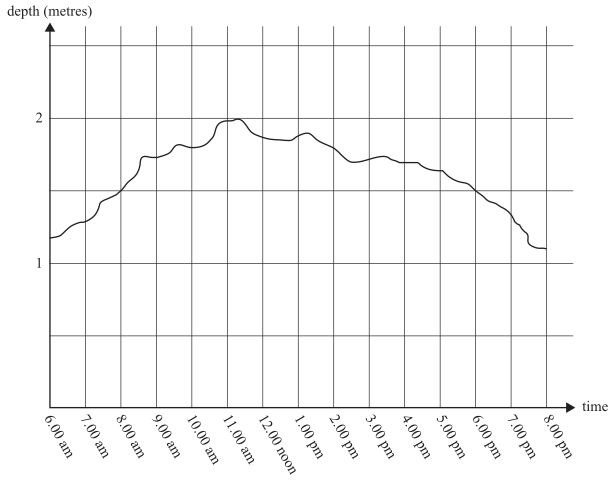


  1. What was the maximum depth, in metres, of water in the sea bath?   (1 mark)

    --- 1 WORK AREA LINES (style=lined) ---

  2. The sea bath was open to the public when the depth of water was above 1.5 m.
  3. Between which times was the sea bath open?   (1 mark)

    --- 1 WORK AREA LINES (style=lined) ---

Show Answers Only

a.   `text(2 metres)`

b.   `text(8 am – 6 pm)`

Show Worked Solution

a.   `text(2 metres)`

b.   `text(8 am – 6 pm)`

Filed Under: Graphs - Histograms and Other Tagged With: Band 2, Band 3, smc-644-45-Other Graphs

GEOMETRY, FUR2 2017 VCAA 1

Miki is planning a gap year in Japan.

She will store some of her belongings in a small storage box while she is away.

This small storage box is in the shape of a rectangular prism.

The diagram below shows that the dimensions of the small storage box are 40 cm × 19 cm × 32 cm.
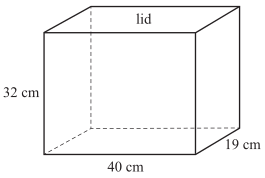
 

The lid of the small storage box is labelled on the diagram above.

    1. What is the surface area of the lid, in square centimetres?  (1 mark)
    2. What is the total outside surface area of this storage box, including the lid and base, in square centimetres?  (1 mark)
  1. Miki has a large storage box that is also a rectangular prism.


    The large storage box and the small storage box are similar in shape.


    The volume of the large storage box is eight times the volume of the small storage box.


    The length of the small storage box is 40 cm.

    What is the length of the large storage box, in centimetres?  (1 mark)

Show Answers Only

a.i.   `760\ text(cm²)`

a.ii.  `5296\ text(cm²)`

b.     `80\ text(cm)`

Show Worked Solution
a.i.    `text{Area (lid)}` `= 40 xx 19`
    `= 760\ text(cm²)`


a.ii.    `text(Total S.A.)` `= 2 xx (32 xx 19) + 2 xx (40 xx 32) + 2 xx 760`
    `= 5296\ text(cm²)`


b.   `text(If volume scale factor = 8,)`

♦♦ Mean mark 32%.
MARKER’S COMMENT: A lack of understanding between linear and volume scale factors was again notable.

`text(⇒ Linear scale factor) = root(3)8 = 2`

`:.\ text(Length of large storage box)`

`= 2 xx 40`

`= 80\ text(cm)`

Filed Under: Perimeter, Area and Volume, Similarity and Scale Tagged With: Band 3, Band 5, smc-606-30-Factors k / k^2 / k^3

NETWORKS, FUR2 2017 VCAA 1

Bus routes connect six towns.

The towns are Northend (`N`), Opera (`O`), Palmer (`P`), Quigley (`Q`), Rosebush (`R`) and Seatown (`S`).

The graph below gives the cost, in dollars, of bus travel along these routes.

Bai lives in Northend (`N`) and he will travel by bus to take a holiday in Seatown (`S`).


  1. Bai considers travelling by bus along the route Northend (`N`) – Opera (`O`) – Seatown (`S`).


    How much would Bai have to pay?   (1 mark)

    --- 2 WORK AREA LINES (style=lined) ---

  2. If Bai takes the cheapest route from Northend (`N`) to Seatown (`S`), which other town(s) will he pass through?   (1 mark)

    --- 2 WORK AREA LINES (style=lined) ---

  3. Euler’s formula, `v + f = e + 2`, holds for this graph.

    Complete the formula by writing the appropriate numbers in the boxes provided below.   (1 mark)

    --- 0 WORK AREA LINES (style=lined) ---

     

Show Answers Only

a.   `$120`

b.   `text(Quigley and Rosebush.)`

c. 

       

Show Worked Solution
a.    `text(C)text(ost)` `= 15 + 105`
    `= $120`


b.   `text(Cheapest route is)\ N – Q – R – S`

`:.\ text(Other towns are Quigley and Rosebush.)`


c.   

Filed Under: Basic Concepts, Minimum Spanning Trees and Shortest Paths Tagged With: Band 2, Band 3, smc-624-20-Cost, smc-626-40-Euler's Formula

MATRICES, FUR2 2017 VCAA 1

A school canteen sells pies (`P`), rolls (`R`) and sandwiches (`S`).

The number of each item sold over three school weeks is shown in matrix `M`.

`{:(qquadqquadqquadquadPqquadRqquadS),(M = [(35,24,60),(28,32,43),(32,30,56)]{:(text(week 1)),(text(week 2)),(text(week 3)):}):}` 

  1. In total, how many sandwiches were sold in these three weeks?   (1 mark)

    --- 1 WORK AREA LINES (style=lined) ---

  2. The element in row `i` and column `j` of matrix `M` is `m_(ij)`.
  3. What does the element `m_12` indicate?  (1 mark)

    --- 1 WORK AREA LINES (style=lined) ---

  4. Consider the matrix equation

    `[(35,24,60),(28,32,43),(32,30,56)] xx [(a),(b),(c)] = [(491.55),(428.00),(487.60)]`

    where `a` = cost of one pie, `b` = cost of one roll and `c` = cost of one sandwich.
  5.  i. What is the cost of one sandwich?   (1 mark)

    --- 3 WORK AREA LINES (style=lined) ---

The matrix equation below shows that the total value of all rolls and sandwiches sold in these three weeks is $915.60

`L xx [(491.55),(428.00),(487.60)] = [915.60]`

Matrix `L` in this equation is of order `1 × 3`.

  1. ii. Write down matrix `L`.   (1 mark)

    --- 1 WORK AREA LINES (style=lined) ---

Show Answers Only
  1. `159`
  2. `text(It represents the number of rolls sold in week 1.)`
    1. `$3.80`
    2. `text(Matrix)\ L = [0,1,1]`
Show Worked Solution
a.    `text(Total sandwiches)` `= 60 + 43 + 56`
    `= 159`

 
b. 
 `m_12 = 24`

`text(It represents the number of rolls sold in week 1.)`
 

c.i.    `[(a),(b),(c)]` `= [(35,24,60),(28,32,43),(32,30,56)]^(−1)[(491.55),(428.00),(487.60)]`
    `= [(4.65),(4.20),(3.80)]`

 
`:.\ text(C)text(ost of 1 sandwich = $3.80)`
 

c.ii.   `text(Matrix)\ L = [0,1,1]`

Filed Under: Matrix Applications, Simultaneous Equations Tagged With: Band 3, Band 4, smc-617-40-Inverse Matrix to solve equation, smc-619-30-Matrix product and interpretation, smc-619-40-Interpret Elements

CORE, FUR2 2017 VCAA 5

Alex is a mobile mechanic.

He uses a van to travel to his customers to repair their cars.

The value of Alex’s van is depreciated using the flat rate method of depreciation.

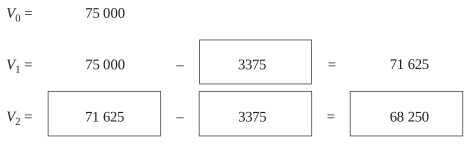
The value of the van, in dollars, after `n` years, `V_n`, can be modelled by the recurrence relation shown below.

`V_0 = 75\ 000 qquad V_(n + 1) = V_n - 3375`

  1. Recursion can be used to calculate the value of the van after two years.


    Complete the calculations below by writing the appropriate numbers in the boxes provided.   (2 marks)

    --- 0 WORK AREA LINES (style=lined) ---


    1. By how many dollars is the value of the van depreciated each year?   (1 mark)

      --- 1 WORK AREA LINES (style=lined) ---

    2. Calculate the annual flat rate of depreciation in the value of the van.
    3. Write your answer as a percentage.   (1 mark)

      --- 2 WORK AREA LINES (style=lined) ---

  2. The value of Alex’s van could also be depreciated using the reducing balance method of depreciation.
  3. The value of the van, in dollars, after `n` years, `R_n`, can be modelled by the recurrence relation shown below.


            `R_0 = 75\ 000 qquad R_(n + 1) = 0.943R_n`

    At what annual percentage rate is the value of the van depreciated each year?   (1 mark)

    --- 2 WORK AREA LINES (style=lined) ---
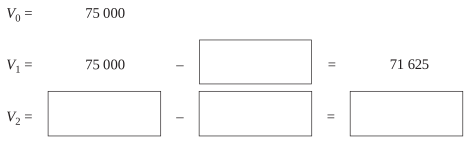
Show Answers Only

a.

b.i.  `$3375`

b.ii. `4.5text(%)`

c.  `5.7text(%)`

Show Worked Solution

a.   

  
b.i.
   `$3375`


b.ii.    `text(Annual Rate)` `= 3375/(75\ 000) xx 100`
    `= 4.5text(%)`


c.    `text(Annual Rate)` `= (1-0.943) xx 100text(%)`
    `= 5.7text(%)`

Filed Under: Depreciation, Recursion - Financial Tagged With: Band 2, Band 3, Band 4, smc-602-40-Comparing methods, smc-602-50-Recurrence relation, smc-717-50-Depreciation (SL), smc-717-60-Depreciation (reducing balance)

Algebra, MET2 2017 VCAA 2

Sammy visits a giant Ferris wheel. Sammy enters a capsule on the Ferris wheel from a platform above the ground. The Ferris wheel is rotating anticlockwise. The capsule is attached to the Ferris wheel at point `P`. The height of `P` above the ground, `h`, is modelled by  `h(t) = 65-55cos((pit)/15)`, where `t` is the time in minutes after Sammy enters the capsule and `h` is measured in metres.

Sammy exits the capsule after one complete rotation of the Ferris wheel.
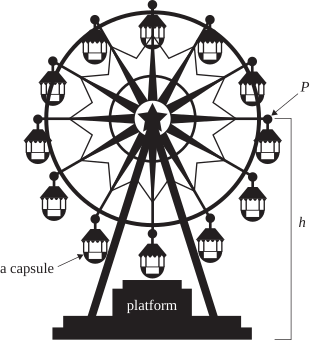


  1. State the minimum and maximum heights of `P` above the ground.   (1 mark)

    --- 2 WORK AREA LINES (style=lined) ---

  2. For how much time is Sammy in the capsule?   (1 mark)

    --- 2 WORK AREA LINES (style=lined) ---

  3. Find the rate of change of `h` with respect to `t` and, hence, state the value of `t` at which the rate of change of `h` is at its maximum.   (2 marks)

    --- 4 WORK AREA LINES (style=lined) ---

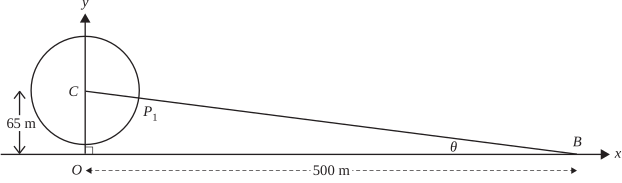
As the Ferris wheel rotates, a stationary boat at `B`, on a nearby river, first becomes visible at point `P_1`. `B` is 500 m horizontally from the vertical axis through the centre `C` of the Ferris wheel and angle `CBO = theta`, as shown below.
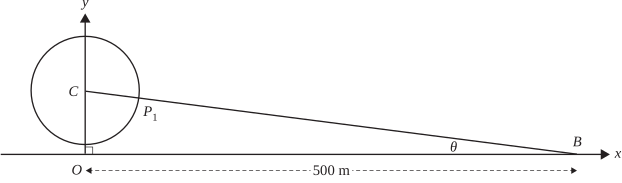


  1. Find `theta` in degrees, correct to two decimal places.   (1 mark)

    --- 3 WORK AREA LINES (style=lined) ---

Part of the path of `P` is given by  `y = sqrt(3025-x^2) + 65, x ∈ [-55,55]`, where `x` and `y` are in metres.

  1. Find `(dy)/(dx)`.   (1 mark)

    --- 2 WORK AREA LINES (style=lined) ---

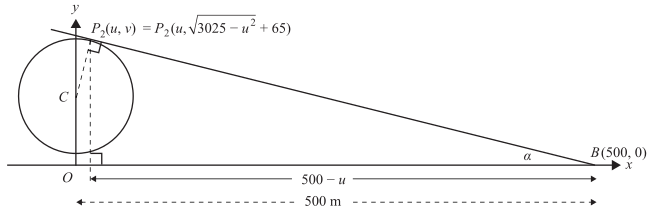
As the Ferris wheel continues to rotate, the boat at `B` is no longer visible from the point  `P_2(u, v)` onwards. The line through `B` and `P_2` is tangent to the path of `P`, where angle `OBP_2 = alpha`.
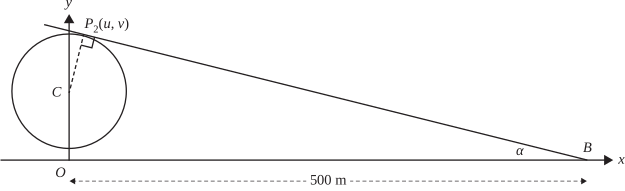


  1. Find the gradient of the line segment `P_2B` in terms of `u` and, hence, find the coordinates of `P_2`, correct to two decimal places.   (3 marks)

    --- 10 WORK AREA LINES (style=lined) ---

  2. Find `alpha` in degrees, correct to two decimal places.   (1 mark)

    --- 4 WORK AREA LINES (style=lined) ---

  3. Hence or otherwise, find the length of time, to the nearest minute, during which the boat at `B` is visible.   (2 marks)

    --- 5 WORK AREA LINES (style=lined) ---

Show Answers Only
  1. `h_text(min) = 10\ text(m), h_text(max) = 120\ text(m)`
  2. `30\ text(min)`
  3. `t = 7.5`
  4. `7.41^@`
  5. `(-x)/(sqrt(3025-x^2))`
  6. `P_2(13.00, 118.44)`
  7. `13.67^@`
  8. `7\ text(min)`
Show Worked Solution
a.    `h_text(min)` `= 65-55` `h_text(max)` `= 65 + 55`
    `= 10\ text(m)`   `= 120\ text(m)`


b.   `text(Period) = (2pi)/(pi/15) = 30\ text(min)`


c.   `h^{prime}(t) = (11pi)/3\ sin(pi/15 t)`

♦ Mean mark 50%.
MARKER’S COMMENT: A number of commons errors here – 2 answers given, calc not in radian mode, etc …


`text(Solve)\ h^{primeprime}(t) = 0, t ∈ (0,30)`

`t = 15/2\ \ text{(max)}`   `text(or)`   `t = 45/2\ \ text{(min – descending)}`

`:. t = 7.5`


d.   

♦ Mean mark 36%.
MARKER’S COMMENT: Choosing degrees vs radians in the correct context was critical here.

`tan(theta)` `= 65/500`
`:. theta` `=7.406…`
  `= 7.41^@`


e.    `(dy)/(dx)` `= (-x)/(sqrt(3025-x^2))`


f.   

`P_2(u,sqrt(3025-u^2) + 65),\ \ B(500,0)`

`:. m_(P_2B)` `= (sqrt(3025-u^2) + 65)/(u-500)`


`text{Using part (e), when}\ \ x=u,`

♦♦♦ Mean mark part (f) 18%.
MARKER’S COMMENT: Many students were unable to use the rise over run information to calculate the second gradient.

`dy/dx=(-u)/(sqrt(3025-u^2))`


`text{Solve (by CAS):}`

`(sqrt(3025-u^2) + 65)/(u-500)` `= (-u)/(sqrt(3025-u^2))\ \ text(for)\ u`


`u=12.9975…=13.00\ \ text{(2 d.p.)}`


`:. v` `= sqrt(3025-(12.9975…)^2) + 65`
  `= 118.4421…`
  `= 118.44\ \ text{(2 d.p.)}`


`:.P_2(13.00, 118.44)`


♦♦♦ Mean mark part (g) 7%.

g.    `tan alpha` `=v/(500-u)`
    `= (118.442…)/(500-12.9975…)`
  `:. alpha` `= 13.67^@\ \ text{(2 d.p.)}`


h.   

♦♦♦ Mean mark 5%.

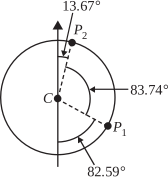
`text(Find the rotation between)\ P_1 and P_2:`

`text(Rotation to)\ P_1 = 90-7.41=82.59^@`

`text(Rotation to)\ P_2 = 180-13.67=166.33^@`

`text(Rotation)\ \ P_1 → P_2 = 166.33-82.59 = 83.74^@`


`:.\ text(Time visible)` `= 83.74/360 xx 30\ text(min)`
  `=6.978…`
  `= 7\ text{min  (nearest degree)}`

Filed Under: Average Value and Other, Trig Graphing Tagged With: Band 2, Band 3, Band 4, Band 5, Band 6, page-break-before-question, smc-2757-15-Cos, smc-2757-80-Applications, smc-2757-85-Max/min (non-calc), smc-756-20-Trig

  • « Previous Page
  • 1
  • …
  • 39
  • 40
  • 41
  • 42
  • 43
  • …
  • 59
  • Next Page »

Copyright © 2014–2026 SmarterEd.com.au · Log in