SmarterEd

Aussie Maths & Science Teachers: Save your time with SmarterEd

  • Login
  • Get Help
  • About

Mechanics, EXT2 2016 HSC 8 MC

A small object of mass `m` kg sits on a rotating conical surface at `C, r` metres from the axis `OA` and with `/_ OCB = theta,` as shown in the diagram.

The surface is rotating about its axis with angular velocity `omega.` The forces acting on the object are gravity, a normal reaction force `N` and a frictional force `F`, which prevents the object from sliding down the surface.

 ext2-hsc-2016-8a

Which pair of statements is correct?

A. `F cos theta + N sin theta = mr omega^2`
  `F sin theta + N cos theta = mg`
B. `F cos theta + N sin theta = mr omega^2`
  `F sin theta - N cos theta = mg`
C. `F cos theta - N sin theta = mr omega^2`
  `F sin theta + N cos theta = mg`
D.  `F cos theta - N sin theta = mr omega^2`
  `F sin theta - N cos theta = mg`
Show Answers Only

`=> C`

Show Worked Solution

`text(Resolving the forces,)`

`text(Horizontally:)`

`Fcostheta – Nsintheta = mromega^2`

`text(Vertically:)`

`Fsintheta + Ncostheta = mg`

`=> C`

Filed Under: Circular Motion Tagged With: Band 3

Measurement, STD2 M1 2016 HSC 28b

The cost of buying a new heater is $990. It has an energy consumption of 505 kWh per year.

Energy is charged at the rate of $0.35 kWh.

How much will it cost in total to purchase and then run this heater for five years?  (2 marks)

--- 4 WORK AREA LINES (style=lined) ---

Show Answers Only

`$1873.75`

Show Worked Solution

`text(C)text(ost to run heater for 5 years)`

`= 5 xx 505 xx 0.35`

`= $883.75`
 

`:.\ text(Total purchase and running cost)`

`= 883.75 + 990`

`= $1873.75`

Filed Under: Energy and Mass (Std 2), FS Resources, M4 Rates (Y12), Rates (Std2) Tagged With: Band 3, smc-1104-25-Energy, smc-799-20-Electricity, smc-805-20-Energy

Financial Maths, STD2 F4 2016 HSC 27d

Marge borrowed $19 000 to buy a used car. Interest on the loan was charged at 4.8% pa at the end of each month. She made a repayment of $436 at the end of every month. The table below sets out her monthly repayment schedule for the first four months of the loan. 
 

2ug-2016-hsc-q27_1

  1. Some values in the table are missing. Write down the values for `A` and `B`.  (2 marks)

    --- 4 WORK AREA LINES (style=lined) ---

  2. Calculate the value of `X`.  (2 marks)

    --- 3 WORK AREA LINES (style=lined) ---

  3. Marge repaid this loan over four years.


    What is the total amount that Marge repaid?  (1 mark)

    --- 2 WORK AREA LINES (style=lined) ---

Show Answers Only
  1. `A = $19\ 000,quadB = $17\ 551.33`
  2. `$74.56`
  3. `$20\ 928`
Show Worked Solution
i.    `A + 76-436` `= 18\ 640`
  `:. A` `= $19\ 000`


`17\ 915.67 + 71.66-436 = B`

`:. B = $17\ 551.33`


ii.   `18\ 640 + X-436 = 18\ 278.56`

`:. X` `= 18\ 278.56 + 436-18\ 640`
  `= $74.56`
♦♦ Mean mark part (iii) 28%.
COMMENT: Read carefully whether total paid or total interest paid is required.


iii.   `text(Total amount repaid)`

`= 48 xx 436`

`= $20\ 928`

Filed Under: FM4 - Credit and Borrowing, Loans (Std 1), Loans and Credit Cards (Std 2) Tagged With: Band 3, Band 4, Band 5, smc-1140-20-P+I-R Tables, smc-1140-40-Total Loan/Interest Payments, smc-814-20-P+I-R Tables, smc-814-40-Total Loan/Interest Payments

Algebra, STD2 A2 2016 HSC 26c

Peta’s car uses fuel at the rate of 5.9 L /100 km for country driving and 7.3 L /100 km for city driving. On a trip, she drives 170 km in the country and 25 km in the city.

Calculate the amount of fuel she used on this trip.  (2 marks)

--- 4 WORK AREA LINES (style=lined) ---

Show Answers Only

`11.855\ text(L)`

Show Worked Solution

`text(Fuel used in country)`

`= 170 xx 5.9/100`

`= 10.03\ text(L)`

`text(Fuel used in city)`

`= 25 xx 7.3/100`

`= 1.825\ text(L)`


`:.\ text(Total fuel used)`

`= 10.03 + 1.825`

`= 11.855\ text(L)`

Filed Under: Applications of Linear Relationships (Std1-2027), Applications of Linear Relationships (Std2-2027), Applications: Currency, Fuel and Other Problems (Std 1), Applications: Currency, Fuel and Other Problems (Std 2), Depreciation / Running costs, M4 Rates (Y12), MM1 - Units of Measurement, Rates (Std2) Tagged With: Band 3, smc-1104-20-Fuel, smc-1119-20-Fuel, smc-6256-20-Fuel, smc-6513-10-Fuel, smc-793-20-Fuel, smc-805-10-Fuel

Measurement, STD2 M7 2016 HSC 11 MC

The concentration of a drug in a certain medication is 100 mg / 5 mL. A patient is prescribed 2000 mg of the drug.

How much medication should be given to the patient?

  1.  4 mL
  2. 25 mL
  3. 100 mL
  4. 400 mL
Show Answers Only

`C`

Show Worked Solution

`text(Volume required)`

`= 2000/100 xx 5`

`= 100\ text(mL)`

`=> C`

Filed Under: M4 Rates (Y12), Medication, MM1 - Units of Measurement, Rates (Std2) Tagged With: Band 3, smc-1104-30-Medication, smc-805-30-Medication

Measurement, STD2 M7 2016 HSC 9 MC

An old washing machine uses 130 L of water per load. A new washing machine uses 50 L per load.

How much water is saved each year if two loads of washing are done each week using the new machine?

  1.   2600 L
  2. 4160 L
  3. 5200 L
  4. 8320 L
Show Answers Only

`D`

Show Worked Solution

`text(Water used by old machine)`

`= 130 xx 2 xx 52`

`= 13\ 520\ text(L)`

`text(Water used by new machine)`

`= 50 xx 2 xx 52`

`= 5200\ text(L)`

`:.\ text(Water saved)` `= 13\ 520 – 5200`
  `= 8320\ text(L)`

`=> D`

Filed Under: FS Resources, M4 Rates (Y12), MM1 - Units of Measurement, Rates (Std2) Tagged With: Band 3, smc-1104-15-General rate problems, smc-805-60-Other rate problems

Probability, STD2 S2 2016 HSC 6 MC

Ben has 6 shirts, 4 ties and 2 jackets.

How many different outfits of a shirt, a tie and a jacket can he choose?

  1.    12
  2.    16
  3.    24
  4.    48
Show Answers Only

`D`

Show Worked Solution

`text(Combinations)`

`= 6 xx 4 xx 2`

`= 48`

`=> D`

Filed Under: # Combinations, Combinations (Std 1), Combinations and Single Stage Events (Std 2) Tagged With: Band 3, smc-1134-40-Combinations - Other, smc-828-40-Combinations - Other

Algebra, 2UG 2016 HSC 4 MC

A company manufactures phones. The company’s income equation and cost equation are drawn on the same graph.
 

2ug-2016-hsc-4-mc 

 
Which region of the graph is the profit zone?

(A)   `W`

(B)   `X`

(C)   `Y`

(D)   `Z`

Show Answers Only

`=> B`

Show Worked Solution

`text(Profit occurs when the income graph)`

`text(is higher than the cost graph.)`

`=> B`

Filed Under: Breakeven and Financial modelling Tagged With: Band 3, M/C

Functions, 2ADV F1 2016 HSC 11e

Find the points of intersection of  `y=-5-4x`  and  `y=3-2x-x^2.`  (3 marks)

--- 7 WORK AREA LINES (style=lined) ---

Show Answers Only

`(4, – 21) and (– 2, 3)`

Show Worked Solution

`y = 3 – 2x – x^2`

`text(Substitute)\ \ y = -5 – 4x\ \ text(into equation)`

`-5 – 4x` `= 3 – 2x – x^2`
`x^2 – 2x – 8` `= 0`
`(x – 4) (x + 2)` `= 0`

  
`:. x = 4 or -2`
 

`text(When)\ \ x = 4,\ \ y = -5 – 4(4) = -21`

`text(When)\ \ x = -2,\ \ y = -5 – 4 (-2) = 3`  
 

`:.\ text(Intersection at)\ \ (4, – 21) and (– 2, 3)`

Filed Under: Factors and Other Equations, Quadratics and Cubic Functions (Adv-2027), Quadratics and Cubic Functions (Y11) Tagged With: Band 3, smc-6215-10-Quadratics, smc-6215-60-Intersections, smc-984-10-Quadratics

Calculus, 2ADV C4 2016 HSC 11d

Evaluate  `int_0^1 (2x + 1)^3\ dx.`  (2 marks)

Show Answers Only

`10`

Show Worked Solution

`int_0^1 (2x + 1)^3\ dx`

`= 1/4 · 1/2 [(2x + 1)^4]_0^1`

`= 1/8 [3^4 – 1^4]`

`= 1/8 xx 80`

`= 10`

Filed Under: Integrals, Standard Integration Tagged With: Band 3, smc-1202-20-Definite Integrals

Functions, EXT1* F1 2016 HSC 11c

Solve  `|\ x - 2\ | <= 3.`  (2 marks)

--- 5 WORK AREA LINES (style=lined) ---

Show Answers Only

`-1 <= x <= 5`

Show Worked Solution
`|\ x – 2\ |` `<= 3`
`(x – 2)^2` `<= 3^2`
`(x^2 – 4x + 4)` `<= 9`
`x^2 – 4x – 5` `<= 0`
`(x – 5) (x + 1)` `<= 0`


`:. -1 <= x <= 5`

Filed Under: Inequalities (Ext1), Inequalities and Absolute Values Tagged With: Band 3, smc-1033-20-Absolute Value

Functions, 2ADV F1 2016 HSC 11a

Sketch the graph of  `(x-3)^2 + (y + 2)^2 = 4.`  (2 marks)

--- 8 WORK AREA LINES (style=lined) ---

Show Answers Only

Show Worked Solution

`(x-3)^2 + (y + 2)^2 = 4\ \ text(is a circle),`

`text(centre)\ (3, -2),\ text(radius 2.)`
 

Filed Under: 4. Real Functions, Circles and Hyperbola, Further Functions and Relations (Y11), Graph Transformations (Adv-2027) Tagged With: Band 3, num-title-ct-pathc, num-title-qs-hsc, smc-4445-25-Sketch circle, smc-6408-80-Circles, smc-987-50-Circles

Calculus, 2ADV C2 2016 HSC 5 MC

What is the derivative of  `ln (cos x)?`

  1. `– sec x`
  2. `– tan x`
  3. `sec x`
  4. `tan x`
Show Answers Only

`B`

Show Worked Solution
`y` `= ln (cos x)`
 `(dy)/(dx)` `= (-sin x)/(cos x)`
  `= -tan x`

`=>  B`

Filed Under: Differentiation and Integration, L&E Differentiation (Y12), Logs and Exponentials - Differentiation, Trig Differentiation (Y12) Tagged With: Band 3, smc-967-20-Logs, smc-967-80-Trig Overlap, smc-968-20-Cos, smc-968-70-Log/Exp Overlap

Functions, 2ADV F2 2016 HSC 3 MC

Which diagram best shows the graph of the parabola  `y = 3 - (x - 2)^2?`
 

hsc-2016-3mci

hsc-2016-3mcii

Show Answers Only

`B`

Show Worked Solution

`y = 3 – (x – 2)^2`

`text(Curve is concave down and passes through)\ (2, 3)`

`=>  B`

Filed Under: 4. Real Functions, Graph Transformations (Adv-2027), The Parabola, Transformations (Y12) Tagged With: Band 3, smc-1008-10-Polynomials, smc-1008-60-Translation (Only), smc-6408-10-Polynomials, smc-6408-40-Translation (only)

Trigonometry, 2ADV T1 2016 HSC 1 MC

For the angle  `theta, sin theta = 7/25`  and  `cos theta = -24/25.`

Which diagram best shows the angle `theta?`
 

hsc-2016-1mcaii

Show Answers Only

`B`

Show Worked Solution

`text(S) text(ince)\ sin theta > 0 and cos theta < 0,`

`pi/2 < theta < pi`

`=>  B`

Filed Under: Exact Trig Ratios and Other Identities, Trig Ratios, Sine and Cosine Rules (Adv-2027), Trig Ratios, Sine and Cosine Rules (Y11) Tagged With: Band 3, smc-6392-20-Trig Ratios, smc-980-20-Trig Ratios

Complex Numbers, EXT2 N1 2016 HSC 4 MC

The Argand diagram shows the complex numbers `z` and `w`, where `z` lies in the first quadrant and `w` lies in the second quadrant.
  

ext2-hsc-2016-4mc
 

Which complex number could lie in the 3rd quadrant?

  1. `-w`
  2. `2 iz`
  3. `bar z`
  4. `w - z`
Show Answers Only

`=> D`

Show Worked Solution

`text(Using the parallelogram method:)`
 

ext2-hsc-2016-4mc-answer1
 

`text(From the graph above,)`

`w – z\ \ text(could lie in 3rd quadrant.)`

`=> D`

Filed Under: Argand Diagrams and Mod/Arg form, Geometry and Complex Numbers (vectors) Tagged With: Band 3, smc-1049-10-Cartesian and Argand diagrams

Functions, EXT1′ F1 2016 HSC 1 MC

Which equation best represents the following graph?
 

ext2-hsc-2016-1mc
 

  1. `y = sqrt x­`
  2. `|\ y\ | = sqrt x`
  3. `y = sqrt (|\ x\ |)`
  4. `|\ y\ |\ = sqrt (|\ x\ |)`
Show Answers Only

`=> C`

Show Worked Solution

`text(Graph is an even function.)`

`=> C`

Filed Under: Basic Curves, Reflections and Harder Graphs (Ext1) Tagged With: Band 3, smc-1072-20-y = root f(x); y^2 = f(x), smc-1072-30-y = | f(x) |; y = f( |x| ), smc-1072-50-Even Functions

Functions, MET1 2006 VCAA 2

For the function  `f: R -> R, f(x) = 3e^(2x)-1,`

  1. find the rule for the inverse function  `f^-1`   (2 marks)

    --- 7 WORK AREA LINES (style=lined) ---

  2. find the domain of the inverse function  `f^-1`   (1 mark)

    --- 2 WORK AREA LINES (style=lined) ---

Show Answers Only
  1. `f^-1 (x) = 1/2 log_e ((x + 1)/3)`
  2. `x in (-1, oo)`
Show Worked Solution

a.    `text(Let)\ \ y = f(x)`

`text(For inverse, swap)\ \ x harr y`

`x` `= 3e^(2y)-1`
`(x + 1)/3` `= e^(2y)`
`2y` `= log_e ((x + 1)/3)`
`y` `= 1/2 log_e ((x + 1)/3)`


`:. f^-1 (x) = 1/2 log_e ((x + 1)/3)`


♦ Mean mark 45%.

b.   `text(Domain)\ (f^-1) = text(Range)\ f(x),`

`:.x in (-1, oo)`

Filed Under: Logs and Exponential Functions Tagged With: Band 3, Band 5, smc-633-20-Log/Exponential

Calculus, MET1 2007 VCAA 1

Let  `f(x) = (x^3)/(sin(x))`. Find  `f^{′}(x)`.   (2 marks)

--- 4 WORK AREA LINES (style=lined) ---

Show Answers Only

`(3x^2sin(x)-x^3cos(x))/(sin^2(x))`

Show Worked Solution

`f(x) = (x^3)/(sin(x))`

`text(Using Quotient Rule:)`

`d/(dx)(u/v) = (vu^{prime}-uv^{prime})/(v^2)`

`:. f^{prime}(x) = (3x^2sin(x)-x^3cos(x))/(sin^2(x))`

Filed Under: Differentiation (Trig), Trig Differentiation Tagged With: Band 3, smc-736-10-sin, smc-736-50-Quotient Rule, smc-744-10-sin, smc-744-50-Quotient Rule

Graphs, MET1 2008 VCAA 2

On the axes below, sketch the graph of  `f: R\ text(\)\ {−1} -> R`,  `f(x) = 2 - 4/(x + 1)`.

Label all axis intercepts. Label each asymptote with its equation.   (4 marks)

--- 0 WORK AREA LINES (style=lined) ---


met1-2008-vcaa-q2

Show Answers Only

met1-2008-vcaa-q2-answer1

Show Worked Solution

met1-2008-vcaa-q2-answer1

`text(Asymptotes:)`

`x = −1`

`y = 2`

Filed Under: Quotient and Other Graphs Tagged With: Band 3, smc-757-10-Quotient function, smc-757-50-Sketch graph

Calculus, MET1 2008 VCAA 1a

Let  `y = (3x^2 - 5x)^5`.  Find  `(dy)/(dx)`.  (2 marks)

Show Answers Only

`5(3x^2 – 5x)^4(6x – 5)`

Show Worked Solution

`text(Using Chain Rule:)`

`(dy)/(dx) = 5(3x^2 – 5x)^4(6x – 5)`

Filed Under: Standard Differentiation Tagged With: Band 3, smc-746-30-Chain Rule

Probability, MET1 2009 VCAA 5

Four identical balls are numbered 1, 2, 3 and 4 and put into a box. A ball is randomly drawn from the box, and not returned to the box. A second ball is then randomly drawn from the box.

  1. What is the probability that the first ball drawn is numbered 4 and the second ball drawn is numbered 1?  (1 mark)

    --- 3 WORK AREA LINES (style=lined) ---

  2. What is the probability that the sum of the numbers on the two balls is 5?  (1 mark)

    --- 3 WORK AREA LINES (style=lined) ---

  3. Given that the sum of the numbers on the two balls is 5, what is the probability that the second ball drawn is numbered 1?  (2 marks)

    --- 4 WORK AREA LINES (style=lined) ---

Show Answers Only

  1. `1/12`
  2. `1/3`
  3. `1/4`

Show Worked Solution

a.   `text(Pr) (4, 1)`

`= 1/4 xx 1/3`

`= 1/12`


b.   `text(Pr) (text(Sum) = 5)`

`= text(Pr) (1, 4) + text(Pr) (2, 3) + text(Pr) (3, 2) + text(Pr) (4, 1)`

`= 4 xx (1/4 xx 1/3)`

`= 1/3`


c.   `text(Conditional Probability)`

♦ Mean mark 46%.

`text(Pr) (2^{text(nd)} = 1\ |\ text(Sum) = 5)`

`= (text{Pr} (4, 1))/(text{Pr} (text(Sum) = 5))`

`= (1/12)/(1/3)`

`= 1/4`

Filed Under: Conditional Probability and Set Notation Tagged With: Band 3, Band 4, Band 5, smc-2736-10-Conditional probability

Calculus, MET1 2009 VCAA 1a

Differentiate  `x log_e (x)`  with respect to `x`.   (2 marks)

--- 3 WORK AREA LINES (style=lined) ---

Show Answers Only

`log_e (x) + 1`

Show Worked Solution

`text(Using Product rule:)`

`(fg)^{\prime}` `= f^{\prime}g + fg^{\prime}`
`d/(dx) (x log_e (x))` `= 1 xx log_e (x) + x (1/x)`
  `= log_e (x) + 1`

Filed Under: Differentiation (L&E), L&E Differentiation Tagged With: Band 3, smc-739-30-Logs, smc-739-40-Product Rule, smc-745-20-Logs, smc-745-30-Product Rule

Calculus, MET1 2010 VCAA 9

Part of the graph of  `f: R^+ -> R, \ f(x) = x log_e (x)`  is shown below.

vcaa-2010-meth-9a

  1. Find the derivative of  `x^2 log_e (x)`.   (1 mark)

    --- 3 WORK AREA LINES (style=lined) ---

  2. Use your answer to part a. to find the area of the shaded region in the form  `a log_e (b) + c`  where `a, b` and `c` are non-zero real constants.   (3 marks)

    --- 8 WORK AREA LINES (style=lined) ---

Show Answers Only
  1. `x + 2x log_e (x)`
  2. `(9/2 log_e (3)-2)\ text(u²)`
Show Worked Solution

a.   `text(Using Product Rule:)`

`(fg)^{′}` `= f g^{′} + f^{′} g`
`d/(dx) (x^2 log_e (x))` `= x^2 (1/x) + 2x log_e (x)`
  `= x + 2x log_e (x)`


b.   `text{Integrating the answer from part (a):}`

`int (x + 2x log_e (x))\ dx` `= x^2 log_e (x)`
`1/2 x^2 + 2 int x log_e (x)\ dx` `= x^2 log_e (x)`
`2 int x log_e (x)\ dx` `= x^2 log_e (x)-1/2 x^2`
`:. int x log_e (x)\ dx` `= 1/2 x^2 log_e (x)-1/4 x^2`
♦♦ Mean mark 33%.
MARKER’S COMMENT: The most common error was not dividing everything through by 2. Be careful!


`:.\ text(Area)` `= int_1^3 (x log_e (x)) dx`
  `= [1/2 x^2 log_e (x)-1/4 x^2]_1^3`
  `= (9/2 log_e (3)-9/4)-(0-1/4)`
  `= (9/2 log_e (3)-2)\ \ text(u²)`

Filed Under: Area Under Curves Tagged With: Band 3, Band 5, smc-723-50-Log/Exponential

Calculus, MET1 2010 VCAA 2

Find an antiderivative of  `cos (2x + 1)`  with respect to `x.`   (1 mark)

--- 5 WORK AREA LINES (style=lined) ---

Show Answers Only

`1/2 sin (2x + 1)`

Show Worked Solution

`int cos (2x + 1)\ dx`

`= 1/2 sin (2x + 1)`

Filed Under: Integration (Trig), Trig Integration Tagged With: Band 3, smc-737-20-cos, smc-747-20-cos

Functions, MET1 2010 VCAA 4a

Write down the amplitude and period of the function

`qquad f: R -> R,\ \ f(x) = 4 sin ((x + pi)/3)`.   (2 marks)

--- 3 WORK AREA LINES (style=lined) ---

Show Answers Only

`text(Amplitude) = 4;\ \ text(Period) = 6 pi`

Show Worked Solution

`text(Amplitude) = 4`

`text(Period):\ \ (2 pi)/n = (2 pi)/(1/3) = 6 pi`

Filed Under: Trig Graphing Tagged With: Band 3, smc-2757-10-Sin, smc-2757-30-Find period, smc-2757-40-Find amplitude

Calculus, MET1 2010 VCAA 1a

Differentiate  `x^3 e^(2x)`  with respect to `x`.   (2 marks)

--- 3 WORK AREA LINES (style=lined) ---

Show Answers Only

`3x^2 e^(2x) + 2x^3 e^(2x)`

Show Worked Solution

    `text(Using Product rule:)`

`(fg)^{prime}` `= f^{prime}g + fg^{prime}`
`d/(dx) (x^3 e^(2x))` `= 3x^2 e^(2x) + 2x^3 e^(2x)`

Filed Under: Differentiation (L&E), L&E Differentiation Tagged With: Band 3, Band 4, smc-739-10-Exponential, smc-739-40-Product Rule, smc-745-10-Exponential, smc-745-30-Product Rule

Functions, MET1 2011 VCAA 4

If the function `f` has the rule  `f(x) = sqrt (x^2-9)`  and the function `g` has the rule  `g(x) = x + 5`

  1.  find integers `c` and `d` such that  `f(g(x)) = sqrt {(x + c) (x + d)}`  (2 marks)

    --- 4 WORK AREA LINES (style=lined) ---

  2.  state the maximal domain for which `f(g(x))` is defined.   (2 marks)

    --- 4 WORK AREA LINES (style=lined) ---

Show Answers Only
  1. `c = 2, d = 8 or c = 8, d = 2`
  2. `x in (– oo, – 8] uu [– 2, oo)`
Show Worked Solution
a.   `f(g(x))` `= sqrt {(x + 5)^2-9}`
    `= sqrt (x^2 + 10x + 16)`
    `= sqrt {(x + 2) (x + 8)}`

 
 `:. c = 2, d = 8 or c = 8, d = 2`


b.   `text(Find)\ x\ text(such that:)`

♦♦♦ Mean mark 13%.
MARKER’S COMMENT: “Very poorly answered” with a common response of `[-3,3)` that ignored the information from part (a).

`(x+2)(x+8) >= 0`
 

 vcaa-2011-meth-4ii

`(x + 2) (x + 8) >= 0\ \ text(when)`

`x <= -8 or x >= -2`

`:.\ text(Maximal domain is:)`

`x in (– oo, – 8] uu [– 2, oo)`

Filed Under: Functional Equations Tagged With: Band 3, Band 6, smc-642-10-(f o g)(x)

Calculus, MET1 2012 VCAA 9

  1. Let  `f: R -> R,\ \ f(x) = x sin (x)`.
  2. Find  `f^{prime} (x)`.   (1 mark)

    --- 4 WORK AREA LINES (style=lined) ---

  3. Use the result of part a. to find the value of  `int_(pi/6)^(pi/2) x cos (x)\ dx`  in the form  `a pi + b`.   (3 marks)

    --- 8 WORK AREA LINES (style=lined) ---

Show Answers Only
  1. `x cos (x) + sin (x)`
  2. `(5 pi)/12-sqrt 3/2`
Show Worked Solution

a.   `f(x)=x sin(x)`

`text(Using Product Rule:)`

`(gh)^{prime}` `= g^{prime}h + g h^{prime}`
`:. f^{prime}(x)` `= x cos (x) + sin (x)`


b.   `text(Integrating)\ \ f^{prime}(x)\ \ text{from part (a),}`

`int (x cos (x) + sin (x))\ dx` `= x sin (x)`
`int (x cos x)\ dx-cos (x)` `= x sin (x)`
`:. int (x cos x)\ dx` `= x sin (x) + cos x`

   
`text(Evaluate definite integral:)`

`int_(pi/6)^(pi/2) (x cos x) dx`

`= [x sin (x) + cos (x)]_(pi/6)^(pi/2)`

`= (pi/2 sin (pi/2) + cos (pi/2))-(pi/6 sin (pi/6) + cos (pi/6))`

`= (pi/2 + 0)-(pi/6 xx 1/2 + sqrt 3/2)`

`= (5 pi)/12-sqrt 3/2`

Filed Under: Integration (Trig), Trig Integration Tagged With: Band 3, Band 5, smc-737-40-Integration by recognition, smc-747-50-Integration by recognition

Functions, MET1 2012 VCAA 6

The graphs of  `y = cos (x) and y = a sin (x)`,  where `a` is a real constant, have a point of intersection at  `x = pi/3.`

  1. Find the value of `a`.  (2 marks)

    --- 5 WORK AREA LINES (style=lined) ---

  2. If  `x in [0, 2 pi]`, find the `x`-coordinate of the other point of intersection of the two graphs.  (1 mark)

    --- 3 WORK AREA LINES (style=lined) ---

Show Answers Only
  1. `1/sqrt 3`
  2. `(4 pi)/3`
Show Worked Solution

a.   `text(Intersection occurs when)\ \ x=pi/3,`

`a sin(pi/3)` `= cos (pi/3)`
`tan(pi/3)` `= 1/a`
`sqrt 3` `=1/a`
`:. a` `=1/sqrt3`


b.   `tan (x)` `= sqrt 3`
  `x` `= pi/3, (4 pi)/3, 2pi+ pi/3, …\ text(but)\ x in [0, 2 pi]`
  `:. x` `= (4 pi)/3`

Filed Under: Trig Graphing Tagged With: Band 3, Band 5, smc-2757-10-Sin, smc-2757-15-Cos, smc-2757-40-Find amplitude, smc-2757-80-Applications

Probability, MET1 2012 VCAA 4

On any given day, the number `X` of telephone calls that Daniel receives is a random variable with probability distribution given by

vcaa-2012-meth-4

  1. Find the mean of `X`.   (2 marks)

    --- 4 WORK AREA LINES (style=lined) ---

  2. What is the probability that Daniel receives only one telephone call on each of three consecutive days?   (1 mark)

    --- 3 WORK AREA LINES (style=lined) ---

  3. Daniel receives telephone calls on both Monday and Tuesday.
  4. What is the probability that Daniel receives a total of four calls over these two days?   (3 marks)

    --- 6 WORK AREA LINES (style=lined) ---

Show Answers Only

  1. `1.5`
  2. `0.008`
  3. `29/64`

Show Worked Solution

a.    `text(E) (X)` `= 0 xx 0.2 + 1 xx 0.2 + 2 xx 0.5 + 3 xx 0.1`
    `= 0 + .2 + 1 + 0.3`
    `= 1.5`


b.   `text(Pr) (1, 1, 1)`

MARKER’S COMMENT: Many students understood that the calculation of 0.2³ was required but were not able evaluate correctly.

`= 0.2 xx 0.2 xx 0.2`

`= 0.008`


c.   `text(Conditional Probability:)`

♦ Mean mark 36%.

`text(Pr) (x = 4 | x >= 1\ text{both days})`

`= (text{Pr} (1, 3) + text{Pr} (2, 2) + text{Pr} (3, 1))/(text{Pr}(x>=1\ text{both days}))`

`= (0.2 xx 0.1 + 0.5 xx 0.5 + 0.1 xx 0.2)/(0.8 xx 0.8)`

`= (0.02 + 0.25 + 0.02)/0.64`

`= 0.29/0.64`

`= 29/64`

Filed Under: Probability Distribution Tables Tagged With: Band 3, Band 4, Band 5, smc-732-20-E(X) / Mean, smc-732-60-General Probability, smc-732-70-Conditional Probability

Functions, MET1 2012 VCAA 3

The rule for function  `h`  is  `h(x) = 2x^3 + 1.`  Find the rule for the inverse function  `h^-1.`   (2 marks)

--- 5 WORK AREA LINES (style=lined) ---

Show Answers Only

`h^-1 (x) = root 3 ((x-1)/2),\ \ x in R`

Show Worked Solution

`h(x) = 2x^3+1,\ \ text(let)\ \ y = 2x^3+1,`

MARKER’S COMMENT: “It is important” students do not proceed directly from  `y-2x^3+1`  to  `x=2y^3+1`. See approach shown in working.

`text(For inverse, swap)\ x harr y`

`x` `= 2y^3 + 1`
`y^3` `= (x-1)/2`
`y` `= root 3 ((x-1)/2)`
`:. h^-1 (x)` `= root 3 ((x-1)/2),\ \ x in R`

Filed Under: Polynomial and Other Functions Tagged With: Band 3, smc-5205-10-Polynomials, smc-633-10-Polynomial

Calculus, MET1 2012 VCAA 1a

If  `y = (x^2 - 5x)^4`,  find `(dy)/(dx).`  (1 mark)

Show Answers Only

`4(x^2 – 5x)^3 (2x – 5)`

Show Worked Solution

`text(Using Chain Rule:)`

`(dy)/(dx) = 4 (x^2 – 5x)^3 (2x – 5)`

Filed Under: Standard Differentiation Tagged With: Band 3, smc-746-30-Chain Rule

Calculus, MET1 2013 VCAA 1a

If  `y = x^2 log_e (x)`, find  `(dy)/(dx)`.   (2 marks)

--- 3 WORK AREA LINES (style=lined) ---

Show Answers Only

`2x log_e (x) + x`

Show Worked Solution

`text(Using Product Rule:)`

`(fg)^{\prime}` `= f^{prime} g + f g^{prime}`
`(dy)/(dx)` `= 2x log_e (x) + x^2 (1/x)`
  `= 2x log_e (x) + x`

Filed Under: Differentiation (L&E), L&E Differentiation Tagged With: Band 3, smc-739-30-Logs, smc-739-40-Product Rule, smc-745-20-Logs, smc-745-30-Product Rule

Calculus, MET1 2014 VCAA 5

Consider the function  `f:[−1,3] -> R`,  `f(x) = 3x^2-x^3`.

  1. Find the coordinates of the stationary points of the function.   (2 marks)

    --- 5 WORK AREA LINES (style=lined) ---

  2. On the axes  below, sketch the graph of `f`.


    Label any end points with their coordinates.   (2 marks)


        met1-2014-vcaa-q5

    --- 0 WORK AREA LINES (style=lined) ---


  3. Find the area enclosed by the graph of the function and the horizontal line given by  `y = 4`.   (3 marks)

    --- 6 WORK AREA LINES (style=lined) ---

Show Answers Only
  1. `(0, 0) and (2, 4)`
  2.  
    met1-2014-vcaa-q5-answer3
  3. `27/4\ text(u²)`
Show Worked Solution
a.    `text(SP’s occur when)\ \ f^{′}(x)` `= 0`
`6x-3x^2`  `= 0` 
 `3x(2-x)` `=0`

`x = 0,\ \ text(or)\ \ 2`
 

`:.\ text{Coordinates are (0, 0) and (2, 4)}`


b.    met1-2014-vcaa-q5-answer3


♦ Mean mark (c) 48%.
c.    met1-2014-vcaa-q5-answer4

`text(Solution 1)`

`text(Area)` `= int_(−1)^2 4-(3x^2-x^3)dx`
  `= int_(−1)^2 4-3x^2 + x^3dx`
  `= [4x-x^3 + 1/4x^4]_(−1)^2`
  `= (8-8 + 4)-(−4-(−1) + 1/4)`
   
`:.\ text(Area)` `= 27/4 text(units²)`


`text(Solution 2)`

`text(Area)` `= 12-int_(−1)^2(3x^2-x^3)dx`
  `= 12-[x^3-1/4 x^4]_(−1)^2`
  `= 12-[(8-4)-(−1-1/4)]`
  `= 27/4\ text(units²)`

Filed Under: Area Under Curves, Curve Sketching Tagged With: Band 3, Band 4, Band 5, smc-723-20-Cubic, smc-723-80-Area between graphs, smc-724-10-Cubic

Algebra, MET1 2014 VCAA 4

Solve the equation  `2^(3x - 3) = 8^(2 - x)`  for  `x`.  (2 marks)

Show Answers Only

`3/2`

Show Worked Solution
`2^(3x – 3)` `= 2^(3(2 – x))`
`3x – 3` `= 6 – 3x`
`6x` `= 9`
`:. x` `= 3/2`

Filed Under: Log/Index Laws and Equations Tagged With: Band 3, smc-726-50-Exponential Equation

Probability, MET1 2015 VCAA 8

For events `A` and `B` from a sample space, `text(Pr)(A | B) = 3/4`  and  `text(Pr)(B) = 1/3`.

  1. Calculate  `text(Pr)(A ∩ B)`.   (1 mark)

    --- 4 WORK AREA LINES (style=lined) ---

  2. Calculate  `text(Pr)(A^{′} ∩ B)`, where `A^{′}` denotes the complement of `A`.   (1 mark)

    --- 4 WORK AREA LINES (style=lined) ---

  3. If events `A` and `B` are independent, calculate  `text(Pr)(A ∪ B)`.   (1 mark)

    --- 6 WORK AREA LINES (style=lined) ---

Show Answers Only

  1. `1/4`
  2. `1/12`
  3. `5/6`

Show Worked Solution

a.   `text(Using Conditional Probability:)`

`text(Pr)(A | B)` `= (text(Pr)(A ∩ B))/(text(Pr)(B))`
`3/4` `= (text(Pr)(A ∩ B))/(1/3)`
`:. text(Pr)(A ∩ B)` `= 1/4`


b.    met1-2015-vcaa-q8-answer
`text(Pr)(A^{′} ∩ B)` `= text(Pr)(B)-text(Pr)(A ∩B)`
  `= 1/3-1/4`
  `= 1/12`


c.   `text(If)\ A, B\ text(independent)`

♦♦ Mean mark 28%.
MARKER’S COMMENT: A lack of understanding of independent events was clearly evident.

`text(Pr)(A ∩ B)` `= text(Pr)(A) xx Pr(B)`
`1/4` `= text(Pr)(A) xx 1/3`
`:. text(Pr)(A)` `= 3/4`


`text(Pr)(A ∪ B)` `= text(Pr)(A) + text(Pr)(B)-text(Pr)(A ∩ B)`
  `= 3/4 + 1/3-1/4`
`:. text(Pr)(A ∪ B)` `= 5/6`

Filed Under: Conditional Probability and Set Notation Tagged With: Band 3, Band 4, Band 5, smc-2736-10-Conditional probability, smc-2736-30-Venn Diagrams, smc-2736-50-Complement

Algebra, MET1 2015 VCAA 7a

Solve  `log_2(6 - x) - log_2(4 - x) = 2`  for `x`, where  `x < 4`.  (2 marks)

Show Answers Only

`10/3`

Show Worked Solution

`text(Simplify using log laws:)`

`log_2((6 – x)/(4 – x))` `= 2`
`2^2` `= (6 – x)/(4 – x)`
`16 – 4x` `= 6 – x`
`3x` `= 10`
`:. x` `= 10/3`

Filed Under: Log/Index Laws and Equations Tagged With: Band 3, smc-726-10-Log - Product/Quotient Rule

Calculus, MET1 2015 VCAA 4

Consider the function  `f:[-3,2] -> R, \ \ f(x) = 1/2(x^3 + 3x^2-4)`.

  1. Find the coordinates of the stationary points of the function.   (2 marks)

    --- 5 WORK AREA LINES (style=lined) ---

The rule for  `f` can also be expressed as  `f(x) = 1/2(x-1)(x + 2)^2`.

  1. On the axes below, sketch the graph of  `f`, clearly indicating axis intercepts and turning points.


    Label the end points with their coordinates.   (2 marks)

    --- 0 WORK AREA LINES (style=lined) ---


    met1-2015-vcaa-q4
     

  2. Find the average value of  `f` over the interval  `0<=x<=2.`   (2 marks)

    --- 5 WORK AREA LINES (style=lined) ---

Show Answers Only
  1. `(0,-2), (-2,0)`
  2.  


    met1-2015-vcaa-q4-answer

  3. `1`
Show Worked Solution

a.   `text(Stationary points when)\ \ f^{prime}(x)=0,`

`1/2(3x^2 + 6x)` `= 0`
`3x(x + 2)` `= 0`


`:. x = 0, -2`


`:.\ text(Coordinates of stationary points:)`

`(0, -2), (-2,0)`


b.    met1-2015-vcaa-q4-answer
♦ Part (c) mean mark 50%.
MARKER’S COMMENT: Most students recalled the average value definition but then did not integrate correctly.


c.    `text(Avg value)` `= 1/(2-0) int_0^2 f(x) dx`
    `= 1/2 int_0^2 1/2(x^3 + 3x^2-4)dx`
    `= 1/4[1/4x^4 + x^3-4x]_0^2`
    `= 1/4[(16/4 + 2^3-4(2))-0]`
    `= 1`

Filed Under: Average Value and Other, Curve Sketching Tagged With: Band 3, Band 4, Band 5, smc-724-10-Cubic, smc-756-30-Polynomial

Calculus, MET1 2015 VCAA 1a

Let  `y = (5x + 1)^7`.

Find  `(dy)/(dx)`.  (1 mark)

Show Answers Only

`35(5x + 1)^6`

Show Worked Solution

`text(Using Chain Rule:)`

`(dy)/(dx)` `= 7(5x + 1)^6 xx 5`
  `= 35(5x + 1)^6`

Filed Under: Standard Differentiation Tagged With: Band 3, smc-746-30-Chain Rule

CORE*, FUR2 2006 VCAA 1

A company purchased a machine for $60 000.

For taxation purposes the machine is depreciated over time.

Two methods of depreciation are considered.

  1. Flat rate depreciation

    The machine is depreciated at a flat rate of 10% of the purchase price each year.

    i.
      By how many dollars will the machine depreciate annually?   (1 mark)

    --- 2 WORK AREA LINES (style=lined) ---

    ii.  Calculate the value of the machine after three years.   (1 mark)

    --- 2 WORK AREA LINES (style=lined) ---

  2. iii. After how many years will the machine be $12 000 in value?   (1 mark)

    --- 4 WORK AREA LINES (style=lined) ---

  3. Reducing balance depreciation

    The value, `V`, of the machine after `n` years is given by the formula `V=60\ 000 xx(0.85)^n`.

    i.
      By what percentage will the machine depreciate annually?   (1 mark)

    --- 2 WORK AREA LINES (style=lined) ---

    ii.  Calculate the value of the machine after three years.   (1 mark)

    --- 2 WORK AREA LINES (style=lined) ---

  4. iii. At the end of which year will the machine's value first fall below $12 000?   (1 mark)

    --- 5 WORK AREA LINES (style=lined) ---

  1. At the end of which year will the value of the machine first be less using flat rate depreciation than it will be using reducing balance depreciation?  (2 marks)

    --- 6 WORK AREA LINES (style=lined) ---

Show Answers Only
  1. i.   `$6000`
    ii.  `$42\ 000`
    iii. `8\ text(years)`
  2. i.   `text(15%)` 
    ii. 
    `$36\ 847.50`
    iii. `10\ text(years)`
  3. `text(7th year)`
Show Worked Solution
a.i.    `text(Annual depreciation)` `= 10text(%) xx 60\ 000`
    `= $6000`

a.ii.   `text(After 3 years,)`

`text(Value)` `= 60\ 000-(3 xx 6000)`
  `= $42\ 000`

a.iii.   `text(Find)\ n\ text(when value = $12 000)`

`12\ 000` `= 60\ 000-6000 xx n`
`6000n` `= 48\ 000`
`:.n` `=(48\ 000)/6000`
  `= 8\ text(years)`


b.i.    `1-r` `= 0.85`
   `r` `= 0.15`

`:.\ text(Annual depreciation is 15%.)`
  

b.ii.   `text(After 3 years,)`

`text(Value)` `= 60\ 000 xx (0.85)^3`
  `= $36\ 847.50`


b.iii.   `text(Find)\ n\ text(when)\ \ V = $12\ 000`

`12\ 000` `= 60\ 000 xx (0.85)^n`
`(0.85)^n` `= 0.2`
`:. n` `= 9.90…\ \ text(years)`

  
`:.\ text(Machine value falls below $12 000)`

`text(after 10 years.)`
  

c.   `text(Sketching both graphs,)`

BUSINESS, FUR2 2006 VCAA 1 Answer

`text(From the graph, at the end of the 7th year the)`

`text(value using flat rate drops below reducing)`

`text(balance for the 1st time.)`

Filed Under: Depreciation Tagged With: Band 3, Band 4, Band 5, smc-602-40-Comparing methods

CORE*, FUR2 2007 VCAA 3

Khan paid $900 for a fax machine.

This price includes 10% GST (goods and services tax).

  1. Determine the price of the fax machine before GST was added. Write your answer correct to the nearest cent.  (1 mark)

    --- 5 WORK AREA LINES (style=lined) ---

  2. Khan will depreciate his $900 fax machine for taxation purposes.
  3. He considers two methods of depreciation.
  4. Flat rate depreciation
  5. Under flat rate depreciation the fax machine will be valued at $300 after five years.
    1. Calculate the annual depreciation in dollars.   (1 mark)

      --- 2 WORK AREA LINES (style=lined) ---

    2. ii. Determine the value of the fax machine after five years.   (1 mark)

      --- 2 WORK AREA LINES (style=lined) ---

Show Answers Only

  1. `$818.18`
  2. i. `$120`
    ii. `$325` 

Show Worked Solution

a.   `text(Let $)P = text(price ex-GST)`

MARKER’S COMMENT: Reverse GST questions continue to cause problems for many students.

`:. P + 10text(%)P` `= 900`
`1.1P` `= 900`
`P` `= 900/1.1`
  `= 818.181…`
  `= $818.18\ \ text(nearest cent)`

  
b.i.
  `text(Annual depreciation)`

`= ((900-300))/5`

`= $120`


b.ii.   `text(Value after 5 years)`

`= 900-(250 xx 0.46 xx 5)`

`= $325`

Filed Under: Depreciation, Taxation and Other Tagged With: Band 3, Band 4, Band 5, smc-602-40-Comparing methods, smc-605-10-GST

CORE*, FUR2 2007 VCAA 1

Khan wants to buy some office furniture that is valued at $7000.

    1. A store requires 25% deposit. Calculate the deposit.   (1 mark)

      --- 2 WORK AREA LINES (style=lined) ---

    2. The balance is to be paid in 24 equal monthly instalments. No interest is charged.
    3. Determine the amount of each instalment. Write your answer in dollars and cents.   (1 mark)

      --- 2 WORK AREA LINES (style=lined) ---

Another store offers the same $7000 office furniture for $500 deposit and 36 monthly instalments of $220.


    1. Determine the total amount paid for the furniture at this store.   (1 mark)

      --- 2 WORK AREA LINES (style=lined) ---

    2. Calculate the annual flat rate of interest charged by this store.
    3. Write your answer as a percentage correct to one decimal place.   (2 marks)

      --- 5 WORK AREA LINES (style=lined) ---

A third store has the office furniture marked at $7000 but will give 15% discount if payment is made in cash at the time of sale.

  1. Calculate the cash price paid for the furniture after the discount is applied.   (1 mark) 

    --- 3 WORK AREA LINES (style=lined) ---

Show Answers Only

  1. i.  `$1750`
  2. ii.`$218.75`
  3. i.  `$8420`
  4. ii.  `7.3text{%}`
  5. `$5950`

Show Worked Solution

a.i.    `text(Deposit)` `= 25text(%) xx 7000`
    `= $1750`

 
a.ii.
  `text(Installment amount)`

`= ((7000-1750))/24`

`= $218.75`
 

b.i.    `text(Total paid)` `= 500 + 36 xx 220`
    `= $8420`


b.ii.   `text(Total interest paid)`

`= 8420-7000`

`= $1420`


`I` `= (PrT)/100`
`1420` `= (6500 xx r xx 3)/100`
`:. r` `= (1420 xx 100)/(6500 xx 3)`
  `= 7.282…`
  `= 7.3text{%  (1 d.p.)}`


c.    `text(Cash price)` `= 7000-15text(%) xx 7000`
    `= 7000-1050`
    `= $5950`

Filed Under: Borrowing and Loans Tagged With: Band 2, Band 3, Band 4, smc-603-20-Flat rate loans, smc-603-40-Loans - Other

GRAPHS, FUR2 2007 VCAA 2

The Goldsmiths’ car can use either petrol or gas. 

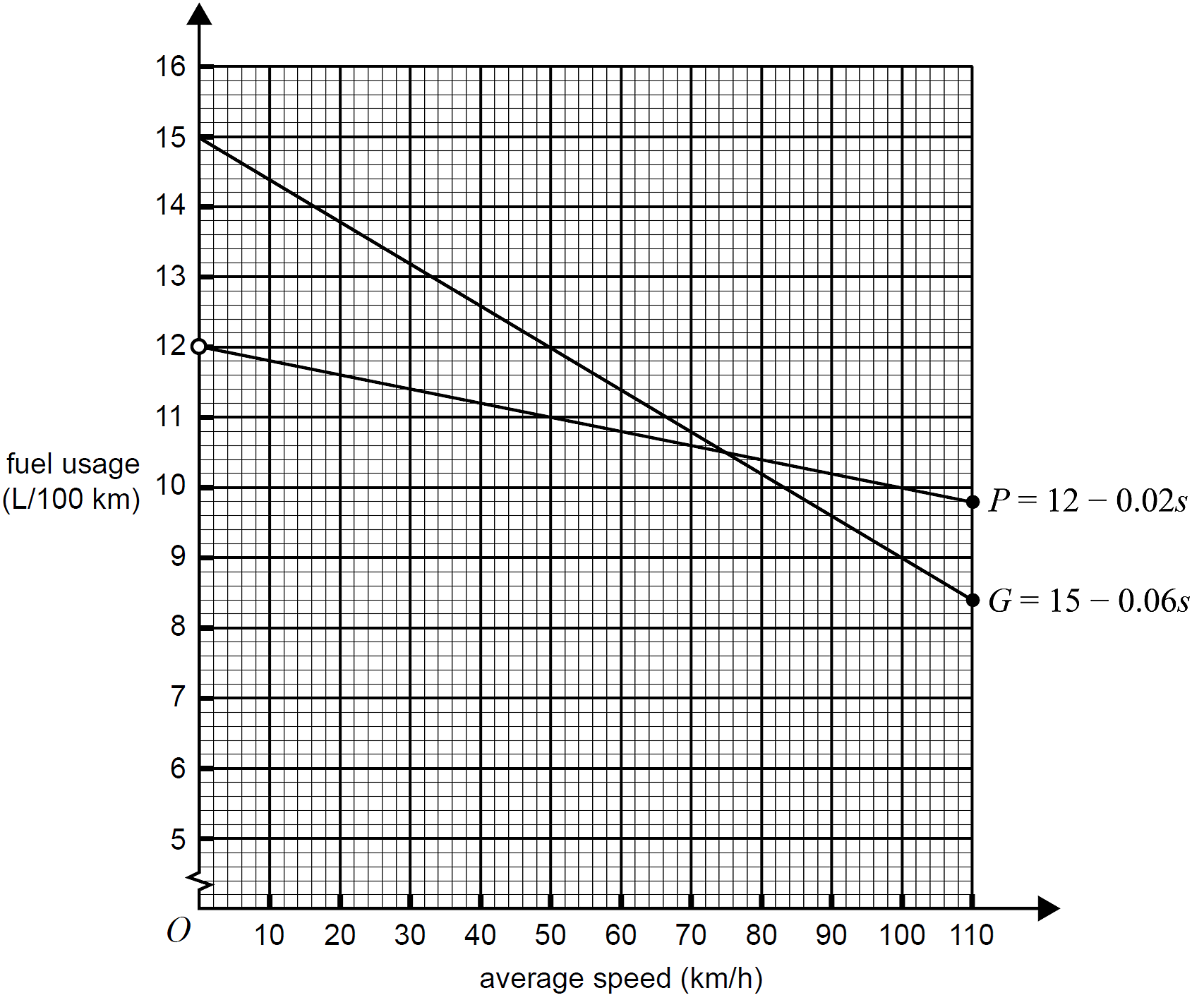
The following equation models the fuel usage of petrol, `P`, in litres per 100 km (L/100 km) when the car is travelling at an average speed of `s` km/h.

`P = 12 - 0.02s`

The line  `P = 12 - 0.02s`  is drawn on the graph below for average speeds up to 110 km/h.

GRAPHS, FUR2 2007 VCAA 2

  1. Determine how many litres of petrol the car will use to travel 100 km at an average speed of 60 km/h.


    Write your answer correct to one decimal place.  (1 mark)

The following equation models the fuel usage of gas, `G`, in litres per 100 km (L/100 km) when the car is travelling at an average speed of `s` km/h.

`G = 15 - 0.06s`

  1. On the axes above, draw the line  `G = 15 - 0.06s`  for average speeds up to 110 km/h.  (1 mark)
  2. Determine the average speeds for which fuel usage of gas will be less than fuel usage of petrol.  (1 mark)

The Goldsmiths'’ car travels at an average speed of 85 km/h. It is using gas.

Gas costs 80 cents per litre.

  1. Determine the cost of the gas used to travel 100 km.


    Write your answer in dollars and cents.  (2 marks)

Show Answers Only
  1. `10.8\ text(litres)`
  2.  
    GRAPHS, FUR2 2007 VCAA 2 Answer
  3. `text(75 km/hr) < text(speed) <= 110\ text(km/hr)`
  4. `$7.92`
Show Worked Solution

a.   `text(When)\ S = 60\ text(km/hr)`

`P` `= 12 – 0.02 xx 60`
  `= 10.8\ text(litres)`


b.   `text(When)\ s = 110,`

`G = 15 – 0.06 xx 100 = 8.4`

`:.\ text{(0, 15) and (110, 8.4) are on the line}`

GRAPHS, FUR2 2007 VCAA 2 Answer


c.   `text(Intersection of graphs occur when)`

MARKER’S COMMENT: Since fuel usage is less for gas, a speed of 75 km/hr was incorrect, as it was equal.
`12 – 0.02s` `= 15 – 0.06s`
`0.04s` `= 3`
`s` `= 75`


`:.\ text(Gas usage is less than fuel for)`

`text(average speeds over 75 km/hr.)`


d.   `text(When)\ x = 85,`

`text(Gas usage)` `= 15 – 0.06 xx 85`
  `= 9.9\ text(L/100 km.)`


`:.\ text(C)text(ost of gas for 100km journey)`

`= 9.9 xx 0.80`

`= $7.92`

Filed Under: Linear relationships Tagged With: Band 3, Band 4, Band 5

GRAPHS, FUR2 2007 VCAA 1

The Goldsmith family are going on a driving holiday in Western Australia.

On the first day, they leave home at 8 am and drive to Watheroo then Geraldton.

The distance––time graph below shows their journey to Geraldton.

GRAPHS, FUR2 2007 VCAA 1

At 9.30 am the Goldsmiths arrive at Watheroo.

They stop for a period of time.

  1. For how many minutes did they stop at Watheroo?  (1 mark)

After leaving Watheroo, the Goldsmiths continue their journey and arrive in Geraldton at 12 pm.

  1. What distance (in kilometres) do they travel between Watheroo and Geraldton?  (1 mark)
  2. Calculate the Goldsmiths'’ average speed (in km/h) when travelling between Watheroo and Geraldton.  (1 mark)

The Goldsmiths leave Geraldton at 1 pm and drive to Hamelin. They travel at a constant speed of 80 km/h for three hours. They do not make any stops.

  1. On the graph above, draw a line segment representing their journey from Geraldton to Hamelin.  (1 mark)


Show Answers Only
  1. `text(30 minutes)`
  2. `190 \ text(km)`
  3. `95\ text(km/hr)`
  4.  
    GRAPHS, FUR2 2007 VCAA 1 Answer
Show Worked Solution

a.   `text(30 minutes)`


b.   `text(Distance travelled)`

`= 310 – 120`

`= 190\ text(km)`


c.   `text(Time taken = 2 hours)`

`:.\ text(Average speed)` `= 190/2`
  `= 95\ text(km/hr)`


d.    GRAPHS, FUR2 2007 VCAA 1 Answer


Filed Under: Graph Applications Tagged With: Band 2, Band 3, Band 4

Calculus, MET2 2010 VCAA 1

  1. Part of the graph of the function  `g: (-4, oo) -> R,\ g(x) = 2 log_e (x + 4) + 1`  is shown on the axes below


    1. Find the rule and domain of  `g^-1`, the inverse function of  `g`.   (3 marks)

      --- 4 WORK AREA LINES (style=lined) ---

    2. On the set of axes above sketch the graph of  `g^-1`. Label the axes intercepts with their exact values.   (3 marks)

      --- 0 WORK AREA LINES (style=lined) ---

    3. Find the values of `x`, correct to three decimal places, for which  `g^-1(x) = g(x)`.   (2 marks)

      --- 3 WORK AREA LINES (style=lined) ---

    4. Calculate the area enclosed by the graphs of  `g`  and  `g^-1`. Give your answer correct to two decimal places.   (2 marks)

      --- 3 WORK AREA LINES (style=lined) ---

  2. The diagram below shows part of the graph of the function with rule
  3.         `f (x) = k log_e (x + a) + c`, where `k`, `a` and `c` are real constants.
     

    • The graph has a vertical asymptote with equation  `x =-1`.
    • The graph has a y-axis intercept at 1.
    • The point `P` on the graph has coordinates  `(p, 10)`, where `p` is another real constant.
       

      VCAA 2010 1b

    1. State the value of `a`.   (1 mark)

      --- 1 WORK AREA LINES (style=lined) ---

    2. Find the value of `c`.   (1 mark)

      --- 1 WORK AREA LINES (style=lined) ---

    3. Show that  `k = 9/(log_e (p + 1)`.   (2 marks)

      --- 4 WORK AREA LINES (style=lined) ---

    4. Show that the gradient of the tangent to the graph of `f` at the point `P` is  `9/((p + 1) log_e (p + 1))`.   (1 mark)

      --- 3 WORK AREA LINES (style=lined) ---

    5. If the point  `(-1, 0)`  lies on the tangent referred to in part b.iv., find the exact value of `p`.   (2 marks)

      --- 4 WORK AREA LINES (style=lined) ---

Show Answers Only
  1.   i. `g^-1(x) = e^((x-1)/2)-4,\ \ x in R`
  2.  ii. 
     
  3. iii. `3.914 or 5.503`
  4. iv. `52.63\ text(units²)`
  5.   i. `1`
  6.  ii. `1`
  7. iii. `text(Proof)\ \ text{(See Worked Solutions)}`
  8.  iv. `text(Proof)\ \ text{(See Worked Solutions)}`
  9.   v. `e^(9/10)-1`
Show Worked Solution

a.i.   `text(Let)\ \ y = g(x)`

`text(Inverse:  swap)\ \ x harr y,\ \ text(Domain)\ (g^-1) = text(Range)\ (g)`

`x = 2 log_e (y + 4) + 1`

`:. g^{-1} (x) = e^((x-1)/2)-4,\ \ x in R`


ii.  


 iii.  `text(Intercepts of a function and its inverse occur)`

  `text(on the line)\ \ y=x.`

`text(Solve:)\ \ g(x) = g^{-1} (x)\ \ text(for)\ \ x`

`:. x dot = -3.914 or x = 5.503\ \ text{(3 d.p.)}`


  iv.   `text(Area)` `= int_(-3.91432…)^(5.50327…) (g(x)-g^-1 (x))\ dx`
    `= 52.63\ text{u²   (2 d.p.)}`


b.i.   `text(Vertical Asymptote:)`

`x =-1`

`:. a = 1`


  ii.   `text(Solve)\ \ f(0) = 1\ \ text(for)\ \ c,`

`c = 1`


iii.  `f(x)= k log_e (x + 1) + 1`

`text(S)text(ince)\ \ f(p)=10,`

`k log_e (p + 1) + 1` `= 10`
`k log_e (p + 1)` `= 9`
`:. k` `= 9/(log_e (p + 1))\ text(… as required)`


  iv.   `f^{′}(x)` `= k/(x + 1)`
  `f^{′}(p)` `= k/(p + 1)`
    `= (9/(log_e(p + 1))) xx 1/(p + 1)\ \ \ text{(using part (iii))}`
    `= 9/((p + 1)log_e(p + 1))\ text(… as required)`


  v.   `text(Two points on tangent line:)`

♦♦ Mean mark 33%.
MARKER’S COMMENT: Many students worked out the equation of the tangent which was unnecessary and time consuming.

`(p, 10),\ \ (-1, 0)`

`f^{′} (p)` `= (10-0)/(p-(-1))`
  `=10/(p+1)`

`text(Solve:)\ \ 9/((p + 1)log_e(p + 1))=10/(p+1)\ \ \ text(for)\ p,`

`:.p= e^(9/10)-1`

Filed Under: Area Under Curves, Graphs and Applications, Logs and Exponential Functions Tagged With: Band 3, Band 4, Band 5, smc-2745-40-Log graphs, smc-2745-50-Find Domain/Range, smc-5204-70-Sketch graph, smc-5204-80-Area between curves, smc-723-50-Log/Exponential, smc-723-80-Area between graphs

CORE*, FUR2 2008 VCAA 1

Michelle has a bank account that pays her simple interest.

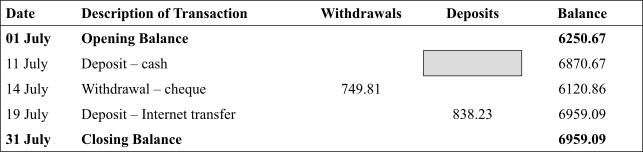
The bank statement below shows the transactions on Michelle’s account for the month of July.


  1. What amount, in dollars, was deposited in cash on 11 July?   (1 mark)

    --- 2 WORK AREA LINES (style=lined) ---

Interest for this account is calculated on the minimum monthly balance at a rate of 3% per annum.

  1. Calculate the interest for July, correct to the nearest cent.   (2 marks)

    --- 3 WORK AREA LINES (style=lined) ---

Show Answers Only
  1. `$620`
  2. `$15.30`
Show Worked Solution
a.    `text(Deposit)` `= 6870.67-6250.67`
    `= $620`


b.   `text(Minimum Balance) = $6120.86`

`:.\ text(Interest)` `=(PrT)/100`
  `= 6120.86 xx 3/100 xx 1/12`
  `= 15.302…`
  `= $15.30`

Filed Under: Interest Rates and Investing Tagged With: Band 3, Band 4, smc-604-10-Simple interest, smc-604-80-Bank Statement

GRAPHS, FUR2 2008 VCAA 3

An event involves running for 10 km and cycling for 30 km.

Let  `x`  be the time taken (in minutes) to run 10 km

 `y`  be the time taken (in minutes) to cycle 30 km

Event organisers set constraints on the time taken, in minutes, to run and cycle during the event.

Inequalities 1 to 6 below represent all time constraints on the event.

Inequality 1:   `x ≥ 0` Inequality 4:   `y <= 150`
Inequality 2:   `y ≥ 0` Inequality 5:   `y <= 1.5x`
Inequality 3:   `x ≤ 120` Inequality 6:   `y >= 0.8x`


  1. Explain the meaning of Inequality 3 in terms of the context of this problem.  (1 mark)


The lines  `y = 150`  and  `y = 0.8x`  are drawn on the graph below.

GRAPHS, FUR2 2008 VCAA 3

  1. On the graph above


    1. draw and label the lines  `x = 120`  and  `y = 1.5x`  (2 marks)
    2. clearly shade the feasible region represented by Inequalities 1 to 6.  (1 mark)

One competitor, Jenny, took 100 minutes to complete the run.

  1. Between what times, in minutes, can she complete the cycling and remain within the constraints set for the event?  (1 mark)
  2. Competitors who complete the event in 90 minutes or less qualify for a prize. 


    Tiffany qualified for a prize.


    1. Determine the maximum number of minutes for which Tiffany could have cycled.  (1 mark)
    2. Determine the maximum number of minutes for which Tiffany could have run.  (1 mark)
Show Answers Only
  1. `text(Inequality 3 means that the run must take)`
    `text(120 minutes or less for any competitor.)`
  2.  i. & ii.
    GRAPHS, FUR2 2008 VCAA 3 Answer
  3. `text(80 – 150 minutes)`
    1. `54\ text(minutes)`
    2. `50\ text(minutes)`
Show Worked Solution

a.   `text(Inequality 3 means that the run must take)`

`text(120 minutes or less for any competitor.)`


b.i. & ii.

GRAPHS, FUR2 2008 VCAA 3 Answer


c.   `text(From the graph, the possible cycling)`

♦♦ Mean mark of parts (c)-(d) (combined) was 19%.

`text(time range is between:)`

`text(80 – 150 minutes)`


d.i.   `text(Constraint to win a prize is)`

`x + y <= 90`

`text(Maximum cycling time occurs)`

`text(when)\ y = 1.5x`

`:. x + 1.5x` `<= 90`
`2.5x` `<= 90`
`x` `<= 36`


`:. y_(text(max))` `= 1.5 xx 36`
  `= 54\ text(minutes)`


d.ii.   `text(Maximum run time occurs)`

`text(when)\ \ y = 0.8x`

`:. x + 0.8x` `<= 90`
`1.8x` `<= 90`
`x` `<= 50`


`:. x_(text(max)) = 50\ text(minutes)`

Filed Under: Linear Programming Tagged With: Band 3, Band 4, Band 5, Band 6

GRAPHS, FUR2 2008 VCAA 2

Tiffany decides to enter a charity event involving running and cycling. 

There is a $35 fee to enter.

  1. Write an equation that gives the total amount, `R` dollars, collected from entry fees when there are `x` competitors in the event.  (1 mark)

The event costs the organisers $50 625 plus $12.50 per competitor.

  1. Write an equation that gives the total cost, `C`, in dollars, of the event when there are `x` competitors.  (1 mark)
    1. Determine the number of competitors required for the organisers to break even.  (1 mark)

The number of competitors who entered the event was 8670.

  1. Determine the profit made by the organisers.  (1 mark)
Show Answers Only
  1. `R = 35x`
  2. `C = 50\ 625 + 12.5x`
    1. `2250`
    2. `$144\ 450`
Show Worked Solution

a.   `R = 35x`


b.   `C = 50\ 625 + 12.50x`


c.i.   `text(Break even when)\ R = C`

`35x` `= 50\ 625 + 12.5x`
`22.5x` `= 50\ 625`
`x` `= (50\ 625)/22.5`
  `= 2250`


`:. 2250\ text(competitors required to break even.)`


c.ii.   `text(When)\ \ x = 8670,`

`text(Profit)` `= R – C`
  `= 35 xx 8670 – (50\ 625 + 12.5 xx 8670)`
  `= 303\ 450 – 159\ 000`
  `= $144\ 450`

Filed Under: Linear relationships Tagged With: Band 3, Band 4

GRAPHS, FUR2 2008 VCAA 1

Tiffany’s pulse rate (in beats/minute) during the first 60 minutes of a long-distance run is shown in the graph below.

GRAPHS, FUR2 2008 VCAA 1

  1. What was Tiffany’s pulse rate (in beats/minute) 15 minutes after she started her run?  (1 mark)
  2. By how much did Tiffany’s pulse rate increase over the first 60 minutes of her run?


    Write your answer in beats/minute.  (1 mark)

  3. The recommended maximum pulse rate for adults during exercise is determinded by subtracting the person’s age in years from 220.


    1. Write an equation in terms of the variables maximum pulse rate and age that can be used to determine a person’s recommended maximum pulse rate from his or her age.  (1 mark)

The target zone for aerobic exercise is between 60% and 75% of a person’s maximum pulse rate.

Tiffany is 20 years of age.

  1. Determine the values between which Tiffany’s pulse rate should remain so that she exercises within her target zone.


    Write your answers correct to the nearest whole number.  (1 mark)

Show Answers Only
  1. `110`
  2. `80`
    1. `text(Maximum pulse rate = 220 − age)`
    2. `text(Between 120 and 150)`
Show Worked Solution

a.   `text(110 beats/min)`


b.   `text(Increase of pulse rate)`

`=\ text(Rate at 60 min − initial rate)`

`= 150 – 70`

`= 80 \ text(beats/min)`


c.i.   `text(Maximum pulse rate = 220 − age)`


c.ii.   `text(Tiffany’s maximum pulse rate)`

`= 200 – 20`

`= 200\ text(beats/min)`

`=>\ text(Lower range) = 60text(%) xx 200 = 120`

`=>\ text(Higher range) = 75text(%) xx 200 = 150`


`:.\ text(Target range is 120 − 150 beats/min.)`


Filed Under: Graph Applications Tagged With: Band 2, Band 3

CORE*, FUR2 2009 VCAA 3

The golf club’s social committee has $3400 invested in an account which pays interest at the rate of 4.4% per annum compounding quarterly.

  1. Show that the interest rate per quarter is 1.1%.   (1 mark)

    --- 2 WORK AREA LINES (style=lined) ---

  2. Determine the value of the $3400 investment after three years.


    Write your answer in dollars correct to the nearest cent.   (1 mark)

    --- 3 WORK AREA LINES (style=lined) ---

  3. Calculate the interest the $3400 investment will earn over six years.


    Write your answer in dollars correct to the nearest cent.   (2 marks)

    --- 5 WORK AREA LINES (style=lined) ---

Show Answers Only
  1. `text(See Worked Solutions)`
  2. `$3876.97`
  3. `$1020.86`
Show Worked Solution

a.   `text(Interest rate per quarter)`

`= 4.4/4`

`= 1.1text(%  …as required.)`
 

b.   `text(Compounding periods = 12)`

`A` `= PR^n`
  `= 3400(1.011)^12`
  `= 3876.973…`
  `= $3876.97`


c.   `text(Compounding periods) = 6 xx 4 = 24`

`A` `= 3400(1.011)^24`
  `= 4420.858…`

 
`text(Interest earned over 6 years)`

`= 4420.86- 3400`

`= $1020.86\ \ text{(nearest cent)}`

Filed Under: Interest Rates and Investing Tagged With: Band 3, Band 4, Band 5, smc-604-20-Compound interest

CORE*, FUR2 2009 VCAA 2

Rebecca will need to borrow $250 to buy a golf bag.

  1. If she borrows the $250 on her credit card, she will pay interest at the rate of 1.5% per month.


    Calculate the interest Rebecca will pay in the first month.


    Write your answer correct to the nearest cent.   (1 mark)

    --- 2 WORK AREA LINES (style=lined) ---

  2. If Rebecca borrows the $250 from the store’s finance company she will pay $6 interest per month.


    Calculate the annual flat interest rate charged. Write your answer as a percentage correct to one decimal place.   (1 mark)

    --- 3 WORK AREA LINES (style=lined) ---

Show Answers Only
  1. `$3.75`
  2. ` text(28.8%)`
Show Worked Solution

a.   `text(Interest in the 1st month)`

`= 1.5text(%) xx 250`

`= $3.75`
 

b.   `text(Annual interest) = 12 xx 6 = $72`

`:.\ text(Annual flat interest rate)`

`= 72/250 xx 100text(%)`

`= 28.8text(%)`

Filed Under: Borrowing and Loans Tagged With: Band 3, Band 4, smc-603-20-Flat rate loans

CORE*, FUR2 2009 VCAA 1

The recommended retail price of a golf bag is $500. Rebecca sees the bag discounted by $120 at a sale.

  1. What is the price of the golf bag after the $120 discount has been applied?   (1 mark)

    --- 2 WORK AREA LINES (style=lined) ---

  2. Find the discount as a percentage of the recommended retail price.   ( 1 mark)

    --- 2 WORK AREA LINES (style=lined) ---

Show Answers Only
  1. `$380`
  2. `text(24%)`
Show Worked Solution
a.    `text(Price)` `= 500-120`
    `= $380`


b.    `text(Discount)` `= 120/500 xx 100text(%)`
    `= 24text(%)`


Filed Under: Interest Rates and Investing Tagged With: Band 2, Band 3, smc-604-40-% Increase/Decrease

GRAPHS, FUR2 2009 VCAA 2

Luggage over 20 kg in weight is called excess luggage.

Fair Go Airlines charges for transporting excess luggage.

The charges for some excess luggage weights are shown in Table 2.

GRAPHS, FUR2 2009 VCAA 21

  1. Complete this graph by plotting the charge for excess luggage weight of 10 kg. Mark this point with a cross (×).  (1 mark)

    GRAPHS, FUR2 2009 VCAA 22

  2. A graph of the charge against (excess luggage weight)² is to be constructed.


    Fill in the missing (excess luggage weight)² value in Table 3 and plot this point with a cross (×) on the graph below.  (1 mark)

    GRAPHS, FUR2 2009 VCAA 23

GRAPHS, FUR2 2009 VCAA 24

  1. The graph above can be used to find the value of `k` in the equation below.


          charge = `k` × (excess luggage weight)²


    Find `k`.  (1 mark)

  2. Calculate the charge for transporting 12 kg of excess luggage.


    Write your answer in dollars correct to the nearest cent.  (1 mark)

Show Answers Only
  1.  
    GRAPHS, FUR2 2009 VCAA 2 Answer
  2.  
    GRAPHS, FUR2 2009 VCAA 2 Answer1
    GRAPHS, FUR2 2009 VCAA 2 Anwer2
  3. `0.45`
  4. `$64.80`
Show Worked Solution
a.   

GRAPHS, FUR2 2009 VCAA 2 Answer


b.    GRAPHS, FUR2 2009 VCAA 2 Answer1

GRAPHS, FUR2 2009 VCAA 2 Anwer2


c.   `text(Using the point)\ (100,45),`

`45` `= k xx 100`
`:. k` `= 0.45`


d.   `text(Charge for 12 kg excess)`

`= 0.45 xx 12^2`

`= $64.80`

Filed Under: Non-linear Relationships Tagged With: Band 1, Band 3, Band 4

GRAPHS, FUR2 2009 VCAA 1

Fair Go Airlines offers air travel between destinations in regional Victoria. 

Table 1 shows the fares for some distances travelled.

GRAPHS, FUR2 2009 VCAA 11

  1. What is the maximum distance a passenger could travel for $160?  (1 mark)

The fares for the distances travelled in Table 1 are graphed below.

GRAPHS, FUR2 2009 VCAA 13

  1. The fare for a distance longer than 400 km, but not longer than 550 km, is $280.


    Draw this information on the graph above.  (1 mark)

Fair Go Airlines is planning to change its fares.

A new fare will include a service fee of $40, plus 50 cents per kilometre travelled.

An equation used to determine this new fare is given by

fare = `40 + 0.5` × distance.

  1. A passenger travels 300 km.


    How much will this passenger save on the fare calculated using the equation above compared to the fare shown in Table 1?  (1 mark)

  2. At a certain distance between 250 km and 400 km, the fare, when calculated using either the new equation or Table 1, is the same.


    What is this distance?  (2 marks)

  3. An equation connecting the maximum distance that may be travelled for each fare in Table 1 on page 16 can be written as


             fare = `a` + `b` × maximum distance.


    Determine `a` and `b`.  (2 marks)

Show Answers Only
  1. `text(250 km)`
  2.  
    GRAPHS, FUR2 2009 VCAA 1 Answer
  3. `$30`
  4. `360\ text(km)`
  5. `b = 2/5\ text(and)\ a = 60`
Show Worked Solution

a.   `text(250 km)`


b.   

GRAPHS, FUR2 2009 VCAA 1 Answer


c.    `text(New fare)` `= 40 + 0.5 xx 300`
    `= $190`


`text(Fare from the table = $220`

`:.\ text(Passenger will save $30.)`


d.   `text(In table 1, a fare of $220 applies for travel)`

`text(between 250 – 400 km.)`

`:. 220` `= 40 + 0.5d`
`0.5d` `= 180`
`d` `= 360\ text(km)`


e.   `text(Equations in required form are:)`

`100` `= a + b xx 100\ \ …(1)`
`160` `= a + b xx 250\ \ …(2)`


`text(Subtract)\ (2) – (1)`

`60` `= 150b`
`:. b` `= 60/150 = 2/5`


`text(Substitute)\ b = 2/5\ text{into (1)}`

`100` `= a + 2/5 xx 100`
`:. a` `= 60`


Filed Under: Graph Applications, Linear relationships Tagged With: Band 2, Band 3, Band 4

CORE*, FUR2 2010 VCAA 1

The cash price of a large refrigerator is $2000.

  1. A customer buys the refrigerator under a hire-purchase agreement.
  2. She does not pay a deposit and will pay $55 per month for four years.
    1. Calculate the total amount, in dollars, the customer will pay.   (1 mark)

      --- 2 WORK AREA LINES (style=lined) ---

    2. Find the total interest the customer will pay over four years.   (1 mark)

      --- 2 WORK AREA LINES (style=lined) ---

    3. Determine the annual flat interest rate that is applied to this hire-purchase agreement.
    4. Write your answer as a percentage.   (1 mark)

      --- 3 WORK AREA LINES (style=lined) ---

  3. Next year the cash price of the refrigerator will rise by 2.5%.
  4. The following year it will rise by a further 2.0%.
  5. Calculate the cash price of the refrigerator after these two price rises.   (1 mark)

    --- 3 WORK AREA LINES (style=lined) ---

--- 2 WORK AREA LINES (style=lined) ---

Show Answers Only

  1. i.  `$2640`
  2. ii.  `$640`
  3. iii. `text(8%)`
  4. `$2091`

Show Worked Solution

a.i.   `text(Total amount paid)`

`= 55 xx 4 xx 12`

`= $2640`
  

a.ii.    `text(Total interest)` `= 2640-2000`
    `= $640`


a.iii.    `I` `= (PrT)/100`
  `640` `= (2000 xx r xx 4)/100`
  `:. r` `= (640 xx 100)/(2000 xx 4)`
    `= 8text(%)`

  
b.
  `text(After 1 year,)`

`P = 2000(1.025) = $2050`

`text(After 2 years,)`

`P = 2050(1.02) = $2091`

Filed Under: Borrowing and Loans Tagged With: Band 3, Band 4, smc-603-30-Hire purchase

GRAPHS, FUR2 2010 VCAA 3

Let `x` be the number of Softsleep pillows that are sold each week and `y` be the number of Resteasy pillows that are sold each week.

A constraint on the number of pillows that can be sold each week is given by

Inequality 1:   `x + y ≤ 150`

  1. Explain the meaning of Inequality 1 in terms of the context of this problem.  (1 mark)

Each week, Anne sells at least 30 Softsleep pillows and at least `k` Resteasy pillows.

These constraints may be written as

Inequality 2:   `x ≥ 30`


Inequality 3:   `y ≥ k`

The graphs of  `x + y = 150`  and  `y = k`  are shown below.

GRAPHS, FUR2 2010 VCAA 3

  1. State the value of `k`.  (1 mark)
  2. On the axes above


    1. draw the graph of  `x = 30`  (1 mark)
    2. shade the region that satisfies Inequalities 1, 2 and 3.  (1 mark)
  3. Softsleep pillows sell for $65 each and Resteasy pillows sell for $50 each.


    What is the maximum possible weekly revenue that Anne can obtain?  (2 marks)

Anne decides to sell a third type of pillow, the Snorestop.

She sells two Snorestop pillows for each Softsleep pillow sold. She cannot sell more than 150 pillows in total each week.

  1. Show that a new inequality for the number of pillows sold each week is given by


          Inequality 4:   `3x + y ≤ 150`


    where     `x`  is the number of Softsleep pillows that are sold each week


        and     `y`  is the number of Resteasy pillows that are sold each week.  (1 mark)

Softsleep pillows sell for $65 each.

Resteasy pillows sell for $50 each.

Snorestop pillows sell for $55 each.

  1. Write an equation for the revenue, `R` dollars, from the sale of all three types of pillows, in terms of the variables `x` and `y`.  (1 mark)
  2. Use Inequalities 2, 3 and 4 to calculate the maximum possible weekly revenue from the sale of all three types of pillow.  (2 marks) 
Show Answers Only
  1. `text(Inequality 1 means that the combined number of Softsleep)`
    `text(and Resteasy pillows must be less than 150.)`
  2. `45`
  3. i. & ii.
    GRAPHS, FUR2 2010 VCAA 3 Answer
  4. `$9075`
  5. `text(See Worked Solutions)`
  6. `R = 175x + 50y`
  7. `$8375`
Show Worked Solution

a.   `text(Inequality 1 means that the combined number of Softsleep)`

`text(and Resteasy pillows must be less than 150.)`


b.   `k = 45`


c.i. & ii.   

GRAPHS, FUR2 2010 VCAA 3 Answer


d.   `text(Checking revenue at boundary)`

`text(At)\ (30,120),`

`R = 65 xx 30 + 50 xx 120 = $7950`

`text(At)\ (105,45),`

`R = 65 xx 105 + 50 xx 45 = $9075`

`:. text(Maximum weekly revenue) = $9075`


e.   `text(Let)\ z = text(number of SnoreStop pillows)`

♦♦ Mean mark of parts (e)-(g) (combined) was 24%.

`:. x + y + z <= 150,\ text(and)`

`z = 2x\ \ text{(given)}`

`:. x + y + 2x` `<= 150`
`3x + y` `<= 150\ \ …text(as required)`


f.    `R` `= 65x + 50y + 55(2x)`
    `= 65x + 50y + 110x`
    `= 175x + 50y`


g.   

GRAPHS, FUR2 2010 VCAA 3 Answer1

`text(New intersection occurs at)\ (35,45)`

`:.\ text(Maximum weekly revenue)`

`= 175 xx 35 + 50 xx 45`

`= $8375`

Filed Under: Linear Programming Tagged With: Band 3, Band 4, Band 5, Band 6

GRAPHS, FUR2 2010 VCAA 1

Anne sells Softsleep pillows for $65 each.

  1. Write an equation for the revenue, `R` dollars, that Anne receives from the sale of `x` Softsleep pillows.  (1 mark)
  2. The cost, `C` dollars, of making `x` Softsleep pillows is given by

`C = 500 + 40x`

Find the cost of making 30 Softsleep pillows.  (1 mark)

The revenue, `R`, from the sale of `x` Softsleep pillows is graphed below.


GRAPHS, FUR2 2010 VCAA 1

  1. Draw the graph of  `C = 500 + 40x`  on the axes above.  (1 mark)
  2. How many Softsleep pillows will Anne need to sell in order to break even?  (1 mark)
Show Answers Only
  1. `R = 65x`
  2. `$1700`
  3.  
    GRAPHS, FUR2 2010 VCAA 1 Answer
  4. `text(20 pillows)`
Show Worked Solution

a.   `R = 65x`


b.   `text(When)\ x = 30,`

`C` `= 500 + 40 xx 30`
  `= $1700`


c.   

GRAPHS, FUR2 2010 VCAA 1 Answer


d.   `text(Breakeven occurs when:)`

`text(Revenue)` `=\ text(C)text(osts)`
`65x` `= 500 + 40x`
`25x` `= 500`
`x` `= 20`


`:.\ text(Anne needs to sell 20 pillows to breakeven.)`

Filed Under: Linear relationships Tagged With: Band 3, Band 4

GEOMETRY, FUR2 2010 VCAA 1

In the plan below, the entry gate of an adventure park is located at point `G`.

A canoeing activity is located at point `C`.

The straight path `GC` is 40 metres long.

The bearing of `C` from `G` is 060°.


Geometry anad Trig, FUR2 2011 VCAA 1_1
 

  1. Write down the size of the angle that is marked `x^@` in the plan above.  (1 mark)
  2. What is the bearing of the entry gate from the canoeing activity?  (1 mark)
  3. How many metres north of the entry gate is the canoeing activity?  (1 mark)

`CW` is a 90 metre straight path between the canoeing activity and a water slide located at point `W`.

`GW` is a straight path between the entry gate and the water slide.

The angle `GCW` is 120°.


GEOMETRY, FUR2 2010 VCAA 12
 

    1. Find the area that is enclosed by the three paths, `GC`, `CW` and `GW`.


      Write your answer in square metres, correct to one decimal place.  (1 mark)

    2. Show that the length of path `GW` is 115.3 metres, correct to one decimal place.  (1 mark)

Straight paths `CK` and `WK` lead to the kiosk located at point `K`.

These two paths are of equal length.

The angle `KCW` is 10°.


GEOMETRY, FUR2 2010 VCAA 13

    1. Find the size of the angle `CKW`.  (1 mark)
    2. Find the length of path `CK`, in metres, correct to one decimal place.  (1 mark)
Show Answers Only
  1. `120^@`
  2. `240^@`
  3. `20\ text(m)`
    1. `1558.8\ text{m²  (1 d.p.)}`
    2. `text(See Worked Solutions.)`
    1. `160^@`
    2. `45.7\ text{m  (1 d.p.)}`
Show Worked Solution
a.    `x^@ + 60^@` `= 180^@`
   `:. x^@` `= 120^@`


b.   `text(Bearing of)\ G\ text(from)\ C`

MARKER’S COMMENT: True bearings (3 figure) are preferred to quadrant bearings although S60°W was accepted.

`= 360 – 120`

`= 240^@`


c.   

GEOMETRY, FUR2 2010 VCAA 1 Answer1

`text(Let)\ d = text(distance north of)\ C\ text(from)\ G`

`cos60^@` `= d/40`
`:. d` `= 40 xx cos60`
  `= 20\ text(m)`


d.i.    `A` `= 1/2ab sinC`
    `= 1/2 xx 40 xx 90 xx sin120^@`
    `= 1558.84…`
    `= 1558.8\ text{m²  (1 d.p.)}`


d.ii.   `text(Using the cosine rule,)`

`GW` `= sqrt(40^2 + 90^2 + 2 xx 40 xx 90 xx cos120^@)`
  `= sqrt(13\ 300)`
  `= 115.32…`
  `= 115.3\ text{(1 d.p.)  …as required.}`


e.i.   `DeltaCKW\ text(is isosceles)`

`:. angleCKW` `= 180 – (2 xx 10)`
  `= 160^@`


e.ii.   `text(Using the sine rule,)`

`(CK)/(sin10^@)` `= 90/(sin160^@)`
`:. CK` `= (90 xx sin10^@)/(sin160^@)`
  `= 45.69…`
  `= 45.7\ text{m  (1 d.p.)}`

Filed Under: Trig - Bearings Tagged With: Band 2, Band 3, Band 4

CORE*, FUR2 2011 VCAA 1

Tony plans to take his family on a holiday.

The total cost of $3630 includes a 10% Goods and Services Tax (GST).

  1. Determine the amount of GST that is included in the total cost.  (1 mark)

During the holiday, the family plans to visit some theme parks.

The prices of family tickets for three theme parks are shown in the table below.

BUSINESS, FUR2 2011 VCAA 1

  1. What is the total cost for the family if it visits all three theme parks?  (1 mark)

If Tony purchases the Movie Journey family ticket online, the cost is discounted to $202.40

  1. Determine the percentage discount.  (1 mark)
Show Answers Only
  1. `$330`
  2. `$462`
  3. `text(8%)`
Show Worked Solution

a.   `text(Let $)P\ text(be the cost ex-GST)`

`P + 10text(%)P` `= 3630`
`1.1P` `= 3630`
`P` `= 3630/1.1`
  `= $3300`
   
`:.\ text(GST)` `= 10text(%) xx $3300`
  `= $330`


b.   `text(C)text(ost to visit all 3 parks)`

`= 82 + 220 + 160`

`= $462`


c.    `text(Savings)` `= 220 – 202.40`
    `= 17.60`
`:.\ text(Discount)` `= (17.60)/220`
  `= 0.08`
  `= 8text(%)`

Filed Under: Taxation and Other Tagged With: Band 2, Band 3, Band 4, smc-605-10-GST, smc-605-20-% increase/decrease

  • « Previous Page
  • 1
  • …
  • 42
  • 43
  • 44
  • 45
  • 46
  • …
  • 57
  • Next Page »

Copyright © 2014–2025 SmarterEd.com.au · Log in