SmarterEd

Aussie Maths & Science Teachers: Save your time with SmarterEd

  • Login
  • Get Help
  • About

HMS, HAG EQ-Bank 58 MC

People with disability often encounter barriers when accessing healthcare services. Which development represents a future opportunity to improve healthcare accessibility for individuals with disability?

  1. Reducing the number of accessible healthcare facilities to concentrate resources
  2. Training healthcare staff in disability awareness and implementing universal design principles
  3. Requiring people with disability to bring their own support equipment to appointments
  4. Scheduling all disability-related appointments during off-peak hours only
Show Answers Only

\(B\)

Show Worked Solution
  • B is correct: Staff training and universal design principles create accessible healthcare environments.

Other Options:

  • A is incorrect: Reducing accessible facilities decreases rather than improves healthcare access.
  • C is incorrect: Requiring personal equipment creates additional barriers rather than opportunities.
  • D is incorrect: Restricted scheduling limits rather than expands healthcare access opportunities.

Filed Under: Healthcare System effectiveness Tagged With: Band 3, smc-5479-15-Future opportunities

HMS, HAG EQ-Bank 53 MC

What is the PRIMARY role of Australia's healthcare system in achieving better health outcomes for the population?

  1. To provide emergency medical treatment only when people become seriously ill
  2. To prevent illness, treat disease, and promote health across the entire population
  3. To ensure private healthcare companies generate maximum profits
  4. To focus exclusively on treating chronic diseases in elderly populations
Show Answers Only

\(B\)

Show Worked Solution
  • B is correct: Healthcare system’s comprehensive role includes prevention, treatment, and health promotion.

Other Options:

  • A is incorrect: System encompasses prevention and routine care, not just emergency treatment.
  • C is incorrect: System aims for population health outcomes, not commercial profit maximisation.
  • D is incorrect: System serves all age groups and addresses various health conditions.

Filed Under: Healthcare System effectiveness Tagged With: Band 3, smc-5479-05-Healthcare roles

HMS, HAG EQ-Bank 025 MC

A sleep-tracking app records time awake, time asleep, and oxygen levels. What is the purpose of this technology?

  1. Provide an early diagnosis of cardiovascular disease
  2. Help identify patterns for further medical assessment
  3. Perform minimally invasive surgery
  4. Replace the role of medical imaging
Show Answers Only

\(B\)

Show Worked Solution
  • B is correct. An app that records time awake, time asleep and oxygen levels helps identify patterns in a person’s sleep which can be used for further medical assessment.

Other options:

  • A is incorrect. The app does not diagnose cardiovascular disease although it may indicate irregularities that require professional follow-up.
  • C is incorrect. Minimally invasive surgery is part of precision surgery, not health monitoring via apps.
  • D is incorrect. Sleep apps do not replace medical imaging, rather they collect lifestyle data.

Filed Under: Technology and Health relationship Tagged With: Band 3, smc-5490-20-Monitoring

HMS, HAG EQ-Bank 024 MC

Which health condition could be monitored using a smart contact lens?

  1. Blood glucose levels
  2. Blood clotting
  3. Sleep quality
  4. Lung function
Show Answers Only

\(A\)

Show Worked Solution
  • A is correct. A smart contact lens can be used to monitor blood glucose levels.

Other options:

  • B is incorrect. Blood clotting requires medical imaging or laboratory testing, not wearable eye-based technology.
  • C is incorrect. Sleep quality is tracked using devices such as smartwatches, rings or apps, not contact lenses.
  • D is incorrect. Lung function is assessed through respiratory monitoring devices.

Filed Under: Technology and Health relationship Tagged With: Band 3, smc-5490-20-Monitoring

HMS, HAG EQ-Bank 49 MC

Australia's healthcare system operates through a mixed funding model. Which statement accurately describes this funding arrangement?

  1. All healthcare services are funded exclusively through private health insurance premiums
  2. Government provides Medicare funding while private insurers cover additional services and choice
  3. State governments are solely responsible for funding both public and private healthcare
  4. Healthcare funding relies entirely on out-of-pocket payments from individual patients
Show Answers Only

\(B\)

Show Worked Solution
  • B is correct: Mixed model combines government Medicare funding with private insurance options.

Other Options:

  • A is incorrect: Government provides significant funding through Medicare and public systems.
  • C is incorrect: Federal government plays major role through Medicare and PBS funding.
  • D is incorrect: Medicare and insurance systems reduce individual payment burden significantly.

Filed Under: Person centred health - Govt/Non-Govt orgs Tagged With: Band 3, smc-5481-15-Funding models

HMS, HAG EQ-Bank 45 MC

Australia's healthcare system involves collaboration between different levels of government and non-government organisations. Which combination BEST represents the key components of this collaborative system?

  1. Federal government, state governments, private hospitals, and community health organisations
  2. Only federal government agencies responsible for all healthcare delivery
  3. Private health insurance companies operating independently without government involvement
  4. State governments exclusively managing all public and private healthcare services
Show Answers Only

\(A\)

Show Worked Solution
  • A is correct: Multiple levels of government and non-government sectors collaborate in healthcare delivery.

Other Options:

  • B is incorrect: Healthcare involves multiple levels of government, not just federal agencies.
  • C is incorrect: Private insurers work within government-regulated framework, not independently.
  • D is incorrect: Both federal and state governments share healthcare responsibilities.

Filed Under: Person centred health - Govt/Non-Govt orgs Tagged With: Band 3, smc-5481-05-System components

HMS, HAG EQ-Bank 44 MC

A patient receives a diagnosis from their GP but feels uncertain about the recommended treatment plan. Which consumer protection strategy would be MOST appropriate in this situation?

  1. Ignore the diagnosis completely and seek alternative medicine only
  2. Accept the diagnosis without question since doctors are always correct
  3. Seek a second opinion from another qualified healthcare practitioner
  4. Research the condition online and self-diagnose using internet sources
Show Answers Only

\(C\)

Show Worked Solution
  • C is correct: Seeking second opinions from qualified practitioners protects consumers and verifies accuracy.

Other Options:

  • A is incorrect: Completely ignoring medical diagnosis prevents proper healthcare management.
  • B is incorrect: Healthcare professionals can make errors, second opinions provide verification.
  • D is incorrect: Self-diagnosis using internet sources lacks professional medical expertise.

Filed Under: Being a critical health consumer Tagged With: Band 3, smc-5483-17-Accuracy and credibility

HMS, HAG EQ-Bank 42 MC

A social media advertisement promotes a pain relief cream with multiple video testimonials claiming "instant results." Which approach BEST demonstrates accurate assessment of this product's credibility?

  1. Trust the testimonials completely as they show real people with genuine experiences
  2. Purchase the product immediately since multiple people recommend it
  3. Assume the product is effective because it's advertised on a popular social media platform
  4. Verify if the product is endorsed by medical associations and check for scientific evidence
Show Answers Only

\(D\)

Show Worked Solution
  • D is correct: Medical association endorsement and scientific evidence provide credible accuracy assessment.

Other Options:

  • A is incorrect: Testimonials may be from paid actors and don’t meet therapeutic standards.
  • B is incorrect: Multiple recommendations don’t guarantee product safety or effectiveness.
  • C is incorrect: Platform popularity doesn’t indicate product credibility or therapeutic value.

Filed Under: Being a critical health consumer Tagged With: Band 3, smc-5483-17-Accuracy and credibility

CHEMISTRY, M2 EQ-Bank 5

An organic compound is analysed and found to have the following percentage composition by mass:

\(\ce{C}\) - 54.5%, \(\ce{H}\) - 9.1%, \(\ce{O}\) - 36.4%

  1. Calculate the empirical formula of this compound.   (2 marks)

--- 4 WORK AREA LINES (style=lined) ---

  1. If the relative molecular mass of the compound is 88.104, determine its molecular formula.   (1 mark)

--- 2 WORK AREA LINES (style=lined) ---

Show Answers Only

a.    \(\ce{C2H4O}\)

b.    \(\ce{C4H8O2}\)

Show Worked Solution

a.    Assume that there is \(100\) grams in sample of the organic compound.

Then there are \(54.5\) grams of \(\ce{C}\), \(9.1\) grams of \(\ce{H}\) and \(36.4\) grams of \(\ce{O}\).

\(n(\ce{C}) = \dfrac{54.5}{12.01} = 4.54\ \text{mol}\).

\(n(\ce{H}) = \dfrac{9.01}{1.008} = 8.94\ \text{mol}\).

\(n(\ce{O}) = \dfrac{36.4}{16.00} = 2.28\ \text{mol}\).

 
Divide through by the smallest number of moles to determine the empirical formula

\(\ce{C}: \dfrac{4.54}{2.28} \approx 2\)

\(\ce{H}: \dfrac{8.94}{2.28} \approx 4\)

\(\ce{O}: \dfrac{2.28}{2.28} = 1\)

 
The empirical formula for the organic compound is \(\ce{C2H4O}\).
 

b.    The molar mass of \(\ce{C2H4O} = 2(12.01) + 4(1.008) + 16.00 = 44.052\).

Ratio of the molar mass of the compound to the molar mass of the empirical formula:

Ratio \(= \dfrac{88.104}{44.052} = 2\).

Hence, the molecular formula for the compound is \(\ce{C4H8O2}\).

Filed Under: Mole Concept Tagged With: Band 3, Band 5, smc-4260-60-Empirical formula

HMS, HAG EQ-Bank 37 MC

A patient receives conflicting advice about managing their diabetes from different sources. Which source should be considered MOST trustworthy when determining whom to believe?

  1. A celebrity influencer sharing their personal diabetes management routine
  2. A registered endocrinologist who specialises in diabetes treatment
  3. A friend who has lived with diabetes for several years
  4. A health website with no author information or medical credentials listed
Show Answers Only

\(B\)

Show Worked Solution
  • B is correct: Registered specialists with relevant qualifications represent most trustworthy medical sources.

Other Options:

  • A is incorrect: Celebrity status doesn’t indicate medical expertise or diabetes specialisation.
  • C is incorrect: Personal experience valuable but lacks professional medical training.
  • D is incorrect: Anonymous sources without credentials cannot be verified for trustworthiness.

Filed Under: Being a critical health consumer Tagged With: Band 3, smc-5483-07-Trustworthy sources

CHEMISTRY, M2 EQ-Bank 1 MC

A gardener spreads a 2.00 kilogram bag of ammonium sulfate fertilizer, \(\ce{(NH4)_2SO4}\), over a lawn.

What is the number of moles of \(\ce{(NH4)_2SO4}\)​ in the bag?

  1. 7.6
  2. 11.3
  3. 15.1
  4. 26.4
Show Answers Only

\(C\)

Show Worked Solution
  • Find molar mass of \(\ce{(NH4)_2SO4}:\)
  •    \(MM = 2(14.01) + 8(1.008) + 32.07 + 4(16.00) = 132.154\ \text{g mol}^{-1}\)
  •    \(n = \dfrac{m}{MM} = \dfrac{2000}{132.154} = 15.13\ \text{mol}\)

\(\Rightarrow C\)

Filed Under: Mole Concept Tagged With: Band 3, smc-4260-20-Mole conversions

HMS, HAG EQ-Bank 019 MC

Which device is most commonly used by individuals to track daily step counts?

  1. MRI scanner
  2. Smartwatch
  3. CT scanner
  4. Robotic surgical system
Show Answers Only

\(B\)

Show Worked Solution
  • B is correct. A smartwatch is the most common device used by individuals to measure and track daily step counts.

Other options:

  • A is incorrect. MRI scanners are used in hospitals for diagnostic imaging.
  • C is incorrect. CT scanners also provide medical imaging.
  • D is incorrect. Robotic surgical systems are used in precision surgery.

Filed Under: Technology and Health relationship Tagged With: Band 3, smc-5490-10-Measuring

HMS, HAG EQ-Bank 016

In Australia, there are groups experiencing inequities in health.

Describe TWO factors that can contribute to the health status of ONE group experiencing inequities in health.   (4 marks)

--- 12 WORK AREA LINES (style=lined) ---

Show Answers Only

Sample Answer 1 – ATSI Peoples

Factor 1: Intergenerational trauma

  • This type of trauma significantly impacts health outcomes through chronic stress responses passed down through families.
  • The forced removal of children, destruction of cultural practices, and ongoing discrimination create psychological wounds. These manifest as higher rates of mental illness, substance abuse, and chronic disease across generations.

Factor 2: Disrupted connection to Country

  • Disrupted connection to Country affects spiritual, mental and physical wellbeing.
  • Traditional lands provide not just physical resources but cultural identity, healing practices, and community cohesion.
  • Displacement from Country breaks these protective health systems, leading to poorer nutrition, reduced physical activity, and loss of traditional medicinal knowledge.

 
Sample Answer 2 – Rural communities

Factor 1: Geographic isolation

  • This creates substantial barriers to accessing healthcare services.
  • Rural residents must travel hundreds of kilometres for specialist appointments, emergency care, or diagnostic tests.
  • This distance delays treatment and results in later-stage disease diagnosis.

Factor 2: Limited economic opportunities

  • This directly impacts health through lower incomes and job insecurity.
  • Rural communities often rely on single industries like farming or mining, creating financial stress during downturns.
  • Lower incomes reduce ability to afford healthy food, medications, and private health services.
Show Worked Solution

Sample Answer 1 – ATSI Peoples

Factor 1: Intergenerational trauma

  • This type of trauma significantly impacts health outcomes through chronic stress responses passed down through families.
  • The forced removal of children, destruction of cultural practices, and ongoing discrimination create psychological wounds. These manifest as higher rates of mental illness, substance abuse, and chronic disease across generations.

Factor 2: Disrupted connection to Country

  • Disrupted connection to Country affects spiritual, mental and physical wellbeing.
  • Traditional lands provide not just physical resources but cultural identity, healing practices, and community cohesion.
  • Displacement from Country breaks these protective health systems, leading to poorer nutrition, reduced physical activity, and loss of traditional medicinal knowledge.

 
Sample Answer 2 – Rural communities

Factor 1: Geographic isolation

  • This creates substantial barriers to accessing healthcare services.
  • Rural residents must travel hundreds of kilometres for specialist appointments, emergency care, or diagnostic tests.
  • This distance delays treatment and results in later-stage disease diagnosis.

Factor 2: Limited economic opportunities

  • This directly impacts health through lower incomes and job insecurity.
  • Rural communities often rely on single industries like farming or mining, creating financial stress during downturns.
  • Lower incomes reduce ability to afford healthy food, medications, and private health services.

Filed Under: Key features of SDGs Tagged With: Band 3, Band 4, smc-5491-30-SDG 10

HMS, HAG EQ-Bank 35 MC

A teenager sees a social media post claiming "This miracle supplement cured my depression in 3 days - no doctors needed!" Which response BEST demonstrates a critical health consumer mindset?

  1. Immediately purchase the supplement as depression treatment is urgently needed
  2. Share the post with friends to help them with similar mental health issues
  3. Question the claim's validity and seek professional medical advice before taking action
  4. Assume all social media health advice is automatically trustworthy and evidence-based
Show Answers Only

\(C\)

Show Worked Solution
  • C is correct: Questioning claims and seeking professional advice demonstrates critical thinking approach.

Other Options:

  • A is incorrect: Immediate action without verification ignores potential risks and lack of evidence.
  • B is incorrect: Sharing unverified health claims could harm others with mental health conditions.
  • D is incorrect: Social media health advice requires verification from credible sources.

Filed Under: Being a critical health consumer Tagged With: Band 3, smc-5483-17-Accuracy and credibility

HMS, HAG EQ-Bank 010 MC

Which Sustainable Development Goal (SDG) has a specific aim to reduce child and maternal mortality?

  1. SDG 4
  2. SDG 10
  3. SDG 11
  4. SDG 3
Show Answers Only

\(D\)

Show Worked Solution
  • D is correct. SDG 3 represents Good Health and Wellbeing that aims to reduce child and maternal mortality, among many other goals.

Filed Under: Key features of SDGs Tagged With: Band 3, smc-5491-60-Identify SDG

HMS, HAG EQ-Bank 009 MC

Which initiative by Healthy Cities Illawarra specifically targets children aged 8-12 years?

  1. Age Friendly Illawarra
  2. Active In-betweens
  3. Safe and Active Routes to School
  4. Drug Action Teams
Show Answers Only

\(B\)

Show Worked Solution
  • B is correct. Active In-betweens is explicitly designed to engage children aged 8-12 (the ‘in-between’ age group) in physical activities and healthy living.

Other options:

  • A is incorrect – Age Friendly Illawarra targets older adults, not children.

  • C is incorrect – While this involves children, it focuses on school transport safety for all ages, not specifically 8-12 year olds.

  • D is incorrect – Drug Action Teams work with priority populations on substance misuse, not specifically targeting this age group.

Filed Under: Application of SDGs 3, 4, 10 & 11 Tagged With: Band 3, smc-5492-60-Illawarra

HMS, HAG EQ-Bank 004

Outline how achieving SDG 3 (Good Health and Wellbeing) supports progress toward SDG 4 (Quality Education).   (3 marks)

--- 7 WORK AREA LINES (style=lined) ---

Show Answers Only
  • Healthy children have better school attendance rates as they experience fewer illnesses, allowing consistent participation in learning activities.
  • Good nutrition and healthcare improve cognitive development and concentration, enabling students to engage more effectively in class.
  • Mental health support reduces anxiety and stress, creating better conditions for learning and academic achievement.
Show Worked Solution
  • Healthy children have better school attendance rates as they experience fewer illnesses, allowing consistent participation in learning activities.
  • Good nutrition and healthcare improve cognitive development and concentration, enabling students to engage more effectively in class.
  • Mental health support reduces anxiety and stress, creating better conditions for learning and academic achievement.

Filed Under: Key features of SDGs Tagged With: Band 3, smc-5491-05-SDG 3, smc-5491-10-SDG 4, smc-5491-50-Interconnected

HMS, HAG EQ-Bank 001

Outline THREE key features of Sustainable Development Goal 10: Reduced Inequalities.   (3 marks)

--- 7 WORK AREA LINES (style=lined) ---

Show Answers Only

Answers could include any three of the following:

  • SDG 10 focuses on addressing disparities stemming from income, gender, race, disability or other forms of discrimination.
  • The goal promotes social, economic and political inclusion of all people, particularly disadvantaged groups.
  • SDG 10 provides a framework for fostering more inclusive societies. It promotes policies that provide equal access to public services for marginalised groups.
  • It aims to reduce inequalities between countries by supporting fair economic systems that benefit everyone.
Show Worked Solution

Answers could include any three of the following:

  • SDG 10 focuses on addressing disparities stemming from income, gender, race, disability or other forms of discrimination.
  • The goal promotes social, economic and political inclusion of all people, particularly disadvantaged groups.
  • SDG 10 provides a framework for fostering more inclusive societies. It promotes policies that provide equal access to public services for marginalised groups.
  • It aims to reduce inequalities between countries by supporting fair economic systems that benefit everyone.

Filed Under: Key features of SDGs Tagged With: Band 3, smc-5491-30-SDG 10

Vectors, EXT1 V1 EQ-Bank 4

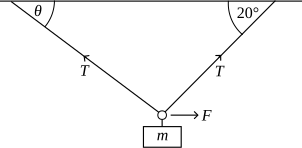
A light inextensible string is connected at each end to horizontal ceiling, as shown in the diagram. A mass of \(m\) kilograms hangs from a smooth ring on the string.

A horizontal force of \(F\) newtons is applied to the string until the tension in the string equals \(T\) and is constant across the whole system. At one end, the string makes an angle \(\theta\) with the ceiling and at the other end it makes an angle of \(2\theta\).
 

  1. Resolve the vertical forces to show that  \(T=\dfrac{mg}{sin\,\theta+\sin\,2\theta}\)   (1 mark)
  2. Hence, or otherwise, show  \(F=mg\Bigg( \dfrac{1-\cos\,\theta}{\sin\,\theta} \Bigg) \).   (3 marks)
Show Answers Only

a.   \(\text{See Worked Solutions}\)

b.   \(\text{See Worked Solutions}\)

Show Worked Solution

a.
                          

\(\text{Resolving forces vertically:}\)

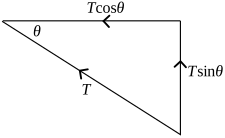
\(T \sin \theta+T \sin 2 \theta\) \(=mg\)
\(T(\sin \theta+\sin 2 \theta)\) \(=mg\)
\(T\) \(=\dfrac{m g}{\sin \theta+\sin 2 \theta}\)


b.    \(\text{Resolving forces horizontally: }\)

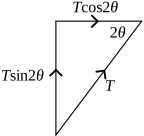
\(F+T \cos 2 \theta\) \(=T \cos \theta\)
\(F\) \(=T(\cos \theta-\cos 2 \theta)\)
  \(=\dfrac{m g\left(\cos \theta-2 \cos ^2 \theta+1\right)}{\sin \theta+2 \sin \theta \cos \theta}\)
  \(=\dfrac{m g(1-\cos \theta)(1+2 \cos \theta)}{\sin \theta(1+2 \cos \theta)}\)
  \(=mg\left(\dfrac{1-\cos \theta}{\sin \theta}\right)\)

Filed Under: Vectors, Force and Velocity (Ext1) Tagged With: Band 3, Band 5, smc-3577-20-Force

Calculus, EXT2 C2 EQ-Bank 3

  1. Find  \(\displaystyle \int \frac{1}{\sqrt{4 x-x^2}}\, d x\).   (2 marks)

    --- 5 WORK AREA LINES (style=lined) ---

  2. Determine the values of \(x\) for which the antiderivative  \(\int \dfrac{1}{\sqrt{4 x-x^2}}\, d x\)  is real and finite.     (1 mark)

    --- 3 WORK AREA LINES (style=lined) ---

Show Answers Only

a.   \(\sin ^{-1}\left(\frac{x-2}{2}\right)+c\)

b.  \(0<x<4\)

Show Worked Solution
a.     \(\displaystyle\int \frac{1}{\sqrt{4 x-x^2}}\, d x\) \(=\displaystyle\int \frac{1}{\sqrt{4-4+4 x-x^2}}\, d x\)
    \(=\displaystyle\int \frac{1}{\sqrt{4-(x-2)^2}}\, d x\)
    \(=\sin ^{-1}\left(\dfrac{x-2}{2}\right)+c\)


b.    \(4 x-x^2>0\)

\(x(4-x)>0\)

\(0<x<4\)

Filed Under: Inverse Functions Calculus (Ext1) Tagged With: Band 3, Band 5, smc-1037-30-Sin/Cos Integration

HMS, HAG EQ-Bank 33 MC

A fitness app claims to "scientifically track your wellness" but provides no details about the research behind its algorithms. When evaluating this health product, which question should be prioritised?

  1. How much does the app cost compared to similar products?
  2. What scientific evidence supports the app's health tracking claims?
  3. How many downloads has the app received from users?
  4. Does the app have an attractive and user-friendly interface design?
Show Answers Only

\(B\)

Show Worked Solution
  • B is correct: Scientific evidence validation essential for health product evaluation and safety.

Other Options:

  • A is incorrect: Cost comparison doesn’t address effectiveness or scientific validity.
  • C is incorrect: Download numbers indicate popularity, not accuracy of health claims.
  • D is incorrect: Interface design important for usability but not health effectiveness.

Filed Under: Being a critical health consumer Tagged With: Band 3, smc-5483-17-Accuracy and credibility

HMS, HAG EQ-Bank 30 MC

A health article claims that a particular herb can "cure all diseases instantly with no side effects." Which aspect of this claim should immediately raise credibility concerns?

  1. The article mentions using natural herbs rather than synthetic medications
  2. The claim promises universal benefits with no limitations or risks
  3. The article discusses health benefits of plant-based treatments
  4. The information is presented in an easy-to-read format for consumers
Show Answers Only

\(B\)

Show Worked Solution
  • B is correct: Claims of universal cures with no risks indicate lack of credibility.

Other Options:

  • A is incorrect: Natural herb discussion alone doesn’t indicate poor credibility.
  • C is incorrect: Plant-based treatment information can be legitimate and evidence-based.
  • D is incorrect: Clear formatting is positive for health communication, not credibility concern.

Filed Under: Being a critical health consumer Tagged With: Band 3, smc-5483-17-Accuracy and credibility

HMS, HAG EQ-Bank 27 MC

A young adult is considering whether to purchase a fitness tracker after seeing advertisements claiming it will "guarantee weight loss within 30 days." Which approach demonstrates informed decision making?

  1. Purchase immediately based on the advertisement's promises
  2. Ask friends on social media for their opinions only
  3. Buy the most expensive option available assuming higher cost means better results
  4. Research the product's actual features, read independent reviews, and consult healthcare advice
Show Answers Only

\(D\)

Show Worked Solution
  • D is correct: Research, independent reviews and professional consultation enable informed decisions.

Other Options:

  • A is incorrect: Advertisement claims require verification before making purchasing decisions.
  • B is incorrect: Social media opinions alone don’t provide comprehensive evidence.
  • C is incorrect: Price doesn’t guarantee effectiveness or suitability for individual needs.

Filed Under: Being a critical health consumer Tagged With: Band 3, smc-5483-12-Informed decisions

HMS, HAG EQ-Bank 25 MC

A patient receives conflicting health advice from a social media influencer and their GP about a new supplement. Which action demonstrates the BEST health information literacy skills?

  1. Always follow the social media influencer's advice as they have more followers
  2. Ignore both sources of information completely and make no decision
  3. Critically evaluate both sources by checking qualifications and evidence provided
  4. Choose the advice that sounds most appealing regardless of the source
Show Answers Only

\(C\)

Show Worked Solution
  • C is correct: Critical evaluation of sources and evidence demonstrates strong health literacy.

Other Options:

  • A is incorrect: Follower count doesn’t indicate medical expertise or credibility.
  • B is incorrect: Avoidance prevents informed decision-making about health choices.
  • D is incorrect: Appeal alone doesn’t ensure accuracy or safety.

Filed Under: Being a critical health consumer Tagged With: Band 3, smc-5483-07-Trustworthy sources

HMS, HAG EQ-Bank 17 MC

Despite Australia's strong overall health performance among OECD countries, Australia faces challenges with obesity rates ranking 10th highest. Which factor BEST explains why this particular health issue persists?

  1. Australia has no public health campaigns addressing diet and physical activity
  2. Medicare does not cover any obesity-related health services
  3. Cultural norms around food consumption and lifestyle habits contribute to obesity prevalence
  4. Australia has banned all forms of physical activity promotion
Show Answers Only

\(C\)

Show Worked Solution
  • C is correct: Cultural attitudes towards diet and lifestyle contribute to obesity challenges.

Other Options:

  • A is incorrect: Australia has various public health campaigns promoting healthy lifestyles.
  • B is incorrect: Medicare provides coverage for obesity-related health conditions.
  • D is incorrect: Australia actively promotes physical activity through various initiatives.

Filed Under: Australia vs OECD Countries Tagged With: Band 3, smc-5476-10-Health comparisons

HMS, HAG EQ-Bank 13 MC

According to Australia's Health 2024 data, Australia's life expectancy ranking among OECD countries is:

  1. First highest among all OECD countries
  2. Below the OECD average for life expectancy
  3. Tenth highest among OECD countries
  4. Fourth highest among OECD countries
Show Answers Only

\(D\)

Show Worked Solution
  • D is correct: Australia ranks fourth highest for life expectancy among 38 OECD countries.

Other Options:

  • A is incorrect: Japan has the highest life expectancy at 84.5 years.
  • B is incorrect: Fourth highest indicates well above OECD average.
  • C is incorrect: Australia ranks fourth, not tenth highest.

Filed Under: Australia vs OECD Countries Tagged With: Band 3, smc-5476-10-Health comparisons

HMS, HAG EQ-Bank 12 MC

Australia's Health 2024 data shows that First Nations people have a lower life expectancy compared to non-Indigenous Australians. Which factor is identified as a key contributor to reducing this health gap?

  1. Improving employment rates and educational attainment for First Nations people
  2. Focusing solely on genetic factors that influence health outcomes
  3. Reducing healthcare services in urban areas to fund remote programs
  4. Implementing identical health programs for all population groups regardless of cultural needs
Show Answers Only

\(A\)

Show Worked Solution
  • A is correct: Social determinants like employment and education contribute significantly to health gap.

Other Options:

  • B is incorrect: Social and environmental factors more significant than genetics.
  • C is incorrect: Reducing urban services doesn’t effectively address inequities.
  • D is incorrect: Cultural responsiveness needed, not identical programs.

Filed Under: Current Health Status Tagged With: Band 3, smc-5474-10-Inequity issues

HMS, HAG EQ-Bank 4 MC

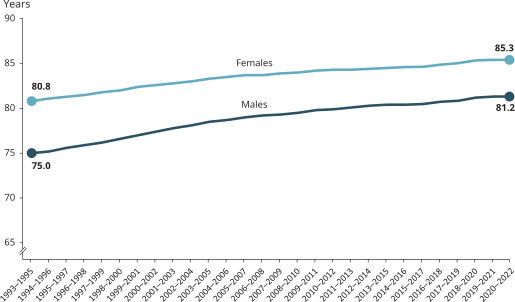
The graph below shows life expectancy trends in Australia from 1993-2022. 

Based on this data trend, which statement BEST describes what the epidemiological data reveals about recent Australian health patterns?

  1. Life expectancy has remained constant for both males and females since 1993
  2. The gender gap in life expectancy has increased significantly over this period
  3. Life expectancy steadily increased until 2020-2022 when it showed a slight decline
  4. Males consistently have higher life expectancy than females throughout this period
Show Answers Only

\(C\)

Show Worked Solution
  • C is correct: Graph shows steady increase until recent slight decline in 2020-2022.

Other Options:

  • A is incorrect: Clear upward trend visible from 1993 to 2020.
  • B is incorrect: Gender gap appears relatively stable throughout period.
  • D is incorrect: Females consistently higher than males throughout graph.

Filed Under: Current Health Status Tagged With: Band 3, smc-5474-20-Data interpretation

HMS, BM 2012 HSC 26

Describe TWO different types of motivation that can affect performance. Provide examples.   (3 marks)

--- 7 WORK AREA LINES (style=lined) ---

Show Answers Only

Any 2 of the following:

  • Intrinsic motivation involves engaging in activities for personal satisfaction and enjoyment. Athletes participate because they find the sport fulfilling and rewarding. For example, a swimmer training because they love moving through water.
  • Extrinsic motivation involves external rewards or consequences driving participation. Athletes perform to gain prizes, recognition or avoid punishment. For example, a footballer training intensively to earn team selection.
  • Positive motivation drives athletes toward desired outcomes and rewards. Athletes work to achieve success, recognition or personal goals. For example, a tennis player practising serves to win upcoming tournaments and improve rankings.
  • Negative motivation involves avoiding undesirable consequences or failure. Athletes train to prevent disappointing coaches, teammates or losing selection. For example, a cyclist training harder to avoid being dropped from the racing team.
Show Worked Solution

Any 2 of the following:

  • Intrinsic motivation involves engaging in activities for personal satisfaction and enjoyment. Athletes participate because they find the sport fulfilling and rewarding. For example, a swimmer training because they love moving through water.
  • Extrinsic motivation involves external rewards or consequences driving participation. Athletes perform to gain prizes, recognition or avoid punishment. For example, a footballer training intensively to earn team selection.
  • Positive motivation drives athletes toward desired outcomes and rewards. Athletes work to achieve success, recognition or personal goals. For example, a tennis player practising serves to win upcoming tournaments and improve rankings.
  • Negative motivation involves avoiding undesirable consequences or failure. Athletes train to prevent disappointing coaches, teammates or losing selection. For example, a cyclist training harder to avoid being dropped from the racing team.

Filed Under: Psych–Movement–Performance interplay Tagged With: Band 3, smc-5536-10-Motivation

HMS, BM 2012 HSC 25

Outline the influence of prior experience on skill acquisition.   (3 marks)

--- 9 WORK AREA LINES (style=lined) ---

Show Answers Only
  • Prior experience accelerates skill acquisition through transfer of learning from similar movements. Athletes with related sport backgrounds progress more quickly through cognitive and associative learning stages.
  • For example, hockey players learning cricket benefit from existing hand-eye coordination and striking techniques. Basketball players transitioning to netball utilise established passing and spatial awareness skills.
  • Previous movement patterns provide a foundation for new skill development. Experienced athletes demonstrate better motor control and coordination when learning related skills compared to complete beginners.
Show Worked Solution
  • Prior experience accelerates skill acquisition through transfer of learning from similar movements. Athletes with related sport backgrounds progress more quickly through cognitive and associative learning stages.
  • For example, hockey players learning cricket benefit from existing hand-eye coordination and striking techniques. Basketball players transitioning to netball utilise established passing and spatial awareness skills.
  • Previous movement patterns provide a foundation for new skill development. Experienced athletes demonstrate better motor control and coordination when learning related skills compared to complete beginners.

Filed Under: Characteristics of learners, Characteristics of skills Tagged With: Band 3, smc-5534-25-Prior experience, smc-5921-10-Cognitive, smc-5921-20-Associative

HMS, BM 2012 HSC 12 MC

During a grand final match, an athlete becomes negatively affected by the pressure and significance of the occasion.

Which of the following is the athlete experiencing?

  1. High self-esteem
  2. High concentration
  3. Trait anxiety
  4. State anxiety
Show Answers Only

\(D\)

Show Worked Solution
  • D is correct: State anxiety is situational stress response to specific events.

Other Options:

  • A is incorrect: High self-esteem would help cope with pressure.
  • B is incorrect: High concentration would improve performance under pressure.
  • C is incorrect: Trait anxiety is general personality characteristic, not situational.

Filed Under: Psych–Movement–Performance interplay Tagged With: Band 3, smc-5536-20-Self-regulation

HMS, HIC 2012 HSC 7 MC

Which of the following is a clear example of social justice principles in action?

  1. Providing children and infants with priority health care in all instances
  2. Providing public health policies that are passed by government officials
  3. Providing health materials and services that are delivered in a variety of languages
  4. Providing incentives for people of higher socioeconomic status to use private health care facilities
Show Answers Only

\(C\)

Show Worked Solution
  • C is correct: Multilingual health services demonstrate equity and access principles.

Other Options:

  • A is incorrect: Priority based on age alone isn’t equitable.
  • B is incorrect: Policy creation doesn’t demonstrate social justice implementation.
  • D is incorrect: Incentivising wealthy people contradicts equity principles.

Filed Under: Social Justice Principles Tagged With: Band 3, smc-5505-20-Equity, smc-5505-30-Access, smc-5505-55-Identify principle

HMS, HAG 2012 HSC 5 MC

Which government strategy would have the greatest potential to reduce long-term health care expenditure?

  1. Increasing spending on emergency care in hospitals
  2. Directing more expenditure towards preventative health
  3. Providing rebates to people with private health insurance
  4. Allocating greater funding to improve existing curative health services
Show Answers Only

\(B\)

Show Worked Solution
  • B is correct: Preventative health reduces disease burden and long-term treatment costs.

Other Options:

  • A is incorrect: Emergency care is expensive reactive treatment.
  • C is incorrect: Insurance rebates don’t reduce overall healthcare costs.
  • D is incorrect: Curative services treat existing conditions expensively.

Filed Under: Uncategorized Tagged With: Band 3, smc-5482-10-Healthcare v prevention

HMS, HIC 2012 HSC 1 MC

Which condition is currently the leading cause of mortality in Australia?

  1. Asthma
  2. Lung cancer
  3. Breast cancer
  4. Cardiovascular disease
Show Answers Only

\(D\)

Show Worked Solution
  • D is correct: Cardiovascular disease remains Australia’s leading cause of death.

Other Options:

  • A is incorrect: Asthma causes relatively few deaths annually.
  • B is incorrect: Major cause but not the leading one.
  • C is incorrect: Significant but affects only females primarily.

Filed Under: Health status of Australians Tagged With: Band 3, smc-5504-10-Mortality

HMS, HIC 2013 HSC 4 MC

A driver education course is an example of which area of the Ottawa Charter?

  1. Developing personal skills
  2. Building healthy public policy
  3. Strengthening community action
  4. Creating supportive environments
Show Answers Only

\(A\)

Show Worked Solution
  • A is correct: Driver education builds individual knowledge and safety skills.

Other Options:

  • B is incorrect: Policy involves legislation, not education courses.
  • C is incorrect: Community action requires collective group involvement.
  • D is incorrect: Supportive environments modify physical/social settings.

Filed Under: Models of health promotion Tagged With: Band 3, smc-5515-10-Ottawa Charter

HMS, HAG 2013 HSC 3 MC

What would a comparison of the health status of Indigenous and non­Indigenous Australians show?

  1. Non­-Indigenous Australians have higher infant mortality rates.
  2. Non­-Indigenous Australians have a lower prevalence of acute diseases.
  3. Indigenous Australians have lower hospital admission rates.
  4. Indigenous Australians have a higher prevalence of chronic diseases
Show Answers Only

\(D\)

Show Worked Solution
  • D is correct: Indigenous Australians experience significantly higher chronic disease rates.

Other Options:

  • A is incorrect: Indigenous Australians have higher infant mortality rates.
  • B is incorrect: Non-Indigenous Australians have lower chronic disease prevalence.
  • C is incorrect: Indigenous Australians have higher hospitalisation rates overall.

Filed Under: Groups Experiencing Inequities Tagged With: Band 3, smc-5475-05-Indigenous health

HMS, TIP 2014 HSC 25

Outline the post-performance dietary considerations of an endurance athlete.   (3 marks)

--- 7 WORK AREA LINES (style=lined) ---

Show Answers Only

Carbohydrate replenishment:

  • High glycaemic index foods consumed within 30 minutes post-exercise
    • Restores depleted muscle and liver glycogen stores effectively
    • Sports drinks or bananas facilitate rapid glycogen synthesis

Protein intake:

  • Consume 20-25 grams of quality protein for muscle repair
    • Lean meat, dairy or protein supplements provide essential amino acids
    • Supports muscle adaptation and reduces tissue breakdown

Rehydration:

  • Replace 2-3 litres of fluid losses from sweating
    • Water and electrolyte solutions restore cellular function
    • Proper hydration facilitates nutrient transport and waste removal
Show Worked Solution

Carbohydrate replenishment:

  • High glycaemic index foods consumed within 30 minutes post-exercise
    • Restores depleted muscle and liver glycogen stores effectively
    • Sports drinks or bananas facilitate rapid glycogen synthesis

Protein intake:

  • Consume 20-25 grams of quality protein for muscle repair
    • Lean meat, dairy or protein supplements provide essential amino acids
    • Supports muscle adaptation and reduces tissue breakdown

Rehydration:

  • Replace 2-3 litres of fluid losses from sweating
    • Water and electrolyte solutions restore cellular function
    • Proper hydration facilitates nutrient transport and waste removal

Filed Under: Dietary requirements and fluid intake Tagged With: Band 3, smc-5466-05-Dietary requirements, smc-5466-15-Timing, smc-5466-20-Fluids

HMS, HAG 2014 HSC 21

Outline TWO groups most at risk of cardiovascular disease in Australia.   (3 marks)

--- 7 WORK AREA LINES (style=lined) ---

Show Answers Only
  • Aboriginal and Torres Strait Islander people experience significantly higher rates of cardiovascular disease compared to non-Indigenous Australians. This increased risk results from higher smoking rates and increased diabetes prevalence. Limited access to healthcare services particularly affects those in remote communities.
  • People from low socioeconomic backgrounds face substantially increased CVD risk due to various interconnected factors. These include limited access to preventive healthcare and regular medical check-ups. Higher stress levels from financial pressures and poor dietary choices also contribute significantly.

Alternative groups at risk: Older people (natural ageing process increases risk), smokers (major modifiable risk factor), people with obesity (contributes to multiple CVD risk factors).

Show Worked Solution
  • Aboriginal and Torres Strait Islander people experience significantly higher rates of cardiovascular disease compared to non-Indigenous Australians. This increased risk results from higher smoking rates and increased diabetes prevalence. Limited access to healthcare services particularly affects those in remote communities.
  • People from low socioeconomic backgrounds face substantially increased CVD risk due to various interconnected factors. These include limited access to preventive healthcare and regular medical check-ups. Higher stress levels from financial pressures and poor dietary choices also contribute significantly.

Alternative groups at risk: Older people (natural ageing process increases risk), smokers (major modifiable risk factor), people with obesity (contributes to multiple CVD risk factors).

Filed Under: Chronic Conditions, Diseases and Injury Tagged With: Band 3, smc-5477-05-Cardiovascular disease, smc-5477-20-Protective factors

HMS, TIP 2014 HSC 18 MC

The graph shows results of testing an athlete’s strength for competition. These strength levels were recorded at the start of training (Weeks 1–3), right before competition (Week 6) and after a break from training (Weeks 8–12).
 

Which principle of training has the athlete displayed from Weeks 6 to 12?

  1. Peaking
  2. Overload
  3. Reversibility
  4. Progressive overload
Show Answers Only

\(C\)

Show Worked Solution
  • C is correct: Strength decreased after training stopped demonstrating reversibility principle.

Other Options:

  • A is incorrect: Peaking involves planned performance optimization not fitness loss.
  • B is incorrect: Overload requires increasing training load not stopping training.
  • D is incorrect: Progressive overload involves gradual increases not decreases in performance.

Filed Under: Principles of training Tagged With: Band 3, smc-5460-05-Adaptations

HMS, BM 2014 HSC 11 MC

A coach tells the squad that a strong performance in its next match will result in individuals being selected for a representative team.

What type of motivation is this?

  1. Positive and intrinsic
  2. Positive and extrinsic
  3. Negative and intrinsic
  4. Negative and extrinsic
Show Answers Only

\(B\)

Show Worked Solution
  • B is correct: Representative selection is external reward making it positive and extrinsic.

Other Options:

  • A is incorrect: Selection reward comes from outside so not intrinsic.
  • C is incorrect: Opportunity for selection is positive not negative motivation.
  • D is incorrect: This offers reward not punishment so positive not negative.

Filed Under: Psych–Movement–Performance interplay Tagged With: Band 3, smc-5536-10-Motivation

HMS, HAG 2014 HSC 9 MC

What is the most likely consequence of a growth in the percentage of aged people in the Australian population?

  1. Higher demand for medical services provided by hospitals
  2. Better research into the effects of medication for aged people
  3. Increased revenue from private patients in Australia’s health care sector
  4. More employment opportunities for aged people in the health care sector
Show Answers Only

\(A\)

Show Worked Solution
  • A is correct: Ageing population increases demand for hospital medical services.

Other Options:

  • B is incorrect: Research improvement isn’t a direct consequence of population ageing.
  • C is incorrect: Revenue increase isn’t the most likely primary consequence.
  • D is incorrect: Employment opportunities for aged people isn’t the main impact.

Filed Under: Impact of an Ageing Population Tagged With: Band 3, smc-5478-20-Current/future challenges

HMS, HAG 2014 HSC 7 MC

Which of the following is an environmental determinant that best explains why Indigenous Australians have a shorter life expectancy than non-Indigenous Australians?

  1. The types of illness Indigenous Australians develop are more likely to result in death.
  2. Traditional forms of medicine are no longer widely used by Indigenous Australians.
  3. Indigenous Australians are less likely to have access to primary health care and adequate treatment.
  4. Indigenous Australians have higher rates of unemployment so they cannot afford to visit the doctor regularly.
Show Answers Only

\(C\)

Show Worked Solution
  • C is correct: Limited healthcare access is an environmental determinant affecting outcomes.

Other Options:

  • A is incorrect: This describes disease outcomes not environmental determinants.
  • B is incorrect: Traditional medicine use is cultural not environmental.
  • D is incorrect: Unemployment is socioeconomic not environmental determinant.

Filed Under: Groups Experiencing Inequities Tagged With: Band 3, smc-5475-05-Indigenous health, smc-5475-10-Determinants interaction, smc-5475-15-Inequity causes

HMS, HAG 2014 HSC 2 MC

Which type of skin cancer is most closely linked to increased mortality?

  1. Solar keratosis
  2. Basal cell carcinoma
  3. Malignant melanoma
  4. Squamous cell carcinoma
Show Answers Only

\(C\)

Show Worked Solution
  • C is correct: Malignant melanoma has the highest mortality rate of skin cancers.

Other Options:

  • A is incorrect: Solar keratosis is pre-cancerous with low mortality risk.
  • B is incorrect: Basal cell carcinoma rarely metastasises or causes death.
  • D is incorrect: Squamous cell carcinoma has lower mortality than melanoma.

Filed Under: Chronic Conditions, Diseases and Injury Tagged With: Band 3, smc-5477-10-Cancer trends

HMS, BM 2015 HSC 20 MC

The table shows scores achieved by an athlete undertaking a series of tests to assess the same performance outcome. Each test was administered five times under the same conditions.

\begin{array}{|l|c|c|c|c|}
\hline & \textit{Test 1} & \textit{Test 2} & \textit{Test 3} & \textit{Test 4} \\
\hline \text{Scores} \quad & 10,10,6,4,0 & 8,8,4,4,2 & 10,8,6,4,4 & 6,6,6,6,4 \\
\hline \text{Total} & 30 & 26 & 32 & 28 \\
\hline
\end{array}

Which test is likely to have been the most reliable?

  1. Test 1
  2. Test 2
  3. Test 3
  4. Test 4
Show Answers Only

\(D\)

Show Worked Solution
  • D is correct: Test 4 shows most consistent scores with least variation.

Other Options:

  • A is incorrect: Test 1 has high variation from 0 to 10.
  • B is incorrect: Test 2 shows inconsistent results across trials.
  • C is incorrect: Test 3 has more variation than Test 4.

Filed Under: Fitness testing Tagged With: Band 3, smc-5637-70-Reliability and validity

HMS, HIC 2015 HSC 17 MC

Which combination of factors is most likely to account for the difference in life expectancy of females and males in Australia today?

  1. Males are less likely to engage in unsafe behaviours and less likely to visit a doctor regularly.
  2. Females are less likely to engage in unsafe behaviours and more likely to visit a doctor regularly.
  3. Males are more likely to work in lower risk occupations and more likely to participate in organised physical activity.
  4. Females are more likely to work in lower risk occupations and less likely to participate in organised physical activity.
Show Answers Only

\(B\)

Show Worked Solution
  • B is correct: Females have safer behaviours and better health-seeking patterns.

Other Options:

  • A is incorrect: Males are more likely to engage in unsafe behaviours.
  • C is incorrect: Males work in higher risk occupations generally.
  • D is incorrect: Females are more likely to seek medical care.

Filed Under: Biomedical and Health Behaviours, Health status of Australians Tagged With: Band 3, smc-5806-10-Health behaviours

HMS, HIC 2015 HSC 13 MC

Which of the following is a sociocultural determinant that explains the increased risk of respiratory diseases for some Australians?

  1. Being unemployed
  2. Affordability of medical care
  3. Exposure to smoking in the family
  4. Presence of hazardous chemicals at work
Show Answers Only

\(C\)

Show Worked Solution
  • C is correct: Family smoking exposure is a sociocultural determinant affecting behaviour.

Other Options:

  • A is incorrect: Unemployment is a socioeconomic not sociocultural determinant.
  • B is incorrect: Medical care affordability is socioeconomic not sociocultural.
  • D is incorrect: Workplace chemicals are environmental not sociocultural determinants.

Filed Under: Socioeconomic Tagged With: Band 3, smc-5805-80-Identify determinant

HMS, TIP 2015 HSC 5 MC

The physiological adaptation that is likely to occur from progressively overloading a strength-training program is an increase in

  1. muscle hypertrophy.
  2. cardiac muscle capacity.
  3. muscle contraction speed.
  4. the number of fast twitch muscle fibres.
Show Answers Only

\(A\)

Show Worked Solution
  • A is correct: Progressive overload in strength training causes muscle hypertrophy.

Other Options:

  • B is incorrect: Cardiac adaptations occur primarily with aerobic training.
  • C is incorrect: Contraction speed relates to power training, not hypertrophy.
  • D is incorrect: Fibre type numbers are genetically determined, not trainable.

Filed Under: Physiological adaptations and improved performance Tagged With: Band 3, smc-5461-30-Muscular adaptations

HMS, HAG 2015 HSC 3 MC

What is the most appropriate advice to give people who are making a decision about an alternative health care service or product?

  1. Investigate the credibility of the service, product and practitioner
  2. Cease the conventional medication and medical advice they have been receiving
  3. Combine alternative health care services with complementary health care products
  4. Seek recommendations from friends and family who have experienced success with alternative health care services and products
Show Answers Only

\(A\)

Show Worked Solution
  • A is correct: Critical evaluation of credibility ensures safe healthcare decisions.

Other Options:

  • B is incorrect: Ceasing conventional treatment without consultation is dangerous.
  • C is incorrect: Combining treatments without professional guidance risks interactions.
  • D is incorrect: Personal testimonials don’t guarantee safety or effectiveness.

Filed Under: Complementary Healthcare Tagged With: Band 3, smc-5489-10-Alternative treatments

HMS, TIP 2015 HSC 25

How can flexibility improve athletic performance?   (3 marks)

--- 9 WORK AREA LINES (style=lined) ---

Show Answers Only
  • Flexibility training enables athletes to achieve greater range of motion around joints during movement execution. This leads to more efficient technique patterns, such as swimmers achieving longer stroke distances through improved shoulder flexibility.
  • As a result, athletes experience reduced injury risk because flexible muscles and joints can accommodate sudden movements without exceeding normal range limits. Consequently, improved flexibility allows faster recovery between training sessions and competitions through reduced muscle tension and stiffness.
  • Therefore, enhanced flexibility contributes to optimal performance by combining technical efficiency with injury prevention, enabling consistent training participation.
Show Worked Solution
  • Flexibility training enables athletes to achieve greater range of motion around joints during movement execution. This leads to more efficient technique patterns, such as swimmers achieving longer stroke distances through improved shoulder flexibility.
  • As a result, athletes experience reduced injury risk because flexible muscles and joints can accommodate sudden movements without exceeding normal range limits. Consequently, improved flexibility allows faster recovery between training sessions and competitions through reduced muscle tension and stiffness.
  • Therefore, enhanced flexibility contributes to optimal performance by combining technical efficiency with injury prevention, enabling consistent training participation.

Filed Under: Types of training and training methods Tagged With: Band 3, smc-5459-15-Flexibility

HMS, HAG 2015 HSC 24

To what extent is access to health care facilities and services equitable for all Australians?   (8 marks)

--- 24 WORK AREA LINES (style=lined) ---

Show Answers Only

Judgment Statement

  • Access to healthcare facilities and services is moderately equitable for Australians, with significant variations across geographic location and socioeconomic status affecting system accessibility.

Geographic Access Barriers

  • Evidence supporting this includes major disparities between metropolitan and remote areas in healthcare provision. Rural and remote populations experience higher death rates and increased rates of potentially avoidable deaths compared to major cities.
  • The main factors supporting this include limited healthcare services, with very remote communities having substantially fewer non-hospital attendances than metropolitan areas. Distance, transport barriers and workforce shortages compound these access challenges.
  • This demonstrates substantial geographic inequities despite targeted interventions.

Socioeconomic Equity Measures

  • However, it is important to consider that Medicare provides universal coverage ensuring basic healthcare access regardless of financial capacity.
  • An alternative perspective is that people in lower socioeconomic areas have higher GP service attendance rates and pay lower out-of-pocket costs due to higher Medicare subsidy rates.
  • Despite this, these same populations experience higher public hospitalisation rates while having lower access to specialist consultations and private healthcare services. Cultural and linguistic barriers further affect some population groups’ healthcare experiences.

Reaffirmation

  • The strengths outweigh the weaknesses because Medicare’s universal foundation provides essential healthcare access for most Australians.
  • While significant geographic and economic barriers persist, the system achieves moderate equity rather than complete disparity.
  • This represents a healthcare system that ensures basic coverage while requiring ongoing improvements to address remaining inequities across the population.
Show Worked Solution

Judgment Statement

  • Access to healthcare facilities and services is moderately equitable for Australians, with significant variations across geographic location and socioeconomic status affecting system accessibility.

Geographic Access Barriers

  • Evidence supporting this includes major disparities between metropolitan and remote areas in healthcare provision. Rural and remote populations experience higher death rates and increased rates of potentially avoidable deaths compared to major cities.
  • The main factors supporting this include limited healthcare services, with very remote communities having substantially fewer non-hospital attendances than metropolitan areas. Distance, transport barriers and workforce shortages compound these access challenges.
  • This demonstrates substantial geographic inequities despite targeted interventions.

Socioeconomic Equity Measures

  • However, it is important to consider that Medicare provides universal coverage ensuring basic healthcare access regardless of financial capacity.
  • An alternative perspective is that people in lower socioeconomic areas have higher GP service attendance rates and pay lower out-of-pocket costs due to higher Medicare subsidy rates.
  • Despite this, these same populations experience higher public hospitalisation rates while having lower access to specialist consultations and private healthcare services. Cultural and linguistic barriers further affect some population groups’ healthcare experiences.

Reaffirmation

  • The strengths outweigh the weaknesses because Medicare’s universal foundation provides essential healthcare access for most Australians.
  • While significant geographic and economic barriers persist, the system achieves moderate equity rather than complete disparity.
  • This represents a healthcare system that ensures basic coverage while requiring ongoing improvements to address remaining inequities across the population.

Filed Under: Healthcare System effectiveness Tagged With: Band 3, smc-5479-10-Access equity

HMS, HAG 2015 HSC 21

What are the advantages to Australians of having a public health care system?   (3 marks)

--- 7 WORK AREA LINES (style=lined) ---

Show Answers Only
  • Australia’s public healthcare system provides universal access to essential medical services regardless of individual financial capacity. Medicare ensures all citizens receive subsidised general practitioner consultations, with many services available through bulk billing arrangements that eliminate patient costs entirely.
  • The Pharmaceutical Benefits Scheme reduces medication expenses significantly, making prescription drugs affordable for chronic condition management. Public hospitals deliver emergency care and essential surgical procedures without direct patient charges, ensuring life-saving treatments remain accessible.
  • This system promotes health equity by removing financial barriers that might prevent timely medical intervention, supporting better population health outcomes across all socioeconomic groups.
Show Worked Solution
  • Australia’s public healthcare system provides universal access to essential medical services regardless of individual financial capacity. Medicare ensures all citizens receive subsidised general practitioner consultations, with many services available through bulk billing arrangements that eliminate patient costs entirely.
  • The Pharmaceutical Benefits Scheme reduces medication expenses significantly, making prescription drugs affordable for chronic condition management. Public hospitals deliver emergency care and essential surgical procedures without direct patient charges, ensuring life-saving treatments remain accessible.
  • This system promotes health equity by removing financial barriers that might prevent timely medical intervention, supporting better population health outcomes across all socioeconomic groups.

Filed Under: Govt and Non-Govt responsibilities Tagged With: Band 3, smc-5480-05-Government roles

HMS, BM 2016 HSC 26

Justify the psychological strategies used by athletes to enhance their motivation and to manage anxiety.   (8 marks)

--- 24 WORK AREA LINES (style=lined) ---

Show Answers Only

Position Statement

  • Psychological strategies are essential for athletic success because they directly address mental barriers that limit performance potential.
  • Goal setting, visualisation and relaxation techniques provide proven methods for optimising motivation and anxiety management.

Goal Setting Effectiveness

  • Goal setting demonstrates substantial evidence for enhancing athlete motivation through clear performance targets and achievement pathways. SMART goals provide specific, measurable objectives that maintain focus during training and competition periods.
  • Research confirms that athletes using systematic goal setting show increased training adherence and performance improvements.
  • For example, marathon runners setting progressive time targets maintain motivation throughout lengthy preparation phases.
  • This strategy works because it provides direction and measurable progress indicators that sustain long-term commitment.

Visualisation and Relaxation Benefits

  • Visualisation techniques prove highly effective for managing pre-competition anxiety whilst enhancing performance confidence levels. Mental rehearsal allows athletes to practice skills and scenarios in controlled environments before actual competition.
  • Progressive muscle relaxation reduces physical tension and cognitive anxiety that impair optimal performance execution.
  • Evidence includes tennis players using imagery to practice serve technique, resulting in improved accuracy under pressure.
  • This approach succeeds because it prepares athletes mentally while reducing physiological stress responses that interfere with skill execution.

Reinforcement

  • The evidence strongly supports implementing multiple psychological strategies to address both motivational and anxiety-related performance barriers effectively.

Show Worked Solution

Position Statement

  • Psychological strategies are essential for athletic success because they directly address mental barriers that limit performance potential.
  • Goal setting, visualisation and relaxation techniques provide proven methods for optimising motivation and anxiety management.

Goal Setting Effectiveness

  • Goal setting demonstrates substantial evidence for enhancing athlete motivation through clear performance targets and achievement pathways. SMART goals provide specific, measurable objectives that maintain focus during training and competition periods.
  • Research confirms that athletes using systematic goal setting show increased training adherence and performance improvements.
  • For example, marathon runners setting progressive time targets maintain motivation throughout lengthy preparation phases.
  • This strategy works because it provides direction and measurable progress indicators that sustain long-term commitment.

Visualisation and Relaxation Benefits

  • Visualisation techniques prove highly effective for managing pre-competition anxiety whilst enhancing performance confidence levels. Mental rehearsal allows athletes to practice skills and scenarios in controlled environments before actual competition.
  • Progressive muscle relaxation reduces physical tension and cognitive anxiety that impair optimal performance execution.
  • Evidence includes tennis players using imagery to practice serve technique, resulting in improved accuracy under pressure.
  • This approach succeeds because it prepares athletes mentally while reducing physiological stress responses that interfere with skill execution.

Reinforcement

  • The evidence strongly supports implementing multiple psychological strategies to address both motivational and anxiety-related performance barriers effectively.

Filed Under: Psych–Movement–Performance interplay Tagged With: Band 3, Band 4, smc-5536-10-Motivation

HMS, BM 2016 HSC 24

  1. Outline the stages of skill acquisition.   (3 marks)

    --- 9 WORK AREA LINES (style=lined) ---

  2. Outline, using specific examples, the types of feedback that are appropriate at each stage of skill acquisition.   (4 marks)

    --- 12 WORK AREA LINES (style=lined) ---

Show Answers Only

a.    Stages of skill acquisition

  • Cognitive stage involves beginners learning basic movement patterns with frequent errors and slow performance. Learners require significant mental concentration to understand fundamental skill requirements and movement sequences.
  • Associative stage features improved skill consistency with fewer errors and increased movement fluency. Learners can identify some mistakes and make basic corrections to their technique during practice sessions.
  • Autonomous stage demonstrates automatic skill execution with minimal conscious thought and very few errors. Learners perform skills fluently whilst focusing attention on tactical and strategic performance elements.

b.    Types of feedback

  • Cognitive stage requires external and knowledge of performance feedback to correct major technique errors. For example, a swimming coach provides verbal instructions about arm positioning during freestyle stroke practice sessions.
  • Associative stage benefits from delayed and knowledge of performance feedback allowing self-correction development. For example, a tennis player watches video footage after practice to analyse their serve technique and identify improvement areas.
  • Autonomous stage utilises internal and concurrent feedback for fine-tuning performance during skill execution. For example, an experienced basketball player feels their shooting motion and adjusts follow-through based on immediate sensory information.

Show Worked Solution

a.    Stages of skill acquisition

  • Cognitive stage involves beginners learning basic movement patterns with frequent errors and slow performance. Learners require significant mental concentration to understand fundamental skill requirements and movement sequences.
  • Associative stage features improved skill consistency with fewer errors and increased movement fluency. Learners can identify some mistakes and make basic corrections to their technique during practice sessions.
  • Autonomous stage demonstrates automatic skill execution with minimal conscious thought and very few errors. Learners perform skills fluently whilst focusing attention on tactical and strategic performance elements.

b.    Types of feedback

  • Cognitive stage requires external and knowledge of performance feedback to correct major technique errors. For example, a swimming coach provides verbal instructions about arm positioning during freestyle stroke practice sessions.
  • Associative stage benefits from delayed and knowledge of performance feedback allowing self-correction development. For example, a tennis player watches video footage after practice to analyse their serve technique and identify improvement areas.
  • Autonomous stage utilises internal and concurrent feedback for fine-tuning performance during skill execution. For example, an experienced basketball player feels their shooting motion and adjusts follow-through based on immediate sensory information.

Filed Under: Stages of learning Tagged With: Band 3, Band 4, smc-5921-10-Cognitive, smc-5921-20-Associative, smc-5921-30-Autonomous, smc-5921-90-Identify type of feedback

HMS, HIC 2016 HSC 19 MC

From December 2012, the Australian Government required all tobacco products to be sold in plain packaging.

Why did the government do this?

  1. To increase costs at the point of sale
  2. To increase taxation on tobacco products
  3. To provide a mix of strategies aimed at developing personal skills
  4. To implement a health promotion strategy directed at changing behaviour
Show Answers Only

\(D\)

Show Worked Solution
  • D is correct: Plain packaging is a health promotion strategy targeting tobacco behaviour change.

Other Options:

  • A is incorrect: Plain packaging doesn’t directly increase product costs.
  • B is incorrect: Packaging requirements don’t affect taxation levels.
  • C is incorrect: This targets population behaviour, not individual skill development.

Filed Under: Models of health promotion Tagged With: Band 3, smc-5515-20-Policy legislation

HMS, HAG 2016 HSC 13 MC

Which of the following lists the most common risk factors associated with both cardiovascular disease (CVD) and breast cancer?

  1. Ethnicity, gender, lack of physical activity
  2. Family history, smoking, low sugar intake
  3. Family history, obesity, lack of physical activity
  4. Ethnicity, high fat diet, early onset of menstruation
Show Answers Only

\(C\)

Show Worked Solution
  • C is correct: All three factors are established risk factors for both conditions.

Other Options:

  • A is incorrect: Gender is not a modifiable risk factor for both.
  • B is incorrect: Low sugar intake is protective, not a risk factor.
  • D is incorrect: Early menstruation affects breast cancer but not CVD specifically.

Filed Under: Chronic Conditions, Diseases and Injury Tagged With: Band 3, smc-5477-05-Cardiovascular disease, smc-5477-10-Cancer trends

HMS, HAG 2016 HSC 9 MC

In which list are all the factors perceived advantages of choosing private health insurance?

  1. Private room, reduced time on waiting lists, assigned medical practitioners
  2. Choice of doctor, reduced time on waiting lists, access to ancillary services
  3. Private room, decreased cost to the individual, assigned medical practitioners
  4. Choice of doctor, increased cost to the government, access to ancillary services
Show Answers Only

\(B\)

Show Worked Solution
  • B is correct: All three factors are genuine advantages of private health insurance.

Other Options:

  • A is incorrect: Medical practitioners are chosen, not assigned in private system.
  • C is incorrect: Private insurance increases costs to individuals, not decreases.
  • D is incorrect: Increased government cost isn’t an advantage to individuals.

Filed Under: Healthcare expenditure Tagged With: Band 3, smc-5482-20-Private insurance

HMS, TIP 2016 HSC 8 MC

Compared to an untrained person, a trained endurance athlete is likely to have a

  1. lower resting heart rate.
  2. higher resting heart rate.
  3. increased fast-twitch fibre concentration.
  4. decreased fast-twitch fibre concentration.
Show Answers Only

\(A\)

Show Worked Solution
  • A is correct: Endurance training strengthens the heart, reducing resting heart rate.

Other Options:

  • B is incorrect: Training decreases resting heart rate, doesn’t increase it.
  • C is incorrect: Endurance training develops slow-twitch fibres, not fast-twitch.
  • D is incorrect: While relatively decreased, absolute numbers don’t significantly change.

Filed Under: Physiological adaptations and improved performance Tagged With: Band 3, smc-5461-10-Cardio adaptations

HMS, HIC 2016 HSC 1 MC

Immunisation information is provided in a range of languages.

Which of the following best relates to the principle of social justice that is being applied in this case?

  1. Reducing equity
  2. Recognising diversity
  3. Reorienting health services
  4. Establishing supportive environments
Show Answers Only

\(B\)

Show Worked Solution
  • B is correct: Providing multilingual information acknowledges cultural and linguistic diversity.

Other Options:

  • A is incorrect: This would increase equity, not reduce it.
  • C is incorrect: This is an Ottawa Charter action area.
  • D is incorrect: This is an Ottawa Charter action area.

Filed Under: Social Justice Principles Tagged With: Band 3, smc-5505-55-Identify principle

HMS, HAG 2017 HSC 12 MC

In Australia, women have a higher health status than men.

What is the most likely reason for this?

  1. Females are more likely to seek medical assistance than males
  2. Females have much higher rates of health literacy than males
  3. The types of health care services available for males and females differ
  4. Heredity and lifestyle factors have a greater effect on males compared to females
Show Answers Only

\(A\)

Show Worked Solution
  • A is correct: Females demonstrate better help-seeking behaviours, leading to earlier intervention and better outcomes.

Other Options:

  • B is incorrect: Health literacy differences exist but are not the primary reason.
  • C is incorrect: Healthcare services are generally available to both genders equally.
  • D is incorrect: Lifestyle factors affect both genders, though patterns may differ.

Filed Under: Current Health Status Tagged With: Band 3, smc-5474-20-Data interpretation

HMS, BM 2017 HSC 9 MC

What is the nature of the skill required by a dart thrower?

  1. Open, self-paced
  2. Open, externally paced
  3. Closed, externally paced
  4. Closed, self-paced
Show Answers Only

\(D\)

Show Worked Solution
  • D is correct: Dart throwing is closed (predictable environment) and self-paced (performer controls timing).

Other Options:

  • A is incorrect: Dart throwing occurs in a predictable environment, making it closed.
  • B is incorrect: Environment is predictable (closed) and performer controls timing (self-paced).
  • C is incorrect: Dart thrower controls when to throw, making it self-paced.

Filed Under: Characteristics of skills Tagged With: Band 3, smc-5922-10-Open/Closed, smc-5922-40-Self and externally paced

  • « Previous Page
  • 1
  • …
  • 3
  • 4
  • 5
  • 6
  • 7
  • …
  • 57
  • Next Page »

Copyright © 2014–2025 SmarterEd.com.au · Log in