The quadratic equation `x^2+3x -1=0` has roots `alpha` and `beta`.
What is the value of `alpha beta+(alpha+beta)` ?
(A) `4`
(B) `2`
(C) `-4`
(D) `-2`
Aussie Maths & Science Teachers: Save your time with SmarterEd
The quadratic equation `x^2+3x -1=0` has roots `alpha` and `beta`.
What is the value of `alpha beta+(alpha+beta)` ?
(A) `4`
(B) `2`
(C) `-4`
(D) `-2`
`C`
| `alpha beta+(alpha+beta)` | `=c/a+(- b/a)` |
| `=-1-3` | |
| `=-4` |
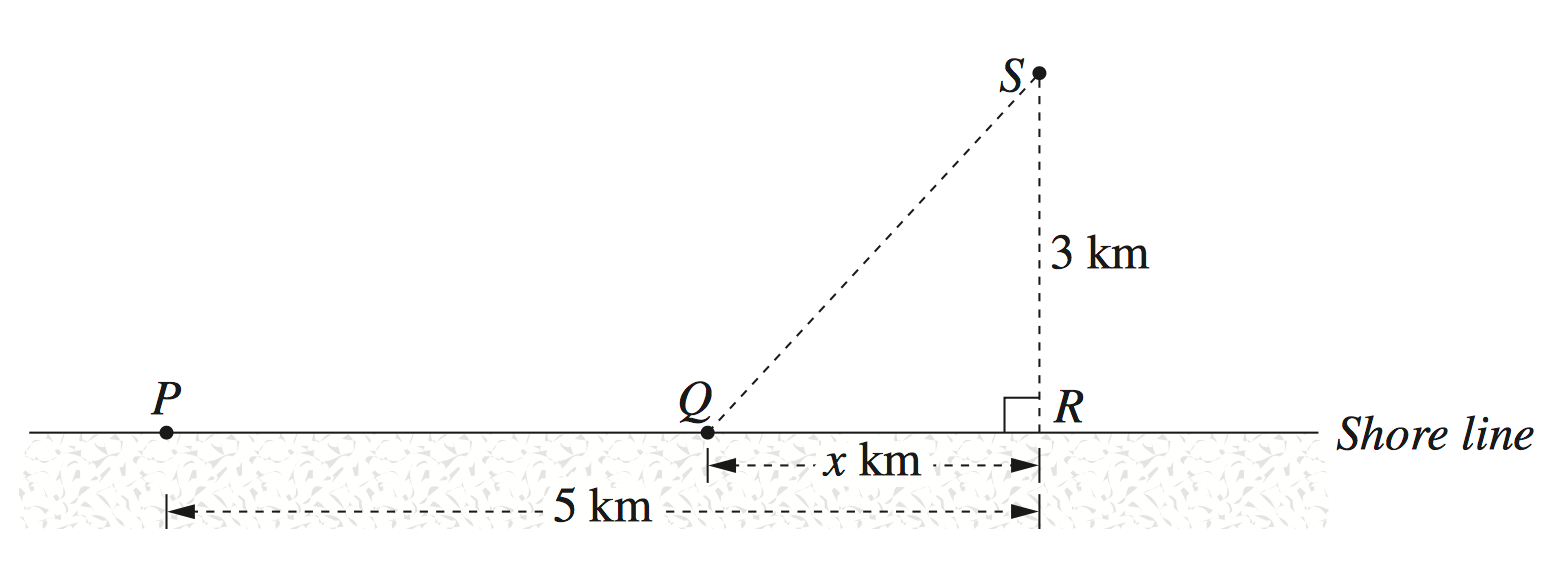
An oil rig, `S`, is 3 km offshore. A power station, `P`, is on the shore. A cable is to be laid from `P` to `S`. It costs $1000 per kilometre to lay the cable along the shore and $2600 per kilometre to lay the cable underwater from the shore to `S`.
The point `R` is the point on the shore closest to `S`, and the distance `PR` is 5 km.
The point `Q` is on the shore, at a distance of `x` km from `R`, as shown in the diagram.
--- 2 WORK AREA LINES (style=lined) ---
--- 5 WORK AREA LINES (style=lined) ---
--- 8 WORK AREA LINES (style=lined) ---
Determine the path for laying the cable in order to minimise the cost in this case. (2 marks)
--- 5 WORK AREA LINES (style=lined) ---
a. `$12\ 800`
b. `$15\ 160`
c. `text{Proof (See Worked Solutions)}`
d. `$12\ 200`
e. `P\ text(to)\ S\ text(in a straight line.)`
| a. `text(C)text(ost)` | `=(PRxx1000)+(SRxx2600)` |
| `=(5xx1000)+(3xx2600)` | |
| `=12\ 800` |
`:. text(C)text(ost is)\ $12\ 800`
b. `text(C)text(ost)=PSxx2600`
`text(Using Pythagoras:)`
| `PS^2` | `=PR^2+SR^2` |
| `=5^2+3^2` | |
| `=34` | |
| `PS` | `=sqrt34` |
| `:.\ text(C)text(ost)` | `=sqrt34xx2600` |
| `=15\ 160.474…` | |
| `=$15\ 160\ \ text{(nearest dollar)}` |
c. `text(Show)\ \ C=1000(5-x+2.6sqrt(x^2+9))`
`text(C)text(ost)=(PQxx1000)+(QSxx2600)`
| `PQ` | `=5-x` |
| `QS^2` | `=QR^2+SR^2` |
| `=x^2+3^2` | |
| `QS` | `=sqrt(x^2+9)` |
| `:.C` | `=(5-x)1000+sqrt(x^2+9)\ (2600)` |
| `=1000(5-x+2.6sqrt(x^2+9))\ \ text(… as required)` |
d. `text(Find the MIN cost of laying the cable)`
| `C` | `=1000(5-x+2.6sqrt(x^2+9))` |
| `(dC)/(dx)` | `=1000(–1+2.6xx1/2xx2x(x^2+9)^(–1/2))` |
| `=1000(–1+(2.6x)/(sqrt(x^2+9)))` |
`text(MAX/MIN when)\ (dC)/(dx)=0`
`1000(–1+(2.6x)/(sqrt(x^2+9)))=0`
| `(2.6x)/sqrt(x^2+9)` | `=1` |
| `2.6x` | `=sqrt(x^2+9)` |
| `(2.6)^2x^2` | `=x^2+9` |
| `x^2(2.6^2-1)` | `=9` |
| `x^2` | `=9/5.76` |
| `=1.5625` | |
| `x` | `=1.25\ \ \ \ (x>0)` |
`text(If)\ \ x=1,\ \ (dC)/(dx)<0`
`text(If)\ \ x=2,\ \ (dC)/(dx)>0`
`:.\ text(MIN when)\ \ x=1.25`
| `C` | `=1000(5-1.25+2.6sqrt(1.25^2+9))` |
| `=1000(122)` | |
| `=12\ 200` |
`:.\ text(MIN cost is)\ $12\ 200\ text(when)\ x=1.25`
e. `text(Underwater cable now costs $1100 per km)`
| `=>\ C` | `=1000(5-x)+1100sqrt(x^2+9)` |
| `=1000(5-x+1.1sqrt(x^2+9))` | |
| `(dC)/(dx)` | `=1000(–1+1.1xx1/2xx2x(x^2+9)^(-1/2))` |
| `=1000(–1+(1.1x)/sqrt(x^2+9))` |
`text(MAX/MIN when)\ (dC)/(dx)=0`
| `1000(–1+(1.1x)/sqrt(x^2+9))` | `=0` |
| `(1.1x)/sqrt(x^2+9)` | `=1` |
| `1.1x` | `=sqrt(x^2+9)` |
| `1.1^2x^2` | `=x^2+9` |
| `x^2(1.1^2-1)` | `=9` |
| `x^2` | `=9/0.21` |
| `x` | `~~6.5\ text{km (to 1 d.p.)}` |
| `=>\ text(no solution since)\ x<=5` |
`text(If we lay cable)\ PR\ text(then)\ RS`
`=>\ text(C)text(ost)=5xx1100+3xx1000=8500`
`text(If we lay cable directly underwater via)\ PS`
`=>\ text(C)text(ost)=sqrt34xx1100=6414.047…`
`:.\ text{MIN cost is $6414 by cabling directly from}\ P\ text(to)\ S`.
The diagram shows the trajectory of a ball thrown horizontally, at speed `v` m/s, from the top of a tower `h` metres above the ground level.
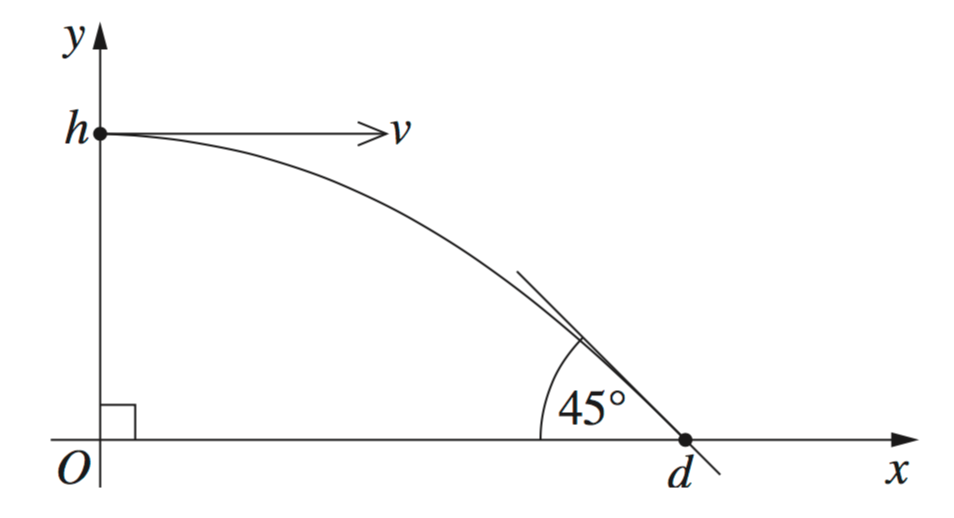
The ball strikes the ground at an angle of 45°, `d` metres from the base of the tower, as shown in the diagram. The equations describing the trajectory of the ball are
`x=vt` and `y=h-1/2 g t^2`, (DO NOT prove this)
where `g` is the acceleration due to gravity, and `t` is time in seconds.
--- 3 WORK AREA LINES (style=lined) ---
--- 7 WORK AREA LINES (style=lined) ---
i. `text(Show)\ \ y=0\ \ text(when)\ t=sqrt((2h)/g)\ \ text(seconds:)`
| `0` | `=h-1/2 g t^2` |
| `1/2 g t^2` | `=h` |
| `t^2` | `=(2h)/g` |
| `:.t` | `=sqrt((2h)/g)\ \ text(seconds,)\ \ t>=0\ \ text(… as required)` |
ii. `text(Show that)\ d=2h`
`x=vt\ \ \ \ =>\ \ \ dotx=v`
`y=h-1/2 g t^2\ \ \ \ =>\ \ \ doty=-g t`
`text(At)\ t=sqrt((2h)/g)`,
| `doty` | `=-gxxsqrt((2h)/g)` |
| `=-sqrt(2gh)` |
`text(S)text(ince the ball strikes the ground at)\ 45^@,\ text(we know)`
| `tan45^@=` | `|\ doty\ |/dotx` |
| `1=` | `sqrt(2gh)/v` |
| `v=` | `sqrt(2gh)` |
`text(S)text(ince)\ \ x=d=vt\ \ text(when)\ \ t=sqrt((2h)/g)`
| `d` | `=sqrt(2gh)xxsqrt((2h)/g)` |
| `=sqrt((2h)^2)` | |
| `=2h\ \ text( … as required)` |
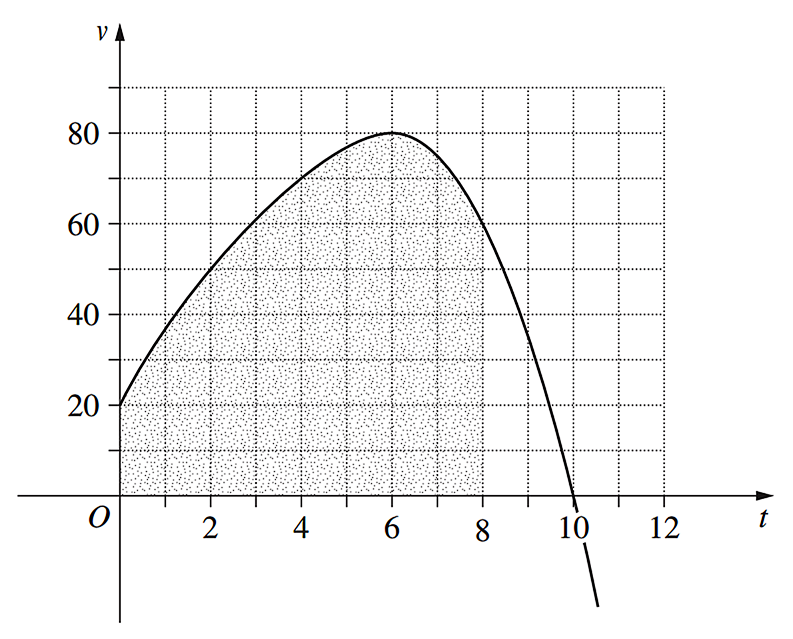
The graph shows the velocity of a particle, `v` metres per second, as a function of time, `t` seconds.
(i) `text(Find)\ v \ text(when) t=0`
`v=20\ \ text(m/s)`
(ii) `text(Particle comes to rest at)\ t=10\ text{seconds (from graph)}`
(iii) `text(Acceleration is zero when)\ t=6\ text{seconds (from graph)}`
| (iv) | |
| `text(Area)` | `~~h/3[y_0+y_n+4text{(odds)}+2text{(evens)}]` |
| `~~h/3[y_0+y_4+4(y_1+y_3)+2(y_2)]` | |
| `~~2/3[20+60+4(50+80)+2(70)]` | |
| `~~2/3[740]` | |
| `~~493 1/3` |
`:.\ text{Distance travelled is 493 1/3 m (approx.)}`
The acceleration of a particle is given by
`a=8e^(-2t)+3e^(-t)`,
where `x` is the displacement in metres and `t` is the time in seconds.
Initially its velocity is `-6\ text(ms)^(-1)` and its displacement is 5 m.
--- 5 WORK AREA LINES (style=lined) ---
--- 7 WORK AREA LINES (style=lined) ---
--- 3 WORK AREA LINES (style=lined) ---
a. `text{Proof (See Worked Solutions)}`
b. `ln4\ text(seconds)`
c. `7/8+ln4\ \ text(units)`
a. `text(Show)\ \ x=2e^(-2t)+3e^-t+t`
`a=8e^(-2t)+3e^-t\ \ text{(given)}`
`v=int a\ dt=-4e^(-2t)-3e^-t+c_1`
`text(When)\ t=0, v=-6\ \ text{(given)}`
| `-6` | `=-4e^0-3e^0+c_1` |
| `-6` | `=-7+c_1` |
| `c_1` | `=1` |
`:. v=-4e^(-2t)-3e^-t+1`
| `x` | `=int v\ dt` |
| `=int(-4e^(-2t)-3e^-t+1)\ dt` | |
| `=2e^(-2t)+3e^-t+t+c_2` |
`text(When)\ \ t=0,\ x=5\ \ text{(given)}`
| `5` | `=2e^0+3e^0+c_2` |
| `c_2` | `=0` |
`:.\ x=2e^(-2t)+3e^-t+t\ \ text(… as required)`
b. `text(Particle comes to rest when)\ \ v=0`
`text(i.e.)\ \ -4e^(-2t)-3e^-t+1=0`
`text(Let)\ X=e^-t\ \ \ \ =>X^2=e^(-2t)`
| `-4X^2-3X+1` | `=0` |
| `4X^2+3X-1` | `=0` |
| `(4X-1)(X+1)` | `=0` |
`:.\ \ X=1/4\ \ text(or)\ \ X=-1`
`text(When)\ \ X=1/4:`
| `e^-t` | `=1/4` |
| `lne^-t` | `=ln(1/4)` |
| `-t` | `=ln(1/4)` |
| `t` | `=-ln(1/4)=ln(1/4)^-1=ln4` |
`text(When)\ \ X=-1:`
`e^-t=-1\ \ text{(no solution)}`
`:.\ text(The particle comes to rest when)\ t=ln4\ text(seconds)`
c. `text(Find)\ \ x\ \ text(when)\ \ t=ln4 :`
`x=2e^(-2t)+3e^-t+t`
`\ \ =2e^(-2ln4)+3e^-ln4+ln4`
`\ \ =2(e^ln4)^-2+3(e^ln4)^-1+ln4`
`\ \ =2xx4^-2+3xx4^-1+ln4`
`\ \ =2/16+3/4+ln4`
`\ \ =7/8+ln4`
The acceleration of a particle is given by
`ddotx=4cos2t`,
where `x` is the displacement in metres and `t` is the time in seconds.
Initially the particle is at the origin with a velocity of `text(1 ms)^(–1)`.
`dotx=2sin2t+1`. (2 marks)
--- 5 WORK AREA LINES (style=lined) ---
--- 4 WORK AREA LINES (style=lined) ---
| i. `text(Show)\ dotx` | `=2sin2t+1` |
| `dotx` | `=intddotx\ dt` |
| `=int4cos2t\ dt` | |
| `=2sin2t+c` |
`text(When)\ t=0, \ \ dotx=1\ \ text{(given)}`
`1=2sin0+c`
`c=1`
`:. dotx=2sin2t+1 \ \ \ text(… as required)`
ii. `text(Find)\ t\ text(when)\ dotx=0 :`
| `2sin2t+1` | `=0` |
| `sin2t` | `=-1/2` |
`=>sin theta=1/2\ text(when)\ theta=pi/6`
`text(S)text(ince)\ \ sin theta\ \ text(is negative in 3rd and 4th quadrants)`
| `2t` | `=pi + pi/6` |
| `2t` | `=(7pi)/6` |
| `t` | `=(7pi)/12` |
`:.\ text(Particle first comes to rest at)\ t=(7pi)/12\ text(seconds)`
| iii. `x` | `=intdotx\ dt` |
| `=int(2sin2t+1)\ dt` | |
| `=t-cos2t+c` |
`text(When)\ t=0,\ x=0\ \ text{(given)}`
`0=0-cos0+c`
`c=1`
`:. x=t-cos2t+1`
The velocity of a particle is given by
`v=1-2cost`,
where `x` is the displacement in metres and `t` is the time in seconds. Initially the particle is 3 m to the right of the origin.
--- 1 WORK AREA LINES (style=lined) ---
--- 4 WORK AREA LINES (style=lined) ---
a. `-1\ text(m/s)`
b. `3\ text(m/s)`
c. `x=t-2sint+3`
d. `pi/3-sqrt3+3`
a. `text(Find)\ \ v\ \ text(when)\ \ t=0`:
| `v` | `=1-2cos0` |
| `=1-2` | |
| `=-1` |
`:.\ text(Initial velocity is)\ -1\ text(m/s.)`
b. `text(Solution 1)`
`text(Max velocity occurs when)\ \ a=(d v)/(dt)=0`
`a=2sint`
`text(Find)\ \ t\ \ text(when)\ \ a=0 :`
`2sint=0`
`t=0`, `pi`, `2pi`, …
`text(At)\ \ t=0,\ \ v=-1\ text(m/s)`
`text(At)\ \ t=pi,\ \ v=1-2(-1)=3\ text(m/s)`
`:.\ text(Maximum velocity is 3 m/s)`
`text(Solution 2)`
`v=1-2cost`
| `text(S)text(ince)\ \ -1` | `<cost<1` |
| `-2` | `<2cost<2` |
| `-1` | `<1-2cost<3` |
`:.\ text(Maximum velocity is 3 m/s)`
| c. `x` | `=int v\ dt` |
| `=int(1-2cost)\ dt` | |
| `=t-2sint+c` |
`text(When)\ \ t=0,\ \ x=3\ \ text{(given)}`
`3=0-2sin0+3`
`c=3`
`:. x=t-2sint+3`
d. `text(Find)\ \ x\ \ text(when)\ \ v=0\ \ text{(first time):}`
`text(When)\ \ v=0 ,`
| `0` | `=1-2cost` |
| `cost` | `=1/2` |
| `t` | `=cos^-1(1/2)` |
| `=pi/3\ \ \ text{(first time)}` |
`text(Find)\ \ x\ \ text(when)\ \ t=pi/3 :`
| `x` | `=pi/3-2sin(pi/3)+3` |
| `=pi/3-2xxsqrt3/2+3` | |
| `=pi/3-sqrt3+3\ \ text(units)` |
The mass `M` of a whale is modelled by
`M=36-35.5e^(-kt)`
where `M` is measured in tonnes, `t` is the age of the whale in years and `k` is a positive constant.
--- 2 WORK AREA LINES (style=lined) ---
Find the value of `k`, correct to three decimal places. (2 marks)
--- 8 WORK AREA LINES (style=lined) ---
--- 3 WORK AREA LINES (style=lined) ---
i. `M=36-35.5e^(-kt)`
`35.5e^(-kt)=36-M`
| `:. (dM)/(dt)` | `=-kxx-35.5e^(-kt)` |
| `=kxx35.5e^(-kt)` | |
| `=k(36-M)\ \ \ text(… as required)` |
ii. `text(Find)\ \ k`
`text(When)\ \ t=10,\ \ M=20`
| `M` | `=36-35.5e^(-kt)` |
| `20` | `=36-35.5e^(-10k)` |
| `35.5e^(-10k)` | `=16` |
| `lne^(-10k)` | `=ln(16/35.5)` |
| `-10k` | `=ln(16/35.5)` |
| `:. k` | `=-ln(16/35.5)/10` |
| `=0.07969…` | |
| `=0.080\ \ text{(to 3 d.p.)}` |
iii. `text(As)\ t->oo, e^(-kt)=1/e^(kt)\ ->0,\ \ k>0`
`M->36`
`:.\ text(The whale’s limiting mass is 36 tonnes.)`
A cup of coffee with an initial temperature of 80°C is placed in a room with a constant temperature of 22°C.
The temperature, `T`°C, of the coffee after `t` minutes is given by
`T=A+Be^(-kt)`,
where `A`, `B` and `k` are positive constants. The temperature of the coffee drops to 60°C after 10 minutes.
How long does it take for the temperature of the coffee to drop to 40°C? Give your answer to the nearest minute. (3 marks)
--- 8 WORK AREA LINES (style=lined) ---
`text(28 minutes)`
`T=A+Be^(-kt)`
`text(S)text(ince constant room temp is)\ 22°text(C)“=>\ A=22`
`T=22+Be^(-kt)`
`text(At)\ \ t=0,\ T=80`
`80=22+Be^0`
`=>\ B=58`
`:.\ T=22+58e^(-kt)`
`text(At)\ \ t=10,\ T=60`
| `60` | `=22+58e^(-10k)` |
| `58e^(-10k)` | `=38` |
| `e^(-10k)` | `=38/58` |
| `lne^(-10k)` | `=ln(38/58)` |
| `-10k` | `=ln(38/58)` |
| `:.\ k` | `=-1/10ln(38/58)` |
`text(Find)\ \ t\ \ text(when)\ T=40°text(C) :`
| `40` | `=22+58e^(-kt)` |
| `58e^(-kt)` | `=18` |
| `-kt` | `=ln(18/58)` |
| `t` | `=-ln(18/58)/k,\ \ text(where) \ k=–1/10ln(38/58)` |
| `=10 xx ln(18/58)/ln(38/58)` | |
| `=27.6706…` | |
| `=28\ text{mins (nearest minute)}` |
`:.\ text(It takes 28 minutes to cool to 40°C.)`
Light intensity is measured in lux. The light intensity at the surface of a lake is 6000 lux. The light intensity, `I` lux, a distance `s` metres below the surface of the lake is given by
`I=Ae^(-ks)`
where `A`, and `k` are constants.
--- 2 WORK AREA LINES (style=lined) ---
--- 6 WORK AREA LINES (style=lined) ---
i. `I=Ae^(-ks)`
`text(Find)\ A,\ text(given)\ I=6000\ text(at)\ s=0`
| `6000` | `=Ae^0` |
| `:.\ A` | `=6000` |
ii. `text(Find)\ k\ text(given)\ I=1000\ text(at) s=6`
| `1000` | `=6000e^(-6xxk)` |
| `e^(-6k)` | `=1/6` |
| `lne^(-6k)` | `=ln(1/6)` |
| `-6k` | `=ln(1/6)` |
| `k` | `=- 1/6 ln(1/6)` |
| `=0.2986…` | |
| `=0.30\ \ \ text{(2 d.p.)}` |
iii. `text(Find)\ \ (dI)/(ds)\ \ text(at)\ \ s=6`
| `I` | `=6000e^(-ks)` |
| `:.(dI)/(ds)` | `=-6000ke^(-ks)` |
`text(At)\ s=6,`
| `(dI)/(ds)` | `=-6000ke^(-6k),\ \ \ text(where)\ k=- 1/6 ln(1/6)` |
| `=-298.623…` | |
| `=-299\ \ text{(nearest whole number)}` |
`:. text(At)\ s=6,\ text(the light intensity is decreasing)`
`text(at 299 lux per metre.)`
Radium decays at a rate proportional to the amount of radium present. That is, if `Q(t)` is the amount of radium present at time `t`, then `Q=Ae^(-kt)`, where `k` is a positive constant and `A` is the amount present at `t=0`. It takes 1600 years for an amount of radium to reduce by half.
--- 6 WORK AREA LINES (style=lined) ---
How many years will it be before the amount of radium reaches the safe level. (2 marks)
--- 6 WORK AREA LINES (style=lined) ---
i. `Q=Ae^(-kt)`
`text(When)\ \ t=0,\ \ Q=A`
`text(When)\ \ t=1600,\ \ Q=1/2 A`
| `:.1/2 A` | `=A e^(-1600xxk)` |
| `e^(-1600xxk)` | `=1/2` |
| `lne^(-1600xxk)` | `=ln(1/2)` |
| `-1600k` | `=ln(1/2)` |
| `k` | `=(-ln(1/2))/1600` |
| `=0.0004332\ \ text{(to 4 sig. figures)}` |
ii. `text(Find)\ \ t\ \ text(when)\ \ Q=1/3 A :`
| `1/3 A` | `=A e^(-kt)` |
| `e^(-kt)` | `=1/3` |
| `lne^(-kt)` | `=ln(1/3)` |
| `-kt` | `=ln(1/3)` |
| `:.t` | `=(-ln(1/3))/k,\ \ \ text(where)\ \ \ k=(-ln(1/2))/1600` |
| `=(ln(1/3) xx1600)/ln(1/2)` | |
| `=2535.940…` |
`:.\ text(It will take 2536 years.)`
Professor Smith has a colony of bacteria. Initially there are 1000 bacteria. The number of bacteria, `N(t)`, after `t` minutes is given by
`N(t)=1000e^(kt)`.
Show that `k=0.0347` correct to four decimal places. (1 mark)
--- 4 WORK AREA LINES (style=lined) ---
--- 2 WORK AREA LINES (style=lined) ---
--- 5 WORK AREA LINES (style=lined) ---
--- 7 WORK AREA LINES (style=lined) ---
i. `N=1000e^(kt)\ text(and given)\ N=2000\ text(when)\ t=20`
| `2000` | `=1000e^(20xxk)` |
| `e^(20k)` | `=2` |
| `lne^(20k)` | `=ln2` |
| `20k` | `=ln2` |
| `:.k` | `=ln2/20` |
| `=0.0347\ \ text{(to 4 d.p.) … as required}` |
ii. `text(Find)\ \ N\ \ text(when)\ t=120`
| `N` | `=1000e^(120xx0.0347)` |
| `=64\ 328.321..` | |
| `=64\ 328\ \ text{(nearest whole number)}` |
`:.\ text(There are)\ 64\ 328\ text(bacteria when t = 120.)`
iii. `text(Find)\ (dN)/(dt)\ text(when)\ t=120`
| `(dN)/(dt)` | `=0.0347xx1000e^(0.0347t)` |
| `=34.7e^(0.0347t)` |
`text(When)\ \ t=120`
| `(dN)/(dt)` | `=34.7e^(0.0347xx120)` |
| `=2232.1927…` | |
| `=2232\ \ text{(nearest whole)}` |
`:.\ (dN)/(dt)=2232\ text(bacteria per minute at)\ t=120`
iv. `text(Find)\ \ t\ \ text(such that)\ N=100,000`
| `=>100\ 000` | `=1000e^(0.0347t)` |
| `e^(0.0347t)` | `=100` |
| `lne^(0.0347t)` | `=ln100` |
| `0.0347t` | `=ln100` |
| `t` | `=ln100/0.0347` |
| `=132.7138…` | |
| `=133\ \ text{(nearest minute)}` |
`:.\ N=100\ 000\ text(when)\ t=133\ text(minutes.)`
Trout and carp are types of fish. A lake contains a number of trout. At a certain time, 10 carp are introduced into the lake and start eating the trout. As a consequence, the number of trout, `N`, decreases according to
`N=375-e^(0.04t)`,
where `t` is the time in months after the carp are introduced.
The population of carp, `P`, increases according to `(dP)/(dt)=0.02P`.
--- 2 WORK AREA LINES (style=lined) ---
--- 6 WORK AREA LINES (style=lined) ---
--- 10 WORK AREA LINES (style=lined) ---
--- 8 WORK AREA LINES (style=lined) ---

i. `text(Carp introduced at)\ \ t=0`
`N=375-e^0=374`
`:.\ text(There was 374 trout when carp were introduced.)`
ii. `text(Trout population will be zero when)`
| `N` | `=375-e^(0.04t)=0` |
| `e^(0.04t)` | `=375` |
| `0.04t` | `=ln375` |
| `t` | `=ln375/0.04` |
| `=148.173 …` | |
| `=148\ text{months (nearest month)}` |
`:.\ text(After 148 months, the trout population will be zero.)`
| iii. | ![]() |
iv. `text(We need) \ |(dN)/(dt)|=(dP)/(dt)`
`text(Given)\ N=375-e^(0.04t)`
`(dN)/(dt)=-0.04e^(0.04t)`
`text(Find)\ P\ text(in terms of)\ t`
`text(Given)\ (dP)/(dt)=0.02P`
`=> P=Ae^(0.02t)`
`text(Find)\ A\ \ =>text(when)\ t=0,\ P=10`
| `10` | `=Ae^0` |
| `:.A` | `=10` |
| `=>(dP)(dt)` | `=10xx0.02e^(0.02t)` |
| `=0.2e^(0.02t)` |
`text(Given that)\ \ (dP)/(dt)=|(dN)/(dt)|`
| `0.2e^(0.02t)` | `=0.04e^(0.04t)` |
| `5e^(0.02t)` | `=e^(0.04t)` |
| `e^(0.04t)/e^(0.02t)` | `=5` |
| `e^(0.04t-0.02t)` | `=5` |
| `lne^(0.02t)` | `=ln5` |
| `0.02t` | `=ln5` |
| `t` | `=ln5/0.02` |
| `=80.4719…` | |
| `=80\ text{months (nearest month)}` |
v. `text(Find)\ t\ text(when)\ N=P`
| `text(i.e.)\ \ 375-e^(0.04t)` | `=10e^(0.02t)` |
| `e^(0.04t)+10e^(0.02t)-375` | `=0` |
`text(Let)\ X=e^(0.02t),\ text(noting)\ \ X^2=(e^(0.02t))^2=e^(0.04t)`
| `:.\ X^2+10X-375` | `=0` |
| `(X-15)(X+25)` | `=0` |
`X=15\ \ text(or)\ \ –25`
`text(S)text(ince)\ X=e^(0.02t)`
| `e^(0.02t)` | `=15\ \ \ \ (e^(0.02t)>0)` |
| `lne^(0.02t)` | `=ln15` |
| `0.02t` | `=ln15` |
| `t` | `=ln15/0.02` |
| `=135.4025…` | |
| `=135\ text(months)` |
The velocity of a particle moving along the `x`-axis is given by
`v=8-8e^(-2t)`,
where `t` is the time in seconds and `x` is the displacement in metres.
--- 1 WORK AREA LINES (style=lined) ---
--- 2 WORK AREA LINES (style=lined) ---
--- 5 WORK AREA LINES (style=lined) ---
Find the value of this constant. (1 mark)
--- 2 WORK AREA LINES (style=lined) ---
--- 8 WORK AREA LINES (style=lined) ---
a. `text{Proof (See Worked Solutions)}`
b. `text{Proof (See Worked Solutions)}`
c. `text(See Worked Solutions.)`
d. `8\ text(m/s)`
e. `text(See sketch in Worked Solutions)`
a. `text(Initial velocity when)\ \ t=0`
`v=8-8e^0=0\ text(m/s)`
`:.\ text(Particle is initially at rest.)`
b. `a=d/(dt) (v)=-2xx-8e^(-2t)=16e^(-2t)`
`text(S)text(ince)\ e^(-2t)=1/e^(2t)>0\ text(for all)\ t`.
`=>\ a=16e^(-2t)=16/e^(2t)>0\ text(for all)\ t`.
`:.\ text(Acceleration is positive for all)\ \ t>0`.
c. `text{S}text{ince the particle is initially at rest, and ALWAYS}`
`text{has a positive acceleration.`
`:.\ text(It moves in a positive direction for all)\ t`.
d. `text(As)\ t->oo`, `e^(-2t)=1/e^(2t)->0`
`=>8/e^(2t)->0\ text(and)`
`=>v=8-8/e^(2t)->8\ text(m/s)`
`:.\ text(As)\ \ t->oo,\ text(velocity approaches 8 m/s.)`
| e. |
The zoom function in a software package multiplies the dimensions of an image by 1.2. In an image, the height of a building is 50 mm. After the zoom function is applied once, the height of the building in the image is 60 mm. After the second application, it is 72 mm.
--- 4 WORK AREA LINES (style=lined) ---
a. `text(215 mm)`
b. `12`
| a. | `T_1` | `=a=50` |
| `T_2` | `=ar^1=50(1.2)=60` | |
| `T_3` | `=ar^2=50(1.2)^2=72` |
`=>\ text(GP where)\ \ a=50,\ \ r=1.2`
`\ \ vdots`
| `T_9` | `=50(1.2)^8` |
| `=214.99` |
`:.\ text{Height will be 215 mm (nearest mm)}`
| b. | `T_n=ar^(n-1)` | `>400` |
| `:.\ 50(1.2)^(n-1)` | `>400` | |
| `1.2^(n-1)` | `>8` | |
| `ln 1.2^(n-1)` | `>ln8` | |
| `n-1` | `>ln8/ln1.2` | |
| `n` | `>12.405` |
`:.\ text(The height of the building in the 13th image)`
`text(will be higher than 400 mm, which is the 12th)`
`text(time the zoom would be applied.)`
A tree grows from ground level to a height of 1.2 metres in one year. In each subsequent year, it grows `9/10` as much as it did in the previous year.
Find the limiting height of the tree. (2 marks)
--- 4 WORK AREA LINES (style=lined) ---
`12\ text(m)`
`a=1.2, \ \ \ r=9/10`
`text(S)text(ince)\ \ |\ r\ |<1,`
| `S_oo` | `=a/(1-r)` |
| `=1.2/(1-(9/10))` | |
| `=12\ text(m)` |
`:.\ text(Limiting height of tree is 12 m.)`
The velocity of a particle moving along the `x`-axis is given by `dotx=10-2t`, where `x` is the displacement from the origin in metres and `t` is the time in seconds. Initially the particle is 5 metres to the right of the origin.
--- 2 WORK AREA LINES (style=lined) ---
--- 5 WORK AREA LINES (style=lined) ---
--- 6 WORK AREA LINES (style=lined) ---
i. `dotx=10-2t`
`text(Acceleration)=ddotx=d/(dx)dotx=-2`
`:.\ text(The acceleration is constant.)`
ii. `text(Particle comes to rest when)\ dotx=0`
`10-2t=0\ text(when)\ t=5`
`:.\ text(Particle comes to rest after 5 seconds.)`
iii. `text(Show)\ x=26\ text(when)\ t=7`
| `x` | `=int dotx\ dt` |
| `=int (10-2t)\ dt` | |
| `=10t -t^2+c` |
`text(Given)\ t=0\ text(when)\ x=5`
| `=> 5` | `=10(0)-0^2+c` |
| `c` | `=5` |
`:. x=10t-t^2+5`
`text(At)\ \ t=7`
| `x` | `=10(7)-7^2+5` |
| `=70-49+5` | |
| `=26` |
`:.\ text(The particle is 26 metres to the right of the origin)`
`text(after 7 seconds … as required)`
iv. `text(Find the distance travelled in the first 7 seconds:)`
`text(At)\ t=5`,
| `x` | `=10(5)-5^2+5` |
| `=50-25+5` | |
| `=30\ text(m)` |
`=>\ text{The particle travels 25 m to the right}\ (x=5\ text{to}\ 30)`
`text{then 4 m to the left}\ (x=30\ text{to}\ 26)`
`:.\ text(The total distance travelled in 7 seconds)`
`=25+4`
`=29\ text(m)`
Differentiate with respect to `x`.
`(e^x+1)^2`. (2 marks)
`2e^x(e^x+1)`
| `y` | `=(e^x+1)^2` |
| `dy/dx` | `=2(e^x+1)^1xxd/(dx) (e^x+1)` |
| `=2e^x(e^x+1)` |
Differentiate `ln(5x+2)` with respect to `x`. (2 marks)
`5/(5x+2)`
| `y` | `=ln(5x+2)` |
| `dy/dx` | `=5/(5x+2)` |
Solve `2^(2x+1)=32`. (2 marks)
`x=2`
| `2^(2x+1)` | `=32` |
| `2^(2x+1)` | `=2^5` |
| `2x+1` | `=5` |
| `:. x` | `=2` |
Differentiate `(3+e^(2x))^5`. (2 marks)
`10e^(2x)(3+e^(2x))^4`
`y=(3+e^(2x))^5`
| `(dy)/dx` | `=5(3+e^(2x))^4 xx d/(dx)(3+e^(2x))` |
| `=5(3+e^(2x))^4 xx 2e^(2x)` | |
| `=10e^(2x)(3+e^(2x))^4` |
Differentiate with respect to `x`
`(x-1)log_ex` (2 marks)
`log_ex+1-1/x`
| `y` | `=(x-1)log_ex` |
| `dy/dx` | `=1(log_ex)+(x-1)1/x` |
| `=log_ex+1-1/x` |
Find `inte^(4x+1)dx` (2 marks)
--- 2 WORK AREA LINES (style=lined) ---
`1/4e^(4x+1)+C`
`inte^(4x+1)\ dx=1/4e^(4x+1)+C`
Differentiate `x^2e^x` (2 marks)
--- 4 WORK AREA LINES (style=lined) ---
`xe^x(x+2)`
`text{Using the product rule}`
`text(Let)\ \ u=x^2,\ \ \ \ \ \ u^{\ prime}=2x`
`text(Let)\ \ v=e^x,\ \ \ \ \ \ v^{\ prime}=e^x`
| `{d(uv)}/dx` | `=u^{\ prime} v+v^{\ prime} u` |
| `=2x e^x +x^2 e^x ` | |
| `=xe^x(x+2)` |
One year ago Daniel borrowed $350 000 to buy a house. The interest rate was 9% per annum, compounded monthly. He agreed to repay the loan in 25 years with equal monthly repayments of $2937.
--- 3 WORK AREA LINES (style=lined) ---
Daniel has just made his 12th monthly repayment. He now owes $346 095. The interest rate now decreases to 6% per annum, compounded monthly.
The amount `$A_n`, owing on the loan after the `n`th monthly repayment is now calculated using the formula
`qquad qquad A_n=346,095xx1.005^n-1.005^(n-1)M-\ ... -1.005M-M`
where `$M` is the monthly repayment, and `n=1,2,\ ...,288`. (DO NOT prove this formula.)
--- 8 WORK AREA LINES (style=lined) ---
--- 5 WORK AREA LINES (style=lined) ---
a. `$349\ 688`
b. `$2270.31\ \ text{(nearest cent)}`
c. `178.37\ text(months)`
d. `$129\ 976.59\ \ text{(nearest cent)}`
a. `text(Let)\ L_n= text(the amount owing after)\ n\ text(months)`
`text(Repayment)\ =M=$2937\ \ text(and)\ \ r=text(9%)/12=0.0075\ text(/month)`
| `:.\ L_1` | `=350\ 000(1+r)-M` |
| `=350\ 000(1.0075)-2937` | |
| `=349\ 688` |
`:.\ text(After 1 month, the amount owing is)\ $349\ 688`
b. `text(After 12 repayments, Daniel owes)\ $346\ 095,\ text(and)\ r darr 6%`
`:.\ r=(6%)/12=0.005`
`text(Loan is repaid over the next 24 years. i.e.)\ $A_n=0\ text(when)\ n=288`
| `A_n` | `=346\ 095(1.005^n)-1.005^(n-1)M-\ ..\ -1.005M-M` |
| `=346\ 095(1.005^n)-M(1+1.005+..+1.005^(n-1))` | |
| `A_288` | `=346\ 095(1.005^288)-M(1+1.005+..+1.005^287)=0` |
`=>\ GP\ text(where)\ a=1,\ text(and)\ r=1.005`
`M((1(1.005^288-1))/(1.005-1))=346\ 095(1.005^288)`
| `M` | `=(1\ 455\ 529.832)/641.1158` |
| `=2270.31` |
`:.\ text{Monthly repayment is $2270.31 (nearest cent)}`
c. `text(Given)\ $M\ text(remains at $2937, find)\ n\ text(such that)`
`$A_n=0\ text{(i.e. loan fully paid off)}`
| `:. 346\ 095(1.005^n)-2937((1(1.005^n-1))/(1.005-1))` | `=0` |
| `346\ 095(1.005^n)-587\ 400(1.005^n-1)` | `=0` |
| `(346\ 095-587\ 400)(1.005^n)+587\ 400` | `=0` |
| `241\ 305(1.005^n)` | `=587\ 400` |
| `ln1.005^n` | `=ln((587\ 400)/(241\ 305))` |
| `n` | `=ln2.43426/ln1.005` |
| `=178.37..` |
`:.\ text{He will pay off the loan in 179 months (note the}`
`text{last payment will be a partial payment).}`
d. `text(Total paid at $2937 per month)`
`= 2937xx178.37=$523\ 872.69`
`text(Total paid at $2270.31 per month)`
`=2270.31xx288=$653,849.28`
`:.\ text(The amount saved)`
`=653\ 849.28-523\ 872.69`
`=$129\ 976.59\ \ text{(nearest cent)}`
An arithmetic series has 21 terms. The first term is 3 and the last term is 53.
Find the sum of the series. (2 marks)
`588`
| `S_n` | `=n/2 (a+l)` |
| `S_21` | `=21/2(3+53)` |
| `=588` |
Evaluate `sum_(k=1)^4 (-1)^kk^2`. (2 marks)
`10`
`sum_(k=1)^4 (-1)^kk^2`
`=(-1)^1 xx 1^2+(-1)^2 xx 2^2+(-1)^3 xx 3^2+(-1)^4 xx 4^2`
`=-1+4-9+16`
`=10`
Susanna is training for a fun run by running every week for 26 weeks. She runs 1 km in the first week and each week after that she runs 750 m more than the previous week, until she reaches 10 km in a week. She then continues to run 10 km each week.
--- 3 WORK AREA LINES (style=lined) ---
--- 4 WORK AREA LINES (style=lined) ---
a. `7\ text(km)`
b. `13 text(th week)`
c. `201.5\ text(km)`
a. `T_1=a=1`
`T_2=a+d=1.75`
`T_3=a+2d=2.50`
`=>\ text(AP where)\ a=1 \ \ d=0.75`
`\ \ vdots`
| `T_9` | `=a+8d` |
| `=1+8(0.75)` | |
| `=7` |
`:.\ text(Susannah runs 7 km in the 9th week.)`
b. `text(Find)\ n\ text(such that)\ T_n=10\ text(km)`
`text(Using)\ T_n=a+(n-1)d`
| `1+(n-1)(0.75)` | `=10` |
| `0.75n-0.75` | `=9` |
| `n` | `=9.75/0.75` |
| `=13` |
`:.\ text(Susannah runs 10 km for the first time in the 13th Week.)`
c. `text{Let D = the total distance Susannah runs in 26 weeks}`
| `text(D)` | `=S_13+13(10)` |
| `=n/2[2a+(n-1)d]+13(10)` | |
| `=13/2[2(1)+(13-1)(0.75)]+130` | |
| `=13/2(2+9)+130` | |
| `=201.5` |
`:.\ text(Susannah runs a total of 201.5 km in 26 weeks.)`
Find the limiting sum of the geometric series ..
`1\ -1/3\ +1/9\ -1/27\ ...` (2 marks)
--- 4 WORK AREA LINES (style=lined) ---
`3/4`
`a=1`
`r=T_2/T_1=(-1/3)/1=- 1/3`
`text(S)text(ince)\ |\ r\ |<1,`
| `:. S_oo` | `=a/(1-r)` |
| `=1/(1-(-1/3))` | |
| `=3/4` |
A skyscraper of 110 floors is to be built. The first floor to be built will cost $3 million. The cost of building each subsequent floor will be $0.5 million more than the floor immediately below.
--- 4 WORK AREA LINES (style=lined) ---
a. `$15\ text(million)`
b. `$3327.5\ text(million)`
| a. `T_1` | `=a=3` |
| `T_2` | `=a+d=3.5` |
| `T_3` | `=a+2d=4` |
`=>\ text(AP where)\ \ a=3\ \ d=0.5`
| `T_25` | `=a+24d` |
| `=3+24(0.5)` | |
| `=15` |
`:.\ text(The 25th floor costs)\ $15\ 000\ 000.`
| b. `S_110` | `=\ text(Total cost of 110 floors)` |
| `=n/2(2a+(n-1)d)` | |
| `=110/2(2xx3\ 000\ 000+(110-1)500\ 000)` | |
| `=55(6\ 000\ 000+49\ 500\ 000)` | |
| `=$3327.5\ text(million)` |
`:.\ text{The total cost of 110 floors is $3327.5 million}`
Rectangles of the same height are cut from a strip and arranged in a row. The first rectangle has width 10cm. The width of each subsequent rectangle is 96% of the width of the previous rectangle.
--- 5 WORK AREA LINES (style=lined) ---
--- 2 WORK AREA LINES (style=lined) ---
a. `83.8\ text{cm (1 d.p.)}`
b. `S_oo=2.5\ text(m)\ \ =>\ \ text(sufficient.)`
| a. `T_1` | `=a=10` |
| `T_2` | `=ar=10xx0.96=9.6` |
| `T_3` | `=ar^2=10xx0.96^2=9.216` |
`=>\ text(GP where)\ \ a=10\ \ text(and)\ \ r=0.96`
| `S_10` | `=\ text(Length of strip for 10 rectangles)` |
| `=(a(1-r^n))/(1-r)` | |
| `=10((1-0.96^10)/(1-0.96))` | |
| `=83.8\ text{cm (to 1 d.p.)}` |
b. `text(S)text(ince)\ |\ r\ |<\ 1`
| `S_oo` | `=a/(1-r)` |
| `=10/(1-0.96)` | |
| `=250\ text(cm)` |
`:.\ text(S)text(ince 3 m > 2.5 m, it is sufficient.)`
Pat and Chandra are playing a game. They take turns throwing two dice. The game is won by the first player to throw a double six. Pat starts the game.
--- 2 WORK AREA LINES (style=lined) ---
--- 5 WORK AREA LINES (style=lined) ---
a. `1/36`
b. `(2521)/(46\ 656)\ \ text(or)\ \ 0.054`
c. `36/71`
a. `P\ text{(Pat wins on 1st throw)}=P(W)`
| `P(W)` | `=P\ text{(Pat throws 2 sixes)}` |
| `=1/6 xx 1/6` | |
| `=1/36` |
b. `text(Let)\ P(L)=P text{(loss for either player on a throw)}=35/36`
`P text{(Pat wins on 1st or 2nd throw)}`
`=P(W) + P(LL W)`
`=1/36\ + \ (35/36)xx(35/36)xx(1/36)`
`=(2521)/(46\ 656)`
`=0.054\ \ \ text{(to 3 d.p.)}`
c. `P\ text{(Pat wins eventually)}`
`=P(W) + P(LL\ W)+P(LL\ LL\ W)+ … `
`=1/36\ +\ (35/36)^2 (1/36)\ +\ (35/36)^2 (35/36)^2 (1/36)\ +…`
`=>\ text(GP where)\ \ a=1/36,\ \ r=(35/36)^2=(1225)/(1296)`
`text(S)text(ince)\ |\ r\ |<\ 1:`
| `S_oo` | `=a/(1-r)` |
| `=(1/36)/(1-(1225/1296))` | |
| `=1/36 xx 1296/71` | |
| `=36/71` |
`:.\ text(Pat’s chances to win eventually are)\ 36/71`.