SmarterEd

Aussie Maths & Science Teachers: Save your time with SmarterEd

  • Login
  • Get Help
  • About

Trigonometry, 2ADV T3 2016 HSC 6 MC

What is the period of the function  `f(x) = tan (3x)?`

  1. `pi/3`
  2. `(2 pi)/3`
  3. `3 pi`
  4. `6 pi`
Show Answers Only

`A`

Show Worked Solution
♦ Mean mark 42%.
`text(Period)` `= pi/n`
  `= pi/3`

`=>  A`

Filed Under: Trig graphs, Trig Graphs (Y12) Tagged With: Band 5, smc-977-30-tan

Functions, 2ADV F1 2016 HSC 4 MC

Which diagram shows the graph of an odd function?
 

hsc-2016-4mci

hsc-2016-4mcii

Show Answers Only

`A`

Show Worked Solution

`text(Odd functions occur when:)`

♦ Mean mark 38%.

`f(x) = – f(x)`

`text(Graphically, this occurs when a function has)`

`text(symmetry when rotated 180° about the origin.)`

`=>  A`

Filed Under: 4. Real Functions, Further Functions and Relations (Y11), Quadratics and Cubic Functions (Adv-2027) Tagged With: Band 5, smc-6215-10-Quadratics, smc-6215-75-Odd/Even Functions, smc-987-70-Odd/even functions

Calculus, MET1 2006 VCAA 9

A rectangle `XYZW` has two vertices, `X` and `W`, on the `x`-axis and the other two vertices, `Y` and `Z`, on the graph of  `y = 9-3x^2`, as shown in the diagram below. The coordinates of `Z` are `(a, b)` where `a` and `b` are positive real numbers.

vcaa-2006-meth-9a

  1. Find the area, `A`, of rectangle `XYZW` in terms of `a`.   (1 mark)

    --- 3 WORK AREA LINES (style=lined) ---

  2. Find the maximum value of `A` and the value of `a` for which this occurs.   (3 marks)

    --- 7 WORK AREA LINES (style=lined) ---

Show Answers Only
  1. `A = 18a-6a^3`
  2. `A_max = 12\ text(u² when)\ \ a = 1`
Show Worked Solution
♦ Mean mark 37%.
a.    `A` `=\ text(length × height)`
    `=2a (9-3a^2)`
    `= 18a-6a^3`


b.   `text(Stationary point when)\ \ (dA)/(da) = 0`

♦♦ Mean mark 29%.
`18-18 a^2` `=0`
`a^2` `=1`
`a` `=  1,\ \ \ \ \ a > 0`

 
`text(Find)\ \ A\ \ text(when)\ \ \ a = 1:`

`A = 18 (1)-6 (1)^3 = 12`
 

`:. A_max = 12\ text(u²  when)\ \ a = 1`

Filed Under: Maxima and Minima Tagged With: Band 5, smc-641-10-Area

Calculus, MET1 2006 VCAA 8

A normal to the graph of  `y = sqrt x`  has equation  `y = -4x + a`, where `a` is a real constant. Find the value of `a.`   (4 marks)

--- 10 WORK AREA LINES (style=lined) ---

Show Answers Only

`a = 18`

Show Worked Solution

`text(Normal) = text(line) _|_ text(to tangent)`

♦ Mean mark 40%.

`m_{text(norm)}=-4\ \ => \ m_tan=1/4`

`y=sqrt x\ \ => \ dy/dx=1/2 x^(-1/2)`

`text(Find)\ x\ text(when:)`

`1/(2 sqrt x)` `=1/4`
`sqrt x` `=2`
`x` `=4`


`:.\ text(Point of tangency is)\ \ (4, 2)`
 

`text(Find equation of normal:)`

`y-y_1` `= m (x-x_1)`
`y-2` `= -4(x-4)`
`:. y` `= -4x + 18`
`:. a` `= 18`

Filed Under: Tangents and Normals Tagged With: Band 5, smc-634-40-Other Function, smc-634-90-Normals

Probability, MET1 2006 VCAA 6

The probability density function of a continuous random variable `X` is given by
 

`f(x) = {(x/12,\ \ 1 <= x <= 5), (\ 0,\ \  text(otherwise)):}`
 

  1. Find  `text(Pr) (X < 3)`  (2 marks)

    --- 5 WORK AREA LINES (style=lined) ---

  2. If  `text(Pr) (X >= a) = 5/8`, find the value of `a`.  (2 marks)

    --- 5 WORK AREA LINES (style=lined) ---

Show Answers Only

  1. `1/3`
  2. `sqrt 10`

Show Worked Solution

a.   `text(Pr) (X < 3)`

`= int_1^3 1/12x\ dx`

`= 1/12 [1/2 x^2]_1^3`

`= 1/24 [3^2 – 1^2]`

`= 1/3`


b.   `text(Pr) (X >= a) = 5/8`

♦ Mean mark 47%.

`int_a^5 x/12\ dx` `= 5/8`
`1/24 [x^2]_a^5` `= 5/8`
`(5^2 – a^2)` `= 15`
`a^2` `= 10`
`:. a` `= sqrt 10,\ \ \ a in (1, 5)`

Filed Under: Probability density functions Tagged With: Band 4, Band 5, smc-637-45-Other probability, smc-637-50-Linear PDF

Probability, MET1 2006 VCAA 5

Let `X` be a normally distributed random variable with a mean of 72 and a standard deviation of 8. Let `Z` be the standard normal random variable. Use the result that `text(Pr) (Z < 1) = 0.84`, correct to two decimal places, to find

  1. the probability that `X` is greater than `80`  (1 mark)

    --- 4 WORK AREA LINES (style=lined) ---

  2. the probability that  `64 < X < 72`  (1 mark)

    --- 4 WORK AREA LINES (style=lined) ---

  3. the probability that  `X < 64`  given that  `X < 72`  (2 marks)

    --- 4 WORK AREA LINES (style=lined) ---

Show Answers Only

  1. `0.16`
  2. `0.34`
  3. `8/25`

Show Worked Solution

a.   vcaa-2006-meth-5ai

`text(Pr) (X > 80)`

`= text(Pr) (Z > (80 – 72)/8)`

`= text(Pr) (Z > 1)`

`= 0.16`


b.   `text(Pr) (64 < X < 72)`

♦ Mean mark 45%.

`= text(Pr) (72 < X < 80)\ \ \ text(due to symmetry)`

`= 0.5 – 0.16`

`= 0.34`


♦ Mean mark 40%.
MARKER’S COMMENT: Notation was poor, showing a lack of understanding in this area.

c.   `text(Conditional probability)`

`text(Pr) (X < 64 | X < 72)` `= (text{Pr} (X < 64))/(text{Pr} (X < 72))`
  `= 0.16/0.50`
  `= 8/25 or 0.32`

Filed Under: Normal Distribution Tagged With: Band 4, Band 5, smc-719-10-Single z-score, smc-719-30-Other z-score intervals, smc-719-50-Conditional probability

Functions, MET1 2006 VCAA 4

For the function  `f: [-pi, pi] -> R, f(x) = 5 cos (2 (x + pi/3))`

  1. write down the amplitude and period of the function.   (2 marks)

    --- 2 WORK AREA LINES (style=lined) ---

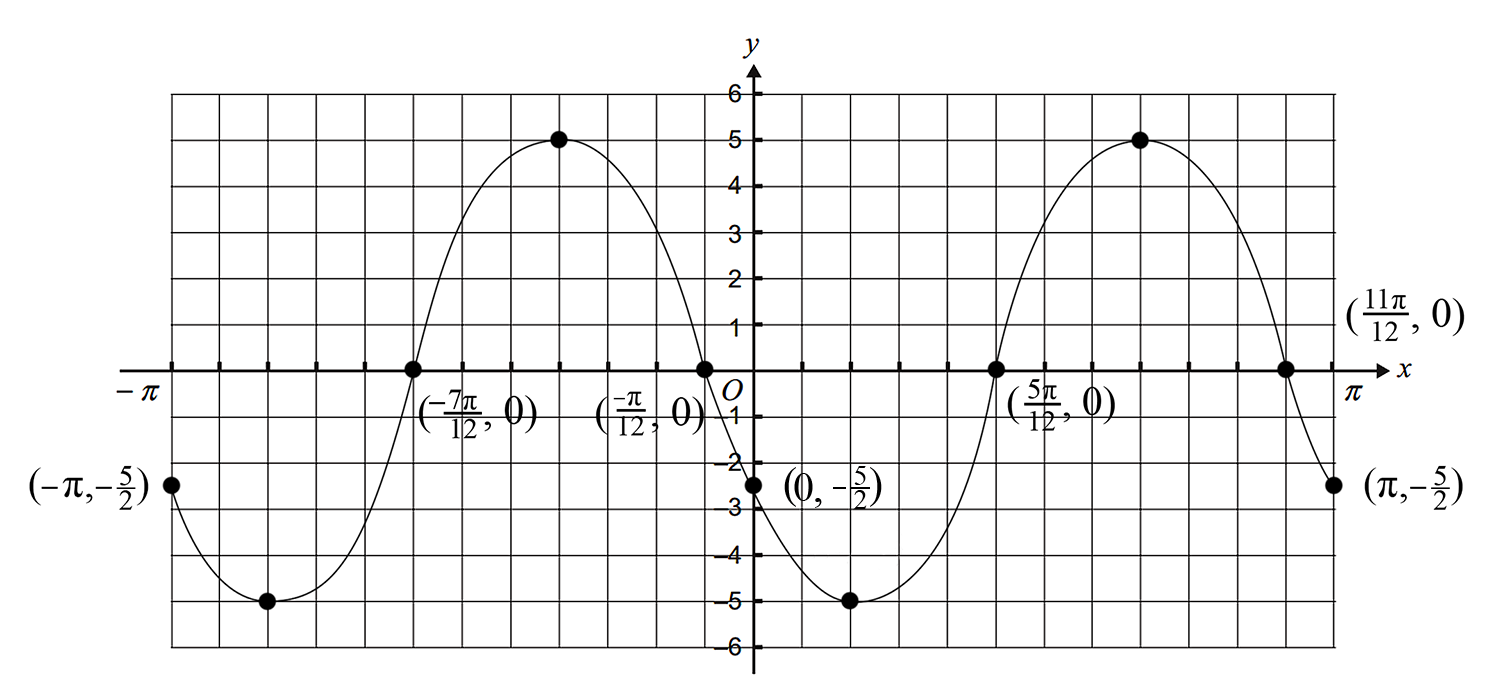
  2. sketch the graph of the function `f` on the set of axes below. Label axes intercepts with their coordinates.


    Label endpoints of the graph with their coordinates.   (3 marks)

    --- 3 WORK AREA LINES (style=lined) ---


VCAA 2006 meth 4b

Show Answers Only
  1. `text(Amplitude) = 5;\ \ \ text(Period) = pi`
  2.  
Show Worked Solution

a.   `text(Amplitude) = 5`

`text(Period) = (2 pi)/2 = pi`


b.  

`text(Shift)\ \ y = 5 cos (2x)\ \ text(left)\ \ pi/3\ \ text(units).`

`text(Period) = pi`

`text(Endpoints are)\ \ (-pi, -5/2) and (pi,-5/2)`

Filed Under: Trig Graphing Tagged With: Band 2, Band 5, smc-2757-15-Cos, smc-2757-30-Find period, smc-2757-40-Find amplitude, smc-2757-70-Sketch graph

Functions, MET1 2006 VCAA 2

For the function  `f: R -> R, f(x) = 3e^(2x)-1,`

  1. find the rule for the inverse function  `f^-1`   (2 marks)

    --- 7 WORK AREA LINES (style=lined) ---

  2. find the domain of the inverse function  `f^-1`   (1 mark)

    --- 2 WORK AREA LINES (style=lined) ---

Show Answers Only
  1. `f^-1 (x) = 1/2 log_e ((x + 1)/3)`
  2. `x in (-1, oo)`
Show Worked Solution

a.    `text(Let)\ \ y = f(x)`

`text(For inverse, swap)\ \ x harr y`

`x` `= 3e^(2y)-1`
`(x + 1)/3` `= e^(2y)`
`2y` `= log_e ((x + 1)/3)`
`y` `= 1/2 log_e ((x + 1)/3)`


`:. f^-1 (x) = 1/2 log_e ((x + 1)/3)`


♦ Mean mark 45%.

b.   `text(Domain)\ (f^-1) = text(Range)\ f(x),`

`:.x in (-1, oo)`

Filed Under: Logs and Exponential Functions Tagged With: Band 3, Band 5, smc-633-20-Log/Exponential

Calculus, MET1 2007 VCAA 12

`P` is the point on the line  `2x + y-10 = 0`  such that the length of `OP`, the line segment from the origin `O` to `P`, is a minimum. Find the coordinates of `P` and this minimum length.  (4 marks)

Show Answers Only

`P(4,2)\ text(for minimum length)\ 2sqrt5\ text(units)`

Show Worked Solution

`P(x, − 2x + 10)`

♦ Mean mark 26%.
`text(Let)\ z` `=\ text(length of)\ OP`
`z` `= sqrt((x-0)^2 + (−2x + 10)^2)`
`z^2` `= x^2 + 4x^2-40x + 100`
`z^2` `= 5x^2-40x + 100`


`text(Minimum)\ z\ text(occurs when minimum)\ z^2\ text(occurs.)`

`text(Stationary point when:)`

`d/(dx) (z^2)` `= 0`
`10x-40` `= 0`
`x` `= 4`

 
`text(Find)\ ytext(-coordinate:)`

`2(4) + y-10` `= 0`
`y` `= 2`

 
`text(Find length)\ OP:`

`z` `= sqrt(4^2 + (−2 xx 4 + 10)^2)`
  `= sqrt20`
  `=2 sqrt5\ \ text(units)`

 
`:. P(4,2)\ text(for minimum length)\ 2sqrt5\ text(units)`

Filed Under: Maxima and Minima Tagged With: Band 5, smc-641-50-Distance

Probability, MET1 2007 VCAA 11

There is a daily flight from Paradise Island to Melbourne. The probability of the flight departing on time, given that there is fine weather on the island, is 0.8, and the probability of the flight departing on time, given that the weather on the island is not fine, is 0.6.

In March the probability of a day being fine is 0.4.

Find the probability that on a particular day in March

  1. the flight from Paradise Island departs on time  (2 marks)

    --- 6 WORK AREA LINES (style=lined) ---

  2. the weather is fine on Paradise Island, given that the flight departs on time.  (2 marks)

    --- 5 WORK AREA LINES (style=lined) ---

Show Answers Only

  1. `0.68`
  2. `8/17`

Show Worked Solution

a.   

 
`text{Pr(FT)}\ +\ text{Pr(F′T)}`

`= 0.4 xx 0.8 + 0.6 xx 0.6`

`= 0.32 + 0.36`

`= 0.68`


b.   `text(Conditional probability:)`

♦♦ Mean mark 29%.
MARKER’S COMMENT: Students continue to struggle with conditional probability. Attention required here.

`text(Pr)(F\ text(|)\ T)` `= (text(Pr)(F ∩ T))/(text(Pr)(T))`
  `= 0.32/0.68`


`:. text(Pr)(F\ text(|)\ T) = 8/17`

Filed Under: Conditional Probability and Set Notation Tagged With: Band 4, Band 5, smc-2736-10-Conditional probability

Calculus, MET1 2007 VCAA 9

The graph of  `f: R -> R`,  `f(x) = e^(x/2) + 1`  is shown. The normal to the graph of `f` where it crosses the `y`-axis is also shown.
 

MET1 2007 VCAA Q9
 

  1. Find the equation of the normal to the graph of `f` where it crosses the `y`-axis.   (2 marks)

    --- 6 WORK AREA LINES (style=lined) ---

  2. Find the exact area of the shaded region.   (3 marks)

    --- 5 WORK AREA LINES (style=lined) ---

Show Answers Only
  1. `y = -2x + 2`
  2. `(2sqrte-2)\ text(u)²`
Show Worked Solution

a.   `text(Normal is)\ ⊥\ text(to tangent)`

MARKER’S COMMENT: A common error was made in calculating the point of tangency. Be careful!

`text(Point of tangency:)\ (0,2)`

`text(Gradient of normal:)`

`f^{prime}(x)` `= 1/2 e^(x/2)`
`f^{prime}(0)` `= 1/2`

  
`:. m_text(norm) = -2`
  

`text(Equation of normal:)`

`y-y_1` `= m(x-x_1)`
`y-2` `=-2(x-0)`
`y` `=-2x+2`


♦ Mean mark 44%.
b.    `:.\ text(Area)` `= int_0^1 (e^(x/2) + 1-(-2x +2))\ dx`
    `= int_0^1 (e^(x/2) + 2x-1)\ dx`
    `= [2e^(x/2) + x^2-x]_0^1`
    `= (2e^(1/2) + 1^2-1)-(2e^0)`
    `= (2sqrte-2)\ text(u)²`

Filed Under: Area Under Curves, Tangents and Normals Tagged With: Band 4, Band 5, smc-634-20-Log/Exp Function, smc-634-90-Normals, smc-723-50-Log/Exponential, smc-723-80-Area between graphs

Functions, MET1 2007 VCAA 8

Let  `f: R -> R`,  `f(x) = sin((2pix)/3)`.

  1. Solve the equation  `sin((2pix)/3) = -sqrt3/2`  for  ` x ∈ [0,3]`.   (2 marks)

    --- 4 WORK AREA LINES (style=lined) ---

  2. Let  `g: R -> R`,  `g(x) = 3f(x-1) + 2`.
  3. Find the smallest positive value of `x` for which `g(x)` is a maximum.   (2 marks)

    --- 6 WORK AREA LINES (style=lined) ---

Show Answers Only

a.   `x = 2, 5/2`

b.   `7/4`

Show Worked Solution

a.    `sin((2pix)/3) = -sqrt3/2`

`=>\ text(Base angle)\ = pi/3`

`(2 pi x)/3` `=(4pi)/3, (5pi)/3, (10pi)/3, …` 
`:.x` `=2 or 5/2, \ \ \ text(for)\ x ∈ [0,3]`


b.   `g(x) = 3sin[(2pi)/3 (x-1)] + 2`

♦♦ Mean mark 29%.
STRATEGY: Max/min questions involving trig functions can often use the powerful identity, `-1 <= sin theta <=1` to solve efficiently and reduce errors.

`text(Maximum occurs when:)`

`sin[(2pi)/3 (x-1)]` `= 1`
`(2pi)/3 (x-1)` `= pi/2`
`x-1` `= pi/2 xx 3/(2pi)`
`:. x` `=7/4`

Filed Under: Trig Equations Tagged With: Band 4, Band 5, smc-725-10-Sin, smc-725-60-Max/min (non-calc)

Calculus, MET1 2007 VCAA 7

If  `f(x) = xcos(3x)`,  then  `f^{prime}(x) = cos(3x)-3xsin(3x)`.

Use this fact to find an antiderivative of  `xsin(3x)`.   (3 marks)

--- 5 WORK AREA LINES (style=lined) ---

Show Answers Only

`-1/3xcos(3x) + 1/9sin(3x)`

Show Worked Solution

`text(If)\ \ f^{prime}(x) = g(x) \ -> \ int g(x)\ dx = f(x)`

♦ Mean mark 36%.
MARKER’S COMMENT: This standard and familiar calculus problem was surprisingly poorly answered.
`int (cos(3x)-3xsin(3x))\ dx` `= xcos(3x)`
`1/3 sin(3x)-3 int xsin(3x)\ dx` `= xcos(3x)`
`-3 int xsin(3x)\ dx` `= xcos(3x)-1/3sin(3x)`
`:. int xsin(3x)\ dx` `= 1/9sin(3x)-1/3xcos(3x)`

Filed Under: Integration (Trig), Trig Integration Tagged With: Band 5, smc-737-40-Integration by recognition, smc-747-50-Integration by recognition

Probability, MET1 2007 VCAA 6

Two events, `A` and `B`, from a given event space, are such that  `text(Pr)(A) = 1/5`  and  `text(Pr)(B) = 1/3`.

  1. Calculate  `text(Pr)(A^{′} ∩ B)`  when  `text(Pr)(A ∩ B) = 1/8`.  (1 mark)

    --- 5 WORK AREA LINES (style=lined) ---

  2. Calculate  `text(Pr)(A^{′} ∩ B)`  when `A` and `B` are mutually exclusive events.  (1 mark)

    --- 5 WORK AREA LINES (style=lined) ---

Show Answers Only

  1. `5/24`
  2. `1/3`

Show Worked Solution

a.   `text(Sketch Venn diagram:)`

♦♦ Mean mark (a) 31%.
MARKER’S COMMENTS: Students who drew a Venn diagram or Karnaugh map were the most successful.

met1-2007-vcaa-q6-answer3

`:. text(Pr)(A^{′} ∩ B)` `=text(Pr)(B)-text(Pr)(A ∩B)`
  `=1/3-1/8`
  `=5/24`


♦♦ Mean mark (b) 23%.

b.    met1-2007-vcaa-q6-answer4

`text(Mutually exclusive means)\ \ text(Pr)(A ∩ B)=0,`

`:. text(Pr)(A^{′} ∩ B) = 1/3`

Filed Under: Conditional Probability and Set Notation Tagged With: Band 5, Band 6, smc-2736-20-Set Notation, smc-2736-30-Venn Diagrams, smc-2736-40-Independent Events

Probability, MET1 2007 VCAA 5

It is known that 50% of the customers who enter a restaurant order a cup of coffee. If four customers enter the restaurant, what is the probability that more than two of these customers order coffee? (Assume that what any customer orders is independent of what any other customer orders.)  (2 marks)

Show Answers Only

`text(Pr)(X > 2) = 5/16`

Show Worked Solution
`text(Pr)(X > 2)` `= text(Pr)(X = 3) + text(Pr)(X = 4)`
  `= ((4),(3))(1/2)^3(1/2) + ((4),(4))(1/2)^4(1/2)^0`
  `= 4 xx 1/16 + 1 xx 1/16` 
♦ Mean mark 41%.
MARKER’S COMMENT: Notation was often poor and confused. Common error: evaluating co-efficients.


`:. text(Pr)(X > 2) = 5/16`


Filed Under: Binomial Tagged With: Band 5, smc-638-10-binomial expansion (non-calc)

Calculus, MET1 2007 VCAA 3

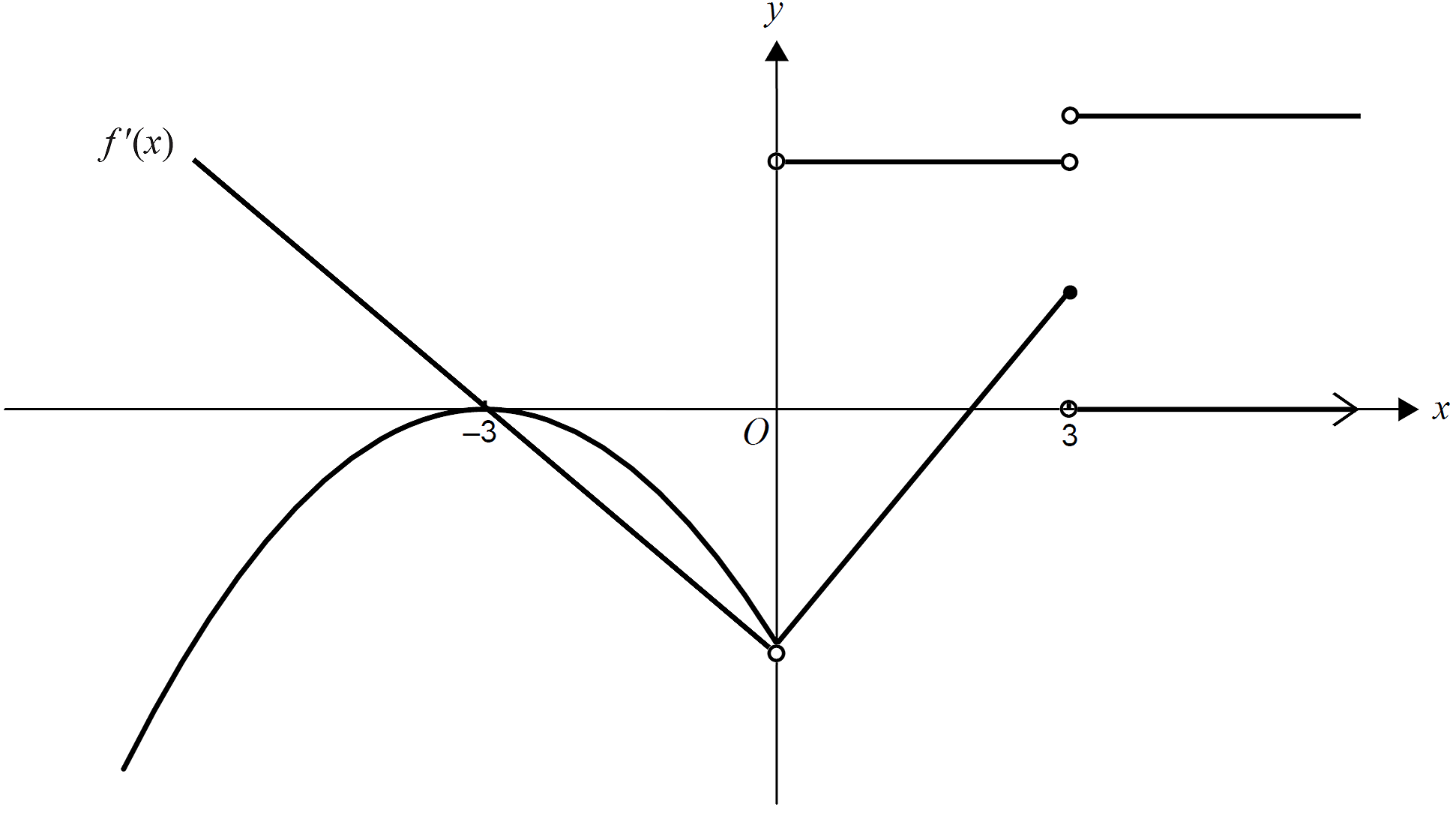
The diagram shows the graph of a function with domain `R`.

MET1 2007 VCAA Q3

  1. For the graph shown above, sketch on the same set of axes the graph of the derivative function.   (3 marks)

    --- 3 WORK AREA LINES (style=lined) ---

  2. Write down the domain of the derivative function.   (1 mark)

    --- 2 WORK AREA LINES (style=lined) ---

Show Answers Only
  1.  
    MET1 2007 VCAA Q3 Answer
  2. `R\ text(\)\ {0,3}`
Show Worked Solution
a.    MET1 2007 VCAA Q3 Answer
♦ Part (a) mean mark 42%, and part (b) mean mark 45%.


b.   `text(Derivative does not exist at either sharp)`

`text(points or discontinuous points.)`

`:. R\ text(\)\ {0,3}`

Filed Under: The Derivative Function and its Graph Tagged With: Band 5, smc-2830-20-Find f'(x) graph given f(x)

Functions, MET1 2008 VCAA 10

Let  `f: R -> R,\ \ f(x) = e^(2x)-1`.

  1. Find the rule and domain of the inverse function  `f^(-1)`.   (2 marks)

    --- 5 WORK AREA LINES (style=lined) ---

  2. On the axes provided, sketch the graph of  `y = f(f^(-1)(x))`  for its maximal domain.   (1 mark)

    --- 0 WORK AREA LINES (style=lined) ---


    met1-2008-vcaa-q2
     

  3. Find  `f(-f^(-1)(2x))`  in the form  `(ax)/(bx + c)`  where `a`, `b` and `c` are real constants.   (2 marks)

    --- 5 WORK AREA LINES (style=lined) ---

Show Answers Only
  1. `f^(-1)(x) = 1/2log_e(x + 1), x ∈ (-1,∞)`
  2.  
    met1-2008-vcaa-q10-answer
  3. `f(-f^(-1)(2x)) = (-2x)/(2x + 1)`
Show Worked Solution

a.   `text(Let)\ \ y = f(x)`

`text(For Inverse, swap)\ x ↔ y`

`x` `= e^(2y)-1`
`x + 1` `= e^(2y)`
`2y` `= log_e(x + 1)`
`y` `= 1/2 log_e(x + 1)`
`text(Domain)(f^(-1))` `=\ text(Range)\ (f)`
  `= (-1,∞)`


`:. f^(-1)(x) = 1/2log_e(x + 1),quadx ∈ (-1,∞)`
  

b.   `f(f^(-1)(x)) = x`

♦ Mean mark part (b) 19%.
MARKER’S COMMENT: Few students were aware that a function of its own inverse function is the line  `y=x`  over the appropriate domain.

`text(Domain is)\ \ (-1, oo)`

met1-2008-vcaa-q10-answer


♦ Mean mark 34%.
c.    `-f^(-1)(2x)` `= -1/2 ln(2x + 1)`
  `:. f(-f^(-1)(2x))` `= e^(-log_e(2x + 1))-1`
    `=(2x+1)^-1-1`
    `= 1/(2x + 1)-1`
    `= (-2x)/(2x + 1)`

Filed Under: Functional Equations, Logs and Exponential Functions Tagged With: Band 4, Band 5, Band 6, smc-5204-70-Sketch graph, smc-642-10-(f o g)(x)

Calculus, MET1 2008 VCAA 9

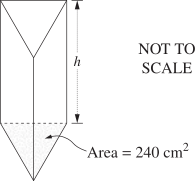
A plastic brick is made in the shape of a right triangular prism. The triangular end is an equilateral triangle with side length `x` cm and the length of the brick is `y` cm.
 

met1-2008-vcaa-q91

The volume of the brick is 1000 cm³.

  1. Find an expression for `y` in terms of `x`.   (2 marks)

    --- 6 WORK AREA LINES (style=lined) ---

  2. Show that the total surface area, `A` cm², of the brick is given by
  3.    `A = (4000sqrt3)/x + (sqrt3 x^2)/2`   (2 marks)

    --- 5 WORK AREA LINES (style=lined) ---

  4. Find the value of `x` for which the brick has minimum total surface area. (You do not have to find this minimum.)   (3 marks)

    --- 8 WORK AREA LINES (style=lined) ---

Show Answers Only
  1. `y = (4000 sqrt3)/(3 x^2)`
  2. `text(See Worked Solutions)`
  3. `10 root(3)(4)`
Show Worked Solution

a.   `text(Cross-section is an equilateral triangle and)`

`text(angles of)\ Delta\ text(are)\ 60^@.`

`sin 60^@` `= h/x`
`:. h` `= sqrt3/2 x`


`text(Volume)` `= 1000`
`(1/2 x)(sqrt3/2 x)y` `= 1000`
`sqrt3/4 x^2y` `= 1000`
`:. y` `= 4000/(sqrt3 x^2)`
  `=(4000 sqrt3)/(3 x^2)`


♦ Mean mark 45%.
b.     `A` `= 2 xx (sqrt3/4 x^2) + 3 xx (xy)`
    `= sqrt3/2 x^2 + 3x(4000/(sqrt3 x^2))`
    `= (12\ 000)/(sqrt3 x) xx sqrt3/sqrt3 + sqrt3/2 x^2`
    `= (4000sqrt3)/x + (x^2 sqrt3)/2`


♦ Mean mark 42%.

c.   `A = 4000 sqrt3 x^(−1) + sqrt3/2 x^2,quadx > 0`

`text(Stationary Point when)\ \ (dA)/(dx)=0,`

`-4000sqrt3 x^(−2) + sqrt3x` `=0`
`(4000sqrt3)/(x^2)` `= sqrt3x`
`x^3` `= 4000`
`:. x` `= root(3)(4000)`
  `= 10 root(3)(4)`

Filed Under: Maxima and Minima Tagged With: Band 4, Band 5, smc-641-20-Surface Area

Probability, MET1 2008 VCAA 4

The function
 

`f(x) = {{:(k),(0):}{:(sin(pix)qquadtext(if)qquadx ∈ [0,1]),(qquadqquadqquadqquadquadtext(otherwise)):}`
 

is a probability density function for the continuous random variable `X`.

  1. Show that  `k = pi/2`.  (2 marks)

    --- 5 WORK AREA LINES (style=lined) ---

  2. Find  `text(Pr)(X <= 1/4 | X <= 1/2)`.  (3 marks)

    --- 5 WORK AREA LINES (style=lined) ---

Show Answers Only

  1. `text(See Worked Solutions)`
  2. `1 – (sqrt2)/2`

Show Worked Solution

a.   `text(Total Area under curve) = 1\ text(u²)`

`int_0^1 k sin(pix)dx` `= 1`
`- k/pi [cos(pix)]_0^1` `= 1`
`- k/pi[cos(pi) – cos(0)]` `= 1`
`- k/pi[(−1) – (1)]` `= 1`
`2k` `= pi`
`:.k` `= pi/2`


b.   `text(Conditional Probability:)`

♦ Mean mark 47%.
MARKER’S COMMENT: Few students used the symmetry of the probability density function to calculate the denominator.

`text(Pr)(X <= 1/4 | X <= 1/2)`

`= (text(Pr)(X <= 1/4))/(text(Pr)(X <= 1/2))`
`= (pi/2 int_0^(1/4) sin(pix)dx)/(1/2)`
`= -pi/pi [cos(pix)]_0^(1/4)`
`= -1 [cos(pi/4) – cos(0)]`
`= -1 [1/(sqrt2) – 1]`
`= 1 – (sqrt2)/2`

Filed Under: Probability density functions Tagged With: Band 4, Band 5, smc-637-35-Sum probabilities = 1, smc-637-40-Conditional probability, smc-637-80-Trig PDF

Calculus, MET1 2009 VCAA 8

Let  `f: R -> R,\ f(x) = e^x + k`,  where `k` is a real number. The tangent to the graph of  `f` at the point where  `x = a`  passes through the point `(0, 0).` Find the value of `k` in terms of `a.`  (3 marks)

--- 10 WORK AREA LINES (style=lined) ---

Show Answers Only

`:. k = ae^a-e^a`

Show Worked Solution

`text(Point of tangency:)\ \ P (a, e^a + k)`

♦ Mean mark 45%.

`text(Find gradient of tangent at)\ \ x = a:`

`f(x)` `=e^x+k`
`f^{prime}(x)` `= e^x`
`:. m_tan` `= e^a`


`text(Find equation of tangent:)`

`y-y_1` `= m (x-x_1)`
`y-(e^a + k)` `= e^a (x-a)`


`text(Substitute)\ \ (0, 0):`

`0-e^a – k` `=-ae^a`
`:. k` `= ae^a-e^a`
  `=e^a(a-1)`

Filed Under: Tangents and Normals Tagged With: Band 5, smc-634-20-Log/Exp Function, smc-634-50-Find tangent given curve

Probability, MET1 2009 VCAA 5

Four identical balls are numbered 1, 2, 3 and 4 and put into a box. A ball is randomly drawn from the box, and not returned to the box. A second ball is then randomly drawn from the box.

  1. What is the probability that the first ball drawn is numbered 4 and the second ball drawn is numbered 1?  (1 mark)

    --- 3 WORK AREA LINES (style=lined) ---

  2. What is the probability that the sum of the numbers on the two balls is 5?  (1 mark)

    --- 3 WORK AREA LINES (style=lined) ---

  3. Given that the sum of the numbers on the two balls is 5, what is the probability that the second ball drawn is numbered 1?  (2 marks)

    --- 4 WORK AREA LINES (style=lined) ---

Show Answers Only

  1. `1/12`
  2. `1/3`
  3. `1/4`

Show Worked Solution

a.   `text(Pr) (4, 1)`

`= 1/4 xx 1/3`

`= 1/12`


b.   `text(Pr) (text(Sum) = 5)`

`= text(Pr) (1, 4) + text(Pr) (2, 3) + text(Pr) (3, 2) + text(Pr) (4, 1)`

`= 4 xx (1/4 xx 1/3)`

`= 1/3`


c.   `text(Conditional Probability)`

♦ Mean mark 46%.

`text(Pr) (2^{text(nd)} = 1\ |\ text(Sum) = 5)`

`= (text{Pr} (4, 1))/(text{Pr} (text(Sum) = 5))`

`= (1/12)/(1/3)`

`= 1/4`

Filed Under: Conditional Probability and Set Notation Tagged With: Band 3, Band 4, Band 5, smc-2736-10-Conditional probability

Calculus, MET1 2010 VCAA 11

A cylinder fits exactly in a right circular cone so that the base of the cone and one end of the cylinder are in the same plane as shown in the diagram below. The height of the cone is 5 cm and the radius of the cone is 2 cm.

The radius of the cylinder is `r` cm and the height of the cylinder is `h` cm.


vcaa-2010-meth-11a

For the cylinder inscribed in the cone as shown above

  1. find `h` in terms of `r`.   (2 marks)

    --- 6 WORK AREA LINES (style=lined) ---

The total surface area, `S` cm², of a cylinder of height `h` cm and radius `r` cm is given by the formula

`S = 2 pi r h + 2 pi r^2`.

  1. find `S` in terms of `r`.   (1 mark)

    --- 3 WORK AREA LINES (style=lined) ---

  2. find the value of `r` for which `S` is a maximum.   (2 marks)

    --- 4 WORK AREA LINES (style=lined) ---

Show Answers Only
  1. `(10 -5r)/2`
  2. `10 pi r-3 pi r^2,\ \ 0 < r < 2`
  3. `5/3\ text(cm)`
Show Worked Solution

a.   `text(Sketch cross-section:)`

vcaa-2010-meth-11ai

`text(Using ratios of similar triangles,)`

♦ Mean mark 43%.

`Delta ABC\ text(|||)\ Delta PQC`

`5/h` `= 2/(2-r)`
`2h` `= 10-5r`
`:. h` `= (10-5r)/2`


♦ Mean mark 47%.
b.    `S` `= 2 pi r ((10-5 r)/2) + 2 pi r^2`
    `= 10 pi r-5 pi r^2 + 2 pi r^2`
    `= 10 pi r-3 pi r^2,\ \ 0 < r < 2`


c.   `text(SP’s occur when)\ \ (dS)/(dr) = 0,`

♦ Mean mark 46%.
`10 pi-6 pi r` `= 0`
`3r` `= 5`
`:. r` `= 5/3\ text(cm)`

Filed Under: Maxima and Minima Tagged With: Band 5, smc-641-20-Surface Area

Calculus, MET1 2010 VCAA 9

Part of the graph of  `f: R^+ -> R, \ f(x) = x log_e (x)`  is shown below.

vcaa-2010-meth-9a

  1. Find the derivative of  `x^2 log_e (x)`.   (1 mark)

    --- 3 WORK AREA LINES (style=lined) ---

  2. Use your answer to part a. to find the area of the shaded region in the form  `a log_e (b) + c`  where `a, b` and `c` are non-zero real constants.   (3 marks)

    --- 8 WORK AREA LINES (style=lined) ---

Show Answers Only
  1. `x + 2x log_e (x)`
  2. `(9/2 log_e (3)-2)\ text(u²)`
Show Worked Solution

a.   `text(Using Product Rule:)`

`(fg)^{′}` `= f g^{′} + f^{′} g`
`d/(dx) (x^2 log_e (x))` `= x^2 (1/x) + 2x log_e (x)`
  `= x + 2x log_e (x)`


b.   `text{Integrating the answer from part (a):}`

`int (x + 2x log_e (x))\ dx` `= x^2 log_e (x)`
`1/2 x^2 + 2 int x log_e (x)\ dx` `= x^2 log_e (x)`
`2 int x log_e (x)\ dx` `= x^2 log_e (x)-1/2 x^2`
`:. int x log_e (x)\ dx` `= 1/2 x^2 log_e (x)-1/4 x^2`
♦♦ Mean mark 33%.
MARKER’S COMMENT: The most common error was not dividing everything through by 2. Be careful!


`:.\ text(Area)` `= int_1^3 (x log_e (x)) dx`
  `= [1/2 x^2 log_e (x)-1/4 x^2]_1^3`
  `= (9/2 log_e (3)-9/4)-(0-1/4)`
  `= (9/2 log_e (3)-2)\ \ text(u²)`

Filed Under: Area Under Curves Tagged With: Band 3, Band 5, smc-723-50-Log/Exponential

Functions, MET1 2010 VCAA 6

The transformation  `T: R^2 -> R^2` is defined by
 

`T([(x), (y)]) = [(3, 0), (0, 2)] [(x), (y)] + [(– 1), (4)].`
 

The image of the curve  `y = 2x^2 + 1`  under the transformation `T` has equation  `y = ax^2 + bx + c.`

Find the values of `a, b,` and `c.`   (3 marks)

--- 9 WORK AREA LINES (style=lined) ---

Show Answers Only

`a = 4/9,\ \ \ b = 8/9,\ \ \ c = 58/9`

Show Worked Solution

`text(Expanding the matrix equation:)`

`x^{′}` `= 3x-1` `qquad qquad y^{′}` `= 2y + 4`
`x` `= (x^{′}+1)/3` `qquad qquad y` `= (y^{′} -4)/2`


`text(Substitute)\ \ x, y\ \ text(into)\ \ y = 2x^2 + 1`

♦ Mean mark 40%.
`(y^{′}-4)/2` `= 2 ((x^{′} + 1)/3)^2 + 1`
`y^{′}-4` `= 4/9 ((x^{′})^2 + 2x^{′} + 1) + 2`
`y^{′}` `= 4/9 (x^{′})^2 + 8/9 x^{′} + (4/9 + 6)`
`:. y^{′}` `= 4/9 (x^{′})^2 + 8/9 x^{′} + 58/9`


`:. a = 4/9,\ \ \ b = 8/9,\ \ \ c = 58/9`

Filed Under: Transformations Tagged With: Band 5, smc-753-60-Matrix, smc-753-70-Polynomials

Statistics, MET1 2010 VCAA 5

Let `X` be a normally distributed random variable with mean 5 and variance 9 and let `Z` be the random variable with the standard normal distribution.

  1. Find  `text(Pr) (X > 5)`.  (1 mark)

    --- 2 WORK AREA LINES (style=lined) ---

  2. Find `b` such that  `text(Pr) (X > 7) = text(Pr) (Z < b)`.  (2 marks)

    --- 4 WORK AREA LINES (style=lined) ---

Show Answers Only

  1. `0.5`
  2. `-2/3`

Show Worked Solution

a.   `text(Pr) (X > 5) = 0.5`


♦ Part (b) mean mark 43%.

b.   `text(Pr) (X > 7)` `= text(Pr) (Z > (7 – 5)/3)`
    `= text(Pr) (Z > 2/3)`
    `= text(Pr) (Z < -2/3)`

 
`:. b=-2/3`

Filed Under: Normal Distribution Tagged With: Band 4, Band 5, smc-719-10-Single z-score

Calculus, MET1 2011 VCAA 10

The figure shown represents a wire frame where `ABCE` is a convex quadrilateral. The point `D` is on line segment `EC` with  `AB = ED = 2\ text(cm)` and  `BC = a\ text(cm)`, where `a` is a positive constant.

`/_ BAE = /_ CEA = pi/2`

Let  `/_ CBD = theta`  where  `0 < theta < pi/2.`

 vcaa-2011-meth-10a

  1. Find `BD` and `CD` in terms of `a` and `theta`.   (2 marks)

    --- 5 WORK AREA LINES (style=lined) ---

  2. Find the length, `L` cm, of the wire in the frame, including length `BD`, in terms of `a` and `theta`.   (1 mark)

    --- 3 WORK AREA LINES (style=lined) ---

  3. Find  `(dL)/(d theta)`, and hence show that  `(dL)/(d theta) = 0`  when  `BD = 2CD`.   (2 marks)

    --- 5 WORK AREA LINES (style=lined) ---

  4. Find the maximum value of `L` if  `a = 3 sqrt 5`.   (1 mark)

    --- 5 WORK AREA LINES (style=lined) ---

Show Answers Only
  1. `BD = a cos theta,\ \ \ CD = a sin theta`
  2. `L = 4 + a + 2 a cos theta + a sin theta`
  3. `text(Proof)\ text{(See Worked Solutions)}`
  4. `L_max = 19 + 3 sqrt 5`
Show Worked Solution

a.   `text(In)\ \ Delta BCD,`

`cos theta` `= (BD)/a`
`:. BD` `= a cos theta`
`sin theta` `= (CD)/a`
`:. CD` `= a sin theta`


b.   `L` `= 4 + 2 BD + CD + a`
    `= 4 + 2a cos theta + a sin theta + a`
    `= 4 + a + 2a cos theta + a sin theta`


c.   `text(Noting that)\ a\ text(is a constant:)`

♦ Mean mark 35%.

`(dL)/(d theta)= – 2 a sin theta + a cos theta`

`text(When)\ \ (dL)/(d theta) = 0`,

`- 2 a sin theta+ a cos theta` `= 0`
`a cos theta` `= 2 a sin theta`
`:.  BD` `= 2CD\ \ text{(using part (a))}`


d.   `text(SP’s when)\ \ (dL)/(d theta)=0,`

♦♦♦ Mean mark 5%.
`- 2 a sin theta+ a cos theta` `= 0`
`sin theta` `=1/2 cos theta`
`tan theta` `=1/2`

vcaa-2011-meth-10ai

`text(If)\ \ tan theta=1/2,\ \ cos theta = 2/sqrt5,\ \ sin theta = 1/sqrt5`

`L_(max)` `= 4 + a + 2a cos theta + a sin theta`
  `= 4 + (3 sqrt 5) + 2 (3 sqrt 5) (2/sqrt 5) + (3 sqrt 5) (1/sqrt 5)`
  `= 4 + 3 sqrt 5 + 12 + 3`
  `= 19 + 3 sqrt 5\ text(cm)`

Filed Under: Maxima and Minima Tagged With: Band 4, Band 5, Band 6, smc-641-60-Other themes

Calculus, MET1 2011 VCAA 9

Parts of the graphs of the functions

`f: R -> R, \ f(x)` `= x^3 - ax\ \ \ \ \ ` `a > 0`
`g: R -> R, \ g(x)` `= ax` `a > 0`
are shown in the diagram below.

The graphs intersect when  `x = 0`  and when  `x = m.`

vcaa-2011-meth-9a

The area of the shaded region is 64.

Find the value of `a` and the value of `m.`  (4 marks)

Show Answers Only

`a = 8,\ \ m = 4`

Show Worked Solution

`text(Intersection between)\ f(x) and g(x):`

♦ Mean mark 41%.
MARKER’S COMMENT: Few students correctly used the intersection to achieve the final answer.
`f(x)` `= g(x)`
`x^3 – ax` `= ax`
`x^3 – 2ax` `= 0`
`x (x^2 – 2a)` `= 0`

`:. x = 0,\ \ x = +- sqrt (2a)`

`:. m = sqrt (2a),\ \ m>0`


`text{Shaded Area = 64  (given)},`

`:. int_0^(sqrt(2a)) (ax – (x^3 – ax))\ dx` `=64`
`int_0^(sqrt(2a)) (2ax – x^3)\ dx` `=64`
`[ax^2 – 1/4 x^4]_0^(sqrt(2a))` `=64`
`(a (2a) – 1/4 (4a^2)) – (0)` `=64`
`2a^2 – a^2` `=64`
`a^2` `=64`
`:. a` `=8,\ \ \ a > 0`


`:. m` `= sqrt (2 xx 8)=4`

 `:. a = 8,\ \ m = 4`

Filed Under: Area Under Curves Tagged With: Band 5, smc-723-20-Cubic, smc-723-80-Area between graphs

Probability, MET1 2011 VCAA 8

Two events, `A` and `B`, are such that  `text(Pr) (A) = 3/5`  and  `text(Pr) (B) = 1/4.`

If `A^{′}` denotes the compliment of `A`, calculate  `text(Pr) (A^{′} nn B)` when

  1. `text(Pr) (A uu B) = 3/4`  (2 marks)

    --- 5 WORK AREA LINES (style=lined) ---

  2. `A` and `B` are mutually exclusive.  (1 mark)

    --- 4 WORK AREA LINES (style=lined) ---

Show Answers Only

  1. `text(Pr) (A^{′} nn B) = 3/20`
  2. `text(Pr) (A^{′} nn B) = 1/4`

Show Worked Solution

a.   `text(Sketch Venn Diagram)`

vcaa-2011-meth-8i

`text(Pr) (A uu B)` `= text(Pr) (A) + text(Pr) (B)-text(Pr) (A nn B)`
`3/4` `= 3/5 + 1/4-text(Pr) (A nn B)`
`text(Pr) (A nn B)` `= 1/10`


 `:.\ text(Pr) (A^{′} nn B) = 1/4-1/10 = 3/20`


b.   vcaa-2011-meth-8ii

`text(Pr) (A∩ B)=0\ \ text{(mutually exclusive)},`

`:.\ text(Pr) (A^{′} nn B) = text(Pr) (B) = 1/4`

Filed Under: Conditional Probability and Set Notation Tagged With: Band 4, Band 5, smc-2736-20-Set Notation, smc-2736-30-Venn Diagrams, smc-2736-40-Independent Events

Probability, MET1 2011 VCAA 7

A biased coin tossed three times. The probability of a head from a toss of this coin is `p.`

  1. Find, in terms of `p`, the probability of obtaining

    1. three heads from the three tosses  (1 mark)

      --- 2 WORK AREA LINES (style=lined) ---

    2. two heads and a tail from the three tosses.  (1 mark)

      --- 2 WORK AREA LINES (style=lined) ---

  2. If the probability of obtaining three heads equals the probability of obtaining two heads and a tail, find `p`.  (2 marks)

    --- 5 WORK AREA LINES (style=lined) ---

Show Answers Only

    1. `p^3`
    2. `3p^2 (1 – p)`
  1. `0 or 3/4`

Show Worked Solution

a.i.    `text(Pr) (HHH)` `= p xx p xx p`
    `= p^3`


  ii.   `text(Pr) text{(2 Heads and 1 Tail from 3 tosses)}`

♦ Part (a)(ii) mean mark 41%.

`= ((3), (2)) xx p xx p xx (1 – p)`

`= 3 p^2 (1 – p)`


b.   `text(If probabilities are equal:)`

♦ Mean mark 48%.
MARKER’S COMMENT: Many students incorrectly assumed `p` could not be zero.

`p^3` `= 3p^2 – 3p^3`
`4p^3 – 3p^2` `= 0`
`p^2 (4p – 3)` `= 0`

`:. p = 0 or p = 3/4`

Filed Under: Binomial Tagged With: Band 4, Band 5, smc-638-10-binomial expansion (non-calc)

Algebra, MET1 2011 VCAA 6

Consider the simultaneous linear equations

`kx - 3y` `= k + 3`
`4x + (k + 7) y` `= 1`

where `k` is a real constant.

  1. Find the value of `k` for which there are infinitely many solutions.  (3 marks)
  2. Find the values of `k` for which there is a unique solution.  (1 mark)
Show Answers Only
  1. `– 4`
  2. `k in R\ text(\)\ {– 4, – 3}`
Show Worked Solution

a.   `text(Infinite solutions if gradients and)`

♦ Mean mark 39%.
MARKER’S COMMENT: A number of solutions are possible here, including using the determinant.

`y text(-intercepts are the same.)`

`kx-3y` `=k+3`
`3y` `=kx-k-3`
`y` `=k/3 x – (k+3)/3`
`:.m_1=k/3 and c_1= -((k+3)/3)`


`4x + (k + 7) y` `=1`
`y` `=((-4)/(k+7)) x + 1/(k+7)`
`:. m_2=(-4)/(k+7) and c_2=1/(k+7)`


`text(Equating gradients and)\ y text(-intercepts:)`

`m_1` `= m_2` `\ \ \ and` `\ \ \ c_1` `=c_2`
`k/3` `= (– 4)/(k + 7)`   `-((k+3)/3)` `= 1/(k+7)`
`k^2 + 7k` `= – 12`   `-(k+3)(k+7)` `=3`
`k^2 + 7k + 12` `= 0`   `k^2+10k+24` `=0`
`(k + 3) (k + 4)` `= 0`   `(k+6)(k+4)` `= 0`
`k` `= – 3, – 4`   `k`  `= – 6, – 4`


`:. k = – 4\ \ \ text{(satisfies both)}`


b.   `text(Unique solution if:)`

♦♦ Mean mark 33%.

`m_1 != m_2`

`:. k in R\ text(\)\ {– 4, – 3}`

Filed Under: Simultaneous Equations Tagged With: Band 5, smc-721-10-Unique solution, smc-721-20-Infinite solutions

Calculus, MET1 2011 VCAA 2a

Find an antiderivative of  `1/(3x-4)`  with respect to `x.`   (1 mark)

--- 3 WORK AREA LINES (style=lined) ---

Show Answers Only

`1/3 log_e | 3x-4 |`

Show Worked Solution

`int (3x-4)^-1\ dx`

♦ Mean mark 43%.
MARKER’S COMMENT: The constant `c` is required for the general derivative `int f(x)\ dx` but is not necessary for an antiderivative.

`= 1/3 log_e (| 3x-4 |)+c`

Filed Under: Integration (L&E), L&E Integration, Standard Integration Tagged With: Band 5, smc-740-30-Log (indefinite), smc-748-30-Log (indefinite), smc-749-10-Indefinite Integrals

Calculus, MET1 2012 VCAA 10

Let  `f: R -> R,\ f(x) = e^(-mx) + 3x`,  where `m` is a positive rational number.

  1.  i. Find, in terms of `m`, the `x`-coordinate of the stationary point of the graph of  `y = f(x).`   (2 marks)

    --- 5 WORK AREA LINES (style=lined) ---

  2. ii. State the values of `m` such that the `x`-coordinate of this stationary point is a positive number.   (1 mark)

    --- 4 WORK AREA LINES (style=lined) ---

  3. For a particular value of `m`, the tangent to the graph of  `y = f(x)`  at  `x =-6`  passes through the origin.
  4. Find this value of `m`.   (3 marks)

    --- 10 WORK AREA LINES (style=lined) ---

Show Answers Only
  1.  i. `1/m log_e(m/3)`
  2. ii. `m > 3`
  3. `1/6`
Show Worked Solution

a.i.   `text(SP’s occur when)\ \ f^{prime}(x)=0`

`-me^(-mx) + 3` `= 0`
`me^(-mx)` `3`
`-mx` `= log_e (3/m)`
`:. x` `=-1/m log_e (3/m)`
  `= 1/m log_e (m/3), \ m>0`


♦♦♦ Part (a.ii.) mean mark 18%.
  ii.    `1/m log_e (m/3)` `> 0`
  `log_e (m/3)` `> 0`
  `m/3` `> 1`
  `:. m` `> 3`


b.   `text(Point of tangency:)\ \ (-6, e^(-6m)-18)`

♦♦ Mean mark (b) 33%.
MARKER’S COMMENT: Many confused `m` with the more common use of `m` for gradient in  `y=mx+c`.

`text(At)\ \ x=-6,`

`m_tan= f^{prime} (-6)= -me^(-6m) + 3`

`:.\ text(Equation of tangent:)`

`y-y_1` `= m (x-x_1)`
`y-(e^(-6m)-18)` `= (-me^(-6m) + 3) (x-(-6))`


`text(S)text{ince tangent passes through (0, 0):}`

`-e^(-6m) + 18` `= (-me^(-6m) + 3)(6)`
`-e^(-6m) + 18` `=-6 me^(-6m) + 18`
`e^(-6m)-6me^(-6m)` `= 0`
`e^(-6m) (1-6m)` `= 0`
`1-6m` `=0`
`:.m` `=1/6`

Filed Under: Curve Sketching, Tangents and Normals Tagged With: Band 4, Band 5, Band 6, smc-634-20-Log/Exp Function, smc-634-50-Find tangent given curve, smc-724-30-Log/Exponential

Calculus, MET1 2012 VCAA 9

  1. Let  `f: R -> R,\ \ f(x) = x sin (x)`.
  2. Find  `f^{prime} (x)`.   (1 mark)

    --- 4 WORK AREA LINES (style=lined) ---

  3. Use the result of part a. to find the value of  `int_(pi/6)^(pi/2) x cos (x)\ dx`  in the form  `a pi + b`.   (3 marks)

    --- 8 WORK AREA LINES (style=lined) ---

Show Answers Only
  1. `x cos (x) + sin (x)`
  2. `(5 pi)/12-sqrt 3/2`
Show Worked Solution

a.   `f(x)=x sin(x)`

`text(Using Product Rule:)`

`(gh)^{prime}` `= g^{prime}h + g h^{prime}`
`:. f^{prime}(x)` `= x cos (x) + sin (x)`


b.   `text(Integrating)\ \ f^{prime}(x)\ \ text{from part (a),}`

`int (x cos (x) + sin (x))\ dx` `= x sin (x)`
`int (x cos x)\ dx-cos (x)` `= x sin (x)`
`:. int (x cos x)\ dx` `= x sin (x) + cos x`

   
`text(Evaluate definite integral:)`

`int_(pi/6)^(pi/2) (x cos x) dx`

`= [x sin (x) + cos (x)]_(pi/6)^(pi/2)`

`= (pi/2 sin (pi/2) + cos (pi/2))-(pi/6 sin (pi/6) + cos (pi/6))`

`= (pi/2 + 0)-(pi/6 xx 1/2 + sqrt 3/2)`

`= (5 pi)/12-sqrt 3/2`

Filed Under: Integration (Trig), Trig Integration Tagged With: Band 3, Band 5, smc-737-40-Integration by recognition, smc-747-50-Integration by recognition

Probability, MET1 2012 VCAA 8a

The random variable `X` is normally distributed with mean 100 and standard deviation 4.

If  `text(Pr) (X < 106) = q`,  find  `text(Pr) (94 < X < 100)`  in terms of  `q`.   (2 marks)

Show Answers Only

`q – 1/2`

Show Worked Solution

`text(Given)\ \ text(Pr) (X < 106) = q,`

♦ Mean mark 40%.
MARKER’S COMMENT: Those who drew a diagram to visualise the symmetry were the most successful.

`=> text(Pr) (X < 94) = 1-q`


`text(By symmetry of normal curve:)`

`:.\ text(Pr) (94 < X < 100)`

`= 1/2 – (1 – q)`

`= q – 1/2`

Filed Under: Normal Distribution Tagged With: Band 5, smc-719-30-Other z-score intervals

Functions, MET1 2012 VCAA 6

The graphs of  `y = cos (x) and y = a sin (x)`,  where `a` is a real constant, have a point of intersection at  `x = pi/3.`

  1. Find the value of `a`.  (2 marks)

    --- 5 WORK AREA LINES (style=lined) ---

  2. If  `x in [0, 2 pi]`, find the `x`-coordinate of the other point of intersection of the two graphs.  (1 mark)

    --- 3 WORK AREA LINES (style=lined) ---

Show Answers Only
  1. `1/sqrt 3`
  2. `(4 pi)/3`
Show Worked Solution

a.   `text(Intersection occurs when)\ \ x=pi/3,`

`a sin(pi/3)` `= cos (pi/3)`
`tan(pi/3)` `= 1/a`
`sqrt 3` `=1/a`
`:. a` `=1/sqrt3`


b.   `tan (x)` `= sqrt 3`
  `x` `= pi/3, (4 pi)/3, 2pi+ pi/3, …\ text(but)\ x in [0, 2 pi]`
  `:. x` `= (4 pi)/3`

Filed Under: Trig Graphing Tagged With: Band 3, Band 5, smc-2757-10-Sin, smc-2757-15-Cos, smc-2757-40-Find amplitude, smc-2757-80-Applications

Probability, MET1 2012 VCAA 4

On any given day, the number `X` of telephone calls that Daniel receives is a random variable with probability distribution given by

vcaa-2012-meth-4

  1. Find the mean of `X`.   (2 marks)

    --- 4 WORK AREA LINES (style=lined) ---

  2. What is the probability that Daniel receives only one telephone call on each of three consecutive days?   (1 mark)

    --- 3 WORK AREA LINES (style=lined) ---

  3. Daniel receives telephone calls on both Monday and Tuesday.
  4. What is the probability that Daniel receives a total of four calls over these two days?   (3 marks)

    --- 6 WORK AREA LINES (style=lined) ---

Show Answers Only

  1. `1.5`
  2. `0.008`
  3. `29/64`

Show Worked Solution

a.    `text(E) (X)` `= 0 xx 0.2 + 1 xx 0.2 + 2 xx 0.5 + 3 xx 0.1`
    `= 0 + .2 + 1 + 0.3`
    `= 1.5`


b.   `text(Pr) (1, 1, 1)`

MARKER’S COMMENT: Many students understood that the calculation of 0.2³ was required but were not able evaluate correctly.

`= 0.2 xx 0.2 xx 0.2`

`= 0.008`


c.   `text(Conditional Probability:)`

♦ Mean mark 36%.

`text(Pr) (x = 4 | x >= 1\ text{both days})`

`= (text{Pr} (1, 3) + text{Pr} (2, 2) + text{Pr} (3, 1))/(text{Pr}(x>=1\ text{both days}))`

`= (0.2 xx 0.1 + 0.5 xx 0.5 + 0.1 xx 0.2)/(0.8 xx 0.8)`

`= (0.02 + 0.25 + 0.02)/0.64`

`= 0.29/0.64`

`= 29/64`

Filed Under: Probability Distribution Tables Tagged With: Band 3, Band 4, Band 5, smc-732-20-E(X) / Mean, smc-732-60-General Probability, smc-732-70-Conditional Probability

Calculus, MET1 2012 VCAA 2

Find an anti-derivative of  `1/(2x - 1)^3`  with respect to `x.`  (2 marks)

Show Answers Only

`(-1)/(4(2x – 1)^2) + c`

Show Worked Solution
♦ Mean mark 37%.
MARKER’S COMMENT: The most common error was answering with a log equation. The low mean mark was a surprise here. Worth attention!
`int (2x – 1)^-3 dx` `= -1/(2 xx 2) (2x – 1)^-2 +c`
  `= (-1)/(4(2x – 1)^2) + c`

Filed Under: Standard Integration Tagged With: Band 5, smc-749-10-Indefinite Integrals

Calculus, MET1 2013 VCAA 10

Let  `f: [0, oo) -> R,\ \ f(x) = 2e^(-x/5).`

A right-angled triangle `OQP` has vertex `O` at the origin, vertex `Q` on the `x`-axis and vertex `P` on the graph of `f`, as shown. The coordinates of `P` are `(x, f(x)).`
 

 vcaa-2013-meth-10

  1. Find the area, `A`, of the triangle `OPQ` in terms of `x`.   (1 mark)

    --- 3 WORK AREA LINES (style=lined) ---

  2. Find the maximum area of triangle `OQP` and the value of `x` for which the maximum occurs.   (3 marks)

    --- 6 WORK AREA LINES (style=lined) ---

  3. Let `S` be the point on the graph of `f` on the `y`-axis and let `T` be the point on the graph of `f` with the `y`-coordinate `1/2`.


    Find the area of the region bounded by the graph of `f` and the line segment `ST`.   (3 marks)


    vcaa-2013-meth-10i

    --- 9 WORK AREA LINES (style=lined) ---

Show Answers Only
  1. `x e^(-x/5)`
  2. `5/e\ text(u²)`
  3. `25/4 log_e (4)-15/2\ text(u²)`
Show Worked Solution
a.   `text(Area)` `= 1/2 xx b xx h`
    `= 1/2x(2e^(-x/5))`
  `:. A` `= xe^(-x/5)`


b.   `text(Stationary point when)\ \ (dA)/(dx) = 0,`

♦ Mean mark 35%.
`x(-1/5 e^(-x/5)) + e^(-x/5)` `= 0`
`e^(-x/5)[1-x/5]` `= 0`
`:. x` `= 5\ \ text{(as}\ \ e^(-x/5) >0,\ \ text(for all)\ x text{)}`
`text(When)\ \ x = 5,\ \ A` `= xe^(-x/5)`
  `= 5e^-1`

`:. A_max = 5/e\ text(u²,   when)\ \ x = 5`


c.   `text(Find)\ \ S:\ \ F(0) = 2.`

♦♦ Mean mark 32%.

`:. S(0, 2)`
 

`text(Find)\ \ T:\ \ \ ` `2e^(-x/5)` `= 1/2`
  `e^(-x/5)` `= 1/4`
  `-x/5` `= log_e (1/4)`
  `x` `= 5 log_e (4)`

`:. T(5log_e(4), 1/2)`


vcaa-2013-meth-10ii

`:.\ text(Area)` `= text(Area)\ SOAT-int_0^(5 log_e(4)) (2e^(-x/5)) dx`
  `=1/2h(a+b) + 10 [e^(-x/5)]_0^(5 log_e (4))`
  `= 5/2 log_e (4) (2 + 1/2) + 10 [e^(-log_e (4))-e^0]`
  `= 25/4 log_e (4) +10 (1/4-1)`
  `= 25/4 log_e (4)-15/2\ text(u²)`

Filed Under: Area Under Curves, Maxima and Minima Tagged With: Band 4, Band 5, smc-641-10-Area, smc-723-50-Log/Exponential, smc-723-80-Area between graphs

Functions, MET1 2013 VCAA 9

The graph of  `f(x) = (x-1)^2-2, x in [– 2, 2]`, is shown below. The graph intersects the `x`-axis where  `x = a.`

vcaa-2013-meth-9

Find the value of `a.`  (1 mark)

Note: other parts of this question are out of the syllabus and not included.

--- 4 WORK AREA LINES (style=lined) ---

Show Answers Only

`1-sqrt 2`

Show Worked Solution

`text(Find)\ \ x text(-intercept:)`

♦ Mean mark 50%.
`(x-1)^2-2` `= 0`
`(x-1)^2` `= 2`
`x-1` `= +- sqrt 2`
`x` `= 1 +- sqrt 2,\ \ a < 0`
`:. a` `= 1-sqrt 2`

Filed Under: Polynomials Tagged With: Band 5, smc-750-40-Solve Quadratic

Probability, MET1 2013 VCAA 8

A continuous random variable, `X`, has a probability density function
 

`f(x) = { (pi/4 cos ((pi x)/4),\ \ \ text(if)\ x in [0, 2]), (\ \ \ 0,\ \ \ text(otherwise)):}`
 

Given that  `d/(dx) (x sin ((pi x)/4)) = (pi x)/4 cos ((pi x)/4) + sin ((pi x)/4)`,  find  `text(E)(X).`  (3 marks)

Show Answers Only

`2 – 4/pi`

Show Worked Solution

`text(Find)\ \ int (pix)/4 cos ((pi x)/4)\ dx`

`text(Integrating the given equation:)`

`int (pi x)/4 cos ((pi x)/4) + sin ((pi x)/4)\ dx` `= x sin ((pi x)/4)`
`int (pi x)/4 cos ((pi x)/4)\ dx – 4/pi cos ((pi x)/4)` `= x sin ((pi x)/4)`
`:. int (pi x)/4 cos ((pi x)/4)\ dx` `= x sin ((pi x)/4) + 4/pi cos ((pi x)/4)`
♦♦ Mean mark 32%.


`:.  text(E)(X)` `= int_0^2 x (pi/4 cos (pi/4 x)) dx`
  `= [x sin ((pi x)/4) + 4/pi cos ((pi x)/4)]_0^2`
  `= (2 sin (pi/2) + 4/pi cos (pi/2)) – (0 + 4/pi cos (0))`
  `= (2 + 0) – (0 +4/pi)`
  `= 2 – 4/pi`

Filed Under: Probability density functions Tagged With: Band 5, smc-637-10-E(X), smc-637-80-Trig PDF

Probability, MET1 2013 VCAA 7

The probability distribution of a discrete random variable, `X`, is given by the table below

vcaa-2013-meth-7

  1. Show that  `p = 2/3`  or  `p = 1`.   (3 marks)

    --- 5 WORK AREA LINES (style=lined) ---

  2. Let  `p = 2/3`.

    1. Calculate `text(E)(X)`.   (2 marks)

      --- 5 WORK AREA LINES (style=lined) ---

    2. Find  `text(Pr) (X >= text(E) (X))`.   (1 mark)

      --- 3 WORK AREA LINES (style=lined) ---

Show Answers Only

  1. `text(Proof)\ \ text{(See Worked Solutions)}`
    1. `28/15`
    2. `8/15`

Show Worked Solution

a.   `text(S)text(ince probabilities must sum to 1:)`

`0.2 + 0.6p^2 + 0.1 + 1 – p + 0.1` `= 1`
`0.6p^2 – p + 0.4` `= 0`
`6p^2 – 10p + 4` `= 0`
`3p^2 – 5p + 2` `= 0`
`(p – 1) (3p – 2)` `= 0`

`:. p = 1 or p = 2/3`


b.i.   `text(E) (X)` `= sum x text(Pr) (X = x)`
    `= 1 xx (3/5 xx 2^2/3^2) + 2 (1/10) + 3 (1-2/3) + 4 (1/10)`
    `= 4/15 + 1/5 + 1 + 2/5`
    `= 28/15`


♦♦ Part (b)(ii) mean mark 32%.

  ii.   `text(Pr) (X >= 28/15)` `= text(Pr) (X = 2) + text(Pr) (X = 3) + text(Pr) (X = 4)`
    `= 1/10 + 1/3 + 1/10`
    `= 8/15`

Filed Under: Probability Distribution Tables Tagged With: Band 4, Band 5, smc-732-10-Sum of Probabilities = 1, smc-732-20-E(X) / Mean, smc-732-60-General Probability

Calculus, MET1 2013 VCAA 6

Let  `g: R -> R,\ \ g(x) = (a-x)^2`,  where `a` is a real constant.

The average value of `g` on the interval  `[-1, 1]`  is  `31/12.`

Find all possible values of `a.`   (3 marks)

--- 5 WORK AREA LINES (style=lined) ---

Show Answers Only

`+- 3/2`

Show Worked Solution

`text(Solution 1)`

♦ Mean mark 39%.
MARKER’S COMMENT: “Far too many” students misunderstood “average value” in this context.
`1/(1-(-1)) int_-1^1 (a-x)^2 dx` `= 31/12`
`[ax^2-ax^2 + x^3/3]_-1^1` `= 31/6`
`[(a^2-a+1/3)-(-a^2-a-1/3)]` `=31/6`
`2a^2+2/3` `=31/6`
`a^2` `=27/4`
`:. a` `=+- 3/2`


`text(Solution 2)`

`1/(1-(-1)) int_-1^1 (a-x)^2 dx` `= 31/12`
`1/2 [(a-x)^3/-3]_-1^1` `= 31/12`
`[(a-x)^3]_-1^1` `=-31/2`
`(a-1)^3-(a + 1)^3` `=-31/2`

`(a^3-3a^2 + 3a-1)-(a^3 + 3a^2 + 3a + 1)=-31/2`

`-6a^2-2` `=-31/2`
`6a^2` `= 27/2`
`a^2` `= 9/4`
`:. a` `= +- 3/2`

Filed Under: Average Value and Other Tagged With: Band 5, smc-756-30-Polynomial

Calculus, MET1 2014 VCAA 10

A line intersects the coordinate axes at the points `U` and `V` with coordinates `(u, 0)` and `(0, v)`, respectively, where `u` and `v` are positive real numbers and  `5/2 <= u <= 6`.

  1. When `u = 6`, the line is a tangent to the graph of  `y = ax^2 + bx`  at the point `Q` with coordinates `(2, 4)`, as shown.


    met1-2014-vcaa-q10


    If `a` and `b` are non-zero real numbers, find the values of `a` and `b`.   (3 marks)

    --- 9 WORK AREA LINES (style=lined) ---

  2. The rectangle `OPQR` has a vertex at `Q` on the line. The coordinates of `Q` are `(2, 4)`, as shown.

     
    met1-2014-vcaa-q10_1
     

    1. Find an expression for `v` in terms of `u`.   (1 mark)

      --- 4 WORK AREA LINES (style=lined) ---

    2. Find the minimum total shaded area and the value of `u` for which the area is a minimum.   (2 marks)

      --- 7 WORK AREA LINES (style=lined) ---

    3. Find the maximum total shaded area and the value of `u` for which the area is a maximum.   (1 mark)

      --- 4 WORK AREA LINES (style=lined) ---

Show Answers Only
  1. `a = −3/2, b = 5`
    1. `v=(4u)/(u-2)`
    2. `8\ text{u²   (when}\ u=4)`
    3. `17\ text{u²}\ \  (text{when}\ u=5/2)`
Show Worked Solution

a.   `text(S)text{ince (2, 4) lies on parabola:}`

♦ Mean mark 48%.
MARKER’S COMMENT: The most common error incorrectly stated that (6,0) lay on the parabola.
`4` `= a(2)^2 + b(2)`
`4` `= 4a + 2b`
`2` `= 2a + b\ …\ (1)`


`y` `=ax^2+bx`
`dy/dx` `=2ax+b`


`text(At)\ \ x=2,`

`m_(QU)` `=m_(text(tang))`
`(4-0)/(2-6)` `= 2a(2) + b`
`−1` `= 4a + b\ …\ (2)`

 
`text(Subtract)\ \ (2)-(1)`

`−3 = 2a`

`:. a = −3/2, b = 5`


b.i.   `text(Solution 1)`

`text(Using similar triangles:)`

met1-2014-vcaa-q10-answer

`Delta VOU\ text(|||)\ Delta QPU`

♦♦ Mean mark (b.i.) 32%.
`v/4` `= u/(u -2)`
`:. v` `= (4u)/(u -2)`


`text(Solution 2)`

`m_(VQ)` `=m_(UQ)`
`(v-4)/(0-2)` `=(0-4)/(u-2)`
`v` `=8/(u-2) + 4`
  `=(8+4(u-2))/(u-2)`
  `=(4u)/(u-2)`


♦♦♦ Mean mark (b.ii.) 18%.
b.ii.    `text(Area)` `= 1/2uv-2 xx 4`
    `= 1/2u((4u)/(u -2))-8`
    `= (2u^2)/(u -2)-8`

 
`text(SP occurs when)\ \ (dA)/(du)=0,`

`(4u(u-2)-2u^2)/((u-2)^2)` `= 0`
`2u^2-8u` `= 0`
`2u(u-4)` `= 0`


`u = 0quadtext(or)quadu = 4`

`:. u = 4, \ \ u ∈ [5/2,6]`

`text(When)\ u=4,\ \ A` `=(2 xx 4^2)/(4-2)-8`
  `= 8\ text(u²)`

 
`text(Test areas at end points,)`

`text(When)\ u=5/2,\ A=17`

`text(When)\ u=6,\ A=10`

`:. A_(text(min))=8\ text{u²   (when}\ u=4)`
 

b.iii.   `text{As only one (local minimum) stationary point}`

♦♦♦ Mean mark (b.iii.) 8%.

`text(exists over)\ 5/2 <= u <= 6, text(the maximum area)`

`text(must occur at an endpoint.)`

`:. A_(text(max)) = 17\ text{u²}\ \  (text{when}\ u=5/2)`

Filed Under: Maxima and Minima Tagged With: Band 5, Band 6, smc-641-10-Area

Probability, MET1 2014 VCAA 9

Sally aims to walk her dog, Mack, most mornings. If the weather is pleasant, the probability that she will walk Mack is `3/4`, and if the weather is unpleasant, the probability that she will walk Mack is `1/3`.

Assume that pleasant weather on any morning is independent of pleasant weather on any other morning.

  1. In a particular week, the weather was pleasant on Monday morning and unpleasant on Tuesday morning.
  2. Find the probability that Sally walked Mack on at least one of these two mornings.  (2 marks)

    --- 5 WORK AREA LINES (style=lined) ---

  3. In the month of April, the probability of pleasant weather in the morning was `5/8`.
  4.  i. Find the probability that on a particular morning in April, Sally walked Mack.  (2 marks)

    --- 5 WORK AREA LINES (style=lined) ---

  5. ii. Using your answer from part b.i., or otherwise, find the probability that on a particular morning in April, the weather was pleasant, given that Sally walked Mack that morning.  (2 marks)

    --- 5 WORK AREA LINES (style=lined) ---

Show Answers Only

  1. `5/6`
    1. `19/32`
    2. `15/19`

Show Worked Solution

a.    `text{Pr(at least 1 walk)}` `= 1 – text{Pr(no walk)}`
    `= 1 – 1/4 xx 2/3`
    `= 5/6`


b.i.   `text(Construct tree diagram:)`
 

met1-2014-vcaa-q9-answer1 
 

`text(Pr)(PW) + text(Pr)(P′W)` `= 5/8 xx 3/4 + 3/8 xx 1/3`
  `= 19/32`


♦ Part (b)(ii) mean mark 38%.

b.ii.    `text(Pr)(P | W)` `= (text(Pr)(P ∩ W))/(text(Pr)(W))`
    `= (5/8 xx 3/4)/(19/32)`
    `= 15/32 xx 32/19`
    `= 15/19`

Filed Under: Conditional Probability and Set Notation Tagged With: Band 4, Band 5, smc-2736-10-Conditional probability

Probability, MET1 2014 VCAA 8

A continuous random variable, `X`, has a probability density function given by
 

`f(x) = {{:(1/5e^(−x/5),x >= 0),(0, x < 0):}`
 

The median of `X` is  `m`.

  1. Determine the value of  `m`.  (2 marks)
  2. The value of `m` is a number greater than 1.


    Find `text(Pr)(X < 1 | X <= m)`.  (2 marks)

Show Answers Only
  1. `−5log_e(1/2)\ \ text(or)\ \ 5log_e(2)\ \ text(or)\ \ log_e 32`
  2. `2(1 – e^(−1/5))`
Show Worked Solution
a.    `1/5 int_0^m e^(−x/5)dx` `= 1/2`
  `1/5 xx (−5)[e^(−x/5)]_0^m` `= 1/2`
  `[-e^(- x/5)]_0^m` `= 1/2`
  `-e^(−m/5) + 1` `= 1/2`
  `e^(−m/5)` `= 1/2`
  `- m/5` `= log_e(1/2)`


`:. m = −5log_e(1/2)\ \ \ (text(or)\ \ 5log_e(2),\ text(or)\ \ log_e 32)`


b.   `text(Using Conditional Probability:)`

♦ Part (b) mean mark 38%.
MARKER’S COMMENT: A common error was assuming `m` obtained in part (a) was equivalent to `text(Pr)(X<=m)`.
`text(Pr)(X < 1 | X <= m)` `= (text(Pr)(X < 1))/(text(Pr)(X <= m))`
  `= (1/5 int_0^1 e^(−x/5)dx)/(1/2)`
  `= (1/5(−5)[e^(−x/5)]_0^1)/(1/2)`
  `= −2[(e^(−1/5)) – e^0]`
  `= 2(1 – e^(−1/5))`

Filed Under: Probability Density Functions (old) Tagged With: Band 4, Band 5, smc-637-20-Median (old), smc-637-40-Conditional probability, smc-637-70-Exp/Log PDF

Calculus, MET1 2014 VCAA 5

Consider the function  `f:[−1,3] -> R`,  `f(x) = 3x^2-x^3`.

  1. Find the coordinates of the stationary points of the function.   (2 marks)

    --- 5 WORK AREA LINES (style=lined) ---

  2. On the axes  below, sketch the graph of `f`.


    Label any end points with their coordinates.   (2 marks)


        met1-2014-vcaa-q5

    --- 0 WORK AREA LINES (style=lined) ---


  3. Find the area enclosed by the graph of the function and the horizontal line given by  `y = 4`.   (3 marks)

    --- 6 WORK AREA LINES (style=lined) ---

Show Answers Only
  1. `(0, 0) and (2, 4)`
  2.  
    met1-2014-vcaa-q5-answer3
  3. `27/4\ text(u²)`
Show Worked Solution
a.    `text(SP’s occur when)\ \ f^{′}(x)` `= 0`
`6x-3x^2`  `= 0` 
 `3x(2-x)` `=0`

`x = 0,\ \ text(or)\ \ 2`
 

`:.\ text{Coordinates are (0, 0) and (2, 4)}`


b.    met1-2014-vcaa-q5-answer3


♦ Mean mark (c) 48%.
c.    met1-2014-vcaa-q5-answer4

`text(Solution 1)`

`text(Area)` `= int_(−1)^2 4-(3x^2-x^3)dx`
  `= int_(−1)^2 4-3x^2 + x^3dx`
  `= [4x-x^3 + 1/4x^4]_(−1)^2`
  `= (8-8 + 4)-(−4-(−1) + 1/4)`
   
`:.\ text(Area)` `= 27/4 text(units²)`


`text(Solution 2)`

`text(Area)` `= 12-int_(−1)^2(3x^2-x^3)dx`
  `= 12-[x^3-1/4 x^4]_(−1)^2`
  `= 12-[(8-4)-(−1-1/4)]`
  `= 27/4\ text(units²)`

Filed Under: Area Under Curves, Curve Sketching Tagged With: Band 3, Band 4, Band 5, smc-723-20-Cubic, smc-723-80-Area between graphs, smc-724-10-Cubic

Calculus, MET1 2015 VCAA 10

The diagram below shows a point, `T`, on a circle. The circle has radius 2 and centre at the point `C` with coordinates `(2, 0)`. The angle `ECT` is `theta`, where  `0 < theta <= pi/2`.
  

met1-2015-vcaa-q10
  

The diagram also shows the tangent to the circle at `T`. This tangent is perpendicular to `CT` and intersects the `x`-axis at point `X` and the `y`-axis at point `Y`.

  1. Find the coordinates of `T` in terms of `theta`.   (1 mark)

    --- 5 WORK AREA LINES (style=lined) ---

  2. Find the gradient of the tangent to the circle at `T` in terms of `theta`.   (1 mark)

    --- 4 WORK AREA LINES (style=lined) ---

  3. The equation of the tangent to the circle at `T` can be expressed as
  4. `qquad cos(theta)x + sin(theta)y = 2 + 2cos(theta)`
  5.  i. Point `B`, with coordinates `(2, b)`, is on the line segment `XY`.
  6.     Find `b` in terms of `theta`.   (1 mark)

    --- 3 WORK AREA LINES (style=lined) ---

  7. ii. Point `D`, with coordinates `(4, d)`, is on the line segment `XY`.
  8.     Find `d` in terms of `theta`.   (1 mark)

    --- 4 WORK AREA LINES (style=lined) ---

  9. Consider the trapezium `CEDB` with parallel sides of length `b` and `d`.
  10. Find the value of `theta` for which the area of the trapezium `CEDB` is a minimum. Also find the minimum value of the area.   (3 marks)

    --- 10 WORK AREA LINES (style=lined) ---

Show Answers Only
  1. `T(2 + 2costheta, 2 sintheta)`
  2. `(-1)/(tan(theta))`
  3.  i. `2/(sintheta)`
  4. ii. `(2-2 costheta)/(sintheta)`
  5. `theta = pi/3`
  6. `A_text(min) = 2sqrt3\ text(u²)`
Show Worked Solution
a.    `cos theta` `= (CM)/(CT)`
    `=(CM)/2`
  `CM` `= 2costheta`
♦♦♦ Part (a) mean mark 20%.
MARKER’S COMMENT: Many students did not include the “+2” in the `x`-coordinate.
`sintheta` `= (TM)/2`
`TM` `= 2sintheta`


`:. T\ text(has coordinates)\ \ (2 + 2costheta, 2 sintheta)`


♦♦♦ Part (b) mean mark 16%.
b.    `m_(CT)` `=(TM)/(CM)`
    `=(2 sin theta)/(2 cos theta)`
    `=tan theta`
     
  `:.m_(XY)` `=-1/tan theta,\ \ \ (CT ⊥ XY)`


c.i.   `text(Substitute)\ \ (2,b)\ \ text(into equation:)`

`2costheta + bsintheta` `= 2 + 2costheta`
`:. b` `= 2/(sintheta)`


c.ii.   `text(Substitute)\ \ (4,d)\ \ text(into equation:)`

♦ Part (c)(ii) mean mark 47%.
`4costheta + dsintheta` `= 2 + 2costheta`
`d sin theta` `=2-cos theta`
`:.d`  `= (2-2 costheta)/(sintheta)`


♦♦♦ Part (d) mean mark 19%.
d.    `text(A)_text(trap)` `= 1/2 xx 2 xx (b + d)`
    `= 2/(sintheta) + (2-2costheta)/(sintheta)`
    `= (4-2costheta)/(sintheta)`


`text(Stationary point when)\ \ (dA)/(d theta)=0`

`(2sin^2theta-costheta(4-2costheta))/(sin^2theta)` `= 0`
`2sin^2theta-4costheta + 2cos^2theta` `= 0`
`2[sin^2theta + cos^2theta]-4costheta` `= 0`
`2-4costheta` `= 0`
`costheta` `= 1/2`
`theta` `= pi/3,\ \ \ \ theta ∈ (0, pi/2)`


`A(pi/3)` `= (4-2(1/2))/(sqrt3/2)`
  `=3 xx 2/sqrt3`
  `= 2sqrt3`


`:. A_text(min) = 2sqrt3\ text(u²)`

Filed Under: Maxima and Minima, Tangents and Normals Tagged With: Band 4, Band 5, Band 6, smc-634-30-Trig Function, smc-634-70-Find point of tangency, smc-641-10-Area

Calculus, MET2 2010 VCAA 4

Consider the function  `f: R -> R,\ f(x) = 1/27 (2x-1)^3 (6-3x) + 1.`

  1. Find the `x`-coordinate of each of the stationary points of  `f` and state the nature of each of these stationary points.   (4 marks)

    --- 7 WORK AREA LINES (style=lined) ---

In the following, `f` is the function  `f: R -> R,\ f(x) = 1/27 (ax-1)^3 (b-3x) + 1` where `a` and `b` are real constants.

  1. Write down, in terms of `a` and `b`, the possible values of `x` for which `(x, f (x))` is a stationary point of `f`.   (3 marks)

    --- 5 WORK AREA LINES (style=lined) ---

  2. For what value of `a` does `f` have no stationary points?   (1 mark)

    --- 2 WORK AREA LINES (style=lined) ---

  3. Find `a` in terms of `b` if `f` has one stationary point.   (2 marks)

    --- 3 WORK AREA LINES (style=lined) ---

  4. What is the maximum number of stationary points that `f` can have?  (1 mark)

    --- 2 WORK AREA LINES (style=lined) ---

  5. Assume that there is a stationary point at `(1, 1)` and another stationary point `(p, p)` where  `p != 1`.
  6. Find the value of `p`.   (3 marks)

    --- 4 WORK AREA LINES (style=lined) ---

Show Answers Only
  1. `text(Point of inflection at)\ \ x = 1/2`
    `text(Local max at)\ \ x = 13/8`
  2. `x = (ab + 1)/(4a) or x = 1/a`
  3. `0`
  4. `3/b`
  5. `2`
  6. `4`
Show Worked Solution

a.   `text(S.P. occurs when)\ \ f^{′}(x) = 0`

`f(x)` `=1/27 (2x-1)^3 (6-3x) + 1`
`f^{′}(x)` `=- 1/9 (2x-1)^2 (8x-13) `

 
`text(Solve:)\ \ f^{′}(x)=0\ \ text(for)\ x,`

`:. x = 1/2 or x = 13/8`
 

 `text(Sketch the graph:)`

vcaa-graphs-fur2-2010-4ai

`=>\ text(Point of inflection at)\ \ x = 1/2`

`=>\ text(Local max at)\ \ x = 13/8`
 

b.   `text(S.P. occurs when)\ \ f prime (x) = 0`

♦ Mean mark (b) 46%.
MARKER’S COMMENT: Issues with use of CAS caused significant difficulties in this question.
`f(x)` `=1/27 (ax-1)^3 (b-3x) + 1`
`f^{′}(x)` `=1/9 (ax-1)^2 (ab+1-4ax)`

 
`text(Solve:)\ \ f^{′}(x) = 0\ \ text(for)\ \ x,`

`:. x = (ab + 1)/(4a)\ \ \text{or}\  \ x = 1/a`
 

c.   `text(For)\ \ x = (ab + 1)/(4a) or x = 1/a\ \ text(to exist,)`

♦ Mean mark part (c) 47%.

`a != 0`

`:.\ text(No stationary points when)\ \ a = 0`
 

d.   `text(If there is 1 S.P.,)`

♦♦♦ Mean mark (d) 16%.
`(ab + 1)/(4a)` `= 1/a`
`:. a` `= 3/b`


♦ Mean mark (e) 37%.

e.   `text(The maximum number of SP’s for a quartic)`

`text(polynomial is 3. In the function given, one of)`

`text(the SP’s is a point of inflection.)`

`:.f(x)\ \ text(has a maximum of 2 SP’s.)`


f.   `text{Solution 1 [by CAS]}` 

`text(Define)\ \ f(x) = 1/27 (x-1)^3 (b-3x) + 1`

`text(Solve:)\ \ f(p) = p, f^{′}(1) = 1  and f^{′}(p) = p\ \ text(for)\ \ p,`

`:. p = 4,\  \ \ (p != 1)`
 

`text(Solution 2)`

`text(SP’s occur at)\ \ (1,1) and (p,p),\ \ text(where,)`

♦♦♦ Mean mark (f) 9%.

`x = (ab + 1)/(4a) or x = 1/a`

`text(Consider)\ \ p=1/a,`

`f(p)` `=f(1/a)`
 

`=1/27 (a*1/a-1)^3(b-3*1/a)+1=1`


`f(p)=1,\ \ text(SP at)\ (1,1) and p!=1`

`=> p!=1/a`
 

`text(Consider)\ \ 1=1/a,`

`=> a=1 and  b=4p-1`

`f(1)=1`

`f(p)=p`

`1/27 (p-1)^3(4p-1-3p)+1` `=p`
`1/27(p-1)^4-(p-1)` `=0`
`(p-1)(1/27(p-1)^3-1)` `=0`
`(p-1)^3` `=27`
`p` `=4`


Filed Under: Curve Sketching Tagged With: Band 4, Band 5, Band 6, smc-724-20-Degree 4

Calculus, MET2 2010 VCAA 3

An ancient civilisation buried its kings and queens in tombs in the shape of a square-based pyramid, `WABCD.`

The kings and queens were each buried in a pyramid with  `WA = WB = WC = WD = 10\ text(m).`

Each of the isosceles triangle faces is congruent to each of the other triangular faces.

The base angle of each of these triangles is `x`, where  `pi/4 < x < pi/2.`

Pyramid `WABCD` and a face of the pyramid, `WAB`, are shown here.
 

VCAA 2010 3a

`Z` is the midpoint of `AB.`

  1. i. Find `AB` in terms of `x`.   (1 mark)

    --- 2 WORK AREA LINES (style=lined) ---

  2. ii. Find `WZ` in terms of `x`.   (1 mark)

    --- 2 WORK AREA LINES (style=lined) ---

  3. Show that the total surface area (including the base), `S\ text(m)^2`, of the pyramid, `WABCD`, is given by 
  4.      `S = 400(cos^2 (x) + cos (x) sin (x))`.   (2 marks)

    --- 6 WORK AREA LINES (style=lined) ---

  5. Find `WY`, the height of the pyramid `WABCD`, in terms of `x`.    (2 marks)

    --- 3 WORK AREA LINES (style=lined) ---

  6. The volume of any pyramid is given by the formula  `text(Volume) = 1/3 xx text(area of base) xx text(vertical height)`.
  7. Show that the volume, `T\ text(m³)`, of the pyramid `WABCD`  is  `4000/3 sqrt(cos^4 x-2 cos^6 x)`.   (1 mark)

    --- 6 WORK AREA LINES (style=lined) ---

Queen Hepzabah’s pyramid was designed so that it had the maximum possible volume.

  1. Find  `(dT)/(dx)`  and hence find the exact volume of Queen Hepzabah’s pyramid and the corresponding value of `x`.   (4 marks)

    --- 6 WORK AREA LINES (style=lined) ---

Queen Hepzabah’s daughter, Queen Jepzibah, was also buried in a pyramid. It also had

`WA = WB = WC = WD = 10\ text(m.)`

The volume of Jepzibah’s pyramid is exactly one half of the volume of Queen Hepzabah’s pyramid. The volume of Queen Jepzibah’s pyramid is also given by the formula for `T` obtained in part d.

  1. Find the possible values of `x`, for Jepzibah’s pyramid, correct to two decimal places.   (2 marks)

    --- 3 WORK AREA LINES (style=lined) ---

Show Answers Only

a.i. `20 cos (x)`

a.ii.`10 sin (x)`

b.   `text(Proof)\ \ text{(See Worked Solutions)}`

c.   `10 sqrt (sin^2(x)-cos^2 (x))`

d.   `text(Proof)\ \ text{(See Worked Solutions)}`

e.   `x = cos^-1 (sqrt 3/3) -> T_max = (4000 sqrt 3\ m^3)/27`

f.   `x dot = 0.81 or x dot = 1.23`

Show Worked Solution
a.i.   `cos x` `= (1/2 AB)/10`
  `:. AB` `= 20 cos(x)`


  ii.   `sin (x)` `= (wz)/10`
  `:. wz` `= 10 sin (x)`


b.   `text(Area base)` `= (20 cos (x))^2`
    `= 400 cos^2(x)`
  `4 xx text(Area)_Delta` `= 4 xx (1/2 xx 20 cos (x) xx 10 sin (x))`
    `= 400 cos (x) sin (x)`
♦ Mean mark 47%.


`:. S` `= 400 cos^2 (x) + 400 cos (x) sin (x)`
  `= 400 (cos^2 (x) + cos (x) sin (x))\ \ text(… as required.)`


c.   `text(Using)\ \ Delta WYZ,`

 vcaa-graphs-fur2-2010-ci

`text(Using Pythagoras,)`

`WY` `= sqrt (10^2 sin^2 (x)-10^2 cos^2 (x))`
  `= 10 sqrt (sin^2(x)-cos^2 (x))`
♦♦♦ Mean mark part (d) 22%.


d.   `T` `= 1/3 xx text(base) xx text(height)`
    `= 1/3 xx (400 cos^2 (x)) xx (10 sqrt(sin^2 (x)-cos^2 (x)))`
    `= 4000/3 sqrt (cos^4 (x) (sin^2 (x)-cos^2 (x))`


`text(Using)\ \ sin^2 (x) = 1-cos^2 (x),`

`T` `= 4000/3 sqrt (cos^4 (x) (1-cos^2 (x)-cos^2 (x))`
  `= 4000/3 sqrt (cos^4 (x)-2 cos^6 (x))`


e.   `(dT)/(dx) = (8000 cos (x) sin (x) (3 cos^2 (x)-1))/(3 sqrt(1-2 cos^2 (x)))`

♦ Mean mark part (e) 45%.


`text(Stationary point when,)`

`(dT)/(dx) = 0\ \ text(for)\ \ x in (pi/4, pi/2)`

`:. x = cos^-1 (sqrt 3/3)`

`:.T_max` `=T(cos^-1 (sqrt 3/3))`
  `= (4000 sqrt 3)/27\ \ text(m³)`

♦♦♦ Mean mark part (f) 16%.


f.   `text(Solve)\ \ T(x) = (2000 sqrt 3)/27\ \ text(for)\ \ x in (pi/4, pi/2)`

`:. x = 0.81  or  x = 1.23\ \ text{(2 d.p.)}`

Filed Under: Maxima and Minima, Trig Equations Tagged With: Band 4, Band 5, Band 6, smc-641-40-Volume (Other)

Probability, MET1 2015 VCAA 9

An egg marketing company buys its eggs from farm A and farm B. Let `p` be the proportion of eggs that the company buys from farm A. The rest of the company’s eggs come from farm B. Each day, the eggs from both farms are taken to the company’s warehouse.

Assume that `3/5` of all eggs from farm A have white eggshells and `1/5` of all eggs from farm B have white eggshells.

  1. An egg is selected at random from the set of all eggs at the warehouse.
  2. Find, in terms of `p`, the probability that the egg has a white eggshell.  (1 mark)

    --- 4 WORK AREA LINES (style=lined) ---

  3. Another egg is selected at random from the set of all eggs at the warehouse.


    1. Given that the egg has a white eggshell, find, in terms of `p`, the probability that it came from farm B.  (2 marks)

      --- 5 WORK AREA LINES (style=lined) ---

    2. If the probability that this egg came from farm B is 0.3, find the value of `p`.  (1 mark)

      --- 5 WORK AREA LINES (style=lined) ---

Show Answers Only

  1. `(2p+1)/5`
    1. `(1 – p)/(2p + 1)`
    2. `7/16`

Show Worked Solution

a.  

met1-2015-vcaa-q9-answer1


`text(Pr)(AW) + text(Pr)(BW)` `= p xx 3/5 + (1-p) xx 1/5`
  `=(3p)/5+1/5-p/5`
  `= (2p+1)/5`


♦ Part (b) mean mark 41%.
MARKER’S COMMENT: Algebraic fractions “were not handled well”!

b.i.    `text(Pr)(B | W)` `= (text(Pr)(B ∩ W))/(text(Pr)(W))`
    `= ((1 – p)/5)/((2p + 1)/5)`
    `=(1-p)/5 xx 5/(2p+1)`
    `= (1 – p)/(2p + 1)`


♦♦♦ Part (c) mean mark 19%.
STRATEGY: Previous parts of a question are gold dust for directing your strategy in many harder questions.

b.ii.    `text(Pr)(B | W)` `= 3/10`
  `(1 – p)/(2p + 1)` `= 3/10`
  `10 – 10p` `= 6p + 3`
  `7` `= 16p`
  `:. p` `= 7/16`

Filed Under: Conditional Probability and Set Notation Tagged With: Band 4, Band 5, Band 6, smc-2736-10-Conditional probability

Probability, MET1 2015 VCAA 8

For events `A` and `B` from a sample space, `text(Pr)(A | B) = 3/4`  and  `text(Pr)(B) = 1/3`.

  1. Calculate  `text(Pr)(A ∩ B)`.   (1 mark)

    --- 4 WORK AREA LINES (style=lined) ---

  2. Calculate  `text(Pr)(A^{′} ∩ B)`, where `A^{′}` denotes the complement of `A`.   (1 mark)

    --- 4 WORK AREA LINES (style=lined) ---

  3. If events `A` and `B` are independent, calculate  `text(Pr)(A ∪ B)`.   (1 mark)

    --- 6 WORK AREA LINES (style=lined) ---

Show Answers Only

  1. `1/4`
  2. `1/12`
  3. `5/6`

Show Worked Solution

a.   `text(Using Conditional Probability:)`

`text(Pr)(A | B)` `= (text(Pr)(A ∩ B))/(text(Pr)(B))`
`3/4` `= (text(Pr)(A ∩ B))/(1/3)`
`:. text(Pr)(A ∩ B)` `= 1/4`


b.    met1-2015-vcaa-q8-answer
`text(Pr)(A^{′} ∩ B)` `= text(Pr)(B)-text(Pr)(A ∩B)`
  `= 1/3-1/4`
  `= 1/12`


c.   `text(If)\ A, B\ text(independent)`

♦♦ Mean mark 28%.
MARKER’S COMMENT: A lack of understanding of independent events was clearly evident.

`text(Pr)(A ∩ B)` `= text(Pr)(A) xx Pr(B)`
`1/4` `= text(Pr)(A) xx 1/3`
`:. text(Pr)(A)` `= 3/4`


`text(Pr)(A ∪ B)` `= text(Pr)(A) + text(Pr)(B)-text(Pr)(A ∩ B)`
  `= 3/4 + 1/3-1/4`
`:. text(Pr)(A ∪ B)` `= 5/6`

Filed Under: Conditional Probability and Set Notation Tagged With: Band 3, Band 4, Band 5, smc-2736-10-Conditional probability, smc-2736-30-Venn Diagrams, smc-2736-50-Complement

Probability, MET1 2015 VCAA 6

Let the random variable `X` be normally distributed with mean 2.5 and standard deviation 0.3

Let `Z` be the standard normal random variable, such that  `Z ∼\ text(N)(0, 1)`.

  1. Find `b` such that  `text(Pr)(X > 3.1) = text(Pr)(Z < b)`.  (1 mark)

    --- 3 WORK AREA LINES (style=lined) ---

  2. Using the fact that, correct to two decimal places,  `text(Pr)(Z < –1) = 0.16`, find  `text(Pr)(X < 2.8 | X > 2.5)`.
  3. Write the answer correct to two decimal places.  (2 marks) 

    --- 5 WORK AREA LINES (style=lined) ---

Show Answers Only

  1. `−2`
  2. `0.68`

Show Worked Solution
♦ Part (a) mean mark 50%.

a.    `text(Pr)(X > 3.1)` `= text(Pr)(Z > (3.1 – 2.5)/0.3)`
    `= text(Pr)(Z > 2)`
    `= text(Pr)(Z < − 2)`

`:. b = −2`


♦ Part (b) mean mark 48%.
MARKER’S COMMENT: Students who drew a diagram of a “normal” curve with relevent shaded areas were more successful.

b.    met1-2015-vcaa-q6-answer

`text(Pr)(X < 2.8 | X > 2.5)`

`= (text(Pr)(2.5 < X < 2.8))/(text(Pr)(X > 2.5))`
`= 0.34/0.5`
`= 34/50`
`= 68/100`
`= 0.68`

Filed Under: Normal Distribution Tagged With: Band 5, smc-719-10-Single z-score, smc-719-50-Conditional probability

Calculus, MET1 2015 VCAA 4

Consider the function  `f:[-3,2] -> R, \ \ f(x) = 1/2(x^3 + 3x^2-4)`.

  1. Find the coordinates of the stationary points of the function.   (2 marks)

    --- 5 WORK AREA LINES (style=lined) ---

The rule for  `f` can also be expressed as  `f(x) = 1/2(x-1)(x + 2)^2`.

  1. On the axes below, sketch the graph of  `f`, clearly indicating axis intercepts and turning points.


    Label the end points with their coordinates.   (2 marks)

    --- 0 WORK AREA LINES (style=lined) ---


    met1-2015-vcaa-q4
     

  2. Find the average value of  `f` over the interval  `0<=x<=2.`   (2 marks)

    --- 5 WORK AREA LINES (style=lined) ---

Show Answers Only
  1. `(0,-2), (-2,0)`
  2.  


    met1-2015-vcaa-q4-answer

  3. `1`
Show Worked Solution

a.   `text(Stationary points when)\ \ f^{prime}(x)=0,`

`1/2(3x^2 + 6x)` `= 0`
`3x(x + 2)` `= 0`


`:. x = 0, -2`


`:.\ text(Coordinates of stationary points:)`

`(0, -2), (-2,0)`


b.    met1-2015-vcaa-q4-answer
♦ Part (c) mean mark 50%.
MARKER’S COMMENT: Most students recalled the average value definition but then did not integrate correctly.


c.    `text(Avg value)` `= 1/(2-0) int_0^2 f(x) dx`
    `= 1/2 int_0^2 1/2(x^3 + 3x^2-4)dx`
    `= 1/4[1/4x^4 + x^3-4x]_0^2`
    `= 1/4[(16/4 + 2^3-4(2))-0]`
    `= 1`

Filed Under: Average Value and Other, Curve Sketching Tagged With: Band 3, Band 4, Band 5, smc-724-10-Cubic, smc-756-30-Polynomial

CORE*, FUR2 2006 VCAA 4

A company anticipates that it will need to borrow $20 000 to pay for a new machine.

It expects to take out a reducing balance loan with interest calculated monthly at a rate of 10% per annum.

The loan will be fully repaid with 24 equal monthly instalments.

Determine the total amount of interest that will be paid on this loan.

Write your answer to the nearest dollar.   (2 marks) 

--- 6 WORK AREA LINES (style=lined) ---

Show Answers Only

`$2150\ \ text{(nearest $)}`

Show Worked Solution

`text(Find monthly payment by TVM Solver,)`

♦♦ Mean mark 21%.
`N` `= 2 xx 12 = 24`
`I(text(%))` `= 10`
`PV` `= 20\ 000`
`PMT` `= ?`
`FV` `= 0`
`text(P/Y)` `= text(C/Y) = 12`


`=>PMT = -922.898…`


`text(Total repayments)`

`= 24 xx 922.898…`

`= $22\ 149.65…`
 

`:.\ text(Total interest paid)`

`= 22\ 149.56…-20\ 000`

`= 2149.56…`

`= $2150\ \ text{(nearest $)}`

Filed Under: Borrowing and Loans Tagged With: Band 5, Band 6, smc-603-22-Reducible balance loans, smc-603-60-CAS (1 step)

CORE*, FUR2 2006 VCAA 3

The company prepares for this expenditure by establishing three different investments.

  1. $7000 is invested at a simple interest rate of 6.25% per annum for eight years.
  2. Determine the total value of this investment at the end of eight years.   (2 marks)

    --- 3 WORK AREA LINES (style=lined) ---

  3. $10 000 is invested at an interest rate of 6% per annum compounding quarterly for eight years.
  4. Determine the total value of this investment at the end of eight years.
  5. Write your answer correct to the nearest dollar.   (1 mark)

    --- 5 WORK AREA LINES (style=lined) ---

  6. $500 is deposited into an account with an interest rate of 6.5% per annum compounding monthly.
  7. Deposits of $200 are made to this account on the last day of each month after interest has been paid.
  8. Determine the total value of this investment at the end of eight years.
  9. Write your answer correct to the nearest dollar.   (1 mark) 

    --- 5 WORK AREA LINES (style=lined) ---

Show Answers Only

  1. `$10\ 500`
  2. `$16\ 103`
  3. `$25\ 935`

Show Worked Solution

a.    `I` `= (PrT)/100`
    `= (7000 xx 6.25 xx 8)/100`
    `= $3500`

  
`:.\ text(Total value of investment)`

`= 7000 + 3500`

`= $10\ 500`
    

b.   `text(Compounding periods) = 8 xx 4 = 32`

`text(Interest rate)` `= (text(6%))/4`
  `= 1.5text(%  per quarter)`

  
`:.\ text(Total value of investment)`

`= PR^n`

`= 10\ 000(1.015)^32`

`= 16\ 103.24…`

`= $16\ 103\ \ text{(nearest $)}`
  

c.   `text(By TVM Solver,)`

`N` `= 8 xx 12 = 96`
`I(text(%))` `= 6.5`
`PV` `= 500`
`PMT` `= 200`
`FV` `= ?`
`text(P/Y)` `= text(C/Y) = 12`

   
`=> FV = −25\ 935.30…`

`:.\ text(Total value of investment is $25 935.)`

Filed Under: Annuities and Perpetuities, Interest Rates and Investing Tagged With: Band 4, Band 5, smc-2512-10-Annuity, smc-2512-50-CAS solver, smc-604-10-Simple interest, smc-604-20-Compound interest

CORE*, FUR2 2006 VCAA 1

A company purchased a machine for $60 000.

For taxation purposes the machine is depreciated over time.

Two methods of depreciation are considered.

  1. Flat rate depreciation

    The machine is depreciated at a flat rate of 10% of the purchase price each year.

    i.
      By how many dollars will the machine depreciate annually?   (1 mark)

    --- 2 WORK AREA LINES (style=lined) ---

    ii.  Calculate the value of the machine after three years.   (1 mark)

    --- 2 WORK AREA LINES (style=lined) ---

  2. iii. After how many years will the machine be $12 000 in value?   (1 mark)

    --- 4 WORK AREA LINES (style=lined) ---

  3. Reducing balance depreciation

    The value, `V`, of the machine after `n` years is given by the formula `V=60\ 000 xx(0.85)^n`.

    i.
      By what percentage will the machine depreciate annually?   (1 mark)

    --- 2 WORK AREA LINES (style=lined) ---

    ii.  Calculate the value of the machine after three years.   (1 mark)

    --- 2 WORK AREA LINES (style=lined) ---

  4. iii. At the end of which year will the machine's value first fall below $12 000?   (1 mark)

    --- 5 WORK AREA LINES (style=lined) ---

  1. At the end of which year will the value of the machine first be less using flat rate depreciation than it will be using reducing balance depreciation?  (2 marks)

    --- 6 WORK AREA LINES (style=lined) ---

Show Answers Only
  1. i.   `$6000`
    ii.  `$42\ 000`
    iii. `8\ text(years)`
  2. i.   `text(15%)` 
    ii. 
    `$36\ 847.50`
    iii. `10\ text(years)`
  3. `text(7th year)`
Show Worked Solution
a.i.    `text(Annual depreciation)` `= 10text(%) xx 60\ 000`
    `= $6000`

a.ii.   `text(After 3 years,)`

`text(Value)` `= 60\ 000-(3 xx 6000)`
  `= $42\ 000`

a.iii.   `text(Find)\ n\ text(when value = $12 000)`

`12\ 000` `= 60\ 000-6000 xx n`
`6000n` `= 48\ 000`
`:.n` `=(48\ 000)/6000`
  `= 8\ text(years)`


b.i.    `1-r` `= 0.85`
   `r` `= 0.15`

`:.\ text(Annual depreciation is 15%.)`
  

b.ii.   `text(After 3 years,)`

`text(Value)` `= 60\ 000 xx (0.85)^3`
  `= $36\ 847.50`


b.iii.   `text(Find)\ n\ text(when)\ \ V = $12\ 000`

`12\ 000` `= 60\ 000 xx (0.85)^n`
`(0.85)^n` `= 0.2`
`:. n` `= 9.90…\ \ text(years)`

  
`:.\ text(Machine value falls below $12 000)`

`text(after 10 years.)`
  

c.   `text(Sketching both graphs,)`

BUSINESS, FUR2 2006 VCAA 1 Answer

`text(From the graph, at the end of the 7th year the)`

`text(value using flat rate drops below reducing)`

`text(balance for the 1st time.)`

Filed Under: Depreciation Tagged With: Band 3, Band 4, Band 5, smc-602-40-Comparing methods

CORE, FUR2 2007 VCAA 4

The books in Khan's office are valued at $10 000.

  1. Calculate the value of these books after five years if they are depreciated by 12% per annum using the reducing balance method. Write your answer correct to the nearest dollar.   (1 mark)

    --- 5 WORK AREA LINES (style=lined) ---

Khan believes his books should be valued at $4000 after five years.

  1. Determine the annual reducing balance depreciation rate that will produce this value. Write your answer as a percentage correct to one decimal place.   (2 marks) 

    --- 5 WORK AREA LINES (style=lined) ---

Show Answers Only
  1. `$5277\ \ text{(nearest $)}`
  2. `text(16.7%)`
Show Worked Solution

a.   `text(Value after 5 years)`

`= 10\ 000(1-r)^n`

`= 10\ 000(1-0.12)^5`

`= 10\ 000(0.88)^5`

`= 5277.319…`

`= $5277\ \ text{(nearest $)}`

   
b.
  `text(Value after 5 years = $4000)`

`:. 4000` `= 10\ 000 xx (1-r)^5`
`(1-r)^5` `= 0.4`
`1-r` `= root(5)(0.4)`
  `= 0.832…`
`:. r` `= 0.1674…`
  `= 16.7text{%  (1 d.p.)}`

  
`text(Alternative solution)`

`text(By TVM Solver:)`

`N` `= 5`
`I(text(%))` `= ?`
`PV` `= 10\ 000`
`PMT` `= 0`
`FV` `=-4000`
`text(P/Y)` `= 1`
`text(C/Y)` `= 1`

 
`Itext(%) =-16.74`

`:.\ text(Depreciation rate is 16.7%.)`

Filed Under: Depreciation Tagged With: Band 5, smc-602-20-Reducing balance

CORE*, FUR2 2007 VCAA 3

Khan paid $900 for a fax machine.

This price includes 10% GST (goods and services tax).

  1. Determine the price of the fax machine before GST was added. Write your answer correct to the nearest cent.  (1 mark)

    --- 5 WORK AREA LINES (style=lined) ---

  2. Khan will depreciate his $900 fax machine for taxation purposes.
  3. He considers two methods of depreciation.
  4. Flat rate depreciation
  5. Under flat rate depreciation the fax machine will be valued at $300 after five years.
    1. Calculate the annual depreciation in dollars.   (1 mark)

      --- 2 WORK AREA LINES (style=lined) ---

    2. ii. Determine the value of the fax machine after five years.   (1 mark)

      --- 2 WORK AREA LINES (style=lined) ---

Show Answers Only

  1. `$818.18`
  2. i. `$120`
    ii. `$325` 

Show Worked Solution

a.   `text(Let $)P = text(price ex-GST)`

MARKER’S COMMENT: Reverse GST questions continue to cause problems for many students.

`:. P + 10text(%)P` `= 900`
`1.1P` `= 900`
`P` `= 900/1.1`
  `= 818.181…`
  `= $818.18\ \ text(nearest cent)`

  
b.i.
  `text(Annual depreciation)`

`= ((900-300))/5`

`= $120`


b.ii.   `text(Value after 5 years)`

`= 900-(250 xx 0.46 xx 5)`

`= $325`

Filed Under: Depreciation, Taxation and Other Tagged With: Band 3, Band 4, Band 5, smc-602-40-Comparing methods, smc-605-10-GST

CORE*, FUR2 2007 VCAA 2

Khan decides to extend his home office and borrows $30 000 for building costs. Interest is charged on the loan at a rate of 9% per annum compounding monthly.

Assume Khan will pay only the interest on the loan at the end of each month.

  1. Calculate the amount of interest he will pay each month.   (1 mark)

    --- 3 WORK AREA LINES (style=lined) ---

Suppose the interest rate remains at 9% per annum compounding monthly and Khan pays $400 each month for five years.

  1. Determine the amount of the loan that is outstanding at the end of five years.


    Write your answer correct to the nearest dollar.   (1 mark)

    --- 3 WORK AREA LINES (style=lined) ---

Khan decides to repay the $30 000 loan fully in equal monthly instalments over five years.

The interest rate is 9% per annum compounding monthly.

  1. Determine the amount of each monthly instalment. Write your answer correct to the nearest cent.   (1 mark) 

    --- 3 WORK AREA LINES (style=lined) ---

Show Answers Only
  1. `$225`
  2. `$16\ 801`
  3. `$622.75`
Show Worked Solution

a.   `text(Interest paid each month)`

♦ Mean mark of all parts (combined) was 37%.
MARKER’S COMMENT: Many students were confused by the fact that part (a) did not have a given loan period.

`= 1/12 xx 0.09 xx 30\ 000`

`= $225`
  

b.   `text(Find principal left after 5 years.)`

`text(By TVM Solver:)`

`N` `= 5 xx 12 = 60`
`I(text(%))` `= 9`
`PV` `= 30\ 000`
`PMT` `= −400`
`FV` `= ?`
`text(P/Y)` `= text(C/Y) = 12`

`=> FV = −16\ 800.77…`

`:. $16\ 801\ text(is outstanding after 5 years.)`
  

c.   `text(By TVM Solver,)`

`N` `= 5 xx 12 = 60`
`I(text(%))` `= 9`
`PV` `= 30\ 000`
`PMT` `= ?`
`FV` `= 0`
`text(P/Y)` `= text(C/Y) = 12`

`=>PMT = −622.750…`

`:.\ text(Monthly installment is $622.75)`

Filed Under: Borrowing and Loans Tagged With: Band 5, Band 6, smc-603-22-Reducible balance loans, smc-603-60-CAS (1 step)

GRAPHS, FUR2 2007 VCAA 3

Gas is generally cheaper than petrol. 

A car must run on petrol for some of the driving time.

Let  `x`  be the number of hours driving using gas

 `y`  be the number of hours driving using petrol

Inequalities 1 to 5 below represent the constraints on driving a car over a 24-hour period.

Explanations are given for Inequalities 3 and 4.

Inequality 1:   `x ≥ 0`

Inequality 2:   `y ≥ 0`

Inequality 3:   `y ≤ 1/2x`     The number of hours driving using petrol must not exceed half the number of hours driving using gas.
Inequality 4:   `y ≥ 1/3x`     The number of hours driving using petrol must be at least one third the number of hours driving using gas.

Inequality 5:   `x + y ≤ 24`


  1. Explain the meaning of Inequality 5 in terms of the context of this problem.  (1 mark)

The lines  `x + y = 24`  and  `y = 1/2x`  are drawn on the graph below.

GRAPHS, FUR2 2007 VCAA 3

  1. On the graph above


    1. draw the line  `y = 1/3x`  (1 mark)
    2. clearly shade the feasible region represented by Inequalities 1 to 5.  (1 mark)

On a particular day, the Goldsmiths plan to drive for 15 hours. They will use gas for 10 of these hours.

  1. Will the Goldsmiths comply with all constraints? Justify your answer.  (1 mark)

On another day, the Goldsmiths plan to drive for 24 hours.

Their car carries enough fuel to drive for 20 hours using gas and 7 hours using petrol.

  1. Determine the maximum and minimum number of hours they can drive using gas while satisfying all constraints.  (2 marks)


    Maximum = ___________ hours


    Minimum = ___________ hours

Show Answers Only
  1. `text(Inequality 5 means that the total hours driving)`
    `text(with gas PLUS the total hours driving with petrol)`
    `text(must be less than or equal to 24 hours.)`
  2. i. & ii.
    GRAPHS, FUR2 2007 VCAA 3 Answer
  3. `text(If they drive for 10 hours on gas,)`
    `text(5 hours is driven on petrol,)`
    `text{(10, 5) is in the feasible region.}`
    `:.\ text(They comply with all constraints.)`
  4. `text(Maximum = 18 hours)`
    `text(Minimum = 17 hours)`
Show Worked Solution

a.   `text(Inequality 5 means that the total hours driving)`

`text(with gas PLUS the total hours driving with petrol)`

`text(must be less than or equal to 24 hours.)`

♦♦ Mean mark of parts (b)-(d) (combined) was 33%.


b.i. & ii.

GRAPHS, FUR2 2007 VCAA 3 Answer


c.   `text(If they drive for 10 hours on gas, 5 hours)`

MARKER’S COMMENT: A mark was only awarded if a reference was made to the 5 hours driving.

`text(is driven on petrol.)`

`=>\ text{(10, 5) is in the feasible region.}`

`:.\ text(They comply with all constraints.)`


d.   `text(Maximum = 18 hours)`

♦♦♦ “Very few” obtained both answers here.
MARKER’S COMMENT: Many ignored that the Goldsmiths planned to drive for 24 hours.

`text{(6 hours of petrol available)}`

`text(Minimum = 17 hours)`

`text{(7 hours of petrol is the highest available)}`


Filed Under: Linear Programming Tagged With: Band 4, Band 5, Band 6

  • « Previous Page
  • 1
  • …
  • 65
  • 66
  • 67
  • 68
  • 69
  • …
  • 81
  • Next Page »

Copyright © 2014–2025 SmarterEd.com.au · Log in