SmarterEd

Aussie Maths & Science Teachers: Save your time with SmarterEd

  • Login
  • Get Help
  • About

Algebra, SPEC2 2020 VCAA 7 MC

For non-zero constants `a` and `b`, where  `b < 0`, the expression  `1/(ax(x^2 + b))`  in partial fraction form with linear denominators, where  `A, B`  and  `C`  are real constants, is

  1. `A/(ax) + (Bx + C)/(x^2 + b)`
  2. `A/(ax) + B/(x + sqrtb) + C/(x - sqrtb)`
  3. `A/x + B/(ax + sqrt|b|) + C/(ax - sqrt|b|)`
  4. `A/x + B/(x + sqrt|b|) + C/(x - sqrt|b|)`
  5. `A/(ax) + B/((x + sqrtb)^2) + C/(x + sqrtb)`
Show Answers Only

`D`

Show Worked Solution

♦♦♦ Mean mark 26%.
MARKER’S COMMENT: Option A results from not considering `b<0`.
`1/(ax(x^2 + b))` `= 1/a (A_1/x + B_1/(x + sqrt|b|) + C_1/(x – sqrt|b|))`
  `= A/x + B/(x + sqrt|b|) + C/(x – sqrt|b|)`

 
`=>D`


Filed Under: Partial Fractions, Quotient and Other Functions (SM) Tagged With: Band 6, smc-1154-20-Partial fractions

Trigonometry, SPEC2 2020 VCAA 4 MC

Let  `f(x) = sqrt(x - 1)/x`  over its implied domain and  `g(x) = text(cosec)^2 x`  for  `0 < x < pi/2`.

The rule for  `f(g(x))`  and the range, respectively, are given by

  1. `f(g(x)) = text(cosec)^2(sqrt(x - 1)/x), [1, ∞)`
  2. `f(g(x)) = text(cosec)^2(sqrt(x - 1)/x), [2, ∞)`
  3. `f(g(x)) = sin(x)cos(x), [−0.5, 0.5]\\ {0}`
  4. `f(g(x)) = sin(x)cos(x), (0, 1/2)`
  5. `f(g(x)) = 1/2 sin(2x), (0, 1/2]`
Show Answers Only

`E`

Show Worked Solution

♦♦♦ Mean mark 28%.
`f(g(x))` `= sqrt(text(cosec)^2(x) – 1)/(text(cosec)^2(x))`
  `= sqrt(cot^2(x))/(text(cosec)^2(x))`
  `= (cos(x))/(sin(x)) · sin^2(x)`
  `= cos(x)sin(x)`
  `= 1/2 sin(2x)`

 
`text(Given)\ \ 0 < x < pi/2`,

`text(Range)\ \ f(g(x)) :\ \ (0, 1/2]`

`=>E`

Filed Under: Trigonometry (SM) Tagged With: Band 6, smc-1150-30-Composite

Number, NAPX-p73124v02

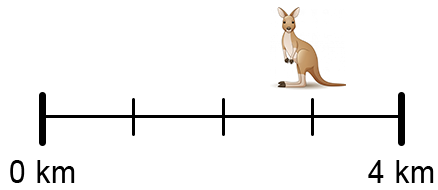
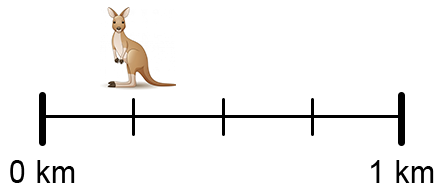
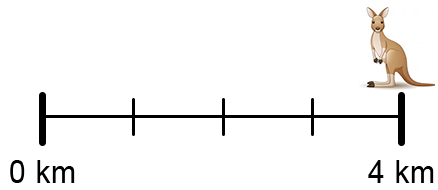
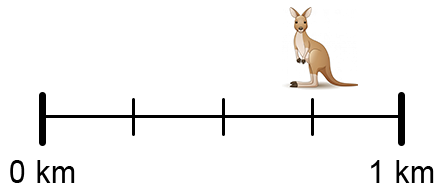
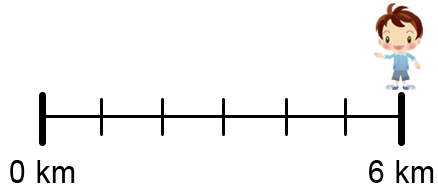
Julian was driving into town and hit a kangaroo `3/4` of a kilometre into his trip.

Which of these represent where Julian hit the kangaroo?


Show Answers Only

Show Worked Solution

`text(Each spacing is worth)\ 1/4\ text(km.)`
 

Filed Under: Fractions and Decimals Tagged With: Band 6, NAPX-MultipleChoice

Number, NAPX-p73124v01

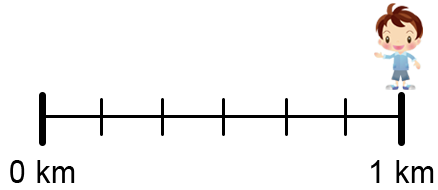
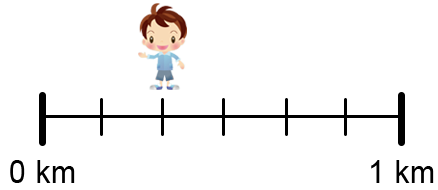
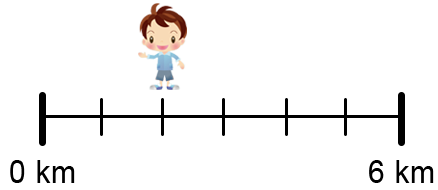
Axe went jogging and stopped after  `2/6`  of a kilometre to take a rest. 

Which of these represents where Axe stopped jogging?


Show Answers Only

Show Worked Solution

`text(Each spacing is worth)\ 1/6\ text(km.)`

Filed Under: Fractions and Decimals Tagged With: Band 6, NAPX-MultipleChoice

Geometry, NAPX-Z3-CA07 v1


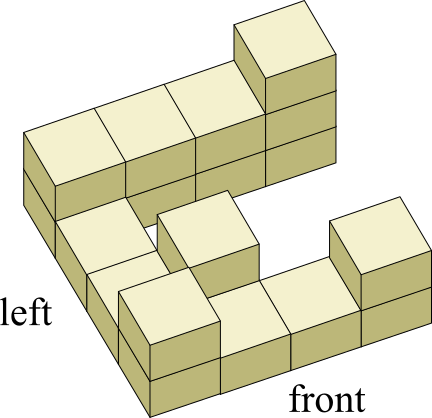
Which of these is the left view of this object made from cubes?


Show Answers Only

Show Worked Solution

Filed Under: 2D-3D Shapes and Location, TESTLET A1 Tagged With: Band 6, NAPX-MultipleChoice

Number, NAPX-Z3-CA06 v1

What number is exactly halfway between `4 frac{1}{4}` and `6 frac{3}{4}`


  `4 frac{3}{4}`
 
 
  `5`
 
 
  `5 frac{1}{4}`
 
 
  `5 frac{1}{2}`
Show Answers Only

`5 frac{1}{2}`

Show Worked Solution
  `text{Halfway}` `= (4 frac{1}{4} + 6 frac{3}{4}) \ div 2`
    `= 11/2`
    `= 5 frac{1}{2}`

Filed Under: Fractions, TESTLET A1, TESTLET A2 Tagged With: Band 6, NAPX-MultipleChoice

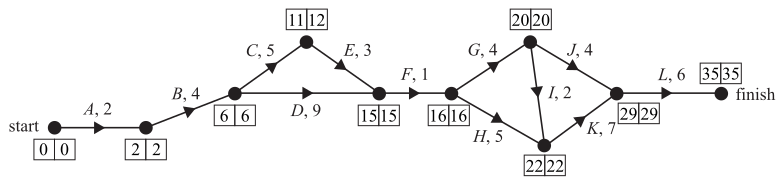
NETWORKS, FUR1 2020 VCAA 10 MC

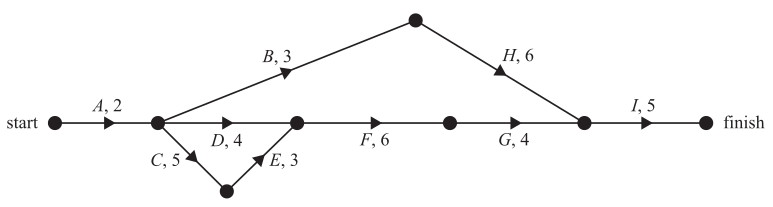
The directed network below shows the sequence of activities, `A` to `I`, that is required to complete an office renovation.

The time taken to complete each activity, in weeks, is also shown.


The project manager would like to complete the office renovation in less time.

The project manager asks all the workers assigned to activity `H` to also work on activity `F`.

This will reduce the completion time of activity `F` to three weeks.

The workers assigned to activity `H` cannot work on both activity `H` and activity `F` at the same time.

No other activity times will be changed.

This change to the network will result in a change to the completion time of the office renovation.

Which one of the following is correct?

  1. The completion time will be reduced by one week if activity `F` is completed before activity `H` is started.
  2. The completion time will be reduced by three weeks if activity `F` is completed before activity `H` is started.
  3. The completion time will be reduced by one week if activity `H` is completed before activity `F` is started.
  4. The completion time will be reduced by three weeks if activity `H` is completed before activity `F` is started.
  5. The completion time will be increased by three weeks if activity `H` is completed before activity `F` is started.
Show Answers Only

`A`

Show Worked Solution

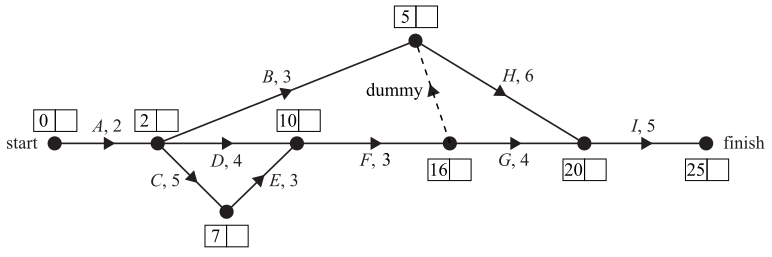
`text{Original forward scan (note}\ F\ text{is 6 origionally but}`

♦♦♦ Mean mark 24%.

`text{is reduced to 3 for the adjusted critical path):}`


`text(Original critical path is:)\ ACEFGI = 2+5+3+6+4+5=25`

`text(If activity)\ F\ text(is completed in 3 weeks, and then)`

`text(activity)\ H\ text(starts, new critical path is:)`

`ACEF\ text{(dummy)}\ HI = 24\ text(weeks)`

`=>  A`

Filed Under: Critical Path Analysis Tagged With: Band 6, smc-621-20-Critical Paths/EST, smc-621-40-Crashing/Reduce completion time

NETWORKS, FUR1 2020 VCAA 9 MC

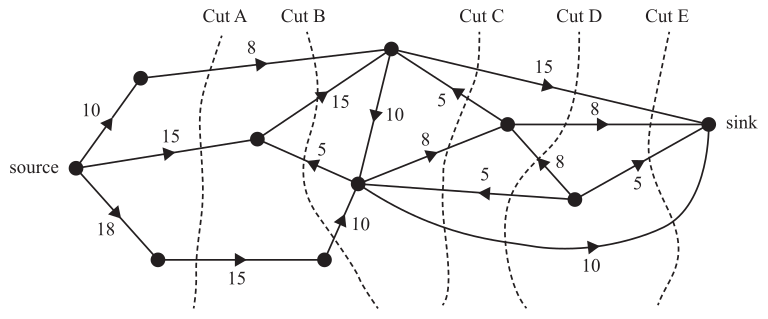
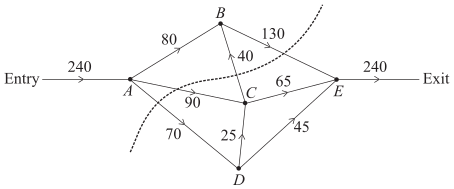
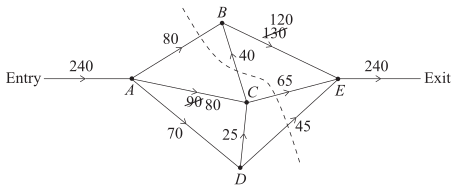
The flow of liquid through a series of pipelines, in litres per minute, is shown in the directed network below.


Five cuts labelled A to E are shown on the network.

The number of these cuts with a capacity equal to the maximum flow of liquid from the source to the sink, in litres per minute, is

  1. 1
  2. 2
  3. 3
  4. 4
  5. 5
Show Answers Only

`C`

Show Worked Solution

`text(Minimum cut) = 33`

`text(Cut)\ A = 8 + 15 + 15 = 38`

`text(Cut)\ B = 8 + 15 + 10 = 33`

`text(Cut)\ C = 15 + 8 + 10 = 33`

`text(Cut)\ D = 15 + 8 + 10 = 33`

`text(Cut)\ E = 15 + 8 + 5 + 10 = 38`

`text{(Note that it is arguable that the flow of 5 should not be counted}`

`text{in Cut}\ E,\ text(making the correct answer)\ D.\ text(This is because this)`

`text{edge cannot hold any flow in the network as given.)}`

`=>  C`

Filed Under: Flow Problems Tagged With: Band 6, smc-625-20-Max Flow/Min Cut

CORE, FUR1 2020 VCAA 26 MC

Ray deposited $5000 in an investment account earning interest at the rate of 3% per annum, compounding quarterly.

A rule for the balance, `R_n` , in dollars, after `n` years is given by

  1. `R_n = 5000 xx 0.03^n`
  2. `R_n = 5000 xx 1.03^n`
  3. `R_n = 5000 xx 0.03^(4n)`
  4. `R_n = 5000 xx 1.0075^n`
  5. `R_n = 5000 xx 1.0075^(4n)`
Show Answers Only

`E`

Show Worked Solution

`text(Quarterly rate) = 0.03/4 = 0.0075`

♦♦♦ Mean mark 20%.

`text(Compounding periods) = 4n`

`:.\ text(Balance after)\ n\ text(years)`

`= 5000 xx 1.0075^(4n)`
 

`=>  E`

Filed Under: Interest Rates and Investing Tagged With: Band 6, smc-604-20-Compound interest

Calculus, MET1 2020 VCAA 8

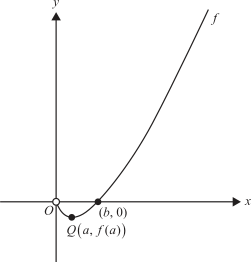
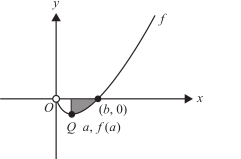
Part of the graph of  `y = f(x)`, where  `f:(0, ∞) -> R, \ f(x) = xlog_e(x)`, is shown below.


The graph of `f` has a minimum at the point `Q(a, f(a))`, as shown above.

  1. Find the coordinates of the point `Q`.   (2 marks)

    --- 6 WORK AREA LINES (style=lined) ---

  2. Using  `(d(x^2log_e(x)))/(dx) = 2x log_e(x) + x`, show that  `xlog_e(x)`  has an antiderivative  `(x^2log_e(x))/2-(x^2)/4`.   (1 mark)

    --- 3 WORK AREA LINES (style=lined) ---

  3. Find the area of the region that is bounded by `f`, the lines  `x = a`  and the horizontal axis for  `x ∈ [a, b]`, where `b` is the `x`-intercept of `f`.   (2 marks)

    --- 7 WORK AREA LINES (style=lined) ---

  4. Let  `g: (a, ∞) -> R, \ g(x) = f(x) + k`  for  `k ∈ R`.


    i. Find the value of `k` for which  `y = 2x`  is a tangent to the graph of `g`.   (1 mark)

    --- 6 WORK AREA LINES (style=lined) ---

    ii. Find all values of `k` for which the graphs of `g` and `g^(-1)` do not intersect.   (2 marks)

    --- 5 WORK AREA LINES (style=lined) ---

Show Answers Only
  1. `Q(1/e, -1/e)`
  2. `text(See Worked Solutions)`
  3. `1/4-3/(4e^2)\ text(u)^2`
  4. i.  `e`
  5. ii.  `k ∈ (1, ∞)`
Show Worked Solution

a.   `y = xlog_e x`

`(dy)/(dx)` `= x · 1/x + log_e x`
  `= 1 + log_e x`

 
`text(Find)\ x\ text(when)\ (dy)/(dx) = 0:`
`1 + log_e x` `= 0`
`log_e x` `= -1`
`x` `= 1/e`
`y` `= 1/e log_e (e^(-1))`
  `= -1/e`

 
`:. Q(1/e, -1/e)`


b.    `int 2x log_e(x) + x\ dx` `= x^2 log_e (x) + c`
  `2 int x log_e(x)\ dx` `= x^2 log_e (x)-intx\ dx + c`
  `:. int x log_e(x)\ dx` `= (x^2 log_e (x))/2-(x^2)/4 \ \ (c = 0)`


c.   

`text(When)\ \ x log_e x = 0 \ => \ x = 1`

`=> b = 1`

`:.\ text(Area)` `= −int_(1/e)^1 x log_e(x)\ dx`
  `= [(x^2)/4-(x^2 log_e(x))/2]_(1/e)^1`
  `= (1/4-0)-(1/(4e^2)-(log_e(e^(-1)))/(2e^2))`
  `= 1/4-(1/(4e^2) + 1/(2e^2))`
  `= 1/4-3/(4e^2) \ text(u)^2`


d.i.   `text(When)\ \ f^{prime}(x) = m_text(tang) = 2,`

`1 + log_e(x)` `= 2`
`x` `= e`

 
`text(T)text(angent meets)\ \ g(x)\ \ text(at)\ \ (e, 2e)`

`g(e)` `= f(e) + k`
`2e` `= e log_e e + k`
`:.k` `= e`


d.ii. `text(Find the value of)\ k\ text(when)\ \ y = x\ \ text(is a tangent to)\ g(x):`

`text(When)\ \ f^{prime}(x) = 1,`

`1 + log_e(x)` `= 1`
`x` `= 1`

 
`text(T)text(angent occurs at)\ (1, 1)`

`g(1) = f(1) + k \ => \ k = 1`
 

`:.\ text(Graphs don’t intersect for)\ k ∈ (1, ∞)`

Filed Under: Area Under Curves, Tangents and Normals Tagged With: Band 4, Band 5, Band 6, smc-723-50-Log/Exponential

Calculus, EXT2 C1 2020 HSC 16b

Let  `I_n = int_0^(frac{pi}{2}) sin^(2n + 1)(2theta)\ d theta, \ n = 0, 1, ...`

  1. Prove that  `I_n = frac{2n}{2n + 1} I_(n-1) , \ n ≥ 1`.  (3 marks)

    --- 8 WORK AREA LINES (style=lined) ---

  2. Deduce that  `I_n = frac{2^(2n)(n!)^2}{(2n +1)!}`.  (3 marks)

    --- 8 WORK AREA LINES (style=lined) ---

Let  `J_n = int_0^1 x^n (1 - x)^n\ dx , \ n = 0, 1, 2,...`

  1. Using the result of part (ii), or otherwise, show that  `J_n = frac{(n!)^2}{(2n + 1)!}`.  (3 marks)

    --- 8 WORK AREA LINES (style=lined) ---

  2. Prove that  `(2^n n!)^2 ≤ (2n + 1)!`.  (2 marks)

    --- 10 WORK AREA LINES (style=lined) ---

Show Answers Only
  1. `text{See Worked Solutions}`
  2. `text{See Worked Solutions}`
  3. `text{See Worked Solutions}`
  4. `text{See Worked Solutions}`
Show Worked Solution

i.    `text{Prove} \ \ I_n = frac{2n}{2n + 1} I_(n-1) , \ n ≥ 1`

♦ Mean mark (i) 48%.

`I_n = int_0^(frac{pi}{2}) sin^(2n) (2 theta) * sin (2 theta)\ d theta`

`text{Integrating by parts:}`

`u = sin^(2n) (2 theta)`   `u^(′) = 2n sin^(2n -1) (2 theta)  xx -frac(1)(2) cos (2 theta)`
`v = -frac{1}{2} cos (2 theta)`   `v^(′) = sin 2 theta`


`I_n` `= [ sin^(2n) (2 theta) * -frac{1}{2} cos (2 theta)]_0^(frac{pi}{2}) -2n int_0^(frac{pi}{2}) sin^(2n -1) (2 theta) * 2 cos (2 theta) * -frac{1}{2} cos (2 theta)\ d theta`
`I_n` `= 0 + 2n int_0^(frac{pi}{2}) sin^(2n-1) (2 theta) * cos^2 (2 theta)\ d theta`
`I_n` `= 2 n int_0^(frac{pi}{2}) sin^(2n-1) (2 theta) (1 – sin^2 (2 theta))\ d theta`
`I_n` `= 2 n int_0^(frac{pi}{2}) sin^(2n-1) ( 2 theta) – sin^(2n+1) (2 theta)\ d theta`
`I_n` `= 2n (I_(n-1) – I_n)`
`I_n + 2 n  I_n` `= 2 n I_(n-1)`
`I_n (2n + 1)` `= 2 n I_(n-1)`
`therefore I_n` `= frac{2n}{2n +1} I_(n-1)`
♦ Mean mark (ii) 36%.


ii.     `I_0` `= int_0^(frac{pi}{2}) sin (2 theta)\ d theta`
    `= [ -frac(1)(2) cos (2 theta) ]_0^(frac{pi}{2}`
    `=( -frac{1}{2} cos pi + frac{1}{2} cos 0 )`
    `= 1`
     
`I_n` `= frac{2n}{2n + 1} I_(n-1)`
`I_(n-1)` `= frac{2(n -1)}{2n -1} I_(n-2)`
  `vdots`
`I_1` `= frac{2}{3} I_0`


`I_n` `= frac{2n}{2n + 1} xx frac{2(n-1)}{2n-1} xx frac{2(n-2)}{2n-3} xx … xx frac{2}{3} xx 1`
  `= frac{2n}{2n+1} xx frac{2n}{2n} xx frac{2(n-1)}{2n-1} xx frac{2(n-1)}{2n-2} xx … xx frac{2}{3} xx frac{2}{2} xx 1`
  `= frac{2^n (n xx (n-1) xx .. xx 1) xx 2^n (n xx (n – 1) xx … xx 1)}{(2n + 1)!}`
  `= frac{2^(2n) (n!)^2}{(2n + 1)!}`
♦♦♦ Mean mark (iii) 16%.


iii.   `J_n = int_0^1 x^n (1-x)^n\ dx ,  \ n = 0, 1, 2, …`

`text{Let} \ \ x` `= sin^2 theta`
`frac{dx}{d theta}` `= 2 sin theta \ cos theta \ => \ dx = 2 sin theta \ cos theta \ d theta`


`text{When}`    `x = 0 \ ,` ` \ theta = 0`
  `x = 1  \ ,` ` \ theta = frac{pi}{2}`


`J_n` `= int_0^(frac{pi}{2}) (sin^2 theta)^n (1 – sin^2 theta)^n * 2 sin theta \ cos theta \ d theta`
  `= int_0^(frac{pi}{2}) sin^(2n) theta \ cos^(2n) theta * sin (2 theta)\ d theta`
  `= frac{1}{2^(2n)} int_0^(frac{pi}{2}) 2^(2n) sin^(2n) theta \ cos^(2n) theta * sin (2 theta)\ d theta`
  `= frac{1}{2^(2n)} int_0^(frac{pi}{2}) sin^(2n) (2 theta) * sin (2 theta)\ d theta`
  `= frac{1}{2^(2n)} int_0^(frac{pi}{2}) sin^(2n+1) (2 theta)\ d theta`
  `= frac{1}{2^(2n)} * frac{2^(2n) (n!)^2}{(2n+1)!}\ \ \ text{(using part (ii))}`
  `= frac{(n!)^2}{(2n + 1)!}`
♦♦♦ Mean mark (iv) 10%.


iv.   `text{If} \ \ I_n ≤ 1,`

`2^(2n) (n!)^2` ` ≤ (2n + 1)!`
`(2^n n!)^2` `≤ (2n + 1)!`

  
`text{Show} \ \ I_n ≤ 1 :`

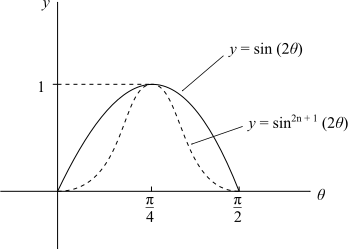
`text{Consider the graphs}`

`y = sin(2 theta) \ \ text{and}\ \ y = sin^(2n + 1) (2 theta) \ \ text{for} \ \ 0 ≤ theta ≤ frac{pi}{2}`
 

`int_0^(frac{pi}{2}) sin(2 theta)` `= [ – frac{1}{2} cos (2 theta) ]_0^(frac{pi}{2})`
  `= – frac{1}{2} cos \ pi + frac{1}{2} cos \ 0`
  `= 1`

 
`y = sin(2 theta) \ => \ text{Range} \ [0, 1] \ \ text{for}\ \ theta ∈ [0, frac{pi}{2}]`

`sin^(2n+1) (2 theta)` `≤ sin (2 theta) \ \ text{for}\ \ theta ∈ [0, frac{pi}{2}]`
`sin^(2n+1) (2 theta)` `≤ 1`
`I_n` `≤ 1`
`therefore (2^n n!)^2` `≤ (2n + 1) !`

Filed Under: Recurrence Relations Tagged With: Band 5, Band 6, smc-1054-10-Trig

Measurement, STD1 M5 2020 HSC 28

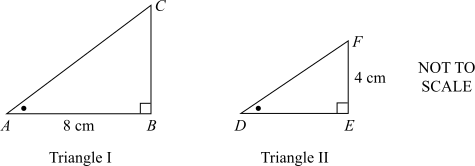
Two similar right-angled triangles are shown.


The length of side `AB` is 8 cm and the length of side `EF` is 4 cm.

The area of triangle `ABC` is 20 cm2.

Calculate the length in centimetres of side `DF` in Triangle II, correct to two decimal places.   (4 marks)

--- 8 WORK AREA LINES (style=lined) ---

Show Answers Only

`7.55\ \text{cm}`

Show Worked Solution

`text{Consider} \ Δ ABC :`

`text{Area}` `= frac{1}{2} xx AB xx BC`
`20` `= frac{1}{2} xx 8 xx BC`
`therefore \ BC` `= 5`


`text{Using Pythagoras in} \ Δ ABC :`

♦♦♦ Mean mark 11%.

`AC = sqrt(8^2 + 5^2) = sqrt89`


`text{S} text{ince} \ Δ ABC\ text{|||}\ Δ DEF,`

`frac{AC}{BC}` `= frac{DF}{EF}`
`frac{sqrt89}{5}` `= frac{DF}{4}`
`therefore \ DF` `= frac{4 sqrt89}{5}`
  `= 7.547 …`
  `= 7.55 \ text{cm (to 2 d.p.)}`

Filed Under: M5 Scale Drawings (Y12), Similarity Tagged With: Band 6, num-title-ct-pathb, num-title-qs-hsc, smc-1105-30-Similarity, smc-4746-20-Similar triangles, smc-4746-40-Areas and Volumes

Trigonometry, EXT1 T3 2020 HSC 14b

  1. Show that  `sin^3 theta-3/4 sin theta + (sin(3theta))/4 = 0`.  (2 marks)

    --- 7 WORK AREA LINES (style=lined) ---

  2. By letting  `x = 4sin theta`  in the cubic equation  `x^3-12x + 8 = 0`.


    Show that  `sin (3theta) = 1/2`. (2 marks)

    --- 7 WORK AREA LINES (style=lined) ---

  3. Prove that  `sin^2\ pi/18 + sin^2\ (5pi)/18 + sin^2\ (25pi)/18 = 3/2`.  (3 marks)

    --- 10 WORK AREA LINES (style=lined) ---

Show Answers Only
  1. `text(See Worked Solutions)`
  2. `text(See Worked Solutions)`
  3. `text(See Worked Solutions)`
Show Worked Solution

i.   `text(Prove:)\  \ sin^3 theta-3/4 sin theta + (sin(3theta))/4 = 0`

`text(LHS)` `= sin^3 theta-3/4 sin theta + 1/4 (sin 2thetacostheta + cos2thetasintheta)`
  `= sin^3 theta-3/4 sintheta + 1/4(2sinthetacos^2theta + sintheta(1 – 2sin^2theta))`
  `= sin^3theta-3/4 sintheta + 1/4(2sintheta(1-sin^2theta) + sintheta – 2sin^3theta)`
  `= sin^3theta-3/4 sintheta + 1/4(2sintheta-2sin^3theta + sintheta-2sin^3theta)`
  `= sin^3theta-3/4sintheta + 3/4sintheta-sin^3theta`
  `= 0`


ii.   `text(Show)\ \ sin(3theta) = 1/2`

`text{Using part (i):}`

`(sin(3theta))/4` `= 3/4 sintheta-sin^3 theta`
`sin(3theta)` `= 3sintheta-4sin^3theta\ …\ (1)`

 
`x^3-12x + 8 = 0`

`text(Let)\ \ x = 4 sin theta`

`(4sintheta)^3-12(4sintheta) + 8` `= 0`
`64sin^3theta-48sintheta` `= 0`
`−16underbrace{(3sintheta-4sin^2theta)}_text{see (1) above}` `= −8`
`−16 sin(3theta)` `= −8`
`sin(3theta)` `= 1/2`
♦♦♦ Mean mark (iii) 21%.


iii.   `text(Prove:)\ \ sin^2\ pi/18 + sin^2\ (5pi)/18 + sin^2\ (25pi)/18 = 3/2`

`text(Solutions to)\ \ x^3-12x + 8 = 0\ \ text(are)`

`x = 4sintheta\ \ text(where)\ \ sin(3theta) = 1/2`

`text(When)\ \ sin3theta = 1/2,`

`3theta` `= pi/6, (5pi)/6, (13pi)/6, (17pi)/6, (25pi)/6, (29pi)/6, …`
`theta` `= pi/18, (5pi)/18, (13pi)/18, (17pi)/18, (25pi)/18, (29pi)/18, …`

 
`:.\ text(Solutions)`

`x = 4sin\ pi/18 \ \ \ (= 4sin\ (17pi)/18)`

`x = 4sin\ (5pi)/18 \ \ \ (= 4sin\ (13pi)/18)`

`x = 4sin\ (25pi)/18 \ \ \ (= 4sin\ (29pi)/18)`
 

`text(If roots of)\ \ x^3-12x + 8 = 0\ \ text(are)\ \ α, β, γ:`

`α + β + γ = −b/a = 0`

`αβ + βγ + αγ = c/a = −12`

`(4sin\ pi/18)^2 + (4sin\ (5pi)/18)^2 + (4sin\ (25pi)/18)^2` `= (α + β + γ)^2 – 2(αβ + βγ + αγ)`
`16(sin^2\ pi/18 + sin^2\ (5pi)/18 + sin^2\ (25pi)/18)` `= 0-2(−12)`
`:. sin^2\ pi/18 + sin^2\ (5pi)/18 + sin^2\ (25pi)/18` `= 24/16=3/2`

Filed Under: Identities, Equations and 't' formulae (Ext1), Sum, Products and Multiplicity of Roots (Ext1) Tagged With: Band 4, Band 6, smc-1076-10-Double Angle Identities/Equations, smc-1205-10-Sum and Product

Algebra, STD1 A3 2020 HSC 29

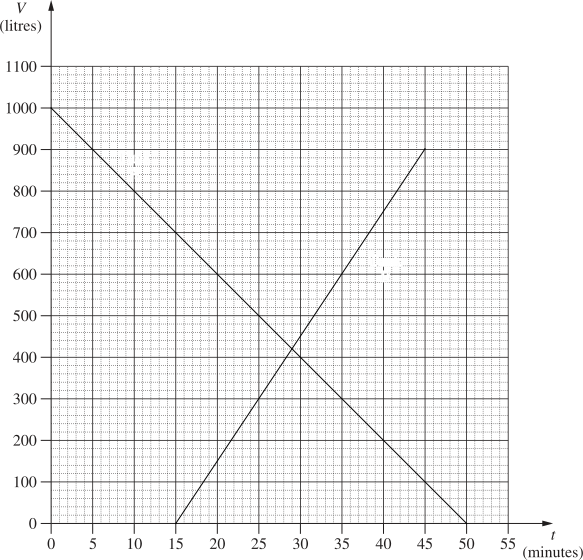
There are two tanks on a property, Tank A and Tank B. Initially, Tank A holds 1000 litres of water and Tank B is empty.

  1. Tank A begins to lose water at a constant rate of 20 litres per minute.


    The volume of water in Tank A is modelled by  `V = 1000 - 20t`  where `V` is the volume in litres and  `t`  is the time in minutes from when the tank begins to lose water.


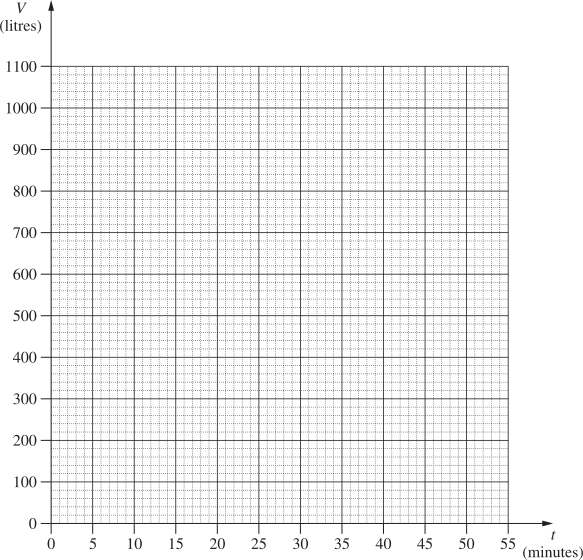
    On the grid below, draw the graph of this model and label it as Tank A.   (1 mark)


  2. Tank B remains empty until  `t=15`  when water is added to it at a constant rate of 30 litres per minute.
    By drawing a line on the grid (above), or otherwise, find the value of  `t`  when the two tanks contain the same volume of water.  (2 marks)
  3. Using the graphs drawn, or otherwise, find the value of  `t`  (where  `t > 0`) when the total volume of water in the two tanks is 1000 litres.  (1 mark)

    --- 2 WORK AREA LINES (style=lined) ---

Show Answers Only
  1.  `text{T} text{ank} \ A \ text{will pass trough (0, 1000) and (50, 0)}` 


  2. `29 \ text{minutes}`
  3. `45 \ text{minutes}`
Show Worked Solution

a.     `text{T} text{ank} \ A \ text{will pass trough (0, 1000) and (50, 0)}`

♦ Mean mark part (a) 45%.


b.   `text{T} text{ank} \ B \ text{will pass through (15, 0) and (45, 900)}`

♦♦ Mean mark part (b) 24%.


`text{By inspection, the two graphs intersect at} \ \ t = 29 \ text{minutes}`

 
c.   `text{Strategy 1}`

♦♦♦ Mean mark part (c) 5%.

`text{By inspection of the graph, consider} \ \ t = 45`

`text{T} text{ank A} = 100 \ text{L} , \ text{T} text{ank B} =900 \ text{L} `

`:.\ text(Total volume = 1000 L when  t = 45)`
  

`text{Strategy 2}`

`text{Total Volume}` `=text{T} text{ank A} + text{T} text{ank B}`
`1000` `= 1000 – 20t + (t – 15) xx 30`
`1000` `= 1000 – 20t + 30t – 450 `
`10t` `= 450`
`t` `= 45 \ text{minutes}`

Filed Under: A3 Types of Relationships (Y12) Tagged With: Band 5, Band 6, smc-1099-20-Other SE applications, smc-1099-40-Sketch equations

Algebra, STD1 A2 2020 HSC 10 MC

A plumber charges a call-out fee of $90 as well as $2 per minute while working.

Suppose the plumber works for  `t`  hours.

Which equation expresses the amount the plumber charges ($`C`) as a function of time (`t`  hours)?

  1.  `C = 2 + 90t`
  2.  `C = 90 + 2t`
  3.  `C = 120 + 90t`
  4.  `C = 90 + 120t`
Show Answers Only

`D`

Show Worked Solution

♦♦♦ Mean mark 21%.
`text(Hourly rate)` `= 60 xx 2`
  `= $120`

 
`therefore  C = 90 + 120t`

Filed Under: Applications: Currency, Fuel and Other Problems (Std 1) Tagged With: Band 6, smc-1119-30-Other Linear Applications

Measurement, STD1 M1 2020 HSC 3 MC

What is 0.002073 expressed in standard form with two significant figures?

  1. `2.07 xx 10^(-2)`
  2. `2.1 xx 10^(-2)`
  3. `2.07 xx 10^(-3)`
  4. `2.1 xx 10^(-3)`
Show Answers Only

`B`

Show Worked Solution

♦♦♦ Mean mark 12%.
`0.002073` `= 2.073 xx 10^(-3)`  
  `=2.1 xx 10^(-3)\ \ \ text{(to 2 sig fig)}`  

 
`=> B`

Filed Under: Units and Measurement Error (Std 1) Tagged With: Band 6, smc-1120-20-Scientific Notation, smc-1120-30-Significant Figures

Financial Maths, STD2 F5 2020 HSC 37

Wilma deposited a lump sum into a new bank account which earns 2% per annum compound interest.

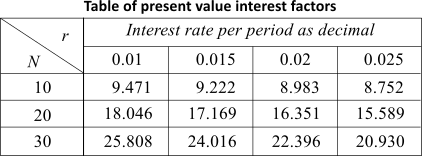
Present value interest factors for an annuity of $1 for various interest rates (`r`) and numbers of periods (`N`) are given in the table.


Wilma was able to make the following withdrawals from this account.

  • $1000 at the end of each year for twenty years (starting one year after the account is opened)
  • $3000 each year for ten years starting 21 years after the account is opened.

Calculate the minimum lump sum Wilma must have deposited when she opened the new account.   (3 marks)

--- 6 WORK AREA LINES (style=lined) ---

Show Answers Only

`$ 34 \ 486`

Show Worked Solution

`text{Annuity 1:}\ PV\ text{of $1000 annuity for 20 years at} \ \ r = 0.02`

♦♦♦ Mean mark 23%.

`PV\ text{factor} = 16.351`

`therefore \ PV\ text{Annuity 1}` `= 16.351 xx 1000`
  `= $16 \ 351`

 
`text{Annuity 2:}\ PV\ text{of $3000 annuity for years 21-30 at} \ \ r = 0.02`

`PV\ text{Annuity 2}` `= PVtext{(30 years)} – PVtext{(20 years)}`
  `= 3000 xx 22.396 – 3000 xx 16.351`
  `= $ 18 \ 135`


`:.\ text{Lump sum required}` `= 16 \ 351 + 18\ 135`
  `= $ 34 \ 486`

Filed Under: F5 Annuities (Y12) Tagged With: Band 6, common-content, smc-816-20-PV of $1 Annuity Table

Calculus, EXT1 C2 2020 HSC 13c

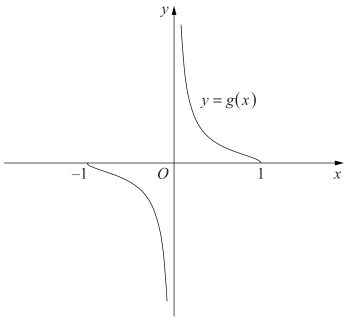
Suppose  `f(x) = tan(cos^(-1)(x))`  and  `g(x) = (sqrt(1-x^2))/x`.

The graph of  `y = g(x)`  is given.
 

  1. Show that  `f^(′)(x) = g^(′)(x)`.  (4 marks)

    --- 8 WORK AREA LINES (style=lined) ---

  2. Using part (i), or otherwise, show that  `f(x) = g(x)`.  (3 marks) 

    --- 6 WORK AREA LINES (style=lined) ---

Show Answers Only
  1. `text(See Worked Solutions)`
  2. `text(See Worked Solutions)`
Show Worked Solution

i.   `f(x) = tan(cos^(-1)(x))`

♦ Mean mark (i) 50%.
`f^(′)(x)` `= -1/sqrt(1-x^2) · sec^2(cos^(-1)(x))`
  `= -1/sqrt(1-x^2) · 1/(cos^2(cos^(-1)(x)))`
  `= -1/(x^2sqrt(1-x^2))`

 
`g(x) = (1-x^2)^(1/2) · x^(-1)`

`g^(′)(x)` `= 1/2 · -2x(1-x^2)^(-1/2) · x^(-1)-(1-x^2)^(1/2) · x^(-2)`
  `= (-x)/(x sqrt(1-x^2))-sqrt(1-x^2)/(x^2)`
  `= (-x^2-sqrt(1-x^2) sqrt(1-x^2))/(x^2 sqrt(1-x^2))`
  `= (-x^2-(1-x^2))/(x^2sqrt(1-x^2))`
  `= -1/(x^2sqrt(1-x^2))`
  `=f^(′)(x)`


ii.   `f^(′)(x) = g^(′)(x)`

♦♦♦ Mean mark (ii) 15%.

`=> f(x) = g(x) + c`
 

`text(Find)\ c:`

`f(1)` `= tan(cos^(-1) 1)`
  `= tan 0`
  `= 0`

`g(1) = sqrt(1-1)/0 = 0`

`f(1) = g(1) + c`

`:. c = 0`

`:. f(x) = g(x)`

Filed Under: Harder Trig Calculus (Ext1), Inverse Functions Calculus (Ext1) Tagged With: Band 5, Band 6, smc-1037-10-Sin/Cos Differentiation, smc-1037-20-Tan Differentiation, smc-1038-60-Other

Statistics, STD2 S5 2020 HSC 35

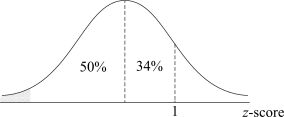
The intelligence Quotient (IQ) scores for adults in City A are normally distributed with a mean of 108 and a standard deviation of 10.

The IQ score for adults in City B are normally distributed with a mean of 112 and a standard deviation of 16.

  1. Yin is an adult who lives in City A and has an IQ score of 128.
    What percentage of the adults in this city have an IQ score higher than Yin's?   (2 marks) 

    --- 4 WORK AREA LINES (style=lined) ---

  2. There are 1 000 000 adults living in City B.
    Calculate the number of adults in City B that would be expected to have an IQ score lower than Yin's.  (2 marks)

    --- 4 WORK AREA LINES (style=lined) ---

  3. Simon, an adult who lives in City A, moves to City B. The  `z` -score corresponding to his IQ score in City A is the same as the `z`-score corresponding to his IQ score in City B.
    By first forming an equation, calculate Simon's IQ score. Give your answer correct to one decimal place.   (3 marks)

    --- 6 WORK AREA LINES (style=lined) ---

Show Answers Only
  1. `text(2.5%)`
  2. `840 \ 000`
  3. `101.3`
Show Worked Solution

a.    `text{In City A:}`

♦ Mean mark 50%.

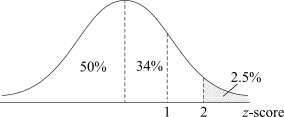
`z text{-score}\ (128) = frac {x -mu}{sigma} = frac{128 – 108}{10} = 2`


`therefore\ text{2.5% have a higher IQ in City} \ A.`
 

b.    `text{In City B:}`

♦ Mean mark 44%.

`z text{-score}\ (128) = frac{128 – 112}{16} = 1`


`therefore \ text{Adults in City} \ B \ text{with an IQ}\ <  128`

`= 84text(%) xx 1 \ 000 \ 000`

`= 840 \ 000`
 

c.    `z text{-score in City A}\ = z text{-score in City B}`

♦♦♦ Mean mark 17%.
`frac{x – 108}{10} ` `= frac{x -112}{16} \ \ text{(multiply b.s.} \ xx 160 text{)}`
`16 (x – 108)` `= 10 (x – 112)`
`16 x – 1728` `= 10 x – 1120`
`6x` `= 608`
`x` `= 101.3`

  
`therefore \ text{Simon’s IQ} = 101.3 \ text{(to 1 d.p.)}`

Filed Under: S5 The Normal Distribution (Y12) Tagged With: Band 5, Band 6, common-content, smc-819-10-Single z-score, smc-819-30-Comparisons of Data Sets

Statistics, STD2 S4 2020 HSC 36

A cricket is an insect. The male cricket produces a chirping sound.

A scientist wants to explore the relationship between the temperature in degrees Celsius and the number of cricket chirps heard in a 15-second time interval.

Once a day for 20 days, the scientist collects data. Based on the 20 data points, the scientist provides the information below.

  • A box-plot of the temperature data is shown.
     
       
  • The mean temperature in the dataset is 0.525°C below the median temperature in the dataset.
  • A total of 684 chirps was counted when collecting the 20 data points.

The scientist fits a least-squares regression line using the data `(x, y)`, where `x` is the temperature in degrees Celsius and `y` is the number of chirps heard in a 15-second time interval. The equation of this line is

`y = −10.6063 + bx`,

where `b` is the slope of the regression line.

The least-squares regression line passes through the point  `(barx, bary)`, where  `barx`  is the sample mean of the temperature data and  `bary`  is the sample mean of the chirp data.

Calculate the number of chirps expected in a 15-second interval when the temperature is 19° Celsius. Give your answer correct to the nearest whole number.  (5 marks)

Show Answers Only

`29\ text(chirps)`

Show Worked Solution

`y = −10.6063 + bx`

♦♦♦ Mean mark 18%.

`text(Find)\ b:`

`text(Line passes through)\ \ (barx, bary)`

`barx` `= 22 – 0.525`
  `= 21.475`
`bary` `= text(total chirps)/text(number of data points)`
  `= 684/20`
  `= 34.2`


`34.2` `= −10.6063 + b(21.475)`
`:.b` `= 44.8063/21.475`
  `~~ 2.0864`

 
`text(If)\ \ x = 19,`

`y` `= −10.6063 + 2.0864 xx 19`
  `= 29.03`
  `= 29\ text(chirps)`

Filed Under: S4 Bivariate Data Analysis (Y12) Tagged With: 2adv-std2-common, Band 6, common-content, smc-785-20-Least-Squares Regression Line

Algebra, STD2 A4 2020 HSC 33

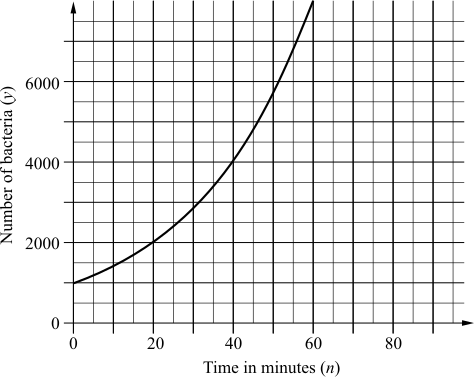
The graph shows the number of bacteria, `y`, at time `n` minutes. Initially (when `n = 0`) the number of bacteria is 1000.


  1. Find the number of bacteria at 40 minutes.   (1 mark)

    --- 1 WORK AREA LINES (style=lined) ---

  2. The number of bacteria can be modelled by the equation  `y = A xx b^n`, where `A` and `b` are constants.
    Use the guess and check method to find, to two decimal places, an upper and lower estimate for the value of `b`. The upper and lower estimates must differ by 0.01. (2 marks)

    --- 4 WORK AREA LINES (style=lined) ---

Show Answers Only
  1. `4000`
  2. `text{Show Worked Solutions}`
Show Worked Solution

a.    `text{When} \ \ n = 40,`

`text{Number of Bacteria} \ (y) = 4000`
 

b.   `A = 1000 \ => \ y = 1000  b^n`

♦♦♦ Mean mark 14%.

`text{By inspection, graph passes through (40, 4000)}`

`=> \ 4000 = 1000  b^40`
 

`text(Guess and check possible values of)\ b:`

`text{If} \ \ b = 1.03 \ , \ \ y = 1000 xx 1.03^40 = 3262 \ text{(too low)}`

`text{If} \ \ b = 1.04 \ , \ \ y = 1000 xx 1.04^40 = 4801 \ text{(too high)}`

`therefore \ 1.03 < b < 1.04`

Filed Under: Non-Linear: Exponential/Quadratics (Std 2) Tagged With: Band 2, Band 6, smc-830-30-Exponential

Combinatorics, EXT1 A1 2020 HSC 14a

  1. Use the identity `(1 + x)^(2n) = (1 + x)^n(1 + x)^n`


    to show that
     
        `((2n),(n)) = ((n),(0))^2 + ((n),(1))^2 + … + ((n),(n))^2`,
     
    where `n` is a positive integer.  (2 marks)

    --- 6 WORK AREA LINES (style=lined) ---

  2. A club has `2n` members, with `n` women and `n` men.


    A group consisting of an even number `(0, 2, 4, …, 2n)` of members is chosen, with the number of men equal to the number of women.
     
    Show, giving reasons, that the number of ways to do this is `((2n),(n))`.  (2 marks)

    --- 5 WORK AREA LINES (style=lined) ---

  3. From the group chosen in part (ii), one of the men and one of the women are selected as leaders.


    Show, giving reasons, that the number of ways to choose the even number of people and then the leaders is


        `1^2 ((n),(1))^2 + 2^2((n),(2))^2 + … + n^2((n),(n))^2`.  (2 marks)

    --- 6 WORK AREA LINES (style=lined) ---

  4. The process is now reversed so that the leaders, one man and one woman, are chosen first. The rest of the group is then selected, still made up of an equal number of women and men.


    By considering this reversed process and using part (ii), find a simple expression for the sum in part (iii).  (2 marks)

    --- 6 WORK AREA LINES (style=lined) ---

Show Answers Only
  1. `text(See Worked Solutions)`
  2. `text(See Worked Solutions)`
  3. `text(See Worked Solutions)`
  4. `n^2 xx \ ^(2n – 2)C_(n – 1)`
Show Worked Solution

i.   `text(Expand)\ \ (1 + x)^(2n):`

♦♦ Mean mark part (i) 26%.

`\ ^(2n)C_0 + \ ^(2n)C_1 x^2 + … + \ ^(2n)C_n x^n + … \ ^(2n)C_(2n) x^(2n)`

`=> text(Coefficient of)\ \ x^n = \ ^(2n)C_n`
 

`text(Expand)\ \ (1 + x)^n (1 + x)^n:`

`[\ ^nC_0 + \ ^nC_1 x + … + \ ^nC_n x^n][\ ^nC_0 + \ ^nC_1 x + … + \ ^nC_n x^n]`

`=> \ text(Coefficient of)\ \ x^n`

`= \ ^nC_0 · \ ^nC_n + \ ^nC_1 · \ ^nC_(n – 1) + … + \ ^nC_(n – 1) · \ ^nC_1 + \ ^nC_n · \ ^nC_0`

`= (\ ^nC_0)^2 + (\ ^nC_1)^2 + … + (\ ^nC_(n – 1))^2 + (\ ^nC_n)^2\ \ \ (\ ^nC_k = \ ^nC_(n – k))`
 

`text(Equating coefficients:)`

`\ ^(2n)C_n = (\ ^nC_0)^2 + (\ ^nC_1)^2 + … + (\ ^nC_n)^2`

♦♦ Mean mark part (ii) 23%.


ii.   `text(Number of men = Number of women)\ \ (M = W)`

`text(If)\ \ M = W = 0:`  `text(Ways) = \ ^nC_0 · \ ^nC_0 = (\ ^nC_0)^2`
`text(If)\ \ M = W = 1:`  `text(Ways) = \ ^nC_1 · \ ^nC_1 = (\ ^nC_1)^2`

`vdots`

`text(If)\ \ M = W = n:  text(Ways) = \ ^nC_n · \ ^nC_n = (\ ^nC_n)^2`
 

`:.\ text(Total combinations)`

`= (\ ^nC_0)^2 + (\ ^nC_1)^2 + … + (\ ^nC_n)^2`

`= \ ^(2n)C_n\ \ \ text{(from part (i))}`


iii.   `text(Let)\ \ M_L = text(possible male leaders)`

♦♦ Mean mark part (iii) 26%.

`text(Let)\ \ W_L = text(possible female leaders)`

`text(If)\ \ M = W = 0 => text(no leaders)`

`text(If)\ \ M = W = 1:  text(Ways) = \ ^nC_1 xx M_L xx \ ^nC_1 xx W_L = 1^2 (\ ^nC_1)^2`

`text(If)\ \ M = W = 2:  text(Ways) = \ ^nC_2 xx 2 xx \ ^nC_2 xx 2 = 2^2 (\ ^nC_2)^2`

`vdots`

`text(If)\ \ M = W = n:  text(Ways) = \ ^nC_n xx n xx \ ^nC_2 xx n = n^2 (\ ^nC_n)^2`
 

`:.\ text(Total combinations)`

`= 1^2(\ ^nC_1)^2 + 2^2(\ ^nC_2)^2 + … + n^2(\ ^nC_n)^2`

♦♦♦ Mean mark part (iv) 16%.


iv.  `text(If)\ \ M = W = 1:  text(Ways)` `= M_L xx \ ^(n – 1)C_0 xx W_L xx \ ^(n – 1)C_0`
    `= n xx \ ^(n – 1)C_0 xx n xx \ ^(n – 1)C_0`
    `= n^2(\ ^(n – 1)C_0)^2`
`text(If)\ \ M = W = 2:  text(Ways)` `= n xx \ ^(n – 1)C_1 xx n xx \ ^(n – 1)C_1`
  `= n^2(\ ^(n – 1)C_1)^2`

`vdots`

`text(If)\ \ M = W = n:\ text(Ways)` `= n xx \ ^(n – 1)C_(n – 1) xx n xx \ ^(n – 1)C_(n – 1)`
  `= n^2(\ ^(n – 1)C_(n – 1))^2`

 
`:.\ text(Total combinations)`

`= n^2(\ ^(n – 1)C_0)^2 + n^2(\ ^(n – 1)C_1)^2 + … + n^2(\ ^(n – 1)C_(n – 1))^2`

`= n^2 xx \ ^(2(n – 1))C_(n – 1)\ \ \ text{(using part (i))}`

`= n^2 xx \ ^(2n – 2)C_(n – 1)`

Filed Under: Binomial Expansion (Ext1) Tagged With: Band 5, Band 6, smc-1088-30-Proofs

Trigonometry, 2ADV T3 2020 HSC 31

The population of mice on an isolated island can be modelled by the function.

`m(t) = a sin (pi/26 t) + b`,

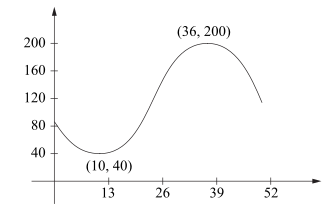
where  `t`  is the time in weeks and  `0 <= t <= 52`. The population of mice reaches a maximum of 35 000 when  `t=13`  and a minimum of 5000 when  `t = 39`. The graph of  `m(t)`  is shown.
 

  1. What are the values of `a` and `b`?  (2 marks)

    --- 3 WORK AREA LINES (style=lined) ---

  2. On the same island, the population of cats can be modelled by the function
     
    `\ \ \ \ \ c(t) = −80cos(pi/26 (t - 10)) + 120`
     
    Consider the graph of  `m(t)`  and the graph of  `c(t)`.


    Find the values of  `t, \ 0 <= t <= 52`, for which both populations are increasing.  (3 marks)

    --- 7 WORK AREA LINES (style=lined) ---

  3. Find the rate of change of the mice population when the cat population reaches a maximum.  (2 marks)

    --- 5 WORK AREA LINES (style=lined) ---

Show Answers Only
  1. `a = 15\ 000, b = 20\ 000`
  2. `text(Both populations are increasing when)\ 10 < t < 13`
  3. `\text(– 643 mice per week)`
Show Worked Solution
a.    `b` `= (35\ 000 + 5000)/2`
    `= 20\ 000`


`a` `=\ text(amplitude of sin graph)`
  `= 35\ 000 – 20\ 000`
  `= 15\ 000`


b.   `text(By inspection of the)\ \ m(t)\ \ text(graph)`

♦♦ Mean mark part (b) 30%.

`m^{′}(t) > 0\ \ text(when)\ \ 0 <= t < 13\ \ text(and)\ \ 39 < t <= 52`

`text(Sketch)\ \ c(t):`

`text(Minimum)\ \ (cos0)\ \ text(when)\ \ t = 10`

`text(Maximum)\ \ (cospi)\ \ text(when)\ \ t = 36`

`:. c^{′}(t) > 0\ \ text(when)\ \ 10 < t < 36`

`:. text(Both populations are increasing when)\ \ 10 < t < 13`


c.   `c(t)\ text(maximum when)\ \ t = 36`

♦♦♦ Mean mark part (c) 27%.
`m(t)` `= 15\ 000 sin(pi/26 t) + 20\ 000`
`m^{′}(t)` `= (15\ 000pi)/26 cos(pi/26 t)`
`m^{′}(36)` `= (15\ 000pi)/26 · cos((36pi)/26)`
  `= -642.7`

 
`:.\ text(Mice population is decreasing at 643 mice per week.)`

Filed Under: Rates of Change (Y12), Trig Applications (Y12) Tagged With: Band 4, Band 5, Band 6, smc-1091-25-Other Themes, smc-1091-40-Trig Function, smc-1188-10-Population

Calculus, 2ADV C3 2020 HSC 10 MC

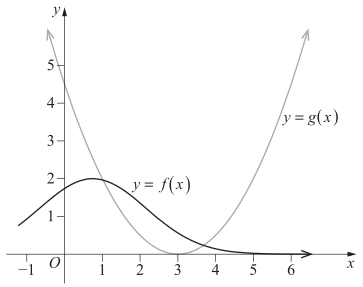
The graph shows two functions  `y = f(x)`  and  `y = g(x)`.

Define  `h(x) = f(g(x))`.

How many stationary points does  `y = h(x)`  have for  `1 <= x <= 5`?

  1. 0
  2. 1
  3. 2
  4. 3
Show Answers Only

`D`

Show Worked Solution

`h(x) = f(g(x))`

♦♦♦ Mean mark 11%.

`h′(x) = g′(x) xx f′(g(x))`
  

`text(S.P.’s occur when)\ \ g′(x) = 0\ \ text(or)\ \ f′(g(x)) = 0`

`g′(x) = 0\ \ text(when)\ \ x =3\ (text(from graph))`

`f′(x) = 0\ \ text(when)\ \ x ~~ 1  \ \ text{(i.e.}\ xtext{-value is just under 1)}`
 

`text(Find values of)\ x\ text(when)\ g(x) ~~ 1:`

`text(By inspection, there are 2 values where)`

`g(x) ~~ 1, \ x ∈ [1, 5]`

`:.\ text(There are 3 S.P.’s for)\ y = h(x), \ x ∈ [1, 5]`

`=> D`

Filed Under: The Derivative Function and its Graph (Y12) Tagged With: Band 6, smc-1089-45-Composite Functions

Algebra, STD2 A1 2020 HSC 13 MC

When Jake stops drinking alcohol at 10:30 pm, he has a blood alcohol content (BAC) of 0.08375.

The number of hours required for a person to reach zero BAC after they stop consuming alcohol is given by the formula

`text(Time) = frac{ text(BAC)}{0.015}`.

At what time on the next day should Jake expect his BAC to be 0.05?

  1.  12:45 am
  2.  1:50 am
  3.  2:15 am
  4.  4:05 am
Show Answers Only

`A`

Show Worked Solution

♦♦♦ Mean mark 17%.
COMMENT: The rates aspect of this question proved extremely challenging.

`text(Time from  0.08375 → 0  BAC)`

`= frac(0.08375)(0.015)`

`approx 5.58 \ text(hours)`
 

`text(Time from  0.08375 → 0.05  BAC)`

`approx frac{(0.08375 – 0.05)}{0.08375} xx 5.58` 

`approx 0.4 xx 5.58`

`approx 2.25\ text(hours)`
 

`therefore \ text(Time)` `approx \ 10:30 \ text(pm) \ + 2 \ text(hr) \ 15 \ text(min)`
  `approx \ 12:45 \ text(am)`

 
`=> \ A`

Filed Under: Applications: BAC, Medication and D=SxT (Std 2), Applications: BAC, Medicine and D=SxT (Std2-2027) Tagged With: Band 6, smc-6235-10-BAC, smc-791-10-BAC

Mechanics, EXT2 M1 EQ-Bank 2

A particle with mass `m` moves horizontally against a resistance force `F`, equal to  `mv(1 + v^2)`  where `v` is the particle's velocity.

Initially, the particle is travelling in a positive direction from the origin at velocity `T`.

  1. Show that the particle's displacement from the origin, `x`, can be expressed as
     
         `x = tan^(-1)((T - v)/(1 + Tv))`  (2 marks)

    --- 6 WORK AREA LINES (style=lined) ---


  2. Show that the time, `t`, when the particle is travelling at velocity `v`, is given by
     
         `t = 1/2 log_e ((T^2(1 + v^2))/(v^2(1 + T^2)))`  (4 marks)

    --- 8 WORK AREA LINES (style=lined) ---


  3. Express `v^2` as a function of `t`, and hence find the limiting values of `x` and `v`.  (2 marks)

    --- 6 WORK AREA LINES (style=lined) ---

Show Answers Only
  1. `text(See Worked Solutions)`
  2. `text(See Worked Solutions)“
  3. `v -> 0, \ x -> tan^(−1)T`
Show Worked Solution

i.   `text(Newton’s 2nd law:)`

`F = mddotx = −mv(1 + v^2)`

`v · (dv)/(dx)` `= −v(1 + v^2)`
`(dv)/(dx)` `= −(1 + v^2)`
`(dx)/(dv)` `= −1/(1 + v^2)`
`x` `= −int 1/(1 + v^2)\ dv`
  `= −tan^(−1) v + C`


`text(When)\ \ x = 0, v = T:`

`C = tan^(−1)T`

`x = tan^(−1)T – tan^(−1)v`
 

`text(Let)\ \ x = A – B`

`A = tan^(−1) T \ => \ T = tan A`

`B = tan^(−1)v \ => \ v = tan B`

`tan x` `= tan(A – B)`
  `= (tan A – tan B)/(1 + tan A tan B)`
  `= (T – v)/(1 + Tv)`
`:. x` `= tan^(−1)((T – v)/(1 + Tv))`


ii.   `text(Using)\ \ ddotx = (dv)/(dt):`

`(dv)/(dt) = −1/(v(1 + v^2))`

`t = −int 1/(v(1 + v^2)) dv`
 

`text(Using Partial Fractions):`

`1/(v(1 + v^2)) = A/v + (Bv + C)/(1 + v^2)`

`A(1 + v^2) + (Bv + C)v = 1`

`A = 1`

`(A + B)v^2` `= 0`   `=> `    `B` `= −1`
`Cv` `= 0`   `=> `    `C` `= 0`


`t` `= −int 1/v\ dv + int v/(1 + v^2)\ dv`
  `= −log_e v + 1/2 int(2v)/(1 + v^2)\ dv`
  `= −log_e v + 1/2 log_e (1 + v^2) + C`
  `= −1/2 log_e v^2 + 1/2 log_e (1 + v^2) + C`
  `= 1/2 log_e ((1 + v^2)/(v^2)) + C`


`text(When)\ \ t = 0, v = T:`

`C = −1/2 log_e ((1 + T^2)/(T^2))`
 

`:. t` `= 1/2 log_e ((1 + v^2)/(v^2)) – 1/2 log_e((1 + T^2)/(T^2))`
  `= 1/2 log_e (((1 + v^2)/(v^2))/((1 + T^2)/(T^2)))`
  `= 1/2 log_e ((T^2(1 + v^2))/(v^2(1 + T^2)))`


iii. `t` `= 1/2 log_e ((T^2(1 + v^2))/(v^2(1 + T^2)))`
  `e^(2t)` `= (T^2(1 + v^2))/(v^2(1 + T^2))`
  `1 + v^2` `= (e^(2t)v^2(1 + T^2))/(T^2)`
  `1` `= v^2((e^(2t)(1 + T^2))/(T^2) – 1)`
  `1` `= v^2((e^(2t)(1 + T^2) – T^2)/(T^2))`
  `:. v^2` `= (T^2)/(e^(2t)(1 + T^2) – T^2)`

 
`text(As)\ \ t -> ∞:`

`v^2 -> 0, \ v -> 0`

`x = tan^(−1)T – tan^(−1)v`

`x -> tan^(−1)T`

Filed Under: Resisted Motion Tagged With: Band 4, Band 5, Band 6, smc-1061-06-Planes/Inclined Planes, smc-1061-20-R ~ v^2, smc-1061-70-Newton's Law

GEOMETRY, FUR1-NHT 2019 VCAA 8 MC

A young tree is protected by a tree guard in the shape of a square-based pyramid.

The height of the tree guard is 54 cm, as shown in the diagram below.


The top section of the tree guard is removed along the dotted line to allow the tree to grow.

Removing this top section decreases the height of the tree guard to 45 cm, as shown in the diagram below.


The ratio of the volume of the tree guard that is removed to the volume of the tree guard that remains is

  1.  `1 : 6`
  2.  `1 : 35`
  3.  `1 : 36`
  4.  `1 : 215`
  5.  `1 : 216`
Show Answers Only

`D`

Show Worked Solution

`text(Top section is similar to full tree guard.)`

`text(Ratio of sides)` `= (54 – 45) : 54`
  `= 9:54`
  `= 1:6`


`:. \ text(V)_1 : text(V)_2` `= 1^3 : 6^3`
  `= 1 : 216`


`text(However V)_2 \ text(is the volume of a full tree guard. )`

`text(We need volume of the remaining tree guard.)`

`:. \ V_1 : V_2 \ text{(remains)} = 1:215`
 
`=> \ D`

Filed Under: Similarity and Scale Tagged With: Band 6, smc-606-30-Factors k / k^2 / k^3

Calculus, MET1-NHT 2018 VCAA 9

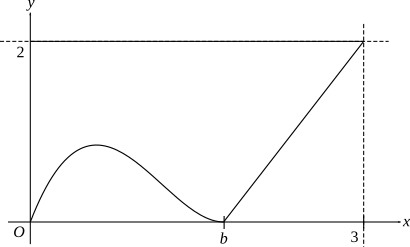
Let diagram below shows a trapezium with vertices at  `(0, 0), (0, 2), (3, 2)`  and  `(b, 0)`, where  `b`  is a real number and  `0 < b < 2`

On the same axes as the trapezium, part of the graph of a cubic polynomial function is drawn. It has the rule  `y = ax(x-b)^2`, where  `a`  is a non-zero real number and  `0 ≤ x ≤ b`.

  1. At the local maximum of the graph, `y = b`.
  2. Find `a` in terms of `b`.   (3 marks)

    --- 5 WORK AREA LINES (style=lined) ---

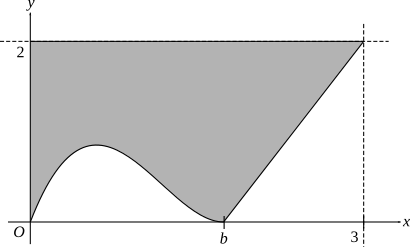
The area between the graph of the function and the `x`-axis is removed from the trapezium, as shown in the diagram.
 

  1. Show that the expression for the area of the shaded region is  `b + 3-(9b^2)/(16)`  square units.   (3 marks)

    --- 8 WORK AREA LINES (style=lined) ---

  2. Find the value of  `b`  for which the area of the shaded region is a maximum and find this maximum area.   (2 marks)

    --- 6 WORK AREA LINES (style=lined) ---

Show Answers Only
  1. `(27)/(4b^2)`
  2. `text(Proof (See Worked Solution))`
  3. `(31)/(9)`
Show Worked Solution
a.     `y` `= ax(x-b)^2`
`y^{′}` `= a(x-b)^2 + 2ax(x-b)`
  `= a(x-b)(x-b + 2x)`
  `= a(x-b)(3x-b)`

 
`text(S) text(olve) \ \ y^{′} = 0 \ \ text(for) \ x:`

`x = b \ \ text(or) \ \ (b)/(3)`
 
`y_text(max) = b \ \ text{(given) and occurs at} \ \ x = (b)/(3)`
 

`b` `= a((b)/(3))((b)/(3)-b)^2`
`b` `= a((b)/(3))((4b^2)/(9))`
`b` `= a((4b^3)/(27))`

 
`:. \ a = (27)/(4b^2)`
 

b.   `text(Let)\ \ A_1 = \ text(area under the graph)`

`A_1` `= int_0^b ax (x-b)^2 dx`
  `= a int_0^b x(x^2-2bx + b^2)\ dx`
  `= (27)/(4b^2) int_0^b x^3-2bx^2 + b^2 x \ dx`
  `= (27)/(4b^2) [(x^4)/(4)-(2bx^3)/(3) + (b^2 x^2)/(2)]_0^b`
  `= (27)/(4b^2) ((b^4)/(4)-(2b^4)/(3) + (b^4)/(2))`
  `= (27)/(4b^2) ((b^4)/(12))`
  `= (9b^2)/(16)`

 
`text(Let) \ \ A_2 = \ text(area of triangle)`

`A_2 = (1)/(2) xx 2 xx (3-b) = 3-b`
 

`:. \ text(Shaded region)` `= 6-(9b^2)/(16)-(3-b)`
  `= b + 3-(9b^2)/(16)`


c.   `A = b + 3-(9b^2)/(16)`

`(dA)/(db) = 1-(9b)/(8)`

`(dA^2)/(db^2) =-(9)/(8) <0`
 

`=>\ text{SP (max) when} \ \ (dA)/(db) = 0`

`(9b)/(8) = 1 \ => \ \ b = (8)/(9)`

`:. A_(max)` `= (8)/(9) + 3-{9((8)/(9))^2}/{16}`
  `= (35)/(9)-(64)/(9 xx 16)`
  `= (31)/(9)`

Filed Under: Maxima and Minima Tagged With: Band 5, Band 6, smc-641-10-Area

Financial Maths, GEN1 2019 NHT 24 MC

Robyn has a current balance of $347 283.45 in her superannuation account.

Robyn’s employer deposits $350 into this account every fortnight.

This account earns interest at the rate of 2.5% per annum, compounding fortnightly.

Robyn will stop work after 15 years and will no longer receive deposits from her employer.

The balance of her superannuation account at this time will be invested in an annuity that will pay interest at the rate of 3.6% per annum, compounding monthly.

After 234 monthly payments there will be no money left in Robyn’s annuity.

The value of Robyn’s monthly payment will be closest to

  1. $3993
  2. $5088
  3. $6664
  4. $8051
  5. $9045
Show Answers Only

`A`

Show Worked Solution

`text(Balance after 15 years (by TVM Solver):)`

`N` `= 26 xx 15 = 390`
`Itext(%)` `= 2.5`
`PV` `= 347\ 283.45`
`PMT` `= 350`
`FV` `= ?`
`text(P/Y)` `= 26`
`text(C/Y)` `= 26`

 
`=>\ 670\ 724.87`


`text(Monthly payment (by TVM Solver)):`

`N` `= 234`
`Itext(%)` `= 3.6`
`PV` `= 670\ 724.87`
`PMT` `= ?`
`FV` `= 0`
`text(P/Y)` `= 12`
`text(C/Y)` `= 12`

 
`=> PMT = −3993.31`

`=>\ A`

Filed Under: Annuities and Perpetuities Tagged With: Band 6, smc-2512-10-Annuity, smc-2512-50-CAS solver

Financial Maths, GEN2 2019 NHT 8

A record producer gave the band $50 000 to write and record an album of songs.

This $50 000 was invested in an annuity that provides a monthly payment to the band.

The annuity pays interest at the rate of 3.12% per annum, compounding monthly.

After six months of writing and recording, the band has $32 667.68 remaining in the annuity.

  1. What is the value, in dollars, of the monthly payment to the band?   (1 mark)

    --- 2 WORK AREA LINES (style=lined) ---

  2. After six months of writing and recording, the band decided that it needs more time to finish the album.


    To extend the time that the annuity will last, the band will work for three more months without withdrawing a payment.


    After this, the band will receive monthly payments of $3800 for as long as possible.


    The annuity will end with one final monthly payment that will be smaller than all of the others.


    Calculate the total number of months that this annuity will last.   (2 marks)

    --- 3 WORK AREA LINES (style=lined) ---

Show Answers Only
  1. `$3000`
  2. `18`
Show Worked Solution

a.    `text(By TVM Solver:)`

`N` `= 6`  
`I text(%)` `=3.12`  
`PV` `=50\ 000`  
`PMT` `= ?`  
`FV` `=-32\ 667.68`  
`text(PY)` `= text(CY) = 12`  

 
`=> PMT = -3000.00`

`:. \ text(Monthly payment) = $3000`


b.   `text{Value after 3 more months (by TVM Solver):}`

`N` `= 3`  
`I text(%)` `=3.12`  
`PV` `=32\ 667.68`  
`PMT` `= 0`  
`FV` `=?`  
`text(PY)` `= text(CY) = 12`  

 
`=> FV = -32\ 923.15`
 

`text(Find) \ \ N \ text(when) \ FV= 0 \ text{(by TVM Solver):}`

`N` `= ?`  
`I text(%)` `=3.12`  
`PV` `=-32\ 923.15`  
`PMT` `= 3800`  
`FV` `=0`  
`text(PY)` `= text(CY) = 12`  

 
`=> N = 8.77`

`:. \ text(Total months of annuity)` `= 6 + 3 + 9`
  `= 18`

Filed Under: Annuities and Perpetuities Tagged With: Band 5, Band 6, smc-2512-10-Annuity, smc-2512-50-CAS solver

Data Analysis, GEN2 2019 NHT 5

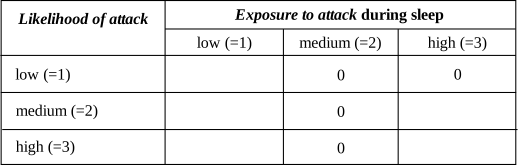
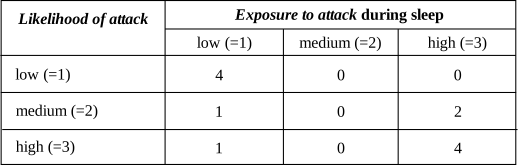
A random sample of 12 mammals drawn from a population of 62 types of mammals was categorized according to two variables.

likelihood of attack (1 = low, 2 = medium, 3 = high)

exposure to attack during sleep (1 = low, 2 = medium, 3 = high)

The data is shown in the following table.


  1. Use this data to complete the two-way frequency table below.   (1 mark)

    --- 0 WORK AREA LINES (style=lined) ---


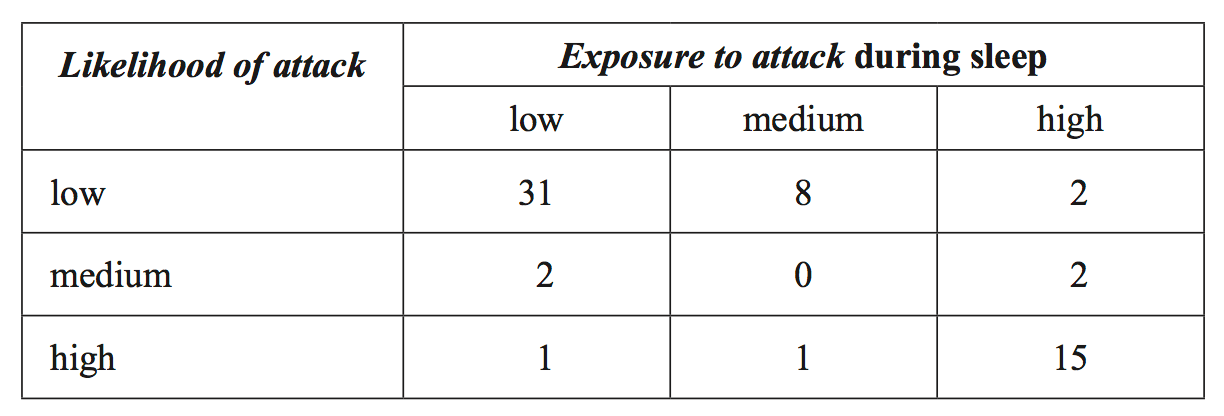
The following two-way frequency table was formed from the data generated when the entire population of 62 types of mammals was similarly categorized.


    1. How many of these 62 mammals had both a high likelihood of attack and a high exposure to attack during sleep?   (1 mark)

      --- 5 WORK AREA LINES (style=lined) ---

    2. Of those mammals that had a medium likelihood of attack, what percentage also had a low exposure to attack during sleep?   (1 mark)

      --- 2 WORK AREA LINES (style=lined) ---

    3. Does the information in the table above support the contention that likelihood of attack is associated with exposure to attack during sleep? justify your answer by quoting appropriate percentages. It is sufficient to consider only one category of likelihood of attack when justifying your answer.   (2 marks)

      --- 4 WORK AREA LINES (style=lined) ---

Show Answers Only

  1.  
    1. `15`
    2. `text(Percentage) = (2)/(4) xx 100`
                           `= 50 %`
    3. `text(The data supports the contention that animals with a low likelihood)`
      `text(of attack is associated with low exposure to attack during sleep.)`
       
      `text(- 91%) \ ({31}/{34}) \ text(of animals with low exposure to attack)`
         `text(during sleep, have a low likelihood of attack.)`
       
      `text(- Similarly, 89% of animals with a medium exposure to attack during)`
         `text(sleep have a low likelihood of attack.)`
       
      `text(- 11% of animals with a high exposure to attack during sleep have)`
          `text(a low likelihood of attack)`

Show Worked Solution

a.     


b.    i. `15`

ii.   `text(Percentage)` `= (2)/(4) xx 100`
  `= 50%`


iii. `text(The data supports the contention that animals with a low likelihood)`

`text(of attack is associated with low exposure to attack during sleep.)`

`text(- 91%) \ ({31}/{34}) \ text(of animals with low exposure to attack)`

`text(during sleep, have a low likelihood of attack.)`

`text(- Similarly, 89% of animals with a medium exposure to attack during)`

`text(sleep have a low likelihood of attack.)`

`text(- 11% of animals with a high exposure to attack during sleep have)`

`text(a low likelihood of attack)`

Filed Under: Graphs - Histograms and Other Tagged With: Band 4, Band 5, Band 6, page-break-before-question, smc-644-50-Frequency Tables

MATRICES, FUR1-NHT 2019 VCAA 7-8 MC

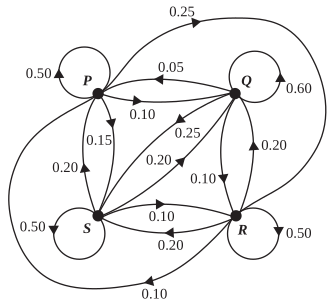
A farm contains four water sources, `P`, `Q`, `R` and `S`.

Part 1

Cows on the farm are free to move between the four water sources.

The change in the number of cows at each of these water sources from week to week is shown in the transition diagram below.
 

Let `C_n` be the state matrix for the location of the cows in week `n` of 2019.

The state matrix for the location of the cows in week 23 of 2019 is `C_23 = [(180),(200),(240),(180)]{:(P),(Q),(R),(S):}`
 

The state matrix for the location of the cows in week 24 of 2019 is `C_24 = [(160),(222),(203),(215)]{:(P),(Q),(R),(S):}`

Of the cows expected to be at `Q` in week 24 of 2019, the percentage of these cows at `R` in week 23 of 2019 is closest to

  1.   8%
  2.   9%
  3. 20%
  4. 22%
  5. 25%


Part 2

Sheep on the farm are also free to move between the four water sources.

The change in the number of sheep at each water source from week to week is shown in matrix `T` below.
 

`{:(),(),(T=):}{:(qquadqquadqquadtext(this week)),((qquadP,quadQ,quadR,quadS)),([(0.4,0.3,0.2,0.1),(0.2,0.1,0.5,0.3),(0.1,0.3,0.1,0.2),(0.3,0.3,0.2,0.4)]):}{:(),(),({:(P),(Q),(R),(S):}):}{:(),(),(text(next week)):}`
 

In the long term, 635 sheep are expected to be at `S` each week.

In the long term, the number of sheep expected to be at `Q` each week is closest to

  1. 371
  2. 493
  3. 527
  4. 607
  5. 635
Show Answers Only

`text(Part 1:)\ D`

`text(Part 2:)\ C`

Show Worked Solution

`text(Part 1)`

`text(In week 23, 240 cows are at)\ R.`

`text(In week 24, number of cows moving from)\ R\ text(to)\ Q`

`=20text(%) xx 240`

`= 48\ text(cows)`
 

`text(Total cows at)\ Q = 222`
 

`:.\ text(Percentage)` `= 48/222`
  `= 0.2162`
  `= 22text(%)`

`=>\ D`


`text(Part 2)`

`T^50 = [(0.2434, 0.2434, 0.2434, 0.2434),(0.2603, 0.2603, 0.2603, 0.2603),(0.1834, 0.1834, 0.1834, 0.1834),(0.3130, 0.3130, 0.3130, 0.3130)]`

 
`text(S)text(ince 635 sheep are expected long term at)\ S,`

`text(Total sheep)` `= 635/0.3130`
  `= 2029`

 
`:. text(Long term expected at)\ Q`

`~~ 0.2603 xx 2029`

`~~ 528`

`=>\ C`

Filed Under: Transition Matrices - Regular Tagged With: Band 5, Band 6, smc-618-10-Diagram/Info to Matrix, smc-618-40-Steady State

GRAPHS, FUR1-NHT 2019 VCAA 8 MC

Jamie sold bottles of homemade lemonade to his neighbours on Saturday.

The revenue, in dollars, he made from selling `n` bottles of lemonade is given by

revenue = 3.5`n`

The cost, in dollars, of making `n` bottles of lemonade is given by

cost = 60 + `n`

The profit made by Jamie on Saturday could have been

  1. $162
  2. $165
  3. $168
  4. $173
  5. $177
Show Answers Only

`B`

Show Worked Solution
`text(Profit)` `= R – C`
  `= 3.5n – (60 + n)`
  `= 2.5n – 60`

 
`text(If profit is a whole number)`

`=> n\ text(must be even)`

`=>\ text(revenue total must be a multiple of $5)`

`=>\ text(profit total must be a multiple of $5)`


`=>  B`

Filed Under: Linear relationships Tagged With: Band 6

NETWORKS, FUR1-NHT 2019 VCAA 8 MC

A landscape gardener is planning the construction of a garden.

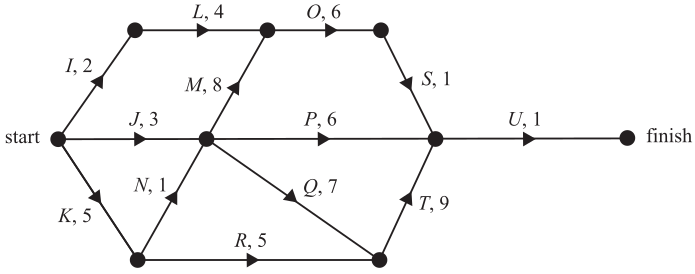
This project requires 13 activities, `I` to `U`.

The directed graph below shows each of these activities represented by edges.

The numbers on the edges are the durations of the activities, in days.


The cost of reducing the completion time of any activity in this project is $1000 per day.

The landscape gardener has a maximum of $3000 to spend on reducing the minimum completion time of this project.

The total completion time of the project can be reduced by three days by reducing

  1. activity `K` by one day and activity `Q` by two days.
  2. activity `K` by two days and activity `Q` by one day.
  3. activity `K` by two days and activity `M` by one day.
  4. activity `K` by one day and activity `M` by two days.
  5. activity `K` by one day, activity `M` by one day and activity `Q` by one day.
Show Answers Only

`B`

Show Worked Solution

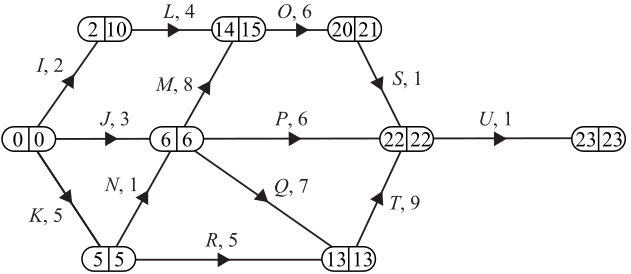
`text(Scanning forwards and backwards.)`

`text(Critical path:)\ KNQTU`


`text(By reducing)\ K\ text(by)\ 2\ text(days and)\ Q\ text(by 1 day, the critical)`

`text(path remains)\ KNQTU\ text{(reduced by 3 days).}`

`=>  B`

Filed Under: Critical Path Analysis Tagged With: Band 6, smc-621-40-Crashing/Reduce completion time

Calculus, MET2-NHT 2019 VCAA 5

Let  `f: R → R, \ f(x) = e^((x/2))`  and  `g: R → R, \ g(x) = 2log_e(x)`.

  1. Find  `g^-1 (x)`.   (1 mark)

    --- 4 WORK AREA LINES (style=lined) ---

  2. Find the coordinates of point  `A`, where the tangent to the graph of  `f` at  `A` is parallel to the graph of  `y = x`.   (2 marks)

    --- 5 WORK AREA LINES (style=lined) ---

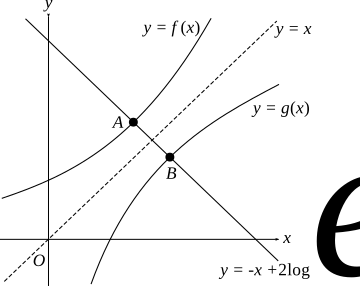
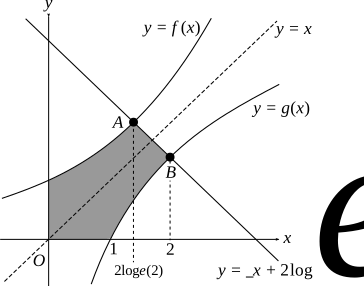
  3. Show that the equation of the line that is perpendicular to the graph of  `y = x`  and goes through point  `A` is  `y = -x + 2log_e(2) + 2`.   (1 mark)

    --- 3 WORK AREA LINES (style=lined) ---

Let `B` be the point of intersection of the graphs of `g` and  `y =-x + 2log_e(2) + 2`, as shown in the diagram below.


  1. Determine the coordinates of point `B`.   (1 mark)

    --- 4 WORK AREA LINES (style=lined) ---

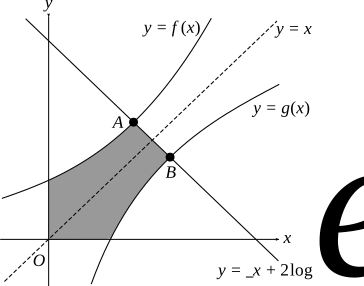
  2. The shaded region below is enclosed by the axes, the graphs of  `f` and `g`, and the line  `y =-x + 2log_e(2) + 2`.


    Find the area of the shaded region.   (2 marks)

    --- 4 WORK AREA LINES (style=lined) ---

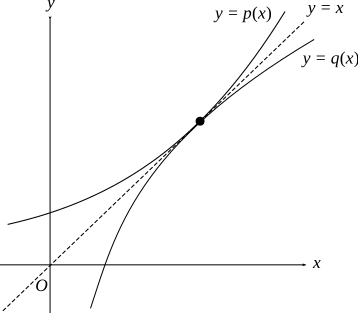
Let  `p : R→ R, \ p(x) = e^(kx)`  and  `q : R→ R, \ q(x) = (1)/(k) log_e(x)`.

  1. The graphs of `p`, `q` and  `y = x`  are shown in the diagram below. The graphs of `p` and `q` touch but do not cross.


     Find the value of  `k`.   (2 marks)

    --- 6 WORK AREA LINES (style=lined) ---

  2. Find the value of  `k, k > 0`, for which the tangent to the graph of `p` at its `y`-intercept and the tangent to the graph of `q` at its `x`-intercept are parallel.   (1 mark)

    --- 5 WORK AREA LINES (style=lined) ---

Show Answers Only
  1. `e^{(x)/(2)}`
  2. `(2log_e 2, 2)`
  3. `text(Proof(See Worked Solution))`
  4. `(2, 2log_e 2)`
  5. `6-2(log_e 2)^2-4 log_e 2`
  6. `(1)/(e)`
  7. `k =1`
Show Worked Solution

a.    `g(x) = 2log_e x`

`text(Inverse: swap) \ x ↔ y`

`x` `= 2log_e y`
`log_e y` `= (x)/(2)`
`y` `= e^{(x)/(2)}`


b.    `f(x) = e^{(x)/(2)}`

`f′(x) = (1)/(2) e^{(x)/(2)}`
 
`text(S) text(olve) \ \ f′(x) = 1 \ text(for) \ x:`

`x = 2log_e 2`

`y = e^(log_e 2) = 2`
 
`:. \ A\ text(has coordinates)\  (2log_e 2, 2)`


c.    `m_(⊥) = -1`

`text(Equation of line) \ \ m = -1 \ \ text(through)\ \ (2log_e 2, 2) :`

`y-2` `= -(x-2log_e 2)`
`y` `= -x +  2log_e 2 + 2`


d.    `text(Method 1)`

`text(S) text(olve for) \ x :`

`-x + 2log_e 2 + 2 = 2log_e x`

`=> x = 2 , \ y = 2log_e 2`

`:. B ≡ (2, 2log_e 2)`
 

`text(Method 2)`

`text(S) text(ince) \ \ f(x) = g^-1 (x)`

`B \ text(is the reflection of) \ \ A(2log_e 2, 2) \ \ text(in the) \ \ y=x \ \ text(axis)`

`:. \ B ≡ (2, 2log_e 2)`


e.


`y = g(x) \ \ text(intersects) \ x text(-axis at) \ \ x = 1`

`text(Dividing shaded area into 3 sections:)`

`A` `= int_0^1 f(x)\ dx \ + \ int_1^(2log_e 2) f(x)-g(x)\ dx`  
  ` \ + \ int_(2log_e 2)^2 (-x + 2log_e 2 + 2)-g(x)\ dx`  
  `= 6-2(log_e 2)^2-4 log_e 2`  


f.   `p(x) = e^(kx) \ , \ q(x) = (1)/(k) log_e x`

`p′(x) = k e^(kx) \ , \ q′(x) = (1)/(kx)`
 
`text(S) text(ince graphs touch on) \ y = x`

`k e^(kx) = 1\ …\ (1)`

`(1)/(kx) = 1\ …\ (2)`

`text(Substitute) \ x = (1)/(k) \ text{from (2) into (1)}`

`k e^(k xx 1/k)` `= 1`
`:. k` `= (1)/(e)`


g.   `text(Consider)\ \ p(x):`

`text(When) \ \ x = 0 , \ p(0) = 1 , \ p′(0) = k`
 

 `text(Consider) \ \ q(x):`

`text(When) \ \ y= 0, \ (1)/(k) log_e x = 0 \ => \ x = 1`

`q′(1) = (1)/(k)`

`text(If lines are parallel), \ k = (1)/(k)`
 
`:. \ k = 1`

Filed Under: Area Under Curves, Logs and Exponential Functions Tagged With: Band 4, Band 5, Band 6, smc-5204-50-Find intersection, smc-723-50-Log/Exponential

Calculus, MET2-NHT 2019 VCAA 4

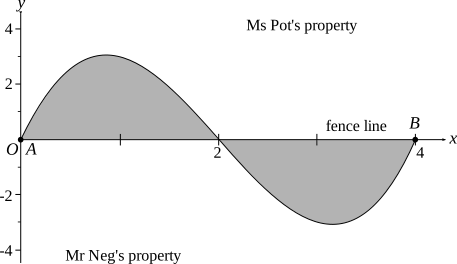
A mining company has found deposits of gold between two points, `A` and `B`, that are located on a straight fence line that separates Ms Pot's property and Mr Neg's property. The distance between `A` and `B` is 4 units.

The mining company believes that the gold could be found on both Ms Pot's property and Mr Neg's property.

The mining company initially models he boundary of its proposed mining area using the fence line and the graph of 

`f : [0, 4] → R, \ f(x) = x(x-2)(x-4)`

where `x` is the number of units from point `A` in the direction of point `B` and `y` is the number of units perpendicular to the fence line, with the positive direction towards Ms Pot's property. The mining company will only mine from the boundary curve to the fence line, as indicated by the shaded area below.
 

  1. Determine the total number of square units that will be mined according to this model.   (2 marks)

    --- 3 WORK AREA LINES (style=lined) ---

The mining company offers to pay Mr Neg $100 000 per square unit of his land mined and Ms Pot $120 000 per square unit of her land mined.

  1. Determine the total amount of money that the mining company offers to pay.   (1 mark)

    --- 2 WORK AREA LINES (style=lined) ---

The mining company reviews its model to use the fence line and the graph of

     `p : [0, 4] → R, \ p(x) = x(x-4 + (4)/(1 + a)) (x-4)`  where `a > 0`.

  1. Find the value of  `a`  for which  `p(x) = f(x)`  for all `x`.   (1 mark)

    --- 3 WORK AREA LINES (style=lined) ---

  2. Solve  `p^{′}(x) = 0`  for `x` in terms of `a`.   (2 marks)

    --- 3 WORK AREA LINES (style=lined) ---

Mr Neg does not want his property to be mined further than 4 units measured perpendicular from the fence line.

  1. Find the smallest value of `a`, correct to three decimal places, for this condition to be met.   (2 marks)

    --- 5 WORK AREA LINES (style=lined) ---

  2. Find the value of `a` for which the total area of land mined is a minimum.   (3 marks)

    --- 5 WORK AREA LINES (style=lined) ---

  3. The mining company offers to pay Ms Pot $120 000 per square unit of her land mined and Mr Neg $100 000 per square unit of his land mined.
  4. Determine the value of `a` that will minimize the total cost of the land purchase for the mining company. Give your answer correct to three decimal places.   (2 marks)

    --- 4 WORK AREA LINES (style=lined) ---

Show Answers Only
  1. `8`
  2. `$880\ 000`
  3. `1`
  4. `x = ((8a + 4) ± 4 sqrt(a^2 + a + 1))/(3a + 3)`
  5. `0.716`
  6. `1`
  7. `0.886`
Show Worked Solution
a.    `A` `= int_0^2 x(x-2)(x-4)\ dx – int_2^4 x(x-2)(x-4)\ dx`
  `= 4-(-4)`
  `= 8`


b.    `text(Total payment)` `= 4 xx 100 000 + 4 xx 120 000`
  `= $880\ 000`

 
c.
    `text(If) \ \ p(x) = f(x)`

`x-2` `= x-4 + (4)/(1 + a)`  
`(4)/(1 + a)` `=2`  
`:. a` `=1`  

 
d.
    `p^{′}(x) = (3(a + 1) x^2-8(2a + 1) x + 16a)/(a + 1) \ \ \ text{(by CAS)}`

`text(S) text(olve) \ \ p^{′}(x) = 0 \ \ text(for) \ \ x :`

`x = ((8a + 4) ± 4 sqrt(a^2 + a + 1))/(3a +3) \ , \ a > 0` 
 

e.    `text(If no mining further than 4 units,) \ \ p(x) ≥-4`

`text(Max distance from Mr Neg’s fence occurs when) \ \ 2< x <4 .`

`text((i.e. the higher) \ x text(-value when) \ \ p^{′}(x) = 0)`
 

`text(At) \ \ x = ((8a + 4) + 4 sqrt(a^2 + a + 1))/(3a + 3) \ ,`
 
`text(S) text(olve for) \ \ a \ \ text(such that) \ \ p(x) = -4`

`=> a = 0.716 \ \ text((to 3 d.p.))`


f.    `p(x) \ text(intersects) \ x text(-axis at) \ \ x = 4-(4)/(1 + a) = (4a)/(1 + a)`

`A` `= int_0^{(4a)/(1 +a)} p(x)\ dx-int_{(4a)/(1 +a)}^4 p(x)\ dx`
  `= (64(1 + 2a + 2a^3 + a^4))/(3(1 + a)^4)`

 
`text(S) text(olve) \ \ A^{′}(a) = 0 \ \ text(for) \ \ a :`

`a = 1`


g.    `C(a) = 120\ 000 int_0^{(4a)/(1 +a)} p(x)\ dx-100\ 000 int_{(4a)/(1 +a)}^4 p(x)\ dx`

`text(S) text(olve) \ \ C^{′}(a) = 0 \ \ text(for) \ \ a :`

`a = 0.886 \ \ text((to 3 d.p.))`

Filed Under: Maxima and Minima Tagged With: Band 4, Band 5, Band 6, smc-641-10-Area

Trigonometry, MET2-NHT 2019 VCAA 2

The wind speed at a weather monitoring station varies according to the function

`v(t) = 20 + 16sin ((pi t)/(14))`

where `v` is the speed of the wind, in kilometres per hour (km/h), and  `t`  is the time, in minutes, after 9 am.

  1. What is the amplitude and the period of  `v(t)`?   (2 marks)

    --- 3 WORK AREA LINES (style=lined) ---

  2. What are the maximum and minimum wind speeds at the weather monitoring station?   (1 mark)

    --- 2 WORK AREA LINES (style=lined) ---

  3. Find  `v(60)`, correct to four decimal places.   (1 mark)

    --- 2 WORK AREA LINES (style=lined) ---

  4. Find the average value of  `v(t)`  for the first 60 minutes, correct to two decimal places.   (2 marks)

    --- 5 WORK AREA LINES (style=lined) ---

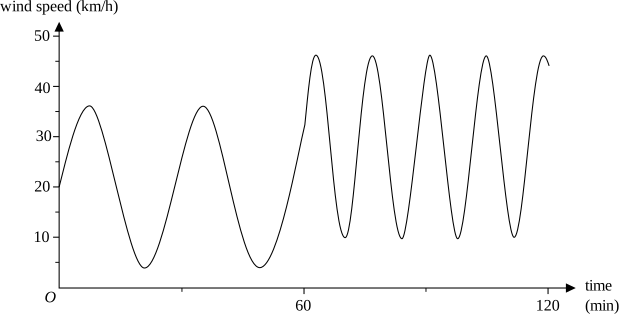
A sudden wind change occurs at 10 am. From that point in time, the wind speed varies according to the new function

                    `v_1(t) = 28 + 18 sin((pi(t-k))/(7))`

where  `v_1`  is the speed of the wind, in kilometres per hour, `t` is the time, in minutes, after 9 am and  `k ∈ R^+`. The wind speed after 9 am is shown in the diagram below.
 

  1. Find the smallest value of `k`, correct to four decimal places, such that  `v(t)`  and  `v_1(t)`  are equal and are both increasing at 10 am.   (2 marks)

    --- 2 WORK AREA LINES (style=lined) ---

  2. Another possible value of `k` was found to be 31.4358


    Using this value of `k`, the weather monitoring station sends a signal when the wind speed is greater than 38 km/h.


    i.  Find the value of `t` at which a signal is first sent, correct to two decimal places.   (1 mark)

    --- 2 WORK AREA LINES (style=lined) ---


    ii. Find the proportion of one cycle, to the nearest whole percent, for which  `v_1 > 38`.   (2 marks)

    --- 5 WORK AREA LINES (style=lined) ---

  3. Let  `f(x) = 20 + 16 sin ((pi x)/(14))`  and  `g(x) = 28 + 18 sin ((pi(x-k))/(7))`.
     
    The transformation  `T([(x),(y)]) = [(a \ \ \ \ 0),(0 \ \ \ \ b)][(x),(y)] + [(c),(d)]`  maps the graph of  `f`  onto the graph of  `g`.


    State the values of  `a`, `b`, `c` and `d`, in terms of `k` where appropriate.   (3 marks)

    --- 11 WORK AREA LINES (style=lined) ---

Show Answers Only
  1. `28`
  2. `v_text(max) \ = 36 \ text(km/h)`


    `v_text(min) \ = 4 \ text(km/h)`

  3. `32.5093 \ text(km/h)`
  4. `20.45 \ text(km/h)`
  5. `3.4358`
  6. i. `60.75 \ text(m)`


    ii. `31text(%)`

  7. `a = (1)/(2) \ , \ b = (9)/(8) \ , \ c = k \ , \ d = (11)/(2)`
Show Worked Solution

a.    `text(Amplitude) = 16`

`text{Find Period (n):}`

`(2 pi)/(n)` `= (pi)/(14)`
`n` `= 28`


b.    `v_text(max) = 20 + 16 = 36 \ text(km/h)`

`v_text(min) = 20-16 = 4 \ text(km/h)`


c.    `v(60)` `= 20 + 16 sin ((60 pi)/(14))`
  `= 32.5093 \ \ text(km/h)`


d.    `v(t)\ \ text(is always positive.)`

`s(t) = int_0^60 v(t) \ dt`

`v(t)_(avg)` `= (1)/(60) int_0^60 20 + 16 sin ((pi t)/(14))\ dt`
  `= 20.447`
  `= 20.45 \ text(km/h) \ \ text((to 2 d.p.))`


e.    `text(S) text{olve (for}\ k text{):} \ \ v(60) = v_1(60)`

`k = 3.4358 \ \ text((to 4 d.p.))`


f.i.  `text(S) text(olve for) \ t , \ text(given) \ \ v_1(t) = 38 \ \ text(and) \ \ k = 31.4358`

`=> t = 60.75 \ text(minutes)`
 

f.ii.  `text(S) text(olving for) \ \ v_1(t) = 38 \ , \ k = 31.4358`

`t_1 = 60.75 \ text{(part i)}, \ t_2 = 65.123`

`text(Period of) \ \ v_1 = (2 pi)/(n) = (pi)/(7)\ \ => \ n = 14`

`:. \ text(Proportion of cycle)` `= (65.123-60.75)/(14)`
  `= 0.312`
  `= 31 text{%  (nearest %)}`


g.    `f(x) → g(x)`

`y^{prime} = 28 + 18 sin ({pi(x^{prime}-k)}/{7})`

`x^{prime} = ax + c` `\ \ \ \ \ \ y^{prime} = by + d`


`text(Using) \ \ y^{prime} = by + d`

`28 + 18 sin ({pi(x^{prime}-k)}/{7}) = b (20 + 16 sin ({pi x}/{14})) + d`
 

`text(Equating coefficients of) \ \ sin theta :`

`16b = 18 \ \ \ => \ b = (9)/(8)`
 

`text(Equating constants:)`

`20 xx (9)/(8) + d = 28 \ \ \ => \ \ d = (11)/(2)`

`(x^{prime}-k)/(7)` `= (x)/(14)`
`x^{prime}` `= (x)/(2) + k \ \ => \ \ a = (1)/(2) \ , \ c = k`


`a = (1)/(2) \ , \ b = (9)/(8) \ , \ c = k \ , \ d = (11)/(2)`

Filed Under: Transformations, Trig Graphing Tagged With: Band 4, Band 5, Band 6, smc-2757-10-Sin, smc-2757-30-Find period, smc-2757-40-Find amplitude, smc-2757-80-Applications, smc-2757-85-Max/min (non-calc), smc-753-60-Matrix

Algebra, MET2-NHT 2019 VCAA 20 MC

Let  `f(x) = (ax + b)^5`  and let  `g`  be the inverse function of  `f`.

Given that  `f(0) = 1`, what is the value of  `g' (1)`

  1.  `(5)/(a)`
  2.  `1`
  3.  `(1)/(5a)`
  4.  `5a(a + 1)^4`
  5.  `0`
Show Answers Only

`C`

Show Worked Solution

`f(x) = (ax + b)^5`

`text(Given) \ \ f(0) = 1\ \ =>\ \ b^5 = 1 \ => \ b = 1`
  
`f ‘(x) = 5a(ax + 1)^4`

`f(0) = 1 \ => \ g(1) = 0 \ \ text{(Inverse: swap} \ x ↔ y )`
 
`text(Gradient of) \ \ f(x) \ \ text(at) \ \ x =0 \ \ text(will be the reciprocal of the gradient of) \ \ g(x) \ \ text(at) \ \ x = 1`

`f ‘(0) = 5a`

`:. \ g'(1) = (1)/(5a)`
 
`=> \ C`

Filed Under: Polynomial and Other Functions Tagged With: Band 6, smc-5205-10-Polynomials, smc-633-10-Polynomial

Calculus, MET1-NHT 2019 VCAA 7

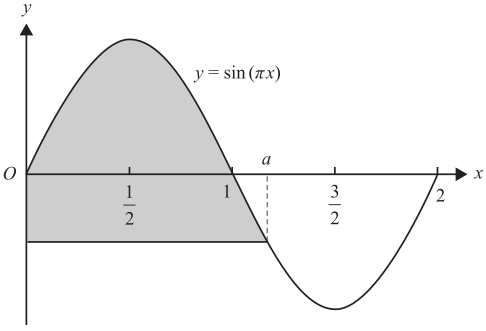
The shaded region in the diagram below is bounded by the vertical axis, the graph of the function with rule  `f(x) = sin(pix)`  and the horizontal line segment that meets the graph at  `x = a`, where  `1 <= a <= 3/2`.


Let  `A(a)`  be the area of the shaded region.

  1. Show that  `A(a) = 1/pi-1/pi cos(a pi)-a sin (a pi)`.   (3 marks)

    --- 6 WORK AREA LINES (style=lined) ---

  2. Determine the range of values of `A(a)`.   (2 marks)

    --- 4 WORK AREA LINES (style=lined) ---

    1. Express in terms of  `A(a)`, for a specific value of `a`, the area bounded by the vertical axis, the graph of  `y = 2(sin(pi x) + sqrt 3/2)`  and the horizontal axis.   (2 marks)

      --- 5 WORK AREA LINES (style=lined) ---

    2. Hence, or otherwise, find the area described in part c.i.   (1 mark)

      --- 3 WORK AREA LINES (style=lined) ---

Show Answers Only
  1. `text(Proof)\ \ text{(See Worked Solutions)}`
  2. `[2/pi, (2 + 3 pi)/(2pi)]`
    1. `2 A(a)`
    2. `(9 + 4 sqrt 3 pi)/(3 pi)`
Show Worked Solution

a.   `text(Lower border of shaded area:)\ y = f(a) = sin(a pi)`

`text(Area)` `= int_0^a sin(pi x)-sin (a pi)\ dx`
  `= [-1/pi cos (pi x)-x sin(a pi)]_0^a`
  `= [-1/pi cos(pi a)-a sin (a pi)-(-1/pi-0)]`
  `= 1/pi-1/pi cos (a pi)-a sin(a pi)`


b.   `text(S) text(ince)\ 1 <= a <= 3/2,`

`A(1) = 1/pi-1/pi cos(pi)-1 sin (pi) = 2/pi`

`A(3/2) = 1/pi-1/pi cos ((3 pi)/2)-3/2 sin ((3pi)/2) = 1/pi + 3/2 = (2 + 3pi)/(2 pi)`
 

`:.\ text(Range:)\ \ [2/pi, (2 + 3pi)/(2 pi)]`


c.i.  `A(a) = int_0^a sin(pi x)-sin (a pi)\ dx`

`A_1` `=2int _0^a sin(pi x) + sqrt 3/2\ dx`   
  `=2int _0^a sin(pi x)-sin((4pi)/3)\ dx,\ \ \ (a=4/3)`  
  `=2int _0^(4/3) sin(pi x)-sin((4pi)/3)\ dx`  
  `=2 xx A(a)`  

 
`:.\ text(When)\ \ a = 4/3,\ \ text(Area) = 2 xx A(a)`


c.ii.  `text(When)\ \ a = 4/3`

`text(Area)` `= 2 xx (1/pi-1/pi cos ((4 pi)/3)-4/3 sin ((4 pi)/3))`
  `= 2 xx (1/pi + 1/(2 pi) + 4/3 xx sqrt 3/2)`
  `= 2(3/(2pi) + (2 sqrt 3)/3)`
  `= 3/pi + (4 sqrt 3)/3`
  `= (9 + 4 sqrt 3 pi)/(3 pi)`

Filed Under: Area Under Curves Tagged With: Band 4, Band 5, Band 6, smc-723-60-Trig, smc-723-80-Area between graphs

Mechanics, SPEC2-NHT 2019 VCAA 5

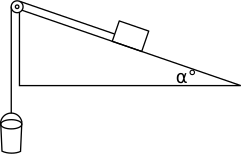
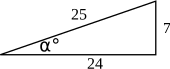
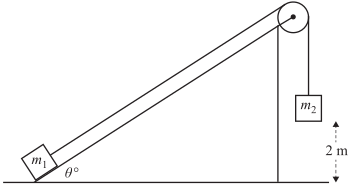
A pallet of bricks weighing 500 kg sits on a rough plane inclined at an angle of  `α°` to the horizontal, where  `tan(α°) = (7)/(24)`. The pallet is connected by a light inextensible cable that passes over a smooth pulley to a hanging container of mass `m` kilograms in which there is 10 L of water. The pallet of bricks is held in equilibrium by the tension `T` newtons in the cable and a frictional resistance force of 50 `g` newtons acting up and parallel to the plane. Take the weight force exerted by 1 L of water to be `g` newtons.


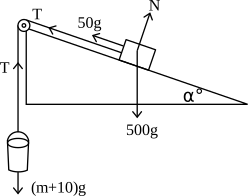
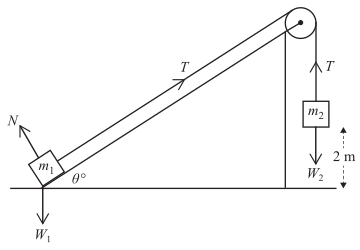
  1. Label all forces acting on both the pallet of bricks and the hanging container on the diagram above, when the pallet of bricks is in equilibrium as described.   (1 mark)
  2. Show that the value of `m` is 80.  (3 marks)

Suddenly the water is completely emptied from the container and the pallet of bricks begins to slide down the plane. The frictional resistance force of 50 `g` newtons acting up the plane continues to act on the pallet.

  1. Find the distance, in metres, travelled by the pallet after 10 seconds.  (3 marks)
  2. When the pallet reaches a velocity of  `3\ text(ms)^-1`, water is poured back into the container at a constant rate of 2 L per second, which in turn retards the motion of the pallet moving down the plane. Let  `t`  be the time, in seconds, after the container begins to fill. 
  3.   i. Write down, in terms of  `t`, an expression for the total mass of the hanging container and the water it contains after `t` seconds. Give your answer in kilograms.  (1 mark)
  4.  ii. Show that the acceleration of the pallet down the plane is given by  `(text(g)(5 - t))/(t + 290)\ text(ms)^-2`  for  `t ∈[0, 5)`.  (2 marks)
  5. iii. Find  the velocity of the pallet when  `t = 4`. Give your answer in metres per second, correct to one decimal place.  (2 marks)
Show Answers Only
  1.  
    `qquad`
  2. `text(Proof(Show Worked Solution))`
  3. `(25 text(g))/(29)`
  4.   i. `80 + 2t`
     ii. `text(Proof (Show Worked Solution))`
    iii. `3.4\ text(ms)^-1`
Show Worked Solution

a.

 
b.   `text(Resolving vertical forces on container:)`

`T – (m + 10)g = 0 \ …\ (1)`

`text(Resolving forces on plane:)`


`tan α = (7)/(24) \ => \ sin α = (7)/(25)`
 

`text(Solve for m:)`

`(m + 10)g` `= 500 text(g) · (7)/(25) – 50 text(g)`
`m + 10` `= 140 – 50`
`:. \ m` `= 80`


c.   `text(Resolving vertical forces on container:)`

`T – 80 g = 80 a \ …\ (1)`

`text(Resolving forces on plane:)`

`500 g sin α – (T + 50 g) = 500 a`

`90 g – T = 500 a \ …\ (2)`

`text(Add) \ (1) + (2)`

`10 g` `= 580 a`
`a` `= (g)/(58)`
`s` `= ut + (1)/(2) at^2`
  `= 0 + (1)/(2) · (g)/(58) + 10^2`
  `= (25g)/(29)`


d.i.   `m = 80 + 2t`
 

d.ii.   `text(Resolving vertical forces on container:)`

`T – (80+2t)g = (80+2t)a \ …\ (1)`

`text(Resolving forces on plane:)`

`90g – T = 500a \ …\ (2)`

`text(Add)\ (1) + (2)`

`(90 – 80 – 2t)g` `= (500 + 80 + 2t)a`
`(10 – 2t)g` `=(580 + 2t)a`
`a` `= (g(5 – t))/(t + 290) ms^-2`


d.iii.   `(dv)/(dt) = (g(5 – t))/(t + 290)`

`v = int (dv)/(dt)\ dt = 295 log_e ((t + 290)/(290)) – g t + c`

 
`text(When)\ t = 0, v = 3\ \ text{(given)} \ => \ c = 3`

`:. \ v = 295 log_e ((t+290)/(290)) – g t + 3`

`:. \ v(4) = 3.4\ text(ms)^-1`

Filed Under: Pulleys, Planes and Equilibrium (SM) Tagged With: Band 4, Band 5, Band 6, smc-1175-30-Connected particles

Vectors, EXT1 V1 SM-Bank 30

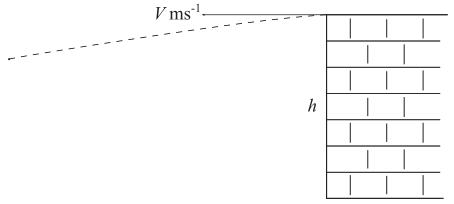
A canon ball is fired from a castle wall across a horizontal plane at `V` ms−1.

Its position vector  `t` seconds after it is fired from its origin is given by  `underset~s(t) = V tunderset~i - 1/2g t^2 underset~j`.

  1. If the projectile hits the ground at a distance 8 times the height at which it was fired, show that it initial velocity is given by
     
          `V = 4sqrt(2hg)`  (2 marks)

    --- 5 WORK AREA LINES (style=lined) ---

  2. Show that the total distance the canon ball travels can be expressed as
     
          `int_0^sqrt((2h)/g) sqrt(g(32h + g t^2))\ dt` 
    (2 marks)

    --- 5 WORK AREA LINES (style=lined) ---

Show Answers Only
  1. `text(See Worked Solutions)`
  2. `text(See Worked Solutions)`
Show Worked Solution

i.   `text(Time of flight  ⇒  find)\ t\ text(when)\ \ y = −h`

`−1/2g t^2` `= −h`
`t^2` `= (2h)/g`
`t` `= sqrt((2h)/g),\ \ t > 0`


`text(S)text(ince the canon ball impacts when)\ \ x = 8h:`

`Vt` `= 8h`
`Vsqrt((2h)/g)` `= 8h`
`V` `= (8sqrt(hg))/sqrt2`
  `= 4sqrt(2hg)`


ii.   `underset~v = 4sqrt(2hg) underset~i – g t underset~j`

`|underset~v|` `= sqrt((4sqrt(2hg))^2 + (−g t)^2)`
  `= sqrt(16 xx 2hg  + g^2 t^2)`
  `=sqrt(g(32h + g t^2)`


`text(Distance)` `= int_0^sqrt((2h)/g) |underset~v|\ dt`
  `= int_0^sqrt((2h)/g) sqrt(g(32h + g t^2))\ dt`

Filed Under: Vectors and Projectile Motion (Ext1) Tagged With: Band 5, Band 6, smc-1087-10-Range, smc-1087-30-Time of Flight, smc-1087-80-Total Distance

Vectors, EXT1 V1 2019 SPEC2-N 4

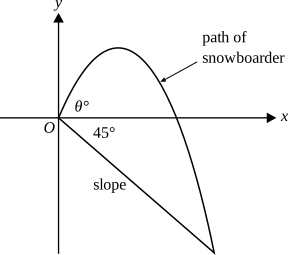
A snowboarder at the Winter Olympics leaves a ski jump at an angle of `theta` degrees to the horizontal, rises up in the air, performs various tricks and then lands at a distance down a straight slope that makes an angle of 45° to the horizontal, as shown below.

Let the origin `O` of a cartesian coordinate system be at the point where the snowboarder leaves the jump, with a unit vector in the positive `x` direction being represented by  `underset~i`  and a unit vector in the positive `y` direction being represented by  `underset~j`. Distances are measured in metres and time is measured in seconds.

The position vector of the snowboarder  `t`  seconds after leaving the jump is given by

`underset~r (t) = (6t-0.01t^3) underset~i + (6 sqrt3 t-4.9t^2 + 0.01t^3) underset~j , \ t ≥ 0`


  1. Find the angle  `theta °`.    (2 marks)

    --- 5 WORK AREA LINES (style=lined) ---

  2. Find the speed, in metres per second, of the snowboarder when she leaves the jump at `O`.    (1 mark)

    --- 2 WORK AREA LINES (style=lined) ---

  3. Find the maximum height above `O` reached by the snow boarder. Give your answer in metres, correct to one decimal place.    (2 marks)

    --- 4 WORK AREA LINES (style=lined) ---

  4. Show that the time spent in the air by the snowboarder is  `(60(sqrt3 + 1))/(49)`  seconds.    (3 marks)

    --- 6 WORK AREA LINES (style=lined) ---

Show Answers Only
  1. `60°`
  2. `12 \ text(ms)^-1`
  3. `5.5 \ text(m)`
  4. `text(See Worked Solutions)`
Show Worked Solution

a.   `v(t) = (6-0.03t^2)underset~i + (6 sqrt3-9.8t + 0.03t^2) underset~j`

`text(When) \ t =0,`

`v(t) = 6underset~i + 6 sqrt3 underset~j`

`tan theta = (6 sqrt3)/(6) = sqrt3`

`:. \ theta` `= tan^-1 sqrt3= 60°`


b.    `text(Speed)` `= |v(0)|`
    `= sqrt(6^2 + (6 sqrt3)^2)`
    `= 12 \ text(ms)^-1`

 
c.   `text(Max height when) \ underset~j \ text(component of) \ v(t) = 0`

`text(Solve): \ \ 6 sqrt3-9.8t + 0.03t^2 = 0`

`=> t =  1.064 \ text(seconds)`

`text(Max height)` `= 6 sqrt3 (1.064)-4.9(1.064)^2 + 0.01(1.064)^3`  
  `~~5.5\ text(m)`  

 
d.   `text(Time of Flight  ⇒  Solve for)\ \ t\ \ text(when)\ \ y=-x:`

`6 sqrt 3 t-4.9t^2 + 0.01 t^3` `= -(6t-0.01t^3)`
`(6 + 6 sqrt3)t-4.9 t^2` `= 0`
`t(6 + 6 sqrt3-4.9 t)` `= 0`
`4.9 t` `= 6 + 6 sqrt3`
`t` `= (6 + 6 sqrt3)/(4.9)`
  `= (60(sqrt3 + 1))/(49)\ text(seconds)`

Filed Under: Vectors and Projectile Motion (Ext1) Tagged With: Band 4, Band 5, Band 6, smc-1087-20-Maximum Height, smc-1087-30-Time of Flight, smc-1087-40-Initial Angle

Vectors, SPEC2-NHT 2019 VCAA 4

A snowboarder at the Winter Olympics leaves a ski jump at an angle of `theta` degrees to the horizontal, rises up in the air, performs various tricks and then lands at a distance down a straight slope that makes an angle of 45° to the horizontal, as shown below.

Let the origin `O` of a cartesian coordinate system be at the point where the snowboarder leaves the jump, with a unit vector in the positive `x` direction being represented by  `underset~i`  and a unit vector in the positive `y` direction being represented by  `underset~j`. Distances are measured in metres and time is measured in seconds.

The position vector of the snowboarder  `t`  seconds after leaving the jump is given by

`underset~r (t) = (6t-0.01t^3) underset~i + (6 sqrt3 t-4.9t^2 + 0.01t^3) underset~j , \ t ≥ 0`


  1. Find the angle  `theta °`.    (2 marks)

    --- 4 WORK AREA LINES (style=lined) ---

  2. Find the speed, in metres per second, of the snowboarder when she leaves the jump at `O`.   (1 mark)

    --- 4 WORK AREA LINES (style=lined) ---

  3. Show that the time spent in the air by the snowboarder is  `(60(sqrt3 + 1))/(49)`  seconds.   (3 marks)

    --- 5 WORK AREA LINES (style=lined) ---

  4. Find the total distance the snowboarder travels while airborne. Give your answer in metres, correct to two decimal places.   (2 marks)

    --- 4 WORK AREA LINES (style=lined) ---

Show Answers Only
  1. `60°`
  2. `12 \ text(ms)^-1`
  3. `5.5 \ text(m)`
  4. `text(See Worked Solutions)`
  5. `38.51 \ text{m  (to 2 decimal places)}`
Show Worked Solution

a.   `v(t) = (6-0.03t^2)underset~i + (6 sqrt3-9.8t + 0.03t^2) underset~j`

`text(When) \ t =0,`

`v(t) = 6underset~i + 6 sqrt3 underset~j`

`tan theta = (6 sqrt3)/(6) = sqrt3`

`:. \ theta` `= tan^-1 sqrt3`
  `= 60°`


b.    `text(Speed)` `= |v(0)|`
    `= sqrt(6^2 + (6 sqrt3)^2)`
    `= 12 \ text(ms)^-1`

 
c.   `text(Max height when) \ underset~j \ text(component of) \ v(t) = 0`

`text(Solve): \ \ 6 sqrt3-9.8t + 0.03t^2 = 0`

`=> t =  1.064 \ text(seconds)`

`text(Max height)` `= 6 sqrt3 (1.064)-4.9(1.064)^2 + 0.01(1.064)^3`  
  `~~5.5\ text(m)`  

 
d.   `text(Time of Flight  ⇒  Solve for)\ \ t\ \ text(when)\ \ y=-x:`

`6 sqrt 3 t-4.9t^2 + 0.01 t^3` `= -(6t-0.001t^3)`
`(6 + 6 sqrt3)t-4.9 t^2` `= 0`
`t(6 + 6 sqrt3-4.9 t)` `= 0`
`4.9 t` `= 6 + 6 sqrt3`
`t` `= (6 + 6 sqrt3)/(4.9)`
  `= (60(sqrt3 + 1))/(49)\ text(seconds)`


e.
   `text(Total distance) \ = text(Area under) \ v(t) \ text(graph from)\ \ t = 0 \ \ text(to)\ \ t_1 = (60(sqrt3 + 1))/(49)`

`|v(t)| = sqrt{(6-0.03 t^2)^2 + (6 sqrt3- 9.8t + 0.03 t^2)^2}`

`text(Distance)` `= int_0^(t_1) |v(t)| \ dt`
  `= 38.51 \ text{m (to 2 d.p.)}`

Filed Under: Forces and Motion Along a Curve Tagged With: Band 4, Band 5, Band 6, smc-1179-70-Projectile motion

Trigonometry, 2ADV* T1 2011 HSC 24c

A ship sails 6 km from `A` to `B` on a bearing of 121°. It then sails 9 km to `C`.  The
size of angle `ABC` is 114°.
 

2UG 2011 24c

Copy the diagram into your writing booklet and show all the information on it.

  1. What is the bearing of `C` from `B`?   (1 mark)

    --- 2 WORK AREA LINES (style=lined) ---

  2. Find the distance `AC`. Give your answer correct to the nearest kilometre.   (2 marks)

    --- 5 WORK AREA LINES (style=lined) ---

  3. What is the bearing of `A` from `C`? Give your answer correct to the nearest degree.   (3 marks)

    --- 6 WORK AREA LINES (style=lined) ---

Show Answers Only
  1.  `055^@`
  2.  `13\ text(km)`
  3.  `261^@`
Show Worked Solution
STRATEGY: This deserves repeating again: Draw North-South parallel lines through major points to make the angle calculations easier!
i.     2011 HSC 24c

 `text(Let point)\ D\ text(be due North of point)\ B`

`/_ABD` `=180-121\ text{(cointerior with}\ \ /_A text{)}`
  `=59^@`
`/_DBC` `=114-59`
  `=55^@`

   
`:. text(Bearing of)\ \ C\ \ text(from)\ \ B\ \ text(is)\ 055^@`


ii.    `text(Using cosine rule:)`

`AC^2` `=AB^2+BC^2-2xxABxxBCxxcos/_ABC`
  `=6^2+9^2-2xx6xx9xxcos114^@`
  `=160.9275…`
`:.AC` `=12.685…\ \ \ text{(Noting}\ AC>0 text{)}`
  `=13\ text(km)\ text{(nearest km)}`


iii.    `text(Need to find)\ /_ACB\ \ \ text{(see diagram)}`

MARKER’S COMMENT: The best responses showed clear working on the diagram.
`cos/_ACB` `=(AC^2+BC^2-AB^2)/(2xxACxxBC)`
  `=((12.685…)^2+9^2-6^2)/(2xx(12.685..)xx9)`
  `=0.9018…`
`/_ACB` `=25.6^@\ text{(to 1 d.p.)}`


`text(From diagram,)`

`/_BCE=55^@\ text{(alternate angle,}\ DB\ text(||)\ CE text{)}`

`:.\ text(Bearing of)\ A\ text(from)\ C`

  `=180+55+25.6`
  `=260.6`
  `=261^@\ text{(nearest degree)}`

Filed Under: Bearings (Adv-2027), Bearings (Y11) Tagged With: Band 4, Band 5, Band 6, common-content, smc-6395-10-Bearings, smc-981-10-Bearings

GRAPHS, FUR2 2019 VCAA 3

Members of the association will travel to a conference in cars and minibuses:

  • Let `x` be the number of cars used for travel.
  • Let `y` be the number of minibuses used for travel.
  • A maximum of eight cars and minibuses in total can be used.
  • At least three cars must be used.
  • At least two minibuses must be used.

The constraints above can be represented by the following three inequalities.
 

`text(Inequality 1) qquad qquad x + y <= 8`

`text(Inequality 2) qquad qquad x >= 3`

`text(Inequality 3) qquad qquad y >= 2`
 

  1. Each car can carry a total of five people and each minibus can carry a total of 10 people.


    A maximum of 60 people can attend the conference.


    Use this information to write Inequality 4.   (1 mark)

The graph below shows the four lines representing Inequalities 1 to 4.

Also shown on this graph are four of the integer points that satisfy Inequalities 1 to 4. Each of these integer points is marked with a cross (✖).


  1. On the graph above, mark clearly, with a circle (o), the remaining integer points that satisfy Inequalities 1 to 4.  (1 mark)

Each car will cost $70 to hire and each minibus will cost $100 to hire.

  1. What is the cost for 60 members to travel to the conference?  (1 mark)
  2. What is the minimum cost for 55 members to travel to the conference?  (1 mark)
  3. Just before the cars were booked, the cost of hiring each car increased.


    The cost of hiring each minibus remained $100.


    All original constraints apply.


    If the increase in the cost of hiring each car is more than `k` dollars, then the maximum cost of transporting members to this conference can only occur when using six cars and two minibuses.


    Determine the value of  `k`.  (1 mark)

Show Answers Only
  1. `5x + 10y <= 60`
  2. `text(See Worked Solutions)`
  3. `$680`
  4. `$610`
  5. `30`
Show Worked Solution

a.  `5x + 10y <= 60`


b.    


c.    `text(Consider the line)\ \ 5x + 10y = 60\ \ text(on the graph)`

`text(Touches the feasible region at)\ (4, 4)\ text(only)`

`:.\ text (C) text(ost of 60 members)`

`= 4 xx 70 + 4 xx 100`

`= $680`


d.    `text(Coordinates that allow 55 to travel) \ => \ (5, 3) and (3, 4)`

`text(C) text(ost)\ (5, 3) = 5 xx 70 + 3 xx 100 = $650`

`text(C) text(ost)\ (3, 4) = 3 xx 70 + 4 xx 100 = $610`

`:.\ text(Minimum cost is $610)`


e.    `text(Objective function): \ C = ax + 100y`

`text(Max cost occurs at)\ \ (6, 2)\ \ text(when)\ \ a > 100`

`text{(i.e. graphically when the slope of}\ \ C = ax + 100y`

   `text(is steeper than)\ \ x + y= 8 text{)}`

`:. k + 70` `= 100`
`k` `= 30`

Filed Under: Linear Programming Tagged With: Band 4, Band 5, Band 6, page-break-before-question

GEOMETRY, FUR2 2019 VCAA 3

The following diagram shows a crane that is used to transfer shipping containers between the port and the cargo ship.


The length of the boom, `BC`, is 25 m. The length of the hoist, `AB`, is 15 m.

    1. Write a calculation to show that the distance `AC` is 20 m.  (1 mark)
    2. Find the angle `ACB`.


      Round your answer to the nearest degree.  (1 mark)

  1. The diagram below shows a cargo ship next to a port. The base of a crane is shown at point `Q`.


    `qquad`


    The base of the crane (`Q`) is 20 m from a shipping container at point `R`. The shipping container will be moved to point `P`, 38 m from `Q`. The crane rotates 120° as it moves the shipping container anticlockwise from `R` to `P`.


    What is the distance `RP`, in metres?


    Round your answer to the nearest metre.  (1 mark)

  2. A shipping container is a rectangular prism.


    Four chains connect the shipping container to a hoist at point `M`, as shown in the diagram below.


    `qquad` 


    The shipping container has a height of 2.6 m, a width of 2.4 m and a length of 6 m.


    Each chain on the hoist is 4.4 m in length.


    What is the vertical distance, in metres, between point `M` and the top of the shipping container?


    Round your answer to the nearest metre.  (2 marks)

Show Answers Only
    1. `text(Proof)\ \ text{(See Worked Solutions)}`
    2. `37^@`
  1. `51\ text(m)`
  2. `3\ text(m)`
Show Worked Solution
a.i.   `AC` `= sqrt(BC^2 – AB^2)`
    `= sqrt(25^2 – 15^2)`
    `= sqrt 400`
    `= 20`


a.ii.   `tan\  /_ ACB` `= 15/20`
  `/_ ACB` `= tan^(-1) (3/4)`
    `= 36.86…`
    `~~ 37^@`


b.  `text(Using cosine rule:)`

`RP^2` `= 20^2 + 38^2 – 2 xx 20 xx 38 xx cos 120^@`
  `= 2604`
`:. RP` `= 51.029…`
  `~~ 51\ text(metres)`


c.  

`text(Find)\ h => text(need to find)\ x`

`text(Consider the top of the container)`


`x` `= sqrt(3^2 + 1.2^2)`
  `~~ 3.2311`


`:. h` `= sqrt(4.4^2 – 3.2311^2)`
  `= 2.98…`
  `~~ 3\ text(metres)`

Filed Under: Trig - Harder Applications Tagged With: Band 3, Band 4, Band 6

Networks, STD2 N3 2019 FUR2 3

Fencedale High School is planning to renovate its gymnasium.

This project involves 12 activities, `A` to `L`.

The directed network below shows these activities and their completion times, in weeks.


The minimum completion time for the project is 35 weeks.

  1. Identify the critical path and state how many activities are on it?  (2 marks)

    --- 2 WORK AREA LINES (style=lined) ---

  2. Determine the latest start time of activity `E`.  (1 mark)

    --- 1 WORK AREA LINES (style=lined) ---

  3. Which activity has the longest float time?  (1 mark)

    --- 2 WORK AREA LINES (style=lined) ---

It is possible to reduce the completion time for activities `C, D, G, H` and `K` by employing more workers.

  1.  The completion time for each of these five activities can be reduced by a maximum of two weeks.


    What is the minimum time, in weeks, that the renovation project could take?  (1 mark)

    --- 2 WORK AREA LINES (style=lined) ---

Show Answers Only
  1. `8\ text(activities)`
  2. `12\ text(weeks)`
  3. `text(Activity)\ J`
  4. `29\ text(weeks)`
Show Worked Solution

a.  `text(Scanning forwards and backwards:)`


`text(Critical path:)\ ABDFGIKL`

`:. 8\ text(activities)`
 

b.  `text(LST for activity)\ E = 12\ text{weeks  (i.e. start of 13th week)}`
 

c.   `text(Consider float times of all activities not on critical path.)`

`J-5, H-1, E-1, C-1`

`:.\ text(Activity)\ J\ text(has the largest float time.)`
 

d.   `text(Critical path after reducing)\ CDGHK\ text(by 2 weeks is)`

`ABDFGIKL.`
 

`:.\ text(Minimum time)` `= 2 + 4 + 7 + 1 + 2 + 2 + 5 + 6`
  `= 29\ text(weeks)`

Filed Under: Critical Paths Tagged With: Band 4, Band 5, Band 6, smc-916-30-Scanning Both Ways, smc-916-40-Critical Path Adjustments

NETWORKS, FUR2 2019 VCAA 3

Fencedale High School is planning to renovate its gymnasium.

This project involves 12 activities, `A` to `L`.

The directed network below shows these activities and their completion times, in weeks.


The minimum completion time for the project is 35 weeks.

  1. How many activities are on the critical path?   (1 mark)

    --- 4 WORK AREA LINES (style=lined) ---

  2. Determine the latest start time of activity `E`.   (1 mark)

    --- 1 WORK AREA LINES (style=lined) ---

  3. Which activity has the longest float time?   (1 mark)

    --- 3 WORK AREA LINES (style=lined) ---

It is possible to reduce the completion time for activities `C, D, G, H` and `K` by employing more workers.

  1.  The completion time for each of these five activities can be reduced by a maximum of two weeks.


    What is the minimum time, in weeks, that the renovation project could take?   (1 mark)

    --- 3 WORK AREA LINES (style=lined) ---

  2. The reduction in completion time for each of these five activities will incur an additional cost to the school.


    The table below shows the five activities that can have their completion times reduced and the associated weekly cost, in dollars.
      

           Activity                    Weekly cost ($)             
    `C` 3000
    `D` 2000
    `G` 2500
    `H` 1000
    `K` 4000

      
    The completion time for each of these five activities can be reduced by a maximum of two weeks.


    Fencedale High School requires the overall completion time for the renovation project to be reduced by four weeks at minimum cost.


    Complete the table below, showing the reductions in individual activity completion times that would achieve this.   (2 marks)

    --- 5 WORK AREA LINES (style=lined) ---

           Activity       

                 Reduction in completion time             
            (0, 1 or 2 weeks)
    `C`  
    `D`  
    `G`  
    `H`  
    `K`  
Show Answers Only
  1. `8\ text(activities)`
  2. `12\ text(weeks)`
  3. `text(Activity)\ J`
  4. `29\ text(weeks)`
  5.  
             Activity       

             Reduction in completion time         
            (0, 1 or 2 weeks)
      `C` 0
      `D` 1
      `G` 2
      `H` 1
      `K` 1
Show Worked Solution

a.  `text(Scanning forwards and backwards:)`


`text(Crirical path:)\ ABDFGIKL`

`:. 8\ text(activities)`
 

b.  `text(LST for activity)\ E = 12\ text{weeks  (i.e. start of 13th week)}`
 

c.   `text(Consider float times of all activities not on critical path.)`

`J-5, H-1, E-1, C-1`

`:.\ text(Activity)\ J\ text(has the largest float time.)`
 

d.   `text(Critical path after reducing)\ CDGHK\ text(by 2 weeks is)`

`ABDFGIKL.`
 

`:.\ text(Minimum time)` `= 2 + 4 + 7 + 1 + 2 + 2 + 5 + 6`
  `= 29\ text(weeks)`

  
e.
   `text(Reduce cheapest activities on the critical path by 1 week)`

`↓ 1 =>\ text(Activity)\ D\ text(and)\ G`
 

`text{Possibilities for reducing by a further week (choose 2)}`

`C and D:\ text(cost $5000)\ \ text{(too expensive)}`

`G and H:\ text(cost $3500)\ \ text{(yes)}`

`K:\ text(cost $4000)\ \ text{(yes)}`
 

         Activity       

         Reduction in completion time         
        (0, 1 or 2 weeks)
  `C` 0
  `D` 1
  `G` 2
  `H` 1
  `K` 1

Filed Under: Critical Path Analysis Tagged With: Band 5, Band 6, smc-621-30-Float time/LST, smc-621-40-Crashing/Reduce completion time

MATRICES, FUR2 2019 VCAA 3

On Sunday, matrix `V` is used when calculating the expected number of visitors at each location every hour after 10 am. It is assumed that the park will be at its capacity of 2000 visitors for all of Sunday.

Let `L_0` be the state matrix that shows the number of visitors at each location at 10 am on Sunday.

The number of visitors expected at each location at 11 am on Sunday can be determined by the matrix product

 
`{:(qquadqquadqquadqquadqquadqquadqquadqquadqquadqquadqquadqquadqquadqquadqquadqquadqquadqquadqquadqquadqquadqquadqquadqquad text(this hour)),(qquadqquadqquadqquadqquadqquadqquadqquadqquadqquadqquadqquadqquadqquadqquadqquadqquadqquadqquad qquad qquad  \ A qquad quad F qquad \  G \ quad quad W),({:V xx L_0 qquad text(where) qquad L_0 = [(500), (600), (500), (400)]{:(A),(F),(G),(W):}, qquad text(and):} qquad V = [(0.3,0.4,0.6,0.3),(0.1,0.2,0.1,0.2),(0.1,0.2,0.2,0.1),(0.5,0.2,0.1,0.4)]{:(A),(F),(G),(W):}\ text(next hour)):}`
 

  1. Safety restrictions require that all four locations have a maximum of 600 visitors.
  2. Which location is expected to have more than 600 visitors at 11 am on Sunday?   (1 mark) 

    --- 3 WORK AREA LINES (style=lined) ---

  3. Whenever more than 600 visitors are expected to be at a location on Sunday, the first 600 visitors can stay at that location and all others will be moved directly to Ground World `(G)`.
  4. State matrix `R_n` contains the number of visitors at each location `n` hours after 10 am on Sunday, after the safety restrictions have been enforced.
  5. Matrix `R_1` can be determined from the matrix recurrence relation
  6. `qquad qquad qquad R_0 = [(500),(600),(500),(400)]{:(A),(F),(G),(W):}, qquad qquad R_1 = V xx R_0 + B_1`
  7. where matrix `B_1` shows the required movement of visitors at 11 am.
    1. Determine the matrix `B_1`.   (1 mark)

      --- 4 WORK AREA LINES (style=lined) ---

    2. State matrix `R_2` can be determined from the new matrix rule
    3. `qquad qquad R_2 = VR_1 + B_2`
    4. where matrix `B_2` shows the required movement of visitors at 12 noon.
    5. Determine the state matrix `R_2`.   (1 mark)

      --- 3 WORK AREA LINES (style=lined) ---

Show Answers Only
  1. `text(Location)\ A`
  2.  i. `B_1 = [(-210),(0),(210),(0)]`
    ii. `R_2 = [(600),(288),(512),(600)]`
Show Worked Solution
a.   `text{By inspection (higher decimal values in row 1)}`
  `=>\ text(test location)\ A`
  `text(Visitors at)\ A\ text{(11 am)}` `= 0.3 xx 500 + 0.4 xx 600 + 0.6 xx 500 + 0.3 xx 400`
    `= 810`

 
`text(Location)\ A\ text(will have more than 600 visitors.)`


b.i.   `VR_0` `= [(0.3,0.4,0.6,0.3),(0.1,0.2,0.1,0.2),(0.1,0.2,0.2,0.1),(0.5,0.2,0.1,0.4)][(500),(600),(500),(400)]=[(810),(300),(310),(580)]`
     
  `R_1` `= V xx R_0 + B_1`
    `= [(810),(300),(310),(580)] + [(-210),(0),(210),(0)]`
  `:. B_1` `= [(-210),(0),(210),(0)]`


b.ii.   `R_2` `= [(0.3,0.4,0.6,0.3),(0.1,0.2,0.1,0.2),(0.1,0.2,0.2,0.1),(0.5,0.2,0.1,0.4)][(600),(300),(520),(580)] + B_2`
    `= [(786),(288),(282),(644)] + [(-186),(0),(230),(-44)]= [(600),(288),(512),(600)]`

Filed Under: Transition Matrices - Modified Tagged With: Band 4, Band 5, Band 6, smc-1893-20-State Matrix in discrete period, smc-1893-32-4x4 Matrix

NETWORKS, FUR1 2019 STD2 40

A museum is planning an exhibition using five rooms.

The museum manager draws a network to help plan the exhibition. The vertices `A`, `B`, `C`, `D` and `E` represent the five rooms. The number on the edges represent the maximum number of people per hour who can pass through the security checkpoints between the rooms.


  1. What is the capacity of the cut shown?   (1 mark)

    --- 2 WORK AREA LINES (style=lined) ---

  2. The museum manager is planning for a maximum of 240 visitors to pass through the exhibition each hour. By using the 'minimum cut-maximum flow' theorem, the manager determines that the plan does not provide sufficient flow capacity.


    Draw the minimum cut onto the network below and recommend a change that the manager could make to one or more security checkpoints to increase the flow capacity to 240 visitors per hour.   (2 marks)

    --- 4 WORK AREA LINES (style=lined) ---


Show Answers Only
  1. `290`
  2.   

Show Worked Solution
a.    `text(Capacity)` `= 130 + 90 + 70`
    `= 290`

♦♦ Mean mark 32%.
COMMENT: In part (a), edge BC flows from the exit to the entry and is therefore not counted.

b.   `text(Maximum flow capacity:)`
   

`text(Minimum cut = 80 + 40 + 65 + 45 = 230)`

♦♦♦ Mean mark 19%.
COMMENT: In part (b), edge BC now flows from entry to exit in the new “minimum” cut and is counted.

`text(If security is improved to increase the flow)`

`text(between Room C and Room B by 10 visitors)`

`text(per hour, the network’s flow capacity increases)`

`text(to 240.)`

Filed Under: Flow Problems Tagged With: Band 5, Band 6, smc-625-10-Cut Capacity, smc-625-20-Max Flow/Min Cut

Statistics, SPEC2 2019 VCAA 6

A company produces packets of noodles. It is known from past experience that the mass of a packet of noodles produced by one of the company's machines is normally distributed with a mean of 375 grams and a standard deviation of 15 grams.

To check the operation of the machine after some repairs, the company's quality control employees select two independent random samples of 50 packets and calculate the mean mass of the 50 packets for each random sample.

  1. Assume that the machine is working properly. Find the probability that at least one random sample will have a mean mass between 370 grams and 375 grams. Give your answer correct to three decimal places.   (2 marks)

    --- 5 WORK AREA LINES (style=lined) ---

  2. Assume that the machine is working properly. Find the probability that the means of the two random samples differ by less than 2 grams. Give your answer correct to three decimal places.   (3 marks)

    --- 5 WORK AREA LINES (style=lined) ---

To test whether the machine is working properly after the repairs and is still producing packets with a mean mass of 375 grams, the two random samples are combined and the mean mass of the 100 packets is found to be 372 grams. Assume that the standard deviation of the mass of the packets produced is still 15 grams. A two-tailed test at the 5% level of significance is to be carried out.

  1. Write down suitable hypotheses `H_0` and `H_1` for this test.   (1 mark)

    --- 1 WORK AREA LINES (style=lined) ---

  2. Find the  `p`  value for the test, correct to three decimal places.   (1 mark)

    --- 2 WORK AREA LINES (style=lined) ---

  3. Does the mean mass of the sample of 100 packets suggest that the machine is working properly at the 5% level of significance for a two-tailed test? Justify your answer.   (1 mark)

    --- 2 WORK AREA LINES (style=lined) ---

  4. What is the smallest value of the mean mass of the sample of 100 packets for `H_0` to be not rejected? Give your answer correct to one decimal place.   (1 mark)

    --- 3 WORK AREA LINES (style=lined) ---

Show Answers Only
  1. `0.741`
  2. `0.495`
  3. `H_0: mu = 375`
    `H_1: mu != 375`
  4. `0.046`
  5. `text(See Worked Solutions)`
  6. `372.1`
Show Worked Solution

a.   `barX\ ~\ N(375, (15/sqrt50)^2)`

`text(Pr)(370 <= barX <= 375)`

`= 0.490788…`
 

`text(Pr)(text(not in range)) ~~ 1-0.490788 ~~ 0.509212`

`text(Pr)(text(Samples within range) >= 1)`

`= 1-text(Pr)(text(0 samples in range))`

`~~ 1-(0.509212)^2`

`~~ 0.741`
 

b.   `text(Let)\ \ Y = barX_1-barX_2`

`Y\ ~\ N (0, 2 xx (15^2)/50)`

`text(Pr)(−2 < Y < 2)\ \ (text(by CAS))`

`= text(norm cdf)\ (−2,2,0, sqrt(2 xx (15^2)/50))`

`~~ 0.495`
 

c.   `H_0: \ mu = 375`

`H_1: \ mu != 375`
 

d.   `text(By CAS:)\ \ mu_0 = 375, \ barx = 372, \ sigma = 15, \ n = 100`

`p ~~ 0.046`
 

e.   `p < 0.05 \ => \ text(reject)\ H_0`

`=>\ text(The machine is NOT working properly.)`
 

f.   `text(Pr)(barx <= a) = 0.025\ \ (text(2 sided test))`

`a_text(min)` `= text(inv norm)\ (0.025, 375, 15/sqrt100)`
  `= 372.06…`
  `=372.1`

Filed Under: Confidence Intervals and Hypothesis Testing (SM) Tagged With: Band 4, Band 5, Band 6, smc-1162-20-Other CI (sample), smc-1162-50-Null/Alternative hypothesis

Mechanics, SPEC2 2019 VCAA 5

A mass of  `m_1`  kilograms is initially held at rest near the bottom of a smooth plane inclined at `theta` degrees to the horizontal. It is connected to a mass of  `m_2`  kilograms by a light inextensible string parallel to the plane, which passes over a smooth pulley at the end of the plane. The mass  `m_2`  is 2 m above the horizontal floor.

The situation is shown in the diagram below.


  1. After the mass  `m_1`  is released, the following forces, measured in newtons, act on the system:


    • weight forces  `W_1`  and  `W_2`
    •  the normal reaction force  `N`
    •  the tension in the string  `T`


    On the diagram above, show and clearly label the forces acting on each of the masses.  (1 mark) 

  2. If the system remains in equilibrium after the mass  `m_1`  is released, show that  `sin(theta) = (m_2)/(m_1)`.  (1 mark)
  3. After the mass  `m_1`  is released, the mass  `m_2`  falls to the floor.


    1. For what values of  `theta`  will this occur? Express your answer as an inequality in terms of  `m_1`  and  `m_2`.  (1 mark)
    2. Find the magnitude of acceleration, in ms−2, of the system after the mass  `m_1`  is released and before the mass  `m_2`  hits the floor. Express your answer in terms of  `m_1, \ m_2`  and  `theta`.  (2 marks)
  4. After the mass  `m_1`  is released, it moves up the plane.
    Find the maximum distance, in metres, that the mass  `m_1`  will move up the plane if  `m_1 = 2m_2`  and  `sin(theta) = 1/4`.  (5 marks)
Show Answers Only
  1.   
  2. `text(See Worked Solutions)`
    1. `theta < sin^(−1)\ ((m_2)/(m_1)), theta ∈ (0, pi/2)`
    2. `a = (g(m_2 – m_1 · sin(theta)))/(m_1 + m_2)`
  3. `10/3 \ text(m)`
Show Worked Solution
a.   


b.   `T = m_2g\ \ … \ (1)`

`T = m_1sin(theta)\ \ … \ (2)`

`text{Solve:  (1) = (2)}`

`m_1g sin(theta)` `= m_2g`
`sin(theta)` `= (m_2)/(m_1)`


c.i.   `m_2g > m_1gsin(theta)`

`sin(theta) < (m_2)/(m_1)`

`theta < sin^(−1)\ ((m_2)/(m_1)), \ \ theta ∈ (0, pi/2)`


c.ii.   `text(Net force)\ (F) = m_2g – m_1gsin(theta)`

`(m_1 + m_2) · a` `= g(m_2 – m_1 sin(theta))`
`:. a` `= (g(m_2 – m_1 sin(theta)))/(m_1 + m_2)`


d.   `text(Motion:)\ m_1\ text(will accelerate up the plane for 2 m.)`

 `m_1\ text(will then decelerate up plane until)\ v = 0.`

`text(Find)\ v_(m_1)\ \ text(given)\ \ s_(m_1) = 2, \ u = 0, \ m_1=2m_2`

`a = (g(m_2 – m_1  sintheta))/(m_1 + m_2) = (g(m_2 – 2m_2 · 1/4))/(2m_2 + m_2) = g/6`
 

`text(Using)\ \ v^2 = u^2 + 2as,`

`v_(m_1)^2 = 0 + 2 · g/6 · 2 = (2g)/3`

`text(Find distance)\ (s_2)\ text(for)\ m_1\ text(to decelerate until)\ v = 0:`

`a = −gsintheta = −g/4, \ u = sqrt((2g)/3)`

`0` `= (2g)/3 – 2 · g/4 · s_2`
`s_2` `= (2g)/3 xx 2/g`
  `= 4/3`


`:.\ text(Maximum distance)` `= 2 + 4/3`
  `= 10/3\ text(m)`

Filed Under: Pulleys, Planes and Equilibrium (SM) Tagged With: Band 3, Band 4, Band 5, Band 6

Complex Numbers, SPEC2 2019 VCAA 2

  1. Show that the solutions of  `2z^2 + 4z + 5 = 0`, where  `z ∈ C`, are  `z = −1 ± sqrt6/2 i`.   (1 mark)

    --- 3 WORK AREA LINES (style=lined) ---

  2. Plot the solutions of  `2z^2 + 4z + 5 = 0`  on the Argand diagram below.   (1 mark)

    --- 0 WORK AREA LINES (style=lined) ---


Let  `|z + m| = n`, where  `m, n ∈ R`, represent the circle of minimum radius that passes through the solutions of  `2z^2 + 4z + 5 = 0`.

    1. Find  `m`  and  `n`.   (2 marks)

      --- 3 WORK AREA LINES (style=lined) ---

    2. Find the cartesian equation of the circle  `|z + m| = n`.   (1 mark)

      --- 2 WORK AREA LINES (style=lined) ---

    3. Sketch the circle on the Argand diagram in part a.ii. Intercepts with the coordinate axes do not need to be calculated or labelled.   (1 mark)

      --- 0 WORK AREA LINES (style=lined) ---

  1. Find all values of  `d`, where  `d ∈ R`, for which the solutions of  `2z^2 + 4z + d = 0`  satisfy the relation  `|z + m| <= n`.   (2 marks)

    --- 4 WORK AREA LINES (style=lined) ---

  2. All complex solutions of  `az^2 + bz + c = 0`  have non-zero real and imaginary parts.


    Let  `|z + p| = q`  represent the circle of minimum radius in the complex plane that passes through these solutions, where  `a, b, c, p, q ∈ R`.


    Find  `p`  and  `q`  in terms of  `a, b`  and  `c`.   (2 marks)

    --- 4 WORK AREA LINES (style=lined) ---

Show Answers Only
  1. `text(See Worked Solutions)`
  2.   
  3. `m = 1, n = sqrt6/2`
  4. `(x + 1)^2 + y^2 = 3/2`
  5. `−1 <= d <= 5\ \ (text(by CAS))`
  6. `p = b/(2a), \ q = |sqrt(b^2-4ac)/(2a)|`
Show Worked Solution
a.i.    `z` `= (−b ± sqrt(b^2-4ac))/(2a)`
    `= (−4 ± sqrt(16-4 · 2 · 5))/(4)`
    `= (−4 ± 2sqrt6 i)/(4)`
    `= −1 ± sqrt6/2 i\ \ …\ text(as required)`


a.ii.   


b.i.   `text(Radius of circle = )sqrt6/2`

 `text(Centre) = (0, −1)`

`:. m = 1, \ n = sqrt6/2`


b.ii.    `|z + 1|` `= sqrt6/2`
  `|x + iy + 1|` `= sqrt6/2`
  `(x + 1)^2 + y^2` `= 3/2`


b.iii.   


c.   `text(Solve:)\ 2z^2 + 4z + d = 0`

`z = −1 ± sqrt(4-2d)/2 = −1 ± sqrt((2-d)/2)`

`z + 1 = ± sqrt((2-d)/2)`
 

`text(Solve for)\ d\ text(such that:)`

`|sqrt((2-d)/2)| <= sqrt6/2`

`−1 <= d <= 5\ \ (text(by CAS))`


d.   `z = (−b ± sqrt(b^2-4ac))/(2a) = (−b)/(2a) ± sqrt(b^2-4ac)/(2a)`

`z + b/(2a)` `= ± sqrt(b^2-4ac)/(2a)`
`|z + b/(2a)|` `= |sqrt(b^2-4ac)/(2a)|`

 
`:. p = b/(2a), \ q = |sqrt(b^2-4ac)/(2a)|`

Filed Under: Factors and Roots (SM), Geometry and Complex Numbers (SM) Tagged With: Band 3, Band 4, Band 5, Band 6, smc-1172-10-Quadratic roots, smc-1172-60-Sketch solutions, smc-1173-10-Circles

Calculus, MET2 2019 VCAA 5

Let  `f: R -> R, \ f(x) = 1-x^3`. The tangent to the graph of `f` at  `x = a`, where  `0 < a < 1`, intersects the graph of `f` again at `P` and intersects the horizontal axis at `Q`. The shaded regions shown in the diagram below are bounded by the graph of `f`, its tangent at  `x = a`  and the horizontal axis.
 

  1. Find the equation of the tangent to the graph of `f` at  `x = a`, in terms of `a`.   (1 mark)

    --- 3 WORK AREA LINES (style=lined) ---

  2. Find the `x`-coordinate of `Q`, in terms of `a`.   (1 mark)

    --- 3 WORK AREA LINES (style=lined) ---

  3. Find the `x`-coordinate of `P`, in terms of `a`.   (2 marks)

    --- 4 WORK AREA LINES (style=lined) ---

Let  `A`  be the function that determines the total area of the shaded regions.

  1. Find the rule of `A`, in terms of `a`.   (3 marks)

    --- 5 WORK AREA LINES (style=lined) ---

  2. Find the value of `a` for which `A` is a minimum.   (2 marks)

    --- 3 WORK AREA LINES (style=lined) ---

Consider the regions bounded by the graph of `f^(-1)`, the tangent to the graph of `f^(-1)` at  `x = b`, where  `0 < b < 1`, and the vertical axis.

  1. Find the value of `b` for which the total area of these regions is a minimum.   (2 marks)

    --- 4 WORK AREA LINES (style=lined) ---

  2. Find the value of the acute angle between the tangent to the graph of `f` and the tangent to the graph of `f^(-1)` at  `x = 1`.   (1 mark)

    --- 4 WORK AREA LINES (style=lined) ---

Show Answers Only
  1. `y = 2a^3-3a^2x + 1`
  2. `(2a^3 + 1)/(3a^2)`
  3. `-2a`
  4. `(80a^6 + 8a^3-9a^2 + 2)/(12a^2)`
  5. `10^(-1/3)`
  6. `9/10`
  7. `tan^(-1)(1/3)`
Show Worked Solution

a.   `f(x) = 1-x^3,\ \ f^{\prime}(x) = -3x^2`

`m_text(tang) = -3a^2\ \ text(through)\ \ (a, 1-a^3)`

`y = 2a^3-3a^2x + 1`
 

b.   `text(Solve for)\ \x:`

`2a^3-3a^2x + 1 = 0`

`x = (2a^3 + 1)/(3a^2)`
 

c.   `text(Solve for)\ \ x:`

`2a^3-3a^2x + 1 = 1-x^3`

`x=-2a`

`:. x text(-coordinate of)\ P = -2a`
 

d.   `P(-2a, 8a^3 + 1),\ \ Q((2a^3 + 1)/(3a^2), 0)`

`A` `= text(Area of triangle)-int_(-2a)^1 f(x)\ dx`
  `= 1/2((2a^3 + 1)/(3a^2) + 2a)(8a^3 + 1)-int_(-2a)^1 1-x^3\ dx`
  `= (80a^6 + 8a^3-9a^2 + 2)/(12a^2)\ \ text{(by CAS)}`


e.   `text(Solve for)\ a: \ (dA)/(da) = 0\ \ text{(by CAS)}`

`a = 10^(-1/3)`
 

f.   `text(Consider)\ f(x):\ \ f(10^(-1/3)) = 9/10`

`A_text(min)\ text(for)\ \ f(x)\ \ text(occurs at)\ \ (10^(-1/3), 9/10)`

`=> A_text(min)\ text(for)\ \ f^(-1)(x)\ \ text(occurs when)\ \ x=9/10`

`:. b = 9/10`
 

g.   `f^{\prime} (1)  = -3`

`text(Gradient of)\ \  f^(-1)(x)\ \ text(at)\ \ x = 1\ \ text(is vertical line.)`

`tan theta` `= 1/3`
`theta` `= tan^(-1)(1/3)`
  `=18.4°\ \ text{(to 1 d.p.)}`

Filed Under: Area Under Curves, Maxima and Minima, Tangents and Normals Tagged With: Band 4, Band 5, Band 6, smc-634-10-Polynomial, smc-634-50-Find tangent given curve, smc-641-10-Area, smc-723-20-Cubic, smc-723-80-Area between graphs

Statistics, MET2 2019 VCAA 4

The Lorenz birdwing is the largest butterfly in Town A.

The probability density function that describes its life span, `X`, in weeks, is given by
 

`f(x) = {(4/625 (5x^3-x^4), quad 0 <= x <= 5),(0, quad text(elsewhere)):}`
 

  1. Find the mean life span of the Lorenz birdwing butterfly.  (2 marks)

    --- 3 WORK AREA LINES (style=lined) ---

  2. In a sample of 80 Lorenz birdwing butterflies, how many butterflies are expected to live longer than two weeks, correct to the nearest integer?  (2 marks)

    --- 3 WORK AREA LINES (style=lined) ---

  3. What is the probability that a Lorenz birdwing butterfly lives for at least four weeks, given that it lives for at least two weeks, correct to four decimal places?  (2 marks)

    --- 3 WORK AREA LINES (style=lined) ---

The wingspans of Lorenz birdwing butterflies in Town A are normally distributed with a mean of 14.1 cm and a standard deviation of 2.1 cm.

  1. Find the probability that a randomly selected Lorenz birdwing butterfly in Town A has a wingspan between 16 cm and 18 cm, correct to four decimal places.  (1 mark)

    --- 2 WORK AREA LINES (style=lined) ---

  2. A Lorenz birdwing butterfly is considered to be very small if its wingspan is in the smallest 5% of all the Lorenz birdwing butterflies in Town A.


    Find the greatest possible wingspan, in centimetres, for a very small Lorenz birdwing butterfly in Town A, correct to one decimal place.  (1 mark)

    --- 4 WORK AREA LINES (style=lined) ---

Each year, a detailed study is conducted on a random sample of 36 Lorenz birdwing butterflies in Town A.

A Lorenz birdwing butterfly is considered to be very large if its wingspan is greater than 17.5 cm. The probability that the wingspan of any Lorenz birdwing butterfly in Town A is greater than 17.5 cm is 0.0527, correct to four decimal places.

    1. Find the probability that three or more of the butterflies, in a random sample of 36 Lorenz birdwing butterflies from Town A, are very large, correct to four decimal places.  (1 mark)

      --- 2 WORK AREA LINES (style=lined) ---

    2. The probability that `n` or more butterflies, in a random sample of 36 Lorenz birdwing butterflies from Town A, are very large is less than 1%.


      Find the smallest value of `n`, where `n` is an integer.  (2 marks)

      --- 5 WORK AREA LINES (style=lined) ---

    3. For random samples of 36 Lorenz birdwing butterflies in Town A, `hat p` is the random variable that represents the proportion of butterflies that are very large.
    4. Find the expected value and the standard deviation of `hat p`, correct to four decimal places.  (2 marks)

      --- 2 WORK AREA LINES (style=lined) ---

    5. What is the probability that a sample proportion of butterflies that are very large lies within one standard deviation of 0.0527, correct to four decimal places? Do not use a normal approximation.  (2 marks)

      --- 5 WORK AREA LINES (style=lined) ---

  1. The Lorenz birdwing butterfly also lives in Town B.


    In a particular sample of Lorenz birdwing butterflies from Town B, an approximate 95% confidence interval for the proportion of butterflies that are very large was calculated to be (0.0234, 0.0866), correct to four decimal places.


    Determine the sample size used in the calculation of this confidence interval.  (2 marks)

    --- 5 WORK AREA LINES (style=lined) ---

Show Answers Only

  1. `10/3`
  2. `73`
  3. `0.2878`
  4. `0.1512`
  5. `10.6\ text(cm)`
    1. `0.2947`
    2. `7`
    3. `0.0372`
    4. `0.7380`
  6. `200`

Show Worked Solution

a.    `mu` `= 4/625 int_0^5 x(5x^3-x^4)\ dx`
    `= 4/625[x^5-1/6 x^6]_0^5`
    `= 10/3\ \ \ text{(by CAS)}`


b.    `text(Pr)(X > 2)` `= 4/625 int_2^5 5x^3-x^4\ dx`
    `= 4/625[5/4x^4-x^5/5]_2^5`
    `= 0.9129…`


`:.\ text(Expected number)` `= 80 xx 0.9129…`
  `~~ 73.03`
  `~~ 73`


c.    `text(Pr)(X = 4|X> 2)` `= (text(Pr)(X >= 4))/(text(Pr)(X >= 2))`
    `= 0.26272/0.91296`
    `= 0.2878`


d.   `W\ ~\ N (14.1, 2.1^2)`

`text(Pr)(16 < W < 18) = 0.1512\ \ \ text{(by CAS)}`


e.   `text(Solution 1:)`

`text(Pr)(W < w) = 0.05`

`text(Pr)(Z < z) = 0.05\ \ =>\ \ z = -1.6449\ \ text{(by CAS)}`

`(w-14.1)/2.1` `= -1.6449`
`w` `= 10.6\ text(cm)`

 
`text(Solution 2:)`

`text(invNorm)`

`text(Tail setting: left)`

`text(prob: 0.05)`

`sigma: 2.1`

`mu: 14.1`

`=> 10.6\ \ \ text{cm (by CAS)}`


f.i.   `L\ ~\ text(Bi)(n, p)\ ~\ text(Bi) (36, 0.0527)`

`text(Pr)(L >= 3) ~~ 0.2947`


f.ii.    `text(Pr)(L >= n) < 0.01`
 

`text(CAS: binomialCdf) (x, 36, 36, 0.0527)`

`text(Pr)(L >= 0) = 0.011 > 0.01`

`text(Pr)(L >= 7) = 0.002 < 0.01`

`:.\ text(Smallest)\ n = 7`


f.iii.    `E(hat p)` `= p = 0.0527`
  `sigma(hat p)` `= sqrt((p(1-p))/n) = sqrt((0.0527(1-0.0527))/36) ~~ 0.0372`


f.iv.        `hat p +- 1 sigma: (0.0527-0.0372, 0.0527 + 0.0372) = (0.0155, 0.0899)`

`text(Pr)(0.0155 < hat p < 0.0899)`

`= text(Pr)(36 xx 0.0155 < L < 36 xx 0.0899)`

`= text(Pr)(0.56 < L < 3.24)`

`= text(Pr)(1 <= L <= 3)`

`~~ 0.7380`


g.   `0.0234 = hat p-1.96 sqrt((hat p(1-hat p))/n) qquad text{… (1)}`

`0.0866 = hat p + 1.96 sqrt((hat p(1-hat p))/n) qquad text{… (2)}`

`text(Solve simultaneous equations:)`

`hat p ~~ 0.055, quad n ~~ 199.96`

`:.\ text(Sample size) = 200`

Filed Under: Binomial, Normal Distribution, Probability density functions Tagged With: Band 3, Band 4, Band 5, Band 6, smc-637-10-E(X), smc-637-40-Conditional probability, smc-637-45-Other probability, smc-638-20-binomCdf (CAS), smc-638-32-Find E(X)/var(X) given n p, smc-719-10-Single z-score, smc-719-20-95% confidence intervals

Calculus, MET2 2019 VCAA 3

During a telephone call, a phone uses a dual-tone frequency electrical signal to communicate with the telephone exchange.

The strength, `f`, of a simple dual-tone frequency signal is given by the function  `f(t) = sin((pi t)/3) + sin ((pi t)/6)`, where  `t`  is a measure of time and  `t >= 0`.

Part of the graph of `y = f(t)`  is shown below

  1. State the period of the function.   (1 mark)

    --- 5 WORK AREA LINES (style=lined) ---

  2. Find the values of  `t`  where  `f(t) = 0`  for the interval  `t in [0, 6]`.   (1 mark)

    --- 5 WORK AREA LINES (style=lined) ---

  3. Find the maximum strength of the dual-tone frequency signal, correct to two decimal places.   (1 mark)

    --- 5 WORK AREA LINES (style=lined) ---

  4. Find the area between the graph of  `f`  and the horizontal axis for  `t in [0, 6]`.   (2 marks)

    --- 5 WORK AREA LINES (style=lined) ---

Let  `g`  be the function obtained by applying the transformation  `T`  to the function  `f`, where
 

`T([(x), (y)]) = [(a, 0), (0, b)] [(x), (y)] + [(c), (d)]`
 

and `a, b, c` and `d` are real numbers.

  1. Find the values of `a, b, c` and `d` given that  `int_2^0 g(t)\ dt + int_2^6 g(t)\ dt`  has the same area calculated in part d.   (2 marks)

    --- 5 WORK AREA LINES (style=lined) ---

  2. The rectangle bounded by the line  `y = k, \ k in R^+`, the horizontal axis, and the lines  `x = 0`  and  `x = 12`  has the same area as the area between the graph of  `f`  and the horizontal axis for one period of the dual-tone frequency signal.


    Find the value of  `k`.   (2 marks)

    --- 5 WORK AREA LINES (style=lined) ---

Show Answers Only
  1. `12`
  2. `0, 4, 6`
  3. `1.760`
  4. `15/pi\ text(u²)`
  5. `a = 1,\ b =-1,\ c =-6,\ d = 0`
  6. `5/(2pi)`
Show Worked Solution

a.   `text(Period) = 12`
  

b.   `t = 0, 4, 6`
  

c.   `f(t) = sin ((pi t)/3) + sin ((pi t)/6)`

`f(t)_max ~~ 1.76\ \ text{(by CAS)}`


d.    `text(Area)` `= int_0^4 sin((pi t)/3) + sin ((pi t)/6) dt-int_4^6 sin ((pi t)/3) + sin ((pi t)/6) dt`
    `= 15/pi\ text(u²)`


e.   `text(Same area) => f(t)\ text(is reflected in the)\ x text(-axis and)`

`text(translated 6 units to the left.)`

`x′=ax+c`

`y′=by+d`

`text(Reflection in)\ xtext(-axis) \ => \ b=-1, \ d=0`

`text(Translate 6 units to the left) \ => \ a=1, \ c=-6`

`:. a = 1,\ b = -1,\ c = -6,\ d = 0`
  

f.    `text(Area of rectangle)` `= 2 xx text(Area between)\ f(t) and x text(-axis)\ \ t in [0, 6]`
  `12k` `= 2 xx 15/pi`
  `:. k` `=5/(2pi)`

Filed Under: Area Under Curves, Trig Graphing Tagged With: Band 3, Band 4, Band 5, Band 6, smc-2757-10-Sin, smc-2757-30-Find period, smc-2757-85-Max/min (non-calc), smc-723-60-Trig

Algebra, MET2 2019 VCAA 19 MC

Given that  `tan(alpha) = d`, where  `d > 0`  and  `0 < alpha < pi/2`, the sum of the solutions to  `tan (2x) = d`, where  `0 < x < (5 pi)/4`, in terms of  `alpha`  is

  1. `0`
  2. `2 alpha`
  3. `pi + 2 alpha`
  4. `pi/2 + alpha`
  5. `(3 (pi + alpha))/2`
Show Answers Only

`E`

Show Worked Solution

`tan(alpha) = tan(2x) = d`

`text(Period of)\ \ tan alpha = pi`

`2x = alpha, quad alpha + pi, quad alpha + 2 pi`

`x = alpha/2, quad (alpha + pi)/2, quad (alpha + 2 pi)/2`

`text(Given)\ \ 0 < alpha < pi/2, => (alpha + 2 pi)/2 < (5 pi)/4`

`:. sum text(solutions)` `= alpha/2 + (alpha + pi)/2 + (alpha + 2 pi)/2`
  `= (3 (pi + alpha))/2`

 
`=>   E`

Filed Under: Trig Equations Tagged With: Band 6, smc-725-30-Tan

Number, NAP-L4-NC01

Mike is downloading a complete hard drive onto his new computer.

It should take 24 minutes to download the full hard drive.

Mike loses his internet connection when  `5/6`  of the hard drive is downloaded.

How many more minutes are needed for Mike to complete the download?

`1/6\ text(of a minute)` `text(4 minutes)` `text(20 minute)s` `23 1/6\ text(minutes)`


Show Answers Only

`text(4 minutes)`

Show Worked Solution

`5/6 xx 24 =\ text(20 minutes)`

`:.\ text(Minutes needed)` `= 24 – 20`
  `= 4\ text(minutes)`

Filed Under: Fractions and Decimals, Fractions and Decimals Tagged With: Band 6, smc-3175-30-Fractions – Word problems, smc-663-30-Fractions - Word problems

Number, NAP-L3-NC01

Mike is downloading a complete hard drive onto his new computer.

It should take 24 minutes to download the full hard drive.

Mike loses his internet connection when  `5/6`  of the hard drive is downloaded.

How many more minutes are needed for Mike to complete the download?

`1/6\ text(of a minute)` `text(4 minutes)` `text(20 minute)s` `23 1/6\ text(minutes)`


Show Answers Only

`text(4 minutes)`

Show Worked Solution

`5/6 xx 24 =\ text(20 minutes)`

`:.\ text(Minutes needed)` `= 24 – 20`
  `= 4\ text(minutes)`

Filed Under: Fractions, Fractions Tagged With: Band 6, smc-3145-30-Word problems, smc-662-30-Word problems

Calculus, MET1 2019 VCAA 9

Consider the functions  `f: R -> R,\ \ f(x) = 3 + 2x-x^2`  and  `g: R -> R,\ \ g(x) = e^x`

  1. State the rule of `g(f(x))` .  (1 mark) 

    --- 2 WORK AREA LINES (style=lined) ---

  2. Find the values of `x` for which the derivative of `g(f(x))` is a negative.  (2 marks)

    --- 4 WORK AREA LINES (style=lined) ---

  3. State the rule of `f(g(x))`.  (1 mark)

    --- 2 WORK AREA LINES (style=lined) ---

  4. Solve  `f(g(x)) = 0`.  (2 marks)

    --- 5 WORK AREA LINES (style=lined) ---

  5. Find the coordinates of the stationary point of the graph of `f(g(x))`.  (2 marks)

    --- 5 WORK AREA LINES (style=lined) ---

  6. State the number of solutions to  `g(f(x)) + f(g(x)) = 0`.  (1 mark)

    --- 5 WORK AREA LINES (style=lined) ---

Show Answers Only
  1. `g(f(x)) = e^(3 + 2x-x^2)`
  2. `x > 1`
  3. `f(g(x)) = 3 + 2e^x-e^(2x)`
  4. `x = ln 3`
  5. `text(S.P. at)\ (0, 4)`
  6. `text(1 solution only)`
Show Worked Solution

a.   `g(f(x)) = e^(3 + 2x-x^2)`
 

b.   `d/(dx) g(f(x)) = (2-2x)e^(3 + 2x-x^2)`

`e^(3 + 2x-x^2) > 0\ \ text(for all)\ \ x`

`=> d/(dx) g(f(x)) < 0\  \text(when):`

`2-2x` `< 0`
`x` `> 1`

 
c.
   `f(g(x)) = 3 + 2e^x-e^(2x)`
 

d.   `e^(2x)-2e^x-3 = 0`

`text(Let)\ \ X = e^x`

`X^2-2X-3` `= 0`
`(X-3)(X + 1)` `= 0`

 
`X = 3 or -1`

`text(When)\ \ X = 3,\ \ e^x = 3 => x = ln 3`

`text(When)\ \ X = -1,\ \ e^x = -1 \ => \ text(no solution)`

`:. x = ln 3`
 

e.    `d/(dx)\ f(g(x))` `= 2e^x-2e^(2x)`
    `= 2e^x (1-e^x)`

 
`text(S.P. occurs when:)`

`2e^x(1-e^x)` `= 0`
`e^x` `= 1`
`x` `= 0`

 
`text(When)\ \ x = 0,`

`f(g(x))` `= 3 + 2-1=4`

 
`:.\ text(S.P. at)\ \ (0, 4)`
 

f.    `text(Solutions occur when)\ \ g(f(x)) = -f(g(x))`

`text{Sketch both graphs (using parts a-e):}`


`:. 1\ text(solution only)`

Filed Under: Curve Sketching Tagged With: Band 4, Band 5, Band 6, smc-724-35-Composite functions

  • « Previous Page
  • 1
  • …
  • 12
  • 13
  • 14
  • 15
  • 16
  • …
  • 28
  • Next Page »

Copyright © 2014–2025 SmarterEd.com.au · Log in