SmarterEd

Aussie Maths & Science Teachers: Save your time with SmarterEd

  • Login
  • Get Help
  • About

Calculus, MET2 2024 VCAA 17 MC

Consider the algorithm below, which prints the roots of the cubic polynomial  \(f(x)=x^3-2 x^2-9 x+18\).

\begin{array} {l}
\rule{0pt}{2.5ex} \textbf{ define} \ \text{ f (x) }  \\
\rule{0pt}{2.5ex} \quad \quad \textbf{return} \ \text{(x} ^3 - 2  \text{x}^2 - 9 \text{x} + 18) \\
\rule{0pt}{2.5ex}  \text{c} \leftarrow \text{f} \ (0) \\
\rule{0pt}{2.5ex} \textbf{if}\  \ \text{c < 0} \ \textbf{then}\\
\rule{0pt}{2.5ex} \quad \quad \text{c} \ \leftarrow \ \text{(- c)} \\
\rule{0pt}{2.5ex} \textbf{end if} \\
\rule{0pt}{2.5ex} \textbf{while} \ \text{ c > 0 } \\
\rule{0pt}{2.5ex} \quad \quad \textbf{if} \ \ \text{f (c) = 0 } \ \textbf{then}  \\
\rule{0pt}{2.5ex} \quad \quad \quad \quad \textbf{print} \ \text{c }   \\
\rule{0pt}{2.5ex} \quad \quad  \textbf{end if} \\
\rule{0pt}{2.5ex} \quad \quad  \textbf{if} \ \ \text{f (-c) = 0} \ \textbf{then} \\
\rule{0pt}{2.5ex} \quad \quad \quad \quad \textbf{print} \ \text{-c }   \\
\rule{0pt}{2.5ex} \quad \quad  \textbf{end if} \\
\rule{0pt}{2.5ex} \quad \quad  \text{c} \ \leftarrow \ \text{c - 1} \\
\rule{0pt}{2.5ex} \textbf{ end while } \\
\end{array}

In order, the algorithm prints the values

  1. \(-3, 3, 2\)
  2. \(-3, 2, 3\)
  3. \(3, 2, -3\)
  4. \(3, -3, 2\)
Show Answers Only

\(D\)

Show Worked Solution

\(\text{Solve}\ \ \ x^3-2 x^2-9 x+18=0\ \ \text{(using CAS):}\)

\(\text{Roots are:}\ \ \ x=3,\ 2, -3\)

\(\text{Using the algorithm the order is }\ c, -c,\ c-1\ \rightarrow \ 3, -3,\ 2\)

\(\Rightarrow D\)

♦♦♦ Mean mark 27%.

Filed Under: Pseudocode Tagged With: Band 6, smc-5196-25-Other

PHYSICS, M7 2024 HSC 20 MC

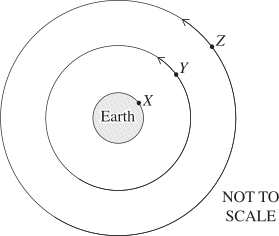
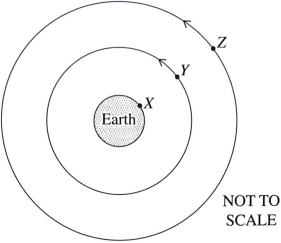
Three identical atomic clocks are made so that they tick at precisely the same rate. One is kept in a laboratory, \(X\), on Earth's equator. Another is placed on board a satellite, \(Y\), in a circular orbit with a period of 12 hours. A third is placed in a satellite, \(Z\), that is in a geostationary orbit. The satellites orbit Earth in the equatorial plane.
 

Assume that the satellites are inertial frames of reference and the clocks are affected ONLY by the predictions of special relativity.

Which statement correctly compares the rates at which the clocks tick, as determined by an observer at \(X\), when the satellites are in the positions shown in the diagram?

  1. The clock at \(Y\) ticks faster than either the clock at \(X\) or the clock at \(Z\).
  2. The clock at \(Y\) ticks slower than either the clock at \(X\) or the clock at \(Z\).
  3. The clocks tick at different rates, with \(X\) being the fastest and \(Y\) being the slowest.
  4. The clocks tick at different rates, with \(Z\) being the slowest and \(X\) being the fastest.
Show Answers Only

\(B\)

Show Worked Solution
  • Using Einstein’s special theory of relativity in relation to time dilation, the faster a clock travels relative to a stationary observer, the slower time moves for the clock. This means that the clock moving relative to the observer will tick more slowly.
  • The clock placed at \(X\) will be stationary relative to the observer at \(X\).
  • This is also true for the clock placed at \(Z\). As the clock being placed in a satellite which is in a geostationary orbit, the satellite will appear to be stationary in the sky. Therefore, the observer at \(X\) is in the same frame of reference as the clock at \(Z\) and no effects of time dilation will be observed.
  • The clock at \(Y\) has a period of 12 hours, hence it must have a smaller orbital radius and so a higher linear velocity than \(Z\). Thus the clock at \(Y\) would be moving faster as seen by the observer at \(X\) which is in the same frame of reference as \(Z\). Therefore, the observer at \(X\) would see the clock at \(Y\) tick slower than the clocks at \(X\) and \(Z\) due to the effects of time dilation.

\(\Rightarrow B\)

Note: As the question assumes that all satellites are in inertial frames of reference, students can discount the rotational velocities of the satellites and the centripetal forces of gravity on the satellites, effectively treating the Earth as flat.

♦♦♦ Mean mark 21%.

Filed Under: Light and Special Relativity Tagged With: Band 6, smc-3699-10-Time Dilation

PHYSICS, M6 2024 HSC 19 MC

In a vacuum chamber there is a uniform electric field and a uniform magnetic field.

A proton having a velocity, \(v\), enters the chamber. Its velocity remains unchanged as it travels through the chamber.

A second proton having a velocity, \(2v\), in the same direction as the first proton, then enters the chamber at the same point as the first proton.

In the chamber, the acceleration of the second proton

  1. is zero.
  2. is constant in magnitude and direction.
  3. changes in both magnitude and direction.
  4. is constant in magnitude, but not direction.
Show Answers Only

\(C\)

Show Worked Solution
  • The first proton, with velocity \(v\), travels through with no deflection. The net force acting on the proton is zero.
  • However, as the second proton has a velocity of \(2v\), \(F_B > F_E\) and the initial direction of \(F_B\) will be in the opposite direction of \(F_E\). This will cause the second proton to undergo circular motion (force is perpendicular to the velocity). 
  • The acceleration of the second proton will change direction as the centripetal force/acceleration will act towards the centre of the circular path that the second proton undertakes.
  • The magnitude of the acceleration of the second proton will also change. Initially \(F_B\) opposes \(F_E\) and \(F_{\text{net}}\) is at a minimum. As the direction of \(F_B\) changes, \(F_{\text{net}}\) will increase as \(F_E\) will not directly oppose \(F_B\).
  • As the magnitude of the net force on the second proton increases, the magnitude of the acceleration on the second proton will also increase.

\(\Rightarrow C\)

♦♦♦ Mean mark 26%.

Filed Under: Charged Particles, Conductors and Electric/Magnetic Fields Tagged With: Band 6, smc-3693-18-Combination EF and MF, smc-3693-65-Uniform Circular Motion

BIOLOGY, M8 2024 HSC 35

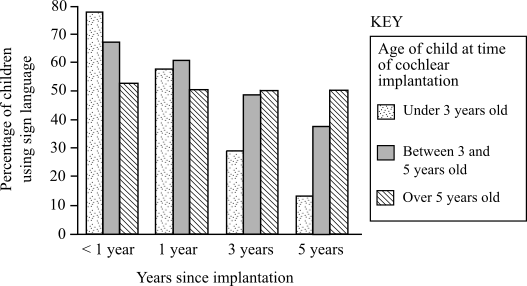
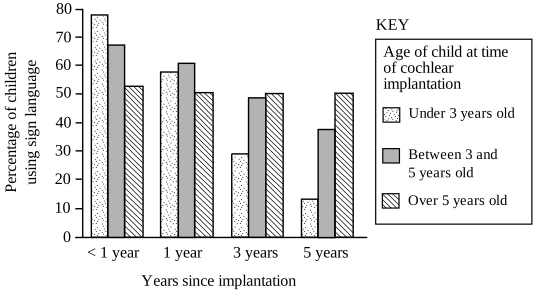
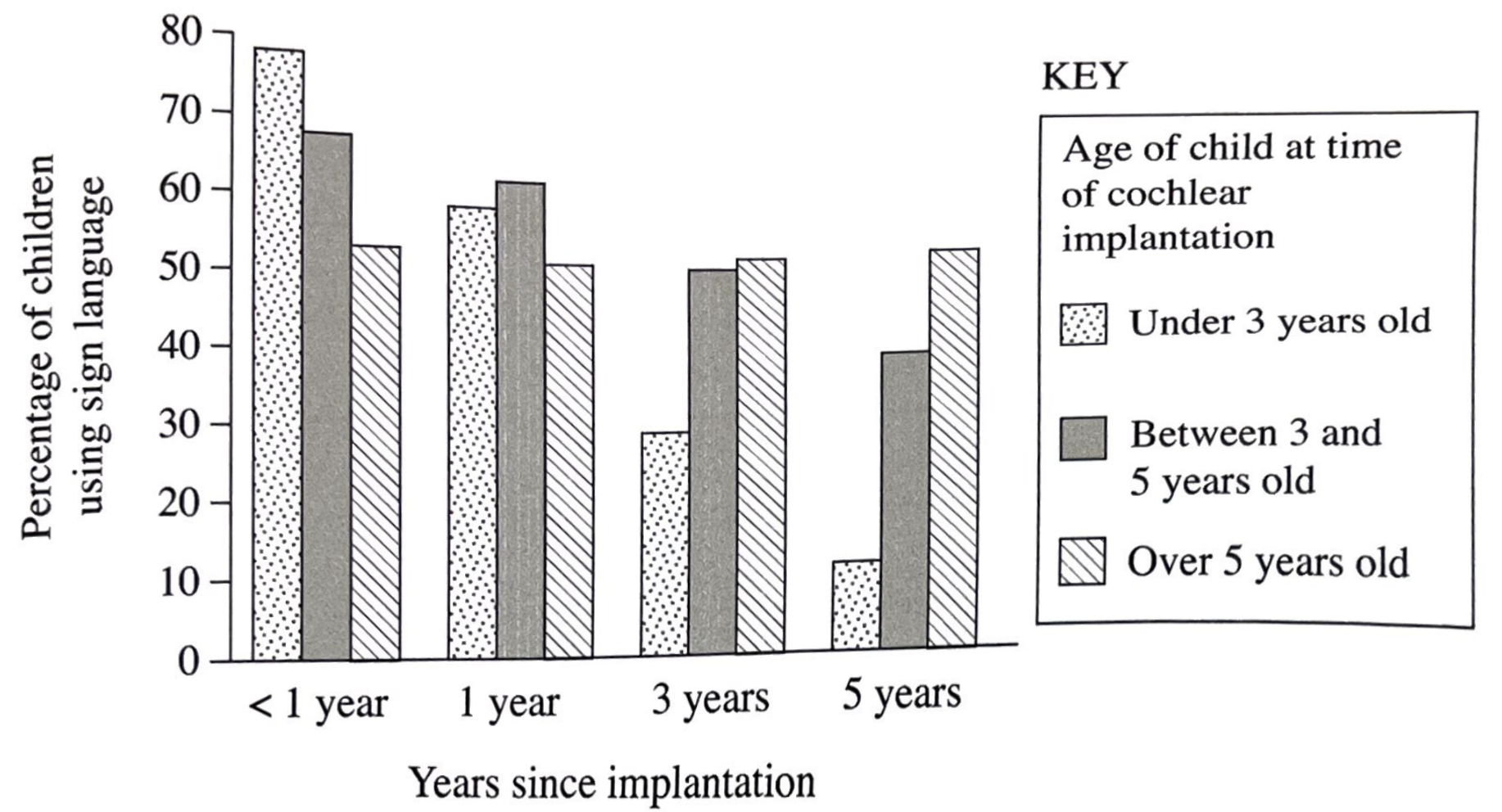
The graph shows the results of a survey conducted to determine if children changed their method of communication after cochlear implantation.
 

With reference to the data, describe how cochlear implants work, and how they affect communication in children.   (5 marks)

--- 15 WORK AREA LINES (style=lined) ---

Show Answers Only
  • Cochlear implants are surgical electronic devices that help restore hearing in patients with cochlear damage.
  • The implants are inserted directly into the cochlea and stimulate the auditory nerve by sending sound signals straight to the brain.
  • The graph demonstrates that the age of implantation significantly affects communication outcomes.
  • Early implantation (under 3 years): Dramatic decrease in sign language use, with only 10% (approximately) still signing after 5 years.
  • Middle age implantation (3-5 years): Moderate decrease in sign language use.
  • Late implantation (over 5 years): Little to no change in sign language use
  • The data clearly shows that earlier cochlear implantation leads to greater shifts away from sign language as the primary mode of communication.
Show Worked Solution
  • Cochlear implants are surgical electronic devices that help restore hearing in patients with cochlear damage.
  • The implants are inserted directly into the cochlea and stimulate the auditory nerve by sending sound signals straight to the brain.
  • The graph demonstrates that the age of implantation significantly affects communication outcomes.
  • Early implantation (under 3 years): Dramatic decrease in sign language use, with only 10% (approximately) still signing after 5 years.
  • Middle age implantation (3-5 years): Moderate decrease in sign language use.
  • Late implantation (over 5 years): Little to no change in sign language use
  • The data clearly shows that earlier cochlear implantation leads to greater shifts away from sign language as the primary mode of communication.
♦♦ Mean mark 52%.
Filed Under: Technologies and Disorders Tagged With: Band 5, Band 6, smc-3663-30-Ears

BIOLOGY, M7 2024 HSC 32

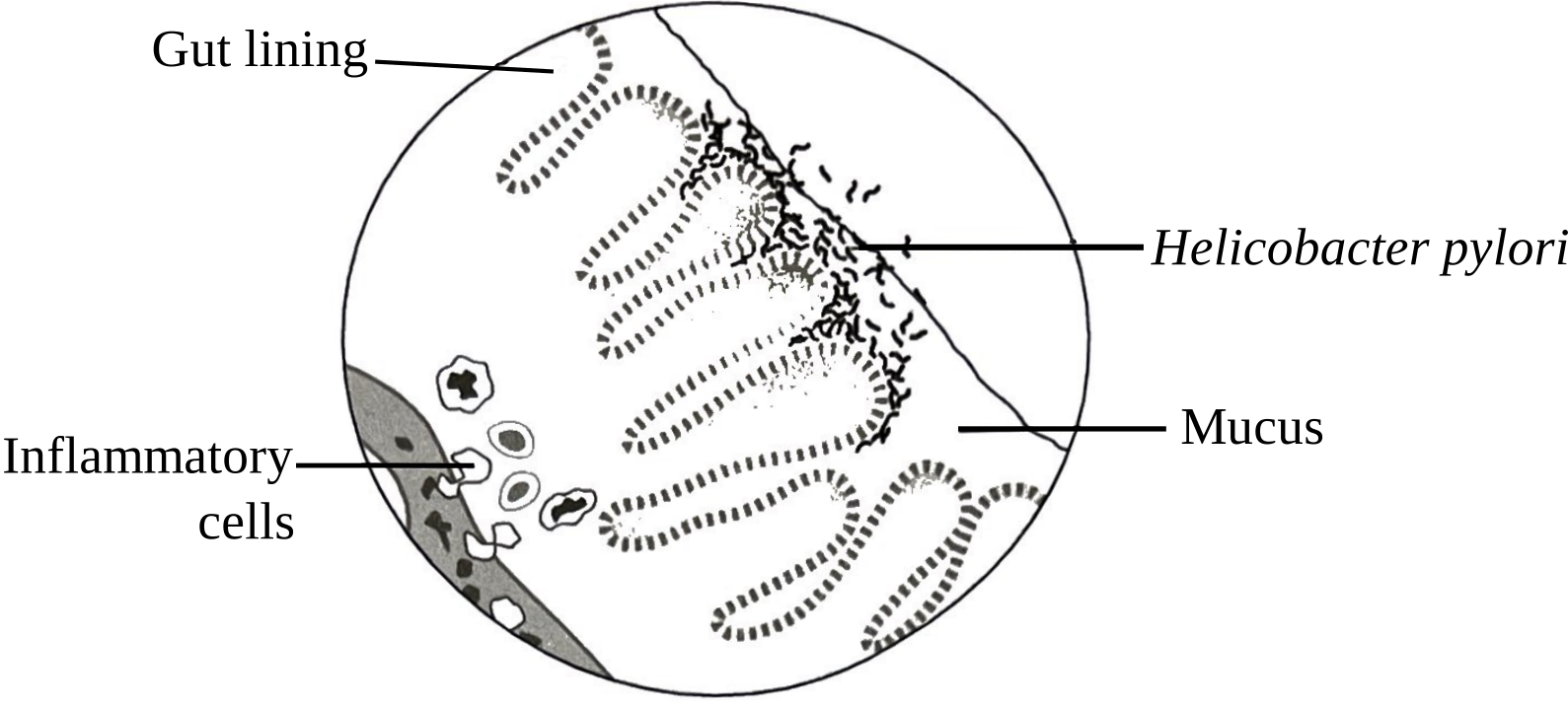
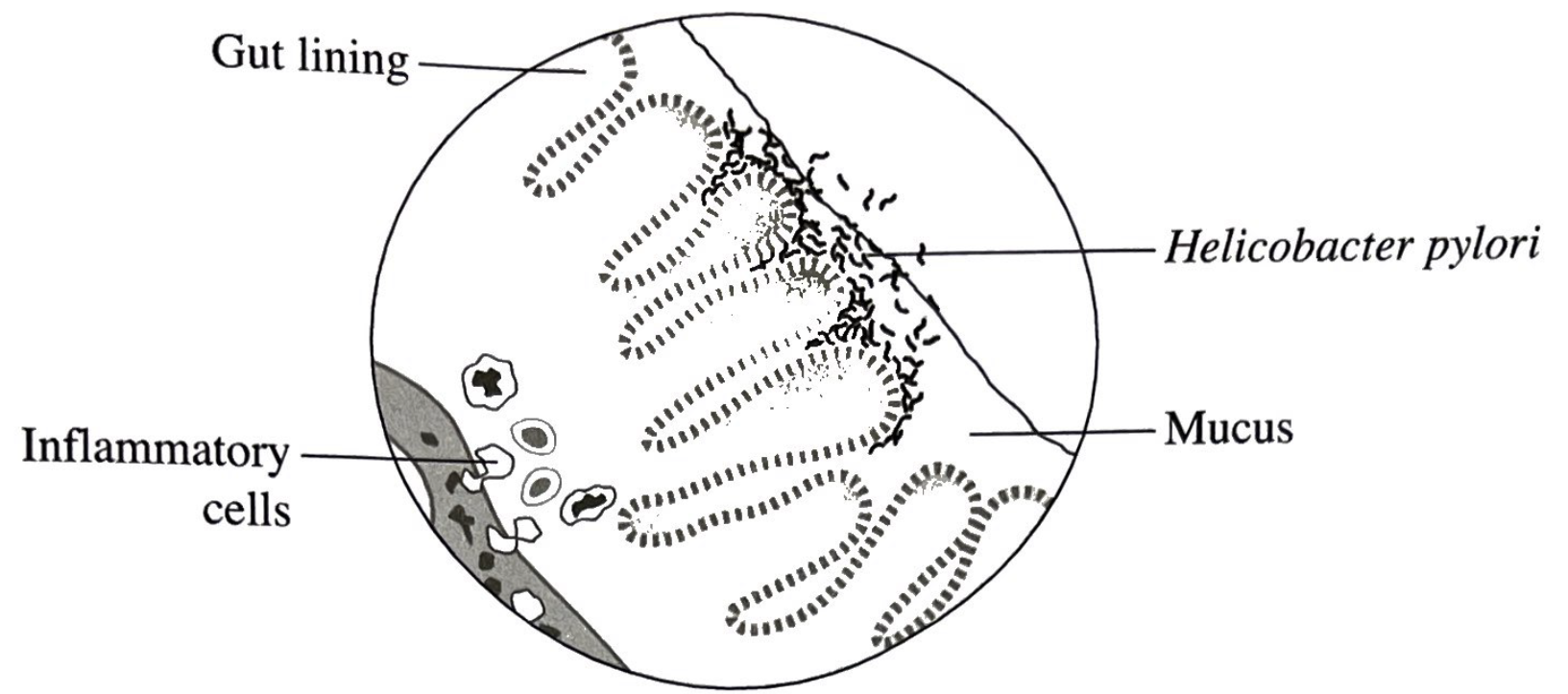
Helicobacter pylori is a bacterium that invades the gut lining and can cause damage to the stomach as shown in the diagram.
 

With reference to innate and adaptive immunity, explain how the body responds after exposure to Helicobacter pylori.   (7 marks)

--- 17 WORK AREA LINES (style=lined) ---

Show Answers Only
  • Damaged cells release chemicals that trigger inflammation as an initial response.
  • The inflammatory response causes blood vessels to dilate, increasing blood flow and allowing phagocytes (macrophages and neutrophils) to move into the infected area.
  • Phagocytes process H.pylori antigens and present them to helper T-cells, which launch the adaptive immune response by releasing cytokines.
  • This cytokine release activates both T and B cells to mount multiple specific defences.
  • Cytotoxic T-cells directly attack H.pylori while memory T-cells remain for secondary rapid responses.
  • Suppressor T-cells regulate the immune response and plasma B-cells produce H.pylori-specific antibodies. Memory B-cells persist for responding to future (secondary) infections.
  • Antibodies work in two ways – direct neutralisation of antigens and tagging antigens for destruction by phagocytes. 

The immune response involves both innate and adaptive immunity systems working together:

  • Innate immunity provides rapid, immediate defence.
  • Adaptive immunity develops more slowly but offers long-term protection through memory cells.
Show Worked Solution
  • Damaged cells release chemicals that trigger inflammation as an initial response.
  • The inflammatory response causes blood vessels to dilate, increasing blood flow and allowing phagocytes (macrophages and neutrophils) to move into the infected area.
  • Phagocytes process H.pylori antigens and present them to helper T-cells, which launch the adaptive immune response by releasing cytokines.
  • This cytokine release activates both T and B cells to mount multiple specific defences.
  • Cytotoxic T-cells directly attack H.pylori while memory T-cells remain for secondary rapid responses.
  • Suppressor T-cells regulate the immune response and plasma B-cells produce H.pylori-specific antibodies. Memory B-cells persist for responding to future (secondary) infections.
  • Antibodies work in two ways – direct neutralisation of antigens and tagging antigens for destruction by phagocytes. 

The immune response involves both innate and adaptive immunity systems working together:

  • Innate immunity provides rapid, immediate defence.
  • Adaptive immunity develops more slowly but offers long-term protection through memory cells.
♦♦ Mean mark 48%.

Filed Under: Immunity and Responses to Pathogens Tagged With: Band 5, Band 6, smc-3657-25-Antibodies, smc-3657-30-Innate Response (2nd Line)

CHEMISTRY, M5 2024 HSC 39

Water and octan-1-ol do not mix. When an aqueous solution of bromoacetic acid \(\left(\ce{BrCH2COOH}\right)\) is shaken with octan-1-ol, an equilibrium system is established between bromoacetic acid dissolved in the octan-1-ol and in the water.

\(\ce{BrCH2COOH(aq) \rightleftharpoons BrCH2COOH}\textit{(octan-l-ol)}\)

The equilibrium constant expression for this system is

\(K_{e q}=\dfrac{\left[\ce{BrCH2COOH}\textit{(octan-l-ol)}\right]}{\left[\ce{BrCH2COOH}\textit{(aq)}\right]}\).

An aqueous solution of bromoacetic acid with an initial concentration of 0.1000 mol L \(^{-1}\) is shaken with an equal volume of octan-1-ol. Bromoacetic acid does not dissociate in octan-1-ol but does dissociate in water, with \(K_a=1.29 \times 10^{-3}\). When the system has reached equilibrium, the \(\left[\ce{H+}\right]\) is \(9.18 \times 10^{-3} \text{ mol L}^{-1}\).

Calculate the equilibrium concentration of aqueous bromoacetic acid and hence, or otherwise, calculate the \(K_{eq}\) for the octan-1-ol and water system.   (4 marks)

--- 10 WORK AREA LINES (style=lined) ---

Show Answers Only

\(0.390\) 

Show Worked Solution

  • The ionisation of bromoacetic acid in water is:
  •    \(\ce{BrCH2COOH(aq) \rightleftharpoons BrCH2COO^-(aq) + H^+(aq)}\)
  • At equilibrium \(\ce{[BrCH2COO^-(aq)] = [H^+(aq)]} = 9.18 \times 10^{-3}\ \text{mol L}^{-1}\) as the are formed in a \(1:1\).
\(K_{a}\) \(=\dfrac{\ce{[H^+][BrCH2COO^-]}}{\ce{[BrCH2COOH]_{eq}}}\)  
\(\ce{[BrCH2COOH]_{eq}}\) \(=\dfrac{\ce{[H^+][BrCH2COO^-]}}{K_a}\)  
  \(=\dfrac{(9.18 \times 10^{-3})^2}{1.29 \times 10^{-3}}\)  
  \(=0.06533\ \text{mol L}^{-1}\)  


\(\ce{[BrCH2COOH]_{\text{total}}}=\ce{[BrCH2COOH(aq)]_{eq} + [BrCH2COO^-(aq)]}\)

\(\ce{+ [BrCH2COOH(octan-1-ol)]_{eq}}\)

\(\ce{[BrCH2COOH(octan-1-ol)]_{eq}}\) \(=0.1000-0.06533-9.18 \times 10^{-3}\)  
  \(=0.02549\ \text{mol L}^{-1}\)    
     
  • Since the volume of the aqueous solution of bromoacetic acid and octane is the same, the concentration values between the water and octane solutions can be added/subtracted in one equation and mole calculations are not required.
  •    \(K_{eq} = \dfrac{\ce{[BrCH2COOH(octan-1-ol)]_{eq}}}{\ce{[BrCH2COOH(aq)]_{eq}}}= \dfrac{0.02549}{0.06533}=0.390\ \text{(3 sig. fig.)}\)
♦♦ Mean mark 27%.
COMMENT: Students who identified the acid conc in the organic solvent often succeeded in this question.

Filed Under: Equilibrium Constant, Quantitative Analysis Tagged With: Band 5, Band 6, smc-3671-10-Find K(eq), smc-3675-30-Ka/Kb

Networks, GEN2 2024 VCAA 15

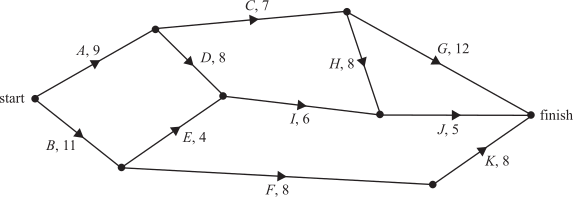
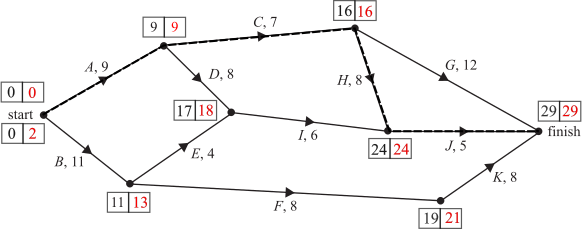
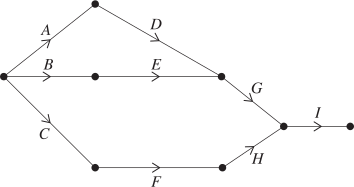
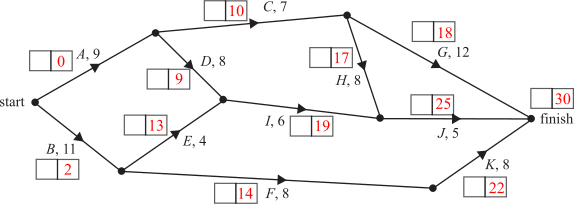
An upgrade to the supermarket requires the completion of 11 activities, \(A\) to \(K\).

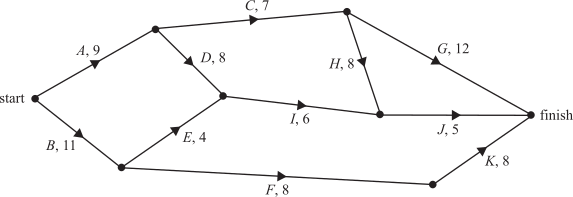
The directed network below shows these activities and their completion time, in weeks.

The minimum completion time for the project is 29 weeks.


  1. Write down the critical path.   (1 mark)

    --- 1 WORK AREA LINES (style=lined) ---

  2. Which activity can be delayed for the longest time without affecting the minimum completion time of the project?   (1 mark)

    --- 1 WORK AREA LINES (style=lined) ---

Use the following information to answer parts c-e.

A change is made to the order of activities.

The table below shows the activities and their new latest starting times in weeks.

\begin{array}{|c|c|}
\hline
\textbf{Activity} & \textbf{Latest Starting}\\
&\textbf{time} \text{(weeks)}\\
\hline A & 0 \\
\hline B & 2 \\
\hline C & 10 \\
\hline D & 9 \\
\hline E & 13 \\
\hline F & 14 \\
\hline G & 18 \\
\hline H & 17 \\
\hline I & 19 \\
\hline J & 25 \\
\hline K & 22 \\
\hline
\end{array}

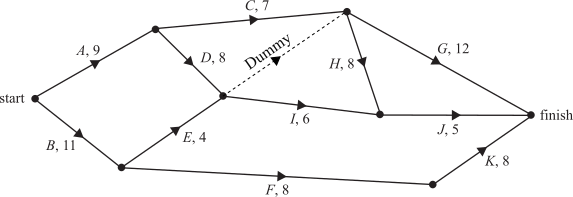
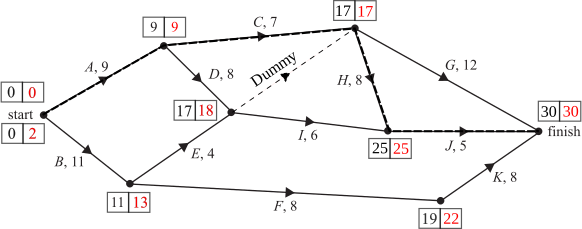
A dummy activity is now required in the network.

  1. On the directed network below, draw a directed edge to represent the dummy activity. Include a label.  (1 mark)

    --- 1 WORK AREA LINES (style=lined) ---


  1. What is the new minimum completion time of the project?  (1 mark)

    --- 1 WORK AREA LINES (style=lined) ---

  2. The owners of the supermarket want the project completed earlier.
  3. They will pay to reduce the time of some of the activities.
  4. A reduction in completion time of an activity will incur an additional cost of $10 000 per week.
  5. Activities can be reduced by a maximum of two weeks.
  6. The minimum number of weeks an activity can be reduced to is seven weeks.
  7. What is the minimum amount the owners of the supermarket will have to pay to reduce the completion time of the project as much as possible?   (1 mark)

    --- 1 WORK AREA LINES (style=lined) ---

Show Answers Only

a.    \(A, C, H, J\)

b.    \(\text{Activity E}\)

c.    

d.    \(\text{30 weeks}\)

e.    \($50\,000\)

Show Worked Solution

a.    \(\text{Critical path:  }A, C, H, J\)


b.    
\(\text{Activity with the largest float time can be delayed the longest.}\)

\(\text{Consider Activity E:}\)

\(\text{EST = 11, LST}= 18-4=14\rightarrow\ \text{Float time = 3 weeks}\)

\(\therefore\ \text{Activity E can be delayed the longest.}\)
 

♦♦ Mean mark (b) 34%.

c.    

♦♦♦ Mean mark (c) 10%.

d.    \(\text{New minimum completion time is 30 weeks.}\)
 

♦♦♦ Mean mark (d) 27%.

e.    \(\text{Activities that can be reduced:}\)

\(-A\ \text{can be reduced by 2 weeks}\)

\(-B, D\ \text{can each be reduced by 1 week each}\)

\(-H\ \text{can be reduced by 1 week}\)

\(\text{Total reduction = 5 weeks}\)

\(\Rightarrow \ \text{Minimum payment}=$50\,000\)

♦♦♦ Mean mark (e) 7%.

Filed Under: Critical Path Analysis Tagged With: Band 4, Band 5, Band 6, smc-621-20-Critical Paths/EST, smc-621-40-Crashing/Reduce completion time, smc-621-45-Adding activities, smc-621-50-Dummy activities

Networks, GEN2 2024 VCAA 14

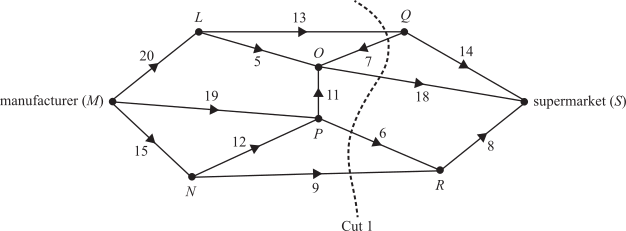
A manufacturer \((M)\) makes deliveries to the supermarket \((S)\) via a number of storage warehouses, \(L, N, O, P, Q\) and \(R\). These eight locations are represented as vertices in the network below.

The numbers on the edges represent the maximum number of deliveries that can be made between these locations each day.
 

  1. When considering the possible flow of deliveries through this network, many different cuts can be made.   
  2. Determine the capacity of Cut 1, shown above.   (1 mark)

    --- 1 WORK AREA LINES (style=lined) ---

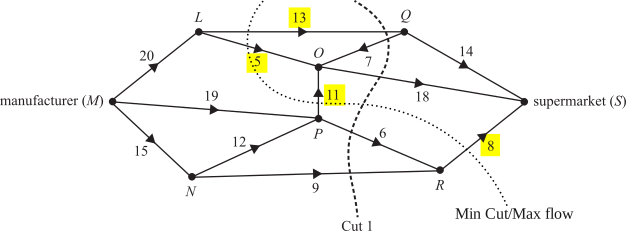
  3. Determine the maximum number of deliveries that can be made each day from the manufacturer to the supermarket.   (1 mark)

    --- 1 WORK AREA LINES (style=lined) ---

  4. The manufacturer wants to increase the number of deliveries to the supermarket.
  5. This can be achieved by increasing the number of deliveries between one pair of locations.
  6. Complete the following sentence by writing the locations on the lines provided:
  7. To maximise this increase, the number of deliveries should be increased between
    locations ____ and  ____.
       (1 mark)

    --- 0 WORK AREA LINES (style=lined) ---


Show Answers Only

a.    \(46\)

b.    \(37\)

c.    \(\text{R and S}\)

Show Worked Solution

a.    \(13+18+6+9=46\)

\(\text{(Reverse flow}\ Q → O\ \text{is not counted.)}\)
 

b.  

\(\text{Max deliveries (min cut)}\ =13+5+11+8=37\)

♦ Mean mark (b) 29%.

 
c.   
\(\text{The number of deliveries should be increased between}\)

\(\text{locations R and S.}\)

♦ Mean mark (c) 22%.

Filed Under: Flow Problems Tagged With: Band 3, Band 5, Band 6, smc-625-10-Cut Capacity, smc-625-20-Max Flow/Min Cut, smc-625-25-Network adjustments

Matrices, GEN2 2024 VCAA 12

When the construction company established the construction site at the beginning of 2023, it employed 390 staff to work on the site.

The staff comprised 330 construction workers \((C)\), 50 foremen \((F)\) and 10 managers \((M)\).

At the beginning of each year, staff can choose to stay in the same job, move to a different job on the site, or leave the site \((L)\) and not return.

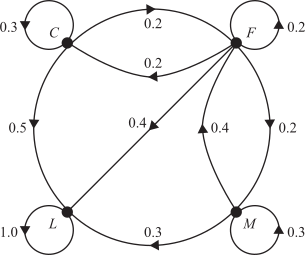
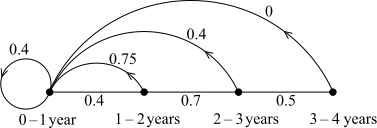
The transition diagram below shows the proportion of staff who are expected to change their job at the site each year.
 

This situation can be modelled by the recurrence relation

\(S_{n+1}=T S_n\), where

\(T\) is the transitional matrix, \(S_0=\left[\begin{array}{c}330 \\ 50 \\ 10 \\ 0\end{array}\right] \begin{aligned} & C \\ & F \\ & M \\ & L \end{aligned}\)  and \(n\) is the number of years after 2023.

  1. Calculate the predicted percentage decrease in the number of foremen \((F)\) on the site from 2023 to 2025.   (1 mark)

    --- 4 WORK AREA LINES (style=lined) ---

  2. Determine the total number of staff on the site in the long term.  (1 mark)

    --- 2 WORK AREA LINES (style=lined) ---

To encourage more construction workers \((C)\) to stay, the construction company has given workers an incentive to move into the job of foreman \((F)\).

Matrix \(R\) below shows the ways in which staff are expected to change their jobs from year to year with this new incentive in place.

\begin{aligned}
& \quad \quad \ \ \textit{this year} \\
& \quad  C \quad  \ \ F \quad  \ \  M \quad L\\
R = & \begin{bmatrix}
0.4 & 0.2 & 0 & 0 \\
0.4 & 0.2 & 0.4 & 0 \\
0 & 0.2 & 0.3 & 0 \\
0.2 & 0.4 & 0.3 & 1
\end{bmatrix}\begin{array}{l}
C\\
F\\
M\\
L
\end{array} \quad \textit{next year}
\end{aligned}

The site always requires at least 330 construction workers.

To ensure that this happens, the company hires an additional 190 construction workers \((C)\) at the beginning of 2024 and each year thereafter.

The matrix  \(V_{n+1}\)  will then be given by

\(V_{n+1}=R V_n+Z\), where

\(V_0=\left[\begin{array}{c}330 \\ 50 \\ 10 \\ 0\end{array}\right] \begin{aligned} & C \\ & F \\ & M \\ & L\end{aligned} \quad\quad\quad Z=\left[\begin{array}{c}190 \\ 0 \\ 0 \\ 0\end{array}\right] \begin{aligned} & C \\ & F \\ & M \\ & L\end{aligned} \ \ \) and \(n\) is the number of years after 2023.

  1. How many more staff are there on the site in 2024 than there were in 2023 ?    (1 mark)

    --- 4 WORK AREA LINES (style=lined) ---

  2. Based on this new model, the company has realised that in the long term there will be more than 200 foremen on site.
  3. In which year will the number of foremen first be above 200?   (1 mark)

    --- 4 WORK AREA LINES (style=lined) ---

Show Answers Only

a.    \(14\%\)

b.    \(\text{Zero}\)

c.    \(101\)

d.    \(2027\)

Show Worked Solution

a.    \(\text{Using CAS:}\)

\(\text{Transition matrix}(T):\ \begin{aligned}
& \quad \quad \quad \ \ \ \ \textit{from} \\
& \quad \ \ \ \  C \ \ \ \ \  F \ \ \ \ \ \  M \ \ \ \ \ \  L \ \ \\
\ \ \textit{to}\ \ \ & \begin{array}{l}
C \\
F \\
M \\
L
\end{array}\begin{bmatrix}
0.3 & 0.2 & 0 & 0 \\
0.2 & 0.2 & 0.4 & 0 \\
0 & 0.2 & 0.3 & 0 \\
0.5 & 0.4 & 0.3 & 1
\end{bmatrix}
\end{aligned}\)

♦♦♦ Mean mark (a) 25%.

\(S_{2023}=\begin{bmatrix}
330 \\
50 \\
10 \\
0 \\
\end{bmatrix}\ \ ,\ \  S_{2024}=T\times S_{2023}=\begin{bmatrix}
109 \\
80 \\
13 \\
188 \\
\end{bmatrix}\)

\( S_{2025}=T\times S_{2024}=\begin{bmatrix}
48.7 \\
43 \\
19.9 \\
278.4 \\
\end{bmatrix}\)

 
\(\text{% decrease in foremen}\ (F)=\dfrac{50-43}{50}\times 100\%=14\%\)
 

b.   \(\text{Test for 10 years:}\)

\(\text{Using CAS:}\)

\(S_{2024}=T^{10}\times S_{2023}=\begin{bmatrix}
0.490748 \\
0.734232 \\
0.488858 \\
388.286 \\
\end{bmatrix}\)

 
\(\text{In the long term, there will be zero employees on site.}\)
 

♦♦♦ Mean mark (b) 24%.

c.    \(\text{Using CAS:}\)

\(V_{2024}=R\times V_{2023}+Z=\begin{bmatrix}
332 \\
146 \\
13 \\
89 \\
\end{bmatrix}\)
  

\(\text{Difference in staff from}\ 2023-2024\)

\(=(332+146+13)-390\)

\(=101\ \text{more staff.}\)
 

\(\text{NOTE: 89 not included in calculation as these are the staff}\)

\(\text{who have left the company during the year.}\)
 

♦♦♦ Mean mark (c) 12%.

d.   \(\text{Using CAS:}\)

\(V_{2024}=R\times V_{2023}+Z=\begin{bmatrix}
332 \\
146 \\
13 \\
89 \\
\end{bmatrix}\ \ ,\ \  V_{2025}=R\times V_{2024}+Z=\begin{bmatrix}
352 \\
167.2 \\
33.1 \\
217.7 \\
\end{bmatrix}\ \\\)

♦♦♦ Mean mark (d) 26%.

\(V_{2026}=R\times V_{2025}+Z=\begin{bmatrix}
364.24\\
187.48 \\
43.37 \\
364.91 \\
\end{bmatrix}\ \ ,\ \  V_{2027}=R\times V_{2026}+Z=\begin{bmatrix}
373.192 \\
200.54 \\
50.507 \\
525.761 \\
\end{bmatrix}\ \\\)

 
\(\therefore\ \text{In 2027 the number of foremen will be over 200.}\)

Filed Under: Transition Matrices - Modified Tagged With: Band 5, Band 6, smc-1893-20-State Matrix in discrete period, smc-1893-32-4x4 Matrix, smc-1893-60-Regular Transition Matrices, smc-618-25-Interpret Diagram, smc-618-30-State Matrix in discrete period, smc-618-62-4x4 Matrix

Matrices, GEN2 2024 VCAA 11

A population of a native animal species lives near the construction site.

To ensure that the species is protected, information about the initial female population was collected at the beginning of 2023. The birth rates and the survival rates of the females in this population were also recorded.

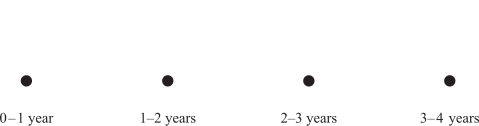
This species has a life span of 4 years and the information collected has been categorised into four age groups: 0-1 year, 1-2 years, 2-3 years, and 3-4 years.

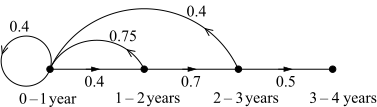
This information is displayed in the initial population matrix, \(R_0\), and the Leslie matrix, \(L\), below.

\(R_0=\left[\begin{array}{c}70 \\ 80 \\ 90 \\ 40\end{array}\right] \quad \quad L=\left[\begin{array}{cccc}0.4 & 0.75 & 0.4 & 0 \\ 0.4 & 0 & 0 & 0 \\ 0 & 0.7 & 0 & 0 \\ 0 & 0 & 0.5 & 0\end{array}\right]\)

  1. Using the information above
  2.  i. complete the following transition diagram.   (1 mark) 

    --- 0 WORK AREA LINES (style=lined) ---

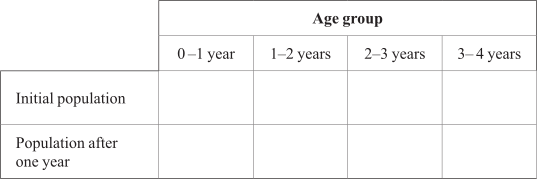
  1. ii. complete the following table, showing the initial female population, and the predicted female population after one year, for each of the age groups.  (1 mark)  

--- 0 WORK AREA LINES (style=lined) ---


  1. It is predicted that if this species is not protected, the female population of each of the four age groups will rapidly decrease within the next 10 years.
  2. After how many years is it predicted that the total female population of this species will first be half the initial female population?   (1 mark)

    --- 1 WORK AREA LINES (style=lined) ---

Show Answers Only

a.i. 

a.ii.

  \(\textbf{Age Group}\)
  \(\ 0-1\ \text{year}\ \) \(\ 1-2\ \text{years}\ \) \(\ 2-3\ \text{years}\ \) \(\ 3-4\ \text{years}\ \)
\(\ \text{Initial population}\ \) \(70\) \(80\) \(90\) \(40\)
\(\ \text{Population after}\ \)
\(\ \text{one year}\)
\(124\) \(28\) \(56\) \(45\)


b.    \(\text{5 years}\)

Show Worked Solution

a.i. 

♦♦♦ Mean mark (a) 24%.

a.ii.  \(\text{Population after 1 yr calculations}\)

\(0-1\ \text{year}\ =0.4\times 70+0.75\times 80+0.4\times 90=124\)

\(1-2\ \text{years}\ =0.4\times 70=28\)

\(2-3\ \text{years}\ =0.7\times 80=56\)

\(3-4\ \text{years}\ =0.5\times 90=45\)


  \(\textbf{Age Group}\)
  \(\ 0-1\ \text{year}\ \) \(\ 1-2\ \text{years}\ \) \(\ 2-3\ \text{years}\ \) \(\ 3-4\ \text{years}\ \)
\(\ \text{Initial population}\ \) \(70\) \(80\) \(90\) \(40\)
\(\ \text{Population after}\ \)
\(\ \text{one year}\)
\(124\) \(28\) \(56\) \(45\)


b.    \(\text{Using CAS:}\)

\(R_1=L\times R_0=\begin{bmatrix}
124  \\
28 \\
56  \\
45  \end{bmatrix}\ \ \text{Total = 253}\ ,\ \ R_2=L\times R_1=\begin{bmatrix}
93  \\
49.6 \\
19.6  \\
28  \end{bmatrix}\ \ \text{Total = 190.2}\)


\(R_3=L\times R_2=\begin{bmatrix}
82.24  \\
37.2 \\
34.72  \\
9.8  \end{bmatrix}\ \ \text{Total = 163.96}\ ,\ \ R_4=L\times R_3=\begin{bmatrix}
74.684  \\
32.896 \\
26.04  \\
17.36  \end{bmatrix}\ \ \text{Total =150.98}\)


\(R_5=L\times R_4=\begin{bmatrix}
64.9616 \\
29.8736 \\
23.0272 \\
13.02 \end{bmatrix}\ \ \text{Total = 130.8824}\)

 
\(\therefore\ \text{Total female population less than 140 after 5 years}\)

♦ Mean mark (b) 39%.

Filed Under: Transition Matrices - Regular Tagged With: Band 4, Band 5, Band 6, smc-618-20-Matrix to Diagram, smc-618-24-Interpret Matrix, smc-618-55-Leslie matrix

Vectors, EXT2 V1 2024 HSC 15a

Consider the three vectors  \(\underset{\sim}{a}=\overrightarrow{O A}, \underset{\sim}{b}=\overrightarrow{O B}\)  and  \(\underset{\sim}{c}=\overrightarrow{O C}\), where \(O\) is the origin and the points \(A, B\) and \(C\) are all different from each other and the origin.

The point \(M\) is the point such that  \(\dfrac{1}{2}(\underset{\sim}{a}+\underset{\sim}{b})=\overrightarrow{O M}\).

  1. Show that \(M\) lies on the line passing through \(A\) and \(B\).   (1 mark)

    --- 2 WORK AREA LINES (style=lined) ---

  2. The point \(G\) is the point such that  \(\dfrac{1}{3}(\underset{\sim}{a}+\underset{\sim}{b}+\underset{\sim}{c})=\overrightarrow{O G}\).
  3. Show that \(G\) lies on the line passing through \(M\) and \(C\), and lies between \(M\) and \(C\).   (2 marks)

    --- 5 WORK AREA LINES (style=lined) ---

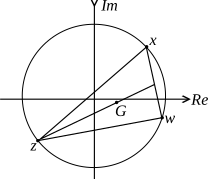
  4. The complex numbers \(x, w\) and \(z\) are all different and all have modulus 1.
  5. Using part (ii), or otherwise, show that  \(\dfrac{1}{3}(x+w+z)\) is never a cube root of \(x w z\).   (2 marks)

    --- 5 WORK AREA LINES (style=lined) ---

Show Answers Only

i.    \(\text{Equation of line through \(A\) and \(B\)}\)

\(\Rightarrow \ell_1=\overrightarrow{O A}+\lambda \overrightarrow{A B}\)

  \(\overrightarrow{O M}\) \(=\dfrac{1}{2} \underset{\sim}{a}+\dfrac{1}{2} \underset{\sim}{b}\)
    \(=\underset{\sim}{a}-\dfrac{1}{2} \underset{\sim}{a}+\dfrac{1}{2} \underset{\sim}{b}\)
    \(=\overrightarrow{O A}+\dfrac{1}{2}(\underset{\sim}{b}-\underset{\sim}{a})\)
    \(=\overrightarrow{O A}+\dfrac{1}{2} \overrightarrow{A B}\)

 
\(\therefore \overrightarrow{OM} \ \text{lies on} \ \ell_1\).
 

ii.    \(\text{Equation of line through \(M\) and \(C\)}\)

\(\Rightarrow \ell_2=\overrightarrow{OC}+\lambda \overrightarrow{CM}\)

  \(\overrightarrow{O G}\) \(=\dfrac{1}{3}(\underset{\sim}{a}+\underset{\sim}{b}+\underset{\sim}{c})\)
    \(=\underset{\sim}{c}-\dfrac{2}{3} \underset{\sim}{c}+\dfrac{1}{3} \underset{\sim}{a}+\dfrac{1}{3} \underset{\sim}{b}\)
    \(=\overrightarrow{OC}+\dfrac{2}{3}\left(\dfrac{1}{2} \underset{\sim}{a}+\dfrac{1}{2} \underset{\sim}{b}-\underset{\sim}{c}\right)\)
    \(=\overrightarrow{OC}+\dfrac{2}{3} \overrightarrow{CM}\)

 
\(\therefore \overrightarrow{O G} \ \ \text{lies on} \ \ \ell_2\)

\(\ \ \overrightarrow{O G} \neq \overrightarrow{O C}  \ \ \text{and} \ \ \overrightarrow{O G} \neq \overrightarrow{O M}\)

\(\therefore G \ \ \text{lies between} \ \ C \ \text{and} \ M\).
 

iii.  \(\text{Place}\ x, w,\ \text{and}\ z\ \text{on unit circle.}\)
 

\(\abs{w}=\abs{x}=\abs{z}=1\)

\(\text{Using part (ii):}\)

\(G \equiv \dfrac{1}{3}(x+w+z)\)

\(G \ \text{lies on} \ CM \Rightarrow G \ \text{is inside the unit circle.}\)

\(\Rightarrow\left|\dfrac{1}{3}(x+w+z)\right|<1\)

\(\text{Since}\ \ \abs{xwz}=\abs{x}\abs{w}\abs{z}=1\)

\(\Rightarrow \ \text{All cube roots have modulus = 1.}\)

\(\therefore \dfrac{1}{3}(x+w+z) \ \ \text{cannot be a cube root of  \(xwz\).}\)

Show Worked Solution

i.    \(\text{Equation of line through \(A\) and \(B\)}\)

\(\Rightarrow \ell_1=\overrightarrow{O A}+\lambda \overrightarrow{A B}\)

  \(\overrightarrow{O M}\) \(=\dfrac{1}{2} \underset{\sim}{a}+\dfrac{1}{2} \underset{\sim}{b}\)
    \(=\underset{\sim}{a}-\dfrac{1}{2} \underset{\sim}{a}+\dfrac{1}{2} \underset{\sim}{b}\)
    \(=\overrightarrow{O A}+\dfrac{1}{2}(\underset{\sim}{b}-\underset{\sim}{a})\)
    \(=\overrightarrow{O A}+\dfrac{1}{2} \overrightarrow{A B}\)

 
\(\therefore \overrightarrow{OM} \ \text{lies on} \ \ell_1\).
 

ii.    \(\text{Equation of line through \(M\) and \(C\)}\)

\(\Rightarrow \ell_2=\overrightarrow{OC}+\lambda \overrightarrow{CM}\)

  \(\overrightarrow{O G}\) \(=\dfrac{1}{3}(\underset{\sim}{a}+\underset{\sim}{b}+\underset{\sim}{c})\)
    \(=\underset{\sim}{c}-\dfrac{2}{3} \underset{\sim}{c}+\dfrac{1}{3} \underset{\sim}{a}+\dfrac{1}{3} \underset{\sim}{b}\)
    \(=\overrightarrow{OC}+\dfrac{2}{3}\left(\dfrac{1}{2} \underset{\sim}{a}+\dfrac{1}{2} \underset{\sim}{b}-\underset{\sim}{c}\right)\)
    \(=\overrightarrow{OC}+\dfrac{2}{3} \overrightarrow{CM}\)

 
\(\therefore \overrightarrow{O G} \ \ \text{lies on} \ \ \ell_2\)

\(\ \ \overrightarrow{O G} \neq \overrightarrow{O C}  \ \ \text{and} \ \ \overrightarrow{O G} \neq \overrightarrow{O M}\)

\(\therefore G \ \ \text{lies between} \ \ C \ \text{and} \ M\).

♦ Mean mark (ii) 43%.

iii.  \(\text{Place}\ x, w,\ \text{and}\ z\ \text{on unit circle.}\)
 

♦♦♦ Mean mark (iii) 10%.

\(\abs{w}=\abs{x}=\abs{z}=1\)

\(\text{Using part (ii):}\)

\(G \equiv \dfrac{1}{3}(x+w+z)\)

\(G \ \text{lies on} \ CM \Rightarrow G \ \text{is inside the unit circle.}\)

\(\Rightarrow\left|\dfrac{1}{3}(x+w+z)\right|<1\)

\(\text{Since}\ \ \abs{xwz}=\abs{x}\abs{w}\abs{z}=1\)

\(\Rightarrow \ \text{All cube roots have modulus = 1.}\)

\(\therefore \dfrac{1}{3}(x+w+z) \ \ \text{cannot be a cube root of  \(xwz\).}\)

Filed Under: Equations of Lines and Curves, Vectors and Vector Equations of Lines Tagged With: Band 4, Band 5, Band 6, smc-1196-25-Point lies on line, smc-1196-70-2D vectors, smc-1196-85-Complex Numbers, smc-7425-25-Point lies on line, smc-7425-70-2D vectors, smc-7425-85-X-topic

Data Analysis, GEN2 2024 VCAA 2

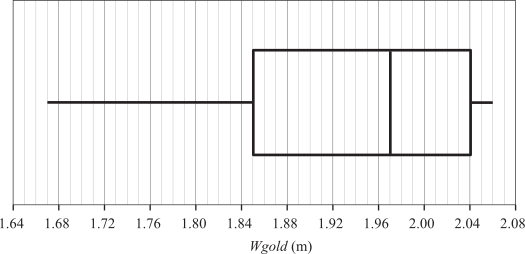
The boxplot below displays the distribution of all gold medal-winning heights for the women's high jump, \(\textit{Wgold}\), in metres, for the 19 Olympic Games held from 1948 to 2020.

  1. Describe the shape of this data distribution.   (1 mark)

    --- 2 WORK AREA LINES (style=lined) ---

  2. For this boxplot, what is the smallest possible number of \(\textit{Wgold}\) heights lower than 1.85 m?   (1 mark)

    --- 1 WORK AREA LINES (style=lined) ---

  3.  i. Using the boxplot, show that the lower fence is 1.565 m and the upper fence is 2.325 m.  (1 mark)

    --- 3 WORK AREA LINES (style=lined) ---

  4. ii. Referring to the boxplot, the lower fence and the upper fence, explain why no outliers exist.  (1 mark)

    --- 2 WORK AREA LINES (style=lined) ---

Show Answers Only

a.    \(\text{Negatively skewed}\)

b.    \(1\)

c.i.  \(Q_1=1.85,\ Q_3=2.04,\ IQR=2.04-1.85=0.19\)

\(\text{Lower Fence}\) \(=Q_1-1.5\times IQR\)
  \(=1.85-1.5\times 0.19\)
  \(=1.565\)
\(\text{Upper Fence}\) \(=Q_1+1.5\times IQR\)
  \(=2.04+1.5\times 0.19\)
  \(=2.325\)

c.ii. \(\text{No values exist below the lower fence or above the upper fence.}\)

\(\therefore\ \text{No outliers exist.}\)

Show Worked Solution

a.    \(\text{Negatively skewed.}\)
 

b.    \(\text{Only 1 value is needed to extend the whisker below the}\)

\(\text{range of the}\ IQR.\)

♦♦♦ Mean mark (b) 3%.

c.i.  \(Q_1=1.85,\ Q_3=2.04,\ IQR=2.04-1.85=0.19\)

\(\text{Lower Fence}\) \(=Q_1-1.5\times IQR\)
  \(=1.85-1.5\times 0.19\)
  \(=1.565\)
\(\text{Upper Fence}\) \(=Q_1+1.5\times IQR\)
  \(=2.04+1.5\times 0.19\)
  \(=2.325\)


c.ii. \(\text{No values exist below the lower fence or above the upper fence.}\)

\(\therefore\ \text{No outliers exist.}\)

Filed Under: Graphs - Stem/Leaf and Boxplots Tagged With: Band 3, Band 6, smc-643-10-Single Box-Plots, smc-643-60-Outliers, smc-643-70-Distribution Description

Networks, GEN1 2024 VCAA 39 MC

Anush, Blake, Carly and Dexter are workers on a construction site. They are each allocated one task.

The time, in hours, it takes for each worker to complete each task is shown in the table below.

\begin{array}{|c|c|c|c|c|}
\hline
\rule{0pt}{2.5ex} \rule[-1ex]{0pt}{0pt}& \textbf{Task 1} & \textbf{Task 2} & \textbf{Task 3} & \textbf{Task 4} \\
\hline
\rule{0pt}{2.5ex} \textbf{Anush} \rule[-1ex]{0pt}{0pt}& 12 & 8 & 16 & 9 \\
\hline
\rule{0pt}{2.5ex} \textbf{Blake} \rule[-1ex]{0pt}{0pt}& 10 & 7 & 15 & 10 \\
\hline
\rule{0pt}{2.5ex} \textbf{Carly} \rule[-1ex]{0pt}{0pt}& 11 & 10 & 18 & 12 \\
\hline
\rule{0pt}{2.5ex} \textbf{Dexter} \rule[-1ex]{0pt}{0pt}& 10 & 14 & 16 & 11 \\
\hline
\end{array}

The tasks must be completed sequentially and in numerical order: Task 1, Task 2, Task 3 and then Task 4.

Management makes an initial allocation of tasks to minimise the amount of time required, but then decides that it takes the workers too long.

Another worker, Edgar, is brought in to complete one of the tasks.

His completion times, in hours, are listed below.

\begin{array}{|c|c|c|c|c|}
\hline
\rule{0pt}{2.5ex} \rule[-1ex]{0pt}{0pt}& \textbf{Task 1} & \textbf{Task 2} & \textbf{Task 3} & \textbf{Task 4} \\
\hline
\rule{0pt}{2.5ex} \textbf{Edgar} \rule[-1ex]{0pt}{0pt}& 9 & 5 & 14 & 8 \\
\hline
\end{array}

When a new allocation is made and Edgar takes over one of the tasks, the minimum total completion time compared to the initial allocation will be reduced by

  1. 1 hour.
  2. 2 hours.
  3. 3 hours.
  4. 4 hours.
Show Answers Only

\(D\)

Show Worked Solution

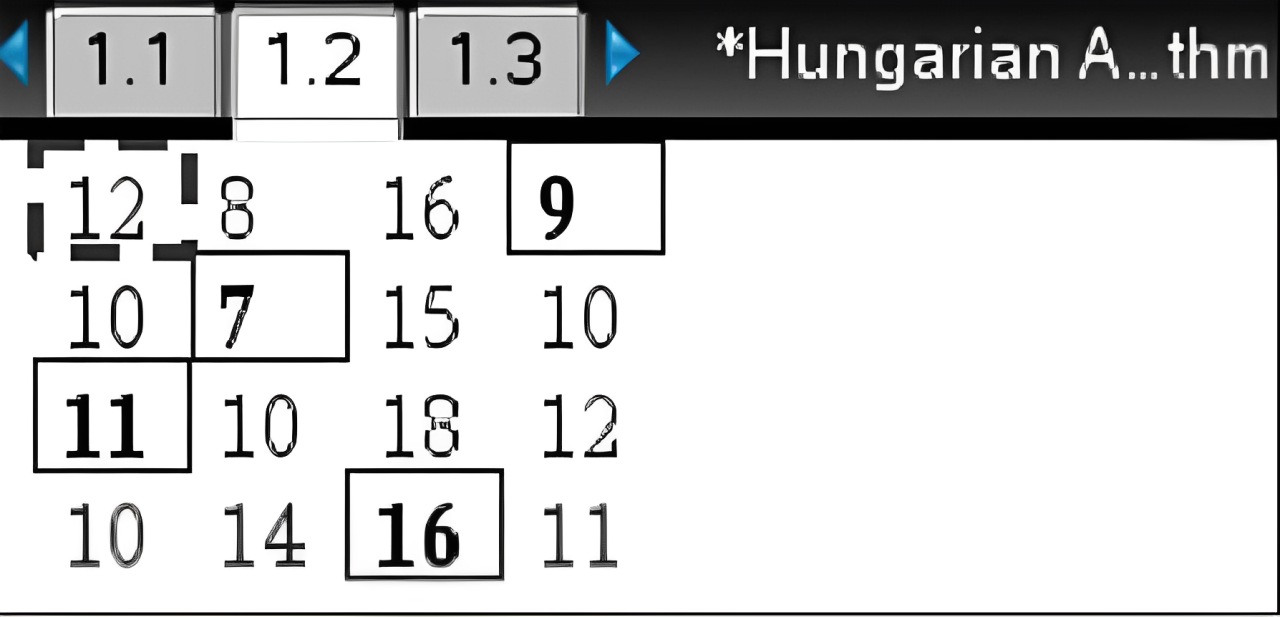
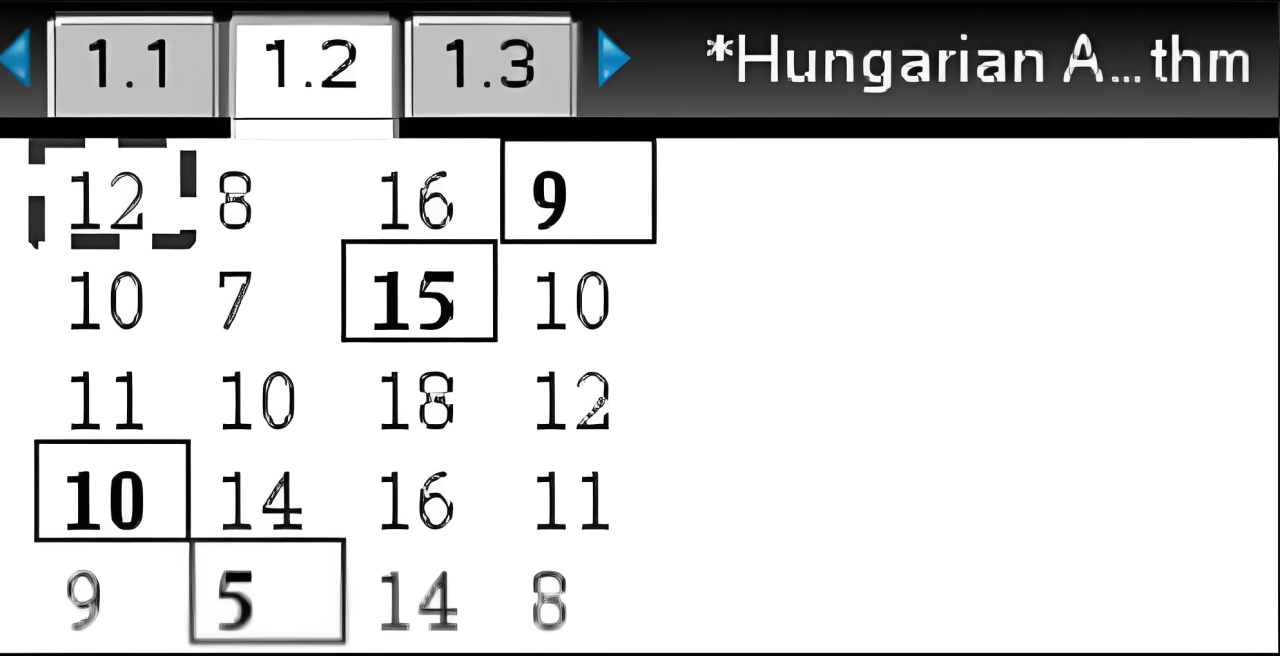
\(\text{Using Hungarian Algorithm on CAS:}\)

\(\text{Original Allocation}\)


\(\text{Minimal Sum}\ =9+7+11+16=43\)

\(\text{Task Allocation: Anush – T4, Blake – T2, Carly – T1, Dexter – T3}\)

♦♦♦ Mean mark 19%.

\(\text{Allocation with Edgar included}\)

\(\text{Minimal Sum}\ =9+15+10+5=39\)

\(\text{Task Allocation: Anush – T4, Blake – T3, Carly – None, Dexter – T1, Edgar – T2}\)

\(\therefore\ \text{Minimum completion time reduces from 43 to 39 hours i.e. by 4 hours.}\)

\(\Rightarrow D\) 

Filed Under: Matching Problems Tagged With: Band 6, smc-623-10-Hungarian Algorithm

Networks, GEN1 2024 VCAA 38 MC

A connected graph has six vertices and six edges.

How many of the following four statements must always be true?

  • the graph has no vertices of odd degree
  • the graph contains a Eulerian trail
  • the graph contains a Hamiltonian path
  • the sum of the degrees of the vertices is 12
  1. 1
  2. 2
  3. 3
  4. 4
Show Answers Only

\(A\)

Show Worked Solution

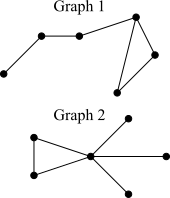
\(\text{Solve by drawing simple hypothetical example(s):}\)
 

♦♦♦ Mean mark 18%.

\(\text{Considering each option}\)

\(\text{1.  Both Graph 1 & 2 above have vertices of odd degree }\rightarrow\ \text{Incorrect} \)

\(\text{2.  Graph 2 has 4 vertices of odd degree which means no Eulerian Trail}\rightarrow\ \text{Incorrect} \)

\(\text{3.  Path cannot be completed in Graph 2 without repeating a vertex}\)

\(\ \ \ \ \ \text{No Hamiltonian Path}\rightarrow\ \text{Incorrect} \)

\(\text{4. The sum of the degrees of the vertices is always 12}\ \rightarrow\  \text{Correct in both examples}\)

\(\text{Given the available options, only 1 statement can always be true.}\)

\(\Rightarrow A\)

Filed Under: Basic Concepts Tagged With: Band 6, smc-626-10-Definitions

Matrices, GEN1 2024 VCAA 32 MC

A large sporting event is held over a period of four consecutive days: Thursday, Friday, Saturday and Sunday.

People can watch the event at four different sites throughout the city: Botanical Gardens \((G)\), City Square \((C)\), Riverbank \((R)\) or Main Beach \((M)\).

Let \(S_n\) be the state matrix that shows the number of people at each location \(n\) days after Thursday.

The expected number of people at each location can be determined by the matrix recurrence rule

\(S_{n+1}=TS_n+A\)

\begin{aligned}
& \quad \quad \quad \quad \quad \quad \quad \quad \quad \textit{this day} \\
& \quad \quad \quad \quad \quad \quad \quad \ G \quad \ \  C \quad \ \ R \quad \ \  M \\
& \text{where} \quad T=\begin{bmatrix}
0.4 & 0.2 & 0.4 & 0 \\
0.4 & 0.1 & 0.3 & 0.3 \\
0.1 & 0.4 & 0.1 & 0.2 \\
0.1 & 0.3 & 0.2 & 0.5
\end{bmatrix}\begin{array}{l}
G \\
C \\
R \\
M
\end{array} \text { next day } \quad \text{and}& A=\begin{bmatrix}
300 \\
200\\
100 \\
300
\end{bmatrix}\begin{array}{l}
G \\
C \\
R \\
M
\end{array}
\end{aligned}


\begin{aligned} \text{Given the state matrix}& \quad \quad S_3=\begin{bmatrix}
5620\\
6386\\
4892\\
6902
\end{bmatrix}\begin{array}{l}
G \\
C \\
R \\
M
\end{array}
\end{aligned}

the number of people watching the event at the Botanical Gardens \((G)\) from Thursday to Sunday has

  1. decreased by 162
  2. decreased by 212
  3. increased by 124
  4. increased by 696
Show Answers Only

\(D\)

Show Worked Solution
\(S_{n+1}\) \(=TS_n+A\)
\(TS_n\) \(=S_{n+1}-A\)
\(S_n\)  \(=T^{-1}\times \left(S_{n+1}-A\right)\)
♦♦♦ Mean mark 33%.

  
\(\text{Using CAS:}\)
  
\(T =\begin{bmatrix}
\ 0.4 & 0.2 & 0.4 & 0 \\
\ 0.4 & 0.1 & 0.3 & 0.3 \\
\ 0.1 & 0.4 & 0.1 & 0.2 \\
\ 0.1 & 0.3 & 0.2 & 0.5 
\end{bmatrix}\ \rightarrow \ \ T^{-1}=
 \begin{bmatrix}
\ -2.6 & 5.4 & 3.4 & -4.6 \\
\ 0.2 & -0.8 & 3.2 & -0.8 \\
\ 5 & -5 & -5 & 5 \\
\ -1.6 & 1.4 & -0.6 & 1.4   
\end{bmatrix}\)


\(\text{Sunday} =S_3=\begin{bmatrix}
\ 5620 \\
\ 6386 \\
\ 4892  \\
\ 6902
\end{bmatrix} \)

\(\text{Saturday} =S_2=T^{-1}\times \left(S_{3}-A\right)=\begin{bmatrix}
\ 5496 \\
\ 6168 \\
\ 4720  \\
\ 6516
\end{bmatrix} \)

\(\text{Friday} =S_1=T^{-1}\times \left(S_{2}-A\right)=\begin{bmatrix}
\ 5832 \\
\ 6076 \\
\ 4120  \\
\ 5972
\end{bmatrix} \)

\(\text{Thursday} =S_0=T^{-1}\times \left(S_{1}-A\right)=\begin{bmatrix}
\ 4924 \\
\ 4732 \\
\ 6540  \\
\ 4904
\end{bmatrix} \)

  
\(5620-4924=696\)

\(\therefore\ \text{Botanical Gardens attendance has increased by 696 people.}\)

\(\Rightarrow D\)

Filed Under: Transition Matrices - Modified Tagged With: Band 6, smc-1893-20-State Matrix in discrete period, smc-1893-25-Inverse Matrix

Mechanics, EXT2 M1 2024 HSC 16c

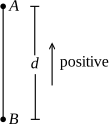
Two particles, \(A\) and \(B\), each have mass 1 kg and are in a medium that exerts a resistance to motion equal to \(k v\), where  \(k>0\)  and \(v\) is the velocity of any particle. Both particles maintain vertical trajectories.

The acceleration due to gravity is \(g\) ms\(^{-2}\), where  \(g>0\).

The two particles are simultaneously projected towards each other with the same speed, \(v_0\) ms\(^{-1}\), where  \(0<v_0<\dfrac{g}{k}\).

The particle \(A\) is initially \(d\) metres directly above particle \(B\), where  \(d<\dfrac{2 v_0}{k}\).

Find the time taken for the particles to meet.   (4 marks)

--- 16 WORK AREA LINES (style=lined) ---

Show Answers Only

\(t=-\dfrac{1}{k} \ln \left(\dfrac{2v_0-dk}{v_0}\right)\)

Show Worked Solution

\(\text{Particle A:}\)

\(\ddot{x}=\dfrac{dv_{\small{A}}}{dt}=-g-k v_{\small{A}}\)

\(\dfrac{dt}{dv_{\small{A}}}=\dfrac{1}{-g-kv_{\small{A}}}\)

\(t=-\displaystyle \int \dfrac{1}{g+k v_{\small{A}}} \, dv_{\small{A}}=-\dfrac{1}{k} \ln \left(g+k v_A\right)+c\)

\(\text{At} \ \ t=0, \ v_{\small{A}}=-v_0 \ \Rightarrow \ c=\dfrac{1}{k} \ln \left(g-k v_0\right)\)

\(t=\dfrac{1}{k} \ln \left(g-k v_0\right)-\dfrac{1}{k} \ln \left(g+kv_{\small{A}}\right)=\dfrac{1}{k} \ln \left(\dfrac{g-kv_0}{g+kv_{\small{A}}}\right)\)

♦♦♦ Mean mark 28%.

\(\text{Find} \ v_{\small{A}}:\)

  \(\dfrac{g-k v_0}{g+k v_{\small{A}}}\) \(=e^{kt}\)
  \(g-kv_0\) \(=e^{kt} \cdot g+e^{kt} \cdot kv_{\small{A}}\)
  \(kv_{\small{A}}\) \(=e^{-kt}\left(g-kv_0\right)-g\)
  \(v_{\small{A}}\) \(=\dfrac{1}{k}\left[e^{-kt}\left(g-kv_0\right)-g\right]\)

  \(x\) \(=\displaystyle \frac{1}{k} \int e^{-kt} \cdot g-e^{-kt} \cdot v_0-g \, dt\)
    \(=\dfrac{1}{k}\left[-\dfrac{g}{k}e^{-kt}+v_0 e^{-kt}-gt\right]+c\)
    \(=-\left(\dfrac{g}{k^2}-\dfrac{v_0}{k}\right) e^{-kt}-gt+c\)

 
\(\text{When} \ \ t=0, x=0 \ \Rightarrow \ c=\dfrac{g}{k^2}-\dfrac{v_0}{k}\)

\(x_{\small{A}}=d-\left(\dfrac{g}{k^2}-\dfrac{v_0}{k}\right) e^{-kt}-gt+\dfrac{g}{k^2}-\dfrac{v_0}{k}\)
 

\(\text{Particle B:}\)

\(\ddot{x}=-g-k v_{\small{B}}\)

\(t=-\dfrac{1}{k} \ln \left(g+k v_{\small{B}}\right)+c\)
 

\(\text{When} \ \ t=0, v_B=v_0 \ \Rightarrow \ c=\dfrac{1}{k} \ln \left(g+kv_0\right)\)

  \(v_{\small{B}}\) \(=\dfrac{1}{k}\left[e^{-kt}\left(g+kv_0\right)-g\right]\)
  \(x_{\small{B}}\) \(=-\left(\dfrac{g}{k^2}+\dfrac{v_0}{k}\right) e^{-kt}-gt+c\)


\(\text{When} \ \ t=0, x=0 \ \Rightarrow \ c=\dfrac{g}{k^2}+\dfrac{v_0}{k}\)

\(x_{\small{B}}=-\left(\dfrac{g}{k^2}+\dfrac{v_0}{k}\right) e^{-kt}-gt+\dfrac{g}{k^2}+\dfrac{v_0}{k}\)
 

\(\text{Find  \(t\)  when \(\ x_{\small{A}}=x_{\small{B}}\):}\)

\(d-\left(\dfrac{g}{k^2}-\dfrac{v_0}{k}\right) e^{-k t}-g t+\dfrac{g}{k^2}-\dfrac{v_0}{k}=-\left(\dfrac{g}{k^2}+\dfrac{v_0}{k}\right) e^{-k t}-g t+\dfrac{g}{k^2}+\dfrac{v_0}{k}\)

  \(\dfrac{2 v_0}{k} \cdot e^{-k t}\) \(=\dfrac{2 v_0}{k}-d\)
  \(e^{-kt}\) \(=\left(\dfrac{2 v_0-d k}{k}\right) \cdot \dfrac{k}{v_0}\)
  \(-kt\) \(=\ln \left(\dfrac{2 v_0-d k}{v_0}\right)\)
  \(t\) \(=-\dfrac{1}{k} \ln \left(\dfrac{2v_0-dk}{v_0}\right)\)

Filed Under: Resisted Motion, Vertical Resisted Motion Tagged With: Band 6, smc-1061-07-Resistive medium, smc-1061-10-R ~ v, smc-7441-30-\(\large R \propto v\)

Vectors, EXT2 V1 2024 HSC 10 MC

Three unit vectors \(\underset{\sim}{a}, \underset{\sim}{b}\) and \(\underset{\sim}{c}\), in 3 dimensions, are to be chosen so that  \(\underset{\sim}{a} \perp \underset{\sim}{b}, \ \underset{\sim}{b} \perp \underset{\sim}{c}\)  and the angle \(\theta\) between \(\underset{\sim}{a}\) and  \(\underset{\sim}{a}+\underset{\sim}{b}+\underset{\sim}{c}\)  is as small as possible.

What is the value of \(\cos \theta\) ?

  1. \(0\)
  2. \(\dfrac{1}{\sqrt{3}}\)
  3. \(\dfrac{1}{\sqrt{2}}\)
  4. \(\dfrac{2}{\sqrt{5}}\)
Show Answers Only

\(D\)

Show Worked Solution

\(\cos \theta=\dfrac{\underset{\sim}{a} \cdot(\underset{\sim}{a}+\underset{\sim}{b}+\underset{\sim}{c})}{\abs{\underset{\sim}{a}}\abs{\underset{\sim}{a}+\underset{\sim}{b}+\underset{\sim}{c}}}\)

♦♦♦ Mean mark 25%.

\(\theta_{\text{min}} \ \Rightarrow \ \cos\,\theta_{\text{max}}:\)

\(\underset{\sim}{a} \cdot\left(\underset{\sim}{a}+\underset{\sim}{b}+\underset{\sim}{c}\right)=\abs{\underset{\sim}{a}}^2+\underset{\sim}{a} \cdot \underset{\sim}{b}+\underset{\sim}{a} \cdot \underset{\sim}{c}=1+\underset{\sim}{a} \cdot \underset{\sim}{c}\)

\(\text{Find}\ \ \abs{\underset{\sim}{a}+\underset{\sim}{b}+\underset{\sim}{c}}:\)

  \(\abs{\underset{\sim}{a}+\underset{\sim}{b}+\underset{\sim}{c}}^2\) \(=\abs{\underset{\sim}{a}}^2+\abs{\underset{\sim}{b}}^2+\abs{\underset{\sim}{c}}^2+2\left(\underset{\sim}{a} \cdot \underset{\sim}{b}+\underset{\sim}{b} \cdot \underset{\sim}{c}+\underset{\sim}{a} \cdot \underset{\sim}{c}\right)\)
    \(=3+2 \underset{\sim}{a} \cdot \underset{\sim}{c}\)

 
\(\cos \theta=\dfrac{1+a \cdot c}{\sqrt{3+2 a \cdot c}}\)

\(\underset{\sim}{a} \cdot\underset{\sim}{c}=\abs{\underset{\sim}{a}}\abs{\underset{\sim}{c}} \cos\, \alpha = \cos\,\alpha \)

\(0 \leqslant \cos\, \alpha \, \leqslant 1\)

\(\therefore \cos \theta_{\text{max}}=\dfrac{2}{\sqrt{5}}\)

\(\Rightarrow D\)

Filed Under: Basic Concepts and Arithmetic Tagged With: Band 6, smc-1195-20-Angles Between Vectors, smc-1195-30-Perpendicular Vectors

Complex Numbers, EXT2 N2 2024 HSC 16b

The number  \(w=e^{\small{\dfrac{2 \pi i}{3}}}\)  is a complex cube root of unity. The number \(\gamma\) is a cube root of \(w\).

  1. Show that  \(\gamma+\bar{\gamma}\)  is a real root of  \(z^3-3 z+1=0\).   (3 marks)

    --- 12 WORK AREA LINES (style=lined) ---

  2. By using part (i) to find the exact value of  \(\cos \dfrac{2 \pi}{9} \cos \dfrac{4 \pi}{9} \cos \dfrac{8 \pi}{9}\), deduce the value(s) of  \(\cos \dfrac{2^n \pi}{9} \cos \dfrac{2^{n+1} \pi}{9} \cos \dfrac{2^{n+2} \pi}{9}\)  for all integers  \(n \geq 1\). Justify your answer.   (3 marks)

    --- 12 WORK AREA LINES (style=lined) ---

Show Answers Only

i.     \(w=e^{\small{\dfrac{2 \pi i}{3}}} \Rightarrow \ \text{complex (cube) root of 1}\)

\(\gamma^3=w, \quad \gamma \bar{\gamma}=\abs{\gamma}^2=1\)

\(\text{Show}\ \ \gamma+\bar{\gamma}\ \ \text{is a real root of} \ \ z^3-3 z+1=0:\)

  \((\gamma+\bar{\gamma})^3-3(\gamma+\bar{\gamma})+1\)
    \(=\gamma^3+3 \gamma^2 \bar{\gamma}+3 \gamma \bar{\gamma}^2+\bar{\gamma}^3-3 \gamma-3 \bar{\gamma}+1\)
    \(=\gamma^3+3 \gamma\abs{\gamma}^2+3 \bar{\gamma}\abs{\gamma}^2+\bar{\gamma}^3-3 \gamma-3 \bar{\gamma}+1\)
    \(=w+3 \gamma+3 \bar{\gamma}+\bar{w}-3 \gamma-3 \bar{\gamma}+1\)
    \(=w+\bar{w}+1\)
    \(=0 \quad \text{(Sum of complex roots of 1 = 0)}\)

 
\(\text{Show}\ \ \gamma+\bar{\gamma} \ \ \text{is real:}\)

\(\gamma+\bar{\gamma}=a+b i+a-b i=2 a \quad(a \in \mathbb{R})\)

\(\therefore \gamma+\bar{\gamma} \ \ \text{is a real root of} \ \  z^3-3 z+1=0.\)
 

ii.   \(e^{\small{\dfrac{2 \pi i}{9}}}\ \ \text{is a cube root of}\ \ \omega \ \Rightarrow \ \Bigg(e^{\small{\dfrac{2 \pi i}{9}}}\Bigg)^3=e^{\small{\dfrac{2 \pi i}{3}}}\)

\(\text{Cubic roots are} \ \dfrac{2}{3} \ \text {rotations from each other.}\)

\(\text{Roots of} \ \ z^3-3 z+1=0:\)

  \((\gamma+\bar{\gamma})_1\) \(=2 \cos \left(\dfrac{2 \pi}{9}\right)\)
  \((\gamma+\bar{\gamma})_2\) \(=2 \cos \left(\dfrac{8 \pi}{9}\right)\)
  \((\gamma+\bar{\gamma})_3\) \(=2 \cos \left(\dfrac{4\pi}{9}\right)\)


\(\text{Product of roots} \ \ \alpha B \gamma=-\dfrac{d}{a}:\)

  \(2 \cos \left(\dfrac{2 \pi}{9}\right) \cdot 2 \cos \left(\dfrac{8 \pi}{9}\right) \cdot 2 \cos \left(\dfrac{4 \pi}{4}\right)\) \(=-1\)
  \(\cos \left(\dfrac{2 \pi}{9}\right) \cdot \cos \left(\dfrac{8 \pi}{9}\right) \cdot \cos \left(\dfrac{4 \pi}{9}\right)\) \(=-\dfrac{1}{8}\)

 
\(\text{Consider} \ \ \cos \left(\dfrac{2 \pi}{9}\right) \cdot \cos \left(\dfrac{2^{n+1} \pi}{9}\right) \cdot \cos \left(\dfrac{2^{n+2} \pi}{9}\right):\)

\(\text{If} \ \ n=1,\)

\(\cos \left(\dfrac{2 \pi}{9}\right) \cdot \cos \left(\dfrac{4 \pi}{9}\right) \cdot \cos \left(\dfrac{8 \pi}{9}\right)=-\dfrac{1}{8}\ \ \text{(see above)}\)

\(\text {If} \ \ n=2,\)

\(\cos \left(\dfrac{4 \pi}{9}\right) \cdot \cos \left(\dfrac{8 \pi}{9}\right) \cdot \cos \left(\dfrac{2\pi}{9}\right)=-\dfrac{1}{8}\)

 
\(\Rightarrow \ \text{Multiplying each argument by 2 does not change the equation}\)

\(\therefore \cos \left(\dfrac{2^n \pi}{9}\right) \cdot \cos \left(\dfrac{2^{n+1} \pi}{9}\right) \cdot \cos \left(\dfrac{2^{n+2} \pi}{9}\right)=-\dfrac{1}{8}\)

Show Worked Solution

i.     \(w=e^{\small{\dfrac{2 \pi i}{3}}} \Rightarrow \ \text{complex (cube) root of 1}\)

\(\gamma^3=w, \quad \gamma \bar{\gamma}=\abs{\gamma}^2=1\)

\(\text{Show}\ \ \gamma+\bar{\gamma}\ \ \text{is a real root of} \ \ z^3-3 z+1=0:\)

♦♦ Mean mark (i) 36%.
  \((\gamma+\bar{\gamma})^3-3(\gamma+\bar{\gamma})+1\)
    \(=\gamma^3+3 \gamma^2 \bar{\gamma}+3 \gamma \bar{\gamma}^2+\bar{\gamma}^3-3 \gamma-3 \bar{\gamma}+1\)
    \(=\gamma^3+3 \gamma\abs{\gamma}^2+3 \bar{\gamma}\abs{\gamma}^2+\bar{\gamma}^3-3 \gamma-3 \bar{\gamma}+1\)
    \(=w+3 \gamma+3 \bar{\gamma}+\bar{w}-3 \gamma-3 \bar{\gamma}+1\)
    \(=w+\bar{w}+1\)
    \(=0 \quad \text{(Sum of complex roots of 1 = 0)}\)


\(\text{Show}\ \ \gamma+\bar{\gamma} \ \ \text{is real:}\)

\(\gamma+\bar{\gamma}=a+b i+a-b i=2 a \quad(a \in \mathbb{R})\)

\(\therefore \gamma+\bar{\gamma} \ \ \text{is a real root of} \ \  z^3-3 z+1=0.\)
 

ii.   \(e^{\small{\dfrac{2 \pi i}{9}}}\ \ \text{is a cube root of}\ \ \omega \ \Rightarrow \ \Bigg(e^{\small{\dfrac{2 \pi i}{9}}}\Bigg)^3=e^{\small{\dfrac{2 \pi i}{3}}}\)

\(\text{Cubic roots are} \ \dfrac{2}{3} \ \text {rotations from each other.}\)

♦♦♦ Mean mark (ii) 18%.

\(\text{Roots of} \ \ z^3-3 z+1=0:\)

  \((\gamma+\bar{\gamma})_1\) \(=2 \cos \left(\dfrac{2 \pi}{9}\right)\)
  \((\gamma+\bar{\gamma})_2\) \(=2 \cos \left(\dfrac{8 \pi}{9}\right)\)
  \((\gamma+\bar{\gamma})_3\) \(=2 \cos \left(\dfrac{4\pi}{9}\right)\)


\(\text{Product of roots} \ \ \alpha B \gamma=-\dfrac{d}{a}:\)

  \(2 \cos \left(\dfrac{2 \pi}{9}\right) \cdot 2 \cos \left(\dfrac{8 \pi}{9}\right) \cdot 2 \cos \left(\dfrac{4 \pi}{4}\right)\) \(=-1\)
  \(\cos \left(\dfrac{2 \pi}{9}\right) \cdot \cos \left(\dfrac{8 \pi}{9}\right) \cdot \cos \left(\dfrac{4 \pi}{9}\right)\) \(=-\dfrac{1}{8}\)

 
\(\text{Consider} \ \ \cos \left(\dfrac{2 \pi}{9}\right) \cdot \cos \left(\dfrac{2^{n+1} \pi}{9}\right) \cdot \cos \left(\dfrac{2^{n+2} \pi}{9}\right):\)

\(\text{If} \ \ n=1,\)

\(\cos \left(\dfrac{2 \pi}{9}\right) \cdot \cos \left(\dfrac{4 \pi}{9}\right) \cdot \cos \left(\dfrac{8 \pi}{9}\right)=-\dfrac{1}{8}\ \ \text{(see above)}\)

\(\text {If} \ \ n=2,\)

\(\cos \left(\dfrac{4 \pi}{9}\right) \cdot \cos \left(\dfrac{8 \pi}{9}\right) \cdot \cos \left(\dfrac{2\pi}{9}\right)=-\dfrac{1}{8}\)

 
\(\Rightarrow \ \text{Multiplying each argument by 2 does not change the equation}\)

\(\therefore \cos \left(\dfrac{2^n \pi}{9}\right) \cdot \cos \left(\dfrac{2^{n+1} \pi}{9}\right) \cdot \cos \left(\dfrac{2^{n+2} \pi}{9}\right)=-\dfrac{1}{8}\)

Filed Under: Solving Equations with Complex Numbers Tagged With: Band 5, Band 6, smc-1050-20-Cubic roots, smc-1050-35-Conjugate roots, smc-1050-50-Exponential form

Vectors, EXT2 V1 2024 HSC 16a

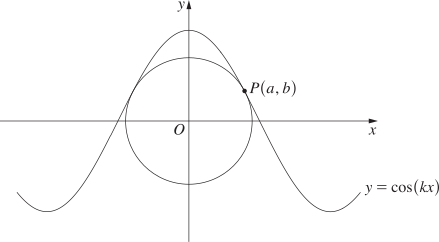
Consider the function  \(y=\cos (k x)\), where  \(k>0\). The value of \(k\) has been chosen so that a circle can be drawn, centred at the origin, which has exactly two points of intersection with the graph of the function and so that the circle is never above the graph of the function. The point  \(P(a, b)\)  is the point of intersection in the first quadrant, so  \(a>0\)  and  \(b>0\),  as shown in the diagram.

The vector joining the origin to the point \(P(a, b)\) is perpendicular to the tangent to the graph of the function at that point. (Do NOT prove this.)

Show that  \(k>1\).   (4 marks)

--- 12 WORK AREA LINES (style=lined) ---

Show Answers Only

\(y=\cos (k x) \ \Rightarrow \ \dfrac{dy}{dx}=-k \, \sin (k x)\)

\(P(a, b)=P(a, \cos (k a))\)

\(\text{Let}\ \  \underset{\sim}{p}=\overrightarrow{OP}.\)

\(\text{At}\ \ x=a, \ m_{\text{tang}} \perp \underset{\sim}{p} :\)

  \(m_{\text{tang}}\) \(=-k \, \sin (ka)\)
  \(m_{\overrightarrow{OP}}\) \(=\dfrac{\cos(ka)}{a}\)

 
\(-k \, \sin(ka) \times \dfrac{\cos(ka)}{a}=-1\)

  \(k\) \(=\dfrac{a}{\sin(ka) \cos(ka)}\)
    \(=\dfrac{2a}{\sin(2ka)}\)


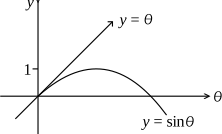
\(\text{For} \ \ \theta>0, \ \sin \theta<\theta\)

\(\Rightarrow k=\dfrac{2a}{\sin (2ka)}>\dfrac{2a}{2ka}>1\).

Show Worked Solution

\(y=\cos (k x) \ \Rightarrow \ \dfrac{dy}{dx}=-k \, \sin (k x)\)

\(P(a, b)=P(a, \cos (k a))\)

\(\text{Let}\ \  \underset{\sim}{p}=\overrightarrow{OP}.\)

\(\text{At}\ \ x=a, \ m_{\text{tang}} \perp \underset{\sim}{p} :\)

  \(m_{\text{tang}}\) \(=-k \, \sin (ka)\)
  \(m_{\overrightarrow{OP}}\) \(=\dfrac{\cos(ka)}{a}\)
♦♦♦ Mean mark 8%.

\(-k \, \sin(ka) \times \dfrac{\cos(ka)}{a}=-1\)

  \(k\) \(=\dfrac{a}{\sin(ka) \cos(ka)}\)
    \(=\dfrac{2a}{\sin(2ka)}\)


\(\text{For} \ \ \theta>0, \ \sin \theta<\theta\)

\(\Rightarrow k=\dfrac{2a}{\sin (2ka)}>\dfrac{2a}{2ka}>1\).

Filed Under: Vectors and Geometry, Vectors and Geometry Tagged With: Band 6, smc-1210-50-Circle/Sphere, smc-1210-60-2D problems, smc-7426-50-Circle/Sphere, smc-7426-60-2D problems

Mechanics, EXT2 M1 2024 HSC 15c

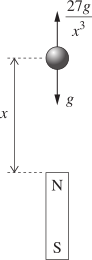
A bar magnet is held vertically. An object that is repelled by the magnet is to be dropped from directly above the magnet and will maintain a vertical trajectory. Let \(x\) be the distance of the object above the magnet.
 

The object is subject to acceleration due to gravity, \(g\), and an acceleration due to the magnet \(\dfrac{27 g}{x^3}\), so that the total acceleration of the object is given by

 \(a=\dfrac{27 g}{x^3}-g\)

The object is released from rest at  \(x=6\).

  1. Show that  \(v^2=g\left(\dfrac{51}{4}-2 x-\dfrac{27}{x^2}\right)\).   (2 marks)

    --- 8 WORK AREA LINES (style=lined) ---

  2. Find where the object next comes to rest, giving your answer correct to 1 decimal place.   (2 marks)

    --- 10 WORK AREA LINES (style=lined) ---

Show Answers Only

i.    \(\text{See Worked Solutions}\)

ii.   \(1.7 \ \text{units}\)

Show Worked Solution

i.    \(a=\dfrac{27 g}{x^3}-g\)

\(\dfrac{d}{dx}(\frac{1}{2}v^{2})\) \(= \dfrac{27g}{x^3}-g\)  
\(\dfrac{1}{2} v^2\) \(=-\dfrac{27 g}{2 x^2}-g x+c\)  

 
\(\text{When}\ \ x=6, v=0:\)

\(0\) \(=-\dfrac{27g}{2 \times 6^2}-6g+c\)  
\(c\) \(=\dfrac{459 g}{72}=\dfrac{51 g}{8}\)  


  \(\dfrac{1}{2} v^2\) \(=-\dfrac{27 g}{2 x^2}-g x+\dfrac{51 g}{8}\)
  \(v^2\) \(=-\dfrac{27 g}{x^2}-2 g x+\dfrac{51g }{4}\)
    \(=g\left(\dfrac{51}{4}-2 x-\dfrac{27}{x^2}\right)\)


ii.    \(\text{Find \(x\) when  \(v=0\):}\)

\(\dfrac{51}{4}-2 x-\dfrac{27}{x^2}\) \(=0\)  
\(51 x^2-8 x^3-108\) \(=0\)  
\(8 x^3-51 x^2+108\) \(=0\)  

 
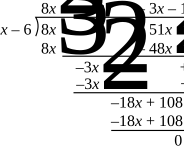
\(\text{Given  \(x=6\)  is a root:}\)

♦♦♦ Mean mark (ii) 24%.

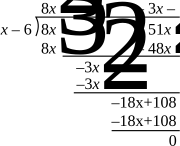
\(8 x^3-51 x^2+108=(x-6)\left(8 x^2-3 x-18\right)\)

\(\text{Other roots:}\)

  \(x\) \(=\dfrac{3 \pm \sqrt{9-4 \cdot 8 \cdot 18}}{2 \times 8}\)
    \(=\dfrac{3 \pm \sqrt{585}}{16}\)
    \(=\dfrac{3+3 \sqrt{65}}{16} \quad(x>0)\)
    \(=1.7 \ \text{units (1 d.p.)}\)

 
\(\therefore \ \text{Object next comes to rest at  \(x=1.7\) units}\) 

Filed Under: Forces and Further Motion in a Straight Line, Resisted Motion Tagged With: Band 3, Band 6, smc-1061-07-Resistive medium, smc-1061-30-R ~ other, smc-7437-10-Motion as \(\large \ f(x)\), smc-7437-70-Inverse

Vectors, EXT1 V1 2024 HSC 14d

A particle is projected from the origin, with initial speed \(V\) at an angle of \(\theta\) to the horizontal. The position vector of the particle, \(\underset{\sim}{r}(t)\), where \(t\) is the time after projection and \(g\) is the acceleration due to gravity, is given by

\(\underset{\sim}{r}(t)=\left(\begin{array}{c}Vt\cos\theta \\Vt\sin \theta -\dfrac{gt^2}{2}\end{array}\right)\).   (Do NOT prove this.)

Let \(D(t)\) be the distance of the particle from the origin at time \(t\), so  \(D(t)=|\underset{\sim}{r}(t)|\).

Show that for  \(\theta<\sin ^{-1}\left(\sqrt{\dfrac{8}{9}}\right)\)  the distance, \(D(t)\), is increasing for all  \(t>0\).   (4 marks)

--- 14 WORK AREA LINES (style=lined) ---

Show Answers Only

\(\text{See Worked Solutions.}\)

Show Worked Solution

\(\underset{\sim}{r}(t)=\left(\begin{array}{c}Vt\cos\theta \\Vt\sin \theta -\dfrac{gt^2}{2}\end{array}\right), \ D(t)=\abs{\underset{\sim}{r}(t)}\)

  \(D(t)^2\) \(=(V t \cos \theta)^2+\left(V t \sin \theta-\dfrac{g t^2}{2}\right)^2\)
    \(=V^2 t^2 \cos ^2 \theta+V^2 t^2 \sin ^2 \theta-V g t^3 \sin \theta+\dfrac{g^2 t^4}{4}\)
    \(=V^2 t^2\left(\cos ^2 \theta+\sin ^2 \theta\right)-V g t^3 \sin \theta+\dfrac{g^2 t^4}{4}\)
    \(=V^2 t^2-V g t^3 \sin \theta+\dfrac{g^2 t^4}{4}\)
♦♦♦ Mean mark 25%.

\(\text{Let }F(t)=D(t)^2\)

  \(F^{\prime}(t)\) \(=2 V^2 t-3 V g t^2 \sin \theta+g^2 t^3\)
    \(=t\left(2 V^2-3 V g t \sin \theta+g^2 t^2\right)\)

\(\text {Monotonically increasing when } F^{\prime}(t)>0 \text { for all } t.\)

\(g^2 t^2-3 V g t\, \sin \theta+2 V^2>0\)
 

\(\text {Find } t \text { when } \Delta<0:\)

  \((-3 V g \sin \theta)^2-4 \cdot g^2 \cdot 2 V^2\) \(<0\)
  \(9 V^2 g^2 \sin ^2 \theta-8 V^2 g^2\) \(<0\)
  \(\sin ^2 \theta\) \(<\dfrac{8}{9}\)
  \(\sin \theta\) \(<\sqrt{\dfrac{8}{9}} \ \ \left(\theta \in\left(0, \dfrac{\pi}{2}\right) \Rightarrow \ \sin \theta \in(0,1)\right)\)
  \(\theta\) \(<\sin ^{-1}\left(\sqrt{\dfrac{8}{9}}\right)\)

Filed Under: Vectors and Projectile Motion, Vectors and Projectile Motion Tagged With: Band 6, smc-1087-40-Initial Angle, smc-1087-80-Total Distance, smc-7288-40-Initial Angle, smc-7288-80-Total Distance

Trigonometry, EXT1 T3 2024 HSC 10 MC

For real numbers \(a\) and \(b\), where  \(a \neq 0\)  and  \(b \neq 0\), we can find numbers \(\alpha\), \(\beta\), \(\gamma\), \(\delta\) and \(R\) such that  \(a\,\cos x + b\,\sin x\)  can be written in the following 4 forms:

\(R\,\sin(x + \alpha)\)

\(R\,\sin(x-\beta)\)

\(R\,\cos(x + \gamma)\)

\(R\,\cos(x-\delta)\)

where  \(R \gt 0\)  and  \(0<\alpha, \beta, \gamma, \delta \lt 2\pi\).

What is the value of  \(\alpha + \beta + \gamma + \delta\)?

  1. \(0\)
  2. \(\pi\)
  3. \(2\pi\)
  4. \(4\pi\)
Show Answers Only

\(D\)

Show Worked Solution

\(a\,\sin\,x+b\,\cos\,x\ \ \text{can be written 4 ways.}\)

\(\text{Consider the case:}\)

\(\cos\,x+\sin\,x\ \ \text{where}\ a=b=1,\ \ R=\sqrt{2}\)

\(\sqrt{2}\,\sin(x+\alpha)\) \(= \sqrt{2}(\sin\,x\,\cos\,\alpha + \cos\,x\,\sin\,\alpha)\)  
  \(= \sqrt{2}\Big(\sin\,x \cdot \dfrac{1}{\sqrt2} + \cos\,x \cdot \dfrac{1}{\sqrt2}\Big)\)  

 
\(\cos\, \alpha^{+}, \sin\,\alpha^{+}\ \Rightarrow\ \ \alpha=\dfrac{\pi}{4} \)

♦♦♦ Mean mark 19%.

\(\text{Similarly for other 3 cases:}\)

\(\sqrt{2}\,\sin(x-\beta): \ \cos\, \beta^{+}, \sin\,\beta^{-}\ \Rightarrow\ \ \beta=\dfrac{7\pi}{4} \)

\(\sqrt{2}\,\cos(x+\gamma): \ \cos\, \gamma^{+}, \sin\,\gamma^{-}\ \Rightarrow\ \ \gamma=\dfrac{7\pi}{4} \)

\(\sqrt{2}\,\cos(x-\delta): \ \cos\, \delta^{+}, \sin\,\delta^{+}\ \Rightarrow\ \ \delta=\dfrac{\pi}{4} \)

\(\therefore \alpha + \beta + \gamma + \delta = 4\pi\)

\(\Rightarrow D\)

Filed Under: Auxiliary Angles, Auxiliary Angles Tagged With: Band 6, smc-1075-10-Rsin, smc-1075-20-Rcos, smc-6674-10-Rsin, smc-6674-20-Rcos

Trigonometry, EXT1 T3 2024 HSC 14c

  1. Explain why the equation  \(\tan ^{-1}(3 x)+\tan ^{-1}(10 x)=\theta\), where  \(-\pi<\theta<\pi\), has exactly one solution.   (1 marks)

    --- 5 WORK AREA LINES (style=lined) ---

  2. Solve  \(\tan ^{-1}(3 x)+\tan ^{-1}(10 x)=\dfrac{3 \pi}{4}\).   (2 marks)

    --- 7 WORK AREA LINES (style=lined) ---

Show Answers Only

i.     \(\tan ^{-1}(3 x)+\tan ^{-1}(10 x)=\theta \quad-\pi<\theta<\pi\)

\(\text {Range:}\ \ \tan ^{-1}(3 x) \in\left(-\dfrac{\pi}{2}, \dfrac{\pi}{2}\right), \ \tan ^{-1}(10 x) \in\left(-\dfrac{\pi}{2}, \dfrac{\pi}{2}\right)\)

 \(\Rightarrow \text { Both are monotonically increasing functions}\)

\(\Rightarrow\tan ^{-1}(3 x)+\tan ^{-1}(10 x) \text{ is also monotonically increasing with range }(-\pi, \pi)\) 

 \(\Rightarrow \text{ Only 1 solution exists (horizontal line will only cut graph once).}\)
 

ii.   \(x=\dfrac{1}{2}\)

Show Worked Solution

i.     \(\tan ^{-1}(3 x)+\tan ^{-1}(10 x)=\theta \quad-\pi<\theta<\pi\)

\(\text {Range:}\ \ \tan ^{-1}(3 x) \in\left(-\dfrac{\pi}{2}, \dfrac{\pi}{2}\right), \ \tan ^{-1}(10 x) \in\left(-\dfrac{\pi}{2}, \dfrac{\pi}{2}\right)\)

♦♦♦ Mean mark (i) 11%.

\(\Rightarrow \text { Both are monotonically increasing functions}\)

\(\Rightarrow\tan ^{-1}(3 x)+\tan ^{-1}(10 x) \text{ is also monotonically increasing with range }(-\pi, \pi)\) 

 \(\Rightarrow \text{ Only 1 solution exists (horizontal line will only cut graph once).}\)
 

ii.    \(\tan ^{-1}(3 x)+\tan ^{-1}(10 x)=\dfrac{3 \pi}{4}\)

\(\tan \left(\tan ^{-1}(3 x)+\tan ^{-1}(10 x)\right)=\tan \left(\dfrac{3 \pi}{4}\right)\)

♦♦ Mean mark (ii) 32%.

\(\dfrac{\tan \left(\tan ^{-1}(3 x)\right)+\tan \left(\tan ^{-1}(10 x)\right)}{1-\tan \left(\tan ^{-1}(3 x)\right) \cdot \tan \left(\tan ^{-1}(10 x)\right)}=-1\)

  \(\dfrac{3 x+10 x}{1-30 x^2}\) \(=-1\)
  \(13 x\) \(=30 x^2-1\)
  \(30 x^2-13 x-1\) \(=0\)
  \((15 x+1)(2 x-1)\) \(=0\)

 
\(x=\dfrac{1}{2}\ \ \text {or}\ \ -\dfrac{1}{15}\)

\(\text {Graph is monotonically increasing through } (0,0) \Rightarrow \ \Big(x \neq -\dfrac{1}{15} \Big)\)

\(\therefore x=\dfrac{1}{2}\)

Filed Under: Identities, Equations and 't' formulae, Other Trig Equations Tagged With: Band 5, Band 6, smc-1076-15-Compound Angles, smc-6675-20-Compound Angles

CHEMISTRY, M2 EQ-Bank 10

  1. A student is asked to prepare 500.0 mL of a 0.150 mol L\(^{-1}\) standard solution of oxalic acid \(\ce{(C2H2O4.2H2O)}\), and then to perform a dilution to produce 250.0 mL of a 0.0300 mol L\(^{-1}\) solution. Outline and explain each step in this process, including the calculations involved and choice of equipment.   (5 marks)

--- 12 WORK AREA LINES (style=lined) ---

  1. Justify the procedure in part (a.) by explaining two measures taken to ensure the accuracy of the standard solution and diluted solution produced.   (2 marks)

--- 4 WORK AREA LINES (style=lined) ---

Show Answers Only

a.    Calculate the mass of oxalic acid:

\(MM\ce{(C2H2O4.2H2O)}= 2(12.01) + 2(1.008) + 4(16.00) + 4(1.008) +2(16.00) = 126.068\ \text{g mol}^{-1}\)

\(n\ce{(C2H2O4.2H2O)} = c \times V = 0.150 \times 0.5 = 0.075\ \text{mol}\)

\(m\ce{(C2H2O4.2H2O)} = 0.075 \times 126.068 = 9.455\ \text{g}\)

  • Measure 9.455 g of oxalic acid using an electronic balance.

Prepare the standard solution:

  • Transfer the oxalic acid to a 500.0 mL volumetric flask using a funnel and rinse any remaining crystals from the weighing container into the flask with a small amount of distilled water.
  • Fill the volumetric flask with distilled water to about 80% full and swirl to dissolve the oxalic acid completely and carefully add more distilled water with a pipette until the bottom of the meniscus rests on the 500.0 mL mark to ensure precise volume.
  • Stopper the flask and invert several times to ensure a homogeneous solution.

Perform the dilution:

\(V_1=\dfrac{c_2V_2}{c_1} = \dfrac{0.03 \times 250}{0.15} = 50\ \text{mL}\)

  • Use a pipette to transfer 50.0 mL of the 0.150 mol L\(^{-1}\) solution into a 250.0 mL volumetric flask.
  • Dilute with distilled water up to the 250.0 mL mark in the flask to achieve a concentration of 0.0300 mol L\(^{-1}\).

b.    Answers could include two of the following:

  • A volumetric flask is used for both the standard solution and the diluted solution, as it provides precise measurements for the final solution volume. This accuracy is essential for ensuring the concentration is exactly as calculated.
  • The primary solute is weighed on an electronic balance to the nearest 0.01 g or better, minimising any error in the amount of solute added to the solution. 
  • The pipette provides precise measurements crucial for accurate dilutions.
  • Using oxalic acid as the primary standard for the investigation. Primary standard’s have high molar masses and are anhydrous (don’t absorb water). This ensures the substance is pure and the electronic balance can accurately weigh the sample.
Show Worked Solution

a.    Calculate the mass of oxalic acid:

\(MM\ce{(C2H2O4.2H2O)}= 2(12.01) + 2(1.008) + 4(16.00) + 4(1.008) +2(16.00) = 126.068\ \text{g mol}^{-1}\)

\(n\ce{(C2H2O4.2H2O)} = c \times V = 0.150 \times 0.5 = 0.075\ \text{mol}\)

\(m\ce{(C2H2O4.2H2O)} = 0.075 \times 126.068 = 9.455\ \text{g}\)

  • Measure 9.455 g of oxalic acid using an electronic balance.

Prepare the standard solution:

  • Transfer the oxalic acid to a 500.0 mL volumetric flask using a funnel and rinse any remaining crystals from the weighing container into the flask with a small amount of distilled water.
  • Fill the volumetric flask with distilled water to about 80% full and swirl to dissolve the oxalic acid completely and carefully add more distilled water with a pipette until the bottom of the meniscus rests on the 500.0 mL mark to ensure precise volume.
  • Stopper the flask and invert several times to ensure a homogeneous solution.

Perform the dilution:

\(V_1=\dfrac{c_2V_2}{c_1} = \dfrac{0.03 \times 250}{0.15} = 50\ \text{mL}\)

  • Use a pipette to transfer 50.0 mL of the 0.150 mol L\(^{-1}\) solution into a 250.0 mL volumetric flask.
  • Dilute with distilled water up to the 250.0 mL mark in the flask to achieve a concentration of 0.0300 mol L\(^{-1}\).

b.    Answers could include two of the following:

  • A volumetric flask is used for both the standard solution and the diluted solution, as it provides precise measurements for the final solution volume. This accuracy is essential for ensuring the concentration is exactly as calculated.
  • The primary solute is weighed on an electronic balance to the nearest 0.01 g or better, minimising any error in the amount of solute added to the solution. 
  • The pipette provides precise measurements crucial for accurate dilutions.
  • Using oxalic acid as the primary standard for the investigation. Primary standard’s have high molar masses and are anhydrous (don’t absorb water). This ensures the substance is pure and the electronic balance can accurately weigh the sample.

Filed Under: Concentration and Molarity Tagged With: Band 5, Band 6, smc-4261-20-Concentration Calculations, smc-4261-60-Dilutions, smc-4261-70-Standard Solutions, smc-4261-90-Practical Investigation

Statistics, STD1 S1 2024 HSC 24

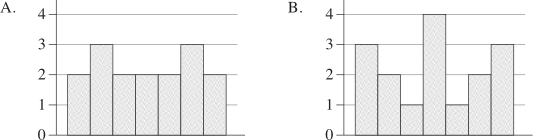
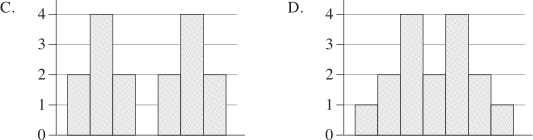
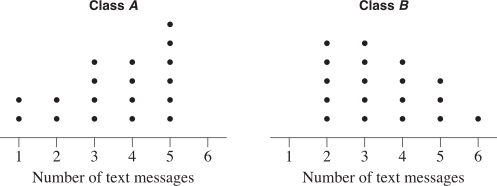
Students in two classes, Class \(A\) and Class \(B\), recorded the number of text messages they sent in a day. Each class has 18 students.

The results are shown in the dot plots.


Compare the two datasets by examining the skewness, median and spread of the distributions.   (3 marks)

--- 7 WORK AREA LINES (style=lined) ---

Show Answers Only

\begin{array} {|l|c|}
\hline
\rule{0pt}{2.5ex} \text{} \rule[-1ex]{0pt}{0pt} & \text{Range} & \quad Q_1\quad & \text{Median}&\quad Q_3\quad & IQR\\
\hline
\rule{0pt}{2.5ex} \text{Class } A\rule[-1ex]{0pt}{0pt} & 5-1=4&3&4&5&5-3=2\\
\hline
\rule{0pt}{2.5ex} \text{Class } B\rule[-1ex]{0pt}{0pt} & 6-2=4 &2&3&4&4-2=2\\
\hline
\end{array}

\(\text{Skewness:}\)

\(\text{Class A is slightly negatively skewed, while Class B is more symmetrical with}\)

\(\text{a slightly positive skew.}\)
 

\(\text{Median:}\)

\(\text{Class A has a higher median (4) compared to Class B (3).}\)
 

\(\text{Spread:}\)

\(\text{Both classes have the same range (4) and IQR (2), suggesting similar variability}\)

\(\text{in the data.}\)
 

\(\text{In conclusion, while the spread of data is similar for both classes, Class A
tends to}\)

\(\text{have a higher number of text messages sent (higher median and negative skew)}\)

\(\text{compared to Class B, which has a more symmetrical, slightly positive distribution.}\)

Show Worked Solution

\begin{array} {|l|c|}
\hline
\rule{0pt}{2.5ex} \text{} \rule[-1ex]{0pt}{0pt} & \text{Range} & \quad Q_1\quad & \text{Median}&\quad Q_3\quad & IQR\\
\hline
\rule{0pt}{2.5ex} \text{Class } A\rule[-1ex]{0pt}{0pt} & 5-1=4&3&4&5&5-3=2\\
\hline
\rule{0pt}{2.5ex} \text{Class } B\rule[-1ex]{0pt}{0pt} & 6-2=4 &2&3&4&4-2=2\\
\hline
\end{array}

♦♦♦ Mean mark 16%.

\(\text{Skewness:}\)

\(\text{Class A is slightly negatively skewed, while Class B is more symmetrical with}\)

\(\text{a slightly positive skew.}\)
 

\(\text{Median:}\)

\(\text{Class A has a higher median (4) compared to Class B (3).}\)
 

\(\text{Spread:}\)

\(\text{Both classes have the same range (4) and IQR (2), suggesting similar variability}\)

\(\text{in the data.}\)
 

\(\text{In conclusion, while the spread of data is similar for both classes, Class A
tends to}\)

\(\text{have a higher number of text messages sent (higher median and negative skew)}\)

\(\text{compared to Class B, which has a more symmetrical, slightly positive distribution.}\)

Filed Under: Bar Charts, Histograms and Other Graphs, Displaying Data - Other Charts Tagged With: Band 6, smc-1128-28-Other Charts, smc-6531-30-Other Charts

Measurement, STD1 M5 2024 HSC 32

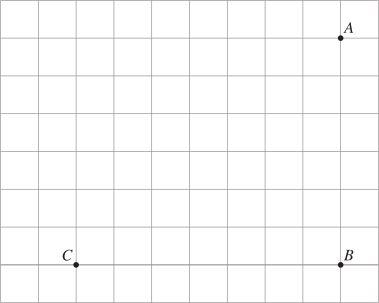
A scale diagram is shown with locations \(A, B\) and \(C\) marked (assume grid squares are 1 cm × 1 cm).

Jo takes 24 minutes to walk from \(A\) to \(B\) (in a straight line) when walking at 3 km per hour.
 

  1. What is the scale used in the diagram?   (3 marks)

    --- 7 WORK AREA LINES (style=lined) ---

  2. What is the distance from \(B\) to \(C\), in kilometres?   (2 marks)

    --- 5 WORK AREA LINES (style=lined) ---

Show Answers Only

a.    \(1:20\,000\)

b.    \(\text{1.4 km}\)

Show Worked Solution

a.    \(\text{Find distance }A\rightarrow B:\)

\(D=S \times T = 3 \times \dfrac{24}{60} = 1.2\ \text{km}\)
  

  \(\text{Scale }\rightarrow\ 6\ \text{cm }\) \(:\ 1.2\ \text{km}\)
  \(6\ \text{cm }\) \(:\ 1200\ \text{m}\)
  \(6\ \text{cm }\) \(:\ 1200\times 100\ \text{cm}\)
  \(6\ \) \(:\ 120\,000\)
  \(1\ \) \(:\ 20\,000\)
♦♦♦ Mean mark 15%.

b.    \(\text{Distance }B\rightarrow C = 7\ \text{grid units}\)

\(\text{Real distance }B\rightarrow C\) \(=7 \times 20\,000\)
  \(=140\,000\ \text{cm}\)
  \(=1400\ \text{m}\)
  \(=1.4\ \text{km}\)
♦♦♦ Mean mark 28%.

Filed Under: M5 Scale Drawings (Y12), Ratios Tagged With: Band 5, Band 6, smc-1105-20-Maps and Scale Drawings, smc-6858-10-Maps and Scale Drawings

Measurement, STD1 M3 2024 HSC 14

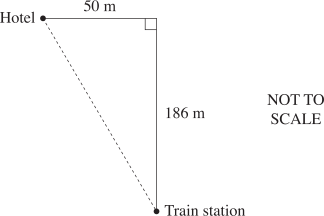
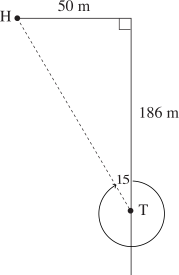
A hotel is located 186 m north and 50 m west of a train station.
 

  1. What is the straight line distance from the hotel to the train station? Round your answer to the nearest metre.   (2 marks)

    --- 6 WORK AREA LINES (style=lined) ---

  2. What is the bearing of the hotel from the train station? Round your answer to the nearest degree.   (2 marks)

    --- 6 WORK AREA LINES (style=lined) ---

Show Answers Only

a.    \(193\ \text{m}\)

b.    \(345^\circ\ \text{(nearest degree)}\)

Show Worked Solution

a.   \(\text{By Pythagoras:}\)

  \(d^2\) \(=50^2+186^2\)
  \(d^2\) \(=37\,096\)
  \(d\) \(=\sqrt{37\,096}\)
    \(=192.603\ \dots\)
    \(=193\ \text{m (nearest metre)}\)
♦♦ Mean mark (a) 37%.
b.     \(\tan\theta\) \(=\dfrac{50}{186}\)
  \(\theta\) \(=15.046\ \dots^\circ\)
    \(\approx 15^\circ\ \text{(nearest degree)}\)


\(\text{Bearing}\ H\ \text{from}\ T =360-15=345^\circ\ \text{(nearest degree)}\)

♦♦♦ Mean mark (b) 12%.

Filed Under: M3 Right-Angled Triangles (Y12), Right-angled Triangles (Y12) Tagged With: Band 5, Band 6, smc-1103-10-Pythagoras, smc-1103-60-Bearings, smc-6834-10-Pythagoras, smc-6834-60-Bearings

Statistics, STD1 S1 2024 HSC 13

Consider the following dataset.

\(1, \ 1, \ 2, \ 3, \ 5, \ 7, \ 15\)

  1. What is the interquartile range?   (1 mark)

    --- 2 WORK AREA LINES (style=lined) ---

  2. By using the outlier formula, determine whether 15 is an outlier.   (2 marks)

    --- 4 WORK AREA LINES (style=lined) ---

Show Answers Only

a.    \(\text{IQR = 6}\)

b.    \(15\ \text{is not an outlier as it is not greater than 16.}\)

Show Worked Solution

a.    \(Q_2=3, \ Q_1=1, \ Q_3=7\)

\(\therefore\ IQR=7-1=6\)
 

♦♦♦ Mean mark (a) 25%.

b.   \(\text{Find upper fence:}\)

\(Q_3+1.5\times IQR=7 + 1.5\times 6=16\)

\(\therefore\ \text{15 is not an outlier (15 < 16)}\)

♦♦ Mean mark (b) 32%.

Filed Under: Measures of Centre and Spread, Summary Statistics Tagged With: Band 5, Band 6, smc-1131-30-IQR and Outliers, smc-6532-30-IQR and Outliers

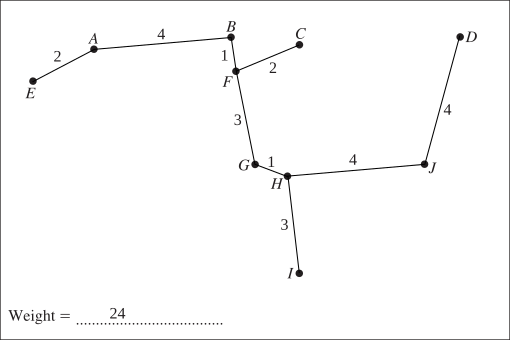
Networks, STD1 N1 2024 HSC 20

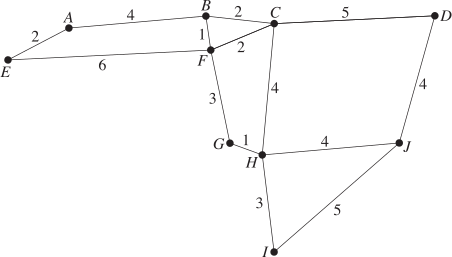
The diagram shows a network with weighted edges.
 

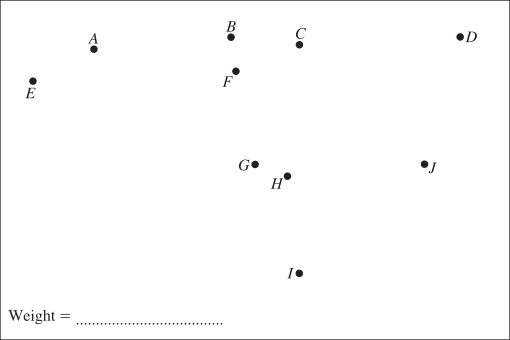
  1. Draw a minimum spanning tree for this network and determine its weight.   (2 marks)


--- 0 WORK AREA LINES (style=lined) ---

  1. Is it possible to find another spanning tree with the same weight? Give a reason for your answer.   (1 mark)

    --- 3 WORK AREA LINES (style=lined) ---

Show Answers Only

a.
         

b.    \(\text{Yes.}\)

\(\text{The edge}\ FC\ \text{on the MST above could be replaced by the edge}\ BC\)

\(\text{to create a second MST (with equivalent weight = 24)}\)

Show Worked Solution

a.
         

♦ Mean mark 53%.

 b.    \(\text{Yes.}\)

\(\text{The edge}\ FC\ \text{on the MST above could be replaced by the edge}\ BC\)

\(\text{to create a second MST (with equivalent weight = 24)}\)

♦♦♦ Mean mark 16%.

Filed Under: Minimum Spanning Trees, Spanning Trees Tagged With: Band 5, Band 6, smc-1138-10-General, smc-1138-40-Draw Tree, smc-6528-10-General, smc-6528-40-Draw Tree, std2-std1-common

Probability, 2ADV S1 2024 HSC 9 MC

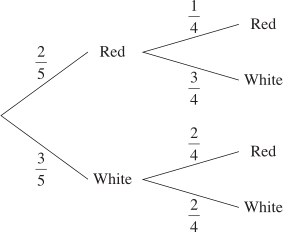
A bag contains 2 red and 3 white marbles. Jovan randomly selects two marbles at the same time from this bag. The probability tree diagram shows the probabilities for each of the outcomes.
 

Given that one of the marbles that Jovan has selected is red, what is the probability that the other marble that he has selected is also red?

  1. \(\dfrac{1}{10}\)
  2. \(\dfrac{1}{7}\)
  3. \(\dfrac{1}{4}\)
  4. \(\dfrac{7}{10}\)
Show Answers Only

\(B\)

Show Worked Solution
\(P(R_2|_{\text{other is red}})\) \(=\dfrac{P(R_1 \cap R_2)}{P\text{(at least 1 red)}}\)  
  \(=\dfrac{\frac{2}{5} \times \frac{1}{4}}{1-P(WW)}\)  
  \(=\dfrac{\frac{2}{5} \times \frac{1}{4}}{1-(\frac{3}{5} \times \frac{2}{4})}\)  
  \(=\dfrac{1}{7}\)  

 
\(\Rightarrow B\)

♦♦♦ Mean mark 14%.

Filed Under: Conditional Probability and Venn Diagrams, Conditional Probability and Venn Diagrams Tagged With: Band 6, smc-6470-10-Conditional Prob Formula, smc-991-10-Conditional Prob Formula

Calculus, 2ADV C3 2024 HSC 31

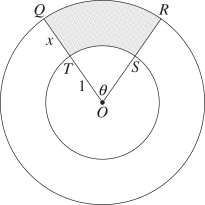
Two circles have the same centre \(O\). The smaller circle has radius 1 cm, while the larger circle has radius \((1 + x)\) cm. The circles enclose a region \(QRST\), which is subtended by an angle \(\theta\) at \(O\), as shaded.

The area of \(QRST\) is \(A\) cm\(^{2}\), where \(A\) is a constant and \(A \gt 0\).
 

Let \(P\) cm be the perimeter of \(QRST\).

  1. By finding expressions for the area and perimeter of \(QRST\), show that  \(P(x)=2x+\dfrac{2A}{x}\).   (3 marks)

    --- 10 WORK AREA LINES (style=lined) ---

  2. Show that if the perimeter, \(P(x)\), is minimised, then \(\theta\) must be less than 2.   (3 marks)

    --- 14 WORK AREA LINES (style=lined) ---

Show Answers Only

a.    \(\text{See Worked Solution}\) 

b.    \(\text{See Worked Solution}\)

Show Worked Solution

a.    \(\text{Area}\ =\ \text{Sector}\ OQR-\text{Sector}\ OTS\)

\(A\) \(=\dfrac{\theta}{2\pi} \times \pi (1+x)^2-\dfrac{\theta}{2\pi} \times \pi \times 1^2\)
\(A\) \(=\dfrac{\theta}{2} (1+x)^2-\dfrac{\theta}{2}\)
\(A\) \(=\dfrac{\theta}{2}(1+2x+x^2-1)\)
\(A\) \(=\dfrac{\theta}{2}x(x+2)\)
\(\theta\) \(=\dfrac{2A}{x(x+2)}\)


\(\text{Perimeter}\ QRST\) \(=\dfrac{\theta}{2\pi} \times 2\pi(x+1)+\dfrac{\theta}{2\pi} \times 2\pi (1)+2x \)
  \(=\theta(x+1)+\theta+2x\)
  \(=\theta(x+2)+2x\)
  \(=\dfrac{2A}{x(x+2)}(x+2)+2x\)
  \(=2x+\dfrac{2A}{x}\)
♦ Mean mark (a) 41%.
COMMENT: Sector/arc calculations used in solution are for those who don’t want to remember formulas.

b.    \(P(x)=2x+\dfrac{2A}{x}\)

\(P^{\prime}(x) = 2-\dfrac{2A}{x^2}\)

\(P^{\prime\prime}(x) = \dfrac{4A}{x^3} \gt0\ \ (x,A \gt 0)\)

\(\Rightarrow\ \text{MIN when}\ \ P^{\prime}(x)=0:\)

\(2-\dfrac{2A}{x^2}\) \(=0\)
\(2x^2\) \(=2A\)
\(x^2\) \(=A\)

 
\(\text{Using part (a):}\)

\(\theta\) \(=\dfrac{2A}{x(x+2)}\)
  \(=\dfrac{2x^2}{x(x+2)}\)
  \(=\dfrac{2x}{x+2}\)
  \(=2 \times \dfrac{x}{x+2} \)
  \( \lt 2\ \ \Big(\text{since}\ \ \dfrac{x}{x+2} \lt 1 \ \ \text{for all}\ x \Big) \)

 
\(\therefore\ \text{If}\ P(x)\ \text{is minimised,}\ \theta \lt 2. \)

♦♦♦ Mean mark (b) 12%.
 

Filed Under: Maxima and Minima, Optimisation Tagged With: Band 5, Band 6, smc-7134-10-Area, smc-970-10-Area

Measurement, STD2 M6 2024 HSC 40

A compass radial survey is shown.
 

Given that \(AC\) is a straight line, find the bearing of \(C\) from \(O\), correct to the nearest degree.   (3 marks)

--- 10 WORK AREA LINES (style=lined) ---

Show Answers Only

\(\text{Bearing of}\ C\ \text{from}\ O =220^{\circ}\)

Show Worked Solution

\(\text{In}\ \Delta ODA,\ \text{using cosine rule:}\)

\(\cos \angle DOA\) \(=\dfrac{38^2+42^2-67.6^2}{2 \times 38 \times 42}\)  
  \(=-0.4223…\)  
\(\angle DOA\) \(=115.0^{\circ}\)  

 
\(\text{Let}\ X\ \text{be a point directly north of point}\ O:\)

\(\angle DOX=360-285=75^{\circ}\)

\(\angle XOA=115-75=40^{\circ}\)

\(\angle AOB=110-40=70^{\circ}\)

\(\angle COB=180-70=110^{\circ}\ \ (AOC\ \text{is a straight line)}\)

\(\therefore\ \text{Bearing of}\ C\ \text{from}\ O = 110+110=220^{\circ}\)

♦♦♦ Mean mark 19%
STRATEGY:  The information in \(\Delta ODA\) strongly suggests finding \(\angle DOA\) is a good strategy to explore.

Filed Under: Bearings and Radial Surveys, Bearings and Radial Surveys Tagged With: Band 6, smc-6930-20-Radial Surveys, smc-803-20-Radial Surveys

Networks, STD2 N3 2024 HSC 39

A project involving nine activities is shown in the network diagram.

The duration of each activity is not yet known.
 

The following table gives the earliest start time (EST) and latest start time (LST) for three of the activities. All times are in hours.

\begin{array} {|c|c|c|}
\hline
\rule{0pt}{2.5ex} \textit{Activity} \rule[-1ex]{0pt}{0pt} & EST & LST \\
\hline
\rule{0pt}{2.5ex} A \rule[-1ex]{0pt}{0pt} & \ \ \ \ \ \ 0\ \ \ \ \ \  & \ \ \ \ \ \ 2\ \ \ \ \ \  \\
\hline
\rule{0pt}{2.5ex} C \rule[-1ex]{0pt}{0pt} & 0 & 1 \\
\hline
\rule{0pt}{2.5ex} I \rule[-1ex]{0pt}{0pt} & 12 & 12 \\
\hline
\end{array}

  1. What is the critical path?   (1 mark)

    --- 2 WORK AREA LINES (style=lined) ---

  2. The minimum time required for this project to be completed is 19 hours.
  3. What is the duration of activity \(I\)?   (1 mark)

    --- 2 WORK AREA LINES (style=lined) ---

  4. The duration of activity \(C\) is 3 hours.
  5. What is the maximum amount of time that could occur between the start of activity \(F\) and the end of activity \(H\)?   (1 mark)

    --- 2 WORK AREA LINES (style=lined) ---

Show Answers Only

a.   \(\text{Critical Path:}\ BEGI\)

b.   \(\text{Duration of}\ I =7\ \text{hours}\)

c.  \(\text{Max time}\ =8\ \text{hours}\)

Show Worked Solution

a.   \(\text{Activity}\ A\ \text{and}\ C: \ LST \gt EST\)

\(\Rightarrow\ \text{Activity}\ A\ \text{and}\ C\ \text{not on critical path.}\)

\(\text{Critical Path:}\ BEGI\)
 

♦ Mean mark (a) 43%.

b.   \(\text{Duration of}\ I = 19-12=7\ \text{hours}\)
 

c.   \(\text{Since}\ C + F + H + I\ \text{is not a critical path:}\)

\(C + F + H + I = 18\ \text{or less (C.P. = 19 hours)}\)

\(3+F+H+7 = 18\ \text{or less}\)

\(\Rightarrow\ F+H = 8\ \text{or less}\)

\(\therefore\ \text{Max time from start of}\ F\ \text{to end of}\ H = 8\ \text{hours}\)

♦♦♦ Mean mark (c) 10%.

Filed Under: Critical Path Analysis (Y12), Critical Paths Tagged With: Band 4, Band 5, Band 6, smc-6916-20-Forward Scanning, smc-6916-30-Scanning Both Ways, smc-916-20-Forward Scanning, smc-916-30-Scanning Both Ways

Statistics, STD2 S5 2024 HSC 35

A random variable is normally distributed with mean 0 and standard deviation 1. The table gives the probability that this random variable is less than \(z\).

\begin{array} {|c|c|c|c|c|c|c|c|c|c|}
\hline
\rule{0pt}{2.5ex} z \rule[-1ex]{0pt}{0pt} & 0.6 & 0.7 & 0.8 & 0.9 & 1.0 & 1.1 & 1.2 & 1.3 & 1.4 \\
\hline
\rule{0pt}{2.5ex} \textit{Probability} \rule[-1ex]{0pt}{0pt} & 0.7257 & 0.7580 & 0.7881 & 0.8159 & 0.8413 & 0.8643 & 0.8849 & 0.9032 & 0.9192 \\
\hline
\end{array}

The probability values given in the table for different values of \(z\) are represented by the shaded area in the following diagram.
 

The scores in a university examination with a large number of candidates are normally distributed with mean 58 and standard deviation 15.

  1. By calculating a \(z\)-score, find the percentage of scores that are between 58 and 70.   (2 marks)

    --- 4 WORK AREA LINES (style=lined) ---

  2. Explain why the percentage of scores between 46 and 70 is twice your answer to part (a).   (1 mark)

    --- 2 WORK AREA LINES (style=lined) ---

  3. By using the values in the table above, find an approximate minimum score that a candidate would need to be placed in the top 10% of the candidates.   (2 marks)

    --- 4 WORK AREA LINES (style=lined) ---

Show Answers Only

a.   \(28.81%\)

b.   \(\text{Normal distribution is symmetrical about the mean (58).}\)

\(\text{Since 70 and 46 are both the same distance (12) from the mean, the}\)

\(\text{percentage of scores in this range will be twice the answer in part (a).}\)

c.   \(\text{Approx minimum score = 78%}\)

Show Worked Solution

a.   \(z\text{-score (58)}\ =\dfrac{x-\mu}{\sigma} = \dfrac{58-58}{15}=0\)

\(z\text{-score (70)}\ = \dfrac{70-58}{15}=0.8\)

\(\text{Using table:}\)

\(\text{% between 58–70}\ =0.7881-0.5=0.2881=28.81%\)
 

♦♦ Mean mark (a) 36%.

b.   \(\text{Normal distribution is symmetrical about the mean (58).}\)

\(\text{Since 70 and 46 are both the same distance (12) from the mean, the}\)

\(\text{percentage of scores in this range will be twice the answer in part (a).}\)
 

♦♦♦ Mean mark (b) 19%.

c.   \(z\text{-score 1.3 has a table value 0.9032}\)

\(1-0.9032=0.0968\ \Rightarrow\ \text{i.e. 9.68% of students score higher.}\)

\(\text{Find}\ x\ \text{for a}\ z\text{-score of 1.3:}\)

\(1.3\) \(=\dfrac{x-58}{15}\)  
\(x\) \(=1.3 \times 15 +58\)   
  \(=77.5\)  

 
\(\therefore\ \text{Approx minimum score = 78%}\)

♦♦ Mean mark (c) 30%.

Filed Under: S5 The Normal Distribution (Y12) Tagged With: 2adv-std2-common, Band 5, Band 6, smc-819-10-Single z-score, smc-819-20-z-score Intervals, smc-819-50-z-score table

Statistics, 2ADV S2 2024 HSC 8 MC

Some data are used to create a box plot shown.
 

A histogram is created from the same set of data.

Which of these histograms is NOT possible for the given box plot?


Show Answers Only

\(D\)

Show Worked Solution

\(\text{By inspection of box plot,}\ \ IQR=\dfrac{2}{3}\times \text{range}\)

\(\text{ln options A, B and C (given 16 data points):}\)

\(Q_1\ \text{(4th data point)}\ \rightarrow \text{2nd column}\)

\(Q_3\ \text{(13th data point)}\  \rightarrow \text{6th column}\)

\(\text{Since}\ IQR=\dfrac{2}{3}\times \text{range}\ \Rightarrow\ \text{histograms are possible.}\)

♦♦♦ Mean mark 11%.

\(\text{ln option D:}\)

\(Q_1  \rightarrow \text{3rd column}\)

\(Q_3 \rightarrow \text{5th column}\)

\(\text{Since}\ IQR=\dfrac{1}{3} \times \text{range}\ \Rightarrow\ \text{not possible.}\)

\(\Rightarrow D\)

Filed Under: Summary Statistics - Box Plots Tagged With: 2adv-std2-common, Band 6, smc-1000-50-Other

Statistics, STD2 S1 2024 HSC 15 MC

Some data are used to create a box plot shown.
 

A histogram is created from the same set of data.

Which of these histograms is NOT possible for the given box plot?


Show Answers Only

\(D\)

Show Worked Solution

\(\text{By inspection of box plot,}\ \ IQR=\dfrac{2}{3}\times \text{range}\)

\(\text{ln options A, B and C (given 16 data points):}\)

\(Q_1\ \text{(4th data point)}\ \rightarrow \text{2nd column}\)

\(Q_3\ \text{(13th data point)}\  \rightarrow \text{6th column}\)

\(\text{Since}\ IQR=\dfrac{2}{3}\times \text{range}\ \Rightarrow\ \text{histograms are possible.}\)
 

\(\text{ln option D:}\)

\(Q_1  \rightarrow \text{3rd column}\)

\(Q_3 \rightarrow \text{5th column}\)

\(\text{Since}\ IQR=\dfrac{1}{3} \times \text{range}\ \Rightarrow\ \text{not possible.}\)

\(\Rightarrow D\)

♦♦♦ Mean mark 9%.

Filed Under: Summary Statistics - Box Plots, Summary Statistics - Box Plots Tagged With: 2adv-std2-common, Band 6, smc-6313-50-Other, smc-825-50-Other

CHEMISTRY, M2 EQ-Bank 8

A gas at a temperature of \(9.0 \times 10^2\ \text{K}\) in a container with a volume of \(30.0\ \text{L}\) has a pressure of \(5.0 \times 10^2\ \text{kPa}\).

  1. How many moles of gas are in the container?   (3 marks)

--- 6 WORK AREA LINES (style=lined) ---

  1. If the empty container weighs \(450.0\ \text{g}\) and the container with the gas weighs \(526.0\ \text{g}\), what is the gaseous element in the container?   (2 marks)

--- 4 WORK AREA LINES (style=lined) ---

Show Answers Only

a.    \(2.0\ \text{mol}\)

b.    The unknown gas is fluorine.

Show Worked Solution

a.    Using the Ideal Gas Law:

\(PV=nRT \Rightarrow n=\dfrac{PV}{RT}\)

\(n=\dfrac{500 \times 30}{8.314 \times 900}=2.0\ \text{mol (2 sig.fig)}\) 


b.    Mass of the gas \(=526.0-450.0=76\ \text{g}\)

Molar Mass of the gas \(=\dfrac{m}{n}=\dfrac{76}{2.0}=38\ \text{g mol}^{-1}\)

  • This is equal to the MM of fluorine gas \(\ce{(F2)}\).
  • The unknown gas is fluorine.

Filed Under: Gas Laws Tagged With: Band 4, Band 6, smc-4262-20-Molar Calculations, smc-4262-30-Ideal Gas Law

CHEMISTRY, M3 EQ-Bank 8

A galvanic cell has been set up as illustrated in the diagram below.

  1. The standard potential for this reaction is 0.78 V. Use half equations to determine the unknown electrode.   (2 marks)

--- 4 WORK AREA LINES (style=blank) ---

  1. The unknown solution is light green in colour. Explain what will happen to the colour of the unknown solution as the reaction proceeds.   (2 marks)

--- 4 WORK AREA LINES (style=lined) ---

  1. After some time, a solid deposit formed on the copper electrode was removed and dried. The mass of the deposit was 0.150 g. Determine the final concentration of the copper nitrate solution.   (3 marks)

--- 6 WORK AREA LINES (style=lined) ---

Show Answers Only

a.    \(\ce{Fe(s) -> Fe^{2+} + 2e^-}\)

b.    As the reaction progresses:

  • The solution will darken, taking on a more intense green colour.
  • This change occurs because nickel undergoes oxidation to form \(\ce{Fe^{2+}}\) ions, which are released into the solution, thereby increasing its colour intensity.

c.    \(0.137\ \text{mol L}^{-1}\)

Show Worked Solution
a.     \(E^{\circ}_{\text{cell}}\) \(=E^{\circ}_{\text{cathode}}-E^{\circ}_{\text{anode}}\)
  \(0.78\) \(=0.34-E^{\circ}_{\text{anode}}\)
  \(E^{\circ}_{\text{anode}}\) \(=0.34-0.78\)
  \(E^{\circ}_{\text{anode}}\) \(=-0.44\)
     
  • \(\ce{Fe^{2+} + 2e^- -> Fe(s)} \qquad -0.44\ \text{V}\)
  • \(\ce{Fe^{2+}}\) is undergoing oxidation. The correct half equation is: \(\ce{Fe(s) -> Fe^{2+} + 2e^-}\)
     

b.    As the reaction progresses:

  • The solution will darken, taking on a more intense green colour.
  • This change occurs because nickel undergoes oxidation to form \(\ce{Fe^{2+}}\) ions, which are released into the solution, thereby increasing its colour intensity.
     

c.    Moles of solid copper formed on electrode: \(\dfrac{m}{MM}=\dfrac{0.175}{63.55}=2.36 \times 10^{-3}\ \text{mol}\)

Moles of copper taken out of solution: \(2.36 \times 10^{-3}\ \text{mol}\)

Moles of copper remaining in solution: \((0.15 \times 0.18)-2.36 \times 10^{-3}= 0.0246\ \text{mol}\)

Final concentration: \(c=\dfrac{n}{V}=\dfrac{0.0246}{0.18}=0.137\ \text{mol L}^{-1}\)

Filed Under: Predicting Reactions of Metals Tagged With: Band 4, Band 5, Band 6, smc-4264-25-Redox, smc-4264-40-Cell Potentials

CHEMISTRY, M3 EQ-Bank 20

During a laboratory investigation, a student mixed two solutions and observed a sudden colour change, an increase in temperature, and the formation of bubbles.

  1. Explain why these observations indicate a chemical change.   (3 marks)

--- 6 WORK AREA LINES (style=lined) ---

  1. Describe two types of chemical reactions that could cause at least two of these observations each.   (2 marks)

--- 4 WORK AREA LINES (style=lined) ---

Show Answers Only

a.   Colour Change:

  • This suggests that new chemical compounds are forming that have different properties from the original reactants.

Temperature Increase (Exothermic Reaction):

  • The release of heat indicates that the reaction is exothermic, where energy is released as bonds are formed in the products.

Gas Production (Bubbles):

  • The formation of bubbles without boiling is a sign that a gas is being produced as a result of the reaction.
     

b.   Acid-Base Reaction:

  • When an acid reacts with a base, it can lead to a colour change if an indicator is present (e.g., phenolphthalein changes from colourless to pink). An exothermic reaction may also occur, causing a temperature increase.

Decomposition Reaction:

  • Certain decomposition reactions, such as the breakdown of hydrogen peroxide, produce gas (oxygen) and heat. The bubbling and increase in temperature can be observed in this type of reaction.


Show Worked Solution

a.   Colour Change:

  • This suggests that new chemical compounds are forming that have different properties from the original reactants.

Temperature Increase (Exothermic Reaction):

  • The release of heat indicates that the reaction is exothermic, where energy is released as bonds are formed in the products.

Gas Production (Bubbles):

  • The formation of bubbles without boiling is a sign that a gas is being produced as a result of the reaction.
     

b.   Acid-Base Reaction:

  • When an acid reacts with a base, it can lead to a colour change if an indicator is present (e.g., phenolphthalein changes from colourless to pink). An exothermic reaction may also occur, causing a temperature increase.

Decomposition Reaction:

  • Certain decomposition reactions, such as the breakdown of hydrogen peroxide, produce gas (oxygen) and heat. The bubbling and increase in temperature can be observed in this type of reaction.

Filed Under: Chemical Reactions Tagged With: Band 5, Band 6, smc-4263-15-Predicting products, smc-4263-8-Indicators of chemical change

CHEMISTRY, M3 EQ-Bank 16

Describe how activation energy, collision frequency, and molecular orientation work together to determine the rate of a chemical reaction. In your answer, define what each term refers to and relate these factors to collision theory.   (5 marks)

--- 8 WORK AREA LINES (style=lined) ---

Show Answers Only
  • Activation Energy: For a reaction to occur, the colliding molecules must have enough energy to overcome the activation energy barrier, which is the minimum energy required to break the bonds in the reactants and initiate the reaction. 
  • Collision Frequency: The rate of a reaction is also influenced by how frequently reactant molecules collide.
  • Molecular Orientation: In addition to having enough energy, molecules must collide with the correct orientation for a reaction to take place. Reactant molecules need to align in a way that allows bonds to break and new bonds to form. 
  • Increasing collision frequency increases the number of opportunities for molecules to collide, but only those collisions with enough energy and the correct orientation will lead to successful bond rearrangements.
  • For the maximum rate of reaction there needs to be a lower activation energy which makes it easier for collisions to result in a reaction, the proper orientation that ensures when collisions occur, they lead to the formation of products and a high collision frequency.
Show Worked Solution
  • Activation Energy: For a reaction to occur, the colliding molecules must have enough energy to overcome the activation energy barrier, which is the minimum energy required to break the bonds in the reactants and initiate the reaction. 
  • Collision Frequency: The rate of a reaction is also influenced by how frequently reactant molecules collide.
  • Molecular Orientation: In addition to having enough energy, molecules must collide with the correct orientation for a reaction to take place. Reactant molecules need to align in a way that allows bonds to break and new bonds to form. 
  • Increasing collision frequency increases the number of opportunities for molecules to collide, but only those collisions with enough energy and the correct orientation will lead to successful bond rearrangements.
  • For the maximum rate of reaction there needs to be a lower activation energy which makes it easier for collisions to result in a reaction, the proper orientation that ensures when collisions occur, they lead to the formation of products and a high collision frequency.

Filed Under: Rates of Reactions Tagged With: Band 5, Band 6, smc-4265-10-Collision theory, smc-4265-60-Orientation

CHEMISTRY, M3 EQ-Bank 28v4

A student stirs 2.50 g of silver (I) nitrate powder into 100.0 mL of 1.50 mol L\(^{-1}\) sodium chloride solution until it is fully dissolved. A reaction occurs and a precipitate appears.

  1. Write a balanced chemical equation for the reaction.   (1 mark)

    --- 2 WORK AREA LINES (style=lined) ---

  2. Calculate the theoretical mass of precipitate that will be formed.   (4 marks)

    --- 8 WORK AREA LINES (style=lined) ---


    The student weighed a piece of filter paper, filtered out the precipitate and dried it thoroughly in an incubator. The final precipitate mass was higher than predicted in (b).
  3. Identify one scientific reason why the precipitate mass was too high and suggest an improvement to the experimental method which would eliminate this error.   (2 marks)

    --- 4 WORK AREA LINES (style=lined) ---

Show Answers Only

a.    \(\ce{AgNO3(aq) + NaCl(aq) -> AgCl(s) + NaNO3(aq)}\)

b.    \(2.11 \text{ g}\)

c.    One possible reason for the higher mass could be the presence of excess solution in the filter paper or incomplete drying. An improvement could be to ensure the precipitate is thoroughly rinsed with distilled water to remove soluble impurities and dried completely in the incubator before weighing.

Show Worked Solution

a.    \(\ce{AgNO3(aq) + NaCl(aq) -> AgCl(s) + NaNO3(aq)}\)

b.    \(\ce{n(AgNO3) = \frac{m}{M} = \frac{2.50}{107.9 + 14.01 + 16.00 \times 3} = \frac{2.50}{169.91} = 0.01471 \text{ mol}}\)

\(\ce{n(NaCl) = c \times V = 1.50 \times 0.100 = 0.150 \text{ mol}}\)

\(\ce{AgNO3} \text{ is the limiting reagent}\)

\(\ce{n(AgCl) = n(AgNO3) = 0.01471 \text{ mol}}\)

\(\ce{m(AgCl) = n \times M = 0.01471 \times (107.9 + 35.45) = 0.01471 \times 143.35 = 2.11 \text{ g}}\)

c.    One possible reason for the higher mass could be the presence of excess solution in the filter paper or incomplete drying. An improvement could be to ensure the precipitate is thoroughly rinsed with distilled water to remove soluble impurities and dried completely in the incubator before weighing.

Filed Under: Chemical Reactions - draft Tagged With: Band 4, Band 5, Band 6, smc-4263-15-Predicting products, smc-4263-25-Precipitation

CHEMISTRY, M3 EQ-Bank 28v2

A student stirs 3.50 g of copper (II) nitrate powder into 150.0 mL of 1.50 mol L\(^{-1}\) sodium chloride solution until it is fully dissolved. A reaction occurs and a precipitate appears.

  1. Write a balanced chemical equation for the reaction.   (1 mark)

    --- 2 WORK AREA LINES (style=lined) ---

  2. Calculate the theoretical mass of precipitate that will be formed.   (4 marks)

    --- 8 WORK AREA LINES (style=lined) ---


    The student weighed a piece of filter paper, filtered out the precipitate and dried it thoroughly in an incubator. The final precipitate mass was higher than predicted in (b).
  3. Identify one scientific reason why the precipitate mass was too high and suggest an improvement to the experimental method which would eliminate this error.   (2 marks)

    --- 4 WORK AREA LINES (style=lined) ---

Show Answers Only

a.    \(\ce{Cu(NO3)2(aq) + 2NaCl(aq) -> CuCl2(s) + 2NaNO3(aq)}\)

b.    \(2.51 \text{ g}\)

c.    One possible reason for the higher mass could be the presence of excess solution in the filter paper or incomplete drying. An improvement could be to ensure the precipitate is thoroughly rinsed with distilled water to remove soluble impurities and dried completely in the incubator before weighing.

Show Worked Solution

a.    \(\ce{Cu(NO3)2(aq) + 2NaCl(aq) -> CuCl2(s) + 2NaNO3(aq)}\)

b.    \(\ce{n(Cu(NO3)2) = \frac{m}{M} = \frac{3.50}{63.55 + 2 \times (14.01 + 16.00 \times 3)} = \frac{3.50}{187.57} = 0.01866 \text{ mol}}\)

\(\ce{n(NaCl) = c \times V = 1.50 \times 0.150 = 0.225 \text{ mol}}\)

\(\ce{Cu(NO3)2} \text{ is the limiting reagent}\)

\(\ce{n(CuCl2) = n(Cu(NO3)2) = 0.01866 \text{ mol}}\)

\(\ce{m(CuCl2) = n \times M = 0.01866 \times (63.55 + 2 \times 35.45) = 0.01866 \times 134.45 = 2.51 \text{ g}}\)

c.    One possible reason for the higher mass could be the presence of excess solution in the filter paper or incomplete drying. An improvement could be to ensure the precipitate is thoroughly rinsed with distilled water to remove soluble impurities and dried completely in the incubator before weighing.

Filed Under: Chemical Reactions - draft Tagged With: Band 4, Band 5, Band 6, smc-4263-15-Predicting products, smc-4263-25-Precipitation

CHEMISTRY, M4 EQ-Bank 6

Explain why using bond energies is not an accurate method of calculating enthalpy changes.   (2 marks)

Show Answers Only
  • Enthalpy changes calculated using bond energies are not entirely accurate because bond energies represent averages of similar bond dissociations.
  • The actual energy of a specific bond can vary depending on the electrochemical environment around it, such as the presence of nearby electronegative atoms, adjacent double bonds, or the overall size of the molecule.
  • The energy of a specific bond depends also on the pressure, temperature, and state of the molecule. Bond energies assume standard laboratory conditions and all compounds already being in gas form and so are inaccurate. 
Show Worked Solution
  • Enthalpy changes calculated using bond energies are not entirely accurate because bond energies represent averages of similar bond dissociations.
  • The actual energy of a specific bond can vary depending on the electrochemical environment around it, such as the presence of nearby electronegative atoms, adjacent double bonds, or the overall size of the molecule.
  • The energy of a specific bond depends also on the pressure, temperature, and state of the molecule. Bond energies assume standard laboratory conditions and all compounds already being in gas form and so are inaccurate. 

Filed Under: Enthalpy and Hess's Law Tagged With: Band 6, smc-4267-20-Enthalpy and bonding

CHEMISTRY, M4 EQ-Bank 5

The chemical equation for the complete combustion of ethane  \(\ce{(C2H6)}\)  is given below:

\(\ce{2C2H6(g) + 7O2(g) -> 4CO2(g) + 6H2O(l)}\)

The structural formula for ethane and standard bond energies for provided for you.

\begin{array} {|c|c|}
\hline Bond & Enthalpy \text{ (kJ mol}^{-1})  \\     
\hline \ce{C-C} & 348 \\
\hline \ce{O-O} & 146 \\
\hline \ce{O=O} & 495 \\
\hline \ce{C-O} & 358 \\
\hline \ce{C=O} & 799 \\
\hline \ce{C-H} & 413 \\
\hline \ce{H-O} & 463 \\
\hline \end{array}

Using the bond energies provided, calculate the enthalpy for the complete combustion of one mole of ethane.   (3 marks)

Show Answers Only

\(-1415.5\ \text{kJ mol}^{-1}\)

Show Worked Solution
\(\Delta H\) \(=\Sigma\,{\text{bonds broken}}-\Sigma\,{\text{bonds formed}}\)  
  \(=((12 \times 413) + (2 \times 348) + (7 \times 495))-((8 \times 799) + (12 \times 463))\)  
  \(=9117-11948\)  
  \(=-2831\)  (for two moles of ethane, as per the equation)  
     
  • \(\Delta H\) for the combustion of one mole of ethane is \(-1415.5 \text{ kJ mol}^{-1}\)

Filed Under: Enthalpy and Hess's Law Tagged With: Band 5, Band 6, smc-4267-20-Enthalpy and bonding

CHEMISTRY, M4 EQ-Bank 4

The chemical equation for the combustion of butane \(\ce{(C4H10)}\) is given below:

\(\ce{2C4H10(g) + 13O2(g) -> 8CO2(g) + 10H2O(g)} \qquad \Delta H = -5754\ \text{kJ mol}^{-1}\)

Given that the standard enthalpy of formation of \(\ce{CO2(g)}\) is –393 kJ mol\(^{-1}\) and \(\ce{H2O(g)}\) is –241 kJ mol \(^{-1}\), calculate the standard enthalpy of formation of butane.   (3 marks)

--- 6 WORK AREA LINES (style=lined) ---

Show Answers Only

\(-126\ \text{kJ mol}^{-1}\)

Show Worked Solution
  • The enthalpy change for the combustion of 2 moles of butane is -5754 kJ.
\(\Delta H\) \(=\Sigma{\Delta H_f \text{ (products)}}-\Sigma{\Delta H_f \text{ (reactants)}}\)  
\(-5754\) \(=(8 \times -393 + 10 \times -241)-(2 \times \Delta H_f \text{ (butane)})\)  
\(-5754\) \(=-4334-2 \times \Delta H_f \text{ (butane)}\)  
\(\Delta H_f \text{ (butane)}\) \(=\dfrac{-4334 + 5754}{2}\)  
  \(=-126\ \text{kJ mol}^{-1}\)  
     
  • The standard enthalpy of formation of butane is \(-126\ \text{kJ mol}^{-1}\).

Filed Under: Enthalpy and Hess's Law Tagged With: Band 6, smc-4267-30-Enthalpies of formation

CHEMISTRY, M4 EQ-Bank 1

The chemical equation for the combustion of butanol \(\ce{(C4H9OH(l))}\) is given below

\(\ce{C4H9OH(l) + 6O2(g) -> 4CO2(g) + 5H2O(l)}\)         \(\Delta H = -2670\ \text{kJ mol}^{-1}\)

\begin{array} {|c|c|}
\hline \text{Compound} & \Delta H_f \ \text{(kJ mol}^{-1}) \\
\hline \ce{CO2(g)} & -393 \\
\hline \ce{H2O(l)} & -286 \\
\hline \end{array}

  1. Define what the term 'standard enthalpy of formation' means.   (1 mark)

--- 2 WORK AREA LINES (style=lined) ---

  1. Use the table data to calculate the standard enthalpy of formation of butanol.   (3 marks)

--- 6 WORK AREA LINES (style=blank) ---

Show Answers Only

a.   Standard enthalpy of formation:

  • The change in enthalpy when one mole of a substance is formed from its constituent elements in their standard states under standard conditions (298 K temperature and 100 kPa).
  • The elements must be in their most stable form at these conditions.

b.    \(-332\ \text{kJ mol}^{-1}\)

Show Worked Solution

a.   Standard enthalpy of formation:

  • The change in enthalpy when one mole of a substance is formed from its constituent elements in their standard states under standard conditions (298 K temperature and 100 kPa).
  • The elements must be in their most stable form at these conditions.
     
b.     \(\Delta H\) \(= \Sigma{\Delta H_f \text{ (products)}}-\Sigma{\Delta H_f \text{ (reactants)}}\)
  \(-2670\) \(=(4 \times -393 + (5 \times -286))-(\Delta H_f \text{ butanol} + (6 \times 0))\)
  \(\Delta H_f \text{ butanol}\) \(=-3002 + 2670\)
    \(=-332\ \text{kJ mol}^{-1}\)
     
  • The standard enthalpy of formation of an element is 0.

Filed Under: Enthalpy and Hess's Law Tagged With: Band 4, Band 6, smc-4267-30-Enthalpies of formation

CHEMISTRY, M4 EQ-Bank 17

The decomposition of a metal carbonate is represented by the following equation:

\(\ce{MCO3(s) → MO(s) + CO2(g)}\)

The following data was recorded:

\(\Delta H = +130 \, \text{kJ/mol},\ \ \Delta S = +160 \, \text{J/mol K}\)

  1. Calculate the Gibbs free energy at 350 K.   (2 marks)

--- 4 WORK AREA LINES (style=blank) ---

  1. Determine if the reaction is spontaneous at this temperature.   (1 mark)

--- 2 WORK AREA LINES (style=blank) ---

  1. Discuss how both enthalpy and entropy influence the spontaneity of this reaction and predict the temperature range in which the reaction will be spontaneous.   (4 marks)

--- 8 WORK AREA LINES (style=blank) ---

Show Answers Only

a.    \(\Delta G = +74 \, \text{kJ/mol}\)

b.    The reaction is non-spontaneous at 350 K.

c.   Enthalpy and entropy influence the spontaneity:

  • To be spontaneous, \(\Delta G\) must be negative, where  \(\Delta G = \Delta H- T\Delta S\).
  • The reaction has a positive enthalpy, indicating it requires energy input, which opposes spontaneity.
  • However, the positive entropy means the disorder of the system increases, which favours spontaneity.
  • At higher temperatures, the entropy contribution will dominate, overcoming the positive enthalpy and making the reaction spontaneous.
  • To find the temperature where the reaction becomes spontaneous, set \(\Delta G = 0\):
  •    \(0=\Delta H-T\Delta S\)
  •    \(T=\dfrac{\Delta H}{\Delta S}=\dfrac{130}{0.160}=812.5\ \text{K}\)
  • Thus, the reaction will be spontaneous above 812.5 K.
Show Worked Solution

a.    \(\Delta G = \Delta H- T\Delta S\)

Convert \(\Delta S\) to \(\text{kJ/mol K}\)

\(\Delta S = 0.160 \, \text{kJ/mol K}\)

\(\Delta G = 130-(350 \times 0.160) = 130-56 = +74 \, \text{kJ/mol}\)
 

b.    Since \(\Delta G > 0\), the reaction is non-spontaneous at 350 K.
 

c.   Enthalpy and entropy influence the spontaneity:

  • To be spontaneous, \(\Delta G\) must be negative, where  \(\Delta G = \Delta H- T\Delta S\).
  • The reaction has a positive enthalpy, indicating it requires energy input, which opposes spontaneity.
  • However, the positive entropy means the disorder of the system increases, which favours spontaneity.
  • At higher temperatures, the entropy contribution will dominate, overcoming the positive enthalpy and making the reaction spontaneous.
  • To find the temperature where the reaction becomes spontaneous, set \(\Delta G = 0\):
  •    \(0=\Delta H-T\Delta S\)
  •    \(T=\dfrac{\Delta H}{\Delta S}=\dfrac{130}{0.160}=812.5\ \text{K}\)
  • Thus, the reaction will be spontaneous above 812.5 K.

Filed Under: Entropy and Gibbs Free Energy Tagged With: Band 4, Band 6, smc-4268-50-Determining Spontaneity, smc-4268-80-Calculating G

Algebra, STD2 A2 2009 HSC 24d (Adapted)

A factory makes both cloth and leather lounges. In any week

• the total number of cloth lounges and leather lounges that are made is 400
• the maximum number of leather lounges made is 270
• the maximum number of cloth lounges made is 325.

The factory manager has drawn a graph to show the numbers of leather lounges (\(x\)) and cloth lounges (\(y\)) that can be made.


  1. Find the equation of the line \(AD\).   (1 mark)

    --- 2 WORK AREA LINES (style=lined) ---

  2. Explain why this line is only relevant between \(B\) and \(C\) for this factory.     (1 mark)

    --- 3 WORK AREA LINES (style=lined) ---

  3. The profit per week, \($P\), can be found by using the equation  \(P = 2520x + 1570y\).


    Compare the profits at \(B\) and \(C\).     (2 marks)

    --- 6 WORK AREA LINES (style=lined) ---

Show Answers Only

a.    \(x+y=400\)

b.    \(\text{Since the max amount of leather lounges}=270\)


\(\rightarrow\ x\ \text{cannot be}\ >270\)


\(\text{Since the max amount of cloth lounges}=325\)


\(\rightarrow\ y\ \text{cannot be}\ >325\)


\(\therefore\ \text{The line}\ AD\ \text{is only possible between}\ B\ \text{and}\ C.\)

c.    \(\text{The profits at}\ C\ \text{are }$185\ 250\ \text{more than at}\ B.\)

Show Worked Solution

a.    \(\text{We are told the number of leather lounges}\ (x),\)

\(\text{and cloth lounges}\  (y),\ \text{made in any week} = 400\)

\(\rightarrow\ \text{Equation of}\ AD\ \text{is}\ x+y=400\)


♦♦♦ Mean mark part (i) 14%.
Using \(y=mx+c\) is a less efficient but equally valid method, using  \(m=–1\)  and  \(b=400\) (\(y\)-intercept).

b.    \(\text{Since the max amount of leather lounges}=270\)

\(\rightarrow\ x\ \text{cannot}\ >270\)

\(\text{Since the max amount of cloth lounges}=325\)

\(\rightarrow\ y\ \text{cannot}\ >325\)

\(\therefore\ \text{The line}\ AD\ \text{is only possible between}\ B\ \text{and}\ C.\)


♦ Mean mark part (ii) 49%.

c.    \(\text{At}\ B,\ x=75,\ y=325\)

\(\rightarrow\ $P  (\text{at}\ B)\) \(=2520\times 75+1570\times 325\)
  \(=189\ 000+510\ 250\)
  \(=$699\ 250\)

  
\(\text{At}\ C,\ x=270,\ y=130\)

\(\rightarrow\ $P  (\text{at}\ C)\) \(=2520\times 270+1570\times 130\)
  \(=680\ 400+204\ 100\)
  \(=$884\ 500\)

  
\(\text{Difference in profits}=$884\ 500-$699\ 250=$185\ 250\)

\(\text{The profits at}\ C\ \text{are } $185\ 250\ \text{more than at}\ B.\)


♦ Mean mark (iii)40%.

Filed Under: Applications of Linear Relationships (Y11-X), Applications: Currency, Fuel and Other Problems (Std 2-X) Tagged With: adapted, Band 5, Band 6, smc-5236-30-Other linear applications, smc-7716-20-Other Linear Applications

Algebra, STD2 A2 2010 HSC 27c (Adapted)

The graph shows tax payable against taxable income, in thousands of dollars.
  

  1. Use the graph to find the tax payable on a taxable income of \($18\ 000\).   (1 mark)

    --- 1 WORK AREA LINES (style=lined) ---

  2. Use suitable points from the graph to show that the gradient of the section of the graph marked  \(A\)  is  \(\dfrac{7}{15}\).   (1 mark)

    --- 3 WORK AREA LINES (style=lined) ---

  3. How much of each dollar earned between  \($18\ 000\)  and  \($33\ 000\) is payable in tax? Give your answer correct to the nearest whole number.   (1 mark)

    --- 2 WORK AREA LINES (style=lined) ---

  4. Write an equation that could be used to calculate the tax payable, \(T\), in terms of the taxable income, \(I\), for taxable incomes between  \($18\ 000\)  and  \($33\ 000\).   (2 marks)

    --- 4 WORK AREA LINES (style=lined) ---

Show Answers Only

a.    \($3000\ \ \text{(from graph)}\)

b.    \(\text{See worked solution}\)

c.    \(46\frac{2}{3}\approx  47\ \text{cents per dollar earned}\)

d.    \(\text{Tax payable →}\ T=\dfrac{7}{15}I-5400\)

Show Worked Solution
a.    

\(\text{Income on}\ $18\ 000=$3000\ \ \text{(from graph)}\)


b.    \(\text{Using the points}\ (18, 3)\ \text{and}\ (33, 10)\)

\(\text{Gradient at}\ A\) \(=\dfrac{y_2-y_1}{x_2-x_1}\)
  \(=\dfrac{10\ 000-3000}{33\ 000-18\ 000}\)
  \(=\dfrac{7000}{15\ 000}\)
  \(=\dfrac{7}{15}\ \ \ \ \text{… as required}\)

♦♦ Mean mark (ii) 25%.

c.    \(\text{The gradient represents the tax applicable on each dollar}\)

\(\text{Tax}\) \(=\dfrac{7}{15}\ \text{of each dollar earned}\)
  \(=46\frac{2}{3}\approx 47\ \text{cents per dollar earned (nearest whole number)}\)

♦♦♦ Mean mark (iii) 12%!
MARKER’S COMMENT: Interpreting gradients is an examiner favourite, so make sure you are confident in this area.

d.    \(\text{Tax payable up to }$18\ 000 = $3000\)

\(\text{Tax payable on income between }$18\ 000\ \text{and }$33\ 000\)

\(=\dfrac{7}{15}(I-18\ 000)\)

\(\therefore\ \text{Tax payable →}\ \ T\) \(=3000+\dfrac{7}{15}(I-18\ 000)\)
  \(=3000+\dfrac{7}{15} I-8400\)
  \(=\dfrac{7}{15}I-5400\)

♦♦♦ Mean mark (iv) 15%.
STRATEGY: The earlier parts of this question direct students to the most efficient way to solve this question. Make sure earlier parts of a question are front and centre of your mind when devising strategy.

Filed Under: Applications of Linear Relationships (Y11-X), Applications: Currency, Fuel and Other Problems (Std 2-X) Tagged With: adapted, Band 3, Band 5, Band 6, page-break-before-solution, smc-5236-30-Other linear applications, smc-7716-20-Other Linear Applications

Algebra, STD2 A2 2007 HSC 18 MC (Adapted)

Art started to make this pattern of shapes using matchsticks.


If the pattern of shapes is continued, which shape would use exactly 416 matchsticks?

  1. Shape 83
  2. Shape 103
  3. Shape 104
  4. Shape 138
Show Answers Only

\(D\)

Show Worked Solution

\begin{array} {|l|c|c|c|}
\hline
\rule{0pt}{2.5ex} \text{Shape}\ \textit(S) \rule[-1ex]{0pt}{0pt}\ \ &\  \ 1\ \ &\ \ 2\ \ &\ \ 3\ \  \\
\hline
\rule{0pt}{2.5ex} \text{Matches}\ \textit(M) \rule[-1ex]{0pt}{0pt} \ \ & \ \ 5\ \ &\ \ 8\ \ &\ \ 11\ \  \\
\hline
\end{array}

\(\text{Equation rule:}\)

\(M=3S+2\)

\(\text{Find}\ \ S\ \text{when}\ \ M=416:\)

\(416\) \(=3S+2\)
\(3S\) \(=414\)
\(S\) \(=138\)

 
\(\therefore\ \text{The 138th shape uses 416 matchsticks.}\)

\(\Rightarrow D\)

Filed Under: Linear Equations and Basic Graphs (Std 2-X) Tagged With: adapted, Band 6, smc-5240-40-Patterns

Algebra, STD2 A1 2020 HSC 13 MC (Adapted)

When Stuart stops drinking alcohol at 11:30 pm, he has a blood alcohol content (BAC) of 0.08625.

The number of hours required for a person to reach zero BAC after they stop consuming alcohol is given by the formula:

\(\text{Time}=\dfrac{BAC}{0.015}\).

At what time on the next day should Stuart expect his BAC to be 0.05?

  1.  1:33 am
  2.  1:55 am
  3.  2:15 am
  4.  5:15 am
Show Answers Only

\(B\)

Show Worked Solution

\(\text{Time from  0.08625 → 0}\ BAC\)

\(=\dfrac{0.08625}{0.015}\)

\(=5.75\ \text{hours}\)
 

\(\text{Time from  0.08625 → 0.05}\ BAC\)

\(=\dfrac{(0.08625 – 0.05)}{0.08625}\times 5.75\) 

\(=\dfrac{29}{69}\times 5.75\)

\(=2.41\dot{6}=2\ \text{h}\ 25\ \text{min}\)
 

\(\therefore\ \text{Time}\) \(=11:30\ \text{pm} \ + 2 \ \text{h} \ 25 \ \text{min}\)
  \(=1:55\ \text{am}\)

 
\(\Rightarrow B\)


♦♦♦ Mean mark 17%.
COMMENT: The rates aspect of this question proved extremely challenging.

Filed Under: Applications: BAC, D=SxT and Medication (Y11-X), Applications: BAC, Medication and D=SxT (Std 2-X) Tagged With: adapted, Band 6, smc-5234-10-BAC, smc-7713-10-BAC

Algebra, STD2 A1 2007 HSC 28b (Adapted)

This shape is made up of two right-angled triangle and a regular hexagon.
 

The area of a regular hexagon can be estimated using the formula  \(A=2.598S^2\)  where \(S\) is the hexagon's side-length.

Calculate the total area of the shape using this formula.   (3 marks)

--- 6 WORK AREA LINES (style=lined) ---

Show Answers Only

\(619.6\ \text{cm}^2\)

Show Worked Solution

\(\text{Area}=2.598S^2\)

\(\text{Using Pythagoras}\)

\(S^2= 10^2+10^2=200\)

\(S=\sqrt{200}\)

\(A=2.598\times (\sqrt {200})^2=519.6\ \text{cm}^2\)

\(\text{Area of Δ}\ =\dfrac{1}{2}bh=\dfrac{1}{2}\times 10\times 10=50 \ \text{cm}^2\)

\(\therefore\ \text{Total Area}\ =519.6+50+50=619.6\ \text{cm}^2\)

Filed Under: Substitution and Other Equations (Std 2-X), Substitution and Other Equations (Y11-X) Tagged With: adapted, Band 6, smc-5233-10-Substitute, smc-7712-10-Substitute

EXAMCOPY Functions, MET2 2022 VCAA 4

Consider the function `f`, where `f:\left(-\frac{1}{2}, \frac{1}{2}\right) \rightarrow R, f(x)=\log _e\left(x+\frac{1}{2}\right)-\log _e\left(\frac{1}{2}-x\right).`

Part of the graph of `y=f(x)` is shown below.
 

  1. State the range of `f(x)`.   (1 mark)

    --- 1 WORK AREA LINES (style=lined) ---

  2.  i. Find `f^{\prime}(0)`.   (2 marks)

    --- 3 WORK AREA LINES (style=lined) ---

  3. ii. State the maximal domain over which `f` is strictly increasing.   (1 mark)

    --- 2 WORK AREA LINES (style=lined) ---

  4. Show that `f(x)+f(-x)=0`.   (1 mark)

    --- 3 WORK AREA LINES (style=lined) ---

  5. Find the domain and the rule of `f^{-1}`, the inverse of `f`.   (3 marks)

    --- 4 WORK AREA LINES (style=lined) ---

  6. Let `h` be the function `h:\left(-\frac{1}{2}, \frac{1}{2}\right) \rightarrow R, h(x)=\frac{1}{k}\left(\log _e\left(x+\frac{1}{2}\right)-\log _e\left(\frac{1}{2}-x\right)\right)`, where `k \in R` and `k>0`.
  7. The inverse function of `h` is defined by `h^{-1}: R \rightarrow R, h^{-1}(x)=\frac{e^{k x}-1}{2\left(e^{k x}+1\right)}`.
  8. The area of the regions bound by the functions `h` and `h^{-1}` can be expressed as a function, `A(k)`.
  9. The graph below shows the relevant area shaded.
     

  1. You are not required to find or define `A(k)`.
  1. Determine the range of values of `k` such that `A(k)>0`.   (1 mark)

    --- 2 WORK AREA LINES (style=lined) ---

  2. Explain why the domain of `A(k)` does not include all values of `k`.   (1 mark)

    --- 2 WORK AREA LINES (style=lined) ---

Show Answers Only
a.     `R`
b.i `f^{\prime}(0)=4`
b.ii `\left(-\frac{1}{2}, \frac{1}{2}\right)`
c. `0`
d. `x \in \mathbb{R}`
e.i  ` k > 4`
e.ii No bounded area for `0<k \leq 4`
Show Worked Solution

a.   `R` is the range.

b.i    `f(x)`
`= \log _e\left(x+\frac{1}{2}\right)-\log _e\left(\frac{1}{2}-x\right)`  
  `f^{\prime}(x)` `= \frac{1}{x+\frac{1}{2}}+\frac{1}{\frac{1}{2}-x}`  
    `= \frac{2}{2 x+1}-\frac{2}{2 x-1}`  
  `f^{\prime}(0)` `= \frac{2}{2 xx 0+1}-\frac{2}{2 xx 0-1}`  
    `= 4`  

 
b.ii 
`\left(-\frac{1}{2}, \frac{1}{2}\right)`

c.   `f(x)+f(-x)` `= \log _e\left(x+\frac{1}{2}\right)-\log _e\left(\frac{1}{2}-x\right)+\log _e\left(-x+\frac{1}{2}\right)-\log _e\left(\frac{1}{2}+x\right)`  
  `= 0`  

 
d.  
To find the inverse swap `x` and `y` in `y=f(x)`

`x` `= \log _e\left(y+\frac{1}{2}\right)-\log _e\left(\frac{1}{2}-y\right)`  
`x` `= \log _e\left(\frac{y+\frac{1}{2}}{\frac{1}{2}-y}\right)`  
`e^x` `=\frac{y+\frac{1}{2}}{\frac{1}{2}-y}`  
`y+\frac{1}{2}` `= e^x\left(-y+\frac{1}{2}\right)`  
`y+\frac{1}{2}` `= -e^x y+\frac{e^x}{2}`  
`y\left(e^x+1\right)` `= \frac{e^x-1}{2}`  
`:.\ f^(-1)(x)` `= \frac{e^x-1}{2(e^x + 1)}`  

 
  `:.`  Domain: `x \in \mathbb{R}`
  

e.i   The vertical dilation factor of  `f(x)` is  `1/k`

For `A(k)>=0` , `h^{\prime}(0)<1`

`\frac{1}{k}(4)<1`   [Using CAS]

`:.\  k > 4`


♦♦♦♦ Mean mark (e.i) 10%.
MARKER’S COMMENT: Incorrect responses included `k>0` and `4<k<33`.

e.ii  When `h \geq h^{-1}` for  `x>0` (or `h \leq h^{-1}` for  `x<0`) there is no bounded area.

`:.`  There will be no bounded area for `0<k \leq 4`.


♦♦♦♦ Mean mark (e.ii) 10%.

Filed Under: Test category Tagged With: Band 3, Band 4, Band 6, smc-2745-40-Log graphs, smc-2745-50-Find Domain/Range, smc-5204-80-Area between curves, smc-723-50-Log/Exponential, smc-723-80-Area between graphs, smc-723-95-Transformations

CHEMISTRY, M8 2022 VCE 5*

A chemist uses spectroscopy to identify an unknown organic molecule, Molecule \(\text{J}\), that contains chlorine.

The \({}^{13}\text{C NMR}\) spectrum of Molecule \(\text{J}\) is shown below.
 

The infra-red (IR) spectrum of Molecule \(\text{J}\) is shown below.
 

  1. Name the functional group that produces the peak at 168 ppm in the \({}^{13}\text{C NMR}\) spectrum on the first image, which is consistent with the IR spectrum shown above. Justify your answer with reference to the IR spectrum.   (2 marks)

    --- 2 WORK AREA LINES (style=lined) ---

The mass spectrum of Molecule \(\text{J}\) is shown below
 

  1. The molecular mass of Molecule \(\text{J}\) is 108.5
  2.  Explain the presence of the peak at 110 m/z.  (1 mark)

    --- 2 WORK AREA LINES (style=lined) ---

The \({ }^1 \text{H NMR}\) spectrum of Molecule \(\text{J}\) is shown below.
 

  1. The \({ }^1 \text{H NMR}\) spectrum consists of two singlet peaks.
  2. What information does this give about the molecule?   (2 marks)

    --- 3 WORK AREA LINES (style=lined) ---

  3. Draw a structural formula for Molecule \(\text{J}\) that is consistent with the information provided in parts a–c.   (2 marks)

    --- 5 WORK AREA LINES (style=blank) ---

Show Answers Only

a.   Absence of a very broad \(\ce{OH}\) acid peak between 2500–3000. 

  • Molecule \(\text{J}\) must be an ester. 

b.    The peak at 110 m/z:

  • due to the Chlorine-37 isotope which is slightly heavier than the more abundant Chlorine-35. 

c.    The two singlet peaks indicate:

  • two different hydrogen environments within the molecule.
  • there are no adjacent hydrogen environments.
  • The relative heights of the peaks show the ratios of the hydrogens in the environments are 2 : 3. 

d.    Either of the two molecules shown below are correct:

Show Worked Solution

a.    Absence of a very broad \(\ce{OH}\) acid peak between 2500–3000. 

  • Molecule \(\text{J}\) must be an ester. 
♦ Mean mark (a) 41%.

b.    The peak at 110 m/z:

  • due to the Chlorine-37 isotope which is slightly heavier than the more abundant Chlorine-35. 

c.    The two singlet peaks indicate:

  • two different hydrogen environments within the molecule.
  • there are no adjacent hydrogen environments.
  • The relative heights of the peaks show the ratios of the hydrogens in the environments are 2 : 3. 
♦♦♦ Mean mark (b) 15%.
COMMENT: Know the masses of common isotopes.

d.    Either of the two molecules shown below are correct:
 

♦ Mean mark (d) 40%.

Filed Under: Organic Substances Tagged With: Band 4, Band 5, Band 6, smc-3683-50-Combining Techniques

CHEMISTRY, M8 2021 VCE 16 MC

Which one of the following statements about IR spectroscopy is correct?

  1. IR radiation changes the spin state of electrons.
  2. Bond wave number is influenced only by bond strength.
  3. An IR spectrum can be used to determine the purity of a sample.
  4. In an IR spectrum, high transmittance corresponds to high absorption.
Show Answers Only

\(C\)

Show Worked Solution
  • Every pure compound has a different fingerprint region on the Infrared spectrum. 
  • Hence the fingerprint region of the sample can be compared against the fingerprint region of the pure substance to determine the purity of the sample.

\(\Rightarrow C\)

♦♦♦ Mean mark 15%.

Filed Under: Organic Substances Tagged With: Band 6, smc-3683-43-IR Spectroscopy

CHEMISTRY, M8 2023 VCE 7-2*

The infrared (IR) spectrum of the molecule 3-methyl-2-butanone is shown below.
 

Explain why different frequencies of infrared radiation can be absorbed by the same molecule as shown in the spectrum above.   (3 marks)

--- 7 WORK AREA LINES (style=lined) ---

Show Answers Only

  • As infrared radiation is passed through the molecules, the different bonds within the molecule vibrate at specific wavelengths leading to the absorption of the infrared radiation.
  • In this way, different frequencies of infrared radiation can be absorbed by a molecule as bonds differ in electronegativity, dipole strengths and in the masses of atoms at the end of bonds.  
  • For example, the double bond between the oxygen atom and carbon atom in the given molecule has a greater dipole than the carbon-hydrogen bonds. This causes a transmittance at 1450 whereas \(\ce{C-H}\) bonds have a transmittance at 3000.
  • An oxygen atom has a higher molecular mass than hydrogen atoms and this also leads to different frequencies of infrared radiation being absorbed in the one molecule.

Other possible explanations:

  • Students could have also discussed the strength of bonds, bond length or molecular vibrations.

Show Worked Solution

  • As infrared radiation is passed through the molecules, the different bonds within the molecule vibrate at specific wavelengths leading to the absorption of the infrared radiation.
  • In this way, different frequencies of infrared radiation can be absorbed by a molecule as bonds differ in electronegativity, dipole strengths and in the masses of atoms at the end of bonds.  
  • For example, the double bond between the oxygen atom and carbon atom in the given molecule has a greater dipole than the carbon-hydrogen bonds. This causes a transmittance at 1450 whereas \(\ce{C-H}\) bonds have a transmittance at 3000.
  • An oxygen atom has a higher molecular mass than hydrogen atoms and this also leads to different frequencies of infrared radiation being absorbed in the one molecule.

Other possible explanations:

  • Students could have also discussed the strength of bonds, bond length or molecular vibrations.
♦♦ Mean mark 30%.
COMMENT: A deep understanding of the principles behind analytical techniques required here.

Filed Under: Organic Substances Tagged With: Band 6, smc-3683-43-IR Spectroscopy

CHEMISTRY, M8 2013 VCE 2

The strength of the eggshell of birds is determined by the calcium carbonate, \(\ce{CaCO3}\), content of the eggshell.

The percentage of calcium carbonate in the eggshell can be determined by gravimetric analysis.

0.412 g of clean, dry eggshell was completely dissolved in a minimum volume of dilute hydrochloric acid.

\(\ce{CaCO3(s) + 2H+(aq)\rightarrow Ca^2+(aq) + CO2(g) + H2O(l)}\)

An excess of a basic solution of ammonium oxalate, \(\ce{(NH4)2C2O4}\), was then added to form crystals of calcium oxalate monohydrate, \(\ce{CaC2O4.H2O}\).

The suspension was filtered and the crystals were then dried to constant mass.

0.523 g of \(\ce{CaC2O4.H2O}\) was collected.

  1. Write a balanced equation for the formation of the calcium oxalate monohydrate precipitate.   (1 mark)

    --- 1 WORK AREA LINES (style=lined) ---

  2. Determine the percentage, by mass, of calcium carbonate in the eggshell.   (3 marks)

    --- 6 WORK AREA LINES (style=lined) ---

Show Answers Only

a.    \(\ce{(NH4)2C2O4(aq) + Ca^2+(aq) + H2O(l) \rightarrow CaC2O4.H2O(s) + 2NH4^+(aq)}\)

b.    \(86.9\)%

Show Worked Solution

a.    \(\ce{(NH4)2C2O4(aq) + Ca^2+(aq) + H2O(l)} \rightarrow \)

\(\ce{CaC2O4.H2O(s) + 2NH4^+(aq)}\)
 

♦♦♦ Mean mark (a) 30%.

b.    \(\ce{M(CaC2O4.H2O)= 40.08 + 2(12.01) + 4(16) + 2(1.008) + 16 = 146.116\ \text{g mol}^{-1}}\)

\(\ce{n(CaC2O4.H2O)=\dfrac{0.523}{146.116}=0.003579\ \text{mol}}\)

\(\ce{n(CaC2O4.H2O) = n(Ca^2+)= n(CaCO3) = 0.003579\ \text{mol}}\)

\(\ce{m(CaCO3)=0.003579 \times (40.08 +12.01 + 3(16))= 0.358\ \text{g}}\)

\(\text{% Mass}\ =\dfrac{0.358}{0.412} \times 100 = 86.9\%\)

Filed Under: Inorganic Substances Tagged With: Band 4, Band 6, smc-3682-40-Gravimetric Analysis

CHEMISTRY, M7 2018 VCE 1a

Organic compounds are numerous and diverse due to the nature of the carbon atom. There are international conventions for the naming and representation of organic compounds.

  1. Draw the structural formula of 2-methyl-propan-2-ol.   (1 mark)

    --- 5 WORK AREA LINES (style=lined) ---

  2. Give the molecular formula of but-2-yne.   (1 mark)

    --- 1 WORK AREA LINES (style=lined) ---

  1. Give the IUPAC name of the compound that has the structural formula shown above.   (1 mark)

    --- 1 WORK AREA LINES (style=lined) ---

Show Answers Only

i.    
         

ii.    \(\ce{C4H6}\)

  • Structural or semi-structural formulas are not appropriate.
     

iii. •   Longest carbon chain is 6, hence hexane

  • Number carbons to give functional group lowest possible numbers: 2,3-dibromo, 4-methyl
  • Compound name: 2,3-dibromo-4-methylhexane

Show Worked Solution

i.    
         

ii.    \(\ce{C4H6}\)

  • Structural or semi-structural formulas are not appropriate.
     

iii.    Longest carbon chain is 6, hence hexane

  • Number carbons to give functional group lowest possible numbers: 2,3-dibromo, 4-methyl
  • Compound name: 2,3-dibromo-4-methylhexane
♦♦♦ Mean mark (c) 27%.

Filed Under: Nomenclature Tagged With: Band 3, Band 4, Band 6, smc-3676-10-Alkanes

CHEMISTRY, M8 2016 VCE 6

Brass is an alloy of copper and zinc.

To determine the percentage of copper in a particular sample of brass, an analyst prepared a number of standard solutions of copper\(\text{(II)}\) ions and measured their absorbance using an atomic absorption spectrometer (AAS).

The calibration curve obtained is shown below.
 

  1. A 0.198 g sample of the brass was dissolved in acid and the solution was made up to 100.00 mL in a volumetric flask. The absorbance of this test solution was found to be 0.13
  2. Calculate the percentage by mass of copper in the brass sample.   (3 marks)

    --- 5 WORK AREA LINES (style=lined) ---

  3. If the analyst had made up the solution of the brass sample to 20.00 mL instead of 100.00 mL, would the result of the analysis have been equally reliable? Why?   (2 marks)

    --- 3 WORK AREA LINES (style=lined) ---

  4. Name another analytical technique that could be used to verify the result from part a.   (1 mark)

    --- 1 WORK AREA LINES (style=lined) ---

Show Answers Only

a.    55.6%

b.    No, this would increase the concentration of the copper solution by a factor of 5.

  • The concentration of the solution and absorbance would be too high and outside the range of the calibration curve (it can’t be assumed that the calibration curve remains linear beyond the range of the known data).

c.    Answers could include:

  • UV-vis spectroscopy, colorimetry, volumetric analysis, gravimetric analysis.
Show Worked Solution

a.    Absorbance of 0.13 → \(\ce{Cu^2+}\) concentration of 1.1 gL\(^{-1}\)  (see graph)

\(\text{In 100 mL:}\)

\(\ce{m(Cu^2+)}=1.1 \times 0.1=0.11\ \text{g}\)

\(\Rightarrow \ce{\% Cu^2+}=\dfrac{0.11}{0.198} \times 100=55.6\%\)
 

b.    No, this would increase the concentration of the copper solution by a factor of 5.

  • The concentration of the solution and absorbance would be too high and outside the range of the calibration curve.
  • It can’t be assumed that the calibration curve remains linear beyond the range of the known data. 
♦♦♦ Mean mark (b) 25%.

c.    Answers could include:

  • UV-vis spectroscopy, colorimetry, volumetric analysis, gravimetric analysis.

Filed Under: Inorganic Substances Tagged With: Band 4, Band 6, smc-3682-60-Colourimetry UV-Vis and AAS

PHYSICS, M8 2019 VCE 17

Students are comparing the diffraction patterns produced by electrons and X-rays, in which the same spacing of bands is observed in the patterns, as shown schematically in the diagram. Note that both patterns shown are to the same scale.
 

The electron diffraction pattern is produced by 3.0 × 10\(^3\) eV electrons.

  1. Explain why electrons can produce the same spacing of bands in a diffraction pattern as X-rays.   (3 marks)

    --- 4 WORK AREA LINES (style=lined) ---

  1. Calculate the frequency of X-rays that would produce the same spacing of bands in a diffraction pattern as for the electrons. Show your working.   (4 marks)

    --- 6 WORK AREA LINES (style=lined) ---

Show Answers Only

a.    Electron vs X-ray wavelength:

  • Electrons with momentum exhibit wave-like properties.
  • In this way, moving electrons produce a de Broglie wavelength.
  • As diffraction is a wave phenomenon and is dependent on wavelengths, if the de Broglie wavelength of an electron matches the wavelength of an X-ray then spacing of the bands will be the same. 

b.    \(1.34 \times 10^{19}\ \text{Hz}\)

Show Worked Solution

a.    Electron vs X-ray wavelength:

  • Electrons with momentum exhibit wave-like properties.
  • In this way, moving electrons produce a de Broglie wavelength.
  • As diffraction is a wave phenomenon and is dependent on wavelengths, if the de Broglie wavelength of an electron matches the wavelength of an X-ray then spacing of the bands will be the same. 
♦ Mean mark (a) 49%.

b.    Find velocity of the electrons using  \(E=\dfrac{1}{2}mv^2 :\)

\(3.0 \times 10^3 \times 1.602 \times 10^{-19}=\dfrac{1}{2} \times 9.109 \times 10^{-31} \times v^2\)

\(v^2\) \(=\dfrac{4.806 \times 10^{-16}}{4.5545 \times 10^{-31}}\)  
\(v\) \(=\sqrt{1.055 \times 10^{15}}\)  
  \(=3.25 \times 10^7\ \text{ms}^{-1}\)  


The de Broglie wavelength of the electron is:

\(\lambda\) \(=\dfrac{h}{mv}\)  
  \(=\dfrac{6.626 \times 10^{-34}}{3.25 \times 10^7 \times 9.109 \times 10^{-31}}\)  
  \(=2.24 \times 10^{-11}\ \text{m}\)  

 
Frequency of the X-ray:

\(f=\dfrac{c}{\lambda}=\dfrac{3 \times 10^8}{2.24 \times 10^{-11}}=1.34 \times 10^{19}\ \text{Hz}\)

♦♦♦ Mean mark (b) 27%.
COMMENT: Multi-step solutions require clear and logical working.

Filed Under: Quantum Mechanical Nature of the Atom Tagged With: Band 5, Band 6, smc-3702-40-De Broglie

  • « Previous Page
  • 1
  • …
  • 5
  • 6
  • 7
  • 8
  • 9
  • …
  • 29
  • Next Page »

Copyright © 2014–2026 SmarterEd.com.au · Log in