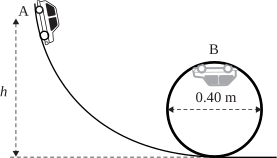
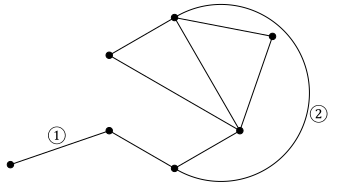
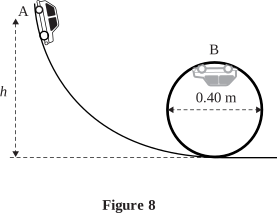
A 250 g toy car performs a loop in the apparatus shown in the diagram below. The car starts from rest at point \(\text{A}\) and travels along the track without any air resistance or retarding frictional forces. The radius of the car's path in the loop is 0.20 m. When the car reaches point \(\text{B}\) it is travelling at a speed of 3.0 m s\(^{-1}\). --- 6 WORK AREA LINES (style=lined) --- --- 6 WORK AREA LINES (style=lined) --- --- 5 WORK AREA LINES (style=lined) ---
PHYSICS, M6 2019 VCE 6
A home owner on a large property creates a backyard entertainment area. The entertainment area has a low-voltage lighting system. To operate correctly, the lighting system requires a voltage of 12 V. The lighting system has a resistance of 12 \(\Omega\). --- 3 WORK AREA LINES (style=lined) --- To operate the lighting system, the home owner installs an ideal transformer at the house to reduce the voltage from 240 V to 12 V. The home owner then runs a 200 m long heavy-duty outdoor extension lead, which has a total resistance of 3 \( \Omega\), from the transformer to the entertainment area. --- 7 WORK AREA LINES (style=lined) --- --- 4 WORK AREA LINES (style=lined) ---
PHYSICS, M6 2019 VCE 1
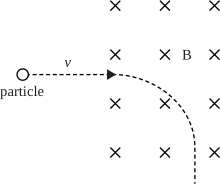
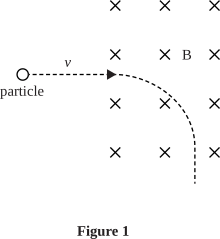
A particle of mass \(m\) and charge \(q\) travelling at velocity \(v\) enters a uniform magnetic field \(\text{B}\), as shown in the diagram. --- 2 WORK AREA LINES (style=lined) --- --- 3 WORK AREA LINES (style=lined) ---
PHYSICS, M7 2020 VCE 11
An astronaut has left Earth and is travelling on a spaceship at 0.800\(c\) directly towards the star known as Sirius, which is located 8.61 light-years away from Earth, as measured by observers on Earth. --- 4 WORK AREA LINES (style=lined) --- --- 3 WORK AREA LINES (style=lined) ---
PHYSICS, M6 2020 VCE 6
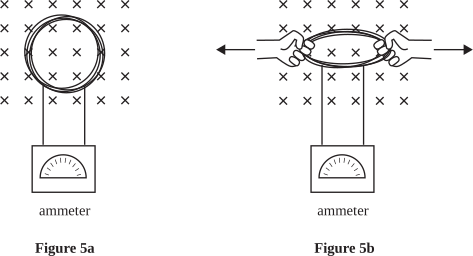
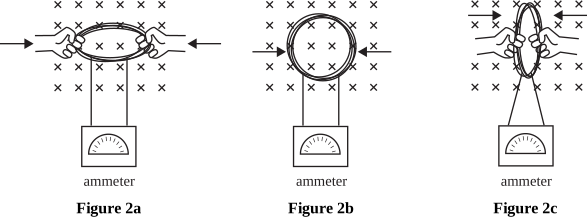
Two Physics students hold a coil of wire in a constant uniform magnetic field, as shown in Figure 5a. The ends of the wire are connected to a sensitive ammeter. The students then change the shape of the coil by pulling each side of the coil in the horizontal direction, as shown in Figure 5b. They notice a current register on the ammeter.
- Will the magnetic flux through the coil increase, decrease or stay the same as the students change the shape of the coil? (1 mark)
--- 2 WORK AREA LINES (style=blank) ---
- Explain, using physics principles, why the ammeter registered a current in the coil and determine the direction of the induced current. (3 marks)
--- 6 WORK AREA LINES (style=lined) ---
- The students then push each side of the coil together, as shown in Figure 6a, so that the coil returns to its original circular shape, as shown in Figure 6b, and then changes to the shape shown in Figure 6c.
- Describe the direction of any induced currents in the coil during these changes. Give your reasoning. (2 marks)
--- 6 WORK AREA LINES (style=lined) ---
PHYSICS, M5 2020 VCE 4*
The Ionospheric Connection Explorer (ICON) space weather satellite, constructed to study Earth's ionosphere, was launched in October 2019. ICON will study the link between space weather and Earth's weather at its orbital altitude of 600 km above Earth's surface. Assume that ICON's orbit is a circular orbit.
- Calculate the orbital radius of the ICON satellite. (1 mark)
--- 2 WORK AREA LINES (style=lined) ---
- Calculate the orbital period of the ICON satellite correct to three significant figures. Show your working. (4 marks)
--- 8 WORK AREA LINES (style=lined) ---
- Explain how the ICON satellite maintains a stable circular orbit without the use of propulsion engines. (2 marks)
--- 4 WORK AREA LINES (style=lined) ---
PHYSICS, M6 2020 VCE 3
Electron microscopes use a high-precision electron velocity selector consisting of an electric field, \(E\), perpendicular to a magnetic field, \(B\).
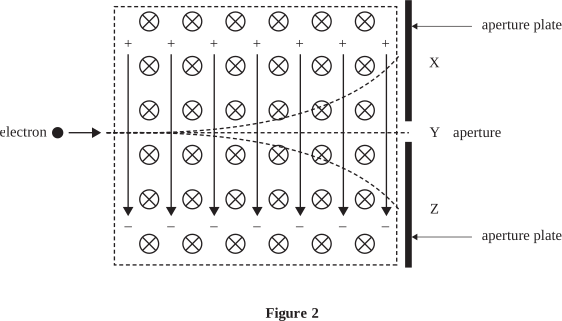
Electrons travelling at the required velocity, \(v_0\), exit the aperture at point \(\text{Y}\), while electrons travelling slower or faster than the required velocity, \(v_0\), hit the aperture plate, as shown in Figure 2.
- Show that the velocity of an electron that travels straight through the aperture to point \(\text{Y}\) is given by \( v_{0} \) = \( \dfrac{E}{B}\). (1 mark)
--- 2 WORK AREA LINES (style=lined) ---
- Calculate the magnitude of the velocity, \(v_0\), of an electron that travels straight through the aperture to point \(\text{Y}\) if \(E\) = 500 kV m\(^{-1}\) and \(B\) = 0.25 T. Show your working. (2 marks)
--- 4 WORK AREA LINES (style=lined) ---
- i. At which of the points – \(\text{X, Y}\), or \(\text{Z}\) – in Figure 2 could electrons travelling faster than \(v_0\) arrive? (1 mark)
--- 1 WORK AREA LINES (style=lined) ---
- ii. Explain your answer to part c.i. (2 marks)
--- 5 WORK AREA LINES (style=lined) ---
CHEMISTRY, M3 EQ-Bank 12
A student stirs 2.80 g of silver \(\text{(I)}\) nitrate powder into 250.0 mL of 1.00 mol L\(^{-1}\) sodium hydroxide solution until it is fully dissolved. A reaction occurs and a precipitate appears.
- Write a balanced chemical equation for the reaction. (1 mark)
--- 2 WORK AREA LINES (style=lined) ---
- Calculate the theoretical mass of precipitate that will be formed. (3 marks)
--- 8 WORK AREA LINES (style=lined) ---
The student weighed a piece of filter paper, filtered out the precipitate and dried it thoroughly in an incubator. The final precipitate mass was higher than predicted in (b).
- Identify one scientific reason why the precipitate mass was too high and suggest an improvement to the experimental method which would eliminate this error. (2 marks)
--- 4 WORK AREA LINES (style=lined) ---
CHEMISTRY, M3 EQ-Bank 11
A student stirs 2.45 g of copper \(\text{(II)}\) nitrate powder into 200.0 mL of 1.25 mol L\(^{-1}\) sodium carbonate solution until it is fully dissolved. A reaction occurs and a precipitate appears.
- Write a balanced chemical equation for the reaction. (1 mark)
--- 1 WORK AREA LINES (style=lined) ---
- Calculate the theoretical mass of precipitate that will be formed. (3 marks)
--- 6 WORK AREA LINES (style=lined) ---
The student weighed a piece of filter paper, filtered out the precipitate and dried it thoroughly in an incubator. The final precipitate mass was higher than predicted in (b).
- Identify one scientific reason why the precipitate mass was too high and suggest an improvement to the experimental method which would eliminate this error. (2 marks)
--- 5 WORK AREA LINES (style=lined) ---
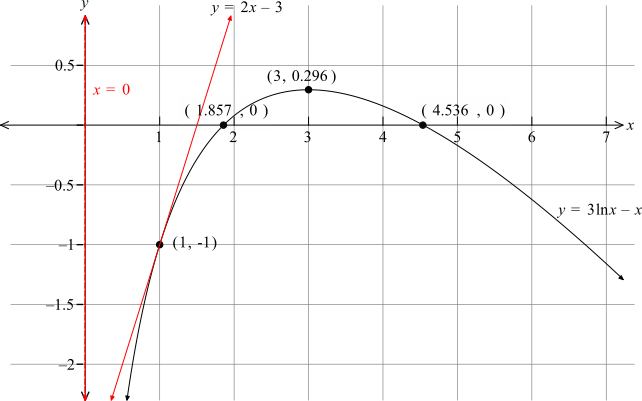
Calculus, MET2 2023 SM-Bank 1
The function \(g\) is defined as follows.
\(g:(0,7] \rightarrow R, g(x)=3\, \log _e(x)-x\)
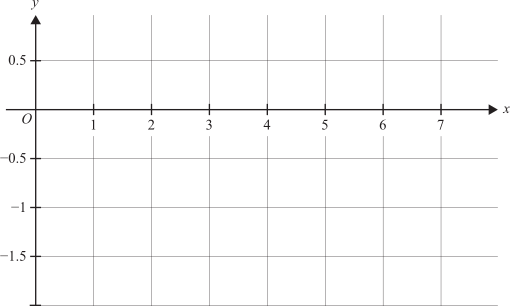
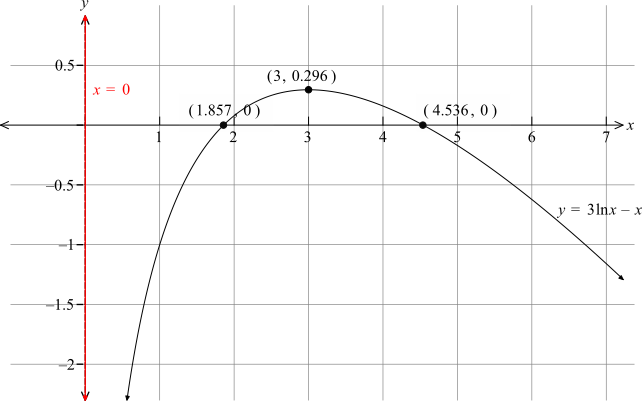
- Sketch the graph of \(g\) on the axes below. Label the vertical asymptote with its equation, and label any axial intercepts, stationary points and endpoints in coordinate form, correct to three decimal places. (3 marks)
--- 0 WORK AREA LINES (style=lined) ---
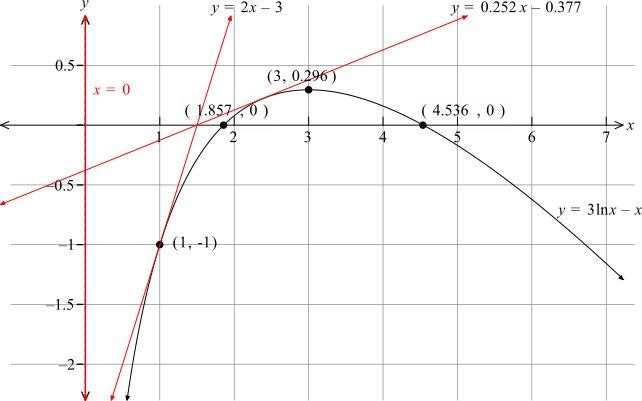
- i. Find the equation of the tangent to the graph of \(g\) at the point where \(x=1\). (1 mark)
--- 2 WORK AREA LINES (style=lined) ---
- ii. Sketch the graph of the tangent to the graph of \(g\) at \(x=1\) on the axes in part a. (1 mark)
--- 0 WORK AREA LINES (style=lined) ---
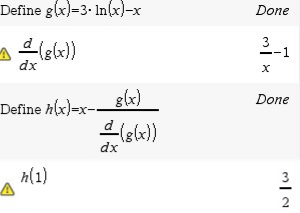
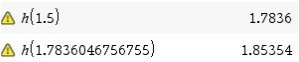
Newton's method is used to find an approximate \(x\)-intercept of \(g\), with an initial estimate of \(x_0=1\).
- Find the value of \(x_1\). (1 mark)
--- 3 WORK AREA LINES (style=lined) ---
- Find the horizontal distance between \(x_3\) and the closest \(x\)-intercept of \(g\), correct to four decimal places. (1 mark)
--- 3 WORK AREA LINES (style=lined) ---
- i. Find the value of \(k\), where \(k>1\), such that an initial estimate of \(x_0=k\) gives the same value of \(x_1\) as found in part \(c\). Give your answer correct to three decimal places. (2 marks)
--- 4 WORK AREA LINES (style=lined) ---
- ii. Using this value of \(k\), sketch the tangent to the graph of \(g\) at the point where \(x=k\) on the axes in part a. (1 mark)
--- 0 WORK AREA LINES (style=lined) ---
CHEMISTRY, M2 EQ-Bank 2
During a laboratory experiment, a gas is collected in a sealed syringe. Initially, the gas has a volume of 5.0 litres and a pressure of 1.0 atmosphere.
- Calculate the new pressure inside the syringe when the volume is decreased to 3.0 litres, assuming no temperature change. (2 marks)
--- 4 WORK AREA LINES (style=lined) ---
- After reaching the pressure calculated in part a, the volume is further decreased so that the pressure inside the syringe doubles. Calculate the final volume of the gas. (2 marks)
--- 4 WORK AREA LINES (style=lined) ---
- Discuss two potential experimental errors that could affect the accuracy of the observed results compared to the theoretical predictions of Boyle's Law. (2 marks)
--- 4 WORK AREA LINES (style=lined) ---
CHEMISTRY, M1 EQ-Bank 8
Explain why the boiling points of hydrogen halides \(\ce{(HF, HCl, HBr}\), and \(\ce{HI)}\) increase from \(\ce{HF}\) to \(\ce{HI}\).
Include in your answer the types of intermolecular forces involved and how molecular mass affects these boiling points. (3 marks)
--- 6 WORK AREA LINES (style=lined) ---
Calculus, SPEC2 2022 VCAA 3
A particle moves in a straight line so that its distance, \(x\) metres, from a fixed origin \(O\) after time \(t\) seconds is given by the differential equation \(\dfrac{d x}{d t}=\dfrac{2 e^{-x}}{1+4 t^2}\), where \(x=0\) when \(t=0\).
- i. Express the differential equation in the form \(\displaystyle \int g(x)dx=\int f(t)dt\). (1 mark)
--- 2 WORK AREA LINES (style=lined) ---
- ii. Hence, show that \(x=\log _e\left(\tan ^{-1}(2 t)+1\right)\). (2 marks)
--- 4 WORK AREA LINES (style=lined) ---
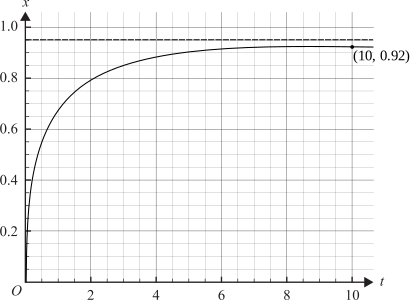
- The graph of \(x=\log _e\left(\tan ^{-1}(2 t)+1\right)\) has a horizontal asymptote.
-
- Write down the equation of this asymptote. (1 mark)
--- 3 WORK AREA LINES (style=lined) ---
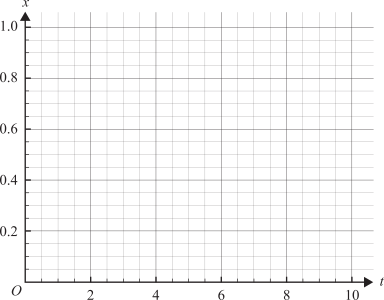
- Sketch the graph of \(x=\log _e\left(\tan ^{-1}(2 t)+1\right)\) and the horizontal asymptote on the axes below. Using coordinates, plot and label the point where \(t=10\), giving the value of \(x\) correct to two decimal places. (2 marks)
--- 3 WORK AREA LINES (style=lined) ---
- Write down the equation of this asymptote. (1 mark)
- Find the speed of the particle when \(t=3\). Give your answer in metres per second, correct to two decimal places. (1 mark)
--- 3 WORK AREA LINES (style=lined) ---
Two seconds after the first particle passed through \(O\), a second particle passes through \(O\).
Its distance \(x\) metres from \(O, t\) seconds after the first particle passed through \(O\), is given by \(x=\log _e\left(\tan ^{-1}(3 t-6)+1\right).\)
- Verify that the particles are the same distance from \(O\) when \(t=6\). (1 mark)
--- 3 WORK AREA LINES (style=lined) ---
- Find the ratio of the speed of the first particle to the speed of the second particle when the particles are at the same distance from \(O\). Give your answer as \(\dfrac{a}{b}\) in simplest form, where \(a\) and \(b\) are positive integers. (2 marks)
--- 4 WORK AREA LINES (style=lined) ---
Calculus, MET2 2022 VCAA 5
Consider the composite function `g(x)=f(\sin (2 x))`, where the function `f(x)` is an unknown but differentiable function for all values of `x`.
Use the following table of values for `f` and `f^{\prime}`.
| `\quad x \quad` | `\quad\quad 1/2\quad\quad` | `\quad\quad(sqrt{2})/2\quad\quad` | `\quad\quad(sqrt{3})/2\quad\quad` |
| `f(x)` | `-2` | `5` | `3` |
| `\quad\quad f^{prime}(x)\quad\quad` | `7` | `0` | `1/9` |
- Find the value of `g\left(\frac{\pi}{6}\right)`. (1 mark)
--- 3 WORK AREA LINES (style=lined) ---
The derivative of `g` with respect to `x` is given by `g^{\prime}(x)=2 \cdot \cos (2 x) \cdot f^{\prime}(\sin (2 x))`.
- Show that `g^{\prime}\left(\frac{\pi}{6}\right)=\frac{1}{9}`. (1 mark)
--- 2 WORK AREA LINES (style=lined) ---
- Find the equation of the tangent to `g` at `x=\frac{\pi}{6}`. (2 marks)
--- 4 WORK AREA LINES (style=lined) ---
- Find the average value of the derivative function `g^{\prime}(x)` between `x=\frac{\pi}{8}` and `x=\frac{\pi}{6}`. (2 marks)
--- 5 WORK AREA LINES (style=lined) ---
- Find four solutions to the equation `g^{\prime}(x)=0` for the interval `x \in[0, \pi]`. (3 marks)
--- 8 WORK AREA LINES (style=lined) ---
Functions, MET2 2022 VCAA 4
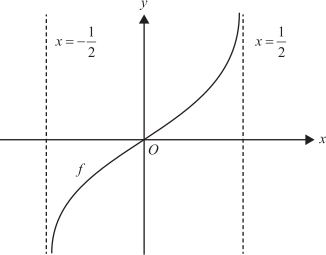
Consider the function `f`, where `f:\left(-\frac{1}{2}, \frac{1}{2}\right) \rightarrow R, f(x)=\log _e\left(x+\frac{1}{2}\right)-\log _e\left(\frac{1}{2}-x\right).`
Part of the graph of `y=f(x)` is shown below.
- State the range of `f(x)`. (1 mark)
--- 1 WORK AREA LINES (style=lined) ---
- i. Find `f^{\prime}(0)`. (2 marks)
--- 4 WORK AREA LINES (style=lined) ---
- ii. State the maximal domain over which `f` is strictly increasing. (1 mark)
--- 1 WORK AREA LINES (style=lined) ---
- Show that `f(x)+f(-x)=0`. (1 mark)
--- 3 WORK AREA LINES (style=lined) ---
- Find the domain and the rule of `f^{-1}`, the inverse of `f`. (3 marks)
--- 6 WORK AREA LINES (style=lined) ---
- Let `h` be the function `h:\left(-\frac{1}{2}, \frac{1}{2}\right) \rightarrow R, h(x)=\frac{1}{k}\left(\log _e\left(x+\frac{1}{2}\right)-\log _e\left(\frac{1}{2}-x\right)\right)`, where `k \in R` and `k>0`.
- The inverse function of `h` is defined by `h^{-1}: R \rightarrow R, h^{-1}(x)=\frac{e^{k x}-1}{2\left(e^{k x}+1\right)}`.
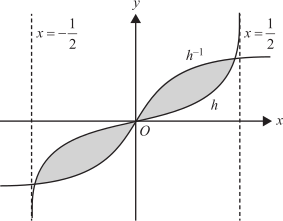
- The area of the regions bound by the functions `h` and `h^{-1}` can be expressed as a function, `A(k)`.
- The graph below shows the relevant area shaded.
- You are not required to find or define `A(k)`.
- i. Determine the range of values of `k` such that `A(k)>0`. (1 mark)
--- 2 WORK AREA LINES (style=lined) ---
- ii. Explain why the domain of `A(k)` does not include all values of `k`. (1 mark
--- 2 WORK AREA LINES (style=lined) ---
Probability, MET2 2022 VCAA 3
Mika is flipping a coin. The unbiased coin has a probability of \(\dfrac{1}{2}\) of landing on heads and \(\dfrac{1}{2}\) of landing on tails.
Let \(X\) be the binomial random variable representing the number of times that the coin lands on heads.
Mika flips the coin five times.
-
- Find \(\text{Pr}(X=5)\). (1 mark)
--- 2 WORK AREA LINES (style=lined) ---
- Find \(\text{Pr}(X \geq 2).\) (1 mark)
--- 2 WORK AREA LINES (style=lined) ---
- Find \(\text{Pr}(X \geq 2 | X<5)\), correct to three decimal places. (2 marks)
--- 4 WORK AREA LINES (style=lined) ---
- Find the expected value and the standard deviation for \(X\). (2 marks)
--- 4 WORK AREA LINES (style=lined) ---
- Find \(\text{Pr}(X=5)\). (1 mark)
The height reached by each of Mika's coin flips is given by a continuous random variable, \(H\), with the probability density function
\(f(h)=\begin{cases} ah^2+bh+c &\ \ 1.5\leq h\leq 3 \\ \\ 0 &\ \ \text{elsewhere} \\ \end{cases}\)
where \(h\) is the vertical height reached by the coin flip, in metres, between the coin and the floor, and \(a, b\) and \(c\) are real constants.
-
- State the value of the definite integral \(\displaystyle\int_{1.5}^3 f(h)\,dh\). (1 mark)
--- 5 WORK AREA LINES (style=lined) ---
- Given that \(\text{Pr}(H \leq 2)=0.35\) and \(\text{Pr}(H \geq 2.5)=0.25\), find the values of \(a, b\) and \(c\). (3 marks)
--- 5 WORK AREA LINES (style=lined) ---
-
The ceiling of Mika's room is 3 m above the floor. The minimum distance between the coin and the ceiling is a continuous random variable, \(D\), with probability density function \(g\).
- The function \(g\) is a transformation of the function \(f\) given by \(g(d)=f(rd+s)\), where \(d\) is the minimum distance between the coin and the ceiling, and \(r\) and \(s\) are real constants.
- Find the values of \(r\) and \(s\). (1 mark)
--- 5 WORK AREA LINES (style=lined) ---
- State the value of the definite integral \(\displaystyle\int_{1.5}^3 f(h)\,dh\). (1 mark)
- Mika's sister Bella also has a coin. On each flip, Bella's coin has a probability of \(p\) of landing on heads and \((1-p)\) of landing on tails, where \(p\) is a constant value between 0 and 1 .
- Bella flips her coin 25 times in order to estimate \(p\).
- Let \(\hat{P}\) be the random variable representing the proportion of times that Bella's coin lands on heads in her sample.
- Is the random variable \(\hat{P}\) discrete or continuous? Justify your answer. (1 mark)
--- 2 WORK AREA LINES (style=lined) ---
- If \(\hat{p}=0.4\), find an approximate 95% confidence interval for \(p\), correct to three decimal places. (1 mark)
--- 6 WORK AREA LINES (style=lined) ---
- Bella knows that she can decrease the width of a 95% confidence interval by using a larger sample of coin flips.
- If \(\hat{p}=0.4\), how many coin flips would be required to halve the width of the confidence interval found in part c.ii.? (1 mark)
--- 2 WORK AREA LINES (style=lined) ---
- Is the random variable \(\hat{P}\) discrete or continuous? Justify your answer. (1 mark)
Calculus, SPEC2 2022 VCAA 14 MC
A particle moving in a straight line with constant acceleration has a velocity of 7 ms\(^{-1}\) at point \(A\) and 17 ms\(^{-1}\) at point \(B\).
The velocity of the particle, in metres per second, at the midpoint of \(AB\) is
- \(\sqrt{119}\)
- \(11\)
- \(12\)
- \(13\)
- \(\sqrt{240}\)
PHYSICS, M6 2020 VCE 7 MC
An ideal transformer has an input DC voltage of 240 V, 2000 turns in the primary coil and 80 turns in the secondary coil.
The output voltage is closest to
- 0 V
- 9.6 V
- 6.0 × 10\(^{3}\) V
- 3.8 × 10\(^{7}\) V
Calculus, MET2 2022 VCAA 2
On a remote island, there are only two species of animals: foxes and rabbits. The foxes are the predators and the rabbits are their prey.
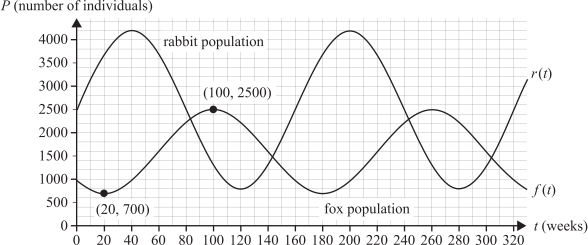
The populations of foxes and rabbits increase and decrease in a periodic pattern, with the period of both populations being the same, as shown in the graph below, for all `t \geq 0`, where time `t` is measured in weeks.
One point of minimum fox population, (20, 700), and one point of maximum fox population, (100, 2500), are also shown on the graph.
The graph has been drawn to scale.
The population of rabbits can be modelled by the rule `r(t)=1700 \sin \left(\frac{\pi t}{80}\right)+2500`.
- i. State the initial population of rabbits. (1 mark)
--- 2 WORK AREA LINES (style=lined) ---
- ii. State the minimum and maximum population of rabbits. (1 mark)
--- 2 WORK AREA LINES (style=lined) ---
- iii. State the number of weeks between maximum populations of rabbits. (1 mark)
--- 2 WORK AREA LINES (style=lined) ---
The population of foxes can be modelled by the rule `f(t)=a \sin (b(t-60))+1600`.
- Show that `a=900` and `b=\frac{\pi}{80}`. (2 marks)
--- 4 WORK AREA LINES (style=lined) ---
- Find the maximum combined population of foxes and rabbits. Give your answer correct to the nearest whole number. (1 mark)
--- 1 WORK AREA LINES (style=lined) ---
- What is the number of weeks between the periods when the combined population of foxes and rabbits is a maximum? (1 mark)
--- 1 WORK AREA LINES (style=lined) ---
The population of foxes is better modelled by the transformation of `y=\sin (t)` under `Q` given by
- Find the average population during the first 300 weeks for the combined population of foxes and rabbits, where the population of foxes is modelled by the transformation of `y=\sin(t)` under the transformation `Q`. Give your answer correct to the nearest whole number. (4 marks)
--- 8 WORK AREA LINES (style=lined) ---
Over a longer period of time, it is found that the increase and decrease in the population of rabbits gets smaller and smaller.
The population of rabbits over a longer period of time can be modelled by the rule
`s(t)=1700cdote^(-0.003t)cdot sin((pit)/80)+2500,\qquad text(for all)\ t>=0`
- Find the average rate of change between the first two times when the population of rabbits is at a maximum. Give your answer correct to one decimal place. (2 marks)
--- 3 WORK AREA LINES (style=lined) ---
- Find the time, where `t>40`, in weeks, when the rate of change of the rabbit population is at its greatest positive value. Give your answer correct to the nearest whole number. (2 marks)
--- 3 WORK AREA LINES (style=lined) ---
- Over time, the rabbit population approaches a particular value.
- State this value. (1 mark)
--- 1 WORK AREA LINES (style=lined) ---
Calculus, MET2 2022 VCAA 1
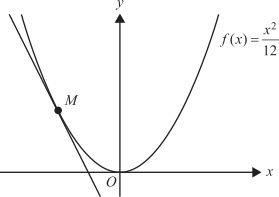
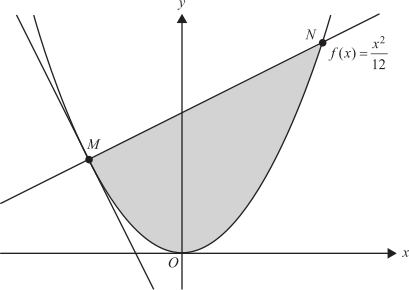
The diagram below shows part of the graph of `y=f(x)`, where `f(x)=\frac{x^2}{12}`.
- State the equation of the axis of symmetry of the graph of `f`. (1 mark)
--- 2 WORK AREA LINES (style=lined) ---
- State the derivative of `f` with respect to `x`. (1 mark)
--- 2 WORK AREA LINES (style=lined) ---
The tangent to `f` at point `M` has gradient `-2` .
- Find the equation of the tangent to `f` at point `M`. (2 marks)
--- 6 WORK AREA LINES (style=lined) ---
The diagram below shows part of the graph of `y=f(x)`, the tangent to `f` at point `M` and the line perpendicular to the tangent at point `M`.
- i. Find the equation of the line perpendicular to the tangent passing through point `M`. (1 mark)
--- 5 WORK AREA LINES (style=lined) ---
- ii. The line perpendicular to the tangent at point `M` also cuts `f` at point `N`, as shown in the diagram above.
- Find the area enclosed by this line and the curve `y=f(x)`. (2 marks)
--- 8 WORK AREA LINES (style=lined) ---
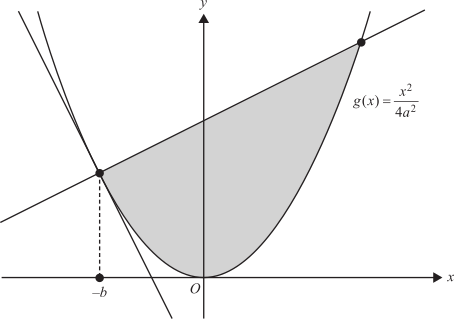
- Another parabola is defined by the rule `g(x)=\frac{x^2}{4 a^2}`, where `a>0`.
- A tangent to `g` and the line perpendicular to the tangent at `x=-b`, where `b>0`, are shown below.
- Find the value of `b`, in terms of `a`, such that the shaded area is a minimum. (4 marks)
--- 8 WORK AREA LINES (style=lined) ---
Probability, MET2 2022 VCAA 20 MC
A soccer player kicks a ball with an angle of elevation of `theta` °, where `theta` is a normally distributed random variable with a mean of 42° and a standard deviation of 8°.
The horizontal distance that the ball travels before landing is given by the function `d=50 \ sin (2\theta)`.
The probability that the ball travels more than 40 m horizontally before landing is closest to
- 0.969
- 0.937
- 0.226
- 0.149
- 0.027
Calculus, SPEC2 2022 VCAA 10 MC
Consider the curve given by `5 x^2 y-3 x y+y^2=10`.
The equation of the tangent to this curve at the point `(1, m)`, where `m` is a real constant, will have a negative gradient when
- `m \in R \backslash[-1,0]`
- `m=-\sqrt{11}-1 \ text {only}`
- `m \in R \backslash(-1,0]`
- `m=\sqrt{11}-1 \ text[only]`
- `m=-\sqrt{11}-1 or m=\sqrt{11}-1`
Calculus, MET2 2023 VCAA 3
Consider the function \(g:R \to R, g(x)=2^x+5\).
- State the value of \(\lim\limits_{x\to -\infty} g(x)\). (1 mark)
--- 1 WORK AREA LINES (style=lined) ---
- The derivative, \(g^{'}(x)\), can be expressed in the form \(g^{'}(x)=k\times 2^x\).
- Find the real number \(k\). (1 mark)
--- 2 WORK AREA LINES (style=lined) ---
-
i. Let \(a\) be a real number. Find, in terms of \(a\), the equation of the tangent to \(g\) at the point \(\big(a, g(a)\big)\). (1 mark)ii. Hence, or otherwise, find the equation of the tangent to \(g\) that passes through the origin, correct to three decimal places. (2 marks)
--- 3 WORK AREA LINES (style=lined) ---
--- 8 WORK AREA LINES (style=lined) ---
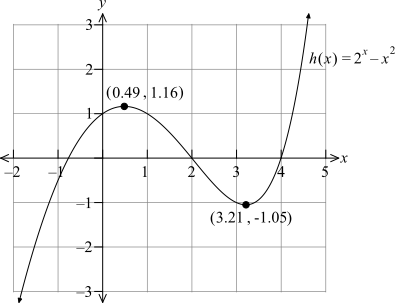
Let \(h:R\to R, h(x)=2^x-x^2\).
- Find the coordinates of the point of inflection for \(h\), correct to two decimal places. (1 mark)
--- 2 WORK AREA LINES (style=lined) ---
- Find the largest interval of \(x\) values for which \(h\) is strictly decreasing.
- Give your answer correct to two decimal places. (1 mark)
--- 2 WORK AREA LINES (style=lined) ---
- Apply Newton's method, with an initial estimate of \(x_0=0\), to find an approximate \(x\)-intercept of \(h\).
- Write the estimates \(x_1, x_2,\) and \(x_3\) in the table below, correct to three decimal places. (2 marks)
\begin{array} {|c|c|}
\hline
\rule{0pt}{2.5ex} \qquad x_0\qquad \ \rule[-1ex]{0pt}{0pt} & \qquad \qquad 0 \qquad\qquad \\
\hline
\rule{0pt}{2.5ex} x_1 \rule[-1ex]{0pt}{0pt} & \\
\hline
\rule{0pt}{2.5ex} x_2 \rule[-1ex]{0pt}{0pt} & \\
\hline
\rule{0pt}{2.5ex} x_3 \rule[-1ex]{0pt}{0pt} & \\
\hline
\end{array}
--- 0 WORK AREA LINES (style=lined) ---
- For the function \(h\), explain why a solution to the equation \(\log_e(2)\times (2^x)-2x=0\) should not be used as an initial estimate \(x_0\) in Newton's method. (1 mark)
--- 3 WORK AREA LINES (style=lined) ---
- There is a positive real number \(n\) for which the function \(f(x)=n^x-x^n\) has a local minimum on the \(x\)-axis.
- Find this value of \(n\). (2 marks)
--- 5 WORK AREA LINES (style=lined) ---
PHYSICS, M6 2021 VCE 5
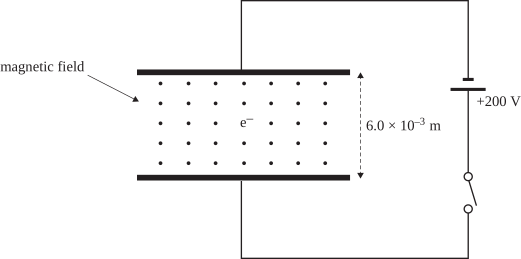
The digram shows shows a stationary electron (e\(^{-}\)) in a uniform magnetic field between two parallel plates. The plates are separated by a distance of 6.0 × 10\(^{-3}\) m, and they are connected to a 200 V power supply and a switch. Initially, the plates are uncharged. Assume that gravitational effects on the electron are negligible. --- 3 WORK AREA LINES (style=lined) --- The switch is now closed. --- 5 WORK AREA LINES (style=lined) --- Ravi and Mia discuss what they think will happen regarding the size and the direction of the magnetic force on the electron after the switch is closed. Ravi says that there will be a magnetic force of constant magnitude, but it will be continually changing direction. Mia says that there will be a constantly increasing magnetic force, but it will always be acting in the same direction. Evaluate these two statements, giving clear reasons for your answer. (4 marks) --- 8 WORK AREA LINES (style=lined) ---
PHYSICS, M6 2021 VCE 2
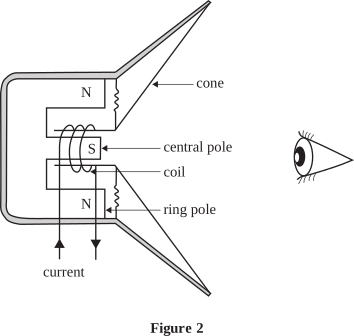
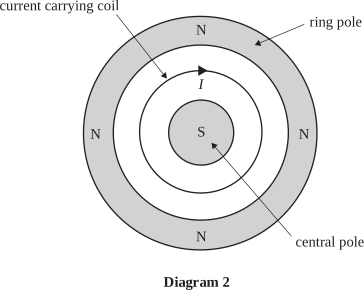
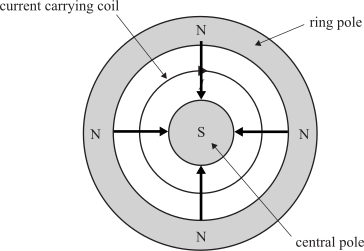
A schematic side view of one design of an audio loudspeaker is shown in Diagram 1 below. It uses a current carrying coil that interacts with permanent magnets to create sound by moving a cone in and out. Diagram 2 shows a schematic view of the loudspeaker from the position of the eye shown in Diagram 1. The direction of the current is clockwise, as shown. --- 0 WORK AREA LINES (style=lined) --- --- 1 WORK AREA LINES (style=lined) --- --- 6 WORK AREA LINES (style=lined) ---
A.
left
B.
right
C.
up the page
D.
down the page
E.
into the page
F.
out of the page
Functions, MET2 2023 VCAA 2
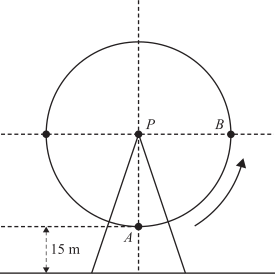
The following diagram represents an observation wheel, with its centre at point \(P\). Passengers are seated in pods, which are carried around as the wheel turns. The wheel moves anticlockwise with constant speed and completes one full rotation every 30 minutes.When a pod is at the lowest point of the wheel (point \(A\)), it is 15 metres above the ground. The wheel has a radius of 60 metres.
Consider the function \(h(t)=-60\ \cos(bt)+c\) for some \(b, c \in R\), which models the height above the ground of a pod originally situated at point \(A\), after time \(t\) minutes.
- Show that \(b=\dfrac{\pi}{15}\) and \(c=75\). (2 marks)
--- 5 WORK AREA LINES (style=lined) ---
- Find the average height of a pod on the wheel as it travels from point \(A\) to point \(B\).
- Give your answer in metres, correct to two decimal places. (2 marks)
--- 3 WORK AREA LINES (style=lined) ---
- Find the average rate of change, in metres per minute, of the height of a pod on the wheel as it travels from point \(A\) to point \(B\). (1 mark)
--- 3 WORK AREA LINES (style=lined) ---
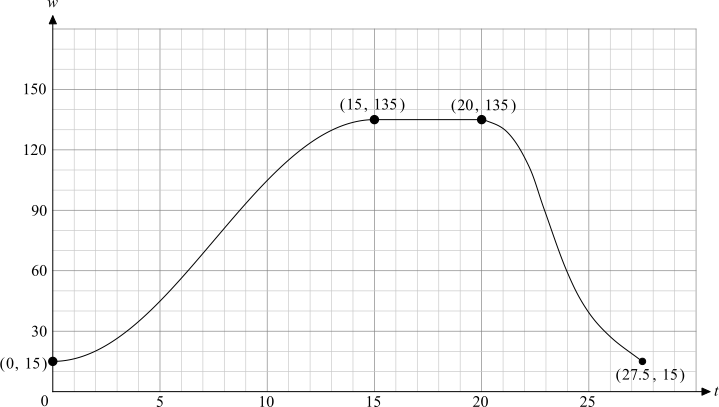
After 15 minutes, the wheel stops moving and remains stationary for 5 minutes. After this, it continues moving at double its previous speed for another 7.5 minutes.
The height above the ground of a pod that was initially at point \(A\), after \(t\) minutes, can be modelled by the piecewise function \(w\):
\(w(t) = \begin {cases}
h(t) &\ \ 0 \leq t < 15 \\
k &\ \ 15 \leq t < 20 \\
h(mt+n) &\ \ 20\leq t\leq 27.5
\end{cases}\)
where \(k\geq 0, m\geq 0\) and \(n \in R\).
- i.State the values of \(k\) and \(m\). (1 mark)
--- 2 WORK AREA LINES (style=lined) ---
ii. Find all possible values of \(n\). (2 marks)--- 4 WORK AREA LINES (style=lined) ---
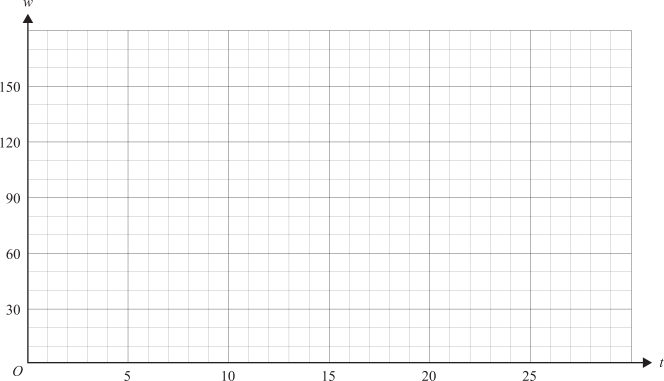
iii. Sketch the graph of the piecewise function \(w\) on the axes below, showing the coordinates of the endpoints. (3 marks)
Calculus, MET2 2023 VCAA 1
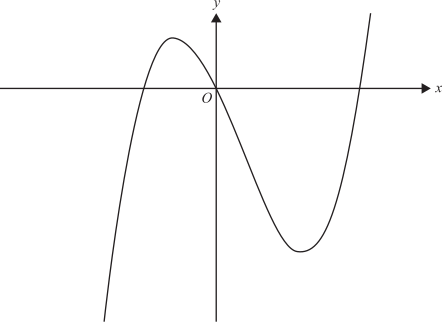
Let \(f:R \rightarrow R, f(x)=x(x-2)(x+1)\). Part of the graph of \(f\) is shown below.
- State the coordinates of all axial intercepts of \(f\). (1 mark)
--- 2 WORK AREA LINES (style=lined) ---
- Find the coordinates of the stationary points of \(f\). (2 marks)
--- 3 WORK AREA LINES (style=lined) ---
-
- Let \(g:R\rightarrow R, g(x)=x-2\).
- Find the values of \(x\) for which \(f(x)=g(x)\). (1 mark)
--- 3 WORK AREA LINES (style=lined) ---
-
- Write down an expression using definite integrals that gives the area of the regions bound by \(f\) and \(g\). (2 marks)
--- 4 WORK AREA LINES (style=lined) ---
- Hence, find the total area of the regions bound by \(f\) and \(g\), correct to two decimal places. (1 mark)
--- 2 WORK AREA LINES (style=lined) ---
- Write down an expression using definite integrals that gives the area of the regions bound by \(f\) and \(g\). (2 marks)
- Let \(h:R\rightarrow R, h(x)=(x-a)(x-b)^2\), where \(h(x)=f(x)+k\) and \(a, b, k \in R\).
- Find the possible values of \(a\) and \(b\). (4 marks)
--- 9 WORK AREA LINES (style=lined) ---
PHYSICS, M5 2022 VCE 2
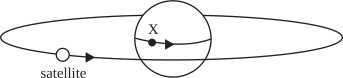
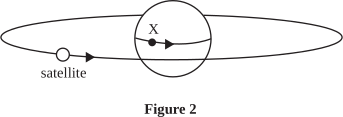
There are over 400 geostationary satellites above Earth in circular orbits. The period of orbit is one day (86 400 seconds). Each geostationary satellite remains stationary in relation to a fixed point on the equator. The diagram shows an example of a geostationary satellite that is in orbit relative to a fixed point, \(\text{X}\), on the equator. --- 4 WORK AREA LINES (style=lined) --- --- 8 WORK AREA LINES (style=lined) --- --- 7 WORK AREA LINES (style=lined) ---
Complex Numbers, SPEC2 2023 VCAA 2
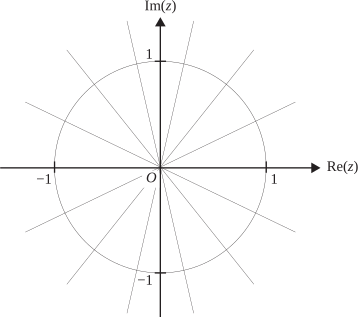
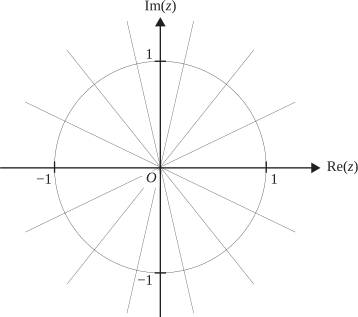
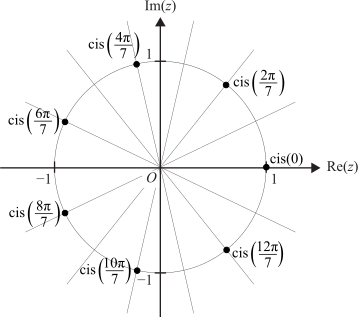
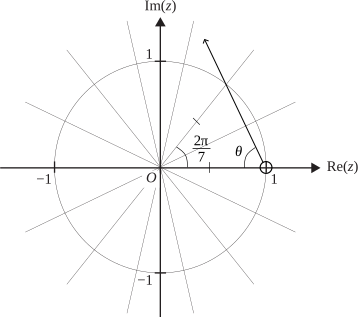
Let \(w=\text{cis}\left(\dfrac{2 \pi}{7}\right)\). --- 2 WORK AREA LINES (style=lined) --- --- 2 WORK AREA LINES (style=lined) --- --- 0 WORK AREA LINES (style=blank) --- --- 0 WORK AREA LINES (style=lined) --- --- 3 WORK AREA LINES (style=lined) --- --- 4 WORK AREA LINES (style=lined) --- --- 3 WORK AREA LINES (style=lined) --- use De Moivre's theorem to show that --- 8 WORK AREA LINES (style=lined) ---
Probability, MET2 2023 VCAA 4
A manufacturer produces tennis balls.
The diameter of the tennis balls is a normally distributed random variable \(D\), which has a mean of 6.7 cm and a standard deviation of 0.1 cm.
- Find \(\Pr(D>6.8)\), correct to four decimal places. (1 mark)
--- 1 WORK AREA LINES (style=lined) ---
- Find the minimum diameter of a tennis ball that is larger than 90% of all tennis balls produced.
- Give your answer in centimetres, correct to two decimal places. (1 mark)
--- 2 WORK AREA LINES (style=lined) ---
Tennis balls are packed and sold in cylindrical containers. A tennis ball can fit through the opening at the top of the container if its diameter is smaller than 6.95 cm.
- Find the probability that a randomly selected tennis ball can fit through the opening at the top of the container.
- Give your answer correct to four decimal places. (1 mark)
--- 2 WORK AREA LINES (style=lined) ---
- In a random selection of 4 tennis balls, find the probability that at least 3 balls can fit through the opening at the top of the container.
- Give your answer correct to four decimal places. (2 marks)
--- 2 WORK AREA LINES (style=lined) ---
A tennis ball is classed as grade A if its diameter is between 6.54 cm and 6.86 cm, otherwise it is classed as grade B.
- Given that a tennis ball can fit through the opening at the top of the container, find the probability that it is classed as grade A.
- Give your answer correct to four decimal places. (2 marks)
--- 4 WORK AREA LINES (style=lined) ---
- The manufacturer would like to improve processes to ensure that more than 99% of all tennis balls produced are classed as grade A.
- Assuming that the mean diameter of the tennis balls remains the same, find the required standard deviation of the diameter, in centimetres, correct to two decimal places. (2 marks)
--- 5 WORK AREA LINES (style=lined) ---
- An inspector takes a random sample of 32 tennis balls from the manufacturer and determines a confidence interval for the population proportion of grade A balls produced.
- The confidence interval is (0.7382, 0.9493), correct to four decimal places.
- Find the level of confidence that the population proportion of grade A balls is within the interval, as a percentage correct to the nearest integer. (2 marks)
--- 5 WORK AREA LINES (style=lined) ---
A tennis coach uses both grade A and grade B balls. The serving speed, in metres per second, of a grade A ball is a continuous random variable, \(V\), with the probability density function
\(f(v) = \begin {cases}
\dfrac{1}{6\pi}\sin\Bigg(\sqrt{\dfrac{v-30}{3}}\Bigg) &\ \ 30 \leq v \leq 3\pi^2+30 \\
0 &\ \ \text{elsewhere}
\end{cases}\)
- Find the probability that the serving speed of a grade A ball exceeds 50 metres per second.
- Give your answer correct to four decimal places. (1 mark)
--- 2 WORK AREA LINES (style=lined) ---
- Find the exact mean serving speed for grade A balls, in metres per second. (1 mark)
--- 3 WORK AREA LINES (style=lined) ---
The serving speed of a grade B ball is given by a continuous random variable, \(W\), with the probability density function \(g(w)\).
A transformation maps the graph of \(f\) to the graph of \(g\), where \(g(w)=af\Bigg(\dfrac{w}{b}\Bigg)\).
- If the mean serving speed for a grade B ball is \(2\pi^2+8\) metres per second, find the values of \(a\) and \(b\). (2 marks)
--- 5 WORK AREA LINES (style=lined) ---
Calculus, MET2 2023 VCAA 5
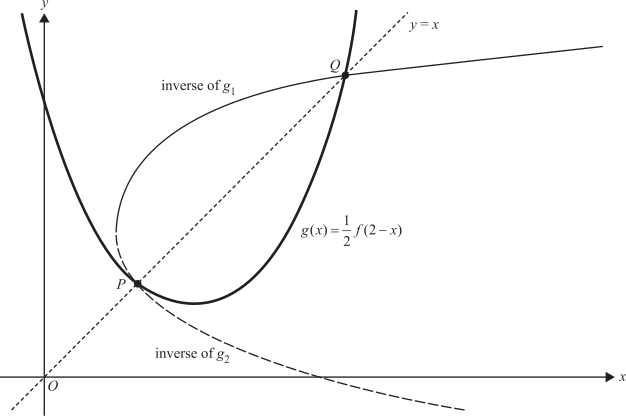
Let \(f:R \to R, f(x)=e^x+e^{-x}\) and \(g:R \to R, g(x)=\dfrac{1}{2}f(2-x)\).
- Complete a possible sequence of transformations to map \(f\) to \(g\). (2 marks)
• Dilation of factor \(\dfrac{1}{2}\) from the \(x\) axis.--- 2 WORK AREA LINES (style=lined) ---
Two functions \(g_1\) and \(g_2\) are created, both with the same rule as \(g\) but with distinct domains, such that \(g_1\) is strictly increasing and \(g_2\) is strictly decreasing.
- Give the domain and range for the inverse of \(g_1\). (2 marks)
--- 3 WORK AREA LINES (style=lined) ---
Shown below is the graph of \(g\), the inverse of \(g_1\) and \(g_2\), and the line \(y=x\).
The intersection points between the graphs of \(y=x, y=g(x)\) and the inverses of \(g_1\) and \(g_2\), are labelled \(P\) and \(Q\).
-
- Find the coordinates of \(P\) and \(Q\), correct to two decimal places. (1 mark)
--- 2 WORK AREA LINES (style=lined) ---
- Find the coordinates of \(P\) and \(Q\), correct to two decimal places. (1 mark)
-
- Find the area of the region bound by the graphs of \(g\), the inverse of \(g_1\) and the inverse of \(g_2\).
- Give your answer correct to two decimal places. (2 marks)
--- 4 WORK AREA LINES (style=lined) ---
Let \(h:R\to R, h(x)=\dfrac{1}{k}f(k-x)\), where \(k\in (o, \infty)\).
- The turning point of \(h\) always lies on the graph of the function \(y=2x^n\), where \(n\) is an integer.
- Find the value of \(n\). (1 mark)
--- 2 WORK AREA LINES (style=lined) ---
Let \(h_1:[k, \infty)\to R, h_1(x)=h(x)\).
The rule for the inverse of \(h_1\) is \(y=\log_{e}\Bigg(\dfrac{1}{k}x+\dfrac{1}{2}\sqrt{k^2x^2-4}\Bigg)+k\)
- What is the smallest value of \(k\) such that \(h\) will intersect with the inverse of \(h_1\)?\
- Give your answer correct to two decimal places. (1 mark)
--- 3 WORK AREA LINES (style=lined) ---
It is possible for the graphs of \(h\) and the inverse of \(h_1\) to intersect twice. This occurs when \(k=5\).
- Find the area of the region bound by the graphs of \(h\) and the inverse of \(h_1\), where \(k=5\).
- Give your answer correct to two decimal places. (2 marks)
--- 5 WORK AREA LINES (style=lined) ---
Calculus, MET2 2023 VCAA 11 MC
Two functions, \(f\) and \(g\), are continuous and differentiable for all \(x\in R\). It is given that \(f(-2)=-7,\ g(-2)=8\) and \(f^{′}(-2)=3,\ g^{′}(-2)=2\).
The gradient of the graph \(y=f(x)\times g(x)\) at the point where \(x=-2\) is
- \(-10\)
- \(-6\)
- \(0\)
- \(6\)
- \(10\)
Calculus, MET1 2022 VCAA 8
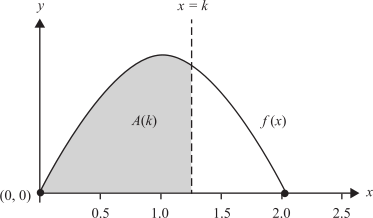
Part of the graph of `y=f(x)` is shown below. The rule `A(k)=k \ sin(k)` gives the area bounded by the graph of `f`, the horizontal axis and the line `x=k`.
- State the value of `A\left(\frac{\pi}{3}\right)`. (1 mark)
--- 2 WORK AREA LINES (style=lined) ---
- Evaluate `f\left(\frac{\pi}{3}\right)`. (2 marks)
--- 6 WORK AREA LINES (style=lined) ---
- Consider the average value of the function `f` over the interval `x \in[0, k]`, where `k \in[0,2]`.
- Find the value of `k` that results in the maximum average value. (2 marks)
--- 6 WORK AREA LINES (style=lined) ---
Calculus, MET1 2022 VCAA 7
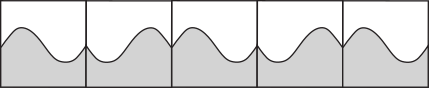
A tilemaker wants to make square tiles of size 20 cm × 20 cm.
The front surface of the tiles is to be painted with two different colours that meet the following conditions:
- Condition 1 - Each colour covers half the front surface of a tile.
- Condition 2 - The tiles can be lined up in a single horizontal row so that the colours form a continuous pattern.
An example is shown below.
There are two types of tiles: Type A and Type B.
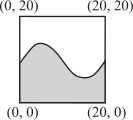
For Type A, the colours on the tiles are divided using the rule `f(x)=4 \sin \left(\frac{\pi x}{10}\right)+a`, where `a \in R`.
The corners of each tile have the coordinates (0,0), (20,0), (20,20) and (0,20), as shown below.
- i. Find the area of the front surface of each tile. (1 mark)
--- 2 WORK AREA LINES (style=lined) ---
ii. Find the value of `a` so that a Type A tile meets Condition 1. (1 mark)
--- 2 WORK AREA LINES (style=lined) ---
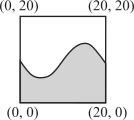
Type B tiles, an example of which is shown below, are divided using the rule `g(x)=-\frac{1}{100} x^3+\frac{3}{10} x^2-2 x+10`.
- Show that a Type B tile meets Condition 1. (3 marks)
--- 8 WORK AREA LINES (style=lined) ---
- Determine the endpoints of `f(x)` and `g(x)` on each tile. Hence, use these values to confirm that Type A and Type B tiles can be placed in any order to produce a continuous pattern in order to meet Condition 2. (2 marks)
--- 8 WORK AREA LINES (style=lined) ---
Graphs, MET1 2022 VCAA 6
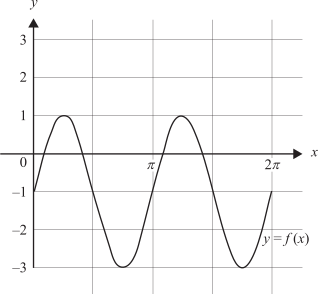
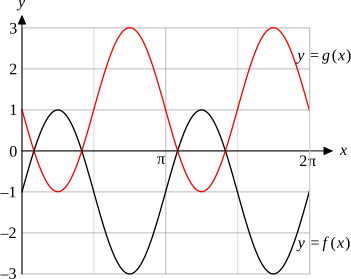
The graph of `y=f(x)`, where `f:[0,2 \pi] \rightarrow R, f(x)=2 \sin(2x)-1`, is shown below.
- On the axes above, draw the graph of `y=g(x)`, where `g(x)` is the reflection of `f(x)` in the horizontal axis. (2 marks)
--- 0 WORK AREA LINES (style=lined) ---
- Find all values of `k` such that `f(k)=0` and `k \in[0,2 \pi]`. (3 marks)
--- 5 WORK AREA LINES (style=lined) ---
- Let `h: D \rightarrow R, h(x)=2 \sin(2x)-1`, where `h(x)` has the same rule as `f(x)` with a different domain.
- The graph of `y=h(x)` is translated `a` units in the positive horizontal direction and `b` units in the positive vertical direction so that it is mapped onto the graph of `y=g(x)`, where `a, b \in(0, \infty)`.
-
- Find the value for `b`. (1 mark)
--- 2 WORK AREA LINES (style=lined) ---
- Find the smallest positive value for `a`. (1 mark)
--- 2 WORK AREA LINES (style=lined) ---
- Hence, or otherwise, state the domain, `D`, of `h(x)`. (1 mark)
--- 2 WORK AREA LINES (style=lined) ---
- Find the value for `b`. (1 mark)
Calculus, MET1 2023 VCAA 9
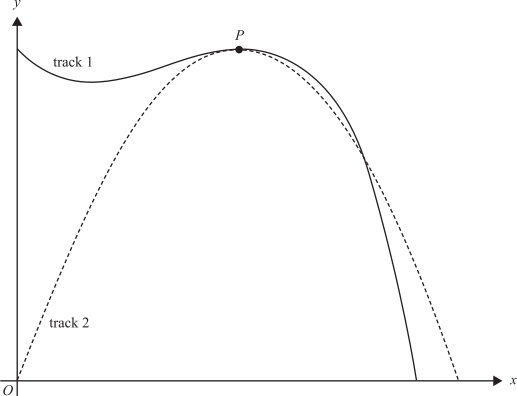
The shapes of two walking tracks are shown below.
Track 1 is described by the function \(f(x)=a-x(x-2)^2\).
Track 2 is defined by the function \(g(x)=12x-bx^2\).
The unit of length is kilometres.
- Given that \(f(0)=12\) and \(g(1)=9\), verify that \(a=12\) and \(b=-3\). (1 mark)
--- 4 WORK AREA LINES (style=lined) ---
- Verify that \(f(x)\) and \(g(x)\) both have a turning point at \(P\).
- Give the co-ordinates of \(P\). (2 marks)
--- 8 WORK AREA LINES (style=lined) ---
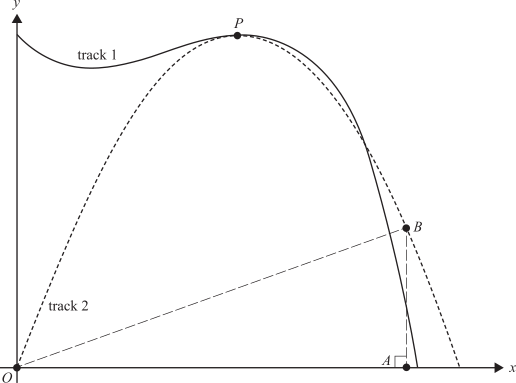
- A theme park is planned whose boundaries will form the triangle \(\Delta OAB\) where \(O\) is the origin, \(A\) is at \((k, 0)\) and \(B\) is at \((k, g(k))\), as shown below, where \(k \in (0, 4)\).
- Find the maximum possible area of the theme park, in km². (3 marks)
--- 12 WORK AREA LINES (style=lined) ---
Statistics, MET1 2023 VCAA 6
Let \(\hat{P}\) be the random variable that represents the sample proportion of households in a given suburb that have solar panels installed.
From a sample of randomly selected households in a given suburb, an approximate 95% confidence interval for the proportion \(p\) of households having solar panels installed was determined to be (0.04, 0.16).
- Find the value of \(\hat{p}\) that was used to obtain this approximate 95% confidence interval. (1 mark)
--- 2 WORK AREA LINES (style=lined) ---
Use \(z=2\) to approximate the 95% confidence interval.
- Find the size of the sample from which this 95% confidence interval was obtained. (2 marks)
--- 5 WORK AREA LINES (style=lined) ---
- A larger sample of households is selected, with a sample size four times the original sample.
- The sample proportion of households having solar panels installed is found to be the same.
- By what factor will the increased sample size affect the width of the confidence interval? (1 mark)
--- 3 WORK AREA LINES (style=lined) ---
Probability, MET1 2023 VCAA 8
Suppose that the queuing time, \(T\) (in minutes), at a customer service desk has a probability density function given by
\(f(t) = \begin {cases}
kt(16-t^2) &\ \ 0 \leq t \leq 4 \\
\\
0 &\ \ \text{elsewhere}
\end{cases}\)
for some \(K \in R\).
- Show that \(k=\dfrac{1}{64}\). (1 mark)
--- 5 WORK AREA LINES (style=lined) ---
- Find \(\text{E}(T)\). (2 marks)
--- 6 WORK AREA LINES (style=lined) ---
- What is the probability that a person has to queue for more than two minutes, given that they have already queued for one minute? (3 marks)
--- 12 WORK AREA LINES (style=blank) ---
Networks, GEN2 2023 VCAA 14
One of the landmarks in state \(A\) requires a renovation project.
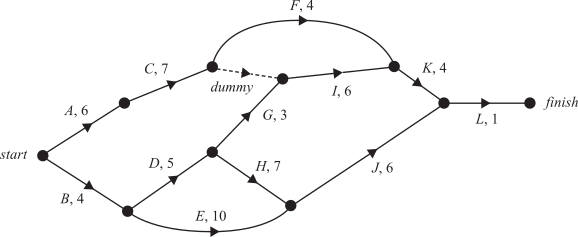
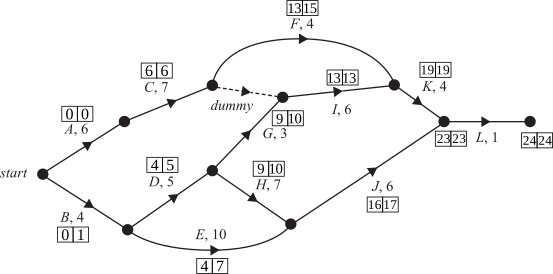
This project involves 12 activities, \(A\) to \(L\). The directed network below shows these activities and their completion times, in days.
The table below shows the 12 activities that need to be completed for the renovation project.
It also shows the earliest start time (EST), the duration, and the immediate predecessors for the activities.
The immediate predecessor(s) for activity \(I\) and the EST for activity \(J\) are missing.
\begin{array} {|c|c|c|}
\hline
\quad \textbf{Activity} \quad & \quad\quad\textbf{EST} \quad\quad& \quad\textbf{Duration}\quad & \textbf{Immediate} \\
& & & \textbf{predecessor(s)} \\
\hline
\rule{0pt}{2.5ex} A \rule[-1ex]{0pt}{0pt} & 0 & 6 & - \\
\hline
\rule{0pt}{2.5ex} B \rule[-1ex]{0pt}{0pt} & 0 & 4 & - \\
\hline
\rule{0pt}{2.5ex} C \rule[-1ex]{0pt}{0pt} & 6 & 7 & A \\
\hline
\rule{0pt}{2.5ex} D \rule[-1ex]{0pt}{0pt} & 4 & 5 & B \\
\hline
\rule{0pt}{2.5ex} E \rule[-1ex]{0pt}{0pt} & 4 & 10 & B \\
\hline
\rule{0pt}{2.5ex} F \rule[-1ex]{0pt}{0pt} & 13 & 4 & C \\
\hline
\rule{0pt}{2.5ex} G \rule[-1ex]{0pt}{0pt} & 9 & 3 & D \\
\hline
\rule{0pt}{2.5ex} H \rule[-1ex]{0pt}{0pt} & 9 & 7 & D \\
\hline
\rule{0pt}{2.5ex} I \rule[-1ex]{0pt}{0pt} & 13 & 6 & - \\
\hline
\rule{0pt}{2.5ex} J \rule[-1ex]{0pt}{0pt} & - & 6 & E, H \\
\hline
\rule{0pt}{2.5ex} K \rule[-1ex]{0pt}{0pt} & 19 & 4 & F, I \\
\hline
\rule{0pt}{2.5ex} L \rule[-1ex]{0pt}{0pt} & 23 & 1 & J, K \\
\hline
\end{array}
- Write down the immediate predecessor(s) for activity \(I\). (1 mark)
--- 1 WORK AREA LINES (style=lined) ---
- What is the earliest start time, in days, for activity \(J\) ? (1 mark)
--- 1 WORK AREA LINES (style=lined) ---
- How many activities have a float time of zero? (1 mark)
--- 1 WORK AREA LINES (style=lined) ---
The managers of the project are able to reduce the time, in days, of six activities.
These reductions will result in an increase in the cost of completing the activity.
The maximum decrease in time of any activity is two days.
\begin{array} {|l|c|}
\hline
\rule{0pt}{2.5ex} \textbf{Activity} \rule[-1ex]{0pt}{0pt} & \quad A \quad & \quad B \quad& \quad F \quad & \quad H \quad & \quad I \quad & \quad K \quad \\
\hline
\rule{0pt}{2.5ex} \textbf{Daily cost (\$)} \rule[-1ex]{0pt}{0pt} & 1500 & 2000 & 2500 & 1000 & 1500 & 3000 \\
\hline
\end{array}
- If activities \(A\) and \(B\) have their completion time reduced by two days each, the overall completion time of the project will be reduced.
- What will be the maximum reduction time, in days? (1 mark)
--- 2 WORK AREA LINES (style=lined) ---
- The managers of the project have a maximum budget of $15 000 to reduce the time for several activities to produce the maximum reduction in the project's overall completion time.
- Complete the table below, showing the reductions in individual activity completion times that would achieve the earliest completion time within the $ 15 000 budget. (1 mark)
--- 0 WORK AREA LINES (style=lined) ---
\begin{array} {|c|c|}
\hline
\quad\textbf{Activity} \quad & \textbf{Reduction in completion time} \\
& \textbf{(0, 1 or 2 days)}\\
\hline
\rule{0pt}{2.5ex} A \rule[-1ex]{0pt}{0pt} & \\
\hline
\rule{0pt}{2.5ex} B \rule[-1ex]{0pt}{0pt} & \\
\hline
\rule{0pt}{2.5ex} F \rule[-1ex]{0pt}{0pt} & \\
\hline
\rule{0pt}{2.5ex} H \rule[-1ex]{0pt}{0pt} & \\
\hline
\rule{0pt}{2.5ex} I \rule[-1ex]{0pt}{0pt} & \\
\hline
\rule{0pt}{2.5ex} K \rule[-1ex]{0pt}{0pt} & \\
\hline
\end{array}
Networks, GEN2 2023 VCAA 13
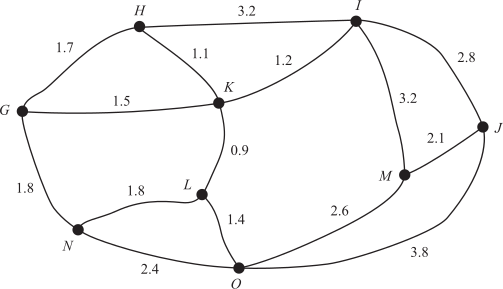
The state \(A\) has nine landmarks, \(G, H, I, J, K, L, M, N\) and \(O\).
The edges on the graph represent the roads between the landmarks.
The numbers on each edge represent the length, in kilometres, along each road.
Three friends, Eden, Reynold and Shyla, meet at landmark \(G\).
- Eden would like to visit landmark \(M\).
- What is the minimum distance Eden could travel from \(G\) to \(M\) ? (1 mark)
--- 1 WORK AREA LINES (style=lined) ---
- Reynold would like to visit all the landmarks and return to \(G\).
- Write down a route that Reynold could follow to minimise the total distance travelled. (1 mark)
--- 1 WORK AREA LINES (style=lined) ---
- Shyla would like to travel along all the roads.
- To complete this journey in the minimum distance, she will travel along two roads twice.
- Shyla will leave from landmark \(G\) but end at a different landmark.
- Complete the following by filling in the boxes provided.
- The two roads that will be travelled along twice are the roads between: (1 mark)
--- 0 WORK AREA LINES (style=lined) ---
Financial Maths, GEN2 2023 VCAA 7
Arthur takes out a new loan of $60 000 to pay for an overseas holiday. Interest on this loan compounds weekly. The balance of the loan, in dollars, after \(n\) weeks, \(V_n\), can be determined using a recurrence relation of the form \(V_0=60\ 000, \quad V_{n+1}=1.0015\,V_n-d\) --- 2 WORK AREA LINES (style=lined) --- --- 2 WORK AREA LINES (style=lined) --- --- 3 WORK AREA LINES (style=lined) --- --- 3 WORK AREA LINES (style=lined) --- --- 2 WORK AREA LINES (style=lined) ---
Networks, GEN1 2022 VCAA 4 MC
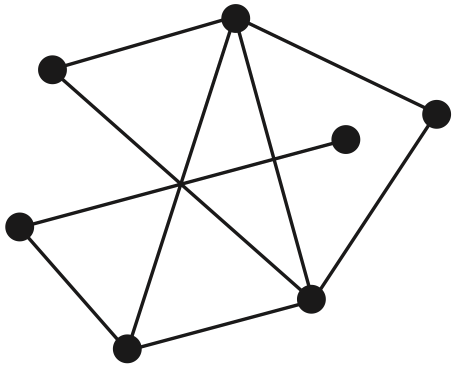
Consider the graph below.

The number of edges that need to be removed for this graph to be planar is
- 0
- 1
- 2
- 3
- 4
Matrices, GEN1 2022 VCAA 8 MC
Two types of computers - laptops `(L)` and desktops `(D)` - can be serviced by Henry `(H)`, Irvine `(I)` or Jean `(J)`.
Matrix `N` shows the time, in minutes, it takes each person to service a laptop and a desktop.
`{:(qquadqquadquad\ LquadqquadD),(N = [(18,8),(10,17),(12,9)]{:(H),(I),(J):}):}`
Matrix `Q` shows the number of laptops and desktops in four different departments: marketing `(M)`, advertising `(A)`, publishing `(P)` and editing `(E)`.
`{:(qquadqquadquad\ LquadqquadD),(Q = [(6,8),(4,7),(5,5),(10,12)]{:(M),(A),(P),(E):}):}`
A calculation that determines the total time that it would take each of Henry, Irvine or Jean, working alone, to service all the laptops and desktops in all four departments is
- `[1\ 1\ 1\ 1]×(Q×N^T)`
- `(Q×N^T)×[(1),(1),(1)]`
- `(N×Q^T)×Q`
- `[(1,0,0),(0,1,0),(0,0,1)]×N×Q^T`
- `[1\ 1\ 1\ 1]×Q×N^T×[(1),(1),(1)]`
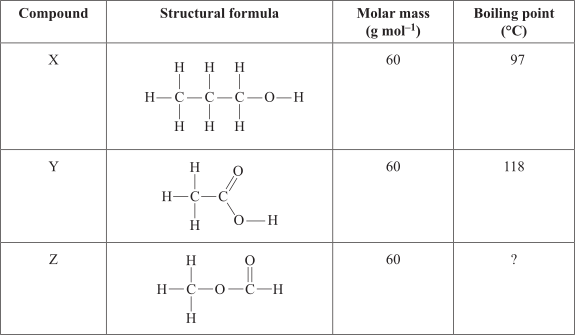
CHEMISTRY, M7 2020 VCE 16 MC
Complex Numbers, EXT2 N2 2023 HSC 16c
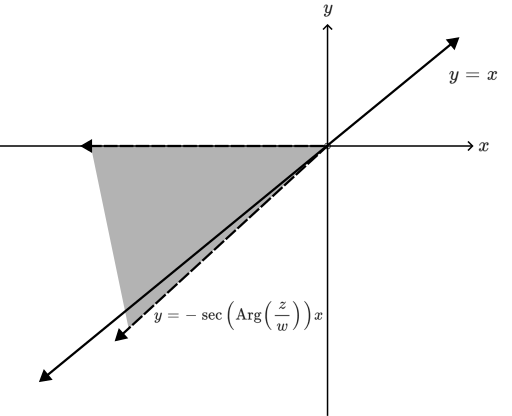
The complex numbers \(w\) and \(z\) both have modulus 1, and \(\dfrac{\pi}{2} \lt \text{Arg} \Big{(}\dfrac{z}{w}\Big{)} \lt \pi\), where \(\text{Arg}\) denotes the principal argument.
For real numbers \(x\) and \(y\), consider the complex number \(\dfrac{xz+yw}{z}\).
On an \(xy\)-plane, clearly sketch the region that contains all points \((x,y)\) for which \(\dfrac{\pi}{2} \lt \text{Arg} \Big{(}\dfrac{xz+yw}{z}\Big{)} \lt \pi\).
Vectors, EXT2 V1 2023 HSC 10 MC
Consider any three-dimensional vectors \(\underset{\sim}{a}=\overrightarrow{O A}, \underset{\sim}{b}=\overrightarrow{O B}\) and \(\underset{\sim}{c}=\overrightarrow{O C}\) that satisfy these three conditions
\(\underset{\sim}{a} \cdot \underset{\sim}{b}=1\)
\(\underset{\sim}{b} \cdot \underset{\sim}{c}=2\)
\(\underset{\sim}{c} \cdot \underset{\sim}{a}=3\).
Which of the following statements about the vectors is true?
- Two of \(\underset{\sim}{a}, \underset{\sim}{b}\) and \(\underset{\sim}{c}\) could be unit vectors.
- The points \(A, B\) and \(C\) could lie on a sphere centred at \(O\).
- For any three-dimensional vector \(\underset{\sim}{a}\), vectors \(\underset{\sim}{b}\) and \(\underset{\sim}{c}\) can be found so that \(\underset{\sim}{a}, \underset{\sim}{b}\) and \(\underset{\sim}{c}\) satisfy these three conditions.
- \(\forall \ \underset{\sim}{a}, \underset{\sim}{b}\) and \(\underset{\sim}{c}\) satisfying the conditions, \(\exists \ r, s\) and \(t\) such that \(r, s\) and \(t\) are positive real numbers and \(r\underset{\sim}{a}+s \underset{\sim}{b}+t \underset{\sim}{c}=\underset{\sim}{0}\).
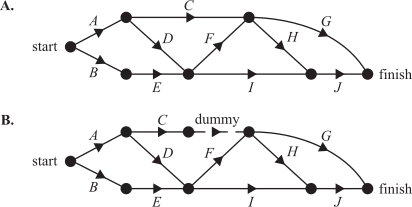
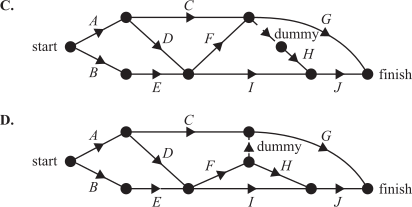
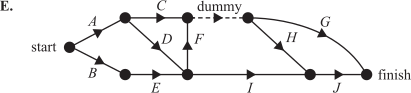
Networks, GEN1 2023 VCAA 38 MC
A particular building project has ten activities that must be completed.
These activities and their immediate predecessor(s) are shown in the table below.
\begin{array} {|c|c|}
\hline
\rule{0pt}{2.5ex} \textbf{Activity} \rule[-1ex]{0pt}{0pt} & \textbf{Immediate predecessor(s)} \\
\hline
A & - \\
\hline
B & - \\
\hline
C & A \\
\hline
D & A \\
\hline
E & B \\
\hline
F & D, E \\
\hline
G & C, F \\
\hline
H & F \\
\hline
I & D, E \\
\hline
J & H, I \\
\hline
\end{array}
A directed graph that could represent this project is
Complex Numbers, EXT2 N2 2023 HSC 16a
Let \(w\) be the complex number \(z=e^{\small{\dfrac{2i \pi}{3}}} \).
- Show that \(1+w+w^2=0\). (2 marks)
--- 8 WORK AREA LINES (style=lined) ---
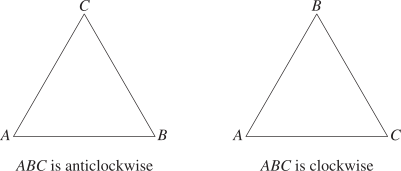
The vertices of a triangle can be labelled \(A, B\) and \(C\) in anticlockwise or clockwise direction, as shown.
Three complex numbers \(a, b\) and \(c\) are represented in the complex plane by points \(A, B\) and \(C\) respectively.
- Show that if triangle \(A B C\) is anticlockwise and equilateral, then \(a+b w+c w^2=0\). (2 marks)
--- 8 WORK AREA LINES (style=lined) ---
- It can be shown that if triangle \(A B C\) is clockwise and equilateral, then \(a+b w^2+c w=0\). (Do NOT prove this.)
- Show that if \(A B C\) is an equilateral triangle, then
\(a^2+b^2+c^2=a b+b c+c a .\) (2 marks)
--- 8 WORK AREA LINES (style=lined) ---
Financial Maths, GEN1 2023 VCAA 23 MC
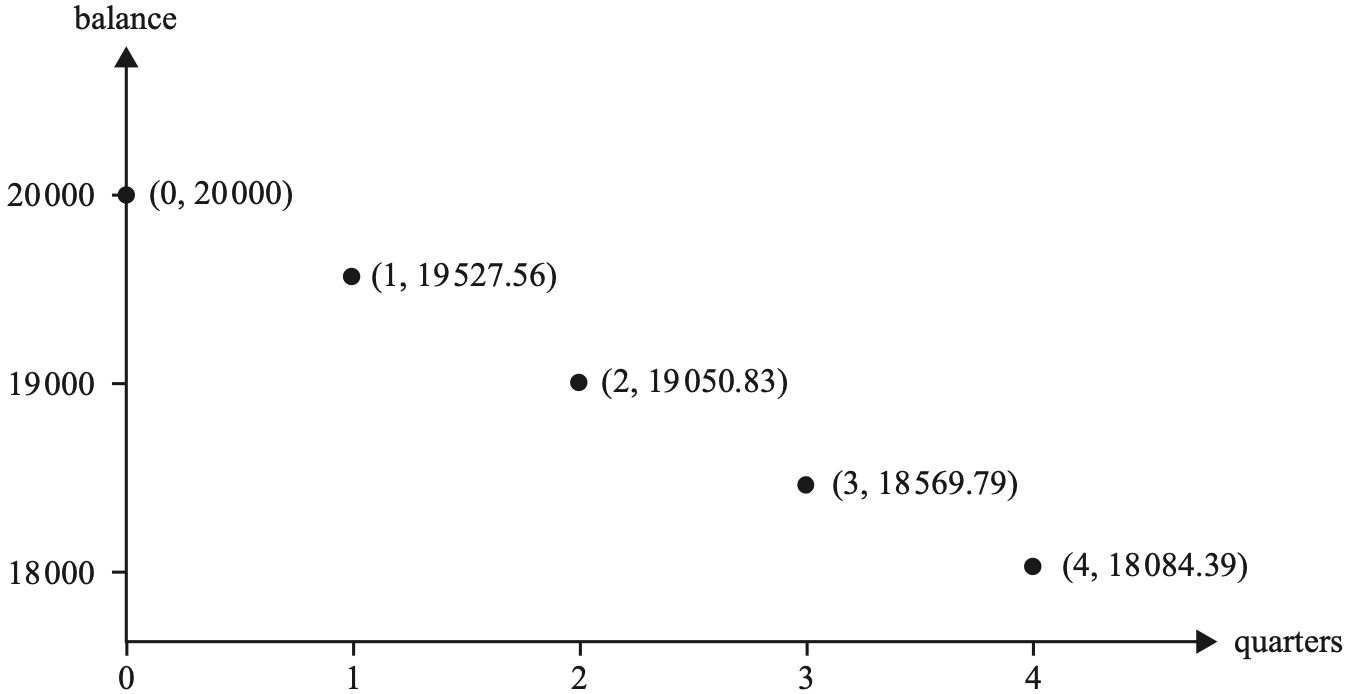
Tavi took out a loan of $20 000, with interest compounding quarterly. She makes quarterly repayments of $653.65.
The graph below represents the balance in dollars of Tavi's loan at the end of each quarter of the first year of the loan.

The effective interest rate for the first year of Tavi's loan is closest to
- 3.62%
- 3.65%
- 3.66%
- 3.67%
- 3.68%
PHYSICS, M2 2023 VCE 8
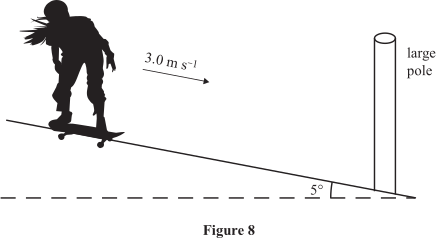
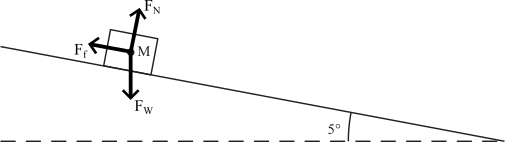
Maia is at a skatepark. She stands on her skateboard as it rolls in a straight line down a gentle slope at a constant speed of 3.0 m s\(^{-1}\), as shown in the figure below. The slope is 5° to the horizontal. The combined mass of Maia and the skateboard is 65 kg. --- 0 WORK AREA LINES (style=lined) --- --- 5 WORK AREA LINES (style=lined) --- Near the bottom of the ramp, Maia takes hold of a large pole and comes to a complete rest while still standing on the skateboard. Maia and the skateboard now have no momentum or kinetic energy. --- 3 WORK AREA LINES (style=lined) ---
ENGINEERING, PPT 2023 HSC 27b
A portion of a roller coaster wheel sub-assembly is shown. An exploded pictorial of the wheel sub-assembly is shown. Complete an assembled sectioned front view of the wheel sub-assembly at scale 1: 2. Apply AS 1100 drawing standards. Do NOT add dimensions. (6 marks) --- 0 WORK AREA LINES (style=lined) ---
ENGINEERING, CS 2023 HSC 26c
A truss is loaded as shown.
Showing working, complete the table. (6 marks)
\hline
\rule{0pt}{2.5ex} \rule[-1ex]{0pt}{0pt} & \textit{Magnitude} & \textit{Nature of force}\\ & \text{(kN)} & \text{(T or C)} \\
\hline
\rule{0pt}{2.5ex} \text{Internal reaction of member}\ EF \rule[-1ex]{0pt}{0pt} & & \\
\hline
\rule{0pt}{2.5ex} \text{Internal reaction of member}\ CH \rule[-1ex]{0pt}{0pt} & & \\
\hline
\end{array}
ENGINEERING, PPT 2023 HSC 25d
A uniform 8-metre ladder with a mass of 12 kg has been placed against a smooth wall. Determine the minimum coefficient of static friction between the ground and the ladder. Assume there is no friction between the ladder and the wall. (4 marks) --- 5 WORK AREA LINES (style=lined) ---
ENGINEERING, PPT 2023 HSC 24b
A roller coaster component is fabricated using cold rolled steel. Two webs are welded onto a base plate as shown. (2 marks) The diagram shows a partially completed microstructure of the parent and weld metals. Complete the microstructure by drawing and labelling the following grain types in the heat-affected zone for ONE of the webs:
PHYSICS, M3 EQ-Bank 5
A 50 gram copper ball is placed into an insulated container containing 50 mL of water and immediately sealed. The initial temperature of the metal ball and water is 50°C and 10°C respectively.
A student hypothesises that since the water and copper ball both have the same mass, the temperature of the metal ball and water, once thermal equilibrium is established, would be 30°C.
When the student measured the temperature inside the container, it was 26°C.
Explain the results of the experiment and why the student's hypothesis is incorrect. (4 marks)
--- 10 WORK AREA LINES (style=lined) ---
PHYSICS, M3 EQ-Bank 1
Jack enjoys drinking green tea at 60°C.
He pours 200 mL of 90°C green tea into a cup and then adds 4°C chilled water to the same cup to cool it down.
What is the minimum amount of chilled water, to the nearest mL, required to cool Jack's green tea to 60°C? (4 marks)
(Assume the green tea is essentially water and no energy is lost to the surroundings)
--- 9 WORK AREA LINES (style=lined) ---
PHYSICS, M1 EQ-Bank 5
Car A approaches an intersection at 10 ms\(^{-1}\) from the South as shown. As Car B approaches the intersection, it measures the velocity of Car A to be 22.36 ms\(^{-1}\) NW. Draw Car B on the diagram showing its direction and speed. Show all working. (3 marks) --- 8 WORK AREA LINES (style=lined) ---
PHYSICS, M3 2018 VCE 11
The diagram shows two speakers, \(\text{A}\) and \(\text{ B}\), facing each other. The speakers are connected to the same signal generator/amplifier and the speakers are simultaneously producing the same 340 Hz sound.
Take the speed of sound to be 340 ms\( ^{-1}\).
- Calculate the wavelength of the sound. (1 mark)
--- 2 WORK AREA LINES (style=lined) ---
- A student stands in the centre, equidistant from speakers \(\text{A}\) and \(\text{B}\). He then moves towards speaker \(\text{B}\) and experiences a sequence of loud and quiet regions. He stops at the second region of quietness.
- How far has the student moved from the centre? Explain your reasoning. (3 marks)
--- 8 WORK AREA LINES (style=lined) ---
CHEMISTRY, M2 2014 VCE 11*
Consider the following unbalanced ionic equation.
\(\ce{Hg(l) + Cr2O7^2–(aq) + H+(aq)\rightarrow Hg^2+(aq) + Cr^3+(aq) + H2O(l)}\)
When this equation is completely balanced including the total charge on each side of the equation, find the coefficient of \(\ce{Hg(l)}\). (3 marks)
--- 3 WORK AREA LINES (style=lined) ---
PHYSICS, M4 2020 VCE 18
Students are modelling the effect of the resistance of electrical cables, \(r\), on the transmission of electrical power. They model the cables using the circuit shown in Figure 18. The students investigate the effect of changing \(r\) by measuring the current in the electrical cables for a range of values. Their results are shown in Table 1 below. \begin{array} {|c|c|c|} --- 3 WORK AREA LINES (style=lined) --- --- 0 WORK AREA LINES (style=lined) --- --- 0 WORK AREA LINES (style=lined) --- --- 5 WORK AREA LINES (style=lined) ---
\hline
\rule{0pt}{2.5ex} \text{Resistance of cables,}\ r\ (\Omega) \rule[-1ex]{0pt}{0pt} & \text{Current in cables},\ i\ (\text{A}) & \ \ \ \dfrac{1}{i} \Big{(}\text{A}^{-1}\Big{)}\ \ \ \\
\hline
\rule{0pt}{2.5ex} 2.4 \rule[-1ex]{0pt}{0pt} & 2.4 & \\
\hline
\rule{0pt}{2.5ex} 3.6 \rule[-1ex]{0pt}{0pt} & 2.0 & \\
\hline
\rule{0pt}{2.5ex} 6.4 \rule[-1ex]{0pt}{0pt} & 1.7 & \\
\hline
\rule{0pt}{2.5ex} 7.6 \rule[-1ex]{0pt}{0pt} & 1.5 & \\
\hline
\rule{0pt}{2.5ex} 10.4 \rule[-1ex]{0pt}{0pt} & 1.3 & \\
\hline
\end{array}
- « Previous Page
- 1
- …
- 6
- 7
- 8
- 9
- 10
- …
- 29
- Next Page »