SmarterEd

Aussie Maths & Science Teachers: Save your time with SmarterEd

  • Login
  • Get Help
  • About

CORE, FUR2 2020 VCAA 3

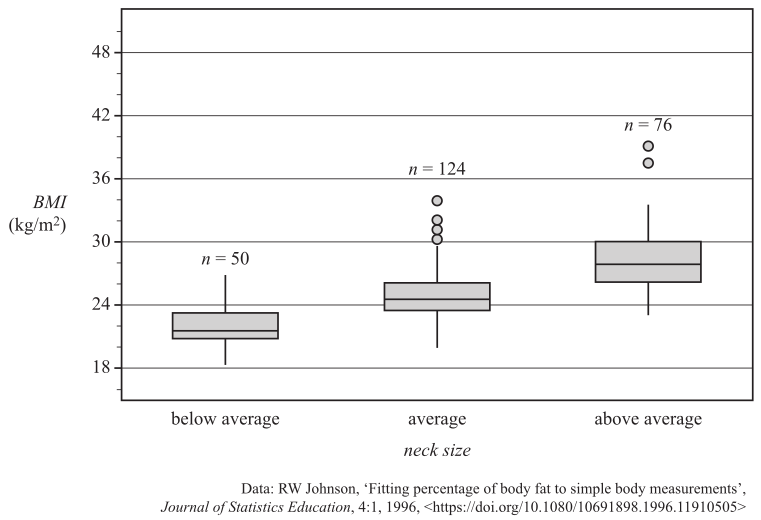
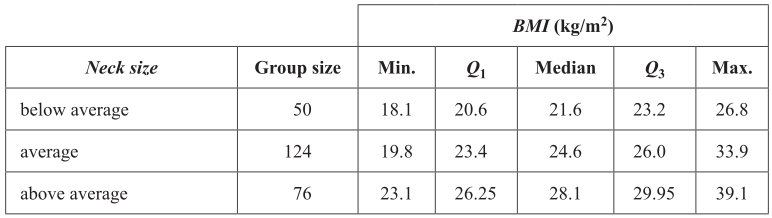
In a study of the association between BMI and neck size, 250 men were grouped by neck size (below average, average and above average) and their BMI recorded.

Five-number summaries describing the distribution of BMI for each group are displayed in the table below along with the group size.

The associated boxplots are shown below the table.
 

  1. What percentage of these 250 men are classified as having a below average neck size?   (1 mark)

    --- 2 WORK AREA LINES (style=lined) ---

  2. What is the interquartile range (IQR) of BMI for the men with an average neck size?   (1 mark)

    --- 2 WORK AREA LINES (style=lined) ---

  3. People with a BMI of 30 or more are classified as being obese.
  4. Using this criterion, how many of these 250 men would be classified as obese? Assume that the BMI values were all rounded to one decimal place.   (1 mark)

    --- 3 WORK AREA LINES (style=lined) ---

  5. Do the boxplots support the contention that BMI is associated with neck size? Refer to the values of an appropriate statistic in your response.   (2 marks)

    --- 4 WORK AREA LINES (style=lined) ---
Show Answers Only
  1. `20 text(%)`
  2. `2.6`
  3. `23`
  4. `text(See Worked Solutions)`
Show Worked Solution
a.    `text(Percentage)` `= 50/250 xx 100`
    `= 20text(%)`


b.    `text(IQR)` `= 26.0-23.4`
    `= 2.6`


c.   `text{Outliers in average neck size}\ (text(BMI) >= 30) = 4`

♦♦ Mean mark part c. 22%.
COMMENT: Many students incorrectly counted the two “above average” outliers twice.

`:.\ text(Number classified as obese)`

`= 4 + 1/4 xx 76`

`= 23`


d.   `text(The boxplots support a strong association between)`

♦ Mean mark 49%.
MARKER’S COMMENT: General statement of change = 1 mark. Median or IQR values need to be quoted directly for the second mark.

`text(BMI and neck size as median BMI values increase)`

`text(as neck size increases.)`

`text(Below average neck sizes have a BMI of 21.6, which)`

`text(increases to 24.6 for average neck sizes and increases)`

`text(further to 28.1 for above average neck sizes.)`

Filed Under: Graphs - Stem/Leaf and Boxplots Tagged With: Band 2, Band 3, Band 5, smc-643-20-Parallel Box-Plots, smc-643-60-Outliers

CORE, FUR2 2020 VCAA 2

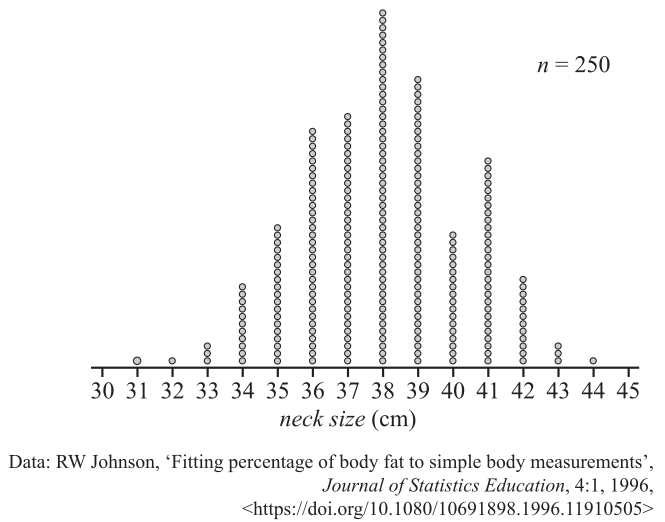
The neck size, in centimetres, of 250 men was recorded and displayed in the dot plot below.
 

  1. Write down the modal neck size, in centimetres, for these 250 men.   (1 mark)

    --- 1 WORK AREA LINES (style=lined) ---

  2. Assume that this sample of 250 men has been drawn at random from a population of men whose neck size is normally distributed with a mean of 38 cm and a standard deviation of 2.3 cm.
  3.  i. How many of these 250 men are expected to have a neck size that is more than three standard deviations above or below the mean? Round your answer to the nearest whole number.   (1 mark)

    --- 2 WORK AREA LINES (style=lined) ---

  4. ii. How many of these 250 men actually have a neck size that is more than three standard deviations above or below the mean?   (1 mark)

    --- 2 WORK AREA LINES (style=lined) ---

  5. The five-number summary for this sample of neck sizes, in centimetres, is given below.
     

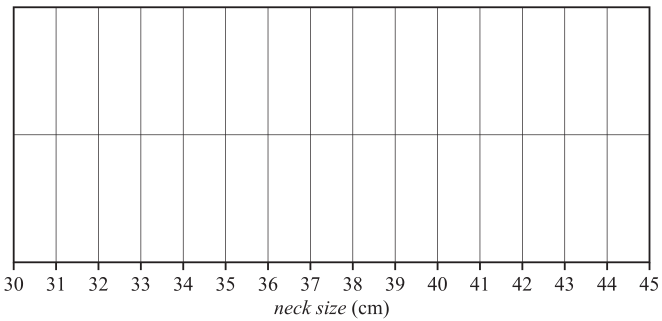
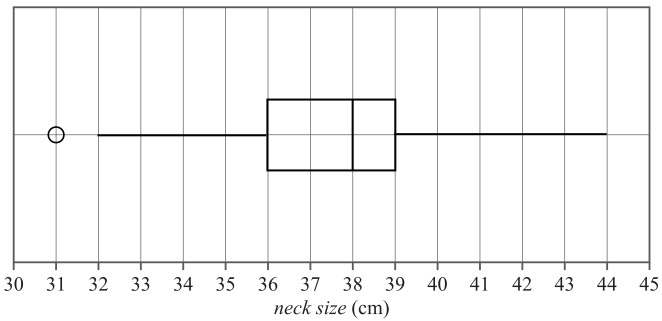
    Use the five-number summary to construct a boxplot, showing any outliers if appropriate, on the grid below.   (2 marks)

    --- 3 WORK AREA LINES (style=lined) ---

Show Answers Only

a.    `text(Mode) = 38\ text(cm)`

b.i.   `1`

b.ii. `1`

c.    `text(See Worked Solutions)`

Show Worked Solution

a.   `text(Mode) = 38\ text(cm)`


♦ Mean mark part b.i. 40%.
b.i.   `text(Expected number of men)` `= (1-0.997) xx 250`
    `= 0.75`
    `= 1\ text{(nearest whole)}`


♦ Mean mark part b.ii. 42%.
b.ii.   `text(When)\ \ z = +- 3`
  `text(Neck size limits)` `= 38 +- (2.3 xx 3)`
    `= 44.9 or 31.1`

 
`:.\ text(1 man has neck size outside 3 s.d.)`
 

c.   `IQR = 39-36=3`

`text(Upper fence)\ =Q_3 + 1.5 xx 3=39 + 4.5=43.5`

`text(Lower fence)\ =Q_1-1.5 xx 3=36-4.5=31.5`


Filed Under: Graphs - Stem/Leaf and Boxplots, Normal Distribution Tagged With: Band 2, Band 4, Band 5, smc-600-20-z-score Intervals, smc-643-10-Single Box-Plots

GRAPHS, FUR1 2020 VCAA 2 MC

At a school concert, the entry fee for adults was different from the entry fee for children.

The entry fee for three adults and four children was $67.00

The entry fee for two adults and five children was $57.50

Let  `x`  be the entry fee for an adult.

Let  `y`  be the entry fee for a child.

A pair of simultaneous equations that could be used to represent the situation above is

A.   `3x + 2y = 57.5` B.   `3x + 2y = 67`
 

`4x + 5y = 67`


`4x + 5y = 57.5`


C.   `3x + 4y = 57.5` D.   `3x + 4y = 67`
 

`2x + 5y = 67`


`2x + 5y = 57.5`


E.   `4x + 3y = 67`    
  `5x + 2y = 57.5`


Show Answers Only

`D`

Show Worked Solution
`3x + 4y` `= 67`
`2x + 5y` `= 57.5`

 
`=>  D`

Filed Under: Linear relationships Tagged With: Band 2

CORE, FUR1 2020 VCAA 10-12 MC

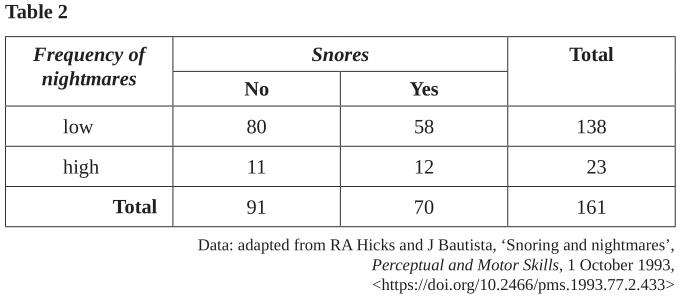
The data in Table 2 was collected in a study of the association between the variables frequency of nightmares (low, high) and snores (no, yes).


Part 1

The variables in this study, frequency of nightmares (low, high) and snores (no, yes), are

  1. ordinal and nominal respectively.
  2. nominal and ordinal respectively.
  3. both numerical.
  4. both ordinal.
  5. both nominal.

 
Part 2

The percentage of participants in the study who did not snore is closest to

  1. 42.0%
  2. 43.5%
  3. 49.7%
  4. 52.2%
  5. 56.5%

 
Part 3

Of those people in the study who did snore, the percentage who have a high frequency of nightmares is closest to

  1.   7.5%
  2. 17.1%
  3. 47.8%
  4. 52.2%
  5. 58.0%
Show Answers Only

`text(Part 1:)\ A`

`text(Part 2:)\ E`

`text(Part 3:)\ B`

Show Worked Solution

Part 1

`text{frequency of nightmares (low, high) is ordinal.}`

`text{snores (no, yes) is nominal.}`

`=> A`
 

Part 2

`text(Percentage)` `= text(not snore)/text(total participants) xx 100`
  `= 91/161 xx 100`
  `= 56.5%`

`=> E`
 

Part 3

`text(Percentage)` `= text(High frequency and snore)/text(total who snore) xx 100`
  `= 12/70 xx 100`
  `= 17.1%`

`=> B`

Filed Under: Graphs - Histograms and Other, Summary Statistics Tagged With: Band 2, Band 4, smc-468-10-Data Classification, smc-644-50-Frequency Tables

CORE, FUR1 2020 VCAA 1-3 MC

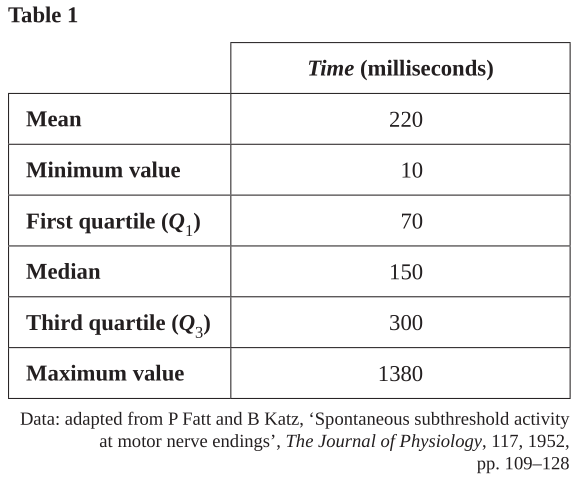
The times between successive nerve impulses (time), in milliseconds, were recorded.

Table 1 shows the mean and the five-number summary calculated using 800 recorded data values.


Part 1

The difference, in milliseconds, between the mean time and the median time is

  1.  10
  2.  70
  3.  150
  4.  220
  5.  230

 
Part 2

Of these 800 times, the number of times that are longer than 300 milliseconds is closest to

  1. 20
  2. 25
  3. 75
  4. 200
  5. 400

 
Part 3

The shape of the distribution of these 800 times is best described as

  1. approximately symmetric.
  2. positively skewed.
  3. positively skewed with one or more outliers.
  4. negatively skewed.
  5. negatively skewed with one or more outliers.
Show Answers Only

`text(Part 1:)\ B`

`text(Part 2:)\ D`

`text(Part 3:)\ C`

Show Worked Solution

Part 1

`text(Difference)` `= 220 -150`
  `= 70`

`=> B`
 

Part 2

`Q_3 = 300`

`:.\ text(Impulses longer than 300 milliseconds)`

`= 25text(%) xx 800`

`= 200`

`=> D`
 

Part 3

`text(Distribution has a long tail to the right)`

♦ Mean mark 50%.

`:.\ text(Positively skewed)`

`text(Upper fence)` `= Q_3 + 1.5 xx IQR`
  `= 300 + 1.5 (300 – 70)`
  `= 645`

 
`=> C`

Filed Under: Summary Statistics Tagged With: Band 2, Band 3, Band 4, smc-468-20-Mean, smc-468-40-Median Mode and Range, smc-468-50-IQR / Outliers

Complex Numbers, EXT2 N1 2004 HSC 2b

Let  `alpha = 1 + i sqrt3`  and  `beta = 1 + i`.

  1. Find  `frac{alpha}{beta}`, in the form  `x + i y`.   (1 mark)

    --- 3 WORK AREA LINES (style=lined) ---

  2. Express `alpha` in modulus-argument form.   (3 marks)

    --- 3 WORK AREA LINES (style=lined) ---

  3. Given that `beta` has the modulus-argument form
     
         `beta = sqrt2 (cos frac{pi}{4} + i sin frac{pi}{4})`.
     
    find the modulus-argument form of  `frac{alpha}{beta}`.   (1 mark)

    --- 3 WORK AREA LINES (style=lined) ---

  4. Hence find the exact value of  `sin frac{pi}{12}`   (1 mark)

    --- 3 WORK AREA LINES (style=lined) ---

Show Answers Only
  1. `frac{1+sqrt3}{2} + i (frac{sqrt3 – 1}{2})`
  2. `2 \ text{cis} (frac{pi}{3})`
  3. `sqrt2 \ text{cis} (frac{pi}{12})`
  4. `frac{sqrt6-sqrt2}{4}`
Show Worked Solution
i.     `frac{alpha}{beta}` `= frac{1 + i sqrt3}{1 + i} xx frac{1 – i}{1 – i}`
    `= frac{(1 + i sqrt3)(1 – i)}{1^2 – i^2}`
    `= frac{1 – i + i sqrt3 – i^2 sqrt3}{2}`
    `= frac{1+sqrt3}{2} + i (frac{sqrt3 – 1}{2})`


ii.   `alpha` `= 1 + i sqrt3`
  `| alpha |` `= sqrt(1^2 + (sqrt3)^2) = 2`

`text{arg} \ (alpha) = tan^-1 (frac{sqrt3}{1}) = frac{pi}{3}`

`therefore \ alpha = 2 text{cis} (frac{pi}{3})`


iii.   `beta` `= sqrt2 text{cis} (frac{pi}{4})`
  `frac{alpha}{beta}` `= frac{2}{sqrt2} \ text{cis} (frac{pi}{3} – frac{pi}{4})`
    `= sqrt2 text{cis}  (frac{pi}{12})`


iv.  `text{Equating imaginary parts of i and ii:}`

`sqrt2 \ sin \ (frac{pi}{12})` `= frac{sqrt3 – 1}{2}`
`sin (frac{pi}{12})` `= frac{sqrt3 – 1}{2 sqrt2} xx frac{sqrt2}{sqrt2}`
  `= frac{sqrt6 – sqrt2}{4}`

Filed Under: Argand Diagrams and Mod/Arg form Tagged With: Band 2, Band 3, smc-1049-20-Cartesian to Mod/Arg, smc-1049-40-Mod/Arg arithmetic

Complex Numbers, EXT1 N1 SM-Bank 5

Let  `z = 1 + 2 i`  and  `w = 3 - i`.

Find, in the form  `x + i y`,

  1.  `zw`   (1 mark)

    --- 2 WORK AREA LINES (style=lined) ---

  2.  `overset_((frac{10}{z}))`.   (1 mark)

    --- 3 WORK AREA LINES (style=lined) ---

Show Answers Only
  1. `5 + 5 i`
  2. `2+4 i`
Show Worked Solution
i.    `zw` `= (1 + 2 i)(3 – i)`
    `= 3 – i + 6 i – 2 i^2`
    `= 5 + 5 i`


ii.    `frac{10}{z}` `= frac{10}{1 + 2 i} xx frac{1-2 i}{1-2 i}`
    `= frac{10-20 i}{1^2 – (2 i)^2`
    `= frac{10-20 i}{1+4}`
    `= 2-4i`

 
`therefore \ overset_(frac{10}{z})= 2+4 i`

Filed Under: Arithmetic of Complex Numbers Tagged With: Band 2, smc-1048-10-Basic Arithmetic

Complex Numbers, EXT2 N2 EQ-Bank 1

`z = sqrt2 e^((ipi)/15)`  is a root of the equation  `z^5 = alpha(1 + isqrt3), \ alpha ∈ R`.

  1. Express  `1 + isqrt3`  in exponential form.  (2 marks)

    --- 4 WORK AREA LINES (style=lined) ---

  2. Find the value of `alpha`.  (1 mark)

    --- 4 WORK AREA LINES (style=lined) ---
  3. Find the other 4 roots of the equation in exponential form.  (3 marks)

    --- 6 WORK AREA LINES (style=lined) ---

Show Answers Only
  1. `2e^((ipi)/3)`
  2. `alpha = 2sqrt2`
  3. `e^((i11pi)/15), e^(-(ipi)/3), e^((i13pi)/15), e^(−(i11pi)/15)`
Show Worked Solution

i.   `beta = 1 + isqrt3`

`|beta| = sqrt(1 + (sqrt3)^2) = 2`

`text(arg)(beta) = tan^(−1) (sqrt3/1) = pi/3`

`beta = 2e^((ipi)/3)`


ii.    `z` `= sqrt2 e^((ipi)/15)`
  `z^5` `= (sqrt2 e^((ipi)/15))^5`
    `= (sqrt2)^5 e^((ipi)/15 xx 5)`
    `= 4sqrt2 e^((ipi)/3)`

 
`:. alpha = 2sqrt2`


iii.   `text(arg)(z^5) = pi/3 + 2kpi, \ \ k = 0, ±1, ±2, …`

`text(arg)(z) = pi/15 + (2kpi)/5`

`k = 1:\ text(arg)(z) = pi/15 + (2pi)/5 = (11pi)/15`

`k = text(−1):\ text(arg)(z) = pi/15 – (2pi)/5 = −pi/3`

`k = 2:\ text(arg)(z) = pi/15 + (4pi)/5 = (13pi)/15`

`k =text(−2):\ text(arg)(z) = pi/15 – (4pi)/5 = −(11pi)/15`
 

`:. 4\ text(other roots are:)`

`e^((i11pi)/15), e^(−(ipi)/3), e^((i13pi)/15), e^(−(i11pi)/15)` 

Filed Under: Solving Equations with Complex Numbers Tagged With: Band 2, Band 3, Band 4, smc-1050-30-Roots > 3, smc-1050-50-Exponential form

Complex Numbers, EXT2 N1 2005 HSC 2b

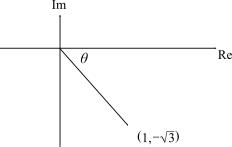
Let  `beta = 1-i sqrt3`.

  1. Express  `beta`  in modulus-argument form.   (2 marks)

    --- 6 WORK AREA LINES (style=lined) ---

  2. Express  `beta^5`  in modulus-argument form.   (2 marks)

    --- 3 WORK AREA LINES (style=lined) ---

  3. Hence express  `beta^5`  in the form  `x+iy`.   (1 mark)

    --- 3 WORK AREA LINES (style=lined) ---

Show Answers Only
  1. `2 \ text{cis} (-frac{pi}{3})`
  2. `32 \ text{cis} (frac{pi}{3})`
  3. `16 + i 16 sqrt3`
Show Worked Solution

i.    `beta = 1 – i sqrt3`


`| beta | = sqrt(1^2 + (sqrt3)^2) = 2`

`tan theta` `= frac{sqrt3}{1} = sqrt3`
`theta` `= frac{pi}{3}`
`text{arg} (beta)` `= -frac{pi}{3}`

`therefore \ beta = 2 \ text{cis} (-frac{pi}{3})`


ii.   `beta^5` `= 2^5 \ text{cis} (-frac{pi}{3} xx5)`
    `= 32 \ text{cis} (-frac{5pi}{3} + 2 pi)`
    `= 32 \ text{cis} (frac{pi}{3})`


iii.   `beta^5` `= 32 ( cos (frac{pi}{3}) + i sin (frac{pi}{3}) )`
    `= 32 ( frac{1}{2} + i  frac{sqrt3}{2})`
    `= 16 + i 16 sqrt3`

Filed Under: Argand Diagrams and Mod/Arg form Tagged With: Band 2, Band 3, smc-1049-20-Cartesian to Mod/Arg, smc-1049-30-Mod/Arg to Cartesian, smc-1049-50-Powers

Complex Numbers, EXT2 N1 2005 HSC 2a

Let  `z = 3 + i`  and  `w=1-i`.  Find, in the form  `x+iy`,

  1.  `2z+iw`   (1 mark)

    --- 2 WORK AREA LINES (style=lined) ---

  2.  `bar z w`   (1 mark)

    --- 2 WORK AREA LINES (style=lined) ---

  3.  `6/w`   (1 mark)

    --- 3 WORK AREA LINES (style=lined) ---

Show Answers Only
  1.  `7+3i`
  2.  `2-4i`
  3.  `3+3i`
Show Worked Solution

i.    `z = 3 + i \ , \ w = 1 – i`

`2z + i w` `=2 (3 + i) + i(1 – i)`
  `= 6 + 2i + i – i^2`
  `= 7 + 3 i`


ii.    `overset_z w` `= (3 – i)(1 – i)`
    `= 3 – 3i –  i + i^2`
    `= 2 – 4 i`


iii.   `frac{6}{w}` `= frac{6}{1 – i} xx frac{1 + i}{1 + i}`
    `= frac{6 + 6i}{1^2 – i^2}`
    `= frac{6 + 6i}{2}`
    `= 3 + 3i`

Filed Under: Arithmetic of Complex Numbers Tagged With: Band 2, smc-1048-10-Basic Arithmetic

Complex Numbers, EXT2 N1 2008 HSC 2a

Find real numbers `a` and `b` such that  `(1 + 2 i)(1 -3i) = a + ib`.   (2 marks)

Show Answers Only

`a=7, \ b=-1`

Show Worked Solution
`(1 + 2 i)(1 -3i)` `= 1 – 3i + 2i – 6i^2`
  `= 1 – i + 6`
  `= 7 – i`

 
`:. a=7, \ b=-1`

Filed Under: Arithmetic of Complex Numbers Tagged With: Band 2

Complex Numbers, EXT2 N1 2020 HSC 13d

  1. Show that for any integer `n`,  `e^(i n theta) + e^(-i n theta) = 2 cos (n theta)`.   (1 mark)

    --- 2 WORK AREA LINES (style=lined) ---

  2. By expanding  `(e^(i theta) + e^(-i theta))^4`  show that
     
       `cos^4 theta = frac{1}{8} ( cos (4 theta) + 4 cos (2 theta) + 3 )`.   (3 marks)

    --- 6 WORK AREA LINES (style=lined) ---

  3. Hence, or otherwise, find  `int_0^(frac{pi}{2}) cos^4 theta\ d theta`.   (2 marks)

    --- 4 WORK AREA LINES (style=lined) ---
Show Answers Only
  1. `text{See Worked Solution}`
  2. `text{See Worked Solution}`
  3. `text{See Worked Solution}`
Show Worked Solution
i.      `e^(i n theta) + e^(-i n theta)` `= cos(n theta) + i sin(n theta) + cos(-n theta) + i sin(-n theta)`
    `= cos(n theta) + i sin(n theta) + cos(n theta) – i sin(n theta)`
    `= 2 cos (n theta)`


ii.    `(e^{i theta} + e^{-i theta})^4` `= (2 cos theta)^4`
    `= 16 cos^4 theta`

 
`text{Expand} \ (e^{i theta} + e^{-i theta})^4 :`

`e^(i 4 theta) + 4 e^(i 3 theta) e^(-i theta) + 6 e^(i 2 theta) e^(-i 2 theta) + 4 e^(i theta) e^(-i 3 theta) + e^(-i 4 theta)`

`= e^(i 4 theta) + 4e^(i 2 theta) + 6 + 4^(-i 2 theta) + e^(-i 4 theta)`

`= e^(i 4 theta) + e^(i 4 theta) + 4 (e^{i 2 theta} + e^{-i 2 theta}) + 6`

`= 2 cos (4 theta) + 8 cos (2 theta) + 6`
 

`therefore \ 16 cos^4 theta` `= 2 cos (4 theta) + 8 cos (2 theta) + 6`
`cos^4 theta` `= frac{1}{8} cos(4 theta) + 1/2 cos(2 theta) + 3/8`
`cos^4 theta` `= frac{1}{8} (cos(4 theta) + 4 cos(2 theta) + 3)`


iii.    `int_0^(frac{pi}{2}) cos^4 theta\ d theta` `= frac{1}{8} int_0^(frac{pi}{2}) cos(4 theta) + 4 cos(2 theta) + 3\ d theta`
    `= frac{1}{8} [ frac{1}{4} sin(4 theta) + 2 sin (2 theta) + 3 theta ]_0^(frac{pi}{2}`
    `= frac{1}{8} [( frac{1}{4} sin (2 pi) + 2 sin pi  + frac{3 pi}{2}) – 0 ]`
    `= frac{1}{8} ( frac{3 pi}{2})`
    `= frac{3 pi}{16}`

Filed Under: Exponential Form, Trig Integration Tagged With: Band 2, Band 3, smc-1191-50-Powers, smc-1193-10-sin/cos

Complex Numbers, EXT2 N1 2020 HSC 11a

Consider the complex numbers  `w = -1 + 4i`  and  `z = 2 -i`.

  1. Evaluate  `|w|`.   (1 mark)

    --- 1 WORK AREA LINES (style=lined) ---

  2. Evaluate  `w overset_ z`.   (2 marks)

    --- 2 WORK AREA LINES (style=lined) ---

Show Answers Only
  1. `text{See Worked Solutions}`
  2. `text{See Worked Solutions}`
Show Worked Solution
i.      `w` ` = -1 + 4 i`
  `|w| ` `= sqrt{(-1)^2 + 4^2} = 17`


ii.     `z = 2 – i`

`overset_z = 2 + i`

`w overset_z` `= (-1 + 4i)(2 + i)`
  `= -2 – i +8 i + 4i^2`
  `= -6 + 7i`

Filed Under: Arithmetic of Complex Numbers Tagged With: Band 2, smc-1048-10-Basic Arithmetic

Calculus, EXT2 C1 2020 HSC 6 MC

Which expression is equal to `int frac{1}{x^2 + 4x + 10}\ dx`?

  1. `frac{1}{sqrt(6)} tan^-1 (frac{x + 2}{sqrt{6} )) + c`
  2. `tan^-1 (frac{x + 2}{sqrt{6} )) + c`
  3. `frac{1}{2 sqrt(6)} ln | frac{x + 2 - sqrt(6)}{x + 2 + sqrt(6)} | + c`
  4. `ln | frac{x + 2 - sqrt(6)}{x + 2 + sqrt(6)} | + c`
Show Answers Only

`A`

Show Worked Solution
`int frac{1}{x^3 + 4x + 10}\ dx` `= int frac{1}{(x + 2)^2 + (sqrt6)^2}\ dx`
  `= frac{1}{6} tan^-1 (frac{x + 2}{sqrt6}) + c`

`=> \ A`

Filed Under: Trig Integration Tagged With: Band 2, smc-1193-15-tan, smc-1193-50-Completing the square

Vectors, EXT2 V1 2020 HSC 1 MC

What is the length of the vector  `- underset~i + 18 underset~j - 6 underset~k`?

  1.  5
  2.  19
  3.  25
  4.  361
Show Answers Only

`B`

Show Worked Solution
`text{Length}` `= | – underset~i + 18 underset~j – 6 underset~k \ |`
  `= sqrt{(-1)^2 + 18^2 + (-6)^2}`
  `= sqrt{361}`
  `= 19`

Filed Under: Basic Concepts and Arithmetic Tagged With: Band 2, smc-1195-10-Basic Calculations

Functions, EXT1 F2 2020 HSC 11a

Let  `P(x) = x^3 + 3x^2-13x + 6`.

  1. Show that  `P(2) = 0`.  (1 mark)

    --- 2 WORK AREA LINES (style=lined) ---

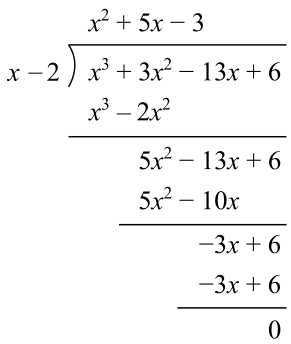
  2. Hence, factor the polynomial  `P(x)`  as  `A(x)B(x)`, where  `B(x)`  is a quadratic polynomial.  (2 marks)

    --- 8 WORK AREA LINES (style=lined) ---

Show Answers Only
  1. `text(See Worked Solutions)`
  2. `P(x) = (x-2)(x^2 + 5x – 3)`
Show Worked Solution
i.    `P(2)` `= 8 + 12-26 + 6`
    `= 0`


ii.   

`:. P(x) = (x-2)(x^2 + 5x – 3)`

Filed Under: Polynomials, Remainder and Factor Theorems (Ext1) Tagged With: Band 2, Band 3, num-title-ct-patha, num-title-qs-hsc, smc-1031-10-Factor Theorem, smc-4242-10-Factor Theorem, smc-4242-40-Long division

Algebra, STD2 A4 2020 HSC 33

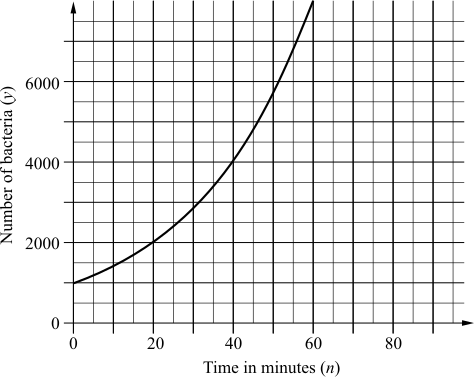
The graph shows the number of bacteria, `y`, at time `n` minutes. Initially (when `n = 0`) the number of bacteria is 1000.


  1. Find the number of bacteria at 40 minutes.   (1 mark)

    --- 1 WORK AREA LINES (style=lined) ---

  2. The number of bacteria can be modelled by the equation  `y = A xx b^n`, where `A` and `b` are constants.
    Use the guess and check method to find, to two decimal places, an upper and lower estimate for the value of `b`. The upper and lower estimates must differ by 0.01. (2 marks)

    --- 4 WORK AREA LINES (style=lined) ---
Show Answers Only
  1. `4000`
  2. `text{Show Worked Solutions}`
Show Worked Solution

a.    `text{When} \ \ n = 40,`

`text{Number of Bacteria} \ (y) = 4000`
 

b.   `A = 1000 \ => \ y = 1000  b^n`

♦♦♦ Mean mark 14%.

`text{By inspection, graph passes through (40, 4000)}`

`=> \ 4000 = 1000  b^40`
 

`text(Guess and check possible values of)\ b:`

`text{If} \ \ b = 1.03 \ , \ \ y = 1000 xx 1.03^40 = 3262 \ text{(too low)}`

`text{If} \ \ b = 1.04 \ , \ \ y = 1000 xx 1.04^40 = 4801 \ text{(too high)}`

`therefore \ 1.03 < b < 1.04`

Filed Under: Non-Linear: Exponential/Quadratics (Std 2) Tagged With: Band 2, Band 6, smc-830-30-Exponential

Statistics, EXT1 S1 2020 HSC 12b

When a particular biased coin is tossed, the probability of obtaining a head is `3/5`.

This coin is tossed 100 times.

Let `X` be the random variable representing the number of heads obtained. This random variable will have a binomial distribution.

  1. Find the expected value, `E(X)`.  (1 mark)

    --- 2 WORK AREA LINES (style=lined) ---
  2. By finding the variance, `text(Var)(X)`, show that the standard deviation of `X` is approximately 5.  (1 mark)

    --- 3 WORK AREA LINES (style=lined) ---
  3. By using a normal approximation, find the approximate probability that `X` is between 55 and 65.  (1 mark)

    --- 1 WORK AREA LINES (style=lined) ---
Show Answers Only
  1. `60`
  2. `text(See Worked Solutions)`
  3. `68text(%)`
Show Worked Solution

i.   `X = text(number of heads)`

`X\ ~\ text(Bin) (n, p)\ ~\ text(Bin) (100, 3/5)`

`E(X)` `= np`
  `= 100 xx 3/5`
  `= 60`


ii.    `text(Var)(X)` `= np(1 – p)`
    `= 60 xx 2/5`
    `= 24`


`sigma(x)` `= sqrt24`
  `~~ 5`


iii.    `P(55 <= x <=65)` `~~ P(−1 <= z <= 1)`
    `~~ 68text(%)`

Filed Under: Normal Approximations of Sample Proportions (Ext1), Statistics and Binomial Distributions (Ext1) Tagged With: Band 2, Band 3, Band 4, smc-1085-20-z-score intervals, smc-1199-10-Calculate E(X), smc-1199-20-Calculate Var(X)/Std Dev

Functions, 2ADV F1 2020 HSC 11

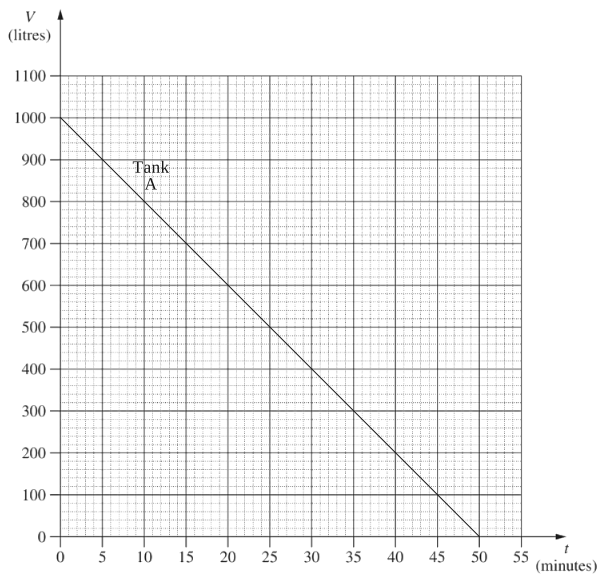
There are two tanks on a property, Tank `A` and Tank `B`. Initially, Tank `A` holds 1000 litres of water and Tank B is empty.

  1.  Tank `A` begins to lose water at a constant rate of 20 litres per minute. The volume of water in Tank `A` is modelled by  `V = 1000 - 20t`  where  `V`  is the volume in litres and  `t`  is the time in minutes from when the tank begins to lose water.   (1 mark)
     
    On the grid below, draw the graph of this model and label it as Tank `A`.


  2. Tank `B` remains empty until  `t=15`  when water is added to it at a constant rate of 30 litres per minute.


    By drawing a line on the grid (above), or otherwise, find the value of  `t`  when the two tanks contain the same volume of water.  (2 marks)

  3. Using the graphs drawn, or otherwise, find the value of  `t`  (where  `t > 0`) when the total volume of water in the two tanks is 1000 litres.  (1 mark)

    --- 2 WORK AREA LINES (style=lined) ---
Show Answers Only
  1.  `text{T} text{ank} \ A \ text{will pass trough (0, 1000) and (50, 0)}` 
      
  2. `29 \ text{minutes}`
  3. `45 \ text{minutes}`
Show Worked Solution

a.     `text{T} text{ank} \ A \ text{will pass trough (0, 1000) and (50, 0)}` 


b.   `text{T} text{ank} \ B \ text{will pass through (15, 0) and (45, 900)}`  


`text{By inspection, the two graphs intersect at} \ \ t = 29 \ text{minutes}`

 
c.   `text{Strategy 1}`

`text{By inspection of the graph, consider} \ \ t = 45`

`text{T} text{ank A} = 100 \ text{L} , \ text{T} text{ank B} =900 \ text{L} `

`:.\ text(Total volume = 1000 L when  t = 45)`
  

`text{Strategy 2}`

`text{Total Volume}` `=text{T} text{ank A} + text{T} text{ank B}`
`1000` `= 1000 – 20t + (t – 15) xx 30`
`1000` `= 1000 – 20t + 30t – 450 `
`10t` `= 450`
`t` `= 45 \ text{minutes}`

Filed Under: Linear Functions (Adv-2027), Linear Functions (Y11) Tagged With: 2adv-std2-common, Band 2, Band 3, Band 4, common-content, smc-6214-50-Simultaneous Equations, smc-985-40-Simultaneous Equations

Calculus, 2ADV C3 2020 HSC 21

Hot tea is poured into a cup. The temperature of tea can be modelled by  `T = 25 + 70(1.5)^(−0.4t)`, where `T` is the temperature of the tea, in degrees Celsius, `t` minutes after it is poured.

  1. What is the temperature of the tea 4 minutes after it has been poured?  (1 mark)

    --- 1 WORK AREA LINES (style=lined) ---

  2. At what rate is the tea cooling 4 minutes after it has been poured?  (2 marks)

    --- 4 WORK AREA LINES (style=lined) ---
  3. How long after the tea is poured will it take for its temperature to reach 55°C?  (3 marks)

    --- 6 WORK AREA LINES (style=lined) ---

Show Answers Only
  1. `61.6\ \ (text(to 1 d.p.))`
  2. `−5.9^@text(C/min)`
  3. `5.2\ text(minutes  (to 1 d.p.))`
Show Worked Solution
a.    `T` `= 25 + 70(1.5)^(−0.4 xx 4)`
    `= 61.58…`
    `= 61.6\ \ (text(to 1 d.p.))`


b.    `(dT)/(dt)` `= 70 log_e(1.5) xx −0.4(1.5)^(−0.4t)`
    `= −28log_e(1.5)(1.5)^(−0.4t)`


`text(When)\ \ t = 4,`

`(dT)/(dt)` `= −28log_e(1.5)(1.5)^(−1.6)`
  `= −5.934…`
  `= −5.9^@text(C/min  (to 1 d.p.))`


c.   `text(Find)\ \ t\ \ text(when)\ \ T = 55:`

♦ Mean mark part (c) 44%.
`55` `= 25 + 70(1.5)^(−0.4t)`
`30` `= 70(1.5)^(0.4t)`
`(1.5)^(−0.4t)` `= 30/70`
`−0.4t log_e(1.5)` `= log_e\ 3/7`
`−0.4t` `= (log_e\ 3/7)/(log_e (1.5))`
`:. t` `= (−2.08969)/(−0.4)`
  `= 5.224…`
  `= 5.2\ text(minutes  (to 1 d.p.))`

Filed Under: Rates of Change (Y12) Tagged With: Band 2, Band 3, Band 5, smc-1091-22-Exponential G&D, smc-1091-30-Log/Exp Function, smc-966-30-Other exponential modelling

Trigonometry, 2ADV T1 2020 HSC 15

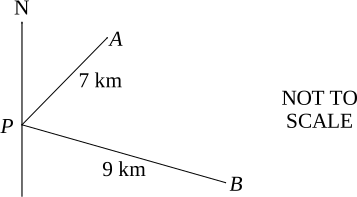
Mr Ali, Ms Brown and a group of students were camping at the site located at `P`. Mr Ali walked with some of the students on a bearing of 035° for 7 km to location `A`. Ms Brown, with the rest of the students, walked on a bearing of 100° for 9 km to location `B`.


  1. Show that the angle `APB` is 65°.  (1 mark)

    --- 1 WORK AREA LINES (style=lined) ---
  2. Find the distance `AB`.  (2 marks)

    --- 5 WORK AREA LINES (style=lined) ---

  3. Find the bearing of Ms Brown's group from Mr Ali's group. Give your answer correct to the nearest degree.  (2 marks)

    --- 5 WORK AREA LINES (style=lined) ---
Show Answers Only
  1. `text(See Worked Solutions)`
  2. `8.76\ text{km  (to 2 d.p.)}`
  3. `146^@`
Show Worked Solution
a.    `angle APB` `= 100-35`
    `= 65^@`


b.   `text(Using cosine rule:)`

`AB^2` `= AP^2 + PB^2-2 xx AP xx PB cos 65^@`
  `= 49 + 81-2 xx 7 xx 9 cos 65^@`
  `= 76.750…`
`:.AB` `= 8.760…`
  `= 8.76\ text{km  (to 2 d.p.)}`

 
c.

`anglePAC = 35^@\ (text(alternate))`

`text(Using cosine rule, find)\ anglePAB:`

`cos anglePAB` `= (7^2 + 8.76-9^2)/(2 xx 7 xx 8.76)`  
  `= 0.3647…`  
`:. angle PAB` `= 68.61…^@`  
  `= 69^@\ \ (text(nearest degree))`  


`:. text(Bearing of)\ B\ text(from)\ A\ (theta)` 

`= 180-(69-35)`

`= 146^@`

Filed Under: Bearings (Adv-2027), Bearings (Y11) Tagged With: 2adv-std2-common, Band 2, Band 3, Band 4, common-content, smc-6395-10-Bearings, smc-981-10-Bearings

NETWORKS, FUR2-NHT 2019 VCAA 1

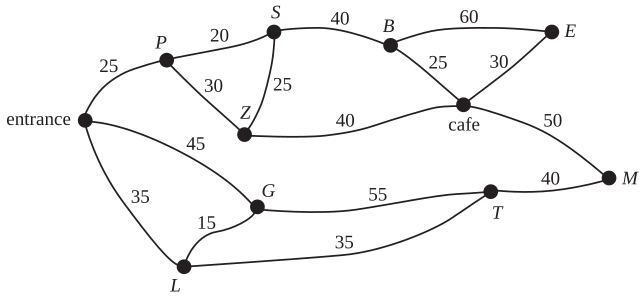
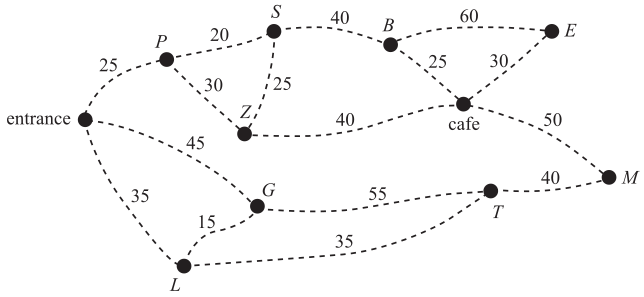
A zoo has an entrance, a cafe and nine animal exhibits: bears `(B)`, elephants `(E)`, giraffes `(G)`, lions `(L)`, monkeys `(M)`, penguins `(P)`, seals `(S)`, tigers `(T)` and zebras `(Z)`.

The edges on the graph below represent the paths between the entrance, the cafe and the animal exhibits. The numbers on each edge represent the length, in metres, along that path. Visitors to the zoo can use only these paths to travel around the zoo.


  1. What is the shortest distance, in metres, between the entrance and the seal exhibit `(S)`?   (1 mark)

    --- 1 WORK AREA LINES (style=lined) ---
  2. Freddy is a visitor to the zoo. He wishes to visit the cafe and each animal exhibit just once, starting and ending at the entrance.
  3. i. What is the mathematical term used to describe this route?   (1 mark)

    --- 1 WORK AREA LINES (style=lined) ---
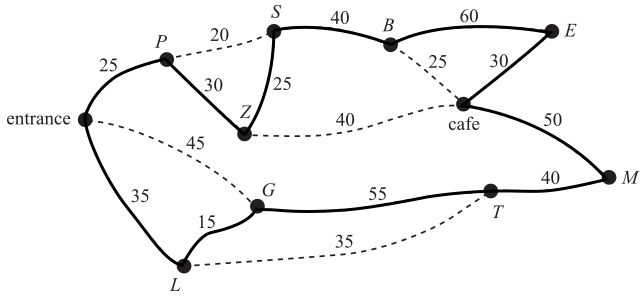
  4. ii. Draw one possible route that Freddy may take on the graph below.   (1 mark)

    --- 0 WORK AREA LINES (style=lined) ---
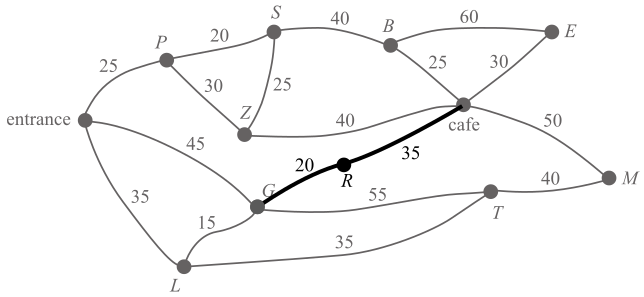


A reptile exhibit `(R)` will be added to the zoo.

A new path of length 20 m will be built between the reptile exhibit `(R)` and the giraffe exhibit `(G)`.

A second new path, of length 35 m, will be built between the reptile exhibit `(R)` and the cafe.

  1. Complete the graph below with the new reptile exhibit and the two new paths added. Label the new vertex `R` and write the distances on the new edges.   (1 mark)

    --- 0 WORK AREA LINES (style=lined) ---


  1. The new paths reduce the minimum distance that visitors have to walk between the giraffe exhibit `(G)` and the cafe.


    By how many metres will these new paths reduce the minimum distance between the giraffe exhibit `(G)` and the cafe?   (1 mark)

    --- 5 WORK AREA LINES (style=lined) ---
Show Answers Only
  1.  `45\ text(metres)`
  2. i.  `text(Hamilton cycle.)`
    ii. `text(See Worked Solutions)`
  3.  `text(See Worked Solutions)`
  4.  `85\ text(metres)`
Show Worked Solution

a.   `45\ text(metres)`
 

b.i.   `text(Hamilton cycle.)`
 

b.ii.  

`text(Possible route:)`

`text(entrance)\ – LGTMCEBSZP\ –\ text(entrance)`


c.  


d.  `text{Minimum distance (before new exhibit)}`

`= GLTMC`

`= 15 + 35 + 40 + 50`

`= 140\ text(m)`
 

`:.\ text(Reduction in minimum distance)`

`= 140 – (20 + 35)`

`= 85\ text(m)`

Filed Under: Minimum Spanning Trees and Shortest Paths Tagged With: Band 2, Band 3, Band 4, smc-624-60-Shortest Paths

MATRICES, FUR2-NHT 2019 VCAA 1

A total of six residents from two towns will be competing at the International Games.

Matrix `A`, shown below, contains the number of male `(M)` and the number of female `(F)` athletes competing from the towns of Gillen `(G)` and Haldaw `(H)`.

`{:(qquad qquad quad \ M quad F), (A = [(2, 2), (1, 1)]{:(G),(H):}):}` 

  1. How many of these athletes are residents of Haldaw?   (1 mark)

    --- 1 WORK AREA LINES (style=lined) ---

Each of the six athletes will compete in one event: table tennis, running or basketball.

Matrices `T` and `R`, shown below, contain the number of male and female athletes from each town who will compete in table tennis and running respectively.
 

            Table tennis                        Running             
 

`{:(qquad qquad quad \ M quad F), (T = [(0, 1), (1, 0)]{:(G),(H):}):}`

`{:(qquad qquad quad \ M quad F), (R = [(1, 1), (0, 0)]{:(G),(H):}):}`


  1. Matrix `B` contains the number of male and female athletes from each town who will compete in basketball.


    Complete matrix `B` below.   (1 mark)

    --- 0 WORK AREA LINES (style=lined) ---
`{:(qquad qquad qquad \ M qquad quad F), (B = [(\ text{___}, text{___}\ ), (\ text{___}, text{___}\)]{:(G),(H):}):}`

Matrix `C` contains the cost of one uniform, in dollars, for each of the three events: table tennis `(T)`, running `(R)` and basketball `(B)`.

`C = [(515), (550), (580)]{:(T), (R), (B):}`

    1. For which event will the total cost of uniforms for the athletes be $1030?   (1 mark)

      --- 1 WORK AREA LINES (style=lined) ---
    2. Write a matrix calculation, that includes matrix `C`, to show that the total cost of uniforms for the event named in part c.i. is contained in the matrix answer of [1030].   (1 mark)

      --- 3 WORK AREA LINES (style=lined) ---
  1. Matrix `V` and matrix `Q` are two new matrices where  `V = Q xx C`  and:
  • matrix `Q` is a  `4 xx 3`  matrix
  • element `v_11 =` total cost of uniforms for all female athletes from Gillen
  • element `v_21 =` total cost of uniforms for all female athletes from Haldaw
  • element `v_31 =` total cost of uniforms for all male athletes from Gillen
  • element `v_41 =` total cost of uniforms for all male athletes from Haldaw
     
  • `C = [(515), (550), (580)]{:(T), (R), (B):}`
  1. Complete matrix `Q` with the missing values.   (1 mark)

    --- 0 WORK AREA LINES (style=lined) ---
`Q = [(1, text{___}, text{___}\ ), (0, 0, 1), (0, 1, 1), (\ text{___}, text{___}, 0)]`

Show Answers Only
  1.  `2`
  2.  `B = [(1, 0), (0, 1)]`
  3. i.  `text(Table tennis)`
    ii. `[2\ \ \ 0\ \ \ 0] xx [(515), (550), (580)] = [1030]`
  4.  `Q = [(1, \ 1, \ 0),(0, \ 0, \ 1),(0, \ 1, \ 1),(1, \ 0, \ 0)]`
Show Worked Solution

a.  `2`
 

b.  `B = [(1, 0), (0, 1)]`
 

c.i.  `text(Table tennis)`
 

c.ii.  `[2\ \ \ 0\ \ \ 0] xx [(515), (550), (580)] = [1030]`
 

d.  `Q = [(1, \ 1, \ 0),(0, \ 0, \ 1),(0, \ 1, \ 1),(1, \ 0, \ 0)]`

Filed Under: Matrix Applications Tagged With: Band 2, Band 3, Band 4, smc-619-10-Matrix from info/table, smc-619-30-Matrix product and interpretation, smc-619-40-Interpret Elements

Financial Maths, GEN2 2019 NHT 6

Marlon plays guitar in a band.

He paid $3264 for a new guitar.

The value of Marlon's guitar will be depreciated by a fixed amount for each concert that he plays.

After 25 concerts, the value of the guitar will have decreased by $200.

  1. What will be the value of Marlon's guitar after 25 concerts?   (1 mark)

    --- 2 WORK AREA LINES (style=lined) ---
  2. Write a calculation that shows that the value of Marlon's guitar will depreciate by $8 per concert.   (1 mark)

    --- 2 WORK AREA LINES (style=lined) ---
  3. The value of Marlon's guitar after `n` concerts, `G_n`, can be determined using a rule.


    Complete the rule below by writing the appropriate numbers in the boxes provided.   (1 mark)

    --- 1 WORK AREA LINES (style=lined) ---
     
              `G_n =`   – × `n`
     

  4. The value of the guitar continues to be depreciated by $8 per concert.


    After how many concerts will the value of Marlon's guitar first fall below $2500?   (2 marks)

    --- 4 WORK AREA LINES (style=lined) ---
Show Answers Only
  1. `$3064`
  2. `text{Proof (See Worked Solution)}`
  3. `G_n = 3264-8 xx n`
  4. `96 \ text(concerts)`
Show Worked Solution
a.    `text(Value)` `= 3264-200`
  `= $3064`


b.    `text(Depreciation per concert)` `= (200)/(25)`
  `= $8 \ text(per concert)`

c.    `G_n = 3264 – 8 xx n`
 

d.    `text(Find) \ n \ text(when) \ \ G_n = 2500:`

`2500` `= 3264 – 8n`
`n` `= (3264-2500)/8`
  `= 95.5`

 
`:. \ text(After) \ 96 \ text(concerts, value first falls below $2500)`

Filed Under: Depreciation Tagged With: Band 2, Band 3, Band 4, smc-602-30-Unit cost

Data Analysis, GEN2 2019 NHT 1

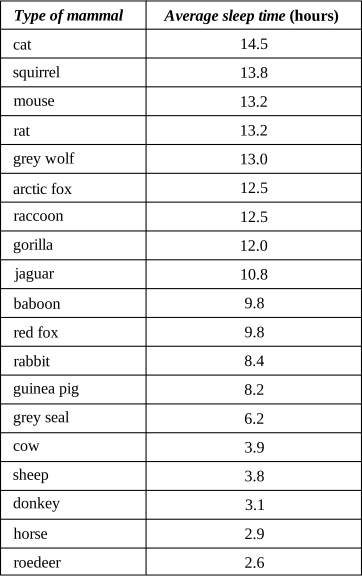
The table below displays the average sleep time, in hours, for a sample of 19 types of mammals.
 

  1. Which of the two variables, type of mammal or average sleep time, is a nominal variable?   (1 mark)

    --- 1 WORK AREA LINES (style=lined) ---
  2. Determine the mean and standard deviation of the variable average sleep time for this sample of mammals.
  3. Round your answer to one decimal place.   (1 mark)

    --- 2 WORK AREA LINES (style=lined) ---
  4. The average sleep time for a human is eight hours.
  5. What percentage of this sample of mammals has an average sleep time that is less than the average sleep time for a human.
  6. Round your answer to one decimal place.   (1 mark)

    --- 2 WORK AREA LINES (style=lined) ---
  7. The sample is increase in size by adding in the average sleep time of the little brown bat.
  8. Its average sleep time is 19.9 hours.
  9. By how many many hours will the range for average sleep time increase when the average sleep time for the little brown bat is added to the sample?   (1 mark)

    --- 2 WORK AREA LINES (style=lined) ---
Show Answers Only
  1. `text(type of mammal)`
  2. `text(mean)= 9.2 \ text(hours)`


    `sigma = 4.2 \ text(hours)`

  3. `31.6text(%)`
  4. `5.4 \ text(hours)`
Show Worked Solution

a.    `text(type of mammal is nominal)`

 
b.    `text(mean)= 9.2 \ text(hours) \ \ text{(by CAS)}`

`sigma = 4.2 \ text(hours) \ \ text{(by CAS)}`
 

c.    `text(Percentage)` `= (6)/(19) xx 100`
  `= 0.3157 …`
  `= 31.6text(%)`


d.    `text(Range increase)` `= 19.9-14.5`
  `= 5.4 \ text(hours)`

Filed Under: Summary Statistics Tagged With: Band 2, Band 3, Band 4, page-break-before-question, smc-468-10-Data Classification, smc-468-20-Mean, smc-468-30-Std Dev, smc-468-40-Median Mode and Range

GRAPHS, FUR1-NHT 2019 VCAA 1 MC

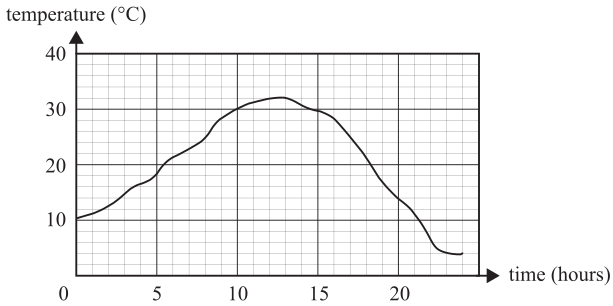
The graph below shows the temperature, in degrees Celsius, over 24 hours.


The difference between the highest and lowest temperatures on this day, in degrees Celsius, is closest to

  1. 16
  2. 20
  3. 24
  4. 28
  5. 32
Show Answers Only

`D`

Show Worked Solution

`text(High) ~~ 32`

`text(Low) ~~ 4`

`:.\ text(Range)` `~~ 32 -4`
  `~~ 28`

`=>  D`

Filed Under: Graph Applications Tagged With: Band 2

NETWORKS, FUR1-NHT 2019 VCAA 1 MC

The graph below has five vertices and eight edges.


How many of the vertices in this graph have an even degree?

  1. 0
  2. 1
  3. 2
  4. 3
  5. 4
Show Answers Only

`D`

Show Worked Solution

`text(Three vertices have an even degree.)`

`=>  D`

Filed Under: Basic Concepts Tagged With: Band 2, smc-626-20-Degrees of Vertices

Data Analysis, GEN1 2019 NHT 3 MC

The total birth weight of a sample of 12 babies is 39.0 kg.

The mean birth weight of these babies, in kilograms, is

  1.  2.50
  2.  2.75
  3.  3.00
  4.  3.25
  5.  3.50
Show Answers Only

`D`

Show Worked Solution
`text(Mean)` `= 39.0/12`
  `= 3.25\ text(kg)`

 
`=>\ D`

Filed Under: Summary Statistics Tagged With: Band 2, smc-468-20-Mean

Functions, 2ADV F1 SM-Bank 53

  1. If  `1/(root3(7+pi)) = (7+pi)^x`, find  `x`.  (1 mark)

    --- 1 WORK AREA LINES (style=lined) ---
  2. Calculate the value of  `1/(root3(7+pi))`  to 3 significant figures.   (1 mark)

    --- 2 WORK AREA LINES (style=lined) ---
Show Answers Only
  1. `-1/3`
  2. `0.462`
Show Worked Solution

i.    `1/(root3(7+pi)) = (7+pi)^(-1/3)`

ii.     `1/(root3(7+pi))` `=0.4619…`
    `=0.462\ \ text{(to 3 sig. fig.)}`

Filed Under: Algebraic Techniques (Adv-2027), Algebraic Techniques (Y11), Log/Index Laws and Equations (Adv-2027), Log/Index Laws and Equations (Y11) Tagged With: Band 2, Band 3, smc-6213-60-Rounding, smc-6455-50-Exponential Equations, smc-963-50-Exponential Equation, smc-983-10-Rounding

Functions, 2ADV F1 SM-Bank 50

Rationalise the denominator of  `1/(4sqrt 3)`.  (2 marks)

Show Answers Only

`sqrt 3/12`

Show Worked Solution
`1/(4sqrt 3) xx (4sqrt 3)/(4sqrt 3)` `= (4sqrt 3)/(16xx3)`  
  `= sqrt 3/12`  

Filed Under: Algebraic Techniques (Y11) Tagged With: Band 2, smc-983-30-Surd Denominators

Vectors, EXT2 V1 SM-Bank 9

  1. Find the equation of line vector  `underset ~r`, given it passes through  `(1, 3, –2)`  and  `(2, –1, 2)`.   (2 marks)

    --- 4 WORK AREA LINES (style=lined) ---
  2. Determine if  `underset ~r`  passes through  `(4, –9, 10)`.   (1 mark)

    --- 4 WORK AREA LINES (style=lined) ---
Show Answers Only
  1. `underset ~r = ((1), (3), (-2)) + lambda ((1), (-4), (4)) or`


    `underset ~r = ((2), (-1), (2)) + lambda ((-1), (4), (-4))`

  2. `text(See Worked Solutions)`
Show Worked Solution

i.     `text(Method 1)`

`text(Let)\ \ A(1, 3, –2) and B(2, –1, 2)`

`vec (AB)` `= ((2), (-1), (2))-((1), (3), (-2)) = ((1), (-4), (4))`
`underset ~r` `= ((1), (3), (-2)) + lambda ((1), (-4), (4))`


`text (Method 2)`

`vec (BA)` `= ((1), (3), (-2))-((2), (-1), (2)) = ((-1), (4), (-4))`
`underset ~r` `= ((2), (-1), (2)) + lambda ((-1), (4), (-4))`


ii.   `text(If)\ \ (4, –9, 10)\ \ text(lies on the vector line,)`

`∃ lambda\ \ text(that satisfies:)`

`1 + lambda` `= 4\ \ text{… (1)}`
`3-4 lambda` `= -9\ \ text{… (2)}`
`-2 + 4 lambda` `= 10\ \ text{… (3)}`


`lambda = 3\ \ text(satisfies all equations)`

`:. (4, –9, 10)\ \ text(lies on the line.)`

Filed Under: Vectors and Vector Equations of Lines Tagged With: Band 2, Band 3, smc-1196-10-Find line given 2 points, smc-1196-25-Point lies on line, smc-1196-80-3D vectors

GRAPHS, FUR2 2019 VCAA 1

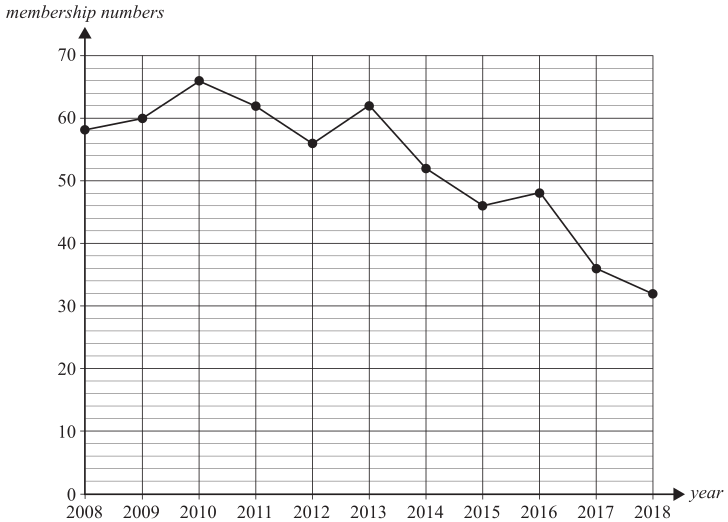
The graph below shows the membership numbers of the Wombatong Rural Women’s Association each year for the years 2008–2018.


  1. How many members were there in 2009?  (1 mark)
    1. Show that the average rate of change of membership numbers from 2013 to 2018 was − 6 members per year.  (1 mark)
    2. If the change in membership numbers continues at this rate, how many members will there be in 2021?  (1 mark)
Show Answers Only
  1. `60`
    1. `text(Proof)\ \ text{(See Worked Solutions)}`
    2. `14`
Show Worked Solution

a.  `60`


b.i.   `text(Members in 2013)` `= 62`
  `text(Members in 2018)` `= 32`
  `text(Average ROC)` `= (32 – 62)/5`
    `= -6\ text(members per year.)`


b.ii.   `text(Members in 2021)` `= 32 – 3 xx 6`
    `= 14`

Filed Under: Graph Applications Tagged With: Band 2, Band 3, Band 4

GEOMETRY, FUR2 2019 VCAA 1

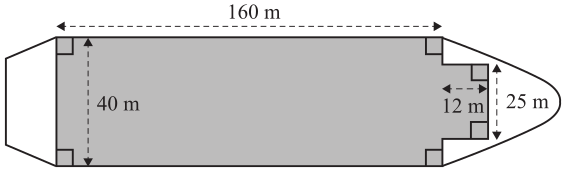
The following diagram shows a cargo ship viewed from above.


The shaded region illustrates the part of the deck on which shipping containers are stored.

  1. What is the area, in square metres, of the shaded region?  (1 mark)

Each shipping container is in the shape of a rectangular prism.

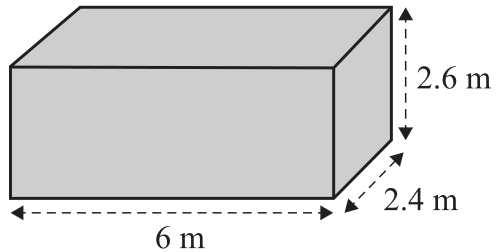
Each shipping container has a height of 2.6 m, a width of 2.4 m and a length of 6 m, as shown in the diagram below.
 

  1. What is the volume, in cubic metres, of one shipping container?  (1 mark)
  2. What is the total surface area, in square metres, of the outside of one shipping container?  (1 mark)
  3. One shipping container is used to carry barrels. Each barrel is in the shape of a cylinder.


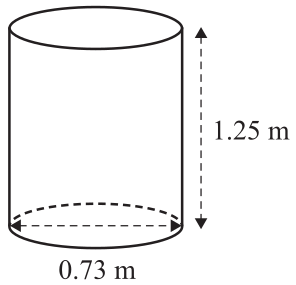
    Each barrel is 1.25 m high and has a diameter of 0.73 m, as shown in the diagram below.


    Each barrel must remain upright in the shipping container


    `qquad qquad`
     
    What is the maximum number of barrels that can fit in one shipping container?  (1 mark)

Show Answers Only
  1. `6700\ text(m²)`
  2. `37.44\ text(m³)`
  3. `72.48\ text(m²)`
  4. `48`
Show Worked Solution
a.   `text(Area)` `= 160 xx 40 + 12 xx 25`
    `= 6700\ text(m²)`


b.   `text(Volume)` `= 6 xx 2.4 xx 2.6`
    `= 37.44\ text(m³)`


c.   `text(S.A.)` `= 2(6 xx 2.6) + 2 (6 xx 2.4) + 2(2.4 xx 2.6)`
    `= 72.48\ text(m²)`


d.   `6 ÷ 0.73 = 8.21` `=> \ text(8 barrels along length)`
  `2.4 ÷ 0.73 = 3.28` `=> \ text(3 barrels along width)`
  `2.6 ÷ 1.25 = 2.08` `=> \ text(2 vertical layers)`


`:.\ text(Maximum barrels)` `= 2 xx 8 xx 3`
  `= 48`

Filed Under: Perimeter, Area and Volume Tagged With: Band 2, Band 3, Band 4

NETWORKS, FUR2 2019 VCAA 1

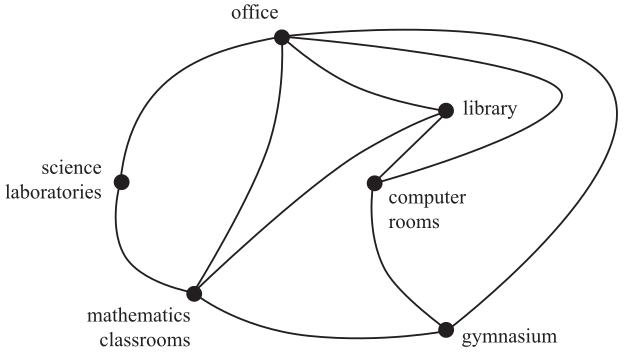
Fencedale High School has six buildings. The network below shows these buildings represented by vertices. The edges of the network represent the paths between the buildings.


  1. Which building in the school can be reached directly from all other buildings?   (1 mark)

    --- 1 WORK AREA LINES (style=lined) ---

  2. A school tour is to start and finish at the office, visiting each building only once.
     i.
    What is the mathematical term for this route?   (1 mark)

    --- 1 WORK AREA LINES (style=lined) ---

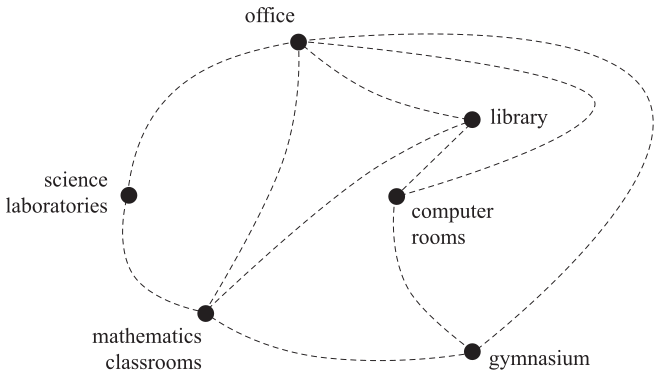
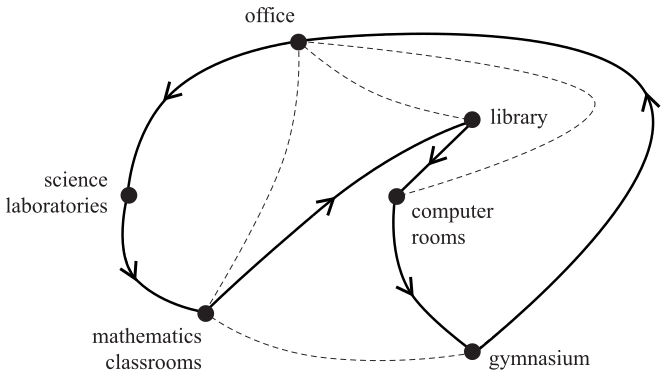
  3. ii. Draw in a possible route for this school tour on the diagram below.   (1 mark)

    --- 0 WORK AREA LINES (style=lined) ---


Show Answers Only
  1. `text(Office)`
  2.  i.  `text(Hamiltonian cycle)`
    ii. `text(See Worked Solutions)` 
Show Worked Solution

a.  `text(Office)`
 

b.i.   `text(Hamiltonian cycle)`

`text{(note a Hamiltonian path does not start and finish}`

  `text{at the same vertex.)}`
 

b.ii.   `text(One of many solutions:)`
 

Filed Under: Travelling Problems and Adjacency Matrices Tagged With: Band 2, Band 3, Band 4, smc-622-20-Hamiltonian

MATRICES, FUR2 2019 VCAA 1

The car park at a theme park has three areas, `A, B` and `C`.

The number of empty `(E)` and full `(F)` parking spaces in each of the three areas at 1 pm on Friday are shown in matrix `Q`  below.
 

`{:(qquad qquad qquad \ E qquad F),(Q = [(70, 50),(30, 20),(40, 40)]{:(A),(B),(C):}quad text(area)):}`
 

  1. What is the order of matrix `Q`?   (1 mark)

    --- 1 WORK AREA LINES (style=lined) ---

  2. Write down a calculation to show that 110 parking spaces are full at 1 pm.   (1 mark)

    --- 2 WORK AREA LINES (style=lined) ---

Drivers must pay a parking fee for each hour of parking.

Matrix `P`, below, shows the hourly fee, in dollars, for a car parked in each of the three areas.
 

`{:(qquad qquad qquad qquad qquad text{area}), (qquad qquad qquad A qquad quad quad B qquad qquad C), (P = [(1.30, 3.50, 1.80)]):}`
 

  1. The total parking fee, in dollars, collected from these 110 parked cars if they were parked for one hour is calculated as follows.  


    `qquad qquad qquad P xx L = [207.00]`


    where matrix  `L`  is a  `3 xx 1`  matrix.


    Write down matrix  `L`.   (1 mark)

    --- 2 WORK AREA LINES (style=lined) ---

The number of whole hours that each of the 110 cars had been parked was recorded at 1 pm. Matrix `R`, below, shows the number of cars parked for one, two, three or four hours in each of the areas `A, B` and `C`.

`{:(qquadqquadqquadqquadquadtext(area)),(quad qquadqquadquad \ A qquad B qquad C),(R = [(3, 1, 1),(6, 10, 3),(22, 7,10),(19, 2, 26)]{:(1),(2),(3),(4):}\ text(hours)):}`
 

  1. Matrix  `R^T`  is the transpose of matrix  `R`.


    Complete the matrix  `R^T`  below.   (1 mark)

    --- 0 WORK AREA LINES (style=lined) ---


    `qquad R^T = [( , , , , , , , , ), ( , , , , , , , , ), ( , , , , , , , , ), ( , , , , , , , , ), ( , , , , , , , , )]`
     

  2. Explain what the element in row 3, column 2 of matrix  `R^T`  represents.   (1 mark)

    --- 2 WORK AREA LINES (style=lined) ---

Show Answers Only
  1. `3 xx 2`
  2. `50 + 20 + 40 = 110`
  3. `L = [(50), (20), (40)]`
  4. `R^T = [(3 ,6 , 22, 19), (1, 10, 7, 2), (1, 3, 10, 26)]`
  5. `text(Number of cars parked in area)\ C\ text(for 2 hours).`
Show Worked Solution

a.  `text(Order) : 3 xx 2`
 

b.  `text(Add 2nd column): \ 50 + 20 + 40 = 110`
 

c.  `L = [(50), (20), (40)]`
 

d.  `R^T = [(3 ,6 , 22, 19), (1, 10, 7, 2), (1, 3, 10, 26)]`
 

e.   `e_32\ text(in)\ R^T =>` `text(number of cars parked in area)\ C`
    `text(for 2 hours.)`

Filed Under: Matrix Applications Tagged With: Band 2, Band 3, Band 4, page-break-before-question, smc-619-10-Matrix from info/table, smc-619-30-Matrix product and interpretation, smc-619-40-Interpret Elements, smc-619-65-Transpose

CORE, FUR2 2019 VCAA 2


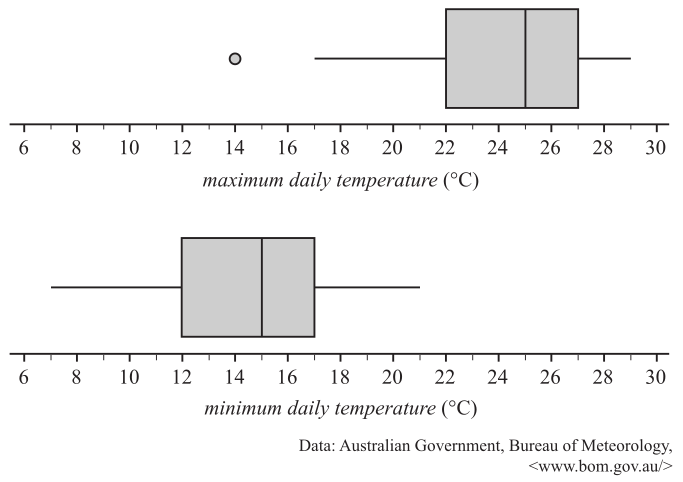
The parallel boxplots below show the maximum daily temperature and minimum daily temperature, in degrees Celsius, for 30 days in November 2017.
 

  1. Use the information in the boxplots to complete the following sentences.
  2. For November 2017
  3.    i. the interquartile range for the minimum daily temperature was _____ °C   (1 mark)

    --- 2 WORK AREA LINES (style=lined) ---

  4.  ii. the median value for maximum daily temperature was _____ °C higher than the median value for minimum daily temperature   (1 mark)

    --- 2 WORK AREA LINES (style=lined) ---

  5. iii. the number of days on which the maximum daily temperature was less than the median value for minimum daily temperature was _____    (1 mark)

    --- 2 WORK AREA LINES (style=lined) ---

  1. The temperature difference between the minimum daily temperature and the maximum daily temperature in November 2017 at this location is approximately normally distributed with a mean of 9.4 °C and a standard deviation of 3.2 °C.
  2. Determine the number of days in November 2017 for which this temperature difference is expected to be greater than 9.4 °C.  (1 mark)

    --- 2 WORK AREA LINES (style=lined) ---

Show Answers Only

    1. `5text(°C)`
    2. `10text(°C)`
    3. `1\ text(day)`
  1. `15\ text(days)`

Show Worked Solution

a.i.  `text(IQR)\ = 17-12= 5text(°C)`
 

a.ii.    `text{Median (maximum temperature)}` `= 25`
  `text{Median (minimum temperature)}` `= 15`

 
`:.\ text(Maximum is 10°C higher)`
 

a.iii.  `text{Median (minimum temperature)} = 15text(°C)`

   `text(1 day) => text(maximum temperature is below)\ 15text(°C)`
 

b.    `text(Number of days)` `= 0.50 xx 30`
    `= 15\ text(days)`

Filed Under: Graphs - Stem/Leaf and Boxplots, Normal Distribution Tagged With: Band 2, Band 3, Band 4, smc-600-10-Single z-score, smc-643-20-Parallel Box-Plots, smc-643-60-Outliers

GRAPHS, FUR1 2019 VCAA 1 MC

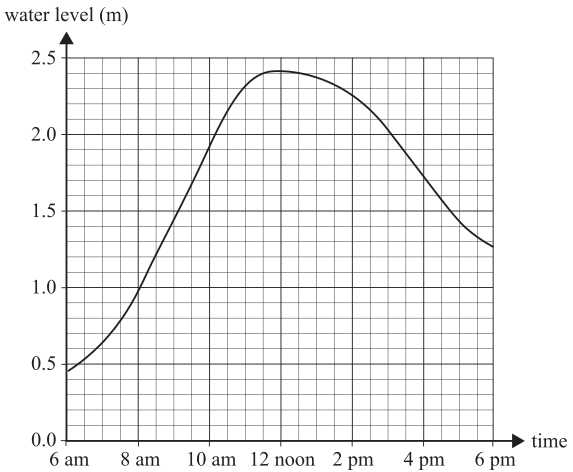
The graph below shows the water level in a creek, in metres, over a 12-hour period.


Compared to the water level at 8 am, the water level at 12 noon was closest to

  1. 1.0 m higher.
  2. 1.4 m higher
  3. 2.4 m higher.
  4. 0.9 m lower.
  5. 1.3 m lower.
Show Answers Only

`B`

Show Worked Solution

`text(Level at 8am) ~~ 1.0\ text(m)`

`text(Level at noon) ~~ 2.4\ text(m)`

`:.\ text(Noon level) ~~ 1.4\ text(m higher)`

`=>  B`

Filed Under: Graph Applications Tagged With: Band 2

GEOMETRY, FUR1 2019 VCAA 1 MC

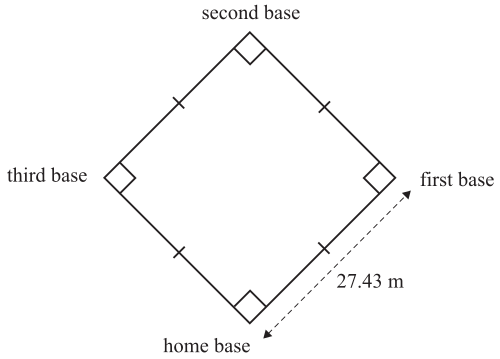
The four bases of a baseball field form four corners of a square of side length 27.43 m, as shown in the diagram below.


A player ran from home base to first base, then to second base, then to third base and finally back to home base.

The minimum distance, in metres, that the player ran is

  1.   27.43
  2.   54.86
  3.   82.29
  4. 109.72
  5. 164.58
Show Answers Only

`D`

Show Worked Solution
`text(Minimum distance)` `= 4 xx 27.43`
  `= 109.72`

`=>  D`

Filed Under: Perimeter, Area and Volume Tagged With: Band 2

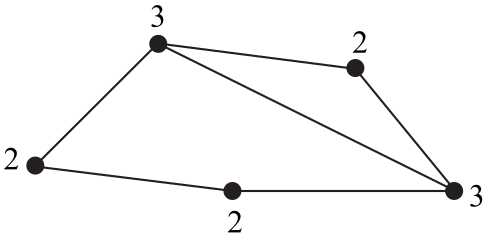
NETWORKS, FUR1 2019 VCAA 1 MC

 
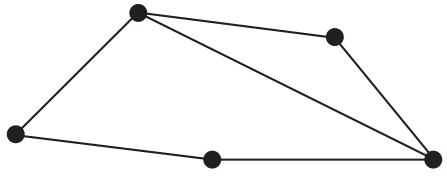
In the graph shown above, the sum of the degrees of the vertices is

  1.   5
  2.   6
  3. 10
  4. 11
  5. 12
Show Answers Only

`E`

Show Worked Solution

`text{Sum of degrees (clockwise from bottom left)}`

`= 2 + 3 + 2 + 3 + 2`

`= 12`
 

`=>  E`

Filed Under: Basic Concepts Tagged With: Band 2, smc-626-20-Degrees of Vertices

MATRICES, FUR1 2019 VCAA 1 MC

Consider the following four matrix expressions.
 

`[(8), (12)]+[(4), (2)] qquad qquad qquad qquad qquad qquad quad [(8), (12)]+[(4, 0),(0, 2)]`
 

`[(8, 0),(12, 0)] + [(4), (2)] qquad qquad qquad qquad qquad \ [(8, 0),(12, 0)] + [(4, 0),(0, 2)]`
 

How many of these four matrix expressions are defined?

  1. 0
  2. 1
  3. 2
  4. 3
  5. 4
Show Answers Only

`C`

Show Worked Solution

`[(8), (12)]+[(4), (2)] = [(12), (4)]`

`[(8), (12)]+[(4, 0),(0, 2)] = text(not defined)`

`[(8, 0),(12, 0)] + [(4), (2)] = text(not defined)`

`[(8, 0),(12, 0)] + [(4, 0),(0, 2)] = [(12, 0), (12, 2)]`


`=>  C`

Filed Under: Matrix Calculations Tagged With: Band 2, smc-616-20-Order / (Un)Defined

Calculus, SPEC1 2019 VCAA 5

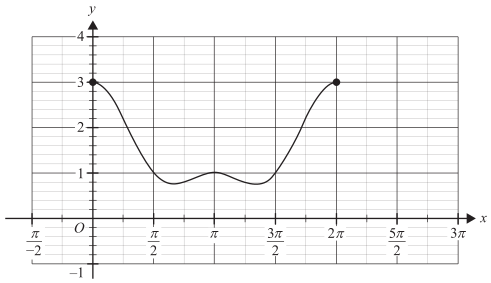
The graph of  `f(x) = cos^2(x) + cos(x) + 1`  over the domain  `0 <= x <= 2pi`  is shown below.

  1.  i.  Find `f^{′}(x)`.  (1 mark)

    --- 2 WORK AREA LINES (style=lined) ---

  2. ii. Hence, find the coordinates of the turning points of the graph in the interval  `(0, 2pi)`.  (2 marks)

    --- 4 WORK AREA LINES (style=lined) ---
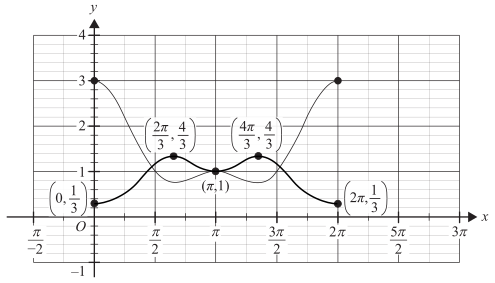
  3. Sketch the graph of  `y = 1/(f(x))`  on the set of axes above. Clearly label the turning points and endpoints of this graph with their coordinates.  (3 marks)
Show Answers Only
  1. i.  `−sin(x)(2cos(x) + 1)`
  2. ii. `(pi, 1), ((2pi)/3,3/4), ((4pi)/3, 3/4)`
  3.  

Show Worked Solution
a.i.    `f(x)` `= cos^2(x) + cos(x) + 1`
  `f^{′}(x)` `= -2sin(x)cos(x)-sin(x)`
    `= -sin(x)(2cos(x) + 1)`


a.ii.   `text(SP when)\ \ sin(x) = 0\ \ text(or)\ \ 2cos(x) + 1 = 0`

`sin(x) = 0 \ => \ x = pi\ \ (x = 0\ \ text{not in domain})`

`2cos(x) + 1` `= 0`
`cos(x)` `= -1/2`
`x` `= (2pi)/3, (4pi)/3`

 
`text(When)\ \ cos(x) = −1/2 \ => \ f(x) = 1/4-1/2 + 1 = 3/4`

`:.\ text(Turning Points:)\ (pi, 1), ((2pi)/3,3/4), ((4pi)/3, 3/4)`


b.   

Filed Under: Tangents and Curve Sketching Tagged With: Band 2, Band 3, Band 4, smc-1182-35-Sketch curve, smc-1182-70-y = 1/f(x)

Complex Numbers, EXT2 N1 2019 HSC 11e

Let  `z = -1 + i sqrt 3`.

  1. Write  `z`  in modulus-argument form.  (2 marks)

    --- 4 WORK AREA LINES (style=lined) ---
  2. Find  `z^3`, giving your answer in the form  `x + iy`, where  `x`  and  `y`  are real numbers.  (2 marks)

    --- 3 WORK AREA LINES (style=lined) ---

Show Answers Only
  1. `z = 2 text(cis) (2 pi)/3`
  2. `8 + 0i`
Show Worked Solution
i.   `|\ z\ |` `= -1 + i sqrt 3`
    `= sqrt((-1)^2 + (sqrt 3)^2)`
    `= 2`


  `tan theta` `= -sqrt 3`
  `text(arg)(z)` `= (2 pi)/3`
  `:. z` `= 2 text(cis) (2 pi)/3`


ii.   `z^3 = 2^3 [cos(3 xx (2 pi)/3) + i sin (3 xx (2 pi)/3)]\ \ \ text{(by De Moivre)}`

`= 8(cos 2 pi + i sin 2 pi)`

`= 8(1 + 0i)`

`= 8 + 0i`

Filed Under: Argand Diagrams and Mod/Arg form Tagged With: Band 2, Band 3, smc-1049-50-Powers

Calculus, EXT2 C1 2019 HSC 11d

Find  `int 6/(x^2-9) dx`.  (3 marks)

--- 6 WORK AREA LINES (style=lined) ---

Show Answers Only

`ln |\ (x-3)/(x + 3)\ |+ c`

Show Worked Solution

`text(Using partial fractions):`

`6/(x^2-9)` `= 6/((x + 3)(x-3))`
  `= A/(x + 3) + B/(x-3)`

 
`:. A(x-3) + B(x + 3) = 6`
 

`text(When)\ \ x = 3,\ 6B = 6 \ => \ B = 1`

`text(When)\ \ x = -3,\ -6A = 6 \ => \ A = -1`

`int 6/(x^2-9)\ dx` `= int (-1)/(x + 3) + 1/(x-3)\ dx`
  `= -ln|\ x + 3\ | + ln |\ x-3\ | + C`
  `= ln |\ (x-3)/(x + 3)\ | + C`

Filed Under: Partial Fractions Tagged With: Band 2, smc-1056-10-Quadratic denom, smc-1056-40-PF not given

Complex Numbers, EXT2 N1 2019 HSC 11a

Let  `z = 1 + 3i`  and  `w = 2 - i`.

  1. Find  `z + bar w`.  (1 mark)

    --- 2 WORK AREA LINES (style=lined) ---

  2. Express  `z/w`  in the form  `x + iy`, where  `x` and  `y`  are real numbers.  (2 marks)

    --- 4 WORK AREA LINES (style=lined) ---

Show Answers Only
  1. `3 + 4i`
  2. `-1/5 + 7/5 i`
Show Worked Solution

i.   `z = 1 + 3i`

`w = 2 – i \ => \ bar w = 2 + i`

`z + bar w` `= 1 + 3i + 2 + i`
  `= 3 + 4i`


ii.    `z/w` `= (1 + 3i)/(2 – i) xx (2 + i)/(2 + i)`
    `= ((1 + 3i)(2 + i))/(2^2 – i^2)`
    `= (2 + i + 6i + 3i^2)/5`
    `= (-1 + 7i)/5`
    `= -1/5 + 7/5 i`

Filed Under: Arithmetic of Complex Numbers Tagged With: Band 1, Band 2, smc-1048-10-Basic Arithmetic

Complex Numbers, EXT2 N1 2019 HSC 1 MC

What is the value of  `(3 - 2i)^2`?

  1. `5 - 12i`
  2. `5 + 12i`
  3. `13 - 12i`
  4. `13 + 12i`
Show Answers Only

`A`

Show Worked Solution
`(3 – 2i)^2` `= 9 – 12i + 4i^2`
  `= 9 – 12i – 4`
  `= 5 – 12i`

 
`=>   A`

Filed Under: Arithmetic of Complex Numbers Tagged With: Band 2, smc-1048-10-Basic Arithmetic

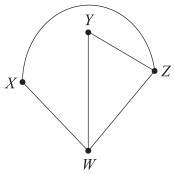
Networks, STD1 N1 2019 HSC 1 MC

A network diagram is given.
 

What is the degree of vertex `W`?

  1. 1
  2. 2
  3. 3
  4. 4
Show Answers Only

`C`

Show Worked Solution

`text(Vertex)\ W\ text(has 3 edges connected and is therefore degree 3.)`

`=> C`

Filed Under: Basic Concepts, Basic Concepts, Network Concepts (Std1-2027) Tagged With: Band 2, num-title-ct-path, num-title-qs-hsc, smc-1136-40-Degrees of Vertices, smc-4788-20-Degrees of vertices, smc-6526-50-Degree of Vertices

Calculus, EXT1* C1 2019 HSC 12c

The number of leaves, `L(t)`, on a tree `t` days after the start of autumn can be modelled by

`L(t) = 200\ 000e^(-0.14t)`

  1. What is the number of leaves on the tree when  `t = 31`?  (1 mark)

    --- 2 WORK AREA LINES (style=lined) ---

  2. What is the rate of change of the number of leaves on the tree when  `t = 31`?  (2 marks)

    --- 5 WORK AREA LINES (style=lined) ---

  3. For what value of `t` are there 100 leaves on the tree?  (2 marks)

    --- 6 WORK AREA LINES (style=lined) ---

Show Answers Only
  1. `2607\ text(leaves)`
  2. `-365.02…`
  3. `54.3\ text{(1 d.p.)}`
Show Worked Solution

i.  `text(When)\ \ t = 31`

`L(t)` `= 200\ 000 xx e^(-0.14(31))`
  `=2607.305…`
  `= 2607\ text(leaves)`


ii.    `L` `= 2000\ 000^(-0.14t)`
  `(dL)/(dt)` `= -0.14 xx 200\ 000 e^(0.14t`
    `= -28\ 000e^(-0.14t)`

 
`text(When)\ \ t = 31,`

`(dL)/(dt)` `= -28\ 000 xx e^(-0.14(31))`
  `= -365.02…`

 
`:.\ text(365 leaves fall per day.)`


iii.   `text(Find)\ t\ text(when)\ \ L = 100:`

`100` `= 200\ 000 e^(-0.14t)`
`e^(-0.14t)` `= 0.0005`
`e^(-0.14t)` `= ln 0.0005`
`t` `= (ln 0.0005)/(-0.14)`
  `= 54.292…`
  `= 54.3\ text{(1 d.p.)}`

Filed Under: Standard Growth and Decay Tagged With: Band 2, Band 3, Band 4, smc-1081-20-Decay, smc-1081-50-Other Themes

Calculus, 2ADV C2 2019 HSC 11b

Differentiate  `x^2 sin x`. (2 marks)

Show Answers Only

`x^2 ⋅ cos x + 2x sin x`

Show Worked Solution

`text(Using the product rule:)`

`d/(dx) (x^2 sin x) = x^2 ⋅ cos x + 2x sin x`

Filed Under: Trig Differentiation (Y12) Tagged With: Band 2, smc-968-10-Sin, smc-968-40-Product Rule

Trigonometry, 2ADV T1 2019 HSC 11a

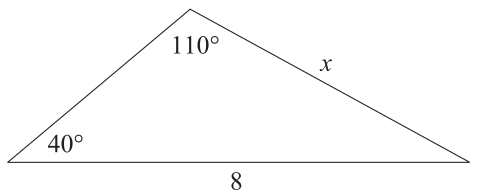
Using the sine rule, find the value of `x` correct to one decimal place.  (2 marks)


Show Answers Only

`5.5\ text{(1 d.p.)}`

Show Worked Solution
`x/sin 40^@` `= 8/(sin 110^@)`
`x` `= (8 xx sin 40^@)/(sin 110^@)`
  `= 5.47`
  `= 5.5\ text{(1 d.p.)}`

Filed Under: Trig Ratios, Sine and Cosine Rules (Adv-2027), Trig Ratios, Sine and Cosine Rules (Y11) Tagged With: Band 2, smc-6392-30-Sine Rule, smc-980-30-Sine Rule

Measurement, STD2 M1 2019 HSC 1 MC

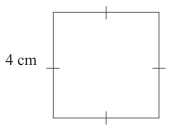
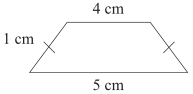
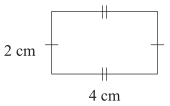
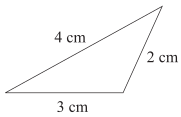
Which of the following shapes has a perimeter of 12 cm?

A.     B.
C. D.

NOT TO SCALE

Show Answers Only

`A`

Show Worked Solution

`text(Perimeter) = 2 xx (4+2)=12\ text(cm)`

`=> A`

Filed Under: Perimeter and Area (Std 1), Perimeter and Area (Std1-2027), Perimeter and Area (Std2-2027), Perimeter, Area and Volume (Std 2) Tagged With: Band 2, smc-1121-10-Perimeter and Area, smc-6483-10-Perimeter, smc-6520-10-Perimeter, smc-798-10-Perimeter and Area

Calculus, SPEC1 2011 VCAA 3

  1. Show that  `f(x) = (2x^2 + 3)/(x^2 + 1)`  can be written in the form  `f(x) = 2 + 1/(x^2 + 1).`  (1 mark)

    --- 3 WORK AREA LINES (style=lined) ---

  2. Sketch the graph of the relation  `y = (2x^2 + 3)/(x^2 + 1)`  on the axes below.
  3. Label any asymptotes with their equations and label any intercepts with the axes, writing them as coordinates.  (3 marks)

    --- 0 WORK AREA LINES (style=lined) ---

     
    VCAA 2011 spec 3b
     

  4. Find the area enclosed by the graph of the relation  `y = (2x^2 + 3)/(x^2 + 1)`, the `x`-axis, and the lines  `x = -1`  and  `x = 1.`  (3 marks)

    --- 5 WORK AREA LINES (style=lined) ---

Show Answers Only

  1. `text(Proof)\ \ text{(See Worked Solutions)}`
  2. “
    VCAA 2011 spec 3bi
  3. `4 + pi/2`

Show Worked Solution

a.    `f(x)` `= (2x^2 + 3)/(x^2 + 1)`
    `= (2(x^2 + 1) + 1)/(x^2 + 1)`
    `= 2 + 1/(x^2 + 1)`


b.   `underset (x→oo) (lim y) = 2`

`text(S)text(ince)\ \ x^2>0\ \ text(for all)\ x,`

`=> f(x)_text(max)\ \ text(occurs when)\ \ x=0\ \ text(at)\ \ (0,3)`
 

VCAA 2011 spec 3bi


c.   `f(x)\ \ text(is an even function.)`

`:.\ text(Area)` `= 2 int_0^1 2 + 1/(x^2 + 1)\ dx`  
  `= 2[2x + tan^(−1)(x)]_0^1`  
  `=2[(2+pi/4)-0]`  
  `= 4 + pi/2`  

Filed Under: Arc Lengths, Areas and Other Tagged With: Band 2, Band 4, smc-1181-20-Area Under Curves

Calculus, SPEC2 2017 VCAA 2

A helicopter is hovering at a constant height above a fixed location. A skydiver falls from rest for two seconds from the helicopter. The skydiver is subject only to gravitational acceleration and air resistance is negligible for the first two seconds. Let downward displacement be positive.

  1. Find the distance, in metres, fallen in the first two seconds.   (2 marks)

    --- 4 WORK AREA LINES (style=lined) ---
  2. Show that the speed of the skydiver after two seconds is 19.6 ms–1.   (1 mark)

    --- 2 WORK AREA LINES (style=lined) ---

After two seconds, air resistance is significant and the acceleration of the skydiver is given by  `a = g -0.01v^2`.

  1. Find the limiting (terminal) velocity, in ms–1, that the skydiver would reach.   (1 mark)

    --- 3 WORK AREA LINES (style=lined) ---

  2. i.  Write down an expression involving a definite integral that gives the time taken for the skydiver to reach a speed of 30 ms–1.   (2 marks)

    --- 4 WORK AREA LINES (style=lined) ---
  3. ii. Hence, find the time, in seconds, taken to reach a speed of 30 ms–1, correct to the nearest tenth of a second.   (1 mark)

    --- 2 WORK AREA LINES (style=lined) ---

  4. Write down an expression involving a definite integral that gives the distance through which the skydiver falls to reach a speed of 30 ms–1. Find this distance, giving your answer in metres, correct to the nearest metre.   (3 marks)

    --- 6 WORK AREA LINES (style=lined) ---

Show Answers Only
  1. `19.6\ text(m)`
  2. `text(See Worked Solutions)`
  3. `v_t = 10sqrtg\ text(ms)^(−1)\ \ text(downwards)`
  4.  i.  `t(30) = int_19.6^30 100/(100g-v^2)dv + 2`
  5. ii. `5.8\ text(s)`
  6. `120\ text(m)`
Show Worked Solution

a.   `u = 0, \ t = 2, \ a = g = 9.8`

`x` `= ut + 1/2 at^2`
  `=0 xx 2 + 1/2 xx 9.8 xx 2^2`
  `= 19.6\ text(m)`


b.    `v` `= u+ at`
  `v(2)` `= 9.8 xx 2`
    `= 19.6\ text(ms)^(−1)\ \ \ text{(downward → positive)}`


c.   `text(Terminal velocity), v_t, text(occurs when)\ \ a = 0,`

♦ Mean mark 48%.

`g -0.01v_t^2` `=0`
`v_t^2` `= 100 xx 9.8`
`:. v_t` `= 14 sqrt5\ text(ms)^(−1)\ \ \ (v_t > 0\ \ text{as}\ \ v_t\ \ text{is downwards})`


d.i.    `(dv)/(dt)` `= g-0.01v^2`
  `(dt)/(dv)` `= 1/(g-0.01v^2)`
    `= 100/(100g-v^2)`
  `t` `= int 100/(100g-v^2)`

 
`text(Time taken until)\ \ v=19.6\ \ text(is 2 seconds.)`

♦ Mean mark part (d)(i) 39%.

 
`:.\ text(Time taken until)\ \ v=30`

`=int_19.6^30 100/(100g-v^2)\ dv + 2`


d.ii.   `5.8\ text(seconds)\ \ \ text{(by CAS)}`

♦♦ Mean mark part (d)(ii) 25%.


e.    `v *(dv)/(dx)` `= g-0.01 v^2`
  `(dv)/(dx)` `= g/v-(v^2)/(100v)`
    `= (100g-v^2)/(100v)`
  `(dx)/(dv)` `= (100v)/(100g-v^2)`
  `x` `= int (100v)/(100g-v^2)\ dv`

 
`text(Distance fallen in 1st 2 seconds)\ = 19.6\ text(m)`

♦♦ Mean mark part (e) 29%.

 
`:.\ text(Total distance fallen until)\ \ v=30`

`= int_19.6^30 (100v)/(100g-v^2)\ dv + 19.6`

`~~ 120\ text(m)`

Filed Under: Motion (SM) Tagged With: Band 2, Band 5, smc-1159-10-Motion as f(t), smc-1159-30-a=f(v), smc-1159-60-Terminal velocity

Calculus, SPEC2 2018 VCAA 3

Part of the graph of  `y = 1/2 sqrt(4x^2-1)`  is shown below.


The curve shown is rotated about the `y`-axis to form a volume of revolution that is to model a fountain, where length units are in metres.

  1. Show that the volume, `V` cubic metres, of water in the fountain when it is filled to a depth of `h` metres is given by  `V = pi/4(4/3h^3 + h)`.   (2 marks)

    --- 5 WORK AREA LINES (style=lined) ---

  2. Find the depth `h` when the fountain is filled to half's its volume. Give your answer in metres, correct to two decimal places.   (2 marks)

    --- 5 WORK AREA LINES (style=lined) ---

The fountain is initially empty. A vertical jet of water in the centre fills the fountain at a rate of 0.04 cubic metres per second and, at the same time, water flows out from the bottom of the fountain at a rate of  `0.05 sqrt h`  cubic metres per second when the depth is `h` metres.

  1.  i. Show that  `(dh)/(dt) = (4-5sqrt h)/(25 pi (4h^2 + 1))`.   (2 marks)

    --- 5 WORK AREA LINES (style=lined) ---

  2. ii. Find the rate, in metres per second, correct to four decimal places, at which the depth is increasing when the depth is 0.25 m.   (1 mark)

    --- 2 WORK AREA LINES (style=lined) ---

  3. Express the time taken for the depth to reach 0.25 m as a definite integral and evaluate this integral correct to the nearest tenth of a second.   (2 marks)

    --- 4 WORK AREA LINES (style=lined) ---
  4. After 25 seconds the depth has risen to 0.4 m.
    Using Euler's method with a step size of five seconds, find an estimate of the depth 30 seconds after the fountain began to fill. Give your answer in metres, correct to two decimal places.   (2 marks)

    --- 4 WORK AREA LINES (style=lined) ---

  5. How far from the top of the fountain does the water level ultimately stabilise? Give your answer in metres, correct to two decimal places.   (2 marks)

    --- 4 WORK AREA LINES (style=lined) ---

Show Answers Only
  1. `text(Proof)\ \ text{(See Worked Solutions)}`
  2. `h~~ 0.59\ text(m)`
    1. `text(Proof)\ \ text{(See Worked Solutions)}`
    2. `0.0153\ text(ms)^(-1)`
  1. `9.8\ text(seconds)`
  2. `0.43\ text(m)`
  3. `0.23\ text(m)`
Show Worked Solution

a.   `V= pi int_0^h x^2\ dy`

`y` `=1/2 sqrt(4x^2-1)`
`2y` `=sqrt(4x^2-1)`
`4y^2` `= 4x^2-1`
`4x^2` `= 4y^2 + 1`
`x^2` `= y^2 + 1/4`


`:. V` `= pi int_0^h y^2 + 1/4\ dy`
  `= pi[y^3/3 + y/4]_0^h`
  `= pi(h^3/3 + h/4-0)`
  `= pi(1/4((4h^3)/3 + h))`
  `= pi/4((4h^3)/3 + h)\ \ …\ text(as required)`


b.    `V_text(max)` `= pi/4 (4/3 xx (sqrt 3/2)^3 + sqrt 3/2)`
    `= pi/4 (sqrt 3/2 + sqrt 3/2)`
    `= (pi sqrt 3)/4`


`1/2 V_text(max)` `= (pi sqrt 3)/8`
`(pi sqrt 3)/8` `= pi/4 (4/3 h^3 + h)`
`sqrt 3/2` `= 4/3 h^3 + h`
`:. h` `~~0.59\ text(m)`


c.i.   `((dV)/(dt))_text(in)` `= 0.04`
  `((dV)/(dt))_text(out)` `= 0.05 sqrt h`
  `(dV)/(dt)` `= 0.04-0.05 sqrt h`
    `= (4-5 sqrt h)/100`
     
  `(dV)/(dh)` `= pi/4(4h^2 + 1)`
  `:. (dh)/(dt)` `= (dh)/(dV) ⋅ (dV)/(dt)`
    `= 4/(pi(4h^2 + 1)) xx (4-5 sqrt h)/100`
    `= (4-5 sqrt h)/(25 pi (4h^2 + 1))`


c.ii.   `(dh)/(dt)|_(h = 0.25)` `= (4-5 sqrt(0.25))/(25 pi (4(0.25)^2 + 1))`
    `~~ 0.0153\ text(ms)^(-1)`


d.   `(dt)/(dh) = (25 pi (4h^2 + 1))/(4-5 sqrt h)`

`:. t(0.25)` `= int_0^0.25 (25 pi (4h^2 + 1))/(4-5 sqrt h)\ dh`
  `~~9.8\ text(seconds)`


e.   `text(When)\ \ t=25,\ \ h=0.4\ \ text{(given)}`

♦♦ Mean mark part (e) 30%.

`:. h(30)` `~~ h(25) + 5 xx (dh)/(dt)|_(h = 0.4)`
  `~~ 0.4 + 5 xx ((4-5 sqrt 0.4)/(25 pi (4(0.4)^2 + 1)))`
  `~~ 0.43\ text(m)`


f.    `(dV)/(dt) = 0`

♦♦ Mean mark part (f) 32%.

`0.04-0.05 sqrt h` `= 0`
`0.04` `= 0.05 sqrt h“
`sqrt h` `= 4/5`
`h` `= 16/25`


`d` `= h_max-16/25`
  `= sqrt 3/2-16/25`
  `~~ 0.23\ text(m)`

Filed Under: Related Rates of Change, Solids of Revolution Tagged With: Band 2, Band 3, Band 4, Band 5, smc-1180-30-Square root, smc-1180-60-y-axis rotation, smc-1185-10-Volume

Mechanics, SPEC1 2016 VCAA 1

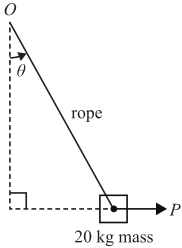
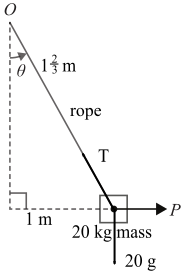
A taut rope of length `1 2/3` m suspends a mass of 20 kg from a fixed point `O`. A horizontal force of `P` newtons displaces the mass by 1 m horizontally so that the taut rope is then at an angle of  `theta`  to the vertical.

  1. Show all the forces acting on the mass on the diagram below.  (1 mark)


  1. Show that  `sin (theta) = 3/5`.  (1 mark)
  2. Find the magnitude of the tension force in the rope in newtons.  (2 marks)
Show Answers Only
  1. `text(See Worked Solutions)`
  2. `text(Proof)\ text{(See Worked Solutions)}`
  3. `T = 245\ text(N)`
Show Worked Solution
a.   


b.    `sin(theta)` `= 1/(1 2/3)`
    `= 1/((5/3)`
    `= 3/5`


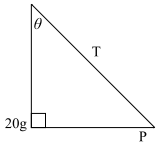
c.   

`cos theta = (20g)/T`

`sin theta = 3/5\ \ text{(using part b)}`

`underbrace{(400g^2)/T^2 + 9/25}_(cos^2 theta + sin^2 theta = 1)` `= 1`
`(400g^2)/T^2` `= 16/25`
`(20g)/T` `=4/5`
`T/(20g)` `= 5/4`
`T` `= 25g`
  `=245\ text(N)`

Filed Under: Pulleys, Planes and Equilibrium (SM) Tagged With: Band 2, Band 4, smc-1175-40-Equilibrium

Networks, STD2 N2 2011 FUR2 1

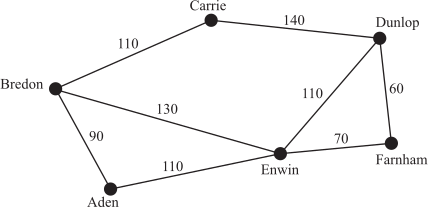
Aden, Bredon, Carrie, Dunlop, Enwin and Farnham are six towns.

The network shows the road connections and distances between these towns in kilometres.


  1. In kilometers, what is the shortest distance between Farnham and Carrie?  (1 mark)

    --- 1 WORK AREA LINES (style=lined) ---

  2. How many different ways are there to travel from Farnham to Carrie without passing through any town more than once?  (1 mark)

    --- 1 WORK AREA LINES (style=lined) ---

Show Answers Only
  1. `200\ text(km)`
  2. `6`
Show Worked Solution

a.   `text{Farnham to Carrie (shortest)}`

`= 60 + 140`

`= 200\ text(km)`


b.   `text(Different paths are)`

`FDC, FEDC, FEBC,`

`FEABC, FDEBC,`

`FDEABC`

 
`:. 6\ text(different ways)`

Filed Under: Shortest Path (Std1-2027), Shortest Paths, Shortest Paths, Shortest Paths (Std2-2027) Tagged With: Band 2, Band 3, smc-1137-10-Network Diagram, smc-6308-10-Network Diagrams, smc-6527-10-Network Diagrams, smc-913-10-Network Diagram

Algebra, MET2 2018 VCAA 1 MC

Let  `f: R -> R,\ f(x) = 4 cos ((2 pi x)/3) + 1`.

The period of this function is

  1. 1
  2. 2
  3. 3
  4. 4
  5. 5
Show Answers Only

`C`

Show Worked Solution
`n` `=\ text(period)`
`(2 pi)/n` `= (2 pi)/3`
`n` `= 3`

 
`=>   C`

Filed Under: Trig Graphing Tagged With: Band 2, smc-2757-15-Cos, smc-2757-30-Find period

GRAPHS, FUR2 2018 VCAA 1

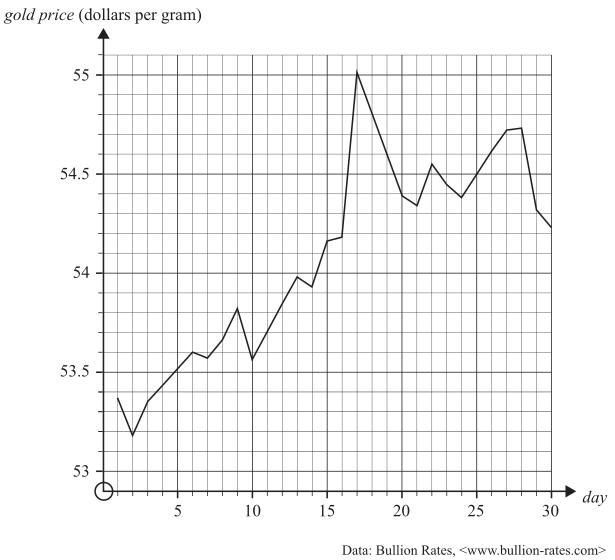
The following chart displays the daily gold prices (dollars per gram) for the month of November 2017.
 

  1. Which day in November had the lowest gold price?  (1 mark)
  2. Between which two consecutive days did the greatest increase in gold price occur?  (1 mark)
Show Answers Only
  1. `text(Day 2)`
  2. `text(between days 16 and 17)`
Show Worked Solution

a.   `text(Day 2)`
 

b.   `text(Between days 16 and 17)`

Filed Under: Graph Applications Tagged With: Band 2, Band 3

GEOMETRY, FUR1 2018 VCAA 1 MC

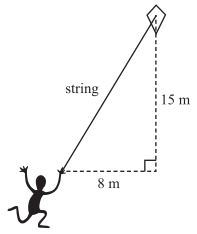
Henry flies a kite attached to a long string, as shown in the diagram below.
 

The horizontal distance of the kite to Henry’s hand is 8 m.

The vertical distance of the kite above Henry’s hand is 15 m.

The length of the string, in metres, is

  1.  13
  2.  17
  3.  23
  4.  161
  5.  289
Show Answers Only

`B`

Show Worked Solution

`text(Using Pythagoras)`

`s^2` `= 8^2 + 15^2`
  `= 289`
`:. s` `= 17\ text(metres)`

  
`=> B`

Filed Under: Right-Angled Trig and Angle Properties Tagged With: Band 2, smc-273-20-Pythagoras

NETWORKS, FUR1 2018 VCAA 1 MC

Consider the graph with five isolated vertices shown below.


To form a tree, the minimum number of edges that must be added to the graph is

  1.   1
  2.   4
  3.   5
  4.   6
  5. 10
Show Answers Only

`B`

Show Worked Solution

`text(5 vertices.)`

`text(Minimum edges for a tree = 4)`

`=> B`

Filed Under: Basic Concepts Tagged With: Band 2, smc-626-10-Definitions

NETWORKS, FUR2 2018 VCAA 2

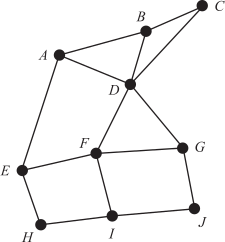
In one area of the town of Zenith, a postal worker delivers mail to 10 houses labelled as vertices `A` to `J` on the graph below.
 

  1. Which one of the vertices on the graph has degree 4?   (1 mark)

    --- 1 WORK AREA LINES (style=lined) ---

For this graph, an Eulerian trail does not currently exist.

  1. For an Eulerian trail to exist, what is the minimum number of extra edges that the graph would require.   (1 mark)

    --- 1 WORK AREA LINES (style=lined) ---

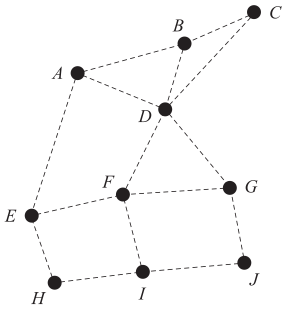
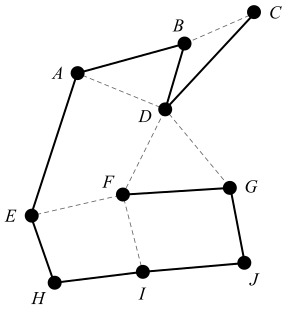
  2. The postal worker has delivered the mail at `F` and will continue her deliveries by following a Hamiltonian path from `F`.


    Draw in a possible Hamiltonian path for the postal worker on the diagram below.   (1 mark)

    --- 0 WORK AREA LINES (style=lined) ---


Show Answers Only
  1. `text(Vertex)\ F`
  2. `2`
  3.  `text(See Worked Solutions)`
Show Worked Solution

a.   `text(Vertex)\ F`
 

b. `text(Eulerian trail)\ =>\ text(all edges used exactly once.)`

`text(6 vertices are odd)`

`=> 2\ text(extra edges could create graph with only 2)`

`text(odd vertices)`

`:.\ text(Minimum of 2 extra edges.)`
 

c.  `text{One example (of a number) beginning at)\ F:}`


`text{(Note: path should not return to}\ F text{)}`

Filed Under: Basic Concepts, Travelling Problems and Adjacency Matrices Tagged With: Band 2, Band 4, smc-622-10-Euler, smc-626-20-Degrees of Vertices

  • « Previous Page
  • 1
  • …
  • 3
  • 4
  • 5
  • 6
  • 7
  • …
  • 10
  • Next Page »

Copyright © 2014–2025 SmarterEd.com.au · Log in