SmarterEd

Aussie Maths & Science Teachers: Save your time with SmarterEd

  • Login
  • Get Help
  • About

CHEMISTRY, M1 EQ-Bank 11

Calcium carbonate, when heated, decomposes according to the following chemical equation:

\(\ce{CaCO3 -> CaO(s) + CO2(g) }\)

60.0 grams of calcium carbonate is heated and the calcium oxide residue produced is weighed and recorded in the table below.

\begin{array} {|l|c|}
\hline
\rule{0pt}{2.5ex} \text{Mass of}\ \ce{CaCO3} \rule[-1ex]{0pt}{0pt} & \text{60.0 grams} \\
\hline
\rule{0pt}{2.5ex} \text{Mass of}\ \ce{CaO} \rule[-1ex]{0pt}{0pt} & \text{33.6 grams} \\
\hline
\end{array}

Determine the percentage of carbon dioxide, by weight, released from the calcium carbonate during this process.   (2 marks)

--- 5 WORK AREA LINES (style=lined) ---
Show Answers Only

\(\%\ce{CO2} = 44.0\%\)

Show Worked Solution

\(\text{Mass of}\ \ce{CaCO3} = 60.0\ \text{grams}\)

\(\text{Mass of}\ \ce{CO2} = 60.0-33.6 = 26.4\ \text{grams}\)

\(\%\ce{CO2}\ \text{released}\ = \dfrac{26.4}{60.0} \times 100\% = 44.0\%\)

Filed Under: Properties of Matter Tagged With: Band 4, smc-4255-30-Percentage composition

CHEMISTRY, M1 EQ-Bank 10

15.00 grams of Silver(\(\text{I}\)) oxide is heated until it decomposes and the silver produced is weighed and recorded in the table below.

\begin{array} {|l|c|}
\hline
\rule{0pt}{2.5ex} \text{Mass of}\ \ce{Ag2O} \rule[-1ex]{0pt}{0pt} & \text{15.00 grams} \\
\hline
\rule{0pt}{2.5ex} \text{Mass of}\ \ce{Ag} \rule[-1ex]{0pt}{0pt} & \text{13.96 grams} \\
\hline
\end{array}

Determine the percentage of oxygen, by weight, in the sample of Silver(\(\text{I}\)) oxide.   (2 marks)

--- 5 WORK AREA LINES (style=lined) ---
Show Answers Only

\(\%\ce{O} = 6.93\%\)

Show Worked Solution

\(\text{Mass of}\ \ce{Ag} = 13.96\ \text{grams}\)

\(\text{Mass of}\ \ce{O} = 15.00-13.96 = 1.04\ \text{grams}\)

\(\%\ce{O} = \dfrac{1.04}{15.00} \times 100\% = 6.93\%\)

Filed Under: Properties of Matter Tagged With: Band 4, smc-4255-30-Percentage composition

CHEMISTRY, M1 EQ-Bank 9

How can the physical properties of components within a mixture be utilised to separate a heterogeneous mixture of sand, salt, and iron filings?   (3 marks)

--- 7 WORK AREA LINES (style=lined) ---

Show Answers Only
  • Magnetism can be used to separate iron filings from the mixture. Iron filings are magnetic, so you can easily separate them from the non-magnetic sand and salt by moving a magnet over the surface of the mixture.
  • Filtration can be used to separate the sand from the salt. Add water to the remaining mixture of sand and salt, and stir well to dissolve the salt. Since sand is insoluble in water, you can separate it by pouring the mixture through a filter paper placed in a funnel.
  • Evaporation can be used to recover the salt. Finally, to separate the salt from the water, heat the saltwater solution until the water evaporates. The salt will be left behind as a solid residue.
Show Worked Solution
  • Magnetism can be used to separate iron filings from the mixture. Iron filings are magnetic, so you can easily separate them from the non-magnetic sand and salt by moving a magnet over the surface of the mixture.
  • Filtration can be used to separate the sand from the salt. Add water to the remaining mixture of sand and salt, and stir well to dissolve the salt. Since sand is insoluble in water, you can separate it by pouring the mixture through a filter paper placed in a funnel.
  • Evaporation can be used to recover the salt. Finally, to separate the salt from the water, heat the saltwater solution until the water evaporates. The salt will be left behind as a solid residue.

Filed Under: Properties of Matter Tagged With: Band 4, smc-4255-35-Separation techniques

PHYSICS, M1 EQ-Bank 7

 A plane is travelling at 315 ms\(^{-1}\) north when it passes through a dense cloud and slows down to a velocity of 265 ms\(^{-1}\) for safety precautions.

The plane did not change direction and travelled 2.5 km while it was slowing down.

Using north as the positive direction for all calculations, determine:

  1. the change in velocity of the plane.   (1 mark)

    --- 3 WORK AREA LINES (style=lined) ---

  2. the plane's acceleration.   (2 marks)

    --- 5 WORK AREA LINES (style=lined) ---
  3. the time over which the plane slowed down.   (2 marks)

    --- 5 WORK AREA LINES (style=lined) ---
Show Answers Only

a.   \(\text{50 ms}^{-1}\ \text{south}\)

b.   \(\text{5.8 ms}^{-2}\ \text{south}\) 

c.   \(\text{8.62 s}\)

Show Worked Solution
a.     \(\Delta v\) \(=v-u\)
    \(=265-315\)
    \(=-50\ \text{ms}^{-1}\)
    \(=50\ \text{ms}^{-1}\ \text{south}\)


b.    Using  \(v^2=u^2 +2as\)  (time is not given):

\(a\) \(=\dfrac{v^2-u^2}{2s}\)  
  \(=\dfrac{(265)^2-(315)^2}{2 \times 2500}\)  
  \(=-5.8\ \text{ms}^{-2}\)  
  \(=5.8\ \text{ms}^{-2}\) to the south.  


c.    Using  \(v=u+at\):

\(t\) \(=\dfrac{v-u}{a}\)  
  \(=\dfrac{265-315}{-5.8}\)  
  \(=8.62\ \text{s}\)  

Filed Under: Motion in a Straight Line Tagged With: Band 4, Band 5, smc-4273-20-Velocity of objects, smc-4273-30-Acceleration, smc-4273-40-v=u+at

PHYSICS, M1 EQ-Bank 6

A motorbike is travelling to the east at 50 ms\(^{-1}\) when it passes a car travelling west at 60 ms\(^{-1}\).

Calculate the velocity of the motorbike relative to the car.   (2 marks)

--- 4 WORK AREA LINES (style=blank) ---

Show Answers Only

\(\text{110 ms}^{-1}\ \text{east}\)

Show Worked Solution

Let east be the positive direction and west be the negative direction.

\(v_{\text{m rel c}}\) \(=v_{\text{m}}-v_{\text{c}}\)  
  \(=50-(-60) \)  
  \(=110\ \text{ms}^{-1}\)  


Therefore, the velocity of the motorbike relative to the car is 110 ms\(^{-1}\) east.

Filed Under: Motion in a Straight Line Tagged With: Band 4, smc-4273-10-Relative velocity

Mechanics, EXT2 M1 2023 HSC 9 MC

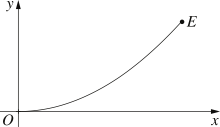
A particle travels along a curve from \(O\) to \(E\) in the \(x y\)-plane, as shown in the diagram.
 

The position vector of the particle is \(r\), its velocity is \( v \), and its acceleration is \( a \).

While travelling from \(O\) to \(E\), the particle is always slowing down.

Which of the following is consistent with the motion of the particle?

  1. \( r \cdot v \leq 0\)  and  \( a \cdot v \geq 0\)
  2. \( r \cdot  v \leq 0\)  and  \( a \cdot v \leq 0\)
  3. \( r \cdot v \geq 0\)  and  \( a \cdot v \geq 0\)
  4. \( r \cdot v \geq 0\)  and  \(a \cdot v \leq 0\)
Show Answers Only

\(D\)

Show Worked Solution

\(\text{By elimination:}\)

\(x\ \text{and}\ y\ \text{components of vector}\ r\ \text{are both positive.}\)

\(\text{The velocity of vector}\ v\ \text{is tangential to the curve}\ OE\ \text{and}\)

\(x\ \text{and}\ y\ \text{components of vector}\ v\ \text{are also both positive.}\)

\( r \cdot v \geq 0\ \ \text{(eliminate}\ A\ \text{and}\ B).\)

\(\text{Particle is slowing down so acceleration must be acting, in part,}\)

\(\text{in the opposite direction to velocity.}\)

\( a \cdot v \leq 0\ \ \text{(eliminate}\ C).\)

\(\Rightarrow D\)

Filed Under: Motion Without Resistance Tagged With: Band 4, smc-1060-50-Vectors and motion

Networks, STD2 N3 SM-Bank 24

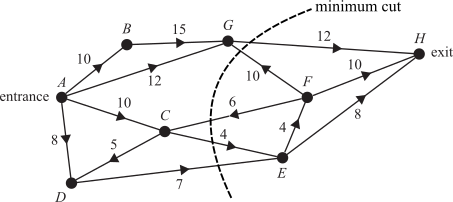
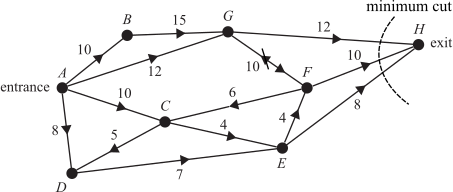
The network below shows the one-way paths between the entrance, \(A\), and the exit, \(H\), of a children's maze.

The vertices represent the intersections of the one-way paths.

The number on each edge is the maximum number of children who are allowed to travel along that path per minute.

The minimum cut of the network is drawn, showing the maximum flow capacity of the maze is 23 children per minute.
 

One path in the maze is to be changed.

Determine the changes in the maximum flow capacity of the network in each of the following changes

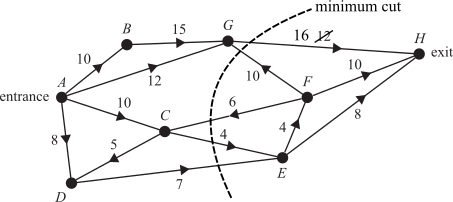
  1. the capacity of flow along the edge \(GH\) is increased to 16.   (1 mark)

    --- 2 WORK AREA LINES (style=lined) ---

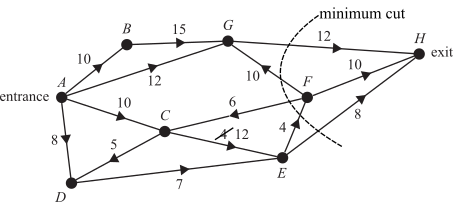
  2. the capacity of flow along the edge \(C E\) is increased to 12.   (2 marks)

    --- 2 WORK AREA LINES (style=lined) ---

  3. the direction of flow along the edge \(G F\) is reversed.   (2 marks)

    --- 2 WORK AREA LINES (style=lined) ---

Show Answers Only

i.    \(GH ↑ 16,\ \text{minimum cut = 27}\)

\(\text{Change: increases by 4}\)

ii.    \(CE ↑ 12,\ \text{minimum cut = 24}\)

\(\text{Change: increases by 1}\)

iii.   \(GF\ \text{is reversed, minimum cut = 30 (close to exit H)}\)

\(\text{Change: increases by 7}\)

Show Worked Solution

i.    \(GH ↑ 16,\ \text{minimum cut = 27}\)
 

\(\text{Change: increases by 4}\)
 

ii.    \(CE ↑ 12,\ \text{minimum cut = 24}\)
 

\(\text{Change: increases by 1}\)
 

iii.   \(GF\ \text{is reversed, minimum cut = 30 (close to exit H)}\)
 

\(\text{Change: increases by 7}\)

Filed Under: Flow Networks and Minimum Cuts Tagged With: Band 4, Band 5, smc-915-10-Min Cut/Max Flow, smc-915-50-Network Adjustments

Networks, GEN1 2023 VCAA 33 MC

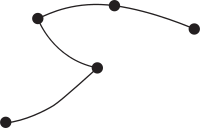
Consider the following graph.
 

How many of the following five statements are true?

  • The graph is a tree.
  • The graph is connected.
  • The graph contains a path.
  • The graph contains a cycle.
  • The sum of the degrees of the vertices is eight.
  1. 1
  2. 2
  3. 3
  4. 4
  5. 5
Show Answers Only

\(D\)

Show Worked Solution

The graph is a tree (any two vertices are connected by one edge).  \(\checkmark\)

The graph is connected.  \(\checkmark\)

The graph contains a path.  \(\checkmark\)

The graph contains a cycle.  \(\cross\)

The sum of the degrees of the vertices is eight.  \(\checkmark\)

\(\Rightarrow D\)

Filed Under: Basic Concepts Tagged With: Band 4, smc-626-10-Definitions, smc-626-20-Degrees of Vertices

Matrices, GEN1 2023 VCAA 29 MC

Matrix \(K\) is a \(3 \times 2\) matrix.

The elements of \(K\) are determined by the rule  \(k_{i j}=(i-j)^2\).

Matrix \(K\) is


A.

\begin{bmatrix} 0 & 1 & -2 \\
1 & 0 & -1
\end{bmatrix}


B.

\begin{bmatrix}
0 & 1 & 4 \\
1 & 0 & 1
\end{bmatrix}


C.

\begin{bmatrix}
0 & -1\\
1 & 0\\
4 & 1
\end{bmatrix}


D.

\begin{bmatrix}
0 & 1\\
1 & 0\\
2 & 1
\end{bmatrix}


E.

\begin{bmatrix}
0 & 1\\
1 & 0\\
4 & 1
\end{bmatrix}
   
Show Answers Only

\(E\)

Show Worked Solution

\(K\ \text{is a 3 × 2 matrix (eliminate A)}\)

\(k_{ij}\ \text{will all be}\ \geq 0\ \text{(eliminate C)}\)

\(k_{31} = (3-1)^2 = 4\ \text{(eliminate B and D)}\)

\(\Rightarrow E\)

Filed Under: Matrix Calculations Tagged With: Band 4, smc-616-70-Elements/Rules

Matrices, GEN1 2023 VCAA 26 MC

Matrix \(P\) is a permutation matrix and matrix \(Q\) is a column matrix.
 

\(P=\begin{bmatrix}
1 & 0 & 0 & 0 & 0 \\
0 & 0 & 1 & 0 & 0 \\
0 & 0 & 0 & 1 & 0 \\
0 & 1 & 0 & 0 & 0 \\
0 & 0 & 0 & 0 & 1
\end{bmatrix}
\quad \quad Q=\begin{bmatrix}
t \\
e \\
a \\
m \\
s
\end{bmatrix}\)
 

When \(Q\) is multiplied by \(P\), which three letters change position?

  1. \(t, e, a\)
  2. \(e, a, m\)
  3. \(a, m, s\)
  4. \(m, s, t\)
  5. \(e, a, s\)
Show Answers Only

\(B\)

Show Worked Solution

\(P \times Q =\begin{bmatrix}
1 & 0 & 0 & 0 & 0 \\
0 & 0 & 1 & 0 & 0 \\
0 & 0 & 0 & 1 & 0 \\
0 & 1 & 0 & 0 & 0 \\
0 & 0 & 0 & 0 & 1
\end{bmatrix}
\begin{bmatrix}
t \\
e \\
a \\
m \\
s
\end{bmatrix}
= \begin{bmatrix}
t \\
a \\
m \\
e \\
s
\end{bmatrix}\)

\(\Rightarrow B\)

Filed Under: Matrix Calculations Tagged With: Band 4, smc-616-30-Matrix Product

CHEMISTRY, M3 EQ-Bank 5

"The reason alkali metals produce ignition and the release of light and heat when reacting with cold water is due to the fact they have the energy to combust oxygen in the water".

Explain the validity of the statement with reference to metal reactivity.   (3 marks)

--- 6 WORK AREA LINES (style=lined) ---

Show Answers Only

The statement is partially correct.

  • Alkali metals have low first ionisation energies and are therefore extremely reactive which enables them to even react with even cold water.
  • However, the statement is incorrect about combustion. Metals and water react in the following generalised equation:
  •    \(\text{Metal + Water}\ \rightarrow\ \text{Metal hydroxide/oxide + Hydrogen gas} \)
  • Although oxygen can combust, the combustion occurring in the reaction of alkali metals is that of hydrogen, which is more flammable than oxygen and produced by the reaction.
  • This is consistent across all metals that react with water, although alkali metals are the only ones that contain enough energy to combust the hydrogen produced.
Show Worked Solution

The statement is partially correct.

  • Alkali metals have low first ionisation energies and are therefore extremely reactive which enables them to even react with even cold water.
  • However, the statement is incorrect about combustion. Metals and water react in the following generalised equation:
  •    \(\text{Metal + Water}\ \rightarrow\ \text{Metal hydroxide/oxide + Hydrogen gas} \)
  • Although oxygen can combust, the combustion occurring in the reaction of alkali metals is that of hydrogen, which is more flammable than oxygen and produced by the reaction.
  • This is consistent across all metals that react with water, although alkali metals are the only ones that contain enough energy to combust the hydrogen produced.

Filed Under: Predicting Reactions of Metals Tagged With: Band 4, smc-4264-20-Reactivity of Metals

CHEMISTRY, M3 EQ-Bank 4

  1. Write the generalised equation for reactions between metals and dilute acids.   (1 mark)

    --- 1 WORK AREA LINES (style=lined) ---

  2. Provide one example of the generalised equation from part (a).   (1 mark)

    --- 1 WORK AREA LINES (style=lined) ---

Show Answers Only

a.    \(\text{Metal + Dilute acid}\ \rightarrow\ \text{Salt + Hydrogen gas}\)

b.    One example (of many possible answers):

  • Magnesium reacts with hydrochloric acid to produce magnesium chloride and hydrogen gas
  •    \(\ce{2Mg(s) + 2HCl(aq) -> 2MgCl + H2(g) } \)
Show Worked Solution

a.    \(\text{Metal + Dilute acid}\ \rightarrow\ \text{Salt + Hydrogen gas}\)

b.    One example (of many possible answers):

  • Magnesium reacts with hydrochloric acid to produce magnesium chloride and hydrogen gas
  •    \(\ce{2Mg(s) + 2HCl(aq) -> 2MgCl + H2(g) } \)

Filed Under: Predicting Reactions of Metals Tagged With: Band 3, Band 4, smc-4264-20-Reactivity of Metals

CHEMISTRY, M3 EQ-Bank 10

A chemical reaction takes place in a sealed vessel containing limewater.

As the reaction progresses the limewater turns from a clear colourless solution, to a milky white one.

Explain, using chemical equations or otherwise, how the reaction taking place could be either a decomposition or a combustion reaction.   (3 marks)

--- 5 WORK AREA LINES (style=lined) ---
Show Answers Only
  • Limewater turns milky in the presence of \(\ce{CO2}\).
  • The reaction in the above example could be either a decomposition or combustion reaction because both of these reactions can involve \(\ce{CO2}\) as a product.
  • Possible chemical equations include
  •   Decomposition: \(\ce{CaCO3(s) \rightarrow CaO(s) + CO2(g)}\)
  •   Combustion: \(\ce{CH4(aq) + 2O2(g) \rightarrow 2H2O(l) + CO2(g)}\)
Show Worked Solution
  • Limewater turns milky in the presence of \(\ce{CO2}\).
  • The reaction in the above example could be either a decomposition or combustion reaction because both of these reactions can involve \(\ce{CO2}\) as a product.
  • Possible chemical equations include
  •   Decomposition: \(\ce{CaCO3(s) \rightarrow CaO(s) + CO2(g)}\)
  •   Combustion: \(\ce{CH4(aq) + 2O2(g) \rightarrow 2H2O(l) + CO2(g)}\)

Filed Under: Chemical Reactions Tagged With: Band 4, smc-4263-30-Combustion

CHEMISTRY, M3 SM-Bank 12 MC

Electrolysis and photolysis are examples of which type of reaction? 

  1. Combustion
  2. Acid/Base 
  3. Synthesis
  4. Decomposition 
Show Answers Only

\(D\)

Show Worked Solution
  • Both electrolysis and photolysis involve the breakdown of compounds into simpler substances under decomposition reactions.

\(\Rightarrow D\)

Filed Under: Chemical Reactions Tagged With: Band 4, smc-4263-15-Predicting products

CHEMISTRY, M3 EQ-Bank 9

Two moles of butane \(\ce{C3H8(g)}\) were reacted with 224 grams of oxygen \(\ce{O2(g)}\).

  1. Write the balanced equation for this reaction.   (3 marks)

    --- 6 WORK AREA LINES (style=lined) ---
  2. Determine the mass, in grams, of \(\ce{CO2(g)}\) produced by this reaction.   (1 mark)

    --- 2 WORK AREA LINES (style=lined) ---
Show Answers Only

a.    \(\ce{2C3H8(g) + 7O2(g)\ \rightarrow 2C(s) + 2CO(g) + 2CO2(g) + 8H2O(l)}\)

b.    \(\ce{m(CO2) = 88.02\ \text{g}}\)

Show Worked Solution

a.    Complete combustion equation:

   \(\ce{C3H8(g) + 5O2(g)\ \rightarrow 3CO2(g) + 4H2O(l)} \)

  • Two moles of butane require 10 moles of oxygen to fully combust. 
  •    \(\ce{n(O2) = \dfrac {m}{MM}= \dfrac {224}{32} = 7}\)
  • Oxygen is limiting reagent and butane will undergo incomplete combustion according to the following balanced equation:
  •    \(\ce{2C3H8(g) + 7O2(g)\ \rightarrow 2C(s) + 2CO(g) + 2CO2(g) + 8H2O(l)}\)

b.    Using the equation in part (i), 2 moles of \(\ce{CO2}\) will be produced

   \(\ce{m(CO2) = n \times MM = 2 \times 44.01 = 88.02\ \text{g}}\)

Filed Under: Chemical Reactions Tagged With: Band 4, Band 5, smc-4263-10-Balanced chemical equations, smc-4263-15-Predicting products, smc-4263-30-Combustion

Matrices, GEN1 2023 VCAA 27 MC

The following transition matrix, \(T\), models the movement of a species of bird around three different locations, \(M, N\) and \(O\) from one day to the next.

\begin{aligned}
& \quad \ \ \textit{this day} \\
& \quad  M \ \  N \ \ \  O\\
T = & \begin{bmatrix}
\frac{1}{3} & 0 & \frac{9}{10} \\
\frac{1}{3} & 1 & \frac{1}{10} \\
\frac{1}{3} & 0 & 0
\end{bmatrix}\begin{array}{l}
M\\
N\\
O
\end{array}\ \ \ next \ day
\end{aligned}

Which one of the following statements best represents what will occur in the long term?

  1. No birds will remain at location \(M\).
  2. No birds will remain at location \(N\).
  3. All of the birds will end up at location \(M\).
  4. All of the birds will end up at location \(O\).
  5. An equal number of birds will be at all three locations.
Show Answers Only

\(A\)

Show Worked Solution

\(\text{Steady state matrix:}\)

\(T^{50} =\begin{bmatrix}
\frac{1}{3} & 0 & \frac{9}{10} \\
\frac{1}{3} & 1 & \frac{1}{10} \\
\frac{1}{3} & 0 & 0
\end{bmatrix}
\approx \begin{bmatrix}
0 & 0 & 0 \\
1 & 1 & 1 \\
0 & 0 & 0
\end{bmatrix}\)

\(\Rightarrow A\)

Filed Under: Transition Matrices - Regular Tagged With: Band 4, smc-618-40-Steady State

Data Analysis, GEN2 2023 VCAA 2a

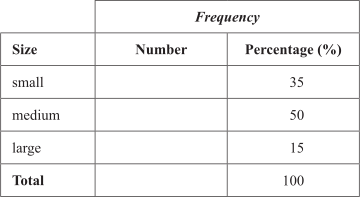
The following data shows the sizes of a sample of 20 oysters rated as small, medium or large.

\begin{array} {ccccc}
\text{small} & \text{small} & \text{large} & \text{medium} & \text{medium} \\
\text{medium} & \text{large} & \text{small} & \text{medium} & \text{medium}\\
\text{small} & \text{medium} & \text{small} & \text{small} & \text{medium}\\
\text{medium} & \text{medium} & \text{medium} & \text{small} & \text{large}
\end{array}

  1. Use the data above to complete the following frequency table.   (1 mark)

    --- 0 WORK AREA LINES (style=lined) ---
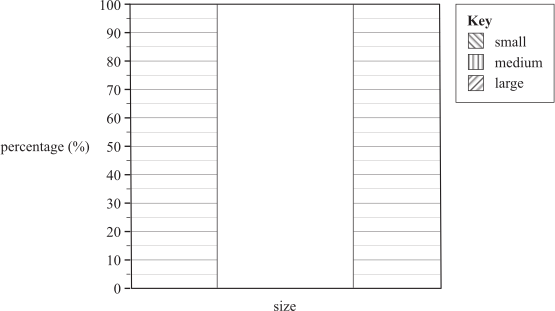
  1. Use the percentages in the table to construct a percentage segmented bar chart below. A key has been provided.   (1 mark)

    --- 0 WORK AREA LINES (style=lined) ---
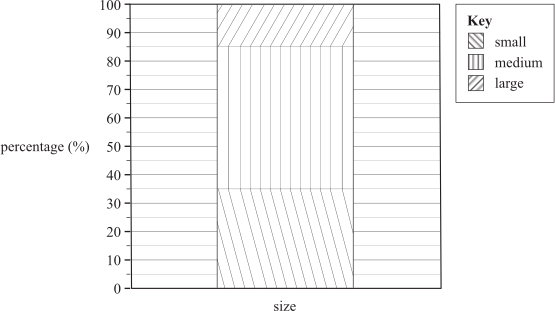
     

Show Answers Only

i.    

\begin{array} {|l|c|c|}
\hline
\rule{0pt}{2.5ex} \textbf{Size} \rule[-1ex]{0pt}{0pt} & \textbf{Number} & \textbf{Percentage (%) } \\
\hline
\rule{0pt}{2.5ex} \text{small} \rule[-1ex]{0pt}{0pt} & 7 & 35 \\
\hline
\rule{0pt}{2.5ex} \text{medium} \rule[-1ex]{0pt}{0pt} & 10 & 50 \\
\hline
\rule{0pt}{2.5ex} \text{large} \rule[-1ex]{0pt}{0pt} & 3 & 15 \\
\hline
\rule{0pt}{2.5ex} \textbf{Total} \rule[-1ex]{0pt}{0pt} & 20 & 100 \\
\hline
\end{array}

ii.    
     

Show Worked Solution

i.    

\begin{array} {|l|c|c|}
\hline
\rule{0pt}{2.5ex} \textbf{Size} \rule[-1ex]{0pt}{0pt} & \textbf{Number} & \textbf{Percentage (%) } \\
\hline
\rule{0pt}{2.5ex} \text{small} \rule[-1ex]{0pt}{0pt} & 7 & 35 \\
\hline
\rule{0pt}{2.5ex} \text{medium} \rule[-1ex]{0pt}{0pt} & 10 & 50 \\
\hline
\rule{0pt}{2.5ex} \text{large} \rule[-1ex]{0pt}{0pt} & 3 & 15 \\
\hline
\rule{0pt}{2.5ex} \textbf{Total} \rule[-1ex]{0pt}{0pt} & 20 & 100 \\
\hline
\end{array}

 
ii.


Filed Under: Graphs - Histograms and Other Tagged With: Band 2, Band 4, smc-644-40-Segmented Bar Charts, smc-644-50-Frequency Tables

Data Analysis, GEN2 2023 VCAA 2b

An oyster farmer has two farms, \(\text{A}\) and \(\text{B}\).

She takes a random sample of oysters from each of the farms and has the oysters classified as small, medium or large.

The number of oysters of each size is displayed in the two-way table below.

\begin{array} {|l|c|}
\hline
\rule{0pt}{2.5ex} \textbf{Oyster size} \rule[-1ex]{0pt}{0pt} & \textbf{Farm A} & \textbf{Farm B}  \\
\hline
\rule{0pt}{2.5ex} \text{small} \rule[-1ex]{0pt}{0pt} & 42 & 114 \\
\hline
\rule{0pt}{2.5ex} \text{medium} \rule[-1ex]{0pt}{0pt} & 124 & 160 \\
\hline
\rule{0pt}{2.5ex} \text{large} \rule[-1ex]{0pt}{0pt} & 44 & 46 \\
\hline
\rule{0pt}{2.5ex} \textbf{Total} \rule[-1ex]{0pt}{0pt} & 210 & 320 \\
\hline
\end{array}

  1. Calculate the percentage of the total number of oysters graded as 'large' in this investigation. Round the percentage to the nearest whole number.   (1 mark)

    --- 2 WORK AREA LINES (style=lined) ---
  2. The farmer believes that farm \(\text{A}\) has a greater capacity to grow larger oysters than farm \(\text{B}\). Does the information in the table support the farmer's belief? Explain your conclusion by comparing the values of two appropriate percentages.
  3. Round these percentages to the nearest whole number.   (2 marks)

    --- 5 WORK AREA LINES (style=lined) ---
Show Answers Only

i.    \(\text{Large oysters}\ = \dfrac{44}{210} = \dfrac{90}{530} = 0.1698 = 17\% \)

ii.  \(\text{Large oysters (farm A)}\ = \dfrac{44}{210} = 0.2095 = 21\% \)

\(\text{Large oysters (farm B)}\ = \dfrac{46}{320} = 0.1437 = 14\% \)

\(\therefore\ \text{Since farm A produces a much higher percentage of large oysters,}\)

\(\text{the information in the table supports the farmer’s belief.}\)

Show Worked Solution

i.    \(\text{Large oysters}\ = \dfrac{44}{210} = \dfrac{90}{530} = 0.1698 = 17\% \)
 

ii.  \(\text{Large oysters (farm A)}\ = \dfrac{44}{210} = 0.2095 = 21\% \)

\(\text{Large oysters (farm B)}\ = \dfrac{46}{320} = 0.1437 = 14\% \)
 

\(\therefore\ \text{Since farm A produces a much higher percentage of large oysters,}\)

\(\text{the information in the table supports the farmer’s belief.}\)

Filed Under: Graphs - Histograms and Other Tagged With: Band 4, smc-644-50-Frequency Tables

Data Analysis, GEN2 2023 VCAA 1

Data was collected to investigate the use of electronic images to automate the sizing of oysters for sale. The variables in this study were:

    • ID: identity number of the oyster
    • weight: weight of the oyster in grams (g)
    • volume: volume of the oyster in cubic centimetres (cm³)
    • image size: oyster size determined from its electronic image (in megapixels)
    • size: oyster size when offered for sale: small, medium or large

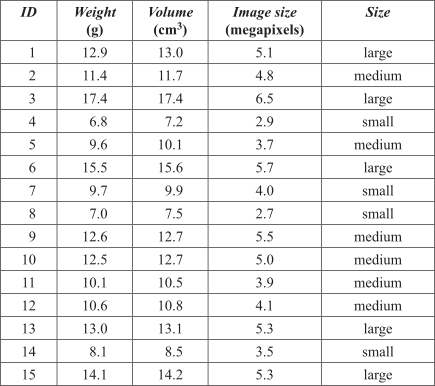
The data collected for a sample of 15 oysters is displayed in the table.
 

  1. Write down the number of categorical variables in the table.   (1 mark)

    --- 1 WORK AREA LINES (style=lined) ---
  2. Determine, in grams:
    1. the mean weight of all the oysters in this sample.   (1 mark)

      --- 1 WORK AREA LINES (style=lined) ---
    2. the median weight of the large oysters in this sample.   (1 mark)

      --- 1 WORK AREA LINES (style=lined) ---
  3. When a least squares line is used to model the association between oyster weight and volume, the equation is: 

    1. \(\textit{volume} = 0.780 + 0.953 \times \textit{weight} \)
    1. Name the response variable in this equation.   (1 mark)

      --- 1 WORK AREA LINES (style=lined) ---
    2. Complete the following sentence by filling in the blank space provided.   (1 mark)

      --- 0 WORK AREA LINES (style=lined) ---
      This equation predicts that, on average, each 10 g increase in the weight of an oyster is associated with a ________________ cm³ increase in its volume.
  1. A least squares line can also be used to model the association between an oyster's volume, in cm³, and its electronic image size, in megapixels. In this model, image size is the explanatory variable.
  2. Using data from the table, determine the equation of this least squares line. Use the template below to write your answer. Round the values of the intercept and slope to four significant figures.   (2 marks)

    --- 4 WORK AREA LINES (style=lined) ---
  3. The number of megapixels needed to construct an accurate electronic image of an oyster is approximately normally distributed.
  4. Measurements made on recently harvested oysters showed that:
    • 97.5% of the electronic images contain less than 4.6 megapixels
    • 84% of the electronic images contain more than 4.3 megapixels.
  1. Use the 68-95-99.7% rule to determine, in megapixels, the mean and standard deviation of this normal distribution.   (2 marks)

    --- 4 WORK AREA LINES (style=lined) ---
Show Answers Only

a.    \(\text{Categorical variables = 2 (ID and size)}\)

b.i.  \(\text{Mean weight}\ = \dfrac{\text{sum of oyster weights}}{15} = \dfrac{171.3}{15} = 11.42 \)

b.ii.  \(\text{Median}\ = 11.4 \)

c.i.   \(\text{Volume}\)

c.ii.  \(\text{Increase}\ = 0.953 \times 10 = 9.53\ \text{cm}^{3} \)

d.    \(\text{Volume}\ = 0.002857 + 2.571 \times \text{image size} \)

e.    \(s_x = 0.1 \)

\(\bar x = 4.4\) 

Show Worked Solution

a.    \(\text{Categorical variables = 2 (ID and size)}\)
 

b.i.  \(\text{Mean weight}\ = \dfrac{\text{sum of oyster weights}}{15} = \dfrac{171.3}{15} = 11.42 \)
 

b.ii.  \(\text{15 data points}\ \ \Rightarrow \ \ \text{Median = 8th data point (in order)}\)

 \(\text{Median}\ = 11.4 \)
 

c.i.   \(\text{Volume}\)
 

c.ii.  \(\text{Increase}\ = 0.953 \times 10 = 9.53\ \text{cm}^{3} \)
 

d.    \(\text{Input the image size column values}\ (x)\ \text{and volume} \)

\(\text{values}\ (y)\ \text{into the calculator:}\)

\(\textit{Volume}\ = 0.002857 + 2.571 \times \textit{image size} \)
 

e.    \(z\text{-score (4.6)}\ = 2\ \ \Rightarrow \bar x + 2 \times s_x = 4.6\ …\ (1)\)

\(z\text{-score (4.3)}\ = -1\ \ \Rightarrow \bar x-s_x = 4.3\ …\ (2)\)

\( (1)-(2) \)

\(3 s_x = 0.3 \ \ \Rightarrow\ \ s_x = 0.1 \)

\(\bar x = 4.4\) 

Filed Under: Correlation and Regression, Normal Distribution, Summary Statistics Tagged With: Band 3, Band 4, smc-265-20-Find LSRL Equation/Gradient, smc-265-30-LSRL formula, smc-265-75-Explanatory / Response, smc-468-20-Mean, smc-468-40-Median Mode and Range, smc-600-20-z-score Intervals

Financial Maths, GEN1 2023 VCAA 20-21 MC

For taxation purposes, Audrey depreciates the value of her $3000 computer over a four-year period. At the end of the four years, the value of the computer is $600.
 

Question 20

If Audrey uses flat rate depreciation, the depreciation rate, per annum is

  1. 10%
  2. 15%
  3. 20%
  4. 25%
  5. 33%

 
Question 21

If Audrey uses reducing balance depreciation, the depreciation rate, per annum is closest to

  1. 10%
  2. 15%
  3. 20%
  4. 25%
  5. 33%
Show Answers Only

\(\text{Question 20:}\ C\)

\(\text{Question 21:}\ E\)

Show Worked Solution

\(\text{Question 20}\)

\(\text{Depreciation value}\ = 3000-600=$2400 \)

\(\text{Depreciation value (per year)}\ = \dfrac{2400}{4} =$600 \)

\(\text{Depreciation rate}\ = \dfrac{600}{3000} \times 100 =20\% \)

\(\Rightarrow C\)
 

\(\text{Question 21}\)

\(A = $600, \ P= $3000,\ n=4\)

\(A\) \(=PR^n\)  
\(600\) \(=3000 \times R^4\)  
\(R^4\) \(=\dfrac{600}{3000} \)  
\(R\) \(=\sqrt[4]{0.2} \)  
  \(=0.668…\)  

 
\(\text{Depreciation rate}\ =1-0.668… = 0.331… \approx 33\% \)

\(\Rightarrow E\)

Filed Under: Depreciation Tagged With: Band 4, Band 5, smc-602-10-Flat rate, smc-602-20-Reducing balance

Financial Maths, GEN1 2023 VCAA 18-19 MC

Gus purchases a coffee machine for $15 000 and depreciates its value using the unit cost method.

The rate of depreciation is $0.04 per cup of coffee made.

A recurrence relation that models the year-to-year value \(G_n\), in dollars, of the machine is
 

Question 18

A rule for \(G_n\), the value of the machine after \(n\) years is

  1. \(G_n=15\ 000-0.04 n\)
  2. \(G_n=15\ 000+0.04 n\)
  3. \(G_n=15\ 000-1314 n\)
  4. \(G_n=1314-0.04 n\)
  5. \(G_n=1314+0.04 n\)

 
Question 19

The number of cups made by the machine per year is

  1. \(1314\)
  2. \(13\ 686\)
  3. \(15\ 000\)
  4. \(31\ 536\)
  5. \(32\ 850\)
Show Answers Only

\(\text{Question 18:}\ C\)

\(\text{Question 19:}\ E\)

Show Worked Solution

\(\text{Question 18}\)

\(G_n =\ \text{cost}-(\text{cups of coffee}\ \times 0.04) \times n \)

\(G_n =\ 15\ 000-(\text{cups of coffee}\ \times 0.04) \times n \)

\(\text{Option C is the only possible correct answer.}\)

\(\Rightarrow C\)
 

\(\text{Question 19}\)

\(\text{Using the}\ G_n\ \text{rule from question 18:}\)

\(\text{cups of coffee}\ \times 0.04\) \(=1314\)  
\(\text{cups of coffee}\) \(=\dfrac{1314}{0.04}\)  
  \(=32\ 850\)  

 
\(\Rightarrow E\)

Filed Under: Depreciation Tagged With: Band 4, smc-602-30-Unit cost

Data Analysis, GEN1 2023 VCAA 13-14 MC

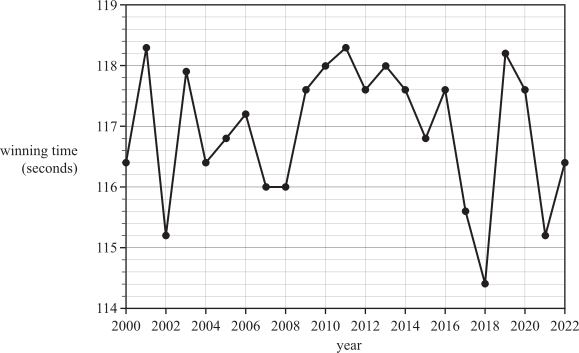
The following graph shows a selection of winning times, in seconds, for the women's 800 m track event from various athletic events worldwide. The graph shows one winning time for each calendar year from 2000 to 2022.
 

Question 13

The time series is smoothed using seven-median smoothing.

The smoothed value for the winning time in 2006, in seconds, is closest to

  1. 116.0
  2. 116.4
  3. 116.8
  4. 117.2
  5. 117.6

 
Question 14

The median winning time, in seconds, for all the calendar years from 2000 to 2022 is closest to

  1. 116.8
  2. 117.2
  3. 117.6
  4. 118.0
  5. 118.3
Show Answers Only

\(\text{Question 13:}\ C\)

\(\text{Question 14:}\ B\)

Show Worked Solution

\(\text{Question 13}\)

\(\text{Consider the 2006 data point and 3 data points either side.}\)

\(\text{Median value (of 7 data points) = 116.8}\)

\(\Rightarrow C\)
 

\(\text{Question 14}\)

\(\text{23 data points between 2000 – 2022.}\)

\(\text{Median value = 12th data point (in order) = 117.2}\)

\(\Rightarrow B\)

Filed Under: Time Series Tagged With: Band 4, Band 5, smc-266-70-MEDIAN Smoothing

Data Analysis, GEN1 2023 VCAA 10 MC

A study of Year 10 students shows that there is a negative association between the scores of topic tests and the time spent on social media. The coefficient of determination is 0.72

From this information it can be concluded that

  1. a decreased time spent on social media is associated with an increased topic test score.
  2. less time spent on social media causes an increase in topic test performance.
  3. an increased time spent on social media is associated with an increased topic test score.
  4. too much time spent on social media causes a reduction in topic test performance.
  5. a decreased time spent on social media is associated with a decreased topic test score.
Show Answers Only

\(A\)

Show Worked Solution

\(\text{Negative association:}\)

  • \(\text{does not mean causality (eliminate B and D).}\)
  • \(\text{Option A: if time spent on social media ↓, topic test scores ↑}\ \checkmark \)
  • \(\text{Option C: if time spent on social media ↑, topic test scores ↓}\ \cross \)
  • \(\text{Option E: if time spent on social media ↓, topic test scores ↓}\ \cross \)

\(\Rightarrow A\)

Filed Under: Correlation and Regression Tagged With: Band 4, smc-265-10-r / r^2 and Association, smc-265-75-Explanatory / Response

Data Analysis, GEN1 2023 VCAA 7-8 MC

A teacher analysed the class marks of 15 students who sat two tests.

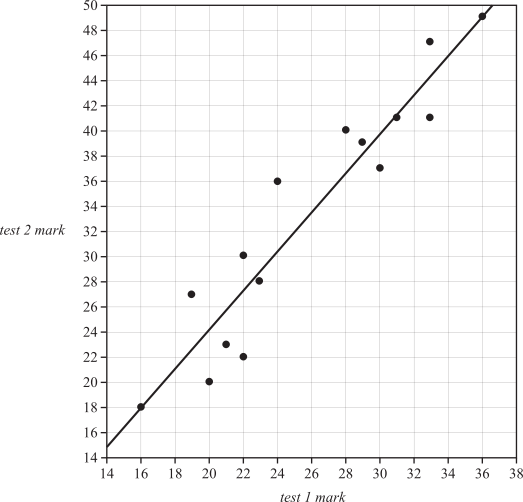
The test 1 mark and test 2 mark, all whole number values, are shown in the scatterplot below.

A least squares line has been fitted to the scatterplot.
 

Question 7

The equation of the least squares line is closest to

  1. test 2 mark = – 6.83 + 1.55 × test 1 mark
  2. test 2 mark = 15.05 + 0.645 × test 1 mark
  3. test 2 mark = – 6.78 + 0.645 × test 1 mark
  4. test 2 mark = 1.36 + 1.55 × test 1 mark
  5. test 2 mark = 6.83 + 1.55 × test 1 mark

 
Question 8

The least squares line shows the predicted test 2 mark for each student based on their test 1 mark.

The number of students whose actual test 2 mark was within two marks of that predicted by the line is

  1. 3
  2. 4
  3. 5
  4. 6
  5. 7
Show Answers Only

\(\text{Question 7:}\ A\)

\(\text{Question 8:}\ C\)

Show Worked Solution

\(\text{Question 7}\)

\(\text{By inspection, gradient is greater than 1 (eliminate B and C)}\)

\(\text{LSRL passes through (16, 18):}\)

\(\text{Option A:}\ -6.83 + 1.55 \times 16 = 18.0\ \checkmark \)

\(\Rightarrow A\)
 

\(\text{Question 8}\)

\(\text{5 values are within 1 grid height (measured vertically), or 2 marks,}\)

\(\text{from the LRSR.}\)

\(\Rightarrow C\)

Filed Under: Correlation and Regression Tagged With: Band 4, Band 5, smc-265-30-LSRL formula, smc-265-50-Residuals

Data Analysis, GEN1 2023 VCAA 6 MC

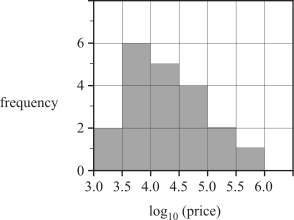
The histogram below displays the distribution of prices, in dollars, of the cars for sale in a used-car yard.

The histogram has a logarithm (base 10) scale.
 

Six of the cars in the yard have the following prices:

\($2450, \ $3175, \ $4999, \ $8925, \ $10\ 250, \ $105\ 600\)

How many of the six car prices listed above are in the modal class interval?

  1. 1
  2. 2
  3. 3
  4. 4
  5. 6
Show Answers Only

\(C\)

Show Worked Solution

\(\text{Modal class interval is 3.5 – 4.0}\)

\(\text{Take the log}_{10}\ \text{of each car price:}\)

\(\log_{10}2450 = 3.389\ \cross, \ \log_{10}3175 = 3.501\ \checkmark\)

\(\log_{10}4999 = 3.69\ \checkmark, \ \log_{10}8925 = 3.95\ \checkmark\)

\(\log_{10}10\ 250 = 4.01\ \cross, \ \log_{10}105\ 600 = 5.02\ \cross\)

\(\Rightarrow C\)

Filed Under: Graphs - Histograms and Other Tagged With: Band 4, smc-644-60-Histogram (log10)

Data Analysis, GEN1 2023 VCAA 4 MC

The time spent by visitors in a museum is approximately normally distributed with a mean of 82 minutes and a standard deviation of 11 minutes.

2380 visitors are expected to visit the museum today.

Using the 68–95–99.7% rule, the number of these visitors who are expected to spend between 60 and 104 minutes in the museum is

  1. 1128
  2. 1618
  3. 2256
  4. 2261
  5. 2373
Show Answers Only

\(D\)

Show Worked Solution

\(\bar x = 82, \ s_x = 11\)

\(z\text{-score (60)} = \dfrac{x-\bar x}{s_x} = \dfrac{60-82}{11} = -2 \)

\(z\text{-score (104)} = \dfrac{104-82}{11} = 2 \)
 

\(\text{95% of data points lie between}\ z=\pm 2 \)

\(\text{Number of visitors}\ = 95\% \times 2380 = 2261\)

\(\Rightarrow D\)

Filed Under: Normal Distribution Tagged With: Band 4, smc-600-10-Single z-score

Data Analysis, GEN1 2023 VCAA 3 MC

Gemma’s favourite online word puzzle allows her 12 attempts to guess a mystery word. Her number of attempts for the last five days is displayed in the table below.

\begin{array} {|c|c|}
\hline
\rule{0pt}{2.5ex} \textbf{Day} \rule[-1ex]{0pt}{0pt} & \textbf{Number of attempts} \\
\hline
\rule{0pt}{2.5ex} 1 \rule[-1ex]{0pt}{0pt} & 8 \\
\hline
\rule{0pt}{2.5ex} 2 \rule[-1ex]{0pt}{0pt} & 11 \\
\hline
\rule{0pt}{2.5ex} 3 \rule[-1ex]{0pt}{0pt} & 5 \\
\hline
\rule{0pt}{2.5ex} 4 \rule[-1ex]{0pt}{0pt} & 6 \\
\hline
\rule{0pt}{2.5ex} 5 \rule[-1ex]{0pt}{0pt} & 9 \\
\hline
\end{array}

On day six, how many attempts can she make so that the mean number of attempts for these six days is exactly eight?

  1. 5
  2. 6
  3. 7
  4. 8
  5. 9
Show Answers Only

\(E\)

Show Worked Solution

\(\text{Let}\ x=\ \text{number of attempts on day 6}\)

\(8\) \(=\dfrac{x+8+11+5+6+9}{6}\)  
\(8 \times 6\) \(=x+39\)  
\(x\) \(=48-39\)  
  \(=9\)  

 
\(\Rightarrow E\)

Filed Under: Summary Statistics Tagged With: Band 4, smc-468-20-Mean

Data Analysis, GEN1 2023 VCAA 1-2 MC

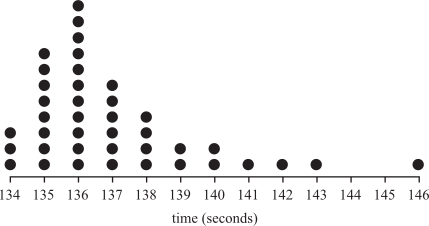
The dot plot below shows the times, in seconds, of 40 runners in the qualifying heats of their 800 m club championship.
 

Question 1

The median time, in seconds, of these runners is

  1. 135.5
  2. 136
  3. 136.5
  4. 137
  5. 137

 
Question 2

The shape of this distribution is best described as

  1. positively skewed with one or more possible outliers.
  2. positively skewed with no outliers.
  3. approximately symmetric with one or more possible outliers.
  4. approximately symmetric with no outliers.
  5. negatively skewed with one or more possible outliers.
Show Answers Only

\(\text{Question 1:}\ B\)

\(\text{Question 2:}\ A\)

Show Worked Solution

\(\text{Question 1}\)

\(\text{40 data points}\ \Rightarrow \ \text{Median = average of 20th and 21st data points}\)

\(\text{Median}\ = \dfrac{136 + 136}{2} = 136\)

\(\Rightarrow B\)
 

\(\text{Question 2}\)

\(\text{Distribution is positive skewed (tail stretches to the right)} \)

\(\text{Q}_1 = \dfrac{135+135}{2} = 135\)

\(\text{Q}_3 = \dfrac{138+138}{2} = 138\)

\(\text{IQR} = 138-135=3 \)

\(\text{Outlier (upper fence)}\ = 138+ 1.5 \times 3 = 142.5\)

\(\Rightarrow A\)

Filed Under: Graphs - Histograms and Other Tagged With: Band 2, Band 4, smc-644-10-Dot Plots

PHYSICS, M2 EQ-Bank 3

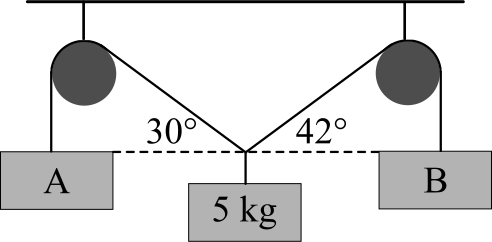
In the system diagram below, a 5-kilogram mass and masses \(A\) and \(B\) are held by high tensile frictionless wire in static equilibrium.
 

Using a vector diagram, calculate the masses of both \(A\) and \(B\).   (4 mark)

--- 8 WORK AREA LINES (style=blank) ---

Show Answers Only

\(\text{Mass}_A =3.91\ \text{kg}\)

\(\text{Mass}_B =4.55\ \text{kg}\)

Show Worked Solution

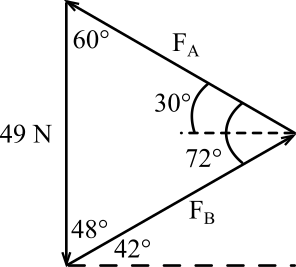
Using the sin rule both \(F_B\) and \(F_A\) can be calculated:

\(\dfrac{F_A}{\sin 48^{\circ}}\) \(=\dfrac{5 \times 9.8}{\sin 72^{\circ}}\)  
\(F_A\) \(=\dfrac{49\,\sin 48^{\circ}}{\sin 72^{\circ}}=38.3\ \text{N}\)  

 
\(\text{Mass}_A =\dfrac{F}{a}=\dfrac{38.3}{9.8}=3.91\ \text{kg}\)
 

\(\dfrac{F_B}{\sin 60^{\circ}}\) \(=\dfrac{49}{\sin 72^{\circ}}\)
\(F_B\) \(=\dfrac{49\, \sin 60^{\circ}}{\sin 72^{\circ}}=44.6\ \text{N}\)


\(\text{Mass}_B =\dfrac{F}{a}=\dfrac{44.6}{9.8}=4.55\ \text{kg}\)

Filed Under: Forces Tagged With: Band 4, Band 5, smc-4275-40-Equilibrium systems

PHYSICS, M2 EQ-Bank 1

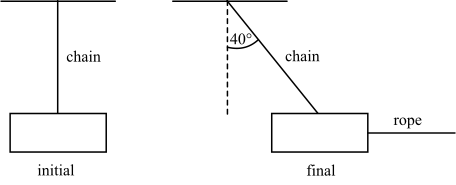
A concrete block with a weight of 1000 \(\text{N}\) is lifted with a pulley and chain system.

Initially the block is suspended by the chain as seen below. The block is then pulled to the side using a rope and makes an angle of 40° with the vertical as shown below. Ignore the masses of the chain and rope.
 

  1. State the tension in the chain initially.   (1 mark)

    --- 2 WORK AREA LINES (style=lined) ---
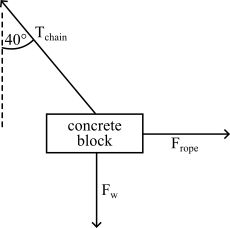
  2. Draw a free body diagram representing the forces acting on the concrete block in the final situation.   (2 marks)

    --- 3 WORK AREA LINES (style=lined) ---
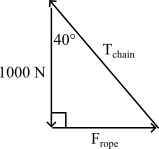
  3. Determine the magnitude of the force being applied on the rope and the tension in the chain in the final situation.   (3 marks)

    --- 5 WORK AREA LINES (style=lined) ---
Show Answers Only

a.    \(1000\ \text{N up.}\)

b. 
             

c.   \(F_{\text{rope}}=839\ \text{N}\)

\(T_{\text{chain}}=1305.4\ \text{N}\)

Show Worked Solution

a.   Initial tension in chain:

  • Tension is equal and opposite to the weight force of 1000 \(\text{N}\) down.
  • Hence the tension in the chain is 1000 \(\text{N}\) up.

 
b. 


c. 
       

\(\tan 40^{\circ}\) \(=\dfrac{F_{\text{rope}}}{1000}\)  
\(F_{\text{rope}}\) \(=1000 \times \tan 40^{\circ}=839\ \text{N}\)  


\( \cos 40^{\circ}\) \(=\dfrac{1000}{T_{\text{chain}}}\)  
\(T_{\text{chain}}\) \(=\dfrac{1000}{\cos 40^{\circ}}=1305.4\ \text{N}\)  

Filed Under: Forces Tagged With: Band 4, smc-4275-40-Equilibrium systems

PHYSICS, M4 EQ-Bank 1

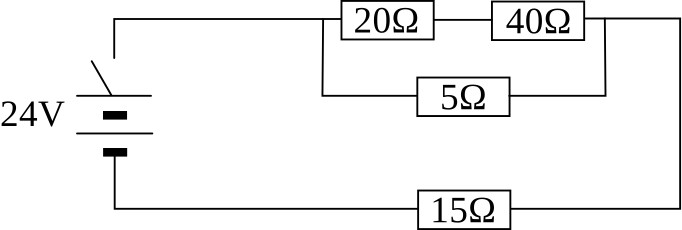
The following circuit has 4 resistors and a 24 V DC supply with a switch.
 

  1. Calculate the value of the single resistor that is equivalent to the 5 \(\Omega\), 20 \(\Omega\), and 40 \(\Omega\) resistors.   (2 marks)

    --- 3 WORK AREA LINES (style=lined) ---
  2. Determine the potential difference across the 15 \(\Omega\) resistor when the switch is closed.   (2 mark)

    --- 5 WORK AREA LINES (style=lined) ---
  3. Determine the current through the 5 \(\Omega\) resistor when the switch is closed.   (2 mark)

    --- 5 WORK AREA LINES (style=lined) ---

Show Answers Only

a.    \(4.6\ \Omega\)

b.    \(18.37\ \text{V}\)

c.   \(1.126\ \text{A}\)

Show Worked Solution
a.     \(R_{series}\) \(= 20 + 40 = 60\ \Omega\)
  \(\dfrac{1}{R_T}\) \(=\dfrac{1}{60}+\dfrac{1}{5}=\dfrac{13}{60}\)
  \(R_T\) \(=\dfrac{60}{13}=4.6\ \Omega\)


b.   \(R_{circuit} = 4.6 +15 = 19.6\ \Omega\)

Circuit current:

\(I=\dfrac{V}{R}=\dfrac{24}{19.6}=1.2245\ \text{A}\)
 

Potential difference across the 15 \(\Omega\) resistor:

\(V=IR=1.2245 \times 15=18.37\ \text{V}\)
 

c.   Potential difference across the 5 \(\Omega\) resistor: 

\(V_{(5\ \Omega)}=24-18.37= 5.63\ \text{V}\)
 

Current through the \(5\ \Omega\) resistor:

\(I=\dfrac{V}{R}=\dfrac{5.63}{5}=1.126\ \text{A}\)

Filed Under: Electric Circuits Tagged With: Band 3, Band 4, smc-4284-10-V=IR, smc-4284-20-Resistence in circuits

PHYSICS, M4 EQ-Bank 1

Determine the magnetic field intensity within a solenoid with 20 coils and a length of 15 cm, given that a direct current of 4 amperes flows through it.   (3 marks)

--- 5 WORK AREA LINES (style=lined) ---
Show Answers Only

\(6.7 \times 10^{-4}\ \text{T}\)

Show Worked Solution
\(B\) \(=\dfrac{\mu_0 N I}{L}\)  
  \(=\dfrac{4\pi \times 10^{-7} \times 20 \times 4}{0.15}\)  
  \(=6.7 \times 10^{-4}\ \text{T}\)  

Filed Under: Magnetism Tagged With: Band 4, smc-4285-20-Fields around wires/solenoids

PHYSICS, M4 2023 VCE 1

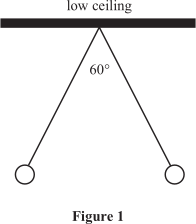
Some physics students are conducting an experiment investigating both electrostatic and gravitational forces. They suspend two equally charged balls, each of mass 4.0 g, from light, non-conducting strings suspended from a low ceiling.

The charged balls repel each other with the strings at an angle of 60°, as shown in Figure 1.
 

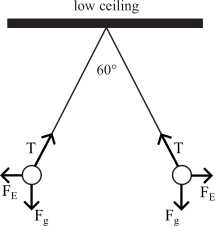
There are three forces acting on each ball:

    • a tension force, \(T\)
    • a gravitational force, \(F_{g}\)
    • an electrostatic force, \(F_{E}\).
  1. On Figure 1, using the labels \(T, F_{g}\) and \(F_{E}\), draw each of the three forces acting on each of the charged balls.  (3 marks)

    --- 0 WORK AREA LINES (style=lined) ---
  2. Show that the tension force, \(T\), in each string is \(4.5 \times 10^{-2} \text{ N}\). Use  \(g=9.8 \text{ N kg}^{-1}\).
  3. Show your working.  (2 marks)

    --- 5 WORK AREA LINES (style=lined) ---

  4. Calculate the magnitude of the electrostatic force, \(F_{ E }\). Show your working.  (2 marks)

    --- 6 WORK AREA LINES (style=lined) ---
Show Answers Only

a.   


b. 
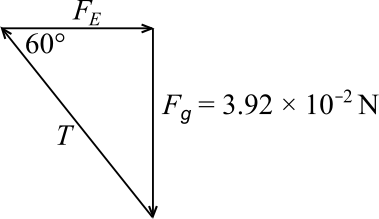
   System is in an equilibrium state:

  • The sum of the forces must add to zero as seen in the triangle below.
      

\(F_g = 9.8 \times 4 \times 10^{-3} = 3.92 \times 10^{-2}\ \text{N}\)

\(\sin\,60^{\circ}\) \(=\dfrac{3.92 \times 10^{-2}}{T}\)  
\(T\) \(=\dfrac{3.92 \times 10^{-2}}{\sin\,60^{\circ}}=4.5 \times 10^{-2}\ \text{N}\)  

 
c.   
Using the same triangle as part (b): 

\(\tan\,60^{\circ}\) \(=\dfrac{3.92 \times 10^{-2}}{F_E}\)  
\(F_E\) \(=\dfrac{3.92 \times 10^{-2}}{\tan\,60^{\circ}}=2.3 \times 10^{-2}\ \text{N}\)  

Show Worked Solution

a.   


b. 
   System is in an equilibrium state:

  • The sum of the forces must add to zero as seen in the triangle below.
      

\(F_g = 9.8 \times 4 \times 10^{-3} = 3.92 \times 10^{-2}\ \text{N}\)

\(\sin\,60^{\circ}\) \(=\dfrac{3.92 \times 10^{-2}}{T}\)  
\(T\) \(=\dfrac{3.92 \times 10^{-2}}{\sin\,60^{\circ}}=4.5 \times 10^{-2}\ \text{N}\)  

c.   Using the same triangle as part (b): 

\(\tan\,60^{\circ}\) \(=\dfrac{3.92 \times 10^{-2}}{F_E}\)  
\(F_E\) \(=\dfrac{3.92 \times 10^{-2}}{\tan\,60^{\circ}}=2.3 \times 10^{-2}\ \text{N}\)  
♦ Mean mark 41%.

Filed Under: Electrostatics Tagged With: Band 3, Band 4, Band 5, smc-4283-30-Forces on charges, smc-4283-40-Systems at equilibrium

BIOLOGY, M7 2022 VCE 27 MC

Which of the following cells responds first when a person receives the MMR vaccination?

  1. helper \( \text{T} \) cells
  2. memory \( \text{T} \) cells
  3. cytotoxic \( \text{T} \) cells
  4. antigen-presenting cells
Show Answers Only

\(D\)

Show Worked Solution
  • As the MMR vaccine contains a weakened version of the Measles, Mumps and Rubella viruses, it is the antigen-presenting cells which first respond.

\(\Rightarrow D\)

Filed Under: Prevention, Treatment and Control Tagged With: Band 4, smc-3658-20-Vaccines

PHYSICS, M3 2023 VCE 12

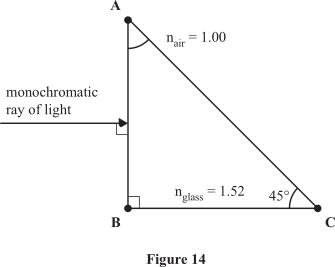
A ray of monochromatic light is incident on a triangular glass prism with a refractive index of 1.52 . The ray is perpendicular to the side \(\text{AB}\) of the glass prism, as shown in the diagram below.
  

The ray of light travels through the glass prism before reaching side \(\text{AC}\).

  1. Calculate the critical angle for the glass prism at the glass-air interface.   (2 marks)

    --- 4 WORK AREA LINES (style=lined) ---
  2. Will the ray of light undergo total internal reflection at side \(\text{AC}\) of the glass prism? Justify your answer.   (2 marks)

    --- 4 WORK AREA LINES (style=lined) ---
Show Answers Only

a.    41°

b.    Total internal reflection:

  • The angle of incidence 45° is greater than the critical angle 41°.
  • Therefore, total internal reflection will occur on side \(\text{AC}\).

Show Worked Solution

a.     \(\sin \theta_c\) \(=\dfrac{n_2}{n_1}\)
  \(\theta_c\) \(=\sin^{-1}(\dfrac{n_2}{n_1})=\sin^{-1}(\dfrac{1.0}{1.52})=41^{\circ}\)

 
b. 
  Total internal reflection:

  • The angle of incidence 45° is greater than the critical angle 41°.
  • Therefore, total internal reflection will occur on side \(\text{AC}\).
♦ Mean mark (b) 46%.

Filed Under: Ray Model of Light Tagged With: Band 4, Band 5, smc-4281-20-Snell's Law and TIR

PHYSICS, M3 2023 VCE 11

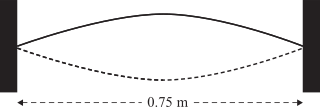
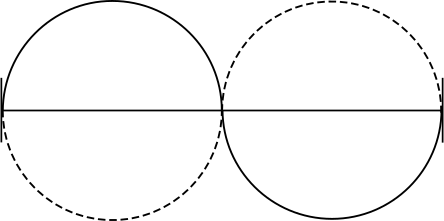
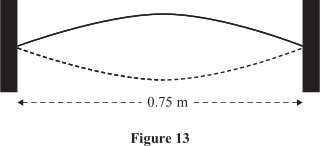
A guitar string of length 0.75 m and fixed at both ends is plucked and a standing wave is produced. The envelope of the standing wave is shown in the diagram.
 

The speed of the wave along the string is 393 m s\( ^{-1}\).

  1. What is the frequency of the wave?   (1 mark)

    --- 2 WORK AREA LINES (style=lined) ---
  2. Describe how the standing wave is produced on the string fixed at both ends.   (2 marks)

    --- 3 WORK AREA LINES (style=lined) ---
Show Answers Only

a.    262 Hz

b.   Standing wave:

  • When waves encounter fixed ends, they reflect.
  • If the string’s length is a multiple of half the wavelength, the reflected wave combines with the original wave, resulting in interference that forms a standing wave pattern
Show Worked Solution

a.   \(f=\dfrac{v}{\lambda}=\dfrac{393}{1.5}=262\ \text{Hz}\)
 

b.   Standing wave:

  • When waves encounter fixed ends, they reflect.
  • If the string’s length is a multiple of half the wavelength, the reflected wave combines with the original wave, resulting in interference that forms a standing wave pattern
♦ Mean mark (b) 47%.

Filed Under: Sound Waves, Wave Properties and Behaviour Tagged With: Band 4, Band 5, smc-4278-20-Wave calculations, smc-4280-20-Modelling standing waves

PHYSICS, M2 2023 VCE 8

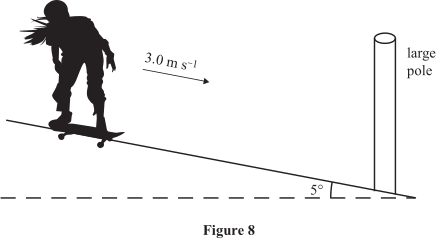
Maia is at a skatepark. She stands on her skateboard as it rolls in a straight line down a gentle slope at a constant speed of 3.0 m s\(^{-1}\), as shown in the figure below. The slope is 5° to the horizontal.

The combined mass of Maia and the skateboard is 65 kg.
  

  1. The combined system of Maia and the skateboard is modelled as a small box with point \(\text{M}\) at the centre of mass, as shown below.
  2. Draw and label arrows to represent each of the forces acting on the system - that is, Maia and skateboard as they roll down the slope.   (3 marks)


--- 0 WORK AREA LINES (style=lined) ---
  1. Calculate the magnitude of the total frictional forces acting on Maia and the skateboard.  (2 marks)

    --- 5 WORK AREA LINES (style=lined) ---
Near the bottom of the ramp, Maia takes hold of a large pole and comes to a complete rest while still standing on the skateboard. Maia and the skateboard now have no momentum or kinetic energy.

  1. Explain what happened to both the momentum and the kinetic energy of Maia and the skateboard. No calculations are required.  (2 marks)

    --- 3 WORK AREA LINES (style=lined) ---
Show Answers Only

a.
         

b.     55.5 N

c.    Momentum:

  • Maia and the skateboards momentum was transferred into the pole and hence into the Earth. Due to the Earth’s very large mass, the effect on its velocity is negligible.

Kinetic energy:

  • The kinetic energy of Maia and the skateboard would have been transformed into heat energy between the contact of Maia and the pole and/or transferred into the work done by Maia’s muscles in slowing herself down.

Show Worked Solution

a.
        

b.     Total frictional forces:

  • Constant speed means that the force down the slope of the incline is equal to the sum of the frictional forces acting on Maia and the skateboard.
\(F_{\text{down slope}}\) \(=F_f\) \(=mg\, \sin\, \theta\)
    \(=65 \times 9.8 \times \sin\,5^{\circ}\)
    \(=55.5\ \text{N}\)
♦ Mean mark (b) 50%.

c.    Momentum:

  • Maia and the skateboards momentum was transferred into the pole and hence into the Earth. Due to the Earth’s very large mass, the effect on its velocity is negligible.

Kinetic energy:

  • The kinetic energy of Maia and the skateboard would have been transformed into heat energy between the contact of Maia and the pole and/or transferred into the work done by Maia’s muscles in slowing herself down.
♦♦♦ Mean mark (c) 26%.

Filed Under: Forces, Acceleration and Energy, Momentum, Energy and Simple Systems Tagged With: Band 4, Band 5, Band 6, smc-4276-20-Friction, smc-4277-20-Momentum conservation, smc-4277-30-Energy conservation

BIOLOGY, M4 EQ-Bank 40

"Close monitoring is critical for endangered species and at-risk ecosystems."

Identify an example of an endangered species and an at-risk ecosystem and describe a policy response that could arise from such monitoring.   (4 marks)

--- 5 WORK AREA LINES (style=lined) ---
Show Answers Only

Endangered species (one of many possibilities):

  • Tasmanian Devils are an endangered species that has been decimated by Devil Facial Tumor Disease (DFTD) and is intensely monitored.
  • Monitoring provides accurate information of their population numbers and allows informed policy to be made, such as the establishment of Devil’s Ark for devil breeding by non-infected individuals. 

At-risk ecosystem (one of many possibilities):

  • The Tarkine rainforest in Tasmania is a closely monitored ecosystem.
  • This ecosystem is endangered from climate change with the forest floor underbrush becoming an increasing fire hazard as vegetation dries out. Monitoring allows for the development of an effective bushfire strategy in the area.
Show Worked Solution

Endangered species (one of many possibilities):

  • Tasmanian Devils are an endangered species that has been decimated by Devil Facial Tumor Disease (DFTD) and is intensely monitored.
  • Monitoring provides accurate information of their population numbers and allows informed policy to be made, such as the establishment of Devil’s Ark for devil breeding by non-infected individuals. 

At-risk ecosystem (one of many possibilities):

  • The Tarkine rainforest in Tasmania is a closely monitored ecosystem.
  • This ecosystem is endangered from climate change with the forest floor underbrush becoming an increasing fire hazard as vegetation dries out. Monitoring allows for the development of an effective bushfire strategy in the area.

Filed Under: Future Ecosystems Tagged With: Band 4, smc-4313-20-Preserving biodiversity

PHYSICS, M3 2023 VCE 12 MC

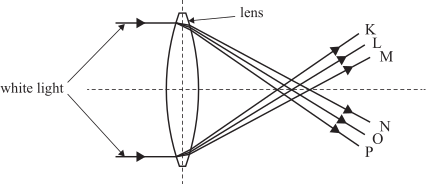
A physics class is investigating the dispersion of white light using a lens, as shown in the diagram below.
 

The students observe the rays \(\text{K–P}\) that have been refracted by the lens.

Which one of the following correctly identifies the colour, red \(\text{(R)}\), green \(\text{(G)}\) or violet \(\text{(V)}\), of the rays \(\text{K–P}\)?
 

  \(\textbf{K}\) \(\textbf{L}\) \(\textbf{M}\) \(\textbf{N}\) \(\textbf{O}\) \(\textbf{P}\)
\(\textbf{A.}\) \(\quad \text{R}\quad \) \(\quad \text{G}\quad \) \(\quad \text{V}\quad \) \(\quad \text{V}\quad \) \(\quad \text{G}\quad \) \(\quad \text{R}\quad \)
\(\textbf{B.}\) \(\text{V}\) \(\text{G}\) \(\text{R}\) \(\text{R}\) \(\text{G}\) \(\text{V}\)
\(\textbf{C.}\) \(\text{V}\) \(\text{G}\) \(\text{R}\) \(\text{V}\) \(\text{G}\) \(\text{R}\)
\(\textbf{D.}\) \(\text{V}\) \(\text{R}\) \(\text{G}\) \(\text{G}\) \(\text{R}\) \(\text{V}\)
Show Answers Only

\(B\)

Show Worked Solution
  • The shorter wavelengths of light (violet) experience a greater refraction so the light rays of \(P\) and \(K\) will be violet. 
  • The longer wavelength light (red) experiences the least refraction and so will be rays \(M\) and \(N\).

\(\Rightarrow B\)

Filed Under: Ray Model of Light Tagged With: Band 4, smc-4281-30-Light dispersion

BIOLOGY, M4 EQ-Bank 39

"Biodiversity is the cornerstone of a healthy planet."

Discuss this statement, outlining the key advantages of preserving biodiversity for ecosystems and human well-being?   (4 marks)

--- 8 WORK AREA LINES (style=lined) ---

Show Answers Only
  • Making the effort to preserve biodiversity creates a range of important benefits to both the ecosystem and us.
  • A well preserved biodiversity provides enormous economic value to society through the bio-resources it produces, such as food, timber, fibres and medicines.
  • Rich biodiversity and a healthy ecosystem also indirectly benefit many other natural processes such as pollination, maintaining clean water and productive soil.
  • Maintaining biodiversity is integral to preserving wild life and ecosystems. By disrupting ecosystems, food webs and chains can be affected, causing drastic changes in populations and even extinction. Preserving ecosystems maintains the aesthetic beauty of nature for current and future generations.
Show Worked Solution
  • Making the effort to preserve biodiversity creates a range of important benefits to both the ecosystem and us.
  • A well preserved biodiversity provides enormous economic value to society through the bio-resources it produces, such as food, timber, fibres and medicines.
  • Rich biodiversity and a healthy ecosystem also indirectly benefit many other natural processes such as pollination, maintaining clean water and productive soil.
  • Maintaining biodiversity is integral to preserving wild life and ecosystems. By disrupting ecosystems, food webs and chains can be affected, causing drastic changes in populations and even extinction. Preserving ecosystems maintains the aesthetic beauty of nature for current and future generations.

Filed Under: Future Ecosystems Tagged With: Band 4, smc-4313-20-Preserving biodiversity

PHYSICS, M2 2023 VCE 8 MC

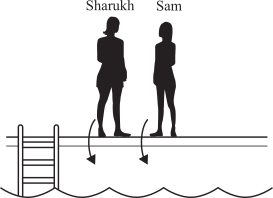
At a swimming pool, Sharukh and Sam, shown below, step off the low diving board at the same time. Over the small distance they fall, air resistance may be ignored. Sharukh and Sam have masses of 80 kg and 60 kg respectively.
 

Which one of the following best explains what happens to Sharukh and Sam as they drop straight down into the water?

  1. Sharukh reaches the surface first because she has a larger mass.
  2. The net force on Sharukh is larger than that on Sam, so Sharukh reaches the surface first.
  3. They both reach the surface together because they both experience the same downward force.
  4. They both reach the surface together because they both experience the same downward acceleration.
Show Answers Only

\(D\)

Show Worked Solution
  • Both Sharukh and Sam fall under the acceleration of gravity which is 9.8 ms\(^{-2}\).
  • They will fall at the same speed and therefore hit the surface at the same time.

\(\Rightarrow D\)

Filed Under: Forces, Acceleration and Energy Tagged With: Band 4, smc-4276-30-Gravity, smc-4276-50-F=ma

PHYSICS, M3 2017 VCE 16

Standing waves are formed on a string of length 4.0 m that is fixed at both ends. The speed of the waves is 240 m s\(^{-1}\).

  1. Calculate the wavelength of the lowest frequency resonance.  (2 marks)

    --- 3 WORK AREA LINES (style=lined) ---

  2. Calculate the frequency of the second-lowest frequency resonance.  (2 marks)

    --- 3 WORK AREA LINES (style=lined) ---

  3. Explain the physics of how standing waves are formed on the string. Include a diagram in your response.  (3 marks)

    --- 6 WORK AREA LINES (style=lined) ---

Show Answers Only

a.    30 Hz

b.    60 Hz

c.    Standing waves:

  • Produced when a wave travels down a string and is reflected back on itself such that the superposition of the two waves produce an interference pattern to form a standing wave.
  • The two waves must be travelling in opposite directions with the same frequency, wavelength and amplitude.


Show Worked Solution

a.     Lowest frequency resonance:

  • Occurs at the maximum wavelength. The maximum wavelength is 8 metres since the half wavelength is the length of the string (4m).
  •    \(f=\dfrac{v}{\lambda}=\dfrac{240}{8}=30\ \text{Hz}\) 

b.   When \(\lambda = 4: \)

    \(f=\dfrac{v}{\lambda}=\dfrac{240}{4}=60\ \text{Hz}\)
 

c.    Standing waves:

  • Produced when a wave travels down a string and is reflected back on itself such that the superposition of the two waves produce an interference pattern to form a standing wave.
  • The two waves must be travelling in opposite directions with the same frequency, wavelength and amplitude.


♦ Mean mark (c) 43%.

Filed Under: Sound Waves, Wave Properties and Behaviour Tagged With: Band 4, Band 5, smc-4278-20-Wave calculations, smc-4280-20-Modelling standing waves

CHEMISTRY, M4 EQ-Bank 36

The enthalpies of formation for a number of chemical reactions are as follows:

\(\ce{C6H12O6(s)}\)                  \(\Delta H^{\circ}_f = -1271\ \text{kJmol}^{-1}\)

\(\ce{C2H5OH(aq)}\)                \(\Delta H^{\circ}_f = -277.7\ \text{kJmol}^{-1}\)

\(\ce{CO2(g)}\)                         \(\Delta H^{\circ}_f = -393.5\ \text{kJmol}^{-1}\)

Calculate the enthalpy change for the fermentation of glucose (reaction below) using the enthalpies of formation above.

\(\ce{C6H12O6(s) \rightarrow 2C2H5OH(aq) + 2CO2(g)}\)   (3 marks)

--- 6 WORK AREA LINES (style=lined) ---

Show Answers Only

\(\Delta H^{\circ}_{\text{reaction}} = -71.4\ \text{kJmol}^{-1}\)

Show Worked Solution

\(\Sigma\ \text{Enthalpy (reactants)}\ = 1 \times -1271 = -1271\ \text{kJ}\)

\(\Sigma\ \text{Enthalpy (products)}\ = 2 \times -277.7 + 2 \times -393.5 = -1342.4\ \text{kJ}\)

\(\Delta H^{\circ}_{\text{reaction}}\) \(= \Delta H^{\circ} (\text{products})-\Delta H^{\circ} (\text{reactants}) \)  
  \(=-1342.4-(-1271)\)  
  \(= -71.4\ \text{kJ mol}^{-1}\)  

Filed Under: Enthalpy and Hess's Law Tagged With: Band 4, Band 5, smc-4267-30-Enthalpies of formation

CHEMISTRY, M4 EQ-Bank 35

The enthalpies of reaction of a number of chemical reactions are as follows:

Reaction 1: \(\ce{CH3CH2OH(l) + 3O2(g) \rightarrow 2CO2(g) + 3H2O(l)}\)      \(\Delta H_1=-1360\ \text{kJ mol}^{-1}\)

Reaction 2: \(\ce{CH3COOH(l) + 2O2(g) \rightarrow 2CO2(g) + 2H2O(l)}\)       \(\Delta H_2=-876\ \text{kJ mol}^{-1}\)

Reaction 3: \(\ce{H2(g) + \frac{1}{2}O2(g) \rightarrow H2O(l)}\)                                           \(\Delta H_3=-285.8\ \text{kJ mol}^{-1}\)

Calculate the enthalpy change for the reaction below using the enthalpies of reaction above.

\(\ce{CH3COOH(l) + H2(g) \rightarrow CH3CH2OH(l) + \frac{1}{2}O2(g)}\)           \(\Delta H_4=?\)   (3 marks)

--- 7 WORK AREA LINES (style=lined) ---

Show Answers Only

 \(\Delta H_4=+198.2\ \text{kJ mol}^{-1}\)

Show Worked Solution
  • Reverse equation 1 to make \(\ce{CH3CH2OH(l)}\) a product (changes the sign of the enthalpy).
  • \(\ce{2CO2(g) + 3H2O(l) \rightarrow CH3CH2OH(l) + 3O2(g)}\)      \(-\Delta H_1=+1360\ \text{kJ mol}^{-1}\)
  • Add the equations and their \(\Delta H\) values and cancel any reactants and products.

\begin{array} {r l l}
\rule{0pt}{2.5ex} \cancel{ \ce{2CO2(g)}} + \cancel{ \ce{3H2O(l)}} \rule[-1ex]{0pt}{0pt} &  \rightarrow \ce{CH3CH2OH(g)} +  \cancelto{\ce{\frac{1}{2}O2(g)}}{\ce{3O2(g)}} & -\Delta H_1=+1360\ \text{kJ mol}^{-1}\\
\rule{0pt}{2.5ex} \ce{CH3COOH(l)} +\cancel{\ce{2O2(g)}} \rule[-1ex]{0pt}{0pt} & \rightarrow \cancel{ \ce{2CO2(g)}} + \cancel{\ce{2H2O(l)}} & 2\Delta H_2= -876\ \text{kJ mol}^{-1}  \\
\rule{0pt}{2.5ex} \ce{H2(g)} + \cancel{\ce{\frac{1}{2}O2(g)}} \rule[-1ex]{0pt}{0pt} & \rightarrow \cancel{\ce{H2O(l)}} &  \Delta H_3=-285.8\ \text{kJ mol}^{-1}  \\
\rule{0pt}{2.5ex}\ce{CH3COOH(l) + H2(g)} \rule[-1ex]{0pt}{0pt} & \ce{\rightarrow CH3CH2OH(l) + \frac{1}{2}O2(g)} &  \Delta H_4=198.2\ \text{kJ mol}^{-1} \\
\end{array}

Filed Under: Enthalpy and Hess's Law Tagged With: Band 4, smc-4267-10-Hess's Law in energy cycles

CHEMISTRY, M4 EQ-Bank 34

Consider the following average bond energies (\(\text{KJ mol}^{-1}\)):

\begin{array} {cc}
\ce{N\equiv N} & 945  \\
\ce{H-H} &  436 \\
\ce{N=N} & 470 \\
\ce{N-H} & 391 \\
\ce{N-N} & 158 \\
\ce{C=N} & 615 \\
\end{array}

Using the values above, calculate the enthalpy change for the Haber Process:

\(\ce{N2(g) + 3H2(g) \rightarrow 2NH3(g)}\)   (2 marks)

--- 4 WORK AREA LINES (style=lined) ---

Show Answers Only

\(\Delta H= -93\ \text{kJ}\)

Show Worked Solution
  • Bond energy refers to the energy required to break the bonds between two atoms.
  • Energy to break apart \(\ce{N2(g) = 945\ \text{kJ mol}^{-1} }\)
  • Energy to break apart \(\ce{H2(g) = 3 \times 436 = 1308\ \text{kJ mol}^{-1}} \)
  • The energy required to form the  \(\ce{2HCL(g)}= 6 \times -391 = -2346\ \text{kJ}^{-1}\) .
  • \(\Delta H = (945 + 1308)-2346 = -93\ \text{kJ}\).

Filed Under: Enthalpy and Hess's Law Tagged With: Band 4, smc-4267-20-Enthalpy and bonding

BIOLOGY, M4 EQ-Bank 38

  1. What fundamental change occurred with the Neolithic revolution?   (1 mark)

    --- 2 WORK AREA LINES (style=lined) ---

  2. Explain TWO consequences of the Neolithic revolution on human civilisation.   (4 marks)

    --- 6 WORK AREA LINES (style=lined) ---

Show Answers Only

a.   → The Neolithic revolution refers to the beginning of agriculture

→ It occurred about 10 000 years ago and includes the first instances of cultivating crops and domesticating animals.
 

b.    Answers could include two of the following:

→ The Neolithic revolution heavily influenced the evolution of the human race, as well as the impacted ecosystems and related flora and fauna.

→ One immediate impact was an increase in human populations. The beginning of agriculture displaced a hunter gatherer lifestyle for many populations, providing an abundance of available food and leading to the first instances of villages and towns.

→ Another impact is soil erosion. The removal of deep-rooted vegetation for crops depleted the environment for many organisms and caused major disruption of the ecosystem. This process leads directly to deforestation which remains a major problem in modern agriculture.

Show Worked Solution

a.   → The Neolithic revolution refers to the beginning of agriculture

→ It occurred about 10 000 years ago and includes the first instances of cultivating crops and domesticating animals.
 

b.    Answers could include two of the following:

→ The Neolithic revolution heavily influenced the evolution of the human race, as well as the impacted ecosystems and related flora and fauna.

→ One immediate impact was an increase in human populations. The beginning of agriculture displaced a hunter gatherer lifestyle for many populations, providing an abundance of available food and leading to the first instances of villages and towns.

→ Another impact is soil erosion. The removal of deep-rooted vegetation for crops depleted the environment for many organisms and caused major disruption of the ecosystem. This process leads directly to deforestation which remains a major problem in modern agriculture.

Filed Under: BIO - Ex-syllabus checks required Tagged With: Band 4, Band 5, smc-4313-11-Human-induced pressures

CHEMISTRY, M3 EQ-Bank 8

Many acid/metal reactions produce hydrogen gas. How can the presence of hydrogen gas be detected, and what type of reaction does this detection method utilise?   (2 marks)

Show Answers Only
  • To test for the presence of hydrogen gas, collect the gas from the reaction and expose it to a naked flame. Hydrogen is highly flammable and if present, will produce a distinctive “pop” sound when it ignites.
  • This type of test is known as a combustion reaction.
Show Worked Solution
  • To test for the presence of hydrogen gas, collect the gas from the reaction and expose it to a naked flame. Hydrogen is highly flammable and if present, will produce a distinctive “pop” sound when it ignites.
  • This type of test is known as a combustion reaction.

Filed Under: Chemical Reactions Tagged With: Band 4, smc-4263-30-Combustion

CHEMISTRY, M3 EQ-Bank 7

Sodium and zinc are each reacted with water and steam. Predict the observations that would be made about these reactions.   (4 marks)

--- 8 WORK AREA LINES (style=lined) ---

Show Answers Only

Sodium \((\ce{Na}) \):

  • Sodium is an alkali metal that will react vigorously with both water and steam to produce a hydroxide and hydrogen gas according to the chemical equation
  •    \(\ce{2Na(s) + 2H2O(l) \rightarrow 2NaOH(aq) + H2(g)} \)
  • The reaction will show no colour change in the aqueous solution as \(\ce{Na(aq)}\) is colourless like water.

Zinc \((\ce{Zn})\):

  • Zinc is less reactive and will not react with water but will form an oxide with steam (due to the higher energy present) according to the equation
  •    \(\ce{Zn(s) + H2O(steam) \rightarrow ZnO(aq) + H2(g)} \)
  • While zinc metal is a silver colour, zinc oxide is white.
Show Worked Solution

Sodium \((\ce{Na}) \):

  • Sodium is an alkali metal that will react vigorously with both water and steam to produce a hydroxide and hydrogen gas according to the chemical equation
  •    \(\ce{2Na(s) + 2H2O(l) \rightarrow 2NaOH(aq) + H2(g)} \)
  • The reaction will show no colour change in the aqueous solution as \(\ce{Na(aq)}\) is colourless like water.

Zinc \((\ce{Zn})\):

  • Zinc is less reactive and will not react with water but will form an oxide with steam (due to the higher energy present) according to the equation
  •    \(\ce{Zn(s) + H2O(steam) \rightarrow ZnO(aq) + H2(g)} \)
  • While zinc metal is a silver colour, zinc oxide is white.

Filed Under: Chemical Reactions Tagged With: Band 4, smc-4263-15-Predicting products, smc-4263-8-Indicators of chemical change

CHEMISTRY, M3 EQ-Bank 6

Three unknown metals are reacted with dilute \(\ce{HCl(aq)}\) and the following observations are made:  

\begin{array} {|c|l|}
\hline
\rule{0pt}{2.5ex} \textit{Metal} \rule[-1ex]{0pt}{0pt} & \ \ \ \ \ \ \textit{Observations} \\
\hline
\rule{0pt}{2.5ex} \text{A} \rule[-1ex]{0pt}{0pt} & \text{No observable reaction} \\
\hline
\rule{0pt}{2.5ex} \text{B} \rule[-1ex]{0pt}{0pt} & \text{Slow bubbling} \\
\hline
\rule{0pt}{2.5ex} \text{C} \rule[-1ex]{0pt}{0pt} &  \text{Fast, abrupt bubbling} \\
\hline
\end{array}

You are told that the metals in question are Magnesium, Platinum and Zinc.

  1. Explain which of the above metals correspond to \(\text{A}\), \(\text{B}\) and \(\text{C}\), giving reasons for your answer.   (3 marks) 

    --- 6 WORK AREA LINES (style=lined) ---

  2. Describe the type of reaction between \(\ce{HCl}\) and metal \(\ce{C}\).   (1 mark)

    --- 1 WORK AREA LINES (style=lined) ---

  3. Provide one balanced chemical equation between \(\ce{HCl}\) and either metal \(\text{B}\) or metal \(\text{C}\).   (1 mark)

    --- 1 WORK AREA LINES (style=lined) ---

Show Answers Only

a.    Identifying metals \(\text{A}\), \(\text{B}\) and \(\text{C}\):

  • The metals \(\text{A}\), \(\text{B}\) and \(\text{C}\) differ by their relative reactivity.
  • Magnesium is the most reactive as it is an alkali earth metal (Metal \(\text{C}\)).
  • Zinc and Platinum are both less reactive than magnesium. Zinc however exists higher on the reactivity series of metals than Platinum which is the least reactive of the three metals.
  • Therefore, metal \(\text{B}\) is zinc and metal \(\text{A}\) is platinum. 

b.   A single displacement reaction.
 

c.    Include one of the following:

\(\ce{Mg(s) + 2HCl(aq) \rightarrow MgCl2(aq) + H2(g) }\)

\(\ce{Zn(s) + 2HCl(aq) \rightarrow ZnCl2(aq) + H2(g) }\)

Show Worked Solution

a.    Identifying metals \(\text{A}\), \(\text{B}\) and \(\text{C}\):

  • The metals \(\text{A}\), \(\text{B}\) and \(\text{C}\) differ by their relative reactivity.
  • Magnesium is the most reactive as it is an alkali earth metal (Metal \(\text{C}\)).
  • Zinc and Platinum are both less reactive than magnesium. Zinc however exists higher on the reactivity series of metals than Platinum which is the least reactive of the three metals.
  • Therefore, metal \(\text{B}\) is zinc and metal \(\text{A}\) is platinum. 

b.   A single displacement reaction.
 

c.    Include one of the following:

\(\ce{Mg(s) + 2HCl(aq) \rightarrow MgCl2(aq) + H2(g) }\)

\(\ce{Zn(s) + 2HCl(aq) \rightarrow ZnCl2(aq) + H2(g) }\)

Filed Under: Chemical Reactions Tagged With: Band 4, Band 5, smc-4263-10-Balanced chemical equations, smc-4263-15-Predicting products, smc-4263-8-Indicators of chemical change

ENGINEERING, PPT 2023 HSC 18 MC

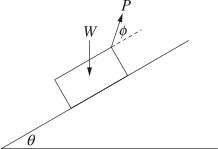
A diagram of a block being pulled by a rope up an inclined plane is shown.
 

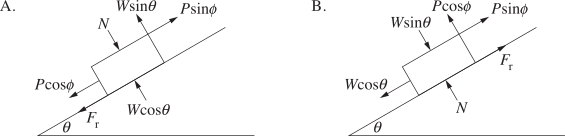
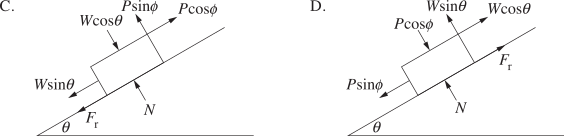
Which free body diagram correctly represents the diagram given?


Show Answers Only

\(  C \)

Show Worked Solution

\(\Rightarrow  C \)

Filed Under: Mechanics Tagged With: Band 4, smc-3718-50-Inclined planes

ENGINEERING, AE 2023 HSC 17 MC

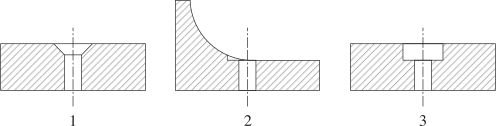
Three machined parts drawn to AS 1100 are shown.
 

Which row of the table correctly identifies the AS 1100 standard representations?
 

  \(1\) \(2\) \(3\)
\( \text{A.} \) \( \text{Counterbore} \) \( \text{Spotface} \) \( \text{Countersink} \)
\( \text{B.} \) \( \text{Spotface} \) \( \text{Countersink} \) \( \text{Counterbore} \)
\( \text{C.} \) \( \text{Countersink}  \) \( \text{Spotface} \) \( \text{Counterbore} \)
\( \text{D.} \) \( \text{Countersink} \) \( \text{Counterbore} \) \( \text{Spotface} \)
Show Answers Only

\(  C \)

Show Worked Solution

\(\Rightarrow  C \)

Filed Under: Communication Tagged With: Band 4, smc-3726-40-AS 1100

ENGINEERING, AE 2023 HSC 16 MC

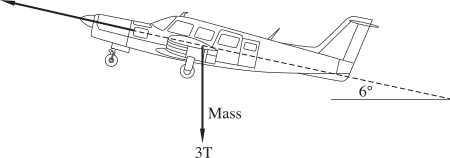
An aircraft weighing 3 tonne is ascending as shown. The lift to drag ratio is \(11: 1\).
 

Which row of the table correctly identifies the lift, drag and thrust values for the aircraft?

  \( \text{Lift} \) \( \text{Drag}\) \( \text{Thrust}\)
\( \text{A.} \) \(29.8\ \text{kN}\) \(2.7\ \text{kN}\) \(5.8\ \text{kN}\)
\( \text{B.} \) \(29.8\ \text{kN}\) \(2.7\ \text{kN}\) \(3.1\ \text{kN}\)
\( \text{C.} \) \(2.7\ \text{kN}\) \(3.1\ \text{kN}\) \(5.8\ \text{kN}\)
\( \text{D.} \) \(2.7\ \text{kN}\) \(3.1\ \text{kN}\) \(29.8\ \text{kN}\)
Show Answers Only

\(  A \)

Show Worked Solution

\(\Rightarrow  A \)

Filed Under: Mechanics and Hydraulics Tagged With: Band 4, smc-3724-10-Lift/Drag

ENGINEERING, PPT 2023 HSC 14 MC

A piece of 0.8% \(\ce{C}\) steel is heated to above its recrystallisation temperature and then normalised.

In what medium is this piece of steel cooled?

  1. Air
  2. Brine
  3. Sand
  4. Water
Show Answers Only

\( A \)

Show Worked Solution
  • Normalising involves heating steel to an elevated temperature, followed by slow cooling to room temperature, which changes the microstructure of the steel, reducing its hardness and increasing its ductility.

\(\Rightarrow A \)

Filed Under: Materials Tagged With: Band 4, smc-3719-30-Normalising

ENGINEERING, CS 2023 HSC 13 MC

Which mechanical property describes an object that is under load and follows Hooke's Law?

  1. Ductility
  2. Elasticity
  3. Malleability
  4. Plasticity
Show Answers Only

\(  B \)

Show Worked Solution
  • Hooke’s law states that for relatively small deformations of an object, the displacement or size of the deformation is directly proportional to the deforming force or load.
  • Hooke’s law is a fundamental principle in understanding the behaviour of elastic materials.

\(\Rightarrow  B \)

Filed Under: Engineering Mechanics Tagged With: Band 4, smc-3714-75-Young/Hooke, smc-3714-80-Stress/Strain - other

ENGINEERING, PPT 2023 HSC 11 MC

Which manufacturing process is used to make soft drink bottles out of polyethylene terephthalate (PET)?

  1. Stamping
  2. Extrusion
  3. Blow moulding
  4. Rotational moulding
Show Answers Only

\( C \)

Show Worked Solution

Making soft drink bottles out of PET:

  • PET is first polymerized to create long molecular chains then processed into plastic pellets, which serve as the raw material for making bottles.
  • The plastic pellets are melted into preforms and heated and stretched in a process known as “blow moulding” to create the final bottle shape.

\(\Rightarrow C \)

Filed Under: Materials Tagged With: Band 4, smc-3719-70-Polymers

ENGINEERING, CS 2023 HSC 10 MC

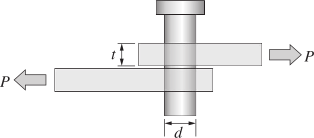
A bogie pin is shown.
 

What is the expression for the shear stress in the pin?

  1. \( \dfrac{4P}{\pi \times d} \)
  2. \( \dfrac{4P}{\pi\ ÷\ d} \)
  3. \( \dfrac{4P}{\pi \times d^2} \)
  4. \( \dfrac{4P}{\pi\ ÷\ d^2} \)
Show Answers Only

\( C \)

Show Worked Solution

\(\Rightarrow C \)

Filed Under: Engineering Mechanics Tagged With: Band 4, smc-3714-60-Shear stress

ENGINEERING, CS 2023 HSC 9 MC

In the process of manufacturing a concrete slab, cables are placed in ducting. After the concrete is poured and cured, the cables are stretched, anchored and released.

What type of concrete slab is this?

  1. Meshed
  2. Reinforced
  3. Pre-tensioned
  4. Post-tensioned
Show Answers Only

\(  D \)

Show Worked Solution
  • In a post-tensioned concrete slab, high-strength steel tendons are placed in the concrete before it sets, and then pulled tight afterwards to create a compressive force on the concrete.

\(\Rightarrow  D \)

Filed Under: Engineering Materials Tagged With: Band 4, smc-3715-30-Concrete

ENGINEERING, PPT 2023 HSC 7 MC

Why is cast iron preferred to steel when used as a heavy machine base?

  1. It is less brittle.
  2. It is more malleable.
  3. It has a lower damping capacity.
  4. It has a higher damping capacity.
Show Answers Only

\( D \)

Show Worked Solution
  • Cast iron has exceptional damping capacity, meaning it can absorb vibrations, providing stability during machine operation.

\(\Rightarrow D \)

Filed Under: Materials Tagged With: Band 4, smc-3719-10-Manufacturing - Ferrous

ENGINEERING, TE 2023 HSC 5 MC

Why does signal loss occur in optical glass fibres?

  1. Flaws in the glass fibres scatter the light.
  2. Twisted cables affect the transmission of light.
  3. External electromagnetic noise affects signal quality.
  4. Pressure affects signal transmission in submarine cables.
Show Answers Only

\( A \)

Show Worked Solution
  • Signal loss in optical glass fibres can be caused by factors such as scattering, absorption, and bending of the fibre.
  • Given the possible options, the most common reason for signal loss is the scattering of light due to flaws in the glass fibre, notwithstanding that excessive bending (twisting) of the fibre may also cause some signal loss.

\(\Rightarrow A \)

Filed Under: Materials Tagged With: Band 4, smc-3729-25-Fibre optics

CHEMISTRY, M4 EQ-Bank 33

Consider the following average bond energies (\(\text{KJ mol}^{-1}\)):

\begin{array} {cc}
\ce{H-H} & 436  \\
\ce{Cl-Cl} &  242 \\
\ce{H-Cl} & 431 \\
\end{array}

Using the values above, calculate the enthalpy change for the following reaction:

\(\ce{H2(g) + Cl2(g) \rightarrow 2HCl(g)}\)   (2 marks)

--- 4 WORK AREA LINES (style=lined) ---

Show Answers Only

\(\Delta H= -184\ \text{kJ}\)

Show Worked Solution
  • Bond energy refers to the energy required to break the bonds between two atoms.
  • Energy to break apart \(\ce{H2(g) = 436\ \text{kJ mol}^{-1} }\)
  • Energy to break apart \(\ce{Cl2(g) = 242\ \text{kJ mol}^{-1}} \)
  • The energy required to form the  \(\ce{2HCL(g)}= 2 \times -431 = -862\ \text{kJ}^{-1}\) .
  • \(\Delta H = (436 + 242)-862 = -184\ \text{kJ}\).
COMMENT:
The units for the enthalpy change is kJ not kJ/mol due to 2 moles of HCl being produced in the reaction.

Filed Under: Enthalpy and Hess's Law Tagged With: Band 4, smc-4267-20-Enthalpy and bonding

  • « Previous Page
  • 1
  • …
  • 40
  • 41
  • 42
  • 43
  • 44
  • …
  • 114
  • Next Page »

Copyright © 2014–2025 SmarterEd.com.au · Log in