SmarterEd

Aussie Maths & Science Teachers: Save your time with SmarterEd

  • Login
  • Get Help
  • About

Probability, STD2 S2 2013 HSC 26c

The probability that Michael will score more than 100 points in a game of bowling is `31/40`. 

  1. A commentator states that the probability that Michael will score less than 100 points in a game of bowling is  `9/40`.


    Is the commentator correct? Give a reason for your answer.   (1 mark)

    --- 2 WORK AREA LINES (style=lined) ---

  2. Michael plays two games of bowling. What is the probability that he scores more than 100 points in the first game and then again in the second game?   (1 mark)

    --- 1 WORK AREA LINES (style=lined) ---

Show Answers Only
  1. `text{Incorrect. Less than “or equal to 100” is correct.}`
  2. `961/1600`
Show Worked Solution
♦♦♦ Mean mark 11%

i.   `text(The commentator is incorrect. The correct)`

`text(statement is)\ Ptext{(score} <=100 text{)} =9/40`

`text{(i.e. less than “or equal to 100” is the correct statement)}`


♦ Mean mark 34%
ii. `\ \ \ P(text{score >100 in both})` `= 31/40 xx 31/40` 
    `= 961/1600`

Filed Under: Fundamental understanding, Fundamental Understanding (Std 1), Fundamental Understanding (Std 2), Multi-stage Events, Multi-Stage Events, Multi-Stage Events (Std 2), Single and Multi-Stage Events (Std 1) Tagged With: Band 5, Band 6, num-title-ct-corea, num-title-qs-hsc, smc-1135-20-Other Multi-Stage Events, smc-4238-20-Independent events, smc-4238-70-Complementary events, smc-829-20-Other Multi-Stage Events

Financial Maths, STD2 F4 2010* HSC 22 MC

In July, Ms Alott received a statement for her credit card account. The account has no interest free period. Compound interest is calculated daily and charged to her account on the statement date.
 

2010 22 mc 
 

What is the minimum payment due on this account? 

  1.    `$23.56`
  2.    `$25.00`
  3.    `$86.08`
  4.    `$87.20`
Show Answers Only

`D`

Show Worked Solution

`text(Days of interest)\ (n) =2+23=25`

♦♦♦ Mean mark 20%. Lowest scoring MC question in the 2010 exam.

`text(Daily interest rate)\ (r) = 0.0521/100 = 0.000521`

`text(Closing Balance)\ (FV)` `=PV(1+r)^n`
  `=1721.50 (1.000521)^25`
  `=$1744.06`


`text(5% of closing balance)` `=5/100xx1744.06`
  `=87.20\ text((nearest cent))`

 
`text(S)text(ince)\ $87.20>$25\ , text(minimum payment)=$87.20`

`=>D`

Filed Under: Credit Cards (Std 1), FM4 - Credit and Borrowing, Loans and Credit Cards (Std 2) Tagged With: Band 6, smc-814-10-Credit Cards

Statistics, STD2 S1 2010 HSC 21 MC

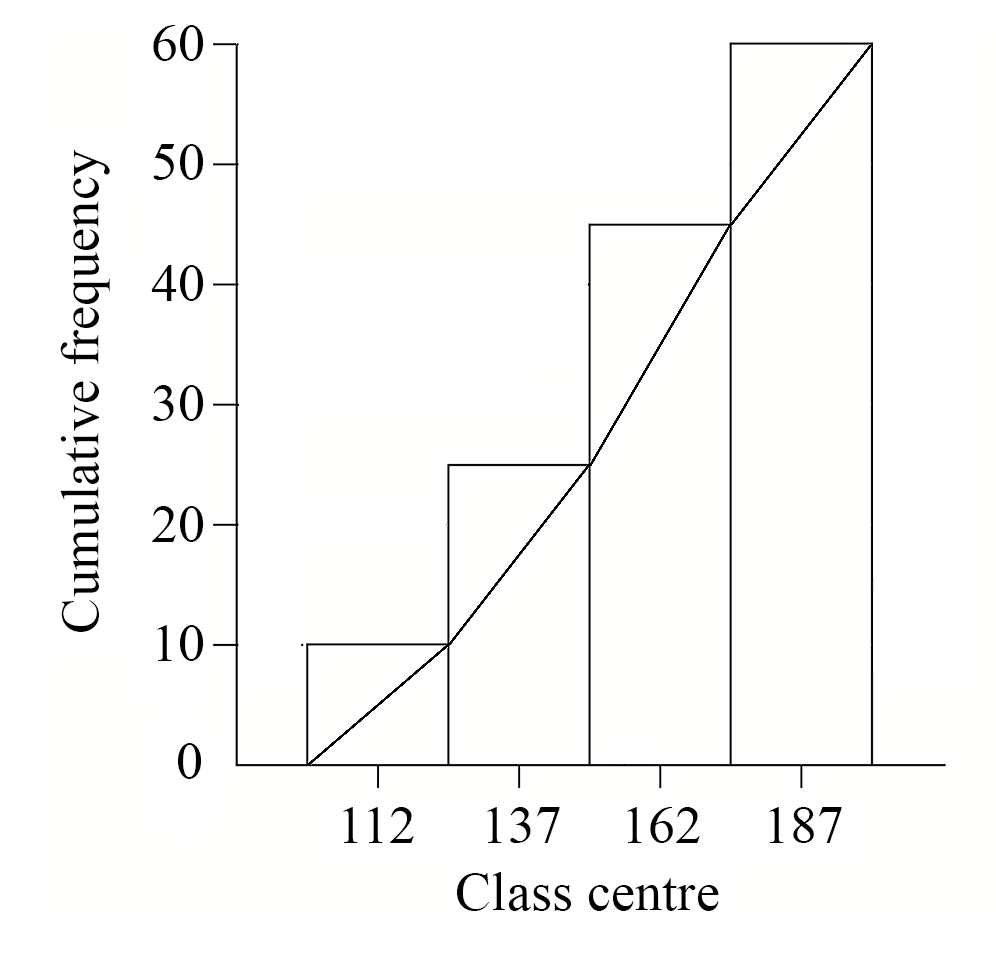
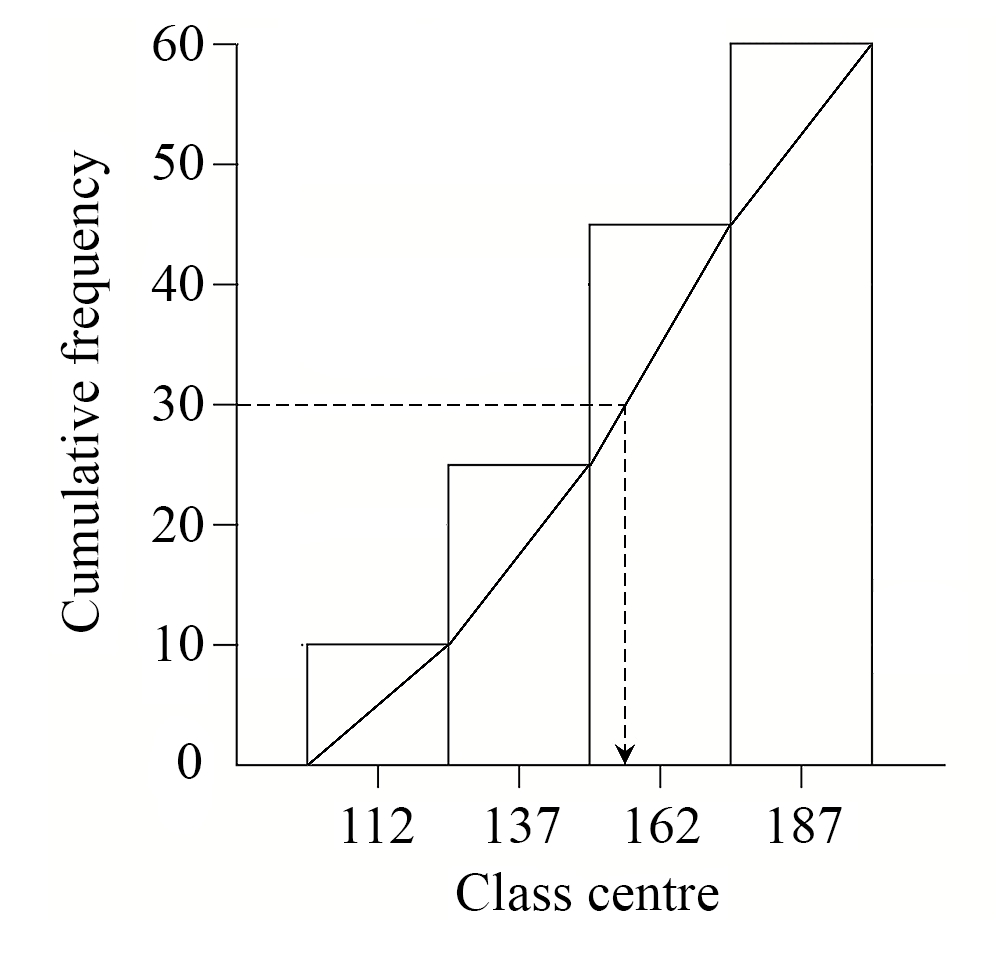
The area graph shows the cost and profits for a business over a period of time.

2010 21-1

The information in the area graph is then displayed as a line graph.

Which of the following line graphs best displays the data from the area graph?

2010 21-2

2010 21-3

Show Answers Only

`B`

Show Worked Solution
♦♦♦ Mean mark 24%
COMMENT: Area graph questions have proven very challenging over recent years. Review this area.

`text(S)text(ince the area in the profit graph is constant and)`

`text(then gradually decreases after a point)`

`=>B`


Filed Under: Other Chart Types (Y12), Other Charts (Std 2), Other Graphs Tagged With: Band 6, smc-822-40-Other Charts, smc-998-40-Other Charts

Probability, 2UG 2010 HSC 14 MC

A restaurant serves three scoops of different flavoured ice-cream in a bowl. There are five flavours to choose from.

How many different combinations of ice-cream could be chosen?

(A)   `10`

(B)   `15`

(C)   `30`

(D)   `60`

Show Answers Only

`A`

Show Worked Solution
♦♦♦ Mean mark 21%
COMMENT: Here, we divide by (3x2x1) because the 3 ice-cream scoops are unordered.
`#\ text(Combinations)` `=(5xx4xx3)/(3xx2xx1)`
  `=10`

`=>  A`

Filed Under: # Combinations Tagged With: Band 6

Algebra, STD2 A2 2009 HSC 24d

A factory makes boots and sandals. In any week

• the total number of pairs of boots and sandals that are made is 200
• the maximum number of pairs of boots made is 120
• the maximum number of pairs of sandals made is 150.

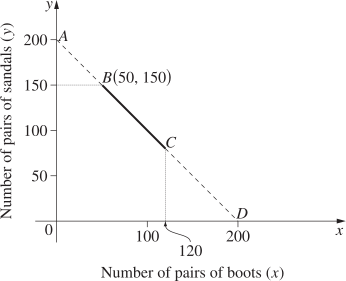
The factory manager has drawn a graph to show the numbers of pairs of boots (`x`) and sandals (`y`) that can be made.


  1. Find the equation of the line `AD`.   (1 mark)

    --- 2 WORK AREA LINES (style=lined) ---

  2. Explain why this line is only relevant between `B` and `C` for this factory.     (1 mark)

    --- 3 WORK AREA LINES (style=lined) ---

  3. The profit per week, `$P`, can be found by using the equation  `P = 24x + 15y`.


    Compare the profits at `B` and `C`.     (2 marks)

    --- 5 WORK AREA LINES (style=lined) ---

Show Answers Only
  1. `x + y = 200`
  2. `text(S)text(ince the max amount of boots = 120)`


    `=> x\ text(cannot)\ >120`


    `text(S)text(ince the max amount of sandals = 150`


    `=> y\ text(cannot)\ >150`


    `:.\ text(The line)\ AD\ text(is only possible between)\ B\ text(and)\ C.`

  3. `text(The profits at)\ C\ text(are $630 more than at)\ B.`
Show Worked Solution

i.   `text{We are told the number of boots}\ (x),` 

♦♦♦ Mean mark part (i) 14%. 
Using `y=mx+b` is a less efficient but equally valid method, using  `m=–1`  and  `b=200` (`y`-intercept).

`text{and shoes}\  (y),\ text(made in any week = 200)`

`=>text(Equation of)\ AD\ text(is)\ \ x + y = 200`


ii.  `text(S)text(ince the max amount of boots = 120)`

♦ Mean mark 49%

`=> x\ text(cannot)\ >120`

`text(S)text(ince the max amount of sandals = 150`

`=> y\ text(cannot)\ >150`

`:.\ text(The line)\ AD\ text(is only possible between)\ B\ text(and)\ C.`


iii.  `text(At)\ B,\ \ x = 50,\ y = 150`

♦ Mean mark 40%.
`=>$P  (text(at)\ B)` `= 24 xx 50 + 15 xx 150`
  `= 1200 + 2250`
  ` = $3450`

`text(At)\ C,\ \  x = 120 text(,)\ y = 80`

`=> $P  (text(at)\ C)` `= 24 xx 120 + 15 xx 80`
  `= 2880 + 1200`
  `= $4080`


`:.\ text(The profits at)\ C\ text(are $630 more than at)\ B.`

Filed Under: Applications: Currency, Fuel and Other Problems (Std 1), Applications: Currency, Fuel and Other Problems (Std 2), Applications: Currency, Fuel and Other Problems (Std2-2027), Breakeven and Financial modelling, Linear Applications, Linear Functions (Adv-2027), Linear Functions (Y11) Tagged With: Band 5, Band 6, common-content, num-title-ct-coreb, num-title-qs-hsc, smc-1119-30-Other Linear Applications, smc-4421-70-Other, smc-6214-20-Other Real World Applications, smc-6256-30-Other Linear Applications, smc-793-30-Other Linear Applications, smc-793-40-Limitations, smc-985-20-Other Linear Applications

Probability, STD2 S2 2009 HSC 23b

A personal identification number (PIN) is made up of four digits. An example of a PIN is 

2009 23b 

  1. When all ten digits are available for use, how many different PINs are possible?    (1 mark)

    --- 2 WORK AREA LINES (style=lined) ---

  2. Rhys has forgotten his four-digit PIN, but knows that the first digit is either 5 or 6.   
  3. What is the probability that Rhys will correctly guess his PIN in one attempt?   (1 mark)

    --- 2 WORK AREA LINES (style=lined) ---
Show Answers Only
  1. `10\ 000`
  2. `1/2000`
Show Worked Solution
♦ Mean mark 43%
i.  `#\ text(Combinations)` `= 10 xx 10 xx 10 xx 10`
    `= 10\ 000`


♦♦♦ Mean mark 18%
MARKER’S COMMENT: A common error is finding the number of possible combinations but not then calculating the probability.
 ii. `#\ text(Combinations)` `= 2 xx 10 xx 10 xx 10`
    `= 2000`
     
  `P text{(Correct PIN)}` `= text{# Correct PINS}/text(# Combinations)`
    `=1/2000`

Filed Under: # Combinations, Combinations (Std 1), Combinations and Single Stage Events (Std 2) Tagged With: Band 5, Band 6, smc-1134-20-Number Combinations, smc-828-20-Number Combinations

Measurement, STD2 M1 2009 HSC 12 MC

How many square centimetres are in 0.0075 square metres? 

  1. 0.75 
  2. 7.5 
  3. 75
  4. 7500
Show Answers Only

`C`

Show Worked Solution
`text{Since 1 m}^2` `= 100\ text(cm) xx 100\ text(cm)`
  `= 10\ 000\ text{cm}^2`


♦♦♦ Mean mark 19%.
`:.0.0075\ text{m}^2`  `= 0.0075 xx 10\ 000`
  `= 75\ text{cm}^2`

`=>  C`

Filed Under: Identify and Convert Between Units (Std2-2027), MM1 - Units of Measurement, Units and Measurement Error (Std 1), Units and Measurement Error (Std 2) Tagged With: Band 6, smc-1120-40-Other unit conversion, smc-6303-20-Length/Area, smc-797-40-Other unit conversion

Algebra, STD2 A4 2012 HSC 30c

In 2010, the city of Thagoras modelled the predicted population of the city using the equation

`P = A(1.04)^n`.

That year, the city introduced a policy to slow its population growth. The new predicted population was modelled using the equation

`P = A(b)^n`.

In both equations, `P` is the predicted population and `n` is the number of years after 2010.  

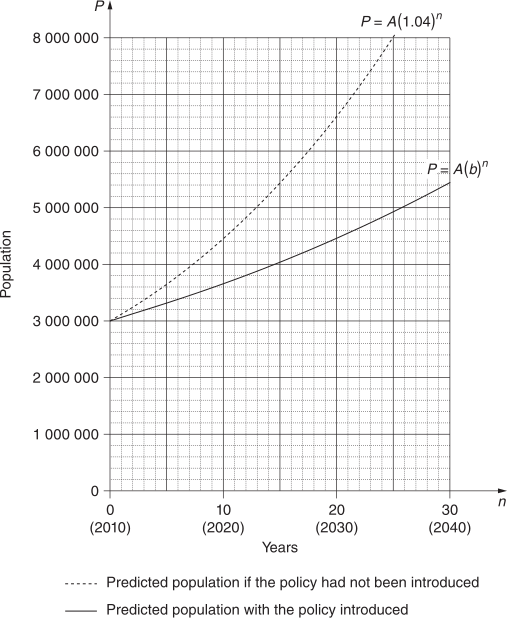
The graph shows the two predicted populations.
 

  1. Use the graph to find the predicted population of Thagoras in 2030 if the population policy had NOT been introduced.   (1 mark)

    --- 1 WORK AREA LINES (style=lined) ---

  2. In each of the two equations given, the value of `A` is 3 000 000.


    What does `A` represent?   (1 mark)

    --- 1 WORK AREA LINES (style=lined) ---

  3. The guess-and-check method is to be used to find the value of `b`, in  `P = A(b)^n`.


    (1) Explain, with or without calculations, why 1.05 is not a suitable first estimate for `b`.  (1 mark)


    (2) With  `n = 20`  and  `P = 4\ 460\ 000`, use the guess-and-check method and the equation  `P = A(b)^n`  to estimate the value of `b` to two decimal places. Show at least TWO estimate values for `b`, including calculations and conclusions.  (2 marks)

    --- 4 WORK AREA LINES (style=lined) ---

  4. The city of Thagoras was aiming to have a population under 7 000 000 in 2050. Does the model indicate that the city will achieve this aim?


    Justify your answer with suitable calculations.  (2 marks)

    --- 5 WORK AREA LINES (style=lined) ---

Show Answers Only
  1.  `6\ 600\ 000`
  2.  `text(The population in 2010.)`
  3.  `text{(1)  See Worked Solution}`


    `(2)\ \ b = 1.03, 1.02`

  4. `text(See Worked Solution)`
Show Worked Solution

i.    `text(2030 occurs at)\ \ n = 20\ \ text(on the)\ x text(-axis.)`

`text(Expected population (no policy) ) = 6\ 600\ 000`

COMMENT: Common ADV/STD2 content in new syllabus.


ii.   `A\ text(represents the population when)\ \ n=0` 

`text(which is the population in 2010.)`
 

♦ Mean mark part (ii) 48%

iii. (1)  `P = A(1.05)^n\ text(would be steeper and lie above)`

    `P = A(1.04)^n\ text(since)\ 1.05 > 1.04`
 

iii. (2)  `text(Let)\ \ b = 1.03`

`P` `= 3\ 000\ 000 xx 1.03^20`
  `= 5\ 418\ 000`

 
`text(Let)\ \ b = 1.02`

`P` `= 3\ 000\ 000 xx 1.02^20`
  `= 4\ 457\ 800`

 
`:. b = 1.02`
 

iv.  `text(In 2050,)\ n = 40`

`P` `= 3\ 000\ 000 xx 1.02^40`
  `= 6\ 624\ 119\ \ (text(nearest whole))`

 
`text(S)text(ince the population is below 7 million,)`

`text(the model will achieve the aim.)`

Filed Under: Exponential/Quadratic (Projectile), Graphs and Applications (Y11), Non-Linear: Exponential/Quadratics (Std 2) Tagged With: Band 4, Band 5, Band 6, common-content, smc-830-30-Exponential, smc-966-10-Exponential graphs, smc-966-20-Population

Algebra, STD2 A4 2012 HSC 30b

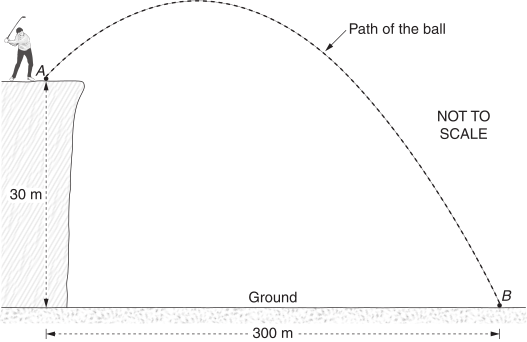
A golf ball is hit from point `A` to point `B`, which is on the ground as shown. Point `A` is 30 metres above the ground and the horizontal distance from point `A` to point `B` is  300 m.
 

The path of the golf ball is modelled using the equation 

`h = 30 + 0.2d-0.001d^2` 

where 

`h` is the height of the golf ball above the ground in metres, and 

`d` is the horizontal distance of the golf ball from point `A` in metres.

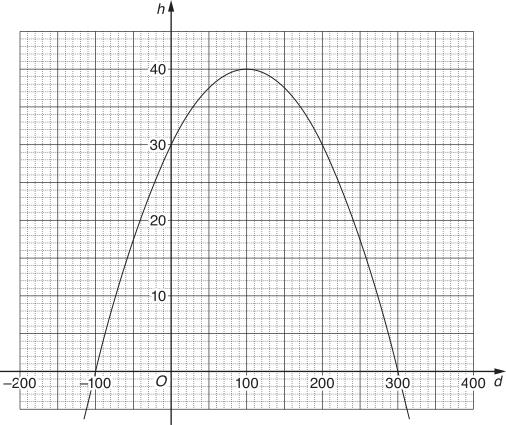
The graph of this equation is drawn below.


  1. What is the maximum height the ball reaches above the ground?    (1 mark)

    --- 1 WORK AREA LINES (style=lined) ---

  2. There are two occasions when the golf ball is at a height of 35 metres.


    What horizontal distance does the ball travel in the period between these two occasions?   (1 mark)

    --- 2 WORK AREA LINES (style=lined) ---
  3. What is the height of the ball above the ground when it still has to travel a horizontal distance of 50 metres to hit the ground at point `B`?   (1 mark)

    --- 2 WORK AREA LINES (style=lined) ---

  4. Only part of the graph applies to this model.


    Find all values of `d` that are not suitable to use with this model, and explain why these values are not suitable.   (2 marks)

    --- 4 WORK AREA LINES (style=lined) ---

Show Answers Only
  1. `40 text(m)`
  2. `140 text(m)`
  3. `text(17.5 m)`
  4. `d < 0\ text(and)\ d>300`
Show Worked Solution

i.   `text(Max height) = 40 text(m)`

COMMENT: With a mean mark of 92% in (i), a classic example of low hanging fruit in later questions.


ii.   `text(From graph)`

`h = 35\ text(when)\ x = 30\ text(and)\ x = 170`

`:.\ text(Horizontal distance)` `= 170-30`
  `= 140\ text(m)`


iii.   `text(Ball hits ground at)\ x = 300`

MARKER’S COMMENT: Responses for (iii) in the range  `17<=\ h\ <=18`  were deemed acceptable estimates read off the graph.

`=>text(Need to find)\ y\ text(when)\ x = 250`

`text(From graph,)\ y = 17.5 text(m)\ text(when)\ x = 250`

`:.\ text(Height of ball is 17.5 m at a horizontal)`

`text(distance of 50m before)\ B.`


iv.   `text(Values of)\ d\ text(not suitable).`

♦♦♦ Mean mark (iv) 12%
MARKER’S COMMENT: Many students did not refer to the domain `d>300` as unsuitable to the model.

`text(If)\ d < 0 text(, it assumes the ball is hit away)`

`text(from point)\ B text(. This is not the case in our)`

`text(example.)`

`text(If)\ d > 300 text(,)\ h\ text(becomes negative which is)`

`text(not possible given the ball cannot go)`

`text(below ground level.)`

Filed Under: Exponential/Quadratic (Projectile), Non-Linear: Exponential/Quadratics (Std 2), Quadratics Tagged With: Band 2, Band 4, Band 6, num-title-ct-coreb, num-title-qs-hsc, page-break-before-question, smc-4443-60-Projectiles, smc-830-20-Quadratics, smc-830-50-Limitations

Statistics, STD2 S1 2009 HSC 21 MC

The mean of a set of ten scores is 14. Another two scores are included and the new mean is 16.

What is the mean of the two additional scores?

  1.    4
  2.    16
  3.    18
  4.    26
Show Answers Only

`D`

Show Worked Solution
♦♦♦ Mean mark 28%.

`text(If ) bar x\ text(of 10 scores = 14)`

  `=>text(Sum of 10 scores)= 10 xx 14 = 140`

`text(With 2 additional scores,)\ \ bar x = 16 `

  `=>text(Sum of 12 scores)= 12 xx 16 = 192`

`:.\ text(Value of 2 extra scores)` `= 192\-140`
  `= 52`


`:.\ text(Mean of 2 extra scores)= 52/2 = 26`

`=>  D`

Filed Under: Data Analysis, Measures of Centre and Spread (Std2-2027), Summary Statistics - No Graph (Std 2), Summary Statistics - No graph (Y12), Summary Statistics (no graph), Summary Statistics (Std 1) Tagged With: Band 6, common-content, num-title-ct-core, num-title-qs-hsc, smc-1131-10-Mean, smc-4224-25-Mean, smc-4224-50-Add/remove data, smc-6312-10-Mean, smc-824-10-Mean, smc-999-10-Mean

Algebra, STD2 A4 2013 HSC 22 MC

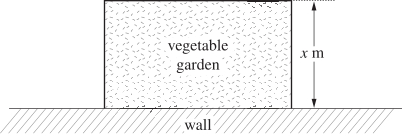
Leanne wants to build a rectangular vegetable garden in her backyard. She has 20 metres of fencing and will use a wall as one side of the garden. The plan for her garden is shown, where `x` metres is the width of her garden.


Which equation gives the area, `A`, of the vegetable garden?

  1.    `A=10x-x^2`
  2.    `A=10x-2x^2`
  3.    `A=20x-x^2`
  4.    `A=20x-2x^2`
Show Answers Only

`D`

Show Worked Solution
♦♦♦ Mean mark 24% (lowest mean of any MC question in 2013 exam)

`text(Length of garden)=(20-2x)`

`text(Area)` `=x(20-2x)`
  `=20x-2x^2`

 
`=>\ D`

Filed Under: Non-Linear: Exponential/Quadratics (Std 2), Perimeter/Area problem Tagged With: Band 6, smc-830-20-Quadratics

Statistics, STD2 S5 2013 HSC 20 MC

There are  60 000  students sitting a state-wide examination. If the results form a normal distribution, how many students would be expected to score a result between 1 and 2 standard deviations above the mean?

You may assume for normally distributed data that:

    • 68% of scores have  `z`-scores between  – 1 and 1
    • 95% of scores have  `z`-scores between  – 2 and 2
    • 99.7% of scores have  `z`-scores between  – 3 and 3.
  1. `8100`
  2. `16\ 200`
  3. `20\ 400`
  4. `28\ 500`
Show Answers Only

`A`

Show Worked Solution
♦♦ Mean mark 24% 

`text(S)text(ince 68% between)\ z=1\ text(and)\ -1`

`  =>  text(34% between)\  z=0\ text(and)\   1`

`text(Likewise, 95% between)\ z=2\ text(and)  -2`

`  =>  text(47.5% between)\ z=0\ text(and)\ 2`
 

`:.\ text(% between)\ z=1\ text(and)\ 2`

`=47.5-34`

`=13.5 text(%)`

 
`:.\ text(Students between)\ \ z=1\  text(and)\ \ z=2`

`=13.5 text(%)xx60\ 000`

`=8100`

`=>\ A`

Filed Under: DS5/6 - Normal Distribution and Sampling, Normal Distribution (Y12), S5 The Normal Distribution (Y12) Tagged With: Band 6, common-content, smc-819-20-z-score Intervals, smc-995-20-z-score Intervals

Quadratic, 2UA 2012 HSC 16c

The circle  `x^2+(y-c)^2=r^2`,  where  `c>0`  and  `r>0`,  lies inside the parabola  `y=x^2`.  The circle touches the parabola at exactly two points located symmetrically on opposite sides of the  `y`-axis, as shown in the diagram.

2012 16c

  1. Show that  `4c=1+4r^2`.   (2 marks)
  2. Deduce that  `c>1/2`.    (1 mark)
Show Answers Only
  1. `text{Proof  (See Worked Solutions)}`
  2. `text{Proof  (See Worked Solutions)}`
Show Worked Solution

(i)    `text(We need to find the intersection of)`

`x^2+(y-c)^2` `=r^2\ \ \ text{… (1)}`
`y` `=x^2\ \ \ text{… (2)}`

`text(Subst.)\ y=x^2\ text{into (1)}`

`y+(y-c)^2` `=r^2`
`y+y^2-2cy+c^2` `=r^2`
`y^2+y(1-2c)+(c^2-r^2)` `=0`


`text(S)text(ince circle touches symmetrically)`

♦♦♦ Mean mark 18%.
MARKER’S COMMENT: Few students were successful in this part, with those that solved the simultaneous equations correctly often not realising that the  `Delta=0`  was a critical element in solving the problem.

`=>\ \ 1\ ytext(-value only)`

`=>Delta=b^2-4ac=0`

`(1-2c)^2-4xx1xx(c^2-r^2)` `=0`
`1-4c+4c^2-4c^2+4r^2` `=0`
`:.\ 4c` `=1+4r^2\ \ \ text(… as required)`


(ii)   `text(Deduce)\ c>1/2`

`text(Given)\ y^2+y(1-2c)+(c^2-r^2)`

`y=(-(1-2c)+-sqrt((1-2c)^2-4xx1xx(c^2-r^2)))/2`

`text(S)text(ince)\ y>0\ \ text(and)\ \ b^2-4ac=0`

♦♦♦ If you found this part difficult, don’t despair, it is a beast. With a mean mark of 0%, it ranks as one of the hardest questions in the history of the course.
`=>\ (-(1-2c)+-0)/2` `>0`
`(-1+2c)/2` `>0`
`2c` `>1`
`c` `>1/2\ \ text(… as required)`


Filed Under: Roots and the discriminant Tagged With: Band 6, page-break-before-solution

Calculus, 2ADV C3 2008 HSC 10b


The diagram shows two parallel brick walls  `KJ`  and  `MN`  joined by a fence from  `J`  to  `M`.  The wall  `KJ`  is  `s`  metres long and  `/_KJM=alpha`.  The fence  `JM`  is  `l`  metres long.

A new fence is to be built from  `K`  to a point  `P`  somewhere on  `MN`.  The new fence  `KP`  will cross the original fence  `JM`  at  `O`.

Let  `OJ=x`  metres, where  `0<x<l`.

  1. Show that the total area,  `A`  square metres, enclosed by  `DeltaOKJ`  and  `DeltaOMP`  is given by
     
         `A=s(x-l+l^2/(2x))sin alpha`.   (3 marks)

    --- 6 WORK AREA LINES (style=lined) ---

  2. Find the value of  `x`  that makes  `A`  as small as possible. Justify the fact that this value of  `x`  gives the minimum value for  `A`.  (3 marks)

    --- 6 WORK AREA LINES (style=lined) ---

  3. Hence, find the length of  `MP`  when  `A`  is as small as possible.    (1 mark)

    --- 2 WORK AREA LINES (style=lined) ---

Show Answers Only
  1. `text{Proof  (See Worked Solutions)}`
  2. `l/sqrt2`
  3. `(sqrt2-1)s\ \ text(metres)`
Show Worked Solution
i.

`A=text(Area)\  Delta OJK+text(Area)\ Delta OMP`

♦♦♦ Low mean marks highlighted (although exact data not available before 2009).

`text(Using sine rule)`

`text(Area)\ Delta OJK=1/2\ x s sin alpha` 

`text(Area)\ DeltaOMP =>text(Need to find)\ \ MP`

`/_OKJ` `=/_MPO\ \ text{(alternate angles,}\ MP\ text(||)\ KJtext{)}`
`/_PMO` `=/_OJK=alpha\ \ text{(alternate angles,}\ MP\ text(||)\ KJtext{)}`

 
`:.\ DeltaOJK\ text(|||)\ Delta OMP\ \ text{(equiangular)}`

`=>x/s` `=(l-x)/(MP)\ ` ` text{(corresponding sides of similar triangles)}`
`MP` `=(l-x)/x *s`  
`text(Area)\ Delta\ OMP` `=1/2 (l-x)* MP * sin alpha`
  `=1/2 (l-x)*((l-x))/x* s  sin alpha`
`:. A`  `=1/2 x*s sin alpha+1/2 (l-x)*((l-x))/x* s sin alpha`
  `=s sin alpha(1/2 x+1/2 (l-x)*((l-x))/x)`
  `=s sin alpha(1/2 x+(l-x)^2/(2x))`
  `=s sin alpha(1/2 x+l^2/(2x)-l+1/2 x)`
  `=s(x-l+l^2/(2x))sin alpha\ \ \ \ text(… as required)`


ii.   `text(Find)\ x\ text(such that)\ A\ text(is a minimum)`

MARKER’S COMMENT: Students who could not complete part (i) are reminded that they can still proceed to part (ii) and attempt to differentiate the result given.
Note that `l` and `alpha` are constants when differentiating. 
`A` `=s(x-l+l^2/(2x))sin alpha`
`(dA)/(dx)` `=s(1-l^2/(2x^2))sin alpha`

`text(MAX/MIN when)\ (dA)/(dx)=0`

`s(1-l^2/(2x^2))sin alpha` `=0`
`l^2/(2x^2)` `=1`
`2x^2` `=l^2`
`x^2` `=l^2/2`
`x` `=l/sqrt2,\ \ \ x>0`


`(d^2A)/(dx^2)=s((l^2)/(2x^3))sin alpha`

`text(S)text(ince)\ \ 0<alpha<90°\ \ =>\ sin alpha>0,\ \ l>0\ \ text(and)\ \  x>0`

`(d^2A)/(dx^2)>0\ \ \ =>text(MIN at)\ \ x=l/sqrt2`


iii.   `text(S)text(ince)\ \ MP=((l-x))/x s\ \ text(and MIN when)\ \ x=l/sqrt2`

`MP` `=((l-l/sqrt2)/(l/sqrt2))s xx sqrt2/sqrt2`
  `=((sqrt2 l-l))/l s`
  `=(sqrt2-1)s\ \ text(metres)`


`:.\ MP=(sqrt2-1)s\ \ text(metres when)\ A\ text(is a MIN.)`

Filed Under: Maxima and Minima, Maxima and Minima (Y12) Tagged With: Band 4, Band 5, Band 6, smc-970-10-Area

Calculus, 2ADV C3 2009 HSC 9b

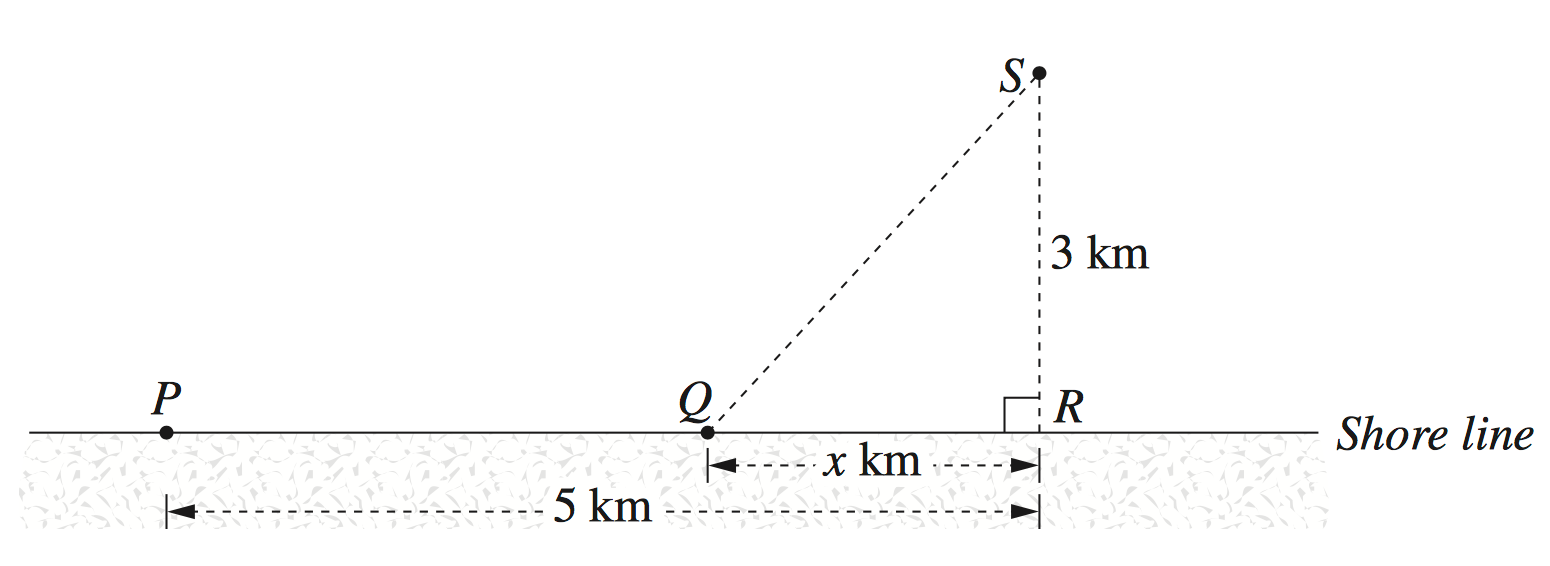
An oil rig,  `S`,  is 3 km offshore. A power station,  `P`,  is on the shore. A cable is to be laid from `P`  to  `S`.  It costs $1000 per kilometre to lay the cable along the shore and $2600 per kilometre to lay the cable underwater from the shore to  `S`.

The point  `R`  is the point on the shore closest to  `S`,  and the distance  `PR`  is 5 km.

The point  `Q`  is on the shore, at a distance of  `x`  km from  `R`,  as shown in the diagram.


  1. Find the total cost of laying the cable in a straight line from  `P`  to  `R`  and then in a straight line from  `R`  to  `S`.   (1 mark)

    --- 2 WORK AREA LINES (style=lined) ---

  2. Find the cost of laying the cable in a straight line from  `P`  to  `S`.  (1 mark)

    --- 2 WORK AREA LINES (style=lined) ---
  3. Let  `$C`  be the total cost of laying the cable in a straight line from  `P`  to  `Q`,  and then in a straight line from `Q`  to  `S`.
     
    Show that  `C=1000(5-x+2.6sqrt(x^2+9))`.    (2 marks)

    --- 5 WORK AREA LINES (style=lined) ---

  4. Find the minimum cost of laying the cable.    (4 marks)

    --- 8 WORK AREA LINES (style=lined) ---

  5. New technology means that the cost of laying the cable underwater can be reduced to $1100 per kilometre.


    Determine the path for laying the cable in order to minimise the cost in this case.    (2 marks)

    --- 5 WORK AREA LINES (style=lined) ---

Show Answers Only
  1. `$12\ 800`
  2. `$15\ 160`
  3. `text{Proof (See Worked Solutions)}`
  4. `$12\ 200`
  5. `P\ text(to)\  S\ text(in a straight line.)`
Show Worked Solution
♦♦ Although specific data is unavailable for question parts, mean marks were 35% for Q9 in total.
i.   `text(C)text(ost)` `=(PRxx1000)+(SRxx2600)`
  `=(5xx1000)+(3xx2600)`
  `=12\ 800`

 
`:. text(C)text(ost is)\   $12\ 800`


ii.   `text(C)text(ost)=PSxx2600`

`text(Using Pythagoras:)`

`PS^2` `=PR^2+SR^2`
  `=5^2+3^2`
  `=34`
`PS` `=sqrt34`


`:.\ text(C)text(ost)` `=sqrt34xx2600`
  `=15\ 160.474…`
  `=$15\ 160\ \ text{(nearest dollar)}`


iii.  `text(Show)\ \ C=1000(5-x+2.6sqrt(x^2+9))`

`text(C)text(ost)=(PQxx1000)+(QSxx2600)`

`PQ` `=5-x`
`QS^2` `=QR^2+SR^2`
  `=x^2+3^2`
`QS` `=sqrt(x^2+9)`
`:.C` `=(5-x)1000+sqrt(x^2+9)\ (2600)`
  `=1000(5-x+2.6sqrt(x^2+9))\ \ text(…  as required)`


iv.   `text(Find the MIN cost of laying the cable)`

`C` `=1000(5-x+2.6sqrt(x^2+9))`
`(dC)/(dx)` `=1000(–1+2.6xx1/2xx2x(x^2+9)^(–1/2))`
  `=1000(–1+(2.6x)/(sqrt(x^2+9)))`

`text(MAX/MIN when)\ (dC)/(dx)=0`

IMPORTANT: Tougher derivative questions often require students to deal with multiple algebraic constants. See Worked Solutions in part (iv).

`1000(–1+(2.6x)/(sqrt(x^2+9)))=0`

`(2.6x)/sqrt(x^2+9)` `=1`
`2.6x` `=sqrt(x^2+9)`
`(2.6)^2x^2` `=x^2+9`
`x^2(2.6^2-1)` `=9`
`x^2` `=9/5.76`
  `=1.5625`
`x` `=1.25\ \ \ \ (x>0)`
MARKER’S COMMENT: Check the nature of the critical points in these type of questions. If using the first derivative test, make sure some actual values are substituted in.

`text(If)\ \ x=1,\ \ (dC)/(dx)<0`

`text(If)\ \ x=2,\ \ (dC)/(dx)>0`

`:.\ text(MIN when)\ \ x=1.25`

`C` `=1000(5-1.25+2.6sqrt(1.25^2+9))`
  `=1000(122)`
  `=12\ 200` 


`:.\ text(MIN cost is)\  $12\ 200\ text(when)\   x=1.25`


v.   `text(Underwater cable now costs $1100 per km)`

`=>\ C` `=1000(5-x)+1100sqrt(x^2+9)`
  `=1000(5-x+1.1sqrt(x^2+9))`
`(dC)/(dx)` `=1000(–1+1.1xx1/2xx2x(x^2+9)^(-1/2))`
  `=1000(–1+(1.1x)/sqrt(x^2+9))`

 
`text(MAX/MIN when)\ (dC)/(dx)=0`

`1000(–1+(1.1x)/sqrt(x^2+9))` `=0`
`(1.1x)/sqrt(x^2+9)` `=1`
`1.1x` `=sqrt(x^2+9)`
`1.1^2x^2` `=x^2+9`
`x^2(1.1^2-1)` `=9`
`x^2` `=9/0.21`
`x` `~~6.5\ text{km (to 1 d.p.)}`
  `=>\ text(no solution since)\ x<=5`

 
`text(If we lay cable)\ PR\ text(then)\ RS`

MARKER’S COMMENT: Many students failed to interpret a correct calculation of  `x>5`  as providing no solution.

`=>\ text(C)text(ost)=5xx1100+3xx1000=8500`

`text(If we lay cable directly underwater via)\ PS`

`=>\ text(C)text(ost)=sqrt34xx1100=6414.047…`

`:.\ text{MIN cost is  $6414 by cabling directly from}\ P\ text(to)\ S`.

Filed Under: Maxima and Minima, Maxima and Minima (Y12) Tagged With: Band 3, Band 4, Band 5, Band 6, smc-970-50-Distance, smc-970-60-Other Themes

Calculus, 2ADV C3 2011 HSC 10b

A farmer is fencing a paddock using  `P`  metres of fencing. The paddock is to be in the shape of a sector of a circle with radius  `r`  and sector angle `theta`  in radians, as shown in the diagram.

2011 10b

  1. Show that the length of fencing required to fence the perimeter of the paddock is
      
       `P=r(theta+2)`.    (1 mark)

    --- 2 WORK AREA LINES (style=lined) ---

  2. Show that the area of the sector is  `A=1/2 Pr-r^2`.    (1 mark) 

    --- 2 WORK AREA LINES (style=lined) ---

  3. Find the radius of the sector, in terms of  `P`, that will maximise the area of the paddock.    (2 marks)

    --- 4 WORK AREA LINES (style=lined) ---

  4. Find the angle  `theta`  that gives the maximum area of the paddock.    (1 mark)

    --- 2 WORK AREA LINES (style=lined) ---

  5. Explain why it is only possible to construct a paddock in the shape of a sector if
     
         `P/(2(pi+1)) <\ r\ <P/2`   (2 marks)

    --- 5 WORK AREA LINES (style=lined) ---

Show Answers Only
  1. `text{Proof  (See Worked Solutions)}`
  2. `text{Proof  (See Worked Solutions)}`
  3. `r=P/4`
  4. `2\ text(radians)`
  5. `text{Proof  (See Worked Solutions)}`
Show Worked Solution

i.   `text(Need to show)\ \ P=r(theta+2)`

`P` `=(2xxr)+theta/(2pi)xx2pir`
  `=2r+ r theta`
  `=r(theta+2)\ \ text(…  as required)`


ii.   `text(Need to show)\ \ A=1/2 Pr-r^2`.

`text(S)text(ince)\ \ P=r(theta+2)\ \ \ =>\ theta=(P-2r)/r`

♦ Mean mark 41%.
TIP: Area of a sector `=pi r^2 xx` the percentage of the circle that the sector angle accounts for, i.e. `theta/(2 pi)` radians. `:. A=pi r^2“ xx theta/(2 pi)=1/2 r^2 theta`.
`:. A` `=1/2 r^2 theta`
  `=1/2 r^2*(P-2r)/r`
  `=1/2(Pr-2r^2)`
  `=1/2 Pr-r^2\ \ text(…  as required)`


iii.  `A=1/2 Pr-r^2`

♦♦ Mean mark 29%
MARKER’S COMMENT: The second derivative test proved much more successful and easily proven in this part. Make sure you are comfortable choosing between it and the 1st derivative test depending on the required calcs.

`(dA)/(dr)=1/2 P-2r`

`text(MAX or MIN when)\ \ (dA)/(dr)=0`

`1/2 P-2r` `=0`
`2r` `=1/2 P`
`r` `=P/4`

 
`(d^2A)/(dr^2)=-2\ \ \ \ =>text(MAX)`

`:.\ text(Area is a MAX when)\ r=P/4\ text(units)`


iv.   `text(Need to find)\ theta\ text(when area is a MAX)\ =>\ r=P/4`

♦♦♦ Mean mark 20%
`P` `=r(theta+2)`
  `=P/4(theta+2)`
`4P` `=P(theta+2)`
`theta+2` `=4`
`theta` `=2\ text(radians)`


v.  `text(For a sector to exist)\ \ 0<\ theta\ <2pi, \ \ text(and)\ \ theta=(P-2r)/r`

♦♦♦ Mean mark 4%. A BEAST!
MARKER’S COMMENT: When asked to ‘explain’, students should support their answer with a mathematical argument.
`=>(P-2r)/r` `>0`
`P-2r` `>0`
`r` `<P/2`
`=>(P-2r)/r` `<2pi`
`P-2r` `<2r pi`
`2r pi+2r` `>P`
`2r(pi+1)` `>P`
`r` `>P/(2(pi+1))`


`:.P/(2(pi+1)) <\ r\ <P/2\ \ text(…  as required)`

Filed Under: Maxima and Minima, Maxima and Minima (Y12) Tagged With: Band 4, Band 5, Band 6, page-break-before-solution, smc-970-10-Area

Mechanics, EXT2* M1 2009 HSC 6a

Two points, `A` and `B`,  are on cliff tops on either side of a deep valley. Let `h` and `R` be the vertical and horizontal distances between `A` and `B` as shown in the diagram. The angle of elevation of `B` from `A` is  `theta`,  so that  `theta=tan^-1(h/R)`.
 

2009 6a
 

At time `t=0`,  projectiles are fired simultaneously from `A` and `B`.  The projectile from `A` is aimed at `B`, and has initial speed `U` at an angle of  `theta`  above the horizontal. The projectile from `B` is aimed at `A` and has initial speed `V` at an angle  `theta`  below the horizontal.

The equations of motion for the projectile from `A` are

`x_1=Utcos theta`   and   `y_1=Utsin theta-1/2 g t^2`,

and the equations for the motion of the projectile from `B` are

`x_2=R-Vtcos theta`   and   `y_2=h-Vtsin theta-1/2 g t^2`,     (DO NOT prove these equations.)

  1. Let `T` be the time at which  `x_1=x_2`.
     
    Show that  `T=R/((U+V)\ cos theta)`.   (1 mark)

    --- 3 WORK AREA LINES (style=lined) ---
  2. Show that the projectiles collide.    (2 marks)

    --- 6 WORK AREA LINES (style=lined) ---

  3. If the projectiles collide on the line  `x=lambdaR`,  where  `0<lambda<1`,  show that
     
         `V=(1/lambda-1)U`.    (1 mark)

    --- 6 WORK AREA LINES (style=lined) ---
Show Answers Only
  1. `text{Proof  (See Worked Solutions)}` 
  2. `text{Proof  (See Worked Solutions)}`
  3. `text{Proof  (See Worked Solutions)}`
Show Worked Solution

i.   `text(Let)\ \ x_1=x_2\ \ text(at)\ \ t=T`

`UTcos theta` `=R-VTcos theta`
`UTcos theta+VTcos theta` `=R`
`Tcos theta\ (U+V)` `=R`

 
 `:. T=R/((U+V)\ cos theta)\ \ text(… as required)`


ii.   `text(If particles collide,)\ \  y_1=y_2\ \ text(at)\ \ t=T`

♦♦♦ Mean mark data not available although “few” students were able to complete this part.
MARKER’S COMMENT: Better responses showed  `y_1=y_2`,  or  `y_1-y_2=0`  which eliminated  `–½ g t^2`  from the algebra. Substituting `tan theta=h//R` was a key element in completing this proof.
`y_1` `=UTsin theta-1/2 g T^2`
  `=(UR sin theta)/((U+V)\ cos theta)-1/2 g T^2`
`y_2` `=h-VTsin theta-1/2 g T^2`
  `=Rtan theta-(VR sin theta)/((U+V)\ cos theta)-1/2 g T^2`
  `=R(((sin theta/cos theta)(U+V) cos theta-V sin theta)/((U+V)\ cos theta))-1/2 g T^2`
  `=R/((U+V)\ cos theta)(Usin theta+Vsin theta-Vsin theta)-1/2 g T^2`
  `=(UR sin theta)/((U+V)\ cos theta)-1/2 g T^2`
  `=y_1`


`:.\ text(Particles collide since)\  y_1=y_2\ text(at)\ t=T`.


iii.  `text(Particles collide on line)\ \ x=lambdaR,\ text(i.e.  where)\ \ t=T`

MARKER’S COMMENT: Students must show sufficient working in proofs to convince markers they have derived the answer themselves.
`lambdaR` `=UTcos theta`
  `=U R/((U+V)\ cos theta)cos theta`
  `=(UR)/((U+V))`
`(U+V)(lambdaR)` `=UR`
`U+V` `=(UR)/(lambdaR)`
`V` `=U/lambda-U`
  `=(1/lambda-1)U\ \ text(… as required)`

Filed Under: Projectile Motion, Projectile Motion EXT1 Tagged With: Band 4, Band 5, Band 6, smc-1062-10-Range/Time of Flight, smc-1062-40-Initial Angle/Speed, smc-1062-90-Projectiles Collide

Mechanics, EXT2* M1 2010 HSC 6b

A basketball player throws a ball with an initial velocity  `v`  m/s at an angle of  `theta`  to the horizontal. At the time the ball is released its centre is at  `(0,0)`, and the player is aiming for the point `(d,h)`  as shown on the diagram. The line joining  `(0,0) `  and  `(d,h)`  makes an angle  `alpha`  with the horizontal, where  `0<alpha<pi/2`.
 

6b
 

Assume that at time  `t`  seconds after the ball is thrown its centre is at the point  `(x,y)`,  where

`x=vtcos theta`

`y=vt sin theta-5 t^2`.      (DO NOT prove this.)

  1. If the centre of the ball passes through  `(d,h)`  show that
     
         `v^2=(5d)/(cos theta sin theta-cos^2 theta tan alpha)`    (3 marks)

    --- 1 WORK AREA LINES (style=lined) ---
    (2) What happens to  `v`  as  `theta\ ->pi/2` ?    (1 mark)

    --- 1 WORK AREA LINES (style=lined) ---
  2. For a fixed value of  `alpha`,  let  `F(theta)=cos theta sin theta-cos^2 theta tan alpha`.
     
    Show that  `F prime(theta)=0`   when   `tan2theta tan alpha=-1`  (2 marks)

    --- 6 WORK AREA LINES (style=lined) ---
  3. Using part (a)(ii)* or otherwise show that  `F prime(theta)=0`,   when  `theta=alpha/2+pi/4`.    (1 mark)

    --- 3 WORK AREA LINES (style=lined) ---


    *Please note for the purposes of this question, part (a)(ii) showed that  when  `tanA tanB=-1`,  then  `A-B=pi/2` 

  4. Explain why  `v^2`  is a minimum when  `theta=alpha/2+pi/4`     (2 marks)

    --- 6 WORK AREA LINES (style=lined) ---

Show Answers Only
  1. `text{Proof  (See Worked Solutions)}` 
  2. (1)  `v->oo`


    (2)  `v->oo`

  3. `text{Proof  (See Worked Solutions)}`
  4. `text{Proof  (See Worked Solutions)}` 
  5. `text{Explanation  (See Worked Solutions)}`
Show Worked Solution

i.   `text(Ball passes through)\ \ (d,h).`

`text(Find)\ t\ text(when)\ x=d :`

♦ Mean mark 43%
IMPORTANT: It is critical to use the relationship `tan alpha=h/d` to achieve the required proof.
`d` `=vtcos theta`
`:. t` `=d/(vcos theta)`


`text(S)text(ince)\ \ y=h\ \ text(when)\ \ t=d/(vcos theta)`

`h` `=vtsin theta-5t^2`
  `=v(d/(vcos theta))sin theta-5(d^2)/(v^2cos^2 theta)`
`(5d^2)/(v^2cos^2 theta)` `=(dsin theta)/cos theta-h`
`(5d^2)/v^2` `=dsin theta cos theta-cos^2 thetaxxh`
`v^2/(5d^2)` `=1/(dsin theta cos theta-cos^2 thetaxxh)`
`v^2` `=(5d^2)/(dsin theta cos theta-cos^2 thetaxxh)`
  `=(5d)/(cos theta sin theta-cos^2 thetaxxh/d)`
  `=(5d)/(cos theta sin theta-cos^2 theta tan alpha)\ \ text(… as required)`


ii. (1)  `text(As)\ \  theta->alpha`

♦ Mean marks of 37% and 32% for parts (ii)(1) and (ii)(2) respectively.

`costheta sin theta-cos^2 theta tan alpha->0`

`v->oo`

ii. (2)  `text(As)\ \  theta->pi/2`

`cos theta sin theta-cos^2 theta tan theta->0`

`v->oo`


iii.  `text(Show)\ \ tan 2thetatan alpha=–1\ \ text(when)\ \ F prime(theta)=0`.

`F(theta)` `=costheta sin theta-cos^2theta tan alpha`
`F prime(theta)` `=cos theta costheta+sin theta (–sin theta)-2cos theta (–sin theta) tan alpha`
  `=cos^2 theta-sin^2 theta+sin 2theta tan alpha`
  `=cos 2theta+sin 2theta tan alpha`


`text(When)\ F prime(theta)=0`

♦♦ Mean mark part (iii) 21%
MARKER’S COMMENT: Many students failed to treat  `tan alpha` as a constant when differentiating.
`cos 2theta+sin2thetatan alpha` `=0`
`sin2thetatan alpha` `=-cos2theta`
`tan 2theta tan alpha` `=-1\ \ text(… as required)`


iv.  `text(Show that)\ \ F prime(theta)=0,\ \ text(when)\ \ theta=alpha/2+pi/4`

`text(If)\ \ tanA tanB=–1\ => A-B=pi/2`

`text{(Given in part (a)(ii) – see note in question)}`


`text(S)text(ince)\ \ tan2theta tan alpha=–1\ \ text{(see part (iii))}`

♦♦♦ Mean mark 14%
MARKER’S COMMENT: Linking part (a)(ii) to this solution was a feature of the more efficient and successful approaches.
`=>\ \ 2theta-alpha` `=pi/2`
`2theta` `=alpha+pi/2`
`theta` `=alpha/2+pi/4`


 `text(Given that)\ \ Fprime(theta)=0\ \ text(when)\ \ tan 2thetatan alpha=–1`

`:. Fprime(theta)=0\ \ text(when)\ \ theta=alpha/2+pi/4\ \ text(… as required)`


v.   `text(S)text(ince)\ \ v^2=(5d)/(F(theta)),`

`=>\ v^2\ \ text(is a MIN when)\ \  F(theta)\ \ text(is a MAX)`

`text(We know)\ \ F prime(theta)=0\ \ text(when)\ \ theta=alpha/2+pi/4`

♦♦♦ Mean mark 9%
MARKER’S COMMENT: Only a small minority of students  explained correctly that  `v^2`  is a MIN when  `F(theta)`  is a MAX.

`:.\ text(MAX or MIN when)\ \ theta=alpha/2+pi/4`


`F prime(theta)=cos 2theta+sin 2theta tan alpha`

`F ″(theta)=-2sin2theta+2cos2theta tan alpha`

`text(When)\ \ theta=alpha/2+pi/4`

`F″(alpha/2+pi/4)=-2sin(alpha+pi/2)+2cos(alpha+pi/2)tan alpha`

`text(S)text(ince)\ \ 0<alpha<pi/2`

`=> tan alpha>0`

`=>sin(alpha+pi/2)>0`

`=>cos(alpha+pi/2)<0`

`:. F″(alpha/2+pi/4)<0\ \ text(i.e.  MAX)`

`:.\ v^2\ \ text(is a minimum.)`  

Filed Under: Projectile Motion, Projectile Motion EXT1 Tagged With: Band 5, Band 6, smc-1062-40-Initial Angle/Speed

Mechanics, EXT2* M1 2013 HSC 13c

Points `A` and `B` are located `d` metres apart on a horizontal plane. A projectile is fired from `A` towards `B` with initial velocity `u` m/s at angle `alpha` to the horizontal.

At the same time, another projectile is fired from `B` towards `A` with initial velocity `w` m/s at angle `beta` to the horizontal, as shown on the diagram.

The projectiles collide when they both reach their maximum height.
 

2013 13c
 

The equations of motion of a projectile fired from the origin with initial velocity  `V` m/s at angle  `theta`  to the horizontal are

`x=Vtcostheta`   and   `y=Vtsintheta-g/2 t^2`.        (DO NOT prove this.)

  1. How long does the projectile fired from  `A`  take to reach its maximum height?  (2 marks)

    --- 5 WORK AREA LINES (style=lined) ---

  2. Show that  `usinalpha=w sin beta`.    (1 mark)

    --- 3 WORK AREA LINES (style=lined) ---
  3. Show that  `d=(uw)/(g)sin(alpha+beta)`.    (2 marks)

    --- 8 WORK AREA LINES (style=lined) ---

Show Answers Only
  1. `(u)/(g) sin alpha\ \ text(seconds)`
  2. `text{Proof  (See Worked Solutions)}`
  3. `text{Proof  (See Worked Solutions)}`
Show Worked Solution

i.   `y=Vtsintheta-g/2 t^2`

`text(Projectile)\ A\   => V=u,\ \ theta=alpha`

`y` `=ut sinalpha- (g)/2 t^2`
`doty` `=u sinalpha- g t`


`text(Max height when)\  doty=0`

`0` `=usinalpha-g t`
`g t` `=usinalpha`
`t` `=(u)/(g)sinalpha`

 
`:.\ text(Projectile from)\ A\ text(reaches max height at)`

 `t=(u)/(g)sin alpha\ \ text(seconds)`


ii.  `text(Show that)\ \ usin alpha=wsin beta`

IMPORTANT: Part (i) in this example leads students to a very quick solution. Always look to previous parts for clues to direct your strategy.

`text(Projectile)\ B\ =>V=w,\ \ theta=beta`

`y` `=wt sin beta- (g)/2 t^2`
`doty` `=wsin beta-g t`


`text(Max height when)\ \ doty=0`

`t=(w)/(g) sin beta`

`text{Projectiles collide at max heights}`

`text(S)text(ince they were fired at the same time)`

`(u)/(g) sin alpha` `=(w)/(g) sin beta`
`:.\ usin alpha` `=wsin beta\ \ text(… as required)`


iii  `text(Show)\ \ d=(uw)/(g) sin (alpha+beta) :`

`text(Find)\ x text(-values for each projectile at max height)`

`text(Projectile)\ A`

`x_1` `=utcos alpha`
  `=u((u)/(g) sin alpha)cos alpha`
  `=(u^2)/(g) sin alpha cos alpha`


`text(Projectile)\ B`

♦ Mean mark 39%
IMPORTANT: Students should direct their calculations by reverse engineering the required result. `sin(alpha+beta)` in the proof means that  `sin alpha cos beta+“ cos alpha sin beta`  will appear in the working calculations.
`x_2` `=wt cos beta`
  `=w((w)/(g) sin beta)cos beta`
  `=(w^2)/(g) sin beta cos beta`
`d` `=x_1+x_2`
  `=(u^2)/(g) sin alpha cos alpha+(w^2)/(g) sin beta cos beta`
  `=(u)/(g)(u sin alpha)cos alpha+(w)/(g) (w sin beta) cos beta`
  `=(u)/(g)(w sin beta) cos alpha+(w)/(g) (usin alpha)cos beta\ \ text{(part (ii))}`
  `=(uw)/(g) (sin alpha cos beta+cos alpha sin beta)`
  `=(uw)/(g) sin (alpha+beta)\ \ text(… as required)`


Filed Under: Projectile Motion, Projectile Motion EXT1 Tagged With: Band 4, Band 5, Band 6, smc-1062-20-Max Height, smc-1062-90-Projectiles Collide

Calculus, 2ADV C3 2012 HSC 16b

The diagram shows a point  `T`  on the unit circle  `x^2+y^2=1`  at an angle  `theta`  from the positive  `x`-axis, where  `0<theta<pi/2`.

The tangent to the circle at  `T`  is perpendicular to  `OT`, and intersects the  `x`-axis at  `P`,  and the line  `y=1`  intersects the  `y`-axis at  `B`.


  1. Show that the equation of the line  `PT`  is  `xcostheta+ysin theta=1`.    (2 marks)

    --- 5 WORK AREA LINES (style=lined) ---

  2. Find the length of  `BQ`  in terms of  `theta`.    (1 mark)

    --- 2 WORK AREA LINES (style=lined) ---

  3. Show that the area,  `A`,  of the trapezium  `OPQB`  is given by 
     
         `A=(2-sintheta)/(2costheta)`    (2 marks)

    --- 5 WORK AREA LINES (style=lined) ---

  4. Find the angle  `theta`  that gives the minimum area of the trapezium.    (3 marks)

    --- 6 WORK AREA LINES (style=lined) ---

Show Answers Only
  1. `text{Proof  (See Worked Solutions)}`
  2. `(1-sin theta)/cos theta`
  3. `text{Proof  (See Worked Solutions)}`
  4. `theta=pi/6\ \ text(radians)`
Show Worked Solution
i.    

`text(Find)\  T:`

♦♦ Mean mark 20%

`text(S)text(ince)\ \ cos theta=x/1\ \ \ text(and)\ \ \  sin theta=y/1`

`:. T\ (cos theta, sin theta)`

`text(Gradient of)\ OT=sin theta/cos theta`

`:.\ text(Gradient)\ PT=-cos theta/sin theta\ \ text{(} _|_ text{lines)}`

`text(Equation of)\ PT\ text(where)`

`m=-cos theta/sin theta,\ \ text(and through)\ \ (cos theta, sin theta)`

`text(Using)\ \ y-y_1` `=m(x-x_1)`
`y-sin theta` `=-cos theta/sin theta(x-cos theta)`
`y sin theta-sin^2 theta` `=-x cos theta+cos^2 theta`
`x cos theta+y sin theta` `=sin^2 theta+cos^2 theta`
`x cos theta+y sin theta` `=1\ \ \ \ \ text(… as required)`


ii.   `text(Find)\ Q:`

 `Q\ => text(intersection of)\ xcos theta+y sin theta=1\ \ text(and)\ \ y=1`

`x cos theta+sin theta` `=1`
`x cos theta` `=1-sin theta`
`x` `=(1-sin theta)/cos theta`

 
`:.\ text(Length of)\ BQ\ text(is)\ \ (1-sin theta)/cos theta\ text(units)`


iii.  `text(Show Area)\ OPQB=(2-sin theta)/(2cos theta)`

`A=1/2h(a+b)\ \ text(where)\ \ h=OB=1\ \   a=OP\ \  text(and)`  

                `b=BQ=(1-sin theta)/cos theta`

`text(Find  length)\ OP:`

`P => xcos theta+ysin theta=1 \ text(cuts)\ \ x text(-axis)`

♦♦ Mean mark 24%
`xcos theta` `=1`
`x` `=1/cos theta`
`=>text(Length)\ OP` `=1/cos theta`


`text(Area)\ OPQB` `=1/2xx1(1/cos theta+(1-sin theta)/cos theta)`
  `=1/2((2-sin theta)/cos theta)`
  `=(2-sin theta)/(2cos theta)\ \ text(u²)\ \ \ text(… as required)`


iv.  `text(Find)\ theta\ text(such that Area)\ OPQB\ text(is a MIN)`

`A` `=(2-sin theta)/(2cos theta)`
`(dA)/(d theta)` `=(2cos theta(-cos theta)-(2- sin theta)(-2 sin theta))/(4cos^2 theta)`
  `=(4 sin theta-2sin^2 theta-2 cos^2 theta)/(4 cos^2 theta)`
  `=(4sin theta-2(sin^2 theta+cos^2 theta))/(4 cos^2 theta)`
  `=(4sin theta-2)/(4cos^2 theta)`
  `=(2sin theta-1)/(2 cos^2 theta)`
Mean mark 19%
IMPORTANT: Look for any opportunity to use the identity `sin^2 theta“+cos^2 theta=1` → often a key to simplifying difficult trig equations.
 

`text(MAX or MIN when)\ (dA)/(d theta)=0`

`=>2sin theta-1` `=0`
`sin theta` `=1/2`
`theta` `=pi/6\ \ \ \ \0<theta<pi/2` 

 
`text(Test for MAX/MIN)`

IMPORTANT: Is the 1st or 2nd derivative test easier here? Examiners have often made one significantly easier than the other.

`text(If)\ theta=pi/12\ \ (dA)/(d theta)<0`

`text(If)\ theta=pi/3\ \ (dA)/(d theta)>0\ \ =>text(MIN)`

`:.\text(Area)\ OPQB\ text(is a MIN when)\ theta=pi/6`.

Filed Under: 6. Linear Functions, Maxima and Minima, Maxima and Minima (Y12) Tagged With: Band 5, Band 6, smc-970-10-Area

Calculus, 2ADV C3 2013 HSC 14b

Two straight roads meet at  `R`  at an angle of 60°.  At time  `t=0`  car  `A`  leaves  `R`  on one road, and car  `B`  is 100km from  `R`  on the other road.  Car  `A`  travels away from  `R`  at a speed of 80 km/h, and car  `B`  travels towards  `R`  at a speed of 50 km/h.
 

2013 14b

The distance between the cars at time  `t`  hours is  `r`  km.

  1. Show that  `r^2=12\ 900t^2-18\ 000t+10\ 000`.   (2 marks)

    --- 5 WORK AREA LINES (style=lined) ---

  2. Find the minimum distance between the cars.    (3 marks)

    --- 7 WORK AREA LINES (style=lined) ---

Show Answers Only
  1. `text{Proof  (See Worked Solutions)}`
  2. `61\ text(km)`
Show Worked Solution

i.   `text(Need to show)\  r^2=12\ 900t^2-18\ 000t+10\ 000`

♦♦ Mean mark 26%

`RB=100-50t`

`RA=80t`

`text(Using the cosine rule)`

`r^2` `=(RB)^2+(RA)^2-2(RB)(RA)cos/_R`
  `=(100-50t)^2+(80t)^2-2(100-50t)(80t)cos60`
  `=10\ 000-10\ 000t+2500t^2+6400t^2-8000t+4000t^2`
  `=12\ 900t^2-18\ 000t+10\ 000\ \ \ \ text(… as required)` 


ii.   `text(Max/min when)\ (dr^2)/(dt)=0`

♦♦ Mean mark 27%
ALGEBRA TIP: Finding the derivative of `r^2` (rather than making `r` the subject), makes calculations much easier. ENSURE you apply the test to confirm a minimum.

`(dr^2)/(dt)=25\ 800t-18\ 000=0`

`t=(18\ 000)/(25\ 800)=30/43`

`text(When)\  t=30/43,\   (d^2(r^2))/(dt^2)=25\ 800>0\ \ =>text(MIN)`

`:.\ text(Minimum distance when)\  t=30/43\ text(hr)`

`text(Find)\  r\ text(when)\ t=30/43`

`r^2` `=12\ 900(30/43)^2-18\ 000(30/43)+10\ 000`
  `=3720.9302…`
`:.\ r` `=sqrt3702.9302…`
  `~~60.99942…`
  `~~61\ text{km  (nearest km)}`


`:.\ text(MIN distance between the cars is 61 km.)`

Filed Under: Maxima and Minima, Maxima and Minima (Y12) Tagged With: Band 5, Band 6, smc-970-50-Distance

Calculus, EXT1* C1 2013 HSC 16b

Trout and carp are types of fish. A lake contains a number of trout. At a certain time, 10 carp are introduced into the lake and start eating the trout. As a consequence, the number of trout,  `N`,  decreases according to

`N=375-e^(0.04t)`,

where `t` is the time in months after the carp are introduced.

The population of carp,  `P`,  increases according to  `(dP)/(dt)=0.02P`.

  1. How many trout were in the lake when the carp were introduced?    (1 mark)

    --- 2 WORK AREA LINES (style=lined) ---

  2. When will the population of trout be zero?    (1 mark)

    --- 6 WORK AREA LINES (style=lined) ---

  3. Sketch the number of trout as a function of time.     (1 marks)

    --- 6 WORK AREA LINES (style=lined) ---

  4. When is the rate of increase of carp equal to the rate of decrease of trout?    (3 marks)

    --- 10 WORK AREA LINES (style=lined) ---

  5. When is the number of carp equal to the number of trout?    (2 marks)

    --- 8 WORK AREA LINES (style=lined) ---

Show Answers Only
  1. `text(374 trout)`
  2. `text{148 months (nearest month)}`
  3.  
     
    2UA 2013 HSC 16b Answer
  4. `text{After 80 months (nearest month)}`
  5. `text{After 135 months (nearest month)}`
Show Worked Solution

i.    `text(Carp introduced at)\ \ t=0`

MARKER’S COMMENT: A number of students did not equate `e^0=1` in this part.

`N=375-e^0=374`

`:.\ text(There was 374 trout when carp were introduced.)`


ii.    `text(Trout population will be zero when)`

NOTE: The last line of the solution isn’t necessary but is included as good practice as a check that the answer matches the exact question asked.
`N` `=375-e^(0.04t)=0`
`e^(0.04t)` `=375`
`0.04t` `=ln375`
`t` `=ln375/0.04`
  `=148.173 …`
  `=148\ text{months (nearest month)}`

 
`:.\ text(After 148 months, the trout population will be zero.)`
 

iii.   2UA 2013 HSC 16b Answer

♦♦ Mean mark 33% for part (iii)


iv.   `text(We need) \ |(dN)/(dt)|=(dP)/(dt)`

`text(Given)\ N=375-e^(0.04t)`

`(dN)/(dt)=-0.04e^(0.04t)`
  

`text(Find)\ P\ text(in terms of)\  t`

`text(Given)\ (dP)/(dt)=0.02P`

`=> P=Ae^(0.02t)`

♦♦♦ Mean mark 20%
COMMENT: Students who progressed to `0.2e^(0.02t)“=0.04e^(0.04t)` received 2 full marks in this part. Show your working!

 `text(Find)\ A\ \ =>text(when)\  t=0,\ P=10`

`10` `=Ae^0`
`:.A` `=10`
`=>(dP)(dt)` `=10xx0.02e^(0.02t)`
  `=0.2e^(0.02t)`

 
`text(Given that)\ \ (dP)/(dt)=|(dN)/(dt)|`

`0.2e^(0.02t)` `=0.04e^(0.04t)`
`5e^(0.02t)` `=e^(0.04t)`
`e^(0.04t)/e^(0.02t)` `=5`
`e^(0.04t-0.02t)` `=5`
`lne^(0.02t)` `=ln5`
`0.02t` `=ln5`
`t` `=ln5/0.02`
  `=80.4719…`
  `=80\ text{months (nearest month)}`


v.   `text(Find)\ t\ text(when)\ N=P`

`text(i.e.)\ \ 375-e^(0.04t)` `=10e^(0.02t)`
`e^(0.04t)+10e^(0.02t)-375` `=0`

`text(Let)\ X=e^(0.02t),\ text(noting)\ \ X^2=(e^(0.02t))^2=e^(0.04t)`

♦♦♦ Mean mark 4%!
MARKER’S COMMENT: Correctly applying substitution to exponentials to form a solvable quadratic proved very difficult for almost all students.
`:.\ X^2+10X-375` `=0`
`(X-15)(X+25)` `=0`

`X=15\ \ text(or)\ \ –25`

 
`text(S)text(ince)\  X=e^(0.02t)`

`e^(0.02t)` `=15\ \ \ \ (e^(0.02t)>0)`
`lne^(0.02t)` `=ln15`
`0.02t` `=ln15`
`t` `=ln15/0.02`
  `=135.4025…`
  `=135\ text(months)`

Filed Under: Exponential growth and decay, Standard Growth and Decay Tagged With: Band 3, Band 4, Band 5, Band 6, smc-1081-10-Growth, smc-1081-20-Decay, smc-1081-40-Population

Calculus, 2ADV C3 2011 HSC 7b

The velocity of a particle moving along the `x`-axis is given by

`v=8-8e^(-2t)`,

where `t` is the time in seconds and `x` is the displacement in metres.

  1. Show that the particle is initially at rest.     (1 mark)

    --- 1 WORK AREA LINES (style=lined) ---

  2. Show that the acceleration of the particle is always positive.     (1 mark)

    --- 2 WORK AREA LINES (style=lined) ---

  3. Explain why the particle is moving in the positive direction for all  `t>0`.     (2 marks)

    --- 5 WORK AREA LINES (style=lined) ---

  4. As  `t->oo`, the velocity of the particle approaches a constant.


    Find the value of this constant.     (1 mark) 

    --- 2 WORK AREA LINES (style=lined) ---

  5. Sketch the graph of the particle's velocity as a function of time.     (2 marks)

    --- 8 WORK AREA LINES (style=lined) ---

Show Answers Only
  1. `text{Proof (See Worked Solutions)}`
  2. `text{Proof (See Worked Solutions)}`
  3. `text(See Worked Solutions.)`
  4. `8\ text(m/s)`
  5. `text(See sketch in Worked Solutions)`
Show Worked Solution

i.   `text(Initial velocity when)\ \ t=0`

`v` `=8-8e^0`
  `=0\ text(m/s)`
 
`:.\ text(Particle is initially at rest.)`


MARKER’S COMMENT: Students whose working showed `e^(-2t)` as `1/e^(2t)`, tended to score highly in this question.

ii.   `a=d/(dt) (v)=-2xx-8e^(-2t)=16e^(-2t)`

`text(S)text(ince)\  e^(-2t)=1/e^(2t)>0\ text(for all)\  t`.

`=>\ a=16e^(-2t)=16/e^(2t)>0\ text(for all)\  t`.
 

`:.\ text(Acceleration is positive for all)\ \ t>0`.
 

iii.  `text{S}text{ince the particle is initially at rest, and ALWAYS}`

♦♦♦ Mean mark 22%
COMMENT: Students found part (iii) the most challenging part of this question by far.

`text{has a positive acceleration.`
 

`:.\ text(It moves in a positive direction for all)\ t`.
 

iv.   `text(As)\ t->oo`,  `e^(-2t)=1/e^(2t)->0`

`=>8/e^(2t)->0\  text(and)`

`=>v=8-8/e^(2t)->8\ text(m/s)`
 

`:.\ text(As)\ \ t->oo,\ text(velocity approaches 8 m/s.)`


IMPORTANT: Use previous parts to inform this diagram. i.e. clearly show velocity was zero at  `t=0`  and the asymptote at  `v=8`. 
v.   

Calculus in the Physical World, 2UA 2011 HSC 7b Answer

Filed Under: Motion, Rates of Change (Y12) Tagged With: Band 3, Band 4, Band 5, Band 6, smc-1091-10-Motion, smc-1091-30-Log/Exp Function

Financial Maths, 2ADV M1 2008 HSC 9b

Peter retires with a lump sum of $100 000. The money is invested in a fund which pays interest each month at a rate of 6% per annum, and Peter receives a fixed monthly payment `$M` from the fund. Thus the amount left in the fund after the first monthly payment is   `$(100\ 500-M)`.

  1. Find a formula for the amount, `$A_n`, left in the fund after `n\ ` monthly payments.   (2 marks)

    --- 4 WORK AREA LINES (style=lined) ---

  2. Peter chooses the value of `M` so that there will be nothing left in the fund at the end of the 12th year (after 144 payments). Find the value of `M`.   (3 marks)

    --- 6 WORK AREA LINES (style=lined) ---

Show Answers Only
  1.  `100\ 000(1.005^n)-M((1.005^n-1)/0.005)`
  2. `$975.85`
Show Worked Solutions

i.    `r=(1+0.06/12)=1.005`

MARKER’S COMMENT: Students who developed this answer from writing the calculations of `A_1`, `A_2`, `A_3` to then generalising for `A_n` were the most successful.
`A_1` `=(100\ 500-M)`
  `=100\ 000(1.005)^1-M`
`A_2` `=A_1 (1.005)-M`
  `=[100\ 000(1.005^1)-M](1.005)-M`
  `=100\ 000(1.005^2)-M(1.005)-M`
  `=100\ 000(1.005^2)-M(1+1.005)`
`A_3` `=100\ 000(1.005^3)-M(1+1.005^1+1.005^2)`

`\ \ \ \ \ vdots`

`A_n` `=100\ 000(1.005^n)-M(1+1.005+\ …\ +1.005^(n-1))`
  `=100\ 000(1.005^n)-M((a(r^n-1))/(r-1))`
  `=100\ 000(1.005^n)-M((1(1.005^n-1))/(1.005-1))`
  `=100\ 000(1.005^n)-M((1.005^n-1)/0.005)`


ii.  `text(Find)\ M\  text(such that)\ \ $A_n=0\ \ text(when)\ \ n=144`

`A_144=100\ 000(1.005)^144-M((1.005^144-1)/0.005)=0`

`M((1.005^144-1)/0.005)` `=100\ 000(1.005^144)`
`M(1.005^144-1)` `=500(1.005^144)`
`M` `=(500(1.005^144))/(1.005^144-1)`
  `=975.85`


`:. M=$975.85\ \ text{(nearest cent).}`

Filed Under: Compound interest, loan repayments and annuities, Financial Applications of Series (Y12) Tagged With: Band 4, Band 5, Band 6, page-break-before-solution, smc-1007-30-Annuity/Deposit - Withdrawal Phase

Proof, EXT2* P2 2013 HSC 14a

  1. Show that for  `k>0,\ \ 1/(k+1)^2-1/k+1/(k+1)<0`.    (1 mark)

    --- 4 WORK AREA LINES (style=lined) ---

  2. Use mathematical induction to prove that for all integers  `n>=2`,
     
        `1/1^2+1/2^2+1/3^2+\ …\ +1/n^2<2-1/n`.   (3 marks)

    --- 8 WORK AREA LINES (style=lined) ---

Show Answer Only
  1. `text{Proof (See Worked Solutions)}`
  2. `text{Proof (See Worked Solution)}`
Show Worked Solution

i.  `text(Prove that for)\ k>0,\ \ 1/(k+1)^2-1/k+1/(k+1)<0`

♦♦ Mean mark 25%.
MARKER’S COMMENT: Student algebra was poor in creating a common denominator and justifying why the final expression is always negative proved challenging.
`text(LHS)` `=(k-(k+1)^2+k(k+1))/(k(k+1)^2)`
  `=(k-(k^2+2k+1)+k^2+k)/(k(k+1)^2)`
  `=(-1)/(k(k+1)^2)`

 
`text(S)text(ince)\ \ k>0,\ text(we know)\ \ k(k+1)^2>0`

`:.\ (-1)/(k(k+1)^2)<0\ \ text(… as required)`


ii.  `text(Prove)\ \ 1/1^2+1/2^2+1/3^2+\ …\ +1/n^2<2-1/n\ \ text(for integer)\ \ n>=2`

`text(If)\ \ n=2`

`text(LHS)=1/1^2+1/2^2=5/4`

`text(RHS)=2-1/2=3/2 > text(LHS)`

`:.\ text(True for)\ \ n=2`

 
`text(Assume true for)\ \ n=k`

`text(i.e.)\ \ 1/1^2+1/2^2+\ …\ +1/k^2<2-1/k`

 
`text(Prove true for)\ \ n=k+1`

`text(i.e.)\ 1/1^2+1/2^2+\ …\ +1/k^2+1/(k+1)^2<2-1/(k+1)`

♦♦ Mean mark of 26%.
IMPORTANT: Students have to carefully examine part (i) of this question to provide the information required to prove true for `n=k+1`.
`text(LHS)` `=1/1^2+1/2^2+\ …\ +1/k^2+1/(k+1)^2`
  `<2-1/k+1/(k+1)^2`
  `< underbrace{(1/(k+1)^2-1/k+1/(k+1))}_text(<0  from part i)+2-1/(k+1)`
  `<2-1/(k+1)`

  
`=> text(True for)\ n=k+1`

`:.\ text(S)text(ince it is true for)\ n=2, text(by PMI, true for integral)\  n>=2`.

Filed Under: 7. Induction and Other Series EXT1, Induction, P2 Induction (Ext2) Tagged With: Band 5, Band 6, smc-1044-10-Inequalities, smc-5115-10-Inequalities

Calculus, 2ADV C4 2010 HSC 3b

  1. Sketch the curve  `y=lnx`.   (1 mark)

    --- 6 WORK AREA LINES (style=lined) ---

  2. Use the trapezoidal rule with 3 function values to find an approximation to `int_1^3 lnx\ dx`   (2 marks) 

    --- 5 WORK AREA LINES (style=lined) ---

  3. State whether the approximation found in part (ii) is greater than or less than the exact value of  `int_1^3 lnx\ dx`. Justify your answer.   (1 mark)

    --- 2 WORK AREA LINES (style=lined) ---

Show Answer Only
  1. `text(See Worked Solutions for sketch.)`
  2. `1.24\ \ text(u²)`
  3. `text(See Worked Solutions)`
Show Worked Solutions
i. 2010 3b image - Simpsons
MARKER’S COMMENT: Many students failed to illustrate important features in their graph such as the concavity, `x`-axis intercept and `y`-axis asymptote (this can be explicitly stated or made graphically clear).


ii.    `text(Area)` `~~h/2[f(1)+2xxf(2)+f(3)]`
  `~~1/2[0+2ln2+ln3]`
  `~~1/2[ln(2^2 xx3)]`
  `~~1/2ln12`
  `~~1.24\ \ text(u²)`    `text{(to 2 d.p.)}`


iii. 2010 13b image 2 - Simpsons


♦♦♦ Mean mark 12%.
MARKER’S COMMENT: Best responses commented on concavity and that the trapezia lay beneath the curve. Diagrams featured in the best responses.

`text(The approximation is less because the sides)`

`text{of the trapezia lie below the concave down}`

`text{curve (see diagram).}`


Filed Under: Applied Calculus (L&E), Trapezium Rule and Newton, Trapezoidal and Simpson's Rule, Trapezoidal Rule (Y12) Tagged With: Band 4, Band 6, page-break-before-solution, smc-5145-04-Trapezium rule, smc-5145-20-No table, smc-5145-30-Estimate comparison, smc-976-20-No Table, smc-976-30-Estimate Comparison

Probability, 2ADV S1 2013 HSC 15d

Pat and Chandra are playing a game. They take turns throwing two dice. The game is won by the first player to throw a double six. Pat starts the game.

  1. Find the probability that Pat wins the game on the first throw.     (1 mark)

    --- 2 WORK AREA LINES (style=lined) ---

  2. What is the probability that Pat wins the game on the first or on the second throw?     (2 marks)

    --- 5 WORK AREA LINES (style=lined) ---

  3. Find the probability that Pat eventually wins the game.     (2 marks)

    --- 5 WORK AREA LINES (style=lined) ---

Show Answers Only
  1. `1/36`
  2. `(2521)/(46\ 656)\ \ text(or)\ \ 0.054`
  3. `36/71`
Show Worked Solutions

i.   `P\ text{(Pat wins on 1st throw)}=P(W)`

`P(W)` `=P\ text{(Pat throws 2 sixes)}`
  `=1/6 xx 1/6`
  `=1/36`


ii.  `text(Let)\ P(L)=P text{(loss for either player on a throw)}=35/36`

`P text{(Pat wins on 1st or 2nd throw)}` 

♦♦ Mean mark 33%
MARKER’S COMMENT: Many students did not account for Chandra having to lose when Pat wins on the 2nd attempt.

`=P(W) + P(LL W)`

`=1/36\ + \ (35/36)xx(35/36)xx(1/36)`

`=(2521)/(46\ 656)`

`=0.054\ \ \ text{(to 3 d.p.)}`


iii.  `P\ text{(Pat wins eventually)}`

`=P(W) + P(LL\ W)+P(LL\ LL\ W)+ … `

`=1/36\ +\ (35/36)^2 (1/36)\ +\ (35/36)^2 (35/36)^2 (1/36)\ +…`

 
`=>\ text(GP where)\ \ a=1/36,\ \ r=(35/36)^2=(1225)/(1296)`

♦♦♦ Mean mark 8%!
 COMMENT: Be aware that diminishing probabilities and `S_oo` within the Series and Applications are a natural cross-topic combination.

 
`text(S)text(ince)\ |\ r\ |<\ 1:`

`S_oo` `=a/(1-r)`
  `=(1/36)/(1-(1225/1296))`
  `=1/36 xx 1296/71`
  `=36/71`


`:.\ text(Pat’s chances to win eventually are)\  36/71`.

Filed Under: 3. Probability, Geometric Series, Geometric Series (Y12), Multi-Stage Events (Adv-2027), Multi-Stage Events (Y11) Tagged With: Band 3, Band 5, Band 6, smc-1006-40-Limiting Sum, smc-1006-80-Applied Context, smc-1006-95-X-topic, smc-6469-20-Other Multi-Stage Events, smc-6469-50-Probability and Series, smc-989-20-Other Multi-Stage Events, smc-989-50-Probability and Series

  • « Previous Page
  • 1
  • …
  • 26
  • 27
  • 28

Copyright © 2014–2025 SmarterEd.com.au · Log in