SmarterEd

Aussie Maths & Science Teachers: Save your time with SmarterEd

  • Login
  • Get Help
  • About

CHEMISTRY, M8 2018 HSC 4 MC

Which of the following greatly enhanced scientific understanding of the effects of trace elements?

  1. Improved filtration techniques
  2. The development of atomic absorption spectroscopy
  3. The creation of new elements in particle accelerators
  4. The work of Le Chatelier in describing chemical equilibrium
Show Answers Only

`B`

Show Worked Solution
  • AAS allows trace elements to be detected at much lower concentrations than previous techniques.

`=>B`

Filed Under: Inorganic Substances Tagged With: Band 2, smc-3682-60-Colourimetry UV-Vis and AAS

CHEMISTRY, M6 2016 HSC 7 MC

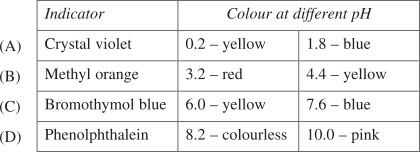
Which indicator in the table would be best for distinguishing between lemon juice (pH = 2.3) and potato juice (pH = 5.8)?
 

Show Answers Only

`B`

Show Worked Solution

If Methyl orange is used:

  • Lemon juice would be red, potato juice yellow

`=>B`

Filed Under: Properties of Acids and Bases Tagged With: Band 2, smc-3673-15-Indicators

ENGINEERING, AE 2022 HSC 17 MC

During routine maintenance, ultrasonic testing is performed on some aircraft components such as aircraft landing gear.

What is the reason for performing this test?

  1. It can be performed quickly.
  2. It reveals any surface defects.
  3. It reveals any hidden internal faults.
  4. It can be carried out using simple techniques.
Show Answers Only

`C`

Show Worked Solution

`=>C`

Filed Under: Materials Tagged With: Band 2, smc-3725-10-Testing

PHYSICS, M5 2015 HSC 21

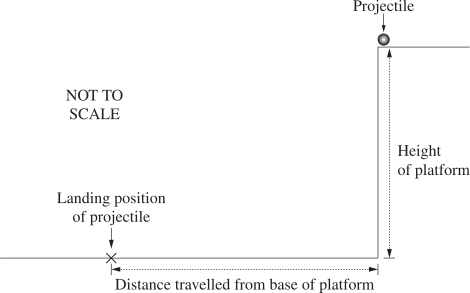
A projectile is fired horizontally from a platform.
 

Measurements of the distance travelled by the projectile from the base of the platform are made for a range of initial velocities.   

\begin{array}{|c|c|}
\hline
\rule{0pt}{2.5ex}\textit{Initial velocity}& \textit{Distance travelled from} \\
\textit{of projectile}\ \text{(ms\(^{-1}\))} \rule[-1ex]{0pt}{0pt}& \textit{base of platform}\  \text{(m)} \\
\hline
\rule{0pt}{2.5ex} 1.4 \rule[-1ex]{0pt}{0pt}&1.0\\
\hline
\rule{0pt}{2.5ex} 2.3 \rule[-1ex]{0pt}{0pt}& 1.7\\
\hline
\rule{0pt}{2.5ex} 3.1 \rule[-1ex]{0pt}{0pt}& 2.2\\
\hline
\rule{0pt}{2.5ex} 3.9 \rule[-1ex]{0pt}{0pt}& 2.3 \\
\hline
\rule{0pt}{2.5ex} 4.2 \rule[-1ex]{0pt}{0pt}& 3.0 \\
\hline
\end{array}

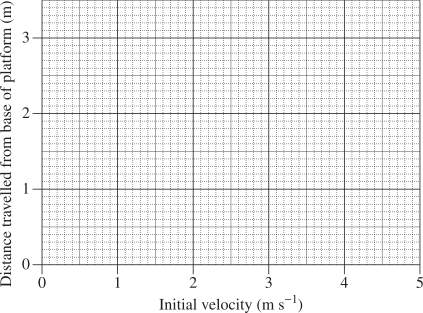
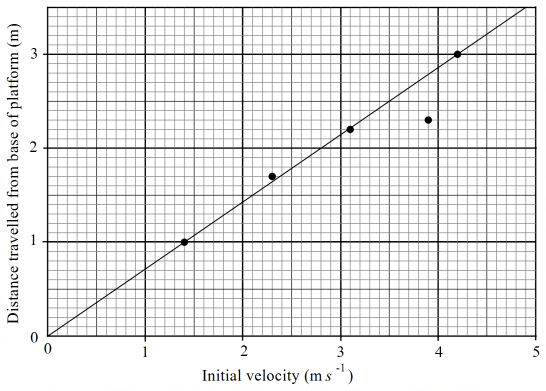
  1. Graph the data on the grid provided and draw the line of best fit.   (2 marks)


--- 0 WORK AREA LINES (style=lined) ---

  1. Calculate the height of the platform.   (2 marks)

    --- 6 WORK AREA LINES (style=lined) ---

Show Answers Only

a. 
     

b.   2.5 m

Show Worked Solution

a.   
          

b.   \(s_x=u(x) t\ \ \Rightarrow\ \ t=\dfrac{s_x}{u_x} \text{(gradient)}\)

\(\text{Using the line of best fit, gradient = 0.714.}\)

\(t = 0.714\ s\)

\(s_y\) \(=u_y t+\frac{1}{2} a_y t^2\)  
  \(=0+0.5 \times 9.8 \times(0.714)^2\)  
  \(=2.5 \ \text{m}\)  

 
\(\text{Height}\ = 2.5\ \text{m}\)

Filed Under: Projectile Motion Tagged With: Band 2, Band 4, smc-3690-40-Vertical Displacement

PHYSICS, M5 2017 HSC 4 MC

An astronaut with a mass of 75 kg lands on Planet X where her weight is 630 N.

What is the acceleration due to gravity (in m s\(^{-2}\)) on Planet X ?

  1. 0.12
  2. 8.4
  3. 9.8
  4. 735
Show Answers Only

\(B\)

Show Worked Solution

\(\text{Using}\ \ F=mg:\)

\(g=\dfrac{F}{m}=\dfrac{630}{75}=8.4\  \text{m s}^{-2}\)

 \(\Rightarrow B\)

Filed Under: Forces, Motion in Gravitational Fields Tagged With: Band 2, smc-3692-15-Gravitational field strength, smc-4275-10-Using Newton's laws

Measurement, STD1 M4 2022 HSC 15

Tom is 25 years old, and likes to keep fit by exercising.

  1. Use this formula to find his maximum heart rate (bpm).
  2.       Maximum heart rate = 220 – age in years
  3. Tom's maximum heart rate is .................... bpm.  (1 mark)
  4. Tom will get the most benefit from this exercise if his heart rate is between 50% and 85% of his maximum heart rate.
  5. Between what two heart rates should Tom be aiming for to get the most benefit from his exercise?  (2 marks)

    --- 4 WORK AREA LINES (style=lined) ---

Show Answers Only
  1. `195\ text{bpm}`
  2. `text{98 – 166 bpm}`
Show Worked Solution
a.    `text{Max heart rate}` `=220-25`
    `=195\ text{bpm}`


b.   `text{50% max heart rate}\ = 0.5 xx 195 = 97.5\ text{bpm}`

`text{85% max heart rate}\ = 0.85 xx 195 = 165.75\ text{bpm}`

`:.\ text{Tom should aim for between 98 and 166 bpm in exercise.}`

Filed Under: M4 Rates (Y12) Tagged With: Band 2, Band 4, smc-1104-40-Heart Rates/Blood Pressure

Algebra, STD1 A2 2022 HSC 12

The cost of hiring a campervan is $210 per day. There is also a charge of $0.35 per km travelled.

A family hired a campervan for 9 days and travelled 2700 km.

How much did the family pay in total?  (2 marks)

Show Answers Only

Cost = $2835

Show Worked Solution
`text{Cost}`  `= 210 xx 9 + 2700 xx 0.35`  
  `= $2835`  

Filed Under: Applications of Linear Relationships (Std1-2027), Applications: Currency, Fuel and Other Problems (Std 1) Tagged With: Band 2, smc-1119-30-Other Linear Applications, smc-6513-30-Other Linear Applications

Calculus, EXT2 C1 2022 HSC 14b

Let  `J_(n)=int_(0)^(1)x^(n)e^(-x)\ dx`, where "n" is a non-negative integer.

  1. Show that  `J_(0)=1-(1)/(e)`.  (1  mark)

    --- 2 WORK AREA LINES (style=lined) ---

  2. Show that  `J_(n) <= (1)/(n+1)`.  (2 marks)

    --- 3 WORK AREA LINES (style=lined) ---

  3. Show that  `J_(n)=nJ_(n-1)-(1)/(e)`.  (2 marks)

    --- 4 WORK AREA LINES (style=lined) ---

  4. Using parts (i) and (iii), show by mathematical induction, or otherwise, that for all `n >= 1`,
  5.        `J_(n)=n!-(n!)/(e)sum_(r=0)^(n)(1)/(r!)`    (2 marks)

    --- 6 WORK AREA LINES (style=lined) ---

  6. Using parts (ii) and (iv) prove that  `e=lim_(n rarr oo)sum_(r=0)^(n)(1)/(r!)`.  (1  mark)

    --- 5 WORK AREA LINES (style=lined) ---

Show Answers Only
  1. `text{Proof (See Worked Solutions)}`
  2. `text{Proof (See Worked Solutions)}`
  3. `text{Proof (See Worked Solutions)}`
  4. `text{Proof (See Worked Solutions)}`
  5. `text{Proof (See Worked Solutions)}`
Show Worked Solution
i.    `J_0` `=int_0^1 e^(-x)\ dx`
    `=[-e^(-x)]_0^1`
    `=-e^(-1)+1`
    `=1-1/e`


Mean mark (i) 93%.

ii.  `text{Show}\ \ J_n<=1/(n+1)`

`text{Note:}\ e^(-x)<1\ \ text{for}\ \ x in [0,1]`

`J_n` `=int_0^1 x^n e^(-x)\ dx`  
  `leq int_0^1 x^n \ dx`  
  `leq 1/(n+1)[x^(n+1)]_0^1`  
  `leq 1/(n+1)(1^(n+1)-0)`  
  `leq 1/(n+1)\ \ text{… as required}`  


♦♦ Mean mark (ii) 28%.
 

iii.  `text{Show}\ \ J_n=nJ_(n-1)-1/e`

`u` `=x^n` `v′` `=e^(-x)`
`u′` `=nx^(n-1)` `v` `=-e^(-x)`
`J_n` `=[-x^n * e^(-x)]_0^1-int_0^1 nx^(n-1)*-e^(-x)\ dx`  
  `=(-1^n * e^(-1)+0^n e^0)+nint_0^1 x^(n-1)*e^(-x)\ dx`  
  `=nJ_(n-1)-1/e`  

 
iv.
   `text{Prove}\ \ J_(n)=n!-(n!)/(e)sum_(r=0)^(n)(1)/(r!)\ \ text{for}\ \ n >= 0`

`text{If}\ \ n=0:`

`text{LHS} = 1-1/e\ \ text{(see part (i))}`

`text{RHS} = 0!-0!/e (1/(0!)) = 1-1/e(1)=\ text{LHS}`

`:.\ text{True for}\ \ n=0.`
 

`text{Assume true for}\ \ n=k:`

`J_(k)=k!-(k!)/(e)sum_(r=0)^(k)(1)/(r!)`


♦ Mean mark (iv) 50%.

`text{Prove true for}\ \ n=k+1:`

`text{i.e.}\ \ J_(k+1)=(k+1)!-((k+1!))/(e)sum_(r=0)^(k+1)(1)/(r!)`

`J_(k+1)` `=(k+1)J_k-1/e\ \ text{(using part (iii))}`  
  `=(k+1)(k!-(k!)/(e)sum_(r=0)^(k)(1)/(r!))-1/e`  
  `=(k+1)!-((k+1)!)/(e)sum_(r=0)^(k)(1)/(r!)-1/e xx ((k+1)!)/((k+1)!)`  
  `=(k+1)!-((k+1)!)/e(\ sum_(\ r=0)^(k)(1)/(r!)+1/((k+1)!))`  
  `=(k+1)!-((k+1)!)/e(\ sum_(\ r=0)^(k+1)(1)/(r!))`  

 
`=>\ text{True for}\ \ n=k+1`

`:.\ text{S}text{ince true for}\ n=1,\ text{by PMI, true for integers}\ n>=1`
 

v.   `0<=J_n<= 1/(n+1)\ \ \ text{(part (ii))}`

`lim_(n->oo) 1/(n+1)=0\ \ => \ lim_(n->oo) J_n=0`

  
`text{Using part (iv):}`

`J_n/(n!)` `=1-1/e sum_(r=0)^(n)(1)/(r!)`  
`1/e sum_(r=0)^(n)(1)/(r!)` `=1-J_n/(n!)`  
`sum_(r=0)^(n)(1)/(r!)` `=e-(eJ_n)/(n!)`  
`lim_(n->oo)(\ sum_(\ r=0)^(n)(1)/(r!))`  `=lim_(n->oo)(e-(eJ_n)/(n!))`  
  `=e-0`  
  `=e`  

♦♦ Mean mark (v) 34%.

Filed Under: Induction, P2 Induction (Ext2), Recurrence Relations Tagged With: Band 2, Band 3, Band 5, smc-1044-60-Recursive, smc-1044-68-Sigma Notation, smc-1054-30-Logs/Exp, smc-5115-60-Recursive, smc-5115-68-Sigma notation

BIOLOGY, M8 2019 HSC 1 MC

Which of the following is an example of a non-infectious disease?

  1. Polio caused by a virus
  2. Cholera caused by a bacterium
  3. Wheat rust caused by a fungus
  4. Haemophilia caused by a gene mutation
Show Answers Only

`D`

Show Worked Solution
  • Virus, bacteria and fungi are all pathogens; disease carriers which can be transmitted between hosts.
  • Gene mutations are changes in DNA and cannot be transmitted to others by contact or vectors.

`=>D`

Filed Under: Causes and Effects, Causes of Infectious Disease Tagged With: Band 2, smc-3655-10-Classifying Pathogens, smc-3660-20-Genetic/Cancer

BIOLOGY, M7 2022 HSC 21a

Outline ONE way that a pathogen can pass from person to person.  (2 marks)

--- 4 WORK AREA LINES (style=lined) ---

Show Answers Only
  • A pathogen such as a bacteria, protozoa or fungus can be passed from person to person by direct transmission
  • This involves skin to skin contact, such as sexual intercourse or shaking hands. 

Other modes of transmission include:

  • Object contamination.
  • Waterborne, foodborne or airborne.
  • Animal faeces or nasal secretions.
  • Bodily fluids/respiratory droplets.
Show Worked Solution
  • A pathogen such as a bacteria, protozoa or fungus can be passed from person to person by direct transmission
  • This involves skin to skin contact, such as sexual intercourse or shaking hands. 

Other modes of transmission include:

  • Object contamination.
  • Waterborne, foodborne or airborne.
  • Animal faeces or nasal secretions.
  • Bodily fluids/respiratory droplets.

Filed Under: Causes of Infectious Disease Tagged With: Band 2, smc-3655-20-Transmission, smc-3655-30-Vectors

ENGINEERING, TE 2020 HSC 21a

Outline how ONE telecommunications engineering innovation has influenced traditional voice communication systems.   (2 marks)

--- 6 WORK AREA LINES (style=lined) ---

Show Answers Only

Smartphones:

  • Have replaced landlines, enable constant communication from anywhere.
  • They also support video conferencing and access to information/the internet.  

Other answers could include:

  • Digital radio: Has less interference and higher sound quality.
  • Videoconferencing: Enables visual as well as audio communication.
  • Cybersecurity: Protects your information when communicating with others.
Show Worked Solution

Smartphones:

  • Have replaced landlines, enable constant communication from anywhere.
  • They also support video conferencing and access to information/the internet.  

Other answers could include:

  • Digital radio: Has less interference and higher sound quality.
  • Videoconferencing: Enables visual as well as audio communication.
  • Cybersecurity: Protects your information when communicating with others.

Filed Under: Scope, Historical and Societal Influences Tagged With: Band 2, smc-3728-20-Innovation

CHEMISTRY, M7 2019 HSC 1 MC

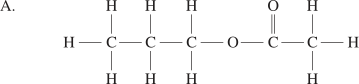
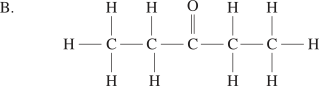
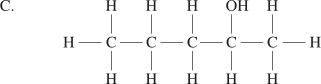
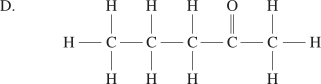
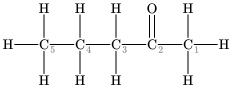
Which structural formula represents pentan-2-one?


Show Answers Only

`D`

Show Worked Solution

The ketone functional group is on the second carbon atom.

`=>D`

Filed Under: Nomenclature Tagged With: Band 2, smc-3676-30-Ketones and Aldehydes

ENGINEERING, AE 2020 HSC 10 MC

Which of the following only contains tasks performed by the aeronautical engineer?

  1. Provide technical advice, assemble aircraft, design aircraft
  2. Assist in air traffic control, investigate crashes, pilot aircraft
  3. Make good checklists, read training manuals, schedule flights
  4. Write training manuals, assist in air traffic control, act as a public relations officer
Show Answers Only

`A`

Show Worked Solution

By Elimination:

  • Engineers do not assist in air traffic control (eliminate `B` and `D`).
  • Engineers do not schedule flights (eliminate `C`).

`=>A`

Filed Under: Scope, Historical and Societal Influences Tagged With: Band 2, smc-3722-20-Professional scope

BIOLOGY, M8 2020 HSC 27

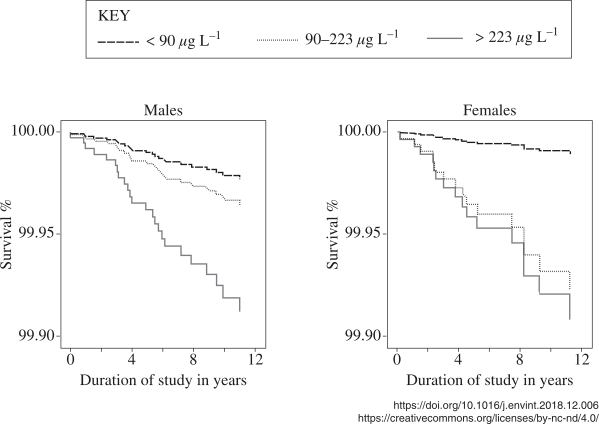
Exposure to arsenic in drinking water has been associated with the onset of many diseases. The World Health Organisation recommends arsenic levels in drinking water should be below 10 `mu`g L-1 .

An epidemiological study involving 58 406 young adults was conducted over an 11-year period in one country to investigate young-adult mortality due to chronic exposure to arsenic in local drinking water. Each individual's average exposure and cumulative exposure to arsenic over the time of the study were calculated. Age, sex, education and socioeconomic status were taken into account during the analysis of the results.

The graphs show survival rates for males and females over the 11-year period associated with different average levels of exposure to arsenic in drinking water.
 

  1. Identify TWO features of the method used that contributed to the validity of this study.   (2 marks)

    --- 2 WORK AREA LINES (style=lined) ---

  2. The hypothesis put forward was that exposure to arsenic in drinking water increases mortality in young adults.
  3. Discuss the data presented in the graphs in relation to this hypothesis.   (4 marks)

    --- 8 WORK AREA LINES (style=lined) ---

Show Answers Only

a.   Successful answers should include two of the following:

  • The identification of the age and sex of participants
  • Socioeconomic status 
  • Arsenic exposure
  • Large sample size
  • The length of the study period

b.   Consider the less than 90 `mu`g L-1 group:

  • The survival rate for both males and females was highest in this “control” group. This is despite the group being exposed to more arsenic than recommended by WHO.
  • In both males and females, increased exposure to arsenic led to lower survival rates.
  • This gradual survival decrease is best seen in males.
  • In females, all doses over 90 `mu`g L-1 lead to similar survival decrease, suggesting other factors, such as a gene or diet, are interacting with the dosage of arsenic.
  • Over the 11 year period, survival progressively declined, supporting the hypothesis.
  • It is important to note, however, that despite the large sample size and time period the study was conducted, survival only dropped by 0.1%.
Show Worked Solution

a.   Successful answers should include two of the following:

  • The identification of the age and sex of participants
  • Socioeconomic status 
  • Arsenic exposure
  • Large sample size
  • The length of the study period

b.   Consider the less than 90 `mu`g L-1 group:

  • The survival rate for both males and females was highest in this “control” group. This is despite the group being exposed to more arsenic than recommended by WHO.
  • In both males and females, increased exposure to arsenic led to lower survival rates.
  • This gradual survival decrease is best seen in males.
  • In females, all doses over 90 `mu`g L-1 lead to similar survival decrease, suggesting other factors, such as a gene or diet, are interacting with the dosage of arsenic.
  • Over the 11 year period, survival progressively declined, supporting the hypothesis.
  • It is important to note, however, that despite the large sample size and time period the study was conducted, survival only dropped by 0.1%.

Filed Under: Causes and Effects, Epidemiology Tagged With: Band 2, Band 4, smc-3660-11-Environmental/Nutritional, smc-3661-10-Analysing Results

ENGINEERING, PPT 2021 HSC 26a

Outline a change in technology that has led to improved fuel efficiency in cars.   (2 marks)

--- 4 WORK AREA LINES (style=lined) ---

Show Answers Only

Successful answers should discuss one of the following:

  • Lighter/more streamlined cars are generally more fuel efficient. This has been achieved through improved manufacturing methods and improved materials (ie replacing steel bumpers with lighter polymers).
  • Improved materials technology used to produce aluminium engine blocks instead of cast iron to decrease weight.
  • Mathematical modelling to increase aerodynamics of a car.
  • Hybrid cars and regenerative braking.
  • Shift towards fuel injection and higher compression ratio.
  • Cruise control maintains better average fuel economy.
  • Improved efficient gearboxes and differentials with low friction and torque.
  • Improvements to lubrication technology to reduce internal friction.
Show Worked Solution

Successful answers should discuss one of the following:

  • Lighter/more streamlined cars are generally more fuel efficient. This has been achieved through improved manufacturing methods and improved materials (ie replacing steel bumpers with lighter polymers).
  • Improved materials technology used to produce aluminium engine blocks instead of cast iron to decrease weight.
  • Mathematical modelling to increase aerodynamics of a car.
  • Hybrid cars and regenerative braking.
  • Shift towards fuel injection and higher compression ratio.
  • Cruise control maintains better average fuel economy.
  • Improved efficient gearboxes and differentials with low friction and torque.
  • Improvements to lubrication technology to reduce internal friction.

Filed Under: Historical and Societal Influences Tagged With: Band 2, smc-3717-20-Innovation, smc-3717-40-Environment

Proof, EXT2 P1 2022 HSC 12a

For real numbers  `a,b >= 0`  prove that  `(a+b)/(2) >= sqrt(ab)`.  (2 marks)

--- 4 WORK AREA LINES (style=lined) ---

Show Answers Only

`text{Proof (See Worked Solutions)}`

Show Worked Solution

`text{S}text{ince}\ \ (sqrta-sqrtb)^2>=0:`

`a-2sqrt(ab)+b` `>=0`  
`a+b` `>=2sqrt(ab)`  
`:.(a+b)/2` `>=sqrt(ab)\ \ text{… as required}`  

Mean mark 93%.

Filed Under: Proof and Inequalities Tagged With: Band 2, smc-1208-20-Proofs using Square > 0

Complex Numbers, EXT2 N1 2022 HSC 11a

Express  `(3-i)/(2+i)`  in the form  `x+iy`, where `x` and `y` are real numbers.  (2 marks)

Show Answers Only

`1-i`

Show Worked Solution
`(3-i)/(2+i)` `=(3-i)/(2+i) xx (2-i)/(2-i)`  
  `=(6-3i-2i+i^2)/(2^2-i^2)`  
  `=(5-5i)/5`  
  `=1-i`  

Filed Under: Arithmetic of Complex Numbers Tagged With: Band 2, smc-1048-10-Basic Arithmetic

BIOLOGY, M8 2020 HSC 9 MC

A public education campaign was developed with the aim of lowering the incidence of skin cancer in the population.

The campaign was adopted Australia wide and is illustrated in the poster.
 

Which is the best method to measure the effectiveness of the campaign?

  1. By measuring exposure to the sun and skin cancer incidence
  2. By surveying beachgoers, asking if they remember the campaign
  3. By comparing skin cancer incidence before and after the campaign
  4. By counting the number of people on the beach wearing hats and sunglasses
Show Answers Only

`C`

Show Worked Solution
  • A direct measurement of any reduction in cancer incidence would prove campaign effectiveness.

`=>C`

Filed Under: Epidemiology Tagged With: Band 2, smc-3661-20-Evaluating the Method

BIOLOGY, M7 2020 HSC 4 MC

Malaria is a disease in humans caused by a single-celled Plasmodium species. It is transmitted by female mosquitoes.

Which of the following is true for malaria?

  1. Both Plasmodium and the mosquito are vectors
  2. Both Plasmodium and the mosquito are pathogens
  3. The mosquito is the vector and Plasmodium is the pathogen
  4. The mosquito is the pathogen and Plasmodium is the vector
Show Answers Only

`C`

Show Worked Solution
  • The Plasmodium is the pathogen that causes malaria disease, while the mosquito transmits the pathogen and is therefore the vector.

`=>C`

Filed Under: Causes of Infectious Disease Tagged With: Band 2, smc-3655-10-Classifying Pathogens, smc-3655-30-Vectors

BIOLOGY, M8 2021 HSC 25

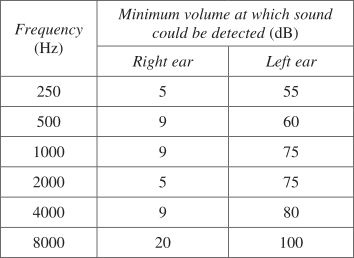
A patient visited an audiologist for a hearing test. The audiologist tested both ears at specific frequencies. The volumes at which each frequency could be heard are shown.
 

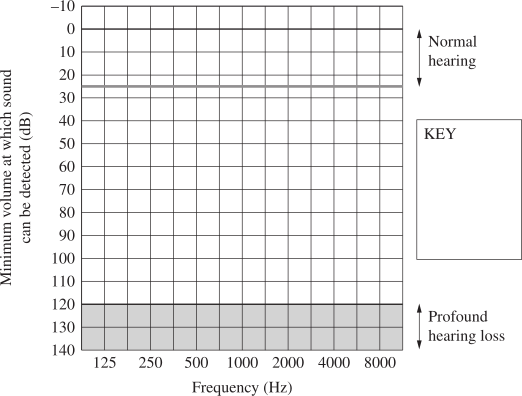
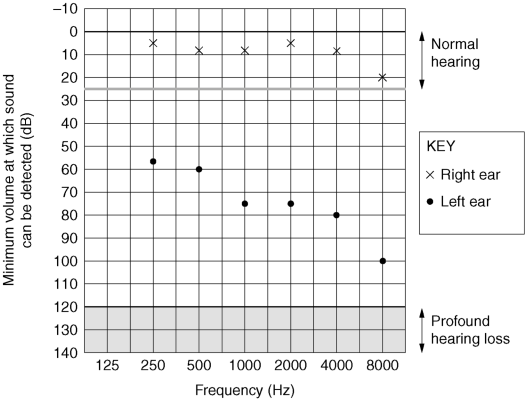
  1. Plot the data on the grid provided and include a key.   (3 marks)
     

  1. What conclusions can be drawn about the patient's hearing?   (2 marks)

    --- 2 WORK AREA LINES (style=lined) ---

  2. It is discovered that there is a complete and permanent blockage of the outer ear, but the cochlea is still fully functional.
  3. Justify the use of a suitable technology to assist the patient's hearing.   (3 marks)

    --- 6 WORK AREA LINES (style=lined) ---

Show Answers Only

a.  

b.   Right ear is within normal hearing range.

Left ear has a deficit and cannot hear at a normal level.
 

c.    Effective technology: Bone Conduction Implants

Bone conduction implants would prove to be the most effective technology to restore hearing to this patient. 

Bone conduction implants detect sound waves via a microphone, relaying them to a sound processor that converts the waves into vibrations which are then directly transferred to the cochlea. This process bypasses the ear blockage, therefore restoring hearing to the patient.

Show Worked Solution

a.   


b.   Right ear is within normal hearing range.

  • Left ear has a deficit and cannot hear at a normal level.

c.    Effective technology: Bone Conduction Implants

  • Bone conduction implants would prove to be the most effective technology to restore hearing to this patient. 
  • Bone conduction implants detect sound waves via a microphone, relaying them to a sound processor that converts the waves into vibrations which are then directly transferred to the cochlea.
  • This process bypasses the ear blockage, therefore restoring hearing to the patient.

♦ Mean mark (c) 43%.

Filed Under: Technologies and Disorders Tagged With: Band 2, Band 3, Band 5, smc-3663-30-Ears

ENGINEERING, CS 2021 HSC 21a

Some large cities, such as Sydney, have bridges which span large bodies of water.

Outline TWO ways in which the construction of such bridges affects society.   (2 marks)

--- 5 WORK AREA LINES (style=lined) ---

Show Answers Only
  • Bridges spanning large bodies of water allow for faster travel than other existing transport such as ferries.
  • This results in greater work productivity due to faster commuting. People will also have greater opportunity to work and recreate on both sides of the bridge.

Other advantages could include:

  • Greater use of major infrastructure like hospitals, schools and stadiums
  • Train lines can be constructed on the bridge to allow for extra mass transit
  • Reduction in existing transport on the harbour such as ferries
  • Potential increase in leisure time
Show Worked Solution
  • Bridges spanning large bodies of water allow for faster travel than other existing transport such as ferries.
  • This results in greater work productivity due to faster commuting. People will also have greater opportunity to work and recreate on both sides of the bridge.  

Other advantages could include:

  • Greater use of major infrastructure like hospitals, schools and stadiums
  • Train lines can be constructed on the bridge to allow for extra mass transit
  • Reduction in existing transport on the harbour such as ferries
  • Potential increase in leisure time

Filed Under: Historical and Societal Influences Tagged With: Band 2, smc-3713-20-Innovation

ENGINEERING, AE 2021 HSC 2 MC

The flight recorder, commonly known as the 'black box', was developed in Australia in the 1950s to assist in air crash investigations.

How does a black box assist in an air crash investigation?

  1. It contains aircraft maintenance history.
  2. It holds passenger details and conversations.
  3. It keeps details of flight data and cockpit conversations.
  4. It retains details of baggage weight and flight crew rosters.
Show Answers Only

`C`

Show Worked Solution

`=>C`

Filed Under: Scope, Historical and Societal Influences Tagged With: Band 2, smc-3722-10-Innovation, smc-3722-50-Safety/Environment

Vectors, EXT1 V1 2022 HSC 11a

For the vectors  `underset~u= underset~i- underset~j`  and  `underset~v=2 underset~i+ underset~j`, evaluate each of the following. 

  1. `underset~u+3 underset~v`   (1 mark)

    --- 2 WORK AREA LINES (style=lined) ---

  2. `underset~u * underset~v`   (1 mark)

    --- 2 WORK AREA LINES (style=lined) ---

Show Answers Only
  1. `((7),(2))`
  2. `1`
Show Worked Solution

i.  `underset~u= ((1),(-1)),\ \ underset~v= ((2),(1))`

`underset~u+3 underset~v` `=((1),(-1))+3((2),(1))`  
  `=((1+3xx2),(-1+3xx1))`  
  `=((7),(2))`  


ii.    `underset~u * underset~v` `=((1),(-1))*((2),(1))`
    `=1xx2+(-1)xx1`
    `=1`

Filed Under: Operations With Vectors (Ext1) Tagged With: Band 2, Band 3, smc-1086-10-Basic Calculations

Calculus, 2ADV C3 2022 HSC 20

A scientist is studying the growth of bacteria. The scientist models the number of bacteria, `N`, by the equation

`N(t)=200e^(0.013 t)`,

where `t` is the number of hours after starting the experiment.

  1. What is the initial number of bacteria in the experiment?  (1 mark)

    --- 1 WORK AREA LINES (style=lined) ---

  2. What is the number of bacteria 24 hours after starting the experiment?  (1 mark)

    --- 2 WORK AREA LINES (style=lined) ---

  3. What is the rate of increase in the number of bacteria 24 hours after starting the experiment?  (2 marks)

    --- 5 WORK AREA LINES (style=lined) ---

Show Answers Only
  1. `200`
  2. `273`
  3. `3.55\ text{bacteria per hour}`
Show Worked Solution
a.    `N(0)` `=200e^0`
    `=200\ text{bacteria}`


b.   `text{Find}\ N\ text{when}\ \ t=24:`

`N(24)` `=200e^(0.013xx24)`  
  `=273.23…`  
  `=273\ text{bacteria (nearest whole)}`  


c.    `N` `=200e^(0.013 t)`
  `(dN)/dt` `=0.013xx200e^(0.013t)`
    `=2.6e^(0.013t)`

 
`text{Find}\ \ (dN)/dt\ \ text{when}\ \ t=24:`

`(dN)/dt` `=2.6e^(0.013xx24)`  
  `=3.550…`  
  `=3.55\ text{bacteria/hr (to 2 d.p.)}`  

Filed Under: Rates of Change (Y12) Tagged With: Band 2, Band 3, smc-1091-22-Exponential G&D, smc-1091-30-Log/Exp Function

Financial Maths, 2ADV M1 2022 HSC 17

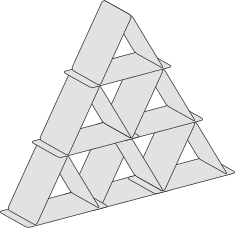
Cards are stacked to build a 'house of cards'. A house of cards with 3 rows is shown.

A house of cards requires 3 cards in the top row, 6 cards in the next row, and each successive row has 3 more cards than the previous row.

  1. Show that a house of cards with 12 rows has a total of 234 cards.  (2 marks)

    --- 4 WORK AREA LINES (style=lined) ---

  2. Another house of cards has a total of 828 cards.
  3. How many rows are in this house of cards?  (3 marks)

    --- 6 WORK AREA LINES (style=lined) ---

Show Answers Only
  1. `text{Proof (See Worked Solutions)}`
  2. `23`
Show Worked Solution

a.   `a=3, \ d=3`

`S_n` `=n/2[2a+(n-1)d]`  
`S_12` `=12/2(2xx3 + 11xx3)`  
  `=6(6+33)`  
  `=234\ \ text{… as required}`  

 
b.
   `text{Find}\ \ n\ \ text{given}\ \ S_n=828:`

`828` `=n/2[6+(n-1)3]`  
`1656` `=n(3+3n)`  
  `=3n^2+3n`  


`3n^2+3n-1656` `=0`  
`n^2+n-552` `=0`  
`(n+24)(n-23)` `=0`  

 
`:. n=23\ text{rows}\ \ (n>0)`

Filed Under: Arithmetic Series (Y12) Tagged With: Band 2, Band 3, smc-1005-10-Find Term, smc-1005-20-Find Sum, smc-1005-70-Applied Context

Statistics, 2ADV S2 2022 HSC 2 MC

Consider the following dataset.

`{:[13,16,17,17,21,24]:}`

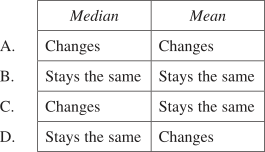
Which row of the table shows how the median and mean are affected when a score of 5 is added to the dataset?

Show Answers Only

`D`

Show Worked Solution

`text{Mean decreases.}`

`text{Median remains 17.}`

`=>D`


♦ Mean mark 48%.

Filed Under: Summary Statistics - No graph (Y12) Tagged With: 2adv-std2-common, Band 2, smc-999-10-Mean, smc-999-20-Median and Mode

Algebra, STD2 A4 2022 HSC 22

The formula  `C=100 n+b`  is used to calculate the cost of producing laptops, where `C` is the cost in dollars, `n` is the number of laptops produced and `b` is the fixed cost in dollars.

  1. Find the cost when 1943 laptops are produced and the fixed cost is $20 180.  (1 mark)

    --- 2 WORK AREA LINES (style=lined) ---

  2. Some laptops have some extra features added. The formula to calculate the production cost for these is
  3.      `C=100 n+a n+20\ 180`
  4. where `a` is the additional cost in dollars per laptop produced.
  5. Find the number of laptops produced if the additional cost is $26 per laptop and the total production cost is $97 040.  (2 marks)

    --- 4 WORK AREA LINES (style=lined) ---

Show Answers Only
  1. `$214\ 480`
  2. `610\ text{laptops}`
Show Worked Solution

a.   `text{Find}\ \ C\ \ text{given}\ \ n=1943 and b=20\ 180`

`C` `=100 xx 1943 + 20\ 180`  
  `=$214\ 480`  


b.   `text{Find}\ \ n\ \ text{given}\ \ C=97\ 040 and a=26`

`C` `=100 n+a n+20\ 180`  
`97\ 040` `=100n + 26n +20\ 180`  
`126n` `=76\ 860`  
`n` `=(76\ 860)/126`  
  `=610 \ text{laptops}`  

Filed Under: Applications of Linear Relationships (Std1-2027), Applications of Linear Relationships (Std2-2027), Applications: Currency, Fuel and Other Problems (Std 2), Linear Applications Tagged With: Band 2, Band 4, num-title-ct-coreb, num-title-qs-hsc, smc-6256-30-Other Linear Applications, smc-6513-30-Other Linear Applications, smc-793-30-Other Linear Applications

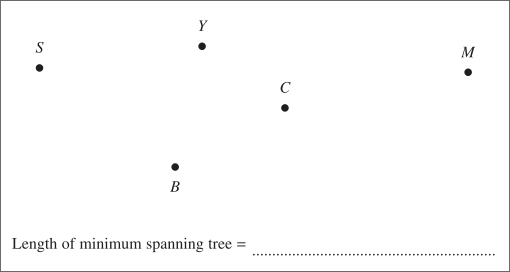
Networks, STD2 N2 2022 HSC 20

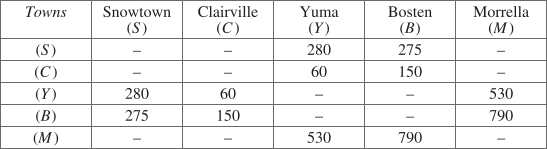
The table below shows the distances, in kilometres, between a number of towns.
 

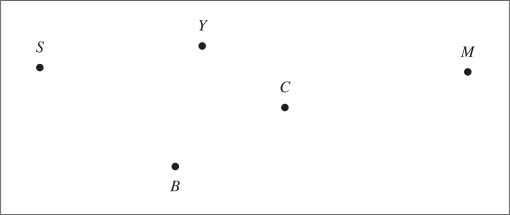
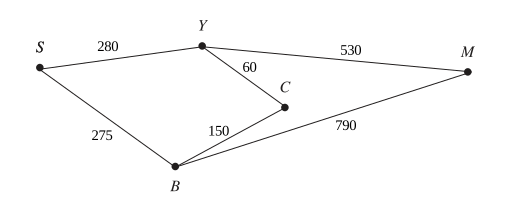
  1. Using the vertices given, draw a weighted network diagram to represent the information shown in the table.  (2 marks)


  2. A tourist wishes to visit each town.
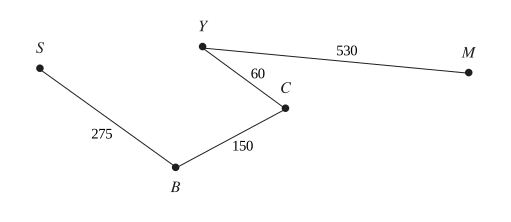
  3. Draw the minimum spanning tree which will allow for this AND determine its length.  (3 marks)
     

    --- 0 WORK AREA LINES (style=lined) ---

Show Answers Only
  1.  
     
     
  2.   
     
  3. `1015\ text{km}`
Show Worked Solution

a. 


b.   `text{Using Prim’s algorithm (starting at}\ Y):`

`text{1st edge:}\ YC`

`text{2nd edge:}\ CB`

`text{3rd edge:}\ SB`

`text{4th edge:}\ YM`

`text{Length of minimum spanning tree}`

`=275 + 150+60+530`

`=1015\ text{km}`

Filed Under: Basic Concepts, Minimum Spanning Trees, Network Concepts (Std2-2027), Spanning Trees (Std2-2027) Tagged With: Band 2, Band 3, smc-6307-10-Table to Network, smc-6320-20-Distance, smc-6320-40-Draw Tree, smc-912-10-Table to Network, smc-914-20-Distance, smc-914-40-Draw Tree

Algebra, STD2 A2 2022 HSC 16

Tom is 25 years old, and likes to keep fit by exercising.

  1. Use this formula to find his maximum heart rate (bpm).    (1 mark)
  2.      Maximum heart rate = 220 – age in years

    --- 2 WORK AREA LINES (style=lined) ---

  3. Tom will get the most benefit from this exercise if his heart rate is between 50% and 85% of his maximum heart rate.
  4. Between what two heart rates should Tom be aiming for to get the most benefit from his exercise?  (2 marks)

    --- 4 WORK AREA LINES (style=lined) ---

Show Answers Only

a.   `text{195 bpm}`

b.   `98-166\ text{bpm}`

Show Worked Solution
a.    `text{Max heart rate}` `=220-25`
    `=195\ text{bpm}`


b.   `text{50% max heart rate}\ = 0.5 xx 195 = 97.5\ text{bpm}`

`text{85% max heart rate}\ = 0.85 xx 195 = 165.75\ text{bpm}`

`:.\ text{Tom should aim for between 98 and 166 bpm in exercise.}`

Filed Under: Applications of Linear Relationships (Std1-2027), Applications of Linear Relationships (Std2-2027), Applications: Currency, Fuel and Other Problems (Std 1), Applications: Currency, Fuel and Other Problems (Std 2), Rates (Std2) Tagged With: Band 2, Band 3, smc-1119-30-Other Linear Applications, smc-6256-30-Other Linear Applications, smc-6513-30-Other Linear Applications, smc-793-30-Other Linear Applications, smc-805-40-Heart Rates

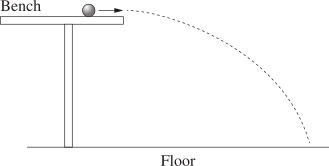
PHYSICS, M5 2021 HSC 1 MC

A marble is rolled off a horizontal bench and falls to the floor.


Rolling the marble at a slower speed would

  1. increase the range.
  2. decrease the range.
  3. increase the time of flight.
  4. decrease the time of flight.
Show Answers Only

`B`

Show Worked Solution

Vertical distance from floor to bench is constant → time of flight stays the same

Slower horizontal velocity → range decreases

`=>B`

Filed Under: Projectile Motion Tagged With: Band 2, smc-3690-10-Projectile Motion Models

CHEMISTRY, M5 2021 HSC 1 MC

Which pair of components must be equal for a chemical system to be at equilibrium?

  1. The rate of the forward reaction and the rate of the reverse reaction
  2. The concentrations of the reactants and the concentrations of the products
  3. The enthalpy of the forward reaction and the enthalpy of the reverse reaction
  4. The time that an atom exists in a reactant molecule and in a product molecule
Show Answers Only

`A`

Show Worked Solution
  • Rate of forward = rate of reverse reaction (dynamic equilibrium)

`=>A`

Filed Under: Static and Dynamic Equilibrium Tagged With: Band 2, smc-3669-10-Static/Dynamic Models
BIOLOGY, M8 2021 HSC 1 MC

A patient felt tired, weak and had a swollen neck. After following the doctor's advice to eat more foods containing iodised salt, her symptoms disappeared.

What was the most likely cause of the patient's symptoms?

  1. Cancer
  2. Genetic disorder
  3. Nutritional deficiency
  4. Environmental exposure
Show Answers Only

`C`

Show Worked Solution
  • Since iodised salt made symptoms disappear, the patient most likely had a deficiency of iodine.

`=>C`

Filed Under: Causes and Effects Tagged With: Band 2, smc-3660-11-Environmental/Nutritional

Complex Numbers, EXT2 N2 SM-Bank 10

The polynomial  `p(z) = z^3 + alpha z^2 + beta z + gamma`, where  `z ∈ C`  and  `alpha, beta, gamma ∈ R`, can also be written as  `p(z) = (z - z_1)(z - z_2)(z - z_3)`, where  `z_1 ∈ R`  and  `z_2, z_3 ∈ C`.

  1. State the relationship between `z_2` and `z_3`.  (1 mark)

    --- 2 WORK AREA LINES (style=lined) ---

  2. Determine the values of  `alpha, beta` and `gamma`, given that  `p(2) = -13, |z_2 + z_3| = 0`  and  `|z_2 - z_3| = 6`.  (3 marks)

    --- 8 WORK AREA LINES (style=lined) ---

Show Answers Only
  1. `z_2 = barz_3`
  2. `alpha = -3, beta = 9, gamma = -27`
Show Worked Solution

i.   `text(By conjugate root theory)`

`z_2 = barz_3`


ii.   `text(Let)\ \ z_1 = a + bi, \ z_2 = a – bi`

`|z_2 + z_3| = |2a| = 0 \ => \ a = 0`

`|z_2 – z_3| = |2b| = 6 \ => \ b = ±3`
 

`text(Using)\ \ p(2) = -13`

`(2 – z_1)(2 – 3i)(2 + 3i)` `= -13`
`(2 – z_1)(4 + 9)` `= -13`
`2 – z_1` `= -1`
`z_1` `= 3`


`p(z)` `= (z – 3)(z – 3i)(z + 3i)`
  `= (z – 3)(z^2 + 9)`
  `= z^3 – 3z^2 + 9z – 27`

 
`:. alpha = –3, \ beta = 9, \ gamma = –27`

Filed Under: Solving Equations with Complex Numbers Tagged With: Band 2, Band 4, smc-1050-20-Cubic roots, smc-1050-35-Conjugate roots

GRAPHS, FUR2 2021 VCAA 2

z

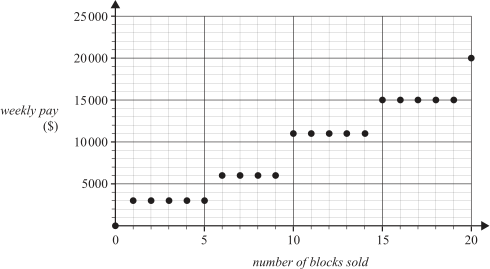
Christy sells blocks of land at the housing estate.

Her pay is based on the number of blocks that she sells each week.

The maximum number of blocks sold each week is 20.
The graph below shows Christy's weekly pay, in dollars, for the number of blocks sold.

  1. What is the minimum number of blocks of land that Chirsty must sell to receive $6000 in one week?   (1 mark)
John also sells blocks of land. He is paid $1000 for each block that he sells.

  1. Write down all values for the number of blocks of land sold for which Christy and John will receive the same weekly pay.  (1 mark)
  2. John sells no more than three blocks of land for every five blocks of land sold by Christy.  (1 mark)
  3. Let  `x`  be the number of blocks that Christy sells.
  4. Let  `y`  be the number of blocks that John sells.
  5. Write the inequality, written as  `y` in terms of  `x`, that represents this situation.
Show Answers Only
  1. `6 \ text{blocks}`
  2. `text{Blocks sold for equal pay: 3, 6, 11, 15, 20}`
  3. `y <= 3/5 x`
Show Worked Solution

a.    `6 \ text{blocks}`
 

b.    `text{Blocks sold for equal pay: 3, 6, 11, 15, 20}`
 

c.     `y <= 3/5 x`

Filed Under: Graph Applications, Linear Programming Tagged With: Band 2, Band 3, Band 4

GRAPHS, FUR2 2021 VCAA 1

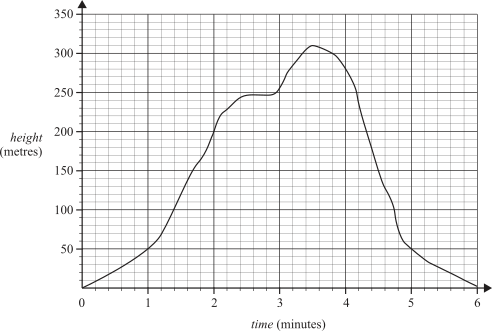
The graph below shows the height, in metres, of a drone flying above a new housing estate over a six-minute period of time.
 

  1. For what length of time, in minutes, was the height of the drone a least 50 m?   (1 mark)
  2. What was the average rate of change in the height of the drone, in metres per minute, in the first two minutes?  (1 mark)
Show Answers Only
  1. `4 \ text{minutes}`
  2. `100 \ text{metres per minute}`
Show Worked Solution

a.   `4 \ text{minutes}`
 

b.   `text{At} \ t = 0 , \ text{height} = 0 \ text{m}`

`text{At} \ t = 2 , \ text{height} = 200 \ text{m}`
  
`:. \ text{Average rate of change}`

`= {200 – 0}/{2}`

`= 100 \ text{metres per minute}`

Filed Under: Graph Applications Tagged With: Band 2, Band 3

GEOMETRY, FUR2 2021 VCAA 1

The game of squash is played with a special ball that has a radius of 2 cm.

  1. Show that the volume of one squash ball, rounded to two decimal places, is 33.51 cm3.  (1 mark)

Squash balls may be sold in cube-shaped boxes.

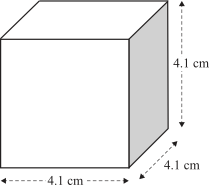
Each box contains one ball and has a side length of 4.1 cm, as shown in the diagram below.
 

  1. Calculate the empty space, in cubic centimetres, that surrounds the ball in the box.
  2. Round your answer to two decimal places.   (1 mark)
  3. Calculate the total surface area, in square centimetres, of one box.   (1 mark)
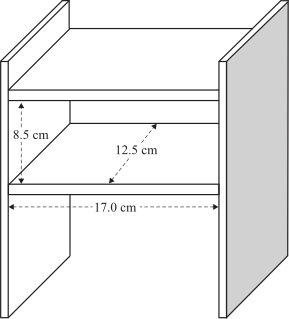
  4. Retail shops store the cube-shaped boxes in a space within a display unit.
  5. The space has a length of 17.0 cm and a width of 12.5 cm. Due to the presence of a shelf above, there is a maximum height of 8.5 cm available. This is shown in the diagram below.


  1. Calculate the maximum number of cube-shaped boxes that can fit into the space within the display unit.   (1 mark)
Show Answers Only
  1. `text(See Worked Solutions)`
  2. `35.41 \ text{cm}^3`
  3. `100.86 \ text{cm}^2`
  4. `text(24 boxes)`
Show Worked Solution
a.   `V` `= 4/3 pi r^3`
    `= 4/3 xx pi xx 2^3`
    `= 33.5103 …`
    `= 33.51 \ text{cm}^3 \ text{(to 2 d.p.)}`


b.  `text{Volume of cube} = 4.1^3 = 68.921 \ text{cm}^3`

     `:. \ text{Empty space}` `= 68.921 – 33.51`
  `= 35.41 \ text{cm}^3 \ text{(to 2 d.p.)}`


c.   `text(S.A.)` `= 6 xx 4.1 xx 4.1`
    `= 100.86 \ text{cm}^2`


d.  `text{Length} = 17 div 4.1 = 4.146 … \ \ to 4 \ text{boxes}`

`text{Width} = 12.5 div 4.1 = 3.048 … \ to 3 \ text{boxes}`

`text{Height} = 8.5 div 4.1 = 2.073 … \ \ to 2\ text{boxes}`
 

`:. \ text{Max boxes}` `= 4 xx 3 xx 2`
  `= 24`

Filed Under: Perimeter, Area and Volume Tagged With: Band 2, Band 3, Band 4

NETWORKS, FUR2 2021 VCAA 1

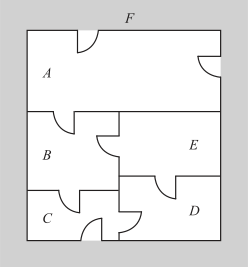
Maggie's house has five rooms, `A, B, C, D` and `E`, and eight doors.

The floor plan of these rooms and doors is shown below. The outside area, `F`, is shown shaded on the floor plan.
 

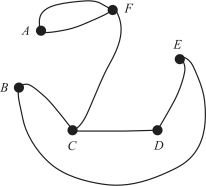
The floor plan is represented by the graph below.

On this graph, vertices represent the rooms and the outside area. Edges represent direct access to the rooms through the doors.

One edge is missing from the graph.
 

  1. On the graph above, draw the missing edge.   (1 mark)

    --- 0 WORK AREA LINES (style=lined) ---

  2. What is the degree of vertex `E`?   (1 mark)

    --- 1 WORK AREA LINES (style=lined) ---

  3. Maggie hires a cleaner to clean the house.
  4. It is possible for the cleaner to enter the house from the outside area, `F`, and walk through each room only once, cleaning each room as he goes and finishing in the outside area, `F`.
  5.  i. Complete the following to show one possible route that the cleaner could take.   (1 mark)

    --- 0 WORK AREA LINES (style=lined) ---


    ii. What is the mathematical term for such a journey?   (1 mark)

    --- 1 WORK AREA LINES (style=lined) ---

Show Answers Only
  1.  
  2. `2`
  3.  i. `FABEDCF\ text(or)\ FCDEBAF`
  4. ii. `text{Hamiltonian cycle}`
Show Worked Solution

a.

b.  `text{Degree} = 2`
 

c.i.  `FABEDCF\ text(or)\ FCDEBAF`

c.ii.  `text{Hamiltonian cycle}`

Filed Under: Travelling Problems and Adjacency Matrices Tagged With: Band 2, Band 3, Band 4, smc-622-20-Hamiltonian, smc-622-50-Draw Network from Map/Matrix

MATRICES, FUR2 2021 VCAA 2

The main computer system in Elena's office has broken down.

The five staff members, Alex (`A`), Brie (`B`), Chai (`C`), Dex (`D`) and Elena (`E`), are having problems sending information to each other.

Matrix `M` below shows the available communication links between the staff members.

`qquadqquadqquadqquadqquadqquadqquadqquadqquad text(receiver)`

`qquadqquadqquadqquadqquadqquadqquad \ \ \ A \ \ B \ \ C \ \ D \ \ E`

`M= \ text{sender} \ \ {:(A),(B),(C),(D),(E):} [(0,1,0,0,1),(0,0,1,1,0),(1,0,0,1,0),(0,1,0,0,0),(0,0,0,1,0)] `

In this matrix:

  • the '1' in row `A`, column `B` indicates that Alex can send information to Brie
  • the '0' in row `D`, column `C` indicates that Dex cannot send information to Chai.
  1. Which two staff members can send information directly to each other?   (1 mark)

    --- 1 WORK AREA LINES (style=lined) ---

  2. Elena needs to send documents to Chai.
  3. What is the sequence of communication links that will successfully get the information from Elena to Chai?   (1 mark)

    --- 2 WORK AREA LINES (style=lined) ---

  4. Matrix  `M^2` below is the square of `M` and shows the number of two-step communication links between each pair of staff members.
     

    `qquadqquadqquadqquadqquadqquadqquadqquadqquad text(receiver)`

    `qquadqquadqquadqquadqquadqquadqquad \ \ \ A \ \ B \ \ C \ \ D \ \ E`

    `M= \ text{sender} \ \ {:(A),(B),(C),(D),(E):} [(0,0,1,2,0),(0,1,0,1,0),(0,1,0,0,0),(0,0,1,1,0),(0,1,0,0,0)] `

    Only one pair of individuals has two different two-step communication links.

  5. List each two-step communication link for this pair.   (1 mark)

    --- 2 WORK AREA LINES (style=lined) ---

Show Answers Only
  1. `text{B and D}`
  2. `text{Elena} to text{Dex} to text{Brie} to text{Chai}`
  3. `text{Alex} to text{Brie} to text{Dex}`
    `text{Alex} to text{Elena} to text{Dex}`
Show Worked Solution

a.   `text{B (sender) to D (receiver)} => 1`

`text{D (sender) to B (receiver)} => 1`

`:. \ text{B and D can send information to each other}`
 

b.   `text{Elena} to text{Dex} to text{Brie} to text{Chai}`
 

c.   `text{The two 2-step links are from Alex to Dex.}`

`text{These are:}`

`text{Alex} to text{Brie} to text{Dex}`

`text{Alex} to text{Elena} to text{Dex}`

Filed Under: Matrix Applications Tagged With: Band 2, Band 3, Band 4, smc-619-70-One/Two Step Dominances, smc-619-80-Communication

MATRICES, FUR2 2021 VCAA 1

Elena imports three brands of olive oil: Carmani (`C`) Linelli (`L`) and Ohana (`O`).

The number of 1 litre bottles of these oils sold in January 2021 is shown in matrix `J` below.

`J = {:[(2800),(1700),(2400)]:} {:(C),(L),(O):}`

  1. What is the order of matrix `J`?   (1 mark)

    --- 1 WORK AREA LINES (style=lined) ---

  2. Elena expected that in February 2021 the sales of all three brands of olive oil would increase by 5%.
  3. She multiplied matrix `J` by a scalar value, `k` , to determine the expected volume of sales for February.
  4. What is the value of the scalar `k`.   (1 mark)

    --- 2 WORK AREA LINES (style=lined) ---

Show Answers Only
  1. `3 xx 1`
  2. `1.05`
Show Worked Solution

a.      `3 xx 1`
 

b.     `text{All brands} \ ↑ 5%`

 `:. k = 1.05`

Filed Under: Matrix Applications, Matrix Calculations Tagged With: Band 2, Band 3, smc-616-10-Basic Calculations, smc-616-20-Order / (Un)Defined

CORE, FUR2 2021 VCAA 1

In the sport of heptathlon, athletes compete in seven events.

These events are the 100 m hurdles, high jump, shot-put, javelin, 200 m run, 800 m run and long jump.

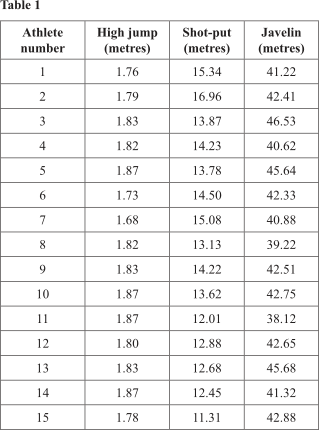
Fifteen female athletes competed to qualify for the heptathlon at the Olympic Games.

Their results for three of the heptathlon events – high jump, shot-put and javelin – are shown in Table 1

  1. Write down the number of numerical variables in Table 1.   (1 mark)

    --- 2 WORK AREA LINES (style=lined) ---

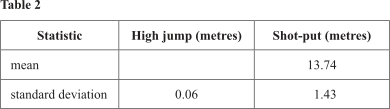
  2. Complete Table 2 below by calculating the mean height jumped for the high jump, in metres, by the 15 athletes. Write your answer in the space provided in the table.   (1 mark)

    --- 0 WORK AREA LINES (style=lined) ---

  3. In shot-put, athletes throw a heavy spherical ball (a shot) as far as they can. Athlete number six, Jamilia, threw the shot 14.50 m.
  4. Calculate Jamilia's standardised score (`z`). Round your answer to one decimal place.   (1 mark)

    --- 3 WORK AREA LINES (style=lined) ---

  5. In the qualifying competition, the heights jumped in the high jump are expected to be approximately normally distributed.
  6. Chara's jump in this competition would give her a standardised score of  `z = –1.0`
  7. Use the 68–95–99.7% rule to calculate the percentage of athletes who would be expected to jump higher than Chara in the qualifying competition.   (1 mark)

    --- 2 WORK AREA LINES (style=lined) ---

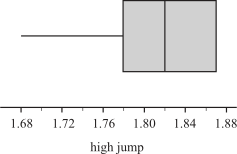
  8. The boxplot below was constructed to show the distribution of high jump heights for all 15 athletes in the qualifying competition.


  1. Explain why the boxplot has no whisker at its upper end.   (1 mark)

    --- 2 WORK AREA LINES (style=lined) ---

  2. For the javelin qualifying competition (refer to Table 1), another boxplot is used to display the distribution of athlete's results.
  3. An athlete whose result is displayed as an outlier at the upper end of the plot is considered to be a potential medal winner in the event.
  4. What is the minimum distance that an athlete needs to throw the javelin to be considered a potential medal winner?   (2 marks)

    --- 5 WORK AREA LINES (style=lined) ---

Show Answers Only

  1. `3`
  2. `1.81`
  3. `0.5 \ text{(to d.p.)}`
  4. `84text(%)`
  5. `text{See Worked Solutions}`
  6. `46.89 \ text{m}`

Show Worked Solution

a.    `3 \ text{High jump, shot-put and javelin}`

 `text{Athlete number is not a numerical variable}`
  

b.     `text{High jump mean}`

`= (1.76 + 1.79 + 1.83 + 1.82 + 1.87 + 1.73 + 1.68 + 1.82 +`

`1.83 + 1.87 + 1.87 + 1.80 + 1.83 + 1.87 + 1.78) ÷ 15`

`= 1.81`
 

c.   `z text{-score} (14.50)` `= {14.50-13.74}/{1.43}`
    `= 0.531 …`
    `= 0.5 \ text{(to 1 d.p.)}`

 
d.  `P (z text{-score} > -1 ) = 84text(%)`
 

e.  `text{If the} \ Q_3 \ text{value is also the highest value in the data set,}`

`text{there is no whisker at the upper end of a boxplot.}`
 

f.  `text{Javelin (ascending):}`

`38.12, 39.22, 40.62, 40.88, 41.22, 41.32, 42.33, 42.41, `

`42.51, 42.65, 42.75, 42.88, 45.64, 45.68, 46.53`

`Q_1 = 40.88 \ \ , \ Q_3 = 42.88 \ \ , \ \ IQR = 42.88-40.88 = 2`

`text{Upper Fence}` `= Q_3 + 1.5  xx IQR`
  `= 42.88 + 1.5 xx 2`
  `= 45.88`

 
`:. \ text{Minimum distance = 45.89 m  (longer than upper fence value)}`

Filed Under: Graphs - Stem/Leaf and Boxplots, Normal Distribution, Summary Statistics Tagged With: Band 2, Band 3, Band 4, smc-468-20-Mean, smc-468-50-IQR / Outliers, smc-600-10-Single z-score, smc-643-10-Single Box-Plots

GRAPHS, FUR1 2021 VCAA 1 MC

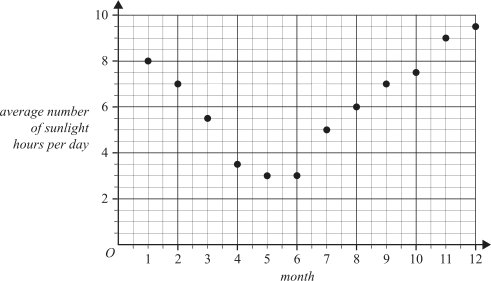
The graph below shows the average number of sunlight hours per day for each month of a particular year.
 

The number of months for which the average number of sunlight hours per day was recorded as being below four hours is 

  1. 2
  2. 3
  3. 4
  4. 5
  5. 6
Show Answers Only

`B`

Show Worked Solution

`text{3 points are below 4 (on}\ y text{-axis)}`

`=> B`

Filed Under: Graph Applications Tagged With: Band 2

NETWORKS, FUR1 2021 VCAA 2 MC

Five friends ate fruit for morning tea.

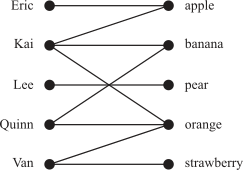
The bipartite graph below shows which types of fruit each friend ate.
 

Which one of the following statements is not true?

  1. Only Lee ate pear.
  2. Eric and Kai each ate apple.
  3. Van ate only strawberry.
  4. Quinn and Kai each ate banana.
  5. Orange was the most eaten type of fruit.
Show Answers Only

`C`

Show Worked Solution

`text{Consider option C}`

`text{Van ate strawberry and orange}`

`:.  text{Statement is not true.}`

`=> C`

Filed Under: Matching Problems Tagged With: Band 2, smc-623-20-Other Matching

NETWORKS, FUR1 2021 VCAA 1 MC

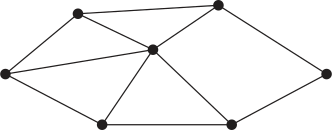
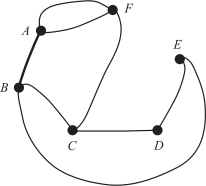
Consider the graph below.
 

The number of vertices with a degree of 3 is

  1. 1
  2. 2
  3. 3
  4. 4
  5. 5
Show Answers Only

`E`

Show Worked Solution

`text{Five vertices have a degree 3}`

`=> E`

Filed Under: Basic Concepts Tagged With: Band 2, smc-626-20-Degrees of Vertices

CORE, FUR1 2021 VCAA 18-19 MC

Deepa invests $500 000 in an annuity that provides an annual payment of $44 970.55

Interest is calculated annually.

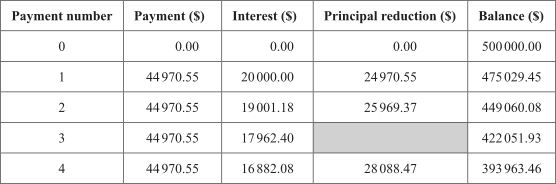
The first five lines of the amortisation table are shown below.
 

Part 1

The principal reduction associated with payment number 3 is

  1. $17 962.40
  2. $25 969.37
  3. $27 008.15
  4. $28 088.47
  5. $44 970.55


Part 2

The number of years, in total, for which Deepa will receive the regular payment of `$44\ 970.55` is closest to

  1. 12
  2. 15
  3. 16
  4. 18
  5. 20
Show Answers Only

`text(Part 1:)\ C`

`text(Part 2:)\ B`

Show Worked Solution

`text{Part 1}`

`text{Principal reduction}` `= 449\ 060.08 – 422\ 051.93`
  `= 27\ 008.15`

`=> C`
 

`text{Part 2}`

♦ Mean mark part (2) 44%.

`text{Interest rate} = {20\ 000}/{500\ 000} = 4text{% p.a.}`
 

`text{Find}\ N\ text{by TVM solver:}`

`N` `= ?`
`I(%)` `= 4`
`PV` `= -500\ 000`
`PMT` `= 44\ 970.55`
`FV` `= 0`
`text(P/Y)` `= text(C/Y) = 1`

 
`:. N = 15.000`

`=> B`

Filed Under: Annuities and Perpetuities Tagged With: Band 2, Band 5, smc-2512-30-Annuity Amortisation Table, smc-2512-50-CAS solver

Vectors, EXT2 V1 2021 HSC 11c

Find the angle between the vectors  `underset~a = ((2),(0),(4))`  and  `underset~b = ((-3),(1),(2))`, giving the angle in degrees correct to 1 decimal place. (3 marks)

Show Answers Only

`83.1^@`

Show Worked Solution

`underset~a = ((2),(0),(4)) \ , \ |underset~a| \ = sqrt{2^2 + 4^2} = sqrt20`

`underset~b = ((-3),(1),(2)) \ , \ |underset~b| \ = sqrt{(-3)^2 + 1^2 + 2^2} = sqrt14`

`underset~a * underset~b` `= ((2),(0),(4)) ((-3),(1),(2)) = – 6 + 0 + 8 = 2`
`underset~a * underset~b` `= |underset~a| |underset~b| \ cos theta`
`2` `= sqrt20 sqrt14 \ cos theta`
`cos theta` `= 2/sqrt280`
`theta` `= cos^(-1) (1/sqrt70)`
  `= 83.1^@ \ text{(1 d.p,)}`

Filed Under: Basic Concepts and Arithmetic Tagged With: Band 2, smc-1195-20-Angles Between Vectors

Complex Numbers, EXT2 N1 2021 HSC 11b

Find  `overset5 underset{n=1}∑ (i)^n`. (2 marks)

Show Answers Only

`i`

Show Worked Solution
`overset5 underset{n=1}∑ (i)^n` `= i + i^2 + i^3 + i^4 + i^5`
  `= i – 1 – i + 1 + i`
  `= i`

Filed Under: Arithmetic of Complex Numbers Tagged With: Band 2, smc-1048-30-Other

Complex Numbers, EXT2 N1 2021 HSC 11a

The complex numbers  \(z=2 e^{i\small{\dfrac{\pi}{2}}}\) and  \(w=6 e^{i \small{\dfrac{\pi}{6}}}\) are given.

Find the value of  \(zw\) , giving the answer in the for  \(r e^{i \theta}\).   (2 marks)

Show Answers Only

\(12 e^{i 2 \small{\dfrac{\pi}{3}}}\)

Show Worked Solution
\(zw\) \(=2 e^{i \small{\dfrac{\pi}{2}}} \cdot 6 e^{i \small{\dfrac{\pi}{6}}}\)  
  \(=12 e^{i \small{\dfrac{\pi}{2}}+i \small{\dfrac{\pi}{6}}}\)  
  \(=12 e^{i \small{\dfrac{2 \pi}{3}}}\)  

Filed Under: Exponential Form Tagged With: Band 2, smc-1191-40-Multiplication

Vectors, EXT2 V1 2021 HSC 3 MC

Which of the following is a vector equation of the line joining the points  `A (4, 2, 5)`  and  `B (–2, 2, 1)`?

  1. `underset~r = ((4), (2), (5)) + λ ((1),(2),(3))`
  2. `underset~r = ((4), (2), (5)) + λ ((3),(0),(2))`
  3. `underset~r = ((1), (2), (3)) + λ ((4),(2),(5))`
  4. `underset~r = ((3), (0), (2)) + λ ((4),(2),(5))`
Show Answers Only

`B`

Show Worked Solution
`overset->{AB}` `= ((-2),(2),(1)) – ((4),(2),(5)) = ((-6),(0),(-4))`  
`underset~r` `= ((4),(2),(5)) + λ_1 ((-6),(0),(-4))`  
  `= ((4), (2), (5)) + λ_2 ((3),(0),(2))`  

 
`=>\ B`

Filed Under: Vectors and Vector Equations of Lines Tagged With: Band 2, smc-1196-10-Find line given 2 points, smc-1196-80-3D vectors

Calculus, EXT2 C1 2021 HSC 2 MC

Which expression is equal to  `int x^5 e^{7x} dx`?

  1. `1/7 x^5 e^{7x} - 5/7 int x^4 e^{7x} dx`
  2. `1/7  x^5 e^{7x} - 5/7 int x^5 e^{7x} dx`
  3. `5/7 x^4 e^{7x} - 5/7 int x^4 e^{7x} dx`
  4. `5/7  x^4 e^{7x} - 5/7 int x^5 e^{7x} dx`
Show Answers Only

`A`

Show Worked Solution
`u = x^5`   `v^{′} = e^{7x}`
`u^{′} = 5x^4`   `v = 1/7 e^{7x}`
`int uv^{′}\ dx` `= uv-int u^{′}v \ dx`  
  `= 1/7  x^5 e^{7x}-5/7 int x^4 e^{7x}\ dx`  

 
`=>\ A`

Filed Under: Integration By Parts, Integration By Parts (SM) Tagged With: Band 2, smc-1055-20-Exponential, smc-5134-20-Exponential

Vectors, EXT2 V1 2021 HSC 1 MC

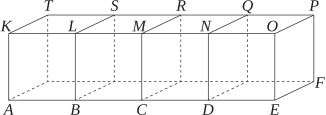
Four cubes are placed in a line as shown on the diagram.


Which of the following vectors is equal to `overset->{AB}  +  overset->{CQ}`

  1. `overset->{AQ}`
  2. `overset->{CP}`
  3. `overset->{PB}`
  4. `overset->{RA}`
Show Answers Only

`B`

Show Worked Solution
`overset->{AB} \ + \ overset->{CQ}` `= overset->{CD} + overset->{DP}`  
  `= overset->{CP}`  

`=>\ B`

Filed Under: Vectors and Geometry Tagged With: Band 2, smc-1210-10-Cube/Rect Prism, smc-1210-70-3D problems

Vectors, EXT1 V1 2021 HSC 11a

Find  `(underset~i + 6underset~j) + (2underset~i - 7underset~j)`.  (1 mark)

Show Answers Only

`3underset~i – underset~j`

Show Worked Solution

`((1),(6)) + ((2),(-7)) = ((3),(-1)) = 3underset~i – underset~j`

Filed Under: Operations With Vectors (Ext1) Tagged With: Band 2, smc-1195-10-Basic Calculations

Calculus, EXT1 C2 2021 HSC 2 MC

Which of the following integrals is equivalent to `int sin^2 3x\ dx`?

  1. `int (1 + cos6x)/2 dx`
  2. `int (1 - cos6x)/2 dx`
  3. `int (1 + sin6x)/2 dx`
  4. `int (1 - sin6x)/2 dx`
Show Answers Only

`B`

Show Worked Solution

`int sin^2 3x\ dx = 1/2 int (1 – cos6x) dx`

`=>\ B`

Filed Under: Harder Trig Calculus (Ext1) Tagged With: Band 2, smc-1038-10-Integrate sin^2(x)

Measurement, STD1 M4 2021 HSC 23

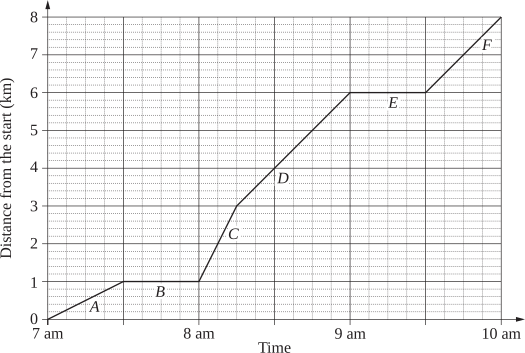
Sue walks along a trail, starting at 7 am and finishing at 10 am. The travel graph shows Sue’s journey from the start to the finish. The journey has been broken into six sections, `A`, `B`, `C`, `D`, `E` and `F`.


  1. On two occasions Sue stopped to rest. In which sections of the journey did Sue rest?  (1 mark)

    --- 2 WORK AREA LINES (style=lined) ---

  2. In which section of the journey did Sue travel fastest? Justify your answer.  (2 marks)

    --- 4 WORK AREA LINES (style=lined) ---

  3. Kim walked along the same trail, also starting at 7 am and finishing at 10 am. Kim walked at a constant speed for the entire journey.
  4. By showing Kim’s journey on the grid above, determine between what times Sue was ahead of Kim.  (3 marks)

    --- 6 WORK AREA LINES (style=lined) ---

Show Answers Only
  1. `B\ text(and)\ E`
  2. `text(S)text(ection)\ C.\ text(Slope is the steepest.)`
  3.  `text(8:30 am – 9:15 am)`
     
       
Show Worked Solution

a.   `B\ text(and)\ E`

♦ Mean mark part (b) 44%.


b.   `text(Fastest travel occurs when the slope is the steepest.)`

♦♦ Mean mark part (c) 30%.

`:. text(S)text(ection)\ C`

c.

`text(Sue was ahead when her graph is higher than Kim’s.)`

`:.\ text(She was ahead between 8:30 am – 9:15 am)`

Filed Under: M4 Rates (Y12) Tagged With: Band 2, Band 5, smc-1104-10-Travel Graphs

Networks, STD1 N1 2021 HSC 1 MC

A network diagram is shown.
 

How many vertices are in this network?

  1. 5
  2. 6
  3. 7
  4. 8
Show Answers Only

`B`

Show Worked Solution

`text(Vertices = 6)`

`=> B`

Filed Under: Basic Concepts, Basic Concepts, Network Concepts (Std1-2027) Tagged With: Band 2, num-title-ct-path, num-title-qs-hsc, smc-1136-30-Definitions, smc-4788-10-Definitions

Measurement, STD2 M1 2021 HSC 1 MC

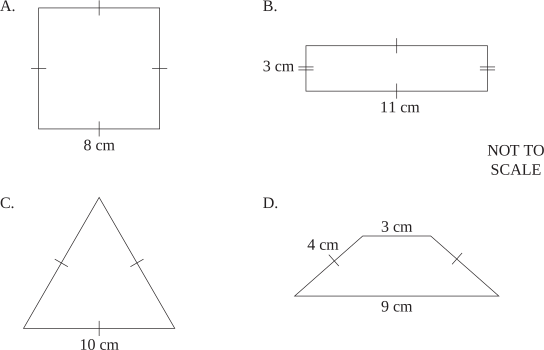
Which of the following shapes has the largest perimeter?
 

Show Answers Only

`A`

Show Worked Solution

`\text{Consider each option:}`

`\text{Option A:} \ 4 \times 8 = 32 \ \text{cm}`

`\text{Option B:} \ 2 \times (3 + 11) = 28 \ \text{cm}`

`\text{Option C:} \ 3 \times 10 = 30 \ \text{cm}`

`\text{Option D:} \ 4 \times 2 + 3 + 9 = 20 \ \text{cm}`
 

`=> A`

Filed Under: Perimeter and Area (Std 1), Perimeter and Area (Std1-2027), Perimeter and Area (Std2-2027), Perimeter, Area and Volume (Std 2) Tagged With: Band 2, smc-1121-10-Perimeter and Area, smc-6483-10-Perimeter, smc-6520-10-Perimeter, smc-798-10-Perimeter and Area

Number and Algebra, NAP-G1-07v1

A dairy farmer owned 28 cows and bought another 34 cows.

How many cows did he now own altogether?

`6` `52` `56` `62`


Show Answers Only

`62`

Show Worked Solution
`text(Number of cows)` `=28+34`
  `=58+4`
  `=62`

Filed Under: Solving Problems - Add/Subtract, TESTLET C Tagged With: Band 2

Number and Algebra, NAP-B1-05 SA v1

Write eight hundred and two as a number.

Show Answers Only

`802`

Show Worked Solution

`802`

Filed Under: Number and Place Value, TESTLET C Tagged With: Band 2, smc-708-60-Place Value

NETWORKS, FUR2 2020 VCAA 1

The Sunny Coast Cricket Club has five new players join its team: Alex, Bo, Cameron, Dale and Emerson.

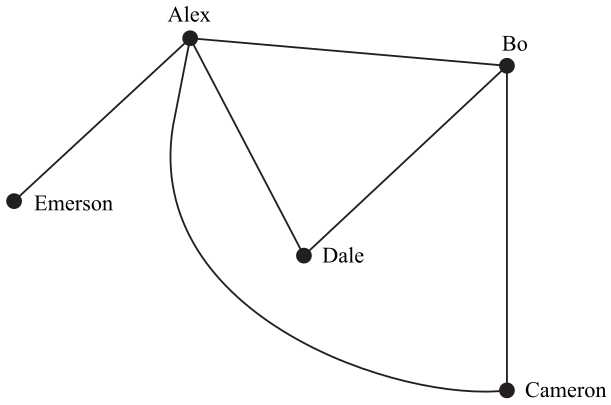
The graph below shows the players who have played cricket together before joining the team.

For example, the edge between Alex and Bo shows that they have previously played cricket together.
 

  1. How many of these players had Emerson played cricket with before joining the team?   (1 mark)

    --- 1 WORK AREA LINES (style=lined) ---

  2. Who had played cricket with both Alex and Bo before joining the team?   (1 mark)

    --- 1 WORK AREA LINES (style=lined) ---

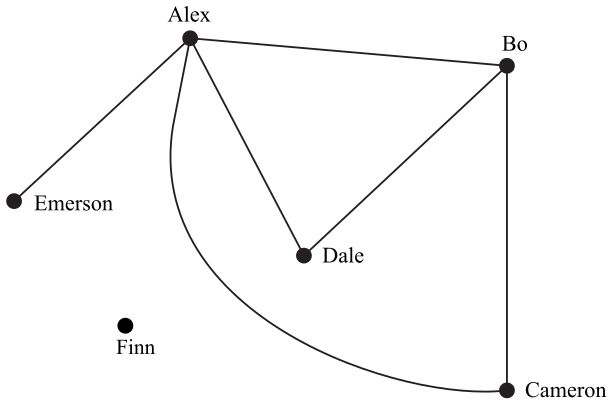
  3. During the season, another new player, Finn, joined the team.


    Finn had not played cricket with any of these players before.


    Represent this information on the graph above.   (1 mark)

    --- 0 WORK AREA LINES (style=lined) ---

Show Answers Only
  1. `text(one)`
  2. `text(Dale)`
  3.  
Show Worked Solution

a.  `text{One (one edge connected to Emerson.)}`
  

b.  `text{Dale (he has edges directly connected to Alex and Bo.)}`


c.  

Filed Under: Basic Concepts Tagged With: Band 2, Band 4, smc-626-10-Definitions

CORE, FUR2 2020 VCAA 7

Samuel owns a printing machine.

The printing machine is depreciated in value by Samuel using flat rate depreciation.

The value of the machine, in dollars, after `n` years, `Vn` , can be modelled by the recurrence relation

`V_0 = 120\ 000, qquad V_(n+1) = V_n-15\ 000`

  1. By what amount, in dollars, does the value of the machine decrease each year?   (1 mark)

    --- 1 WORK AREA LINES (style=lined) ---

  2. Showing recursive calculations, determine the value of the machine, in dollars, after two years.   (1 mark)

    --- 2 WORK AREA LINES (style=lined) ---

  3. What annual flat rate percentage of depreciation is used by Samuel?   (1 mark)

    --- 2 WORK AREA LINES (style=lined) ---

  4. The value of the machine, in dollars, after `n` years, `V_n`, could also be determined using a rule of the form `V_n = a + bn`.


    Write down this rule for `V_n`.   (1 mark)

    --- 2 WORK AREA LINES (style=lined) ---

Show Answers Only
  1. `$15\ 000`
  2. `$90\ 000`
  3. `12.5%`
  4. `V_n = 120\ 000-15\ 000n, n = 0, 1, 2, …`
Show Worked Solution

a. `$15\ 000`
  

b.   `V_1` `= 120\ 000-15\ 000 = $105\ 000`
  `V_2` `= 105\ 000-15\ 000 = $90\ 000`


c.   `text(Flat rate percentage` `= (15\ 000)/ (120\ 000) xx 100`
    `= 12.5 text(%)`


♦ Mean mark part d. 44%.

d.  `V_n = 120\ 000-15\ 000n, \ n = 0, 1, 2, …`

Filed Under: Depreciation, Recursion - Financial Tagged With: Band 1, Band 2, Band 4, smc-602-50-Recurrence relation, smc-717-50-Depreciation (SL)

CORE, FUR2 2020 VCAA 4

The age, in years, body density, in kilograms per litre, and weight, in kilograms, of a sample of 12 men aged 23 to 25 years are shown in the table below.
 

          Age       
(years)

        Body density        
(kg/litre)

        Weight        
(kg)

  23 1.07 70.1
  23 1.07 90.4
  23 1.08 73.2
  23 1.08 85.0
  24 1.03 84.3
  24 1.05 95.6
  24 1.07 71.7
  24 1.06 95.0
  25 1.07 80.2
  25 1.09 87.4
  25 1.02 94.9
  25 1.09 65.3
     
  1. For these 12 men, determine
  2.  i. their median age, in years.   (1 mark)

    --- 2 WORK AREA LINES (style=lined) ---

  3. ii. the mean of their body density, in kilograms per litre.   (1 mark)

    --- 2 WORK AREA LINES (style=lined) ---

  4. A least squares line is to be fitted to the data with the aim of predicting body density from weight.
  5.  i. Name the explanatory variable for this least squares line.   (1 mark)

    --- 1 WORK AREA LINES (style=lined) ---

  6. ii. Determine the slope of this least squares line.
  7.     Round your answer to three significant figures.   (1 mark)

    --- 1 WORK AREA LINES (style=lined) ---

  8. What percentage of the variation in body density can be explained by the variation in weight?
  9. Round your answer to the nearest percentage.   (1 mark)

    --- 2 WORK AREA LINES (style=lined) ---

Show Answers Only
  1.  i. `24`
  2. ii. `1.065\ text(kg/litre)`
  3. i. `text(Weight)`
  4. ii. `text(Slope) = -0.00112\ text{(by CAS)}`
  5. `29 text(%)`
Show Worked Solution
a.i.   `n = 12`  
  `text(Median)` `= (text{6th + 7th})/2`
    `= (24 + 24)/2`
    `= 24`


a.ii.   `text(Mean)` `= (∑\ text{body density})/12`
    `= 1.065\ text(kg/litre)`


b.i.   `text(Weight)`

♦ Mean mark b.ii. 29%.
MARKER’S COMMENT: Most students did not round correctly.

b.ii.   `text(Slope) = -0.00112\ text{(by CAS)}`


c.   `r` `= -0.53847\ text{(by CAS)}`
  `r^2` `= 0.289…`

 
`:. 29 text(%)`

Filed Under: Correlation and Regression Tagged With: Band 2, Band 3, Band 4, Band 5, smc-265-10-r / r^2 and Association, smc-265-20-Find LSRL Equation/Gradient, smc-265-75-Explanatory / Response

  • « Previous Page
  • 1
  • 2
  • 3
  • 4
  • 5
  • 6
  • …
  • 10
  • Next Page »

Copyright © 2014–2025 SmarterEd.com.au · Log in