SmarterEd

Aussie Maths & Science Teachers: Save your time with SmarterEd

  • Login
  • Get Help
  • About

Integration, 2UA 2012 HSC 12d

At a certain location a river is `12` metres wide. At this location the depth of the river, in metres, has been measured at `3` metre intervals. The cross-section is shown below.
 

2012 12d
 

  1. Use Simpson's rule with the five depth measurements to calculate the approximate area of the cross-section   (3 marks)
  2. The river flows at 0.4 metres per second.
  3. Calculate the approximate volume of water flowing through the cross-section in 10 seconds.   (1 mark)
  4.  
Show Answers Only
  1. `32.8 \ text(m²)`
  2. `131.2 \ text(m³)`  
Show Worked Solution
(i)    `A` `~~ h/3 [y_0 + 4y_1 + 2y_2 +4y_3 +y_4 ]`
  `~~3/3 [ 0.5 + (4xx2.3) + (2xx2.9) + (4xx3.8) + 2.1 ]`
  `~~ [ 0.5 + 9.2 + 5.8 + 15.2 + 2.1 ]`
  `~~ 32.8\  text(m²)`


♦ Over half of the students examined answered part (ii) incorrectly. 
(ii)  `text(Distance water flows)`  `= 0.4 xx 10`
  `= 4 \ text(metres)`


`text(Volume flow in 10 seconds)` `~~ 4 xx 32.8`
  `~~ 131.2  text(m³)`

Filed Under: Trapezoidal and Simpson's Rule Tagged With: Band 3, Band 4

Functions, EXT1* F1 2012 HSC 11b

 Solve  `|\ 3x -1\ | < 2`   (2 marks)

Show Answers Only

 ` -1/3 < x < 1 `

Show Worked Solution
 MARKER’S COMMENT: Note that both conditions must be satisfied! Dealing with negative signs and division for inequalities produced many errors.

`|\ 3x -1\ | < 2`

`3x -1` `<2`  `\ \ \ \ \-(3x -1)` `< 2`
`3x`  `<3` `-3x + 1` `< 2`
`x` `< 1`  `3x` `> -1`
    `x` `> -1/3`

`:. -1/3 < x < 1`

Filed Under: Inequalities (Ext1), Inequalities and Absolute Values Tagged With: Band 3, smc-1033-20-Absolute Value

Functions, 2ADV F1 2012 HSC 11a

 Factorise  `2x^2 - 7x +3`   (2 marks)

Show Answers Only

 `(2x -1)(x-3)`

Show Worked Solution

          `2x^2 – 7x +3`

STRATEGY: Check your answer by expanding factors.

`= (2x -1)(x-3)`


Filed Under: Factors and Other Equations, Quadratics and Cubic Functions (Adv-2027), Quadratics and Cubic Functions (Y11) Tagged With: Band 3, smc-6215-10-Quadratics, smc-6215-40-Factorise, smc-984-10-Quadratics

Calculus, 2ADV C1 2012 HSC 11c

Find the equation of the tangent to the curve  `y = x^2`  at the point where  `x = 3`.   (2 marks)

--- 5 WORK AREA LINES (style=lined) ---

Show Answers Only

`6x-y-9 = 0 `

Show Worked Solution
`y` `=x^2`
`dy/dx` `=2x`


`text{Need to find equation with m = 6, through (3,9) }`

`text(When) \  x = 3, y = 9, dy/dx = 6`

`text(Using)\ \ \ y-y_1`  `= m (x-x_1)`
`y -9`  `= 6(x -3)`
`y -9`  `= 6x -18`
`6x -y -9` `=0`


 `:.\ text( Equation of the tangent is 6x-y-9 = 0)`


Filed Under: Tangents (Adv-2027), Tangents (Y11), Tangents and Normals Tagged With: Band 3, smc-6437-10-Find Tangent Equation, smc-973-10-Find Tangent Equation

Functions, 2ADV F1 2012 HSC 2 MC

Which of the following is equal to  `1/(2sqrt5-sqrt3)`? 

  1. `(2sqrt5\-sqrt3)/7`  
  2. `(2sqrt5 + sqrt3)/7`
  3. `(2sqrt5\-sqrt3)/17` 
  4. `(2sqrt5 + sqrt3)/17` 
Show Answers Only

`D`

Show Worked Solution

`1/(2sqrt5\-sqrt3) xx (2sqrt5 + sqrt3)/(2sqrt5 + sqrt3)`

`= (2sqrt5 + sqrt3)/( (2sqrt5\-sqrt3)(2sqrt5 + sqrt3) )`

`= (2sqrt5 + sqrt3)/{(2sqrt5)^2-(sqrt3)^2)`

`= (2sqrt5 + sqrt3)/17`

 
`=>  D`

Filed Under: Algebraic Techniques (Adv-2027) Tagged With: Band 3, smc-6213-30-Surd Denominators, syllabus-2027

Functions, 2ADV F1 2012 HSC 1 MC

What is  `4.097 84`  correct to three significant figures?  

  1. `4.09`  
  2. `4.10`  
  3. `4.097`  
  4. `4.098` 
Show Answers Only

`B`

Show Worked Solution

`4.10`

`=>  B`

Filed Under: Algebraic Techniques (Adv-2027), Algebraic Techniques (Y11), Surds and Rounding Tagged With: Band 3, smc-6213-60-Rounding, smc-983-10-Rounding

Linear Functions, 2UA 2013 HSC 12b

The points  `A(–2, –1)`,  `B(–2, 24)`,  `C(22, 42)` and  `D(22, 17)` form a parallelogram as shown. The point  `E(18, 39)` lies on  `BC`. The point  `F`  is the midpoint of  `AD`.
 

2013 12b
 

  1. Show that the equation of the line through  `A`  and  `D`  is  `3x- 4y + 2 = 0`.    (2 marks)
  2. Show that the perpendicular distance from  `B`  to the line through  `A`  and  `D`  is  `20`  units.   (1 mark)
  3. Find the length of  `EC`.    (1 mark)
  4. Find the area of the trapezium  `EFDC`.    (2 marks)
Show Answers Only
  1. `3x-4y+2=0`
  2. `text(Proof)\  text{(See Worked Solutions)}`
  3. `text(5 units)`
  4. `200\  text(u²)`
Show Worked Solution
(i)    `text(Need to find the equation of)\ AD`
`m_(AD)` `= (y_2\-y_1)/(x_2\-x_1)`
  `= (17+1)/(22+2)`
  `= 18/24`
  `= 3/4`

`text(Equation of)\ AD\ text(has)\ m=3/4 text(, through)\ A text{(–2,–1)}`

`text(Using)\ y\-y_1` `= m (x\-x_1)`
`y+1` `=3/4 (x +2)`
`4y+4` `=3x+6`
`3x-4y+2` `=0`
MARKER’S COMMENT: Students must know the perpendicular distance formula which was again the cause of many errors such that it was flagged by markers.
 

(ii)    `B(–2,24)`
  `AD\ text(is)\  \ 3x -4y+2 =0`
`_|_ text(dist)` `= | (ax_1 + by_1 + c)/sqrt(a^2 + b^2) |`
  `= | (3(–2)\-4(24) + 2)/sqrt(3^2 + (–4)^2 )|`
  `= | (-6\ -96 +2)/sqrt25 |`
  `= | -100/5 |`
  `= 20\ text(units)`


`:.\ _|_ text(dist of)\ B\ text(from)\ AD = 20\ text(units   … as required)`


(iii)   `E(18,39)\ \ \ C(22,42)`
`EC` `=sqrt ( (x_2\-x_1)^2 + (y_2\-y_1)^2 )`
  `= sqrt ( (22\-18)^2 + (42\-39)^2 )`
  `= sqrt (4^2 + 3^2)`
  `= sqrt25`
  `= 5\ text(units)`


`:.\ text(The length of)\ EC\ text(is 5 units.)`


(iv)    `text(Area of trapezium)` `=1/2 h (a+b)`
    `=1/2 h (EC + FD)`

`EC = 5\ text(units)`

 MARKER’S COMMENT: One of the most common cause of errors in this part occurred when students failed to use the result found in part (ii).

`text(Need to find)\ FD`

`text(S)text(ince)\ FD = 1/2 xx AD\ \ \ ( F\ text(is midpoint) )`

`A (–2,–1)\ \ D(22,17)`

`AD` `=sqrt( (22 + 2) + (17 + 1)^2 )`
  `= sqrt (24^2 + 18^2)`
  `= sqrt (900)`
  `= 30`

`=> FD = 1/2 xx 30 = 15`

`text(S)text(ince)\ ABCD\ text(is a parallelogram)`

`h` `= _|_ text(distance in part)\ text{(i)}`
  `= 20`
`:.\ text(Area of trapezium)` `=1/2 xx 20 (5 + 15)`
  `=200\  text(u²)`

Filed Under: 6. Linear Functions Tagged With: Band 2, Band 3, Band 4

Calculus, 2ADV C3 2013 HSC 12a

The cubic  `y = ax^3 + bx^2 + cx + d`  has a point of inflection at  `x = p`. 

Show that  `p= - b/(3a)`.   (2 marks)

--- 5 WORK AREA LINES (style=lined) ---

Show Answers Only

 `text(Proof)\ \ text{(See Worked Solutions)}`

Show Worked Solution

`text(Show)\ \ p= – b/(3a)`

`y` `=ax^3 + bx^2 + cx + d`
`y prime` `=3ax^2 + 2bx + c`
`y″` `=6ax + 2b`

 
`text(Given P.I. occurs when)\ \ x = p`

`=> y″=0\ \ text(when)\ \ x=p`

`:.\ 6ap + 2b` `=0`
`6ap` `=-2b`
`p` `= -(2b)/(6a)`
  `=-b/(3a)\ \ \ text(… as required)`

Filed Under: Curve Sketching and The Primitive Function, The Derivative Function and its Graph (Y12) Tagged With: Band 3, smc-1089-50-Other

Calculus, 2ADV C2 2013 HSC 11c

Differentiate  `(sinx -1)^8`.   (2 marks)

Show Answers Only

 `8cosx (sinx -1)^7`

Show Worked Solution

`y= (sinx – 1)^8`

`dy/dx` `=8 (sinx -1)^7 xx d/dx (sinx -1)`
  `=8 (sinx – 1)^7 xx cosx`
  `=8cosx (sinx – 1)^7`

Filed Under: Differentiation and Integration, Trig Differentiation, Trig Differentiation (Y12) Tagged With: Band 3, smc-968-10-Sin, smc-968-60-Chain Rule

Functions, 2ADV F1 2013 HSC 11a

Evaluate  `ln3`  correct to three significant figures.   (1 mark)  

Show Answers Only

 `1.10\ \ \ text{(to 3 sig. figures)}`

Show Worked Solution
`ln3` `=1.09861…`
  `=1.10\ \ \ text{(to 3 sig. figures)}`

Filed Under: Algebraic Techniques (Adv-2027), Algebraic Techniques (Y11), Surds and Rounding Tagged With: Band 3, smc-6213-60-Rounding, smc-983-10-Rounding

Functions, 2ADV F1 2013 HSC 1 MC

What are the solutions of   `2x^2-5x-1 = 0`? 

  1. `x = (-5 +-sqrt17)/4` 
  2. `x = (5 +-sqrt17)/4`
  3. `x = (-5 +-sqrt33)/4`
  4. `x = (5 +-sqrt33)/4`
Show Answers Only

`D`

Show Worked Solution

`2x^2-5x-1 = 0`

`text(Using)\ x = (-b +- sqrt( b^2-4ac) )/(2a)`

`x` `= (5 +- sqrt{\ \ (-5)^2-4 xx 2 xx(-1) })/ (2 xx 2)`
  `= (5 +- sqrt(25 + 8) )/4`
  `= (5 +- sqrt(33) )/4`

 
`=>  D`

Filed Under: Factors and Other Equations, Quadratics and Cubic Functions (Adv-2027), Quadratics and Cubic Functions (Y11), Quadratics and Cubics Tagged With: Band 3, num-title-ct-pathc, num-title-qs-hsc, smc-4386-40-Quadratic formula, smc-6215-10-Quadratics, smc-6215-15-Quadratic Formula, smc-984-10-Quadratics

Financial Maths, STD2 F1 2010 HSC 23d

Warrick has a net income of $590 per week. He has created a budget to help manage his money.

       2010 23d

  1. Find the value of `X`, the amount that Warrick allocates towards electricity each week.    (1 mark)

    --- 1 WORK AREA LINES (style=lined) ---

  2. Warrick has an unexpectedly high telephone and internet bill. For the last three weeks, he has put aside his savings as well as his telephone and internet money to pay the bill.


    How much money has he put aside altogether to pay the bill?    (1 mark)

    --- 2 WORK AREA LINES (style=lined) ---

  3. The bill for the telephone and internet is $620. It is due in two weeks time. Warrick realises he has not put aside enough money to pay the bill.


    How could Warrick reallocate non-essential funds in his budget so he has enough money to pay the bill? Justify your answer with suitable reasons and calculations.   (3 marks)

    --- 6 WORK AREA LINES (style=lined) ---

Show Answers Only
  1. `$25`
  2. `text(Warwick has put aside $240 to pay the bill.)`
  3. `text(Warwick could reallocate funds for Entertainment and`
  4.  

    `text(Clothes and Gifts to pay the bill.)`

Show Worked Solution
i.    `X` `= 590 ` `-(175 + 45 + 10 + 15 + 90`
      `+ 40 + 30 + 70 + 50 + 40)`
    `= 590-565`
    `= $25`


ii.    `text(Weekly Amount)` `= 40 + 40`
    `= 80`
`text{Total (3 weeks)}` `= 3 xx 80`
  `= 240`

 
`:.\ text(Warwick has put aside $240 to pay the bill.)`


(iii)   `text(Amount required less amount put aside)`
  `= 620\-240`
  `= $380`

 
`text(Extra 2 weeks of savings and telephone)`

`= 2 xx (40 + 40)`

`= $160`
 

`:.\ text(Funds to be reallocated)`

`= 380\-160`

`= 220\ text(over 2 weeks)`

`= $110\ text(per week)`
 

`text(Non essential items are Entertainment)`

`text(and Clothes and Gifts)`

`text(Amount)` `= 70 + 50`
  `= $120\ text(per week)`


`:.\ text(Warwick could reallocate funds for Entertainment)`

`text(and Clothes and Gifts to pay the bill.)`

Filed Under: Budgeting (Std2-2027), Earning Money and Budgeting (Std 1), Earning Money and Budgeting (Std 2), FM1 - Earning money Tagged With: Band 1, Band 3, Band 4, smc-1126-30-Budgeting, smc-6279-10-Personal Budget, smc-810-30-Budgeting

Measurement, STD2 M7 2011 HSC 24a

Part of the floor plan of a house is shown. The plan is drawn to scale.

2011 24a

  1. What is the width of the stairwell, in millimetres?   (1 mark)

    --- 2 WORK AREA LINES (style=lined) ---

  2. What are the internal dimensions of the bathroom, in millimetres?    (1 mark)

    --- 2 WORK AREA LINES (style=lined) ---

  3. What is the length `AB`, the internal length of the rumpus room, in millimetres?   (1 mark)

    --- 2 WORK AREA LINES (style=lined) ---

Show Answers Only
  1. `900\  text(mm)`
  2. `2000\  text(mm) xx 2000\  text(mm)`
  3. `9695\  text(mm)`
Show Worked Solution
i.      `900\  text(mm)`


ii.     `2000\  text(mm) xx 2000\  text(mm)`


iii.    `text(Length of Rumpus Room) = AB`
 `AB` `= 3600 + 90 + 2000 + 90 + 3915`
  `=9695\ text(mm)`

Filed Under: M5 Scale Drawings (Y12), Ratio and Scale (Std2), Similarity and Scale Tagged With: Band 3, Band 4, page-break-before-question, smc-1105-10-Floor Plans, smc-1187-50-Floor Plans

Probability, 2UG 2011 HSC 26a

The two spinners shown are used in a game.

2UG 2011 26a1

Each arrow is spun once. The score is the total of the two numbers shown by the arrows.
A table is drawn up to show all scores that can be obtained in this game.

2UG 2011 26a2

  1. What is the value of `X` in the table?   (1 mark)
  2. What is the probability of obtaining a score less than 4?   (1 mark)
  3. On Spinner `B`, a 2 is obtained. What is the probability of obtaining a score of 3?   (1 mark)
  4. Elise plays a game using the spinners with the following financial outcomes.  

⇒ Win `$12` for a score of `4`

⇒ Win nothing for a score of less than `4`

⇒ Lose `$3` for a score of more than `4`

It costs `$5` to play this game. Will Elise expect a gain or a loss and how much will it be?

Justify your answer with suitable calculations.   (3 marks)

Show Answers Only
  1. `5`
  2. `1/2`
  3.  
  4. `2/3`
  5.  
  6. `text(Loss of)\ $1.50`
  7.  
Show Worked Solution

(i)   `X=3+2=5`


(ii)   `P(text{score}<4)=6/12=1/2`


(iii)   `P(3)=2/3`


(iv)   `P(4)=4/12=1/3`

♦ Mean mark 34%
MARKER’S COMMENT: Better responses remembered to deduct the $5 cost to play and recognised the negative result as a loss.
`P(text{score}<4)` `=6/12=1/2`
`P(text{score}>4)` `=2/12=1/6`


`text(Financial Expectation)`

`=(1/3xx12)+(1/2xx0)-(1/6xx3)-5`
`=4-0.5-5`
`=-1.50`


`:.\ text(Elise should expect a loss of $1.50) `

Filed Under: Financial Expectation Tagged With: Band 3, Band 4, Band 5

Probability, STD2 S2 2011 HSC 25c

At another school, students who use mobile phones were surveyed. The set of data is shown in the table.

2UG 2011 25c

  1. How many students were surveyed at this school?  (1 mark)

    --- 1 WORK AREA LINES (style=lined) ---

  2. Of the female students surveyed, one is chosen at random. What is the probability that she uses pre-paid?  (1 mark)

    --- 2 WORK AREA LINES (style=lined) ---

Ten new male students are surveyed and all ten are on a plan. The set of data is updated to include this information.

  1. What percentage of the male students surveyed are now on a plan? Give your answer to the nearest per cent.  (1 mark)

    --- 2 WORK AREA LINES (style=lined) ---

Show Answers Only
  1. `580`
  2. `text(54%)`
  3. `text(42%)`
Show Worked Solution

i.   `text(# Students surveyed)=319+261=580`


ii.   `Ptext{(Female uses prepaid)}=text(# Females on prepaid)/text(Total females)`

  `=172/319`
  `=0.53918…`
  `=\ text{54%  (nearest %)}`


iii.   `text(% Males on plan)` `=text(# Males on plan + 10)/text(Total males + 10)`
  `=(103+10)/(261+10)`
  `=113/271`
  `=0.4169…`
  `=\ text{42%  (nearest %)}`

Filed Under: Relative Frequency, Relative Frequency (Std 1), Relative Frequency (Std 2), Relative Frequency (Y11), Summary Statistics (no graph) Tagged With: Band 2, Band 3, Band 4, common-content, smc-1133-10-Surveys/Two-Way Tables, smc-827-10-Surveys/Two-Way Tables, smc-990-10-Surveys/Two-Way Tables

Statistics, STD2 S1 2011 HSC 25b

The graph below displays data collected at a school on the number of students
in each Year group, who own a mobile phone.
 

2UG 2011 25b
 

  1. Which Year group has the highest percentage of students with mobile phones? (1 mark)

    --- 1 WORK AREA LINES (style=lined) ---

  2. Two students are chosen at random, one from Year 9 and one from Year 10.


    Which student is more likely to own a mobile phone?


    Justify your answer with suitable calculations. (2 marks)

    --- 4 WORK AREA LINES (style=lined) ---

  3. Identify a trend in the data shown in the graph. (1 mark)

    --- 2 WORK AREA LINES (style=lined) ---

Show Answers Only
  1. `text{Year 12 (100%)}`
  2. `text(Year 10)`
  3. `text(See Worked Solutions for detail)`
Show Worked Solution

i.   `text(Year 12 (100%))`

MARKER’S COMMENT: Many students ignore the instruction to use calculations and lose marks as a result.
 

ii.     `text(% Ownership in Year 9)` `=55/70`
    `=\ text{78.6%  (1d.p.)}`
      `text(% Ownership in Year 10)` `=50/60`
    `=\ text{83.3%  (1d.p.)}`

  
`:.\ text(The Year 10 student is more likely to own a mobile phone.)`


iii.   `text(% Ownership increases as students)`

 `text(progress from Year 7 to Year 12.)`

Filed Under: Bar Charts and Histograms, Bar Charts and Histograms (Std 2), Bar Charts and Histograms (Std2-2027), Bar Charts and Histograms (Y12), Bar Charts, Histograms and Other Graphs (Std 1), Displaying Data, Relative Frequency Tagged With: Band 3, Band 4, common-content, num-title-ct-core, num-title-qs-hsc, smc-1128-10-Bar Charts, smc-5076-10-Column graphs and histograms, smc-6310-10-Bar Charts, smc-821-10-Bar Charts, smc-997-10-Bar Charts

Algebra, STD2 A2 2010 HSC 27c

The graph shows tax payable against taxable income, in thousands of dollars.

2010 27c

  1. Use the graph to find the tax payable on a taxable income of $21 000.  (1 mark)

    --- 1 WORK AREA LINES (style=lined) ---

  2. Use suitable points from the graph to show that the gradient of the section of the graph marked  `A`  is  `1/3`.    (1 mark)

    --- 3 WORK AREA LINES (style=lined) ---

  3. How much of each dollar earned between  $21 000  and  $39 000  is payable in tax?   (1 mark)

    --- 2 WORK AREA LINES (style=lined) ---

  4. Write an equation that could be used to calculate the tax payable, `T`, in terms of the taxable income, `I`, for taxable incomes between  $21 000  and  $39 000.   (2 marks)

    --- 4 WORK AREA LINES (style=lined) ---

Show Answers Only
  1. `$3000\ \ \ text{(from graph)}`
  2. `1/3`
  3. `33 1/3\ text(cents per dollar earned)`
  4. `text(Tax payable on)\ I = 1/3 I\-4000`
Show Worked Solution
i.

 `text(Income on)\ $21\ 000=$3000\ \ \ text{(from graph)}`


ii.  `text(Using the points)\ (21,3)\ text(and)\ (39,9)`

♦♦ Mean mark 25%
`text(Gradient at)\ A` `= (y_2\-y_1)/(x_2\ -x_1)`
  `= (9000-3000)/(39\ 000 -21\ 000)`
  `= 6000/(18\ 000)`
  `= 1/3\ \ \ \ \ text(… as required)`


iii.  `text(The gradient represents the tax applicable to each dollar)`

♦♦♦ Mean mark 12%!
MARKER’S COMMENT: Interpreting gradients is an examiner favourite, so make sure you are confident in this area.
`text(Tax)` ` = 1/3\ text(of each dollar earned)`
  ` = 33 1/3\ text(cents per dollar earned)`


iv.  `text( Tax payable up to $21 000 = $3000)`

`text(Tax payable on income between $21 000 and $39 000)`

♦♦♦ Mean mark 15%.
STRATEGY: The earlier parts of this question direct students to the most efficient way to solve this question. Make sure earlier parts of a question are front and centre of your mind when devising strategy.

` = 1/3 (I\-21\ 000)`

`:.\ text(Tax payable on)\ \ I` `= 3000 + 1/3 (I\-21\ 000)`
  `= 3000 + 1/3 I\-7000`
  `= 1/3 I\-4000`

Filed Under: Applications: Currency, Fuel and Other Problems (Std 2), Applications: Currency, Fuel and Other Problems (Std2-2027), Breakeven and Financial modelling, FM3 - Taxation, Linear Functions (Adv-2027), Linear Functions (Y11), Tax and Percentage Increase/Decrease (Std 2), Taxation (Std2-2027) Tagged With: Band 3, Band 5, Band 6, common-content, page-break-before-solution, smc-6214-20-Other Real World Applications, smc-6256-30-Other Linear Applications, smc-6277-10-Tax Tables, smc-793-30-Other Linear Applications, smc-831-10-Tax Tables, smc-985-20-Other Linear Applications

Statistics, STD2 S1 2010 HSC 26b

A new shopping centre has opened near a primary school. A survey is conducted to determine the number of motor vehicles that pass the school each afternoon between 2.30 pm and 4.00 pm.

The results for 60 days have been recorded in the table and are displayed in the cumulative frequency histogram.
 

2010 26b

  1. Find the value of  Χ  in the table.   (1 mark)

    --- 1 WORK AREA LINES (style=lined) ---

  2. On the cumulative frequency histogram above, draw a cumulative frequency polygon (ogive) for this data.   (1 mark)
  3. Use your graph to determine the median. Show, by drawing lines on your graph, how you arrived at your answer.   (1 mark)
  4. Prior to the opening of the new shopping centre, the median number of motor vehicles passing the school between  2.30 pm  and  4.00 pm  was 57 vehicles per day.


    What problem could arise from the change in the median number of motor vehicles passing the school before and after the opening of the new shopping centre?


    Briefly recommend a solution to this problem.   (2 marks)

    --- 5 WORK AREA LINES (style=lined) ---

Show Answers Only
  1. `15`
  2.  
  3.  
  4. `text(Problems)`
  5. `text(- increased traffic delays)`
  6. `text(- increased danger to students leaving school)`
  7.  

    `text(Solutions)`

  8. `text(- signpost alternative routes around school)`
  9. `text(- decrease the speed limit in the area)`
Show Worked Solution
i. `X` `= 25\ -10`
    `= 15`


♦♦♦ Mean mark 18%
MARKER’S COMMENT: The ogive was poorly drawn with many students incorrectly joining the middle of each column rather than from corner to corner.
ii.
♦♦ Mean mark 25%
MARKER’S COMMENT: Many students did not “show by drawing lines on the graph” as the question asked.

iii.  `text(Median)\ ~~155`

♦ Mean mark 47%
MARKER’S COMMENT: Short answers were often the best. Be concise when you can.
iv. `text(Problems)`
  `text(- increased traffic delays)`
  `text(- increased danger to students leaving school)`
   
  `text(Solutions)`
  `text(- signpost alternative routes around school)`
  `text(- decrease the speed limit in the area)`

Filed Under: Bar Charts and Histograms, Bar Charts and Histograms (Std 2), Bar Charts and Histograms (Std2-2027), Bar Charts and Histograms (Y12) Tagged With: Band 3, Band 5, Band 6, common-content, page-break-before-question, page-break-before-solution, smc-1128-40-Class Centres, smc-6310-30-Cumulative Frequency Histograms, smc-6310-50-Class Centres, smc-821-20-Cumulative Frequency Histograms, smc-821-40-Class Centres, smc-997-20-Cumulative Frequency Histograms, smc-997-40-Class Centres

Algebra, STD2 A4 2013 HSC 30a

Wind turbines, such as those shown, are used to generate power.

2013 30a

In theory, the power that could be generated by a wind turbine is modelled using the equation

`T = 20\ 000w^3`

where `T` is the theoretical power generated, in watts 
  `w` is the speed of the wind, in metres per second.


  1. Using this equation, what is the theoretical power generated by a wind turbine if the wind speed is 7.3 m/s ?  (1 mark)

    --- 1 WORK AREA LINES (style=lined) ---

In practice, the actual power generated by a wind turbine is only 40% of the theoretical power.

  1. If `A` is the actual power generated, in watts, write an equation for `A` in terms of `w`.    (1 mark)

    --- 2 WORK AREA LINES (style=lined) ---

The graph shows both the theoretical power generated and the actual power generated by a particular wind turbine.
 
        2013 30a2

  1. Using the graph, or otherwise, find the difference between the theoretical power and the actual power generated when the wind speed is 9 m/s.   (1 mark)

    --- 1 WORK AREA LINES (style=lined) ---

A particular farm requires at least 4.4 million watts of actual power in order to be self-sufficient.

  1. What is the minimum wind speed required for the farm to be self-sufficient?    (1 mark)

    --- 1 WORK AREA LINES (style=lined) ---

A more accurate formula to calculate the power (`P`) generated by a wind turbine is

`P = 0.61 xx pi xx r^2 × w^3` 

where     `r` is the length of each blade, in metres
  `w` is the speed of the wind, in metres per second. 

 
Each blade of a particular wind turbine has a length of 43 metres.The turbine operates at a wind speed of 8 m/s.

  1. Using the formula above, if the wind speed increased by 10%, what would be the percentage increase in the power generated by this wind turbine?   (3 marks)

    --- 6 WORK AREA LINES (style=lined) ---

Show Answers Only
  1. `7\ 780\ 340\ text(watts)`
  2. `8000w^3`
  3. `8.8\ text(million watts, or 8 748 000 watts)`
  4. `w = 8.2\ text(m/s)\ \ \ text{(1 d.p.)}`
  5. `text(33%)`
Show Worked Solution
i.    `T=20\ 000w^3`
  `text(If)\ \ w = 7.3`
`T` `=20\ 000 xx (7.3)^3`
  `= 7\ 780\ 340\ text(watts)`


♦ Mean mark 34%
ii.    `text(We know)\ A = 40% xx T`
`=> A` `=0.4 xx 20\ 000 xx w^3`
  `=8000w^3`


♦ Mean mark 38%
iii.    `text(Solution 1)`
  `text(At)\ w=9`
  `A = text(5.8 million watts)\ \ \ text{(from graph)}`
  `T = text(14.6 million watts)\ \ \ text{(from graph)}`
`text(Difference)` `= text(14.6 million)\-text(5.8 million)`
  `= text(8.8 million watts)`


`text(Alternative Solution)`
`text(At)\ w=9`
`T` `= 20\ 000 xx 9^3`
  `= 14\ 580\ 000\ text(watts)`
`A` `= 8000 xx 9^3`
  `= 5\ 832\ 000\ text(watts)`
`text(Difference)` `=14\ 580\ 000\-5\ 832\ 000`
  `=8\ 748\ 000\ \ text(watts)`


♦♦ Mean mark 25%
COMMENT: Students need to be comfortable in finding the cube roots of values – a calculation that can be required in a number of topic areas and is regularly examined.
iv.    `text(Find)\ w\ text(if)\ A=4.4\ text(million)`
`8000w^3` `= 4\ 400\ 000`
`w^3` `= (4\ 400\ 000)/8000`
  `= 550`
`:. w` `= root(3)(550)`
  `=8.1932…`
  `=8.2\ text(m/s)\ \ \ text{(1 d.p.)}`


`:.\ text(The minimum wind speed required is 8.2 m/s)`


♦ Mean mark 41%
MARKER’S COMMENT: Students are reminded that a % increase requires them to find the difference in power generated at different wind speeds and divide this result by the original power output, as shown in the Worked Solution.
v.    `text(Find)\ P\ text(when)\ w=8\ text(and)\ r=43`
`P` `= 0.61 xx pi xx r^2 xx w^3`
  `= 0.61 xx pi xx 43^2 xx 8^3`
  `= 1\ 814\ 205.92\ text(watts)`


`text(When speed of wind)\ uarr10%`
`w′ = 8 xx 110text(%) = 8.8\ text(m/s)`
 

`text(Find)\ P\ text(when)\ w′ = 8.8`

`P` `=0.61 xx pi xx 43^2 xx 8.8^3`
  `= 2\ 414\ 708.08\ text(watts)`


`text(Increase in Power)` `=2\ 414\ 708.08\-1\ 814\ 205.92`
  `= 600\ 502.16`


`:.\ text(% Power increase)` `= (600\ 502.16)/(1\ 814\ 205.92)`
  `= 0.331`
  `= text(33%)\ \ \ text{(nearest %)}`


Filed Under: Exponential/Quadratic (Projectile), Non-Linear: Exponential/Quadratics (Std 2) Tagged With: Band 3, Band 5, page-break-before-question, page-break-before-solution, smc-830-40-Cubic

Financial Maths, STD2 F1 2011 HSC 23a

Sri has a gross salary of  $56 350. She has tax deductions of $350 for union fees, $2000 in work-related expenses and $250 in donations to charities.

The Medicare levy is 1.5% of her taxable income.

Calculate Sri’s Medicare levy.   (3 marks)

--- 6 WORK AREA LINES (style=lined) ---

Show Answers Only

 `$806.25`

Show Worked Solution
MARKER’S COMMENT: Clear separate steps results in less calculation errors and more marks for working when errors are made.
`text(Deductions)` `=350+2000+250`
  `=$2600`
`text(Taxable)` `=\ text(Gross Income – deduct)`
  `=56\ 350-2600`
  `=$53\ 750`
`text(Medicare Levy)` `=\ text(1.5%)\ xx 53\ 750`
  `=$806.25`


`:.\ text(Sri’s Medicare levy is)\ \ $806.25`

Filed Under: FM1 - Earning money, FM3 - Taxation, Tax and Percentage Increase/Decrease (Std 1), Tax and Percentage Increase/Decrease (Std 2), Taxation (Std2-2027) Tagged With: Band 3, smc-1125-40-Medicare Levy, smc-6277-20-Medicare Levy, smc-831-40-Medicare Levy

Probability, STD2 S2 2011 HSC 15 MC

An unbiased coin is tossed 10 times.

A tail is obtained on each of the first 9 tosses.

What is the probability that a tail is obtained on the 10th toss?

  1. `1/2^10`
  2. `1/2`
  3. `1/10`
  4. `9/10`
Show Answers Only

`B`

Show Worked Solution

`text(Each toss is an independent event and has an even chance)`

`text(of being a head or tail.)`

`=> B`

Filed Under: Fundamental understanding, Fundamental Understanding (Std 1), Fundamental Understanding (Std 2), Multi-Stage Events Tagged With: Band 3, num-title-ct-corea, num-title-qs-hsc, smc-4238-20-Independent events

Probability, STD2 S2 2010 HSC 23c

On Saturday, Jonty recorded the colour of T-shirts worn by the people at his gym. The results are shown in the graph.


  1. How many people were at the gym on Saturday? (Assume everyone was wearing a T-shirt).   (1 mark)

    --- 1 WORK AREA LINES (style=lined) ---

  2. What is the probability that a person selected at random at the gym on Saturday, would be wearing either a blue or green T-shirt?   (1 mark)

    --- 2 WORK AREA LINES (style=lined) ---

Show Answers Only
  1. `34`
  2. `15/34`
Show Worked Solution
i.   `text(# People)` `=5+15+10+3+1`
  `=34`


ii.   `P (B\ text{or}\ G)` `=P(B)+P(G)`
  `=5/34+10/34`
  `=15/34`

Filed Under: Bar Charts and Histograms, Bar Charts and Histograms (Std 2), Bar Charts and Histograms (Std2-2027), Bar Charts and Histograms (Y12), Combinations and Single Stage Events (Std 2), Probability, Single and Multi-Stage Events (Std 1), Single stage events Tagged With: Band 2, Band 3, common-content, num-title-ct-core, num-title-qs-hsc, smc-1135-05-Simple Probability, smc-4225-15-Single-stage events, smc-6310-10-Bar Charts, smc-821-10-Bar Charts, smc-828-10-Simple Probability, smc-997-10-Bar Charts

Financial Maths, STD2 F1 2010 HSC 23a

This advertisement appeared in a newspaper

2010 23a 

 What is the maximum possible salary per annum for this civil engineer, correct to the nearest dollar?   (2 marks)

--- 4 WORK AREA LINES (style=lined) ---

Show Answers Only

`$86\ 396`

Show Worked Solution

`text(Base wage)=1586.70\ text(pw)`

`text(Max weekly base)` `=$1586.70+(text{3.5%}\ xx 1586.70)`
  `=1586.70+55.53`
  `=1642.23\ text((nearest cent))`
`:.\ text(Max annual base)` `=1642.23xx52`
  `=85\ 395.96`
  `=$85\ 396\ text{(nearest dollar)}`

Filed Under: Earning Money and Budgeting (Std 1), Earning Money and Budgeting (Std 2), FM1 - Earning money, Purchasing Goods (Std2-2027), Tax and Percentage Increase/Decrease (Std 1), Tax and Percentage Increase/Decrease (Std 2), Ways of Earning (Std2-2027) Tagged With: Band 3, smc-1125-30-% Increase/Decrease, smc-1126-10-Wages, smc-6276-10-Wages/Salaries, smc-810-10-Wages, smc-831-30-% Increase/Decrease

Financial Maths, STD2 F4 2009 HSC 24e

Jay bought a computer for $3600. His friend Julie said that all computers are worth nothing (i.e. the value is $0) after 3 years.

  1. Find the amount that the computer would depreciate each year to be worth nothing after 3 years, if the straight line method of depreciation is used.   (1 mark)

    --- 3 WORK AREA LINES (style=lined) ---

  2. Explain why the computer would never be worth nothing if the declining balance method of depreciation is used, with 30% per annum rate of depreciation. Use suitable calculations to support your answer.    (2 marks)

    --- 4 WORK AREA LINES (style=lined) ---

Show Answers Only
  1. `$1200`
  2. `text(See Worked Solutions.)`
Show Worked Solution
i.    `S` `= V_0-Dn`
  `0` `= 3600-D xx 3`
  `3D` `= 3600`
  `D` `= 3600/3`
    `= 1200`

 
`:.\ text(Annual depreciation = $1200`


♦ Mean mark 45%
ii   `text(Using)\ \ S = V_0 (1-r)^n`
  `text(where)\ r = text(30%)\ \ text(and)\ \ V_0 = 3600`


`S` `=3600 (1-30/100)^n`  
  `= 3600 (0.7)^n`  

 
`(0.7)^n > 0\ text(for all)\ n`

`:.\ text(Salvage value is always)\ >0`

Filed Under: Depreciation - Declining Balance (Std 1), Depreciation - Declining Balance (Std 2), Depreciation / Running costs Tagged With: Band 3, Band 5, smc-1139-50-Declining Balance vs Straight Line, smc-813-50-Declining Balance vs Straight Line

Statistics, STD2 S1 2009 HSC 24b

Tayvan is an international company that reports its profits in the USA, Belgium and India at the end of each quarter. The profits for 2008 are shown in the area chart.

2009 24b

  1. What was the total profit for Tayvan on June 30?   (1 mark)
  2. What was Tayvan’s profit in Belgium on March 31?     (1 mark)
Show Answers Only
  1. `$8\ 000\ 000\ \ text{(from graph)}`
  2. `$4\ 000\ 000`
Show Worked Solution
MARKER’S COMMENT: Area charts provide cumulative totals. Many students did not know this and incorrectly answered 14 million.
(i)     `$8\ 000\ 000\ \ \ text{(from graph)}`


(ii)    `text{Belgium profit (30 March)}`
  `= $5\ 000\ 000-$1\ 000\ 000` 
  `= $4\ 000\ 000`

Filed Under: Other Graphs Tagged With: Band 3, Band 4

Statistics, STD2 S1 2009 HSC 24a

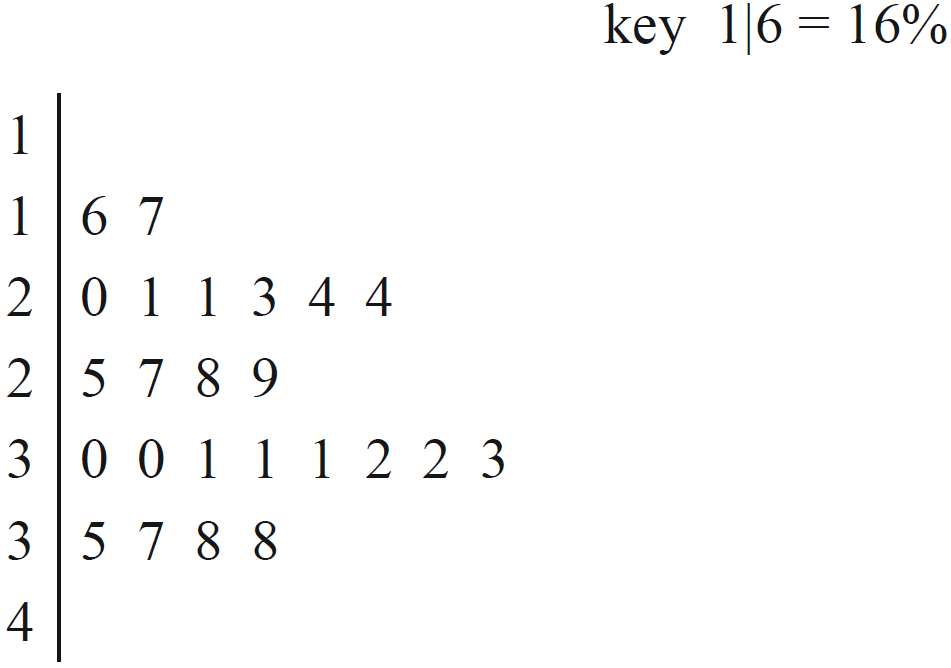
The diagram below shows a stem-and-leaf plot for 22 scores. 
 

2UG-2009-24a
 

  1.  What is the mode for this data?   (1 mark)

    --- 1 WORK AREA LINES (style=lined) ---

  2.  What is the median for this data?     (1 mark)

    --- 1 WORK AREA LINES (style=lined) ---

Show Answers Only
  1. `78`
  2. `46`
Show Worked Solution

i.   `text(Mode) = 78`


ii.    `22\ text(scores)`

`=>\ text(Median is the average of 11th and 12th scores)`
 

`:.\ text(Median)` `= (45 + 47)/2`
  `= 46`

Filed Under: Bar Charts, Histograms and Other Graphs (Std 1), Data Analysis, Other Chart Types (Y12), Other Charts (Std 2), Other Charts (Std2-2027), Stem & Leaf, Box & Whisker Tagged With: Band 3, Band 4, common-content, num-title-ct-core, num-title-qs-hsc, smc-1128-24-Stem and Leaf, smc-4224-15-Mode, smc-4224-20-Median, smc-4224-40-Stem and Leaf, smc-6311-10-Stem-and-Leaf, smc-822-20-Stem and Leaf, smc-998-20-Stem and Leaf

Financial Maths, STD2 F1 2009 HSC 10 MC

Billy worked for 35 hours at the normal hourly rate of pay and for five hours at double time. He earned $561.60 in total for this work.

What was the normal hourly rate of pay?

  1. $7.02
  2. $12.48
  3. $14.04
  4. $16.05
Show Answers Only

`B`

Show Worked Solution

`text(Let hourly rate) = $X\ text(per hour)`

`35X + 5(2X)` `= 561.60`
`45X` `=561.60`
`X` `= 561.60/45` 
  `= $12.48`

 
`=>  B`

Filed Under: Earning and Spending Money, Earning Money and Budgeting (Std 1), Earning Money and Budgeting (Std 2), FM1 - Earning money, Ways of Earning (Std2-2027) Tagged With: Band 3, num-title-ct-corea, num-title-qs-hsc, smc-1126-10-Wages, smc-4331-10-Wages, smc-6276-10-Wages/Salaries, smc-810-10-Wages

Financial Maths, STD2 F4 2009 HSC 6 MC

A house was purchased in 1984 for $35 000. Assume that the value of the house has increased by 3% per annum since then. 

Which expression gives the value of the house in 2009?  

  1. `35\ 000(1 + 0.03)^25`
  2. `35\ 000(1 + 3)^25` 
  3. `35\ 000 xx 25 xx 0.03`
  4. `35\ 000 xx 25 xx 3`
Show Answers Only

`A`

Show Worked Solution

`r =\ text(3%)\ = 0.03`

`n = 25\ text(years)`

`text(Using)\ \ FV = PV(1 + r)^n`

` :.\ text(Value in 2009) = 35\ 000(1+0.03)^25` 

`=>  A`

Filed Under: Compound Interest, Compound Interest and Shares (Std2), F2 Investment (Y12), FM2 - Investing, Modelling Investments and Loans (Y12) Tagged With: Band 3, common-content, num-title-ct-coreb, num-title-qs-hsc, smc-1002-20-FV Formula, smc-1108-20-FV Formula, smc-4334-10-Find FV, smc-4334-70-Inflation, smc-817-20-FV Formula

Statistics, STD2 S3 2009 HSC 5 MC

Jamie wants to know how many songs were downloaded legally from the internet in the last 12 months by people aged 18–25 years. He has decided to conduct a statistical inquiry.

After he collects the data, which of the following shows the best order for the steps he should take with the data to complete his inquiry?

  1.    Display, organise, conclude, analyse
  2.    Organise, display, conclude, analyse
  3.    Display, organise, analyse, conclude
  4.    Organise, display, analyse, conclude
Show Answers Only

`D`

Show Worked Solution

`text(Process of statistical enquiry requirements)`

`=>  D`

Filed Under: Classifying Data (Std 1), Classifying Data (Std 2), Data Classification, Investigation and Sampling Methods (Std2-2027), DS1 - Stats and society Tagged With: Band 3, common-content, smc-1127-30-Other, smc-6309-30-Other, smc-820-30-Other

Statistics, STD2 S1 2009 HSC 3 MC

The eye colours of a sample of children were recorded.

When analysing this data, which of the following could be found?

  1. Mean
  2. Median
  3. Mode
  4. Range
Show Answers Only

`C`

Show Worked Solution

`text(Eye colour is categorical data)`

`:.\ text(Only the mode can be found)`

`=>  C`

Filed Under: Classifying Data, Classifying Data (Std 1), Classifying Data (Std 2), Classifying Data (Y12), Data Analysis, Data Classification, Investigation and Sampling Methods (Std2-2027), DS1 - Stats and society, Measures of Centre and Spread (Std2-2027), Summary Statistics - No Graph (Std 2), Summary Statistics - No graph (Y12), Summary Statistics (no graph), Summary Statistics (Std 1) Tagged With: Band 3, common-content, num-title-ct-core, num-title-qs-hsc, smc-1127-20-Classifying Data, smc-1131-10-Mean, smc-1131-20-Median and Mode, smc-4224-45-Mean/median/mode/range, smc-5075-10-Categorical, smc-6309-20-Data Classification, smc-6312-10-Mean, smc-6312-20-Median and Mode, smc-820-20-Classifying Data, smc-824-10-Mean, smc-824-20-Median and Mode, smc-999-10-Mean, smc-999-20-Median and Mode

Statistics, STD2 S1 2009 HSC 2 MC

The step graph shows the charges for a carpark. 
 

2UG-2009-2MC

 
Maria enters the carpark at 10:10 am and exits at 1:30 pm.

How much will she pay in charges?

  1.   `$6` 
  2.   `$12` 
  3.   `$18` 
  4.   `$24` 
Show Answers Only

`C`

Show Worked Solution

`text(Time in carpark = 3h 20m)`

`text(From graph, charge will be $18)`

`=>  C`

Filed Under: Bar Charts, Histograms and Other Graphs (Std 1), Other Chart Types (Y12), Other Charts (Std 2), Other Graphs Tagged With: Band 3, common-content, smc-1128-28-Other Charts, smc-822-40-Other Charts, smc-998-40-Other Charts

Probability, STD2 S2 2009 HSC 1 MC

A newspaper states: ‘It will most probably rain tomorrow.’

Which of the following best represents the probability of an event that will most probably occur?   

  1.   `33 1/3 text(%)` 
  2.   `text(50%)` 
  3.   `text(80%)` 
  4.   `text(100%)` 
Show Answers Only

`C`

Show Worked Solution

`text(Probably) =>\ text(likelihood > 50%)`

`text(However 100% = certainty)`

`:.\ text(80% is the answer)`

`=> C`

Filed Under: Fundamental understanding, Fundamental Understanding (Std 1), Fundamental Understanding (Std 2), Probability Tagged With: Band 3, num-title-ct-core, num-title-qs-hsc, smc-4225-05-Core concepts

Financial Maths, STD2 F1 2010 HSC 11 MC

Which of the following graphs shows the lowest rate of depreciation over the given time period?
 

Capture4

Capture5

Show Answers Only

`D`

Show Worked Solution

`text(The lowest rate of depreciation will occur when)`

`text(an item retains value for the longest time.)`

`=>  D`

Filed Under: Depreciation / Running costs, Simple Interest and S/L Depreciation (Std 1), Simple Interest and S/L Depreciation (Std 2) Tagged With: Band 3, smc-1124-20-Straight Line Depreciation, smc-808-20-Straight Line Depreciation

Measurement, STD2 M6 2011 HSC 9 MC

Two trees on level ground, 12 metres apart, are joined by a cable. It is attached 2 metres above the ground to one tree and 11 metres above the ground to the other.

What is the length of the cable between the two trees, correct to the nearest metre? 

  1.  `9\ text(m)`
  2. `12\ text(m)`
  3. `15\ text(m)`
  4. `16\ text(m)`
Show Answers Only

`C`

Show Worked Solution

`text(Using Pythagoras)`

`c^2` `=12^2+9^2`
  `=144+81`
  `=225`
`:.c` `=15,\ \ c>0`

 
`=>C`

Filed Under: M3 Right-Angled Triangles (Y12), Pythagoras and basic trigonometry, Pythagoras and Right-Angled Trig (Std2), Right-angled Triangles Tagged With: Band 3, num-title-ct-core, num-title-qs-hsc, smc-1103-20-Right-angled Trig, smc-4218-30-Hypotenuse, smc-802-10-Pythagoras

Probability, STD2 S2 2011 HSC 5 MC

The letters A, B and C are used to make a three-letter company name. Each letter is used only once.

How many different company names can be made?

  1.     3
  2.     6
  3.     9
  4.   27
Show Answers Only

`B`

Show Worked Solution
`text(# Outcomes)` `=3xx2xx1`
  `=6`

`=>B`

Filed Under: # Combinations, Combinations (Std 1), Combinations and Single Stage Events (Std 2) Tagged With: Band 3, smc-1134-30-Letter Combinations, smc-828-30-Letter Combinations

Probability, STD2 S2 2012 HSC 26e

The dot plot shows the number of push-ups that 13 members of a fitness class can do in one minute.

2012 26e

  1.  What is the probability that a member selected at random from the class can do more than 38 push-ups in one minute?   (1 mark)

    --- 1 WORK AREA LINES (style=lined) ---

  2.  A new member who can do 32 push-ups in one minute joins the class.


    Does the addition of this new member to the class change the probability calculated in part (i)? Justify your answer.    (1 mark)

    --- 2 WORK AREA LINES (style=lined) ---

Show Answers Only
  1. `7/13`
  2. `text{Yes (See Worked Solutions)}`
Show Worked Solution
i.  `P` `= text(# Members > 38 push-ups)/text(Total members)`
  `= 7/13`

 
ii.
   `text(Yes.)`

`Ptext{(+ New member)}` `= text(Members > 38 push-ups)/text(Total members)`
  `= 7/14≠ 7/13`
MARKER’S COMMENT: The most successful candidates used the fraction `7/14` in their part (ii) answer rather than relying solely on words.

Filed Under: Probability, Relative Frequency, Relative Frequency (Std 1), Relative Frequency (Std 2), Relative Frequency (Y11) Tagged With: Band 3, Band 4, common-content, num-title-ct-core, num-title-qs-hsc, smc-1133-10-Surveys/Two-Way Tables, smc-4225-35-Relative frequency, smc-827-10-Surveys/Two-Way Tables, smc-990-10-Surveys/Two-Way Tables

Financial Maths, STD2 F4 2012 HSC 26b

Jim buys a photocopier for  $22 000.

Its value is depreciated using the declining balance method at the rate of 15% per annum.

What is its value at the end of 3 years? (2 marks)

Show Answers Only

`$13\ 510.75`

Show Worked Solution
`S` `= V_0 (1-r)^n`
  `= 22\ 000 (1-0.15)^3`
  `= 22\ 000 (0.85)^3`
  `= 13\ 510.75`

 
`:.\ text(After 3 years, it is worth)\ $13\ 510.75`

Filed Under: Depreciation - Declining Balance (Std 1), Depreciation - Declining Balance (Std 2), Depreciation / Running costs Tagged With: Band 3, smc-1139-10-Find S, smc-813-10-Find S

Statistics, STD2 S1 2010 HSC 1 MC

The results of a survey are displayed in the dot plot.

What is the range of this data?
 

2010 1 MC 
 

  1.    7
  2.    8
  3.    9
  4.    10
Show Answers Only

`C`

Show Worked Solution
`text(Range)` `=text(High)-text(Low)`
  `=9-0`
  `=9`

`=>  C`

Filed Under: Bar Charts, Histograms and Other Graphs (Std 1), Data Analysis, Other Chart Types (Y12), Other Charts (Std 2), Other Charts (Std2-2027), Other Graphs Tagged With: Band 3, common-content, num-title-ct-core, num-title-qs-hsc, smc-1128-28-Other Charts, smc-4224-10-Range, smc-6311-30-Other Charts, smc-822-40-Other Charts, smc-998-40-Other Charts

Statistics, STD2 S1 2012 HSC 2 MC

Handmade chocolates are checked for size and shape. Every 30th chocolate is sampled.

Which term best describes this type of sampling? 

  1.   Census
  2.   Random
  3.   Stratified
  4.   Systematic
Show Answers Only

`D`

Show Worked Solution

`text(Systematic Sampling)`

`=>  D`

Filed Under: Classifying Data (Std 1), Classifying Data (Std 2), Data Classification, Investigation and Sampling Methods (Std2-2027), DS1 - Stats and society Tagged With: Band 3, common-content, smc-1127-10-Sampling Methods, smc-6309-10-Sampling Methods, smc-820-10-Sampling Methods

Probability, STD2 S2 2013 HSC 7 MC

In an experiment, a standard six-sided die was rolled 72 times. The results are shown in the table.
 

Which number on the die was obtained the expected number of times?

  1.    1
  2.    2
  3.    3
  4.    6
Show Answers Only

`B`

Show Worked Solution

`text(Probability of rolling a specific number)=1/6`

`:.\ text(After 72 rolls, a specific number is expected)`

 `1/6xx72=12\ text(times.)`

`=>\ B`

Filed Under: Probability, Relative Frequency, Relative Frequency (Std 1), Relative Frequency (Std 2), Relative Frequency (Y11) Tagged With: Band 3, common-content, num-title-ct-core, num-title-qs-hsc, smc-1133-20-Games of Chance, smc-1133-30-Expected Frequency (np), smc-4225-35-Relative frequency, smc-827-20-Games of Chance, smc-827-40-Expected Frequency (np), smc-990-20-Games of Chance, smc-990-40-Expected Frequency (np)

Measurement, STD2 M6 2013 HSC 4 MC

What is the value of  `theta`,  to the nearest degree?

2013 4 mc

  1. `31^@`
  2. `37^@`
  3. `49^@`
  4. `53^@`
Show Answers Only

`B`

Show Worked Solution
`sin theta` `=81/135`
`:. theta` `=37^@`

`=>\ B`

`text(Note that)\ tan theta\  text(or)\ cos theta\ text(could also be used.)`

Filed Under: M3 Right-Angled Triangles (Y12), Pythagoras and basic trigonometry, Pythagoras and Right-Angled Trig (Std2) Tagged With: Band 3, smc-1103-20-Right-angled Trig, smc-802-20-Right-Angled Trig

Quadratic, 2UA 2011 HSC 2a

The quadratic equation  `x^2-6x+2=0`  has roots  `alpha`  and  `beta`.

  1. Find  `alpha+beta`.       (1 mark)
  2. Find  `alpha beta`.        (1 mark)
  3. Find  `1/alpha+1/beta`.      (1 mark)
Show Answers Only
  1. `6`
  2. `2`
  3. `3`
Show Worked Solution

(i)  `alpha+beta=-b/a=6`

(ii)  `alpha beta=c/a=2`

(iii)  `1/alpha+1/beta=(alpha+beta)/(alpha beta)=3`

Filed Under: Roots and the discriminant Tagged With: Band 3, Band 4

Quadratic, 2UA 2012 HSC 3 MC

The quadratic equation  `x^2+3x -1=0`  has roots  `alpha`  and  `beta`.

What is the value of  `alpha beta+(alpha+beta)` ?

(A)   `4`

(B)   `2`

(C)  `-4`

(D)  `-2`

Show Answers Only

`C`

Show Worked Solution
`alpha beta+(alpha+beta)` `=c/a+(- b/a)`
  `=-1-3`
  `=-4`

Filed Under: Roots and the discriminant Tagged With: Band 3

Calculus, 2ADV C3 2009 HSC 9b

An oil rig,  `S`,  is 3 km offshore. A power station,  `P`,  is on the shore. A cable is to be laid from `P`  to  `S`.  It costs $1000 per kilometre to lay the cable along the shore and $2600 per kilometre to lay the cable underwater from the shore to  `S`.

The point  `R`  is the point on the shore closest to  `S`,  and the distance  `PR`  is 5 km.

The point  `Q`  is on the shore, at a distance of  `x`  km from  `R`,  as shown in the diagram.


  1. Find the total cost of laying the cable in a straight line from  `P`  to  `R`  and then in a straight line from  `R`  to  `S`.   (1 mark)

    --- 2 WORK AREA LINES (style=lined) ---

  2. Find the cost of laying the cable in a straight line from  `P`  to  `S`.  (1 mark)

    --- 2 WORK AREA LINES (style=lined) ---

  3. Let  `$C`  be the total cost of laying the cable in a straight line from  `P`  to  `Q`,  and then in a straight line from `Q`  to  `S`.
     
    Show that  `C=1000(5-x+2.6sqrt(x^2+9))`.    (2 marks)

    --- 5 WORK AREA LINES (style=lined) ---

  4. Find the minimum cost of laying the cable.    (4 marks)

    --- 8 WORK AREA LINES (style=lined) ---

  5. New technology means that the cost of laying the cable underwater can be reduced to $1100 per kilometre.


    Determine the path for laying the cable in order to minimise the cost in this case.    (2 marks)

    --- 5 WORK AREA LINES (style=lined) ---

Show Answers Only
  1. `$12\ 800`
  2. `$15\ 160`
  3. `text{Proof (See Worked Solutions)}`
  4. `$12\ 200`
  5. `P\ text(to)\  S\ text(in a straight line.)`
Show Worked Solution
♦♦ Although specific data is unavailable for question parts, mean marks were 35% for Q9 in total.
i.   `text(C)text(ost)` `=(PRxx1000)+(SRxx2600)`
  `=(5xx1000)+(3xx2600)`
  `=12\ 800`

 
`:. text(C)text(ost is)\   $12\ 800`


ii.   `text(C)text(ost)=PSxx2600`

`text(Using Pythagoras:)`

`PS^2` `=PR^2+SR^2`
  `=5^2+3^2`
  `=34`
`PS` `=sqrt34`


`:.\ text(C)text(ost)` `=sqrt34xx2600`
  `=15\ 160.474…`
  `=$15\ 160\ \ text{(nearest dollar)}`


iii.  `text(Show)\ \ C=1000(5-x+2.6sqrt(x^2+9))`

`text(C)text(ost)=(PQxx1000)+(QSxx2600)`

`PQ` `=5-x`
`QS^2` `=QR^2+SR^2`
  `=x^2+3^2`
`QS` `=sqrt(x^2+9)`
`:.C` `=(5-x)1000+sqrt(x^2+9)\ (2600)`
  `=1000(5-x+2.6sqrt(x^2+9))\ \ text(…  as required)`


iv.   `text(Find the MIN cost of laying the cable)`

`C` `=1000(5-x+2.6sqrt(x^2+9))`
`(dC)/(dx)` `=1000(–1+2.6xx1/2xx2x(x^2+9)^(–1/2))`
  `=1000(–1+(2.6x)/(sqrt(x^2+9)))`

`text(MAX/MIN when)\ (dC)/(dx)=0`

IMPORTANT: Tougher derivative questions often require students to deal with multiple algebraic constants. See Worked Solutions in part (iv).

`1000(–1+(2.6x)/(sqrt(x^2+9)))=0`

`(2.6x)/sqrt(x^2+9)` `=1`
`2.6x` `=sqrt(x^2+9)`
`(2.6)^2x^2` `=x^2+9`
`x^2(2.6^2-1)` `=9`
`x^2` `=9/5.76`
  `=1.5625`
`x` `=1.25\ \ \ \ (x>0)`
MARKER’S COMMENT: Check the nature of the critical points in these type of questions. If using the first derivative test, make sure some actual values are substituted in.

`text(If)\ \ x=1,\ \ (dC)/(dx)<0`

`text(If)\ \ x=2,\ \ (dC)/(dx)>0`

`:.\ text(MIN when)\ \ x=1.25`

`C` `=1000(5-1.25+2.6sqrt(1.25^2+9))`
  `=1000(122)`
  `=12\ 200` 


`:.\ text(MIN cost is)\  $12\ 200\ text(when)\   x=1.25`


v.   `text(Underwater cable now costs $1100 per km)`

`=>\ C` `=1000(5-x)+1100sqrt(x^2+9)`
  `=1000(5-x+1.1sqrt(x^2+9))`
`(dC)/(dx)` `=1000(–1+1.1xx1/2xx2x(x^2+9)^(-1/2))`
  `=1000(–1+(1.1x)/sqrt(x^2+9))`

 
`text(MAX/MIN when)\ (dC)/(dx)=0`

`1000(–1+(1.1x)/sqrt(x^2+9))` `=0`
`(1.1x)/sqrt(x^2+9)` `=1`
`1.1x` `=sqrt(x^2+9)`
`1.1^2x^2` `=x^2+9`
`x^2(1.1^2-1)` `=9`
`x^2` `=9/0.21`
`x` `~~6.5\ text{km (to 1 d.p.)}`
  `=>\ text(no solution since)\ x<=5`

 
`text(If we lay cable)\ PR\ text(then)\ RS`

MARKER’S COMMENT: Many students failed to interpret a correct calculation of  `x>5`  as providing no solution.

`=>\ text(C)text(ost)=5xx1100+3xx1000=8500`

`text(If we lay cable directly underwater via)\ PS`

`=>\ text(C)text(ost)=sqrt34xx1100=6414.047…`

`:.\ text{MIN cost is  $6414 by cabling directly from}\ P\ text(to)\ S`.

Filed Under: Maxima and Minima, Maxima and Minima (Y12) Tagged With: Band 3, Band 4, Band 5, Band 6, smc-970-50-Distance, smc-970-60-Other Themes

Mechanics, EXT2* M1 2011 HSC 6b

The diagram shows the trajectory of a ball thrown horizontally, at speed `v` m/s, from the top of a tower `h` metres above the ground level.
 

2011 6b
 

The ball strikes the ground at an angle of  45°, `d` metres from the base of the tower, as shown in the diagram. The equations describing the trajectory of the ball are

`x=vt`   and   `y=h-1/2 g t^2`,    (DO NOT prove this)

where `g` is the acceleration due to gravity, and `t` is time in seconds.

  1. Prove that the ball strikes the ground at time  
     
         `t=sqrt((2h)/(g))`  seconds.    (1 mark)

    --- 3 WORK AREA LINES (style=lined) ---

  2. Hence, or otherwise, show that  `d=2h`.    (2 marks)

    --- 7 WORK AREA LINES (style=lined) ---

Show Answers Only
  1. `text{Proof  (See Worked Solutions)}` 
  2. `text{Proof  (See Worked Solutions)}`
Show Worked Solution

i.   `text(Show)\ \ y=0\ \ text(when)\ t=sqrt((2h)/g)\ \ text(seconds:)`

`0` `=h-1/2 g t^2`
`1/2 g t^2` `=h`
`t^2` `=(2h)/g`
`:.t` `=sqrt((2h)/g)\ \ text(seconds,)\ \ t>=0\ \ text(… as required)`


ii.   `text(Show that)\ d=2h`

`x=vt\ \ \ \ =>\ \ \ dotx=v`

`y=h-1/2 g t^2\ \ \ \ =>\ \ \ doty=-g t`

`text(At)\ t=sqrt((2h)/g)`,

`doty` `=-gxxsqrt((2h)/g)`
  `=-sqrt(2gh)`


`text(S)text(ince the ball strikes the ground at)\ 45^@,\ text(we know)`

♦♦ Mean mark 33%
STRATEGY: The key to unlocking this proof is understanding that `tan theta`, where  `theta` is the angle of trajectory at impact of a projectile, equals  `|\ doty\ |/dotx`.
`tan45^@=` `|\ doty\ |/dotx`
`1=` `sqrt(2gh)/v`
`v=` `sqrt(2gh)`

 
`text(S)text(ince)\ \ x=d=vt\ \ text(when)\ \ t=sqrt((2h)/g)`

`d` `=sqrt(2gh)xxsqrt((2h)/g)`
  `=sqrt((2h)^2)`
  `=2h\ \ text( … as required)`

Filed Under: Projectile Motion, Projectile Motion EXT1 Tagged With: Band 3, Band 5, smc-1062-10-Range/Time of Flight, smc-1062-50-Angle of Trajectory/Impact

Calculus in the Physical World, 2UA 2008 HSC 6b

The graph shows the velocity of a particle,  `v`  metres per second, as a function of time,  `t`  seconds.


  1. What is the initial velocity of the particle?   (1 mark)
  2. When is the velocity of the particle equal to zero?    (1 mark)
  3. When is the acceleration of the particle equal to zero?    (1 mark)
  4. By using Simpson's Rule with five function values, estimate the distance travelled by the particle between  `t=0`  and  `t=8`.   (3 marks)
  5.  
Show Answers Only
  1. `20\ text(m/s)`
  2. `t=10\ text(seconds)`
  3. `t=6\ text(seconds)`
  4. `493 1/3\ text(metres)`
Show Worked Solution

(i)    `text(Find)\   v  \ text(when)  t=0`

`v=20\ \ text(m/s)`


(ii)    `text(Particle comes to rest at)\  t=10\ text{seconds  (from graph)}`


(iii)  `text(Acceleration is zero when)\ t=6\ text{seconds  (from graph)}`


(iv)   

MARKER’S COMMENT: Less errors were made by students using a table and the given formula. Note however, that the formula `A~~(b-a)/6xx` `[f(a)+4f((a+b)/2)+f(b)]` produced the most errors.
`text(Area)` `~~h/3[y_0+y_n+4text{(odds)}+2text{(evens)}]`
  `~~h/3[y_0+y_4+4(y_1+y_3)+2(y_2)]`
  `~~2/3[20+60+4(50+80)+2(70)]`
  `~~2/3[740]`
  `~~493 1/3`


`:.\ text{Distance travelled is 493 1/3 m (approx.)}` 

Filed Under: Motion, Trapezoidal and Simpson's Rule Tagged With: Band 2, Band 3, Band 4, HSC

Calculus, 2ADV C4 2009 HSC 7a

The acceleration of a particle is given by

`a=8e^(-2t)+3e^(-t)`,

where  `x`  is the displacement in metres and  `t`  is the time in seconds.

Initially its velocity is  `text(– 6 ms)^(–1)` and its displacement is 5 m.

  1. Show that the displacement of the particle is given by
  2. `qquad  x=2e^(-2t)+3e^-t+t`.   (2 marks) 

    --- 5 WORK AREA LINES (style=lined) ---

  3. Find the time when the particle comes to rest.    (3 marks)

    --- 7 WORK AREA LINES (style=lined) ---

  4. Find the displacement  when the particle comes to rest.    (1 mark)

    --- 3 WORK AREA LINES (style=lined) ---

Show Answers Only
  1. `text{Proof  (See Worked Solutions)}`
  2. `ln4\ text(seconds)`
  3. `7/8+ln4\ \ text(units)`
Show Worked Solution

i.    `text(Show)\ \ x=2e^(-2t)+3e^-t+t`

`a=8e^(-2t)+3e^-t\ \ text{(given)}`

`v=int a\ dt=-4e^(-2t)-3e^-t+c_1`

`text(When)\ t=0,  v=-6\ \ text{(given)}`

`-6` `=-4e^0-3e^0+c_1`
`-6` `=-7+c_1`
`c_1` `=1`

 
`:. v=-4e^(-2t)-3e^-t+1`
 

`x` `=int v\ dt`
  `=int(-4e^(-2t)-3e^-t+1)\ dt`
  `=2e^(-2t)+3e^-t+t+c_2`

 
`text(When)\ \ t=0,\ x=5\ \ text{(given)}`

`5` `=2e^0+3e^0+c_2`
`c_2` `=0`

 
`:.\ x=2e^(-2t)+3e^-t+t\ \ text(… as required)`


ii.   `text(Particle comes to rest when)\ \ v=0`

`text(i.e.)\ \ -4e^(-2t)-3e^-t+1=0`

`text(Let)\ X=e^-t\ \ \ \ =>X^2=e^(-2t)`

`-4X^2-3X+1` `=0`
`4X^2+3X-1` `=0`
`(4X-1)(X+1)` `=0`

 
 `:.\ \ X=1/4\ \ text(or)\ \ X=-1`

`text(When)\ \ X=1/4:`

`e^-t` `=1/4`
`lne^-t` `=ln(1/4)`
`-t` `=ln(1/4)`
`t` `=-ln(1/4)=ln(1/4)^-1=ln4`

 
`text(When)\ \ X=-1:`

`e^-t=-1\ \ text{(no solution)}`
 

`:.\ text(The particle comes to rest when)\ t=ln4\ text(seconds)`
  

iii.  `text(Find)\ \ x\ \ text(when)\ \ t=ln4 :`

`x=2e^(-2t)+3e^-t+t`

`\ \ =2e^(-2ln4)+3e^-ln4+ln4`

`\ \ =2(e^ln4)^-2+3(e^ln4)^-1+ln4`

`\ \ =2xx4^-2+3xx4^-1+ln4`

`\ \ =2/16+3/4+ln4`

`\ \ =7/8+ln4`

ALGEBRA TIP: Helpful identity  `e^lnx=x`. Easily provable as follows:
`e^ln2=x`
`\ =>lne^ln2=lnx\ `
`\ => ln2=lnx\ `
`\ =>x=2`.

Filed Under: Motion, Other Integration Applications (Y12) Tagged With: Band 3, Band 4, Band 5, smc-1091-10-Motion, smc-1091-30-Log/Exp Function, smc-1213-10-Motion

Calculus, EXT1* C1 2010 HSC 7a

The acceleration of a particle is given by

`ddotx=4cos2t`,

where  `x`  is the displacement in metres and  `t`  is the time in seconds. 

Initially the particle is at the origin with a velocity of  `text(1 ms)^(–1)`.

  1. Show that the velocity of the particle is given by


      `dotx=2sin2t+1`.    (2 marks)

    --- 5 WORK AREA LINES (style=lined) ---

  2. Find the time when the particle first comes to rest.    (2 marks)

    --- 4 WORK AREA LINES (style=lined) ---

  3. Find the displacement,  `x`,  of the particle in terms of  `t`.    (2 marks)

    --- 4 WORK AREA LINES (style=lined) ---

Show Answers Only
  1. `text{Proof  (See Worked Solutions)}`
  2. `(7pi)/12\ text(seconds)`
  3. `x=1-cos2t+t`
Show Worked Solution
i.   `text(Show)\ dotx` `=2sin2t+1`
`dotx` `=intddotx\ dt`
  `=int4cos2t\ dt`
  `=2sin2t+c`

 
`text(When)\ t=0, \ \ dotx=1\ \ text{(given)}`

`1=2sin0+c`

`c=1`

 
`:. dotx=2sin2t+1 \ \ \ text(… as required)`
 

ii.   `text(Find)\ t\ text(when)\ dotx=0 :`

`2sin2t+1` `=0`
`sin2t` `=-1/2`

 
`=>sin theta=1/2\ text(when)\ theta=pi/6`

`text(S)text(ince)\ \ sin theta\ \ text(is negative in 3rd and 4th quadrants)`

`2t` `=pi + pi/6`
`2t` `=(7pi)/6`
`t` `=(7pi)/12`

 
`:.\ text(Particle first comes to rest at)\ t=(7pi)/12\ text(seconds)`
 

iii.    `x` `=intdotx\ dt`
  `=int(2sin2t+1)\ dt`
  `=t-cos2t+c`

 
`text(When)\ t=0,\ x=0\ \ text{(given)}`

`0=0-cos0+c`

`c=1`

 
`:. x=t-cos2t+1`

Filed Under: Motion, Rates of Change with respect to time (Ext1) Tagged With: Band 3, Band 4, Band 5, smc-1077-10-Motion, smc-1077-30-Trig Equation

Calculus, 2ADV C4 2012 HSC 15b

The velocity of a particle is given by

`v=1-2cost`,

where  `x`  is the displacement in metres and  `t`  is the time in seconds. Initially the particle is 3 m to the right of the origin.

  1. Find the initial velocity of the particle.    (1 mark)

    --- 1 WORK AREA LINES (style=lined) ---

  2. Find the maximum velocity of the particle.    (1 mark)

    --- 1 WORK AREA LINES (style=lined) ---

  3. Find the displacement, `x`,  of the particle in terms of  `t`.    (2 marks)

    --- 4 WORK AREA LINES (style=lined) ---

  4. Find the position of the particle when it is at rest for the first time.    (2 marks)

    --- 4 WORK AREA LINES (style=lined) ---

Show Answers Only
  1. `-1\ text(m/s)`
  2. `3\ text(m/s)`
  3. `x=t-2sint+3`
  4. `pi/3-sqrt3+3`
Show Worked Solution

i.    `text(Find)\ \ v\ \ text(when)\ \ t=0`:

`v` `=1-2cos0`
  `=1-2`
  `=-1`

 
`:.\ text(Initial velocity is)\ -1\ text(m/s.)`


ii.  `text(Solution 1)`

`text(Max velocity occurs when)\ \ a=(d v)/(dt)=0`

♦♦ Mean mark 29%
MARKER’S COMMENT: Solution 2 is more efficient here. Using the -1 and +1 limits of trig functions can be very a effective way to calculate max/min values.

`a=2sint`
 

`text(Find)\ \ t\ \ text(when)\ \ a=0 :`

`2sint=0`

`t=0`,  `pi`,  `2pi`, …

`text(At)\ \ t=0,\ \   v=-1\ text(m/s)`

`text(At)\ \ t=pi,\ \ v=1-2(-1)=3\ text(m/s)`

 
`:.\ text(Maximum velocity is 3 m/s)`


`text(Solution 2)`

`v=1-2cost`

`text(S)text(ince)\ \ -1` `<cost<1`
`-2` `<2cost<2`
`-1` `<1-2cost<3`

 
`:.\ text(Maximum velocity is 3 m/s)`


iii.   `x` `=int v\ dt`
  `=int(1-2cost)\ dt`
  `=t-2sint+c`

 
`text(When)\ \ t=0,\ \ x=3\ \ text{(given)}`

`3=0-2sin0+3`

`c=3`

 
`:. x=t-2sint+3`


iv.  `text(Find)\ \ x\ \ text(when)\ \ v=0\ \ text{(first time):}`

♦ Mean mark 50%
MARKER’S COMMENT: Many students found  `t=pi/3`  but failed to gain full marks by omitting to find  `x`. Remember that for calculus, angles are measured in radians, NOT degrees!

`text(When)\ \ v=0 ,`

`0` `=1-2cost`
`cost` `=1/2`
`t` `=cos^-1(1/2)`
  `=pi/3\ \ \ text{(first time)}`

 
`text(Find)\ \ x\ \ text(when)\ \ t=pi/3 :`

`x` `=pi/3-2sin(pi/3)+3`
  `=pi/3-2xxsqrt3/2+3`
  `=pi/3-sqrt3+3\ \ text(units)`

Filed Under: Motion, Other Integration Applications (Y12) Tagged With: Band 3, Band 4, Band 5, smc-1213-10-Motion

Calculus, EXT1 C1 2010 HSC 2b

The mass `M` of a whale is modelled by

`M=36-35.5e^(-kt)` 

where  `M`  is measured in tonnes,  `t`  is the age of the whale in years and  `k`  is a positive constant.

  1. Show that the rate of growth of the mass of the whale is given by the differential equation
     
    `qquad qquad (dM)/(dt)=k(36-M)`    (1 mark)

    --- 2 WORK AREA LINES (style=lined) ---

  2. When the whale is 10 years old its mass is 20 tonnes.


    Find the value of  `k`,  correct to three decimal places.    (2 marks)

    --- 8 WORK AREA LINES (style=lined) ---

  3. According to this model, what is the limiting mass of the whale?    (1 mark)

    --- 3 WORK AREA LINES (style=lined) ---

Show Answers Only
  1. `text{Proof (See Worked Solutions)}`
  2. `0.080`
  3. `36\ text(tonnes)`
Show Worked Solution

i.  `M=36-35.5e^(-kt)`

IMPORTANT: Know this standard proof well and be able to produce it quickly.

`35.5e^(-kt)=36-M`

`:. (dM)/(dt)` `=-kxx-35.5e^(-kt)`
  `=kxx35.5e^(-kt)`
  `=k(36-M)\ \ \ text(… as required)`


ii.  `text(Find)\ \ k`

`text(When)\ \ t=10,\ \ M=20`

`M` `=36-35.5e^(-kt)`
`20` `=36-35.5e^(-10k)`
`35.5e^(-10k)` `=16`
`lne^(-10k)` `=ln(16/35.5)`
`-10k` `=ln(16/35.5)`
`:. k` `=-ln(16/35.5)/10`
  `=0.07969…`
  `=0.080\ \ text{(to 3 d.p.)}`


iii.  `text(As)\ t->oo,  e^(-kt)=1/e^(kt)\ ->0,\ \ k>0`

`M->36`

`:.\ text(The whale’s limiting mass is 36 tonnes.)`

Filed Under: Exponential Growth and Decay EXT1, Modified Growth and Decay Tagged With: Band 2, Band 3, Band 4, smc-1080-20-Other

Calculus, EXT1 C1 2013 HSC 12c

A cup of coffee with an initial temperature of 80°C is placed in a room with a constant temperature of 22°C.

The temperature,  `T`°C,  of the coffee after `t` minutes is given by

`T=A+Be^(-kt)`,

where  `A`,  `B`  and  `k`  are positive constants. The temperature of the coffee drops to 60°C after 10 minutes.

How long does it take for the temperature of the coffee to drop to 40°C?  Give your answer to the nearest minute.    (3 marks)

--- 8 WORK AREA LINES (style=lined) ---

Show Answers Only

`text(28 minutes)`

Show Worked Solution

`T=A+Be^(-kt)`

`text(S)text(ince constant room temp is)\  22°text(C)“=>\ A=22`

`T=22+Be^(-kt)`
 

`text(At)\ \ t=0,\ T=80`

`80=22+Be^0`

`=>\ B=58`

IMPORTANT: Students should either keep  `k` in exact form (using their calculator’s memory button), or ensure they take `k`  to a sufficient number of decimal places to reach an accurate answer.

`:.\ T=22+58e^(-kt)`
 

`text(At)\ \ t=10,\ T=60`

`60` `=22+58e^(-10k)`
`58e^(-10k)` `=38`
`e^(-10k)` `=38/58`
`lne^(-10k)` `=ln(38/58)`
`-10k` `=ln(38/58)`
`:.\ k` `=-1/10ln(38/58)`


`text(Find)\ \ t\ \ text(when)\  T=40°text(C) :`

ALGEBRA TIP: Keep `k`  in the equation right until the last calculation and then substitute in (see Worked Solution).
`40` `=22+58e^(-kt)`
`58e^(-kt)` `=18`
`-kt` `=ln(18/58)`
`t` `=-ln(18/58)/k,\ \ text(where) \ k=–1/10ln(38/58)`
  `=10 xx ln(18/58)/ln(38/58)`
  `=27.6706…`
  `=28\ text{mins  (nearest minute)}`

 
`:.\ text(It takes 28 minutes to cool to 40°C.)`

Filed Under: Exponential Growth and Decay EXT1, Modified Growth and Decay Tagged With: Band 3, smc-1080-10-Cooling

Calculus, EXT1* C1 2008 HSC 5c

Light intensity is measured in lux. The light intensity at the surface of a lake is 6000 lux. The light intensity,  `I`  lux, a distance  `s`  metres below the surface of the lake is given by

`I=Ae^(-ks)`

where  `A`,  and  `k`  are constants.

  1. Write down the value of  `A`.   (2 marks)

    --- 2 WORK AREA LINES (style=lined) ---

  2. The light intensity 6 metres below the surface of the lake is 1000 lux. Find the value of  `k`.    (2 marks)

    --- 6 WORK AREA LINES (style=lined) ---

  3. At what rate, in lux per metre, is the light intensity decreasing 6 metres below the surface of the lake?    (2 marks)

    --- 6 WORK AREA LINES (style=lined) ---

Show Answers Only
  1. `6000`
  2. `- 1/6 ln(1/6)\ text(or)\ 0.29863`
  3. `299`
Show Worked Solution

i.   `I=Ae^(-ks)`

`text(Find)\ A,\ text(given)\   I=6000\ text(at)\  s=0`

`6000` `=Ae^0`
`:.\ A` `=6000`


ii.   `text(Find)\ k\ text(given)\  I=1000\ text(at)  s=6`

MARKER’S COMMENT: Many students used the “log” function on their calculator rather than the `log_e` function. BE CAREFUL!
`1000` `=6000e^(-6xxk)`
`e^(-6k)` `=1/6`
`lne^(-6k)` `=ln(1/6)`
`-6k` `=ln(1/6)`
`k` `=- 1/6 ln(1/6)`
  `=0.2986…`
  `=0.30\ \ \ text{(2 d.p.)}`


iii.  `text(Find)\ \ (dI)/(ds)\ \ text(at)\ \ s=6`

ALGEBRA TIP: Tidy your working by calculating `(dI)/(ds)` using `k` and then only substituting for `k` in part (ii) at the final stage.
`I` `=6000e^(-ks)`
`:.(dI)/(ds)` `=-6000ke^(-ks)`

 
`text(At)\ s=6,`

`(dI)/(ds)` `=-6000ke^(-6k),\ \ \ text(where)\ k=- 1/6 ln(1/6)`
  `=-298.623…`
  `=-299\ \ text{(nearest whole number)}`

 
`:. text(At)\ s=6,\ text(the light intensity is decreasing)`

`text(at 299 lux per metre.)`

Filed Under: Exponential growth and decay, Standard Growth and Decay Tagged With: Band 3, Band 4, Band 5, smc-1081-20-Decay, smc-1081-50-Other Themes

Calculus, EXT1* C1 2009 HSC 6b

Radium decays at a rate proportional to the amount of radium present. That is, if  `Q(t)`  is the amount of radium present at time  `t`,  then  `Q=Ae^(-kt)`,  where  `k`  is a positive constant and  `A`  is the amount present at  `t=0`. It takes 1600 years for an amount of radium to reduce by half.

  1. Find the value of  `k`.   (2 marks)

    --- 6 WORK AREA LINES (style=lined) ---

  2. A factory site is contaminated with radium. The amount of radium on site is currently three times the safe level.


    How many years will it be before the amount of radium reaches the safe level.    (2 marks)

    --- 6 WORK AREA LINES (style=lined) ---

Show Answers Only
  1. `(-ln(1/2))/1600\ \ text(or 0.000433)`
  2. `2536\ text(years)`
Show Worked Solution

i.   `Q=Ae^(-kt)`

MARKER’S COMMENT: Students must be familiar with “half-life” and the algebra required. i.e. using `Q=1/2 A` within their calculations.

`text(When)\ \ t=0,\ \ Q=A`

`text(When)\ \ t=1600,\ \ Q=1/2 A`

`:.1/2 A` `=A e^(-1600xxk)`
`e^(-1600xxk)` `=1/2`
`lne^(-1600xxk)` `=ln(1/2)`
`-1600k` `=ln(1/2)`
`k` `=(-ln(1/2))/1600`
  `=0.0004332\ \ text{(to 4 sig. figures)}`


ii.   `text(Find)\ \ t\ \ text(when)\ \ Q=1/3 A :`

IMPORTANT: Know how to use the memory function on your calculator to store the exact value of `k` found in part (i) to save time.
`1/3 A` `=A e^(-kt)`
`e^(-kt)` `=1/3`
`lne^(-kt)` `=ln(1/3)`
`-kt` `=ln(1/3)`
`:.t` `=(-ln(1/3))/k,\ \ \ text(where)\ \ \ k=(-ln(1/2))/1600`
  `=(ln(1/3) xx1600)/ln(1/2)`
  `=2535.940…`

 
`:.\ text(It will take  2536  years.)`

Filed Under: Exponential growth and decay, Standard Growth and Decay Tagged With: Band 3, Band 4, Band 5, page-break-before-solution, smc-1081-20-Decay, smc-1081-30-Radioactivity

Calculus, EXT1* C1 2012 HSC 14c

Professor Smith has a colony of bacteria. Initially there are 1000 bacteria. The number of bacteria,  `N(t)`,  after  `t`  minutes is given by

`N(t)=1000e^(kt)`. 

  1. After 20 minutes there are 2000 bacteria.


    Show that `k=0.0347`  correct to four decimal places.   (1 mark)

    --- 4 WORK AREA LINES (style=lined) ---

  2. How many bacteria are there when  `t=120`?    (1 mark)

    --- 2 WORK AREA LINES (style=lined) ---

  3. What is the rate of change of the number of bacteria per minute, when  `t=120`?     (1 mark)

    --- 5 WORK AREA LINES (style=lined) ---

  4. How long does it take for the number of bacteria to increase from 1000 to 100 000?    (2 marks)

    --- 7 WORK AREA LINES (style=lined) ---

Show Answers Only
  1. `text{Proof (See Worked Solutions).}`
  2. `64\ 328`
  3. `2232`
  4. `133\ text(minutes)` 
Show Worked Solution

i.   `N=1000e^(kt)\ text(and given)\ N=2000\ text(when)\  t=20`

`2000` `=1000e^(20xxk)`
`e^(20k)` `=2`
`lne^(20k)` `=ln2`
`20k` `=ln2`
`:.k` `=ln2/20`
  `=0.0347\ \ text{(to 4 d.p.)  … as required}`


 ii.  `text(Find)\ \ N\ \ text(when)\  t=120`

NOTE: Students could have used the exact value of  `k=ln2/20`  in parts (ii), (iii) and (iv), which would yield the answers (ii) 64,000, (iii) 2,218, and (iv) 133 minutes.
`N` `=1000e^(120xx0.0347)`
  `=64\ 328.321..`
  `=64\ 328\ \ text{(nearest whole number)}`

 
`:.\ text(There are)\  64\ 328\ text(bacteria when t = 120.)`
 

iii.  `text(Find)\ (dN)/(dt)\ text(when)\  t=120`

MARKER’S COMMENT: This part proved challenging for many students. Differentiation is required to find the rate of change in these type of questions.
`(dN)/(dt)` `=0.0347xx1000e^(0.0347t)`
  `=34.7e^(0.0347t)`

 
`text(When)\ \ t=120`

`(dN)/(dt)` `=34.7e^(0.0347xx120)`
  `=2232.1927…`
  `=2232\ \ text{(nearest whole)}`

 
`:.\ (dN)/(dt)=2232\ text(bacteria per minute at)\  t=120`


iv.  `text(Find)\ \ t\ \ text(such that)\  N=100,000`

`=>100\ 000` `=1000e^(0.0347t)`
`e^(0.0347t)` `=100`
`lne^(0.0347t)` `=ln100`
`0.0347t` `=ln100`
`t` `=ln100/0.0347`
  `=132.7138…`
  `=133\ \ text{(nearest minute)}`

 
`:.\ N=100\ 000\ text(when)\  t=133\ text(minutes.)`

Filed Under: Exponential growth and decay, Standard Growth and Decay Tagged With: Band 2, Band 3, Band 4, page-break-before-solution, smc-1081-10-Growth, smc-1081-40-Population

Calculus, EXT1* C1 2013 HSC 16b

Trout and carp are types of fish. A lake contains a number of trout. At a certain time, 10 carp are introduced into the lake and start eating the trout. As a consequence, the number of trout,  `N`,  decreases according to

`N=375-e^(0.04t)`,

where `t` is the time in months after the carp are introduced.

The population of carp,  `P`,  increases according to  `(dP)/(dt)=0.02P`.

  1. How many trout were in the lake when the carp were introduced?    (1 mark)

    --- 2 WORK AREA LINES (style=lined) ---

  2. When will the population of trout be zero?    (1 mark)

    --- 6 WORK AREA LINES (style=lined) ---

  3. Sketch the number of trout as a function of time.     (1 marks)

    --- 6 WORK AREA LINES (style=lined) ---

  4. When is the rate of increase of carp equal to the rate of decrease of trout?    (3 marks)

    --- 10 WORK AREA LINES (style=lined) ---

  5. When is the number of carp equal to the number of trout?    (2 marks)

    --- 8 WORK AREA LINES (style=lined) ---

Show Answers Only
  1. `text(374 trout)`
  2. `text{148 months (nearest month)}`
  3.  
     
    2UA 2013 HSC 16b Answer
  4. `text{After 80 months (nearest month)}`
  5. `text{After 135 months (nearest month)}`
Show Worked Solution

i.    `text(Carp introduced at)\ \ t=0`

MARKER’S COMMENT: A number of students did not equate `e^0=1` in this part.

`N=375-e^0=374`

`:.\ text(There was 374 trout when carp were introduced.)`


ii.    `text(Trout population will be zero when)`

NOTE: The last line of the solution isn’t necessary but is included as good practice as a check that the answer matches the exact question asked.
`N` `=375-e^(0.04t)=0`
`e^(0.04t)` `=375`
`0.04t` `=ln375`
`t` `=ln375/0.04`
  `=148.173 …`
  `=148\ text{months (nearest month)}`

 
`:.\ text(After 148 months, the trout population will be zero.)`
 

iii.   2UA 2013 HSC 16b Answer

♦♦ Mean mark 33% for part (iii)


iv.   `text(We need) \ |(dN)/(dt)|=(dP)/(dt)`

`text(Given)\ N=375-e^(0.04t)`

`(dN)/(dt)=-0.04e^(0.04t)`
  

`text(Find)\ P\ text(in terms of)\  t`

`text(Given)\ (dP)/(dt)=0.02P`

`=> P=Ae^(0.02t)`

♦♦♦ Mean mark 20%
COMMENT: Students who progressed to `0.2e^(0.02t)“=0.04e^(0.04t)` received 2 full marks in this part. Show your working!

 `text(Find)\ A\ \ =>text(when)\  t=0,\ P=10`

`10` `=Ae^0`
`:.A` `=10`
`=>(dP)(dt)` `=10xx0.02e^(0.02t)`
  `=0.2e^(0.02t)`

 
`text(Given that)\ \ (dP)/(dt)=|(dN)/(dt)|`

`0.2e^(0.02t)` `=0.04e^(0.04t)`
`5e^(0.02t)` `=e^(0.04t)`
`e^(0.04t)/e^(0.02t)` `=5`
`e^(0.04t-0.02t)` `=5`
`lne^(0.02t)` `=ln5`
`0.02t` `=ln5`
`t` `=ln5/0.02`
  `=80.4719…`
  `=80\ text{months (nearest month)}`


v.   `text(Find)\ t\ text(when)\ N=P`

`text(i.e.)\ \ 375-e^(0.04t)` `=10e^(0.02t)`
`e^(0.04t)+10e^(0.02t)-375` `=0`

`text(Let)\ X=e^(0.02t),\ text(noting)\ \ X^2=(e^(0.02t))^2=e^(0.04t)`

♦♦♦ Mean mark 4%!
MARKER’S COMMENT: Correctly applying substitution to exponentials to form a solvable quadratic proved very difficult for almost all students.
`:.\ X^2+10X-375` `=0`
`(X-15)(X+25)` `=0`

`X=15\ \ text(or)\ \ –25`

 
`text(S)text(ince)\  X=e^(0.02t)`

`e^(0.02t)` `=15\ \ \ \ (e^(0.02t)>0)`
`lne^(0.02t)` `=ln15`
`0.02t` `=ln15`
`t` `=ln15/0.02`
  `=135.4025…`
  `=135\ text(months)`

Filed Under: Exponential growth and decay, Standard Growth and Decay Tagged With: Band 3, Band 4, Band 5, Band 6, smc-1081-10-Growth, smc-1081-20-Decay, smc-1081-40-Population

Calculus, 2ADV C3 2011 HSC 7b

The velocity of a particle moving along the `x`-axis is given by

`v=8-8e^(-2t)`,

where `t` is the time in seconds and `x` is the displacement in metres.

  1. Show that the particle is initially at rest.     (1 mark)

    --- 1 WORK AREA LINES (style=lined) ---

  2. Show that the acceleration of the particle is always positive.     (1 mark)

    --- 2 WORK AREA LINES (style=lined) ---

  3. Explain why the particle is moving in the positive direction for all  `t>0`.     (2 marks)

    --- 5 WORK AREA LINES (style=lined) ---

  4. As  `t->oo`, the velocity of the particle approaches a constant.


    Find the value of this constant.     (1 mark) 

    --- 2 WORK AREA LINES (style=lined) ---

  5. Sketch the graph of the particle's velocity as a function of time.     (2 marks)

    --- 8 WORK AREA LINES (style=lined) ---

Show Answers Only
  1. `text{Proof (See Worked Solutions)}`
  2. `text{Proof (See Worked Solutions)}`
  3. `text(See Worked Solutions.)`
  4. `8\ text(m/s)`
  5. `text(See sketch in Worked Solutions)`
Show Worked Solution

i.   `text(Initial velocity when)\ \ t=0`

`v` `=8-8e^0`
  `=0\ text(m/s)`
 
`:.\ text(Particle is initially at rest.)`


MARKER’S COMMENT: Students whose working showed `e^(-2t)` as `1/e^(2t)`, tended to score highly in this question.

ii.   `a=d/(dt) (v)=-2xx-8e^(-2t)=16e^(-2t)`

`text(S)text(ince)\  e^(-2t)=1/e^(2t)>0\ text(for all)\  t`.

`=>\ a=16e^(-2t)=16/e^(2t)>0\ text(for all)\  t`.
 

`:.\ text(Acceleration is positive for all)\ \ t>0`.
 

iii.  `text{S}text{ince the particle is initially at rest, and ALWAYS}`

♦♦♦ Mean mark 22%
COMMENT: Students found part (iii) the most challenging part of this question by far.

`text{has a positive acceleration.`
 

`:.\ text(It moves in a positive direction for all)\ t`.
 

iv.   `text(As)\ t->oo`,  `e^(-2t)=1/e^(2t)->0`

`=>8/e^(2t)->0\  text(and)`

`=>v=8-8/e^(2t)->8\ text(m/s)`
 

`:.\ text(As)\ \ t->oo,\ text(velocity approaches 8 m/s.)`


IMPORTANT: Use previous parts to inform this diagram. i.e. clearly show velocity was zero at  `t=0`  and the asymptote at  `v=8`. 
v.   

Calculus in the Physical World, 2UA 2011 HSC 7b Answer

Filed Under: Motion, Rates of Change (Y12) Tagged With: Band 3, Band 4, Band 5, Band 6, smc-1091-10-Motion, smc-1091-30-Log/Exp Function

Financial Maths, 2ADV M1 2008 HSC 4b

The zoom function in a software package multiplies the dimensions of an image by 1.2.  In an image, the height of a building is 50 mm. After the zoom function is applied once, the height of the building in the image is 60 mm. After the second application, it is 72 mm.

  1. Calculate the height of the building in the image after the zoom function has been applied eight times. Give your answer to the nearest mm.     (2 marks)

    --- 4 WORK AREA LINES (style=lined) ---

  2. The height of the building in the image is required to be more than 400 mm. Starting from the original image, what is the least number of times the zoom function must be applied?     (2 marks)

    --- 4 WORK AREA LINES (style=lined) ---

Show Answers Only
  1. `text(215 mm)`
  2. `12`
Show Worked Solutions
i.    `T_1` `=a=50`
  `T_2` `=ar^1=50(1.2)=60`
  `T_3` `=ar^2=50(1.2)^2=72`

 
`=>\ text(GP where)\ \ a=50,\ \ r=1.2`

`\ \ vdots` 

MARKER’S COMMENT: Within this GP, note that `T_9` is the term where the zoom has been applied 8 times.
`T_9` `=50(1.2)^8`
  `=214.99`


`:.\ text{Height will be 215 mm  (nearest mm)}`


ii.    `T_n=ar^(n-1)` `>400`
  `:.\ 50(1.2)^(n-1)` `>400`
  `1.2^(n-1)` `>8`
  `ln 1.2^(n-1)` `>ln8`
  `n-1` `>ln8/ln1.2`
  `n` `>12.405`


`:.\ text(The height of the building in the 13th image)`

`text(will be higher than 400 mm, which is the 12th)`

`text(time the zoom would be applied.)`

Filed Under: Geometric Series, Geometric Series (Y12) Tagged With: Band 3, Band 4, smc-1006-10-Find Term, smc-1006-80-Applied Context

Financial Maths, 2ADV M1 2009 HSC 4a

A tree grows from ground level to a height of 1.2 metres in one year. In each subsequent year, it grows `9/10` as much as it did in the previous year.

Find the limiting height of the tree.     (2 marks)

--- 4 WORK AREA LINES (style=lined) ---

Show Answer Only

`12\ text(m)`

Show Worked Solution

`a=1.2, \ \ \ r=9/10`

`text(S)text(ince)\ \ |\ r\ |<1,`

`S_oo` `=a/(1-r)`
  `=1.2/(1-(9/10))`
  `=12\ text(m)`


`:.\ text(Limiting height of tree is 12 m.)`

Filed Under: Geometric Series, Geometric Series (Y12) Tagged With: Band 3, smc-1006-40-Limiting Sum, smc-1006-80-Applied Context

Calculus, EXT1* C1 2013 HSC 14a

The velocity of a particle moving along the `x`-axis is given by  `dotx=10-2t`, where `x` is the displacement from the origin in metres and `t` is the time in seconds. Initially the particle is 5 metres to the right of the origin.

  1. Show that the acceleration of the particle is constant.  (1 mark)

    --- 2 WORK AREA LINES (style=lined) ---

  2. Find the time when the particle is at rest.  (1 mark)

    --- 2 WORK AREA LINES (style=lined) ---

  3. Show that the position of the particle after 7 seconds is 26 metres to the right of the origin.  (2 marks)

    --- 5 WORK AREA LINES (style=lined) ---

  4. Find the distance travelled by the particle during the first 7 seconds.   (2 marks)

    --- 6 WORK AREA LINES (style=lined) ---

Show Answers Only
  1.  `ddotx=-2\ \ text{(constant)}`
  2. `t=5\ text(seconds)`
  3. `text{Proof (See Worked Solutions)}`
  4. `29\ text(metres)`
Show Worked Solutions

i.   `dotx=10-2t`

`text(Acceleration)=ddotx=d/(dx)dotx=-2`

 
`:.\ text(The acceleration is constant.)`


 ii.  `text(Particle comes to rest when)\  dotx=0`

`10-2t=0\ text(when)\ t=5`

 
`:.\ text(Particle comes to rest after 5 seconds.)`


 iii. `text(Show)\  x=26\ text(when)\ t=7`

`x` `=int dotx\ dt`
  `=int (10-2t)\ dt`
  `=10t -t^2+c`


`text(Given)\  t=0\ text(when)\ x=5`

`=> 5` `=10(0)-0^2+c`
`c` `=5`

 
`:. x=10t-t^2+5`
 

`text(At)\ \ t=7`

`x` `=10(7)-7^2+5`
  `=70-49+5`
  `=26`

 
`:.\ text(The particle is 26 metres to the right of the origin)`

`text(after 7 seconds … as required)`


 iv.   `text(Find the distance travelled in the first 7 seconds:)`

♦ Mean mark 37%.
IMPORTANT: Students can also draw a number line that shows where a particle starts from, changes direction and finishes in order to reduce errors.

`text(At)\  t=5`,

`x` `=10(5)-5^2+5`
  `=50-25+5`
  `=30\ text(m)`

 
`=>\ text{The particle travels 25 m to the right}\ (x=5\ text{to}\ 30)`

`text{then 4 m to the left}\  (x=30\ text{to}\ 26)`
 

`:.\ text(The total distance travelled in 7 seconds)`

`=25+4`

`=29\ text(m)`

Filed Under: Motion, Rates of Change with respect to time (Ext1) Tagged With: Band 3, Band 5, smc-1077-10-Motion

Calculus, 2ADV C2 2009 HSC 2aii

Differentiate with respect to `x`.

`(e^x+1)^2`.    (2 marks) 

Show Answer Only

`2e^x(e^x+1)`

Show Worked Solutions
`y` `=(e^x+1)^2`
`dy/dx` `=2(e^x+1)^1xxd/(dx) (e^x+1)`
  `=2e^x(e^x+1)`

Filed Under: Exponential Calculus, Exponential Calculus (Y12), L&E Differentiation (Y12), Logs and Exponentials - Differentiation Tagged With: Band 3, smc-965-10-Differentiation (base e), smc-967-10-Exponentials (base e), smc-967-50-Chain Rule

  • « Previous Page
  • 1
  • …
  • 54
  • 55
  • 56
  • 57
  • Next Page »

Copyright © 2014–2025 SmarterEd.com.au · Log in