SmarterEd

Aussie Maths & Science Teachers: Save your time with SmarterEd

  • Login
  • Get Help
  • About

BIOLOGY, M8 2016 HSC 19-20 MC

Refer to the following information to answer Questions 19 and 20. 

Melanomas are characterised by uncontrolled cell division caused by mutations that continue to occur once the tumour has developed. Scientists have discovered that vaccines produced using antigens extracted from the patient's own melanoma cells can be useful in treating melanoma. When injected, the vaccines stimulate an immune response.

 
Question 19

What can be inferred from the scientists' discovery?

  1. Cancer cells carry unique antigens.
  2. Self-antigens are not present on cancer cells.
  3. The melanoma patient has a dysfunctional immune system.
  4. The body cannot mount an immune response against cancer cells.

 
Question 20

The effect of the melanoma vaccine is to stimulate

  1. T cells which produce antibodies.
  2. cytotoxic T cells which activate B cells.
  3. cell division to produce more lymphocytes.
  4. production of B cells which destroy melanoma cells.
Show Answers Only

Question 19: `A`

Question 20: `C`

Show Worked Solution

Question 19

  • The vaccine can create an immune response against the cancer cells if self-antigens are not present in the cells.
`=>A`
 

Question 20

  • Lymphocyte development would be promoted by the vaccine.

`=>C`


Mean mark (Q19) 55%
♦♦♦ Mean mark (Q20) 16%

Filed Under: Prevention, Treatment and Control Tagged With: Band 5, Band 6, smc-3658-20-Vaccines

BIOLOGY, M5 2016 HSC 13-14 MC

Refer to the following information to answer Questions 13 and 14.

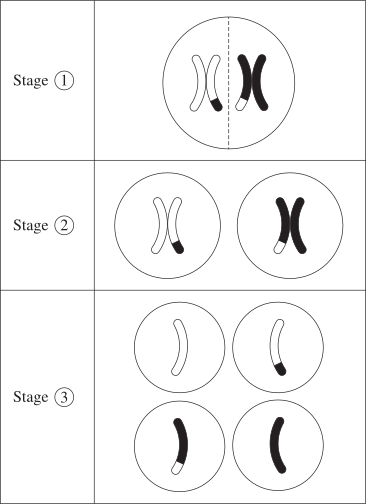
The diagram shows some chromosomes during some stages of meiosis.
 

Question 13

When does the segregation of homologous chromosomes occur?

  1. Before stage (1)
  2. Between stages (1) and (2)
  3. Between stages (2) and (3)
  4. Between stages (1) and (2) and again between stages (2) and (3)

 
Question 14

The chromosomes shown carry

  1. different genes and different alleles.
  2. different genes and the same alleles.
  3. the same genes and different alleles.
  4. the same genes and the same alleles.
Show Answers Only

Question 13: `B`

Question 14: `C`

Show Worked Solution

Question 13

  • Stage 1 shows homologous chromosomes, therefore segregation occurs between stages 1 and 2 (meiosis).

`=>B`


♦♦ Mean mark (Q13) 24%.

Question 14

  • The chromosomes carry the same genes as they are homologous, however, an exchange of alleles has taken place.

`=>C`


Mean mark (Q14) 51%.

Filed Under: Cell Replication Tagged With: Band 5, Band 6, smc-3649-20-Meiosis

BIOLOGY, M8 2016 HSC 12 MC

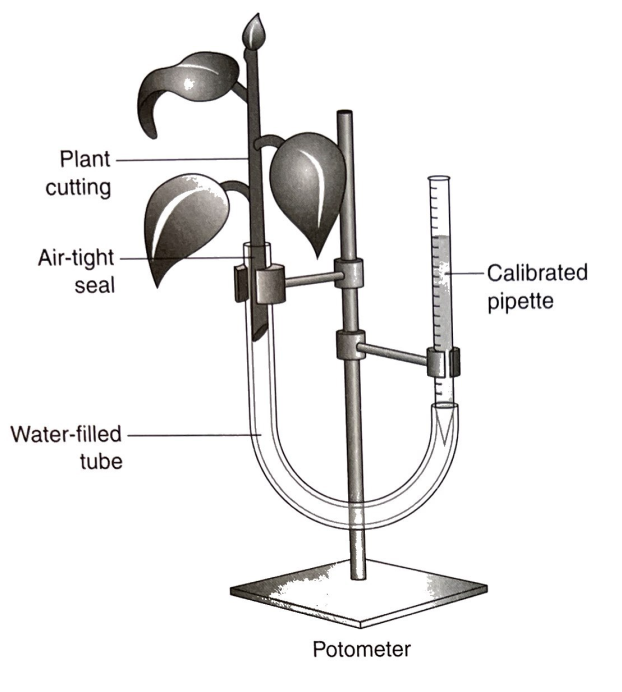
Some students investigated the response of a plant cutting to an increase in ambient air temperature. They used the apparatus shown.

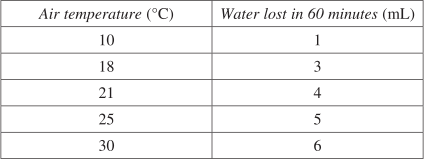
Their data are shown below.
 

The benefit for the plant of this response would be a decrease in the

  1. rate of transpiration.
  2. rate of photosynthesis.
  3. temperature of the plant.
  4. amount of water in the plant.
Show Answers Only

`C`

Show Worked Solution
  • Increased ambient temperature leads to increased water loss.
  • Assists in regulating the temperature of the plant.

`=>C`


♦♦ Mean mark 37%.

Filed Under: Homeostasis Tagged With: Band 5, smc-3659-30-Water Balance in Plants

BIOLOGY, M7 2016 HSC 11 MC

Antibodies are molecules released by

  1. memory B cells.

  2. memory T cells.
  3. specialised B cells.
  4. specialised T cells.
Show Answers Only

`C`

Show Worked Solution
  • Antibodies are synthesised exclusively by specialised B cells.
`=>C`


♦ Mean mark 49%.
Filed Under: Immunity and Responses to Pathogens Tagged With: Band 5, smc-3657-10-Antibody Mediated, smc-3657-25-Antibodies

BIOLOGY, M5 2016 HSC 10 MC

A model of DNA is shown.
 

Which row of the table correctly identifies the different components of the model?
 
\begin{align*}
\begin{array}{l}
\rule{0pt}{3.5ex}\ & \\
\rule{0pt}{2.5ex}\textbf{A.}\rule[-1ex]{0pt}{0pt} \\
\rule{0pt}{2.5ex}\textbf{B.}\rule[-1ex]{0pt}{0pt} \\
\rule{0pt}{2.5ex}\textbf{C.}\rule[-1ex]{0pt}{0pt} \\
\rule{0pt}{2.5ex}\textbf{D.}\rule[-1ex]{0pt}{0pt} \\
\end{array}
\begin{array}{|l|l|l|l|}
\hline \rule{0pt}{2.5ex} \quad \quad W \quad \quad \rule[-1ex]{0pt}{0pt}& \quad \quad X \quad \quad & \quad \quad Y \quad \quad & \quad \quad Z \quad \quad\\
\hline \rule{0pt}{2.5ex}\text{Sugar} \rule[-1ex]{0pt}{0pt} & \text{Phosphate} & \text{Adenine} & \text{Guanine} \\
\hline \rule{0pt}{2.5ex}\text{Phosphate} \rule[-1ex]{0pt}{0pt} & \text{Sugar} & \text{Guanine} & \text{Cytosine} \\
\hline \rule{0pt}{2.5ex}\text{Sugar} \rule[-1ex]{0pt}{0pt} & \text{Phosphate} & \text{Adenine} & \text{Thymine} \\
\hline \rule{0pt}{2.5ex}\text{Phosphate} \rule[-1ex]{0pt}{0pt} & \text{Sugar} & \text{Guanine} & \text{Thymine} \\
\hline
\end{array}
\end{align*}

Show Answers Only

\(A\)

Show Worked Solution
  • Sugars not phosphates attach to bases.
  • Two bases cannot be complementary.

\(\Rightarrow A\)


♦ Mean mark 46%.

Filed Under: Cell Replication Tagged With: Band 5, smc-3649-10-DNA Structure

BIOLOGY, M8 2016 HSC 9 MC

Why is passive transport alone inadequate for the production of urine that is high in nitrogenous wastes?

  1. Osmosis cannot target specific solutes.
  2. Solutes cannot move against a concentration gradient.
  3. Solute transport increases at low concentration gradients.
  4. Osmosis moves water from a low concentration to a high concentration.
Show Answers Only

`B`

Show Worked Solution

By elimination:

  • `A` and `C` are incorrect
  • Water is moved from high concentration to low concentration during osmosis (`D` is incorrect).

`=>B`


Mean mark 53%.

Filed Under: Technologies and Disorders Tagged With: Band 5, smc-3663-10-Kidneys

BIOLOGY, M5 2016 HSC 8 MC

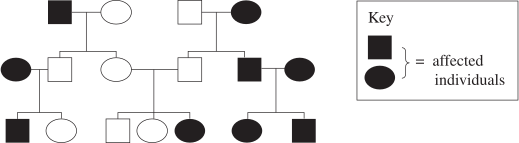
The pedigree shows the inheritance of a characteristic.
 

What pattern of inheritance is shown?

  1. Dominant and sex-linked
  2. Recessive and sex-linked
  3. Dominant and not sex-linked
  4. Recessive and not sex-linked
Show Answers Only

`D`

Show Worked Solution
  • Characteristic is not dominant (recessive) or sex-linked.

`=>D`


Mean mark 55%.

Filed Under: Genetic Variation / Inheritance Tagged With: Band 5, smc-3648-10-Pedigrees, smc-3648-35-Autosomal

CHEMISTRY, M5 2018 HSC 30

Over the last 50 years, scientists have recorded increases in the following:

  • the amount of fossil fuels burnt
  • atmospheric carbon dioxide levels
  • average global air temperature and ocean temperature
  • the volume of carbon dioxide dissolved in the oceans.

Analyse the factors that affect the equilibrium between carbon dioxide in the air and carbon dioxide in the oceans. In your answer, make reference to the scientists' observations and include relevant equations.  (7 marks)

--- 14 WORK AREA LINES (style=lined) ---

Show Answers Only

Fossil fuel combustion:

  • Combustion of fossil fuels releases \(\ce{CO2}\) and heat energy, both of which are released into the atmosphere.
  • Increased burning of fossil fuels will contribute to further rises in atmospheric \(\ce{CO2}\), as described in the equation for the combustion of octane
  •    \(\ce{2C8H18 + 25O2 -> 16CO2 + 18H2O\qquad \triangle H –ve}\)

Carbon dioxide and other climate interactions:

  • \(\ce{CO2}\) combines with water according to the following equilibrium in an exothermic reaction.
  •    \(\ce{CO2(g) + H2O(l) \rightleftharpoons H2CO3(aq) \rightleftharpoons H+(aq) + HCO^3-(aq)\qquad   \triangle H –ve}\)
  • This is an equilibrium and by Le Chatelier’s principle when a system is changed, the system will adjust to oppose the change.
  • Factors that affect equilibrium in this system are temperature, pressure and concentration of reactants and products.
  • The increase of \(\ce{CO2}\) in the air due to the combustion of fossil fuels described above, increases the pressure due to \(\ce{CO2}\) in the system.  By Le Chatelier’s principle, the system will oppose this by absorbing more \(\ce{CO2}\) into the oceans.
  • Scientists have been measuring the level of \(\ce{CO2}\) in oceans due to this effect and confirmed the increase in \(\ce{CO2}\).
  • However, this equilibrium is exothermic and as it causes temperature rises, by Le Chatelier’s principle, the reverse reaction may be subsequently favoured. This would have the effect of decreasing the amount of \(\ce{CO2}\) dissolving in the oceans.
  • In summary, if global temperatures continue to rise and \(\ce{CO2}\) in the atmosphere becomes stable or reduces, the system may adjust so that oceans may release \(\ce{CO2}\) rather than absorbing it.
Show Worked Solution

Fossil fuel combustion:

  • Combustion of fossil fuels releases \(\ce{CO2}\) and heat energy, both of which are released into the atmosphere.
  • Increased burning of fossil fuels will contribute to further rises in atmospheric \(\ce{CO2}\), as described in the equation for the combustion of octane
  •    \(\ce{2C8H18 + 25O2 -> 16CO2 + 18H2O\qquad \triangle H –ve}\)

Carbon dioxide and other climate interactions:

  • \(\ce{CO2}\) combines with water according to the following equilibrium in an exothermic reaction.
  •    \(\ce{CO2(g) + H2O(l) \rightleftharpoons H2CO3(aq) \rightleftharpoons H+(aq) + HCO^3-(aq)\qquad   \triangle H –ve}\)
  • This is an equilibrium and by Le Chatelier’s principle when a system is changed, the system will adjust to oppose the change.
  • Factors that affect equilibrium in this system are temperature, pressure and concentration of reactants and products.
  • The increase of \(\ce{CO2}\) in the air due to the combustion of fossil fuels described above, increases the pressure due to \(\ce{CO2}\) in the system.  By Le Chatelier’s principle, the system will oppose this by absorbing more \(\ce{CO2}\) into the oceans.
  • Scientists have been measuring the level of \(\ce{CO2}\) in oceans due to this effect and confirmed the increase in \(\ce{CO2}\).
  • However, this equilibrium is exothermic and as it causes temperature rises, by Le Chatelier’s principle, the reverse reaction may be subsequently favoured. This would have the effect of decreasing the amount of \(\ce{CO2}\) dissolving in the oceans.
  • In summary, if global temperatures continue to rise and \(\ce{CO2}\) in the atmosphere becomes stable or reduces, the system may adjust so that oceans may release \(\ce{CO2}\) rather than absorbing it.

♦♦ Mean mark 41%.

Filed Under: Static and Dynamic Equilibrium Tagged With: Band 5, Band 6, smc-3669-20-Entropy/Enthalpy, smc-3669-60-Combustion

CHEMISTRY, M6 2018 HSC 29

The concentration of hydrochloric acid in a solution was determined by an acid base titration using a standard solution of sodium carbonate.

  1. Explain why sodium carbonate is a suitable compound for preparation of a standard solution.  (2 marks)

    --- 5 WORK AREA LINES (style=lined) ---

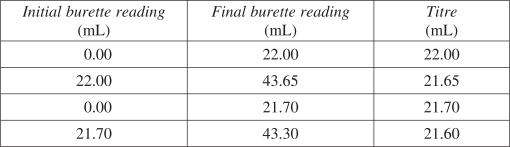
  2. A 25.00 mL sample of 0.1050 mol L¯1 sodium carbonate solution was added to a conical flask and three drops of methyl orange indicator added. The mixture was titrated with the hydrochloric acid and the following readings were recorded.


    Using the data from the table, calculate the concentration of the hydrochloric acid.  (3 marks)

    --- 6 WORK AREA LINES (style=lined) ---

  3. Explain the effect on the calculated concentration of hydrochloric acid if phenolphthalein is used as the indicator instead of methyl orange.  (2 marks)

    --- 5 WORK AREA LINES (style=lined) ---

Show Answers Only

a.    Suitability of  \(\ce{Na2CO3}\):

  • \(\ce{Na2CO3}\) is a stable compound.
  • \(\ce{Na2CO3}\) is a pure solid that will not readily absorb water from the atmosphere.
  • An accurate weight of \(\ce{Na2CO3}\) can therefore be obtained in the experiment’s measurements. 

b.    0.2425 mol L–¹

c.    This is a strong acid / weak base titration.

  • Its equivalence point will occur at a pH less than seven and phenolphthalein changes colour in the pH range 10 – 8.3.
  • Phenolphthalein indicator would therefore signal the end point before equivalence (i.e. with a lower volume of acid). 
  • The calculated concentration of \(\ce{HCl}\) would be higher than the correct concentration.
Show Worked Solution

a.    Suitability of  \(\ce{Na2CO3}\):

  • \(\ce{Na2CO3}\) is a stable compound.
  • \(\ce{Na2CO3}\) is a pure solid that will not readily absorb water from the atmosphere.
  • An accurate weight of \(\ce{Na2CO3}\) can therefore be obtained in the experiment’s measurements. 

♦ Mean mark (a) 43%.

b.   \(\ce{Na2CO3(aq) + 2HCl(aq) -> 2NaCl(aq) + H2O(l) + CO2(g)}\)

\[\ce{Average titre = \frac{21.65 + 21.70 + 21.60}{3} = 21.65 mL}\]

\[\ce{n(Na2CO3) = c \times V = 0.1050 \times 0.0250 = 0.002625 mol}\]

\(\ce{n(HCl) = 2 \times n(Na2CO3) = 0.005250 mol}\)

\[\ce{[HCl] = \frac{n}{V} = \frac{0.005250}{0.02165} = 0.2425 mol L^{-1}}\]  

c.    This is a strong acid / weak base titration.

  • Its equivalence point will occur at a pH less than seven and phenolphthalein changes colour in the pH range 10 – 8.3.
  • Phenolphthalein indicator would therefore signal the end point before equivalence (i.e. with a lower volume of acid). 
  • The calculated concentration of \(\ce{HCl}\) would be higher than the correct concentration.

♦♦♦ Mean mark (c) 29%.

Filed Under: Properties of Acids and Bases, Quantitative Analysis Tagged With: Band 4, Band 5, Band 6, smc-3673-15-Indicators, smc-3675-10-Titration, smc-3675-45-Standard Solutions

CHEMISTRY, M8 2018 HSC 28

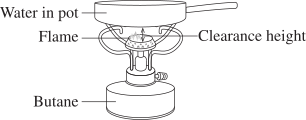
A camp stove using butane as a fuel was used to heat a pot of water inside a small tent. Poisonous carbon monoxide `(text{CO})` gas can be released from these stoves.
 

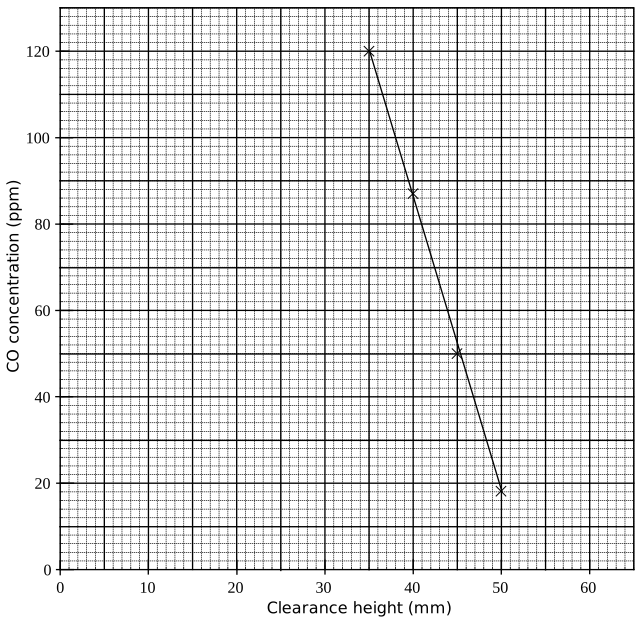
An investigation was carried out to determine the carbon monoxide concentration in the tent when the clearance height of the pot above the flame was altered. The results are shown in the table.

\begin{array} {|l|c|c|c|c|}
\hline \text{Clearance height (mm)} & 35 & 40 & 45 & 50 \\
\hline \text{CO concentration (ppm)} & 120 & 87 & 50 & 18\\
\hline \end{array}

  1. Construct a graph of the data on the grid.   (3 marks)

--- 0 WORK AREA LINES (style=lined) ---

  1. Air containing a `(text{CO})` concentration above 30 ppm is considered unsafe to breathe.  
  2. What is the minimum clearance height at which the pot should be placed?   (1 mark)

    --- 2 WORK AREA LINES (style=lined) ---

  3. Increasing the clearance height decreases the efficiency of the stove according to the following table. 

\begin{array} {|l|c|c|c|c|}
\hline \text{Clearance height (mm)} & 35 & 40 & 45 & 50 \\
\hline \text{Efficiency (%)} & 90 & 70 & 50 & 30\\
\hline \end{array}

  1. A bushwalker only has 15.0 g of butane with which to heat 1.0 L of water with a starting temperature of 20°C.
  2. Calculate the highest temperature of the water that could safely be achieved in the tent. (Molar heat of combustion of butane: `DeltaH_(c)` = 2877 kJ mol ¯1)   (4 marks)

    --- 10 WORK AREA LINES (style=lined) ---

Show Answers Only

a.   
     

b.  48 mm

c.   91.1°C

Show Worked Solution

a.   
     

b.  From the graph, the minimum height above the flame is 48 mm.

c.    Highest temperature of water:

  • The lowest safe distance = 48 mm (part (b)).
  • Fuel efficiency is 40% at 48 mm 
  • `DeltaH_(c) = 0.4 xx 2877 = 1151\ text{kJ mol}^{-1}`
  • \[\ce{n(C4H10) = \frac{m}{MM} = \frac{15}{4 \times 12.01 + 10 \times 1.008} = \frac{15}{58.12} = 0.258 mol}\]
  • \(\ce{Energy (C4H10) = 0.258 \times 1151 = 297 kJ}\)
`q` `=mC DeltaT`  
`297\ 000` `=1.0 xx 4.18 xx 10^3 xx Delta T`  
`Delta T` `=(297\ 000)/(4.18 xx 10^3)=71.1°text{C}`  

 
`:.` Highest temperature of water = 20.0 + 71.1 = 91.1°C


Mean mark (c) 54%.

Filed Under: Hydrocarbons and Associated Reactions Tagged With: Band 3, Band 4, Band 5

CHEMISTRY, M5 2018 HSC 25

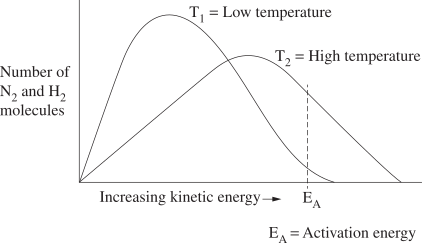
The graph shows the number of molecules of \(\ce{N2}\) and \(\ce{H2}\) that possess a certain kinetic energy at two different temperatures.
 

With reference to the graph, explain why changing the temperature and adding a catalyst would change the rate of production of ammonia.  (4 marks)

--- 10 WORK AREA LINES (style=lined) ---

Show Answers Only
  • Gas particles need to attain activation energy \( \text{E}_\text{A} \) in order to react when they collide.
  • \( \text{E}_\text{A} \) is a level of kinetic energy that is sufficient for reactions to occur.
  • Some \(\ce{N2}\) and \(\ce{H2}\) particles have a kinetic energy above \( \text{E}_\text{A} \) when the temperature is lower at \(\text{T}_1\) (see graph above).
  • However, the number of \(\ce{N2}\) and \(\ce{H2}\) particles with enough energy to react and produce ammonia is significantly greater at the higher temperature \(\text{T}_2\), where the graph has shifted to the right.
  • A catalyst lowers the \( \text{E}_\text{A} \). On the graph, this would shift the dotted \( \text{E}_\text{A} \) line to the left.
  • In the presence of a catalyst, both graphs show there will be a greater number of particles that can react in a given time and therefore the rate of ammonia production will increase in both cases.
Show Worked Solution
  • Gas particles need to attain activation energy \( \text{E}_\text{A} \) in order to react when they collide.
  • \( \text{E}_\text{A} \) is a level of kinetic energy that is sufficient for reactions to occur.
  • Some \(\ce{N2}\) and \(\ce{H2}\) particles have a kinetic energy above \( \text{E}_\text{A} \) when the temperature is lower at \(\text{T}_1\) (see graph above).
  • However, the number of \(\ce{N2}\) and \(\ce{H2}\) particles with enough energy to react and produce ammonia is significantly greater at the higher temperature \(\text{T}_2\), where the graph has shifted to the right.
  • A catalyst lowers the \( \text{E}_\text{A} \). On the graph, this would shift the dotted \( \text{E}_\text{A} \) line to the left.
  • In the presence of a catalyst, both graphs show there will be a greater number of particles that can react in a given time and therefore the rate of ammonia production will increase in both cases.

Mean mark 53%.

Filed Under: Factors that Affect Equilibrium Tagged With: Band 4, Band 5, smc-3670-10-Temperature, smc-3670-40-Collision theory, smc-3670-80-Other graphs

CHEMISTRY, M8 2018 HSC 22

A bottle of solution is missing its label. It is either `text{Pb(NO}_(3))_(2), text{Ba(NO}_(3))_(2)` or `text{Fe(NO}_(3))_(2)`

Using only `text{HCl, NaOH}` and `text{H}_(2) text{SO}_(4)` solutions, outline a sequence of steps that could be followed to confirm the identity of the solution in the bottle. Include observed results and ionic equations in your answer.    (4 marks)

--- 8 WORK AREA LINES (style=lined) ---

Show Answers Only

“

Show Worked Solution

Prepare 1 test tube of the unknown solution.

Step 1: Add \(\ce{HCl}\) to the solution.

  • If a white precipitate forms, \(\ce{Pb(NO3)2}\) is present.
  • \(\ce{Pb^2+(aq) + 2Cl-(aq) -> PbCl2(s)}\) 

Step 2: Add \(\ce{H2SO4}\) to solution if no precipitate in Step 1.

  • If a white precipitate forms, \(\ce{Ba(NO3)2}\) is present.
  • \(\ce{Ba^2+(aq) + SO4^2-(aq) -> BaSO4(s)}\) 

Step 3: Add \(\ce{NaOH}\) to solution if no precipitate in Step 1 and 2.

  • If a green precipitate forms, \(\ce{Fe(NO3)2}\) is present.
  • \(\ce{Fe^2+(aq) + 2OH-(aq) -> Fe(OH)2(s)}\)

Mean mark 56%.

Filed Under: Inorganic Substances Tagged With: Band 4, Band 5, smc-3682-10-Tests for Ions in Solution

BIOLOGY, M8 2018 HSC 15 MC

Which row of the table is correct with respect to the substances that pass through the nephron?

\begin{align*}
\begin{array}{l}
\rule{0pt}{2.5ex}\text{}\rule[-1ex]{0pt}{0pt}\\
\text{}\rule[-1ex]{0pt}{0pt}& \\
\rule{0pt}{2.5ex}\textbf{A.}\\
\text{} & \text{} & \text{} \\
\text{} &\rule[-1ex]{0pt}{0pt}\text{} & \text{}\\
\rule{0pt}{2.5ex}\textbf{B.}\\
\text{} & \text{} & \text{} \\
\text{} &\rule[-1ex]{0pt}{0pt}\text{} & \text{}\\
\rule{0pt}{2.5ex}\textbf{C.}\\
\text{} & \text{} & \text{} \\
\text{} &\rule[-1ex]{0pt}{0pt}\text{} & \text{}\\
\rule{0pt}{2.5ex}\textbf{D.}\\
\text{} & \text{} & \text{} \\
\text{} &\rule[-1ex]{0pt}{0pt}\text{} & \text{}\\
\end{array}
\begin{array}{|l|l|l|}
\hline
\rule{0pt}{2.5ex} \quad \ \textit{Bowman's capsule}& \ \ \ \textit{Proximal convoluted} & \quad \ \  \textit{Collecting duct}\\
 & \quad \quad \quad \quad \textit{tubule}\rule[-1ex]{0pt}{0pt}& \\
\hline
\rule{0pt}{2.5ex}\text{Chloride ions are at the} &\text{All chloride ions are} & \text{Water is reabsorbed}\\
\text{same concentration as in} & \text{reabsorbed} & \text{in the presence of} \\
\text{plasma} &\rule[-1ex]{0pt}{0pt}\text{} & \text{aldosterone}\\
\hline
\rule{0pt}{2.5ex}\text{Plasma proteins are at} &\text{Water is reabsorbed by} & \text{Water is reabsorbed in}\\
\text{the same concentration} & \text{osmosis} & \text{the presence of ADH} \\
\text{as in plasma} &\rule[-1ex]{0pt}{0pt}\text{} & \text{}\\
\hline
\rule{0pt}{2.5ex}\text{Glucose is at the same} &\text{All glucose is reabsorbed} & \text{Water is reabsorbed}\\
\text{concentration as in} & \text{} & \text{in the presence of} \\
\text{plasma} &\rule[-1ex]{0pt}{0pt}\text{} & \text{aldosterone}\\
\hline
\rule{0pt}{2.5ex}\text{Sodium ions are at the} &\text{Sodium ions are} & \text{Water is reabsorbed in}\\
\text{same concentration as in} & \text{reabsorbed} & \text{the presence of ADH} \\
\text{plasma} &\rule[-1ex]{0pt}{0pt}\text{} & \text{}\\
\hline
\end{array}
\end{align*}

Show Answers Only

\(D\)

Show Worked Solution

By Elimination

  • ADH is a hormone that results in the increased permeability of the walls of the collecting duct to water. Aldosterone is used for salts. (Eliminate A and C).
  • Active reabsorption of sodium ions occurs in the proximal convoluted tubule and water is moved out passively by osmosis. (Eliminate B).

\(\Rightarrow D\)


Mean mark 52%.

Filed Under: Technologies and Disorders Tagged With: Band 5, smc-3663-10-Kidneys

BIOLOGY, M5 2018 HSC 14 MC

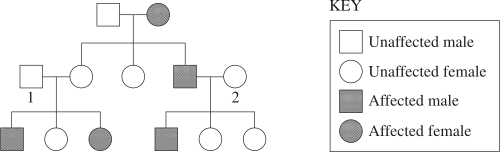
The following pedigree shows the inheritance of a disorder.


Which row of the table shows the genotypes of individuals 1 and 2 ?

\begin{align*}
\begin{array}{l}
\rule{0pt}{2.5ex} \ \rule[-1ex]{0pt}{0pt}& \\
\rule{0pt}{2.5ex} \textbf{A.}\rule[-1ex]{0pt}{0pt}\\
\rule{0pt}{2.5ex} \textbf{B.}\rule[-1ex]{0pt}{0pt}\\
\rule{0pt}{2.5ex} \textbf{C.}\rule[-1ex]{0pt}{0pt}\\
\rule{0pt}{2.5ex} \textbf{D.}\rule[-1ex]{0pt}{0pt}\\
\end{array}
\begin{array}{|c|c|}
\hline \rule{0pt}{2.5ex} \quad \textit{Individual 1} \quad \rule[-1ex]{0pt}{0pt}& \quad \textit{Individual 2} \quad  \\
\hline \rule{0pt}{2.5ex} \text{Aa} \rule[-1ex]{0pt}{0pt}& \text{Aa} \\
\hline \rule{0pt}{2.5ex} \text{AA} \rule[-1ex]{0pt}{0pt}& \text{Aa} \\
\hline \rule{0pt}{2.5ex} \text{X\(^{A}\)} \text{Y} \rule[-1ex]{0pt}{0pt}& \text{X\(^{A}\)} \text{X\(^{a}\)} \\
\hline \rule{0pt}{2.5ex} \text{X\(^{a}\)} \text{Y} \rule[-1ex]{0pt}{0pt}& \text{X\(^{A}\)} \text{X\(^{a}\)} \\
\hline
\end{array}
\end{align*}

Show Answers Only

\(A\)

Show Worked Solution

By Elimination

  • Both individuals do not have the disorder but have children which do and therefore the condition must be recessive. This means the individuals must be unaffected (have dominant allele) and be heterozygous if it is autosomal. (Eliminate B and D).
  • If the disease is sex-linked, then the genotype of individual 1 when crossed with any female genotype will never have any female children with the disease, which therefore means it cannot be sex-linked. (Eliminate C).

\(\Rightarrow A\)


♦ Mean mark 45%.

Filed Under: Genetic Variation / Inheritance Tagged With: Band 5, smc-3648-10-Pedigrees, smc-3648-35-Autosomal

BIOLOGY, M7 2016 HSC 15 MC

Both artificial insemination and cloning are reproductive techniques that can decrease the genetic diversity of a population.

Which row of the table provides a correct reason for each technique's contribution to this decrease?

\begin{align*}
\begin{array}{l}
\rule{0pt}{2.5ex} \ \rule[-1ex]{0pt}{0pt}& \\
\rule{0pt}{2.5ex}\textbf{A.}\rule[-1ex]{0pt}{0pt}\\
\rule{0pt}{2.5ex}\textbf{B.}\rule[-1ex]{0pt}{0pt}\\
\rule{0pt}{2.5ex}\textbf{C.}\rule[-1ex]{0pt}{0pt}\\
\rule{0pt}{2.5ex}\textbf{D.}\rule[-1ex]{0pt}{0pt}\\
\end{array}
\begin{array}{|l|l|}
\hline
\rule{0pt}{2.5ex}\quad \quad \textit{Artificial insemination }\rule[-1ex]{0pt}{0pt}& \quad \quad \quad \quad \quad \quad \quad \ \ \ \textit{Cloning} \\
\hline
\rule{0pt}{2.5ex}\text{Random fertilisation takes place}\rule[-1ex]{0pt}{0pt}&\text{Large numbers of individuals are produced}\\
\hline
\rule{0pt}{2.5ex}\text{One male has many offspring}\rule[-1ex]{0pt}{0pt}& \text{All gametes are genetically identical}\\
\hline
\rule{0pt}{2.5ex}\text{All male gametes are identical}\rule[-1ex]{0pt}{0pt}& \text{All individuals have the same phenotype} \\
\hline
\rule{0pt}{2.5ex}\text{Fewer males are used to reproduce}\rule[-1ex]{0pt}{0pt}& \text{All individuals have the same genotype} \\
\hline
\end{array}
\end{align*}

Show Answers Only

\(D\)

Show Worked Solution
  • Artificial insemination uses pollen with favoured characteristics to pollinate flowers. This means that very few males will be used for their pollen for this process.
  • In whole organism cloning, the offspring have the same genome as the parent.

\(\Rightarrow D\)


♦♦ Mean mark 37%.

Filed Under: Genetic Technologies Tagged With: Band 5, smc-3654-10-Genetic Diversity, smc-3654-51-Reproductive Technologies, smc-3654-70-Whole Organism Cloning

BIOLOGY, M7 2018 HSC 8 MC

An organism suspected of causing a disease is described as being unicellular, having a cell wall and lacking a nucleus.

How is this organism classified?

  1. A bacterium
  2. A fungus
  3. A protozoan
  4. A virus
Show Answers Only

`A`

Show Worked Solution

By Elimination

  • By definition, a virus is not unicellular as it is not living or a cell (Eliminate D).
  • Both protozoa and fungi contain a nucleus (Eliminate B and C).

`=>A`


♦♦ Mean mark 35%.

Filed Under: Causes of Infectious Disease Tagged With: Band 5, smc-3655-10-Classifying Pathogens

ENGINEERING, PPT 2022 HSC 23c

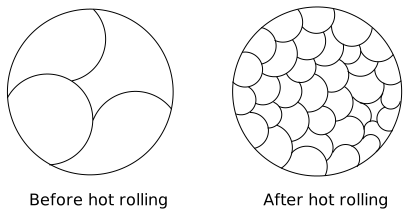
Steel `text{I}`-beams have been used when large, open spans need to be created inside buildings.

Explain how microstructural changes take place in steel when an `text{I}`-beam is formed using the process of hot rolling. You may use a drawing to support your answer.   (4 marks)

--- 9 WORK AREA LINES (style=lined) ---

Show Answers Only

  • During hot rolling the steel is heated to above its recrystallisation temperature.
  • Therefore, due to the pressure of the rollers, the grains change from their original state to become elongated.
  • However, as the steel exits the rollers it is still above recrystallisation temperature, resulting in the recrystallisation of the elongated grains to create finer, equiaxed grains.
Show Worked Solution

  • During hot rolling the steel is heated to above its recrystallisation temperature.
  • Therefore, due to the pressure of the rollers, the grains change from their original state to become elongated.
  • However, as the steel exits the rollers it is still above recrystallisation temperature, resulting in the recrystallisation of the elongated grains to create finer, equiaxed grains.

♦ Mean mark 48%.

Filed Under: Materials Tagged With: Band 5, smc-3719-10-Manufacturing - Ferrous, smc-3719-40-Macro/microstructure

ENGINEERING, CS 2022 HSC 23b

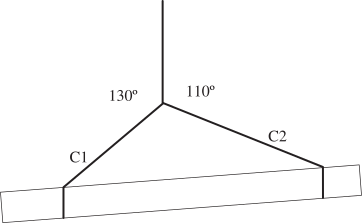
The diagram represents a 120 kg beam that is being guided into place by a crane.
 

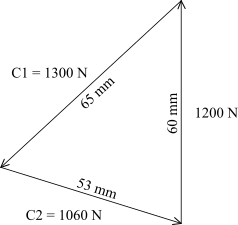
Use a scale drawing to graphically determine the tension in the two cables attached to the beam.   (3 marks)

--- 6 WORK AREA LINES (style=lined) ---

Show Answers Only

Scale: 1 mm = 20 N


Tension in C1 = 1.3 kN

Tension in C2 = 1.06 kN

Show Worked Solution

Scale: 1 mm = 20 N


Tension in C1 = 1.3 kN

Tension in C2 = 1.06 kN

(Answers that are relatively similar in either direction will be correct as question asks for graphical solution, creating a margin of error)


♦ Mean mark 46%.

Filed Under: Engineering Mechanics Tagged With: Band 5, smc-3714-80-Stress/Strain - other

ENGINEERING, TE 2022 HSC 22b

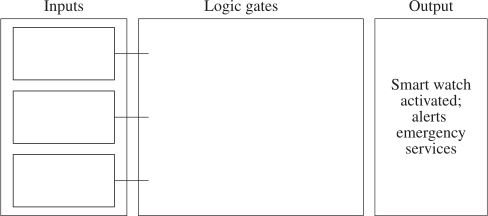
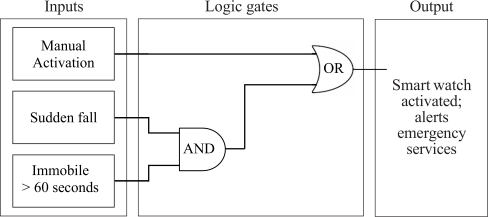
In the event of a fall or a medical emergency, smart watches are designed to alert emergency services when either of the following conditions is met.

Condition 1: the smart watch emergency alert is manually activated

Condition 2: the smart watch detects a sudden fall and no movement for 1 minute

An incomplete logic diagram showing the activation of the smart watch is given.
 

Complete the diagram by identifying the inputs and drawing the appropriate logic gates.   (3 marks)

--- 0 WORK AREA LINES (style=lined) ---

Show Answers Only

Show Worked Solution


Mean mark 54%.

Filed Under: Electricity/Electronics Tagged With: Band 5, smc-3730-30-Logic gates/circuits

ENGINEERING, PPT 2022 HSC 21b

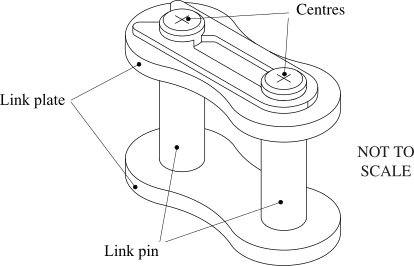
A pictorial drawing of an assembled chain master link is shown.   
 

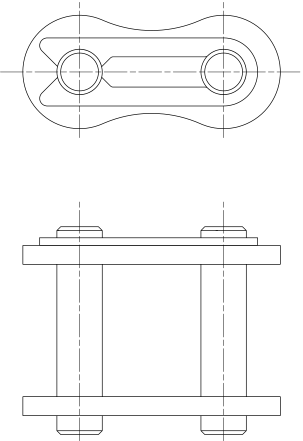
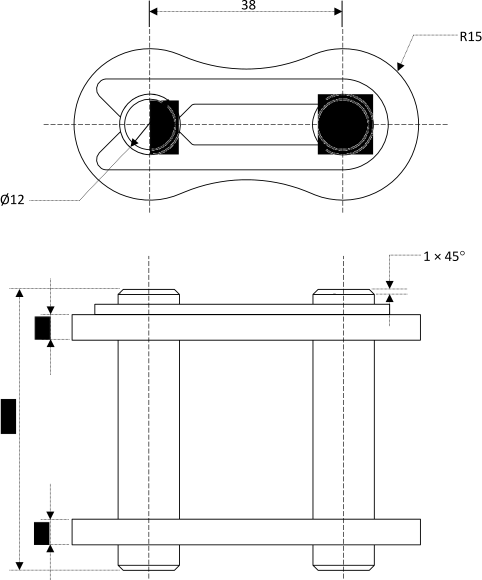
Complete the orthogonal views below, to AS 1100 standards, by adding the following dimensions.   (3 marks)

  • • The overall height of the assembly – 55 mm
    • The thickness of one link plate – 5 mm
    • The radius of the link plate – 15 mm
    • The diameter of the link pin – 12 mm
    • The chamfer of the pin – 1 mm
    • Distance between centres of pins – 38 mm

--- 0 WORK AREA LINES (style=lined) ---

Show Answers Only

Notes on this drawing:

  • The correct radius (R) and diameter (∅) symbols must be used
  • The chamfer must be labelled with the width and angle
  • Dimensioning must be completed to AS1100 standards (including arrow heads and line thickness)
Show Worked Solution

Notes on this drawing:

  • The correct radius (R) and diameter (∅) symbols must be used
  • The chamfer must be labelled with the width and angle
  • Dimensioning must be completed to AS1100 standards (including arrow heads and line thickness)

Mean mark 52%.

Filed Under: Communication Tagged With: Band 5, smc-3721-10-Orthogonal diagrams

ENGINEERING, PPT 2022 HSC 21a

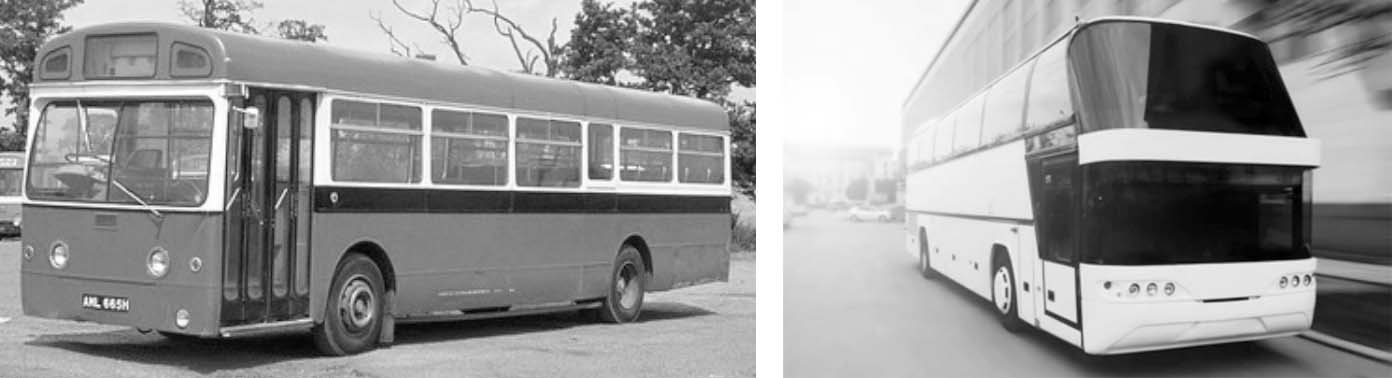
The following images show an older bus and a contemporary bus.
 

  1. Older buses had flat, toughened glass windscreen panels.
  2. How is toughened glass manufactured?   (2 marks)

--- 5 WORK AREA LINES (style=lined) ---

  1. Contemporary buses have windscreens which curve around the front of the bus.
  2. Describe the manufacturing process used to make these windscreens.   (3 marks)

--- 6 WORK AREA LINES (style=lined) ---

Show Answers Only

i.    Toughened glass is formed by:-

  • heating the glass to annealing temperature (approximately 600 degrees) and quenching/rapidly cooling the outside layers using a jet of water.
  • Alternatively toughened glass can be created by soaking the glass in potassium nitrate for an extended period.

ii.    Production of curved glass panels:

  • Windscreens are produced by placing a flat sheet of glass above a metal mould.
  • The glass is then evenly heated until it falls and takes the shape of the mould, and then allowed to cool.
  • Once cooled, the glass is then laminated.
  • Laminating involves placing a layer of polymer between two identically shaped sheets of glass, in this case curved windshields.
Show Worked Solution

i.    Toughened glass is formed by:-

  • heating the glass to annealing temperature (approximately 600 degrees) and quenching/rapidly cooling the outside layers using a jet of water.
  • Alternatively toughened glass can be created by soaking the glass in potassium nitrate for an extended period.

♦ Mean mark (i) 43%.

ii.    Production of curved glass panels:

  • Windscreens are produced by placing a flat sheet of glass above a metal mould.
  • The glass is then evenly heated until it falls and takes the shape of the mould, and then allowed to cool.
  • Once cooled, the glass is then laminated.
  • Laminating involves placing a layer of polymer between two identically shaped sheets of glass, in this case curved windshields.

♦ Mean mark (ii) 39%.

Filed Under: Historical and Societal Influences, Materials Tagged With: Band 5, smc-3717-30-Historical materials, smc-3719-60-Ceramics/Glass, smc-3719-70-Polymers

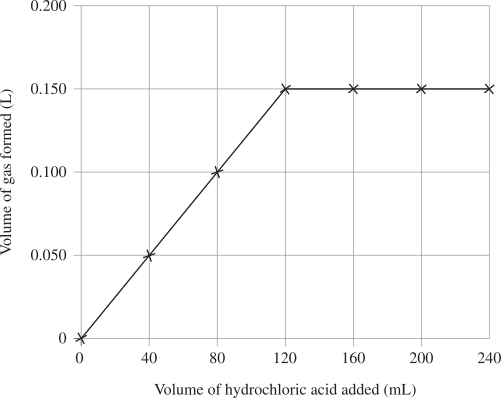
CHEMISTRY, M8 2016 HSC 27

The volume of gas formed at 25°C and 100 kPa as hydrochloric acid was added to a pure sample of aluminium is shown in the graph.
 

Calculate the original mass of the aluminium sample used in the reaction.   (4 marks)

--- 8 WORK AREA LINES (style=lined) ---

Show Answers Only

0.109 grams

Show Worked Solution

\[\ce{Al(s) + 3HCl(aq) -> AlCl3(aq) + \frac{3}{2}H2(g)}\]

  • The graph shows that all the aluminium has reacted when no more gas is being produced, at a volume of 0.150 L.

\[\ce{n(H2) = \frac{0.150}{24.79} = 0.00605 mol}\]

\[\ce{n(Al) = \frac{2}{3} \times 0.00605 = 0.00403 mol}\]

\(\therefore \ce{m(Al) = 0.00403 \times 26.98 = 0.109 g}\)


♦ Mean mark 48%.

Filed Under: Inorganic Substances Tagged With: Band 5, smc-3682-50-Stoichiometric Calculations

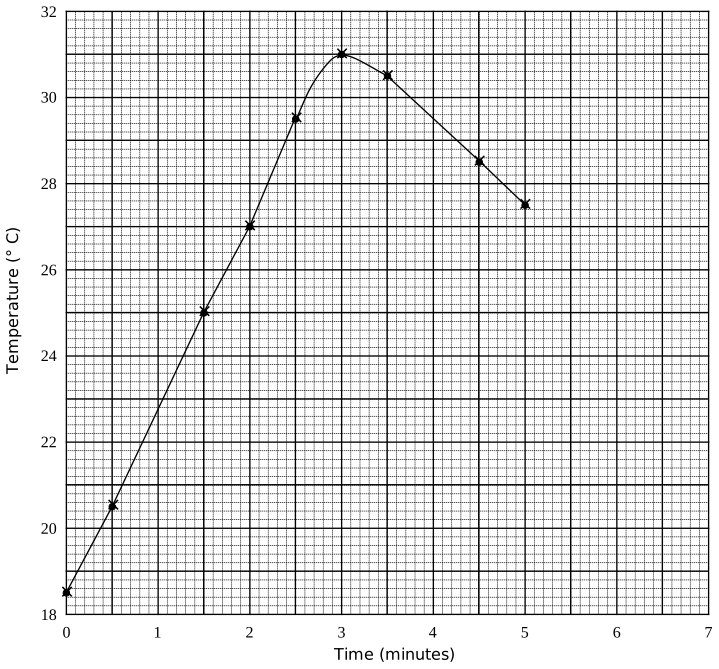
CHEMISTRY, M7 2016 HSC 23

A spirit burner containing ethanol was used to heat water in a conical flask for three minutes to measure the molar heat of combustion of ethanol.

The results from the investigation are shown.
 

  1. On the grid, draw a line graph to represent the data contained in the table.   (3 marks)
     

  1. The following values were also recorded during the investigation:
  2.       Initial mass of spirit burner = 236.14 g
  3.       Final mass of spirit burner = 235.56 g
  4.       Calculated experimental molar heat of combustion of ethanol = – 827 kJ mol ¯1.
  5. Using information from the previous page and the above values, determine the mass of water that was in the conical flask.   (3 marks)

    --- 6 WORK AREA LINES (style=lined) ---

Show Answers Only

a.   
     

b.  0.199 kg

Show Worked Solution

a.   


b.   Using the graph:

\(\triangle T = 31.0-18.5=12.5°\text{C} \)

\( \text{m(Ethanol burnt)} = 236.14-235.56=0.58\ \text{g} \)

\[ \ce{n(Ethanol) = \frac{m}{MM} = \frac{0.58}{2 \times 12.01 + 6 \times 1.008 + 16.00} = 0.0126 mol} \]

\(\ce{Energy released ($q$) = 0.0126 \times 827 = 10.420 kJ}\)

\[q = -mC\triangle T \ \ =>\ \ m= -\frac{q}{C\triangle T} \]

`:.m\text{(water)} =(10\ 420)/(4.18 xx 10^3 xx 12.5)=0.00019927\ text{g}=0.199\ text{kg}`


Mean mark (b) 53%.

Filed Under: Alcohols Tagged With: Band 4, Band 5, smc-3679-10-Combustion

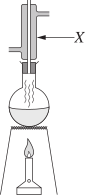
CHEMISTRY, M7 2016 HSC 22

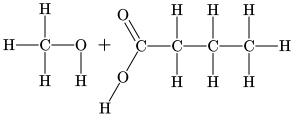
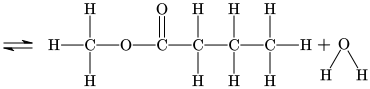
This apparatus was set up to produce methyl butanoate.
 

  1. Identify a safety issue in this experiment.   (1 mark)

    --- 2 WORK AREA LINES (style=lined) ---

  2. Using structural formulae, write the equation for the production of methyl butanoate.   (2 marks)

    --- 10 WORK AREA LINES (style=lined) ---

  3. Justify the use of apparatus `X` in this experiment.   (2 marks)

    --- 5 WORK AREA LINES (style=lined) ---

Show Answers Only

a.   Flame could ignite one of reagents which is flammable.

b.   
     

c.    Esterification is a relatively slow reaction.

  • Heating the reaction makes it go faster. However, the low boiling points of the reactants make them volatile as they readily convert into gas.
  • The cooling condenser `X` prevents the gas reactants from escaping the experiment by condensing them back into the reaction mixture. This process allows the reaction to proceed at higher temperatures.
Show Worked Solution

a.   Flame could ignite one of reagents which is flammable.
 

b.   


♦ Mean mark (b) 52%.

c.    Esterification is a relatively slow reaction.

  • Heating the reaction makes it go faster. However, the low boiling points of the reactants make them volatile as they readily convert into gas.
  • The cooling condenser `X` prevents the gas reactants from escaping the experiment by condensing them back into the reaction mixture. This process allows the reaction to proceed at higher temperatures.

♦♦♦ Mean mark (c) 14%.

Filed Under: Reactions of Organic Acids and Bases Tagged With: Band 3, Band 5, Band 6, smc-3680-10-Esters

ENGINEERING, CS 2022 HSC 20 MC

For a particular material, specimens of different sizes were tested. A load-extension diagram and a stress-strain diagram are to be drawn for each specimen.

The shape of which diagram(s) will be affected by the size of the specimen tested?

  1. Both diagrams
  2. Neither diagram
  3. The stress–strain diagram only
  4. The load–extension diagram only
Show Answers Only

`D`

Show Worked Solution
  • The stress–strain diagrams will be the same shapes as both stress and strain are calculated by dividing by constants (original area and original length).

`=>D`


♦♦ Mean mark 36%.

Filed Under: Engineering Mechanics Tagged With: Band 5, smc-3714-85-Stress-strain diagram, smc-3714-90-Load-ext diagram

ENGINEERING, PPT 2022 HSC 19 MC

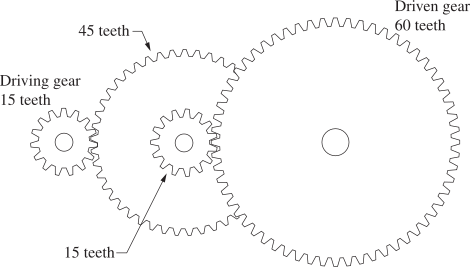
A gear system for a machine is shown.
 

What is the speed, in revolutions per minute (rpm), of the driven gear when the driving gear rotates at 1800 rpm?

  1. 150 rpm
  2. 450 rpm
  3. 600 rpm
  4. 1800 rpm
Show Answers Only

`A`

Show Worked Solution
`R_(output)` `= 1800xx(text{input})/(text{auxiliary})xx(text{auxiliary})/(text{output})`  
  `= 1800xx1/3xx1/4`  
  `= 150\ text{rpm}`  

 
`=>A`


♦ Mean mark 44%.

Filed Under: Mechanics Tagged With: Band 5, smc-3718-20-Velocity ratio

ENGINEERING, PPT 2022 HSC 18 MC

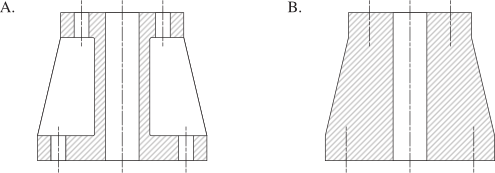
A pictorial view of a machine component is shown.

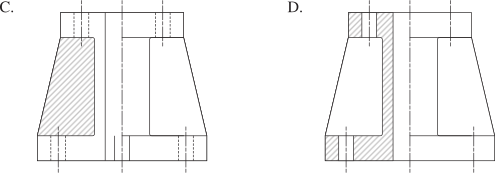
When viewed from the direction of arrow A, which drawing correctly shows the half-sectional view?
 

Show Answers Only

`D`

Show Worked Solution

By Elimination:

  • `A`and `B` are full sectional views of the actual body of the component.
  • Do not section webs in sectional drawings (eliminate `C`)

`=>D`


♦ Mean mark 48%.

Filed Under: Communication Tagged With: Band 5, smc-3721-20-Sectional views

ENGINEERING, TE 2022 HSC 14 MC

What feature of fibre optic cables has made them a suitable replacement for traditional copper-based cables?

  1. Lower bandwidth
  2. Higher attenuation
  3. Do not need repeaters over long distances
  4. Not susceptible to electromagnetic interference
Show Answers Only

`D`

Show Worked Solution

By Elimination:

  • `A` and `B` are both negative impacts
  • `C` may not be true over long enough distances

`=>D`


♦ Mean mark 49%.

Filed Under: Materials Tagged With: Band 5, smc-3729-25-Fibre optics

ENGINEERING, TE 2022 HSC 11 MC

A diode bridge is used to convert AC to DC current.

What type of conversion is this known as?

  1. Partial rectification
  2. Inverse rectification
  3. Full wave rectification
  4. Half wave rectification
Show Answers Only

`C`

Show Worked Solution
  • If a diode bridge is used, the conversion will be full wave rectification.

`=>C`


♦♦ Mean mark 38%.

Filed Under: Electricity/Electronics, Electricity/Electronics Tagged With: Band 5, smc-3720-30-AC/DC, smc-3730-50-Circuits

ENGINEERING, AE 2022 HSC 10 MC

Which of the following identifies two causes of parasitic drag?

  1. Aircraft lift, angle of attack
  2. Aircraft lift, material of aircraft skin
  3. The movement of air over the wing, angle of attack
  4. The movement of air over the wing, material of aircraft skin
Show Answers Only

`D`

Show Worked Solution
  • Parasitic drag is all drag that is caused by the shape, construction-type and material of an aircraft.

`=>D`


♦♦ Mean mark 37%.

Filed Under: Mechanics and Hydraulics Tagged With: Band 5, smc-3724-10-Lift/Drag, smc-3724-30-Angle of attack

ENGINEERING, CS 2022 HSC 7 MC

What is the thickness of a standard nut that fits a M20 × 2 bolt?

  1. 10 mm
  2. 16 mm
  3. 18 mm
  4. 20 mm
Show Answers Only

`B`

Show Worked Solution
  • AS1100 standards state the width of a nut is 0.8 x the diameter of the bolt.
  • 0.8 × 20 = 16 mm

`=>B`


Mean mark 52%.

Filed Under: Communication Tagged With: Band 5, smc-3716-10-AS 1100

BIOLOGY, M8 2015 HSC 31

'Renal dialysis and kidney transplants are very different treatments for the same medical condition. Each treatment was developed from a new application of biological knowledge.'

Justify these statements.  (8 marks)

--- 18 WORK AREA LINES (style=lined) ---

Show Answers Only

Consider each element of the statement separately:

Medical Conditions

  • Kidney failure is a recognised medical condition that can be treated using both kidney transplants or renal dialysis.

Different Treatments

  • Renal dialysis is the cleansing of wastes from the blood externally using a dialysis machine.
  • During a kidney transplant the diseased organ is removed and replaced with a healthy organ provided by a donor.

New Application of biological information: Renal dialysis

  • The movement of substances from regions of high concentration to regions of low concentration is known as diffusion.
  • Diffusion can occur across a semi-permeable membrane.
  • The dialysis machine allows blood to flow through tubing which is permeable to urea.
  • The solution around the tubing is continually replaced to maintain a steep concentration gradient so the urea can be removed out of the blood through diffusion.

New Application of biological information: Kidney transplant

  • Increased knowledge of the immune system allowed for an improved understanding of organ rejection following organ transplantation.
  • B and T cells on donated organs are recognised by the immune system as foreign and it then attacks the transplanted organ.
  • Once an infection has been removed, suppressor T cells stop the immune cells and switch off the immune response.
  • This knowledge lead to the development of immunosuppressants or anti-rejection drugs designed to fight the immune symptoms’ response to reject donated organs.
  • After transplantation, anti-rejection drugs are used by recipients for their lifetime.
Show Worked Solution

Medical Conditions

  • Kidney failure is a recognised medical condition that can be treated using both kidney transplants or renal dialysis.

Different Treatments

  • Renal dialysis is the cleansing of wastes from the blood externally using a dialysis machine.
  • During a kidney transplant the diseased organ is removed and replaced with a healthy organ provided by a donor.

New Application of biological information: Renal dialysis

  • The movement of substances from regions of high concentration to regions of low concentration is known as diffusion.
  • Diffusion can occur across a semi-permeable membrane.
  • The dialysis machine allows blood to flow through tubing which is permeable to urea.
  • The solution around the tubing is continually replaced to maintain a steep concentration gradient so the urea can be removed out of the blood through diffusion.

New Application of biological information: Kidney transplant

  • Increased knowledge of the immune system allowed for an improved understanding of organ rejection following organ transplantation.
  • B and T cells on donated organs are recognised by the immune system as foreign and it then attacks the transplanted organ.
  • Once an infection has been removed, suppressor T cells stop the immune cells and switch off the immune response.
  • This knowledge lead to the development of immunosuppressants or anti-rejection drugs designed to fight the immune symptoms’ response to reject donated organs.
  • After transplantation, anti-rejection drugs are used by recipients for their lifetime.

♦♦ Mean mark 41%.

Filed Under: Technologies and Disorders Tagged With: Band 5, Band 6, smc-3663-10-Kidneys

CHEMISTRY, M8 2015 HSC 29

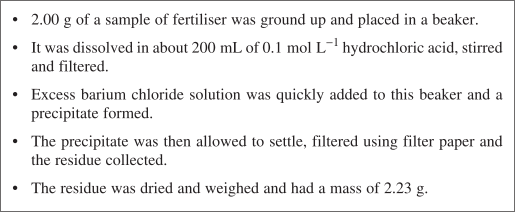
The procedure of a first-hand investigation conducted in a school laboratory to determine the percentage of sulfate in a lawn fertiliser is shown.
 

  1. Suggest modifications that could be made to the procedure to improve the results of this investigation. Justify your suggestions.   (4 marks)

    --- 10 WORK AREA LINES (style=lined) ---

  2. Calculate the percentage of sulfate in the original fertiliser sample.   (3 marks)

    --- 6 WORK AREA LINES (style=lined) ---

Show Answers Only

a.   Modification 1:

  • The \(\ce{BaCl2}\) should be added slowly. This would help more of the sulfate ions come into contact with barium and form a precipitate.

Modification 2:

  • Barium sulfate is a very fine precipitate. By heating the mixture gently for some time, the \(\ce{BaSO4}\) precipitate is able to flocculate into larger particles, which would be trapped by the filter.

Modification 3:

  • The pores of most filter paper are still too large to effectively capture the \(\ce{BaSO4}\) precipitate. The experiment should use a small pore filter, like a sintered glass crucible.

Modification 4:

  • Multiple samples of the fertiliser should be analysed and the average value calculated to achieve more valid results. This would mitigate inaccuracies caused by unevenly distributed sulfate in the mixture.

b.   45.9%

Show Worked Solution

a.   Modification 1:

  • The \(\ce{BaCl2}\) should be added slowly. This would help more of the sulfate ions come into contact with barium and form a precipitate.

Modification 2:

  • Barium sulfate is a very fine precipitate. By heating the mixture gently for some time, the \(\ce{BaSO4}\) precipitate is able to flocculate into larger particles, which would be trapped by the filter.

Modification 3:

  • The pores of most filter paper are still too large to effectively capture the \(\ce{BaSO4}\) precipitate. The experiment should use a small pore filter, like a sintered glass crucible.

Modification 4:

  • Multiple samples of the fertiliser should be analysed and the average value calculated to achieve more valid results. This would mitigate inaccuracies caused by unevenly distributed sulfate in the mixture. 

♦ Mean mark (a) 49%.

b.   \(\ce{Ba^2+(aq) + SO4^2-(aq) -> BaSO4(s)}\)

\(\ce{m_{fertiliser} = 2.00 g, \ \ m_{precipitate} = 2.23 g}\)

\[\ce{m(SO4^2-) = \frac{MM (SO4^2-)}{MM (BaSO4)} \times 2.23 = \frac{96.07}{233.37} \times 2.23 = 0.918 mol}\]

\[\therefore \text{% of} \ce{(SO4^2-) = \frac{0.918}{2.00} = 45.9\text{%}}\]


Mean mark (b) 54%.

Filed Under: Inorganic Substances Tagged With: Band 5, smc-3682-40-Gravimetric Analysis

BIOLOGY, M6 2015 HSC 29

'The application of modern reproductive techniques in plant and animal breeding limits genetic diversity.'

Discuss this statement.   (6 marks)

--- 12 WORK AREA LINES (style=lined) ---

Show Answers Only
  • Artificial pollination occurs when humans perform the natural pollination process and transfer the pollen manually to the stigma of one plant from the anther of another.
  • Artificial insemination is the manual transfer of collected semen into the female reproductive system of animals and humans.
  • Both methods can result in an increase in the number of offspring that can be produced by one parent.
  • Whilst the increase in offspring produced may be beneficial, there is also the added risk of reducing the genetic diversity in future populations as one parent can produce many more offspring.
  • On the other hand where species are endangered, or natural processes are interrupted (for example declining bee populations), the techniques provide an opportunity for numbers to stabilise or even increase in subsequent generations.
  • Another advantage is that the process allows for banks of sperm and pollen to be established that can be accessed by other countries, thus creating genetic diversity, by enabling endangered species to survive across continents.
Show Worked Solution
  • Artificial pollination occurs when humans perform the natural pollination process and transfer the pollen manually to the stigma of one plant from the anther of another.
  • Artificial insemination is the manual transfer of collected semen into the female reproductive system of animals and humans.
  • Both methods can result in an increase in the number of offspring that can be produced by one parent.
  • Whilst the increase in offspring produced may be beneficial, there is also the added risk of reducing the genetic diversity in future populations as one parent can produce many more offspring.
  • On the other hand where species are endangered, or natural processes are interrupted (for example declining bee populations), the techniques provide an opportunity for numbers to stabilise or even increase in subsequent generations.
  • Another advantage is that the process allows for banks of sperm and pollen to be established that can be accessed by other countries, thus creating genetic diversity, by enabling endangered species to survive across continents.

♦ Mean mark 49%.

Filed Under: Biotechnology Tagged With: Band 5, smc-3653-10-Biodiversity, smc-3653-20-Evaluating Genetic Technology

CHEMISTRY, M6 2015 HSC 28

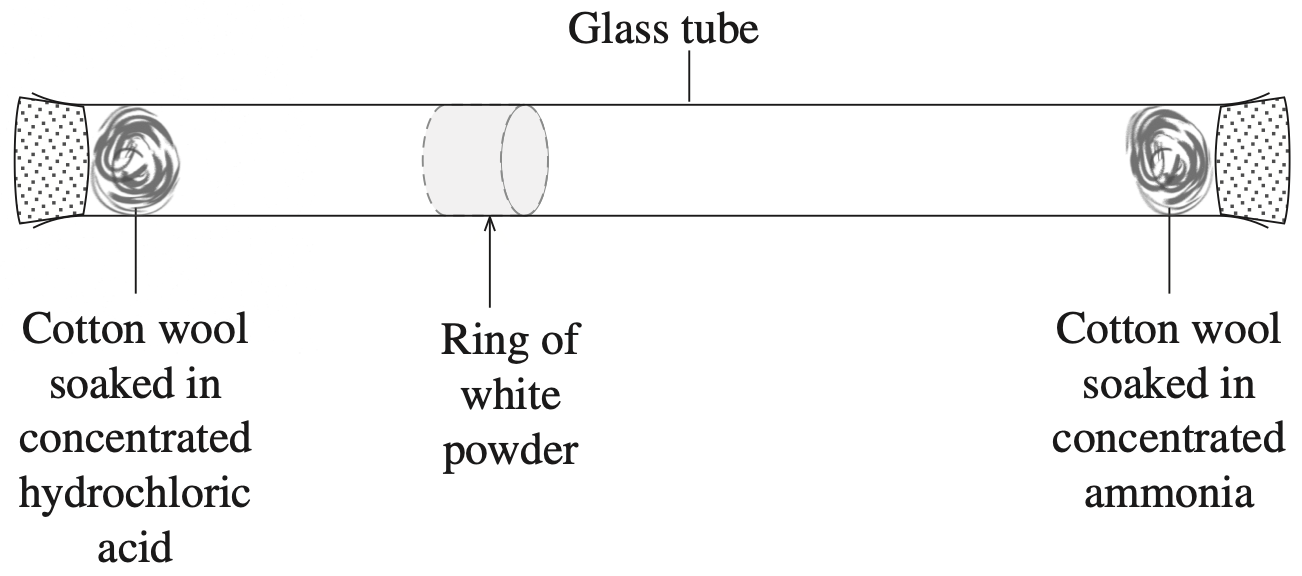
The equipment shown is set up. After some time a ring of white powder is seen to form on the inside of the glass tube.

  1. Why would this NOT be an acid-base reaction according to Arrhenius?   (1 mark)

    --- 4 WORK AREA LINES (style=lined) ---

  2. Explain why this would be considered a Bronsted-Lowry acid-base reaction. Include an equation in your answer.   (2 marks)

    --- 4 WORK AREA LINES (style=lined) ---

Show Answers Only

a.   According to Arrhenius:

  • An acid is a solution that produces hydrogen ions when in a solution.
  • A base is a solution that produces hydroxide ions when in a solution.
  • This reaction does not occur in an aqueous solution and would not be an acid-base reaction according to Arrhenius.
     

b.   \(\ce{HCl(g) + NH3(g) -> NH4+ + Cl-}\)

  • A Bronsted-Lowry acid donates a proton while a base accepts a proton.
  • This reaction involves proton transfer (\(\ce{HCl}\) donates, \(\ce{NH3}\) receives) and would therefore be considered a Bronsted-Lowry acid-base reaction.
Show Worked Solution

a.   According to Arrhenius:

  • An acid is a solution that produces hydrogen ions when in a solution.
  • A base is a solution that produces hydroxide ions when in a solution.
  • This reaction does not occur in an aqueous solution and would not be an acid-base reaction according to Arrhenius.

♦♦ Mean mark (a) 37%.

b.   \(\ce{HCl(g) + NH3(g) -> NH4+ + Cl-}\)

  • A Bronsted-Lowry acid donates a proton while a base accepts a proton.
  • This reaction involves proton transfer (\(\ce{HCl}\) donates, \(\ce{NH3}\) receives) and would therefore be considered a Bronsted-Lowry acid-base reaction.

Mean mark (b) 53%.

Filed Under: Properties of Acids and Bases Tagged With: Band 4, Band 5, smc-3673-10-Arrhenius and Bronsted-Lowry

CHEMISTRY, M6 2015 HSC 26

A sodium hydroxide solution was titrated against citric acid \(\ce{(C6H8O7)}\) which is triprotic.

  1. Draw the structural formula of citric acid (2-hydroxypropane-1,2,3-tricarboxylic acid).   (1 mark)
     

--- 0 WORK AREA LINES (style=lined) ---

  1. How could a computer-based technology be used to identify the equivalence point of this titration?   (2 marks)

    --- 4 WORK AREA LINES (style=lined) ---

  2. The sodium hydroxide solution was titrated against 25.0 mL samples of 0.100 mol L ¯1 citric acid. The average volume of sodium hydroxide used was 41.50 mL.
  3. Calculate the concentration of the sodium hydroxide solution.   (4 marks)

    --- 10 WORK AREA LINES (style=lined) ---

Show Answers Only

a.   
         

b.   Technology solution

  • A digital pH probe could be placed in the flask and used to collect data that plots the pH of the solution against the volume of sodium hydroxide added.
  • The equivalence point would be identified by a steep rise in the pH on the graph.
     

c.   \(\ce{C6H8O7 + 3NaOH -> C6H5O7Na3 + 3H2O}\)

\(\ce{n(C6H8O7) = c \times V = 0.100 \times 0.0250 = 0.00250 mol}\)

\(\ce{n(NaOH) = 3 \times 0.00250 = 0.00750 mol}\)

\[\ce{[NaOH] = \frac{n}{V} = \frac{0.00750}{0.04150} = 0.181 mol L^{-1} (3 sig fig)}\]

Show Worked Solution
a.   
         

♦ Mean mark (a) 46%.

b.   Technology solution

  • A digital pH probe could be placed in the flask and used to collect data that plots the pH of the solution against the volume of sodium hydroxide added.
  • The equivalence point would be identified by a steep rise in the pH on the graph.

♦ Mean mark (b) 42%.

c.   \(\ce{C6H8O7 + 3NaOH -> C6H5O7Na3 + 3H2O}\)

\(\ce{n(C6H8O7) = c \times V = 0.100 \times 0.0250 = 0.00250 mol}\)

\(\ce{n(NaOH) = 3 \times 0.00250 = 0.00750 mol}\)

\[\ce{[NaOH] = \frac{n}{V} = \frac{0.00750}{0.04150} = 0.181 mol L^{-1} (3 sig fig)}\]


Mean mark (c) 56%.

Filed Under: Quantitative Analysis, Reactions of Organic Acids and Bases Tagged With: Band 4, Band 5, smc-3675-10-Titration, smc-3680-20-Formulae and Properties

CHEMISTRY, M7 2015 HSC 25a

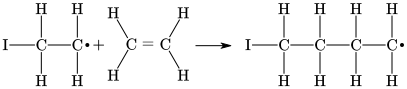
Describe the steps involved in the process of addition polymerisation.   (3 marks)

Show Answers Only

Step 1:

  • An organic peroxide (initiator – `text{I}`) attacks the ethylene molecule, breaking its double bond and forming a free radical.
  • An unpaired reactive electron can be seen on the end of the growing chain (initiation).

Step 2:

  • The free radical will then attack another ethylene molecule, increasing the length of the growing polymer chain (propagation).

Step 3:

  • Chain length increases in this fashion until two growing chains combine (termination).
Show Worked Solution

Step 1:

  • An organic peroxide (initiator – `text{I}`) attacks the ethylene molecule, breaking its double bond and forming a free radical.
  • An unpaired reactive electron can be seen on the end of the growing chain (initiation).

Step 2:

  • The free radical will then attack another ethylene molecule, increasing the length of the growing polymer chain (propagation).

Step 3:

  • Chain length increases in this fashion until two growing chains combine (termination).

♦ Mean mark 50%.

Filed Under: Polymers Tagged With: Band 5, smc-3681-10-Addition Polymers

CHEMISTRY, M6 2015 HSC 24

  1. Explain why the salt, sodium acetate, forms a basic solution when dissolved in water. Include an equation in your answer.   (2 marks)

    --- 5 WORK AREA LINES (style=lined) ---

  2. A solution is prepared by using equal volumes and concentrations of acetic acid and sodium acetate.
  3. Explain how the pH of this solution would be affected by the addition of a small amount of sodium hydroxide solution. Include an equation in your answer.   (3 marks)

    --- 5 WORK AREA LINES (style=lined) ---

Show Answers Only

a.   \(\ce{CH3COO-(aq) + H2O(l) \rightleftharpoons CH3COOH(aq) + OH-(aq)}\)

  • Sodium acetate is a basic salt.
  • Acetate is a strong base that accepts a proton, producing hydroxide.
  • The presence of \(\ce{OH-}\) ions produced by the hydrolysis of \(\ce{CH3COO-}\) increases the pH, producing a basic solution. 

b.  \(\ce{CH3COO-(aq) + H3O+(l) \rightleftharpoons CH3COOH(aq) + H2O(l)}\)

  • The \(\ce{OH-}\) ions introduced into the solution will react with the \(\ce{H3O+}\) ions, reducing their concentration in the equilibrium mixture.
  • By Le Chatelier’s principle, this will subsequently move the reaction to the left to increase the \(\ce{H3O+}\) ions, thus minimising any change in pH.
Show Worked Solution

a.   \(\ce{CH3COO-(aq) + H2O(l) \rightleftharpoons CH3COOH(aq) + OH-(aq)}\)

  • Sodium acetate is a basic salt.
  • Acetate is a strong base that accepts a proton, producing hydroxide.
  • The presence of \(\ce{OH-}\) ions produced by the hydrolysis of \(\ce{CH3COO-}\) increases the pH, producing a basic solution.  

♦♦ Mean mark (a) 37%.

b.  \(\ce{CH3COO-(aq) + H3O+(l) \rightleftharpoons CH3COOH(aq) + H2O(l)}\)

  • The \(\ce{OH-}\) ions introduced into the solution will react with the \(\ce{H3O+}\) ions, reducing their concentration in the equilibrium mixture.
  • By Le Chatelier’s principle, this will subsequently move the reaction to the left to increase the \(\ce{H3O+}\) ions, thus minimising any change in pH.

♦♦♦ Mean mark (b) 25%.

Filed Under: Bronsted-Lowry Theory, Quantitative Analysis Tagged With: Band 5, Band 6, smc-3674-18-Dissociation in Water, smc-3675-60-Buffers

CHEMISTRY, M7 2015 HSC 20 MC

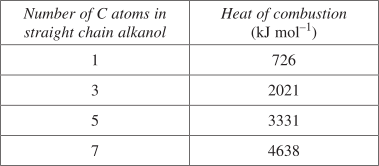
The table shows the heat of combustion of four straight chain alkanols.
 

What is the mass of water that could be heated from 20°C to 45°C by the complete combustion of 1.0 g of heptan-1-ol?

  1. 0.032 kg
  2. 0.044 kg
  3. 0.36 kg
  4. 0.38 kg
Show Answers Only

`D`

Show Worked Solution

`q=mC DeltaT \ \ =>\ \ m=q/(C DeltaT)`

`m` `=(4638 xx 10^3)/((4.18 xx 10^3) xx (45-20))`  
  `=44.38\ text{J per 116.2 g heptan-1-ol}`  
  `=44.38/116.2`  
  `=0.38\ text{kg}`  

 
`=>D`


♦ Mean mark 51%.

Filed Under: Alcohols Tagged With: Band 5, smc-3679-10-Combustion

CHEMISTRY, M8 2015 HSC 18-19 MC

Question 18

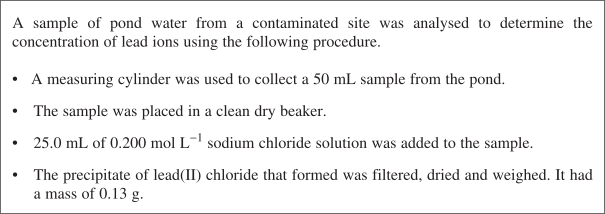
How could the reliability of the analysis of the pond water be improved?

  1. Analyse more samples from the same pond
  2. Use 50 mL of distilled water as a control sample
  3. Analyse samples from different ponds on the site
  4. Remove other contaminants from the sample before the analysis

 
Question 19

What was the concentration of lead ions in the sample?

  1. `5.0 × 10^{-3} \ text{mol L}^(-1)`
  2. `5.8 × 10^{-3} \ text{mol L}^(-1)`
  3. `9.3 × 10^{-3} \ text{mol L}^(-1)`
  4. `10.7 × 10^{-3} \ text{mol L}^(-1)`
Show Answers Only

`18.  A`

`19.  C`

Show Worked Solution

Question 18

`=>A`
 

Question 19

\[\ce{n(PbCl2) = \frac{0.13}{207.2 + 2 \times 35.45} = \frac{0.13}{278.1} = 4.67 \times 10^{-4} mol}\]

\(\ce{n(Pb^2+) = n(PbCl2) = 4.67 \times 10^{-4} mol}\)

\[\ce{[Pb^2+] = \frac{4.67 \times 10^{-4}}{0.050} = 9.3 \times 10^{-3} mol L^{-1}}\]

`=>C`


♦ Mean mark (Q19) 52%.

Filed Under: Inorganic Substances Tagged With: Band 3, Band 5, smc-3682-40-Gravimetric Analysis

BIOLOGY, M8 2015 HSC 28

A group of students hypothesised that the height of plants decreases with increased elevation.

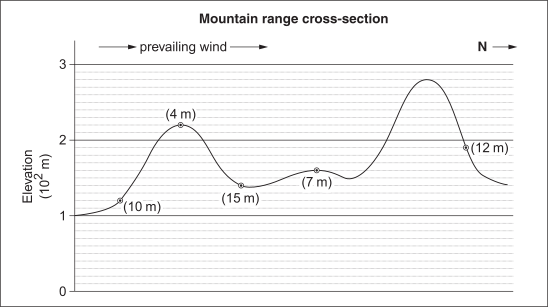
The students planted ten plant cuttings from the same plant at each of five locations. The locations were at varying elevations in the same mountain range. All the cuttings were provided with the same volume of water on planting, and no fertiliser was applied. The students returned after the same growth period and measured the height of the plants.

The cross-section shown indicates the average height of the plants in metres after the growth period at each location in the mountain range.
 

  1. Evaluate the validity of the experiment.   (3 marks)

    --- 8 WORK AREA LINES (style=lined) ---

  2. Complete both columns of the table to best present the data for the analysis of any trend.   (2 marks)
      

--- 0 WORK AREA LINES (style=lined) ---


Show Answers Only

a.    Factors affecting experiment validity:

  • There are many variables in this experiment that are not controlled, hence the experiment is invalid.
  • There is no real evidence that the differences in plant heights observed in the different locations are due to elevation alone.
  • Variables with adequate controls in the experiment include planting methods and genotype.
  • Factors other than these can affect plant growth and should have been considered.
  • Variables not controlled well include exposure to the prevailing wind, available sunlight at the various locations and size and health of cuttings at time of planting.
      

b.   Mountain Range cross-section data

\begin{array} {|c|c|}
\hline \text{Elevation (10² m)} & \text{Plant Height (m)} \\
\hline \ 1.2 & 10 \\
\hline \ 1.4 & 15 \\
\hline \ 1.6 & 7 \\
\hline \ 1.9 & 12 \\
\hline \ 2.2 & 4 \\
\hline \end{array}

Show Worked Solution

a.    Factors affecting experiment validity:

  • There are many variables in this experiment that are not controlled, hence the experiment is invalid.
  • There is no real evidence that the differences in plant heights observed in the different locations are due to elevation alone.
  • Variables with adequate controls in the experiment include planting methods and genotype.
  • Factors other than these can affect plant growth and should have been considered.
  • Variables not controlled well include exposure to the prevailing wind, available sunlight at the various locations and size and health of cuttings at time of planting.  

♦ Mean mark (a) 47%.

b.   Mountain Range cross-section data

\begin{array} {|c|c|}
\hline \text{Elevation (10² m)} & \text{Plant Height (m)} \\
\hline \ 1.2 & 10 \\
\hline \ 1.4 & 15 \\
\hline \ 1.6 & 7 \\
\hline \ 1.9 & 12 \\
\hline \ 2.2 & 4 \\
\hline \end{array}


Mean mark (b) 55%.

Filed Under: DNA and Polypeptide Synthesis Tagged With: Band 5, smc-3650-50-Environment

BIOLOGY, M5 2015 HSC 23

The diagram shows a model involving DNA.
 

  1. What process is being modelled?   (1 mark)

    --- 1 WORK AREA LINES (style=lined) ---

  2. Identify TWO structural features of the DNA molecule which are NOT shown in this model.   (2 marks)

    --- 5 WORK AREA LINES (style=lined) ---

Show Answers Only

a.   DNA replication

b.   Successful answers should include two of the following:

  • the double helix.
  • the sugar-phosphate backbone.
  • hydrogen bonds (connecting base pairs)
Show Worked Solution

a.   DNA replication

b.   Successful answers should include two of the following:

  • the double helix.
  • the sugar-phosphate backbone.
  • hydrogen bonds (connecting base pairs)

Mean mark (a) 53%.

Filed Under: Cell Replication Tagged With: Band 4, Band 5, smc-3649-10-DNA Structure

BIOLOGY, M7 2015 HSC 19-20 MC

Refer to the following information to answer Questions 19 and 20 .

The intestinal tract of a human foetus is sterile.
After birth, microflora from the mother are transferred to the baby's mouth through close contact. After a year, the microflora of the baby is similar to the mother's, with the baby's immune system ignoring these microbes.

Also during the first year of life, breast milk from the mother provides antibodies to the baby for any disease the mother has already experienced. When breastfeeding ceases, these antibody levels in the baby start to fall.

After the first year, any new species of invading bacteria is treated as a pathogen by the baby's immune system.

Question 19

A medical consequence for six-month-old babies that have only been bottle-fed with formula milk and not breastfed is that

  1. they will not develop microflora.
  2. their immune system will be damaged.
  3. their consumption of milk cannot be quantified.
  4. they will be at increased risk of infectious disease.

 
Question 20

Strict hygiene practices are followed in the care of newborns, whereas hygiene practices in the care of older babies are less emphasised.

Which of the following is the best reason for this difference?

  1. Vaccinations render personal hygiene unnecessary for older babies.
  2. Procaryotic cells are not identified as antigens in early development.
  3. Antibiotic treatments kill bacterial populations in the digestive system.
  4. Early exposure to pathogens helps to build a strong immune system.


Show Answers Only

Question 19: `D`

Question 20: `B`

Show Worked Solution

Question 19

  • Bottle fed babies will not have the added immunity that is provided by the mother’s breast milk.
  • They will therefore have immune systems that are more susceptible to infectious disease.

`=>D` 
 

Question 20

  • The immune systems of newborns will not work as efficiently as that of older babies as their immune systems are underdeveloped.

`=>B`


♦ Mean mark Q20 45%.

Filed Under: Immunity and Responses to Pathogens Tagged With: Band 3, Band 5, smc-3657-10-Antibody Mediated, smc-3657-20-Cell Mediated

BIOLOGY, M7 2015 HSC 12-13 MC

Refer to the following information to answer Questions 12 and 13.

The larvae of fruit flies damage fruit in Western Australia. To control the problem, growers are advised to spray fruit trees with pesticides. Any already damaged fruit is boiled and disposed of as chicken food or landfill. Another control measure is the release of genetically engineered infertile flies of this species.


Question 12

Which reason best explains why the corresponding control measure reduces this problem?

\begin{align*}
\begin{array}{l}
\rule{0pt}{2.5ex} \ \rule[-1ex]{0pt}{0pt}& \\
\rule{0pt}{2.5ex}\textbf{A.}\rule[-1ex]{0pt}{0pt}\\
\rule{0pt}{2.5ex}\textbf{B.}\rule[-1ex]{0pt}{0pt}\\
\textbf{}\rule[-1ex]{0pt}{0pt}\\
\rule{0pt}{2.5ex}\textbf{C.}\rule[-1ex]{0pt}{0pt}\\
\textbf{}\rule[-1ex]{0pt}{0pt}\\
\rule{0pt}{2.5ex}\textbf{D.}\rule[-1ex]{0pt}{0pt}\\
\textbf{}\rule[-1ex]{0pt}{0pt}\\
\end{array}
\begin{array}{|l|l|}
\hline
\rule{0pt}{2.5ex}\textit{Control measure}\rule[-1ex]{0pt}{0pt}& \textit{Reason} \\
\hline
\rule{0pt}{2.5ex}\text{Release of infertile flies}\rule[-1ex]{0pt}{0pt}&\text{Infertile flies do not eat the fruit}\\
\hline
\rule{0pt}{2.5ex}\text{Release of infertile flies}\rule[-1ex]{0pt}{0pt}& \text{The number of flies in the next}\\
\text{}\rule[-1ex]{0pt}{0pt}& \text{generation is decreased}\\
\hline
\rule{0pt}{2.5ex}\text{Boiling fruit and feeding to}\rule[-1ex]{0pt}{0pt}& \text{Chickens are unaffected by the} \\
\text{chickens}\rule[-1ex]{0pt}{0pt}& \text{damaged fruit} \\
\hline
\rule{0pt}{2.5ex}\text{Boiling fruit and feeding to}\rule[-1ex]{0pt}{0pt}& \text{The amount of waste for landfill is} \\
\text{chickens}\rule[-1ex]{0pt}{0pt}& \text{reduced} \\
\hline
\end{array}
\end{align*}

 
Question 13

The following measures could be used to prevent the spread of this fruit fly across Australia.

    1. Australia-wide release of infertile fruit flies
    2. Aerial spraying of orchards throughout the country
    3. Spot spraying of newly affected orchards in Western Australia
    4. Stopping the transport of fruit from Western Australia to other states

To prevent the spread of this fruit fly across Australia, which combination of measures would be most practical to use?

  1. 1 and 2
  2. 1 and 4
  3. 2 and 3
  4. 3 and 4
Show Answers Only

Question 12: \(B\)

Question 13: \(D\)

Show Worked Solution

Question 12

  • Future generations of flies will eventually be reduced in numbers and may even be wiped out altogether.

\(\Rightarrow B\)
  

Question 13

  • It may be possible to contain the outbreak to local areas by restricting the movement of affected fruit to other states and countries, thus making it easier to manage.

\(\Rightarrow D\)


♦ Mean mark (Q13) 49%.

Filed Under: Prevention, Treatment and Control Tagged With: Band 3, Band 5, smc-3658-30-Procedures to Prevent Spread

BIOLOGY, M8 2015 HSC 7-8 MC

Refer to the following information to answer Questions 7 and 8 .

The diagram shows a homeostatic mechanism in a mammal.
 

Question 7

What does `text{X}` represent in the diagram?

  1. The heart
  2. The brain
  3. A thermoreceptor in the skin
  4. A pressure receptor in a blood vessel

 
Question 8

Which of the following describes what happens to the muscles and the arteriole walls in the skin when the core body temperature is below normal?
 

Show Answers Only

Q7.  `B`
Q8.  `B`

Show Worked Solution

Q7.   `text{X}` = the brain

  • Messages are sent by the brain to the effectors.
  • This promotes a stimulus response.

`=>B`


♦♦ Mean mark (Q7) 38%.

Q8.   When body temperature is below normal:

  • Hairs stand on end and arteriole walls of skin contract to prevent the loss of heat.

`=>B`

Filed Under: Homeostasis Tagged With: Band 3, Band 5, smc-3659-12-Negative Feedback Loops, smc-3659-15-Temperature

CHEMISTRY, M6 2015 HSC 13 MC

Which of the following solutions has the highest pH?

  1. `1.0 \ text{mol L}^(-1)` acetic acid
  2. `0.10 \ text{mol L}^(-1)` acetic acid
  3. `1.0 \ text{mol L}^(-1)` hydrochloric acid
  4. `0.10 \ text{mol L}^(-1)` hydrochloric acid
Show Answers Only

`B`

Show Worked Solution

By Elimination:

  • Acetic acid is weaker than hydrochloric acid and therefore has a higher pH (eliminate C and D).
  • A more dilute acid has a higher pH (eliminate A).

`=>B`


Mean mark 55%.

Filed Under: Bronsted-Lowry Theory Tagged With: Band 5, smc-3674-20-Strong/Weak Acids & Bases

CHEMISTRY, M7 2017 HSC 28b

The molar heat of combustion \(\left(\Delta H_c\right)\) for ethanol is 1360 kJ mol ¯1.

Calculate the energy generated per kg of \(\ce{CO2}\) released by the combustion of ethanol.   (3 marks)

Show Answers Only

`15\ 450\ text{kJ}`

Show Worked Solution

\(\ce{C2H5OH(l) + 3O2(g) -> 2CO2(g) + 3H2O(g)} \)

\(\ce{m(CO2) = 12.01 + 2 \times 16.00 = 44.01 g mol^{-1}}\)

\[\ce{n(CO2) = \frac{1000}{44.01} = 22.72 mol}\]

\[\ce{n(C2H5OH) = \frac{22.72}{2} = 11.36 mol}\]

`:.\ text{Energy per kg CO}_2=11.36 xx 1360=15\ 450\ text{kJ}`


♦ Mean mark 48%.

Filed Under: Alcohols Tagged With: Band 5, smc-3679-10-Combustion

CHEMISTRY, M7 2017 HSC 28a

Outline TWO advantages and TWO disadvantages of using ethanol as an alternative fuel for motor vehicles.   (4 marks)

Show Answers Only

Advantages:

  • Ethanol can be produced from biomass. These renewable sources include crops such as sugarcane as opposed to other fuels such as petrol which come from non-renewable fossil fuels, which are finite resources.
  • Ethanol undergoes complete combustion more easily than octane, producing less soot \(\ce{(C(s))}\) which can adversely affect the efficiency and running of motors, and less \(\ce{CO(g)}\) which is poisonous.

Disadvantages:

  • Ethanol releases less energy, on a mole or per kilogram basis, than octane. This results in a greater mass of fuel being required to supply an equivalent amount of energy.
  • Producing ethanol from renewable crops requires a huge amount of arable land. This reduces the availability of land for other crops.
Show Worked Solution

Advantages:

  • Ethanol can be produced from biomass. These renewable sources include crops such as sugarcane as opposed to other fuels such as petrol which come from non-renewable fossil fuels, which are finite resources.
  • Ethanol undergoes complete combustion more easily than octane, producing less soot \(\ce{(C(s))}\) which can adversely affect the efficiency and running of motors, and less \(\ce{CO(g)}\) which is poisonous.

Disadvantages:

  • Ethanol releases less energy, on a mole or per kilogram basis, than octane. This results in a greater mass of fuel being required to supply an equivalent amount of energy.
  • Producing ethanol from renewable crops requires a huge amount of arable land. This reduces the availability of land for other crops.

♦ Mean mark 52%.

Filed Under: Alcohols Tagged With: Band 4, Band 5, smc-3679-60-Biofuels

CHEMISTRY, M7 2017 HSC 27

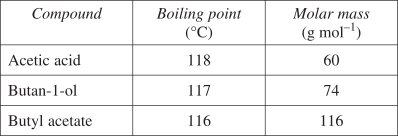
The boiling points and molar masses of three compounds are shown in the table.
 

Acetic acid, butan-1-ol and butyl acetate have very different molar masses but similar boiling points. Explain why in terms of the structure and bonding of the three compounds.   (5 marks)

Show Answers Only
  • Although the three listed compounds different molar masses, they have similar boiling points due to their different structures and resulting intermolecular forces.
  • Butyl acetate has the largest molar mass and therefore greatest dispersion forces but it is only slightly polar and has no hydrogen bonding.
  • Butan-1-ol has lower molar mass than butyl acetate and therefore smaller dispersion forces but it is polar and contains a hydrogen bound to an oxygen. Therefore, it exhibits hydrogen bonding resulting in strong intermolecular forces and a boiling point in the middle of the three compounds.
  • Acetic acid has the lowest molar mass and hence the weakest dispersion forces. It is however highly polar due to the presence of the carboxyl group \(\ce{(COOH)}\) and contains a hydrogen bound to an oxygen allowing the formation of hydrogen bonds between molecules.
  • The presence of a second oxygen in acetic acid increases the hydrogen bonding compared with butan-1-ol. 
  • These factors lead to acetic acid possessing the highest boiling point despite its molar mass being the lowest.
  • In summary, the totality of the intermolecular forces of all three molecules is similar and therefore similar boiling points.
Show Worked Solution
  • Although the three listed compounds different molar masses, they have similar boiling points due to their different structures and resulting intermolecular forces.
  • Butyl acetate has the largest molar mass and therefore greatest dispersion forces but it is only slightly polar and has no hydrogen bonding.
  • Butan-1-ol has lower molar mass than butyl acetate and therefore smaller dispersion forces but it is polar and contains a hydrogen bound to an oxygen. Therefore, it exhibits hydrogen bonding resulting in strong intermolecular forces and a boiling point in the middle of the three compounds.
  • Acetic acid has the lowest molar mass and hence the weakest dispersion forces. It is however highly polar due to the presence of the carboxyl group \(\ce{(COOH)}\) and contains a hydrogen bound to an oxygen allowing the formation of hydrogen bonds between molecules.
  • The presence of a second oxygen in acetic acid increases the hydrogen bonding compared with butan-1-ol. 
  • These factors lead to acetic acid possessing the highest boiling point despite its molar mass being the lowest.
  • In summary, the totality of the intermolecular forces of all three molecules is similar and therefore similar boiling points.

♦♦ Mean mark 41%.

Filed Under: Reactions of Organic Acids and Bases Tagged With: Band 5, Band 6, smc-3680-30-Boiling Point and Solubility

CHEMISTRY, M6 2017 HSC 24

A solution of sodium hydroxide was titrated against a standardised solution of acetic acid which had a concentration of 0.5020 mol L¯1.

  1. The end point was reached when 19.30 mL of sodium hydroxide solution had been added to 25.00 mL of the acetic acid solution.
  2. Calculate the concentration of the sodium hydroxide solution.   (3 marks)

    --- 7 WORK AREA LINES (style=lined) ---

  3. Explain why the pH of the resulting salt solution was not 7. Include a relevant chemical equation in your answer.   (2 marks)

    --- 4 WORK AREA LINES (style=lined) ---

Show Answers Only

a.   \(\ce{CH3COOH(aq) + NaOH(aq) -> NaCH3COO(aq) + H2O(l)}\)
 

b.   \(\ce{CH3COO-(aq) + H2O \rightleftharpoons CH3COOH(aq) + OH-(aq)}\)

  • The acetate ion is a weak base.
  • As a result, it has accepted a proton from the water resulting in production of hydroxide ions.
  • Therefore the solution has a pH > 7.
Show Worked Solution

a.   \(\ce{CH3COOH(aq) + NaOH(aq) -> NaCH3COO(aq) + H2O(l)}\)

\(\ce{n(CH3COOH) = c \times V = 0.5020 \times 0.0250 = 0.01255 mol}\)

\(\ce{n(NaOH) = n(CH3COOH) = 0.01255 mol}\)

\[\ce{[NaOH] = \frac{n}{V} = \frac{0.01255}{0.01930} = 0.6503 mol L^{-1}}\]  

b.   \(\ce{CH3COO-(aq) + H2O \rightleftharpoons CH3COOH(aq) + OH-(aq)}\)

  • The acetate ion is a weak base.
  • As a result, it has accepted a proton from the water resulting in production of hydroxide ions.
  • Therefore the solution has a pH > 7.

♦♦ Mean mark (b) 34%.

Filed Under: Bronsted-Lowry Theory, Quantitative Analysis Tagged With: Band 4, Band 5, smc-3674-18-Dissociation in Water, smc-3675-10-Titration

CHEMISTRY, M7 2019 HSC 34

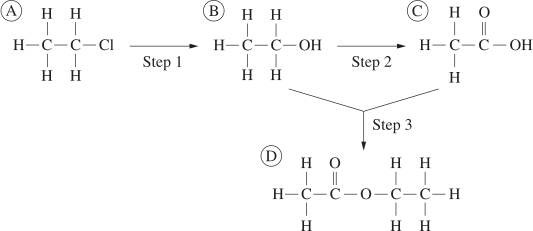
The following reaction scheme can be used to synthesise ethyl ethanoate.


Outline the reagents and conditions required for each step and how the product of each step could be identified.   (7 marks) 

--- 16 WORK AREA LINES (style=lined) ---

Show Answers Only

Step 1:

  • To synthesise chloroethane (A) into ethanol (B), \(\ce{NaOH}\) is added and heated. \(\ce{KMnO4 / H+}\) is then added and heated.
  • The mixture is then treated with concentrated sulfuric acid and refluxed.
  • Ethanol (B) can be identified using infrared spectroscopy by looking for a broad absorption between 3230 cm ¯1 and 3550 cm ¯1, which indicates the presence of an \(\ce{O-H}\) bond. This absorption would not be present in chloroethane (A).
  • Alternative ways to identify ethanol include: mass spectrum analysis (single ion peak at m/z = 46), reactivity tests, and \( \ce{^1H NMR}\) spectrum analysis (3 signals vs 2 for chloroethane). 

Step 2:

  • Ethanol (B) can be converted into ethanoic acid (C) by combining it with a strong oxidant like sodium carbonate, which produces carbon dioxide bubbles, confirming the presence of a carboxylic acid.
  • Ethanol will not react as above and the compounds can be distinguished.
  • Alternative ways to identify ethanoic acid include: IR or \( \ce{^13C NMR}\) spectrum analysis, litmus indicators, mass spectrum analysis (ion peak at m/z = 60 vs m/z = 46) 

Step 3

  • Ethyl ethanoate (D) can be synthesised by heating a mixture of ethanol, ethanoic acid and concentrated sulfuric acid under reflux.
  • A \( \ce{^1H NMR}\) spectrum can be used to identify ethyl ethanoate as it will have 3 signals versus ethanol and ethanoic acid that will only have 2 each.
  • Alternative ways to identify ethyl ethanoate include: a distinct smell, no \(\ce{O-H}\) peaks in the IR spectrum or mass spectrum analysis (ion peak at m/z = 102).
Show Worked Solution

Step 1:

  • To synthesise chloroethane (A) into ethanol (B), \(\ce{NaOH}\) is added and heated. \(\ce{KMnO4 / H+}\) is then added and heated.
  • The mixture is then treated with concentrated sulfuric acid and refluxed.
  • Ethanol (B) can be identified using infrared spectroscopy by looking for a broad absorption between 3230 cm ¯1 and 3550 cm ¯1, which indicates the presence of an \(\ce{O-H}\) bond. This absorption would not be present in chloroethane (A).
  • Alternative ways to identify ethanol include: mass spectrum analysis (single ion peak at m/z = 46), reactivity tests, and \( \ce{^1H NMR}\) spectrum analysis (3 signals vs 2 for chloroethane). 

Step 2:

  • Ethanol (B) can be converted into ethanoic acid (C) by combining it with a strong oxidant like sodium carbonate, which produces carbon dioxide bubbles, confirming the presence of a carboxylic acid.
  • Ethanol will not react as above and the compounds can be distinguished.
  • Alternative ways to identify ethanoic acid include: IR or \( \ce{^13C NMR}\) spectrum analysis, litmus indicators, mass spectrum analysis (ion peak at m/z = 60 vs m/z = 46) 

Step 3

  • Ethyl ethanoate (D) can be synthesised by heating a mixture of ethanol, ethanoic acid and concentrated sulfuric acid under reflux.
  • A \( \ce{^1H NMR}\) spectrum can be used to identify ethyl ethanoate as it will have 3 signals versus ethanol and ethanoic acid that will only have 2 each.
  • Alternative ways to identify ethyl ethanoate include: a distinct smell, no \(\ce{O-H}\) peaks in the IR spectrum or mass spectrum analysis (ion peak at m/z = 102).

♦♦ Mean mark 38%.

Filed Under: Alcohols, Reactions of Organic Acids and Bases Tagged With: Band 5, Band 6, smc-3679-20-Reactions of Alcohols, smc-3679-70-Production, smc-3680-10-Esters, smc-3680-15-Reaction Pathways

CHEMISTRY, M8 2019 HSC 29

Stormwater from a mine site has been found to be contaminated with copper\(\text{(II)}\) and lead\(\text{(II)}\) ions. The required discharge limit is 1.0 mg L¯1 for each metal ion. Treatment of the stormwater with \(\ce{Ca(OH)2}\) solid to remove the metal ions is recommended.

  1. Explain the recommended treatment with reference to solubility. Include a relevant chemical equation.   (2 marks)

    --- 5 WORK AREA LINES (style=lined) ---

  2. Explain why atomic absorption spectroscopy can be used to determine the concentrations of \(\ce{Cu^2+}\) and \(\ce{Pb^2+}\) ions in a solution containing both species.   (2 marks)

    --- 6 WORK AREA LINES (style=lined) ---

  3. The data below were obtained after treatment of the stormwater.


    To what extent is the treatment effective in meeting the required discharge limit of 1.0 mg L¯1 for each metal ion? Support your conclusion with calibration curves and calculations.   (7 marks)


    --- 7 WORK AREA LINES (style=lined) ---

Show Answers Only

a.   Recommended Treatment:

  • Calcium hydroxide is a slightly soluble compound, while copper\(\text{(II)}\) hydroxide and lead\(\text{(II)}\) hydroxide are very insoluble in water.
  • When these compounds are added to water, the metal ions tend to precipitate out of solution.
  • For example, the addition of solid calcium hydroxide to water produces calcium ions \(\ce{Ca^2+}\) and hydroxide ions \(\ce{OH-}\), which can then react with lead\(\text{(II)}\) ions (\(\ce{Pb^2+})\) and copper\(\text{(II)}\) ions \(\ce{Cu^2+}\) to form precipitates of lead\(\text{(II}\) hydroxide and copper\(\text{(II)}\) hydroxide, respectively.
  • These reactions are represented by the equations:
  •    \(\ce{Pb^2+ + 2OH- -> Pb(OH)2, \ \ Cu^2+ + 2OH- -> Cu(OH)2}\) 

b.   Atomic absorption spectroscopy (AAS):

  • Can be used for determining the concentration of metal ions in a sample by measuring the absorbance of light at specific wavelengths that are characteristic of each metal.
  • AAS uses light wavelengths that correspond to atomic absorption by the element of interest, and since each element has unique wavelengths that are absorbed, the concentration of that element can be selectively measured in the presence of other species.
  • As a result, AAS can be used to independently measure the concentrations of different metal ions, such as lead\(\text{(II)}\) ions and copper\(\text{(II)}\) ions in a sample containing both types. 

c.   Concentrations of ions:

\begin{array} {|l|c|c|c|}
\hline  \text{Sample }& \ce{Cu^2+ \times 10^{-5} mol L^{-1}} & \ce{Pb^2+ \times 10^{-5} mol L^{-1}} \\
\hline \text{Water (pre-treatment)} & 5.95 & 4.75 \\
\hline \text{Water (post-treatment)} & 0.25 & 0.85 \\
\hline \end{array}

  • Concentrations of copper and lead have been significantly reduced.
  • Convert concentrations to compare with standard:

\begin{array} {ccc}
\ce{Cu^2+}: & 5.95 \times 10^{-5} \times 63.55 \times 1000 = 3.78\ \text{mg L}^{-1} \\
 & 0.25 \times 10^{-5} \times 63.55 \times 1000 = 0.16\ \text{mg L}^{-1} \\
& \\
\ce{Pb^2+}: & 4.75 \times 10^{-5} \times 207.2 \times 1000 = 9.84\ \text{mg L}^{-1} \\
& 0.85 \times 10^{-5} \times 207.2 \times 1000 = 1.76\ \text{mg L}^{-1} \end{array}


Conclusion:

  • The concentration of copper ions has been reduced to a level that is lower than the discharge limit (0.16 < 1.0) but the lead ion concentration has not (1.76 > 1.0).
  • The treatment has only been partially successful.
Show Worked Solution

a.   Recommended Treatment:

  • Calcium hydroxide is a slightly soluble compound, while copper\(\text{(II)}\) hydroxide and lead\(\text{(II)}\) hydroxide are very insoluble in water.
  • When these compounds are added to water, the metal ions tend to precipitate out of solution.
  • For example, the addition of solid calcium hydroxide to water produces calcium ions \(\ce{Ca^2+}\) and hydroxide ions \(\ce{OH-}\), which can then react with lead\(\text{(II)}\) ions (\(\ce{Pb^2+})\) and copper\(\text{(II)}\) ions \(\ce{Cu^2+}\) to form precipitates of lead\(\text{(II}\) hydroxide and copper\(\text{(II)}\) hydroxide, respectively.
  • These reactions are represented by the equations:
  •    \(\ce{Pb^2+ + 2OH- -> Pb(OH)2, \ \ Cu^2+ + 2OH- -> Cu(OH)2}\) 

♦ Mean mark (a) 46%.

b.   Atomic absorption spectroscopy (AAS):

  • Can be used for determining the concentration of metal ions in a sample by measuring the absorbance of light at specific wavelengths that are characteristic of each metal.
  • AAS uses light wavelengths that correspond to atomic absorption by the element of interest, and since each element has unique wavelengths that are absorbed, the concentration of that element can be selectively measured in the presence of other species.
  • As a result, AAS can be used to independently measure the concentrations of different metal ions, such as lead\(\text{(II)}\) ions and copper\(\text{(II)}\) ions in a sample containing both types. 

c.   Concentrations of ions:

\begin{array} {|l|c|c|c|}
\hline  \text{Sample }& \ce{Cu^2+ \times 10^{-5} mol L^{-1}} & \ce{Pb^2+ \times 10^{-5} mol L^{-1}} \\
\hline \text{Water (pre-treatment)} & 5.95 & 4.75 \\
\hline \text{Water (post-treatment)} & 0.25 & 0.85 \\
\hline \end{array}


♦♦ Mean mark (b) 32%.
  • Concentrations of copper and lead have been significantly reduced.
  • Convert concentrations to compare with standard:

\begin{array} {ccc}
\ce{Cu^2+}: & 5.95 \times 10^{-5} \times 63.55 \times 1000 = 3.78\ \text{mg L}^{-1} \\
 & 0.25 \times 10^{-5} \times 63.55 \times 1000 = 0.16\ \text{mg L}^{-1} \\
& \\
\ce{Pb^2+}: & 4.75 \times 10^{-5} \times 207.2 \times 1000 = 9.84\ \text{mg L}^{-1} \\
& 0.85 \times 10^{-5} \times 207.2 \times 1000 = 1.76\ \text{mg L}^{-1} \end{array}


Conclusion:

  • The concentration of copper ions has been reduced to a level that is lower than the discharge limit (0.16 < 1.0) but the lead ion concentration has not (1.76 > 1.0).
  • The treatment has only been partially successful.

♦ Mean mark (c) 53%.

Filed Under: Inorganic Substances, Solution Equilibria Tagged With: Band 5, Band 6, smc-3672-10-Mixed ionic solutions, smc-3672-60-Concentration graphs, smc-3672-70-Precipitate, smc-3682-60-Colourimetry UV-Vis and AAS

CHEMISTRY, M6 2019 HSC 28

Assess the usefulness of the Brønsted-Lowry model in classifying acids and bases. Support your answer with at least TWO chemical equations.   (5 marks)

Show Answers Only
  • The Bronsted-Lowry model is a way of classifying acids and bases based on their ability to donate or accept protons.
  • This model is more comprehensive than the Arrhenius model, as it can explain the acid-base behaviour of more species, including those that do not contain \(\ce{OH-}\) ions, and non-aqueous acid-base reactions.
  • Consider the reaction \(\ce{NH3(g) + HCl(g) -> NH4Cl(s)}\) where a proton is transferred from hydrogen chloride to ammonia (according to the Bronsted-Lowry model). Ammonia is not an Arrhenius base as it doesn’t dissociate to produce \(\ce{OH-}\) ions and the reaction cannot be described using the Arrhenius model.
  • However, the Bronsted-Lowry model does have some limitation, such as its inability to explain the acidity of certain acidic oxides and their reactions with basic oxides.
  • e.g. \(\ce{CaO(s) + SO3(g) -> CaSO4(s)}\) is an acid-base reaction but since there is no proton transfer, it cannot be described using the Bonsted-Lowry model.
Show Worked Solution
  • The Bronsted-Lowry model is a way of classifying acids and bases based on their ability to donate or accept protons.
  • This model is more comprehensive than the Arrhenius model, as it can explain the acid-base behaviour of more species, including those that do not contain \(\ce{OH-}\) ions, and non-aqueous acid-base reactions.
  • Consider the reaction \(\ce{NH3(g) + HCl(g) -> NH4Cl(s)}\) where a proton is transferred from hydrogen chloride to ammonia (according to the Bronsted-Lowry model). Ammonia is not an Arrhenius base as it doesn’t dissociate to produce \(\ce{OH-}\) ions and the reaction cannot be described using the Arrhenius model.
  • However, the Bronsted-Lowry model does have some limitation, such as its inability to explain the acidity of certain acidic oxides and their reactions with basic oxides.
  • e.g. \(\ce{CaO(s) + SO3(g) -> CaSO4(s)}\) is an acid-base reaction but since there is no proton transfer, it cannot be described using the Bonsted-Lowry model.

♦♦♦ Mean mark 35%.
MARKER’S COMMENT: Two relevant equations required to achieve full marks.

Filed Under: Properties of Acids and Bases Tagged With: Band 5, Band 6, smc-3673-10-Arrhenius and Bronsted-Lowry

CHEMISTRY, M6 2019 HSC 27

The relationship between the acid dissociation constant, `K_a`, and the corresponding conjugate base dissociation constant, `K_b`, is given by:

`K_(a)xxK_(b)=K_(w)`

Assume that the temperature for part (a) and part (b) is 25°C.

  1. The `K_a` of hypochlorous acid `text{(HOCl)}` is  `3.0 xx10^(-8)`.
  2. Show that the `K_b` of the hypochlorite ion, `text{OCl}^-`, is  `3.3 xx10^(-7)`.   (1 mark)

    --- 3 WORK AREA LINES (style=lined) ---

  3. The conjugate base dissociation constant, `K_b`, is the equilibrium constant for the following equation:
  4.      `text{OCl}^(-)(aq)+ text{H}_(2) text{O}(l) ⇌ text{HOCl}(aq)+ text{OH}^(-)(aq)`
  5. Calculate the pH of a 0.20 mol L¯1 solution of sodium hypochlorite `(text{NaOCl})`.   (4 mark)

    --- 14 WORK AREA LINES (style=lined) ---

Show Answers Only
  1. `K_b=3.3 xx 10^{-7}`
  2. \(\ce{pH = 14-3.59 = 10.41}\)
Show Worked Solution

a.   `K_(a)xxK_(b)=K_(w)\ \ =>\ \ K_b=(K_(w))/(K_(a))`

`K_b=(1.0 xx 10^{-14})/(3.0 xx 10^{-8}=3.3 xx 10^{-7}`
 

b.   \(\ce{OCl-(aq) + H2O(l) \rightleftharpoons HOCl(aq) + OH-(aq)}\)
 

\begin{array} {|l|c|c|c|}
\hline  & \ce{OCl-} & \ce{HOCl} & \ce{OH–} \\
\hline \text{Initial} & 0.20 & 0 & 0 \\
\hline \text{Change} & -x & +x & +x \\
\hline \text{Equilibrium} & 0.20-x & x & x \\
\hline \end{array}

 
\[ K_b = \ce{\frac{[HOCl][OH– ]}{[OCl-]}} = \frac{x^2}{(0.20-x)} \]

Assume  `0.20-x~~0.20`  because `x` is negligible:

`3.3 xx 10^(-7)` `= x^2 / (0.20-x)`  
`x` `=sqrt(3.3 xx 10^(−7) xx 0.20)`  
  `= 2.5690 xx 10^{-4}\ text{mol L}^(–1)`  

 
\(\ce{[OH-] = 2.5690 \times 10^{-4} mol L^{-1}}\)

\(\ce{pOH = -log10[OH-] = -log10(2.5690 \times 10^{-4}) = 3.59}\)

\(\therefore \ce{pH = 14-3.59 = 10.41}\)


♦ Mean mark (b) 45%.

Filed Under: Bronsted-Lowry Theory, Equilibrium Constant, Quantitative Analysis Tagged With: Band 4, Band 5, smc-3671-10-Find K(eq), smc-3671-35-Chemical equation given, smc-3671-40-K(eq) and pH, smc-3671-50-Acids and bases, smc-3674-10-Calculations Involving pH, smc-3675-30-Ka/Kb

CHEMISTRY, M7 2015 HSC 10 MC

Which of the equations correctly describes incomplete combustion?

  1. `\text{C}_2\text{H}_5\text{OH}(l)` + `2\text{O}_2(g)` `\rarr`  `2\text{CO}(g)` + `3\text{H}_2\text{O}(l)`
  2. `\text{C}_2 \text{H}_5\text{OH}(l)` + `(7)/(2)\text{O}_2(g)` `\rarr` `2\text{CO}_2(g)` + `3\text{H}_2\text{O}(l)`
  3. `\text{C}_2\text{H}_5\text{OH}(l)` + `3\text{O}_2(g)` `\rarr` `2\text{CO}_2(g)` + `3\text{H}_2\text{O}(l)`
  4. `\text{C}_2\text{H}_5\text{OH}(l)` + `2\text{O}_2(g)` `\rarr` `\text{C}(s)` + `\text{CO}(g)` + `3\text{H}_2\text{O}(l)`
Show Answers Only

`A`

Show Worked Solution
  • Incomplete combustion produces carbon and/or carbon monoxide (eliminate B and C).
  • Option D is not balanced (oxygen atoms do not equate)

`=>A`


♦ Mean mark 44%.

Filed Under: Alcohols Tagged With: Band 5, smc-3679-10-Combustion

CHEMISTRY, M6 2017 HSC 20 MC

20.0 mL of 0.020 mol L¯1 barium hydroxide solution is added to 50.0 mL of 0.040 mol L¯1 hydrochloric acid solution.

What is the pH of the final solution?

  1. `0.2`
  2. `1.6`
  3. `1.8`
  4. `2.9`
Show Answers Only

`C`

Show Worked Solution

\(\ce{n(Ba(OH)2) = 0.020 \times 0.02 = 4.00 \times 10^{-4} mol} \)

\(\ce{n(HCl) = 0.040 \times 0.05 = 2.00 \times 10^{-3} mol} \)

\(\ce{Ba(OH)_2(aq) + 2HCl(aq) -> BaCl_2(aq) + 2H2O(l)} \)
 

\(\ce{Ba(OH)_2}\) is limiting → \(\ce{HCl}\) is in excess

\(\ce{n(HCl)_{excess} = 2.00 \times 10^{-3} – 2(4.00 \times 10^{-4}) = 1.2 \times 10^{-3} mol} \)

\[\ce{[H+] = \frac{n}{total V} = \frac{1.20 \times 10^{-3}}{0.02 + 0.05} = 1.714 \times 10^{-2} mol L^{-1}} \]

\(\ce{pH = -log10[H+] = -log10(1.714 \times 10^{-2})} = 1.8\)

`=>C`


♦♦ Mean mark 33%.

Filed Under: Bronsted-Lowry Theory Tagged With: Band 5, smc-3674-15-pH of Mixed Solution

CHEMISTRY, M5 2017 HSC 18 MC

Three gases `text{X}`, `text{Y}` and `text{Z}` were mixed in a closed container and allowed to reach equilibrium. A change was imposed at time `T` and the equilibrium was re-established. The concentration of each gas is plotted against time.
 

Which reaction is represented by the graph?

  1. `text{X}(g)+ text{Y}(g)⇌2 text{Z}(g)`
  2. `2 text{X}(g)⇌ text{Y}(g)+ text{Z}(g)`
  3. `2 text{X}(g)⇌ text{Y}(g)+3 text{Z}(g)`
  4. `text{X}(g)⇌ text{Y}(g)+text{Z}(g)`
Show Answers Only

`D`

Show Worked Solution

Concentration changes at T:

  • Concentrations of X ↓ 25%, Y ↓ 25%, Z ↓ 25% 

New equilibrium after T:

  • Concentrations of X ↓ 0.005 mol L ¯1, Y ↑ 0.005 mol L ¯1, Z ↑ 0.005 mol L ¯1
  • Shift is equimolar (1:1:1) and Y and Z are on the same side of the equation (both increase)

`=>D`


♦ Mean mark 42%.

Filed Under: Factors that Affect Equilibrium Tagged With: Band 5, smc-3670-30-Concentration, smc-3670-60-Concentration diagrams

CHEMISTRY, M5 2017 HSC 16 MC

The following equilibrium is established in a closed system.

`text{CO}_(2)(g)+ text{H}_(2) text{O} (l) ⇌ text{H}_(2) text{CO}_(3)(aq) qquadqquad Delta H=-19.4 \ text{kJ mol}^(-1)`

How can the gas pressure in the system be decreased?

  1. Add more `text{CO}_2 (g)`
  2. Add hydroxide ions to the solution
  3. Decrease the volume of the container
  4. Increase the temperature of the system
Show Answers Only

`B`

Show Worked Solution
  • Gas pressure can be decreased if the equilibrium shifts to the right.
  • If hydroxide ions are added to the solution by adding NaOH, this will neutralise the carbonic acid and cause an equilibrium shift to the right.

`=>B`


♦♦ Mean mark 32%.

Filed Under: Factors that Affect Equilibrium Tagged With: Band 5, smc-3670-29-Pressure, smc-3670-35-Volume

CHEMISTRY, M6 2017 HSC 14 MC

One litre of an aqueous solution is formed from mixing equal volumes of 0.2 mol L\(^{-1}\) hydrochloric acid \(\ce{(HCl)}\) and 0.2 mol L\(^{-1}\) sodium chloride \(\ce{(NaCl)}\).

How effective as a buffer is the aqueous solution formed?

  1. Ineffective, because \(\ce{HCl}\) is a strong acid
  2. Effective, because \(\ce{Cl-}\) is the conjugate base of \(\ce{HCl}\)
  3. Ineffective, because \(\ce{NaCl}\) forms a neutral salt solution
  4. Effective, because the pH would change when a solution of \(\ce{NaOH}\) is added
Show Answers Only

\(A\)

Show Worked Solution
  • \(\ce{HCl}\) is a strong acid
  • Aqueous solution formed will be ineffective as a buffer (no equilibrium in solution will be formed).

\(\Rightarrow A\)


♦ Mean mark 51%.

Filed Under: Quantitative Analysis Tagged With: Band 5, smc-3675-60-Buffers

CHEMISTRY, M7 2017 HSC 12 MC

What is the product when propene undergoes addition polymerisation?


Show Answers Only

`D`

Show Worked Solution

Polymerisation of propene:

  • No double bonds (eliminate A and C)
  • Methyl functional group appear on every second carbon atom

`=>D`


♦ Mean mark 43%.

Filed Under: Polymers Tagged With: Band 5, smc-3681-10-Addition Polymers

  • « Previous Page
  • 1
  • …
  • 36
  • 37
  • 38
  • 39
  • 40
  • …
  • 82
  • Next Page »

Copyright © 2014–2025 SmarterEd.com.au · Log in