SmarterEd

Aussie Maths & Science Teachers: Save your time with SmarterEd

  • Login
  • Get Help
  • About

PHYSICS, M6 2017 HSC 17 MC

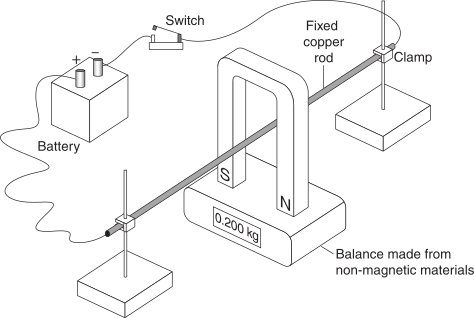
A magnet rests on an electronic balance. A rigid copper rod runs horizontally through the magnet, at right angles to the magnetic field. The rod is anchored so that it cannot move.
 

Which expression can be used to calculate the balance reading when the switch is closed?

  1. `0.200\ text{kg} +BIl`
  2. `0.200\ text{kg} +(BIl)/9.8`
  3. `0.200\ text{kg} -BIl`
  4. `0.200\ text{kg} -(BIl)/9.8`
Show Answers Only

`B`

Show Worked Solution
  • Using the right hand palm rule, the force on the conductor due to the magnet is up.
  • By Newton’s Third Law, an equal force is exerted downwards on the magnet, adding to the reading on the scale.
  • Since the scale shows mass, not force, `F=BIl`  is divided by 9.8 to convert to a mass reading.

`=>B`


♦♦♦ Mean mark 27%.

Filed Under: The Motor Effect Tagged With: Band 6, smc-3694-20-Force on Current-Carrying Conductor

PHYSICS, M6 2018 HSC 30

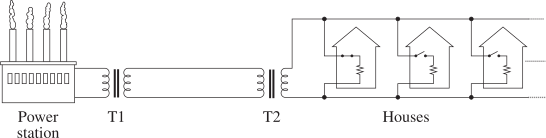
The diagram shows a model of a system used to distribute energy from a power station through transmission lines and transformers to houses.
 

During the evening peak period there is an increase in the number of electrical appliances being turned on in houses.

Explain the effects of this increased demand on the components of the system, with reference to voltage, current and energy.   (6 marks)

--- 18 WORK AREA LINES (style=lined) ---

Show Answers Only

Current and voltage:

  • An increase in the number of electrical appliances causes an increase in energy demand, and a greater power requirement.
  • As `P=VI`, and `V` is constant at approximately 240`V` at the secondary coil of the step down transformer (T2), a greater current is drawn.
  • Similarly, this increases the current in the transmission lines as well as the power station.
  • As the voltage of T2 is approximately fixed at 240`V` and the ratio of coils in each transformer stays constant, the output voltage from the power station, the transmission line voltage and the supply voltage to houses will also remain approximately constant.

Energy losses:

  • As the current increases, the heat produced by resistance in the wires increases leading to losses in energy according to `P_(loss)=I^2R`.
  • Energy loss is also caused by the formation of eddy currents in the transformer cores, and this increases as current increases.
  • This power loss will cause slight voltage drops along the transmission lines leading to slight decreases in voltage inputs and outputs at each of the transformers.
Show Worked Solution

Current and voltage:

  • An increase in the number of electrical appliances causes an increase in energy demand, and a greater power requirement.
  • As `P=VI`, and `V` is constant at approximately 240`V` at the secondary coil of the step down transformer (T2), a greater current is drawn.
  • Similarly, this increases the current in the transmission lines as well as the power station.
  • As the voltage of T2 is approximately fixed at 240`V` and the ratio of coils in each transformer stays constant, the output voltage from the power station, the transmission line voltage and the supply voltage to houses will also remain approximately constant.

Energy losses:

  • As the current increases, the heat produced by resistance in the wires increases leading to losses in energy according to `P_(loss)=I^2R`.
  • Energy loss is also caused by the formation of eddy currents in the transformer cores, and this increases as current increases.
  • This power loss will cause slight voltage drops along the transmission lines leading to slight decreases in voltage inputs and outputs at each of the transformers.

♦♦ Mean mark 42%.

Filed Under: Electromagnetic Induction Tagged With: Band 5, Band 6, smc-3705-80-Energy Distribution

Measurement, STD1 M3 2022 HSC 32

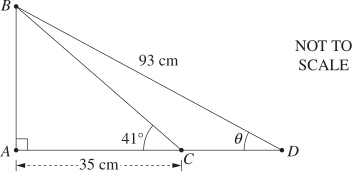
The diagram shows two right-angled triangles, `A B C` and `A B D`,

where `A C=35 \ text{cm}`, `B D=93 \ text{cm}`, `/_ A C B=41^@` and ` /_ A D B=\theta`.


Calculate the size of angle `\theta`, to the nearest minute.   (4 marks)

--- 8 WORK AREA LINES (style=lined) ---

Show Answers Only

`19^@6^{′}`

Show Worked Solution

`text{In}\ Delta ABC:`

`tan 41^@` `=(AB)/35`
`AB` `=35xxtan 41^@`
  `=30.425\ …`

  
`text{In}\ Delta ABD:`

`sin theta` `=(AB)/(BD)`
  `=(30.425\ …)/93`
`:.theta` `=sin^(-1)((30.425\ …)/93)`
  `=19.09…`
  `=19^@6^{′}\ \ text{(nearest minute)}`

♦♦♦ Mean mark 17%.

Filed Under: M3 Right-Angled Triangles (Y12), Right-angled Triangles (Y12) Tagged With: Band 6, smc-1103-20-Right-angled Trig, smc-1103-50-Rounding to the Minute, smc-6834-20-Trigonometry, smc-6834-50-Rounding to the Minute

Statistics, STD1 S1 2022 HSC 29

The ages of the 10 members in a tennis club are

`{:[24,25,27,33,34,34,35,39,47,59.]:}`

Could the age `59` be considered an outlier? Justify your answer with calculations.   (3 marks)

--- 6 WORK AREA LINES (style=lined) ---

Show Answers Only

`Q_1=27, \ Q_3=39`

`IQR = Q_3-Q_1 = 39-27 = 12`
 

`text{Upper limit:}`

`Q_3 + 1.5 xx IQR=39 + 1.5 xx 12=57`

  
`:.\ text{S}text{ince  59 > 57,  59 is an outlier.}`

Show Worked Solution

`Q_1=27, \ Q_3=39`

`IQR = Q_3-Q_1 = 39-27 = 12`
 

`text{Upper limit:}`

`Q_3 + 1.5 xx IQR=39 + 1.5 xx 12=57`

  
`:.\ text{S}text{ince  59 > 57,  59 is an outlier.}`


♦♦♦ Mean mark 11%.

Filed Under: Measures of Centre and Spread, Summary Statistics Tagged With: Band 6, smc-1131-30-IQR and Outliers, smc-6532-30-IQR and Outliers

BIOLOGY, M5 2019 HSC 30

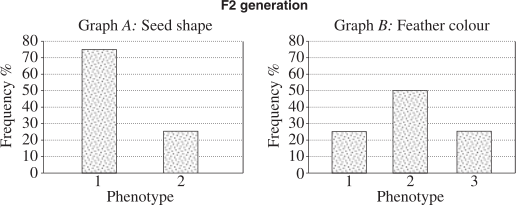
Experiments were conducted to obtain data on the traits 'seed shape' in plants and 'feather colour' in chickens. In each case, the original parents were pure breeding and produced the first generation (F1). The frequency data diagrams below relate to the second generation offspring (F2), produced when the F1 generations were bred together.
 

Explain the phenotypic ratios of the F2 generation in both the plant and chicken breeding experiments. Include Punnett squares and a key to support your answer.   (5 marks)

--- 12 WORK AREA LINES (style=lined) ---

Show Answers Only
  • Graph A shows a 3:1 phenotypic ratio. This is typical of a dominant/recessive allele phenotypic ratio of two heterozygous parents.
  • The Punnet square below supports this argument, where R refers to the dominant seed shape (e.g. round) and r is the recessive allele, producing another seed shape (e.g. wrinkled). The offspring have a 3:1 ratio of dominant : recessive seed shape.

\begin{array} {|c|c|c|}\hline  & \text{R} & \text{r} \\ \hline \text{R} & \text{RR} & \text{Rr} \\ \hline \text{r} & \text{Rr} & \text{rr} \\ \hline \end{array}

Key: R = Round     r = wrinkled

  • Graph B shows a 1:2:1 phenotypic ratio. Because both parents are heterozygous, this ratio is typical of a co-dominant or incomplete dominant trait.
  • If B is an allele referring to black colour feathers and W is the allele for white colour feathers then both parents will be BW, which is either grey colour feathers (co-dominance) or both black and white feathers (incomplete dominance). A cross between these genotypes will produce a phenotypic ratio of the same seen in the graph.

\begin{array} {|c|c|c|}\hline  & \text{B} & \text{W} \\ \hline \text{B} & \text{BB} & \text{BW} \\ \hline \text{W} & \text{BW} & \text{WW} \\ \hline \end{array}

Key: B = Black Feathers     W= White Feathers

Show Worked Solution
  • Graph A shows a 3:1 phenotypic ratio. This is typical of a dominant/recessive allele phenotypic ratio of two heterozygous parents.
  • The Punnet square below supports this argument, where R refers to the dominant seed shape (e.g. round) and r is the recessive allele, producing another seed shape (e.g. wrinkled). The offspring have a 3:1 ratio of dominant : recessive seed shape.

\begin{array} {|c|c|c|}\hline  & \text{R} & \text{r} \\ \hline \text{R} & \text{RR} & \text{Rr} \\ \hline \text{r} & \text{Rr} & \text{rr} \\ \hline \end{array}

Key: R = Round     r = wrinkled

  • Graph B shows a 1:2:1 phenotypic ratio. Because both parents are heterozygous, this ratio is typical of a co-dominant or incomplete dominant trait.
  • f B is an allele referring to black colour feathers and W is the allele for white colour feathers then both parents will be BW, which is either grey colour feathers (co-dominance) or both black and white feathers (incomplete dominance). A cross between these genotypes will produce a phenotypic ratio of the same seen in the graph.

\begin{array} {|c|c|c|}\hline  & \text{B} & \text{W} \\ \hline \text{B} & \text{BB} & \text{BW} \\ \hline \text{W} & \text{BW} & \text{WW} \\ \hline \end{array}

Key: B = Black Feathers     W= White Feathers


♦♦ Mean mark 44%.

Filed Under: Genetic Variation / Inheritance Tagged With: Band 5, Band 6, smc-3648-20-Punnet Squares, smc-3648-35-Autosomal, smc-3648-40-Co-Dominance, smc-3648-45-Incomplete Dominance

BIOLOGY, M8 2019 HSC 29

Describe ONE mechanism by which plants maintain internal water homeostasis.   (3 marks)

--- 8 WORK AREA LINES (style=lined) ---

Show Answers Only
  • The widening and reduction of the size of stomata is one mechanism which controls the water movement out of the leaf; the wider the stomata, the more water will leave the plant via transpiration.
  • The width of the stomata is controlled by both environmental conditions and hormones within the plant.
  • When internal water is low, the stress hormone abscisic acid is released, causing the stomata to close.
Show Worked Solution
  • The widening and reduction of the size of stomata is one mechanism which controls the water movement out of the leaf; the wider the stomata, the more water will leave the plant via transpiration.
  • The width of the stomata is controlled by both environmental conditions and hormones within the plant.
  • When internal water is low, the stress hormone abscisic acid is released, causing the stomata to close.

♦♦♦ Mean mark 23%.

Filed Under: Homeostasis Tagged With: Band 6, smc-3659-30-Water Balance in Plants

BIOLOGY, M5 2019 HSC 28

Huntington's disease is an autosomal dominant condition caused by a mutation of a gene on chromosome 4. It causes nerve cells to break down.

Stargardt disease is an autosomal recessive condition caused by a mutation of a different gene on chromosome 4 . It causes damage to the retina.

A patient is heterozygous for both Huntington's (Hh) and Stargardt disease (Rr). His father's extended family has numerous cases of both of these diseases. His mother does not have either disease and is homozygous for both genes.

  1. Complete the tables, showing the TWO alleles the patient inherited from each parent.   (2 marks)
     
    \begin{aligned}
    &\begin{array}{|l|}
    \hline \rule{0pt}{2.5ex}\quad \quad \textit{ Alleles from father }\quad \quad \rule[-1ex]{0pt}{0pt} \\
    \hline \rule{0pt}{2.5ex}\text{} \rule[-1ex]{0pt}{0pt}\\
    \hline
    \end{array}
    &\begin{array}{|c|}
    \hline \rule{0pt}{2.5ex}\quad \quad \textit{Alleles from mother } \quad \quad \rule[-1ex]{0pt}{0pt}\\
    \hline \rule{0pt}{2.5ex}\text{}\rule[-1ex]{0pt}{0pt}\\
    \hline
    \end{array}
    \end{aligned}
     
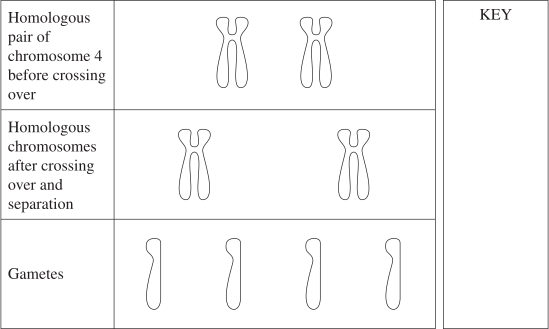
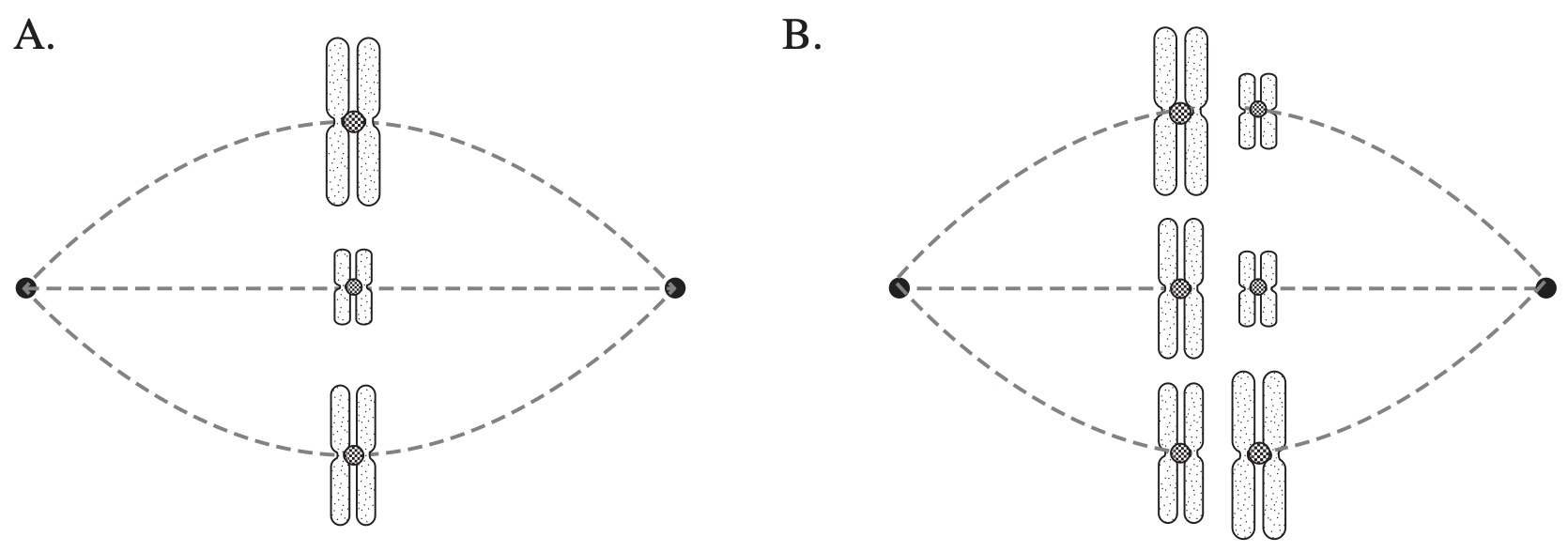
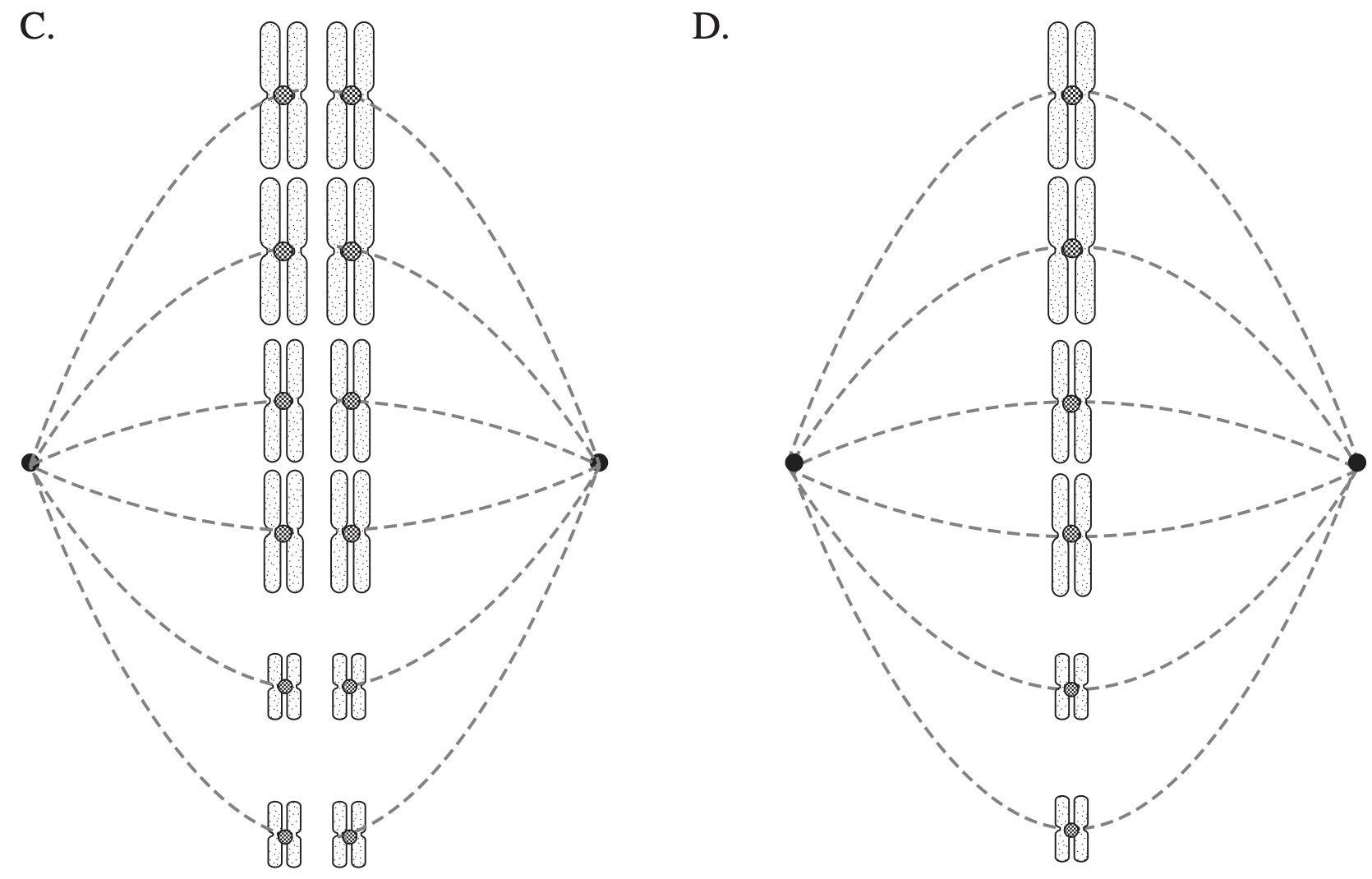
  2. The diagram shows the patient's homologous pair of chromosome 4 at various stages of meiosis.
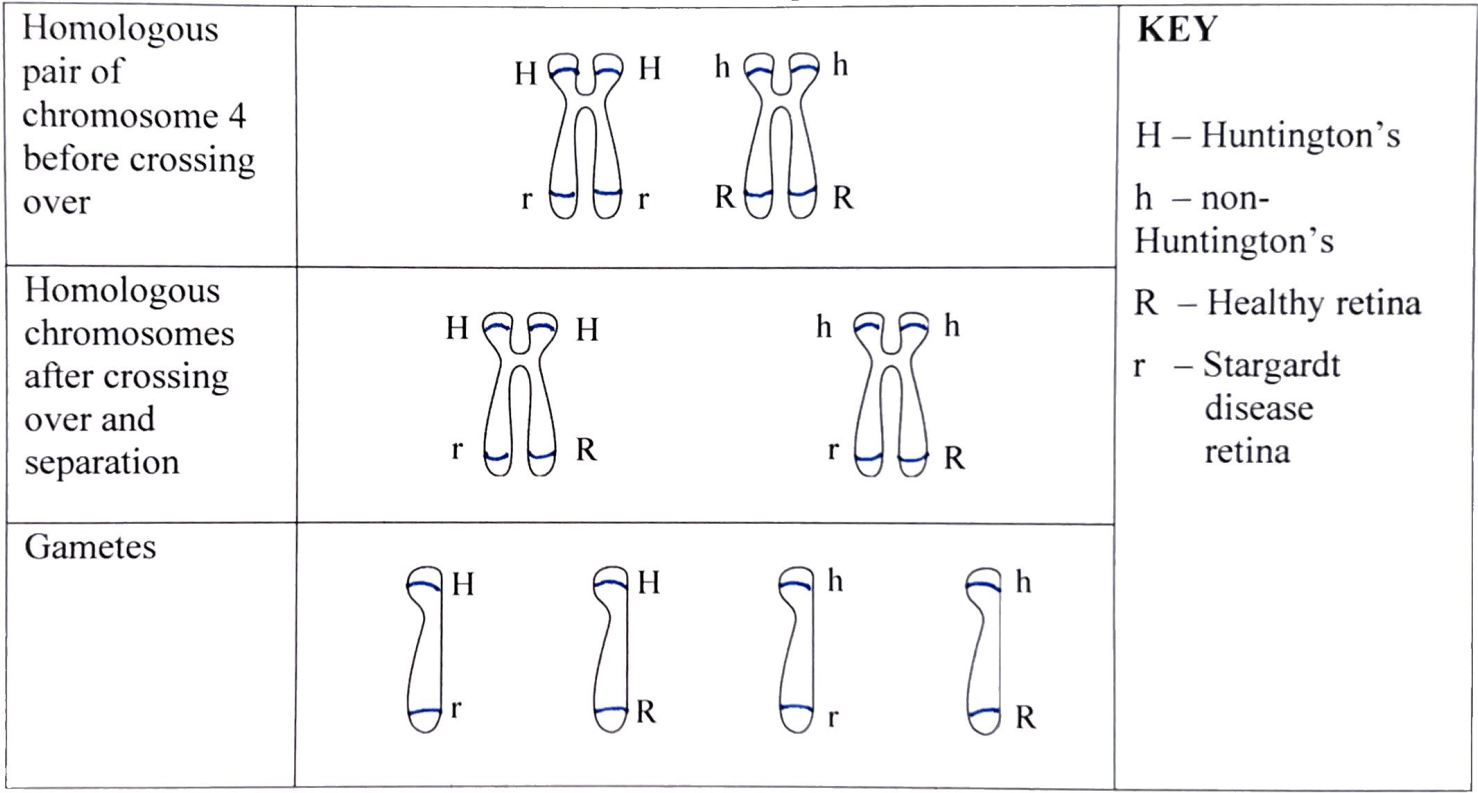
  3. Add the relevant alleles to the diagram to model the production of possible gamete combinations. Include a key and an example of crossing over.   (4 marks)
     

--- 0 WORK AREA LINES (style=lined) ---

Show Answers Only

a.     

\begin{array} {|c|c|}\hline \text{Alleles from father} & \text{Alleles from mother} \\
\hline \text{H, r} & \text{h, R} \\ \hline \end{array}

b.

Show Worked Solution

a.     

\begin{array} {|c|c|}\hline \text{Alleles from father} & \text{Alleles from mother} \\
\hline \text{H, r} & \text{h, R} \\ \hline \end{array}


♦ Mean mark (a) 47%.

b.


♦♦♦ Mean mark (b) 25%.

Filed Under: Genetic Variation / Inheritance Tagged With: Band 5, Band 6, smc-3648-35-Autosomal, smc-3648-50-Meiosis

BIOLOGY, M6 2019 HSC 26

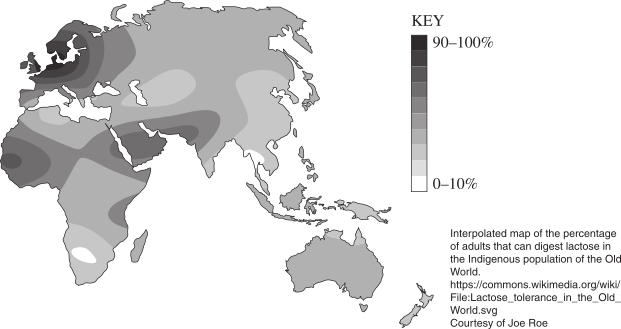
The map shows the percentage of adult indigenous populations able to digest lactose.
 

The ability to digest lactose is due to the presence of an enzyme (lactase) which can metabolise the sugar (lactose) present in milk. The gene responsible for producing lactase is usually permanently switched off at some time between the ages of 2 and 5 years. However, some people remain able to digest lactose throughout their lives.

With reference to evolution and DNA, provide possible reasons for the distribution shown in the map.   (5 marks)

Show Answers Only
  • The ability to digest lactose is most likely due to a mutation where the gene is not shut off after age 5, and the body continues to produce lactase.
  • The differentiation in the graph above can also be viewed as the frequency of this mutation in certain areas.
  • In areas such as Europe, where over 90% of the adult indigenous population can digest lactose, this mutation is highly prevalent, suggesting it may have played a role in survival advantage.
  • In these areas, milk may make up a high portion of the diet and therefore the ability to digest lactose would prove advantageous and the resulting selective pressure would see it passed on (natural selection).
  • The opposite is true when looking at countries such as Australia where < 20% of indigenous adults can digest lactose.
  • We can deduce that milk is not essential to their traditional diet as the mutation is negligible and not passed on (i.e. it doesn’t constitute a survival advantage).
Show Worked Solution
  • The ability to digest lactose is most likely due to a mutation where the gene is not shut off after age 5, and the body continues to produce lactase.
  • The differentiation in the graph above can also be viewed as the frequency of this mutation in certain areas.
  • In areas such as Europe, where over 90% of the adult indigenous population can digest lactose, this mutation is highly prevalent, suggesting it may have played a role in survival advantage.
  • In these areas, milk may make up a high portion of the diet and therefore the ability to digest lactose would prove advantageous and the resulting selective pressure would see it passed on (natural selection).
  • The opposite is true when looking at countries such as Australia where < 20% of indigenous adults can digest lactose.
  • We can deduce that milk is not essential to their traditional diet as the mutation is negligible and not passed on (i.e. it doesn’t constitute a survival advantage).

♦♦ Mean mark 33%.

Filed Under: Mutation Tagged With: Band 5, Band 6, smc-3652-10-Mechanisms of Change/Variation

Algebra, STD1 A3 2022 HSC 10 MC

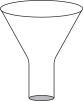
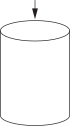
The diagram shows a container, closed at the base. It is to be filled with water at a constant rate.


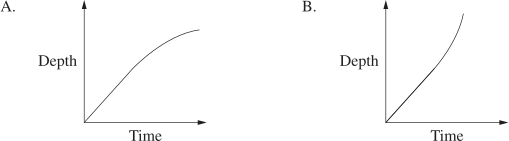
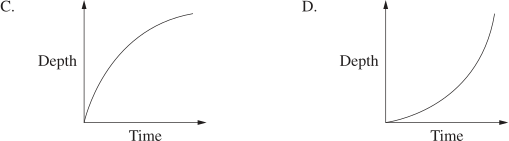
Which graph best shows the depth of water in the container as time varies?


Show Answers Only

\(A\)

Show Worked Solution

\(\text{The container will fill at a constant rate for the cylindrical}\)

\(\text{section of the container → a straight line (linear graph).}\)

\(\text{The container will fill more slowly at a decreasing rate }\)

\(\text{for the conical section of the container → a curved line }\)

\(\text{(non-linear graph).}\)

\(\text{Therefore, }A\ \text{and }B\ \text{are the only options.}\)

\(\text{It cannot be graph}\ B\ \text{as it shows the depth increasing}\)

\(\text{at an increasing rate after the straight line section.}\)

\(\Rightarrow A\)


♦♦♦ Mean mark 24%.

Filed Under: A3 Types of Relationships (Y12), Graphs of Practical Situations Tagged With: Band 6, smc-1099-50-Non-linear graphs, smc-6840-05-Linear Graphs, smc-6840-10-Non-linear Graphs

BIOLOGY, M7 2019 HSC 33d

Alzheimer's disease causes destruction of brain tissue, dementia and eventually death.

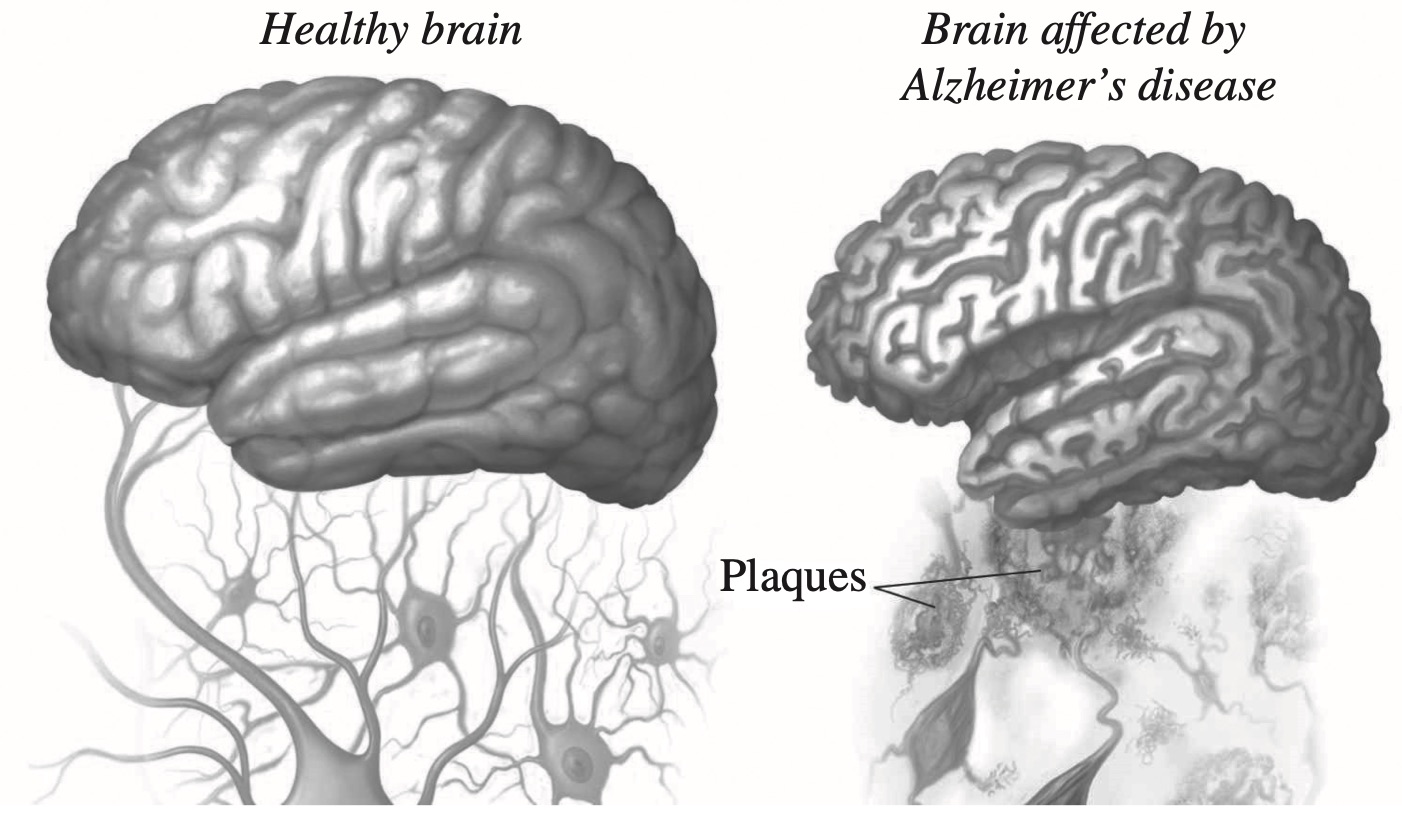
The diagram shows the effect of Alzheimer's disease on the brain.

Amyloid beta protein is produced in the human brain throughout life. In people with Alzheimer's disease, it accumulates in excessive amounts.

The gene with the greatest known effect on the risk of developing late-onset Alzheimer's disease is called APOE. It is found on chromosome 19.

The APOE gene has multiple alleles, including e2, e3 and e4 .

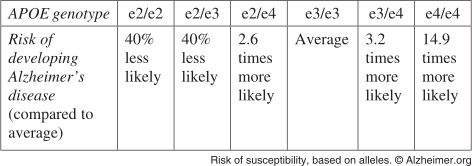
The table shows the risk of developing Alzheimer's disease for various APOE genotypes compared to average risk in the population.


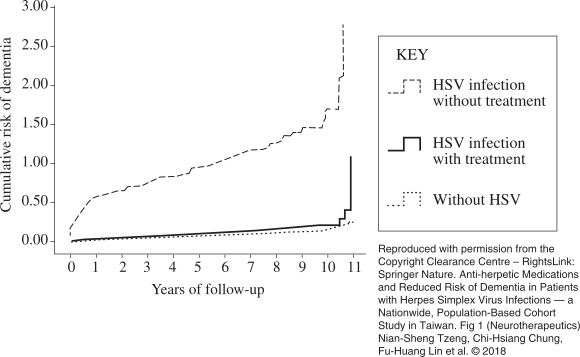
A large epidemiological study was conducted. It used historical data to investigate the association between Herpes simplex virus (HSV) infection and dementia. Dementia is caused by a variety of brain illnesses. Alzheimer's disease is the most common cause of dementia.

The study used the records of 8362 patients with HSV infection and 25086 randomly selected sex- and age-matched control patients without HSV infection. Some of the patients with HSV had been treated with antiviral medication.

The graph below shows some results of the study.
 

Diseases are classified as infectious or non-infectious.

Evaluate whether Alzheimer's disease should be classified as an infectious disease or a non-infectious disease. In your answer, include reference to the information and data provided above.   (8 marks)

--- 18 WORK AREA LINES (style=lined) ---

Show Answers Only

Infectious vs non-infection disease classification

  • Infectious diseases are a result of pathogens, biological agents of disease, which transmit disease between hosts. A pathogen is a cause of a certain disease if it meets the criteria in Koch’s postulates.
  • The study above shows the association between HSV and Alzheimer’s.
  • The study is conducted over a long period and includes a large and controlled sample size, so the assumption can be made that the findings are valid.
  • HSV is an infectious disease as it is caused by a pathogen, the virus Herpes simplex.
  • The findings show that treating HSV with antiviral medication also reduces the risk of developing Alzheimer’s.
  • This may mean that Alzheimer’s is also a virus and therefore an infectious disease. 
  • Non-infectious diseases are not contagious and do not spread from person to person. They are a result of environmental factors or genetic conditions.
  • Alzheimer’s is the result of a build-up of the amyloid beta protein, which is produced in the brain.
  • The synthesis of this protein is regulated by the APOE gene. This gene also has various alleles, each of which in different combinations can increase or decrease a individual’s risk of developing Alzheimer’s.
  • This indicates that Alzheimer’s is a non-infectious disease, as it is not transmitted by a pathogen. Rather, it results from a natural build up of a specific protein, which may be accelerated or reduced based on genotype. 

Conclusion

  • From the information provided it is not possible to accurately classify Alzheimer’s as either an infectious or non-infectious disease.
  • There is evidence to support that the risk of developing Alzheimer’s can be linked to both antiviral and virus traits as well as genotype.
Show Worked Solution

Infectious vs non-infection disease classification

  • Infectious diseases are a result of pathogens, biological agents of disease, which transmit disease between hosts. A pathogen is a cause of a certain disease if it meets the criteria in Koch’s postulates.
  • The study above shows the association between HSV and Alzheimer’s.
  • The study is conducted over a long period and includes a large and controlled sample size, so the assumption can be made that the findings are valid.
  • HSV is an infectious disease as it is caused by a pathogen, the virus Herpes simplex.
  • The findings show that treating HSV with antiviral medication also reduces the risk of developing Alzheimer’s.
  • This may mean that Alzheimer’s is also a virus and therefore an infectious disease. 
  • Non-infectious diseases are not contagious and do not spread from person to person. They are a result of environmental factors or genetic conditions.
  • Alzheimer’s is the result of a build-up of the amyloid beta protein, which is produced in the brain.
  • The synthesis of this protein is regulated by the APOE gene. This gene also has various alleles, each of which in different combinations can increase or decrease a individual’s risk of developing Alzheimer’s.
  • This indicates that Alzheimer’s is a non-infectious disease, as it is not transmitted by a pathogen. Rather, it results from a natural build up of a specific protein, which may be accelerated or reduced based on genotype. 

Conclusion

  • From the information provided it is not possible to accurately classify Alzheimer’s as either an infectious or non-infectious disease.
  • There is evidence to support that the risk of developing Alzheimer’s can be linked to both antiviral and virus traits as well as genotype.

♦♦ Mean mark 46%.

Filed Under: Causes and Effects, Causes of Infectious Disease, Epidemiology Tagged With: Band 5, Band 6, smc-3655-10-Classifying Pathogens, smc-3660-20-Genetic/Cancer, smc-3661-10-Analysing Results

BIOLOGY, M6 2019 HSC 25

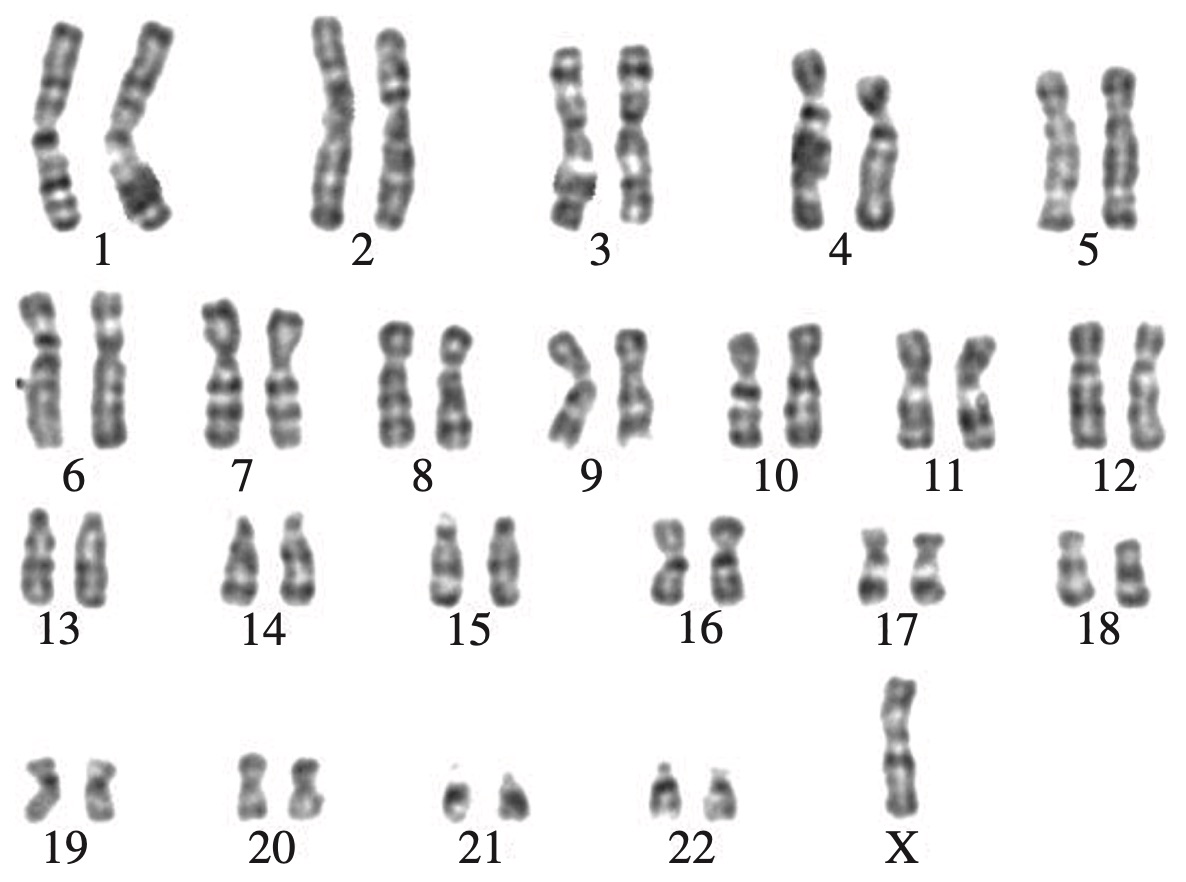
A human karyotype that shows evidence of chromosomal mutation is shown.

  1. Identify the evidence of chromosomal mutation in the karyotype.  (1 mark)

    --- 1 WORK AREA LINES (style=lined) ---

  2. Explain how cell division and fertilisation could lead to the production of this karyotype.  (4 marks)

    --- 8 WORK AREA LINES (style=lined) ---

Show Answers Only

a.   There is only one copy of the sex chromosome (Monosomy, Turner Syndrome).

b.    Process of producing karyotype:

  • During meiosis to produce a gamete, homologous chromosomes (during meiosis I) or sister chromatids (during meiosis II) may fail to separate.
  • This can occur with sex chromosomes, producing one gamete with 2 copies of the sex chromosome, and one without.
  • When the gamete without any sex cells undergoes fertilisation with a normal gamete with only one sex cell, the zygote will have only one sex cell, like the karyotype above.
Show Worked Solution

a.   There is only one copy of the sex chromosome (Monosomy, Turner Syndrome).

b.    Process of producing karyotype:

  • During meiosis to produce a gamete, homologous chromosomes (during meiosis I) or sister chromatids (during meiosis II) may fail to separate.
  • This can occur with sex chromosomes, producing one gamete with 2 copies of the sex chromosome, and one without.
  • When the gamete without any sex cells undergoes fertilisation with a normal gamete with only one sex cell, the zygote will have only one sex cell, like the karyotype above.

♦ Mean mark (a) 47%
♦♦♦ Mean mark (b) 24%.

Filed Under: Mutation Tagged With: Band 5, Band 6, smc-3652-40-Chromosomal Mutations, smc-3652-55-Mutation in Reproduction

Vectors, EXT2 V1 2022 HSC 9 MC

Let \(A\) and \(B\) be two distinct points in three-dimensional space. Let \(M\) be the midpoint of \(A B\).

Let \(S_1\) be the set of all points \(P\) such that  \(\overrightarrow{AP} \cdot \overrightarrow{BP}=0\). 

Let \(S_2\) be the set of all points \(N\) such that \(\Big|\overrightarrow{AN}\Big|=\Big| \overrightarrow{MN} \Big| \).

The intersection of \(S_1\) and \(S_2\) is the circle \(S\).

What is the radius of the circle \(S\) ?

  1. \(\dfrac{\Big| \overrightarrow{AB} \Big|}{2} \)
  2. \(\dfrac{\Big| \overrightarrow{AB} \Big|}{4} \)
  3. \(\dfrac{\sqrt3 \Big| \overrightarrow{AB} \Big|}{2} \)
  4. \(\dfrac{\sqrt3 \Big| \overrightarrow{AB} \Big|}{4} \)
Show Answers Only

\(D\)

Show Worked Solution

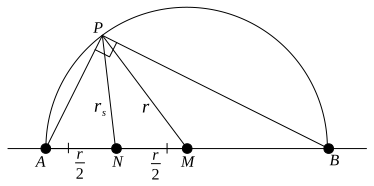
`text{Diagram below is a 2-D sliced image of the 3-D geometry:}`

\(\overrightarrow{AP} \cdot \overrightarrow{BP}=0\). 

\(r=\dfrac{\Big| \overrightarrow{AB} \Big|}{2} \)

\(S_2\ \text{includes}\ N\ \text{where}\ \Big| \overrightarrow{AN} \Big|=\Big| \overrightarrow{MN} \Big| = \dfrac{r}{2} \)  

\(\text{Let}\ r_s=\ \text{radius of}\ S\)

\(\text{Point}\ P\ \text{is intersection of}\ S_1\ \text{and}\ S_2 \)

\(\text{By Pythagoras (see diagram):}\)

\(r_s^2\) \(=r^2-(\dfrac{r}{2})^2 \)  
  \(=\dfrac{3r^2}{4}\)  
\(r_s\) \(=\dfrac{\sqrt3}{2} \times r\)  
  \(=\dfrac{\sqrt3}{2} \cdot \dfrac{\Big| \overrightarrow{AB} \Big|}{2} \)  
  \(=\dfrac{\sqrt3 \Big| \overrightarrow{AB} \Big|}{4} \)  

 
\(=>D\)


♦♦♦ Mean mark 20%.

Filed Under: Vectors and Geometry, Vectors and Geometry Tagged With: Band 6, smc-1210-50-Circle/Sphere, smc-7426-50-Circle/Sphere

Complex Numbers, EXT2 N2 2022 HSC 16d

Find all the complex numbers `z_1, z_2, z_3` that satisfy the following three conditions simultaneously.   (3 marks)

`{[|z_(1)|=|z_(2)|=|z_(3)|],[z_(1)+z_(2)+z_(3)=1],[z_(1)z_(2)z_(3)=1]:}`

--- 8 WORK AREA LINES (style=lined) ---

Show Answers Only

`z_1,z_2,z_3=1,i,-i \ \ text{(in any order)}`

Show Worked Solution

`z_1z_2z_3=1\ \ =>\ \ abs(z_1) abs(z_2) abs(z_3)=1`

`text{Given}\ \ abs(z_1) = abs(z_2) = abs(z_3)`

`=>abs (z_1)^3=1 \ \ => \ \ abs(z_1)=1`

`:.abs(z_1) = abs(z_2) = abs(z_3)=1`


♦♦♦ Mean mark 12%.

`text{Since}\ abs(z_1)=1\ \ =>\ \ z_1= text{cis} theta`

`1/z_1 = 1/(text{cis} theta) = text{cis}(- theta) = \cos theta-i\sin theta = bar(z)_1`

`text{Similarly,}`

`1/z_2=bar(z)_2, \ 1/z_3=bar(z)_3`

`=>z_1z_2z_3=1`

  
`text{Consider}\ z_1z_2:`

`z_1z_2=1/z_3=barz_3`

`text{Similarly,}`

`z_2z_3=1/z_1=barz_1, \ z_1z_3=1/z_2=barz_2`

`z_1z_2+z_1z_3+z_2z_3` `=barz_3+barz_2+barz_1`  
  `=bar(z_1+z_2+z_3)`  
  `=1`  

 
`z_1, z_2,z_3\ text{are zeros of polynomial:}`

`z^3-z^2+z-1` `=0`  
`(z-1)(z^2+1)` `=0`  

 
`z_1,z_2,z_3=1,i,-i \ \ text{(in any order)}`

Filed Under: Powers and Roots, Solving Equations with Complex Numbers Tagged With: Band 6, smc-1050-20-Cubic roots, smc-1050-35-Conjugate roots, smc-1050-50-Exponential form, smc-7430-50-Other Roots

Proof, EXT2 P1 2022 HSC 16c

It is given that for positive numbers `x_(1),x_(2),x_(3),dots,x_(n)` with arithmetic mean `A`,

               `(x_(1)xxx_(2)xxx_(3)xx cdots xxx_(n))/(A^(n)) <= 1`    (Do NOT prove this.)

Suppose a rectangular prism has dimensions `a, b, c` and surface area `S`.

  1. Show that  `abc <= ((S)/(6))^((3)/(2))`.  (2 marks)

    --- 8 WORK AREA LINES (style=lined) ---

  2. Using part (i), show that when the rectangular prism with surface area `S` is a cube, it has maximum volume.  (2 marks)

    --- 8 WORK AREA LINES (style=lined) ---

Show Answers Only
  1. `text{Proof (See Worked Solutions)}`
  2. `text{Proof (See Worked Solutions)}`
Show Worked Solution

i.    `text{Show}\ \ abc <= ((S)/(6))^((3)/(2))`

`S=2(ab+bc+ac)`

`A=(ab+bc+ac)/3`

`text{Using given relationship, where}\ x_1=ab, x_2=bc, …`


♦♦♦ Mean mark (i) 26%.
`(ab xx bc xx ca)/((ab+bc+ac)/3)^3` `<=1`  
`(ab xx bc xx ca)` `<=((ab+bc+ac)/3)^3`  
`(abc)^2` `<=((2(ab+bc+ac))/6)^3`  
`abc` `<=(S/6)^(3/2)`  


ii.   `text{If prism is a cube,}\ a=b=c`

`=> V=a^3, \ \ S=6a^2`

`(S/6)^(3/2)=((6a^2)/6)^(3/2)=a^3`
 

`text{In the case of a cube:}`

`V=(S/6)^(3/2)`


♦♦♦ Mean mark (ii) 26%.

`text{Also,}\ \ V<=(S/6)^(3/2)\ \ \ text{(using part (i))}`

`:.\ text{For rectangular prisms with a given surface area, a cube}`

`text{has the maximum volume.}`

Filed Under: Inequalities, Proof and Inequalities Tagged With: Band 5, Band 6, smc-1208-30-Proof using given equation, smc-1208-50-Arithmetic/Geometric Mean, smc-1208-60-Other Proofs, smc-7423-30-Proof using given equation, smc-7423-50-Arithmetic/Geometric Mean

Complex Numbers, EXT2 N2 2022 HSC 16a

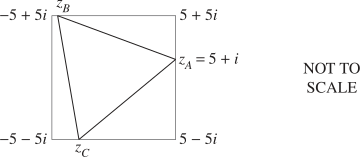
A square in the Argand plane has vertices

        `5+5i,quad5-5i,quad-5-5i`  and  `-5+5i`.

The complex numbers `z_A=5+i, z_B` and `z_C` lie on the square and form the vertices of an equilateral triangle, as shown in the diagram.


Find the exact value of the complex number `z_B`.   (4 marks)

--- 14 WORK AREA LINES (style=lined) ---

Show Answers Only

`(5-16/sqrt3)+5i`

Show Worked Solution

`z_A=5+i, \ \ z_B=b+5i, \ \ z_C=c-5i`

`z_B-z_A=(b-5)+4i`

`z_C-z_A=(c-5)-6i`


♦♦♦ Mean mark 21%.

`text{Internal angles of equilateral triangle} = pi/3:`

`=>\ (z_B-z_A)\ text{is an anti-clockwise rotation of}\ (z_C-z_A)\ text{by}\ pi/3`
 

`e^(i pi/3)(z_B-z_A)=z_C-z_A`

`(1/2+i sqrt3/2)((b-5)+4i)=(c-5)-6i`

`(b-5)/2+2i+((b-5)sqrt3)/2 i-2sqrt3` `=(c-5)-6i`  
`(b-5-4sqrt3)/2 + i((4+(b-5)sqrt3)/2)` `=(c-5)-6i`  

 
`text{Equating imaginary parts:}`

`(4+(b-5)sqrt3)/2` `=-6`  
`(b-5)sqrt3` `=-16`  
`b-5` `=-16/sqrt3`  
`b` `=5-16/sqrt3`  

 
`:.z_B=(5-16/sqrt3)+5i`

Filed Under: Geometrical Implications of Complex Numbers, Powers and Roots Tagged With: Band 6, smc-1052-55-Rotations, smc-7430-60-Rotation and Shapes

ENGINEERING, PPT 2020 HSC 25b

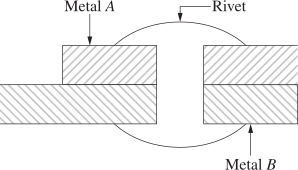
Members of steel trusses are often connected using metal rivets as shown.
 

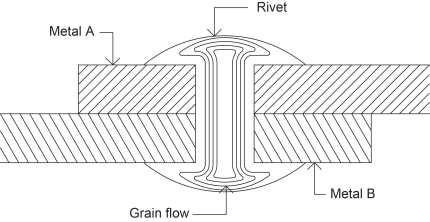
Describe the hot working process that the rivet has undergone to create the resulting structure. Support your answer by completing and labelling the diagram of the sectioned rivet.   (3 marks)

--- 7 WORK AREA LINES (style=lined) ---

Show Answers Only
  • For hot working to be successful, the rivet has to be heated above the recrystallisation temperature of the material.
  • A riveting gun is then used to hot forge the head of the rivet into place.
  • This causes grain flow to form around the head of the rivet, as shown in the image above.

Show Worked Solution
  • For hot working to be successful, the rivet has to be heated above the recrystallisation temperature of the material.
  • A riveting gun is then used to hot forge the head of the rivet into place.
  • This causes grain flow to form around the head of the rivet, as shown in the image above.


♦♦♦ Mean mark 26%.

Filed Under: Materials Tagged With: Band 6, smc-3719-35-Tempering/Hardening

BIOLOGY, M6 2019 HSC 19-20 MC

Use the following diagram to answer Questions 19-20.

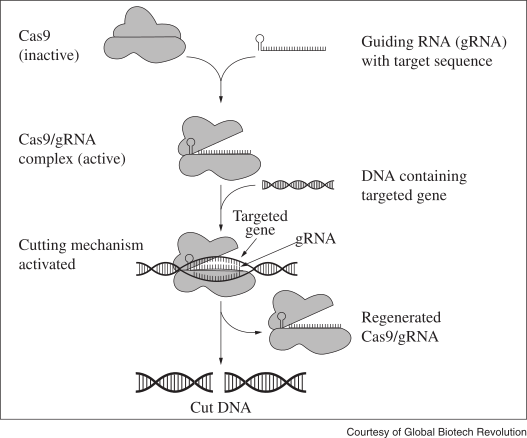
The diagram shows how CRISPR/Cas9 can be used as a new tool for genetic engineering. This technology has dramatically improved scientists' ability to successfully modify genomes.
 

Question 19

What type of structure must Cas9 be?

  1. Enzyme
  2. mRNA
  3. Ribosome
  4. tRNA

 
Question 20

Scientists have been able to use biotechnology to 'cut and paste' DNA for decades.

Why would the new CRISPR/Cas9 technology have improved the scientists' success in cutting DNA of specific genes?

  1. Cas9 is able to combine with specific DNA.
  2. Cas 9 has an active site that cuts target DNA.
  3. gRNA has the same nucleotides as the target DNA.
  4. gRNA has nucleotides complementary to the target DNA.
Show Answers Only

Question 19: `A`

Question 20: `D`

Show Worked Solution

Question 19

  • Cas9 performs a ‘cutting mechanism’, a property of DNA helicase, a known enzyme.
  • Cas9 also contains a recognition site which it uses to perform its tasks, another property of enzymes.

`=>A`
  

Question 20

  • Cas9 has gRNA with complementary bases to the target gene, as displayed in the diagram above.
  • The improvement is due to this feature, as scientists can now use multiple gRNA sequences to cut various amounts of genes and various recognition sites.

`=>D`


♦♦♦ Mean mark (Q20) 23%.

Filed Under: Biotechnology, Genetic Technologies Tagged With: Band 4, Band 6, smc-3653-20-Evaluating Genetic Technology, smc-3654-05-Transgenic Organisms, smc-3654-80-Gene Cloning

BIOLOGY, M5 2019 HSC 17 MC

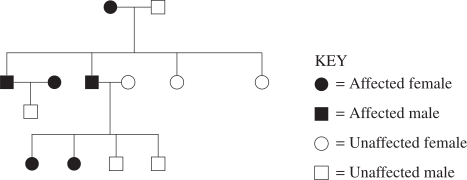
The pedigree shows the inheritance of a genetic disorder.
 

Which row of the table correctly identifies the two possible types of inheritance for this disorder?
 

\begin{align*}
\begin{array}{l}
\rule{0pt}{2.5ex} \ \rule[-1ex]{0pt}{0pt}& \\
\ \rule[-1ex]{0pt}{0pt}& \\
\rule{0pt}{2.5ex}\textbf{A.}\rule[-1ex]{0pt}{0pt}\\
\rule{0pt}{2.5ex}\textbf{B.}\rule[-1ex]{0pt}{0pt}\\
\rule{0pt}{2.5ex}\textbf{C.}\rule[-1ex]{0pt}{0pt}\\
\rule{0pt}{2.5ex}\textbf{D.}\rule[-1ex]{0pt}{0pt}\\
\end{array}
\begin{array}{|c|c|c|c|}
\hline
\rule{0pt}{2.5ex}\quad \textit{Autosomal} \quad &\quad \textit{Autosomal} \quad & \quad \textit{Sex-linked} \quad & \quad \textit{Sex-linked}\quad \\
\textit{dominant} &\textit{recessive} \rule[-1ex]{0pt}{0pt}& \textit{dominant} & \textit{recessive}\\
\hline
\rule{0pt}{2.5ex}\checkmark \rule[-1ex]{0pt}{0pt}& & \checkmark & \\
\hline
\rule{0pt}{2.5ex}\checkmark \rule[-1ex]{0pt}{0pt}& & & \checkmark \\
\hline
\rule{0pt}{2.5ex}& \checkmark \rule[-1ex]{0pt}{0pt}& \checkmark & \\
\hline
\rule{0pt}{2.5ex}& \checkmark \rule[-1ex]{0pt}{0pt}& & \checkmark \\
\hline
\end{array}
\end{align*}

Show Answers Only

\(A\)

Show Worked Solution

By Elimination:

  • If the trait is autosomal recessive, then it would be impossible to not be affected if both parents are affected (aa x aa).
  • This is not the case for the first individual in generation 3 (eliminate C and D).
  • If the trait is sex-linked recessive, then anytime an affected female has male children, they must be affected, as the recessive allele from the mother must couple with the Y chromosome.
  • This is not the case for the first individual in generation 3 (eliminate B).

\(\Rightarrow A\)


♦♦♦ Mean mark 24%.

Filed Under: Genetic Variation / Inheritance Tagged With: Band 6, smc-3648-10-Pedigrees, smc-3648-30-Sex Linkage, smc-3648-35-Autosomal

CHEMISTRY, M8 2019 HSC 19 MC

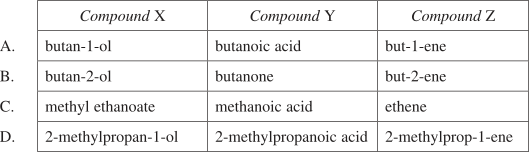
Compound `text{X}` shows three signals in its \(\ce{^{13}C NMR}\) spectrum.

Treatment of `text{X}` with hot acidified potassium permanganate produces a compound `text{Y}`. Compound `text{Y}` turns blue litmus red.

Compound `text{X}` produces compound `text{Z}` upon reaction with hot concentrated sulfuric acid.
Which of the following correctly identifies compounds `text{X}`, `text{Y}` and `text{Z}`?
 

Show Answers Only

`D`

Show Worked Solution
  • The given information suggests that compound `text{Y}` is a carboxylic acid because it is produced through the oxidation of compound `text{X}`, a primary alcohol, with an oxidising agent and turns blue litmus red.
  • The treatment of compound `text{X}` with hot concentrated sulfuric acid results in a dehydration reaction.
  • In summary, the information provided suggests that compound `text{Y}` is a carboxylic acid and compound `text{X}` is a primary alcohol, and that the treatment of compound `text{X}` with hot concentrated sulfuric acid results in a dehydration reaction.

`=>D`


♦♦♦ Mean mark 33%.

Filed Under: Organic Substances Tagged With: Band 6, smc-3683-10-C NMR, smc-3683-60-Hydroxyl Group, smc-3683-70-Carboxylic Acid Group

CHEMISTRY, M5 2019 HSC 18 MC

Consider the following equilibrium.

\(\ce{HF(aq) + CF3COO-(aq) \rightleftharpoons F-(aq) + CF3COOH(aq) \ \ \ \ \ \ $K_{eq}$ = 3.80 \times 10^{-4}} \)

Which row of the table correctly identifies the strongest acid and the strongest base in this system?
 

  \(\text{Strongest acid}\) \(\text{Strongest base}\)
A.   \(\ce{CF3OOH(aq)}\) \(\ce{F-(aq)}\)
B. \(\ce{CF3OOH(aq)}\) \(\ce{CF3OO-(aq)}\)
C. \(\ce{HF(aq)}\) \(\ce{F-(aq)}\)
D. \(\ce{HF(aq)}\) \(\ce{CF3OO-(aq)}\)

Show Answers Only

`A`

Show Worked Solution
  • The small size of `K_(eq)` means that there is a higher concentration of reactants than products at equilibrium.
  • This shifts the equilibrium towards the reactants, which means that the reverse reaction is more likely to occur.
  • Because \(\ce{F-}\) is more likely to accept a proton than \(\ce{CF3COO-}\), it is a stronger base.
  • On the other hand, \(\ce{CF3COO-}\) is more likely to donate a proton than \(\ce{HF}\), making it the stronger acid.

`=>A`


♦♦♦ Mean mark 23%.

Filed Under: Solution Equilibria Tagged With: Band 6, smc-3672-10-Mixed ionic solutions

BIOLOGY, M6 2022 HSC 32

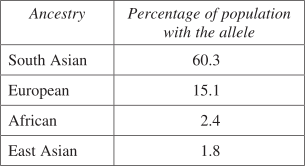
Researchers have identified a gene that determines the inflammatory response of lung cells to infection with a virus. An allele of this gene is associated with increased inflammation and increased chance of death from the virus.

The table shows the percentage presence of the allele in people with different ancestries.
 

Explain how mutation, natural selection, genetic drift and gene flow could have led to these differences in the gene pools of populations with differing ancestry.   (7 marks)

--- 15 WORK AREA LINES (style=lined) ---

Show Answers Only

Mutation

  • A mutation is a mechanism of change which permanently alters DNA, changing genotype and phenotype of the ‘host’.
  • In this case, a mutation has occurred which has altered the gene responsible for the inflammatory response in the lungs in response to a virus, making death more common for people who contract the virus as the gene is now faulty.
  • Other mechanisms of variation such as natural selection, gene flow and genetic drift, are responsible for the allele frequency distribution.

Natural selection

  • Refers to the process where selection pressures such as predators, climate, or in this case the lung virus, favour certain individuals, which then means that their alleles can be carried into further generations.
  • It is highly likely that the virus was never present in South Asia, hence the high frequency in South Asian people (60.3%); the allele was negligible.
  • The virus most likely was present in Europe, Africa and East Asia (<15%) and was responsible for almost eliminating the allele in these populations.

Gene flow

  • Gene Flow is the movement of alleles into new populations, usually via migration.
  • Interbreeding between the migrated individual in the new population with the allele, in conjunction with processes such as natural selection can cause the allele to be prominent in the new population.
  • The allele could have originated in South Asia, and gene flow may be responsible for the other frequencies, especially in Europe.

Genetic drift

  • This occurs when populations experience drastic changes in allele frequencies due to random chance events.
  • These events, such as a natural disaster or re-establishing a new population, can eliminate or change the allele frequency and do not cater towards any genotype. 
  • It is possible genetic drift is responsible for the comparatively high allele frequency in South Asia, or the relatively low frequency in Africa and East Asia.
Show Worked Solution

Mutation

  • A mutation is a mechanism of change which permanently alters DNA, changing genotype and phenotype of the ‘host’.
  • In this case, a mutation has occurred which has altered the gene responsible for the inflammatory response in the lungs in response to a virus, making death more common for people who contract the virus as the gene is now faulty.
  • Other mechanisms of variation such as natural selection, gene flow and genetic drift, are responsible for the allele frequency distribution.

Natural selection

  • Refers to the process where selection pressures such as predators, climate, or in this case the lung virus, favour certain individuals, which then means that their alleles can be carried into further generations.
  • It is highly likely that the virus was never present in South Asia, hence the high frequency in South Asian people (60.3%); the allele was negligible.
  • The virus most likely was present in Europe, Africa and East Asia (<15%) and was responsible for almost eliminating the allele in these populations.

Gene flow

  • Gene Flow is the movement of alleles into new populations, usually via migration.
  • Interbreeding between the migrated individual in the new population with the allele, in conjunction with processes such as natural selection can cause the allele to be prominent in the new population.
  • The allele could have originated in South Asia, and gene flow may be responsible for the other frequencies, especially in Europe.

Genetic drift

  • This occurs when populations experience drastic changes in allele frequencies due to random chance events.
  • These events, such as a natural disaster or re-establishing a new population, can eliminate or change the allele frequency and do not cater towards any genotype. 
  • It is possible genetic drift is responsible for the comparatively high allele frequency in South Asia, or the relatively low frequency in Africa and East Asia.

♦♦♦ Mean mark 32%.

Filed Under: Genetic Variation / Inheritance, Mutation Tagged With: Band 5, Band 6, smc-3648-70-Allele Frequency Data, smc-3652-10-Mechanisms of Change/Variation, smc-3652-55-Mutation in Reproduction

BIOLOGY, M5 2022 HSC 28c

Outline the ways in which the DNA of prokaryotes and eukaryotes differ.   (3 marks)

--- 6 WORK AREA LINES (style=lined) ---

Show Answers Only
  • DNA of Prokaryotes is found in loops whereas the DNA of Eukaryotes is linear.
  • DNA of Prokaryotes is found in the nucleoid region whereas the DNA of Eukaryotes is found as multiple chromosomes in the nucleus (membrane).
  • Prokaryotes have extra “non-nucleoid” DNA in form of plasmids, non-coding fragments found within the cytoplasm, whereas Eukaryotes have non-nuclear DNA within mitochondria (animals) or chloroplasts (plants).
  • Prokaryotes contain nucleoid associated proteins which make DNA form looped structures, while Eukaryotic DNA contains histones, proteins which DNA can wrap around to condense into chromatin and chromosomes.
  • Eukaryotes have Introns, sections of DNA which are non-coding for polypeptides, where Prokaryotic DNA does not contain any non-coding regions.
Show Worked Solution
  • DNA of Prokaryotes is found in loops whereas the DNA of Eukaryotes is linear.
  • DNA of Prokaryotes is found in the nucleoid region whereas the DNA of Eukaryotes is found as multiple chromosomes in the nucleus (membrane).
  • Prokaryotes have extra “non-nucleoid” DNA in form of plasmids, non-coding fragments found within the cytoplasm, whereas Eukaryotes have non-nuclear DNA within mitochondria (animals) or chloroplasts (plants).
  • Prokaryotes contain nucleoid associated proteins which make DNA form looped structures, while Eukaryotic DNA contains histones, proteins which DNA can wrap around to condense into chromatin and chromosomes.
  • Eukaryotes have Introns, sections of DNA which are non-coding for polypeptides, where Prokaryotic DNA does not contain any non-coding regions.

♦♦♦ Mean mark 24%.

Filed Under: DNA and Polypeptide Synthesis Tagged With: Band 6, smc-3650-40-Eukaryotes and Prokaryotes

BIOLOGY, M8 2022 HSC 20 MC

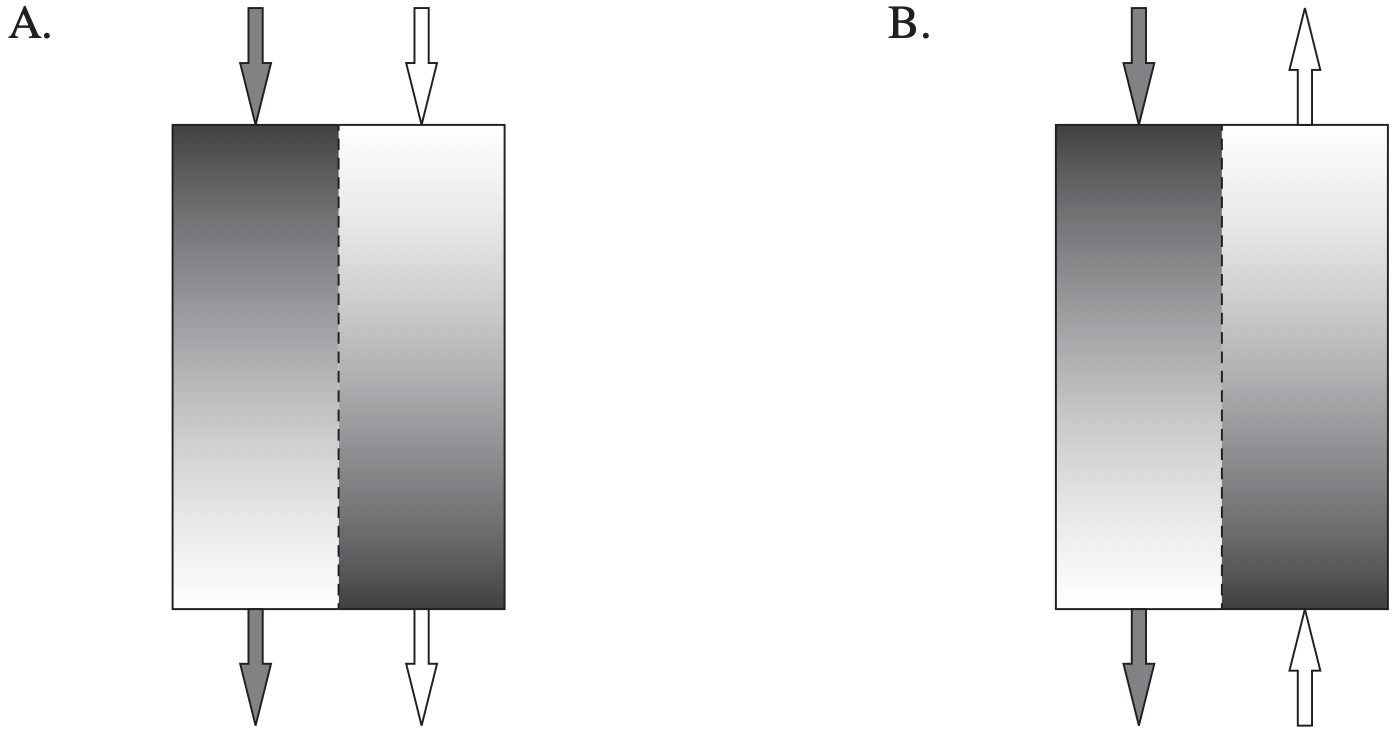
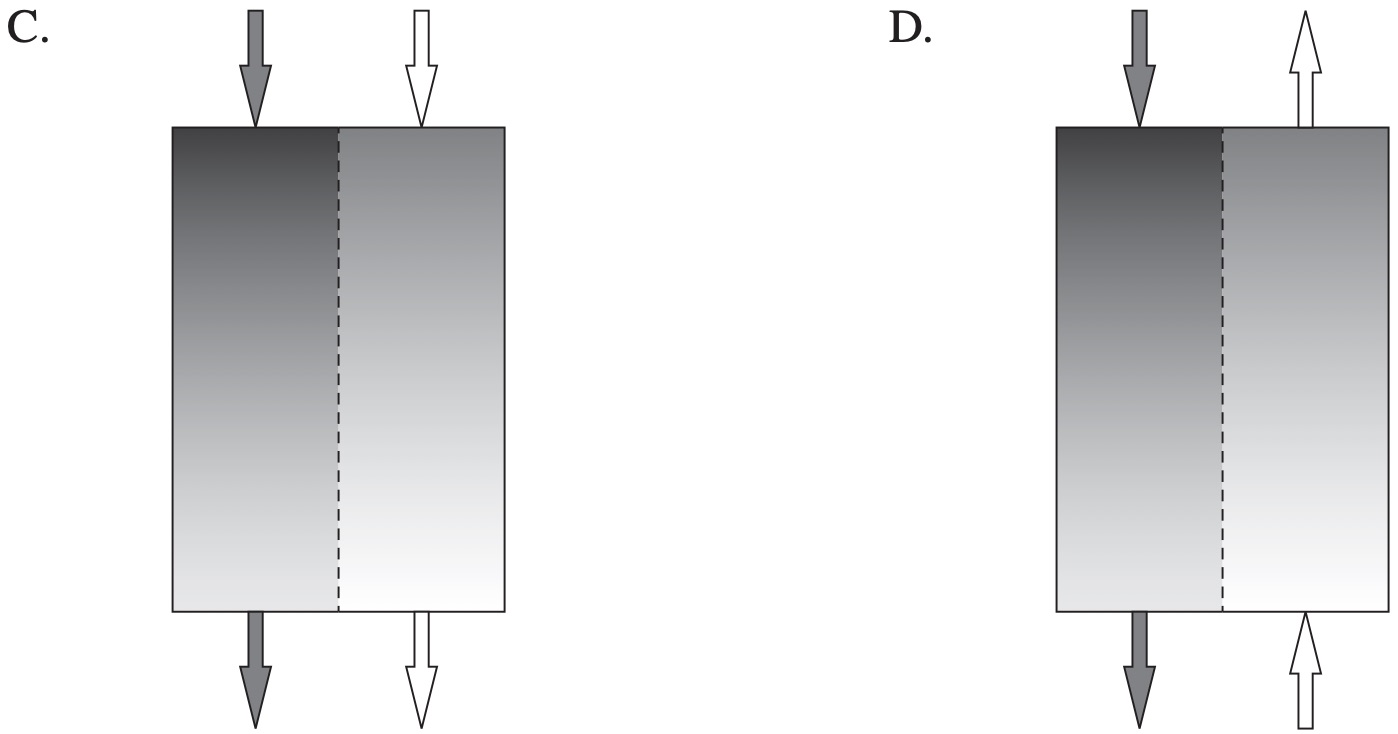
Renal dialysis involves passing blood from a patient past a dialysate solution in order to remove waste such as urea from the blood.

Which diagram correctly shows possible concentrations of urea and the direction of flow of both solutions in a dialysis machine?
 

Show Answers Only

`D`

Show Worked Solution

By Elimination:

  • The blood and dialysate must flow in opposite directions in a dialysis machine to improve diffusion efficiency (eliminate A and C).
  • Initially, the blood will have a high concentration of urea and the dialysate will have a low concentration.

`=>D`


♦♦♦ Mean mark 28%.

Filed Under: Technologies and Disorders Tagged With: Band 6, smc-3663-10-Kidneys

ENGINEERING, CS 2020 HSC 9 MC

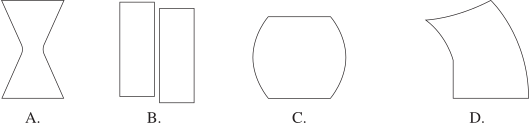
A cured cylindrical concrete specimen is tested under a compressive load through its vertical axis, until it fails.
 

Which of the following is the most likely shape of the front view of the failed specimen?
 

Show Answers Only

`A`

Show Worked Solution
  • There are 3 common fracture patterns in concrete under compressive testing.
  • Of the options given, `A` is the only one displaying an example of these patterns.

`=>A`


♦♦♦ Mean mark 14%.

Filed Under: Engineering Materials Tagged With: Band 6, smc-3715-10-Specialised testing

ENGINEERING, PPT 2020 HSC 6 MC

Which electronic component can be used to increase or decrease the speed of a train powered by an electric motor?

  1. Diode
  2. Capacitor
  3. Transistor
  4. Potentiometer
Show Answers Only

`D`

Show Worked Solution
  • Potentiometers can act as variable resistors.
  • These can increase or decrease current and therefore adjust the speed of an electric motor.

`=>D`


♦♦♦ Mean mark 20%.

Filed Under: Electricity/Electronics Tagged With: Band 6, smc-3720-40-Electrical motors

Vectors, EXT2 V1 2022 HSC 14a

  1. The two non-parallel vectors `\vec{u}` and `\vec{v}` satisfy  `lambda vec(u)+mu vec(v)= vec(0)`  for some real numbers `\lambda` and `\mu`.
  2. Show that  `\lambda=\mu=0`.  (2 marks)

    --- 3 WORK AREA LINES (style=lined) ---

  3. The two non-parallel vectors `\vec{u}` and `\vec{v}` satisfy  `\lambda_1 \vec{u}+\mu_1 \vec{v}=\lambda_2 \vec{u}+\mu_2 \vec{v}`  for some real numbers `\lambda_1, \lambda_2, \mu_1` and `\mu_2`.
  4. Using part (i), or otherwise, show that  `\lambda_1=\lambda_2`  and  `\mu_1=\mu_2`. (1  mark)

    --- 5 WORK AREA LINES (style=lined) ---

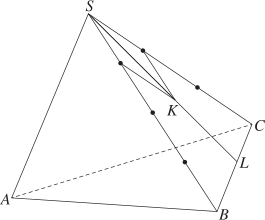
The diagram below shows the tetrahedron with vertices `A, B, C` and `S`.

The point `K` is defined by  `vec(SK)=(1)/(4) vec(SB)+(1)/(3) vec(SC)`, as shown in the diagram.

The point `L` is the point of intersection of the straight lines `S K` and `B C`.


  1. Using part (ii), or otherwise, determine the position of `L` by showing that  `vec(BL)=(4)/(7) vec(BC)`.  (2 marks)

    --- 6 WORK AREA LINES (style=lined) ---

  2. The point `P` is defined by  `vec(AP)=-6 vec(AB)-8 vec(AC)`.
  3. Does `P` lie on the line `A L`? Justify your answer.  (2 marks)

    --- 5 WORK AREA LINES (style=lined) ---

Show Answers Only
  1. `text{Proof (See Worked Solution)}`
  2. `text{Proof (See Worked Solution)}`
  3. `text{Proof (See Worked Solution)}`
  4. `P\ text{lies on}\ vec(AL)\ \ text{(See Worked Solution)}`
Show Worked Solution
i.    `lambda vecu+mu vecv` `=0`
  `lambda vecu` `=-mu vecv`

 
`lambda=0\ \ text{or}\ \ vecu=-(mu/lambda)vecv=k vecv\ \ (kinRR)`

`text{S}text{ince}\ \ vecu and vecv\ \ text{are not parallel}`

`=> lambda=mu=0`
 

ii.  `\lambda_1 \vec{u}+\mu_1 \vec{v}=\lambda_2 \vec{u}+\mu_2 \vec{v}`

`\lambda_1 \vec{u}-\lambda_2 \vec{u}+\mu_1 \vec{v}-\mu_2 \vec{v}` `=vec0`  
`(\lambda_1-\lambda_2)\vec{u}+(\mu_1-\mu_2)\vec{v}` `=vec0`  


`text{Using part (i):}`

`(\lambda_1-\lambda_2)=0 and (\mu_1-\mu_2)=0`

`:.\lambda_1=\lambda_2  and  \mu_1=\mu_2\ …\ text{as required}`


Mean mark (ii) 56%.
iii.   `vec(BL)` `=lambda vec(BC)`
    `=lambda(vec(BS)+vec(SC))\ \ \ …\ (1)`


`vec(BL)` `=vec(BS)+mu vec(SK)`  
  `=-vec(SB)+mu(1/4vec(SB)+1/3vec(SC))`  
  `=-vec(SB)+mu/4vec(SB)+mu/3vec(SC)`  
  `=mu/3vec(SC)+(mu/4-1)vec(SB)\ \ \ …\ (2)`  


♦♦♦ Mean mark (iii) 25%.

`text{Using}\ \ (1) = (2):`

`lambda vec(BS)+ lambda vec(SC)=mu/3vec(SC)+(mu/4-1)vec(SB)`

`mu/3=lambda, \ \ 1-mu/4=lambda`

`mu/3` `=1-mu/4`  
`(4mu+3mu)/12` `=1`  
`(7mu)/12` `=1`  
`mu` `=12/7`  

 
`lambda=(12/7)/3=4/7`

`:.vec(BL)=(4)/(7) vec(BC)\ \ text{… as required}`
 

iv.  `vec(AP)=-6 vec(AB)-8 vec(AC)`

`text{If}\ P\ text{lies on}\ AL, ∃k\ text{such that}\ \ vec(AP)=k vec(AL)`


♦♦♦ Mean mark (iv) 23%.
`-6 vec(AB)-8 vec(AC)` `=k vec(AL)`  
`-6 vec(AB)-8 (vec(AB)+vec(BC))` `=k(vec(AB)+vec(BL))`  
`-14 vec(AB)-8vec(BC)` `=k(vec(AB)+4/7vec(BC))\ \ text{(see part (iii))}`  
`-14 vec(AB)-8vec(BC)` `=kvec(AB)+(4k)/7vec(BC)`  

 
`k=-14, \ \ (4k)/7=-8\ \ =>\ \ k=-14`

`:.\ P\ text{lies on}\ \ AL.`

Filed Under: Vectors and Geometry, Vectors and Geometry, Vectors and Vector Equations of Lines Tagged With: Band 4, Band 5, Band 6, smc-1196-25-Point lies on line, smc-1196-30-Parallel, smc-1196-80-3D vectors, smc-1210-20-Pyramid, smc-1210-70-3D problems, smc-7426-20-Pyramid, smc-7426-70-3D problems

ENGINEERING, CS 2021 HSC 25b

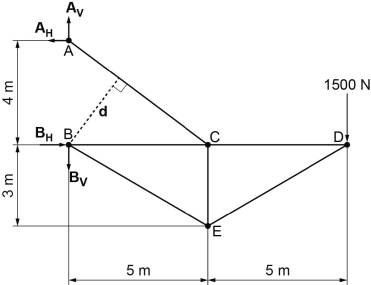
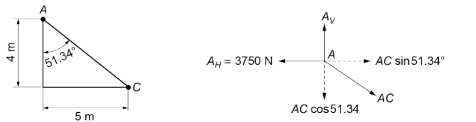
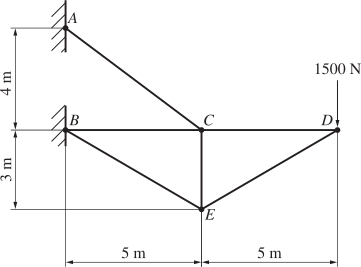
A truss is fixed to a wall at `A` and `B` as shown. Ignore the mass of the truss.


  1. Determine the horizontal reaction at `A`.   (2 marks)

--- 4 WORK AREA LINES (style=lined) ---

  1. Determine, using method of joints, the internal reaction in member `AC`. Indicate the nature of the force in the member.   (3 marks)

--- 6 WORK AREA LINES (style=lined) ---

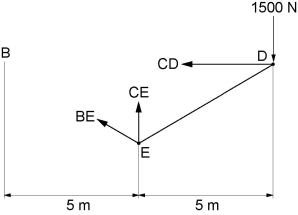
  1. Determine, using method of sections, the internal reaction in member `CE`. Indicate the nature of the force.   (3 marks)

--- 6 WORK AREA LINES (style=lined) ---

Show Answers Only

i.    `3.75\ text{kN ←}`

ii.    `AC=4802\ text{N}`

iii.   `CE = 3\ text{kN (tension)}`

Show Worked Solution

i.   Horizontal reaction at `A`

\(\circlearrowright \Sigma \text{M}_\text{B}\) \(= 0\)  
`0` `= -(A_H xx 4\ text{m}) + (1500\ text{N} xx  10\ text{m})`  
`A_H` `= 3750\ text{N}= 3.75\ text{kN ←}`  


ii.   Method of joints at A


→Σ`F_H` `=0`  
`0` `= -3750+AC xx sin(51.34°)`  
`AC` `=3750/sin(51.34°)=4802\ text{N}`  

♦♦ Mean mark (ii) 41%.

iii.  Method of Sections

\(\circlearrowright \Sigma \text{M}_\text{B}\) \(=0\)  
`0` `= (1500 xx 10)-(CE xx 5)`  
`CE` `=(15\ 000)/5=3000\ text{N}=3\ text{kN (tension)}`  

♦♦♦ Mean mark (iii) 30%.

Filed Under: Engineering Mechanics Tagged With: Band 4, Band 5, Band 6, smc-3714-10-Truss analysis

BIOLOGY, M7 2020 HSC 32c

Rabies is a disease that can affect all mammals and is caused by the rabies virus. It is transmitted by the bite of an infected animal. Without treatment it almost always results in death.


  1.  

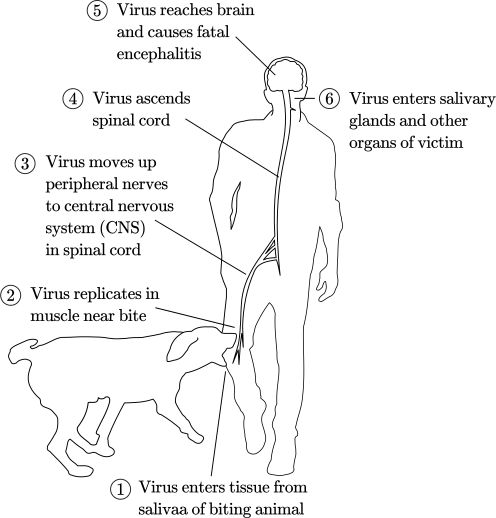
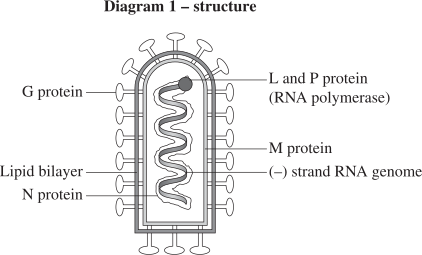
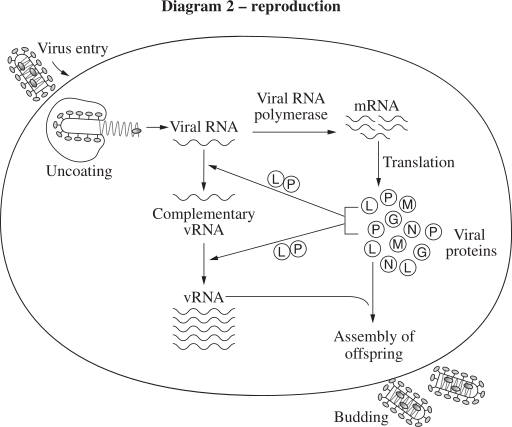
The rabies virus is a single-stranded RNA virus. It contains and codes for only five proteins. The diagrams show the structure and reproduction of the virus.


Post exposure prophylaxis (PEP) is given to patients who have been bitten by a rabid animal.

PEP includes an injection of human rabies antibodies (HRIG) as well as injections of a rabies vaccine at 0, 3, 7 and 14 days after exposure to the virus.

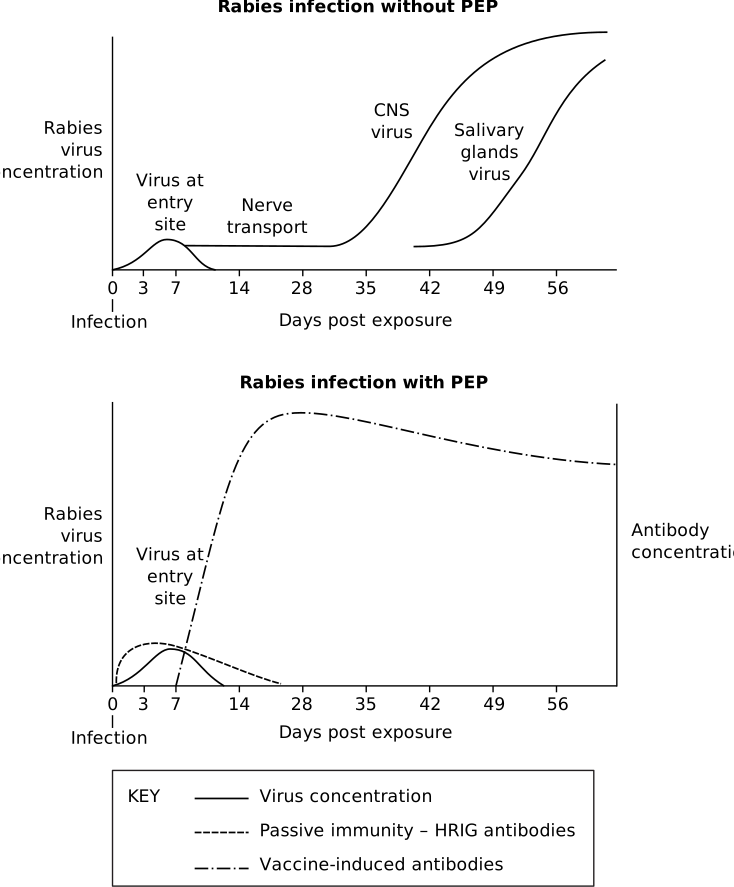
The following graphs show a generalised response to rabies infection without and with PEP.
  

Explain how PEP prevents rabies developing after infection with the virus. Support your answer with reference to the information and data provided above.   (8 marks)

--- 20 WORK AREA LINES (style=lined) ---

Show Answers Only

Once the rabies virus has entered the wound:

  • It will use the patient’s cells to replicate and the viral concentration will increase (as seen in the first five days).
  • Without PEP the virus will continue to replicate, migrate to the CNS (in the first graph this occurs by day 7), and eventually cause rabies and death.
  • Initially, the infected individual will not have the antibodies required to inactivate the virus.
  • A HRIG injection provides the required antibodies to inactivate the virus, through inhibiting replication or enhancing phagocytosis. 
  •  The PEP graph shows that these antibodies will only last up to 21 days, but are essential in inactivating the initial virus, as seen by a reduction in viral concentration after 6-8 days. 

The rabies vaccine works by:

  • containing an inactivated or weakened version of the rabies virus, which stimulates an immune response by the individual.
  • Initially, macrophages will display an MHC-antigen complex on its surface which helper T lymphocytes will bind to.
  • This then stimulates specific plasma B cells which can produce complementary antibodies, and memory B cells, which stay dormant and can rapidly differentiate into plasma B cells when exposed to the same virus.
  • The PEP graph shows the rapid production of antibodies on day 7, which coincides with rapid decrease in the virus concentration over the next few days. 
  • The antibodies then remain in the bloodstream and slowly decline over months, which allows quick diffusion if the virus is encountered within that timeframe.
Show Worked Solution

Once the rabies virus has entered the wound:

  • It will use the patient’s cells to replicate and the viral concentration will increase (as seen in the first five days).
  • Without PEP the virus will continue to replicate, migrate to the CNS (in the first graph this occurs by day 7), and eventually cause rabies and death.
  • Initially, the infected individual will not have the antibodies required to inactivate the virus.
  • A HRIG injection provides the required antibodies to inactivate the virus, through inhibiting replication or enhancing phagocytosis. 
  •  The PEP graph shows that these antibodies will only last up to 21 days, but are essential in inactivating the initial virus, as seen by a reduction in viral concentration after 6-8 days. 

The rabies vaccine works by:

  • containing an inactivated or weakened version of the rabies virus, which stimulates an immune response by the individual.
  • Initially, macrophages will display an MHC-antigen complex on its surface which helper T lymphocytes will bind to.
  • This then stimulates specific plasma B cells which can produce complementary antibodies, and memory B cells, which stay dormant and can rapidly differentiate into plasma B cells when exposed to the same virus.
  • The PEP graph shows the rapid production of antibodies on day 7, which coincides with rapid decrease in the virus concentration over the next few days. 
  • The antibodies then remain in the bloodstream and slowly decline over months, which allows quick diffusion if the virus is encountered within that timeframe.

♦♦ Mean mark 41%.

Filed Under: Immunity and Responses to Pathogens, Prevention, Treatment and Control Tagged With: Band 5, Band 6, smc-3657-10-Antibody Mediated, smc-3657-25-Antibodies, smc-3658-20-Vaccines

BIOLOGY, M8 2020 HSC 31

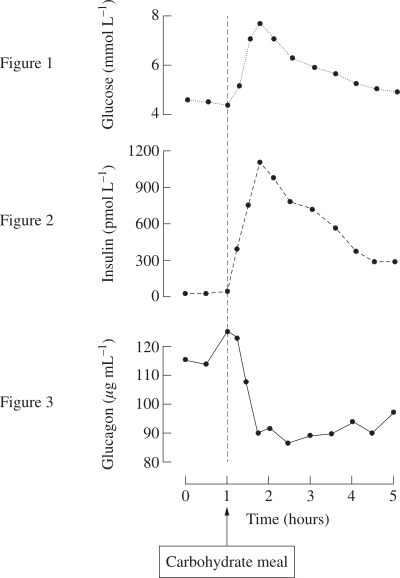
  1. The levels of glucose, insulin and glucagon were measured in the plasma of 24 healthy adults at intervals over a 5-hour period. After 1 hour at rest the patients ate a large carbohydrate meal. The results are shown.

  2. Use the data provided to explain how blood glucose is controlled in the body.   (6 marks)

    --- 12 WORK AREA LINES (style=lined) ---

  3. Outline how in humans, maintenance of temperature is different to the way that glucose is controlled.   (3 marks)

    --- 6 WORK AREA LINES (style=lined) ---

Show Answers Only

a.   Glucose Levels

  • Plasma levels within the first 60 minutes represent the resting glucose levels of the individuals.
  • After the 1 hour mark, the rise in glucose is a result of the absorption of glucose into the bloodstream from the gut after eating the carb rich meal.

Insulin Levels

  • Insulin is a hormone secreted by beta cells in the pancreas. It causes excess glucose in the bloodstream to be taken by the liver and stored as glycogen.
  • This can be seen when the insulin levels directly correlate to the amount of glucose in the body; glucose absorbed in the meal stimulates release of insulin.
  • The reduction in glucose by the insulin then causes insulin to also fall.

Glucagon Levels

  • Glucagon is a hormone secreted by alpha cells in the pancreas. It can almost be seen as the opposite of insulin, and forms the negative feedback loop responsible for controlling blood glucose. 
  • It causes glycogen stores in the liver to decompose into glucose and be absorbed by the bloodstream when blood glucose levels drop too low.
  • When glucose levels rise between the 1-2 hour mark, glucagon levels drop significantly, as the build up of glucose from the meal has meant that glycogen stores are not needed.
  • Gradually, as glucose levels drop, glucagon levels will increase as the glucose from the meal is depleted.

b.  Differences in temperature vs glucose maintenance

  • Temperature changes are detected by the hypothalamus and sensory neurons, but changes in blood glucose levels (BGL) are detected by the pancreas.
  • Responses are carried out by the nervous system when temperature changes are detected, but carried out by hormones when changes in BGL are detected.
Show Worked Solution

a.   Glucose Levels

  • Plasma levels within the first 60 minutes represent the resting glucose levels of the individuals.
  • After the 1 hour mark, the rise in glucose is a result of the absorption of glucose into the bloodstream from the gut after eating the carb rich meal.

Insulin Levels

  • Insulin is a hormone secreted by beta cells in the pancreas. It causes excess glucose in the bloodstream to be taken by the liver and stored as glycogen.
  • This can be seen when the insulin levels directly correlate to the amount of glucose in the body; glucose absorbed in the meal stimulates release of insulin.
  • The reduction in glucose by the insulin then causes insulin to also fall.

Glucagon Levels

  • Glucagon is a hormone secreted by alpha cells in the pancreas. It can almost be seen as the opposite of insulin, and forms the negative feedback loop responsible for controlling blood glucose. 
  • It causes glycogen stores in the liver to decompose into glucose and be absorbed by the bloodstream when blood glucose levels drop too low.
  • When glucose levels rise between the 1-2 hour mark, glucagon levels drop significantly, as the build up of glucose from the meal has meant that glycogen stores are not needed.
  • Gradually, as glucose levels drop, glucagon levels will increase as the glucose from the meal is depleted.

♦ Mean mark (a) 48%.

b.  Differences in temperature vs glucose maintenance

  • Temperature changes are detected by the hypothalamus and sensory neurons, but changes in blood glucose levels (BGL) are detected by the pancreas.
  • Responses are carried out by the nervous system when temperature changes are detected, but carried out by hormones when changes in BGL are detected.

♦♦ Mean mark (b) 36%.

Filed Under: Homeostasis Tagged With: Band 5, Band 6, smc-3659-12-Negative Feedback Loops, smc-3659-25-BGL/Diabetes

BIOLOGY, M5 2020 HSC 28

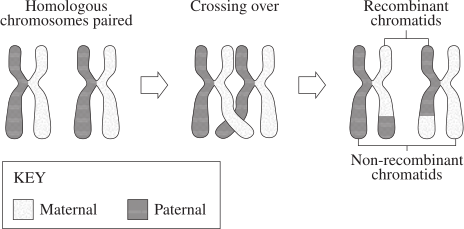
  1. A student drew a diagram to model part of the process of meiosis.
     

  1. Explain the misunderstanding of meiosis shown in this model.   (3 marks)

    --- 6 WORK AREA LINES (style=lined) ---

  2. Explain the effect of meiosis on genetic variation.   (3 marks)

    --- 6 WORK AREA LINES (style=lined) ---

Show Answers Only

a.


  • In the diagram above, the paired homologous chromosomes are incorrectly drawn.
  • Prior to crossing over, each chromosome duplicates forming the sister chromatids with one being maternal and one being paternal.
  • In the model above, they are shown as a mix of both, when in actuality the sister chromatids should be identical.
     

b.   The Effect of Meiosis on Genetic Variation

Independent Assortment

  • when chromosomes are lined up along the cells equator in independent order and orientation to all other chromosomes.

Random Segregation  

  • different combinations of maternal and paternal chromosomes end up in resulting gametes, increasing variability amongst them.

Crossing Over

  • the process of exchanging genetic material between chromatids of homologous chromosomes during Meiosis I, leading to unique combinations of alleles on each chromatid.
Show Worked Solution

a.


  • In the diagram above, the paired homologous chromosomes are incorrectly drawn.
  • Prior to crossing over, each chromosome duplicates forming the sister chromatids with one being maternal and one being paternal.
  • In the model above, they are shown as a mix of both, when in actuality the sister chromatids should be identical.

♦♦♦ Mean mark (a) 25%.

b.   The Effect of Meiosis on Genetic Variation

Independent Assortment

  • when chromosomes are lined up along the cells equator in independent order and orientation to all other chromosomes.

Random Segregation  

  • different combinations of maternal and paternal chromosomes end up in resulting gametes, increasing variability amongst them.

Crossing Over

  • the process of exchanging genetic material between chromatids of homologous chromosomes during Meiosis I, leading to unique combinations of alleles on each chromatid.

♦ Mean mark (b) 43%.

Filed Under: Cell Replication, Genetic Variation / Inheritance Tagged With: Band 5, Band 6, smc-3648-50-Meiosis, smc-3649-20-Meiosis

CHEMISTRY, M6 2020 HSC 33

Excess solid calcium hydroxide is added to a beaker containing 0.100 L of 2.00 mol L¯1 hydrochloric acid and the mixture is allowed to come to equilibrium.

  1. Show that the amount (in mol) of calcium hydroxide that reacts with the hydrochloric acid is 0.100 mol.   (2 marks)

    --- 4 WORK AREA LINES (style=lined) ---

  2. It is valid in this instance to make the simplifying assumption that the amount of calcium ions present at equilibrium is equal to the amount generated in the reaction in part (a).
  3. Calculate the pH of the resulting solution.   (4 marks)

    --- 10 WORK AREA LINES (style=lined) ---

Show Answers Only

a.   \(\ce{Ca(OH)2 (s) + 2 HCl (aq) -> CaCl2 (aq) + 2 H2O (l)}\)

`text{n(HCl)} = text{c} xx text{V} = 2.00 xx 0.100  = 0.200\ text{mol}`

\[\ce{n(Ca(OH)2) = \frac{n(HCL)}{2} = \frac{0.200}{2}= 0.100 mol}\]  

b.   `text{pH} = 11.35`

Show Worked Solution

a.   \(\ce{Ca(OH)2 (s) + 2 HCl (aq) -> CaCl2 (aq) + 2 H2O (l)}\)

`text{n(HCl)} = text{c} xx text{V} = 2.00 xx 0.100  = 0.200\ text{mol}`

\[\ce{n(Ca(OH)2) = \frac{n(HCL)}{2} = \frac{0.200}{2}= 0.100 mol}\]  

b.   \(\ce{Ca(OH)2(s) \rightleftharpoons Ca^2+ (aq) + 2 OH– (aq)}\)

`[text{Ca}^(2+)] = text{n} / text{V} = 0.100 / 0.100 = 1.00\ text{mol L}^-1`
 

\(\ce{K_{sp}}\) \( \ce{= [Ca^2+][OH– ]^2}\)  
`5.02 xx 10^(-6)` `= 1.00 xx [text{OH}^– ]^2`  
`[text{OH}^– ]` `=sqrt{5.02 xx 10^(-6)}=2.24 xx 10^(−3)\ text{mol L}^(-1)`  
`text{pOH }` `= −log_10(2.24 xx 10^(-3))= 2.650`  

 
`:.\ text{pH} = 14-2.650 = 11.35`


♦♦♦ Mean mark (b) 20%.

Filed Under: Bronsted-Lowry Theory, Equilibrium Constant Tagged With: Band 3, Band 6, smc-3671-10-Find K(eq), smc-3671-30-Deduce chemical equation, smc-3671-40-K(eq) and pH, smc-3671-50-Acids and bases, smc-3674-10-Calculations Involving pH

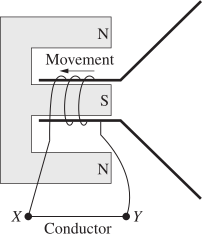
PHYSICS, M6 2018 HSC 18 MC

An experiment is set up as shown.
 

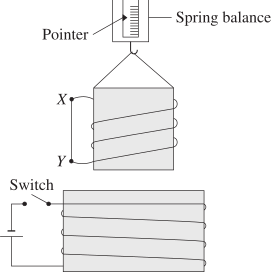
When the switch is closed, the reading on the spring balance changes immediately, then returns to the initial reading.

Which row of the table correctly shows the direction of the current through the straight conductor \(XY\) and the direction in which the pointer on the spring balance initially moves?

\begin{align*}
\begin{array}{l}
\textit{}& \textit{} \\
\rule{0pt}{2.5ex}\textbf{A.}\rule[-1ex]{0pt}{0pt}\\
\rule{0pt}{2.5ex}\textbf{B.}\rule[-1ex]{0pt}{0pt}\\
\rule{0pt}{2.5ex}\textbf{C.}\rule[-1ex]{0pt}{0pt}\\
\rule{0pt}{2.5ex}\textbf{D.}\rule[-1ex]{0pt}{0pt}\\
\end{array}
\begin{array}{|c|c|}
\hline
\textit{Direction of current through}& \textit{Direction in which the} \\
\textit{the straight conductor}& \textit{pointer initially moves} \\
\hline
\rule{0pt}{2.5ex}\text{From \(X\) to \(Y\)}\rule[-1ex]{0pt}{0pt}&\text{Down}\\
\hline
\rule{0pt}{2.5ex}\text{From \(X\) to \(Y\)}\rule[-1ex]{0pt}{0pt}& \text{Up}\\
\hline
\rule{0pt}{2.5ex}\text{From \(Y\) to \(X\)}\rule[-1ex]{0pt}{0pt}& \text{Down} \\
\hline
\rule{0pt}{2.5ex}\text{From \(Y\) to \(X\)}\rule[-1ex]{0pt}{0pt}& \text{Up} \\
\hline
\end{array}
\end{align*}

Show Answers Only

\(B\)

Show Worked Solution
  • Using the right hand grip rule, when the switch is closed the current through the lower solenoid produces a south pole at its top.
  • So, a south pole is induced at the bottom of the solenoid connected to the spring balance (Lenz’s Law).
  • Using the right hand grip rule a second time. The current through the straight conductor goes from \(X\) to \(Y\).
  • As the two solenoids repel each other, the force on the higher solenoid counteracts its weight and the pointer moves up.

\(\Rightarrow B\)


♦♦♦ Mean mark 34%.

Filed Under: Electromagnetic Induction Tagged With: Band 6, smc-3705-40-Lenz and Faraday

PHYSICS, M7 2018 HSC 16 MC

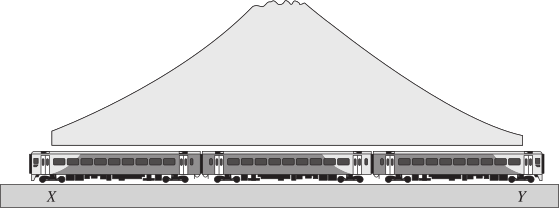
When a train is at rest in a tunnel, the train is slightly longer than the tunnel.
 

In a thought experiment, the train is travelling from left to right fast enough relative to the tunnel that its length contracts and it fits inside the tunnel.

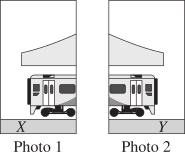
An observer on the ground sets up two cameras, at `X` and `Y`, to take photos at exactly the same time. The photos show that both ends of the train are inside the tunnel.
 

A passenger travelling on the train at its centre can see both ends of the tunnel and is later shown the photos.

From the point of view of the passenger, what is observed and what can be deduced about the photos?

  1. The tunnel's length contracts so the train does not fit, and photo 2 is taken before photo 1.
  2. The tunnel's length contracts so the train does not fit, and photos 1 and 2 are taken at the same time.
  3. The tunnel appears to expand due to length contraction of the train, allowing it to fit in the tunnel, and photo 1 is taken before photo 2 .
  4. The tunnel appears to expand due to length contraction of the train, allowing it to fit in the tunnel, and photos 1 and 2 are taken at the same time.
Show Answers Only

`A`

Show Worked Solution
  • From the frame of reference of an observer on the train, the tunnel’s length will contract (all objects outside the train will appear length contracted).
  • Due to the relativity of simultaneity, the photo that the observer on the train sees as taken first is the photo taken at the end of the tunnel that the train was moving towards at that moment.

`=>A`


♦♦♦ Mean mark 36%.

Filed Under: Light and Special Relativity Tagged With: Band 6, smc-3699-20-Length Contraction, smc-3699-60-Simultaneity

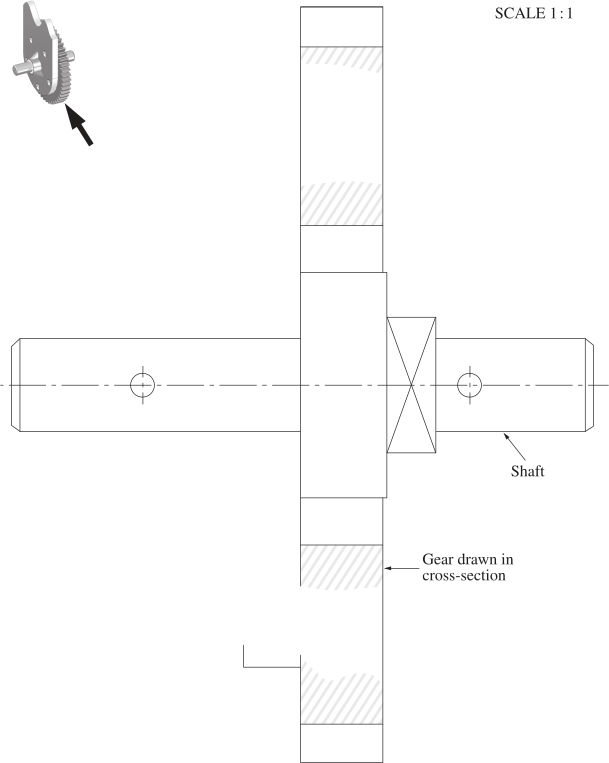
ENGINEERING, PPT 2021 HSC 24d

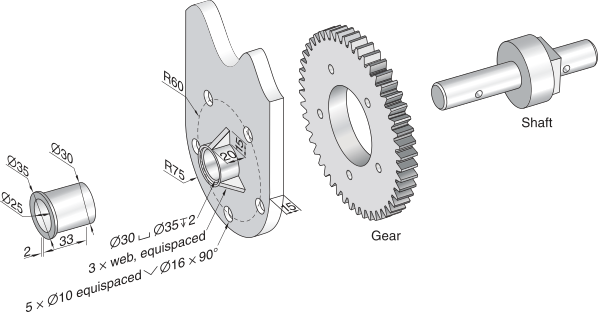
A drive mechanism used to control the satellite dish of a mobile TV transmission van is shown.

Key dimensions of components are given.


The dimensions of each of the five holes in the gear are  \( \phi 10 \vee \phi 16 \times 90°\) on one side.

A partially sectioned drawing of the gear and shaft is provided below.

Complete the sectioned assembly of this drive mechanism to AS 1100 from the direction indicated by the arrow. Include break lines where appropriate.   (6 marks)
 

--- 0 WORK AREA LINES (style=lined) ---

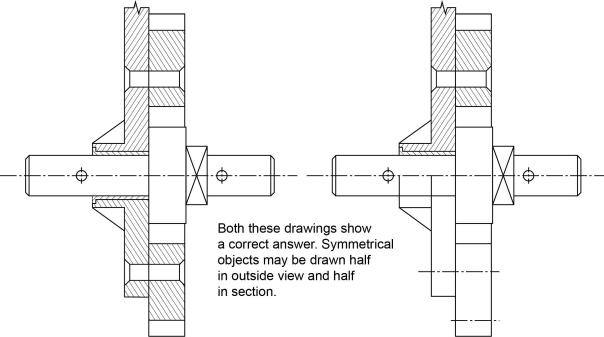
Show Answers Only

Show Worked Solution

Critical aspects of this drawing:

  • Do not section wedges
  • Do not section counterbores or holes
  • Break line must be included
  • Section lines of adjacent areas should go in different directions
  • Section lines should be at 45° and 3mm apart
  • Answer may be drawn half sectioned as it is symmetrical

♦♦ Mean mark 41%.

Filed Under: Communication Tagged With: Band 5, Band 6, smc-3721-20-Sectional views

CHEMISTRY, M5 2020 HSC 19 MC

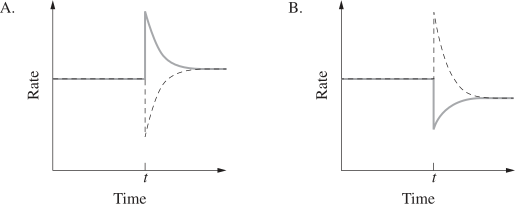
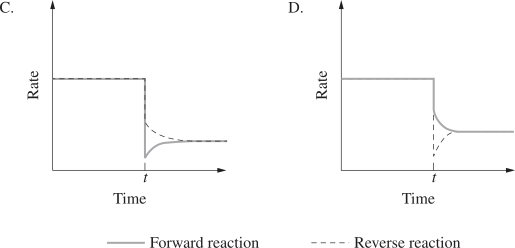
Nitrogen dioxide reacts to form dinitrogen tetroxide in a sealed flask according to the following equation.

`2 text{NO}_(2)(g) ⇌ text{N}_(2) text{O}_(4)(g) qquadqquad Delta H =-57.2 \ text{kJ  mol}^(-1)`

Which graph best represents the rates of both the forward and reverse reactions when an equilibrium system containing these gases is cooled at time `t` ?


Show Answers Only

`D`

Show Worked Solution
  • When the temperature decreases, both the forward and reverse reaction rates will decrease (eliminate A).
  • Exothermic reactions have a lower activation energy threshold (i.e. their reaction rates are less affected by cooling).
  • Therefore, the exothermic reaction rate will decrease to a smaller extent (eliminate B and C).

`=> D`


♦♦♦ Mean mark 22%.

Filed Under: Factors that Affect Equilibrium Tagged With: Band 6, smc-3670-30-Concentration, smc-3670-60-Concentration diagrams

CHEMISTRY, M6 2020 HSC 18 MC

An aqueous solution of sodium hydrogen carbonate has a pH greater than 7 .

Which statement best explains this observation?

  1. `text{H}_(2) text{O}(l)` is a stronger acid than `text{HCO}_(3)^(\ -)(aq)`.
  2. `text{HCO}_(3)^(\ -)(aq)` is a weaker acid than `text{H}_(2) text{CO}_(3)(aq)`.
  3. `text{Na}^(+)(aq)` reacts with water to produce the strong base `text{NaOH}(aq)`.
  4. The conjugate acid of `text{HCO}_(3)^(\ -)(aq)` is a stronger acid than `text{H}_(2)text{O}(l)`.
Show Answers Only

`A`

Show Worked Solution
  • \(\ce{HCO3-}\) can act as an acid or a base (amphiprotic).
  • \(\ce{H2O}\) is a stronger acid than \(\ce{HCO3-}\), so \(\ce{H2O}\) donates a proton to \(\ce{HCO3-}\).
  • As a result, this produces \(\ce{OH-}\) ions in solution, causing the pH to be greater than 7.

`=> A`


♦♦♦ Mean mark 23%.

Filed Under: Bronsted-Lowry Theory Tagged With: Band 6, smc-3674-18-Dissociation in Water, smc-3674-20-Strong/Weak Acids & Bases

CHEMISTRY, M8 2022 HSC 33

Analyse how a student could design a chemical synthesis process to be undertaken in the school laboratory. In your response, use a specific process relating to the synthesis of an organic compound, including a chemical equation, and refer to:

  • selection of reagent(s)
  • reaction conditions
  • any potential hazards and any safety precautions to minimise the risk
  • yield and purity of the product(s).   (8 marks)

--- 25 WORK AREA LINES (style=lined) ---

Show Answers Only

Selecting reagents

  • The student could synthesise ethyl ethanoate through esterification between acetic acid and ethanol.
  • Both readily available in the school laboratory and are relatively safe.

Acetic acid + ethanol  ⇌  Ethyl ethanoate + water

  • Concentrated sulfuric acid should be used as the acid catalyst as it is a strong acid that is also readily available. 
Reaction conditions

  • Increasing the temperature of the system increases the reaction rate because it increases the average kinetic energy of the reactant molecules, and thus increases the likelihood of successful collisions, producing more product.
  • Additionally, the addition of reactants would increase the likelihood of successful collisions, thus increasing the reaction rate.
  • The reaction should also be undertaken under reflux allowing vaporised molecules to condense and return back to the reaction vessel, increasing the amount of reactants, and thus increasing the rate of reaction. 
  • Concentrated sulfuric acid should also be utilised as a catalyst in order to speed up the reaction and lower the activation energy. 
Potential hazards and safety precautions

  • The acetic acid and sulfuric acid used is corrosive and may cause skin and eye burns, therefore, appropriate lab coat and safety glasses should be utilised.
  • The organic reactants are highly flammable and may cause fires. The reaction mixture should be heated on a hot plate or heating mantle instead of a bunsen burner.
  • Refluxing may cause pressure build-up, therefore, ensure the reflux condenser is open.
  • Superheating and bumping may occur in apparatus. Boiling chips should be utilised to provide nucleation sites allowing liquids to boil smoothly. 

Yield and purity

  • Concentrated sulfuric acid, used as a catalyst, also acts as a dehydrating agent that removes water from the system and improves yield.
  • When the reaction reaches equilibrium, the ester can be separated from the mixture by adding excess sodium carbonate solution in order to neutralise the acid.
  • Transfer to a separation funnel to separate the organic layer (containing the ester) from the aqueous layer.
  • Then use fractional distillation to separate the ester from the organic layer.
Show Worked Solution

Selecting reagents

  • The student could synthesise ethyl ethanoate through esterification between acetic acid and ethanol.
  • Both readily available in the school laboratory and are relatively safe.

Acetic acid + ethanol  ⇌  Ethyl ethanoate + water

  • Concentrated sulfuric acid should be used as the acid catalyst as it is a strong acid that is also readily available. 

Reaction conditions

  • Increasing the temperature of the system increases the reaction rate because it increases the average kinetic energy of the reactant molecules, and thus increases the likelihood of successful collisions, producing more product.
  • Additionally, the addition of reactants would increase the likelihood of successful collisions, thus increasing the reaction rate.
  • The reaction should also be undertaken under reflux allowing vaporised molecules to condense and return back to the reaction vessel, increasing the amount of reactants, and thus increasing the rate of reaction. 
  • Concentrated sulfuric acid should also be utilised as a catalyst in order to speed up the reaction and lower the activation energy. 

Potential hazards and safety precautions

  • The acetic acid and sulfuric acid used is corrosive and may cause skin and eye burns, therefore, appropriate lab coat and safety glasses should be utilised.
  • The organic reactants are highly flammable and may cause fires. The reaction mixture should be heated on a hot plate or heating mantle instead of a bunsen burner.
  • Refluxing may cause pressure build-up, therefore, ensure the reflux condenser is open.
  • Superheating and bumping may occur in apparatus. Boiling chips should be utilised to provide nucleation sites allowing liquids to boil smoothly. 

Yield and purity

  • Concentrated sulfuric acid, used as a catalyst, also acts as a dehydrating agent that removes water from the system and improves yield.
  • When the reaction reaches equilibrium, the ester can be separated from the mixture by adding excess sodium carbonate solution in order to neutralise the acid.
  • Transfer to a separation funnel to separate the organic layer (containing the ester) from the aqueous layer.
  • Then use fractional distillation to separate the ester from the organic layer.

♦♦ Mean mark 52%.

Filed Under: Chemical Synthesis and Design Tagged With: Band 4, Band 5, Band 6, smc-3679-20-Reactions of Alcohols, smc-3680-10-Esters, smc-3684-20-Reaction conditions, smc-3684-30-Yield and purity

CHEMISTRY, M6 2022 HSC 32

The concentration of citric acid, a triprotic acid, in a carbonated soft drink was to be determined.

Step 1: A solution of \( \ce{NaOH(aq)} \) was standardised by titrating it against 25.00 mL aliquots of a solution of the monoprotic acid potassium hydrogen phthalate \( \ce{(KHP)} \). The \( \ce{(KHP)} \) solution was produced by dissolving 4.989 g in enough water to make 100.0 mL of solution. The molar mass of \( \ce{(KHP)} \) is 204.22 g mol ¯1.

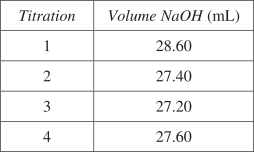
The results of the standardisation titration are given in the table.
 

Step 2: A 75.00 mL bottle of the drink was opened and the contents quantitatively transferred to a beaker. The soft drink was gently heated to remove \( \ce{CO2}\).

Step 3: The cooled drink was quantitatively transferred to a 250.0 mL volumetric flask and distilled water was added up to the mark.

Step 4: 25.00 mL samples of the solution were titrated with the \( \ce{NaOH(aq)}\) solution. The average volume of \( \ce{NaOH(aq)} \) used was 13.10 mL.

  1. Calculate the concentration of the triprotic citric acid in the soft drink.  (6 marks)

--- 20 WORK AREA LINES (style=lined) ---

  1. Explain how your answer to part (a) would be different if the carbon dioxide was not removed from the soft drink.  (2 marks)

--- 5 WORK AREA LINES (style=lined) ---

Show Answers Only

a.  `0.1298  text{mol L}^(–1)`

b.  \( \ce{CO2} \) can dissolve in water to produce \( \ce{H2CO3}\):

\( \ce{CO2(g) + H2O(l) \rightleftharpoons H2CO3(aq)} \)

  • This would enable \( \ce{NaOH} \) to react with \( \ce{H2CO3:} \)
  •    \( \ce{2NaOH(aq) + H2CO3(aq) -> Na2CO3(aq) + 2H2O(l)} \)
  • Therefore, if \( \ce{CO2} \) was not removed, more \( \ce{NaOH} \) would be required to reach the endpoint.
  • This would result in a higher citric acid concentration calculation.
Show Worked Solution

a.   \( \ce{KHP(aq) + NaOH(aq) -> NaKP(aq) + H2O(l)} \)

`text{n(HX)}= 4.989 / 204.22= 0.02443\ text{mol}`

`[text(HX)]= \text{n}/\text{V}= 0.02443 / 0.1000= 0.2443  text{mol L}^(–1)`

`text{n(HX) titrated} =  text{c} xx text{V}= 0.2443 xx 0.02500= 0.0006107\ text{mol}`

 `=>\ text{n(NaOH)}= 0.0006107  text{mol}`
 

Eliminate the first trial because it is an outlier.

`text{V}_(text(avg))text{(NaOH)}= 1 / 3 xx (27.40 + 27.20 + 27.60)= 27.40\ text{mL}`

`text{[NaOH]}= text{n} / text{V}= [6.107 xx 10^−3] / 0.02740 = 0.2229  text{mol L}^(–1)`

\( \ce{H3X(aq) + 3NaOH(aq) -> Na3X(aq) + 3H2O(l)} \)

`text{n(NaOH) titrated}= text{c} xx text{V}=0.2229 xx 0.01310= 2.920 xx 10^(−3)\ text{mol}`

`text{n(H}_3 text{X)}= 1/3 xx 2.920 xx 10^(−3)= 9.733 xx 10^(−4)\ text{mol}`

`text{[H}_3 text{X] diluted} = text{n} / text{V} = (9.733 xx 10^(−4) )/ 0.025= 0.03893 \ text{mol L}^(–1)`

`text{[H}_3 text{X] original}= 250.0 / 75.00 xx 0.03893= 0.1298  text{mol L}^(–1)`

Therefore, the concentration of citric acid in the soft drink is 0.1298 mol L¯1.


♦ Mean mark (a) 48%.

b.   \( \ce{CO2} \) can dissolve in water to produce \( \ce{H2CO3}\):

\( \ce{CO2(g) + H2O(l) \rightleftharpoons H2CO3(aq)} \)

This would enable \( \ce{NaOH} \) to react with \( \ce{H2CO3:} \)

\( \ce{2NaOH(aq) + H2CO3(aq) -> Na2CO3(aq) + 2H2O(l)} \)

  • Therefore, if \( \ce{CO2} \) was not removed, more \( \ce{NaOH} \) would be required to reach the endpoint.
  • This would result in a higher citric acid concentration calculation.

♦♦ Mean mark (b) 28%.

Filed Under: Quantitative Analysis Tagged With: Band 5, Band 6, smc-3675-10-Titration

CHEMISTRY, M7 2022 HSC 18 MC

A low molecular weight biopolymer is being investigated for its suitability for medical use. In one trial a molecular weight of `2900 pm 100\ text{g}\ text{mol}^(-1)` proved to be optimum.

A section of this biopolymer is shown.
 

Which will produce the suitable biopolymer?
 

Show Answers Only

`D`

Show Worked Solution

This polymer is a condensation polymer, meaning that it is formed through the reaction between monomers that consist of a carboxylic acid and/or an alcohol functional group, with the elimination of water.

Thus, if `text{n}` monomers react to form this polyester, `text{(n – 1)}` molecules of water would be eliminated.

Calculating their molar masses:

`text{n}\ xx\ text{monomers}` `= text{polymer} + text{(n – 1)} xx text{H}_2 text{O}`
`text{n} xx (90.078)` `= 2900 + text{(n – 1)} xx (18.016)`
`text{n}(90.078-18.016)` `=2900-18.016`
`:.\ text{n}` `=2881.984/72.062=39.99…`

 
`=> D`


♦♦ Mean mark 23%.

Filed Under: Polymers Tagged With: Band 6, smc-3681-20-Condensation Polymers

CHEMISTRY, M5 2022 HSC 17 MC

A 2.0 g sample of silver carbonate (MM = 275.81 g mol ¯1) was added to 100.0 mL of water in a beaker. The solubility of silver carbonate at this temperature is `1.2 × 10^(-4)` mol L ¯1. It was then diluted by adding another 100.0 mL of water.

What is the ratio of the concentration of silver ions in solution before and after dilution?

  1. `1: 1`
  2. `1: 2`
  3. `2: 1`
  4. `4: 1`
Show Answers Only

`A`

Show Worked Solution

The maximum moles of `text{Ag}_2 text{CO}_3` that can be dissolved in 100.0 mL is:

`text{n(Ag}_2 text{CO}_3 text{)}_max` `= 1.2 × 10^(−4) xx 0.1000`
  `= 1.2 xx 10^(−5)  text{mol}`

 
The number of moles of silver carbonate added to the water is:

`text{n(Ag}_2 text{CO}_3)` `= text{m} / text{MM}`
  `= 2.0 / 275.81`
  `= 7.2514 xx 10 ^(-3)  text{mol}`
  •  Thus, the moles of `text{Ag}_2 text{CO}_3`  added is more than the maximum moles of `text{Ag}_2 text{CO}_3` able to be dissolved. i.e. the solution would be saturated before and after dilution.
  • As a result, the solution would have the same `text{Ag}_2 text{CO}_3` concentration before and after, thus, the ratio is 1:1.

`=> A`


♦♦♦ Mean mark 15%.

Filed Under: Solution Equilibria Tagged With: Band 6, smc-3672-20-Calcs given K(sp)

Financial Maths, STD1 F2 2022 HSC 9 MC

In ten years, the future value of an investment will be $150 000. The interest rate is 4% per annum, compounded half-yearly.

Which equation will give the present value `(P V)` of the investment?
 

  1. `PV=(150\ 000)/((1+0.04)^(10))`
  2. `PV=(150\ 000)/((1+0.04)^(20))`
  3. `PV=(150\ 000)/((1+0.02)^(10))`
  4. `PV=(150\ 000)/((1+0.02)^(20))`
Show Answers Only

`D`

Show Worked Solution

`text{Compounding periods} = 10 xx 2 = 20`

`text{Compounding rate} = (4text{%})/2 = 2text{%} = 0.02`

`FV` `=PV(1+r)^n`
`150\ 000` `=PV(1+0.02)^20`
`PV` `=(150\ 000)/((1+0.02)^(20))`


`=>D`


♦♦♦ Mean mark 16%.

Filed Under: F2 Investment (Y12), Investment (Y12) Tagged With: Band 6, smc-1108-20-FV Formula, smc-6831-20-FV Formula

CHEMISTRY, M6 2021 HSC 35

A manufacturer requires that its product contains at least 85% v/v ethanol.

The concentration of ethanol in water can be determined by a back titration. Ethanol is first oxidised to ethanoic acid using an excess of acidified potassium dichromate solution.

\(\ce{3C2H5OH($aq$) + 2Cr2O7^2-($aq$) + 16H^+($aq$) ->3CH3COOH($aq$) + 4Cr^3+($aq$) + 11H2O($l$)}\)   

The remaining dichromate ions are reacted with excess iodide ions to produce iodine \(\ce{(I2)}\)

\(\ce{Cr2O7^2-($aq$) + 14H^+($aq$) + 61^-($aq$) -> 2Cr^3+($aq$) + 7H2O($l$) + 3I2($aq$)}\)

The iodine produced is then titrated with sodium thiosulfate \(\ce{(Na2S2O3)}\).

\(\ce{I2($aq$) + 2S2O3^2-($aq$) -> 2I^-($aq$) + S4O6^2-($aq$)}\)   

A 25.0 mL sample of the manufacturer's product was diluted with distilled water to 1.00 L. A 25.0 mL aliquot of the diluted solution was added to 20.0 mL of 0.500 mol L¯1 acidified potassium dichromate solution in a conical flask. Potassium iodide (5.0 g) was added and the solution titrated with 0.900 mol L¯1 sodium thiosulfate. This was repeated three times.

The following results were obtained.


The density of ethanol is 0.789 g mL¯1.

Does the sample meet the manufacturer's requirements? Support your answer with calculations.   (7 marks)

--- 22 WORK AREA LINES (style=lined) ---

Show Answers Only
\( \text{V}_\text{avg}\  (\ce{Na2S2O3}) \) `= (28.7 + 28.4 + 28.6) / 3`
  `= 28.5666…  text{mL}`
  `= 0.0285666…  text{L}`
   
  •  The first titration is an outlier and so is excluded from the average.

`text{n(Na}_2 text{S}_2 text{O}_3text{)}=\ text{c} xx text{V}= 0.900 xx 0.0285666…= 0.02571  text{mol}`

\( \ce{n(S2O3^2-) = n(Na2S2O3) = 0.02571\ \text{mol}} \)
 

`text{I}_2  text{and S}_2 text{O}_3  ^(2-)\ text{are in a}\ 1 : 2\ text{ratio:}`

`text{n(I}_2text{)} = 1/2 xx  text{n(S}_2 text{O}_3^( 2-) text{)}= 1/2 xx 0.02571= 0.012855\ text{mol}`
 

`text{Excess Cr}_2 text{O}_7^(\ \ 2-)  text{and I}_2  text{are in}\ 1:3\ text{ratio:}`

`text{n(Cr}_2 text{O}_7^(\ \ 2-) text{) excess}= 1/3 xx  text{n(I}_2 text{)}= 1/3 xx 0.012855= 0.004285\ text{mol}`

`text{n(Cr}_2 text{O}_7^(\ \ 2-) text{) initial}= text{c} xx text{V}= 0.500 xx 20/1000= 0.01\ text{mol}`

`text{n(Cr}_2 text{O}_7^(\ \ 2-) text{) reacted with ethanol}`

`= text{n(Cr}_2 text{O}_7^(\ \ 2-) text{) initial}-text{n(Cr}_2 text{O}_7^(\ \ 2-) text{) excess}`

`= 0.01-0.004285`

`= 0.005715\ text{mol}`
 

`text{n(C}_2 text{H}_5 text{OH)}= 3/2 xx text{n(Cr}_2 text{O}_7^(\ \ 2-) text{)}= 3/2 xx 0.005715= 0.0085725\ text{mol}`

`text{m(C}_2 text{H}_5 text{OH)}= text{n} xx text{MM}=0.0085725 xx (2 xx 12.01 + 6 xx 1.008 + 16.00)= 0.3949\ text{g}`
 

  • Thus, 0.3949 g of ethanol is in a diluted 25 mL solution.

Find the mass of ethanol in the original solution:

`text{m(C}_2 text{H}_5 text{OH) original}= 0.3949… xx 1000/25= 15.796…\ text{g}`

`text{D}= text{m} / text{V}\ \ =>\ \ text{V}= text{m} / text{D}`

`text{V(C}_2 text{H}_5 text{OH)}= 15.796 / 0.789= 20.021\ text{mL}`

`text{% (C}_2text{H}_5text{OH)}= text{V(ethanol)} / text{V(sample)}= 20.021 / 25.0= 80.08… %\ text{v}//text{v}`
 

  • Therefore, the product doesn’t meet the manufacturer’s requirement as the concentration is less than 85%.
Show Worked Solution
\( \text{V}_\text{avg}\  (\ce{Na2S2O3}) \) `= (28.7 + 28.4 + 28.6) / 3`
  `= 28.5666…  text{mL}`
  `= 0.0285666…  text{L}`
   
  •  The first titration is an outlier and so is excluded from the average.

`text{n(Na}_2 text{S}_2 text{O}_3text{)}=\ text{c} xx text{V}= 0.900 xx 0.0285666…= 0.02571  text{mol}`

\( \ce{n(S2O3^2-) = n(Na2S2O3) = 0.02571\ \text{mol}} \)
 

`text{I}_2  text{and S}_2 text{O}_3  ^(2-)\ text{are in a}\ 1 : 2\ text{ratio:}`

`text{n(I}_2text{)} = 1/2 xx  text{n(S}_2 text{O}_3^( 2-) text{)}= 1/2 xx 0.02571= 0.012855\ text{mol}`
 

`text{Excess Cr}_2 text{O}_7^(\ \ 2-)  text{and I}_2  text{are in}\ 1:3\ text{ratio:}`

`text{n(Cr}_2 text{O}_7^(\ \ 2-) text{) excess}= 1/3 xx  text{n(I}_2 text{)}= 1/3 xx 0.012855= 0.004285\ text{mol}`

`text{n(Cr}_2 text{O}_7^(\ \ 2-) text{) initial}= text{c} xx text{V}= 0.500 xx 20/1000= 0.01\ text{mol}`

`text{n(Cr}_2 text{O}_7^(\ \ 2-) text{) reacted with ethanol}`

`= text{n(Cr}_2 text{O}_7^(\ \ 2-) text{) initial}-text{n(Cr}_2 text{O}_7^(\ \ 2-) text{) excess}`

`= 0.01-0.004285`

`= 0.005715\ text{mol}`
 

`text{n(C}_2 text{H}_5 text{OH)}= 3/2 xx text{n(Cr}_2 text{O}_7^(\ \ 2-) text{)}= 3/2 xx 0.005715= 0.0085725\ text{mol}`

`text{m(C}_2 text{H}_5 text{OH)}= text{n} xx text{MM}=0.0085725 xx (2 xx 12.01 + 6 xx 1.008 + 16.00)= 0.3949\ text{g}`
 

  • Thus, 0.3949 g of ethanol is in a diluted 25 mL solution.

Find the mass of ethanol in the original solution:

`text{m(C}_2 text{H}_5 text{OH) original}= 0.3949… xx 1000/25= 15.796…\ text{g}`

`text{D}= text{m} / text{V}\ \ =>\ \ text{V}= text{m} / text{D}`

`text{V(C}_2 text{H}_5 text{OH)}= 15.796 / 0.789= 20.021\ text{mL}`

`text{% (C}_2text{H}_5text{OH)}= text{V(ethanol)} / text{V(sample)}= 20.021 / 25.0= 80.08… %\ text{v}//text{v}`
 

  • Therefore, the product doesn’t meet the manufacturer’s requirement as the concentration is less than 85%.

♦♦♦ Mean mark 39%.

Filed Under: Alcohols, Quantitative Analysis Tagged With: Band 5, Band 6, smc-3675-10-Titration, smc-3679-30-Oxidation

CHEMISTRY, M6 2021 HSC 32

The molar enthalpies of neutralisation of three reactions are given.

Reaction 1:

\(\ce{HCl($aq$) + KOH($aq$) -> KCl($aq$) + H2O($l$)}\)                \(\ce{Δ$H$}\) \(\pu{=-57.6 kJ mol-1}\)

Reaction 2:

\(\ce{HNO3($aq$) + KOH($aq$) -> KNO3($aq$) + H2O($l$)}\)       \(\ce{Δ$H$}\) \(\pu{=-57.6 kJ mol-1}\)

Reaction 3:

\(\ce{HCN($aq$) + KOH($aq$) -> KCN($aq$) + H2O($l$)}\)            \(\ce{Δ$H$}\) \(\pu{=-12.0 kJ mol-1}\)

 
Explain why the first two reactions have the same enthalpy value but the third reaction has a different value.   (4 marks)

--- 10 WORK AREA LINES (style=lined) ---

Show Answers Only
  • Reaction 1 and reaction 2 are both neutralisation reactions between strong acids and strong bases. These reactions completely ionise in solution when added to water.
  • Both reactions have the same net ionic equation:
  •   `text{H}^+ (aq) + text{OH}^-  (aq) →  text{H}_2 text{O} (l)`
  • Therefore, the enthalpy values obtained are the same for both reactions.
  • In reaction 3, `text{HCN}` is a weak acid that only partially ionises in an equilibrium reaction with water.
  •   `text{HCN} (aq) + text{H}_2 text{O} (l)  ⇋  text{CN}^-  (aq) + text{H}_3 text{O}^+ (aq).`
  • As the reaction continues, `text{HCN}` will further ionise as the equilibrium shifts to the right.
  • The bond-breaking is an endothermic process and thus will consume energy to break the bonds. As a result, the overall reaction is less exothermic than reaction 1 and reaction 2.
Show Worked Solution
  • Reaction 1 and reaction 2 are both neutralisation reactions between strong acids and strong bases. These reactions completely ionise in solution when added to water.
  • Both reactions have the same net ionic equation:
  •   `text{H}^+ (aq) + text{OH}^-  (aq) →  text{H}_2 text{O} (l)`
  • Therefore, the enthalpy values obtained are the same for both reactions.
  • In reaction 3, `text{HCN}` is a weak acid that only partially ionises in an equilibrium reaction with water.
  •   `text{HCN} (aq) + text{H}_2 text{O} (l)  ⇋  text{CN}^-  (aq) + text{H}_3 text{O}^+ (aq).`
  • As the reaction continues, `text{HCN}` will further ionise as the equilibrium shifts to the right.
  • The bond-breaking is an endothermic process and thus will consume energy to break the bonds. As a result, the overall reaction is less exothermic than reaction 1 and reaction 2.

♦ Mean mark 44%.

Filed Under: Bronsted-Lowry Theory, Properties of Acids and Bases, Quantitative Analysis Tagged With: Band 5, Band 6, smc-3673-20-Enthalpy of Neutralisation, smc-3674-20-Strong/Weak Acids & Bases, smc-3675-40-Strong/Weak Acids

ENGINEERING, CS 2021 HSC 19 MC

The diagram shows a simply supported beam in equilibrium. It is loaded with a single force (`text{F}`) as shown.
 

Which of the following angles is closest to the angle of the reaction force to the horizontal at the fixed bearing?

  1. 7°
  2. 14°
  3. 31°
  4. 90°
Show Answers Only

`B`

Show Worked Solution
  • The fixed joint takes half of the vertical force and all of the horizontal force, therefore the angle will be half that of the original force `text{F}`.

`=>B`

♦♦♦ Mean mark 18%.

Filed Under: Engineering Mechanics Tagged With: Band 6, smc-3714-80-Stress/Strain - other

ENGINEERING, CS 2021 HSC 17 MC

Which of the following is a specialised test used to determine the compressive strength of cured concrete?

  1. Slump test
  2. Janka hardness test
  3. Shore hardness test
  4. Rebound hammer test
Show Answers Only

`D`

Show Worked Solution

Considering each option:

  • Slump test – tests the workability and consistency of wet concrete.
  • Janka hardness test – tests hardwood flooring.
  • Shore hardness test – tests soft elastomers and other soft polymers.
  • Rebound hammer test – tests the compressive strength of cured concrete.

`=>D`

♦♦♦ Mean mark 19%.

Filed Under: Engineering Materials Tagged With: Band 6, smc-3715-10-Specialised testing, smc-3715-30-Concrete

ENGINEERING, TE 2021 HSC 15 MC

Which of the following would be the most suitable material to use for a spring in a telecommunication component?

  1. Annealed copper zinc alloy
  2. Electrolytic tough pitch copper
  3. Age hardened aluminium silicon alloy
  4. Age hardened copper–beryllium alloy
Show Answers Only

`D`

Show Worked Solution
  • Age hardened copper-beryllium alloy is used due to its conductivity, low sparking capabilities and physical capabilities of hardness and strength in high temperature conditions.

`=>D`

♦♦♦ Mean mark 29%.

Filed Under: Materials Tagged With: Band 6, smc-3729-20-Copper and alloys

BIOLOGY, M5 2020 HSC 19 MC

Which diagram correctly models one phase of meiosis in an organism that has six chromosomes in its somatic cells?

Show Answers Only

`A`

Show Worked Solution

By Elimination:

  • Option D would end up with 12 chromosomes in its somatic cells (Eliminate D).
  • Option B and C show meiosis 1, as they are arranged in tetrads. Option C will end up with 12 chromosomes in its somatic cells, while option B is an incorrect model as it does not correctly display homologous pairs arranging in tetrads. (Eliminate B and C).
  • The diagram in option `A` shows metaphase II of meiosis in a cell with 6 chromosomes.

`=>A`

♦ Mean mark 19%.

Filed Under: Genetic Variation / Inheritance Tagged With: Band 6, smc-3648-50-Meiosis

BIOLOGY, M6 2020 HSC 18 MC

SNP databases have been used in forensic investigations. One is outlined below.

  1. DNA was collected at a crime scene 30 years ago.
  2. Recently the crime scene DNA was analysed at 700 000 SNP locations.
  3. An SNP profile was created and uploaded to a genealogy database.
  4. The SNP profile from the crime scene indicated some shared SNPs with two individuals (who did not have SNPs in common).
  5. The pedigrees were constructed for the two individuals.
     

Which person is most likely to be the suspect who should be investigated?

  1. `A`
  2. `B`
  3. `C`
  4. `D`
Show Answers Only

`D`

Show Worked Solution
  • Individual `D` is the only individual that shares DNA with both I and II and is the most likely suspect.

`=>D`

♦♦♦ Mean mark 17%.

Filed Under: Mutation Tagged With: Band 6, smc-3652-20-Somatic vs. Germ-Line

BIOLOGY, M5 2020 HSC 16 MC

Analysis of DNA shows that adenine and guanine always make up 50% of the total amount of nitrogenous bases in DNA.

Which structural feature of DNA does this provide evidence for?

  1. DNA is helical in structure.
  2. DNA is always a double-stranded molecule.
  3. DNA always has adenine paired with guanine.
  4. DNA is made up of equal amounts of nitrogenous bases.
Show Answers Only

`B`

Show Worked Solution
  • In DNA, adenine always pairs with thymine and guanine always pairs with cytosine.
  • The fact that adenine and guanine make up 50% of the total nitrogenous bases in DNA is therefore evidence that DNA is double stranded (held together by paired bases).

`=>B`

♦ Mean mark 27%.

Filed Under: Cell Replication Tagged With: Band 6, smc-3649-10-DNA Structure

BIOLOGY, M5 2020 HSC 14 MC

A normal allele results in liver cells with sufficient cholesterol receptors. A different allele results in liver cells without cholesterol receptors. Individuals who are heterozygous have liver cells with insufficient cholesterol receptors.

What type of inheritance is the most likely explanation for this?

  1. Sex-linked
  2. Autosomal dominant
  3. Autosomal recessive
  4. Incomplete dominance
Show Answers Only

`D`

Show Worked Solution
  • A heterozygous individual exhibiting faulty cholesterol receptors suggests that neither allele is completely expressed.
  • There is also no evidence of the condition being sex-linked.

`=>D`

♦♦♦ Mean mark 31%.

Filed Under: Genetic Variation / Inheritance Tagged With: Band 6, smc-3648-45-Incomplete Dominance

BIOLOGY, M6 2021 HSC 33c

Genetically engineered Atlantic salmon have been produced and approved for aquaculture in the US. These salmon have a transgene that includes a protein-coding sequence from a Chinook salmon's growth hormone gene and the promoter region of an Ocean Pout's antifreeze protein gene. The following diagram provides an overview of the production of the transgenic salmon.
 

Transgenic fish can reproduce and pass on the dominant transgene (T).

Reproduction for aquaculture is strictly controlled using a variety of techniques in order to protect and preserve biodiversity.

Some of these techniques are outlined below. 

1. Homozygous (TT) female (XX) breeding stock are kept in quarantine.

2. The female fish undergo hormone treatment that results in sex reversal and the development of male sex organs and sperm.

3. The sperm produced is collected and used to fertilise eggs obtained from wild-type, non-transgenic salmon.

4. The eggs are treated with pressure shock to prevent the completion of meiosis II. As a result, offspring are triploid (three copies of each chromosome).

All offspring are transgenic female fish and have XXX (XXX fish cannot develop sex organs).

5. Offspring are transported to inland aquaculture tanks to be grown to market size.

Analyse how these techniques protect and preserve biodiversity.   (9 marks)

--- 21 WORK AREA LINES (style=lined) ---

Show Answers Only

Protecting and Preserving Biodiversity:

  • Biodiversity refers to the variety of genes within the gene pool of a species as well as the variety of species within an ecosystem.
  • The nature of the transgenic salmon carries the risk of reducing biodiversity and has the potential to do great harm.
  • If transgenic salmon escape captivity, they may have a survival advantage over natural salmon and other species. In this way, they could outcompete other species and reduce species diversity, as well as outcompete natural salmon.
  • As a result of the transgene being dominant, it will be passed onto offspring, and in time reduce the gene pool.
  • The physical separation techniques 1 and 5 prevent the transgenic salmon from being released into the environment, preserving biodiversity.
  • Reproductive techniques such as the hormone treatment in technique 2 allow sperm to be produced that only carries the X chromosome as the parents are genetically female.
  • This sperm is then used to fertilise from wild-type salmon, and all offspring will be female as sperm does not contain a Y chromosome, and contain the transgene.
  • Technique 4 uses pressure shock to prevent meiosis 2, resulting in infertile, triploid offspring. This produces transgenic salmon incapable of breeding, meaning the transgene cannot be passed on, preserving biodiversity within the gene pool.
  • The use of wild-type salmon eggs to produce transgenic fish is also crucial in preserving biodiversity as it reduces the likelihood of the accumulation of mutations via interbreeding of transgenic salmon.
  • The physical separation techniques of quarantine and inland aquaculture tanks coupled with reproductive techniques are essential biotechnologies to protect and preserve biodiversity from the dangers of transgenic salmon to the ecosystem and gene pool.
Show Worked Solution

Protecting and Preserving Biodiversity:

  • Biodiversity refers to the variety of genes within the gene pool of a species as well as the variety of species within an ecosystem.
  • The nature of the transgenic salmon carries the risk of reducing biodiversity and has the potential to do great harm.
  • If transgenic salmon escape captivity, they may have a survival advantage over natural salmon and other species. In this way, they could outcompete other species and reduce species diversity, as well as outcompete natural salmon.
  • As a result of the transgene being dominant, it will be passed onto offspring, and in time reduce the gene pool.
  • The physical separation techniques 1 and 5 prevent the transgenic salmon from being released into the environment, preserving biodiversity.
  • Reproductive techniques such as the hormone treatment in technique 2 allow sperm to be produced that only carries the X chromosome as the parents are genetically female.
  • This sperm is then used to fertilise from wild-type salmon, and all offspring will be female as sperm does not contain a Y chromosome, and contain the transgene.
  • Technique 4 uses pressure shock to prevent meiosis 2, resulting in infertile, triploid offspring. This produces transgenic salmon incapable of breeding, meaning the transgene cannot be passed on, preserving biodiversity within the gene pool.
  • The use of wild-type salmon eggs to produce transgenic fish is also crucial in preserving biodiversity as it reduces the likelihood of the accumulation of mutations via interbreeding of transgenic salmon.
  • The physical separation techniques of quarantine and inland aquaculture tanks coupled with reproductive techniques are essential biotechnologies to protect and preserve biodiversity from the dangers of transgenic salmon to the ecosystem and gene pool.
♦ Mean mark 44%.

Filed Under: Biotechnology Tagged With: Band 5, Band 6, smc-3653-10-Biodiversity

Mechanics, EXT2 M1 2022 HSC 8 MC

As a projectile of mass `m` kilograms travels through air, it experiences a frictional force. The magnitude of this force is proportional to the square of the speed `v` of the projectile. The constant of proportionality is the positive number `k`. The position of the particle at time `t` is denoted by `([x],[y])`. The acceleration due to gravity is `g \ text{m s}^(-2)`.

Based on Newton's laws of motion, which equation models the motion of this projectile?

  1. `([0],[-mg])+kv([overset.x],[overset.y])=m([overset{..}x],[overset{..}y])`
  2. `([0],[-mg])-kv([overset.x],[overset.y])=m([overset{..}x],[overset{..}y])`
  3. `([0],[-mg])+kv^(2)([overset.x],[overset.y])=m([overset{..}x],[overset{..}y])`
  4. `([0],[-mg])-kv^(2)([overset.x],[overset.y])=m([overset{..}x],[overset{..}y])`
Show Answers Only

`B`

Show Worked Solution

`text{Friction}\ (F)\ text{works against velocity}`

`:.\ F prop v^2\ \ =>\ \ F=-kv^2\ \ (k>0)`

`text{→ Eliminate A and C}`


♦♦♦ Mean mark 26%.

`text{S}text{ince}\ \ v=abs(((dotx),(doty))):`

`- abs(kv((dotx),(doty))) = -kv abs(((dotx),(doty)))=-kv^2`

`=>B`

Filed Under: Resisted Motion Tagged With: Band 6

BIOLOGY, M8 2021 HSC 31

Millions of people around the world take drugs known as statins, which have been shown to reduce the incidence of heart attacks and strokes in vulnerable patients. However, up to 20% of people stop taking statins due to side-effects such as muscle aches, fatigue, feeling sick and joint pain.

A recent study at a public hospital focused on 60 patients who had all stopped taking statins in the past due to severe side-effects. Patients took statin tablets for four months, placebo tablets for four months and no tablets for four months.

Every day for the year the patients scored, from zero to 100, how bad their symptoms were. The results are shown.
 

Evaluate this study and its results.   (6 marks)

--- 12 WORK AREA LINES (style=lined) ---

Show Answers Only
  • The data shows that when no tablets were taken, patients still displayed symptoms of the side effects (score 8.0). Taking the statin tablets doubled the severity of the side effects (score 16.3), however, placebo tablets with no active ingredients still produced similar results (score 15.4).
  • This seems to indicate that the side effects may arise as a result of other factors.
  • However, this study cannot be regarded as valid. Only 60 patients were involved in comparison to the millions that take statin tablets.
  • The results were also taken in a qualitative way and cannot be regarded as reliable.
  • The study should also have included a control group of people who have never taken statins to be used for a comparison to improve validity.
  • While the raw data provides data which is valuable and should be followed up with a large, randomised control trial, the study itself cannot be regarded as valid.
Show Worked Solution
  • The data shows that when no tablets were taken, patients still displayed symptoms of the side effects (score 8.0). Taking the statin tablets doubled the severity of the side effects (score 16.3), however, placebo tablets with no active ingredients still produced similar results (score 15.4).
  • This seems to indicate that the side effects may arise as a result of other factors.
  • However, this study cannot be regarded as valid. Only 60 patients were involved in comparison to the millions that take statin tablets.
  • The results were also taken in a qualitative way and cannot be regarded as reliable.
  • The study should also have included a control group of people who have never taken statins to be used for a comparison to improve validity.
  • While the raw data provides data which is valuable and should be followed up with a large, randomised control trial, the study itself cannot be regarded as valid.
♦♦ Mean mark 38%.

Filed Under: Epidemiology Tagged With: Band 5, Band 6, smc-3661-10-Analysing Results, smc-3661-20-Evaluating the Method

PHYSICS, M8 2019 HSC 36

A radon-198 atom, initially at rest, undergoes alpha decay. The masses of the atoms involved are shown in atomic mass units `(u)`. 
 

The kinetic energy of the polonium atom produced is  `2.55 × 10^(-14)` J.

By considering mass defect, calculate the kinetic energy of the alpha particle, and explain why it is significantly greater than that of the polonium atom.   (7 marks)

--- 14 WORK AREA LINES (style=lined) ---

Show Answers Only
`Delta m` `=197.999-(193.988+4.000260)`  
  `=0.0084\ \text{u}`  
  `=0.0084 xx1.661 xx10^(-27)` (Converting to kg)
  `=1.395 xx10^(-29)\ \text{kg}`  


`E` `=mc^2`  
  `=1.395 xx10^(-29)xx(3xx10^(8))^(2)`  
  `=1.256 xx10^(-12)\ \text{J}`  

 
Applying the law of conservation of energy:

   `KE_(text{alpha})` `=E_(text{total})-KE_(polonium)`  
  `=1.256 xx10^(-12)-2.44 xx10^(-14)`  
  `=1.23 xx10^(-12)\ \text{J}`  
     
  •  As the radon atom is initially at rest, the initial momentum of this reaction system is zero. So, by applying the principle of conservation of momentum, the decay products must move away from each other with equal and opposite momenta.
  • The alpha particle has a significantly lower mass compared to the polonium atom and therefore has a significantly higher velocity.
  • `KE=(1)/(2)mv^(2)=(1)/(2)mv xx v`  and the momenta, `mv`  are equal for both the alpha particle and polonium atom. The alpha particle therefore has a significantly greater kinetic energy due to its greater velocity.
Show Worked Solution
`Delta m` `=197.999-(193.988+4.000260)`  
  `=0.0084\ \text{u}`  
  `=0.0084 xx1.661 xx10^(-27)` (Converting to kg)
  `=1.395 xx10^(-29)\ \text{kg}`  


`E` `=mc^2`  
  `=1.395 xx10^(-29)xx(3xx10^(8))^(2)`  
  `=1.256 xx10^(-12)\ \text{J}`  

 
Applying the law of conservation of energy:

   `KE_(text{alpha})` `=E_(text{total})-KE_(polonium)`  
  `=1.256 xx10^(-12)-2.44 xx10^(-14)`  
  `=1.23 xx10^(-12)\ \text{J}`  
     
  •  As the radon atom is initially at rest, the initial momentum of this reaction system is zero. So, by applying the principle of conservation of momentum, the decay products must move away from each other with equal and opposite momenta.
  • The alpha particle has a significantly lower mass compared to the polonium atom and therefore has a significantly higher velocity.
  • `KE=(1)/(2)mv^(2)=(1)/(2)mv xx v`  and the momenta, `mv`  are equal for both the alpha particle and polonium atom. The alpha particle therefore has a significantly greater kinetic energy due to its greater velocity.

♦♦♦ Mean mark 30%.

Filed Under: Properties of the Nucleus Tagged With: Band 5, Band 6, smc-3703-10-Nuclear Reactions, smc-3703-20-Conservation of Mass-Energy, smc-3703-50-Nuclear Fission

PHYSICS, M8 2019 HSC 34

Use the following information to answer this question.
 

Describe both the production and radiation of energy by the sun. In your answer, include a quantitative analysis of both the power output and the surface temperature of the sun.   (9 marks)

--- 22 WORK AREA LINES (style=lined) ---

Show Answers Only
  • Production of the sun’s energy is predominantly done through the proton-proton chain.
  • Four protons react in the sun’s core to produce one helium atom. The mass of one helium atom is less than the mass of four protons so mass is converted into energy through Einstein’s mass-energy equivalence, `E=mc^2.`
  • The sun acts as a black body and so radiates its energy in the form of black body radiation.
  • It radiates energy as light with a variety of wavelengths, as shown in the black body curve above. It peaks at a specific wavelength which can be used to calculate its temperature:
  •    `lambda_(max)=5.0xx10^-7` m  (see graph above)
  • Using  `lambda_(max)=(b)/(T)`
  •   `T=(2.898xx10^-3)/(5.0xx10^-7)=5796\ \text{K}`
  • Energy radiated from the sun spreads out over a sphere as it travels away from the sun. The intensity of radiated energy decreases at distances further from the sun, consistent with the inverse square law.
  • Using the intensity of the sun’s radiation at earth, its power output can be calculated using  `P=IA`:
  •    `P=Ixx4pi r^2=1360 xx4xx3.142 xx(1.5 xx10^(11))^(2)=3.85 xx10^(26)\ \text{W}`
Show Worked Solution
  • Production of the sun’s energy is predominantly done through the proton-proton chain.
  • Four protons react in the sun’s core to produce one helium atom. The mass of one helium atom is less than the mass of four protons so mass is converted into energy through Einstein’s mass-energy equivalence, `E=mc^2.`
  • The sun acts as a black body and so radiates its energy in the form of black body radiation.
  • It radiates energy as light with a variety of wavelengths, as shown in the black body curve above. It peaks at a specific wavelength which can be used to calculate its temperature:
  •    `lambda_(max)=5.0xx10^-7` m  (see graph above)
  • Using  `lambda_(max)=(b)/(T)`
  •   `T=(2.898xx10^-3)/(5.0xx10^-7)=5796\ \text{K}`
  • Energy radiated from the sun spreads out over a sphere as it travels away from the sun. The intensity of radiated energy decreases at distances further from the sun, consistent with the inverse square law.
  • Using the intensity of the sun’s radiation at earth, its power output can be calculated using  `P=IA`:
  •    `P=Ixx4pi r^2=1360 xx4xx3.142 xx(1.5 xx10^(11))^(2)=3.85 xx10^(26)\ \text{W}`

♦♦♦ Mean mark 38%.

Filed Under: Light: Quantum Model, Properties of the Nucleus Tagged With: Band 5, Band 6, smc-3703-10-Nuclear Reactions, smc-3703-20-Conservation of Mass-Energy

PHYSICS, M6 2020 HSC 33

A strong magnet of mass 0.04 kg falls 0.78 m under the action of gravity from position `X` above a hollow copper cylinder. It then travels a distance of 0.20 m through the cylinder from `Y` to `Z` before falling freely again.
 

The magnet takes 0.5 seconds to pass through the cylinder. The displacement-time graph of the magnet is shown.
 

Analyse the motion of the magnet by applying the law of conservation of energy.

Your analysis should refer to gravity and the copper cylinder, and include both qualitative and quantitative information.   (9 marks)

--- 20 WORK AREA LINES (style=lined) ---

Show Answers Only

During the first 0.4 seconds:

  • The magnet is accelerating downwards at 9.8 m s–2 due to gravity.
  • The magnet’s gravitational potential energy is being converted into kinetic energy consistent with the law of conservation of energy.
  • Quantitatively:
  •   `Delta E_(k)= Delta U=mg Delta h=0.04 xx9.8 xx0.78=0.30576\ \text{J}`
  • Hence 0.30576 joules of the magnet’s gravitational potential energy is converted into kinetic energy as it falls under gravity.

As magnet reaches the copper cylinder:

  • Its downwards motion causes the formation of induced currents in the cylinder which produce a magnetic field that opposes the magnet’s motion (Lenz’s law).
  • This causes the magnet to decelerate to 0.4 m s–1 and lose kinetic energy. 
  • Finding the magnets speed before entering the copper cylinder:
`E_(k)` `=(1)/(2)mv^2`  
`0.30576` `=(1)/(2)xx 0.04xx v^2`  
`v` `=3.91\ \text{m s}^{-1}`  


  • Quantifying the kinetic energy loss:
`Delta E_(k)` `=(1)/(2)mv^2-(1)/(2)m u^2`  
  `=(1)/(2)xx 0.04xx 3.91^2-(1)/(2)xx 0.04xx 0.4^2`  
  `=0.30256\ \text{J}`  


  • Applying the law of conservation of energy shows that 0.30256 J of the magnet’s kinetic energy is being converted to heat energy within the cylinder as the magnet decelerates.
  • Finally, as the magnet passes through the copper cylinder, its gravitational potential energy decreases while its velocity remains constant.
  • Quantifying the decrease in gravitational potential energy:
  •   `Delta U=mg Delta h=0.04xx 9.8xx 0.2=0.0784`
  • Hence, 0.0784 J of the magnet’s gravitational potential energy is converted into heat energy in the cylinder, consistent with the law of conservation of energy.
Show Worked Solution

During the first 0.4 seconds:

  • The magnet is accelerating downwards at 9.8 m s–2 due to gravity.
  • The magnet’s gravitational potential energy is being converted into kinetic energy consistent with the law of conservation of energy.
  • Quantitatively:
  •   `Delta E_(k)= Delta U=mg Delta h=0.04 xx9.8 xx0.78=0.30576\ \text{J}`
  • Hence 0.30576 joules of the magnet’s gravitational potential energy is converted into kinetic energy as it falls under gravity.

As magnet reaches the copper cylinder:

  • Its downwards motion causes the formation of induced currents in the cylinder which produce a magnetic field that opposes the magnet’s motion (Lenz’s law).
  • This causes the magnet to decelerate to 0.4 m s–1 and lose kinetic energy. 
  • Finding the magnets speed before entering the copper cylinder:
`E_(k)` `=(1)/(2)mv^2`  
`0.30576` `=(1)/(2)xx 0.04xx v^2`  
`v` `=3.91\ \text{m s}^{-1}`  


  • Quantifying the kinetic energy loss:
`Delta E_(k)` `=(1)/(2)mv^2-(1)/(2)m u^2`  
  `=(1)/(2)xx 0.04xx 3.91^2-(1)/(2)xx 0.04xx 0.4^2`  
  `=0.30256\ \text{J}`  


  • Applying the law of conservation of energy shows that 0.30256 J of the magnet’s kinetic energy is being converted to heat energy within the cylinder as the magnet decelerates.
  • Finally, as the magnet passes through the copper cylinder, its gravitational potential energy decreases while its velocity remains constant.
  • Quantifying the decrease in gravitational potential energy:
  •   `Delta U=mg Delta h=0.04xx 9.8xx 0.2=0.0784`
  • Hence, 0.0784 J of the magnet’s gravitational potential energy is converted into heat energy in the cylinder, consistent with the law of conservation of energy.
♦ Mean mark 51%.

Filed Under: Electromagnetic Induction Tagged With: Band 4, Band 5, Band 6, smc-3705-20-Induced emf, smc-3705-40-Lenz and Faraday, smc-3705-90-X-topic: Gravity

PHYSICS M6 2022 HSC 34

Three charged particles, `X, Y` and `Z`, travelling along straight, parallel trajectories at the same speed, enter a region in which there is a uniform magnetic field which causes them to follow the paths shown. Assume that the particles do not exert any significant force on each other.


Explain the different paths that the particles follow through the magnetic field.   (7 marks)

--- 16 WORK AREA LINES (style=lined) ---

Show Answers Only
  • The charged particles each experience a force equal to  `F=qvB`  as they travel perpendicular to the magnetic field lines.
  • This force acts perpendicular to the direction of their velocity, so the charged particles undergo uniform circular motion with the force due to the magnetic field acting as a centripetal force.
  • The radii of their paths can be described by the equation:
`F_(c)` `=F_(b)`  
`(mv^2)/(r)` `=qvB`  
`r` `=(mv)/(qB)`  


  • As the strength of the magnetic field `(B)` and the speed `(v)` of the particles is the same, their trajectory is only affected by their mass to charge ratio `((m)/(q))`  which affects their radius of motion and their sign, which determines the direction which they deflect.
  • Both `X` and `Y` initially curve upwards, using the right hand palm rule, these must both be positive charges.
  • `Y` has a greater radius than `X`, so `Y`’s charge to mass ratio is greater than `X`’s.
  • `Z` initially curves downwards, using the right hand palm rule, it must have a negative charge.
  • `Z` has the same radius of motion as `X`, so the charge to mass ratios of `Z` and `X` are the same.
  • `Z` has a smaller radius than `Y`, so `Z`’s charge to mass ratio is less than that of `Y`.
Show Worked Solution
  • The charged particles each experience a force equal to  `F=qvB`  as they travel perpendicular to the magnetic field lines.
  • This force acts perpendicular to the direction of their velocity, so the charged particles undergo uniform circular motion with the force due to the magnetic field acting as a centripetal force.
  • The radii of their paths can be described by the equation:
`F_(c)` `=F_(b)`  
`(mv^2)/(r)` `=qvB`  
`r` `=(mv)/(qB)`  


  • As the strength of the magnetic field `(B)` and the speed `(v)` of the particles is the same, their trajectory is only affected by their mass to charge ratio `((m)/(q))`  which affects their radius of motion and their sign, which determines the direction which they deflect.
  • Both `X` and `Y` initially curve upwards, using the right hand palm rule, these must both be positive charges.
  • `Y` has a greater radius than `X`, so `Y`’s charge to mass ratio is greater than `X`’s.
  • `Z` initially curves downwards, using the right hand palm rule, it must have a negative charge.
  • `Z` has the same radius of motion as `X`, so the charge to mass ratios of `Z` and `X` are the same.
  • `Z` has a smaller radius than `Y`, so `Z`’s charge to mass ratio is less than that of `Y`.

Mean mark 60%.

Filed Under: Charged Particles, Conductors and Electric/Magnetic Fields Tagged With: Band 4, Band 5, Band 6, smc-3693-15-Charged Particles in MF

PHYSICS M8 2022 HSC 31

Following the Geiger-Marsden experiment, Rutherford proposed a model of the atom.


Bohr modified this model to explain the spectrum of hydrogen observed in experiments.


The Bohr-Rutherford model of the atom consists of electrons in energy levels around a positive nucleus.

How do features of this model account for all the experimental evidence above? Support your answer with a sample calculation and a diagram, and refer to energy, forces and photons.   (9 marks)

--- 18 WORK AREA LINES (style=lined) ---

Show Answers Only

The Geiger-Marsden experiment, which involved firing alpha particles at a thin sheet of gold foil produced results which can be explained by the Bohr-Rutherford model:

  • The majority of fired alpha particles passed through the gold foil undeflected. Rutherford concluded from this that the atom had a small, central nucleus.
  • Some alpha particles were deflected and some of these were deflected at very large angles. Rutherford concluded from this that the nucleus was dense and positively charged exerting a repulsive electromagnetic force on the fired alpha particles.
  • The model accounts for Rutherford’s conclusions, placing electrons in orbits around a small positive nucleus. 

Rutherford’s model alone could not explain the emission spectra of elements such as hydrogen. Bohr’s contribution to the Bohr-Rutherford model amended this:


  • Bohr proposed that electrons orbited the atomic nucleus in quantised orbits at fixed energies. He proposed that electrons could move from a higher energy orbit (eg. n=1) to a lower energy orbit (n=3) by emitting a photon with energy  `E=hf`  equal to the energy difference between the two orbits.
  • Additionally, he proposed that electrons could move from a lower energy orbit to a higher energy orbit by absorbing a photon with energy  `E=hf`  equal to the energy difference between the two orbits. 
  • This is able to account for the given emission spectra of hydrogen, where emission lines correspond to electron transitions from higher energy orbits to the second energy orbit which produce photons within the spectrum of visible light. 

Using Rydberg’s equation it is possible to predict the emission lines of hydrogen, using an electron moving from the sixth to the second Bohr energy orbit as an example: 

`(1)/(lambda)` `=R((1)/(n_(f)^(2))-(1)/(n_(i)^(2)))`  
  `=(1.097 xx10^7)((1)/(2^(2))-(1)/(6^(2)))`  
  `=(2 xx1.097 xx10^7)/(9)`  
  `=2.438 xx10^6`  
`lambda` `=410  text{nm}`  
     
  •  This value corresponds to the leftmost line on the given spectrum, reflecting how Bohr’s model can account for the emission spectra of hydrogen.
Show Worked Solution

The Geiger-Marsden experiment, which involved firing alpha particles at a thin sheet of gold foil produced results which can be explained by the Bohr-Rutherford model:

  • The majority of fired alpha particles passed through the gold foil undeflected. Rutherford concluded from this that the atom had a small, central nucleus.
  • Some alpha particles were deflected and some of these were deflected at very large angles. Rutherford concluded from this that the nucleus was dense and positively charged exerting a repulsive electromagnetic force on the fired alpha particles.
  • The model accounts for Rutherford’s conclusions, placing electrons in orbits around a small positive nucleus. 

Rutherford’s model alone could not explain the emission spectra of elements such as hydrogen. Bohr’s contribution to the Bohr-Rutherford model amended this:


  • Bohr proposed that electrons orbited the atomic nucleus in quantised orbits at fixed energies. He proposed that electrons could move from a higher energy orbit (eg. n=1) to a lower energy orbit (n=3) by emitting a photon with energy  `E=hf`  equal to the energy difference between the two orbits.
  • Additionally, he proposed that electrons could move from a lower energy orbit to a higher energy orbit by absorbing a photon with energy  `E=hf`  equal to the energy difference between the two orbits. 
  • This is able to account for the given emission spectra of hydrogen, where emission lines correspond to electron transitions from higher energy orbits to the second energy orbit which produce photons within the spectrum of visible light. 

Using Rydberg’s equation it is possible to predict the emission lines of hydrogen, using an electron moving from the sixth to the second Bohr energy orbit as an example: 

`(1)/(lambda)` `=R((1)/(n_(f)^(2))-(1)/(n_(i)^(2)))`  
  `=(1.097 xx10^7)((1)/(2^(2))-(1)/(6^(2)))`  
  `=(2 xx1.097 xx10^7)/(9)`  
  `=2.438 xx10^6`  
`lambda` `=410  text{nm}`  
     
  •  This value corresponds to the leftmost line on the given spectrum, reflecting how Bohr’s model can account for the emission spectra of hydrogen.

♦ Mean mark 51%.

Filed Under: Quantum Mechanical Nature of the Atom, Structure of the Atom Tagged With: Band 4, Band 5, Band 6, smc-3701-40-Rutherford, smc-3702-10-Bohr's Model, smc-3702-20-Electron Transitions

PHYSICS, M7 2013 HSC 20 MC

The graph shows the maximum kinetic energy `E` with which photoelectrons are emitted as a function of frequency `f` for two different metals `X` and `Y`.


The metals are illuminated with light of wavelength 450 nm.

What would be the effect of doubling the intensity of this light without changing the wavelength?

  1. For metal `X`, the number of photoelectrons emitted would not change but the maximum kinetic energy would increase.
  2. For metal `X`, the number of photoelectrons emitted would increase but the maximum kinetic energy would remain unchanged.
  3. For both metals `X` and `Y`, the number of photoelectrons emitted would not change but the maximum kinetic energy would increase.
  4. For both metals `X` and `Y`, the number of photoelectrons emitted would increase but the maximum kinetic energy would remain unchanged.
Show Answers Only


Show Worked Solution

Filed Under: Uncategorized Tagged With: Band 6, smc-3698-10-Photoelectric Effect

PHYSICS M6 2022 HSC 19 MC

An AC generator is operated by turning a handle, which rotates a coil in a magnetic field.

The handle is turned at a constant speed and the AC voltage output of the generator causes a light globe connected to it to light up, as shown in Circuit 1.


A second identical light globe is then connected in series to the generator output, as shown in Circuit 2 . The handle is turned at the same constant speed.
 

Which statement describes and explains the effort required to turn the handle in Circuit 2, compared to Circuit 1 ?

  1. The handle in Circuit 2 is easier to turn because the smaller current in Circuit 2 produces less opposing torque.
  2. The handle in Circuit 2 is easier to turn because the voltage output is shared equally across the two identical light globes.
  3. The handle in Circuit 2 is more difficult to turn because the larger current in Circuit 2 produces more opposing torque.
  4. The handle in Circuit 2 is more difficult to turn because it takes more power to operate the two identical globes than it does to operate the single globe.
Show Answers Only

`A`

Show Worked Solution
  • Circuit 2 has a greater resistance due to the second light globe in series.
  • The current in circuit 2 is smaller.
  • As this current is the induced current which opposes the rotation of the handle, the handle in circuit 2 is easier to turn.

`=>A`


♦♦♦ Mean mark 17%.

Filed Under: Applications of the Motor Effect Tagged With: Band 6, smc-3695-20-Back emf

  • « Previous Page
  • 1
  • …
  • 9
  • 10
  • 11
  • 12
  • 13
  • …
  • 29
  • Next Page »

Copyright © 2014–2026 SmarterEd.com.au · Log in