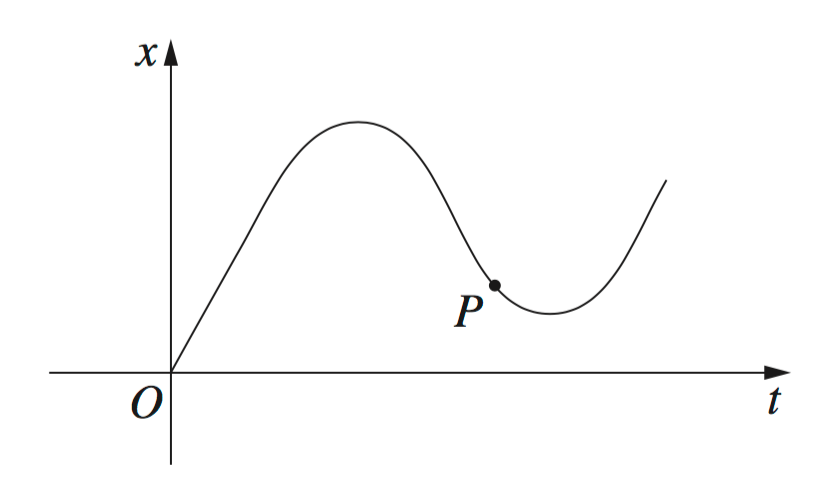
The take-off point `O` on a ski jump is located at the top of a downslope. The angle between the downslope and the horizontal is `pi/4`. A skier takes off from `O` with velocity `V` m s−1 at an angle `theta` to the horizontal, where `0 <= theta < pi/2`. The skier lands on the downslope at some point `P`, a distance `D` metres from `O`.
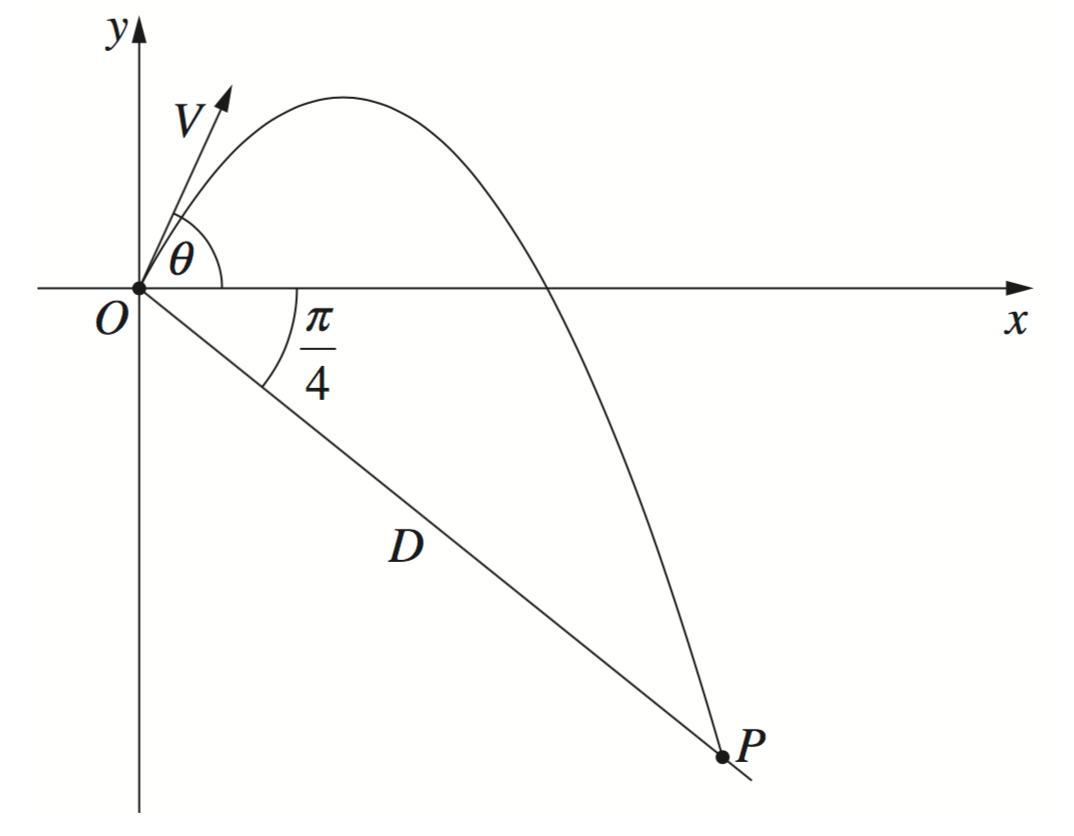
The flight path of the skier is given by
`x = Vtcos theta,\ y = -1/2 g t^2 + Vt sin theta`, (Do NOT prove this.)
where `t` is the time in seconds after take-off.
- Show that the cartesian equation of the flight path of the skier is given by
`y = x tan theta - (gx^2)/(2V^2) sec^2 theta`. (2 marks)
--- 5 WORK AREA LINES (style=lined) ---
- Show that
`D = 2 sqrt 2 (V^2)/(g) cos theta (cos theta + sin theta)`. (3 marks)
--- 8 WORK AREA LINES (style=lined) ---
- Show that
`(dD)/(d theta) = 2 sqrt 2 (V^2)/(g) (cos 2 theta - sin 2 theta)`. (2 marks)
--- 4 WORK AREA LINES (style=lined) ---
- Show that `D` has a maximum value and find the value of `theta` for which this occurs. (3 marks)
--- 9 WORK AREA LINES (style=lined) ---