The diagram represents a field.

What is the area of the field, using two applications of Simpson’s rule?
(A) `\ 99\ text(m²)`
(B) `126\ text(m²)`
(C) `198\ text(m²)`
(D) `396\ text(m²)`
Aussie Maths & Science Teachers: Save your time with SmarterEd
The diagram represents a field.
What is the area of the field, using two applications of Simpson’s rule?
(A) `\ 99\ text(m²)`
(B) `126\ text(m²)`
(C) `198\ text(m²)`
(D) `396\ text(m²)`
Which of the following expresses `(6x^2y)/3-:(2y)/5` in its simplest form?
The sets of data, `X` and `Y`, are displayed in the histograms.

Which of these statements is true?
In which graph would the data have a correlation coefficient closest to – 0.9?

Perth in Western Australia is 8 hours ahead of Coordinated Universal Time (UTC). Cape Town in South Africa is 2 hours ahead of UTC.
What is the time in Cape Town when it is 1 pm in Perth?
Which of the following could be the probability of an event occurring?
A bag contains red, green, yellow and blue balls.
\begin{array} {|c|c|}
\hline
\rule{0pt}{2.5ex} \textit{Colour} \rule[-1ex]{0pt}{0pt} & \textit{Probability} \\
\hline
\rule{0pt}{2.5ex} \text{Red} & \dfrac{1}{3} \\
\hline
\rule{0pt}{2.5ex} \text{Green} & \dfrac{1}{4} \\
\hline
\rule{0pt}{2.5ex} \text{Yellow} & \text{?} \\
\hline
\rule{0pt}{2.5ex} \text{Blue} & \dfrac{1}{6} \\
\hline
\end{array}
The table shows the probability of choosing a red, green, or blue ball from the bag.
If there are 12 yellow balls in the bag, how many balls are in the bag altogether
Minjy invests $2000 for 1 year and 5 months. The simple interest is calculated at a rate of 6% per annum.
What is the total value of the investment at the end of this period?
Which of the following frequency histograms shows data that could be normally distributed?


A field diagram has been drawn from an offset survey.

What is the distance from `G` to `H` correct to the nearest metre?
Bhawana purchases pool chlorine in a new container which holds 35 kg.

She begins using this new container on the first day of a week.
How many full weeks should this container last? (2 marks)
--- 4 WORK AREA LINES (style=lined) ---
The dot plot shows the number of push-ups that 13 members of a fitness class can do in one minute.

--- 1 WORK AREA LINES (style=lined) ---
Does the addition of this new member to the class change the probability calculated in part (a)? Justify your answer. (1 mark)
--- 2 WORK AREA LINES (style=lined) ---
Greg needs to conduct a statistical inquiry into how much time people aged 18–25 years have spent accessing social media websites in the last two weeks. He has decided to survey a sample of students from his university.
The process of statistical inquiry includes the following steps, which are NOT in order.

--- 4 WORK AREA LINES (style=lined) ---
At which step in the process would he have drawn this graph? (1 mark)

--- 2 WORK AREA LINES (style=lined) ---
Which of the following correctly expresses `c` as the subject of `E = mc^2 + p` ?
Town `B` is 80 km due north of Town `A` and 59 km from Town `C`.
Town `A` is 31 km from Town `C`.
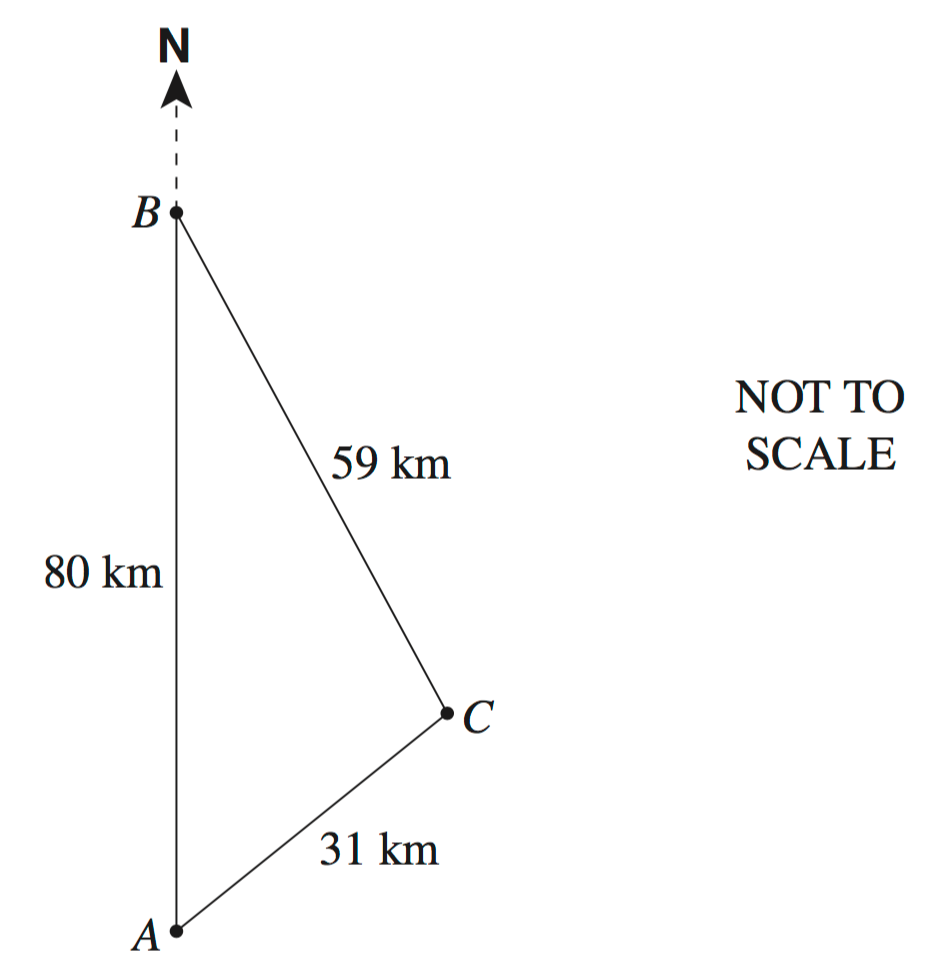
What is the bearing of Town `C` from Town `B`?
Jo qualifies for both Rent Assistance and Youth Allowance and receives a fortnightly payment from the government.
Rent Assistance is $119.40 per fortnight.
The maximum Youth Allowance is $402.70 per fortnight. It is reduced by 50 cents in the dollar for any income earned over $236 per fortnight.
Jo earns $300 per fortnight from a part-time job.
What is the total payment Jo receives each fortnight from the government?
A machine was bought for $25 000.
Which graph best represents the salvage value of the machine over 10 years using the declining balance method of depreciation?
| A. |  |
B. |  |
|
| C. |  |
D. |  |
A car takes 6 hours to complete a journey when travelling at 60 km/h.
How long would the same journey take if the car were travelling at 100 km/h?
Which of the following expresses `2x^2 (5- x)-x(x-2)` in its simplest form?
(A) `–2x^3 + 9x^2 + 2x`
(B) `–2x^3- 9x^2- 2x `
(C) `9x^2- x + 2`
(D) `9x^2- x- 2`
A $400 000 loan can be repaid by making either monthly or fortnightly repayments.
The graph shows the loan balances over time using these two different methods of repayment.

The monthly repayment is $2796.86 and the fortnightly repayment is $1404.76.
What is the difference in the total interest paid using the two different methods of
repayment, to the nearest dollar?

What is the area of this triangle, to the nearest square metre?
Dots were used to create a pattern. The first three shapes in the pattern are shown.

The number of dots used in each shape is recorded in the table.
\begin{array} {|l|c|}
\hline
\rule{0pt}{2.5ex} \text{Shape $(S)$} \rule[-1ex]{0pt}{0pt} &\;\;\; 1 \;\;\; & \;\; \;2 \;\;\; & \;\;\; 3 \;\;\; \\
\hline
\rule{0pt}{2.5ex} \text{Number of dots $(N)$} \rule[-1ex]{0pt}{0pt} &\;\;\; 6 \;\;\; & \;\; \;8 \;\;\; & \;\; \;10\; \;\; \\
\hline
\end{array}
How many dots would be required for Shape 156?
The Pi Company has two bakeries. The radar chart displays the monthly sales for the bakeries.

What was the difference in sales in June between the two bakeries?
What is the volume of this rectangular prism in cubic centimetres?

The angle of depression from a kookaburra’s feet to a worm on the ground is 40°. The worm is 15 metres from a point on the ground directly below the kookaburra’s feet.

How high above the ground are the kookaburra's feet, correct to the nearest metre?
Which expression could be used to calculate the value of `x` in this triangle?

A set of 15 scores is displayed in a stem-and-leaf plot.

What is the median of these scores?
A logo is designed using half of an annulus.

What is the area of the logo, to the nearest cm²?
The shaded region shows a quadrant with a rectangle removed.

What is the area of the shaded region, to the nearest cm2?
The frequency histogram shows the number of goals scored by a football team in each game in a season.

What is the mean number of goals scored per game by this team?
The July sales prices for properties in a suburb were:
$552 000, $595 000, $607 000, $607 000, $682 000, and $685 000.
On 1 August, another property in the same suburb was sold for over one million dollars.
If the property had been sold in July, what effect would it have had on the mean and median sale prices for July?
Polly borrowed $11 000. She repaid the loan in full at the end of two years with a lump sum of $12 000.
What annual simple interest rate was she charged?
A square pyramid fits exactly on top of a cube to form a solid.

What is the volume of the solid?
Students studying vocational education courses were surveyed about their living arrangements.

One of these students is selected at random.
What is the probability that this student is male and living with his parent(s)?
Lynne invests $1000 for a term of 15 months. Simple interest is paid on the investment at a rate of 3.75% per annum.
How much will Lynne's investment be worth at the end of the term?
A survey was conducted where people were asked which of two brands of smartphones they preferred. The results were:
A graph displaying the data is to be included in a magazine article. The editor of the magazine wishes to ensure that the graph is not misleading in any way.
Which graph should the editor choose to include in the article?


Which of the following is `(12T^2)/(3Txx2W)` in its simplest form?
Luke's normal rate of pay is $24.80 per hour. In one week he worked 14 hours at the normal rate, 4 hours at time-and-a-half, and 3 .5 hours at double time. He was also paid a wet weather allowance of $50 for the week.
What was his pay for the week?
Which graph best shows data with a correlation closest to 0.3?


Which of the following events would be LEAST likely to occur?
The quadratic equation `x^2-6x+2=0` has roots `alpha` and `beta`.
Find the coordinates of the focus of the parabola `x^2=16(y-2)`. (2 marks)
A parabola has focus `(5,0)` and directrix `x=1`.
What is the equation of the parabola?
(A) `y^2=16(x-5)`
(B) `y^2=8(x-3)`
(C) `y^2=-16(x-5)`
(D) `y^2=-8(x-3)`

`y^2=4ax`
`text{Focal length}=a=(5-1)/2=2`
`text(Vertex)=(3,0)`
| `:.\ y^2` | `=4xx2(x-3)` |
| `=8(x-3)` |
`=>B`

The diagram shows two parallel brick walls `KJ` and `MN` joined by a fence from `J` to `M`. The wall `KJ` is `s` metres long and `/_KJM=alpha`. The fence `JM` is `l` metres long.
A new fence is to be built from `K` to a point `P` somewhere on `MN`. The new fence `KP` will cross the original fence `JM` at `O`.
Let `OJ=x` metres, where `0<x<l`.
--- 6 WORK AREA LINES (style=lined) ---
--- 6 WORK AREA LINES (style=lined) ---
--- 2 WORK AREA LINES (style=lined) ---
| a. |  |
`A=text(Area)\ Delta OJK+text(Area)\ Delta OMP`
`text(Using sine rule)`
`text(Area)\ Delta OJK=1/2\ x s sin alpha`
`text(Area)\ DeltaOMP =>text(Need to find)\ \ MP`
| `/_OKJ` | `=/_MPO\ \ text{(alternate angles,}\ MP\ text(||)\ KJtext{)}` |
| `/_PMO` | `=/_OJK=alpha\ \ text{(alternate angles,}\ MP\ text(||)\ KJtext{)}` |
`:.\ DeltaOJK\ text(|||)\ Delta OMP\ \ text{(equiangular)}`
| `=>x/s` | `=(l-x)/(MP)\ ` | ` text{(corresponding sides of similar triangles)}` |
| `MP` | `=(l-x)/x *s` |
| `text(Area)\ Delta\ OMP` | `=1/2 (l-x)* MP * sin alpha` |
| `=1/2 (l-x)*((l-x))/x* s sin alpha` |
| `:. A` | `=1/2 x*s sin alpha+1/2 (l-x)*((l-x))/x* s sin alpha` |
| `=s sin alpha(1/2 x+1/2 (l-x)*((l-x))/x)` | |
| `=s sin alpha(1/2 x+(l-x)^2/(2x))` | |
| `=s sin alpha(1/2 x+l^2/(2x)-l+1/2 x)` | |
| `=s(x-l+l^2/(2x))sin alpha\ \ \ \ text(… as required)` |
b. `text(Find)\ x\ text(such that)\ A\ text(is a minimum)`
| `A` | `=s(x-l+l^2/(2x))sin alpha` |
| `(dA)/(dx)` | `=s(1-l^2/(2x^2))sin alpha` |
`text(MAX/MIN when)\ (dA)/(dx)=0`
| `s(1-l^2/(2x^2))sin alpha` | `=0` |
| `l^2/(2x^2)` | `=1` |
| `2x^2` | `=l^2` |
| `x^2` | `=l^2/2` |
| `x` | `=l/sqrt2,\ \ \ x>0` |
`(d^2A)/(dx^2)=s((l^2)/(2x^3))sin alpha`
`text(S)text(ince)\ \ 0<alpha<90°\ \ =>\ sin alpha>0,\ \ l>0\ \ text(and)\ \ x>0`
`(d^2A)/(dx^2)>0\ \ \ =>text(MIN at)\ \ x=l/sqrt2`
c. `text(S)text(ince)\ \ MP=((l-x))/x s\ \ text(and MIN when)\ \ x=l/sqrt2`
| `MP` | `=((l-l/sqrt2)/(l/sqrt2))s xx sqrt2/sqrt2` |
| `=((sqrt2 l-l))/l s` | |
| `=(sqrt2-1)s\ \ text(metres)` |
`:.\ MP=(sqrt2-1)s\ \ text(metres when)\ A\ text(is a MIN.)`
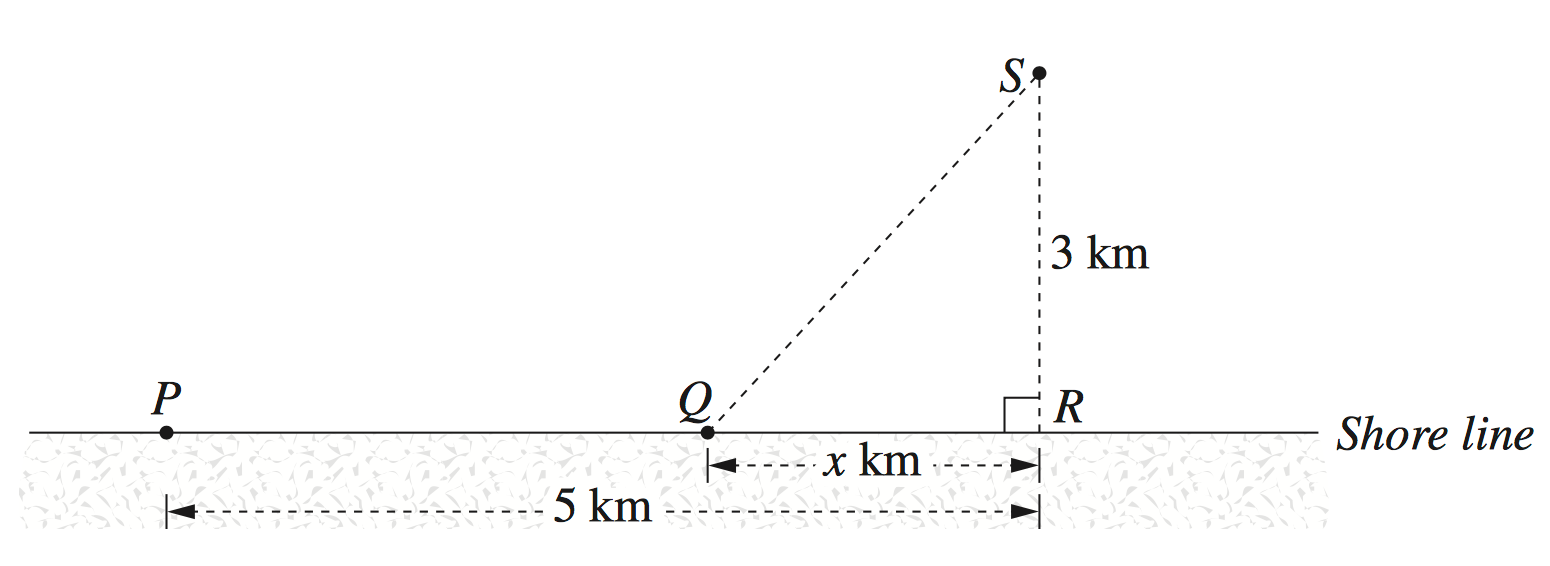
An oil rig, `S`, is 3 km offshore. A power station, `P`, is on the shore. A cable is to be laid from `P` to `S`. It costs $1000 per kilometre to lay the cable along the shore and $2600 per kilometre to lay the cable underwater from the shore to `S`.
The point `R` is the point on the shore closest to `S`, and the distance `PR` is 5 km.
The point `Q` is on the shore, at a distance of `x` km from `R`, as shown in the diagram.
--- 2 WORK AREA LINES (style=lined) ---
--- 2 WORK AREA LINES (style=lined) ---
--- 5 WORK AREA LINES (style=lined) ---
--- 8 WORK AREA LINES (style=lined) ---
Determine the path for laying the cable in order to minimise the cost in this case. (2 marks)
--- 5 WORK AREA LINES (style=lined) ---
A rainwater tank is to be designed in the shape of a cylinder with radius `r` metres and height `h` metres.

The volume of the tank is to be 10 cubic metres. Let `A` be the surface area of the tank, including its top and base, in square metres.
--- 4 WORK AREA LINES (style=lined) ---
--- 6 WORK AREA LINES (style=lined) ---
A farmer is fencing a paddock using `P` metres of fencing. The paddock is to be in the shape of a sector of a circle with radius `r` and sector angle `theta` in radians, as shown in the diagram.

--- 2 WORK AREA LINES (style=lined) ---
--- 2 WORK AREA LINES (style=lined) ---
--- 4 WORK AREA LINES (style=lined) ---
--- 2 WORK AREA LINES (style=lined) ---
--- 5 WORK AREA LINES (style=lined) ---
Two points, `A` and `B`, are on cliff tops on either side of a deep valley. Let `h` and `R` be the vertical and horizontal distances between `A` and `B` as shown in the diagram. The angle of elevation of `B` from `A` is `theta`, so that `theta=tan^-1(h/R)`.

At time `t=0`, projectiles are fired simultaneously from `A` and `B`. The projectile from `A` is aimed at `B`, and has initial speed `U` at an angle of `theta` above the horizontal. The projectile from `B` is aimed at `A` and has initial speed `V` at an angle `theta` below the horizontal.
The equations of motion for the projectile from `A` are
`x_1=Utcos theta` and `y_1=Utsin theta-1/2 g t^2`,
and the equations for the motion of the projectile from `B` are
`x_2=R-Vtcos theta` and `y_2=h-Vtsin theta-1/2 g t^2`, (DO NOT prove these equations.)
--- 3 WORK AREA LINES (style=lined) ---
--- 6 WORK AREA LINES (style=lined) ---
--- 6 WORK AREA LINES (style=lined) ---
Points `A` and `B` are located `d` metres apart on a horizontal plane. A projectile is fired from `A` towards `B` with initial velocity `u` m/s at angle `alpha` to the horizontal.
At the same time, another projectile is fired from `B` towards `A` with initial velocity `w` m/s at angle `beta` to the horizontal, as shown on the diagram.
The projectiles collide when they both reach their maximum height.

The equations of motion of a projectile fired from the origin with initial velocity `V` m/s at angle `theta` to the horizontal are
`x=Vtcostheta` and `y=Vtsintheta-g/2 t^2`. (DO NOT prove this.)
--- 5 WORK AREA LINES (style=lined) ---
--- 3 WORK AREA LINES (style=lined) ---
--- 8 WORK AREA LINES (style=lined) ---
The graph shows the velocity of a particle, `v` metres per second, as a function of time, `t` seconds.
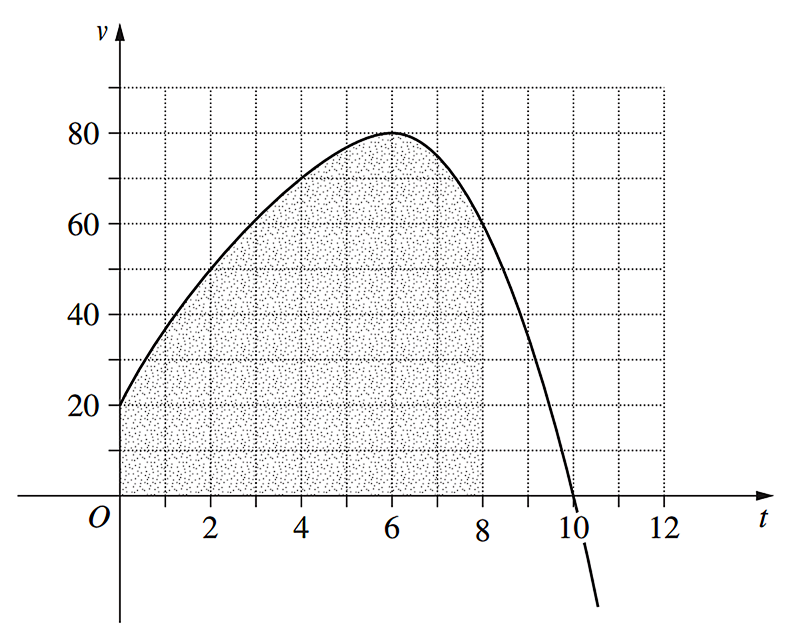
(i) `text(Find)\ v \ text(when) t=0`
`v=20\ \ text(m/s)`
(ii) `text(Particle comes to rest at)\ t=10\ text{seconds (from graph)}`
(iii) `text(Acceleration is zero when)\ t=6\ text{seconds (from graph)}`
| (iv) |  |
| `text(Area)` | `~~h/3[y_0+y_n+4text{(odds)}+2text{(evens)}]` |
| `~~h/3[y_0+y_4+4(y_1+y_3)+2(y_2)]` | |
| `~~2/3[20+60+4(50+80)+2(70)]` | |
| `~~2/3[740]` | |
| `~~493 1/3` |
`:.\ text{Distance travelled is 493 1/3 m (approx.)}`
The acceleration of a particle is given by
`a=8e^(-2t)+3e^(-t)`,
where `x` is the displacement in metres and `t` is the time in seconds.
Initially its velocity is `-6\ text(ms)^(-1)` and its displacement is 5 m.
--- 5 WORK AREA LINES (style=lined) ---
--- 7 WORK AREA LINES (style=lined) ---
--- 3 WORK AREA LINES (style=lined) ---
The acceleration of a particle is given by
`ddotx=4cos2t`,
where `x` is the displacement in metres and `t` is the time in seconds.
Initially the particle is at the origin with a velocity of `text(1 ms)^(–1)`.
`dotx=2sin2t+1`. (2 marks)
--- 5 WORK AREA LINES (style=lined) ---
--- 4 WORK AREA LINES (style=lined) ---
--- 4 WORK AREA LINES (style=lined) ---
The velocity of a particle is given by
`v=1-2cost`,
where `x` is the displacement in metres and `t` is the time in seconds. Initially the particle is 3 m to the right of the origin.
--- 1 WORK AREA LINES (style=lined) ---
--- 1 WORK AREA LINES (style=lined) ---
--- 4 WORK AREA LINES (style=lined) ---
--- 4 WORK AREA LINES (style=lined) ---
The mass `M` of a whale is modelled by
`M=36-35.5e^(-kt)`
where `M` is measured in tonnes, `t` is the age of the whale in years and `k` is a positive constant.
--- 2 WORK AREA LINES (style=lined) ---
Find the value of `k`, correct to three decimal places. (2 marks)
--- 8 WORK AREA LINES (style=lined) ---
--- 3 WORK AREA LINES (style=lined) ---
To test some forensic science students, an object has been left in the park. At 10am the temperature of the object is measured to be 30°C. The temperature in the park is a constant 22°C. The object is moved immediately to a room where the temperature is a constant 5°C.
The temperature of the object in the room can be modelled by the equation
`T=5+25e^(-kt)`,
where `T` is the temperature of the object in degrees Celcius, `t` is the time in hours since the object was placed in the room and `k` is a constant.
After one hour in the room the temperature of the object is 20°C.
--- 6 WORK AREA LINES (style=lined) ---
Find the time of day when the object had a temperature of 37°C. (3 marks)
--- 8 WORK AREA LINES (style=lined) ---
Light intensity is measured in lux. The light intensity at the surface of a lake is 6000 lux. The light intensity, `I` lux, a distance `s` metres below the surface of the lake is given by
`I=Ae^(-ks)`
where `A`, and `k` are constants.
--- 2 WORK AREA LINES (style=lined) ---
--- 6 WORK AREA LINES (style=lined) ---
--- 6 WORK AREA LINES (style=lined) ---
Radium decays at a rate proportional to the amount of radium present. That is, if `Q(t)` is the amount of radium present at time `t`, then `Q=Ae^(-kt)`, where `k` is a positive constant and `A` is the amount present at `t=0`. It takes 1600 years for an amount of radium to reduce by half.
--- 6 WORK AREA LINES (style=lined) ---
How many years will it be before the amount of radium reaches the safe level. (2 marks)
--- 6 WORK AREA LINES (style=lined) ---
Assume that the population, `P`, of cane toads in Australia has been growing at a rate proportional to `P`. That is, `(dP)/(dt)=kP` where `k` is a positive constant.
There were 102 cane toads brought to Australia from Hawaii in 1935.
Seventy-five years later, in 2010, it is estimated that there are 200 million cane toads in Australia.
If the population continues to grow at this rate, how many cane toads will there be in Australia in 2035? (4 marks)
--- 8 WORK AREA LINES (style=lined) ---
The intensity, `I`, measured in watt/m2, of a sound is given by
`I=10^-12xxe^(0.1L)`,
where `L` is the loudness of the sound in decibels.
--- 2 WORK AREA LINES (style=lined) ---
What is the maximum loudness of a sound so that no ear damage occurs? (2 marks)
--- 6 WORK AREA LINES (style=lined) ---
--- 5 WORK AREA LINES (style=lined) ---
Professor Smith has a colony of bacteria. Initially there are 1000 bacteria. The number of bacteria, `N(t)`, after `t` minutes is given by
`N(t)=1000e^(kt)`.
Show that `k=0.0347` correct to four decimal places. (1 mark)
--- 4 WORK AREA LINES (style=lined) ---
--- 2 WORK AREA LINES (style=lined) ---
--- 5 WORK AREA LINES (style=lined) ---
--- 7 WORK AREA LINES (style=lined) ---